Enhance Your Ice Fishing Experience
Ice fishing is a unique and exhilarating activity that requires a combination of skill, patience, and the right equipment. While many anglers are accustomed to traditional techniques, incorporating modern technology like fish finders and electronics can significantly enhance your success on the ice.
In this article, we’ll delve into how and why you should utilize fish finders, and electronics while ice fishing.

MAXIMIZE EFFICIENCY
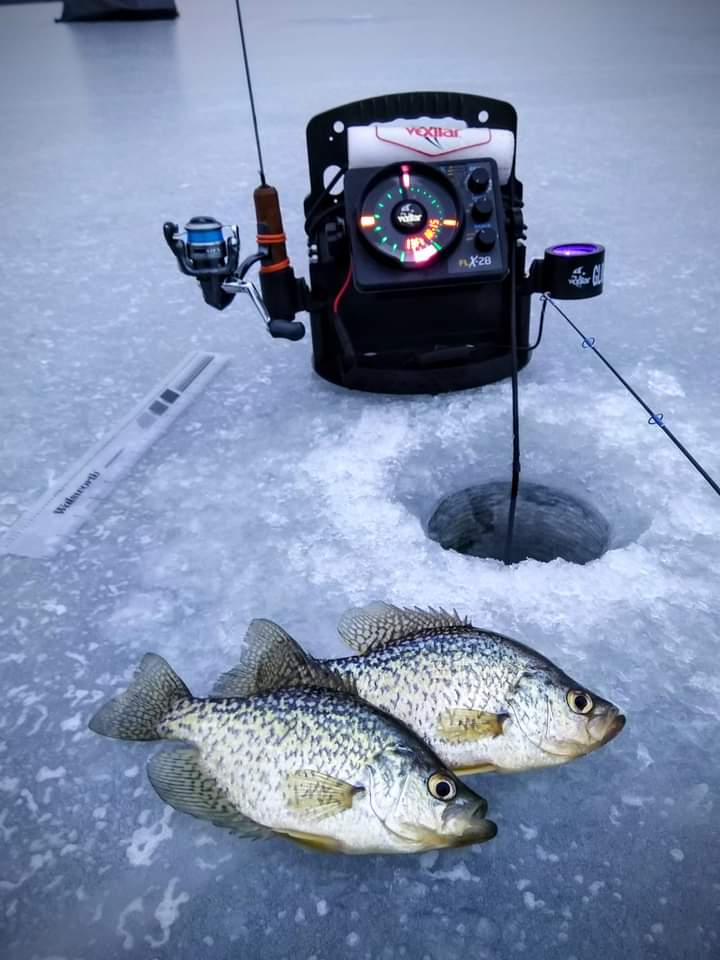
Ice fishing often involves drilling many holes in the ice and patiently waiting for a bite. However, with a fish finder, you locate fish faster and more accurately. These devices use sonar technology to send out sound waves, which bounce off objects in the water and return to the transducer, providing a visual representation of the underwater terrain and fish. This allows you to identify the most promising spots quickly, saving you time and energy.
UNDERSTANDING UNDERWATER TOPOGRAPHY
Fish finders not only reveal the presence of fish but also help you understand the underwater topography. They can detect depth changes, underwater structures, and vegetation, which are crucial factors in determining where fish are likely to congregate. Armed with this information, you can strategically position yourself for a successful ice fishing season.
ACCURATE DEPTH READINGS
One of the most significant advantages of using fish finders is their ability to provide accurate depth readings. This is crucial for ice fishing, as different species prefer different depths. By knowing the exact depth of water, you can adjust your bait and technique accordingly, increasing your chances of more catches.
LOCATING SCHOOLS OF FISH
Fish finders excel at finding schools of fish and of course that lonely straggler. Instead of relying on guesswork or trial and error, you can pinpoint where the fish are congregating. This allows you to make precise adjustments to your bait and presentation to entice more bites.
MONITORING FISH ACTIVITY
Most fish finders are equipped to allow you to monitor fish activity in real-time. Real-time means there's no delay in the transfer from the transducer to the screen, so when the fish or lure moves you can see it move accurately. These devices can display fish movements, indicating whether they are actively feeding or just passing through. This invaluable information helps you adapt your strategy on the fly, ensuring a more productive outing.
STAYING SAFE ON THE ICE
Apart from enhancing your fishing success, fish finders also contribute to safety on the ice. Not only do they read and provide accurate depth information, but some units with GPS can also have up-to-date warnings for hazard areas, thin ice, closed boat launches, etc. while using lake map cards. This knowledge is especially crucial during early and late seasons when ice conditions can be unpredictable.
IMPROVING YOUR OVERALL FISHING EXPERIENCE
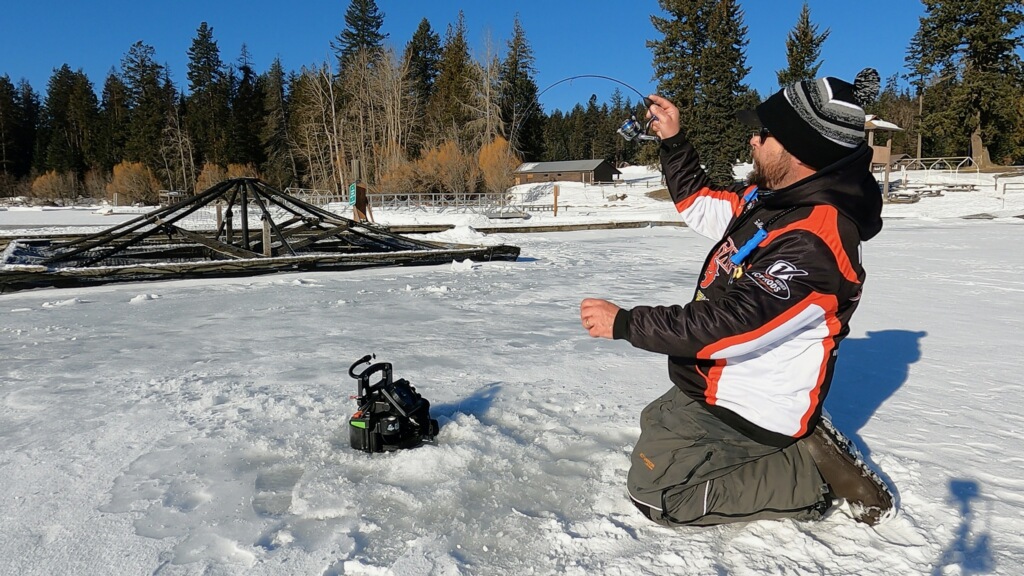
Incorporating electronics like a GPS unit, or an underwater camera alongside a fish finder flasher can further amplify your ice fishing experience. GPS is a nice option in some units, allowing you to mark productive spots for future reference, or a unit that is usable from the boat to the ice. Underwater cameras offer a fascinating glimpse into the underwater world, helping you understand fish behavior and habitat. This can also help you fine-tune your approach each time you chase fish under the ice.
Embracing fish finders and electronics in your ice fishing endeavors is a game changer. By providing valuable insights into the underwater terrain, fish behavior, and safety conditions, these tools significantly increase your chances of a successful and enjoyable ice fishing experience. So, equip yourself with the right gear and technology, venture out to the frozen lakes, and let the fish finding begin!
/articles/enhance-your-ice-fishing-experience
My Favorite Fall Coho Techniques
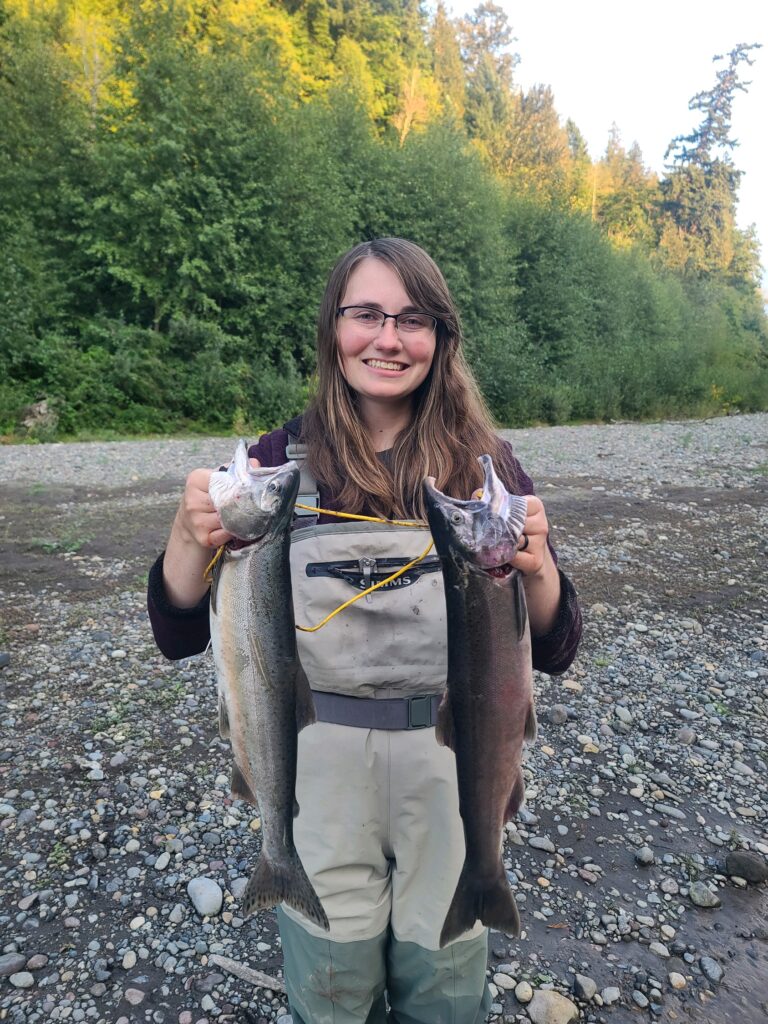
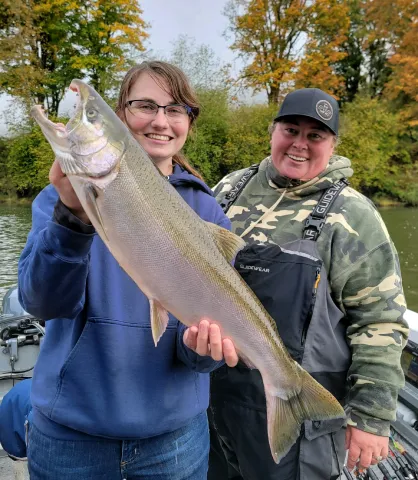
Even though the end of the year is approaching, don’t put away your salmon fishing gear just yet. There are still plenty of rivers teeming with coho salmon right now! These days, there are many different techniques you can use to catch fish on any river. Versatility is important, and river conditions change day by day. I recently went on a guided trip with Brianna Bruce of Livin’ Life Adventures. When we got to our spot, she told us that we would each be fishing a different method. The fish had been hitting different things every day. One day, they only wanted spinners. Another day, they wanted spoons. She began distributing rods- one of us fishing plugs, the other spinners, and so on until we were all casting and hoping to get lucky.
After about 20 minutes of this, another guide motored by on the way back to the launch with their limits. He told Bree that he had gotten all of his fish on eggs! She quickly began switching all of our rods to egg setups. Another hour later, we were back at the boat ramp with huge smiles and limits of dime-bright coho. If she hadn’t brought eggs along, we may have all ended up skunked! Versatility is crucial! Most days when I go river fishing, I carry 3 rods: a twitching rod, a float rod, and a spinner rod. I spent a lot of time getting familiar with each technique and when and how to deploy them. Let’s dive into how and why I use these techniques.
Technique 1: Twitching Jigs
If I had to pick one way to fish for coho, I would have to go with twitching jigs. They are extremely adaptable- I can fish any type of water with a twitching jig. There’s something so satisfying about seeing a big fish dart out of cover to grab your jig. Make sure to vary your jigging speed and length depending on the structure, depth, and speed of the water. Some days, you can let the jig sink to the bottom of a deep hole before you start jigging. Other times, you’ll want to do short jigs as soon as your lure hits the water. There’s no one way to twitch a jig. Color matters! I’ve had days where I fished one color for 30 minutes with no luck, and then hooked a fish on the first cast after switching colors. Most of the time, I use a 3/8 or 1/2 oz jig. My favorite colors are blue/black and pink/green. My twitching rod is a stout 7’6 rod with fast action. It has an extremely sensitive tip so I can feel those subtle bites, and the backbone to back up my hook sets. I pair it up with a size 3000 spinning reel. I use light reels to help avoid wrist fatigue. You can twitch jigs with longer, heavier rods, but I like my 7’6 rod because it translates even the smallest flicks of my wrist to the jig. I never hit the river without my twitching rod! There is a bit of a learning curve, as most fish will pick up your jig on the drop. You might feel the line tighten, or you may feel nothing at all. Most fish won’t simply grab the jig and take off. The majority of bites are subtle. Watch your line and pay attention to how it moves. It pays to fish high visibility braid so you can see exactly where your line is and what it’s doing in the water. Give twitching jigs a try, you’ll be hooked!
Technique 2: Spinner Rods
If I can’t get a fish to bite on twitching jigs, I’ll switch to my spinner rod. This is my 9ft, fast-action, moderate power rod, rated to throw up to an ounce of lead. It has the springiness to be able to launch spinners across long rivers, but the backbone to bring a monster coho to the shore. I often start off beginner river fishermen with spinners because bites are hard to miss. There are two types of spinners, and they both fish differently. Heavy-bodied spinners sink right away and can be cast perpendicular to the opposite shore. Light-bodied or unweighted spinners don’t sink as quickly and are better for shallow rivers. You can cast them out and swing them into the current like a spoon. Keep your rod tip low and reel slowly. Make sure to do 1 or 2 solid hook sets to really drive that barbless hook into the fish’s mouth. In murky water like the Carbon or Puyallup River, I’ll go with a bright-colored spinner, like chartreuse or pink. On clear, coastal rivers, I’ll fish a silver or copper-colored spinner. It never hurts to try something different, though! Don’t forget to pinch your barbs and switch out the treble hook to a single hook if required.
Technique 3: Floating Eggs
My third go-to technique for fall coho fishing is floating eggs. This technique isn’t very well suited for combat fishing, but if you can find a patch of slow-moving water all to yourself, this is a great way to get finicky coho to bite. Floating eggs is a relaxing way to spend the day. You tend to lose a lot less gear, and watching your bobber is therapeutic. You’ll want a 10ft to 11ft rod and 3000/4000 size spinning reel. Don’t use gear you don’t mind getting egg dye on! You can either use store-bought eggs or experiment with curing your own. I usually bring along 2 or 3 different recipes when I fish eggs. Sometimes the fish want pink eggs, other days they like red. You can experiment with adding different scents to your eggs, like tuna or herring. No matter how good your eggs are, you want to make sure you’re fishing them correctly, however. Experiment with your leader length by moving your bobber stopper until you’re hitting the bottom. Then, move it up 6 to 12 inches. That’s where the fish will see it, and, hopefully, bite it. Don’t forget to mend your line by lifting it up off the water and behind your float. This is where a long rod can come in handy, but it can make it difficult to fish in water with lots of overhanging trees and bushes. Float fishing is a highly situational technique, but it can be very deadly.

There you have my top three favorite fall coho techniques. When getting to my spot, I like to sit and watch the water for a few minutes to determine which technique to use. Floating eggs isn’t always possible if the river is flowing quickly. Similarly, when I’m fishing frog water, using a spinner can be difficult. The deep and slow water makes it difficult to reach the fish hugging the bottom. I find that it’s extremely important to be able to adapt to any condition. However, there are days when I want to challenge myself or get better at a technique and I’ll only bring out one pole. This is how I taught myself to be able to use twitching jigs in any situation. If you haven’t tried any of these techniques, hit the water and give it a shot. Make sure to read your rules and regulations, especially emergency ones. Hope to see you all out there!
/articles/my-favorite-fall-coho-techniques
Fiberglass Rods
These fly rods party like it's 1971
I skipped school on a May morning to fish with my uncle Jon and his bride. That was 1985. You might say they were a bad influence on a teenager, but if I had it to do over again, I'd skip my whole senior year and go steelhead fishing. Wouldn't you?
I took two rods to the lake and when, at the end of the day, I put the gear away, I realized I had left the fly rod leaning against a tree. Someone else ended up with my 7-weight Wallace fiberglass and a Pflueger Medalist.
That Wallace rod was equal to or superior to the more popular Fenwicks of the day and looked like a Fenwick, except in a medium brown color.
That was 1985 and my next fly rod was a custom 5-weight graphite my uncle built. In the 1980s, graphite rods were lighter and a bit more responsive, but there were qualities glass rods had the graphite rods lacked.
Summers back
A couple of summers back, I floated the Williamson with Craig Schuhmann and our friend Larry Zeilstra. I brought a custom 5-weight McFarland fiberglass built by Uncle Jon. Before I had even wedged my knees into the casting brace of Craig Schumann's sweet Clackacraft, he was ribbing me about bringing an "old" fiberglass rod on a serious big trout trip. I pointed out this fiberglass rod was more modern than his attitude as well as the graphite rod he was fishing; also, his boat was made out of fiberglass.
I try to keep a small stable of fly rods, seven or eight in rotation. If I'm not using a rod, I give it to a kid. Over the last couple of years, I've given half a dozen rods to teenagers. Fly rods don't do anyone any good unless they are fishing.
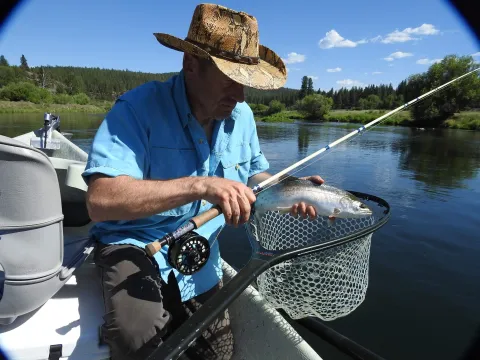
Truth be told, I own two fiberglass fly rods. The other one is an 8-1/2-foot tobacco-brown Wright & McGill 3-A Champion I bummed off a friend for zero dollars. I gave the same amount of no money for the reel and bought a new Cortland floating line off eBay for $13. Thirteen bucks. That's all the money I have into this rig. It parties like it's 1971. Whenever a new acquaintance talks me into taking them fishing and they want to use one of my rods, they get the old-school glass. You want me to take you fishing? You want to use one of my thousand-dollar graphite rods because you're too cheap to buy your own? Nope. You get the Wright & McGill treatment. You don't even get to touch my Orvis magic wand Helios, the Cabela's Rogue rod, or my custom-antlered mule deer Loomis IMX.
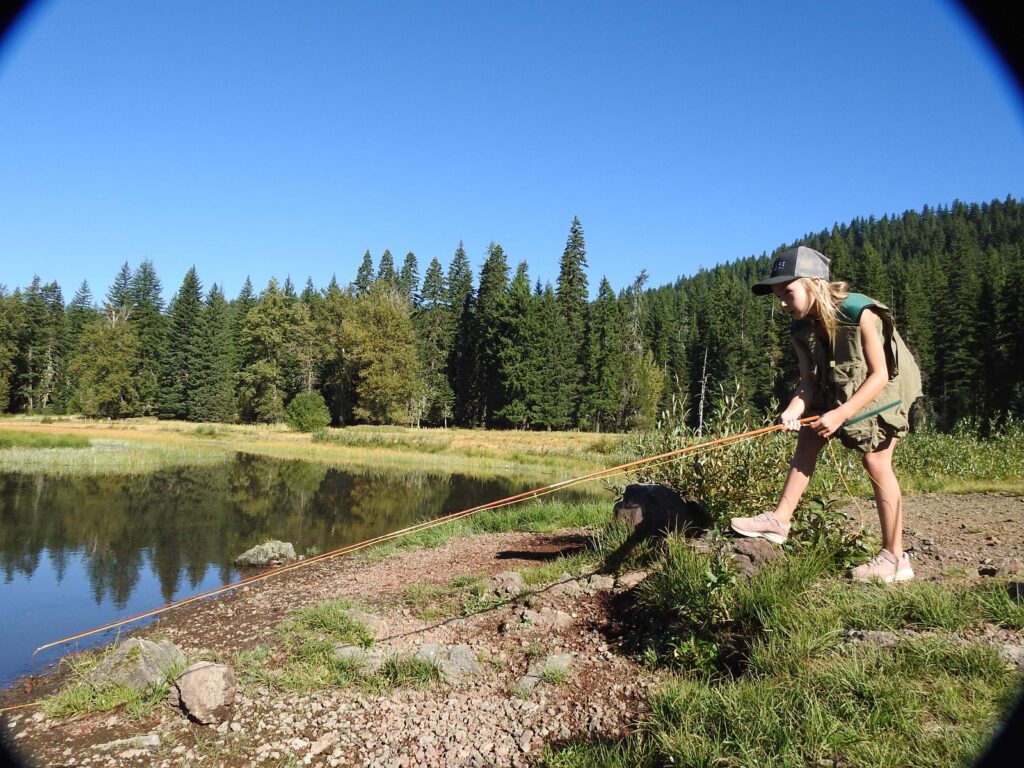
Using a 7-weight Wright & McGill, seven-year-old Little Smokey fishes a wet fly to small brook trout in the Cascades.
This Wright & McGill has bested a boatload of rainbows in the last few years in the hands of grandchildren and other mooches. I even fish it from time to time. It's a pretty good rod, and rugged too.
Glass rods are heavier, which is not a disadvantage. My granddaughter who is 8-years-old has never complained, Grandpa, this rod is too heavy! The heft of a glass rod, along with its to-the-cork action, allows the angler to sense the weight of the line as it shoots through the guides. Weight and slower action tend to slow the casting stroke, which contributes to faster casting competency for a novice.
Advantage
Another advantage is the forgiving nature of glass. Opt for a glass rod when fishing still waters where trout will be girthier. With a fiberglass rod in hand, the rod absorbs hard strikes better than graphite, which translates to fewer fish lost to broken tippets.
Fiberglass is durable too, which means fewer broken tips. That's why, if you want to use my tackle, you get to fish my $13 wonder.
What my collection lacks is a bamboo option. I have owned and fished bamboo and know what I'm missing. Fiberglass rods rival bamboo for liveliness, power, and balance in hand.
If I had it to do over again, I would not lean that Wallace against that fir tree. If you picked up a medium-brown 7-weight at Battleground Lake in the spring of '85, you got a nice rod. I hope you fished it hard.
# # #
For a copy of the Fishing Central Oregon book, send $29.99 to Gary Lewis Outdoors, PO Box 1364, Bend, OR 97709 To contact Gary Lewis, visit www.GaryLewisOutdoors.com
/articles/fiberglass-rods
Ice Fishing Season is Coming
I’ve been watching Ice Cold Catch on TV lately. For those of you who aren’t in the know, it’s a reality TV documentary series that follows two greenhorns as they learn the ins and outs of operating a commercial fishing boat in Iceland. It’s a week at sea in some of the harshest conditions imaginable, and then they return to the port and do it all over again. Some of the catches can yield multiple hundreds of thousands of dollars for the boat and $5,000 for crew members. Other times, they make fractions of that amount. It’s the embodiment of a hard way to make an easy living. Watching the boat and crew lay mile after mile of baited line to circle back, pull it up, and see what was caught is entertaining TV from the warmth of my living room. The blend of passion for the sea with the business acumen needed is something I think anyone who enjoys fishing and also works a “regular” job can appreciate. I don’t plan on heading 50 miles outside of the Icelandic coast to commercial fish for cod anytime soon, so I guess I’ll stick to something closer to home.

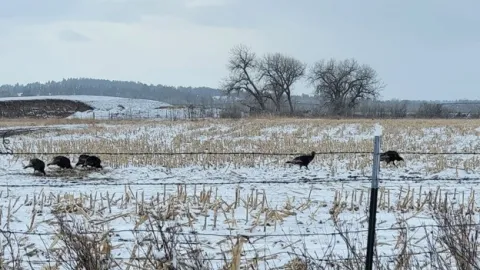
With the winter season approaching, many of us are stowing away the outboard engines on our boats and getting out the ice houses and augers. Maybe if you’re brave enough, and have invested in a decent winter jacket, all you’re checking to see is if you have your trusty plastic bucket to flip upside down as your seat when you jig away for what fish lay below. I’m referencing another way to get your fishing fix during the cold winter months - ice fishing. When the weather gets cold, many of us shift gears and turn our attention to hunting season. Big game, waterfowl, upland bird, or otherwise, it’s the thrill of being outdoors that does it for many of us. I’ve been known to pull off to the side of the road and look at a few turkeys walking around or admire an elk or two coming down from the mountains. For those interested in braving the elements but not quite ready for the physical exertion of hunting outdoors, ice fishing offers continued sporting opportunities. Whether fishing for perch, kokanee, walleye, or burbot, it never hurts to remind yourself of the respect needed on the ice when fishing these glorious winter months.
Gear matters
I joked about the winter coat, but seriously, having an insulated jacket does wonders on those days when the temperature is below freezing. What else might you need before hitting the ice? While a gaiter is always helpful, you’ll need a beanie at a minimum to keep your head warm. Some gloves and boots that are ideally waterproof with disposable hand warmers are a great idea. Ice picks are also a very smart accessory to have should disaster strike and you need to crawl out of the frigid water. They are every bit the equivalent of having life jackets and first aid kits on your boat: the classic “you’d rather have it and not need it than need it and not have it” item. One other item you might not think about but will be glad to have with you is a good pair of sunglasses. It might be December or January and 15 degrees outside, but on a clear day with the sun reflecting off the ice, it can be nearly blinding. The sunglasses/beanie combo is the personification of ice fishing in my mind. It’s a cool look, what can I say?

The gear on your body is important, but you want to make sure the gear you bring to set yourself up to fish is adequate and check that conditions are safe. It is generally advised that ice fishing should be done on ice that is at least 4 inches thick- the thicker the better, especially if you are considering heavy equipment like an ATV or snowmobile to travel to different parts of the lake. 7 inches is recommended when using an ATV. A ruler is an easy tool to measure the thickness of the ice. Another indicator that it is safe to fish is a visual inspection of the ice - it should be clear. Cloudy or cracked ice are indicators it may have been melting and refreezing and not as strong as it should be. After you’ve drilled your hole with an auger (or found an abandoned hole), a scoop is extremely helpful to clear ice out of your fishing hole and to prevent your line from freezing. Besides the obvious fishing pole and lure, the last item to consider bringing along would be a fish finder. Relatively small, briefcase or guitar amp-sized, they can often give you an edge to find the bottom of the water and determine the movement of the fish below the ice.
Got the list? Excellent! You’re ready to hit the water…sorry, ice, to continue this obsession we share that is fishing. It’s always exciting to catch fish on a boat or from shore during the warmer climates and summer months, but it’s a whole other experience to brave the cold and reel up your catch of the day through the ice.
/articles/ice-fishing-season-coming
No Kill Kalama
Sometimes we don’t get the fish, sometimes we don’t get the shot. And sometimes we don’t even think about it because there is just too much going on.
You are not going to get a slick fish picture, but I am going to let you in on a little secret called “License to Chill” on the Kalama River in Washington State. This underdog tributary of the Columbia River is often overlooked, but why? Well, it's hard to get to, and access is limited, but there are substantial year-long opportunities for salmon and steelhead runs. It's a sweet spot, roughly 45 miles long, and narrow enough to cast across to the opposite bank.
It may be relatively small, but when you're there you feel the pulse. It’s a mainline to the Pacific Northwest heartbeat. The swift mossy green waters amble through the Cascades from Mt St Helens to the Columbia.
License to Chill hosts 19 private acres of preserved forest, easy access to the riverbank, and multiple runs every year. Spring chinook get a lot of attention, followed by summer steelhead, coho in the fall, and the almighty winter steelhead running well into the spring.
Can you keep them? No. This is a strictly managed catch-and-release barbless fly-fishing stretch.
Should you pull them out of the water, take a picture, and admire your fish? No, what's the point of that? You're causing stress, suffocation, and possible internal injury. This river isn't for the eating fish, it's for the experience. No Kill Kalama is just the place to go if you want to unwind and wet your line.
I am one of those people who believes that all humans should have the right to forage, hunt, and fish for our own sustenance. And, why not fun? However, I also think we should absolutely look outside of ourselves at the natural world, sustainability, and what we are leaving for each other and our children.
This isn't a debate, but a few words to share what a great time I had on the Kalama River. If other like-minded folks appreciate the suggestion, then I'm pleased about that!
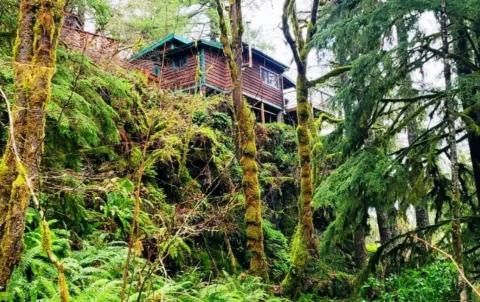
So much love and history has gone into this cabin and property. It is really one of a kind. At 90 feet above the river, you can feel it roar under you as you drift to sleep. If you like eagles, how about taking a shower outdoors while they fly above giant Red Cedars? It is epic!
/articles/no-kill-kalama
Ultimate Kayak Set-ups
In the 2023 March issue of NW Reel Life, I laid out some key items and concepts to help anglers enter the world of kayak fishing. And while weather predictions, condition assessment, and kayak types are all important, in this article I want to focus a bit more on the actual setup of your kayak and how that can determine your level of success out on the water.
Track mounts
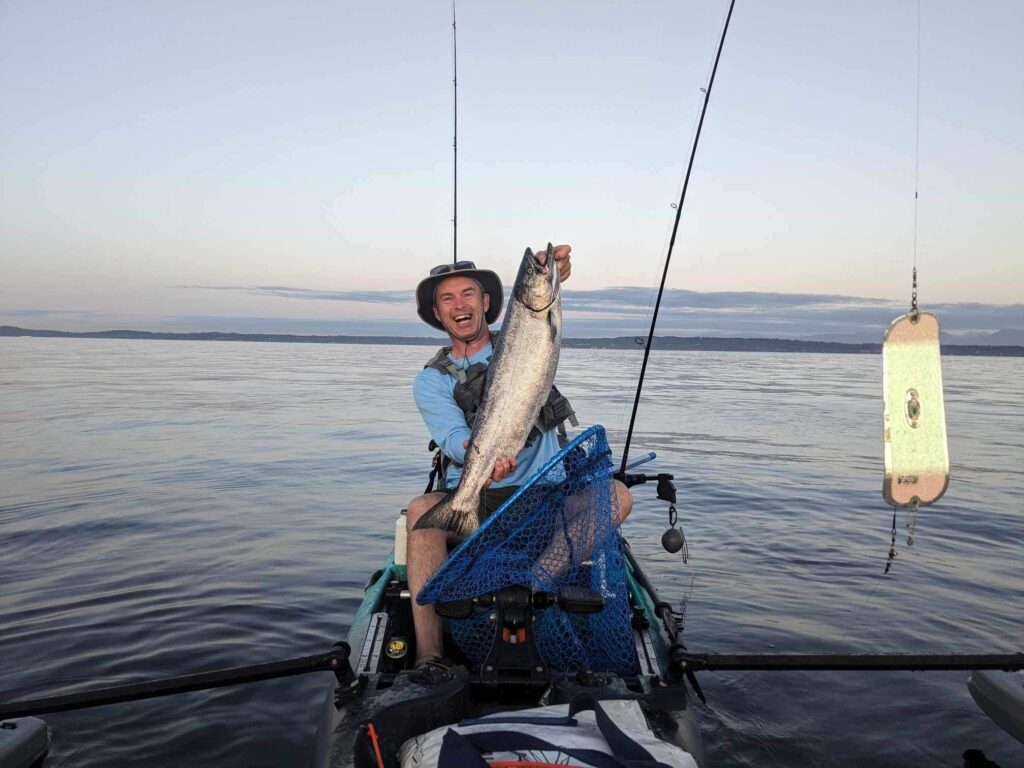
Let’s talk track mounts! Track mount systems are the starting point for your rod holders, fish finders, and other accessories. A track mount is a slotted track that you bolt to the side rails of your kayak and then slide your other accessories onto. They all have fairly similar styles with some small variations amongst different brands. The most important thing to keep in mind is that your track should be strong enough to support whatever type of load you are putting on it. A good track mount system should be metal, corrosion resistant, and come with a backing plate. If the track holds rod holders, it should be large enough and secure enough to do so. Smaller accessories like cell phones, fish finders, and camera mounts won’t require as beefy of a track.
Downriggers
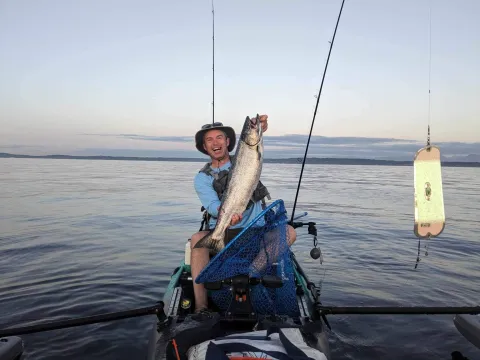
Trolling on a kayak can be straightforward. You drag a lure behind you to target rainbows, or you can utilize a cannonball weight to get you down to chinook salmon territory.
Now, if you want to have more than just an idea of the depth your gear is at in the water column, you need something more surefire. Enter the downrigger.
Because most of my kayak fishing is in the ocean or the Strait of Juan De Fuca, I’ve opted to leave the downrigger trolling to my aluminum boat. The constant attention to equipment while on the water and the inherent risks associated with snags make it an option easier to perform on a vessel of larger size. With that said, a downrigger is not only doable on a kayak, but it’s a technique that can increase your chances severalfold, and if you’re fishing lakes where currents and large waves are less of an issue, a downrigger might be the exact thing that puts you on the fish.
The most common spots to mount a downrigger are just past the midline of your kayak somewhere out of the way of your peddling or paddling, but also close enough to you so that you can operate it without too much struggle. Most kayakers opt for smaller downriggers like a Scotty lake troller or the Cannon mini troll downrigger. When mounting your downrigger, you’ll want to add a backing plate in the hull of the kayak where your bolts will attach. This is essential for the kayak to be able to handle the added weight and pressure. Fish finder and rod holders should be mounted in close enough proximity to the DR so that you can monitor your rod tip, fish finder, and DR at the same time. Instead of using the steel cable that comes with most downriggers, it’s wise to swap the cable for 250 # - 300# braided line. This will lessen drag and it will also allow you to cut your line in case of an emergency. With that in mind, you should always have a knife attached to your person in a place that is easily accessible in case that emergency were to happen.
Stringers
For the longest time, I struggled to find an effective place to connect my stringer to my Hobie Revolution 13’. I would typically have my stringer attached to a carabiner and then the carabiner attached to a strap that was a part of my seat’s recline system. Eventually, the rubbing from the constant motion and tension of the fish that were hanging off the side of my boat would fray the webbing around the strap. I now have a stringer cleat attached to one of my track systems that holds and secures that line out of my way. Metal clip stringers are a top-rated option for kayaks due to their ease of use, though rope stringers and chain stringers will certainly get you by as well.
Fish finders
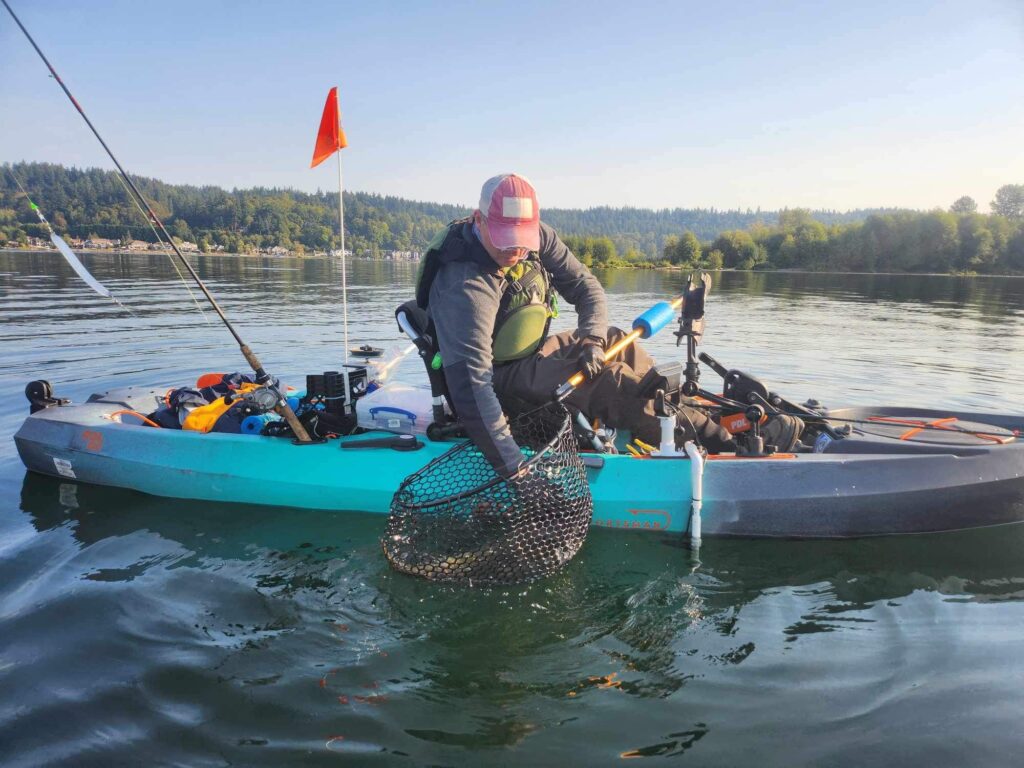
The process of setting up a fish finder on your kayak is going to differ depending on what type of kayak you have. Mounting the screen is simple- it can go on a track or be permanently installed on the boat. The trickiest part of the process will be mounting your transducer. Many fishing kayaks come equipped with a transducer mount directly underneath the hull. This allows the transducer to sit in the water while also being protected from the sand and gravel if the boat were to drag along the bottom. For most kayaks out there, transducer mounts are not built in. If you don't have a transducer mount you will need to mount it either off the side of your boat or better yet, inside the hull. This gets tricky and typically involves using some plumber putty for the transducer to both stick to the kayak and to also create a sealed surface without air bubbles. The solid putty allows for the transducer to transmit through the putty, through the kayak material, and into the water. YouTube is a valuable tool for these types of setups.
Bilge pump and BP storage
If the hull of your kayak fills with water due to crashing waves or due to a capsize, you don't want to be bailing water out of the boat with an empty tackle box. A manual bilge pump is your strongest line of defense against a sinking boat. Some kayakers will stow their bilge pumps inside a hull compartment underneath a hatch. This could seem like a sensible home for your bilge pump, but if you are in a situation where you’ve taken on a lot of water and you’ve lost half your buoyancy, and on top of that, you’re being battered by oncoming waves, leaning over to open a hatch might be just the thing the kayak needs to capsize once again. Instead, stow the pump somewhere within arm’s reach and have it fastened down with a bungee and secured to a lanyard so that it has no chance of going overboard.
Cell phone mounts
Having your cell phone mounted on your fishing kayak might seem like an over-the-top luxury, but if you consider the vast number of apps that can be utilized to help improve your fishing trip, you will find that having your cellphone on the ready and in view at all times is a must. When I’m on the water, I use Navionics to navigate and to get a good sense of underwater topography. I also use weather and wind apps to keep me safe and informed on changing conditions. Using a cellphone mount along with a waterproof cell phone case gives ease of access to all of these things. Phone mounts can be installed directly on the kayak or on your track system.
Bungees and straps
Bungees, straps, webbing, all these small investments will protect your larger investments in the event of a capsize. Strap everything down as if capsizing was just a normal part of your program. This is particularly important if you plan to do any surf launches into the ocean.
Rod holders
Rod holders are an essential part of your fishing kayak set-up. Your kayak likely comes equipped with flush mount rod holders, these are almost standard on most kayaks these days. However, the position of the standard flush mounts is generally aft of the kayak seat, and this isn’t always the best location when you want to have eyes on your rod tip. Additional flush mount holders can be installed in various locations of your boat.
Fixed and elevated rod holders. These will be installed directly to the boat or to a track. Fixed rod holders tend to be one of the sturdier options.
Adjustable rod holders. Adjustable rod holders can move from horizontal to vertical and can be found in various styles that are suited for whatever type of fishing you plan to do.
When installing your rod holder, be sure to place it somewhere where it won’t be in the way of your peddling or paddling.
Fish Storage
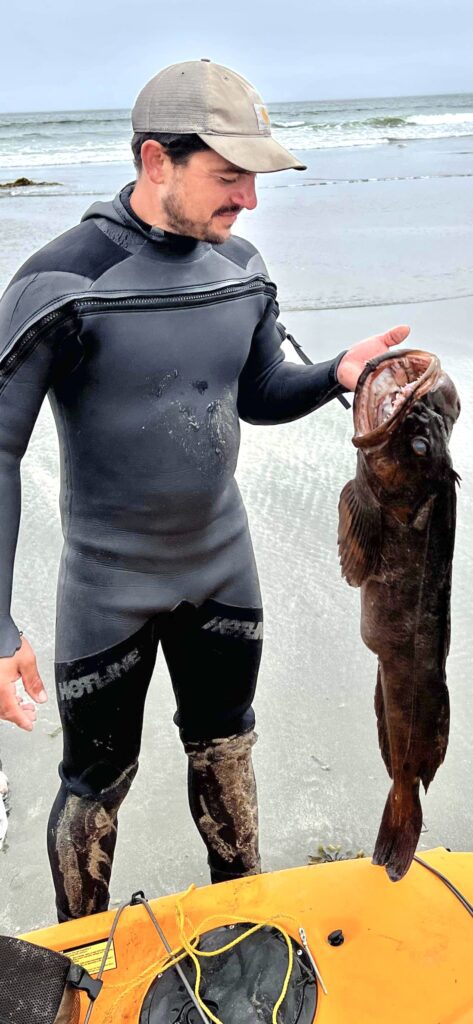
There are quite a few options when it comes to fish storage. Some folks will carry a small cooler on board. This is a good option when fishing for smaller fish on hot days and if you can afford the room on your kayak.
Fish bag. Insulated fish bags are great options for larger fish and are easy to secure on your kayak. If you’re fishing for spiny fish, be sure that your cooler bag is puncture-proof.
In-hull storage. Some anglers have rigged fish bags inside their hull, and if you can make that work, you are ahead of the curve on the fish storage problem that plagues many kayak anglers. If in-hull fish storage is a possibility, be sure that your fish are well insulated as the inside of a kayak can get quite toasty on a hot day. Also keep in mind that if your fish bag leaks inside of the hull, you will have the difficult task of cleaning a stinky mess that gets more stinky the longer it sits unattended. Finally, having the hull open frequently presents the danger of water from crashing waves getting inside your kayak. So, if you choose this method, be wary of the risks associated.
Kayaks offer endless amounts of angling opportunities without some of the drawbacks of larger boats. I hope these tips give you some direction in planning your next outdoor adventure on the open water.
/articles/ultimate-kayak-set-ups
Fathers Day Memories
According to Wikipedia, Father's Day dates back to 1910: “Father's Day was founded in Spokane, Washington at the YMCA in 1910 by Sonora Smart Dodd, who was born in Arkansas.[3] Its first celebration was in the Spokane YMCA on June 19, 1910.”
Reading further, Sonona Smart Dodd wanted a day to honor her dad, similar to Mother’s Day. The day was made a permanent national holiday when President Richard Nixon signed it into law in 1972.
Nothing was mentioned about this being the perfect Dad’s Day for fishing, but truly the timing couldn’t have been much better. Coming out of spring, closing in on summer, the day comes with the prospects of great fishing and fond memories for dads and children alike.
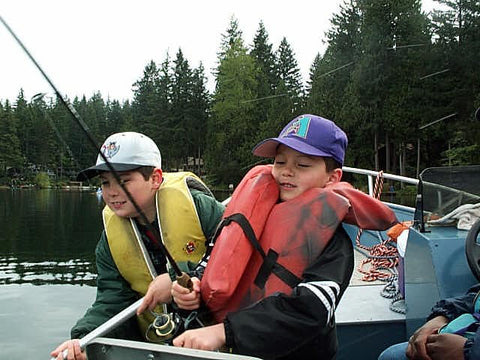
My earliest memory of Father’s Day fishing was with my first son, Matthew, age two. I still remember him running around the park at a small lake, the name long since forgotten. His toddler laughs as dad attempted to introduce him to fishing are still crystal clear in my mind-eye. The day was a mixture of casting power bait and letting it soak, waiting for a trout to come by, and playing on the park’s playground swing and slides.
I have a picture somewhere, buried in a box of pictures, a lifetime of memories. It’s funny how the brain works – so many memories, filed away over a lifetime, coming to the surface out of nowhere. That day it wasn’t about catching fish, it was about father-son time. The goal was not necessarily catching fish, rather, it was time spent together enjoying a shared experience. As it should be. At this early age, first experiences can set the tone for a lifetime. Best to make a gentle introduction and go with the flow. The child will dictate how hardcore the day will be. You’ll have a lifetime of adventures ahead – if you play it right in these formative years.
Farther down the road of parenthood, James came along, and then my Klamath jet boat joined the family. The boys had a lot of fun on that boat, slipstreaming turns, pulling a tube, and of course, fishing.
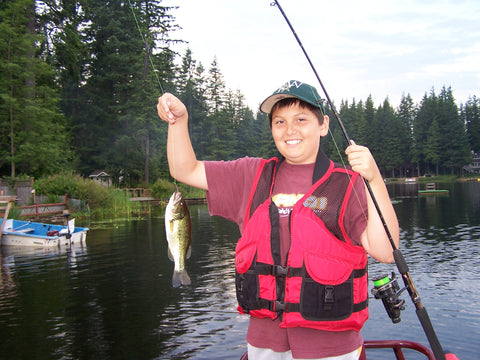
It was another Father’s Day, and we were fishing on Lake St Clair in SW Washington. I had Matt and James in our 16-foot Klamath jet boat, geared up for trolling trout. Lake St Clair is an interesting lake, with many channels and bays to explore. The day was a pleasant early summer father-son get-away, and we enjoyed trolling along on the boat exploring the sights and sounds. Ducks and other animals kept us entertained, and of course, the boys had their Nintendo’s along. I wasn’t one to be hardcore fishing with my boys. I figured it was better to have them along for the experience than it was cramming it down their throats. When a fish came along, they would set their Gameboys down and catch it, enjoying the action, then back to one or another distraction. The fishing was not exactly hot, so after a couple hours it was time to turn back to the boat launch and head home.
Just then, the longline rod violently jerked back and behind the boat a large splash signaled a nice fish on the end of the line. Matt grabbed the rod and began reeling in the huge fish. The smile on his face as he battled the big trout was enough for me to know the magic of angling was taking hold. As the fish came closer I could see it was a big rainbow trout, a triploid most likely. Matt brought the fish close to the net, and I scooped a beautiful rainbow in as Matt let out a whoop of joy. The three of us marveled at the beautiful fish, one of a few we caught that day.
The last Father’s Day fishing adventure I can remember, before my sons became fully enamored with baseball, was a trip my son James and I took on Lake Washington. He was, I believe, 10 years old. It was another beautiful Pacific Northwest early summer day, the kind that begs to get out of the house and do something outdoors. We launched our new Seaswirl and ran across the lake to fish off Kirkland. Downriggers set and gear down, I was hoping to get into some of the quality rainbows and cutthroat that Lake Washington is known for.
As we trolled along, the port rod popped free of the downrigger and it was fish on! Handing the rod to James I could see that he had a solid fish on. The fish would take a screaming run, drag crying out, James laughing and enjoying the feel of a substantial fish on the other end of the line. I said a quiet prayer hoping the fish was well hooked. Ever closer James worked the fish to the boat, until I was able to slip the net under a chrome bright Lake Washington cutthroat.
Back at the dock, James couldn’t stop talking about his fish and the fight it gave him. His smile said everything I needed to know.
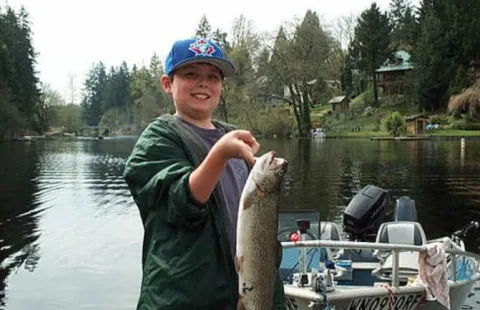
The years have marched ever onward, and many Father’s Days have passed into my rear view mirrow. My boys are adults now and have lives of their own. Matt is himself a father, making me a grandpa. While baby Hanna is a bit young yet to introduce her to a Father’s Day fishing trip, I look forward to being a part of her fishing life. Say, shouldn’t there be a Grandfather’s Day? If there is, I hope it's not in December!
/articles/fathers-day-memories
5 Family Friendly Trout Lakes in Western Washington
With opening day of the Western Washington Lowland Lake opener in the rearview mirror, many of us are looking for future lake fishing opportunities. Let’s take the family fishing! Following are a list of 5 family oriented Northern Washington trout/kokanee fishing adventure lakes. One of them, Lake Samish, would be a day adventure. The other four could be a multiday family camping and fishing expedition. All offer at least one boat ramp and shore fishing, a fishing pier, or both. This article will focus on opportunity, and not necessarily technique. All the lakes offer opportunities for trollers, bait soakers, and even fly fishers. That said, pack up the family, a frypan, maybe the sleeping bags, your favorite gear, then hit the road!
Cranberry Lake (Island County)
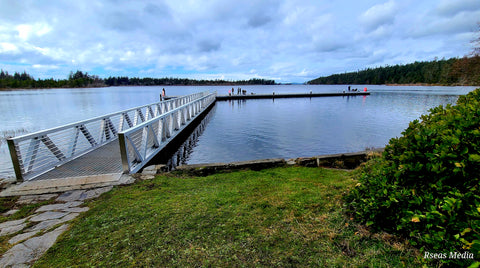
Cranberry Lake is located within the boundaries of Deception Pass State Park. There are multiple shore fishing access points and a very nice fishing pier. There is also a small boat ramp with very limited parking. If you are boating, internal combustion engines are not allowed on Cranberry Lake. You can use an electric motor but oars, paddles, or peddle power are perfect.
At 133.9 acres, Cranberry Lake hosts rainbow trout, coastal cutthroat trout, and an occasional brown trout. I’ve heard that that there are also smallmouth bass and perch in the lake but I’ve never seen anybody fishing for them. No picture, but when I was a teenager (Boy Scout camping trip) I caught a huge brown trout from one of the large boulders by the campground. The brute hit a worm/corn/marshmallow combo.
Not really sure why, but I love fishing Cranberry Lake. Although it is not, to me it feels like you’re fishing some remote lake in the Canadian wilderness. Be aware though, NAS Whidbey is right next door. There may be military aircraft doing maneuvers right overhead. I am in awe anytime one of the Navy aircraft are overhead but not everybody feels that way. It’s the sound of freedom!
If you’re not familiar with Deception Pass State Park, it is an absolute recreational gem. There are multiple well separated campsites, miles of hiking trails, and 77,000 feet of saltwater beaches to enjoy. Across Highway 20 from the lake, there is even a large saltwater boat launch with moorage. It’s not really mentioned anywhere, but in season you can fish for dungeness crab and smelt from the moorage floats. On the west side of the park, the sunsets from West Beach can be spectacular.
https://wdfw.wa.gov/fishing/locations/lowland-lakes/cranberry-lake
https://www.parks.wa.gov/497/Deception-Pass
Lake Samish
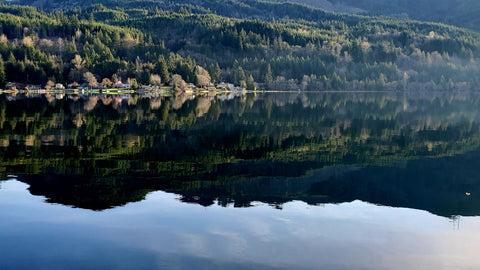
At 809.9 acres, Lake Samish is open to fishing year-round. It is managed as a multi-species lake, offering coastal cutthroat, large and smallmouth bass, crappie, brown bullhead/catfish, yellow perch, and excellent kokanee populations. I can personally attest that there are also largemouth bass and brown bullheads in the lake. The lake consists of a smaller lake connected to a larger main lake by a narrow channel. The larger main lake has significant weedy shallows at the south end and a max depth of 60 feet or so. The smaller lake located at the west end of the two-lake chain is up to 150 feet deep and maintains a large pocket of cool water throughout the late summer and fall. The cool water effectively extends the Lake Samish kokanee fishery when other west side lakes are too warm to support a fall kokanee fishery.
In late April-June, Lake Samish can be red hot kokanee fishing, easily giving up limits of fat 12”-16” kokanee. One of our biggest local kokanee came out of the smaller lake during a mid-October trip a few years back. It hit our old school gear running 2 colors on the lead line, 40’ of 8-pound leader, a rainbow color kokanee gang troll, and an orange wedding ring spinner tipped with a maggot. The fish was nearly 3 pounds and was in full spawning colors.
While the kokanee fishery is a trolling show, there is a fishing pier at Lake Samish Park. The fishing pier catch is primarily coastal cutthroat and peamouth chub. Lake Samish Park offers a couple of well-groomed picnic areas, a swim beach, hiking trails, and seasonal boat rentals. The park is the perfect place for a family outing and picnic with a little fishing thrown in.
An AIS Permit is required for every boat operating on Lake Samish. Here’s a few words about the AIS program at Lake Samish. Aquatic invasive species are non-native plants, animals, and pathogens that live primarily in water. They thrive in a new environment and cause economic loss, environmental damage, and harm to human health and property. An Annual AIS Permit and a per use boat inspection is required to operate your boat on Lake Samish. Whatcom County maintains an AIS inspection station at Lake Samish.
Boat inspections are important because they can help to prevent the transport of aquatic invasive species to Whatcom County lakes. AIS are transported on boats travelling from infested waters and can result in significant impacts to lake ecosystems, water quality, and water supply infrastructure. AIS can also make shoreline areas hazardous and uninviting for recreational users and property owners. To prevent the introduction, AIS inspectors are on the lookout for any animal or plant material on the watercraft that might pose a risk to Lake Samish. They will also be checking to see if your boat has been cleaned, drained, and dried, as some aquatic invasive species larvae can be transported in any areas on the boat that remain damp or have standing water in them. Inspectors will also conduct a physical inspection of the outside of your boat to feel for any signs of mussel larvae, algae, or other organic material on the hull that could pose a risk to the lakes.
As currently planned for 2023, Whatcom County will be staffing the inspection station at the Lake Samish WDFW Boat Launch. The AIS program is sensitive to the needs of anglers participating in the kokanee fishery at Lake Samish. They are planning/budgeting to staff the inspection station 5:30am-8:30pm 7 days a week. Although the AIS inspection program will be a bit of an inconvenience, having AIS inspectors on-site at Lake Samish will help to reduce the unfortunate vandalism problem at the Lake Samish WDFW launch.
On a similar note: Boat motor labels must have at least one star to operate on Lake Samish. Generally, any motor that is certified and labeled as meeting the 2006 or later model year United States EPA emissions standard will be compliant.
https://wdfw.wa.gov/fishing/locations/lowland-lakes/lake-samish
https://www.whatcomcounty.us/3542/Samish-Park
Silver Lake – Whatcom County
157.3 acre Silver Lake in Whatcom County is another unique recreational opportunity. It is a family friendly destination with camping, good trout fishing, and a WDFW boat ramp. The WDFW boat ramp is located at the north end of the lake and has ample trailer parking. The fishery is primarily for planted rainbow and coastal cutthroat trout. Even though the average depth is only 24 feet, holdovers are not uncommon. The fishery is friendly to whatever trout fishing style suits your style, but don’t be afraid to soak some dough bait.
Silver Lake Park is a large Whatcom County Parks and Recreation facility on Silver Lake. The park has 3 campgrounds and a RV accessible group campground. There are also cabin rentals, a handful of hiking trails, a playground, multiple picnic areas, an equestrian center, seasonal boat rentals, and a small boat launch that is probably best suited for hand carry boats.
https://wdfw.wa.gov/fishing/locations/lowland-lakes/silver-lake-whatcom
https://www.whatcomcounty.us/3517/Silver-Lake-Park
Fish Lake – Chelan County
Another family friendly trout destination is Cove Resort on 492-acre Fish Lake in Chelan County. For whatever reason it is probably better known for its winter, hardwater perch fishery but it hosts a solid spring and fall rainbow trout fishery. The lake also has a few respectable brown trout available. The brown trout fishery is kind of a specialty, but if you stick with it there are some true trophies cruising around, just waiting to be caught. In an interesting twist, the WDFW has been experimenting with kokanee fry plants in Fish Lake and it seems that there is blossoming kokanee fishery at hand. The lake also hosts a spring fishery for largemouth bass along with a year-round perch fishery. Access to the lake is primarily through Cove Resort.
Cove Resort is operated under a Forest Service private concession. You can bring your own boat: Cove Resort has a boat launch and moorage. They also have a store, boat rentals, a fishing dock, cabins, and a large campground.
https://wdfw.wa.gov/fishing/locations/lowland-lakes/fish-lake-chelan
https://www.coveresortatfishlake.com/
Lake Pearrygin
183-acre Lake Pearrygin is another first-rate choice for a family outing. There are 4 boat ramps, including a WDFW access point/boat ramp, 2 state park ramps, and a ramp at Silverline Lakeside Resort. For the shore fisherman there are many options. The state park alone has 11,000 feet of shoreline and there is a handicap accessible dock.
The trout fishing at Lake Pearrygin can be either fast and furious or just plain good. The seasoned trout angler can pull out the stops and get technical in their approach to the fishery, or, fortunately, anybody can catch fish using dough bait or casting their favorite spinner. A single salmon egg or a small piece of nightcrawler under a float can be deadly. As a bonus, Lake Pearrygin gives up more than its share of fat holdovers each season. Whether your family are trout fishing newbies or experienced trout hunters, Lake Pearrygin is an excellent choice for a family fishing getaway.
Lake Pearrygin State Park has a swimming beach, 169 various use campsites, 2 group sites, and cabin rentals. There are also 6.5 miles of hiking trails and picnic areas. As staffing permits, they offer campfire programs; they are conducted every Tuesday and Thursday night from June 15 - Labor Day. The park also offers a Junior Ranger program for kidlets.
It just keeps getting better; Silverline Lakeside Resort on Lake Pearrygin is a clean, well-maintained resort. They offer RV and tent sites and a group campground. The resort has RVs available for rent, boat rentals, aquatic equipment rentals, propane fire pit rentals, a store, and a small restaurant. If that’s not enough to spark your interest, Silverline Lakeside Resort also has 3 fishing docks, horseshoe pits, a playground, swimming beach, and mini golf.
https://wdfw.wa.gov/fishing/locations/lowland-lakes/pearrygin-lake
https://www.parks.wa.gov/563/Pearrygin-Lake
https://www.silverlineresort.com/
Have a hankering for a family outing and the sizzle of fresh trout in the ole cast iron? If so, add a trip to one or all of these lakes. Cranberry Lake, Lake Samish, Silver Lake, Fish Lake, and Lake Pearrygin each offer a unique family trout fishing experience. With the exception of Lake Samish, there is a campground adjacent to each lake with many of the campsites right on the lake. You better go pick up the phone, or bring up their websites, reservations are going fast!
/articles/5-family-friendly-trout-lakes-western-washington
Net Innovation
It’s happened to many of us while trolling. Your buddy has a nice fish that he’s battling to the boat, and as you reach out with the net, hoping not to miss, the net washes below the hoop as you get ready to scoop and tangles with the fish’s mouth and hook. Frantically you attempt to bring the fish in, only to watch it twist and turn and the hook pull free. Bad enough for any fish, but especially bad when it’s a twenty-pound king!
If you say this has never happened to you, then you must not be one of the guys who hold the net with one hand while scooping with the other. Admit it, many of us have found this to be an imperfect compromise. If you watch guides net fish, you see them doing this all the time. The problem with this technique is that it shortens your reach to the fish which negates the benefits of a long net handle. It also forces the netter to lean out over the gunnel that much more, increasing the risk of losing both the fish and the netter (not funny, I’ve seen it almost happen in my boat).
You would think that most every innovation under the sun has been built into nets, and then along comes something so simple, but so effective that you have to wonder why no one had thought of it earlier.
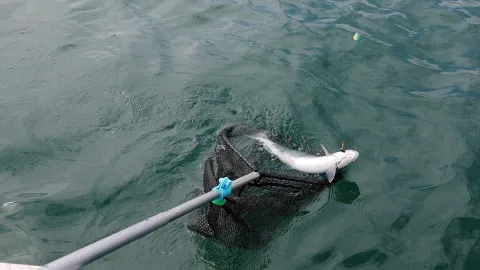
Recently NWFishing was contacted by a company based out of Texas, Netrigger (https://netrigger.com/). They have developed an awesome net accessory called (ready for it?) The Netrigger. Using a simple but incredibly effective magnetic system, the Netrigger does what you’re your hand does – it holds the end of the net hoop in place against the net handle, allowing you to scoop further and deeper with the confidence of knowing that your net won’t slip back and tangle with the fish. When the fish is in the net hoop and you lift up, the fish’s weight releases the net end, and your fish is safely in the net. Simple, effective, and innovative!
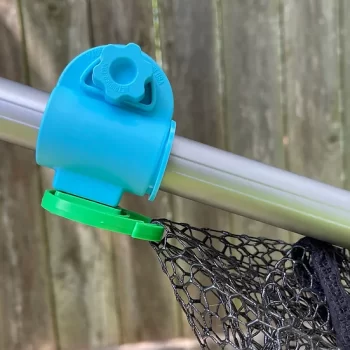
If you’re concerned about the net not deploying, no worries. The Netrigger comes in 10-pound, 15-pound, 20-pound, and 30-pound magnetic weights, and can be purchased in a variety of combinations. The magnets are interchangeable which is a nice feature. Depending on the size of fish you are targeting and the speed of your boat, or current, will dictate which weight to use. My personal experience is the heavier weights work better in trolling conditions. For salt and river salmon/steelhead I would go with the 20-30-pound weights. For kokanee, trout and most 1–2-pound fish the 10-15-pound weights are a good choice.
The one quibble I had with my unit was when I installed the clamp, I over tightened it and caused it to crack. Not enough to make it unusable, but it always bugs me to get something brand-new and damage it. Chalk it up to user error and don’t over tighten that clamp!
Prices range from $20 for a single weight to $45 for the combo packs. The combo packs are nice in that they come with three different weights. The clamp also comes with inserts making it easy to switch from different diameter rod handles.
As to how they work? As advertised! On a recent trip to Fort Peck, Rob went to net my fish, but the magnet was not deployed, and the nightmare scenario almost happened. I watched in horror as the net end tangled into the fish’s mouth. Fortunately, Rob was able to bring the fish in. Our second Chinook, the magnet easily stayed in place and released as a beautiful 17-pound chinook entered the net. No worries about the net snagging and it was an easy net job.
/articles/net-innovation
Josie & the Tomcats go to Alaska
The first time I met Josie Regula was when she boarded our charter boat, the Mystic Lady, at Sportsman's Cove Lodge on Prince of Wales Island in Southeast Alaska. The 50-something year-old-woman was accompanied by her husband, Max. The two had come here from San Diego, California to fish for salmon, halibut, cod, and more during a three-day stay at this luxury Alaska fishing lodge.
It turns out Josie isn't shy. As she boarded the boat for an orientation prior to the next morning of fishing, Josie let us know this was her very first fishing trip. She then told all of us with much bravado she intended to catch the biggest fish on the boat and probably the most as well.
Her husband Max looked shyly downward but the rest of us did not. Her shipmates were myself, my best friend Rusty Johnston, well known Pacific Northwest outdoors writer Terry Sheeley, Frank Skipworth (a veterinarian from Kentucky), and the Captain of the Mystic Lady, Steve Helton. I think Josie was expecting a chorus of loud guffaws and snorts from us but several of us nodded in agreement and said there was a good chance she would do just that.
Josie looked momentarily confused until I explained first time anglers, especially women, tended to out fish their male shipmates because they had not formed a lifetime of bad habits like the rest of us had. Add to that, first time women anglers tend to not only pay attention to the fishing advice dispensed by the captain, but actually follow it. Several of us went on to say we had indeed seen women with no experience catch the biggest fish or the most fish because of this. I'm not sure Josie believed what she was telling us but we all knew her prediction could well come true.
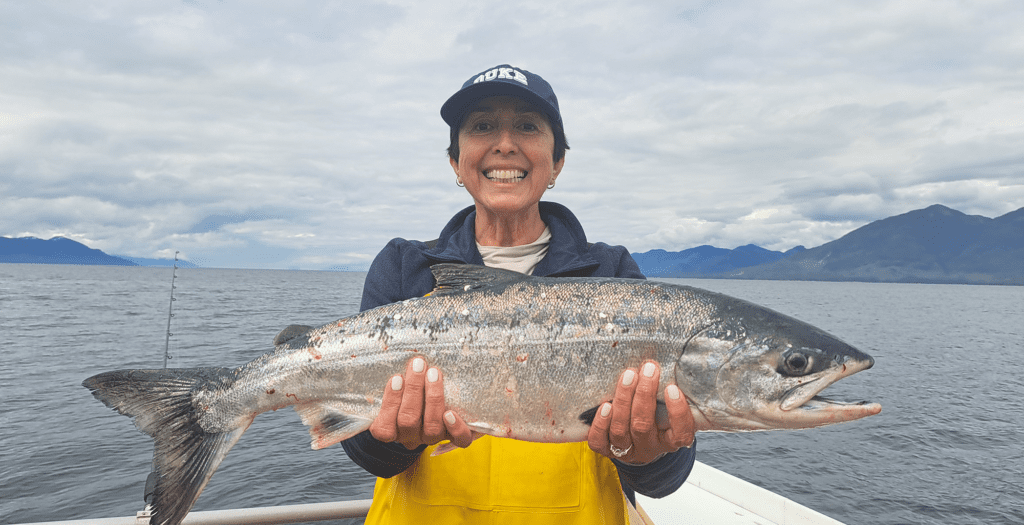
When I asked Josie her name, she said it was "Josie, like Josie and the Pussycats". Being all over 50 years of age on the boat, we all recognized the reference to the old television cartoon show featuring Josie, the star of a female rock band, and her supporting cast the Pussycats. With all of us being men Terry Sheeley said we wouldn't be the Pussycats as her band members, but we would be willing to be the Tomcats. And with that, the fishing band was formed.
On our first morning we fished a large sandy bottom flat that was about 260 feet deep, a non-descript part of the ocean some 35-minutes away from the lodge by boat. Dropping down our bait of herring with 12-ounce lead weights on a short leader, we began to jig for halibut, and wouldn't you know it, Josie caught the first fish of the day, a healthy five-pound true cod. Josie’s luck (and learning curve) increased over the next three days of fishing and she reeled in more than her share of cod, halibut, and salmon but it was our third day of fishing that Josie played her greatest hit.
The weather the first two days was mild but our final day on the water was a rough one. We endured a steady drizzle most of the day and rough seas that had Josie feeling under the weather. In fact, despite the fact she took Dramamine to combat motion sickness, she became sea sick. I’ll give her credit though; she stuck it out on deck as we jigged for halibut during a slow morning of fishing that only yielded a few smaller halibut and true cod. Then, Josie’s rod tip bent down in a big way. She set the hook and the fight was on. The fish Josie hooked was definitely no small halibut; oh no, it was a very big one.
Josie, who was not above using colorful language, used it in abundance during the fight that followed with this goliath of a fish. Having never battled a big fish before, she decided to kneel down on the deck on one knee and brace her fishing rod against the deck rail as she reeled. It was an unorthodox way to fight a fish but it worked. The fish made several runs towards the bottom, robbing Josie of line as it did, and each time the fish made a run Josie would loudly express her dismay. However, Josie stuck it out, kept reeling and eventually, after a long fight, got that halibut to the surface.
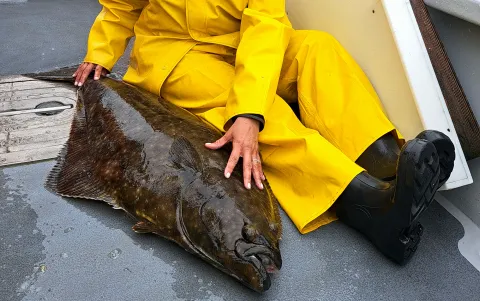
The fish was brought on board and it measured well over the 40 inches where non-resident charter anglers are allowed to keep a halibut in this part of Alaska. In fact, that fish measured a whopping four-feet and weighed an estimated 53 pounds. After snapping a few photos, that halibut was released back into the sea unharmed to grow even bigger and Josie’s day one prediction of catching the biggest fish on the boat came true.
After taking a short break to deal with fatigue from both the fight and sea sickness, she was right back on the rail for the final afternoon of fishing, reeling in half a dozen salmon in the process. In the end it just goes to show first time female anglers really can out fish all the experienced men on board, and Josie’s Tomcats were more than happy to be here supportive band as performed her greatest hit!
If you would like to find out more about the first-class fishing adventures available at Sportsman’s Cove Lodge for anglers of any experience level, go to their website at www.alaskasbestlodge.com .
/articles/josie-tomcats-go-alaska