Fall Trout Techniques
Conventional wisdom dictates that trout fishing usually slows down in the heat of the summer. Trout prefer cold water temperatures and go off the bite when the water gets too warm for comfort. Around October, water temperatures cool down and the bite starts to come back on. The fish have been feeding and growing since spring, so they're usually feistier and bigger. They're a ton of fun for kids and adults alike. Fall in the Pacific Northwest can be the best time of year to catch trout! Read on to learn how you can reach your limit on these tasty fall treats.
Trolling
Don't winterize the boat just yet! Now is the time to troll big spoons and spinners. The fish are looking to pack on some pounds before winter and are more likely to strike large presentations. Try trolling size 7 jointed Rapalas. Bold colors such as fire tiger and chartreuse are great in the fall. Now is the time to experiment with something different. This is my favorite time of year to use large trolling flies. That said, the usual techniques such as Mac's Wedding Rings paired with small dodgers and lake trolls will work very well.
I'd recommend trolling faster than you would in the spring or summer. The fish are more energetic and willing to chase down a lure. How deep you should set your lures is where things get less certain. Sometimes they're on the surface, and other days they’re in the mid-water column. This is where having a decent fish finder will be important. Be adaptable and always have a plan B!
Shore Fishing
No boat? Have no fear, fall trout cruise the shoreline and you have a good chance of bringing home your limit. Dough baits are always a reliable option, though not the most exciting way to fish. On 2 pole endorsement lakes, I like to soak dough bait with 1 rod and throw spinner or spoons with another. Fall trout are eager to bite on hardware!
Not all lakes have good shore access. Some have pay-to-fish docks, such as Lake Tanwax, Mineral Lake, and Clear Lake. It's a good idea to have a backup plan if the fish aren't biting at your lake of choice. Check the stocking reports and take a look to see if any of your local lakes have tagged fish in them. You can win cool prizes from WDFW for catching a tagged fish, and there are plenty still left.
Catch N Cook!
Once you've got your catch home, the fun part begins: cooking it! I learned how to smoke fish by smoking trout. You can smoke them fileted or butterflied. I prefer to smoke filets so I can fit more fish in the smoker but butterflying them is easy and less time consuming. You can make a dry or wet brine- I have recipes for both, depending on how I'm feeling.
Dry brines don't take nearly as long to work their magic, especially on small trout. Wet brines are more forgiving and allow for more flavor options. Smoked trout works well in dips, pastas, and on bagels. Add maple syrup or honey about 30 minutes before taking it off the smoke for trout candy. I like to munch on my smoked trout candy as a high-protein snack while hiking and fishing in the fall.
Fall trout are also good baked, fried, and grilled. I like to use the seasoned fish fry from Winco's bulk section. Dip the fillets in a beaten egg, coat in the fish fry, then gently place in hot oil until golden brown. They're great dipped in sriracha mayo! For a healthier snack, try lightly oiling the fillets, then shaking some lemon pepper seasoning on. Bake at 350 degrees until fully cooked. You can also wrap whole trout in foil with some butter and garlic, then throw it in the oven or grill for an easy and delicious meal.
As you can see, fall trout are not only fun to catch, but delicious to grill and smoke. This is a great time to introduce kids to fishing! The weather isn't too hot and there's no need to be on the water at the crack of dawn. Shore fishermen and boat anglers alike have an excellent chance of coming home with limits of these aggressive, tough fish. We hope to see you out on the water this fall!
/articles/fall-trout-techniques
Chum Salmon Time
Here we go…Fall is upon us. The Sockeye have done their thing, Chinook have made their way into the rivers and are spawning, and the Coho are showing up until January in some places. Since it is an even year in the Pacific Northwest, we will not see a return of pink salmon this year. That leaves us with the fifth species of salmon, the Chum salmon.
Chum salmon, also known as dog salmon or keta salmon, is a species of anadromous salmon native to the coastal rivers of the North Pacific and the Beringian Arctic. The Chum is an often-overlooked species that is not targeted by recreational anglers quite like Chinook and Coho. The primary reason for this is that we don’t usually target or catch them in the salt, and they turn very quickly upon hitting the fresh water in our tributary rivers.
Since they are not great table fair unless caught at the perfect time, we tend to focus on the other species that remain edible after they have spent weeks or months in the freshwater. It is important to note that Chum are targeted in the salt water up and down the Pacific Coast, but they are talked about much less than their coveted cousins, the Chinook and Coho.
Chum salmon are typically commercially caught and marketed as canned or smoked products and exported to Asia and Europe. Their flesh tends to be lighter in color and oil content than other species of salmon, but its firmness and flavor, if caught fresh, make chum salmon pleasant table fair.
One thing to be said for the mighty Chum however is that pound for pound, they are one of the toughest and hardest fighting salmon species. They can grow to nearly the size of Chinook with an average weight of 8-15 pounds, and large fish weighing up to 35 lbs. Chum have an ocean coloration of silvery blue-green with some indistinct spotting in a darker shade, and a paler belly.
When they move into fresh water the color changes quickly to dark olive green and the belly color deepens. When adults are near spawning, they have purple blotchy streaks near the caudal peduncle that resemble stripes that get darker towards the tail. Spawning males typically grow an elongated snout or kype, their lower fins become tipped with white, and they have enlarged teeth. This may explain the nickname “dog” salmon. They are also sold for both dog food and are popular in Italy as food for prisoners.
As mentioned, Chum tend to transition and turn very quickly, even before they enter freshwater. Their flesh is not good for consumption when they begin to turn, but then again, to each his own. Also, Chum migrate, spawn, and die rather quickly, usually within a period of a few weeks after entering fresh water. The key is to know when they show up and get after them while you have a short window of opportunity.
Since returns of Chum are dwindling in many of our rivers, we are often not allowed to target them and when we are allowed to, they often must be released. Check your WDFW regulations or call a local office for information on Chum salmon and ask about volunteer opportunities to catch them for broodstock programs that are being used to restore the runs in some of our rivers.
I have participated in the broodstock collection on the Snohomish River system for the past few years, focusing on the Skykomish River. We catch chum and safely transport them to net pens that are located up and down the river. The fish are collected and taken to a hatchery where the milt and eggs are collected, and the salmon are reared for release back into the system. In my opinion, this is the most effective method to help Chum recover and increase the annual returns to our rivers.
Chum Salmon are usually very aggressive once they enter the river. They will travel and hold in slow to moderate currents that are deeper than 4 feet. You can target them from the tidewater all the way up to their spawning grounds. Once they transition into spawning mode, and flood into the shallow spawning areas, leave them alone and let them do their thing. We really need them to procreate to ensure their long-term sustainability.
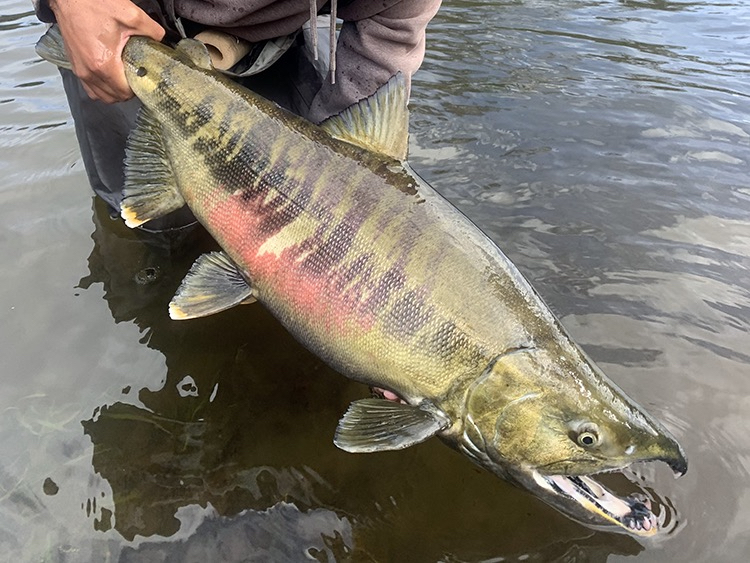
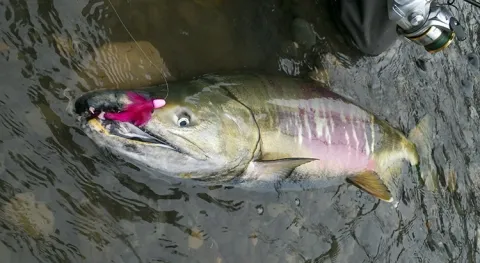
Catching Chum can be a lot of fun. They are aggressive fish and fight much like a Chinook. Chum mostly feed on plankton and shrimp in the ocean. Purple, pink, green/chartreuse are great colors for targeting Chum. Small hoochies work well. Tie up your hoochies with a 30-40-lb fishing line with short leaders of two to three feet behind an inline sinker or use hardware such as spinners with hoochie skirts to target the soft edges and corners. As with any salmon, you can catch Chum on pretty much anything and anywhere in the river but understanding their habits will increase your catch ratio.
The following techniques will offer the shore and boat anglers some great options. You can try using a float/bobber and jig (tip with shrimp or prawn if allowed), twitching jigs much like Coho, casting or pulling plugs, drift fishing a corky and yarn tipped with prawn/shrimp or flavored with a scent such as herring, sardine, shrimp and anchovy which are awesome for Chums, or you can try your hand at throwing flies. I am a big fan of using hardware and my favorite is a Blue Fox Vibrax Size 5 spinner in chartreuse or pink with a hoochie skirt. I find this to be the most fun and active method to cover water and entice a testy Chum to bite in pretty much any type of water. When they decide to bite your offering, it is game on.
Check the regs and get out there. Catching Chum is a ton of fun. You can catch your Coho for the BBQ and freezer and if allowed, wrap up your day on the water targeting some Chum for the fight of it. Have fun and good fishing!
/articles/chum-salmon-time
River Coho
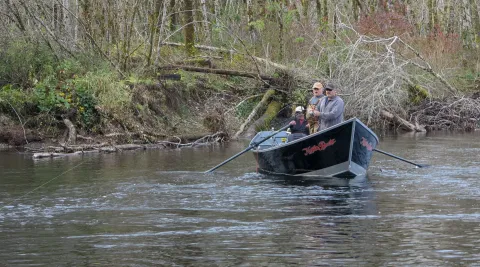
Slowly drifting along with the current until we reached the next hole, I heard a splash along the shoreline. Looking to my right I could see the rings in the water where a fish jumped near the tall grass that lined the river. Instead of continuing on, I quickly dropped the anchor and told my fishing partner to cast his float over to the shoreline and be sure to do so a bit upstream. As the float neared where the fish jumped, it disappeared underwater and he set the hook. A large coho leaped out of the water and took off to the fast water below. All the while, line began peeling off of the reel.
That is what I love about river fishing for coho: you think you know where they are, then you find one in a spot you normally would have just rowed right by. After he fought that fish to the net, we slid it into the fish box and just looked at each other for a minute. Then we saw another boat coming down the river. The quiet discussion we had was if we should pull anchor and try to stay ahead of the other boat to get to the deep hole we were heading to first, or to stay put. Electing to do the latter, we waved as the boat went by and never said a word about the fish we just caught. Once out of sight, we cast towards the shoreline again and the float went down once more. After pulling three more fish from that grassy bank, the fish had moved on and so had we.
Normally, anglers who head to the rivers target coho with spinners or twitching jigs, and mostly concentrate in known areas for chinook with the float rods. This works well, and is what I like to do too, but I also always have the float rod ready. Last year, we were almost to the take out and I saw a fish roll under a tree. Just downstream from this overhanging branch was a fallen tree with a large root ball sticking out. I cast ahead of the branch and let it go under it, but nothing happened. Then, just before I decided I needed to get my gear out of the water, as it neared the root ball the float went under. Thinking it was part of the roots, I pulled back, hoping it would free my gear, but instead a fish jumped out of the water with my float in tow. Coho are known to be acrobatic, and I was once again pleasantly surprised to have one bite the eggs.
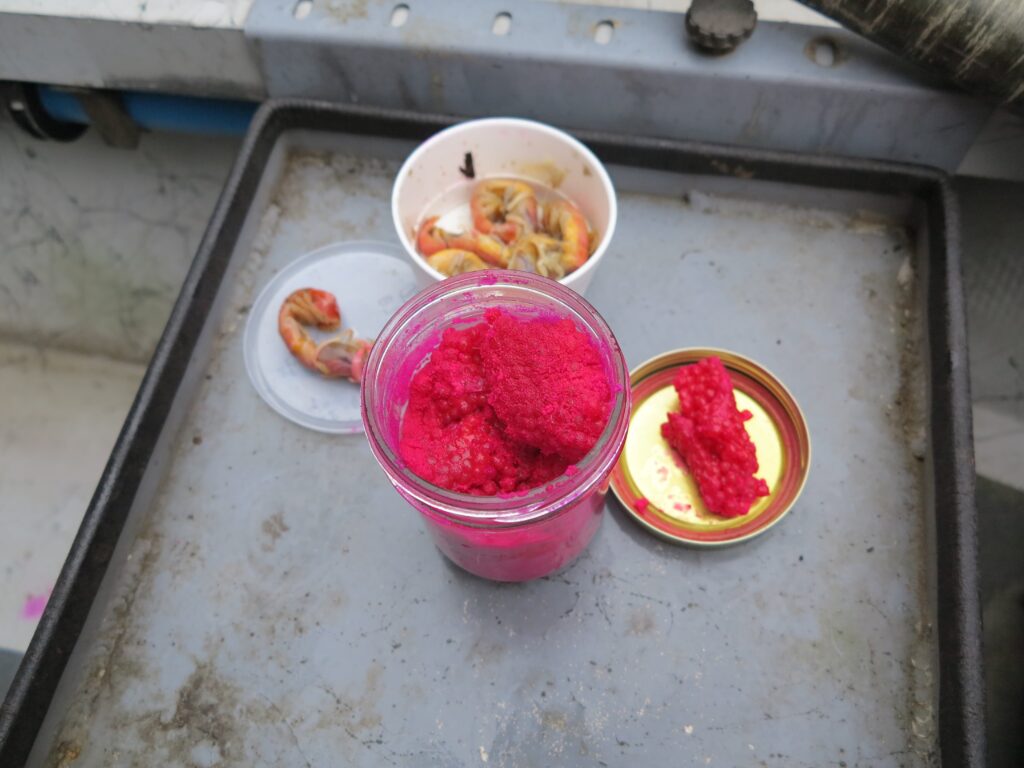
The reason why I threw a float with eggs to this fish wasn’t because I thought it was a chinook that was hiding under the tree branch that I first saw, but instead it was the only way I could fish this spot. Tossing a spinner was an option, except I didn’t have one tied on my rod. Twitching was out, as I knew that if I tried to lift the line from the water it would catch in the branch, so I threw out some eggs and it ended up being the right choice. The float would easily drift under the branch and continue down to the hazard below.
I always have a float rod rigged and ready as we make our way down the river, for this very reason. But when I come to a spot that is known to hold coho, it is time to break out the twitching rods. Deep holes often strewn with logs means coho. Knowing how to twitch is important, but also knowing where to twitch will lead to more coho in the box. For deeper holes I actually use the lightest jig possible. This means 3/8 ounce or ¼ ounce jigs if the water is very still. Twitching has been given a bad name in the past because anglers tend to foul hook fish. Most of the time this happens because the heavier jigs fall fast and end up below the fish. What the angler should do is use a jig that will fall slowly and into the fish, then when twitched will jump up in their face and again fall slowly, allowing the coho to grab it. If the jig is too heavy it often falls too fast, and when you go to twitch again you end up foul hooking the fish. By using the right weight, you not only reduce the chance of foul hooking fish, but also increase your chances of them biting.
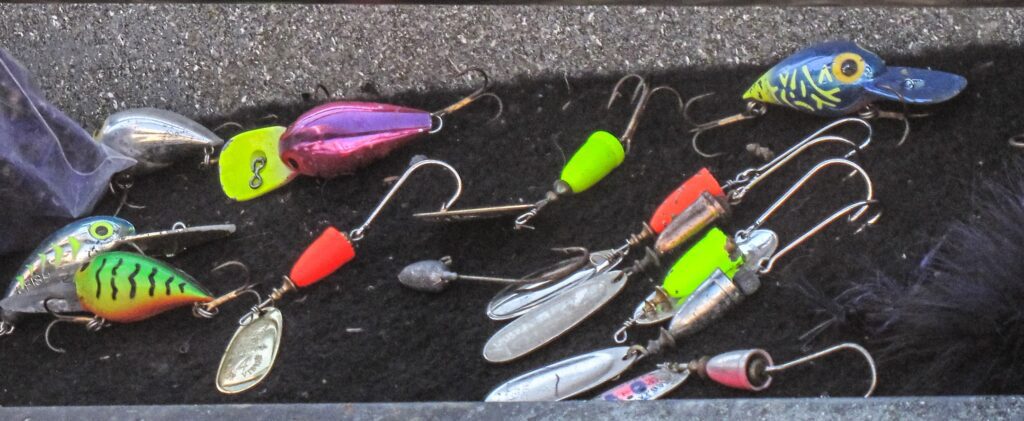
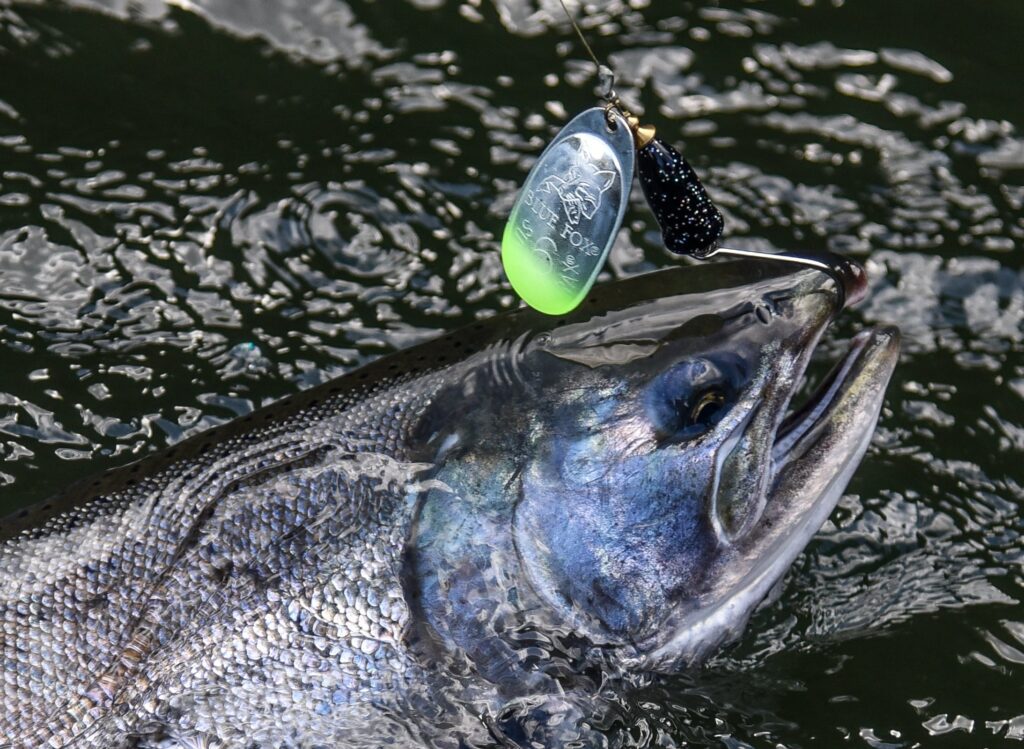
Spinners are a top technique for good reason. When fishing spinners, they are always working. A good cast into a seam, and then the swing of the spinner and the thumping of the blade reinforces the confidence of the lure to the angler. There is nothing like a hooknose coho violently grabbing your spinner and yanking the rod nearly out of your hands. There is no guessing if it is a bite, and the fight is on right away. Spinners also work well in different water conditions. Several years ago, we were fishing during a hard rain. The water was getting murkier by the minute, and after the bite seemed to go off on twitching jigs we began throwing spinners. That thumping silver blade reflecting the sunlight was all it took to get the bite back on again.
On sunny days, try using a dark bladed spinner, or alter the ones you have with a black permanent marker. Dark bodies like black and purple tend to do well, but on dark days or in murky water try chartreuse or fluorescent orange bodies. A Blue Fox Vibrax spinner in sizes 4, 5, and 6 are top producers for fall coho.
Knowing when to go and which river or part of river to fish will lead to more success. A couple of years ago we were going to hit my favorite Olympic coast river for the opener on September 1st. Normally this time of year the river is running as low as it will get all year, but that night a rainstorm approached. The river went from 400 cfs to over 3,000 cfs in twelve hours. Waking up and seeing the brown murky water flowing quickly, we should have canceled for the day. Instead, we launched the boat and had a nice ride down the river, and a fast one at that. We didn’t touch a fish or see another boat all day. Returning a few weeks later, that same run was back to normal and we caught fish.

This particular river has several access points and can be broken down to three main runs. The upper run is usually unfishable until October, when the rains fill the banks and make it floatable. That part of the river is where we should have gone to that day. The middle section is good almost all of the time, but offers very few holes which tend to get crowded early in the day. The lower part is tidal influence, so not only do you need to keep an eye on the river flows, but also the tides.
Fishing tidal waters is often overlooked by anglers. Fish only stack up here when there is a really low tide and that can also be at different times of the day. Personally, I prefer to fish tidal areas because they are predictable. You know that with each tide a new push of fish will come in. I try to time it to fish as the high tide is over and water is pushing out. This is best when it is mid-day to late afternoon, because most anglers will want to be on the water at daylight. Instead, I like to fish “clean up” or after everyone else has gone down the river. The fish fresh from the salt haven’t been harassed all day and anglers are gone, often leaving me in holes all to myself.
If you don’t have a choice but to head to the river early, then remember that during high tide fish will be on the move. This is a good time to drop anchor and let the fish come to you. One year during a high tide time, we sat on the anchor for several hours, casting jigs to a small pocket along the shoreline. This area had a back eddy and the moving fish would stack up here to rest. When they showed up, we would catch a fish, and when they moved on we would take a break. One way to keep fishing during times when fish are moving is to throw out diving plugs or plunk. Plunking tends to be a lost art, but the idea is to cast out and let your lure or bait sit in a spot where the fish will come along at some point and bite it. Why not do it from a boat while taking a break, as this will lead to more fish and it is a great way to know when fish are arriving.

There are a lot of ways to catch coho in rivers, and learning to fish them all not only adds to the experience but also keeps you engaged in fishing. Once you learn to twitch, then learn to float eggs, and then throw spinners. Discover where the holes are and where to fish when the tide is in or out. Best of all, most of the river conditions and routes will change each year, so each time you go to the river it is like learning a new spot all over again. Just like when we were drifting along that grassy cutbank and heard that fish jump; you never know where you will find coho, and that is what makes river fishing for them so fun.
/articles/river-coho
My Favorite Fall Coho Techniques
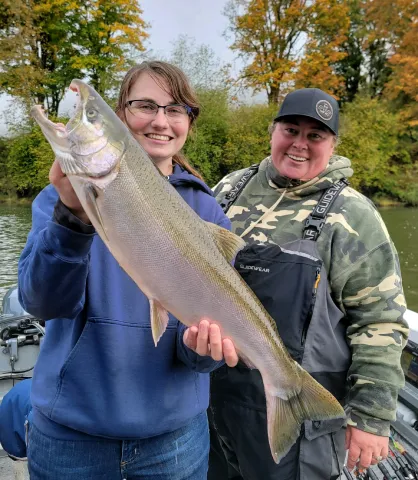
Even though the end of the year is approaching, don’t put away your salmon fishing gear just yet. There are still plenty of rivers teeming with coho salmon right now! These days, there are many different techniques you can use to catch fish on any river. Versatility is important, and river conditions change day by day. I recently went on a guided trip with Brianna Bruce of Livin’ Life Adventures. When we got to our spot, she told us that we would each be fishing a different method. The fish had been hitting different things every day. One day, they only wanted spinners. Another day, they wanted spoons. She began distributing rods- one of us fishing plugs, the other spinners, and so on until we were all casting and hoping to get lucky.
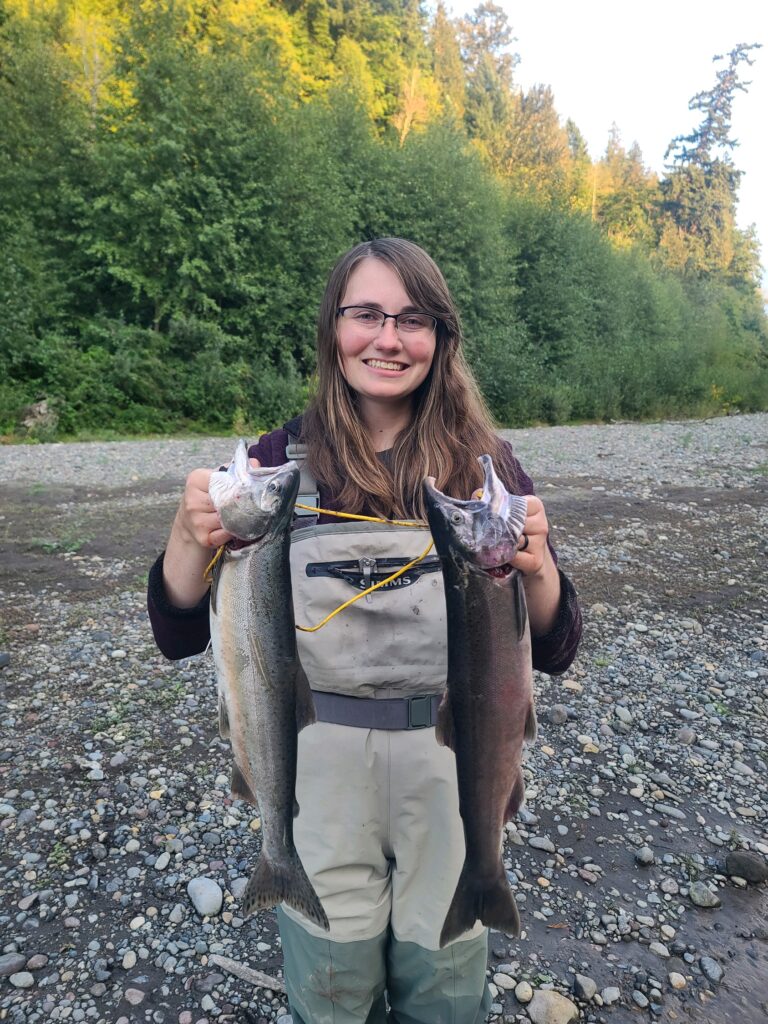
After about 20 minutes of this, another guide motored by on the way back to the launch with their limits. He told Bree that he had gotten all of his fish on eggs! She quickly began switching all of our rods to egg setups. Another hour later, we were back at the boat ramp with huge smiles and limits of dime-bright coho. If she hadn’t brought eggs along, we may have all ended up skunked! Versatility is crucial! Most days when I go river fishing, I carry 3 rods: a twitching rod, a float rod, and a spinner rod. I spent a lot of time getting familiar with each technique and when and how to deploy them. Let’s dive into how and why I use these techniques.
Technique 1: Twitching Jigs
If I had to pick one way to fish for coho, I would have to go with twitching jigs. They are extremely adaptable- I can fish any type of water with a twitching jig. There’s something so satisfying about seeing a big fish dart out of cover to grab your jig. Make sure to vary your jigging speed and length depending on the structure, depth, and speed of the water. Some days, you can let the jig sink to the bottom of a deep hole before you start jigging. Other times, you’ll want to do short jigs as soon as your lure hits the water. There’s no one way to twitch a jig. Color matters! I’ve had days where I fished one color for 30 minutes with no luck, and then hooked a fish on the first cast after switching colors. Most of the time, I use a 3/8 or 1/2 oz jig. My favorite colors are blue/black and pink/green. My twitching rod is a stout 7’6 rod with fast action. It has an extremely sensitive tip so I can feel those subtle bites, and the backbone to back up my hook sets. I pair it up with a size 3000 spinning reel. I use light reels to help avoid wrist fatigue. You can twitch jigs with longer, heavier rods, but I like my 7’6 rod because it translates even the smallest flicks of my wrist to the jig. I never hit the river without my twitching rod! There is a bit of a learning curve, as most fish will pick up your jig on the drop. You might feel the line tighten, or you may feel nothing at all. Most fish won’t simply grab the jig and take off. The majority of bites are subtle. Watch your line and pay attention to how it moves. It pays to fish high visibility braid so you can see exactly where your line is and what it’s doing in the water. Give twitching jigs a try, you’ll be hooked!
Technique 2: Spinner Rods
If I can’t get a fish to bite on twitching jigs, I’ll switch to my spinner rod. This is my 9ft, fast-action, moderate power rod, rated to throw up to an ounce of lead. It has the springiness to be able to launch spinners across long rivers, but the backbone to bring a monster coho to the shore. I often start off beginner river fishermen with spinners because bites are hard to miss. There are two types of spinners, and they both fish differently. Heavy-bodied spinners sink right away and can be cast perpendicular to the opposite shore. Light-bodied or unweighted spinners don’t sink as quickly and are better for shallow rivers. You can cast them out and swing them into the current like a spoon. Keep your rod tip low and reel slowly. Make sure to do 1 or 2 solid hook sets to really drive that barbless hook into the fish’s mouth. In murky water like the Carbon or Puyallup River, I’ll go with a bright-colored spinner, like chartreuse or pink. On clear, coastal rivers, I’ll fish a silver or copper-colored spinner. It never hurts to try something different, though! Don’t forget to pinch your barbs and switch out the treble hook to a single hook if required.
Technique 3: Floating Eggs
My third go-to technique for fall coho fishing is floating eggs. This technique isn’t very well suited for combat fishing, but if you can find a patch of slow-moving water all to yourself, this is a great way to get finicky coho to bite. Floating eggs is a relaxing way to spend the day. You tend to lose a lot less gear, and watching your bobber is therapeutic. You’ll want a 10ft to 11ft rod and 3000/4000 size spinning reel. Don’t use gear you don’t mind getting egg dye on! You can either use store-bought eggs or experiment with curing your own. I usually bring along 2 or 3 different recipes when I fish eggs. Sometimes the fish want pink eggs, other days they like red. You can experiment with adding different scents to your eggs, like tuna or herring. No matter how good your eggs are, you want to make sure you’re fishing them correctly, however. Experiment with your leader length by moving your bobber stopper until you’re hitting the bottom. Then, move it up 6 to 12 inches. That’s where the fish will see it, and, hopefully, bite it. Don’t forget to mend your line by lifting it up off the water and behind your float. This is where a long rod can come in handy, but it can make it difficult to fish in water with lots of overhanging trees and bushes. Float fishing is a highly situational technique, but it can be very deadly.

There you have my top three favorite fall coho techniques. When getting to my spot, I like to sit and watch the water for a few minutes to determine which technique to use. Floating eggs isn’t always possible if the river is flowing quickly. Similarly, when I’m fishing frog water, using a spinner can be difficult. The deep and slow water makes it difficult to reach the fish hugging the bottom. I find that it’s extremely important to be able to adapt to any condition. However, there are days when I want to challenge myself or get better at a technique and I’ll only bring out one pole. This is how I taught myself to be able to use twitching jigs in any situation. If you haven’t tried any of these techniques, hit the water and give it a shot. Make sure to read your rules and regulations, especially emergency ones. Hope to see you all out there!
/articles/my-favorite-fall-coho-techniques