Ten Rules of Coho Trolling by Mike Carey
It’s coho time in the Sound, with resident coho open, and soon the ocean runs will start showing up. Fishing for these silver bullets will only get better, peaking in early September.
With that in mind, I was looking back through previously released articles and found this helpful article I wrote several years ago. The time has passed, but the rules still hold true. And while I won’t be fishing the Sound this year, my thoughts will be with anglers throughout the Pacific Northwest enjoying this special fishery.
So here are my “Ten Tips” to help you catch more coho this year!
September is a special time for me. Like the change in the weather, I can feel a change in myself, a pent-up anticipation that has slowly been building over the summer and, like clockwork, bursts forth in full bloom. It’s coho time in Puget Sound! Yes, this is a great time of the year to be a salmon angler in Puget Sound, if the runs are strong and the fishing is open.
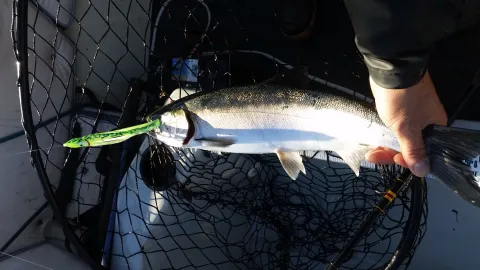
Looking at my fishing report data from trips going back twenty years, it becomes pretty obvious that September is the time to put away freshwater gear and focus on salmon. August can be productive, but September can be (and often is) lights out. My reports show multiple trips with limits by 9 am, red-hot fishing, and lots of pictures of shiny chrome coho. As the season progresses into later September, the fish show a steady increase in size. By late September to early October, the 6-8 pound coho are replaced by beautiful 10-14 pound hooknose monsters. It’s the time of year to stock up the freezer on tasty coho!
For those new to this fishery, you’ll find a wealth of information on techniques and locations scattered on the web. I've broken down some of my thoughts on coho trolling into Ten Rules of Coho Trolling.
Coho tend to be pretty cooperative salmon when it comes to catching them. As these fish stream in from the ocean, heading through the Strait of Juan De Fuca and into Puget Sound, they are putting on the feed in preparation for their runs up to the spawning grounds.
It’s not unusual to find coho stuffed with herring. Don’t get me wrong, there are days they, like other salmon, will have lockjaw. But that truly is the exception, not the rule. Speaking of rules, I offer a list of rules I’ve developed over the years to catch more coho. You’ll likely have your rules to add to this list. Or you may disagree with some of them. But hopefully it will give you some additional ideas when targeting coho in the Sound.
Rule #1
As Russell Wilson would say, “Separation is in the preparation”. - When you put your boat in the water, you should have everything ready to go. No fiddling around with gear or bait the morning of a trip. My fishing ritual is to have everything ready to go the night before.
It’s like a general plan for battle. My rods are ready and geared up. My bait has been cut and cured. My boat is prepped and clean, batteries are charged, the gas tank is full, snacks are bought, and there’s ice in the coolers for the fish.
This evening before prep time is actually a ritual I cherish because, like Russ, I’m visualizing success and making a plan in my head. I try to never go fishing without a plan.
Rule #2
Start early, go shallow. - I try to be on the water as early as possible. Ideally, that means running lights on and gear going in the water while it’s still dark or just turning light. I will run my gear in the top 10-30 feet of water to start.
This is the time of day when a salmon fly in the prop wash can be deadly. I like Arctic Fox Trolling Flies. Denis Peirce ties a nice fly in a variety of effective salmon colors. Try running the fly back 40-50 feet and troll fast (more on that later) with the fly practically skipping on the surface.
Just be sure to have the clicker on the reel because these strikes can be vicious. I love the sound of a clicker going off in the morning!
Rule #3
Watch your fish finder, drop your depth – As the morning progresses, drop your downriggers down. I’ve read the “rule of thumb” is ten feet every hour until you’re trolling your gear around 40-60 feet. That’s fine, I guess, but I also use my fish finder. If I see bait and fish marks down 50-70 feet, I’ll drop down to those fish even if it’s early in the morning. As the day goes on, I may even drop my downrigger ball down to 110-120 feet deep. Depth can be a tricky thing because when coho fishing, I troll fast, which leads us to the next rule.
Rule #4
Troll fast! - In my experience, coho love a fast troll. I have an i-Troll throttle control and will set it on “hunt” mode to keep my boat going fast, around 3.3 to 3.9 mph. A few years back I did a lot of underwater filming and noticed a distinct increase in salmon aggression when the flasher was whipping around in a complete rotation. If it was only doing a lazy rotation, or not doing a full rotation, coho would tend to swim behind the gear, just watching. But speeding up and getting that flasher fully spinning would elicit vicious strikes. I will troll both with and against the tide and catch fish going both ways.
Just be sure to increase your throttle going into the tide to maintain that 3.5 mph speed. I’ll also program my i-Troll to give a periodic 3-5 second slowdown and then speed back up to “wake up” coho that may be lazily following but not biting. It can often trigger a bite. Oh, another thing that will often trigger a bite – if you’re checking gear, pop your line off the release and set the rod in the rod holder. Let the gear come up on its own. I have caught a lot of coho that will chase the gear as it ascends to the surface. Don’t reel your gear in until it hits the surface.
Rule #5
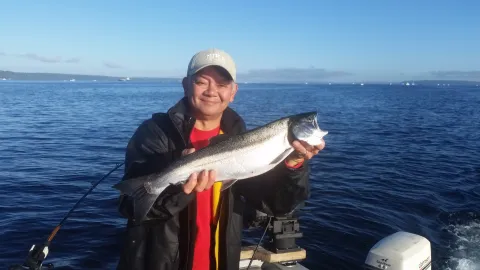
Coho are hungry; feed them! - Coho love a strip of herring on just about any lure. I will add strips to hoochies, flies, and even a small strip on the hook of a spoon (but not too much; you don’t want to kill the spoon’s action). Be sure to brine the herring strips a day ahead of time in rock salt and/or commercial herring brine. Add scents and bite enhancers as well. Check your gear every 20-30 minutes and freshen up with a new herring strip. If you get a bite but no release, bring it in and check it! The one exception to this rule I have is if the dogfish are in thick, I will go without bait.
Rule #6
Experiment – My “go-to” setup is a magnum green splatter glow hoochie, herring strips, 26-30” leader, and an 11” dodger (pick your color…). I always start with this setup. On a second rod, I may run a different color and smaller hoochie. If there is no action and I am seeing fish on the fish finder, I will start trying spoons and plastic lures like the old Big Al’s Cripple Herring. Sometimes the coho just want something with more action. This year, I’m going to be trying the new Old Goat OG2 5” salmon lure. The Old Goats have been awesome on kokanee, and I think they will be deadly on coho. They have an amazing action that I think coho will love.
Rule #7
Fish Where They Ain’t (anglers that is) – coho in Puget Sound can be found pretty much anywhere. We all have favorite starting locations, and it’s human nature to follow the crowds of boats because “hey, they must know something I don’t”. Maybe…and maybe not. I try to start my troll away from clusters of boats. Why be surrounded by additional lures in the water? You want to troll over fish that aren’t seeing offerings non-stop. So, move away from everyone else – and if you take my advice and troll fast, you will, very quickly.
You’ll still find the fish if they are there, and cover more water to find the biters. When you do, don’t be afraid to mark the fish on your fish finder and troll around and right back over the same spot. Again, in viewing underwater footage, I invariably see groups of 4-6 coho following my gear. A solo fish is very rare. So, work over those spots when you pick up a fish.
Rule #8
Midday and tide changes are good – I know I said earlier I like to hit the water at daybreak, but there are days when that just doesn’t happen. The good news with coho is that it doesn’t matter. You can (and will) catch coho all morning and into midday. Tide bites are the period before and after a low or high tide, and these times can be very productive. My favorite tide sequence is a high tide at around 9-10 a.m. The flood tide pushes fish, and as the tide slows down, it triggers a feeding opportunity below for the coho salmon.
Bait becomes easier to pick off without a steady flow of water, and the coho bite often turns on. If you miss that crack of dawn bite, fear not; the coho will cooperate. I’ve caught my biggest hooknose fish from 11 am to 1 pm.
Rule #9
Playing and netting your fish – OK, you have a big fish on and are trolling at 3.5 mph. What do anglers often do? Why, slow down, of course. Bad move. In today’s age of barbless hooks, slowing down is an invitation to let the fish go. The second there is slack in that line, the hook can slip out. Trolling for coho is not a fishery that is about the fight; it’s about catching fish. If you want an epic battle against coho (and they are a hoot), catch them in rivers, or mooch for them. Trolling with an 11” flasher gives these fish a focal point with which they can get slack line.
We don’t want to do anything to help them out, like slowing down. Once they are on the surface, do your best to keep the flasher out of the water. This will help prevent the fish from getting slack line between the hook and the flasher. Make sure you have a net with a long handle and a big opening. This will help as the netter reaches out. Remember, the netter scoops as the angler guides the fish into the net. Don’t make the mistake of the netter reaching to net the fish! Once the fish is close to the boat, slowing down a bit is OK, by the way- just keep that flasher out of the water.
Rule #10
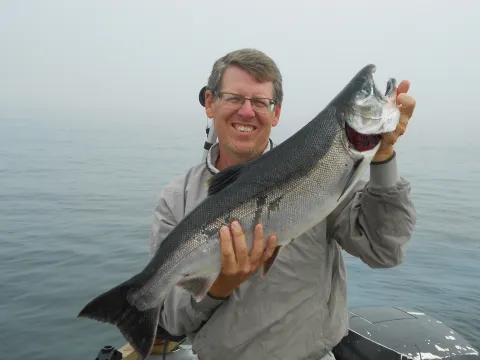
Take good care of your fish – Non-anglers have no idea what freshly caught salmon tastes like. As anglers, we are blessed to be able to have the freshest salmon on the planet. So, take good care of your caught fish. Bonk the fish enough to stun it, then cut a gill and bleed the fish out for a few minutes.
After that, into the ice cooler it goes.
Don’t hang it off the side of the boat to bake in the sun. At the end of the day, gut and cut into steaks, or fillet the fish. If possible, vacuum-seal whatever fillets you don’t eat for dinner. Properly cared for, you’ll have tasty fish until the next season, when you get to do it all over again!

/articles/ten-rules-coho-trolling-mike-carey
Tossing Hardware for Coho
November is here, bringing chilly winds and icy rains. Although the year is almost over, the good news is that the coho run is not. Many rivers, coastal ones in particular, hold late-running fish from November well into December and January. But how do you get these fish in your cooler?
Bait has its time and place. For picky A run fish in clear, low water conditions, eggs are king. November is the perfect time to start using hardware for these big and aggressive B-run fish. Let's go over how to use spinners and spoons for these late B run coho.
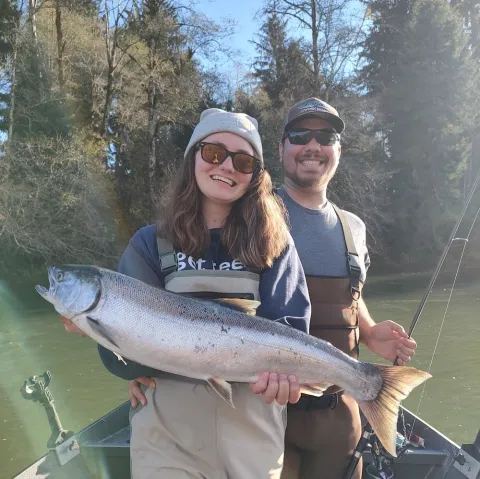
Spinners
If I had to pick my favorite way to fish for coho, it would be throwing spinners. The takedown is aggressive, and there is no question when you have a fish on. Spinners are a great way to search for fish when you aren't sure where they are holding. Cast and retrieve in a spot several times, then walk down 10 steps and repeat until you get a bite. Late-run fish are more aggressive and more likely to strike a well-presented spinner. It's a good idea to bring weighted and unweighted spinners. Make sure to use a bead chain or two attached to a snap swivel so you can change between the types of spinners easily. Unweighted spinners such as Wicked Lures can be fished with a variety of different inline weights according to the depth and speed of the run you're at, making them incredibly versatile. I carry inline weights between 1/4 oz and 1/2 oz. Wicked Lures come in a variety of different colors and sizes. I like the pink/green ones as well as the black/pink ones for most conditions.
Alternatively, weighted spinners such as Blue Foxes are a great option as well. Use small, dark size 3 spinners in clear conditions, and bright size 5 or 6 spinners in murky conditions. Fish will chase down spinners and aggressively chomp them, making for a fun fight. Vibrax spinners have a lot of drag and tend to ride higher in the water column than torpedo spinners. Use the right spinner for the conditions!
Spoons
Much like spinners, spoons are an effective way to search the run for aggressive fish. Spoons can be fished a multitude of ways for coho. You can drift small spoons like Dick Nites or throw larger ones, like Little Cleos and Kastmasters. Smaller spoons wobble and dart when drifted like a cork and a yarn. Many northern Puget Sound anglers use this technique with great success. Use a 3-6ft leader and don't change out the hook- no matter how tempting it is! Bigger hooks would change the action of the spoon. The stock hook works just fine as long as you don't horse the fish in. Cast upstream and follow the drift with your rod tip, using just enough lead to tick the bottom every few seconds. It takes some patience and time to learn what a bite feels like. It can be subtle, so don't wait to set the hook until you feel headshakes.
For larger spoons, it's tempting to fish them like a spinner, but the technique is slightly different. Cast upstream and allow your spoon to sink. Point your rod at the spoon and mend your line as it drifts downstream. Feed out the line as necessary to keep the spoon slowly wobbling near the bottom. The action drives coho crazy! The takedown is much like a spinner bite- aggressive and unmistakable. 50/50 colors work well in most water conditions. It's a good idea to keep a variety of different spoon shapes and colors to see what the fish key in on. Every day is different, and every fish is different.
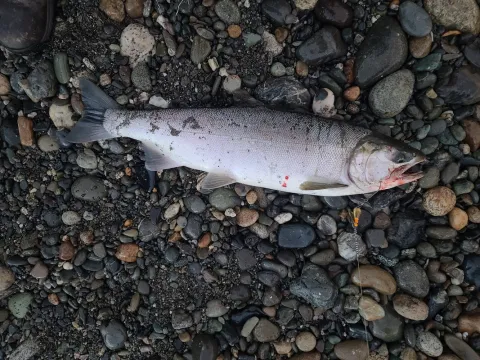
Setups
Rods and reels for hardware fishing tend to be based mostly on personal preference. While some anglers prefer to use a heavier, shorter rod, I like to use a light and long noodle rod. I find that these absorb the headshakes and jumps much better than a short, stiff rod. They also allow me to cast light spinners when the conditions call for it. Pair your rod with a size 3000 to 4000 reel.
I highly recommend using braided line with a monofilament top shot. This allows you to have the sensitivity of braid, but if you break off, you'll leave monofilament in the river instead of braid, which will break down much sooner. 8-17lb rated rods work great, but I've used 6-12lb rods as well. Use at least an 8ft rod. For my leader line, I use 10-15lb fluorocarbon. I find it has good abrasion resistance but also looks almost invisible in the water. Tighten your drag, but loosen it up after your hookset. Remember, these B run fish are big, hook-nosed brutes. You're in for a fun fight!
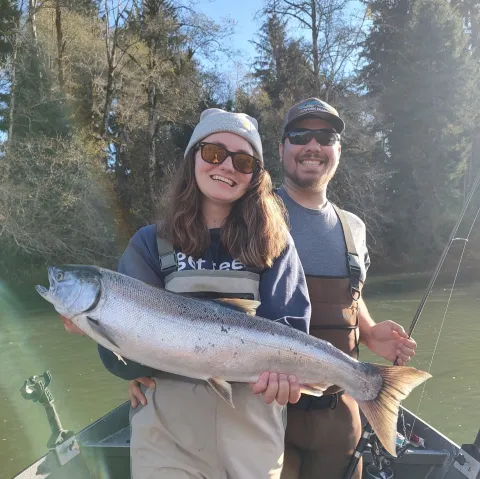
Now is the time of year to perfect your hardware technique for those large, aggressive B-run coho. Spinners and spoons can be used in both slow and fast water, making them a versatile technique. Not every river is open in November, so make sure to check both the regulations and emergency rules before heading out. Pinch those barbs or buy barbless hooks if required; it never hurts to double-check. The Fish Washington app is a great resource!
/articles/tossing-hardware-coho
Coho Craziness
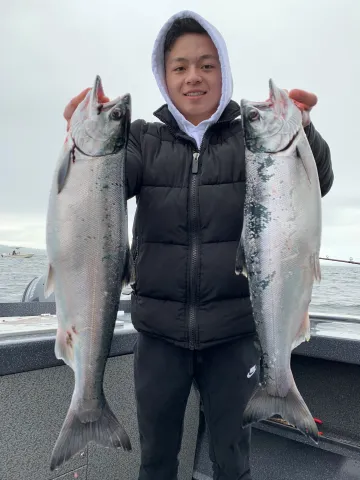
As we head into September, the color of salmon switches from pink to silver around Puget Sound.
The front end of the migratory coho run – also known as silvers for their shiny silvery-colored body – began to filter into the western Strait of Juan de Fuca and Puget Sound in August, and are expected to peak throughout September and early October.
Coho aren’t large – usually averaging 4 to 15 pounds, with some exceeding the 20-plus pounds – but they often put up a good tussle. Young coho spend a year in rivers and estuaries and then migrate out to the Pacific Ocean to feed and grow. They spend about 1½ years in the ocean, then return to spawn as three and four-year-old fish, generally in fall or early winter.
Puget Sound coho returns have gradually made a comeback from a downtrend that began in 2015 and 2016. This was due to negative environmental factors like drought, flooding, and warm water temperatures in their freshwater habitat as juveniles and then in the Ocean from a condition known as El Niño, when surface water becomes warmer than average.
The combined 2025 Puget Sound hatchery and wild coho forecast is 727,490 compared to 722,134 in 2024; 760,029 in 2023; 666,317 in 2022; 614,948 in 2021; and 504,604 in 2020.
Coho fill the air with enthusiasm for their leaping abilities when hooked, and unpredictable movements across the water’s surface.
A positive signal of 2025 expectations began with the good fishing for resident coho, who mainly spend their entire life feeding and growing in local waters –
caught in Marine Area 10 (Seattle and Bremerton Area) from June to early August. Many of these coho have grown since then and will join their larger migratory coho relatives during the late summer and fall marine fisheries.
Knowing when it is “go fishing time” for migrating coho in Puget Sound is to monitor catch rates in the Strait of Juan de Fuca at Marine Area 5 (Sekiu and Pillar Point) and Marine Area 6 (East Strait of Juan de Fuca).
The Marine Area 5 salmon fishery is open daily through Sept. 26 with a two salmon daily limit, plus two additional pink may be retained, and release Chinook, chum, sockeye, and wild coho. The area is then open daily for coho from Sept. 27 to Oct. 9 with a two salmon daily limit, release Chinook, chum, and sockeye.
The Marine Area 6 salmon fishery is open daily through Sept. 26 with a two salmon daily limit, plus two additional pink may be retained, and release Chinook, chum, sockeye, and wild coho. The area is then open daily for coho from Sept. 27 to Oct. 15 with a two salmon daily limit, release Chinook, chum, and sockeye.
Oftentimes, the best coho fishing in the Strait of Juan de Fuca occurs offshore in the shipping lanes, which is the main migration path. These deep-water areas are about one to 10 miles out in 200 to 500 feet of water and sometimes even deeper off the edge of the main shipping channels. Remember to stay within the U.S. side of the shipping lane. Look for tide rips and current breaks where krill and schools of baitfish attract coho, and watch for coho jumping and rolling on the surface.
In the eastern Strait of Juan de Fuca, the Dungeness Bay hatchery coho fishery is open from Oct. 1 to 31. The 2025 Dungeness River coho forecast is 13,328, down slightly from 14,305 in 2024 and 14,654 in 2023.
The Marine Area 7 (San Juan Islands) coho season is open daily through Sept. 6 with a two salmon daily limit, plus two additional pink may be retained, and release Chinook, chum, sockeye, and wild coho. The area is then open daily for coho from Sept. 7 to 30 with a two salmon daily limit, plus two additional pink may be retained, and release Chinook, chum, and sockeye. In Marine Area 7, look for coho staging along the western and southern portions of the island chain.
Coho fishing in Marine Area 8–1 (Deception Pass, Hope Island, and Skagit Bay) is open daily, Sept. 30, with a two salmon daily limit, plus two additional pink may be retained, and release Chinook and chum. Coho fishing is then open daily Oct. 1 to 12 with a daily two salmon catch limit, and release Chinook and chum.
In Marine Area 8–2 (Port Susan and Port Gardner), coho fishing is open daily through Sept. 24 with a two salmon daily limit, and release Chinook, chum, and pink. The Tulalip Bay Terminal Area Fishery has rules that differ from Marine Area 8-2. For details, check the Washington Department of Fish and Wildlife (WDFW) fishing regulations webpage at https://wdfw.wa.gov/.
In Marine Areas 8-1 and 8-2, anglers should find coho along the entire eastern side of Whidbey Island, Possession Point, off the Clinton Ferry Terminal, the Langley/Sandy Point area, Shipwreck to Mukilteo, Hat Island, Camano Head, the entire west side of Camano Island, and outside of Oak Harbor. West Beach at Deception Pass State Park, located north of Oak Harbor on Whidbey Island, provides excellent shore fishing access.
Moving further into Puget Sound, Marine Area 9 (Admiralty Inlet) is another decent fishing location for hatchery-marked coho, which is open daily through Sept. 30. It has a two salmon daily limit, plus two additional pink may be retained, and release Chinook, chum, and wild coho.
In Marine Area 9, focus your fishing time in the unmarked shipping lanes where tide rips and current breaks are commonly found. Try Midchannel Bank off Port Townsend; Point Wilson north of Port Townsend (good public shore access); east side of Marrowstone Island (some shore access); Fort Casey to Bush Point and Lagoon Point (some public shore access); Double Bluff off the west side of Whidbey Island; Point No Point (excellent public shore spot); Possession Bar; Scatchet Head; and Pilot Point.
In Marine Area 10 (Seattle and Bremerton Area), coho fishing is open daily through Sept. 30 with a two salmon daily limit, plus two additional pink may be retained, and release Chinook and chum. Fishing is also open daily from Oct. 1 to Nov. 15 with a two salmon daily limit, and release Chinook.
In Marine Area 11 (Tacoma and Vashon Island), coho fishing is open daily through Sept. 30 with a two salmon daily limit, plus two additional pink may be retained, and release chum and wild Chinook (note, the Chinook fishery may close sooner so check the WDFW fishing regulations webpage for updates. Fishing is also open daily from Oct. 1 to Nov. 15 with a two salmon daily limit, and release Chinook.
Look for coho in the deep-water shipping lanes off Jefferson Head to Kingston, Richmond Beach to Meadow Point near Shilshole Bay, Point Monroe, Shilshole Bay south to West Point, Elliott Bay, the Fauntleroy Ferry area southeast to Dolphin Point, both sides of Vashon Island, Redondo Beach to Dash Point and the Tacoma area of Commencement Bay, Browns Point, and Point Defiance Park from the Slag Pile to the Clay Banks.
Two popular events tied to the arrival of coho are the Edmonds Coho Derby on Sept. 6. For details, go to http://edmondscohoderby.com/. That will be followed by the Everett Coho Derby on Sept. 20-21. For details, go to https://everettcohoderby.com/.
Marine Area 13 (South Puget Sound) is open daily for hatchery-marked coho through Sept. 30 with a two salmon daily limit, plus two additional pink may be retained, and release chum, wild coho, and wild Chinook. Fishing remains open daily beginning Oct. 1 with a two salmon daily limit, and release chum, wild coho and wild Chinook.
In Marine Area 13, look for coho from the Narrows Bridge south to Anderson Island. The Squaxin Island area has become popular area for those targeting coho. The 2024 Squaxin Island net pens coho forecast is 59,596 up from 48,081 in 2024 and 45,417 in 2023.
If you’re looking for a Chinook and coho option try the Bellingham Bay Terminal Fishery open daily through Sept. 30 with a daily limit of four salmon.
Sinclair Inlet and Port Orchard are open daily through Sept. 30 with a three salmon daily limit, plus two additional pink may be retained, and release chum and wild Chinook. Fishing is then open daily from Oct. 1 to Nov. 15 with a two salmon daily limit, and release Chinook.
Lastly, a freshwater coho fishing option in Seattle’s backyard is Lake Washington north of the Highway 520 Bridge, which is open daily from Sept. 16 to Oct. 31 with a daily limit of four coho only, and release all other salmon species. The Lake Washington coho forecast is 28,112 up from 24,090 in 2024 and 21,554 in 2023.
In the October issue, we’ll switch gears and take a look at proposed fall and winter coastal razor clam digging opportunities.
I’ll see you on the water very soon!
/articles/coho-craziness
Ten Rules of Coho Trolling
By Mike Carey
September is a special time for me. Like the change in the weather, I can feel a change in myself, a pent up anticipation that has slowly been building over the summer and like clockwork bursts forth in full bloom. It’s coho time in Puget Sound!
Yes, this is a great time of the year to be a salmon angler in Puget Sound, if the runs are strong and the fishing is open. Last year was unique in that we had closures in the ocean and straits. The coho arrived to Puget Sound in good numbers and virtually unmolested.
This year was questionable what kind of a season we would be given. As of this date, coho is open in areas 8.2, 9, and 10. Check the regs and emergency closures for updates of course. As it stands the daily limit is two coho.

Looking at my fishing reports data from trips going back twenty years, it becomes pretty obvious that September is the time to put away freshwater gear and focus on salmon. August can be productive, but September can be (and often is) lights out.
My reports show multiple trips with limits by 9am, red hot fishing, and lots of pictures of shiny chrome coho. As the season progresses into later September, the fish show a steady increase in size.
By late September to early October, the 6-8 pound coho are replaced by beautiful 10-14 pound hooknose monsters. It’s the time of year to stock up the freezer on tasty coho!
For those new to the fishery, you’ll find a wealth of information on techniques and locations scattered on the web. I've broken down some of my thoughts on coho trolling into Ten Rules of Coho Trolling.
Coho tend to be a pretty cooperative salmon when it comes to catching them. As these fish stream in from the ocean, heading through the Strait of Juan De Fuca and into Puget Sound, they are putting on the feed in preparation for their runs up to the spawning grounds.
It’s not unusual to find coho stuffed with herring. Don’t get me wrong, there are days they, like other salmon, will have lock-jaw. But that truly is the exception, not the rule. Speaking of rules, I offer a list of rules I’ve developed over the years to catch more coho.
You’ll likely have your rules to add to this list. Or you may disagree with some of them. But hopefully it will give you some additional ideas when targeting coho in the Sound.
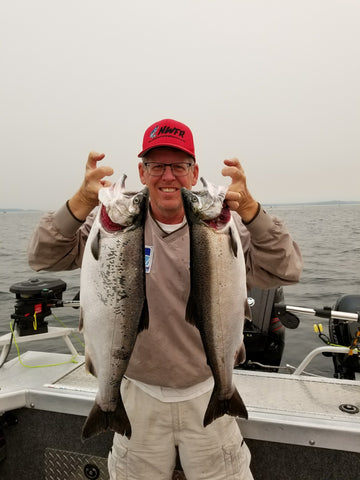
Rule #1
As Russell Wilson would say, “Separation is in the preparation”. - When you put your boat in the water, you should have everything ready to go. No fiddling around with gear or bait the morning of a trip. My fishing ritual is to have everything ready to go the night before.
It’s like a general planning for battle. My rods are ready and geared up. My bait has been cut and cured. My boat is prepped and clean, batteries are charged, gas tank is full, snacks are bought, there’s ice in the coolers for the fish.
This evening before prep time is actually a ritual I cherish because like Russ, I’m visualizing success and making a plan in my head. I try to never go fishing without a plan.
Rule #2
Start early, go shallow. - I try to be on the water as early as possible. Ideally, that means running lights on and gear going in the water while it’s still dark or just turning light. I will run my gear in the top 10-30 feet of water to start.
This is the time of day when a salmon fly in the prop wash can be deadly. I like Artic Fox Trolling Flies. Denis Peirce ties a nice fly in a variety of effective salmon colors. Try running the fly back 40-50 feet and troll fast (more on that later) with the fly practically skipping on the surface.
Just be sure to have the clicker on the reel because these strikes can be vicious. I love the sound of a clicker going off in the morning!
Rule #3
Watch your fish finder, drop your depth – As the morning progresses, drop your downriggers down. I’ve read the “rule of thumb” is ten feet every hour until you’re trolling your gear around 40-60 feet. That’s fine, I guess, but I also use my fish finder.
If I see bait and fish marks down 50-70 feet, I’ll drop down to those fish even if it’s early in the morning. As the day goes on I may even drop my downrigger ball down to 110-120 feet deep.
Depth can be a tricky thing because when coho fishing I troll fast, which leads us to the next rule.
Rule #4
Troll fast! - In my experience, coho love a fast troll. I have an itroll throttle control and will set it on “hunt” mode to keep my boat going fast, around 3.3 to 3.9 mph. A few years back I did a lot of underwater filming and noticed a distinct increase in salmon aggression when the flasher was whipping around in a complete rotation.
If it was only doing a lazy rotation, or not doing a full rotation, coho would tend to swim behind the gear, just watching. But speeding up and getting that flasher fully spinning would elicit vicious strikes. I will troll both with and against the tide and catch fish going both ways.
Just be sure to increase your throttle going into the tide to maintain that 3.5 mph speed. I’ll also program my itroll to give a periodic 3-5 second slow down and then speed back up to “wake up” coho that may be lazily following but not biting.
It can often trigger a bite. Oh, another thing that will often trigger a bite – if you’re checking gear, pop your line off the release and set the rod in the rod holder. Let the gear come up on its own. I have caught a lot of coho that will chase the gear as it ascends to the surface.
Don’t reel your gear in until it hits the surface.
Rule #5
Coho are hungry, feed them! - Coho love a strip of herring on just about any lure. I will add strips to hoochies, flies, and even a small strip on the hook of a spoon (but not too much, you don’t want to kill the spoon’s action).
Be sure to brine the herring strips a day ahead of time in rock salt and/or commercial herring brine. Add scents and bite enhancers as well. Check your gear every 20-30 minutes and freshen up with a new herring strip. If you get a bite but no release, bring it in and check it!
The one exception to this rule I have is if the dogfish are in thick, I will go without bait.
Rule #6
Experiment – My “go to” set up is a magnum green splatter glow hoochie, herring strips, 26-30” leader, and an 11” dodger (pick your color…). I always start with this set up. On a second rod I may run a different color and smaller hoochie.
If there is no action and I am seeing fish on the fish finder I will start trying spoons and plastic lures like the old Big Al’s Cripple Herring. Sometimes the coho just want something with more action. This year I’m going to be trying the new Old Goat OG2 5” salmon lure.
The Old Goats have been awesome on kokanee and I think they will be deadly on coho. They have an amazing action that I think coho will love.
Rule #7
Fish Where They Ain’t (anglers that is) – coho in Puget Sound can be found pretty much anywhere. We all have favorite starting locations and it’s human nature to follow the crowds of boats because “hey, they must know something I don’t”.
Maybe…and maybe not. I try to start my troll away from clusters of boats. Why be surrounded by additional lures in the water? You want to troll over fish that aren’t seeing offerings non-stop. So, move away from everyone else – and if you take my advice and troll fast you will, very quickly.
You’ll still find the fish if they are there, and cover more water to find the biters. When you do, don’t be afraid to mark the fish on your fish finder and troll around and right back over the same spot. Again, in viewing underwater footage, I invariably see groups of 4-6 coho following my gear.
A solo fish is very rare. So, work over those spots when you pick up a fish.
Rule #8
Mid day and tide changes are good – I know I said earlier I like to hit the water at daybreak, but there are days when that just doesn’t happen. The good news with coho is that it doesn’t matter. You can (and will) catch coho all morning and into midday.
Tide bites are the period before and after a low or high tide, and these times can be very productive. My favorite tide sequence is a high tide at around 9-10am. The flood tide pushes fish and as the tide slows down it triggers a feeding opportunity below for the coho salmon.
Bait becomes easier to pick off without a steady flow of water and the coho bite often turns on. If you miss that crack of dawn bite, fear not, the coho will cooperate. I’ve caught my biggest hooknose fish from 11am to 1pm.
Rule #9
Playing and netting your fish – OK, you have a big fish on and are trolling at 3.5 mph. What do anglers often do? Why, slow down the of course. Bad move. In today’s age of barbless hooks, slowing down is an invitation to let the fish go. The second there is slack in that line the hook can slip out.
Trolling for coho is not a fishery that is about the fight, it’s about catching fish. If you want an epic battle against coho (and they are a hoot), catch them in rivers, or mooch for them. Trolling with an 11” flasher gives these fish a focal point with which they can get slack line.
We don’t want to do anything to help them out, like slowing down. Once they are on the surface, do your best to keep the flasher out of the water. This will help prevent the fish getting slack line between the hook and the flasher. Make sure you have a net with a long handle and big opening.
This will help as the netter reaches out. Remember, the netter scoops as the angler guides the fish into the net. Don’t make the mistake of the netter reaching to net the fish! Once the fish is close to the boat slowing down a bit is OK, by the way- just keep that flasher out of the water.
Rule #10
Take good care of your fish – Non-anglers have no idea what a freshly caught salmon tastes like. As anglers we are blessed to be able to have the freshest salmon on the planet. So, take good care of your caught fish. Bonk the fish enough to stun it, then cut a gill and bleed the fish out for a few minutes.
After that, into the ice cooler it goes. Don’t hang it off the side of the boat to bake in the sun. At the end of the day, gut and cut into steaks, or filet the fish out. If possible, vacuum-seal whatever fillets you don’t eat for dinner.
Properly cared for, you’ll have tasty fish until the next season, when you get to do it all over again!

There you have it. Ten “Rules” that will help increase your odds of success this coho season. Have fun out there and remember to be safe, have life jackets and all the safety equipment required and needed in case something goes sideways.
Good luck fishing and I’ll see you on the water.
/articles/ten-rules-coho-trolling-0
Off The Radar
By Randy Castello
With improving ocean conditions, the Puget Sound 2022 fall coho season could be the best in recent history. 666,648 coho are forecasted to return to the Puget Sound basin. With a few exceptions our local coho fisheries (Marine Area 5-13) will open August 16th.
Following is a quick breakdown of our inside coho fisheries. Make sure to review the WDFW Fish Washington App, WDFW Washington Sports Fishing Rules pamphlet and the emergency (https://wdfw.wa.gov/fishing/regulations/emergency-rules) for current daily limits and emergency closures.
MA 5 8/16-9/28 Hatchery Only
MA 6 8/16-9/28 Hatchery Only
Dungeness Bay fishery 10/1-10/31 Hatchery Only
MA 7 8/16-8/30 Hatchery Only
Bellingham Bay 8/16-9/30 Hatchery and Wild
MA 8-1 8/1-10/1 Hatchery and Wild
MA 8-2 South and West of the Line Defined by the Mukilteo and Clinton Ferry Docks 8/13-9/19 Hatchery Only
MA 9 8/16-9/25 Hatchery Only
MA 10 Through 10/31 Hatchery and Wild
The Sinclair Inlet Fishery Through 9/30 Hatchery and Wild
MA 11 Through 10/31 Hatchery and Wild
MA 12 North Through 10/31 Hatchery and Wild
MA 12 South Through 11/30 Hatchery and Wild
MA 13 Year-round Hatchery Only
What, somebody said coho? Break out the gear, check the trailer lights and move the garbage cans out of the way. It’s time to go fishing. I think that more than any other Western Washington fishery, our local coho opportunity is an eagerly anticipated family event.
Where there are many commonly known “stock” coho fisheries, this article will focus on a few of our out of the way opportunities.
Although areas like Eagle Point off San Juan Island, Point No Point, Possession Bar, the Edmonds Oil Docks, Meadowdale Point, Jeff Head, Kingston, Des Moines, Three Tree Point, Point Robinson, and the Slag Pile off Point Defiance are all solid coho fisheries, they can get crowded.
Are there other coho opportunities? The answer is affirmative, and even better, finding off the radar coho is pretty rewarding.
For me, pulling up on a spot and being the only boat in sight is magical. A quick look at the meter confirming there is bait and individual coho on the prowl gets my old ticker going. In general, coho are a very worthy opponent. Being on a school of them without another boat in sight could be the highlight of your summer.
Finding off the radar coho starts at home. Sit down with a digital chart, preferably one that will give you current arrows, and develop your game plan. Your game plan should include a few layers of back up plans.
If you use your phone, screenshot the areas you want to fish. In doing your research, consider the tides and how they will be flowing or interacting with adjacent structure or opposing tidal flows.
A few examples to get you started:
Eagle Point on the south side of San Juan Island is an option. Most people set up along the pronounced rips just off Eagle Point. The reality is that those rips will concentrate bait much further offshore than you would expect.
At the surface, the current break is very subtle, but at depth the current forms a hard wall trapping bait that the coho are feeding on.
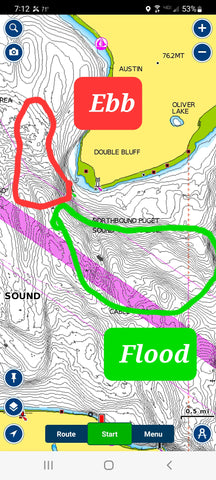
Double Bluff is another sleeper and rarely has more than a few boats on it. I really like Double Bluff; on the right day you can fish the general area and never have to fire up the main and go on the hunt.
Depending on the tides you can drag gear, mooch cut-plug herring, and even fish jigs. On the flood tide you want to fish the rips south of the bluff, and on the ebb, fish from the buoy north. You will need to keep an eye on the fish finder, but many of the early season coho will be suspended in less than 150’ of water. If you’re not seeing anything on the meter, move around.
More than any other place on the Sound, there will be coho holding somewhere at Double Bluff.
Another out of the way and often overlooked coho spot is Partridge Bank. That said, Partridge bank is one of my go-to coho spots. Depending on the given tide series, it typically fishes well on any tide. Fish along the edge of the shipping lane on the west side of the bank.
A couple things to note regarding the Partridge Bank fishery: sometimes there is a big swell that fractures as it approaches the bank. The resulting chop can be unpredictable and you need to be alert to changing sea conditions.
Secondly, you may stray into the shipping lane so keep your radio on and give any passing ships the right of way. Consider setting your VHF up on Tri-Watch, monitor 16, 13 (Bridge to Bridge, commercial traffic) and a floating channel. I have mine on 22 but many recreational boaters monitor channel 68.
The previous three examples are just a few of the areas to find off the radar coho. Again, sit down with some form of chart and current table and do your homework.
There are many other locations in MA 5-11 where you won’t be necessarily be chasing coho with a fleet of like-minded friends. Look for points, underwater structure, and areas where opposing currents will concentrate bait and you’ll find coho.
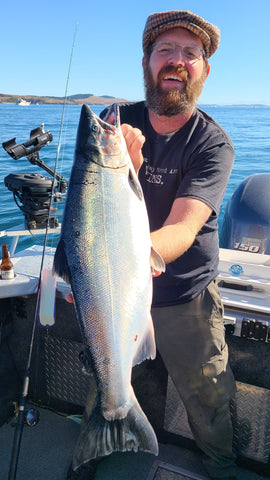
Now that you have identified your coho hidey-hole, what’s next? The coho drill on my boat is pretty basic. Although I have a couple jigging and/or mooching rods ready to go it’s mostly a trolling show. I pull 11” flashers and flies, hoochies or spoons.
Coho Killers, Silver Horde 3.5” Kingfisher Lite spoons and Gibbs G-Force spoons are my go-to spoon offering. I run 36” of 30# fluorocarbon between the flasher and the spoon. Regarding color; you can’t go wrong with any combination of green or chartreuse but a Purple Haze flasher and a clear hoochie with a green insert can be deadly.
Always head out with an assortment of flies, hoochies, or spoons and cycle through gear until you find the magic combination for the day. Also, use scent on your spoons. Try a sticky Bloody Tuna, Herring, or Anchovy goo and re-scent often. Add a salted herring strip to the leading hook on all your flies and hoochies.
At the butt-crack of dawn, fast trolling cut plug herring in the top 30’ of water is a solid option, but after first light it will be a downrigger show. Use 12 pound or heavier downrigger weights and troll 3.5 to 4 mph.
At the speed you’ll be trolling for coho it is likely that you will not see your downrigger balls on the meter and remember that with the blowback you will need additional cable out for a given depth. Especially for coho, I chase meter marks, so keep an eye on the meter.
Be ready for action, we have had every rod on the boat go off at once when trolling for early AM coho. Have a game plan, net ready, and a bleed bucket to assure that your silvery opponent makes its way into the fish box in the best possible condition.
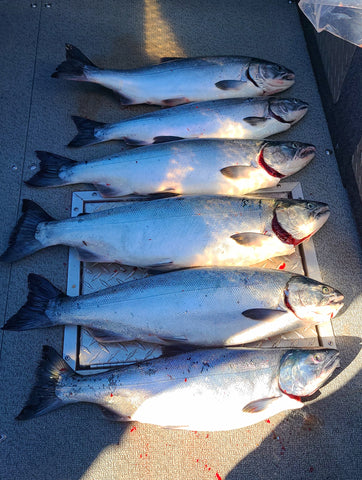
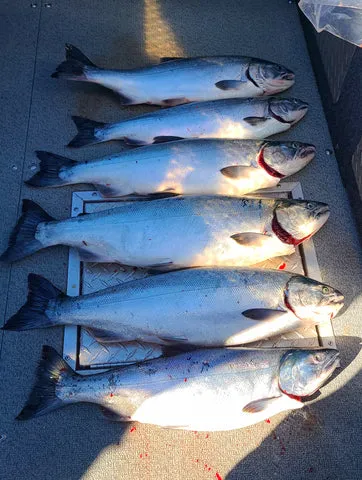
Good luck and remember that our fall coho fishery is an ideal family fishery. They are relatively easy to find, usually hungry, and have some serious shoulders. As a last thought, I want to address the weather. I work 5 to 6 days a week on the water.
While in the San Juans today I encountered a significant squall line of thunderstorms. Basically, the weather went from summer boating weather to “what the heck” in minutes. It was windy, pouring and very dark. Then the thunder was relentless and deafening. Since I had not hit send for the article yet, I figured that a quick note about coho weather was in order.
Coho season falls while our summer boating weather is transitioning to an unsettled weather pattern. Most of the time the pond will be very pleasant. Be aware of and prepared for changing conditions. If the forecast is questionable, don’t go, or at least proceed with caution.
A 15-mph wind against a running tide can be uncomfortable or even dangerous. Know the limits of both your boat and crew, then always error on the cautious side.
/articles/radar
Twitching Jigs for Trout on Holter Lake
By Mike Carey
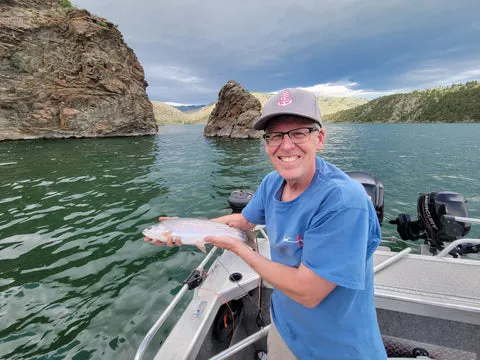
My rod doubled over as the weight of another solid Holter Lake rainbow crushed my black and red jig. Drag screaming runs filled the air as the fish made several nice runs and jumps, clearing the water in a desperate attempt to throw the hook.
Gradually its efforts became less frantic, and I was able to slide the fish into the net as my son Matt skillfully scooped the fish up. After a couple minutes of rest in the knot-less net we eased the fish back and watched it dart away.
Those familiar with fishing for coho in rivers are well aware of the technique of twitching jigs. Many a coho has been caught, including by this writer. What I wasn’t aware of, however, was how effective twitching jigs can be for trout in a lake.
I can’t claim to have discovered this on my own (YouTube is a great source of inspiration) but I am more than happy to share the how-to so you can add another option to your trout-catching tool chest.
Rainbow in a lake or reservoir tend to inhabit the top 30 feet of the water column, making twitching jigs an ideal option for light gear. Jigs in 3/16 to 3/8 ounce size, paired with light line or braid, will easily descend to the depth you need to target these fish.
Mack’s Lure makes a great jig, the Rock Dancer, that has worked very well for twitching. Colors that seem to work best are the black jig heads with black/purple, black/red, black/blue, or all black bucktail. Glow eyes and mylar flash in the body add to the fish-attracting action.
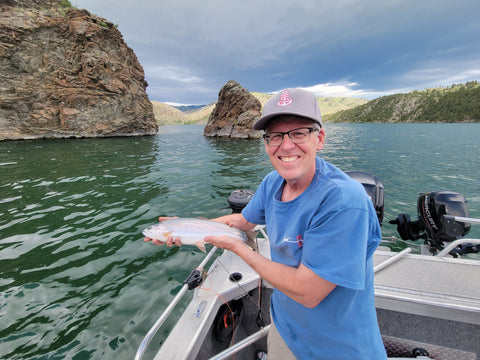
For rod/reel/line set-ups I have used my seven foot coho twitching rods, with medium fast to fast action tip, a quality spinning reel in 100-200 size, and 20 pound braid with a 12 pound fluorocarbon leader. Another option is to use straight mono or fluro on the reel, especially if you’re concerned about spooking the fish. In my experience the braid has not had a huge effect.
Holter Lake rainbows are super-aggressive and hungry! The advantages of braid are two-fold. First, the diameter of the line is tiny, making the jig drop quicker and behave livelier in the water column. Second, with no stretch it’s easy to feel the tick of a fish hitting the jig.
The disadvantages of braid are no give, which means hooks can pull out easier if you don’t have your drag set correctly (i.e., lose enough for a fish to be able to take line but not so loose that you can’t reel it in). Mono or fluro advantages are just the opposite of braid.
Thicker line diameter means slower jig descent, while mono has a very forgiving stretch when you actually hook up. Since you’ll not be fishing super deep water, the mono stretch is not as significant when doing the actual jigging.
Lake jigging differs from river twitching in a couple of ways. It can be used both fishing shore structure such as deep drop-offs and out in open water when your fish-finder lights up with a good number of fish. Lake jigging also lends itself to both horizontal cast and retrieve and vertical jigging under the boat.
If your boat has an electric trolling motor with anchor lock, you are in the best of all worlds! I like to start off shore structures and lock my position, fish the spot, and then drop down 20-30 feet to the next location, working my way along the shoreline, picking off fish as I go.
This technique also works on an open water scenario, or, let the wind drift your boat and hit the anchor lock when you get into the fish.
As to the technique itself, as I mentioned earlier you’ll have the option of horizontal or vertical jigging. In horizontal jigging, cast away from the boat. When the jig hits the water I like to let it sink for a few seconds and then close the bail.
Now, lift the rod tip in a jigging motion and then drop the tip. Reel in slack and repeat. The jig will descend as you bring it back to the boat, covering different depths as you retrieve. Vary your cadence and pay attention to how you were bringing the lure in when you get a fish – try to repeat that pattern on your next cast.
Rainbows will tend to hit the jig on the drop, so be ready as you raise your rod tip because you may well have a fish on!
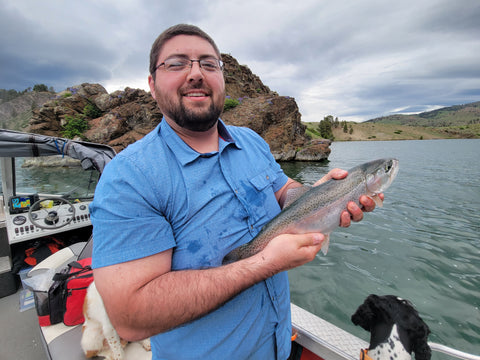
Vertical jigging is straight up and down jigging, under the boat. It comes into play when your fish-finder lights up with arches underneath you. A good fish-finder will show your line and jig so you’ll know exactly where your jig is relative to the suspended fish.
This technique requires either an anchor lock trolling motor or calm wind conditions. Too much breeze and your jig will drag away from the boat, making this method impractical. On marginal conditions you can up your jig weight a bit to help get down to the fish.
After explaining to Matt the technique involved, in no time at all he was into his first jigged Holter Lake rainbow, a beautiful 16” fat stocked specimen. The Montana Fish and Wildlife plant Holter with rainbow and it without a doubt yields some of the best rainbow fishing I have ever experienced.
These fish grow fast and fat on the abundant feed in the lake (which is the Missouri River system). 16-18” fish are the norm, with bigger fish always a possibility.
Whichever lake you try this technique on, I think you’ll agree it’s a fun option rather than the usual trolling or still-fishing methods we grew up on. The fish fight great with no gear getting in the way, putting on an acrobatic show not soon to be forgotten. Give jigging for trout a try the next time you go out!
/articles/twitching-jigs-trout-holter-lake
River Coho
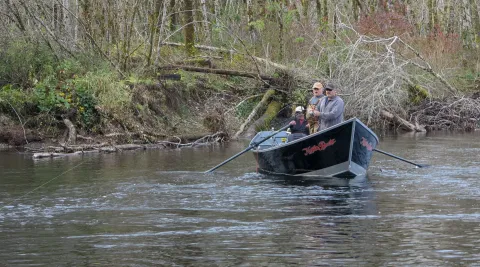
Slowly drifting along with the current until we reached the next hole, I heard a splash along the shoreline. Looking to my right I could see the rings in the water where a fish jumped near the tall grass that lined the river. Instead of continuing on, I quickly dropped the anchor and told my fishing partner to cast his float over to the shoreline and be sure to do so a bit upstream. As the float neared where the fish jumped, it disappeared underwater and he set the hook. A large coho leaped out of the water and took off to the fast water below. All the while, line began peeling off of the reel.
That is what I love about river fishing for coho: you think you know where they are, then you find one in a spot you normally would have just rowed right by. After he fought that fish to the net, we slid it into the fish box and just looked at each other for a minute. Then we saw another boat coming down the river. The quiet discussion we had was if we should pull anchor and try to stay ahead of the other boat to get to the deep hole we were heading to first, or to stay put. Electing to do the latter, we waved as the boat went by and never said a word about the fish we just caught. Once out of sight, we cast towards the shoreline again and the float went down once more. After pulling three more fish from that grassy bank, the fish had moved on and so had we.
Normally, anglers who head to the rivers target coho with spinners or twitching jigs, and mostly concentrate in known areas for chinook with the float rods. This works well, and is what I like to do too, but I also always have the float rod ready. Last year, we were almost to the take out and I saw a fish roll under a tree. Just downstream from this overhanging branch was a fallen tree with a large root ball sticking out. I cast ahead of the branch and let it go under it, but nothing happened. Then, just before I decided I needed to get my gear out of the water, as it neared the root ball the float went under. Thinking it was part of the roots, I pulled back, hoping it would free my gear, but instead a fish jumped out of the water with my float in tow. Coho are known to be acrobatic, and I was once again pleasantly surprised to have one bite the eggs.
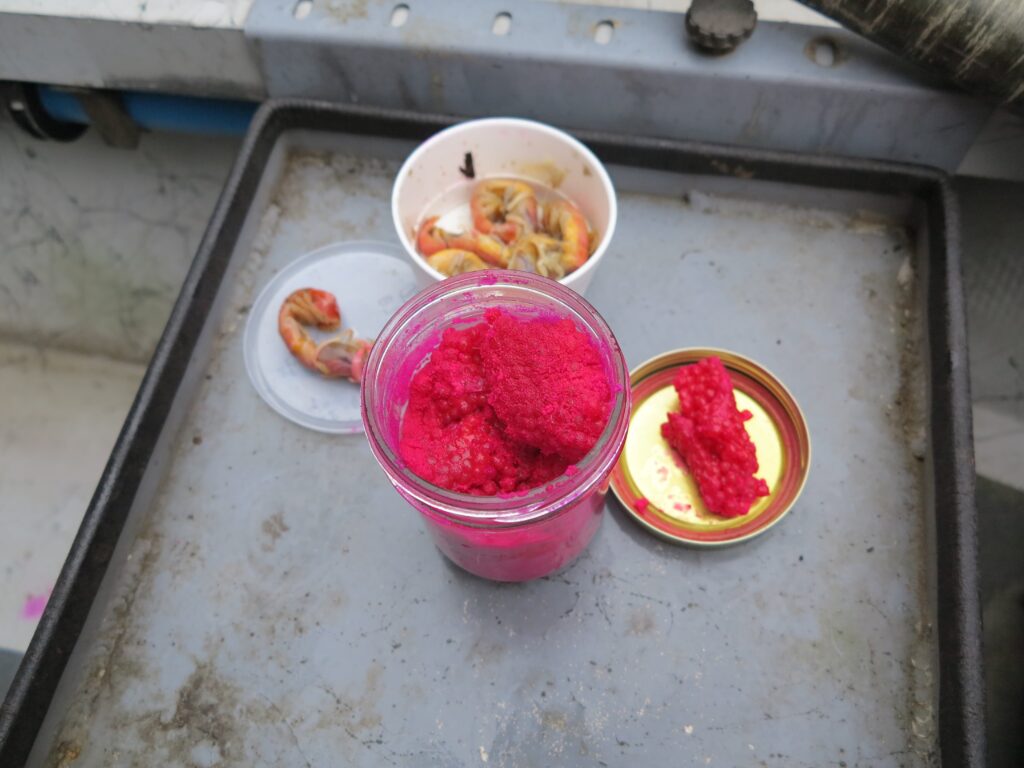
The reason why I threw a float with eggs to this fish wasn’t because I thought it was a chinook that was hiding under the tree branch that I first saw, but instead it was the only way I could fish this spot. Tossing a spinner was an option, except I didn’t have one tied on my rod. Twitching was out, as I knew that if I tried to lift the line from the water it would catch in the branch, so I threw out some eggs and it ended up being the right choice. The float would easily drift under the branch and continue down to the hazard below.
I always have a float rod rigged and ready as we make our way down the river, for this very reason. But when I come to a spot that is known to hold coho, it is time to break out the twitching rods. Deep holes often strewn with logs means coho. Knowing how to twitch is important, but also knowing where to twitch will lead to more coho in the box. For deeper holes I actually use the lightest jig possible. This means 3/8 ounce or ¼ ounce jigs if the water is very still. Twitching has been given a bad name in the past because anglers tend to foul hook fish. Most of the time this happens because the heavier jigs fall fast and end up below the fish. What the angler should do is use a jig that will fall slowly and into the fish, then when twitched will jump up in their face and again fall slowly, allowing the coho to grab it. If the jig is too heavy it often falls too fast, and when you go to twitch again you end up foul hooking the fish. By using the right weight, you not only reduce the chance of foul hooking fish, but also increase your chances of them biting.
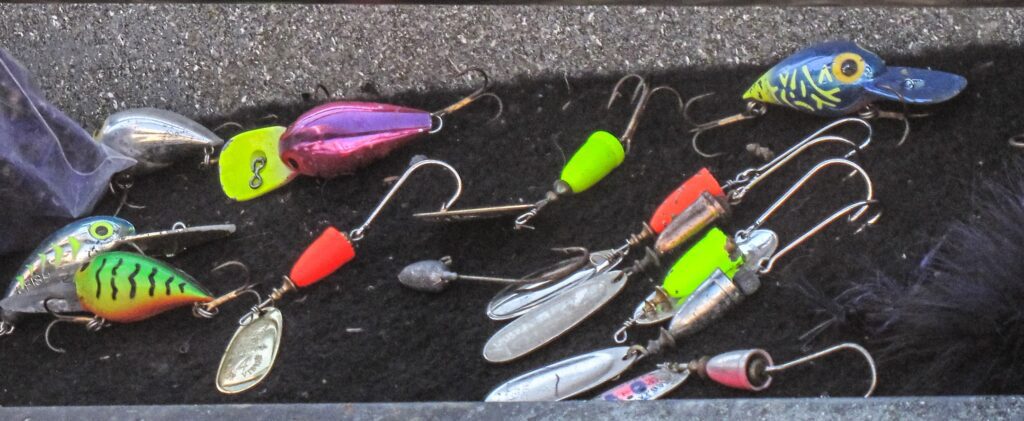
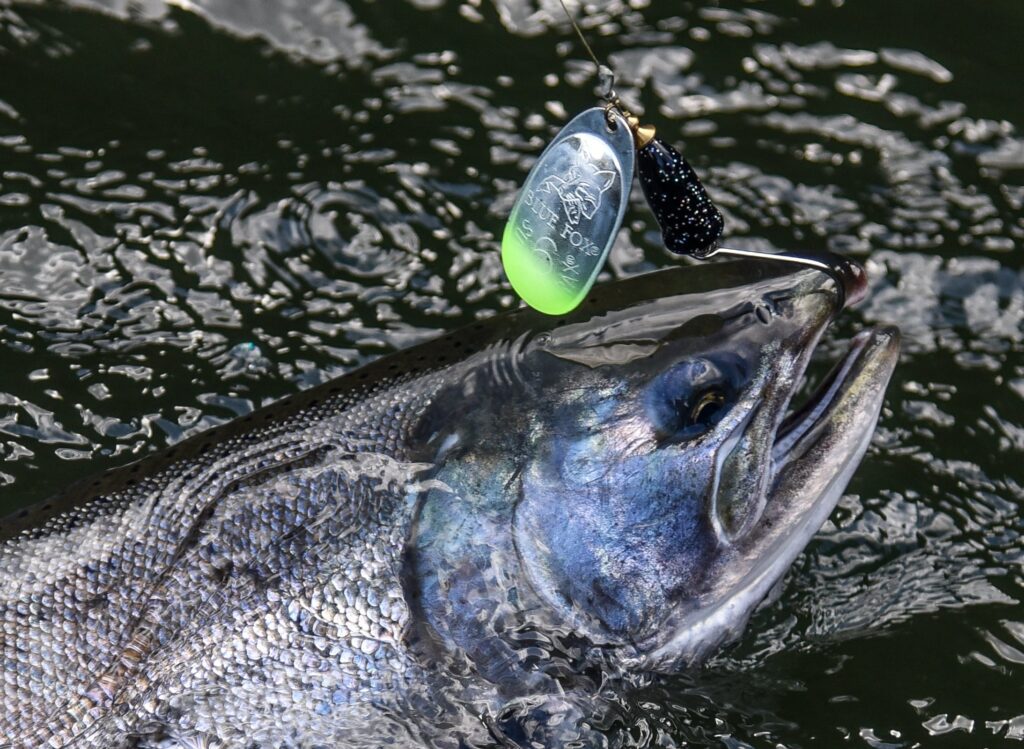
Spinners are a top technique for good reason. When fishing spinners, they are always working. A good cast into a seam, and then the swing of the spinner and the thumping of the blade reinforces the confidence of the lure to the angler. There is nothing like a hooknose coho violently grabbing your spinner and yanking the rod nearly out of your hands. There is no guessing if it is a bite, and the fight is on right away. Spinners also work well in different water conditions. Several years ago, we were fishing during a hard rain. The water was getting murkier by the minute, and after the bite seemed to go off on twitching jigs we began throwing spinners. That thumping silver blade reflecting the sunlight was all it took to get the bite back on again.
On sunny days, try using a dark bladed spinner, or alter the ones you have with a black permanent marker. Dark bodies like black and purple tend to do well, but on dark days or in murky water try chartreuse or fluorescent orange bodies. A Blue Fox Vibrax spinner in sizes 4, 5, and 6 are top producers for fall coho.
Knowing when to go and which river or part of river to fish will lead to more success. A couple of years ago we were going to hit my favorite Olympic coast river for the opener on September 1st. Normally this time of year the river is running as low as it will get all year, but that night a rainstorm approached. The river went from 400 cfs to over 3,000 cfs in twelve hours. Waking up and seeing the brown murky water flowing quickly, we should have canceled for the day. Instead, we launched the boat and had a nice ride down the river, and a fast one at that. We didn’t touch a fish or see another boat all day. Returning a few weeks later, that same run was back to normal and we caught fish.

This particular river has several access points and can be broken down to three main runs. The upper run is usually unfishable until October, when the rains fill the banks and make it floatable. That part of the river is where we should have gone to that day. The middle section is good almost all of the time, but offers very few holes which tend to get crowded early in the day. The lower part is tidal influence, so not only do you need to keep an eye on the river flows, but also the tides.
Fishing tidal waters is often overlooked by anglers. Fish only stack up here when there is a really low tide and that can also be at different times of the day. Personally, I prefer to fish tidal areas because they are predictable. You know that with each tide a new push of fish will come in. I try to time it to fish as the high tide is over and water is pushing out. This is best when it is mid-day to late afternoon, because most anglers will want to be on the water at daylight. Instead, I like to fish “clean up” or after everyone else has gone down the river. The fish fresh from the salt haven’t been harassed all day and anglers are gone, often leaving me in holes all to myself.
If you don’t have a choice but to head to the river early, then remember that during high tide fish will be on the move. This is a good time to drop anchor and let the fish come to you. One year during a high tide time, we sat on the anchor for several hours, casting jigs to a small pocket along the shoreline. This area had a back eddy and the moving fish would stack up here to rest. When they showed up, we would catch a fish, and when they moved on we would take a break. One way to keep fishing during times when fish are moving is to throw out diving plugs or plunk. Plunking tends to be a lost art, but the idea is to cast out and let your lure or bait sit in a spot where the fish will come along at some point and bite it. Why not do it from a boat while taking a break, as this will lead to more fish and it is a great way to know when fish are arriving.

There are a lot of ways to catch coho in rivers, and learning to fish them all not only adds to the experience but also keeps you engaged in fishing. Once you learn to twitch, then learn to float eggs, and then throw spinners. Discover where the holes are and where to fish when the tide is in or out. Best of all, most of the river conditions and routes will change each year, so each time you go to the river it is like learning a new spot all over again. Just like when we were drifting along that grassy cutbank and heard that fish jump; you never know where you will find coho, and that is what makes river fishing for them so fun.
/articles/river-coho
My Favorite Fall Coho Techniques
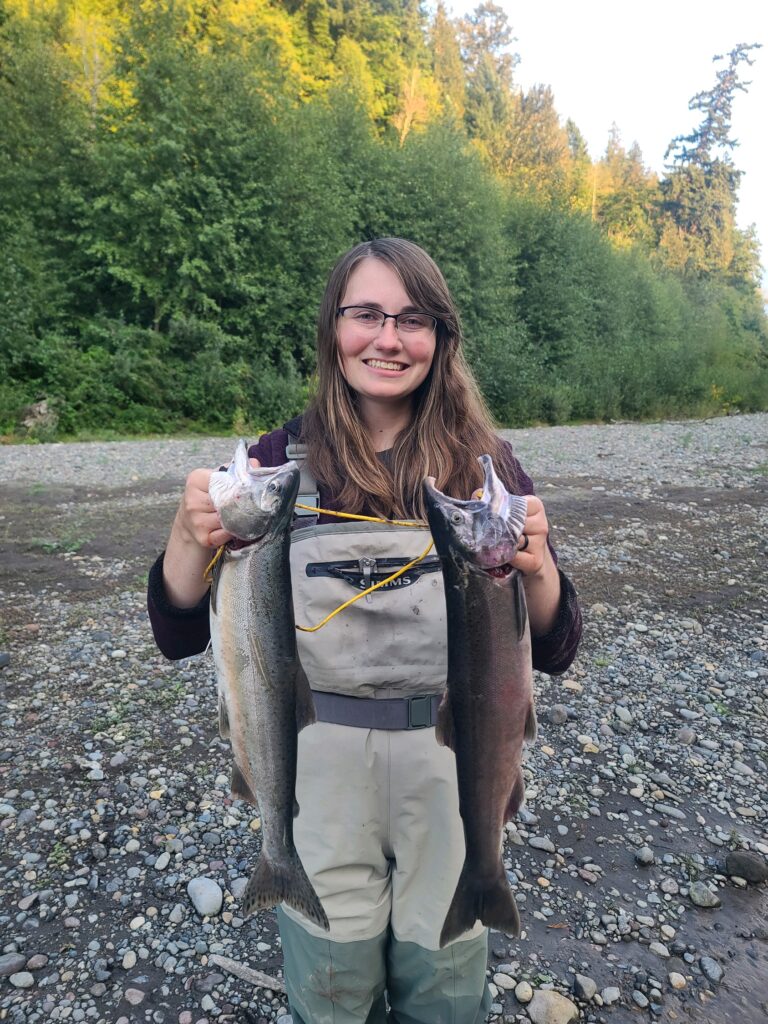
Even though the end of the year is approaching, don’t put away your salmon fishing gear just yet. There are still plenty of rivers teeming with coho salmon right now! These days, there are many different techniques you can use to catch fish on any river. Versatility is important, and river conditions change day by day. I recently went on a guided trip with Brianna Bruce of Livin’ Life Adventures. When we got to our spot, she told us that we would each be fishing a different method. The fish had been hitting different things every day. One day, they only wanted spinners. Another day, they wanted spoons. She began distributing rods- one of us fishing plugs, the other spinners, and so on until we were all casting and hoping to get lucky.
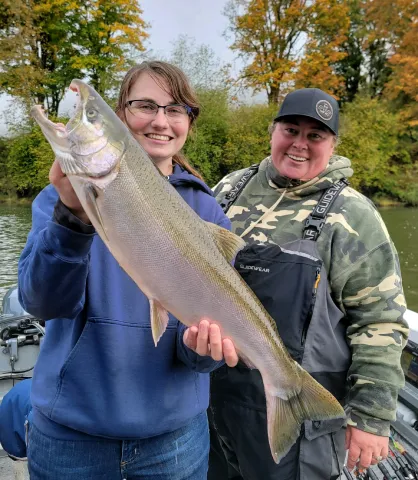
After about 20 minutes of this, another guide motored by on the way back to the launch with their limits. He told Bree that he had gotten all of his fish on eggs! She quickly began switching all of our rods to egg setups. Another hour later, we were back at the boat ramp with huge smiles and limits of dime-bright coho. If she hadn’t brought eggs along, we may have all ended up skunked! Versatility is crucial! Most days when I go river fishing, I carry 3 rods: a twitching rod, a float rod, and a spinner rod. I spent a lot of time getting familiar with each technique and when and how to deploy them. Let’s dive into how and why I use these techniques.
Technique 1: Twitching Jigs
If I had to pick one way to fish for coho, I would have to go with twitching jigs. They are extremely adaptable- I can fish any type of water with a twitching jig. There’s something so satisfying about seeing a big fish dart out of cover to grab your jig. Make sure to vary your jigging speed and length depending on the structure, depth, and speed of the water. Some days, you can let the jig sink to the bottom of a deep hole before you start jigging. Other times, you’ll want to do short jigs as soon as your lure hits the water. There’s no one way to twitch a jig. Color matters! I’ve had days where I fished one color for 30 minutes with no luck, and then hooked a fish on the first cast after switching colors. Most of the time, I use a 3/8 or 1/2 oz jig. My favorite colors are blue/black and pink/green. My twitching rod is a stout 7’6 rod with fast action. It has an extremely sensitive tip so I can feel those subtle bites, and the backbone to back up my hook sets. I pair it up with a size 3000 spinning reel. I use light reels to help avoid wrist fatigue. You can twitch jigs with longer, heavier rods, but I like my 7’6 rod because it translates even the smallest flicks of my wrist to the jig. I never hit the river without my twitching rod! There is a bit of a learning curve, as most fish will pick up your jig on the drop. You might feel the line tighten, or you may feel nothing at all. Most fish won’t simply grab the jig and take off. The majority of bites are subtle. Watch your line and pay attention to how it moves. It pays to fish high visibility braid so you can see exactly where your line is and what it’s doing in the water. Give twitching jigs a try, you’ll be hooked!
Technique 2: Spinner Rods
If I can’t get a fish to bite on twitching jigs, I’ll switch to my spinner rod. This is my 9ft, fast-action, moderate power rod, rated to throw up to an ounce of lead. It has the springiness to be able to launch spinners across long rivers, but the backbone to bring a monster coho to the shore. I often start off beginner river fishermen with spinners because bites are hard to miss. There are two types of spinners, and they both fish differently. Heavy-bodied spinners sink right away and can be cast perpendicular to the opposite shore. Light-bodied or unweighted spinners don’t sink as quickly and are better for shallow rivers. You can cast them out and swing them into the current like a spoon. Keep your rod tip low and reel slowly. Make sure to do 1 or 2 solid hook sets to really drive that barbless hook into the fish’s mouth. In murky water like the Carbon or Puyallup River, I’ll go with a bright-colored spinner, like chartreuse or pink. On clear, coastal rivers, I’ll fish a silver or copper-colored spinner. It never hurts to try something different, though! Don’t forget to pinch your barbs and switch out the treble hook to a single hook if required.
Technique 3: Floating Eggs
My third go-to technique for fall coho fishing is floating eggs. This technique isn’t very well suited for combat fishing, but if you can find a patch of slow-moving water all to yourself, this is a great way to get finicky coho to bite. Floating eggs is a relaxing way to spend the day. You tend to lose a lot less gear, and watching your bobber is therapeutic. You’ll want a 10ft to 11ft rod and 3000/4000 size spinning reel. Don’t use gear you don’t mind getting egg dye on! You can either use store-bought eggs or experiment with curing your own. I usually bring along 2 or 3 different recipes when I fish eggs. Sometimes the fish want pink eggs, other days they like red. You can experiment with adding different scents to your eggs, like tuna or herring. No matter how good your eggs are, you want to make sure you’re fishing them correctly, however. Experiment with your leader length by moving your bobber stopper until you’re hitting the bottom. Then, move it up 6 to 12 inches. That’s where the fish will see it, and, hopefully, bite it. Don’t forget to mend your line by lifting it up off the water and behind your float. This is where a long rod can come in handy, but it can make it difficult to fish in water with lots of overhanging trees and bushes. Float fishing is a highly situational technique, but it can be very deadly.

There you have my top three favorite fall coho techniques. When getting to my spot, I like to sit and watch the water for a few minutes to determine which technique to use. Floating eggs isn’t always possible if the river is flowing quickly. Similarly, when I’m fishing frog water, using a spinner can be difficult. The deep and slow water makes it difficult to reach the fish hugging the bottom. I find that it’s extremely important to be able to adapt to any condition. However, there are days when I want to challenge myself or get better at a technique and I’ll only bring out one pole. This is how I taught myself to be able to use twitching jigs in any situation. If you haven’t tried any of these techniques, hit the water and give it a shot. Make sure to read your rules and regulations, especially emergency ones. Hope to see you all out there!
/articles/my-favorite-fall-coho-techniques