The Best Kind of Fishing Trip by Jerad Sorber
Early-season Spring Chinook is always a bit hectic. There's a short window between when the fishing gets realistic and when the first season closes. The annual uncertainty about when the next opener will be increases the pressure. Both the fishing kind and the internal kind, even if the fish aren't quite here yet. It's easy to get discouraged when you don't see a lot of fish, and nobody else is catching them either. When the magic does happen, though, it makes it all the better. Recently, we had one of those days.
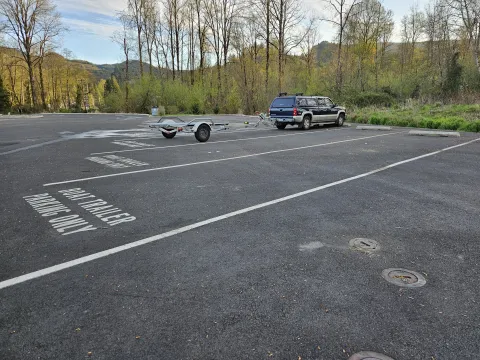
I arrived at the ramp around 5:15 AM to get the boat in the water and do any final preparations. I had told my clients to be there by 6 AM. There was a good morning outgoing tide, and there would be competition for spots to anchor up. As I prepped, I listened to the conversations from the other guides that were doing the same thing. This is a great time to get intel on what's going on with the fish.
Just as I finished up, my clients came down the dock. They had booked the whole boat and brought 4 people. If this had been a July ocean salmon trip, I would be excited about lots of fish. Today I was figuring out how to manage expectations. The fish checker reports the day before were 3 fish on 35 angler trips. We went through the usual greetings, and they hopped on board. A quick safety briefing, and we pulled away from the dock at precisely 6 AM.
I ran us out to the spot I had planned on. That was at least a good sign. With the anchor set, I put out the first round of plugs. I was hoping for the best. The water looked good, and the temperature had risen about half a degree. If they were here, they should be biting. A little bit later, another friend and fellow guide swung by and anchored to the outside of me. A bit after that, another guide popped in, and we had an old-fashioned hog line set up. We were covering everything from 12 feet of water to 40 feet. If a salmon was moving through it would have to look at our gear.
The conversation bounced between boats as it should for hog line fishing. One of my clients seemed to really love hearing the "inside baseball" chat. I talked to my clients about what they had been doing. I answered a lot of questions about fishing and fish biology. I learned about the ins and outs of building embassies for the US government in faraway places. My clients had been working internationally, and this was spring break for the youngest son. Their most recent location was Malawi in Africa. They chose to come back home and enjoy a day of fishing.
I swapped out the initial plugs with ones wrapped with tuna belly. If the water is slow, I usually start with bare plugs covered with some gel scent. This gives them a bit more action. Once the water speeds up with the outgoing tide, I wrap them with tuna belly and send them back. We coordinate line lengths and make sure that there is a literal wall of plugs. Between 3 boats, there were 9 rods in the water. We all waited for a fish to come in. The middle boat had a bite, but it didn't hook. They had a second and lost it within a minute. Then nothing.
The outgoing tide pulled my depth from 18 feet down to 16 on the sonar. It was getting shallow. The water wasn't that murky, and the sky was clear. By this time, I had swapped my middle rod to a flasher in the middle with a cut plug herring. It had worked before when nothing else did. I pulled out a spin glow, putting it on ahead of a coon shrimp. I hooked it to my inside rod and sent it flying to about 4 feet of water. There had been steelhead moving through. If three guide boats captained by guys I respect can't find a springer, maybe I could find some other action. Still nothing.
All three of us started calling and texting our friends that we knew were fishing nearby. Each time, we hoped desperately for a good report. Nothing below us. Nothing above us. A few take-downs, but nothing stuck. I was getting antsy. My clients were enjoying the day, watching ospreys dive on bait. They made a game of trying to spot the sea lion that would periodically cruise the channel. Fortunately, he never came close, but it didn't matter. I found myself talking about the better days of fishing. I stopped myself and cringed a bit inwardly. These guys were probably thinking, "he should have had us come then, instead of now". I do my best to be clear about what to expect with early Springer fishing. I describe it as the most challenging fishery we have. Even with that, I think that people often come to the dock expecting to be the exception. I know several guides that don't offer early spring chinook trips for that reason. They don't want people to be disappointed if they go home empty-handed.
The outside boat moved upriver to a different spot, and I moved out where he was. 23 feet of depth felt a lot better given the high sun and clearing water. All the rods were back to plugs, and the sun was getting high. I remembered some advice from a mentor. When the fishing is tough, don't go crazy changing things. Just go with what you know works best and keep at it. I put fresh wraps on all the plugs and set them down. One of my clients was glued to the sonar like it was a final four game during overtime. If a fish came by, or even something that looked like a fish, I knew he would let me know. There was still nothing. The boat that was now inside of me started picking up. They had to go home early for a doctor's appointment. I decided to make a move as well.
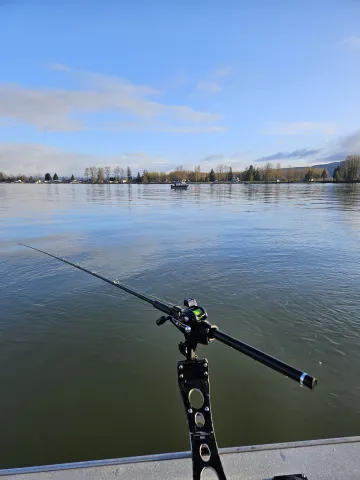
I started swapping out plugs for trolling gear. The outside rods would have 360 flashers with stuffer baits. The inside rods would be running in-line flashers with cut plug herring. There was enough current going that I could get the rods out while we were on anchor. I pulled the socks, fired up the kicker, pulled the anchor, and started trolling. I looked at either side of me on the side-scan looking for fish. I swerved out into even deeper water when the shallow wasn't showing anything. I thought I saw one mark, but nothing came of it. We reached the end of the pass and reeled up. It was time for a bigger move.
Usually, I move downriver when the fishing isn't good. If you're in a gap of fish moving upriver, there's no sense in staying in that gap. Going downriver means a chance to catch fish that you haven't seen. The reports from downriver had been poor, though, and the trolling area there was pretty spread out and fragmented. I had seen some fish move through on the sonar while we were on plugs. I chose to go upriver.
I went way up above the other boats that I saw. The boat that had been outside of us was there. I also spotted some other boats that I recognized as belonging to some really good fishermen. "If that guy is still fishing, then I don't feel so bad," I thought. That little bit of comfort quickly disappeared as the water got a bit choppy and the wind picked up.
The top was on the boat, and it started catching the wind. My clients and I struggled a bit to get the rods out, and we had a tangle. Clearing tangles in a foot and a half high chop while trolling into the wind is not easy. Finally, the torn cut plugs were replaced, and the gear was fishing. I worked the boat against the wind to try to keep it straight. I didn't put a sock on the bow to add stability, but probably should have. I did trim the main over a bit to help compensate. We worked our way out of the worst of it, and the water smoothed out. Even worse than no bites, I wasn't seeing any fish at all.
I stayed glued to the sonar and adjusted the throttle to counter any wind gusts. The 360's were working slowly, which is what I wanted. I didn't want things to move too fast in the water. It was a delicate dance between having enough power to steer and trolling too fast. About halfway down the pass, there is a big shelf that you must swing out wide to avoid. While the depth isn't bad on top of it, it's covered in weeds. They make it nearly impossible to fish in anything less than 18 feet of water. But moving away from the island would subject me to more wind. I had to swing out anyway.
The wind caught the top, and I soon found myself in 35 feet of water. My clients adjusted the rod depth down, and we continued, trying to make the best of it. It's not that 35 feet was magically too deep; I just didn't think the fish were out that far. We passed the shelf, and I pointed the bow back towards the island. The sonar ticked shallower again. At 25 feet, I turned back west and started running parallel to the shore. I looked up at the side scan and saw what looked like a diagonal streak. It started at the edge and moved towards the boat as the sonar scrolled. I waited to see if something would show up on the 2D and down scan. I looked over at the rods on the left side to see if something would come in. They kept working normally. False alarm.
I turned my head to look back and noticed the right inside rod take a dive. This was one of the triangles with a cut plug on it. "Probably bottom," I thought. I started to turn to give it a crank when it took another dive, more assertively this time. Before I could reach it, it started bouncing, then pulling. The line started rolling off the reel. "Fish! Fish! Fish!" We had designated the youngest as the first one to catch a fish. He had never caught a salmon before. He was also sleeping under the top. His dad shook him awake, and he stumbled to the back of the boat. I directed everyone else to start reeling. I grabbed a rod, got it in, handed it off, grabbed the net, and turned around. "I don't think it's there," he said. I looked at the flasher, and it was steady in the water.
When a flasher is moving normally, it has a motion to it, even an inline one. It sways and wobbles a bit with the current. If the lure is loaded with weeds or a fish, there is no sway. It moves firmly. This flasher was moving firmly. "Keep reeling," I told him. "Don't stop reeling, don't give it any slack". He blinked his eyes a couple of times and started to say, "I still don't think..." then chrome flashed under the water, just behind the flasher. The fish was thrashing.
"Reel to the bead, and when I tell you to, swing the rod to the front of the boat. Keep the tip down, it helps keep them from jumping”, I instructed. He reeled down to the orange bead I put just ahead of the line lock. I could see the fish get close, as it turned towards the boat, I took my chance. Just as the net hit the water, the fish turned away, and I brushed its tail with the net. It went wild and shot off. I pulled the net back.
"It's pulling!" The rod was bent over, and the line screamed off the drag.
"It's ok, just keep reeling," I tried to help him not panic. My own mind resembled a pack of chipmunks on a trampoline after someone dropped a bunch of nuts on it. He reeled down to the bead again, and the fish glided in front of me. It took a quick turn, but then came back towards the boat. I shoved the net under it, lifted, and watched it get surrounded. Feeling the net, the fish started thrashing around. I started looking for an adipose fin. We haven’t gotten a fish yet. It had to be hatchery.
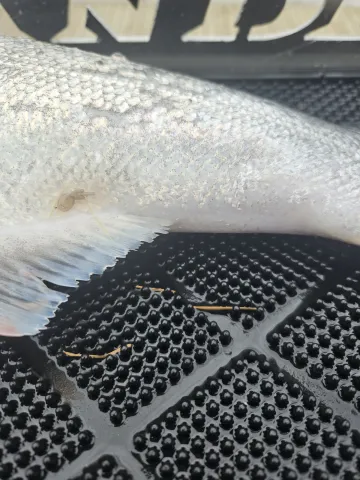
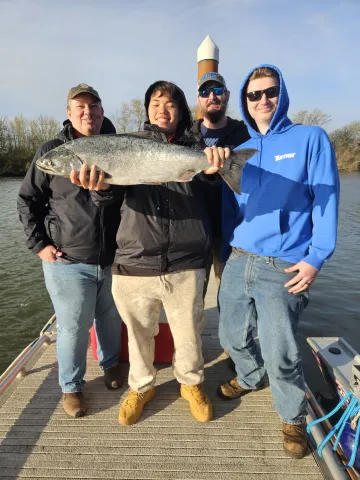
I pulled the fish towards the boat and reached in to steady the fish while trying to avoid the hooks. The fish flipped around, and I saw the back. It was smooth with a beautiful healed scar just ahead of the tail. No mis-clip, just perfect. "Hatchery!" I yelled. My own heart was pumping, and I could barely hear the cheers behind me. I lifted the fish and heard four jaws hit the deck. In the net was a beautiful, purple-backed, chrome-sided, slightly gray belly upriver Spring Chinook. I looked up and saw smiles all around. Dad seemed beside himself; the younger guys were thrilled. They were all talking about how excited they were.
I rushed to get the rods back out while my client tagged the fish. We took pictures, and I filled the bleed bucket with water. With the gills cut, the fish went headfirst to make sure the meat was as high-quality as possible. The latest price on Columbia River Spring Chinook was $70 per pound. This fish would give them about 8 lbs. of meat. I wanted to treat it right.
I put us back on course, circled back through the area where we had caught the fish, and hoped for another. It wasn't to be. Once bled, I put the fish in a bag, and it was placed on ice. I always bag the fish first so clients can use the ice in coolers on the way home. Another trick I learned from a mentor. We said hi to the boat that had been on the outside of us for most of the morning. He had one take-down that didn't stick, and didn't see any other boats catch anything. We set up for one final pass. That fish had bit just before 4 PM. We had been fishing for 10 hours. If we had found one, I didn't want to give up a chance at a second. I didn't have any clients the next day, and they wanted to keep fishing, so we did.
The second pass didn't give any results. I thought I saw one more on the sonar come in, but it didn't hook up. We got to the bottom, and I looked around. Everyone was still flying high from catching that fish. We all agreed that it was time to head back to the dock. There were only two other trailers left when we pulled in. The boat for one of them was already on the dock. I tied up, and everyone headed for the restroom. I retrieved my fillet table from the back of my truck.
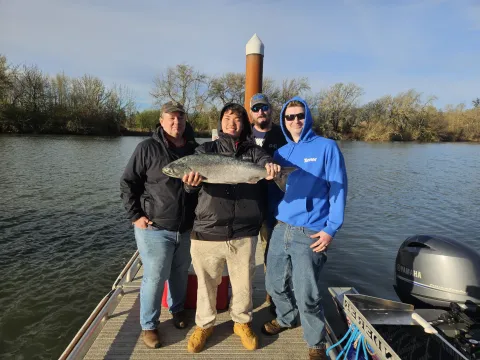
After a group photo, I cut up the fish and gave out a quick recipe tip. For Springer, just bake it at 425 for about 12-15 minutes maximum. Maybe a little salt and pepper. If you're looking to spice it up, top it with some mayo and sriracha first.
Dad pulled me aside and thanked me. "The point of today was to get my son on his first salmon. I just want to say mission accomplished. The salmon is great, but we're going to remember this for a long time. Thank you." They headed for their vehicle, still smiling. The other boat came in, loaded up, and headed out while I was cleaning up. Mine was the last trailer in the parking lot. Once in the truck, I sent a quick thank-you message and headed home.
I was exhausted. I thought about fishing on my own the next day, but decided against it. I wanted to savor the experience myself, and maybe sleep in. Like I said at the start, springer fishing can be tough, but the payoff is worth it!
/articles/best-kind-fishing-trip-jerad-sorber
Coho Craziness
As we head into September, the color of salmon switches from pink to silver around Puget Sound.
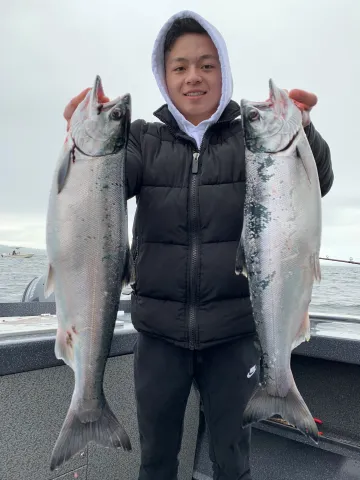
The front end of the migratory coho run – also known as silvers for their shiny silvery-colored body – began to filter into the western Strait of Juan de Fuca and Puget Sound in August, and are expected to peak throughout September and early October.
Coho aren’t large – usually averaging 4 to 15 pounds, with some exceeding the 20-plus pounds – but they often put up a good tussle. Young coho spend a year in rivers and estuaries and then migrate out to the Pacific Ocean to feed and grow. They spend about 1½ years in the ocean, then return to spawn as three and four-year-old fish, generally in fall or early winter.
Puget Sound coho returns have gradually made a comeback from a downtrend that began in 2015 and 2016. This was due to negative environmental factors like drought, flooding, and warm water temperatures in their freshwater habitat as juveniles and then in the Ocean from a condition known as El Niño, when surface water becomes warmer than average.
The combined 2025 Puget Sound hatchery and wild coho forecast is 727,490 compared to 722,134 in 2024; 760,029 in 2023; 666,317 in 2022; 614,948 in 2021; and 504,604 in 2020.
Coho fill the air with enthusiasm for their leaping abilities when hooked, and unpredictable movements across the water’s surface.
A positive signal of 2025 expectations began with the good fishing for resident coho, who mainly spend their entire life feeding and growing in local waters –
caught in Marine Area 10 (Seattle and Bremerton Area) from June to early August. Many of these coho have grown since then and will join their larger migratory coho relatives during the late summer and fall marine fisheries.
Knowing when it is “go fishing time” for migrating coho in Puget Sound is to monitor catch rates in the Strait of Juan de Fuca at Marine Area 5 (Sekiu and Pillar Point) and Marine Area 6 (East Strait of Juan de Fuca).
The Marine Area 5 salmon fishery is open daily through Sept. 26 with a two salmon daily limit, plus two additional pink may be retained, and release Chinook, chum, sockeye, and wild coho. The area is then open daily for coho from Sept. 27 to Oct. 9 with a two salmon daily limit, release Chinook, chum, and sockeye.
The Marine Area 6 salmon fishery is open daily through Sept. 26 with a two salmon daily limit, plus two additional pink may be retained, and release Chinook, chum, sockeye, and wild coho. The area is then open daily for coho from Sept. 27 to Oct. 15 with a two salmon daily limit, release Chinook, chum, and sockeye.
Oftentimes, the best coho fishing in the Strait of Juan de Fuca occurs offshore in the shipping lanes, which is the main migration path. These deep-water areas are about one to 10 miles out in 200 to 500 feet of water and sometimes even deeper off the edge of the main shipping channels. Remember to stay within the U.S. side of the shipping lane. Look for tide rips and current breaks where krill and schools of baitfish attract coho, and watch for coho jumping and rolling on the surface.
In the eastern Strait of Juan de Fuca, the Dungeness Bay hatchery coho fishery is open from Oct. 1 to 31. The 2025 Dungeness River coho forecast is 13,328, down slightly from 14,305 in 2024 and 14,654 in 2023.
The Marine Area 7 (San Juan Islands) coho season is open daily through Sept. 6 with a two salmon daily limit, plus two additional pink may be retained, and release Chinook, chum, sockeye, and wild coho. The area is then open daily for coho from Sept. 7 to 30 with a two salmon daily limit, plus two additional pink may be retained, and release Chinook, chum, and sockeye. In Marine Area 7, look for coho staging along the western and southern portions of the island chain.
Coho fishing in Marine Area 8–1 (Deception Pass, Hope Island, and Skagit Bay) is open daily, Sept. 30, with a two salmon daily limit, plus two additional pink may be retained, and release Chinook and chum. Coho fishing is then open daily Oct. 1 to 12 with a daily two salmon catch limit, and release Chinook and chum.
In Marine Area 8–2 (Port Susan and Port Gardner), coho fishing is open daily through Sept. 24 with a two salmon daily limit, and release Chinook, chum, and pink. The Tulalip Bay Terminal Area Fishery has rules that differ from Marine Area 8-2. For details, check the Washington Department of Fish and Wildlife (WDFW) fishing regulations webpage at https://wdfw.wa.gov/.
In Marine Areas 8-1 and 8-2, anglers should find coho along the entire eastern side of Whidbey Island, Possession Point, off the Clinton Ferry Terminal, the Langley/Sandy Point area, Shipwreck to Mukilteo, Hat Island, Camano Head, the entire west side of Camano Island, and outside of Oak Harbor. West Beach at Deception Pass State Park, located north of Oak Harbor on Whidbey Island, provides excellent shore fishing access.
Moving further into Puget Sound, Marine Area 9 (Admiralty Inlet) is another decent fishing location for hatchery-marked coho, which is open daily through Sept. 30. It has a two salmon daily limit, plus two additional pink may be retained, and release Chinook, chum, and wild coho.
In Marine Area 9, focus your fishing time in the unmarked shipping lanes where tide rips and current breaks are commonly found. Try Midchannel Bank off Port Townsend; Point Wilson north of Port Townsend (good public shore access); east side of Marrowstone Island (some shore access); Fort Casey to Bush Point and Lagoon Point (some public shore access); Double Bluff off the west side of Whidbey Island; Point No Point (excellent public shore spot); Possession Bar; Scatchet Head; and Pilot Point.
In Marine Area 10 (Seattle and Bremerton Area), coho fishing is open daily through Sept. 30 with a two salmon daily limit, plus two additional pink may be retained, and release Chinook and chum. Fishing is also open daily from Oct. 1 to Nov. 15 with a two salmon daily limit, and release Chinook.
In Marine Area 11 (Tacoma and Vashon Island), coho fishing is open daily through Sept. 30 with a two salmon daily limit, plus two additional pink may be retained, and release chum and wild Chinook (note, the Chinook fishery may close sooner so check the WDFW fishing regulations webpage for updates. Fishing is also open daily from Oct. 1 to Nov. 15 with a two salmon daily limit, and release Chinook.
Look for coho in the deep-water shipping lanes off Jefferson Head to Kingston, Richmond Beach to Meadow Point near Shilshole Bay, Point Monroe, Shilshole Bay south to West Point, Elliott Bay, the Fauntleroy Ferry area southeast to Dolphin Point, both sides of Vashon Island, Redondo Beach to Dash Point and the Tacoma area of Commencement Bay, Browns Point, and Point Defiance Park from the Slag Pile to the Clay Banks.
Two popular events tied to the arrival of coho are the Edmonds Coho Derby on Sept. 6. For details, go to http://edmondscohoderby.com/. That will be followed by the Everett Coho Derby on Sept. 20-21. For details, go to https://everettcohoderby.com/.
Marine Area 13 (South Puget Sound) is open daily for hatchery-marked coho through Sept. 30 with a two salmon daily limit, plus two additional pink may be retained, and release chum, wild coho, and wild Chinook. Fishing remains open daily beginning Oct. 1 with a two salmon daily limit, and release chum, wild coho and wild Chinook.
In Marine Area 13, look for coho from the Narrows Bridge south to Anderson Island. The Squaxin Island area has become popular area for those targeting coho. The 2024 Squaxin Island net pens coho forecast is 59,596 up from 48,081 in 2024 and 45,417 in 2023.
If you’re looking for a Chinook and coho option try the Bellingham Bay Terminal Fishery open daily through Sept. 30 with a daily limit of four salmon.
Sinclair Inlet and Port Orchard are open daily through Sept. 30 with a three salmon daily limit, plus two additional pink may be retained, and release chum and wild Chinook. Fishing is then open daily from Oct. 1 to Nov. 15 with a two salmon daily limit, and release Chinook.
Lastly, a freshwater coho fishing option in Seattle’s backyard is Lake Washington north of the Highway 520 Bridge, which is open daily from Sept. 16 to Oct. 31 with a daily limit of four coho only, and release all other salmon species. The Lake Washington coho forecast is 28,112 up from 24,090 in 2024 and 21,554 in 2023.
In the October issue, we’ll switch gears and take a look at proposed fall and winter coastal razor clam digging opportunities.
I’ll see you on the water very soon!
/articles/coho-craziness
Springers Are Here
When May rolls around, the spring Chinook fishery kicks into high gear as more and more fish begin filtering into the “Big-C.”
While most of the effort will shift to tributaries in May, the Columbia River mainstem spring Chinook fishery opportunities both above and below Bonneville Dam still remained up in the air as of this magazine’s publication deadline.
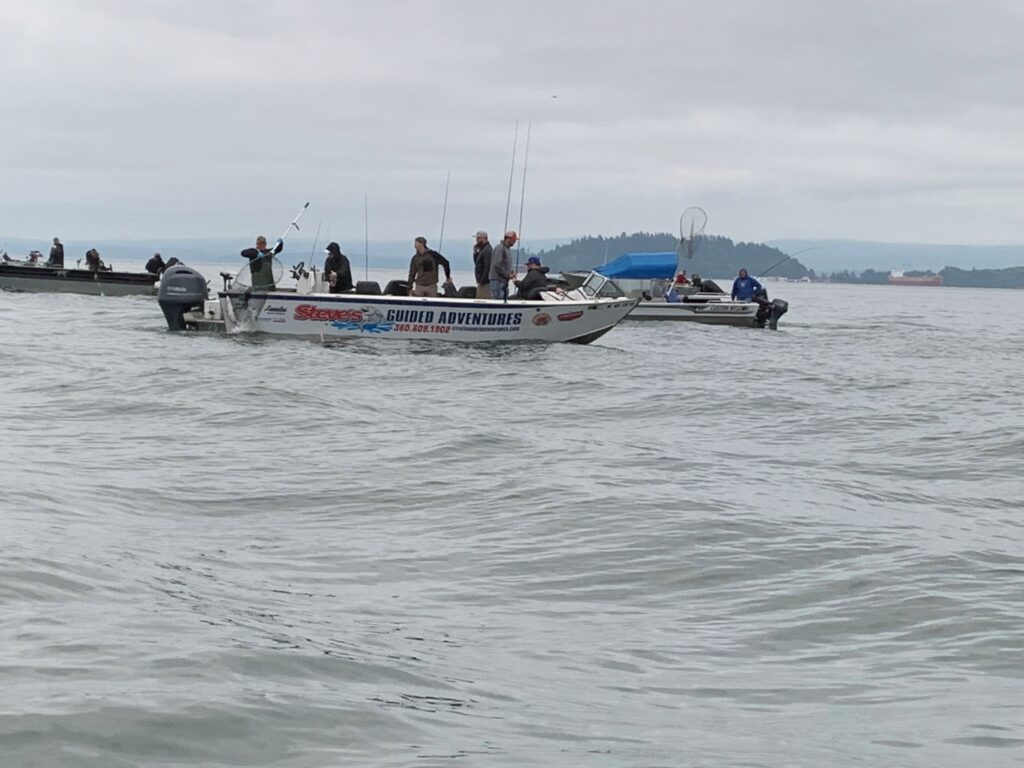
All decisions on whether the Columbia River mainstem reopens later in May and possibly into early summer are left up to joint Washington and Oregon in-season management decisions. To keep track of updates, the public is encouraged to sign up for WDFW Columbia River Compact mailing list notices at https://wdfw.wa.gov/about/lists.
The 2025 forecast for Columbia upriver spring Chinook is 122,250 fish, more than the 116,332 that returned in 2024, but lower than the 10-year average of 139,676 fish.
Several factors influence the arrival of spring Chinook, including flow patterns, which can change on a daily basis. These fish are known to work their way up the maze of channels and will follow bottom structure in the river. They will avoid turbulent water and are known to stall below dams when abrupt changes occur at the tailrace and fish ladder channels.
The initial spring Chinook fishing seasons for the Columbia River mainstem were set in late February, with end dates in mid/early April for below Bonneville Dam and late April upstream. It is usually soon after that when the run begins to ramp up. In recent years, the timing of the run has been later and later.
As of mid-April, the spring Chinook fishing success was just starting to build in the lower river. The number of fish seen at the Bonneville Dam fish ladder was also sporadic. Anglers can track daily fish counts by going to Columbia River adult salmon counts at https://www.fpc.org/currentdaily/HistFishTwo_7day-ytd_Adults.htm, which is key to knowing when to go fishing.
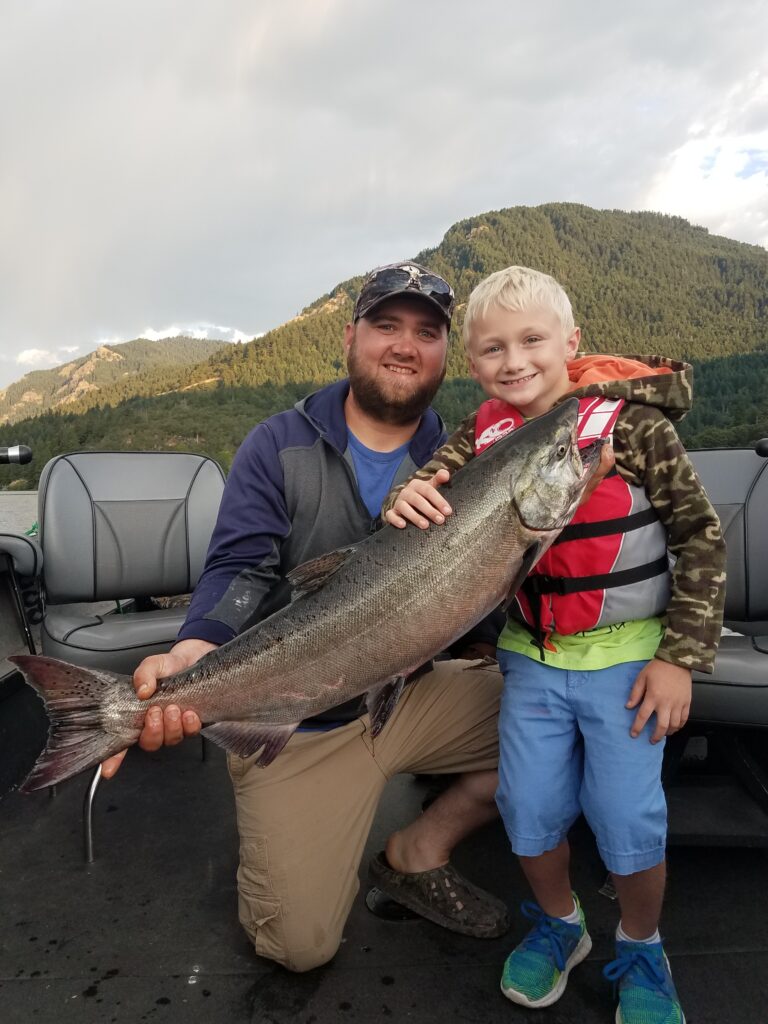
It’s also wise to not wait to go fishing once the run begins to peak, as you’ll likely miss out on the best time period. “For 2025, the corresponding harvest rate tiers are determined by the Snake River wild abundance estimate. Following that, we apply a 30% buffer applied to the forecast until we get a run size update, this is then used to determine the harvest rate,” said Ryan Lothrop, Columbia River fisheries manager with the Washington Department of Fish and Wildlife (WDFW), which he referred to as step one.
Next, fishery managers calculate the allowable catch. Lastly, fishery managers apply the commission guidance of proportion of the Endangered Species Act splits by sector and area.In 2025, recreational anglers are projected to harvest approximately 5,200 adult spring Chinook below Bonneville Dam in the Columbia mainstem, and 550 spring Chinook from Bonneville Dam upstream to the Washington/Oregon border.
“Fortunately, we were able to provide additional quality April days of opportunity downstream of Bonneville Dam this year, given there was a substantial balance remaining,” Lothrop said. “Upstream of Bonneville Dam, increasing catch rates in recent years have led to early closures, resulting in fewer open fishing days before this year’s in-season run size update."
However, if the run size update is large enough or if there’s remaining catch allocation, additional fishing time is likely. ”Fishery managers will monitor the fisheries, dam counts, and hatchery returns as the season progresses and adjust as necessary. The U.S. v. Oregon Technical Advisory Committee typically provides a run size update in mid-May. Based on the 2025 preseason forecasts, anglers can expect to find a decent number of spring Chinook in the Cowlitz, Kalama, and Lewis rivers. Tributary fisheries are managed based on hatchery spring Chinook surplus.
Places like the Cowlitz experienced closures a few years ago, but with a forecast of 13,310 (4,580 and 8,822), a closure isn’t necessary in 2025. The Cowlitz spring Chinook forecast to the tributary mouth is greater than the recent five-year and 10-year average return of 5,300 and 9,800, respectively. In the Kalama River, the spring Chinook forecast to the tributary mouth is 2,900 (1,840 was forecast with an actual return of 2,310 in 2024).
The Kalama spring Chinook forecast to the tributary mouth is similar to the recent five-year and 10-year average return of 2,200 and 2,500, respectively.In the Lewis River, the spring Chinook forecast is 3,060 (3,270 and 2,553). The Lewis spring Chinook forecast to the tributary mouth is similar to the recent five-year average return of 3,700 and greater than the 10-year average return of 2,600. During May a lot of the spring Chinook fishing attention also shifts to tributaries above Bonneville Dam such as Drano Lake, and the Wind and Klickitat rivers. The best way to gauge when it’s time to go is by watching the fish counts at Bonneville Dam.
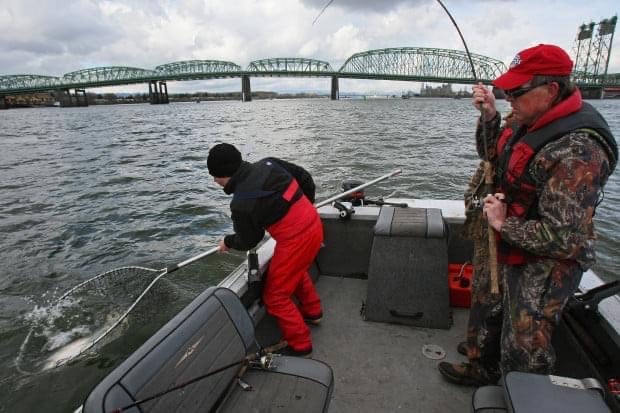
The Wind forecast is 4,900 (4,200 forecast and actual return of 4,604 in 2024) and is greater than the recent five-year and 10-year average return of 4,100 and 4,000, respectively. In Drano Lake (aka Little White Salmon) the forecast is 7,600 (5,300 and 7,863) and forecast is similar to the recent five-year average return of 7,400 and less than the recent 10-year average return of 8,100. The Klickitat forecast is 1,200 (1,300 and 491) and is similar to the recent five-year average return of 1,300 and less than the recent 10-year average return of 1,500.
In Drano Lake, the best action happens in the area referred to as “Toilet Bowl,” a popular spot where anglers troll in a tight circle near the entrance of the lake. While most are Drano Lake stock fish some of these fish are known as “dip-ins” as they first enter the lake before migrating further up the Columbia River. There isn’t much space to troll so make sure you’re following the same path as others and are good at handling your boat and keep your lines right underneath to avoid getting tangled up with others. If someone nearby hooks a fish stay clear of them.
If you plan to fish Drano Lake, be aware the Columbia River outside the mouth of Drano Lake is closed. There is a marked boat fishing boundary area in Drano to allow for some bank angling to occur near the mouth. From the shore cast spinners or Wiggle Warts. Anglers also fishing for springers in the Wind River must stay within the fishing boundary of the river itself and not stray into Columbia River mainstem area. Spring Chinook tips and tactics I could list a hundred different ways to successfully catch spring Chinook and what to use varies depending on river location, flow patterns and water clarity but the most important factor to keep in mind is patience.
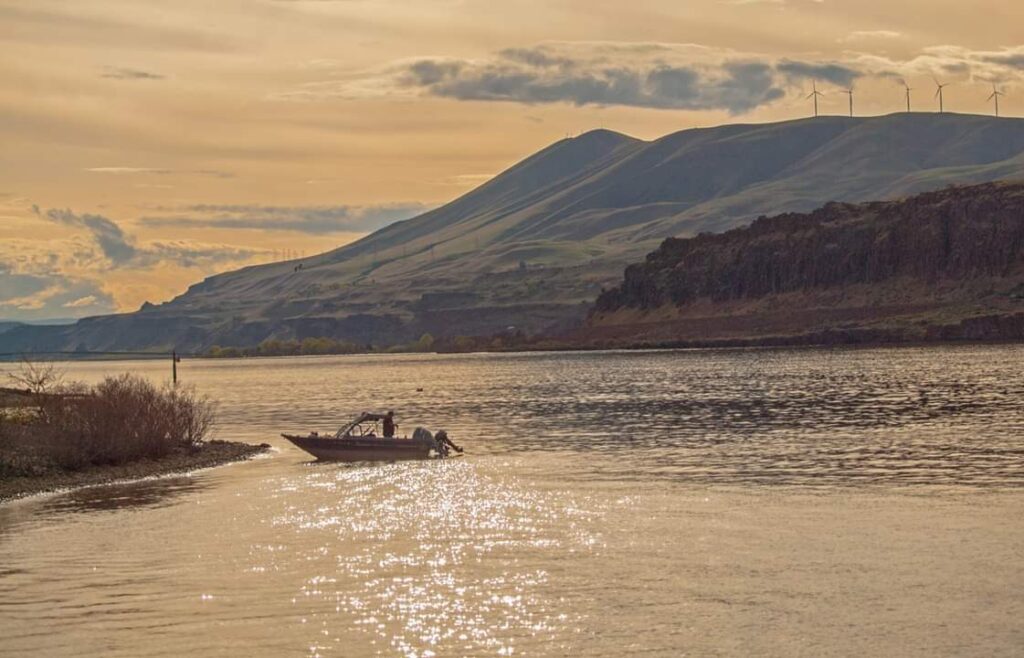
Earlier last month, I had a friend who spent six days and nearly 50 hours on the water of the Lower Columbia River and managed to bring home one hatchery-marked fish.
As for fishing gear, don’t skimp on the rod and reel and spending money wisely will be an investment toward catching more fish. The rods of choice are usually a 9 ½ to 10 ½ foot of 15 to 25 pounds with a lot flex and soft tip. Oftentimes these fish will grab the bait and turn away so flexibility in the rod will allow for a proper hook-up. Let the salmon pull your rod tip down a few times before gently setting the hook and don’t jerk hard since usually the depth of water you’re fishing isn’t very deep to begin with.
Line counter reels are the norm nowadays and enable you to find the sweet spot by aligning the depth on your fish finder to the area where the fish are lurking. Many like to use braided line, but I’m old school and will stick with monofilament line for a bit of stretch and give when the fish bites. The standard setup for trolling is a three-way swivel with 10 to 18 inches of 15-pound monofilament to an eight- to 15-ounce dropper weight, depending on current and flow.
On the other end of the swivel is 24 inches of 30-pound monofilament line to your fish flash and then another 40 to 50 inches of 30-pound monofilament line with a swivel halfway down the leader to allow the bait or lure to spin freely and eliminate the line from twisting and tangling. Often I’ll go “naked” and not use a fish flash which creates less drag too.
The traditional bait is a green-label herring, whole or cut-plug, with the proper tight spin. Many will soak their bait in a brine mixture to toughen them up. After bouncing off the bottom a few times or running into debris they’ll tend to get blown out or will lose their quality spin. To get the right spin on a whole herring, I like to insert a toothpick in the anal vent of the herring and bend the herring to a 45 degree angle. Then take the top hook and insert it under the lower jaw and out through the hard spot between the eyes. About halfway down the side of the body insert and pull out the trailing hook so it dangles freely.
Others like to pin a plastic bait helmet – Krippled Herring or Rhys Davis – to avoid wear and tear on the herring. Before dropping it down, add some scent and make sure it has the right spin. Other top choices are a 3.5 spinner and prawn, flat fish wrapped with a sardine or a Brad’s Super Bait. Downsizing to smaller Kokanee Cut Plugs, or a 2.5 or 3.0 Spinfish filled with tuna to tandem trailing hooks are effective in warmer water conditions and when it gets crowded during a slow troll like at Drano Lake.
Colors are also key to catching fish. Be sure to carry a wide variety but usually chartreuse, silver, orange and red work well. The scent of bare hands can be a deterrent so keeping some environmentally safe liquid soap, clean hand towels and elastic nitrile gloves will enable you to stay in the game of catching fish. Have a small bucket to wash down your lures and be sure to keep your rod handles and cranks on the reel clean.
Be sure to check the WDFW website at https://wdfw.wa.gov/ for current daily limits, other area-specific rules, any emergency rule changes, and closures or openings that tend to occur during the spring Chinook fisheries.
Tight lines, and I’ll see you on the water very soon!
(Mark Yuasa is a Washington Department of Fish and Wildlife Communications Manager. He was also the outdoor reporter at The Seattle Times for 28 years.)
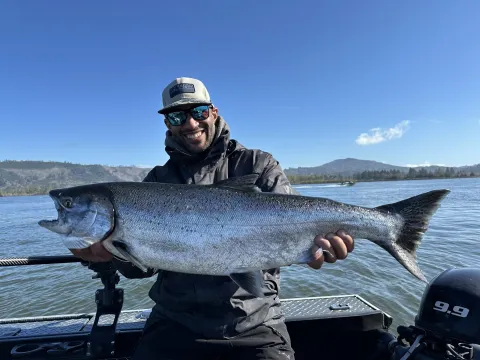
/articles/springers-are-here
Spring Chinook Time
By Jason Brooks
One of the most sought after and tasty salmon in all of the Pacific Northwest is the spring chinook. This run of salmon draws thousands of anglers who will first head to the Columbia, as well as a few coastal rivers for a chance to catch a “springer”.
The fish start to arrive in January and will run until May, with the height of the runs occurring in April. Once the fish make their way up the Columbia to the many tributaries, the anglers will spread out to focus on terminal fisheries. Run estimates and seasons yet to be set will determine where you can go to catch a spring chinook.
Looking at the projected runs, the Columbia total run is expected to be 307,800 wild and hatchery combined. This is good news as it is well over last year's projected run of 197,000 fish and even over the actual return from last year of 274,495. This means anglers should have fisheries in the lower Columbia area as well as the Vancouver-Portland fishery between I-5 and I-205 in early spring.
The Kalama fishery is near the Port of Kalama on the Columbia River, where there is good boat access with a protected harbor and multi-lane boat launch. Run straight across the channel, and you are at the fishery. Some anglers will use a small boat to cross and then beach fish off Sand Island by plunking a Spin-n-Glo with a gob of cured salmon eggs. Other bank plunking options are wobblers on a dropper, or a banana plug such as a MagLip or K15 Kwikfish, both with a herring or sardine wrap.
The boat angler has two options here depending on the tide. Most will troll using a triangle flasher, such as the Mack’s Lure UV Triangle Scent Flash or a Yakima Bait Company Big Al’s Fish Flash, then a long leader from 36 to 48 inches, with a 6-bead chain swivel in the middle, to a plug cut herring. When it comes to bait, the most productive herring are dyed with Bad Azz bait dye in either chartreuse or blue, or brined with Brine-n-Brite, which also comes in chartreuse and blue.
Single point barbless hooks must be used, but to increase the chance at a hook-up, set back the farthest hook and downsize it to a size 4 Gamakatsu Big River. These hooks are strong even in the small size 4- which tends to grab onto the chinook's face or jaw when they swipe at the bait- and will increase your hook to landing ratio.
The second option is to anchor up during the outgoing tide and let out the plugs and wobblers. This is known as “sitting on the hook”, and boats will form lines, often using wing dams to tie up to and to help break up the strong outflowing current. My first time fishing this part of the river was fishing on anchor with a friend in his boat. We sat in the protected covered cabin and played card games until a rod started to bounce, running out into the rain and reeling in the fish.
Then we let out the line, making sure it landed in a travel lane (which are often shallow depressions in the sandy bottom), and then resumed the card game again. It might not sound like much of a fishing experience, but this is springer fishing, and it is all about putting the best-eating salmon in the freezer.
The Cowlitz
The Cowlitz is the second largest lower Columbia tributary, only to be surpassed by the Willamette. With a predicted return of 9,000 springers to the Cowlitz, we can hope there will be a fishery that often coincides with the late returning winter steelhead. The “Cow” is one of the few rivers where anglers can catch a double bag of good eating fish in the same day. Depending on where you go on the Cowlitz will dictate how you fish.
In the lower river, anglers often pull plugs or use bait divers and baits such as cured salmon eggs or prawns. The prawns will have sat a few days in Pro-Cure’s Shrimp and Prawn Cure in magenta or red, and some anglers will use both baits at the same time, making a “cocktail” of sorts. Further upriver, anglers will float fish gobs of eggs or even plunk them. The Cowlitz offers both bank and boat access and is within a few hours’ drive of several cities, which means it gets crowded, but it can be a great place to catch fish.
Willamette
If you are looking for a lower Columbia powerhouse, then look at the Willamette. Anglers will start in early spring, hoping to be one of the first to catch one of the 71,000 projected spring chinook expected back this year. That is nearly 20,000 more than projected last year (51,200) and almost 16,000 more than the 55,391 that returned. The early springtime anglers will target the Multnomah channel which starts at St. Helen’s, Oregon, right across from Ridgefield, Washington. This can be protected waters, often calm and out of the wind, unlike the mainstem Columbia in spring.
I was fishing here several years ago with Buzz Ramsey, and as we crossed the Columbia, I noted that the wind was starting to kick up. After fishing the day in the Multnomah channel, we started back towards Ridgefield, where we had launched from. Making the corner around the island, we were met with gale force winds and whitecaps, and later learned that a boat capsized on the Columbia that day, costing two people their lives.
Be sure to check the wind forecast if you plan to cross the Columbia to fish the Multnomah channel, otherwise, drive around to the Oregon side and launch from there. An Oregon fishing license is needed to fish in the Multnomah channel, as this is considered Oregon waters and is part of the Willamette River and not the Columbia.
Bonneville Dam
Further upriver and above the Bonneville Dam, anglers start to target terminal fisheries. The first being the Wind River, which will have both a run of Wind River bound fish as well as fish stopping to rest near the deadline of the Wind River outlet, as marked by large white buoys in the Columbia. The Wind River is expected to get back 4,400 fish, which is only 200 fish more than last year's projection of 4,200, but last year the run exceeded the estimate by over 2,000 fish, with an actual return of 6,530.
Here, trolling plugs such as MagLips, Kwikfish, and even going “old school” with an orange Mag Wart by Storm is commonplace. In the late 90’s and early 2000’s, about everyone flat lined the hot orange Mag Wart and then started fishing them on droppers to keep from tangling with other boats. This still works, but also anglers will be trolling triangle flashers and Brad’s Super Baits and Super Cut Plugs often in the Hot Lava color and stuffed with tuna.
Drano Lake
Drano Lake is the most popular spring chinook terminal fishery in the entire Columbia system. Here hundreds of boats will try to choke into the “toilet bowl”, which is the entrance to the impoundment at the highway 14 bridge. Be aware of the deadline and do not cross it as you will get cited and be sure to be courteous. Here, boats will slow down and make a turn, trolling in a counterclockwise direction.
Do not try to go against the current of boats, as it will only lead to a mess. Here, anglers primarily slowly troll prawn spinners with a triangle flasher. Again, the Pro-Cure cured prawns are effective, with magenta being the most popular color. For prawn spinners, you can use the tried-and-true Eric’s Prawn Rig by Lugh Jensen with the “backdraft” color, a combination of orange, chartreuse, and green with green beads.
Macks Lure also has a prawn rig which uses their Smile Blade, a Mylar blade that works at extremely low speeds which are needed at Drano. Again, the most popular color is green and chartreuse, with a magenta cured prawn.
For anglers hoping to get some spring chinook further upriver, then 2023 might be your year. The Snake River and Idaho bound fish are estimated to be 85,900, which means there could be a season, but do not expect any announcements until in-run estimates are updated with fish counted at the dams. Icicle River anglers up near Wenatchee, some 500 river miles from the ocean, also have some great news, along with Yakima River anglers, as 41,400 spring chinook are expected in the “Upriver Columbia” run.
Seasons on both rivers are not usually announced until dam counts show there are enough fish above the mid-Columbia pools. If this estimate is like the others and last years, all of which came in above projections, then spring chinook anglers in the upper Columbia and even into Idaho will hopefully have a season. With springers already showing up and passing over Bonneville dam, with one climbing the fish ladder on January 2nd, it looks to be a momentous year. The best eating fish are on their way here, and anglers will have plenty of places to go.
Let us hope the winds do not kick up too much and we can all get along in Drano’s toilet bowl. Start curing up the prawns and soaking the herring, it is springer time!
/articles/spring-chinook-time
Hanford Reach Fall Chinook Bounty
My reel was peeling line at a dizzying rate and it felt like I had a freight train attached on the other end. Without thinking I applied my thumb to the level line spool and pulled back with a loud “ouch!” “That’ll leave a mark” our guide Dave deadpanned. The fish was a good fifty yards behind our boat before I was able to slowly start to regain line. Foot by foot the strong chinook and I battled back and forth, each of us gaining, and then losing line to the other.
The most popular location anglers congregate is Vernita Bridge. There is a large open area to the north of the bridge on the east side of the river. Every year a small town of anglers set up their base camp here. All variety of tents, RVs, and sleeping in the back of trucks can be seen. At night the cries of the coyotes remind you that this is wild country. Camping is free, but a Discovery pass is required. The launch here is rough and rocky and four-wheel drive is a must. Plan on your boat getting scraped up on the rocky shoreline and be sure to bring waders to help during the launch and retrieval process. Launching, by the way, starts at o-dark hundred. Alarm clocks are optional – unless you’re a deep sleeper, you will be awakened by the lights and sounds of anglers starting to launch around 3am.
Closer and closer the powerful fish came, each run a little less intense. Now a giant tail could be seen, trailing a large V wake behind it. Finally, the fish, exhausted came to the side of the boat and I saw the reassuring sign of fatigue as the fish laid on its side, telling us we were getting closer to that critical moment. Net sliding under the fish Dave skillfully scooped him up and into our boat. But not before the big fish gave one final flip of his tail, giving all of us an early morning soaking. Wow! This upriver fall bright was twenty plus pounds of pure power and beauty, not to mention great eating. The smiles and high fives of my friends were the icing on the cake and the day was just beginning!
A perfect morning, the sun just breaking over the shoreline and catching a hot Hanford Reach fall chinook - it’s the stuff dreams are made of, and it was living up to be everything I had heard about the Reach.
Washington’s Hanford Reach is synonymous with some of the state’s best fall chinook fishing to be found – and not coincidentally, the last of the chinook fishing to be found for the season. It’s the icing on the cake, and what icing it is! The Reach is the perfect setting and the perfect fish to end the year’s salmon fishing on the Columbia River. These are the brutes that dreams are made of. A fish worth dreaming about during the long off season and savoring the brief weeks they are available to catch. Battle plans must be made, so let’s talk about what you need to know to get into this fishery and have a chance at one of these amazing fish.
They call “The Reach” the last free-flowing stretch of the Columbia. With dams seemingly from one end of the Columbia to the other, this stretch of water has no dams to impede it. Here, from Priest Rapids dam down to Richland anglers have 63 miles of productive water to fish. Ideal spawning grounds make this a natural holding location for big chinook to do their reproducing thing. For the boat angler, you’ll find a variety of deep holes, shallow runs, and everything in between. A prop boat can be used – with extreme caution, however, downriver in the area known as Coyote Rapids a jet is the way to go.

Just upstream from the rough launch at Vernita you’ll run into the first hole, the Hog Hole. This spot will hold fish early and throughout the season. It’s in the middle of the river and runs a couple hundred yards in length and has a depth of 15-40 feet. Fish will be both suspended and hugging the bottom here. The hole is deep enough to require a way to get your gear down to the fish. This can include divers, dropper weights, and, yes, downriggers. A word of caution – the Columbia is a big, strong, and powerful river. Snagging a downrigger ball on the bottom of the Columbia has the potential for some seriously bad consequences and requires the boat captain and crew to be ready to deal with them. The times I’ve used downriggers I always have a wire cutter at the ready and a good dose of “always pay attention” to go along with it. It goes without saying if another boat hooks up to be ready to pull those riggers up. Backtrolling this hole works well and as you push the fish ever shallower by ready for that take down.
A variety of salmon catching gear can be used for Hanford chinook depending on the depth and speed of the spot you are fishing. Among the most popular setups are flashers with super baits (packed with tuna), plugs, flatfish (wrapped with a sardine or herring strip), and the ever-effective spin-n-glo with eggs, or eggs and shrimp. Anglers that are flexible and willing to adapt techniques to river flow and time of day will be most successful. Backtrolling your gear down the hole can be very effective, pushing fish back down the hole and triggering them to bite out of aggression is a tried-and-true technique.
Farther upriver as you head to toward the dam, you’ll find the King Hole about a mile and a half above the bridge, then the China Bar and Midway Drifts. One of my personal favorite spots is the deep hole just down from the dam. As well as being great holding water, it’s a stunningly beautiful spot. The deep hole off the rocks is great for downrigger fishing. You may even want to try running a diver twenty feet behind your release and bringing the ball up ten feet off the bottom, letting the diver do the work of bring your bait down to the bottom. Be sure to pay attention to the regulations and know the areas that are closed, downriver from the dam and on the west shoreline where the hatchery is located.

Below the Vernita Bridge you will find several more popular spots, including those famous old reactors. It’s about a three-mile run down to the B/C hole, and another four miles to reactor number one, and then number two. Beyond a large bend you’ll find the famous White Bluffs with a nice sixty-foot-deep hole. There’s a concrete launch located here, however; this is the area where running a prop boat becomes a dicey proposition. Be mindful that water levels can go up and down five to six feet in a day, leaving riffles where clear passage had been. It would be best to learn this water by first going with a guide before venturing out on your own.
Finally, farther downstream around the areas of the mouth of the Yakima down to the mouth of the Snake you’ll find slower water, more suited for prop boats. With several launches located around Richland, Pasco, and Kennewick, smaller boats will have a safer time of it than at the fast-flowing upper Reach spots.
As to timing, these up-river brights can be targeted from mid-September well into late October. Don’t be fooled by the dark coloring on these fish – they cut just fine and taste great!

The Reach is truly an amazing place to fish with the very real opportunity of hooking into large chinook. Multi-fish days are not unusual. As a bonus, while fishing you’ll be treated to amazing scenery. Besides moth-balled nuclear reactors, it’s very possible to see coyote, mule deer, several varieties of waterfowl, and even herds of elk on the shoreline. Some of the best weather in the Pacific Northwest can be had with temperatures moderating from the scorching hot summer days. You’ll find cool nights and a sky full of stars to gaze at as the coyotes sing you to sleep. And most likely you’ll be rewarded with some tasty chinook to take home.
/articles/hanford-reach-fall-chinook-bounty