Washington Coastal River Salmon Prospects by Brent Knight
Washington’s coastal rivers occupy some of the most productive salmon country in the Lower 48. From the Willapa and Chehalis systems north to the Quinault, Queets, Hoh, and Quillayute system in Forks, these waters support Chinook, coho, chum, and other salmonids while sustaining tribal fisheries, recreational anglers, commercial fishing communities, and ecosystems built around returning salmon.
For 2026, the outlook is encouraging in several important respects. Forecasts released by the Washington Department of Fish and Wildlife (WDFW) point to substantial returns of coho and other salmon to the Washington coast, and ocean fishing opportunities reflect relatively strong expectations for several stocks. At the same time, the picture differs considerably by river and species. Natural-origin Chinook remain a particular concern in some watersheds, while changing ocean and freshwater conditions continue to create uncertainty.
A Stronger Coastal Coho Picture
Coho are one of the brightest parts of Washington’s 2026 coastal salmon outlook.
WDFW forecasts an overall Washington coastal coho return of approximately 419,000 fish in 2026. That total includes both naturally produced and hatchery salmon returning to coastal watersheds. Individual systems illustrate the scale of the expected return. Preliminary forecasts put Willapa Bay coho at approximately 127,000 fish, including about 100,600 hatchery-origin and 26,500 natural-origin fish.
Grays Harbor also has a substantial projected coho return. Preliminary forecast tables indicate roughly 71,900 natural-origin and 93,300 hatchery coho, producing a combined forecast of about 165,000 fish. Farther north, forecasts include approximately 60,000 coho for the Quinault system, 31,500 for the Queets, and 6,500 natural-origin coho for the Hoh.
These forecasts do not guarantee equally good fishing everywhere. River flows, ocean survival, harvest rates, run timing, and in-season abundance can all influence what anglers ultimately experience. Still, the numbers provide legitimate reasons for optimism about coastal coho fishing during the 2026 season.
The ocean fishery provides another indication of that outlook. Washington's recreational ocean salmon fishery received a 102,900-fish hatchery coho quota for 2026, up from 99,720 in 2025. WDFW described the forecasts for important Chinook and coho stocks contributing to the ocean fishery as strong enough to provide good recreational opportunity.
Willapa Bay Shows Both Opportunity and Concern
Few places demonstrate the complicated nature of Washington salmon management better than Willapa Bay. The 2026 preseason forecast calls for approximately 28,120 Chinook returning to Willapa Bay. However, only about 2,779 are projected to be natural-origin fish, compared with approximately 25,341 hatchery-origin Chinook. The natural-origin forecast is below WDFW's listed escapement goal of 4,353 fish.
That contrast explains why a seemingly healthy total salmon return does not necessarily mean managers can liberalize fishing across the board. A large hatchery return may create harvest opportunities while a comparatively weak natural stock requires protection. In Willapa Bay during the 2026 season, recreational regulations therefore require anglers to release wild, or unmarked, Chinook.
Coho present a more favorable picture. The forecast of 127,123 Willapa coho includes a natural origin return of 26,499 fish, compared with a listed WDFW escapement goal of 13,600. Chum salmon are also expected to return in significant numbers: the 2026 Willapa forecast totals approximately 110,837 chum, the great majority of them natural-origin fish.
Willapa therefore illustrates an important point about discussing “salmon prospects.” There is rarely one simple answer. One species, or even one component of a species, may be doing relatively well while another remains constrained.
Grays Harbor and the Central Coast
Grays Harbor and its tributaries, including the Chehalis and Humptulips systems, are another major focus for coastal salmon anglers.
Coho prospects appear relatively promising based on preseason abundance estimates. Chum numbers are also notable. WDFW's 2026 forecast projects approximately 93,877 chum returning to Grays Harbor, including more than 87,000 natural-origin fish.
As elsewhere on the coast, however, abundance is only part of the management equation. Fisheries must be designed around conservation requirements, escapement objectives, treaty obligations, and the expected effects of different fisheries on individual salmon populations.
Washington's annual North of Falcon process brings WDFW, tribal co-managers, federal managers, anglers, commercial fishing interests, and other participants into the season-setting process.
Forecasts are developed early in the year and then used in negotiations and modeling that ultimately determine where, when, and how salmon can be harvested. That means a large overall forecast does not automatically translate into a long season or generous limits on every river.
North Coast Rivers Remain Wild-Salmon Strongholds
Moving north along the Olympic Peninsula, rivers such as the Quinault, Queets, and Hoh retain something increasingly valuable: substantial natural salmon production and extensive habitat within or near protected lands.
The 2026 preliminary coho forecasts illustrate the importance of these systems. The Quinault forecast includes approximately 23,600 natural and 36,500 hatchery coho. The Queets forecast includes roughly 10,400 natural and 21,100 hatchery fish. The Hoh forecast calls for approximately 6,500 natural coho.
These rivers are important not simply because they produce fish for harvest. They are also benchmarks for understanding how salmon populations function in watersheds that retain comparatively intact forests, floodplains, tributaries, and spawning habitat. Protecting that habitat will be increasingly important as environmental conditions change.
The Biggest Unknown May Be the Ocean
Salmon spend part of their lives in freshwater, but much of their survival story is written at sea.
Ocean temperature, currents, upwelling, prey availability, predators, and marine food webs can dramatically affect the number of juvenile salmon that survive long enough to return as adults. Those conditions can change rapidly, making even scientifically sophisticated forecasts imperfect.
That uncertainty deserves particular attention in 2026. NOAA Fisheries reported in March that a large marine heatwave had persisted off the West Coast since the previous summer, only the third time such a broad area had remained exceptionally warm for so long into winter without an El Niño event. NOAA notes that marine heatwaves can reduce salmon survival because warmer ocean conditions are generally associated with lower productivity, although the effects can vary by species and location.
Freshwater conditions pose another long-term challenge. Climate change is altering both rivers and the ocean, including the availability of cold-water habitat for salmon during freshwater stages of their lives. For Washington's coastal watersheds, maintaining cold tributaries, reconnecting floodplains, improving fish passage, protecting spawning gravel, restoring estuaries, and preserving functioning forests will therefore become even more important.
Habitat Is the Long-Term Investment
Fishing regulations can control harvest, and hatcheries can provide fish for fisheries, but neither can fully substitute for productive habitat. Salmon need connected habitat throughout their life cycle: clean spawning gravels, cold tributaries, complex river channels, floodplain wetlands, estuaries, and productive marine waters. Habitat restoration is therefore a major component of salmon recovery efforts throughout the West Coast.
Significant investment continues in this area. In 2026, NOAA Fisheries announced up to $99 million through the Pacific Coastal Salmon Recovery Fund for state and tribal conservation and recovery projects benefiting Pacific salmon and steelhead.
Those projects may not produce immediate results visible during a single fishing season, but over decades they may prove more important than any particular annual forecast.
What Anglers Should Expect in 2026
For Washington coastal salmon anglers, the 2026 season offers genuine reasons for enthusiasm. Coho numbers are encouraging in several major systems. Hatchery production should provide meaningful harvest opportunity, and the recreational ocean fishery entered the summer with slightly higher quotas for both Chinook and hatchery coho than in 2025. Willapa Bay also has strong projected hatchery Chinook and coho returns, while coastal chum forecasts exceed 200,000 fish between Grays Harbor and Willapa Bay.
But optimism should remain measured. Natural Chinook abundance continues to limit opportunity in some areas, and anglers should expect selective fisheries, changing regulations, and river-specific restrictions designed to protect weaker stocks. Forecasts are estimates rather than guarantees, and actual returns can diverge significantly from preseason expectations.
The larger story is that Washington's coast still possesses something extraordinary: rivers capable of producing substantial numbers of wild salmon alongside hatchery-supported fisheries.
The challenge is ensuring they remain that way. If habitat restoration, responsible harvest management, hatchery reform, tribal and state co-management, and climate adaptation can work together, Washington's coastal rivers can continue supporting salmon, and salmon fishing, for generations to come. The 2026 forecasts provide reasons to look forward to the coming runs, but the future of these fish will ultimately depend less on any single year's numbers than on the condition of the rivers and ocean they depend upon.
/articles/washington-coastal-river-salmon-prospects-brent-knight
Getting Ready for Salmon Season! by Hannah Pennebaker
If you're anything like me, then you have dreams about bobber downs and chrome fish. The long wait is over, and the time is finally here! Whether this is your first or fiftieth salmon season, preparation is the key to success. Let's go over some tips on how to ensure your boat, trailer, and gear are in tip-top shape for this salmon season.
If you have a boat, you'll want to make sure it's running smoothly and has all the gear you need. Fill up your gas tank, check your batteries, test your downriggers, and fire up your motors. Take a look at your engine hours and take care of any recommended services. Repair shops are busy this time of year, so it's not a bad idea to watch some tutorials and figure out how to do some basic repairs and services yourself. Our boat has both a 2-stroke main motor and a 4-stroke kicker, so my husband and I have had to become adept at both 2-stroke and 4-stroke motor maintenance!
Don't forget to ensure you have all the Coast Guard-required safety equipment aboard your boat. This equipment is required for good reason, and the Coast Guard conducts inspections.
Here's a good checklist to use:
Flares (3 daytime and 3 nighttime, or 3 daytime/nighttime combos)
Life jackets for everyone on board
Throwable flotation device (if boat is 16ft or longer)
Navigation lights (if traveling between sunset and sunrise or during low visibility periods)
Horn/whistle/other sound signal
Fire extinguisher
Carbon monoxide warning sticker/placard
Not Coast Guard required, but good to have:
Manual bilge pump
Marine toolkit
Marine radio
Extra gas cans
Spare motor parts (spark plugs, hose clamps, etc.)
First aid kit
Let's not forget your boat trailer! Make sure to do a thorough visual inspection of the brakes, chains, couplers, straps, wheels, bearings, and tires for damage and wear. It's a good idea to re-grease your wheel bearings every year. Top up the air in your tires if needed. Hook up your trailer lights and verify that your signals are all working. While you're at it, make sure your registration is up to date for both your boat and trailer.
Once you've verified that both your boat and trailer are in good, safe condition, it's time to look at your other gear. Look over your rods and fix any broken guides or tips. Open up your reels and grease any and all moving parts to prepare them for the fights ahead. I like to polish up any spoons or spinners that have corroded during the off-season. This is also a good time to organize tackle boxes and stock up on any swivels, line, etc. Do it now before the season is in full swing and tackle store shelves are empty!
Here are a few other miscellaneous things to check before going out. Make sure you have an up-to-date fishing license and catch record card. You can either use a paper card or use the MyWDFW app. Catch record cards are not added automatically in the app. You need to add them to your cart in the MyWDFW or Fish Washington app for $0. If you're going to an area without cell phone service, the data in your card will be added locally and updated when you come back to an area with service. Be sure to familiarize yourself with the rules of the area where you'll be fishing. Don't forget to pinch your barbs and keep all fish in the water until you are 100% certain it's legal to retain. WDFW has great resources on how to identify each salmon species in both saltwater and freshwater. Please follow the rules and help protect the resource so that future generations can enjoy fresh, local salmon on the dinner table too!
/articles/getting-ready-salmon-season-hannah-pennebaker
Summer Salmon are Coming! by Mark Yuasa
That means it’s time to get all the salmon fishing gear in order and begin thinking about the kickoff to several salmon fisheries planned to open in June.
While the tentatively proposed 2026-2027 salmon fishing season package was finalized in mid-April, they won’t be officially adopted until sometime in mid-June.
The rules set by the Washington Department of Fish and Wildlife (WDFW) were submitted to the National Marine Fisheries Service within the National Oceanic and Atmospheric Administration (NOAA) Fisheries in early May.
NOAA Fisheries implements the actions through its regulatory channels under the Endangered Species Act and the Magnuson-Stevens Fishery Conservation and Management Act. Proposed fisheries are not finalized for the 2026-2027 salmon season until NOAA Fisheries approves them.
As part of the North of Falcon process, WDFW is hosting a virtual public hearing on Tuesday, June 9, from 10 a.m. to 12 p.m., and will take additional public comments. Go to this link https://wdfw.wa.gov/events/north-falcon-public-hearing-20260609 to register for the public hearing. Pre-registration is required. Final regulations will be adopted subsequent to that hearing and signed off by the WDFW Director by around mid-June. For a list of the proposed fisheries, go to https://wdfw.wa.gov/fishing/management/north-falcon/summaries. The 2026-2027 fishing regulation pamphlet will come out online around June 18. Printed copies should arrive at license dealers and at WDFW offices by June 26.
In the meantime, before rushing out the door, salmon anglers should check on any early-season summer fishery openers by going to the WDFW website (https://wdfw.wa.gov/) to see what areas are scheduled to open and for any possible emergency fishing rule changes or closures.
Where to Go in June
A much-anticipated early-summer salmon fishery occurs in Marine Area 10 (Seattle-Bremerton Area), which is scheduled to be open daily for a coho beginning June 1. Look for coho averaging 2 to 4 pounds in the shipping lanes off Jefferson Head, from the westernmost Kingston boundary line south to Presidents Point, from the Edmonds oil docks south to Richmond Beach, West Point south of Shilshole Bay, along the east side of Bainbridge Island, and the tide rips off Blake Island, Restoration Point, and the northside of Vashon Island west to Southworth.
If your preference is a chance at catching an early-summer hatchery Chinook, then look no further than Marine Area 11 (Tacoma-Vashon Island). Fishing is scheduled to be open beginning June 1. These fish usually consist of a mix of resident and mature migrating Chinook averaging 7- to 15-pounds with some in the 20-plus pound category.
WDFW will monitor the June Marine Area 11 Chinook fishery, and it could close sooner in order to stay within the quota and/or other guidelines. The Chinook catch quota for the June fishery is 1,423, with a total unmarked encounter of 820 and a total sublegal encounter (Chinook under the 22-inch minimum size limit) of 2,186. The Marine Area 11 Chinook fishery is managed under two separate summer quotas, and a second window of opportunity is tentatively proposed to begin on July 23.
Look for salmon off Point Defiance Park in Tacoma from the Clay Banks to Owen Beach; Slag Pile off the Tacoma Yacht Club, outside of Gig Harbor on the “flats” area; northeast side of Vashon Island; Colvos Passage; outside of Quartermaster Harbor; and the southwest side of Vashon Island at Point Dalco. In the northern sections of Marine Area 11, try Dolphin Point and Point Robinson on the east side of Vashon Island, south of the Southworth Ferry Landing, and Apple Tree Cove to Redondo Beach.
If Marine Area 11 is slow or closes sooner than expected, another option is south of the Narrows Bridge in Marine Area 13 (South Puget Sound). Locating schools to baitfish is key to raising the bar on success for salmon at Gibson Point, Fox Island Fishing Pier, Hale Passage, Johnson Point, Anderson Island’s east side, and Point Fosdick. Marine Area 13 is scheduled to be open year-round for salmon. Anglers should check the WDFW website or the 2026-2027 regulation pamphlet for details.
Another good Chinook option is the Tulalip Terminal Area Fishery (Marine Area 8-2), which is open Fridays through Saturdays of each week and has a harvest quota of 600 Chinook. The popularity of this fishery has generated some decent action in the past few summers. The WDFW will monitor the Tulalip fishery, and it may close sooner to stay within the harvest quota.
For saltwater anglers without a boat, there are a good number of viable year-round fishing piers to catch salmon. They include the Edmonds, Fox Island, Mukilteo Ferry Landing, Seacrest in West Seattle, Dash Point Dock, Point Defiance Park Boathouse, Les Davis, and Des Moines piers.
If you prefer a freshwater salmon fishery, then make plans to head to the Skagit River (areas open vary depending on the species, hatchery Chinook or sockeye); Cascade River from the mouth to the Rockport-Cascade Road Bridge (opens beginning June 3 on Wednesdays through Saturdays only); and Nooksack River North Fork from Highway 9 Bridge to yellow marker at upstream end of the Kendall Hatchery property open through June 30. Anglers are advised to check the WDFW website for river sections open to salmon fishing and for any possible emergency fishing rule changes or closures.
Ocean Salmon Fisheries on Tap
Later this month – June 20 to be exact, which also coincides with the official first day of summer – many salmon anglers will head to the coast for the Chinook and hatchery coho ocean fishery. The recreational Chinook quota is 54,000 (up a tad from 53,750 in 2025) and a hatchery-marked coho quota of 102,900 (up from 99,720 in 2025).
Marine Area 1 (Ilwaco): Open daily beginning June 20 through Sept. 30, all salmon. The daily limit is two salmon and one Chinook only. The subarea guideline is 16,780 Chinook (16,600 in 2025), and the subarea quota is 51,450 marked coho (49,860 in 2025). Columbia Control Zone closed.
Marine Area 2 (Westport-Ocean Shores): Open daily beginning June 20 through June 28 for all salmon except coho, and the daily limit is one salmon; release all coho. Fishing is then open seven days per week from June 29 through Sept. 30, for all salmon. Beginning June 29, the daily limit is two salmon, and only one may be a Chinook. The subarea guideline is 21,910 Chinook (22,270 in 2025), with a subarea quota of 38,070 marked coho (36,900 in 2025).
Marine Area 3 (La Push): Open daily beginning June 20 through June 30, all salmon except coho, and the daily limit is one salmon; release all coho. Open seven days per week from July 1 through Sept. 30, all salmon. The subarea guideline is 2,200 Chinook (2,280 in 2025), with 2,680 marked coho subarea quota (2,590 in 2025). Beginning July 1, the daily limit is two salmon. Beginning Aug. 1, no chum retention.
Marine Area 4 (Neah Bay): Open daily beginning June 20 through June 30, all salmon except coho, and the daily limit is one salmon; release all coho. Open seven days per week from July 1 through Sept. 30, all salmon. Beginning July 1, the daily limit is two salmon. The subarea guideline is 13,110 Chinook (12,600 in 2025), with a subarea quota of 10,700 marked coho (10,370 in 2025). Beginning Aug. 1, no Chinook retention east of the Bonilla-Tatoosh line and no chum retention.
Species and size restrictions are dependent on the marine area. WDFW fishery managers will monitor the number of salmon caught in-season and may close areas earlier than scheduled if quotas or guidelines are met. In-season management may be used to sustain season length and keep harvest within the overall Chinook and coho total allowable catch.
Looking Ahead
While this column is focused on June fisheries, those looking ahead to July can look at the Strait of Juan de Fuca Marine Area 5 (Sekiu and Pillar Point) and Marine Area 6 (East Strait of Juan de Fuca) west of a true north/south line through the #2 Buoy immediately east of Ediz Hook, which are both planned to open beginning July 1 for hatchery Chinook and hatchery coho. Marine Area 7 (San Juan Islands) and Marine Area 9 (Admiralty Inlet) are planned to open July 16-18 for hatchery Chinook and hatchery coho. Marine Area 10 (Seattle and Bremerton Area) is scheduled to open on July 23-25 for a hatchery Chinook directed fishery and is also open daily for coho through Nov. 15. Marine Area 12 (Hood Canal) south of Ayock Point is proposed to open on July 1 for coho and hatchery Chinook.
Each marine area could close sooner for Chinook fishing if specific catch quotas or guidelines are met. Check the WDFW website or the 2026-2027 regulation pamphlet for areas where Chinook must be released or are closed to salmon fishing, and for other specific rules.
(Mark Yuasa is a Washington Department of Fish and Wildlife Communications Manager and longtime local fishing and outdoor writer. Contributed by Mark Yuasa, WDFW.)
/articles/summer-salmon-are-coming-mark-yuasa
Coho Craziness
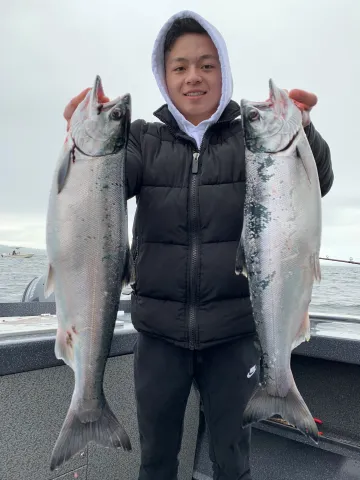
As we head into September, the color of salmon switches from pink to silver around Puget Sound.
The front end of the migratory coho run – also known as silvers for their shiny silvery-colored body – began to filter into the western Strait of Juan de Fuca and Puget Sound in August, and are expected to peak throughout September and early October.
Coho aren’t large – usually averaging 4 to 15 pounds, with some exceeding the 20-plus pounds – but they often put up a good tussle. Young coho spend a year in rivers and estuaries and then migrate out to the Pacific Ocean to feed and grow. They spend about 1½ years in the ocean, then return to spawn as three and four-year-old fish, generally in fall or early winter.
Puget Sound coho returns have gradually made a comeback from a downtrend that began in 2015 and 2016. This was due to negative environmental factors like drought, flooding, and warm water temperatures in their freshwater habitat as juveniles and then in the Ocean from a condition known as El Niño, when surface water becomes warmer than average.
The combined 2025 Puget Sound hatchery and wild coho forecast is 727,490 compared to 722,134 in 2024; 760,029 in 2023; 666,317 in 2022; 614,948 in 2021; and 504,604 in 2020.
Coho fill the air with enthusiasm for their leaping abilities when hooked, and unpredictable movements across the water’s surface.
A positive signal of 2025 expectations began with the good fishing for resident coho, who mainly spend their entire life feeding and growing in local waters –
caught in Marine Area 10 (Seattle and Bremerton Area) from June to early August. Many of these coho have grown since then and will join their larger migratory coho relatives during the late summer and fall marine fisheries.
Knowing when it is “go fishing time” for migrating coho in Puget Sound is to monitor catch rates in the Strait of Juan de Fuca at Marine Area 5 (Sekiu and Pillar Point) and Marine Area 6 (East Strait of Juan de Fuca).
The Marine Area 5 salmon fishery is open daily through Sept. 26 with a two salmon daily limit, plus two additional pink may be retained, and release Chinook, chum, sockeye, and wild coho. The area is then open daily for coho from Sept. 27 to Oct. 9 with a two salmon daily limit, release Chinook, chum, and sockeye.
The Marine Area 6 salmon fishery is open daily through Sept. 26 with a two salmon daily limit, plus two additional pink may be retained, and release Chinook, chum, sockeye, and wild coho. The area is then open daily for coho from Sept. 27 to Oct. 15 with a two salmon daily limit, release Chinook, chum, and sockeye.
Oftentimes, the best coho fishing in the Strait of Juan de Fuca occurs offshore in the shipping lanes, which is the main migration path. These deep-water areas are about one to 10 miles out in 200 to 500 feet of water and sometimes even deeper off the edge of the main shipping channels. Remember to stay within the U.S. side of the shipping lane. Look for tide rips and current breaks where krill and schools of baitfish attract coho, and watch for coho jumping and rolling on the surface.
In the eastern Strait of Juan de Fuca, the Dungeness Bay hatchery coho fishery is open from Oct. 1 to 31. The 2025 Dungeness River coho forecast is 13,328, down slightly from 14,305 in 2024 and 14,654 in 2023.
The Marine Area 7 (San Juan Islands) coho season is open daily through Sept. 6 with a two salmon daily limit, plus two additional pink may be retained, and release Chinook, chum, sockeye, and wild coho. The area is then open daily for coho from Sept. 7 to 30 with a two salmon daily limit, plus two additional pink may be retained, and release Chinook, chum, and sockeye. In Marine Area 7, look for coho staging along the western and southern portions of the island chain.
Coho fishing in Marine Area 8–1 (Deception Pass, Hope Island, and Skagit Bay) is open daily, Sept. 30, with a two salmon daily limit, plus two additional pink may be retained, and release Chinook and chum. Coho fishing is then open daily Oct. 1 to 12 with a daily two salmon catch limit, and release Chinook and chum.
In Marine Area 8–2 (Port Susan and Port Gardner), coho fishing is open daily through Sept. 24 with a two salmon daily limit, and release Chinook, chum, and pink. The Tulalip Bay Terminal Area Fishery has rules that differ from Marine Area 8-2. For details, check the Washington Department of Fish and Wildlife (WDFW) fishing regulations webpage at https://wdfw.wa.gov/.
In Marine Areas 8-1 and 8-2, anglers should find coho along the entire eastern side of Whidbey Island, Possession Point, off the Clinton Ferry Terminal, the Langley/Sandy Point area, Shipwreck to Mukilteo, Hat Island, Camano Head, the entire west side of Camano Island, and outside of Oak Harbor. West Beach at Deception Pass State Park, located north of Oak Harbor on Whidbey Island, provides excellent shore fishing access.
Moving further into Puget Sound, Marine Area 9 (Admiralty Inlet) is another decent fishing location for hatchery-marked coho, which is open daily through Sept. 30. It has a two salmon daily limit, plus two additional pink may be retained, and release Chinook, chum, and wild coho.
In Marine Area 9, focus your fishing time in the unmarked shipping lanes where tide rips and current breaks are commonly found. Try Midchannel Bank off Port Townsend; Point Wilson north of Port Townsend (good public shore access); east side of Marrowstone Island (some shore access); Fort Casey to Bush Point and Lagoon Point (some public shore access); Double Bluff off the west side of Whidbey Island; Point No Point (excellent public shore spot); Possession Bar; Scatchet Head; and Pilot Point.
In Marine Area 10 (Seattle and Bremerton Area), coho fishing is open daily through Sept. 30 with a two salmon daily limit, plus two additional pink may be retained, and release Chinook and chum. Fishing is also open daily from Oct. 1 to Nov. 15 with a two salmon daily limit, and release Chinook.
In Marine Area 11 (Tacoma and Vashon Island), coho fishing is open daily through Sept. 30 with a two salmon daily limit, plus two additional pink may be retained, and release chum and wild Chinook (note, the Chinook fishery may close sooner so check the WDFW fishing regulations webpage for updates. Fishing is also open daily from Oct. 1 to Nov. 15 with a two salmon daily limit, and release Chinook.
Look for coho in the deep-water shipping lanes off Jefferson Head to Kingston, Richmond Beach to Meadow Point near Shilshole Bay, Point Monroe, Shilshole Bay south to West Point, Elliott Bay, the Fauntleroy Ferry area southeast to Dolphin Point, both sides of Vashon Island, Redondo Beach to Dash Point and the Tacoma area of Commencement Bay, Browns Point, and Point Defiance Park from the Slag Pile to the Clay Banks.
Two popular events tied to the arrival of coho are the Edmonds Coho Derby on Sept. 6. For details, go to http://edmondscohoderby.com/. That will be followed by the Everett Coho Derby on Sept. 20-21. For details, go to https://everettcohoderby.com/.
Marine Area 13 (South Puget Sound) is open daily for hatchery-marked coho through Sept. 30 with a two salmon daily limit, plus two additional pink may be retained, and release chum, wild coho, and wild Chinook. Fishing remains open daily beginning Oct. 1 with a two salmon daily limit, and release chum, wild coho and wild Chinook.
In Marine Area 13, look for coho from the Narrows Bridge south to Anderson Island. The Squaxin Island area has become popular area for those targeting coho. The 2024 Squaxin Island net pens coho forecast is 59,596 up from 48,081 in 2024 and 45,417 in 2023.
If you’re looking for a Chinook and coho option try the Bellingham Bay Terminal Fishery open daily through Sept. 30 with a daily limit of four salmon.
Sinclair Inlet and Port Orchard are open daily through Sept. 30 with a three salmon daily limit, plus two additional pink may be retained, and release chum and wild Chinook. Fishing is then open daily from Oct. 1 to Nov. 15 with a two salmon daily limit, and release Chinook.
Lastly, a freshwater coho fishing option in Seattle’s backyard is Lake Washington north of the Highway 520 Bridge, which is open daily from Sept. 16 to Oct. 31 with a daily limit of four coho only, and release all other salmon species. The Lake Washington coho forecast is 28,112 up from 24,090 in 2024 and 21,554 in 2023.
In the October issue, we’ll switch gears and take a look at proposed fall and winter coastal razor clam digging opportunities.
I’ll see you on the water very soon!
/articles/coho-craziness
Springers Are Here
When May rolls around, the spring Chinook fishery kicks into high gear as more and more fish begin filtering into the “Big-C.”
While most of the effort will shift to tributaries in May, the Columbia River mainstem spring Chinook fishery opportunities both above and below Bonneville Dam still remained up in the air as of this magazine’s publication deadline.
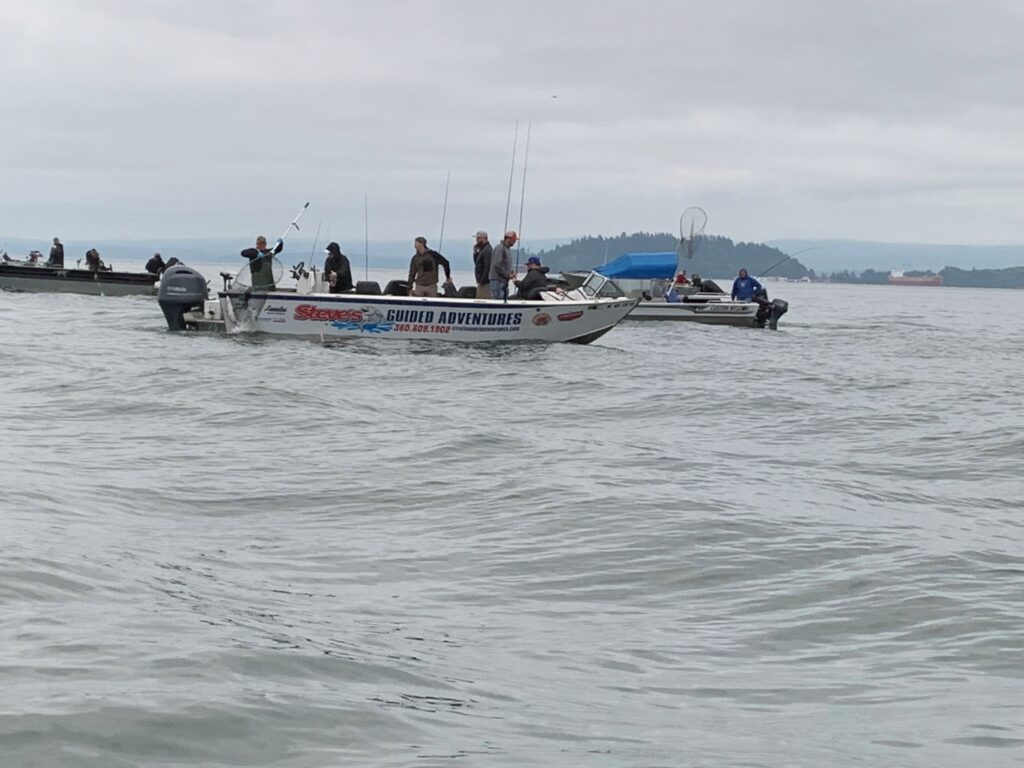
All decisions on whether the Columbia River mainstem reopens later in May and possibly into early summer are left up to joint Washington and Oregon in-season management decisions. To keep track of updates, the public is encouraged to sign up for WDFW Columbia River Compact mailing list notices at https://wdfw.wa.gov/about/lists.
The 2025 forecast for Columbia upriver spring Chinook is 122,250 fish, more than the 116,332 that returned in 2024, but lower than the 10-year average of 139,676 fish.
Several factors influence the arrival of spring Chinook, including flow patterns, which can change on a daily basis. These fish are known to work their way up the maze of channels and will follow bottom structure in the river. They will avoid turbulent water and are known to stall below dams when abrupt changes occur at the tailrace and fish ladder channels.
The initial spring Chinook fishing seasons for the Columbia River mainstem were set in late February, with end dates in mid/early April for below Bonneville Dam and late April upstream. It is usually soon after that when the run begins to ramp up. In recent years, the timing of the run has been later and later.
As of mid-April, the spring Chinook fishing success was just starting to build in the lower river. The number of fish seen at the Bonneville Dam fish ladder was also sporadic. Anglers can track daily fish counts by going to Columbia River adult salmon counts at https://www.fpc.org/currentdaily/HistFishTwo_7day-ytd_Adults.htm, which is key to knowing when to go fishing.
It’s also wise to not wait to go fishing once the run begins to peak, as you’ll likely miss out on the best time period. “For 2025, the corresponding harvest rate tiers are determined by the Snake River wild abundance estimate. Following that, we apply a 30% buffer applied to the forecast until we get a run size update, this is then used to determine the harvest rate,” said Ryan Lothrop, Columbia River fisheries manager with the Washington Department of Fish and Wildlife (WDFW), which he referred to as step one.
Next, fishery managers calculate the allowable catch. Lastly, fishery managers apply the commission guidance of proportion of the Endangered Species Act splits by sector and area.In 2025, recreational anglers are projected to harvest approximately 5,200 adult spring Chinook below Bonneville Dam in the Columbia mainstem, and 550 spring Chinook from Bonneville Dam upstream to the Washington/Oregon border.
“Fortunately, we were able to provide additional quality April days of opportunity downstream of Bonneville Dam this year, given there was a substantial balance remaining,” Lothrop said. “Upstream of Bonneville Dam, increasing catch rates in recent years have led to early closures, resulting in fewer open fishing days before this year’s in-season run size update."
However, if the run size update is large enough or if there’s remaining catch allocation, additional fishing time is likely. ”Fishery managers will monitor the fisheries, dam counts, and hatchery returns as the season progresses and adjust as necessary. The U.S. v. Oregon Technical Advisory Committee typically provides a run size update in mid-May. Based on the 2025 preseason forecasts, anglers can expect to find a decent number of spring Chinook in the Cowlitz, Kalama, and Lewis rivers. Tributary fisheries are managed based on hatchery spring Chinook surplus.
Places like the Cowlitz experienced closures a few years ago, but with a forecast of 13,310 (4,580 and 8,822), a closure isn’t necessary in 2025. The Cowlitz spring Chinook forecast to the tributary mouth is greater than the recent five-year and 10-year average return of 5,300 and 9,800, respectively. In the Kalama River, the spring Chinook forecast to the tributary mouth is 2,900 (1,840 was forecast with an actual return of 2,310 in 2024).
The Kalama spring Chinook forecast to the tributary mouth is similar to the recent five-year and 10-year average return of 2,200 and 2,500, respectively.In the Lewis River, the spring Chinook forecast is 3,060 (3,270 and 2,553). The Lewis spring Chinook forecast to the tributary mouth is similar to the recent five-year average return of 3,700 and greater than the 10-year average return of 2,600. During May a lot of the spring Chinook fishing attention also shifts to tributaries above Bonneville Dam such as Drano Lake, and the Wind and Klickitat rivers. The best way to gauge when it’s time to go is by watching the fish counts at Bonneville Dam.
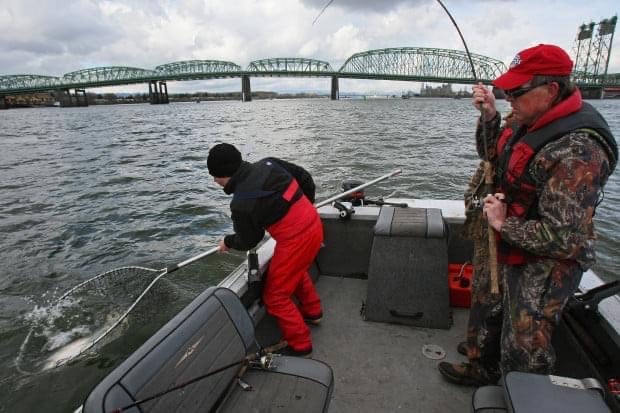
The Wind forecast is 4,900 (4,200 forecast and actual return of 4,604 in 2024) and is greater than the recent five-year and 10-year average return of 4,100 and 4,000, respectively. In Drano Lake (aka Little White Salmon) the forecast is 7,600 (5,300 and 7,863) and forecast is similar to the recent five-year average return of 7,400 and less than the recent 10-year average return of 8,100. The Klickitat forecast is 1,200 (1,300 and 491) and is similar to the recent five-year average return of 1,300 and less than the recent 10-year average return of 1,500.
In Drano Lake, the best action happens in the area referred to as “Toilet Bowl,” a popular spot where anglers troll in a tight circle near the entrance of the lake. While most are Drano Lake stock fish some of these fish are known as “dip-ins” as they first enter the lake before migrating further up the Columbia River. There isn’t much space to troll so make sure you’re following the same path as others and are good at handling your boat and keep your lines right underneath to avoid getting tangled up with others. If someone nearby hooks a fish stay clear of them.
If you plan to fish Drano Lake, be aware the Columbia River outside the mouth of Drano Lake is closed. There is a marked boat fishing boundary area in Drano to allow for some bank angling to occur near the mouth. From the shore cast spinners or Wiggle Warts. Anglers also fishing for springers in the Wind River must stay within the fishing boundary of the river itself and not stray into Columbia River mainstem area. Spring Chinook tips and tactics I could list a hundred different ways to successfully catch spring Chinook and what to use varies depending on river location, flow patterns and water clarity but the most important factor to keep in mind is patience.
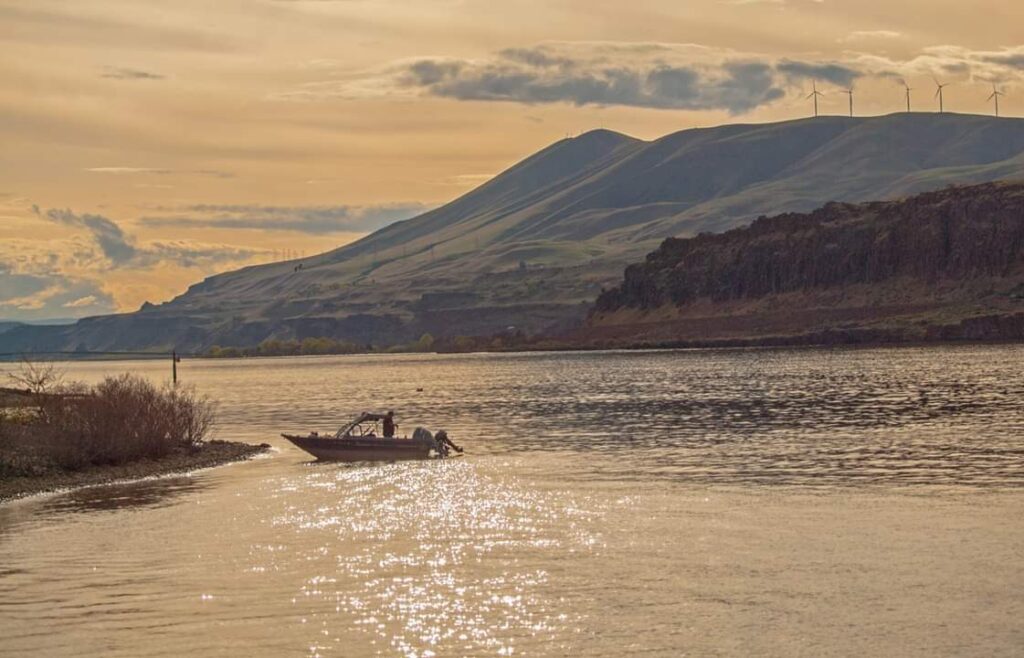
Earlier last month, I had a friend who spent six days and nearly 50 hours on the water of the Lower Columbia River and managed to bring home one hatchery-marked fish.
As for fishing gear, don’t skimp on the rod and reel and spending money wisely will be an investment toward catching more fish. The rods of choice are usually a 9 ½ to 10 ½ foot of 15 to 25 pounds with a lot flex and soft tip. Oftentimes these fish will grab the bait and turn away so flexibility in the rod will allow for a proper hook-up. Let the salmon pull your rod tip down a few times before gently setting the hook and don’t jerk hard since usually the depth of water you’re fishing isn’t very deep to begin with.
Line counter reels are the norm nowadays and enable you to find the sweet spot by aligning the depth on your fish finder to the area where the fish are lurking. Many like to use braided line, but I’m old school and will stick with monofilament line for a bit of stretch and give when the fish bites. The standard setup for trolling is a three-way swivel with 10 to 18 inches of 15-pound monofilament to an eight- to 15-ounce dropper weight, depending on current and flow.
On the other end of the swivel is 24 inches of 30-pound monofilament line to your fish flash and then another 40 to 50 inches of 30-pound monofilament line with a swivel halfway down the leader to allow the bait or lure to spin freely and eliminate the line from twisting and tangling. Often I’ll go “naked” and not use a fish flash which creates less drag too.
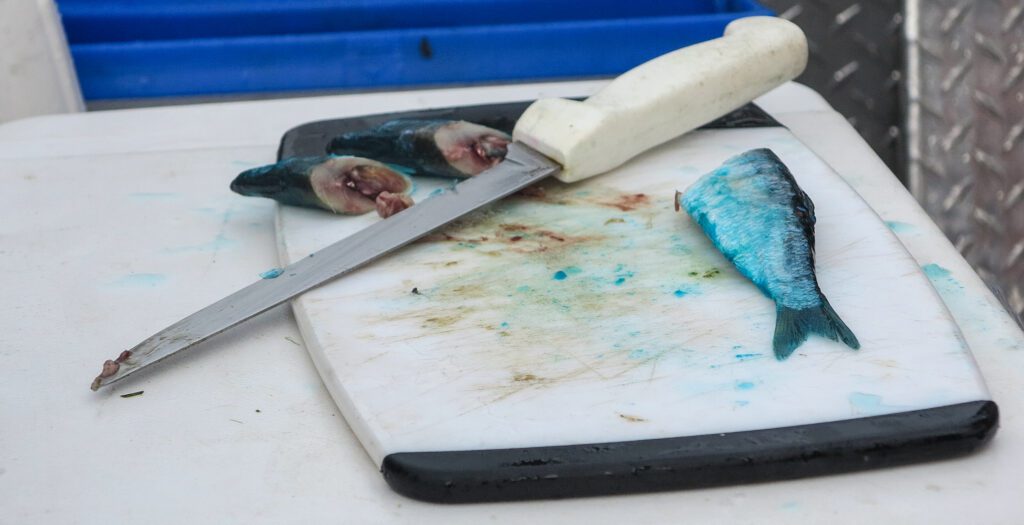
The traditional bait is a green-label herring, whole or cut-plug, with the proper tight spin. Many will soak their bait in a brine mixture to toughen them up. After bouncing off the bottom a few times or running into debris they’ll tend to get blown out or will lose their quality spin. To get the right spin on a whole herring, I like to insert a toothpick in the anal vent of the herring and bend the herring to a 45 degree angle. Then take the top hook and insert it under the lower jaw and out through the hard spot between the eyes. About halfway down the side of the body insert and pull out the trailing hook so it dangles freely.
Others like to pin a plastic bait helmet – Krippled Herring or Rhys Davis – to avoid wear and tear on the herring. Before dropping it down, add some scent and make sure it has the right spin. Other top choices are a 3.5 spinner and prawn, flat fish wrapped with a sardine or a Brad’s Super Bait. Downsizing to smaller Kokanee Cut Plugs, or a 2.5 or 3.0 Spinfish filled with tuna to tandem trailing hooks are effective in warmer water conditions and when it gets crowded during a slow troll like at Drano Lake.
Colors are also key to catching fish. Be sure to carry a wide variety but usually chartreuse, silver, orange and red work well. The scent of bare hands can be a deterrent so keeping some environmentally safe liquid soap, clean hand towels and elastic nitrile gloves will enable you to stay in the game of catching fish. Have a small bucket to wash down your lures and be sure to keep your rod handles and cranks on the reel clean.
Be sure to check the WDFW website at https://wdfw.wa.gov/ for current daily limits, other area-specific rules, any emergency rule changes, and closures or openings that tend to occur during the spring Chinook fisheries.
Tight lines, and I’ll see you on the water very soon!
(Mark Yuasa is a Washington Department of Fish and Wildlife Communications Manager. He was also the outdoor reporter at The Seattle Times for 28 years.)
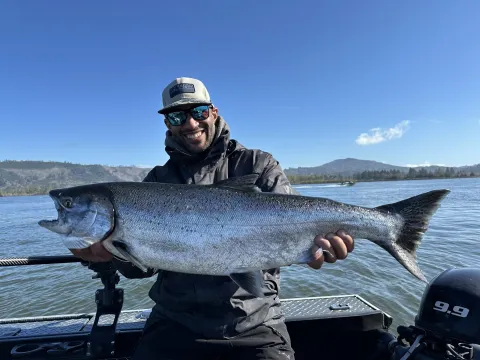
/articles/springers-are-here
August 2024 “Ocean Salmon Update”
When it comes to fall salmon, anglers consider August to be part of the time of year when pumpkin spice lattes and crisp mornings are the norm. The eighth month of the year is technically still summer but anyone who has headed to the ocean this time of year can feel the chill of an early fall coming on. Fog and rainstorms are normal, along with high winds and rough seas but then there are the days of bright sunshine and hot temperatures that remind us it is still summertime, even if only for a few hours in the afternoon. Much like the weather, salmon fishing can change in an instant… Mostly in the form of regulations.
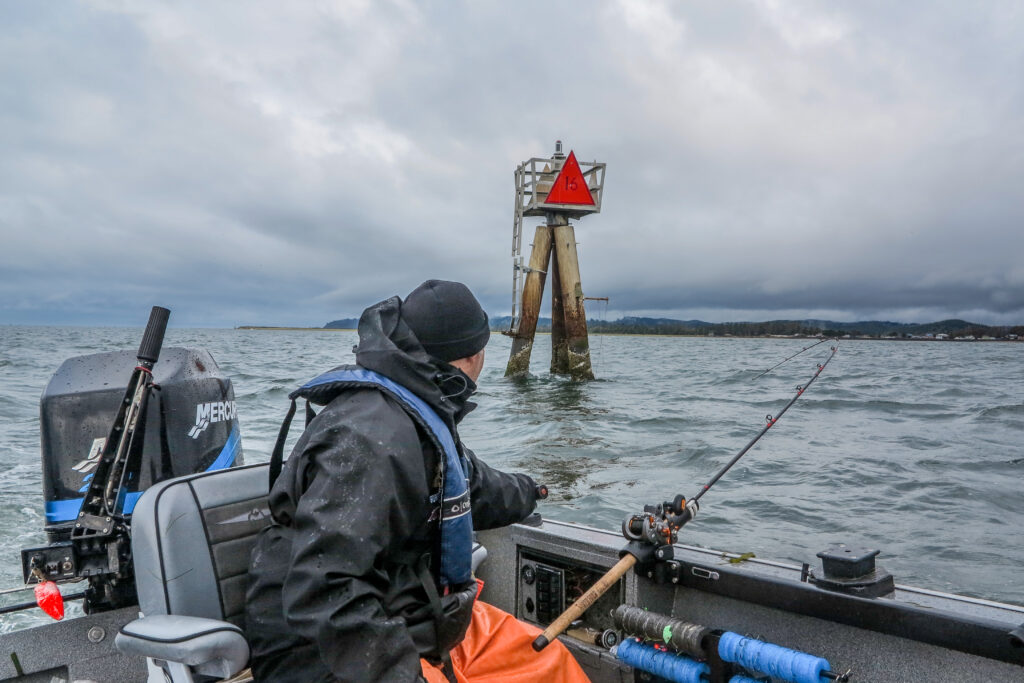
August ocean salmon fishing is all about the rules and emergency closures and openings. The fish are regulated by quotas and estimated returns to natural rivers so be sure to check the regulations and emergency rules daily and be ready to change your location to fish as often as you switch out your cut plug herring. Knowing the rules also means knowing where you are fishing.
Marine Area 1 is slated to be open for salmon fishing in August for both chinook and coho and this is where anglers will be targeting fish stacked up to enter the Columbia River. Known as Buoy 10, the famed August fishery at the mouth of the Columbia River continues out beyond this buoy marker but is considered Marine Area 1. Depending on sea conditions and bar crossing, fishing can be good out in the open ocean. Especially for coho as the chinook are mostly staging in the brackish water and rushing into the Columbia with each tide change. Coho will stay just offshore a bit longer as they prefer to enter the river in September and into late fall.
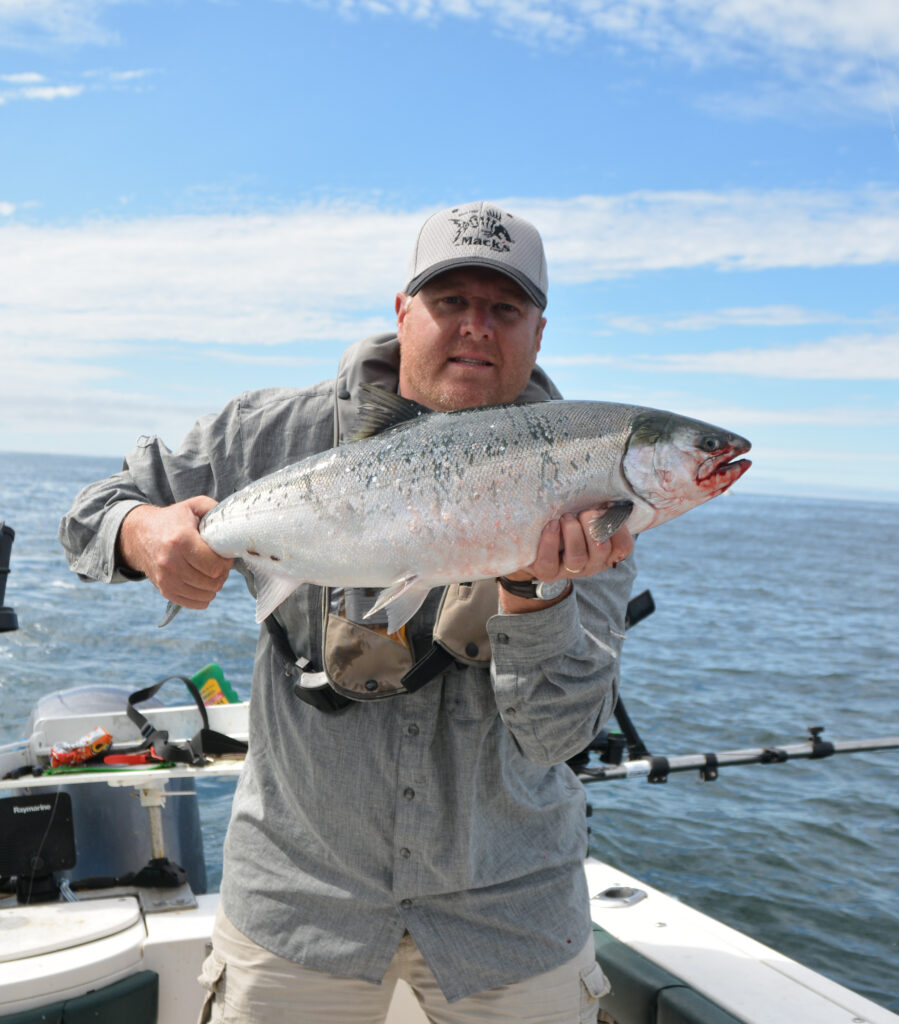
Keep an eye on the Buoy 10 rules and regulations as well as any emergency closures or adjustments. If you have the right boat and navigation skills to cross the deadly Columbia River bar, then Marine Area 1 could save your trip if they close or restrict the Buoy 10 fishery. The same goes for about every ocean area you need to know before you go.
Marine Area 2 gets a little more complex come fall. You can still hit the open ocean from the tiny town of Westport. Extremely popular in July when it first opens Westport becomes a mecca of salmon anglers come August. The complexity comes from the Marine Area itself which is broken down into three segments. Marine Area 2 is the open ocean and is slated to be open, but most likely for coho as the chinook quota gets eaten up quickly as the fish pass by heading to the Columbia or start to stage for Grays Harbor and Willapa Bay. This is where Marine Area 2 is broken down into sub-areas.
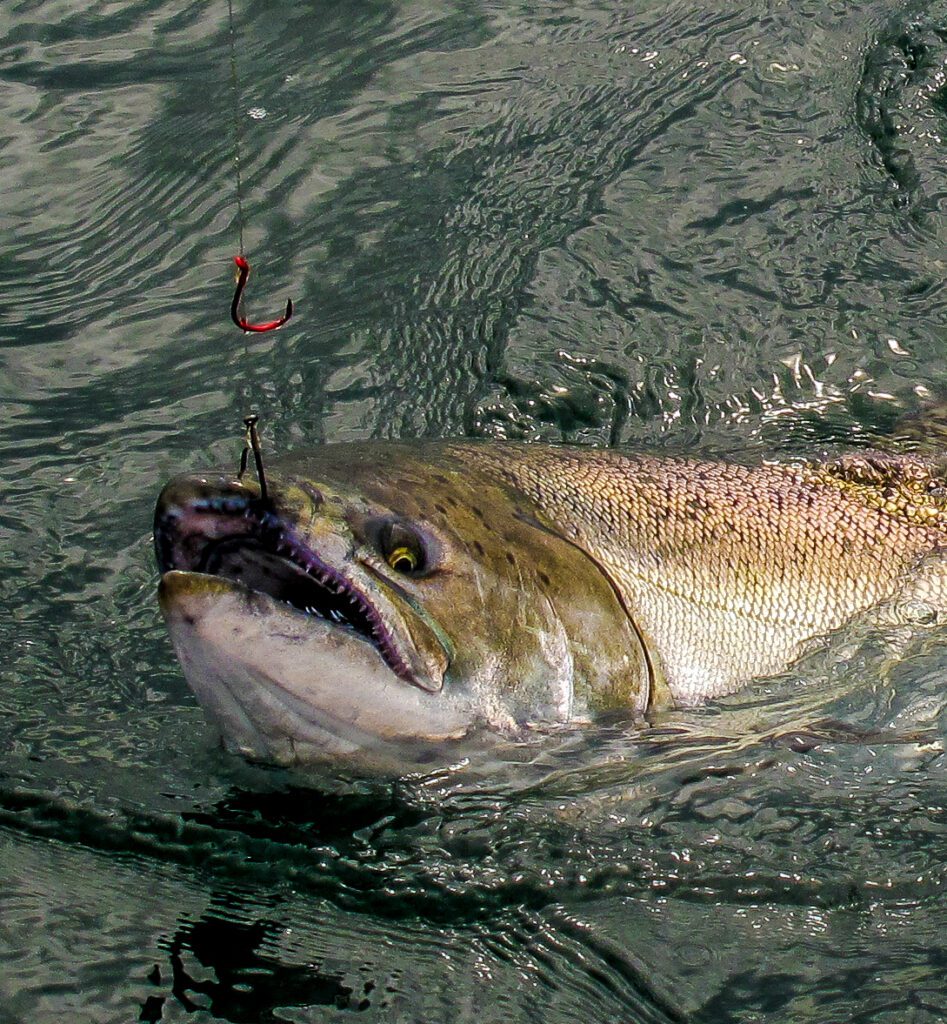
Marine Area 2-1 is Willapa Bay which has three separate zones known as zones 4, 5, and 6. Zones 4 and 5 are closed and zone 6 is most of the bay itself. A kelp and grass shallow water bay where salmon will stage for weeks before heading up the Willapa River and to hatcheries. Wild chinook must be released, and anglers can use two rods each with the endorsement. A dropper weight system is used since this is shallow water and the amount of eelgrass makes it hard to use downriggers. Watch your gear closely and change out baits often but it is hard to beat hooking a large chinook in shallow water which is why this fishery can be immensely popular.
Grays Harbor is Marine sub-Area 2 known as Area 2-2 with zones 1, 2, and 3. Zone 1, known as the Grays Harbor Control zone, closes in mid-August to salmon fishing, which allows fish to enter the harbor. Zone 2 is the Humptulips North Bay fishery zone and is limited to 1 fish, no wild fisher per day. The other zone known as the East Grays Harbor Zone 3 is mostly a coho fishery in front of the Johns River as all chinook must be released.
The Grays Harbor area is not exceedingly popular as you also compete with commercial and native fisheries but can be productive for those that try it. One of the most unique fisheries in the Grays Harbor area is the Westport boat basin fishery which is fishing in the marina where the fleets of charters and commercial boats are stored. Coho returns here thanks to a release effort with a recent addition of 50,000 late coho expected to return in October and November starting in 2026. For now, the fish arrive in late August and into September and can be caught right off the docks at Westport.
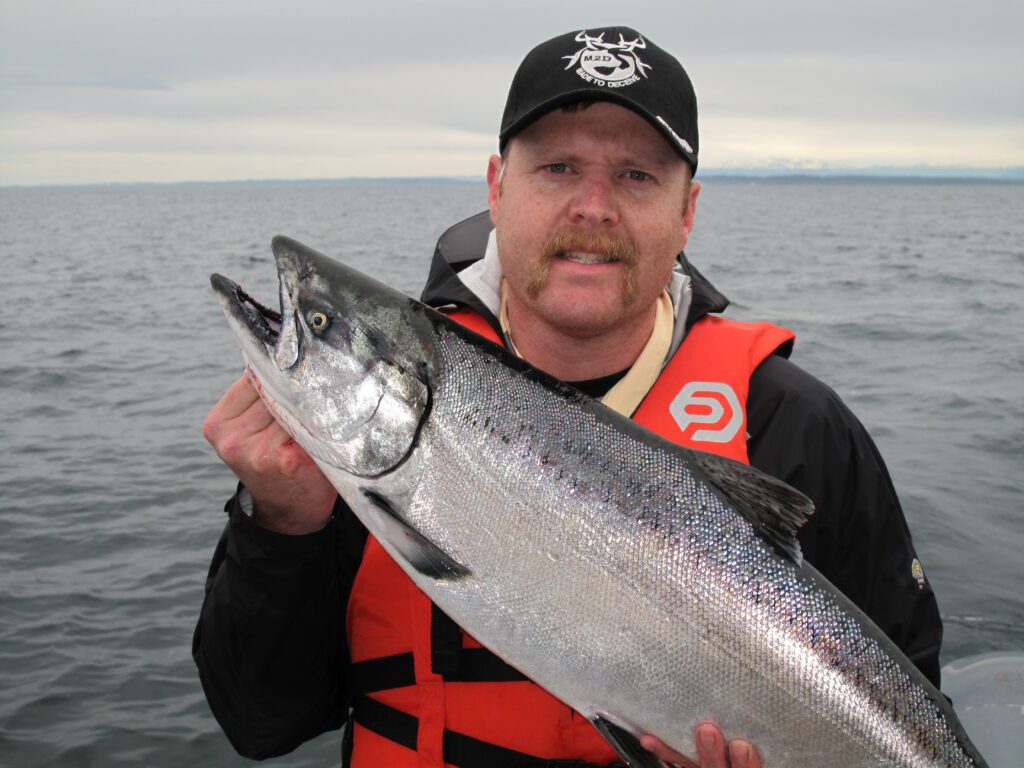
Marine Area 3 is known as LaPush and is very remote. With limited launches and extreme weather area 3 is mostly accessed on days with optimal ocean conditions. It is slated to be open in August for both chinook and coho, but this is one fishery that is often adjusted with an emergency rule. Chinook are prime and targeted in July which often means an August closure but coho here are making their way to the many rivers that have both robust hatchery returns and wild runs as well. Wild coho are not allowed to be kept keeping those runs going so be sure to only keep clipped silvers. This is also a staging area for chums and in the salt, they can be misidentified easily as their purple bars are light and sometimes even non-existent this time of year. Chums must be released so be sure to look at the fish closely and know what you have caught.
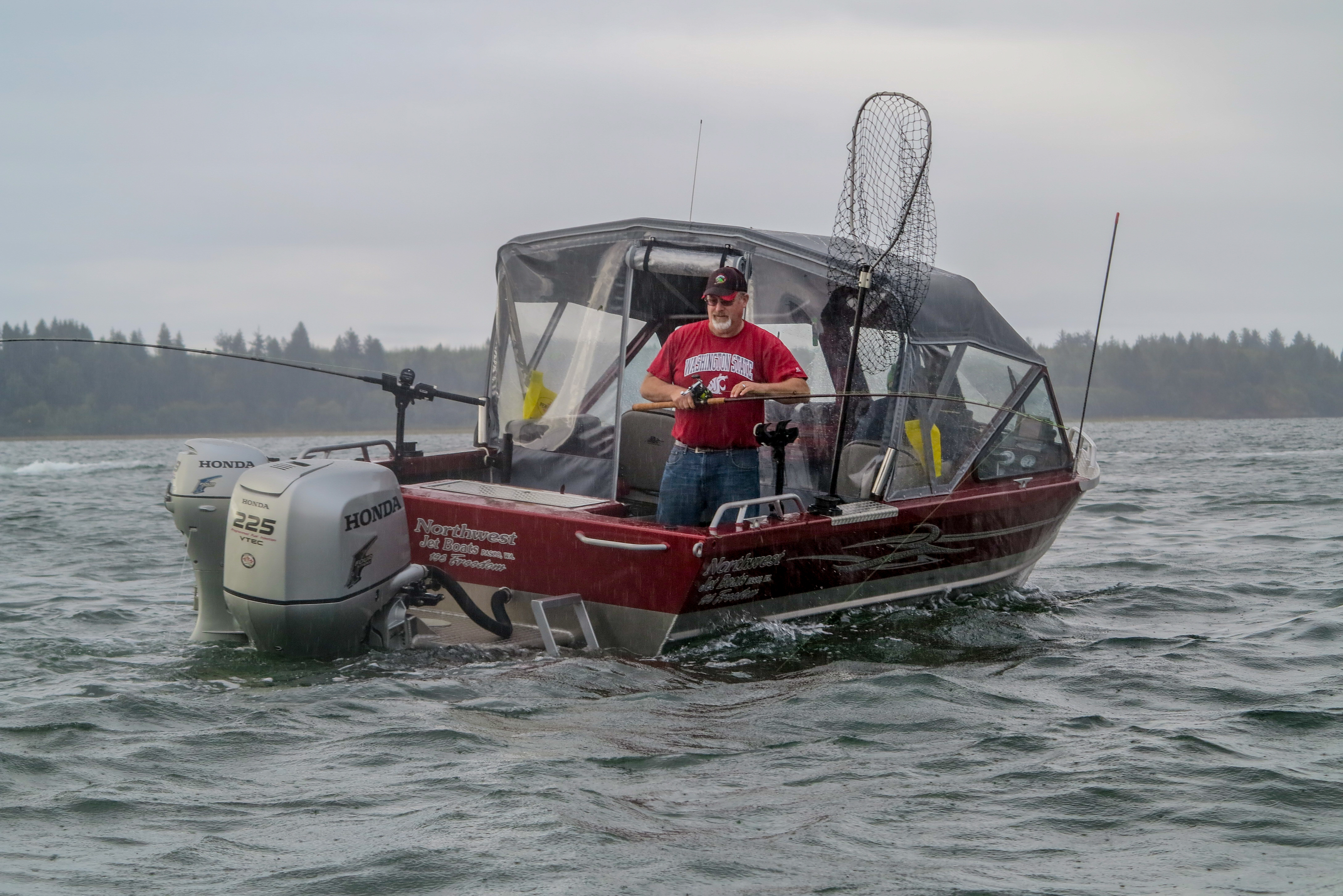
Marine Area 4, the last of the “ocean” areas had a rough start to the chinook fishing. As of July 11th, only 25% of the quota had been caught which normally that time of year the quota is getting close to being filled. I fished this area on July 12th and 13th, when the daily limit of chinook went to 2 per day and we did not hook a single adult chinook. The seas were rough and kept my little 18-foot boat limited to trolling along the kelp line and near shore but those that could make it further out did well. This indicated the chinook were here but out deeper than usual. Coho were being caught but not in respectable numbers which could indicate a later return this year which is great since area 5 to the east is slated to be open into October for coho. Come August the rules for chinook change in Marine Area 4 with it only being open west of the Bonilla-Tatoosh line. Coho is slated to remain open until mid-September in all Marine Area 4.
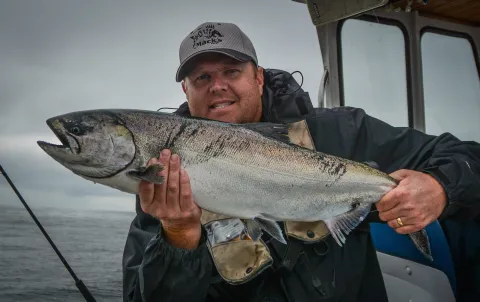
Regardless of where you decide to go, be sure to head out to the open ocean for some great fall salmon fishing. Of course, before you go be sure to check the emergency regulations as these fisheries are subject to quotas and can close quickly. They can also open or be extended as well and just maybe you will find a bonus opportunity out in the ocean. Either way, be ready for some cold, wet, and rough weather as well as bring sunscreen as afternoons are known to burn off the fog and remind us it is still summertime.
/articles/august-2024-ocean-salmon-update
Bag'n Blackmouth
2023/2024 Blackmouth Prospects
With the exception of a few laggard B-run coho in the rivers, our PNW salmon focus should be shifting to the 2023-2024 Puget Sound winter blackmouth fishery. Typically, winter blackmouth is one of my favorite local fishing opportunities. Going back to my mid-teens winter blackmouth fishing has always been one of my very favorite ways to grow snotsicles.
Because recent conservation measures have severely reduced our opportunity to drag downrigger balls in the gravel, many of us will be considering putting the salmon gear away and winterizing the boat. You may want to hold off a bit, break out a wool hat, hoodie, and your cold weather friend Mr Heater. it’s almost blackmouth season. But, what’s a blackmouth?
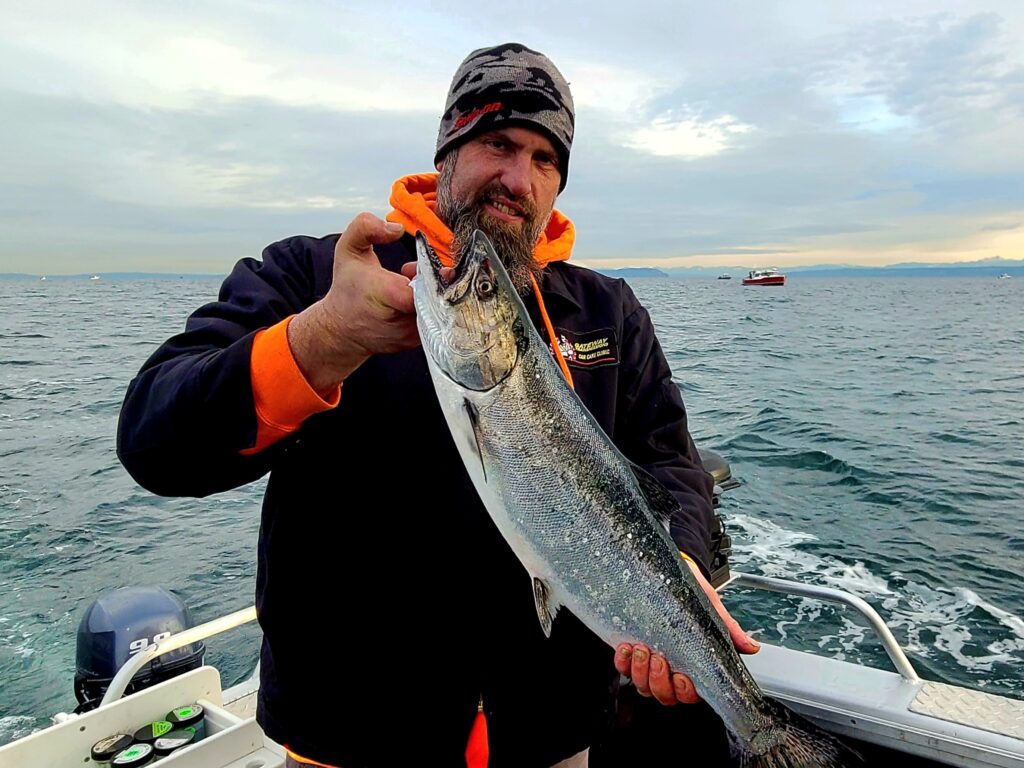
Blackmouth are chinook salmon that have decided not to migrate to the usual feeding grounds in the Gulf of Alaska. Instead, they tend to remain in Puget Sound and the Straights to feed on local schools of herring, candlefish, other forage fish, and squid.
Back in the 1960s, WDFW decided to duplicate the natural tendency of a small percentage of chinook to remain in Puget Sound and create a year-round sports fishery. The WDFW established a team led by Frank Shaw and got to work. It was determined that if you held the usual hatchery release at 3 months for an additional year, or 15-18 months total, the chinook would forage locally.
The original releases were made in Capital Lake in Olympia. The program moved to net pens by Squaxin Island but the WDFW determined that the salt-reared fish tended to migrate. The program was shifted to several local hatcheries. They are for the most part clipped, but there are certain releases where the co-manager agreements do not allow the fish to be clipped.
Over the years we have seen a reduction in opportunity; a few years back we lost the winter blackmouth fishery in Marine Area 7, 8-1, 8-2, and MA 9. They were closed to preserve or extend some of the summer chinook fisheries while still supporting federal and co-manager escapement goals.
Reduced opportunity, well maybe, but there are still a few areas that will host a blackmouth fishery this winter. That said; chip the ice out of your bilge, gas up the boat, and read on.
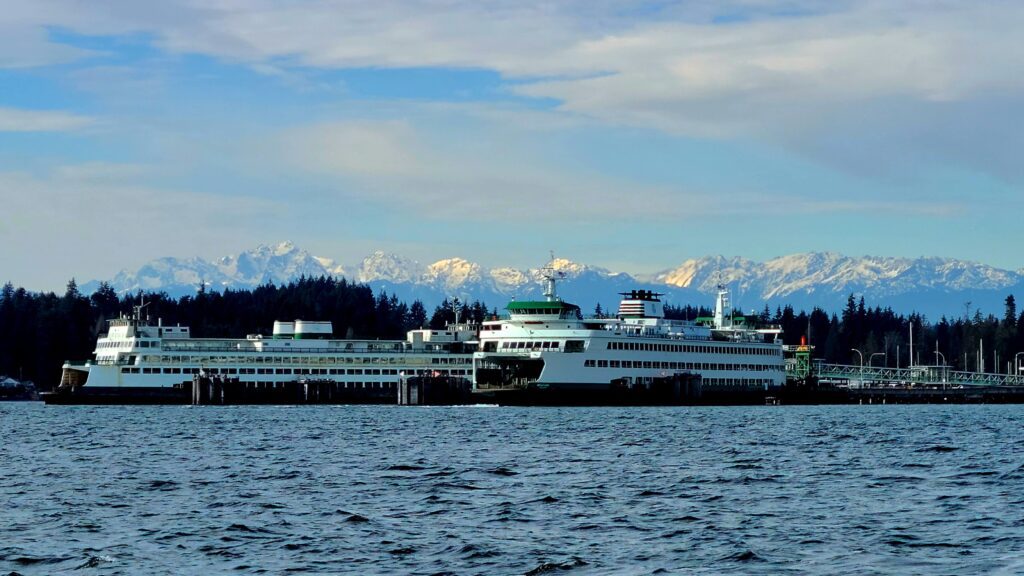
But first, no boat? While most of our winter blackmouth fishing will be from a boat, there is also an opportunity for a limited shore-based fishery. More on that later, if you do have a boat here is a breakdown of the 2023/2024 Puget Sound winter blackmouth fishery.
- MA 5 will be open 4/1/2024-4/30/2024 with a 22” minimum and a 2 fish limit, (1 chinook may be retained).
- MA 5 Management Criteria – Sublegal Encounters; the encounters guideline is 3,707 fish.
- MA 10 will be open 3/1/2024-4/15/2024 with a 22” minimum and a 2 fish limit, (1 chinook may be retained).
- MA 10 Management Criteria – Total Encounters; the encounters guideline is 4,953 fish. Unmarked Encounters; the encounters guideline is 953 fish. Sublegal Encounters; the encounters guideline is 4,181 fish.
- MA 11 will be open 3/1/2024-4/15/2024 with a 22” minimum and a 2 fish limit, (1 chinook may be retained).
- MA 11 Management Criteria – Total Encounters, the encounters guideline is 1,191 fish. Unmarked Encounters; the encounters guideline is 259 fish. Sublegal Encounters; the encounters guideline is 816 fish.
- MA 13 will be open 10/1/2021-5/14/2021 with a 2 fish limit and a 22” minimum size. Management Criteria do not currently apply.
- MA 6, 7, 8-1, 8-2, 9 and both North/South MA 12 will be closed for the 2023/2024 winter blackmouth fishery.
The above information was extracted for the 2023 North of Falcon data and may be subject to additional closures. Consult the WDFW App, or website for the current regulations and emergency closures.
With the limited blackmouth opportunity for the 2023/2024 winter season, the open areas will likely be busy. Instead of detailing each area, I’ll try to break down the different Marine Areas into a few general options for starting your adventure.
Before that though; think of points, banks, and flats. Look for areas where the currents will collect bait. Keep a constant eye on your fishfinder and look for schools of bait. Although forage fish populations change from year to year, candle fish and herring are the primary forage fish for Puget Sound blackmouth. That said, because of a general crash in the Puget Sound herring populations, candlefish are currently the major blackmouth food source.
Candlefish show as a cloud of bait right on the bottom. Find candlefish and you significantly improve your odds, find arches and candlefish on the deck and it will be hammer time! Candlefish spawn in the gravel and are rarely found above that. I have caught many blackmouth where their gill plates and bellies were all scraped up. I have even cleaned fish and found gravel in their stomachs. So, where does one target gravel filled salmon?
Marine Area 5
Or basically the Sekiu/Pillar Point area has a few notable blackmouth areas to target. The Caves, Clallam Bay, and then Slip Point to Pillar Point can all be awesome blackmouth fisheries. All can be very exposed to winter weather so know your limitations. Help is a longways off if you get in trouble so always err on the cautious side.

Marine Area 10
Is the Seattle/Bremerton area and includes a number of well known, semi-protected blackmouth fisheries. Kingston, Jeff Head, West Point, Elliot Bay, Alki Point, Point Monroe, Skiff Point, Manchester, and different banks or points around Blake Island consistently produce blackmouth. Look at the weather, choose a launch and learn a given area to feed your winter addiction.
Marine Area 11
Or the Tacoma area is one of the best small-boat blackmouth fisheries on Puget Sound. The Slag Pile, Owens Beach, and Clay Banks are all easily accessible and just minutes from the Point Defiance launch. With the proper boat for the conditions, Dalco Point, the Beach just north of Gig Harbor, Point Robinson, Browns Point and Dash Point all offer solid blackmouth fishing as well.
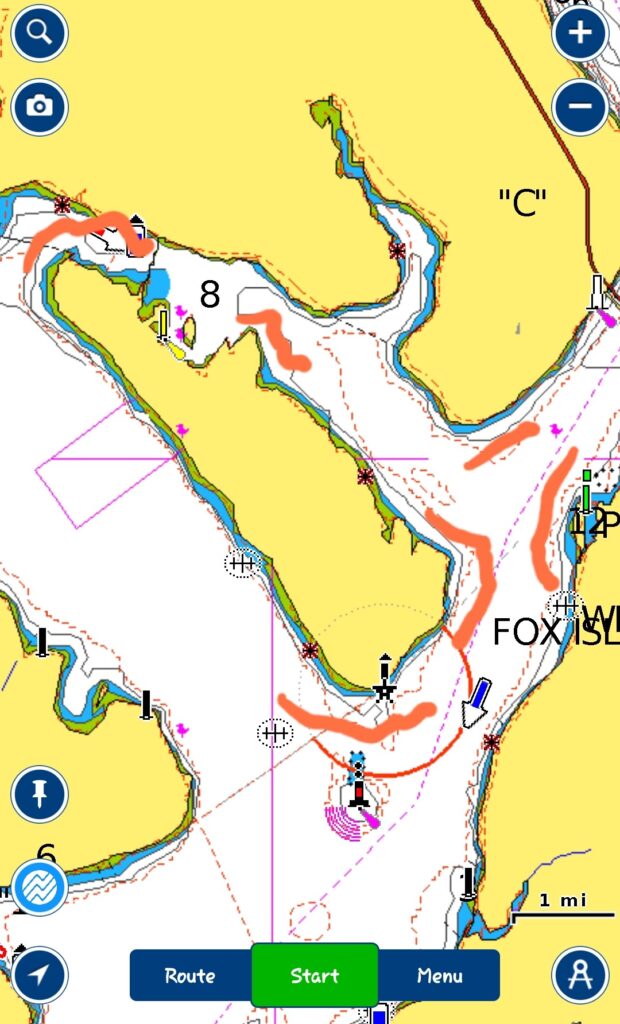
Marine Area 13
Is an interesting fishery. It is the area south of The Tacoma Narrows Bridge. The whole area is fairly protected from winter weather but the better fishing areas are a bit of a run from any of the all-tide metropolitan ramps. With that said, MA 13 is kind of a local’s fishery, with smaller boats launching into open water from a handful of unimproved county ramps. A few areas stand out; including Point Fosdick, various areas around Fox Island, Lyle Point, Oro Bay, and Johnson Point all hold fishable numbers of blackmouth. Depending on the tide there are many less known points that disrupt the tidal flow and hold bait. Be that guy, maybe more so than any other area in Puget Sound, MA 13 has many 1 fish spots. Review both your charts and tidal information and know where to fish during the different tidal phases.
Blackmouth fishing is a planning and patience game. Choose a ramp, select a handful of areas you want to fish, and understand how the tide will impact them. Independent from the tide often the best fishing will be at first light. From there follow your plan, if you make a pass on your initial stop and there are no signs of life move on to plan B and C as required. Depending on the tidal conditions don’t be afraid to revisit plan B! I know that I mentioned patience but if you’re not seeing bait on the meter move on. Typically boat limits will be hard to come by, but put a couple of nice blackmouth on ice and you’ve had a good day.
My general blackmouth drill includes trolling with the downriggers or motor mooching cut plug herring. If dogfish are in the area, skip the cut plug plan and stick to trolling. Run 11” flashers ahead of spoons, trolling flies, or hoochies. Spice up the trolling flies and hoochies with salted herring strips. Target schools of bait along the bottom in 90-140’ of water while keeping your gear within 5’ of the bottom. I troll 2.5-about 3.5 mph for blackmouth and all my blackmouth leaders are tied on 42” of 30# fluorocarbon.
Earlier I mentioned a shore-based opportunity to catch blackmouth. No really, I’m not nuts. Well, OK maybe I am a little nuts but there are many piers and boardwalks that are open to salmon fishing year-round. Study the WDFW Sport Fishing Rules and check the Emergency Rules as they supersede the general sport fishing rules. When I was a kid, well before cell phones and computers I used to frequently fish the piers and caught a lot of blackmouth. I didn’t chase reports to fish a hot bite. I had to put in the time while experimenting my way through the gear and presentation until I caught fish.
I usually carried two rods, a dozen small herring (fresh or frozen, back then fresh herring was the norm), and a small handful of gear. My go-to rig was a level wind steelhead rod rigged with a large sliding float and a hand-tied mooching leader. I would nose hook the herring, leaving the trailing hook free, and gently cast it off the down current corner of the pier. I would free spool, letting the rig drift until I was down the last few wraps of line on the spool and then put it in gear. Recovering a crank or two every few minutes, it would take forever to reset. The process was deadly and accounted for many salmon dinners.
I also fished hardware. A double hooked Colorado spinner with a herring strip will catch anything in the sound. I’d rig them on a 24-30” leader behind a piece of pencil lead. Easy-peazy; just cast, let sink and slowly wind it back in. Where most fish would hammer it, salmon seemed to cause the retrieve to hesitate then go in for the kill. The other method was to use flutter spoons. This was pre-buzzbomb/rotators and involved casting heavy spoons or Swedish Pimple type lures and letting them sink for a bit. The process was similar to twitching jigs, slowly lifting your rod tip, and then picking up a crank of two while you quickly tower the rod. Between the 3 methods, most of my pier fishing excursions were a success.
This should get you started in your quest to extend your local salmon fishing opportunities while you freeze your keister off. The when, where, and how are baselined but I suggest choosing an area and learning it. As a boater or pier-ite, become the local expert! Please remember that our winter weather can be unpredictable. Make sure your boat is seaworthy, full of fuel, fuel conditioner and you are dressed for the weather. A little upfront planning will help to ensure that you and your crew have a safe and productive blackmouth adventure.
/articles/bagn-blackmouth