Puget Sound Squid
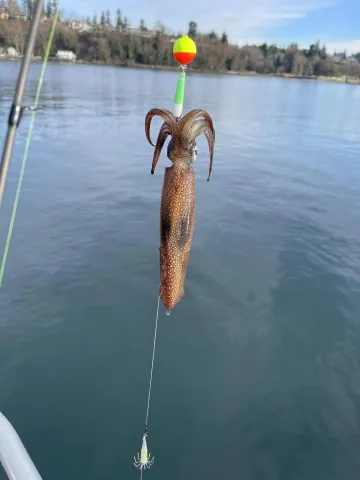
Squid fishing in the Puget Sound is becoming an increasingly popular resource for anglers of all ages and skill levels. Squid are a relaxing, low-pressure fishery and can be targeted successfully on nearly any budget. And you don’t even need a boat; in fact, some of the most successful squid fishermen only fish from shore. This piece will give you some understanding of where, when, and how to fish squid in the Puget Sound.
We will start with the rules and regulations for squid. You will need a shellfish license. I always recommend that everyone just get the Fish WA license, because with that, you are covered for everything, but squid can be covered simply under shellfish. The season and bag limits for squid are very simple.
Squid is open year-round, and the bag limit is 10 pounds per person. This is a lot of squid. I rarely stay and fish out a whole limit, but I always make sure to have a scale handy to make sure I don’t overfish! The only other relevant rule is that you can fish with a maximum of 4 squid jigs on your line at a time. I typically use two. If you are within these rules, you should be all good to get out there!
Next, let’s talk about where. Squid can be found in nearly all waters of the Puget Sound, from the Strait of Juan de Fuca, all the way to Tacoma. Depending on the time of year, they will be more prevalent than others. The general rule is that squid start showing up in the Port Angeles area around September and migrate down to Tacoma through January and February. This is not a hard and fast rule, but they generally follow that pattern.
There are people who catch squid every single day from the Les Davis pier in Tacoma. I, however, do not have that expertise. Some hot spots to check out are the Port Angeles City Pier, the Edmonds Pier, Pier 70 area in Seattle, Seacrest Marina Pier, and Les David Pier in Tacoma. There are several Facebook groups dedicated to squid fishing, and you can usually find out where the squid are from the number of success posts.
When to fish for squid is fairly widespread. There are some people that find success all year long from the same pier. But in general, squid fishing is best, and the squid themselves are largest, in the winter months. I usually start fishing for squid in about November and will fish regularly through February. Earlier in the season, I will usually fish closer to Edmonds, and then the deeper we go into winter, I will move further south and usually end my season closer to Tacoma. If I intend to fish from the pier, I will almost always fish at night. Sometimes I will arrive at 1 or 2 in the morning and fish until sunrise. If I am fishing from a boat, I will often fish in the morning or evening, but almost never at night.
Lastly, how do we fish for squid? Squid can be caught from shore or from a boat, so we will break down how, based on this distinction. Fishing from shore is the most popular and simplest method. You will need your own bucket and a long, sensitive rod (I would say no less than 9’). 9-foot, 5-weight fly rods are growing in popularity due to their sensitivity, and you can rest your arms on the pier and not have a long butt section getting in the way of your jigging action.
Generally, people will set up their rods with braided line about 20–30-pound test, with a corky on the mainline to act as an indicator so you can tell where your line is in relation to others. You will also want to have your squid jigs tied on with monofilament that is about 12-15-pound test. I really like to use one weighted Fisherman’s Gold squid jig in green or pink with another unweighted Fisherman’s Gold jig above that.
The current and tide will impact whether I am going to use half, three-quarter, or one-ounce jigs. The optional part of your kit is a light. There will generally be people on the dock who have lights. If you don’t have a light, you can try to get close to them, but be respectful of their space and bring your own if you want to fish right under a light for your whole session. When you are all rigged up, you will want to cast out and let your jig sink. I usually let mine go to the bottom to start, and I will slowly work the jig back towards me and up the water column using slow jigs with pauses at the top.
To detect a strike, you can usually feel either an increase or a decrease in the weight on your line. A big hookset isn’t required, but a fast set and an increase in your retrieve are enough to keep them pinned on the jig. Strike detection will take some time. If you see someone on the dock really crushing them, be nice and try to learn what they are doing, and maybe ask some questions. My experience has been that if you treat people with respect, they will treat you with respect and usually give you some pointers on how to do better.
If you are going to fish from a boat, the kit is mostly the same, but I usually use a 9’ or 9’6” spinning rod instead of a fly rod. Because you are not limited to how far you can cast from the pier, I will typically drive around slowly and look for a haze near the bottom on my fish finder in roughly 80-120 feet of water. I will then drop my anchor and fish on top of the squid. Because it is light out, they are almost always on the bottom. I will use the same jigging technique, but in a more vertical motion.
So, now you have the what, when, and how of catching squid in the Puget Sound. Give it a try this winter, and instead of waiting for calamari at a restaurant, you’ll be able to serve it up right in your own home.
/articles/puget-sound-squid
Coho Craziness
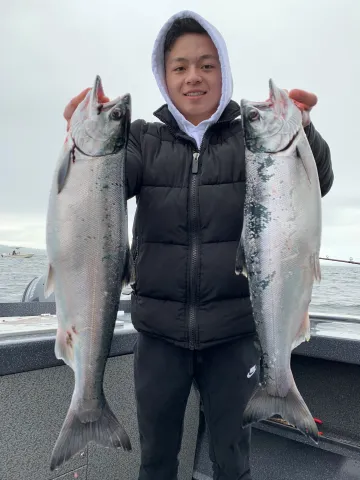
As we head into September, the color of salmon switches from pink to silver around Puget Sound.
The front end of the migratory coho run – also known as silvers for their shiny silvery-colored body – began to filter into the western Strait of Juan de Fuca and Puget Sound in August, and are expected to peak throughout September and early October.
Coho aren’t large – usually averaging 4 to 15 pounds, with some exceeding the 20-plus pounds – but they often put up a good tussle. Young coho spend a year in rivers and estuaries and then migrate out to the Pacific Ocean to feed and grow. They spend about 1½ years in the ocean, then return to spawn as three and four-year-old fish, generally in fall or early winter.
Puget Sound coho returns have gradually made a comeback from a downtrend that began in 2015 and 2016. This was due to negative environmental factors like drought, flooding, and warm water temperatures in their freshwater habitat as juveniles and then in the Ocean from a condition known as El Niño, when surface water becomes warmer than average.
The combined 2025 Puget Sound hatchery and wild coho forecast is 727,490 compared to 722,134 in 2024; 760,029 in 2023; 666,317 in 2022; 614,948 in 2021; and 504,604 in 2020.
Coho fill the air with enthusiasm for their leaping abilities when hooked, and unpredictable movements across the water’s surface.
A positive signal of 2025 expectations began with the good fishing for resident coho, who mainly spend their entire life feeding and growing in local waters –
caught in Marine Area 10 (Seattle and Bremerton Area) from June to early August. Many of these coho have grown since then and will join their larger migratory coho relatives during the late summer and fall marine fisheries.
Knowing when it is “go fishing time” for migrating coho in Puget Sound is to monitor catch rates in the Strait of Juan de Fuca at Marine Area 5 (Sekiu and Pillar Point) and Marine Area 6 (East Strait of Juan de Fuca).
The Marine Area 5 salmon fishery is open daily through Sept. 26 with a two salmon daily limit, plus two additional pink may be retained, and release Chinook, chum, sockeye, and wild coho. The area is then open daily for coho from Sept. 27 to Oct. 9 with a two salmon daily limit, release Chinook, chum, and sockeye.
The Marine Area 6 salmon fishery is open daily through Sept. 26 with a two salmon daily limit, plus two additional pink may be retained, and release Chinook, chum, sockeye, and wild coho. The area is then open daily for coho from Sept. 27 to Oct. 15 with a two salmon daily limit, release Chinook, chum, and sockeye.
Oftentimes, the best coho fishing in the Strait of Juan de Fuca occurs offshore in the shipping lanes, which is the main migration path. These deep-water areas are about one to 10 miles out in 200 to 500 feet of water and sometimes even deeper off the edge of the main shipping channels. Remember to stay within the U.S. side of the shipping lane. Look for tide rips and current breaks where krill and schools of baitfish attract coho, and watch for coho jumping and rolling on the surface.
In the eastern Strait of Juan de Fuca, the Dungeness Bay hatchery coho fishery is open from Oct. 1 to 31. The 2025 Dungeness River coho forecast is 13,328, down slightly from 14,305 in 2024 and 14,654 in 2023.
The Marine Area 7 (San Juan Islands) coho season is open daily through Sept. 6 with a two salmon daily limit, plus two additional pink may be retained, and release Chinook, chum, sockeye, and wild coho. The area is then open daily for coho from Sept. 7 to 30 with a two salmon daily limit, plus two additional pink may be retained, and release Chinook, chum, and sockeye. In Marine Area 7, look for coho staging along the western and southern portions of the island chain.
Coho fishing in Marine Area 8–1 (Deception Pass, Hope Island, and Skagit Bay) is open daily, Sept. 30, with a two salmon daily limit, plus two additional pink may be retained, and release Chinook and chum. Coho fishing is then open daily Oct. 1 to 12 with a daily two salmon catch limit, and release Chinook and chum.
In Marine Area 8–2 (Port Susan and Port Gardner), coho fishing is open daily through Sept. 24 with a two salmon daily limit, and release Chinook, chum, and pink. The Tulalip Bay Terminal Area Fishery has rules that differ from Marine Area 8-2. For details, check the Washington Department of Fish and Wildlife (WDFW) fishing regulations webpage at https://wdfw.wa.gov/.
In Marine Areas 8-1 and 8-2, anglers should find coho along the entire eastern side of Whidbey Island, Possession Point, off the Clinton Ferry Terminal, the Langley/Sandy Point area, Shipwreck to Mukilteo, Hat Island, Camano Head, the entire west side of Camano Island, and outside of Oak Harbor. West Beach at Deception Pass State Park, located north of Oak Harbor on Whidbey Island, provides excellent shore fishing access.
Moving further into Puget Sound, Marine Area 9 (Admiralty Inlet) is another decent fishing location for hatchery-marked coho, which is open daily through Sept. 30. It has a two salmon daily limit, plus two additional pink may be retained, and release Chinook, chum, and wild coho.
In Marine Area 9, focus your fishing time in the unmarked shipping lanes where tide rips and current breaks are commonly found. Try Midchannel Bank off Port Townsend; Point Wilson north of Port Townsend (good public shore access); east side of Marrowstone Island (some shore access); Fort Casey to Bush Point and Lagoon Point (some public shore access); Double Bluff off the west side of Whidbey Island; Point No Point (excellent public shore spot); Possession Bar; Scatchet Head; and Pilot Point.
In Marine Area 10 (Seattle and Bremerton Area), coho fishing is open daily through Sept. 30 with a two salmon daily limit, plus two additional pink may be retained, and release Chinook and chum. Fishing is also open daily from Oct. 1 to Nov. 15 with a two salmon daily limit, and release Chinook.
In Marine Area 11 (Tacoma and Vashon Island), coho fishing is open daily through Sept. 30 with a two salmon daily limit, plus two additional pink may be retained, and release chum and wild Chinook (note, the Chinook fishery may close sooner so check the WDFW fishing regulations webpage for updates. Fishing is also open daily from Oct. 1 to Nov. 15 with a two salmon daily limit, and release Chinook.
Look for coho in the deep-water shipping lanes off Jefferson Head to Kingston, Richmond Beach to Meadow Point near Shilshole Bay, Point Monroe, Shilshole Bay south to West Point, Elliott Bay, the Fauntleroy Ferry area southeast to Dolphin Point, both sides of Vashon Island, Redondo Beach to Dash Point and the Tacoma area of Commencement Bay, Browns Point, and Point Defiance Park from the Slag Pile to the Clay Banks.
Two popular events tied to the arrival of coho are the Edmonds Coho Derby on Sept. 6. For details, go to http://edmondscohoderby.com/. That will be followed by the Everett Coho Derby on Sept. 20-21. For details, go to https://everettcohoderby.com/.
Marine Area 13 (South Puget Sound) is open daily for hatchery-marked coho through Sept. 30 with a two salmon daily limit, plus two additional pink may be retained, and release chum, wild coho, and wild Chinook. Fishing remains open daily beginning Oct. 1 with a two salmon daily limit, and release chum, wild coho and wild Chinook.
In Marine Area 13, look for coho from the Narrows Bridge south to Anderson Island. The Squaxin Island area has become popular area for those targeting coho. The 2024 Squaxin Island net pens coho forecast is 59,596 up from 48,081 in 2024 and 45,417 in 2023.
If you’re looking for a Chinook and coho option try the Bellingham Bay Terminal Fishery open daily through Sept. 30 with a daily limit of four salmon.
Sinclair Inlet and Port Orchard are open daily through Sept. 30 with a three salmon daily limit, plus two additional pink may be retained, and release chum and wild Chinook. Fishing is then open daily from Oct. 1 to Nov. 15 with a two salmon daily limit, and release Chinook.
Lastly, a freshwater coho fishing option in Seattle’s backyard is Lake Washington north of the Highway 520 Bridge, which is open daily from Sept. 16 to Oct. 31 with a daily limit of four coho only, and release all other salmon species. The Lake Washington coho forecast is 28,112 up from 24,090 in 2024 and 21,554 in 2023.
In the October issue, we’ll switch gears and take a look at proposed fall and winter coastal razor clam digging opportunities.
I’ll see you on the water very soon!
/articles/coho-craziness
Squid Jigging the Piers of the Puget Sound
With the arrival of each new season here in the Northwest, it’s hard not to feel like a kid in a candy store. Whether it's fall, winter, spring, or summer, these annual intervals of changing weather and day length always seem to provide new opportunities for the men and women who choose to reap the spoils of the outdoors. If the desire is there, the fun and the food is at our doorsteps.
A commonly overlooked opportunity that starts up in Neah Bay during late August and ends down in the south Puget Sound towards the end of winter, is the squid fishery, specifically the Pacific coast squid, also known as the California market squid.

The Pacific coast squid are relatively small, averaging about 8 inches. They have short lifespans and spend most of their time in the Eastern Pacific Ocean—between Baja California and Southeastern Alaska. They move into the straights of Juan De Fuca during late summer and their numbers tend to peak in the Puget Sound around December and January.
The fishery is often fickle, with some years falling short of anglers’ expectations, while other years the fishery can prove to be quite robust. On these years when the squid are plentiful, the hardest working anglers can find themselves heading home with their limits, which, as of January of 2023, the Washington Department of Fish and Wildlife has set at 10 lbs or a five-gallon bucket filled to the halfway point. Now that is a lot of calamari!
Jigging from a boat or a pier is the most common way to procure these saltwater delicacies, and during the winter you will often find the docks from Everett down to the south Puget Sound alive with folks chasing the Pacific squid. Squidding is a minimalistic endeavor. A fishing rod, a spinning reel, and a squid jig are essentially all that is needed. Squid jigs find their origins in Japan.
They are usually torpedo or bullet-shaped jigs with several spines at the bottom that point upright. These spines don't serve the same purpose as a typical fishing hook. Instead of puncturing or penetrating the squid, they create a bit of a platform for the squid to become entangled in as they latch onto the colorful plastic body portion of the jig.
Many squid jigging enthusiasts swear that nighttime is the best time to catch squid. By in large this holds true, but it’s also important to put some focus on the tides and water clarity. A high tide with decent water clarity can produce squid even during the daytime.
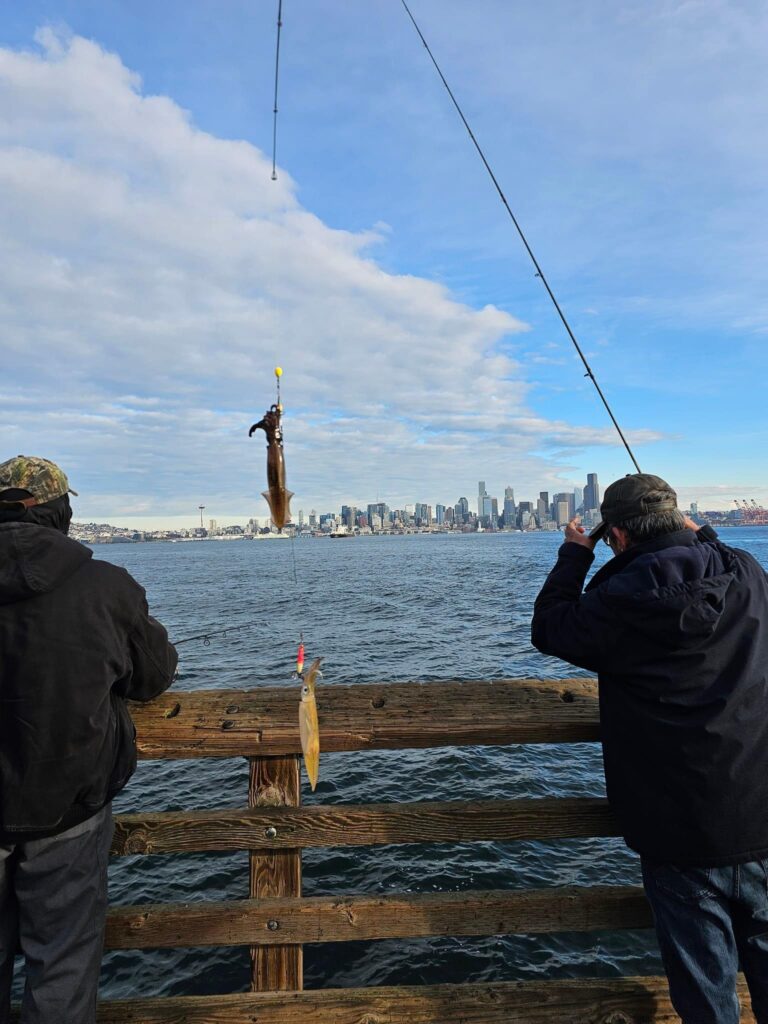
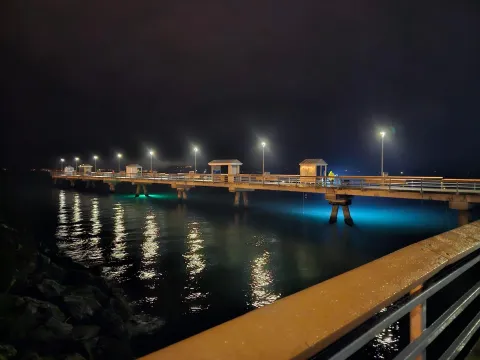
At night, squid are attracted to the lights illuminating off of the piers. The general belief around this is that light attracts phytoplankton, the phytoplankton then attracts zooplankton, and zooplankton attract the fish and other critters that squid like to feed on. Piers already come equipped with their own lights and these typically do a decent job of providing the needed illumination to bring in the squid.
With that being said, the chances of bringing in larger amounts of squid become increased when a more powerful and concentrated light is introduced. Folks will often bring battery or generator-powered lights to shine into the water. Check with local rules to find out if generators are allowed.
While on the topic of rules, it’s important to note that there is a fair amount of pier fishing etiquette to consider while navigating the pier. It’s best to speak with folks who are using lights and ask them if it’s ok to post up next to them. There’s a good chance they might be saving these spots for friends or family and It’s not uncommon for conflict to occur on the pier if people aren’t using common courtesy while acquiring their jigging spots.

Just as the gear is minimalistic, the technique is simple as well. Folks will work their jigs in a variety of ways, but sticking to the basics is what generally will get you on the squid. When casting, you should allow your jig to drop to a depth where squid are holding, lift the tip of your rod and slowly retrieve as you lower the rod tip back down, then repeat the process.
Once you have a squid on your jig, keep tension on the line and the squid should remain there as you retrieve. The method is similar while jigging directly beneath you, though you won’t be doing any reeling in of the line until a squid has attached itself. Some people like to do a few quick and hard lifts of the rod and then let it sit near the bottom for a few moments. Though you might not feel the squid strike your jig, the difference of weight at the end of your line once you lift again, will be your indicator that you have a squid on.
So, if you’re anything like me, and consider the sound of a bubbling deep fryer to be just as much of a winter staple as holiday tunes or roasted turkeys, then put on your winter jacket and head to a local pier for your shot at getting that bucket up to its halfway point with these great tasting cephalopods. And remember, there’s no such thing as bad weather, there’s only such a thing as bad gear!
/articles/squid-jigging-piers-puget-sound
Bag'n Blackmouth
2023/2024 Blackmouth Prospects
With the exception of a few laggard B-run coho in the rivers, our PNW salmon focus should be shifting to the 2023-2024 Puget Sound winter blackmouth fishery. Typically, winter blackmouth is one of my favorite local fishing opportunities. Going back to my mid-teens winter blackmouth fishing has always been one of my very favorite ways to grow snotsicles.
Because recent conservation measures have severely reduced our opportunity to drag downrigger balls in the gravel, many of us will be considering putting the salmon gear away and winterizing the boat. You may want to hold off a bit, break out a wool hat, hoodie, and your cold weather friend Mr Heater. it’s almost blackmouth season. But, what’s a blackmouth?
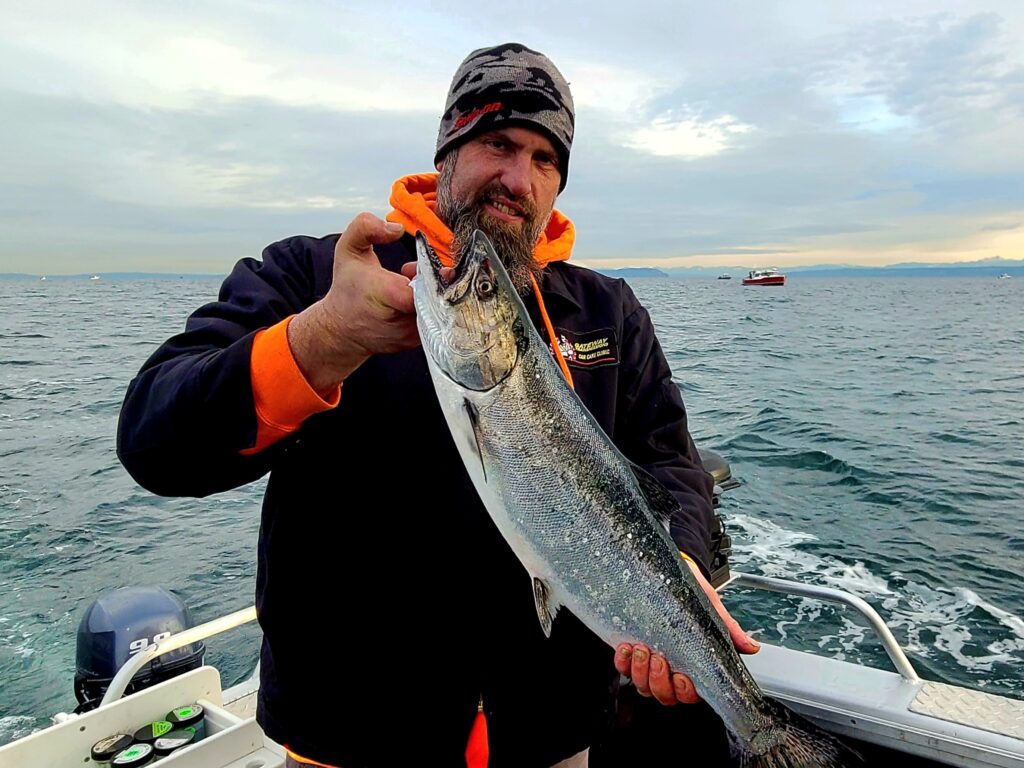
Blackmouth are chinook salmon that have decided not to migrate to the usual feeding grounds in the Gulf of Alaska. Instead, they tend to remain in Puget Sound and the Straights to feed on local schools of herring, candlefish, other forage fish, and squid.
Back in the 1960s, WDFW decided to duplicate the natural tendency of a small percentage of chinook to remain in Puget Sound and create a year-round sports fishery. The WDFW established a team led by Frank Shaw and got to work. It was determined that if you held the usual hatchery release at 3 months for an additional year, or 15-18 months total, the chinook would forage locally.
The original releases were made in Capital Lake in Olympia. The program moved to net pens by Squaxin Island but the WDFW determined that the salt-reared fish tended to migrate. The program was shifted to several local hatcheries. They are for the most part clipped, but there are certain releases where the co-manager agreements do not allow the fish to be clipped.
Over the years we have seen a reduction in opportunity; a few years back we lost the winter blackmouth fishery in Marine Area 7, 8-1, 8-2, and MA 9. They were closed to preserve or extend some of the summer chinook fisheries while still supporting federal and co-manager escapement goals.
Reduced opportunity, well maybe, but there are still a few areas that will host a blackmouth fishery this winter. That said; chip the ice out of your bilge, gas up the boat, and read on.
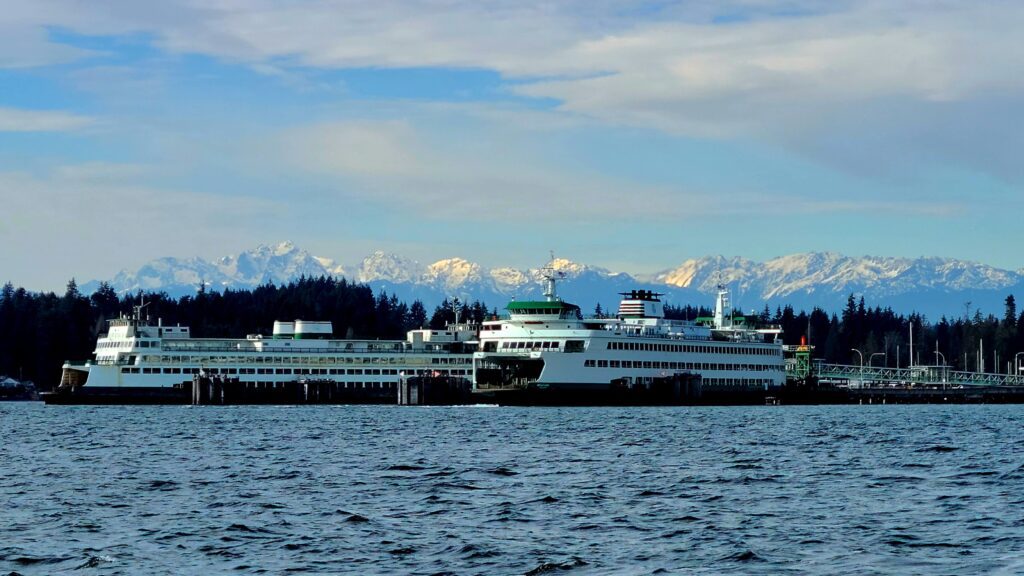
But first, no boat? While most of our winter blackmouth fishing will be from a boat, there is also an opportunity for a limited shore-based fishery. More on that later, if you do have a boat here is a breakdown of the 2023/2024 Puget Sound winter blackmouth fishery.
- MA 5 will be open 4/1/2024-4/30/2024 with a 22” minimum and a 2 fish limit, (1 chinook may be retained).
- MA 5 Management Criteria – Sublegal Encounters; the encounters guideline is 3,707 fish.
- MA 10 will be open 3/1/2024-4/15/2024 with a 22” minimum and a 2 fish limit, (1 chinook may be retained).
- MA 10 Management Criteria – Total Encounters; the encounters guideline is 4,953 fish. Unmarked Encounters; the encounters guideline is 953 fish. Sublegal Encounters; the encounters guideline is 4,181 fish.
- MA 11 will be open 3/1/2024-4/15/2024 with a 22” minimum and a 2 fish limit, (1 chinook may be retained).
- MA 11 Management Criteria – Total Encounters, the encounters guideline is 1,191 fish. Unmarked Encounters; the encounters guideline is 259 fish. Sublegal Encounters; the encounters guideline is 816 fish.
- MA 13 will be open 10/1/2021-5/14/2021 with a 2 fish limit and a 22” minimum size. Management Criteria do not currently apply.
- MA 6, 7, 8-1, 8-2, 9 and both North/South MA 12 will be closed for the 2023/2024 winter blackmouth fishery.
The above information was extracted for the 2023 North of Falcon data and may be subject to additional closures. Consult the WDFW App, or website for the current regulations and emergency closures.
With the limited blackmouth opportunity for the 2023/2024 winter season, the open areas will likely be busy. Instead of detailing each area, I’ll try to break down the different Marine Areas into a few general options for starting your adventure.
Before that though; think of points, banks, and flats. Look for areas where the currents will collect bait. Keep a constant eye on your fishfinder and look for schools of bait. Although forage fish populations change from year to year, candle fish and herring are the primary forage fish for Puget Sound blackmouth. That said, because of a general crash in the Puget Sound herring populations, candlefish are currently the major blackmouth food source.
Candlefish show as a cloud of bait right on the bottom. Find candlefish and you significantly improve your odds, find arches and candlefish on the deck and it will be hammer time! Candlefish spawn in the gravel and are rarely found above that. I have caught many blackmouth where their gill plates and bellies were all scraped up. I have even cleaned fish and found gravel in their stomachs. So, where does one target gravel filled salmon?
Marine Area 5
Or basically the Sekiu/Pillar Point area has a few notable blackmouth areas to target. The Caves, Clallam Bay, and then Slip Point to Pillar Point can all be awesome blackmouth fisheries. All can be very exposed to winter weather so know your limitations. Help is a longways off if you get in trouble so always err on the cautious side.

Marine Area 10
Is the Seattle/Bremerton area and includes a number of well known, semi-protected blackmouth fisheries. Kingston, Jeff Head, West Point, Elliot Bay, Alki Point, Point Monroe, Skiff Point, Manchester, and different banks or points around Blake Island consistently produce blackmouth. Look at the weather, choose a launch and learn a given area to feed your winter addiction.
Marine Area 11
Or the Tacoma area is one of the best small-boat blackmouth fisheries on Puget Sound. The Slag Pile, Owens Beach, and Clay Banks are all easily accessible and just minutes from the Point Defiance launch. With the proper boat for the conditions, Dalco Point, the Beach just north of Gig Harbor, Point Robinson, Browns Point and Dash Point all offer solid blackmouth fishing as well.
Marine Area 13
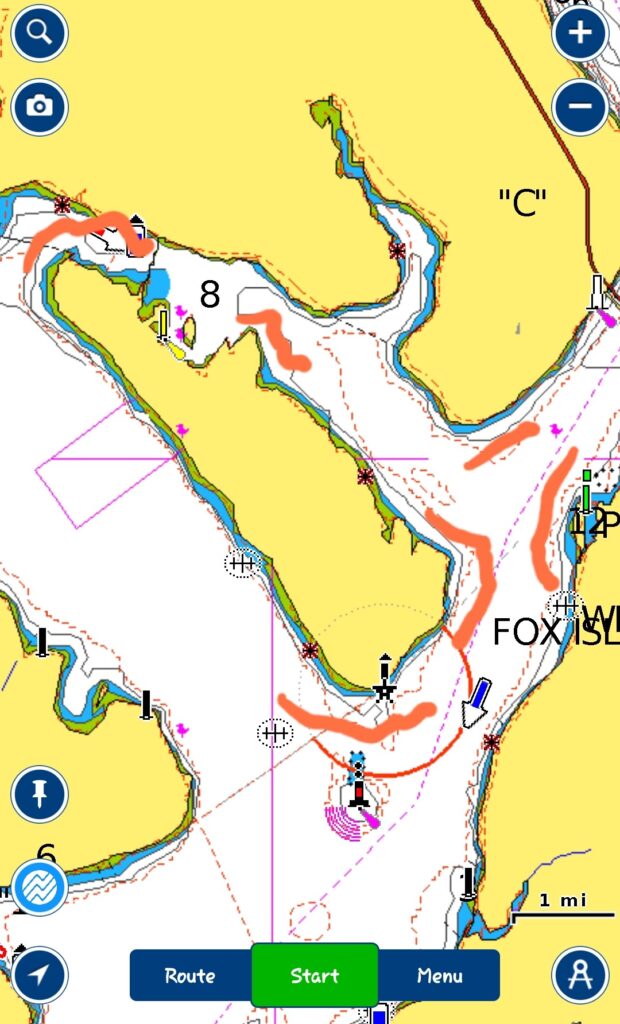
Is an interesting fishery. It is the area south of The Tacoma Narrows Bridge. The whole area is fairly protected from winter weather but the better fishing areas are a bit of a run from any of the all-tide metropolitan ramps. With that said, MA 13 is kind of a local’s fishery, with smaller boats launching into open water from a handful of unimproved county ramps. A few areas stand out; including Point Fosdick, various areas around Fox Island, Lyle Point, Oro Bay, and Johnson Point all hold fishable numbers of blackmouth. Depending on the tide there are many less known points that disrupt the tidal flow and hold bait. Be that guy, maybe more so than any other area in Puget Sound, MA 13 has many 1 fish spots. Review both your charts and tidal information and know where to fish during the different tidal phases.
Blackmouth fishing is a planning and patience game. Choose a ramp, select a handful of areas you want to fish, and understand how the tide will impact them. Independent from the tide often the best fishing will be at first light. From there follow your plan, if you make a pass on your initial stop and there are no signs of life move on to plan B and C as required. Depending on the tidal conditions don’t be afraid to revisit plan B! I know that I mentioned patience but if you’re not seeing bait on the meter move on. Typically boat limits will be hard to come by, but put a couple of nice blackmouth on ice and you’ve had a good day.
My general blackmouth drill includes trolling with the downriggers or motor mooching cut plug herring. If dogfish are in the area, skip the cut plug plan and stick to trolling. Run 11” flashers ahead of spoons, trolling flies, or hoochies. Spice up the trolling flies and hoochies with salted herring strips. Target schools of bait along the bottom in 90-140’ of water while keeping your gear within 5’ of the bottom. I troll 2.5-about 3.5 mph for blackmouth and all my blackmouth leaders are tied on 42” of 30# fluorocarbon.
Earlier I mentioned a shore-based opportunity to catch blackmouth. No really, I’m not nuts. Well, OK maybe I am a little nuts but there are many piers and boardwalks that are open to salmon fishing year-round. Study the WDFW Sport Fishing Rules and check the Emergency Rules as they supersede the general sport fishing rules. When I was a kid, well before cell phones and computers I used to frequently fish the piers and caught a lot of blackmouth. I didn’t chase reports to fish a hot bite. I had to put in the time while experimenting my way through the gear and presentation until I caught fish.
I usually carried two rods, a dozen small herring (fresh or frozen, back then fresh herring was the norm), and a small handful of gear. My go-to rig was a level wind steelhead rod rigged with a large sliding float and a hand-tied mooching leader. I would nose hook the herring, leaving the trailing hook free, and gently cast it off the down current corner of the pier. I would free spool, letting the rig drift until I was down the last few wraps of line on the spool and then put it in gear. Recovering a crank or two every few minutes, it would take forever to reset. The process was deadly and accounted for many salmon dinners.
I also fished hardware. A double hooked Colorado spinner with a herring strip will catch anything in the sound. I’d rig them on a 24-30” leader behind a piece of pencil lead. Easy-peazy; just cast, let sink and slowly wind it back in. Where most fish would hammer it, salmon seemed to cause the retrieve to hesitate then go in for the kill. The other method was to use flutter spoons. This was pre-buzzbomb/rotators and involved casting heavy spoons or Swedish Pimple type lures and letting them sink for a bit. The process was similar to twitching jigs, slowly lifting your rod tip, and then picking up a crank of two while you quickly tower the rod. Between the 3 methods, most of my pier fishing excursions were a success.
This should get you started in your quest to extend your local salmon fishing opportunities while you freeze your keister off. The when, where, and how are baselined but I suggest choosing an area and learning it. As a boater or pier-ite, become the local expert! Please remember that our winter weather can be unpredictable. Make sure your boat is seaworthy, full of fuel, fuel conditioner and you are dressed for the weather. A little upfront planning will help to ensure that you and your crew have a safe and productive blackmouth adventure.
/articles/bagn-blackmouth