Coho Craziness
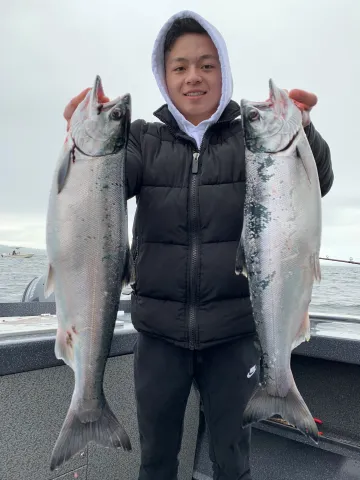
As we head into September, the color of salmon switches from pink to silver around Puget Sound.
The front end of the migratory coho run – also known as silvers for their shiny silvery-colored body – began to filter into the western Strait of Juan de Fuca and Puget Sound in August, and are expected to peak throughout September and early October.
Coho aren’t large – usually averaging 4 to 15 pounds, with some exceeding the 20-plus pounds – but they often put up a good tussle. Young coho spend a year in rivers and estuaries and then migrate out to the Pacific Ocean to feed and grow. They spend about 1½ years in the ocean, then return to spawn as three and four-year-old fish, generally in fall or early winter.
Puget Sound coho returns have gradually made a comeback from a downtrend that began in 2015 and 2016. This was due to negative environmental factors like drought, flooding, and warm water temperatures in their freshwater habitat as juveniles and then in the Ocean from a condition known as El Niño, when surface water becomes warmer than average.
The combined 2025 Puget Sound hatchery and wild coho forecast is 727,490 compared to 722,134 in 2024; 760,029 in 2023; 666,317 in 2022; 614,948 in 2021; and 504,604 in 2020.
Coho fill the air with enthusiasm for their leaping abilities when hooked, and unpredictable movements across the water’s surface.
A positive signal of 2025 expectations began with the good fishing for resident coho, who mainly spend their entire life feeding and growing in local waters –
caught in Marine Area 10 (Seattle and Bremerton Area) from June to early August. Many of these coho have grown since then and will join their larger migratory coho relatives during the late summer and fall marine fisheries.
Knowing when it is “go fishing time” for migrating coho in Puget Sound is to monitor catch rates in the Strait of Juan de Fuca at Marine Area 5 (Sekiu and Pillar Point) and Marine Area 6 (East Strait of Juan de Fuca).
The Marine Area 5 salmon fishery is open daily through Sept. 26 with a two salmon daily limit, plus two additional pink may be retained, and release Chinook, chum, sockeye, and wild coho. The area is then open daily for coho from Sept. 27 to Oct. 9 with a two salmon daily limit, release Chinook, chum, and sockeye.
The Marine Area 6 salmon fishery is open daily through Sept. 26 with a two salmon daily limit, plus two additional pink may be retained, and release Chinook, chum, sockeye, and wild coho. The area is then open daily for coho from Sept. 27 to Oct. 15 with a two salmon daily limit, release Chinook, chum, and sockeye.
Oftentimes, the best coho fishing in the Strait of Juan de Fuca occurs offshore in the shipping lanes, which is the main migration path. These deep-water areas are about one to 10 miles out in 200 to 500 feet of water and sometimes even deeper off the edge of the main shipping channels. Remember to stay within the U.S. side of the shipping lane. Look for tide rips and current breaks where krill and schools of baitfish attract coho, and watch for coho jumping and rolling on the surface.
In the eastern Strait of Juan de Fuca, the Dungeness Bay hatchery coho fishery is open from Oct. 1 to 31. The 2025 Dungeness River coho forecast is 13,328, down slightly from 14,305 in 2024 and 14,654 in 2023.
The Marine Area 7 (San Juan Islands) coho season is open daily through Sept. 6 with a two salmon daily limit, plus two additional pink may be retained, and release Chinook, chum, sockeye, and wild coho. The area is then open daily for coho from Sept. 7 to 30 with a two salmon daily limit, plus two additional pink may be retained, and release Chinook, chum, and sockeye. In Marine Area 7, look for coho staging along the western and southern portions of the island chain.
Coho fishing in Marine Area 8–1 (Deception Pass, Hope Island, and Skagit Bay) is open daily, Sept. 30, with a two salmon daily limit, plus two additional pink may be retained, and release Chinook and chum. Coho fishing is then open daily Oct. 1 to 12 with a daily two salmon catch limit, and release Chinook and chum.
In Marine Area 8–2 (Port Susan and Port Gardner), coho fishing is open daily through Sept. 24 with a two salmon daily limit, and release Chinook, chum, and pink. The Tulalip Bay Terminal Area Fishery has rules that differ from Marine Area 8-2. For details, check the Washington Department of Fish and Wildlife (WDFW) fishing regulations webpage at https://wdfw.wa.gov/.
In Marine Areas 8-1 and 8-2, anglers should find coho along the entire eastern side of Whidbey Island, Possession Point, off the Clinton Ferry Terminal, the Langley/Sandy Point area, Shipwreck to Mukilteo, Hat Island, Camano Head, the entire west side of Camano Island, and outside of Oak Harbor. West Beach at Deception Pass State Park, located north of Oak Harbor on Whidbey Island, provides excellent shore fishing access.
Moving further into Puget Sound, Marine Area 9 (Admiralty Inlet) is another decent fishing location for hatchery-marked coho, which is open daily through Sept. 30. It has a two salmon daily limit, plus two additional pink may be retained, and release Chinook, chum, and wild coho.
In Marine Area 9, focus your fishing time in the unmarked shipping lanes where tide rips and current breaks are commonly found. Try Midchannel Bank off Port Townsend; Point Wilson north of Port Townsend (good public shore access); east side of Marrowstone Island (some shore access); Fort Casey to Bush Point and Lagoon Point (some public shore access); Double Bluff off the west side of Whidbey Island; Point No Point (excellent public shore spot); Possession Bar; Scatchet Head; and Pilot Point.
In Marine Area 10 (Seattle and Bremerton Area), coho fishing is open daily through Sept. 30 with a two salmon daily limit, plus two additional pink may be retained, and release Chinook and chum. Fishing is also open daily from Oct. 1 to Nov. 15 with a two salmon daily limit, and release Chinook.
In Marine Area 11 (Tacoma and Vashon Island), coho fishing is open daily through Sept. 30 with a two salmon daily limit, plus two additional pink may be retained, and release chum and wild Chinook (note, the Chinook fishery may close sooner so check the WDFW fishing regulations webpage for updates. Fishing is also open daily from Oct. 1 to Nov. 15 with a two salmon daily limit, and release Chinook.
Look for coho in the deep-water shipping lanes off Jefferson Head to Kingston, Richmond Beach to Meadow Point near Shilshole Bay, Point Monroe, Shilshole Bay south to West Point, Elliott Bay, the Fauntleroy Ferry area southeast to Dolphin Point, both sides of Vashon Island, Redondo Beach to Dash Point and the Tacoma area of Commencement Bay, Browns Point, and Point Defiance Park from the Slag Pile to the Clay Banks.
Two popular events tied to the arrival of coho are the Edmonds Coho Derby on Sept. 6. For details, go to http://edmondscohoderby.com/. That will be followed by the Everett Coho Derby on Sept. 20-21. For details, go to https://everettcohoderby.com/.
Marine Area 13 (South Puget Sound) is open daily for hatchery-marked coho through Sept. 30 with a two salmon daily limit, plus two additional pink may be retained, and release chum, wild coho, and wild Chinook. Fishing remains open daily beginning Oct. 1 with a two salmon daily limit, and release chum, wild coho and wild Chinook.
In Marine Area 13, look for coho from the Narrows Bridge south to Anderson Island. The Squaxin Island area has become popular area for those targeting coho. The 2024 Squaxin Island net pens coho forecast is 59,596 up from 48,081 in 2024 and 45,417 in 2023.
If you’re looking for a Chinook and coho option try the Bellingham Bay Terminal Fishery open daily through Sept. 30 with a daily limit of four salmon.
Sinclair Inlet and Port Orchard are open daily through Sept. 30 with a three salmon daily limit, plus two additional pink may be retained, and release chum and wild Chinook. Fishing is then open daily from Oct. 1 to Nov. 15 with a two salmon daily limit, and release Chinook.
Lastly, a freshwater coho fishing option in Seattle’s backyard is Lake Washington north of the Highway 520 Bridge, which is open daily from Sept. 16 to Oct. 31 with a daily limit of four coho only, and release all other salmon species. The Lake Washington coho forecast is 28,112 up from 24,090 in 2024 and 21,554 in 2023.
In the October issue, we’ll switch gears and take a look at proposed fall and winter coastal razor clam digging opportunities.
I’ll see you on the water very soon!
/articles/coho-craziness
Summer Saltwater Salmon
Sockeye are arguably the best-eating salmon in the world, and as the summer rolls in, so do they. In Washington State, we are lucky enough to have several great sockeye fisheries to enjoy, both in the river and the lakes. No matter where you end up chasing them, there are a lot of basic building blocks to being a successful sockeye fisherman. Take those fundamentals and with a few location-specific tweaks, you can be successful just about anywhere you choose to target these tasty, feisty fish.
To start, let's talk about some basic sockeye fundamentals and what makes them tick. Unlike other salmon, sockeye are filter feeders, which means their diets mostly consist of krill and zooplankton. They are schooling fish who like to travel in numbers, which can make fishing for them more hunting and waiting that turns into a flurry of chaos. They also have the largest eyes of any salmon species, making them more light sensitive, but they can also see your gear from further away, bonus! We need to keep all these little quirks in mind while targeting sockeye to be successful.
Because sockeye are schooling fish, we need to focus our fishing time where they are most likely to travel. In the rivers, we’re looking for soft seams and slower water, or places that will hold them like thermal barriers, as is the case at Brewster. In the lakes, sockeye will cruise around in pods, looking for more of their kind to join as they get closer and closer to spawning. We can use this to our advantage by using dodgers and flash to mimic a school of fish and pull them into our gear from a distance. My favorite way to do this is trolling with dodgers, with my go-tos being the Mack's Sling Blade in 9” or 6” or the good ole standby 0 Les Davis. Metallic finishes like just a plain chrome will work for sockeye in any water, but I do love having a mix of metallics and colored dodgers. Sockeye are pretty lazy fish, so our troll speed is pretty slow, fluctuating between 0.8-1.5mph. Once we have them joined and following our gear, it's time for our lures and bait (where allowed) to do their job.
Since sockeye are filter feeders, and we target them in the freshwater, they aren’t attacking our lures as a feeding response. This means that they are grabbing our hooks out of reaction. Although the Lake Washington classic of bare red hooks still works, we can improve this reaction bite by using hoochies or flys, UV, flash or glow depending on time of day, and wings or blades that add even more flash and vibration. It’s pretty fun to have what my friends and I call “craft time” and build different lures and see what works best. My top color choices for sockeye, no matter where I go, are pink, orange, and red. I tie my sockeye leaders on heavy fluorocarbon, 25-40lb, with number 2 to 2/0 hooks. Not because they are big fish that are going to break your line, but because the heavier the line, the more action the dodger will impart to your lure.
Sockeye are also hard-hitting, aerobatic, and chaotic. They will take off and tangle up multiple rods or wrap around downrigger cable or anything else they can find. You’ll be glad for the heavier leader when (not if) this happens. My basic sockeye leader is 12” overall, and always has no less than 2 hooks. Once you have your leaders tied up, if you’re fishing where bait is allowed, it's sure to help your odds of hooking dinner. Cured coonshrimp, in pink or red, is a pretty universal sockeye bait; however, chunks of cured prawns work great too. In the fisheries closer to the salt, like Baker Lake, the Skagit, and the lower Columbia, live sand shrimp work very well. Scents can help you as well, and maybe even more so than other salmon; sockeye have a real sweet tooth. Slammin’ Sam’s XXX is one of my favorite sockeye scents, and I will even go as far as sprinkling my baits with pure granulated sugar. Aside from those, the regular standbys work great, like anise, garlic, and krill. Keep in mind that if you are fishing somewhere like Lake Wenatchee, which doesn’t allow bait, you also are not allowed to use scent.
These basics will get you started on the right foot when it comes to sockeye fishing, but each fishery has its own nuances. I approach each fishery differently, whether it’s a lake or river, how far from the saltwater I am, and water and weather conditions all play a role. We covered a little bit of this already, but let's get into a little more depth with some of my favorite fisheries.
Baker Lake is what I consider my “home lake” and where I do most of my sockeye fishing, spending as much as 50 days a year there. Baker Lake is a big, crystal clear lake that tends to stay on the colder side. It has a lot of structure, being a reservoir, with a few original lakes being big deep spots, lots of shelves, shallows, and some sunken forests/stumps. We generally focus our attention on the deeper water areas and along the edges of shelves, with most of our fish coming in the top 40’ of water. This allows me to leave my downriggers at home and just fish “droppers,” which is using lead cannon balls ranging from 4-10 ounces on sliders, followed by a 24-30” bumper line and then my dodger and leader. My heaviest lead is on my rods closest to the bow, with my lightest leads being out the back of the boat, and my line out is the opposite (shortest at the bow and longest at the stern).
An example of this, while running 6 rods, would be my bow rods having 10oz out 30’, my middle rods having 8oz out 40’, and my stern rods having 6oz out 50’. This gives me a good spread while keeping the rods from getting tangled with each other while trolling and turning, yet still keeping them pretty close in depth to give the illusion of a school of fish swimming together. This technique also allows us to get the gear out and fishing quicker, covers more water, and moves more in the water column during turns and speed changes. Baker Lake is also the place I troll the slowest for sockeye, with my target speed being around 0.8-1 mph.
I take this same technique to Brewster Pool, and really, any excuse I have to leave the downriggers off the boat, I will take! Our biggest differences here are that there’s much more current to take into consideration, and we are fishing in shallower water. Those currents are something to watch too, with how busy this fishery gets, you have the main current of the Columbia River as well as the incoming current from the Okanogan River. This Okanogan current will slow you down and can push you sideways into passing boats, so be extra aware of your surroundings. Here’s another reason I love fishing “droppers” because you can really see the action of your dodger, and in changing currents, I watch the thump of my rod to tell me I’m going the right speed instead of my speed over ground on my electronics.
Here at Brewster, I tend to use lighter leads than at Baker, more 3-6 ounces and target 20-35’ deep on average. Although as the day progresses and the sun gets higher, if the heat doesn’t get me off the water, I will start fishing deeper as those big eyes balls will start to drive the sockeye down to escape the sun. My go-to bait here is coonies, and pink is definitely my top color. Some fish will take a detour before getting all the way to Brewster and end up in Lake Wenatchee. Although the one single lane launch can make this fishery a little difficult to access, the fishing here is usually great and the fish tend to be bittier than at Baker.
This fishery is the most unique of all my sockeye fisheries, and I even have a Wenatchee-specific tackle box with all my tools of sockeye destruction. This is the one sockeye fishery I always bring my downriggers to, although I do still fish some droppers. I definitely have more success on the downriggers. Even though this lake is cold, deep, and clear like Baker, these Wenatchee fish seem to travel and be active deeper, and I catch most of my fish from 40-80’ deep. This fishery also doesn’t allow bait or scent, and to make up for this, we do some crazy stuff with our tackle.
Barbless hooks are also required here, which means a lot of lost fish. I always fish with at least two hooks and often three to up the odds of landing a fish. I still tie heavy fluorocarbon leaders but keep them on the short side, 8-10” overall. I don’t use a whole bunch of extra stuff on my leaders here, usually opting for one bead above each hook and sometimes a Mack’s Smile Blade on top of that bead. If I’m feeling really crazy I’ll throw a little LP plankton hoochie on there too, but I like to keep my profiles small here. The crazy part comes when you start checking out my dodgers. Here again, I use 0 dodgers or large Slingblades, but I get really crazy with the bends and accentuate them by increasing the bends on each end. By the time I’m done with them, they resemble an “S” more than a dodger. All this gives my gear a really erratic action, and my troll speed is a little faster here, where I try to keep it around 1-1.4mph.
So you can see that there are a lot of similarities from one fishery to another, and if you take the basic sockeye building blocks to any of these places, you’ll probably catch fish. But if you can tweak your program a little bit to really fit where you're fishing, your success will increase, and space in your freezer will decrease!
/articles/summer-saltwater-salmon
Sockeye Summer in Washington
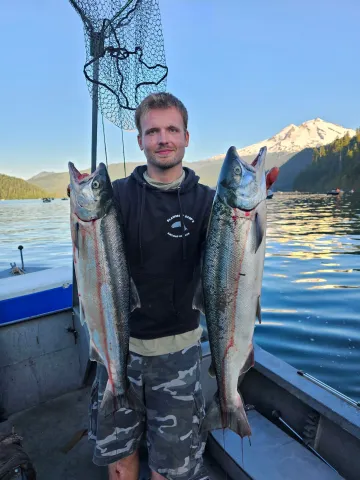
The temperature and the sunshine won't be the only things that're hot this summer. Every year in July and August, Sockeye fever hits Washington. I'm sure you've scrolled through social media this time of year and seen glory shots of the delicious red-meat salmon limited out on your feed. While some of us make it look easy, there is definitely a learning curve that leaves many anglers scratching their heads.
For those who don't know what a Sockeye is, I'll give a brief biology lesson. Sockeye are one of the 5 species of Pacific salmon we have here on the West Coast. They start their lives in cool, clear waters, often adjacent to a large lake. What makes Sockeye unique is that they use a nursery lake to rear for about 2 years before heading to the ocean.
These Sockeye make up the majority of their diet of shrimp, krill, and plankton, which give them that delicious sought-after meat. After 3 to 5 years (most Sockeye return at 4 years old), they return to the rivers where they were born. While there are a handful of naturally occurring Sockeye populations in Washington, the main ones that I will focus on are the Columbia River, Baker Lake, and Lake Wenatchee. Most of these fisheries target Sockeye trolling from a boat. However, bank anglers do have success plunking spinning glows and shrimp close to shore in certain areas of the Columbia and Skagit Rivers.
The Columbia River:
These fish start crossing over Bonneville Dam in Late May and early June, with the run peaking there around the 1st of July. Most of the fish are destined for the Okanogan River, Lake Wenatchee and Redfish Lake on the Snake River, with a handful going up Yakima and Deschutes rivers.
As they make their way upriver, they can be targeted at several different areas, including below Wanipum Dam, Wells Dam, and the ever-popular Brewster pool. The Brewster pool is where the fleet will fish for the majority of the season and for good reason. All the fish in this upper reach of the river are headed up the Okanogan River and into lakes in Canada.
The Thermal barrier:
Sockeye do not like to slow down for anything. The only times they really stop are when they make it to their home lake, have to cross a dam, or encounter some type of obstacle. In this case, it's what we call the thermal barrier. You see, when the Okanogan gets above 70 degrees, the sockeye will stay down in the cooler Columbia, making them sitting ducks until cooler waters prevail. Most years, the thermal barrier will set in by mid to late July, but varies depending on snowmelt and weather temperatures. The last couple of years, the thermal barrier was set right from the get-go, and this year looks no different. You can find the Okanogan River temperature on the USGS river flows site.
The Brewster 500:
You will not get solitude up in Brewster, but you will find great fishing. Most of the boats will fish right at the mouth of the Okanogan, but if you want fewer boats, you can fish down by the pump house. There is a nice shelf there, and the fish will sit all throughout there up to just above the Okanogan.
To target these fish, I like to run a size 0 dodger in either chrome, chrome/ silverscale, or moon jelly. Followed by a Mack's Lure smile blade, 3 red beads, and a coon shrimp. I will run anywhere between a 12 and 16-inch leader, with 14 being my sweet spot. I recommend either a 2 or 3 single hook setup tied with 2/0 hook or 1 single and a size 4 to 6 treble for a trailer.
These will generally be 10 to 25 feet deep and can be targeted with either lead balls or with downriggers. You'll want to troll slowly for these fish, often 1 mph or less going up river. Remember to speed up a bit going downstream. Levels and flows change throughout the day, so pay attention to the action of your gear. You want a side-to-side action on your dodger. If it starts to turn over and do a figure 8, then you are going too fast.
Here are a few things to note here fishing Brewster. It gets HOT! Temperatures are normally in the 90s and triple digits. Drink plenty of water and wear appropriate sun attire. When fishing the Brewster pool, keep your head on a swivel. It's literally combat fishing with boats. Know your limits. If you're not comfortable with the main pool, don't be afraid to fall back to less crowded areas. Be mindful when parking your boat on shore. The Columbia River is dam-controlled, and water levels fluctuate rapidly, sometimes within minutes. Every year, boats get left high and dry.
Baker Lake:
Ah, the Westside's beautiful Baker Lake. I remember the days of plunking for sockeye on the Baker River. Back then, a Sockeye fishery in Baker Lake was just a wishful thought. Finally, in 2010, after some hatchery and smolt collection improvements, the Baker Lake Sockeye fishery was born and has been an absolute hit ever since. This year, there are 60,000 sockeye forecast to the Baker River, and as of the time of writing this article, there have already been a bunch trucked up to the Whatcom County lake. The Sockeye here are big, bright, and fight hard!
As I talked about with Brewster, you'll be slow trolling with dodgers for these guys. Here is a rundown on the gear I use to consistently put Socks in the boat. I like to run either a size 0 or 00 dodger in Chrome, chrome/ silver scale, purple haze, 50/50, or moon jelly.
Sometimes, I will put a slight bend in the dodger for a little more thump. Hoochies work very well at Baker, with orange, purple, and pink being my go-to's. I run a Macks Lure Smile Blade above them and tip my hooks with pink coon shrimp soaked in Slammin Sams XXX. Sometimes I will also run just a smile blade and beads, as well as just bare red hooks.
I tie all my leaders with 8 to 10 inches of 20 to 30lb fluorocarbon. Any lighter and these crazy fish snap it like it's nothing. There are 2 main areas where people fish here. Down near the dam and up lake in the old Baker Lake bed. Don't be afraid to move around and hunt for these fish, as they will move around to get away from pressure. Troll .7 to 1.2 mph and watch your fishfinder for cruising sockeye. Typically the fish will hang anywhere from 20 to 60 feet down and are best targeted with downriggers or 6 to 12 oz of lead. There are 5 boat launches to choose from. Starting at the dam with Kulshan, Horseshoe Cove, Panama Point, Swift Creek, and Shannon Creek at the far end. In past years, Shannon Creek has been restricted to campers only. This is a fun fishery and should be good right from the get-go on July 12th when it opens.
Lake Wenatchee Sockeye:
Last but not least, my personal favorite fishery: Lake Wenatchee Sockeye! Watch the counts at Tumwater Dam. Once we've reached our escapement goal of 23,000 fish plus several thousand for harvest, WDFW will open the lake by emergency rule. This will usually be in either late July or early August. For gear, keep it stupid simple. 2 or 3 bare red hooks behind your dodger on a short leader, 8 to 10 inches. Shorter is always best at Lake Wenatchee. Check the regulations, as here it is no bait and single barbless hooks. The wardens are normally out in force. For depth, the fish here are much deeper. I usually catch them at 30 to 50 feet early on, and later in the season, I'll fish as deep as 115 feet down. Trust your electronics! Also, be mindful of the wind out here. It blows more often than not and gets extremely rough!
Good luck out there, and if you're feeling ambitious, I recommend hitting all 3 fisheries!
/articles/sockeye-summer-washington
Brewster Salmon Derby Adventures
In all my years of fishing, I have heard many legends and stories about fishing at the infamous Brewster Pool. Articles on the Internet caution readers about hostile fishermen and hundreds of inexperienced boaters creating chaos. My own experience couldn’t have been further from these stories. This year, I was lucky enough to get the opportunity to film and participate in the derby on behalf of Northwest Fishing.
From the moment I got to Brewster, I was blown away by the friendly locals and energetic atmosphere of the derby. Other fishermen were giving each other high fives and complementing one another on their catches. This was far from the stories of combat fishing and fishermen yelling at one another that I had heard. Although there were hundreds of other boats out there, everyone was very patient and gave one another plenty of space. Guides and recreational fishermen alike were joking with one another and having a great time doing the sport we all love. I saw hundreds of beautiful fish caught and weighed in over the 3 days of the derby, and even got to reel in some of my own. Here’s the story of my experience at this year’s Brewster Salmon Derby.
Cori Kogan: Interview with Mike Mauk
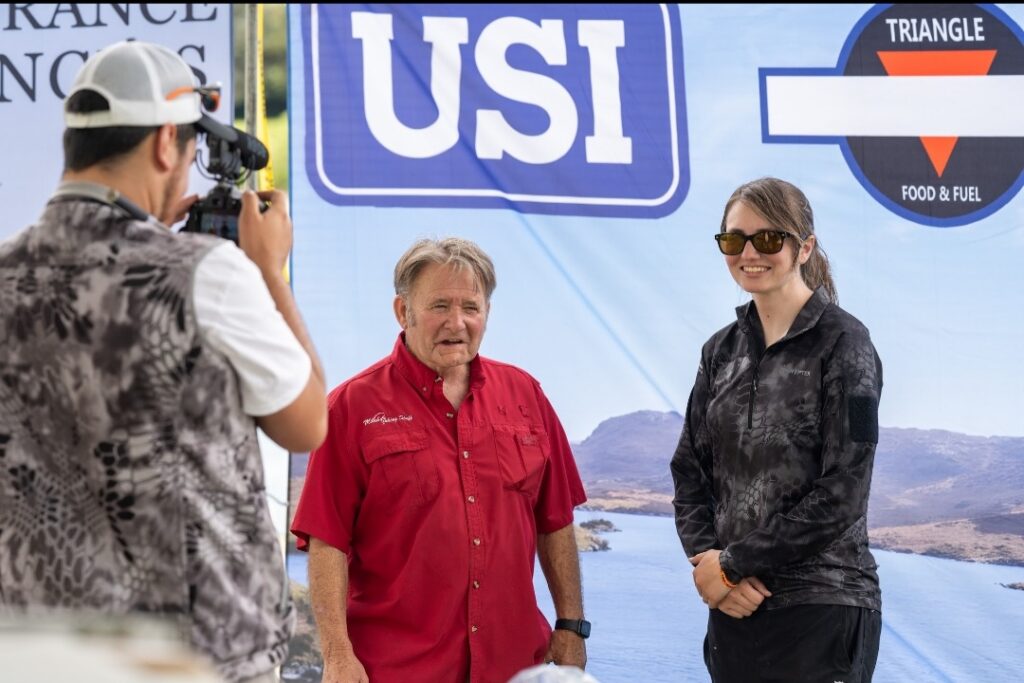
On day 1, Mike Mauk, the president of the Brewster Chamber of Commerce, greeted me with a warm handshake and a big smile. Mike organized this year’s derby, bringing together dozens of sponsors and coordinating prizes and staffing for the event. He gladly took some time from his busy schedule to chat, and I interviewed him about the history of the derby and the town of Brewster. He told me that the proceeds from ticket sales go towards helping the community of Brewster and enabling them to run the derby year after year. The Brewster Salmon Derby is the largest derby on the Columbia River, and up to $20,000 in cash and prizes are given out every year. Next, I interviewed the derby weigh master, Ernie Mauk. Ernie brought incredible energy to the weigh station, high fiving each kid that brought a fish to him. He showed me how he weighs each fish, taking the girth and length measurements and calling them out to be recorded and put on the board. He said that even though he weighs hundreds of fish every year, he still admires the beauty of each and every fish he weighs. WDFW also had a presence at the weigh station, scanning the fish for tags. When they found a tagged fish, they cut the nose of the fish off to remove the tag (after making sure the fisherman had gotten all the pictures they wanted). They let me know that the information they get from the tag helps WDFW determine the health and abundance of salmon populations. Not only does the derby help the small community of Brewster, it also aids WDFW’s research and provides valuable insights into this amazing fishery.
Bree, Waylon, and Hannah with a nice sockeye
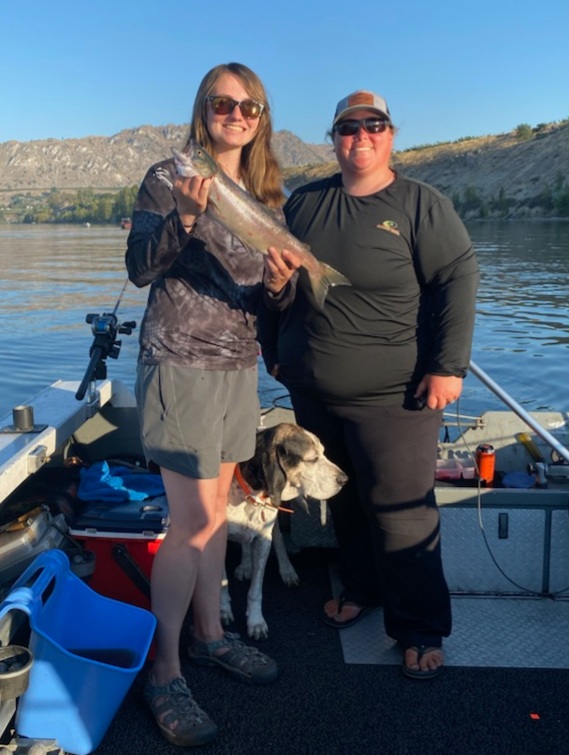
While getting to see the ins and outs of the weigh station was certainly a fascinating experience, fishing is truly my passion, and my experience participating in the derby was absolutely unforgettable. Brianna Bruce of Livin’ Life Adventures was our guide during our 3-day adventure. My friend Michael Francisco, my fiancé Chris Decker, and Northwest Fishing regulars Andrew and Joe Czapla were on board. Brianna (Bree) kept us entertained with dozens of fishing stories from her 11 years of guiding. She told us all about the fishery and what makes it so productive and popular. Every year, thousands of sockeye and chinook salmon stage in Lake Pateros, also known as the Brewster Pool, between the dam and the mouth of the Okanogan River. The mouth of the Okanogan River heats up and creates a thermal barrier, and the fish wait in the pool for it to cool down so they can enter and reach their spawning grounds. This year, Bree said there were over 100,000 sockeye in the pool! Good numbers of chinook are caught every year, some reaching over 30 pounds. Some fishermen got their limits of sockeye and headed back to town for breakfast before the heat of the day began. Others stayed out until 6PM, braving the heat for a chance at a derby winning chinook. There was a 4 fish limit for sockeye, and a 2 fish limit for chinook. The bite seemed best in the early hours of the morning, but there were fish caught all day. Bree’s dog, Waylon, was our bite alarm throughout the weekend. Every other fisherman in the pool knew when we hooked onto a fish! Bree alternated between steering around other boats, netting fish, baiting hooks, and swapping fishing stories, making it all look easy. Her natural talent, great humor, and mastery of the fishery made for an unforgettable experience. On day 2, one of our cameramen had a big, feisty sockeye on the end of his line. As he brought it up to the boat, he lifted the fish out of the water and the hooks popped out. Our hearts sank, but Bree effortlessly scooped the fish into the net and saved the day!

Some early morning sockeye action!
We started off fishing for chinook the first day, armed with spinners and chrome flashers. Bree is an expert in this fishery, and told us that sockeye often hit chinook gear, and vice versa. The second day, we fished sockeye gear, and were rewarded with many nice fish. For her sockeye gear, Bree ran homemade pink spinners and smaller flashers. On the third day of the derby, we fished a combination of sockeye and chinook gear. She ran 2 spinners, 2 sockeye setups, and 2 tuna stuffed Brad’s Super Baits. It was tough to find the right speed to get the different gear to fish right, but like a true pro, Bree made it work. We trolled slowly, between .8 and 1.2 MPH, and kept an eye on the depth. To avoid tangling our 6 lines, Bree used a variety of different cannonball weights, which also allowed us to fish throughout the water column.
No matter how tired and hot we were after fishing all day, we always looked forward to lunch at one of Brewster’s amazing, locally owned restaurants. Mike Mauk and the Brewster Chamber of Commerce treated us to lunch and dinner each day. The sizzling, fragrant fajitas at Campreros were absolutely delicious! Later in the afternoons, we usually got some time to explore the area each day. I was surprised by just how much the town of Brewster has to offer. There are numerous family-owned stores that offer cool refreshments and homemade snacks. If you’re fishing the Brewster Pool, it’s definitely worth it to take the time to sample some of the local cuisine and explore the town.
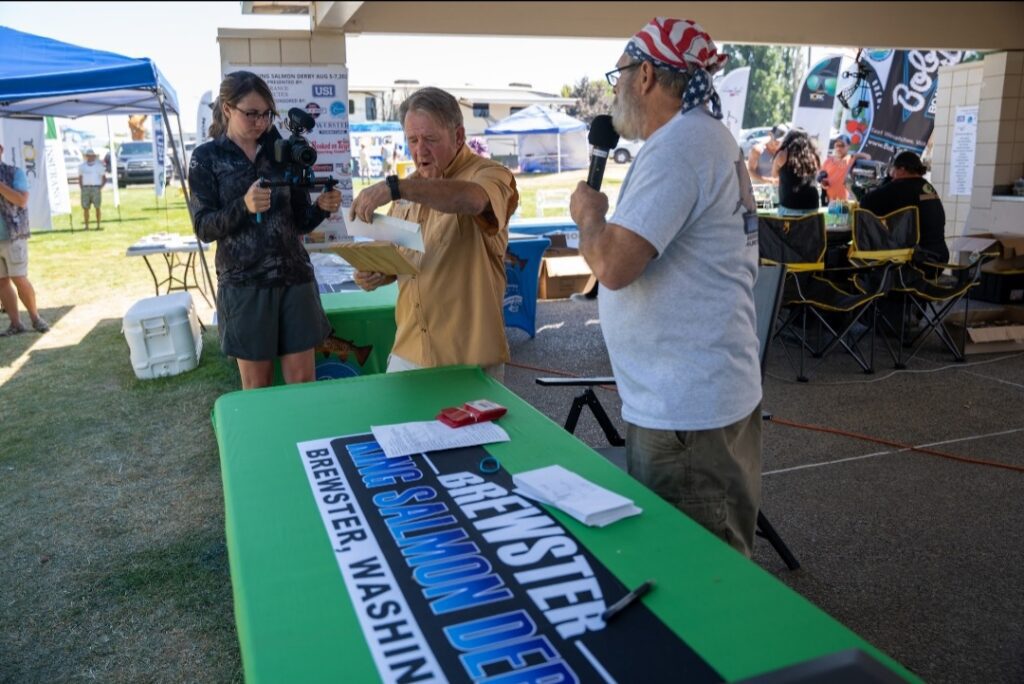
Cori Kogan: Filming the derby winners!
On day 3 of our adventure, we got to see the winners of the derby take home their prizes and win their bragging rights. The winning fish, the “king of the pool”, was a tank of a chinook weighing in at 29 pounds and 10 ounces that got the winning angler a nice check for $2,000. The top 10 winners got a beautiful wooden plaque to commemorate their win. One of the most memorable parts of the weekend was when a young girl weighed in a 26-pound chinook. She ended up winning the youth category of the derby! Besides the competition for the top 25 biggest chinook, there were also side pots and a raffle to take part in. There were many raffle prizes, such as free fishing trips for 4 people, a bow, and a downrigger. The grand prize for the raffle was a 9.9 HP Mercury outboard motor. Weigh master Ernie announced the winners, and photographer Cori Kogan snapped photos of them holding their prize next to Mike Mauk.
All 3 days of my experience at the Brewster Salmon Derby culminated into an unforgettable adventure. From Mike Mauk’s warm welcome to Bree’s terrific netting skills and incredible sense of humor, I’ll always tell stories about the derby with a smile. I know I’ll be back next year for another shot at winning the derby!
/articles/brewster-salmon-derby-adventures