Coho Prospects for 2026 by Mark Yuasa
As summer begins to fade away, excitement is blooming heading into fall with a large coho forecast expected to peak in the weeks ahead.
The front end of the migratory coho run - commonly labeled as silvers by anglers for their bright, chrome-colored body - entered the Strait of Juan de Fuca and Puget Sound in early August, with fair to good catches reported.
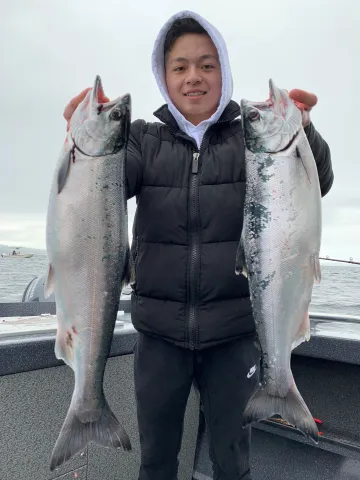
Coho (averaging 4 to 15 pounds, with some exceeding 20 pounds) create a lot of fervor, and when hooked, they’ll leap out of the water and make erratic zigzagging patterns across the surface.
Washington Department of Fish and Wildlife (WDFW) salmon managers indicate that the 2026 coho prediction has the potential to generate the highest statewide recreational fishery catches seen in more than 20 years. Fingers crossed! The 2026 statewide combined hatchery and wild coho forecast is 1,827,748, up from 1,588,658 in 2025. In Puget Sound, the coho forecast is 897,190, up from 727,058 in 2025; 722,134 in 2024; and 760,029 in 2023.
During the North of Falcon salmon season setting process earlier this year, WDFW staff presented the 2026 Puget Sound coho forecasts and abundance trends. For hatchery coho, it showed a 4% improvement, and wild coho are up 53% compared to the 2025 forecast. The recent 10-year average for hatchery coho is up 45%, and wild coho is up 55%. The total Puget Sound coho (hatchery and wild combined) is up 49% from the 10-year average run size and up 22% from the 2025 forecast.
The coho buzz began back in June when Marine Area 10 (Seattle and Bremerton Area) saw good fishing for resident coho. Krill, a major part of a coho diet, has been plentiful in Marine Area 10, as well as baitfish such as herring. The ample feed kept many of the resident fish congregated in the area, and they are now being joined by their larger migratory cousins.
Marine Area 10 is open for coho daily through Sept. 30 with a two salmon daily limit, and anglers must release Chinook and chum. Fishing is also open daily from Oct. 1 through Nov. 15 with a two salmon daily limit, and anglers must release Chinook. Shilshole Bay reopens on Sept. 1. To know when it’s best to hit the water, be sure to monitor the WDFW catch sampling webpage at https://wdfw.wa.gov/fishing/reports/creel/puget.
A good number of coho have already entered the Strait of Juan de Fuca at Marine Area 5 (Sekiu-Pillar Point) and Marine Area 6 (East Strait of Juan de Fuca). These two areas are the barometer of when the peak return of coho will move into Puget Sound.
The Marine Area 5 salmon fishery is open daily through Sept. 24 with a two-salmon daily limit, and anglers must release Chinook, chum, sockeye, and wild coho. Then the area is open daily for all coho retention from Sept. 25 through Oct. 15 with a two-salmon daily limit, and anglers must release Chinook, chum, and sockeye.
In Marine Area 6, the salmon fishery is open daily through Sept. 24 with a two-salmon daily limit, and anglers must release Chinook, chum, sockeye, and wild coho. Then the area is open daily for all coho retention from Sept. 25 through Oct. 15 with a two-salmon daily limit, and anglers must release Chinook, chum, and sockeye.
The best fishing in the Strait tends to be located about one to 10 miles out in the shipping lanes at depths of 200 to 500 feet or deeper. Remember to stay within the U.S. side of the shipping lanes. Look for tide rips and current breaks where krill and baitfish tend to concentrate and attract coho. Also, watch for schools of coho jumping and rolling on the surface.
Moving inland, Marine Area 7 (San Juan Islands) is open daily for all coho retention from Sept. 1 through Sept. 30 with a two-salmon daily limit, and anglers must release Chinook, chum, and sockeye.
Looking for popular inner-sound locations for coho? Try Marine Area 8–1 (Deception Pass, Hope Island, and Skagit Bay), which is open for coho daily through Oct. 11 with a two-salmon daily limit, and anglers must release Chinook and chum. And, just to the south near Everett is Marine Area 8–2 (Port Susan and Port Gardner), which is open for coho daily through Sept. 25 with a two-salmon daily limit, and anglers must release Chinook and chum.
Marine Area 9 (Admiralty Inlet) from Port Townsend south to Apple Cove Point-Edwards Point southernmost boundary line, and all points in between, are open daily through Sept. 18 for hatchery-marked coho with a two-salmon daily limit, and anglers must release Chinook, chum, and wild coho. Fishing is also open for all coho retention from Sept. 19 through Sept. 30 with a two-salmon daily limit, and anglers must release Chinook and chum.
Marine Area 11 (Tacoma and Vashon Island) is open for coho daily through Sept. 30 with a two salmon daily limit, and anglers must release chum and all Chinook (closed for Chinook retention on Aug. 15). Fishing is also open seven days per week from Oct. 1 through Nov. 15 with a two salmon daily limit, and anglers must release Chinook.
Marine Area 13 (South Puget Sound) is open daily for hatchery-marked coho through Sept. 30 with a two-salmon daily limit, and anglers must release chum, wild coho, and wild Chinook. Fishing remains open daily beginning Oct. 1 with a two-salmon daily limit, and anglers must release chum, wild coho, and wild Chinook. Anglers may fish with two poles with a Two-Pole Endorsement. In Marine Area 13, Squaxin Island is a popular area for those targeting hatchery coho.
Coho bank fishing access
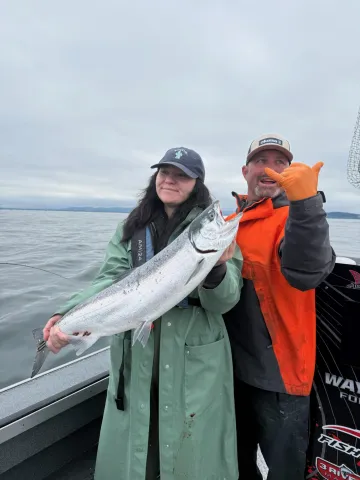
As these fish turn the corner around Port Townsend and enter Puget Sound, bank anglers can find numerous publicly accessible shorelines and piers that are within easy casting distance of silvers. When accessing these areas, make sure to be courteous and respectful around private property shoreline boundaries.
Top locations in the northern region include Point Wilson in Fort Worden State Park north of Port Townsend; Fort Flagler State Park on Marrowstone Island; Marrowstone Point Lighthouse; and the western and eastern shorelines of Whidbey Island around Fort Casey, Lagoon and Bush points, Bait Box Hole just north of Possession Point, and West and North beaches at Deception Pass State Park. The Oak Harbor Marina also has two net pens where hatchery coho are raised and released annually. In 2022, 30,000 fish were released from the net pen, and fish that survived will return this season to the area.
In northern and central Puget Sound, try Point No Point on Kitsap Peninsula; Browns Bay; Salsbury Point; Edmonds Marina Pier; Mukilteo Lighthouse and the public pier at the Mukilteo Ferry Landing; Richmond Beach and Meadow Point Beach at Golden Gardens; Shilshole Bay Pier; Seacrest Pier in West Seattle; West Point at Discovery Park; Carkeek Park, Lincoln Park and Alki Point Lighthouse in West Seattle.
In southcentral and southern Puget Sound, head to Browns Point Lighthouse Park and Dash Point State Park; Dolphin Point off the east side of Vashon Island; Blake Island State Park; Three Tree Point; Point Robinson Lighthouse, Point Beals, and KVI Beach on Vashon Island; Southworth and Manchester areas; and public piers at Des Moines, Redondo, Les Davis, and Point Defiance Park Boathouse.
Stay clear of large ships in shipping lanes
Many coho tend to congregate in the shipping lanes, and fishing is legal in the ship traffic lanes as long as the lanes are kept clear for ships, according to the Board of Pilotage Commissioners of Washington.
Shipping lanes should be cleared when ships - who have the right of way - are five minutes away (about two miles) to avoid impeding traffic. Be aware of your surroundings and monitor vessel traffic on VHF radio channel 14. Lastly, anglers should stay out of ferry lanes when ferry boats are present.
The U.S. Inland Navigation Rules and COLREGS Rule 10 state: Vessels less than 65 feet in length shall not impede the passage of vessels transiting the traffic lanes. For more information, refer to the Board of Pilotage website at www.pilotage.wa.gov.
Westport Boat Basin coho fishing
On Washington’s central coast, the Westport Boat Basin coho-only fishery is open daily through Jan. 31, 2027. The best timing is September through October as coho raised in the marina’s hatchery net pens begin to return.
The daily limit is six salmon, and no more than four may be adult fish. Anglers must release Chinook. No night fishing and an anti-snagging rule is in effect, and any hooks where the weight is molded directly to the hook - such as twitching jigs, swim jigs, or casting jigs - are not allowed. Only single-point barbless hooks may be used. The Catch Record Card (CRC) code for the basin fishery is 2-2W.
(Mark Yuasa is a Washington Department of Fish and Wildlife Communications Manager and longtime local fishing and outdoor writer.)
/articles/coho-prospects-2026-mark-yuasa
Washington Coastal River Salmon Prospects by Brent Knight
Washington’s coastal rivers occupy some of the most productive salmon country in the Lower 48. From the Willapa and Chehalis systems north to the Quinault, Queets, Hoh, and Quillayute system in Forks, these waters support Chinook, coho, chum, and other salmonids while sustaining tribal fisheries, recreational anglers, commercial fishing communities, and ecosystems built around returning salmon.
For 2026, the outlook is encouraging in several important respects. Forecasts released by the Washington Department of Fish and Wildlife (WDFW) point to substantial returns of coho and other salmon to the Washington coast, and ocean fishing opportunities reflect relatively strong expectations for several stocks. At the same time, the picture differs considerably by river and species. Natural-origin Chinook remain a particular concern in some watersheds, while changing ocean and freshwater conditions continue to create uncertainty.
A Stronger Coastal Coho Picture
Coho are one of the brightest parts of Washington’s 2026 coastal salmon outlook.
WDFW forecasts an overall Washington coastal coho return of approximately 419,000 fish in 2026. That total includes both naturally produced and hatchery salmon returning to coastal watersheds. Individual systems illustrate the scale of the expected return. Preliminary forecasts put Willapa Bay coho at approximately 127,000 fish, including about 100,600 hatchery-origin and 26,500 natural-origin fish.
Grays Harbor also has a substantial projected coho return. Preliminary forecast tables indicate roughly 71,900 natural-origin and 93,300 hatchery coho, producing a combined forecast of about 165,000 fish. Farther north, forecasts include approximately 60,000 coho for the Quinault system, 31,500 for the Queets, and 6,500 natural-origin coho for the Hoh.
These forecasts do not guarantee equally good fishing everywhere. River flows, ocean survival, harvest rates, run timing, and in-season abundance can all influence what anglers ultimately experience. Still, the numbers provide legitimate reasons for optimism about coastal coho fishing during the 2026 season.
The ocean fishery provides another indication of that outlook. Washington's recreational ocean salmon fishery received a 102,900-fish hatchery coho quota for 2026, up from 99,720 in 2025. WDFW described the forecasts for important Chinook and coho stocks contributing to the ocean fishery as strong enough to provide good recreational opportunity.
Willapa Bay Shows Both Opportunity and Concern
Few places demonstrate the complicated nature of Washington salmon management better than Willapa Bay. The 2026 preseason forecast calls for approximately 28,120 Chinook returning to Willapa Bay. However, only about 2,779 are projected to be natural-origin fish, compared with approximately 25,341 hatchery-origin Chinook. The natural-origin forecast is below WDFW's listed escapement goal of 4,353 fish.
That contrast explains why a seemingly healthy total salmon return does not necessarily mean managers can liberalize fishing across the board. A large hatchery return may create harvest opportunities while a comparatively weak natural stock requires protection. In Willapa Bay during the 2026 season, recreational regulations therefore require anglers to release wild, or unmarked, Chinook.
Coho present a more favorable picture. The forecast of 127,123 Willapa coho includes a natural origin return of 26,499 fish, compared with a listed WDFW escapement goal of 13,600. Chum salmon are also expected to return in significant numbers: the 2026 Willapa forecast totals approximately 110,837 chum, the great majority of them natural-origin fish.
Willapa therefore illustrates an important point about discussing “salmon prospects.” There is rarely one simple answer. One species, or even one component of a species, may be doing relatively well while another remains constrained.
Grays Harbor and the Central Coast
Grays Harbor and its tributaries, including the Chehalis and Humptulips systems, are another major focus for coastal salmon anglers.
Coho prospects appear relatively promising based on preseason abundance estimates. Chum numbers are also notable. WDFW's 2026 forecast projects approximately 93,877 chum returning to Grays Harbor, including more than 87,000 natural-origin fish.
As elsewhere on the coast, however, abundance is only part of the management equation. Fisheries must be designed around conservation requirements, escapement objectives, treaty obligations, and the expected effects of different fisheries on individual salmon populations.
Washington's annual North of Falcon process brings WDFW, tribal co-managers, federal managers, anglers, commercial fishing interests, and other participants into the season-setting process.
Forecasts are developed early in the year and then used in negotiations and modeling that ultimately determine where, when, and how salmon can be harvested. That means a large overall forecast does not automatically translate into a long season or generous limits on every river.
North Coast Rivers Remain Wild-Salmon Strongholds
Moving north along the Olympic Peninsula, rivers such as the Quinault, Queets, and Hoh retain something increasingly valuable: substantial natural salmon production and extensive habitat within or near protected lands.
The 2026 preliminary coho forecasts illustrate the importance of these systems. The Quinault forecast includes approximately 23,600 natural and 36,500 hatchery coho. The Queets forecast includes roughly 10,400 natural and 21,100 hatchery fish. The Hoh forecast calls for approximately 6,500 natural coho.
These rivers are important not simply because they produce fish for harvest. They are also benchmarks for understanding how salmon populations function in watersheds that retain comparatively intact forests, floodplains, tributaries, and spawning habitat. Protecting that habitat will be increasingly important as environmental conditions change.
The Biggest Unknown May Be the Ocean
Salmon spend part of their lives in freshwater, but much of their survival story is written at sea.
Ocean temperature, currents, upwelling, prey availability, predators, and marine food webs can dramatically affect the number of juvenile salmon that survive long enough to return as adults. Those conditions can change rapidly, making even scientifically sophisticated forecasts imperfect.
That uncertainty deserves particular attention in 2026. NOAA Fisheries reported in March that a large marine heatwave had persisted off the West Coast since the previous summer, only the third time such a broad area had remained exceptionally warm for so long into winter without an El Niño event. NOAA notes that marine heatwaves can reduce salmon survival because warmer ocean conditions are generally associated with lower productivity, although the effects can vary by species and location.
Freshwater conditions pose another long-term challenge. Climate change is altering both rivers and the ocean, including the availability of cold-water habitat for salmon during freshwater stages of their lives. For Washington's coastal watersheds, maintaining cold tributaries, reconnecting floodplains, improving fish passage, protecting spawning gravel, restoring estuaries, and preserving functioning forests will therefore become even more important.
Habitat Is the Long-Term Investment
Fishing regulations can control harvest, and hatcheries can provide fish for fisheries, but neither can fully substitute for productive habitat. Salmon need connected habitat throughout their life cycle: clean spawning gravels, cold tributaries, complex river channels, floodplain wetlands, estuaries, and productive marine waters. Habitat restoration is therefore a major component of salmon recovery efforts throughout the West Coast.
Significant investment continues in this area. In 2026, NOAA Fisheries announced up to $99 million through the Pacific Coastal Salmon Recovery Fund for state and tribal conservation and recovery projects benefiting Pacific salmon and steelhead.
Those projects may not produce immediate results visible during a single fishing season, but over decades they may prove more important than any particular annual forecast.
What Anglers Should Expect in 2026
For Washington coastal salmon anglers, the 2026 season offers genuine reasons for enthusiasm. Coho numbers are encouraging in several major systems. Hatchery production should provide meaningful harvest opportunity, and the recreational ocean fishery entered the summer with slightly higher quotas for both Chinook and hatchery coho than in 2025. Willapa Bay also has strong projected hatchery Chinook and coho returns, while coastal chum forecasts exceed 200,000 fish between Grays Harbor and Willapa Bay.
But optimism should remain measured. Natural Chinook abundance continues to limit opportunity in some areas, and anglers should expect selective fisheries, changing regulations, and river-specific restrictions designed to protect weaker stocks. Forecasts are estimates rather than guarantees, and actual returns can diverge significantly from preseason expectations.
The larger story is that Washington's coast still possesses something extraordinary: rivers capable of producing substantial numbers of wild salmon alongside hatchery-supported fisheries.
The challenge is ensuring they remain that way. If habitat restoration, responsible harvest management, hatchery reform, tribal and state co-management, and climate adaptation can work together, Washington's coastal rivers can continue supporting salmon, and salmon fishing, for generations to come. The 2026 forecasts provide reasons to look forward to the coming runs, but the future of these fish will ultimately depend less on any single year's numbers than on the condition of the rivers and ocean they depend upon.
/articles/washington-coastal-river-salmon-prospects-brent-knight
Ten Rules of Coho Trolling by Mike Carey
It’s coho time in the Sound, with resident coho open, and soon the ocean runs will start showing up. Fishing for these silver bullets will only get better, peaking in early September.
With that in mind, I was looking back through previously released articles and found this helpful article I wrote several years ago. The time has passed, but the rules still hold true. And while I won’t be fishing the Sound this year, my thoughts will be with anglers throughout the Pacific Northwest enjoying this special fishery.
So here are my “Ten Tips” to help you catch more coho this year!
September is a special time for me. Like the change in the weather, I can feel a change in myself, a pent-up anticipation that has slowly been building over the summer and, like clockwork, bursts forth in full bloom. It’s coho time in Puget Sound! Yes, this is a great time of the year to be a salmon angler in Puget Sound, if the runs are strong and the fishing is open.
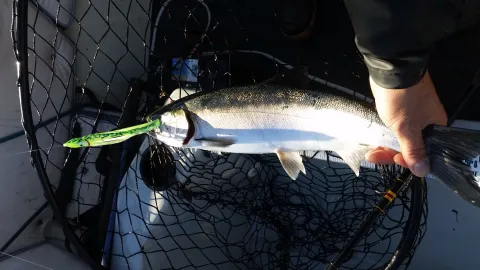
Looking at my fishing report data from trips going back twenty years, it becomes pretty obvious that September is the time to put away freshwater gear and focus on salmon. August can be productive, but September can be (and often is) lights out. My reports show multiple trips with limits by 9 am, red-hot fishing, and lots of pictures of shiny chrome coho. As the season progresses into later September, the fish show a steady increase in size. By late September to early October, the 6-8 pound coho are replaced by beautiful 10-14 pound hooknose monsters. It’s the time of year to stock up the freezer on tasty coho!
For those new to this fishery, you’ll find a wealth of information on techniques and locations scattered on the web. I've broken down some of my thoughts on coho trolling into Ten Rules of Coho Trolling.
Coho tend to be pretty cooperative salmon when it comes to catching them. As these fish stream in from the ocean, heading through the Strait of Juan De Fuca and into Puget Sound, they are putting on the feed in preparation for their runs up to the spawning grounds.
It’s not unusual to find coho stuffed with herring. Don’t get me wrong, there are days they, like other salmon, will have lockjaw. But that truly is the exception, not the rule. Speaking of rules, I offer a list of rules I’ve developed over the years to catch more coho. You’ll likely have your rules to add to this list. Or you may disagree with some of them. But hopefully it will give you some additional ideas when targeting coho in the Sound.
Rule #1
As Russell Wilson would say, “Separation is in the preparation”. - When you put your boat in the water, you should have everything ready to go. No fiddling around with gear or bait the morning of a trip. My fishing ritual is to have everything ready to go the night before.
It’s like a general plan for battle. My rods are ready and geared up. My bait has been cut and cured. My boat is prepped and clean, batteries are charged, the gas tank is full, snacks are bought, and there’s ice in the coolers for the fish.
This evening before prep time is actually a ritual I cherish because, like Russ, I’m visualizing success and making a plan in my head. I try to never go fishing without a plan.
Rule #2
Start early, go shallow. - I try to be on the water as early as possible. Ideally, that means running lights on and gear going in the water while it’s still dark or just turning light. I will run my gear in the top 10-30 feet of water to start.
This is the time of day when a salmon fly in the prop wash can be deadly. I like Arctic Fox Trolling Flies. Denis Peirce ties a nice fly in a variety of effective salmon colors. Try running the fly back 40-50 feet and troll fast (more on that later) with the fly practically skipping on the surface.
Just be sure to have the clicker on the reel because these strikes can be vicious. I love the sound of a clicker going off in the morning!
Rule #3
Watch your fish finder, drop your depth – As the morning progresses, drop your downriggers down. I’ve read the “rule of thumb” is ten feet every hour until you’re trolling your gear around 40-60 feet. That’s fine, I guess, but I also use my fish finder. If I see bait and fish marks down 50-70 feet, I’ll drop down to those fish even if it’s early in the morning. As the day goes on, I may even drop my downrigger ball down to 110-120 feet deep. Depth can be a tricky thing because when coho fishing, I troll fast, which leads us to the next rule.
Rule #4
Troll fast! - In my experience, coho love a fast troll. I have an i-Troll throttle control and will set it on “hunt” mode to keep my boat going fast, around 3.3 to 3.9 mph. A few years back I did a lot of underwater filming and noticed a distinct increase in salmon aggression when the flasher was whipping around in a complete rotation. If it was only doing a lazy rotation, or not doing a full rotation, coho would tend to swim behind the gear, just watching. But speeding up and getting that flasher fully spinning would elicit vicious strikes. I will troll both with and against the tide and catch fish going both ways.
Just be sure to increase your throttle going into the tide to maintain that 3.5 mph speed. I’ll also program my i-Troll to give a periodic 3-5 second slowdown and then speed back up to “wake up” coho that may be lazily following but not biting. It can often trigger a bite. Oh, another thing that will often trigger a bite – if you’re checking gear, pop your line off the release and set the rod in the rod holder. Let the gear come up on its own. I have caught a lot of coho that will chase the gear as it ascends to the surface. Don’t reel your gear in until it hits the surface.
Rule #5
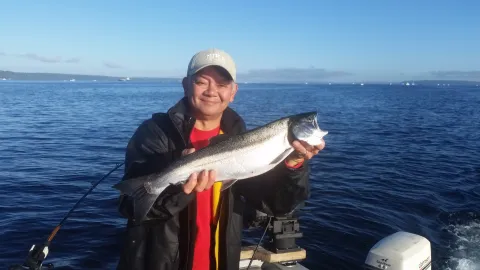
Coho are hungry; feed them! - Coho love a strip of herring on just about any lure. I will add strips to hoochies, flies, and even a small strip on the hook of a spoon (but not too much; you don’t want to kill the spoon’s action). Be sure to brine the herring strips a day ahead of time in rock salt and/or commercial herring brine. Add scents and bite enhancers as well. Check your gear every 20-30 minutes and freshen up with a new herring strip. If you get a bite but no release, bring it in and check it! The one exception to this rule I have is if the dogfish are in thick, I will go without bait.
Rule #6
Experiment – My “go-to” setup is a magnum green splatter glow hoochie, herring strips, 26-30” leader, and an 11” dodger (pick your color…). I always start with this setup. On a second rod, I may run a different color and smaller hoochie. If there is no action and I am seeing fish on the fish finder, I will start trying spoons and plastic lures like the old Big Al’s Cripple Herring. Sometimes the coho just want something with more action. This year, I’m going to be trying the new Old Goat OG2 5” salmon lure. The Old Goats have been awesome on kokanee, and I think they will be deadly on coho. They have an amazing action that I think coho will love.
Rule #7
Fish Where They Ain’t (anglers that is) – coho in Puget Sound can be found pretty much anywhere. We all have favorite starting locations, and it’s human nature to follow the crowds of boats because “hey, they must know something I don’t”. Maybe…and maybe not. I try to start my troll away from clusters of boats. Why be surrounded by additional lures in the water? You want to troll over fish that aren’t seeing offerings non-stop. So, move away from everyone else – and if you take my advice and troll fast, you will, very quickly.
You’ll still find the fish if they are there, and cover more water to find the biters. When you do, don’t be afraid to mark the fish on your fish finder and troll around and right back over the same spot. Again, in viewing underwater footage, I invariably see groups of 4-6 coho following my gear. A solo fish is very rare. So, work over those spots when you pick up a fish.
Rule #8
Midday and tide changes are good – I know I said earlier I like to hit the water at daybreak, but there are days when that just doesn’t happen. The good news with coho is that it doesn’t matter. You can (and will) catch coho all morning and into midday. Tide bites are the period before and after a low or high tide, and these times can be very productive. My favorite tide sequence is a high tide at around 9-10 a.m. The flood tide pushes fish, and as the tide slows down, it triggers a feeding opportunity below for the coho salmon.
Bait becomes easier to pick off without a steady flow of water, and the coho bite often turns on. If you miss that crack of dawn bite, fear not; the coho will cooperate. I’ve caught my biggest hooknose fish from 11 am to 1 pm.
Rule #9
Playing and netting your fish – OK, you have a big fish on and are trolling at 3.5 mph. What do anglers often do? Why, slow down, of course. Bad move. In today’s age of barbless hooks, slowing down is an invitation to let the fish go. The second there is slack in that line, the hook can slip out. Trolling for coho is not a fishery that is about the fight; it’s about catching fish. If you want an epic battle against coho (and they are a hoot), catch them in rivers, or mooch for them. Trolling with an 11” flasher gives these fish a focal point with which they can get slack line.
We don’t want to do anything to help them out, like slowing down. Once they are on the surface, do your best to keep the flasher out of the water. This will help prevent the fish from getting slack line between the hook and the flasher. Make sure you have a net with a long handle and a big opening. This will help as the netter reaches out. Remember, the netter scoops as the angler guides the fish into the net. Don’t make the mistake of the netter reaching to net the fish! Once the fish is close to the boat, slowing down a bit is OK, by the way- just keep that flasher out of the water.
Rule #10
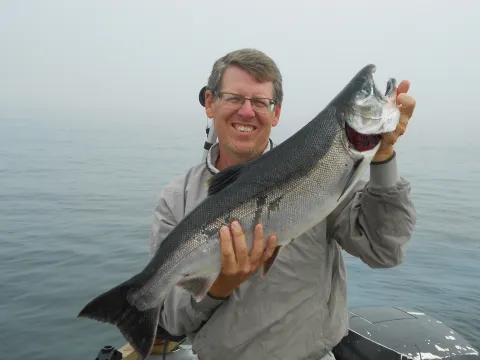
Take good care of your fish – Non-anglers have no idea what freshly caught salmon tastes like. As anglers, we are blessed to be able to have the freshest salmon on the planet. So, take good care of your caught fish. Bonk the fish enough to stun it, then cut a gill and bleed the fish out for a few minutes.
After that, into the ice cooler it goes.
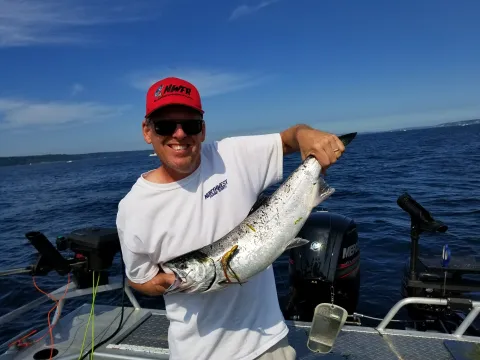
Don’t hang it off the side of the boat to bake in the sun. At the end of the day, gut and cut into steaks, or fillet the fish. If possible, vacuum-seal whatever fillets you don’t eat for dinner. Properly cared for, you’ll have tasty fish until the next season, when you get to do it all over again!

/articles/ten-rules-coho-trolling-mike-carey
Getting Ready for Salmon Season! by Hannah Pennebaker
If you're anything like me, then you have dreams about bobber downs and chrome fish. The long wait is over, and the time is finally here! Whether this is your first or fiftieth salmon season, preparation is the key to success. Let's go over some tips on how to ensure your boat, trailer, and gear are in tip-top shape for this salmon season.
If you have a boat, you'll want to make sure it's running smoothly and has all the gear you need. Fill up your gas tank, check your batteries, test your downriggers, and fire up your motors. Take a look at your engine hours and take care of any recommended services. Repair shops are busy this time of year, so it's not a bad idea to watch some tutorials and figure out how to do some basic repairs and services yourself. Our boat has both a 2-stroke main motor and a 4-stroke kicker, so my husband and I have had to become adept at both 2-stroke and 4-stroke motor maintenance!
Don't forget to ensure you have all the Coast Guard-required safety equipment aboard your boat. This equipment is required for good reason, and the Coast Guard conducts inspections.
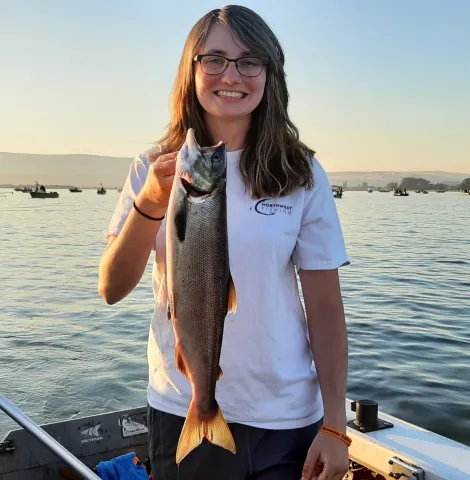
Here's a good checklist to use:
Flares (3 daytime and 3 nighttime, or 3 daytime/nighttime combos)
Life jackets for everyone on board
Throwable flotation device (if boat is 16ft or longer)
Navigation lights (if traveling between sunset and sunrise or during low visibility periods)
Horn/whistle/other sound signal
Fire extinguisher
Carbon monoxide warning sticker/placard
Not Coast Guard required, but good to have:
Manual bilge pump
Marine toolkit
Marine radio
Extra gas cans
Spare motor parts (spark plugs, hose clamps, etc.)
First aid kit
Let's not forget your boat trailer! Make sure to do a thorough visual inspection of the brakes, chains, couplers, straps, wheels, bearings, and tires for damage and wear. It's a good idea to re-grease your wheel bearings every year. Top up the air in your tires if needed. Hook up your trailer lights and verify that your signals are all working. While you're at it, make sure your registration is up to date for both your boat and trailer.
Once you've verified that both your boat and trailer are in good, safe condition, it's time to look at your other gear. Look over your rods and fix any broken guides or tips. Open up your reels and grease any and all moving parts to prepare them for the fights ahead. I like to polish up any spoons or spinners that have corroded during the off-season. This is also a good time to organize tackle boxes and stock up on any swivels, line, etc. Do it now before the season is in full swing and tackle store shelves are empty!
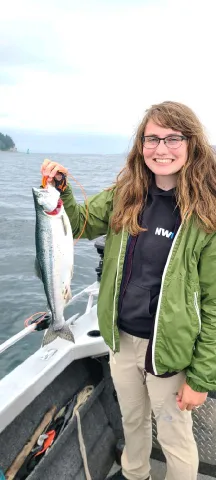
Here are a few other miscellaneous things to check before going out. Make sure you have an up-to-date fishing license and catch record card. You can either use a paper card or use the MyWDFW app. Catch record cards are not added automatically in the app. You need to add them to your cart in the MyWDFW or Fish Washington app for $0. If you're going to an area without cell phone service, the data in your card will be added locally and updated when you come back to an area with service. Be sure to familiarize yourself with the rules of the area where you'll be fishing. Don't forget to pinch your barbs and keep all fish in the water until you are 100% certain it's legal to retain. WDFW has great resources on how to identify each salmon species in both saltwater and freshwater. Please follow the rules and help protect the resource so that future generations can enjoy fresh, local salmon on the dinner table too!
/articles/getting-ready-salmon-season-hannah-pennebaker
Everett Coho Derby: Supporting our Fisheries by Brent Knight
Here we are, mid-summer. And for many of us sportsmen, waiting patiently for the fall salmon runs to begin. With very limited Chinook opportunities in Western Washington, most of us are looking forward to our coveted coho fishery. I know that I am organizing my gear, tying leaders, prepping bait, and doing anything that I can to pass the time. I get in a day or two of kokanee or trout fishing here and there, but it is just not the same. Coho are hard-fighting fish and arguably among the best-tasting salmon, either on the BBQ or in the smoker. The 2026 forecasted return of coho salmon to the Puget Sound projects a strong, healthy return overall, ranking as one of the best seasons in recent memory for total forecasted abundance. This means that we should be both optimistic and excited for what is to come.
Along with the returning salmon come numerous derbies, all up and down the West Coast. Every September, there is a salmon derby unlike any other on the West Coast: The Everett Coho Derby, taking place in September when the Coho are stacking up in the Puget Sound on their way to their natal rivers and spawning grounds. This great event celebrated its 32nd year in 2025 and has become the largest fishing derby on the West Coast, with around 2000 adults and 300 kids registering annually. That’s a lot of sportsmen (and women) and anglers on the water!
I have been fortunate to be a volunteer for the past five years. For me, it’s easy. I just show up at the Edmonds Marina and meet and greet people as they bring their catch in for weighing. We laugh and talk to all the smiling kids, proud to weigh in their fish and compete for prizes. Outside of all the fun that we have over the two days of the derby, many others spend the year planning the event, and it is a lot of hard work.
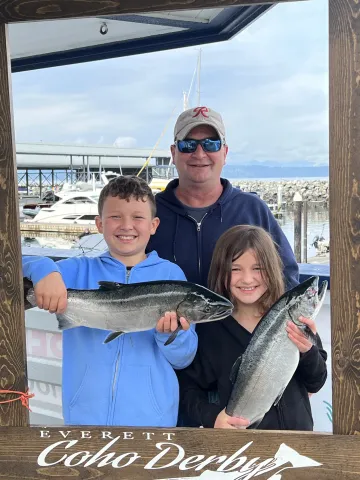
The Everett Coho Derby is sponsored by the Everett Steelhead and Salmon Club/Everett Chapter of the Puget Sound Anglers and the Snohomish Sportsmen’s Club. These two groups work together to plan the event. The money made in this derby goes to support the many fish enhancement projects of the clubs.
Coho can be caught in any of the open marine areas or the open rivers in Snohomish and Skagit Counties. First, second, and third prizes fetch $10K, $5K, and $2.5K, respectively. Gary Hanson from Puyallup won the 2025 Everett Coho Derby with a 12.62 lb coho salmon. The annual derby concluded on September 21, 2025, with Betty Wood (Snohomish) taking second place with a 12.11 lb fish, and David Taylor (Tulalip) in third place with an 11.57 lb fish. The event saw a highly competitive weekend for the top spots.
A little history about the derby: In 1993, the local recreational fishing industry was in a quandary. To protect many of the threatened runs of coho salmon, the State of Washington declared much of the saltwater off limits to salmon fishing, as well as closing most of the local rivers. The only area available was the Snohomish River system and a small “Bubble” right outside the mouth of the Snohomish River called the Tulalip Bubble. Interest in salmon fishing was waning, and the sporting goods stores were worried about their livelihoods - the sale of fishing gear.
One of the local store managers, Fabian Loomas from Jerry’s Surplus in Everett, approached Jim Brauch of the Everett Steelhead and Salmon Club and Mark Spada of the Snohomish Sportsmen’s Club with a proposal. If a salmon derby was created, targeting the small area that was open, Fabian would try to solicit prizes from the various distributors. In addition, if not enough tickets were sold to cover the prize money, Fabian would guarantee that the prize money would be paid. This was a win-win scenario for the two clubs, and the decision was made quickly to create and organize the derby!
That first year, the derby was called the Snohomish River Coho Derby, and it made about $400-$500 per club. Not a lot by today’s standards, but in those days, most of the club’s income came from small raffles and coffee rest-stop donations. Four hundred dollars was significant for both clubs, and they were overjoyed at the additional revenue. Those guiding the effort muddled along for the next few years, happy to have a derby and happy to make a little money from it. A Humpy Derby was attempted one year, and two things were discovered: humpy (pink salmon) anglers don’t buy derby tickets, and most humpies entered in the derby weighed about the same (10th through about 50th differed by less than 2 oz). In about the year 2000, Mac McReynolds - a representative from Olympic Boats, a local retail boat sales operation - approached the group to see if they could help sponsor the derby. McReynolds arranged for a boat, motor, and trailer to be awarded as the grand prize, at no cost to the derby. Ticket sales surged that year, furnishing money for the many enhancement projects carried out by both clubs. Up until a couple of years ago, the boat, motor, and trailer package was a mainstay of the raffle portion of the derby and helped it to continue to grow to what it is today. Other past prizes have included trips to fish in Alaska and cash as alternatives to the raffle.
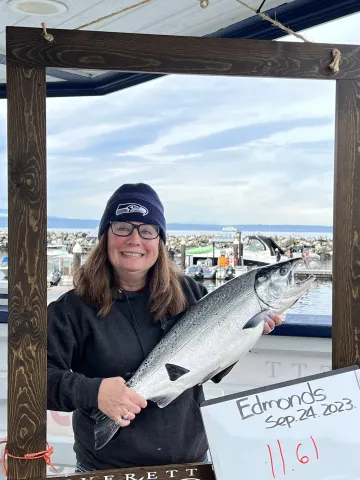
From these humble beginnings, the derby, now called the Everett Coho Derby, has become the largest derby on the West Coast of North America based upon the number of participants. Ticket sales have soared from 900 tickets sold in 2001 to 2527 sold in 2004, a year of inclement weather, along with over 300 free youth tickets. Over 2800 participants in total. The derby now averages 2000 adult paid tickets, and 270 free kids (12 and under) tickets each year. The prize money has also improved with cash for the five largest fish, from $500 for 5th place up to $10,000 for 1st place, along with many added cash prize categories. This derby has surely become a destination event on the West Coast.
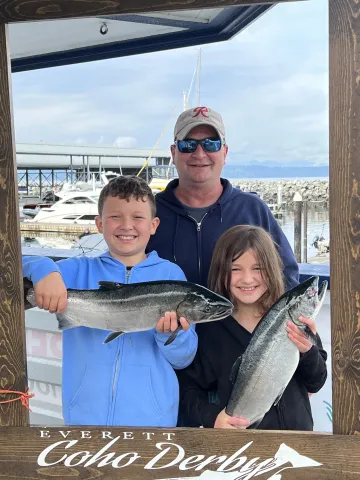
The money made each year in the Everett Coho Derby goes towards the support of the many fish enhancement and propagation projects of the clubs - including stocking of the local lakes with trout, a salmon hatchery raising 60,000 coho smolt each year for release in the Skykomish River (Eagle Creek Hatchery), carcass planting in the upper Pilchuck River and Snohomish System, many different youth activities including trout clinics/fishing events, high school/college scholarships, sending kids to Youth Conservation Camp, as well as many other activities too numerous to mention. The money goes to good causes, and anglers have a chance to win prizes at the same time. What could be better?
These events take a ton of work to organize and coordinate, but the proceeds help more than most people realize. Also, many of the people who donate their time and energy to events like this are getting older, so there is a call for new blood. It is time for the next younger generation to get involved and start to take over so that we can keep these events going.
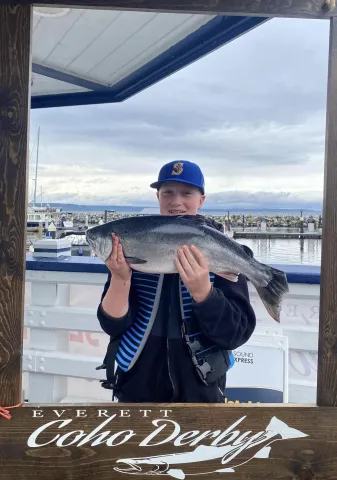
So, what does it take to get involved? There is nothing to it. Just volunteer, and they will be grateful for your help. If you are not the volunteering type, that is okay. Pay your entry fee and come try to win some prizes next year while filling your freezer with chrome bright coho salmon.
To learn more, you can visit https://everettcohoderby.com/. The 2026 derby will be held on Saturday and Sunday, September 26-27. Tickets will go on sale on July 1st. We hope to see you there.
/articles/everett-coho-derby-supporting-our-fisheries-brent-knight
Summer Salmon are Coming! by Mark Yuasa
That means it’s time to get all the salmon fishing gear in order and begin thinking about the kickoff to several salmon fisheries planned to open in June.
While the tentatively proposed 2026-2027 salmon fishing season package was finalized in mid-April, they won’t be officially adopted until sometime in mid-June.
The rules set by the Washington Department of Fish and Wildlife (WDFW) were submitted to the National Marine Fisheries Service within the National Oceanic and Atmospheric Administration (NOAA) Fisheries in early May.
NOAA Fisheries implements the actions through its regulatory channels under the Endangered Species Act and the Magnuson-Stevens Fishery Conservation and Management Act. Proposed fisheries are not finalized for the 2026-2027 salmon season until NOAA Fisheries approves them.
As part of the North of Falcon process, WDFW is hosting a virtual public hearing on Tuesday, June 9, from 10 a.m. to 12 p.m., and will take additional public comments. Go to this link https://wdfw.wa.gov/events/north-falcon-public-hearing-20260609 to register for the public hearing. Pre-registration is required. Final regulations will be adopted subsequent to that hearing and signed off by the WDFW Director by around mid-June. For a list of the proposed fisheries, go to https://wdfw.wa.gov/fishing/management/north-falcon/summaries. The 2026-2027 fishing regulation pamphlet will come out online around June 18. Printed copies should arrive at license dealers and at WDFW offices by June 26.
In the meantime, before rushing out the door, salmon anglers should check on any early-season summer fishery openers by going to the WDFW website (https://wdfw.wa.gov/) to see what areas are scheduled to open and for any possible emergency fishing rule changes or closures.
Where to Go in June
A much-anticipated early-summer salmon fishery occurs in Marine Area 10 (Seattle-Bremerton Area), which is scheduled to be open daily for a coho beginning June 1. Look for coho averaging 2 to 4 pounds in the shipping lanes off Jefferson Head, from the westernmost Kingston boundary line south to Presidents Point, from the Edmonds oil docks south to Richmond Beach, West Point south of Shilshole Bay, along the east side of Bainbridge Island, and the tide rips off Blake Island, Restoration Point, and the northside of Vashon Island west to Southworth.
If your preference is a chance at catching an early-summer hatchery Chinook, then look no further than Marine Area 11 (Tacoma-Vashon Island). Fishing is scheduled to be open beginning June 1. These fish usually consist of a mix of resident and mature migrating Chinook averaging 7- to 15-pounds with some in the 20-plus pound category.
WDFW will monitor the June Marine Area 11 Chinook fishery, and it could close sooner in order to stay within the quota and/or other guidelines. The Chinook catch quota for the June fishery is 1,423, with a total unmarked encounter of 820 and a total sublegal encounter (Chinook under the 22-inch minimum size limit) of 2,186. The Marine Area 11 Chinook fishery is managed under two separate summer quotas, and a second window of opportunity is tentatively proposed to begin on July 23.
Look for salmon off Point Defiance Park in Tacoma from the Clay Banks to Owen Beach; Slag Pile off the Tacoma Yacht Club, outside of Gig Harbor on the “flats” area; northeast side of Vashon Island; Colvos Passage; outside of Quartermaster Harbor; and the southwest side of Vashon Island at Point Dalco. In the northern sections of Marine Area 11, try Dolphin Point and Point Robinson on the east side of Vashon Island, south of the Southworth Ferry Landing, and Apple Tree Cove to Redondo Beach.
If Marine Area 11 is slow or closes sooner than expected, another option is south of the Narrows Bridge in Marine Area 13 (South Puget Sound). Locating schools to baitfish is key to raising the bar on success for salmon at Gibson Point, Fox Island Fishing Pier, Hale Passage, Johnson Point, Anderson Island’s east side, and Point Fosdick. Marine Area 13 is scheduled to be open year-round for salmon. Anglers should check the WDFW website or the 2026-2027 regulation pamphlet for details.
Another good Chinook option is the Tulalip Terminal Area Fishery (Marine Area 8-2), which is open Fridays through Saturdays of each week and has a harvest quota of 600 Chinook. The popularity of this fishery has generated some decent action in the past few summers. The WDFW will monitor the Tulalip fishery, and it may close sooner to stay within the harvest quota.
For saltwater anglers without a boat, there are a good number of viable year-round fishing piers to catch salmon. They include the Edmonds, Fox Island, Mukilteo Ferry Landing, Seacrest in West Seattle, Dash Point Dock, Point Defiance Park Boathouse, Les Davis, and Des Moines piers.
If you prefer a freshwater salmon fishery, then make plans to head to the Skagit River (areas open vary depending on the species, hatchery Chinook or sockeye); Cascade River from the mouth to the Rockport-Cascade Road Bridge (opens beginning June 3 on Wednesdays through Saturdays only); and Nooksack River North Fork from Highway 9 Bridge to yellow marker at upstream end of the Kendall Hatchery property open through June 30. Anglers are advised to check the WDFW website for river sections open to salmon fishing and for any possible emergency fishing rule changes or closures.
Ocean Salmon Fisheries on Tap
Later this month – June 20 to be exact, which also coincides with the official first day of summer – many salmon anglers will head to the coast for the Chinook and hatchery coho ocean fishery. The recreational Chinook quota is 54,000 (up a tad from 53,750 in 2025) and a hatchery-marked coho quota of 102,900 (up from 99,720 in 2025).
Marine Area 1 (Ilwaco): Open daily beginning June 20 through Sept. 30, all salmon. The daily limit is two salmon and one Chinook only. The subarea guideline is 16,780 Chinook (16,600 in 2025), and the subarea quota is 51,450 marked coho (49,860 in 2025). Columbia Control Zone closed.
Marine Area 2 (Westport-Ocean Shores): Open daily beginning June 20 through June 28 for all salmon except coho, and the daily limit is one salmon; release all coho. Fishing is then open seven days per week from June 29 through Sept. 30, for all salmon. Beginning June 29, the daily limit is two salmon, and only one may be a Chinook. The subarea guideline is 21,910 Chinook (22,270 in 2025), with a subarea quota of 38,070 marked coho (36,900 in 2025).
Marine Area 3 (La Push): Open daily beginning June 20 through June 30, all salmon except coho, and the daily limit is one salmon; release all coho. Open seven days per week from July 1 through Sept. 30, all salmon. The subarea guideline is 2,200 Chinook (2,280 in 2025), with 2,680 marked coho subarea quota (2,590 in 2025). Beginning July 1, the daily limit is two salmon. Beginning Aug. 1, no chum retention.
Marine Area 4 (Neah Bay): Open daily beginning June 20 through June 30, all salmon except coho, and the daily limit is one salmon; release all coho. Open seven days per week from July 1 through Sept. 30, all salmon. Beginning July 1, the daily limit is two salmon. The subarea guideline is 13,110 Chinook (12,600 in 2025), with a subarea quota of 10,700 marked coho (10,370 in 2025). Beginning Aug. 1, no Chinook retention east of the Bonilla-Tatoosh line and no chum retention.
Species and size restrictions are dependent on the marine area. WDFW fishery managers will monitor the number of salmon caught in-season and may close areas earlier than scheduled if quotas or guidelines are met. In-season management may be used to sustain season length and keep harvest within the overall Chinook and coho total allowable catch.
Looking Ahead
While this column is focused on June fisheries, those looking ahead to July can look at the Strait of Juan de Fuca Marine Area 5 (Sekiu and Pillar Point) and Marine Area 6 (East Strait of Juan de Fuca) west of a true north/south line through the #2 Buoy immediately east of Ediz Hook, which are both planned to open beginning July 1 for hatchery Chinook and hatchery coho. Marine Area 7 (San Juan Islands) and Marine Area 9 (Admiralty Inlet) are planned to open July 16-18 for hatchery Chinook and hatchery coho. Marine Area 10 (Seattle and Bremerton Area) is scheduled to open on July 23-25 for a hatchery Chinook directed fishery and is also open daily for coho through Nov. 15. Marine Area 12 (Hood Canal) south of Ayock Point is proposed to open on July 1 for coho and hatchery Chinook.
Each marine area could close sooner for Chinook fishing if specific catch quotas or guidelines are met. Check the WDFW website or the 2026-2027 regulation pamphlet for areas where Chinook must be released or are closed to salmon fishing, and for other specific rules.
(Mark Yuasa is a Washington Department of Fish and Wildlife Communications Manager and longtime local fishing and outdoor writer. Contributed by Mark Yuasa, WDFW.)
/articles/summer-salmon-are-coming-mark-yuasa
Tossing Hardware for Coho
November is here, bringing chilly winds and icy rains. Although the year is almost over, the good news is that the coho run is not. Many rivers, coastal ones in particular, hold late-running fish from November well into December and January. But how do you get these fish in your cooler?
Bait has its time and place. For picky A run fish in clear, low water conditions, eggs are king. November is the perfect time to start using hardware for these big and aggressive B-run fish. Let's go over how to use spinners and spoons for these late B run coho.
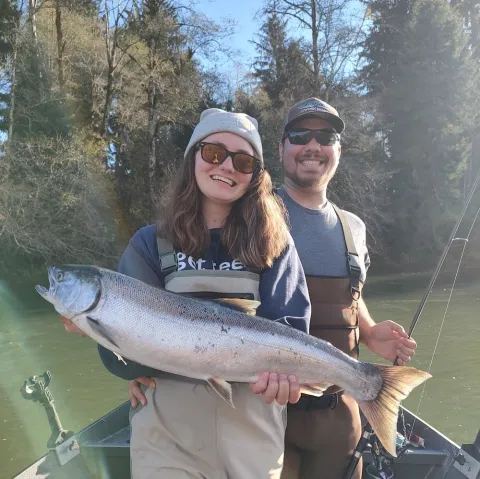
Spinners
If I had to pick my favorite way to fish for coho, it would be throwing spinners. The takedown is aggressive, and there is no question when you have a fish on. Spinners are a great way to search for fish when you aren't sure where they are holding. Cast and retrieve in a spot several times, then walk down 10 steps and repeat until you get a bite. Late-run fish are more aggressive and more likely to strike a well-presented spinner. It's a good idea to bring weighted and unweighted spinners. Make sure to use a bead chain or two attached to a snap swivel so you can change between the types of spinners easily. Unweighted spinners such as Wicked Lures can be fished with a variety of different inline weights according to the depth and speed of the run you're at, making them incredibly versatile. I carry inline weights between 1/4 oz and 1/2 oz. Wicked Lures come in a variety of different colors and sizes. I like the pink/green ones as well as the black/pink ones for most conditions.
Alternatively, weighted spinners such as Blue Foxes are a great option as well. Use small, dark size 3 spinners in clear conditions, and bright size 5 or 6 spinners in murky conditions. Fish will chase down spinners and aggressively chomp them, making for a fun fight. Vibrax spinners have a lot of drag and tend to ride higher in the water column than torpedo spinners. Use the right spinner for the conditions!
Spoons
Much like spinners, spoons are an effective way to search the run for aggressive fish. Spoons can be fished a multitude of ways for coho. You can drift small spoons like Dick Nites or throw larger ones, like Little Cleos and Kastmasters. Smaller spoons wobble and dart when drifted like a cork and a yarn. Many northern Puget Sound anglers use this technique with great success. Use a 3-6ft leader and don't change out the hook- no matter how tempting it is! Bigger hooks would change the action of the spoon. The stock hook works just fine as long as you don't horse the fish in. Cast upstream and follow the drift with your rod tip, using just enough lead to tick the bottom every few seconds. It takes some patience and time to learn what a bite feels like. It can be subtle, so don't wait to set the hook until you feel headshakes.
For larger spoons, it's tempting to fish them like a spinner, but the technique is slightly different. Cast upstream and allow your spoon to sink. Point your rod at the spoon and mend your line as it drifts downstream. Feed out the line as necessary to keep the spoon slowly wobbling near the bottom. The action drives coho crazy! The takedown is much like a spinner bite- aggressive and unmistakable. 50/50 colors work well in most water conditions. It's a good idea to keep a variety of different spoon shapes and colors to see what the fish key in on. Every day is different, and every fish is different.
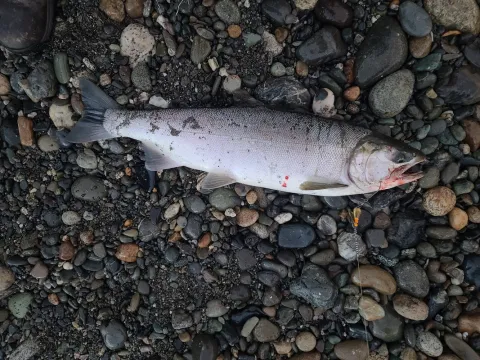
Setups
Rods and reels for hardware fishing tend to be based mostly on personal preference. While some anglers prefer to use a heavier, shorter rod, I like to use a light and long noodle rod. I find that these absorb the headshakes and jumps much better than a short, stiff rod. They also allow me to cast light spinners when the conditions call for it. Pair your rod with a size 3000 to 4000 reel.
I highly recommend using braided line with a monofilament top shot. This allows you to have the sensitivity of braid, but if you break off, you'll leave monofilament in the river instead of braid, which will break down much sooner. 8-17lb rated rods work great, but I've used 6-12lb rods as well. Use at least an 8ft rod. For my leader line, I use 10-15lb fluorocarbon. I find it has good abrasion resistance but also looks almost invisible in the water. Tighten your drag, but loosen it up after your hookset. Remember, these B run fish are big, hook-nosed brutes. You're in for a fun fight!
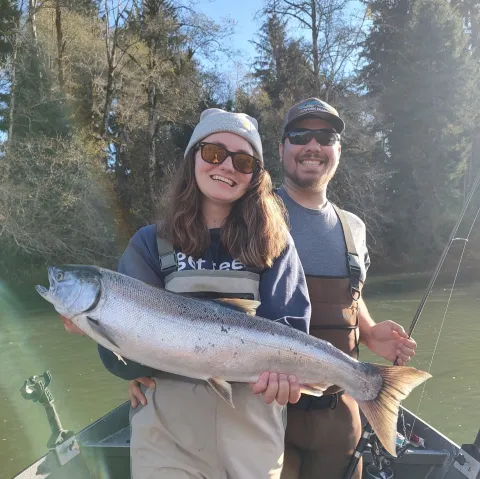
Now is the time of year to perfect your hardware technique for those large, aggressive B-run coho. Spinners and spoons can be used in both slow and fast water, making them a versatile technique. Not every river is open in November, so make sure to check both the regulations and emergency rules before heading out. Pinch those barbs or buy barbless hooks if required; it never hurts to double-check. The Fish Washington app is a great resource!
/articles/tossing-hardware-coho
Fall Coho Fishing in Rivers
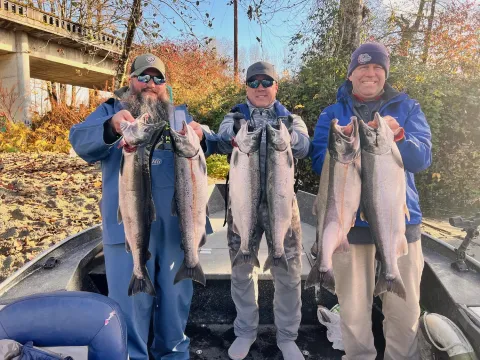
If you ask me my favorite fishery of the year, I will always tell you that winter steelhead fishing is king! There is a romance to steelhead fishing in the winter that is unlike anything else, and I can’t get enough of it. A very close second is fishing for Coho salmon in our many rivers around the Puget Sound and along the Washington Coast.
Coho salmon begin entering our river systems in the early fall, generally from mid-late August, depending on rain. The migrations vary by river, but in some cases continue through January. The peak time to target these fish is from late September into late November. Since 2025 is a pink return year, I expect that the Coho will likely push in just a bit later to avoid the massive influx of pinks. We have over 7,000,000 pinks forecasted to return to the Puget Sound this year. You can always find both species in a system at the same time, but I don’t believe that they like to compete for water, and hence, the Coho tend to avoid the pinks as best they can. For this reason, I have found that early run Coho are often found in less common water when the pinks are in. Think center of the river in the current and on the soft edges.
The best thing about fishing for Coho is that they tend to be very predictable. You are going to find them holding up in softer water, staging for their final push to their spawning grounds. As one group moves out of a hole and upstream, another will travel up and fill in. This will continue as fresh fish enter the river system and continue to migrate upstream. For this reason, I have found that Coho are much more predictable and easier to target than species such as spring Chinook or winter Steelhead. The advantage of Coho fishing is that we often experience greater numbers of encounters, get to fight many fish, and often restock our freezers for the winter.
It is important to note that during the fall, you may find Chinook, summer Steelhead, Pinks, Coho, and even Chums in the same system. Depending on the river, you may be able to keep multiple species and, in some cases, even unmarked fish. Make sure that you read the regulations closely and comply with all rules related to gear restrictions and retention.
Coho can be finicky and may not bite at times, but by nature, they are very aggressive and territorial. It might take a bit to get one to bite, but once you do, it is usually game on for a while. The nice thing with Coho is that you can employ many techniques to target and catch them. It is fun to anchor in a slot and pull plugs. There is nothing quite like the takedown on a plug to get your heart pumping. This is a great technique for those who are looking for a relaxing day on the water. Note that fishing plugs generally means that you are fishing the traveling lanes, not the soft pockets of holding water.
Some prefer to use bait. For years, cured eggs drift-fished was the go-to technique. There are so many options today that you don’t see bait used as much. Some are even switching from bait to beads as they work very well and can be drift fished, bobber dogged, and even used under a float. Speaking of floats, fishing jigs like we do for Steelhead is another fun and proven method to target Coho in slow-moving water. Again, a jig takedown under a float makes for an epic fight.
Currently, I see more anglers targeting Coho in holding water by casting presentations at them. My favorite technique is to throw spinners, but depending on the river system, Wiggle Warts, Dick Nite’s behind an inline weight, or with a dropper, spoons, Wicked Lures, homemade hoochie spinners, and jigs all work very well. The technique that is really catching on is twitching jigs. A twitching jig is a bit heavier than a normal jig, weighing anywhere from 3/8 to 1 oz. They come in a variety of colors and are deadly for Coho. To twitch, you simply cast your jig towards your target and let it sink towards the bottom. Twitch up on the rod from about 30 degrees to 75 degrees and reel ¼ to 1 turn as you drop the rod tip. The speed of your retrieve will dictate your depth in the water column. Note that twitching will work in water as shallow as 2 feet and is deadly effective in deep pools. The takedown when twitching is unmistakable and often very violent. The only drawback to twitching is that it does tend to tire you out, so plan to mix it up throughout the day.
For newbies, I highly recommend that you book with a guide for your first few trips. Learn the tricks from them on where to find fish and which technique to use to target them based on the water you are fishing. Try the river systems in the North Sound, such as the Snohomish, Skagit, or Nooksack systems. Try the SW Washington rivers, such as the Cowlitz or Lewis. Target the rivers feeding into Grays Harbor and the Chehalis system. Some of the largest Coho can be found in this region. For a real adventure, try the rivers on the coast from the Humptulips all the way up to the Quileute system near Forks. I know that the lower Quinault can be a ton of fun when fished with a tribal guide.
I have always said that the fishing in an odd year for pinks is a great way to get the kids interested, since they will catch a lot of fish. Coho are not much different in that they tend to be plentiful and are often not hard to catch. The advantage of catching coho is that they make great table fare once they enter the river. Some might even say that they taste better after they have been in fresh water for a bit.
Give it a try and get out this year! Learn a new river system. Try a “new to you” technique. Most of all, have fun!
/articles/fall-coho-fishing-rivers
Coho Craziness
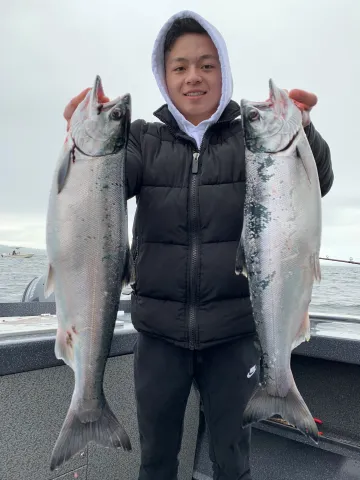
As we head into September, the color of salmon switches from pink to silver around Puget Sound.
The front end of the migratory coho run – also known as silvers for their shiny silvery-colored body – began to filter into the western Strait of Juan de Fuca and Puget Sound in August, and are expected to peak throughout September and early October.
Coho aren’t large – usually averaging 4 to 15 pounds, with some exceeding the 20-plus pounds – but they often put up a good tussle. Young coho spend a year in rivers and estuaries and then migrate out to the Pacific Ocean to feed and grow. They spend about 1½ years in the ocean, then return to spawn as three and four-year-old fish, generally in fall or early winter.
Puget Sound coho returns have gradually made a comeback from a downtrend that began in 2015 and 2016. This was due to negative environmental factors like drought, flooding, and warm water temperatures in their freshwater habitat as juveniles and then in the Ocean from a condition known as El Niño, when surface water becomes warmer than average.
The combined 2025 Puget Sound hatchery and wild coho forecast is 727,490 compared to 722,134 in 2024; 760,029 in 2023; 666,317 in 2022; 614,948 in 2021; and 504,604 in 2020.
Coho fill the air with enthusiasm for their leaping abilities when hooked, and unpredictable movements across the water’s surface.
A positive signal of 2025 expectations began with the good fishing for resident coho, who mainly spend their entire life feeding and growing in local waters –
caught in Marine Area 10 (Seattle and Bremerton Area) from June to early August. Many of these coho have grown since then and will join their larger migratory coho relatives during the late summer and fall marine fisheries.
Knowing when it is “go fishing time” for migrating coho in Puget Sound is to monitor catch rates in the Strait of Juan de Fuca at Marine Area 5 (Sekiu and Pillar Point) and Marine Area 6 (East Strait of Juan de Fuca).
The Marine Area 5 salmon fishery is open daily through Sept. 26 with a two salmon daily limit, plus two additional pink may be retained, and release Chinook, chum, sockeye, and wild coho. The area is then open daily for coho from Sept. 27 to Oct. 9 with a two salmon daily limit, release Chinook, chum, and sockeye.
The Marine Area 6 salmon fishery is open daily through Sept. 26 with a two salmon daily limit, plus two additional pink may be retained, and release Chinook, chum, sockeye, and wild coho. The area is then open daily for coho from Sept. 27 to Oct. 15 with a two salmon daily limit, release Chinook, chum, and sockeye.
Oftentimes, the best coho fishing in the Strait of Juan de Fuca occurs offshore in the shipping lanes, which is the main migration path. These deep-water areas are about one to 10 miles out in 200 to 500 feet of water and sometimes even deeper off the edge of the main shipping channels. Remember to stay within the U.S. side of the shipping lane. Look for tide rips and current breaks where krill and schools of baitfish attract coho, and watch for coho jumping and rolling on the surface.
In the eastern Strait of Juan de Fuca, the Dungeness Bay hatchery coho fishery is open from Oct. 1 to 31. The 2025 Dungeness River coho forecast is 13,328, down slightly from 14,305 in 2024 and 14,654 in 2023.
The Marine Area 7 (San Juan Islands) coho season is open daily through Sept. 6 with a two salmon daily limit, plus two additional pink may be retained, and release Chinook, chum, sockeye, and wild coho. The area is then open daily for coho from Sept. 7 to 30 with a two salmon daily limit, plus two additional pink may be retained, and release Chinook, chum, and sockeye. In Marine Area 7, look for coho staging along the western and southern portions of the island chain.
Coho fishing in Marine Area 8–1 (Deception Pass, Hope Island, and Skagit Bay) is open daily, Sept. 30, with a two salmon daily limit, plus two additional pink may be retained, and release Chinook and chum. Coho fishing is then open daily Oct. 1 to 12 with a daily two salmon catch limit, and release Chinook and chum.
In Marine Area 8–2 (Port Susan and Port Gardner), coho fishing is open daily through Sept. 24 with a two salmon daily limit, and release Chinook, chum, and pink. The Tulalip Bay Terminal Area Fishery has rules that differ from Marine Area 8-2. For details, check the Washington Department of Fish and Wildlife (WDFW) fishing regulations webpage at https://wdfw.wa.gov/.
In Marine Areas 8-1 and 8-2, anglers should find coho along the entire eastern side of Whidbey Island, Possession Point, off the Clinton Ferry Terminal, the Langley/Sandy Point area, Shipwreck to Mukilteo, Hat Island, Camano Head, the entire west side of Camano Island, and outside of Oak Harbor. West Beach at Deception Pass State Park, located north of Oak Harbor on Whidbey Island, provides excellent shore fishing access.
Moving further into Puget Sound, Marine Area 9 (Admiralty Inlet) is another decent fishing location for hatchery-marked coho, which is open daily through Sept. 30. It has a two salmon daily limit, plus two additional pink may be retained, and release Chinook, chum, and wild coho.
In Marine Area 9, focus your fishing time in the unmarked shipping lanes where tide rips and current breaks are commonly found. Try Midchannel Bank off Port Townsend; Point Wilson north of Port Townsend (good public shore access); east side of Marrowstone Island (some shore access); Fort Casey to Bush Point and Lagoon Point (some public shore access); Double Bluff off the west side of Whidbey Island; Point No Point (excellent public shore spot); Possession Bar; Scatchet Head; and Pilot Point.
In Marine Area 10 (Seattle and Bremerton Area), coho fishing is open daily through Sept. 30 with a two salmon daily limit, plus two additional pink may be retained, and release Chinook and chum. Fishing is also open daily from Oct. 1 to Nov. 15 with a two salmon daily limit, and release Chinook.
In Marine Area 11 (Tacoma and Vashon Island), coho fishing is open daily through Sept. 30 with a two salmon daily limit, plus two additional pink may be retained, and release chum and wild Chinook (note, the Chinook fishery may close sooner so check the WDFW fishing regulations webpage for updates. Fishing is also open daily from Oct. 1 to Nov. 15 with a two salmon daily limit, and release Chinook.
Look for coho in the deep-water shipping lanes off Jefferson Head to Kingston, Richmond Beach to Meadow Point near Shilshole Bay, Point Monroe, Shilshole Bay south to West Point, Elliott Bay, the Fauntleroy Ferry area southeast to Dolphin Point, both sides of Vashon Island, Redondo Beach to Dash Point and the Tacoma area of Commencement Bay, Browns Point, and Point Defiance Park from the Slag Pile to the Clay Banks.
Two popular events tied to the arrival of coho are the Edmonds Coho Derby on Sept. 6. For details, go to http://edmondscohoderby.com/. That will be followed by the Everett Coho Derby on Sept. 20-21. For details, go to https://everettcohoderby.com/.
Marine Area 13 (South Puget Sound) is open daily for hatchery-marked coho through Sept. 30 with a two salmon daily limit, plus two additional pink may be retained, and release chum, wild coho, and wild Chinook. Fishing remains open daily beginning Oct. 1 with a two salmon daily limit, and release chum, wild coho and wild Chinook.
In Marine Area 13, look for coho from the Narrows Bridge south to Anderson Island. The Squaxin Island area has become popular area for those targeting coho. The 2024 Squaxin Island net pens coho forecast is 59,596 up from 48,081 in 2024 and 45,417 in 2023.
If you’re looking for a Chinook and coho option try the Bellingham Bay Terminal Fishery open daily through Sept. 30 with a daily limit of four salmon.
Sinclair Inlet and Port Orchard are open daily through Sept. 30 with a three salmon daily limit, plus two additional pink may be retained, and release chum and wild Chinook. Fishing is then open daily from Oct. 1 to Nov. 15 with a two salmon daily limit, and release Chinook.
Lastly, a freshwater coho fishing option in Seattle’s backyard is Lake Washington north of the Highway 520 Bridge, which is open daily from Sept. 16 to Oct. 31 with a daily limit of four coho only, and release all other salmon species. The Lake Washington coho forecast is 28,112 up from 24,090 in 2024 and 21,554 in 2023.
In the October issue, we’ll switch gears and take a look at proposed fall and winter coastal razor clam digging opportunities.
I’ll see you on the water very soon!
/articles/coho-craziness
Washington Saltwater Salmon Opportunities
The list of saltwater salmon fishing options in early summer are far and wide, and in this column, I’ll break down the path to success around Puget Sound and off the Washington coast.
One important factor to keep in mind, when planning a fishing excursion is that the entire 2025-2026 season package won’t be officially adopted until sometime in early to mid-June. What tends to happen is that these early-season summer fisheries will require emergency opening approvals, so anglers should regularly check the Washington Department of Fish and Wildlife (WDFW) website (https://wdfw.wa.gov/) for possible updates and changes.
Back in mid-April, the Pacific Fishery Management Council held meetings in San Jose, California, and the 2025-2026 tentative statewide salmon fishing seasons were adopted by the Council. The season recommendations set forth by WDFW are then moved forward for federal approval by NOAA Fisheries.
While we wait for the ink to officially dry on the approval process, let’s visualize the possibilities of where to go and wet a line in the upcoming weeks, as well as a few pro tips to improve your chances of hooking a fish.
Since no salmon fishing season mirrors another, anglers have learned to become more adaptable to the constant ebb and flow of change. First off, anglers should be mobile and willing to move from location to location to maximize their time on the water.
Don’t focus all your time on one specific area. By doing a little bit of homework and reading this column below, you’ll likely find more choices by going outside of the box. Second, since many seasons are driven by catch quotas/guidelines, it is wise to go sooner rather than later.
Next, build a communication network to stay informed about the latest fishing trends, including the WDFW website and blog posts. Many other social media platforms can be used to gather this kind of information. Attending fishing seminars is another good avenue to gain more knowledge.
Other tips include reading blogs and watching YouTube videos from fishing influencers, especially publications like this magazine, which provide a plethora of information.
Where to go in June
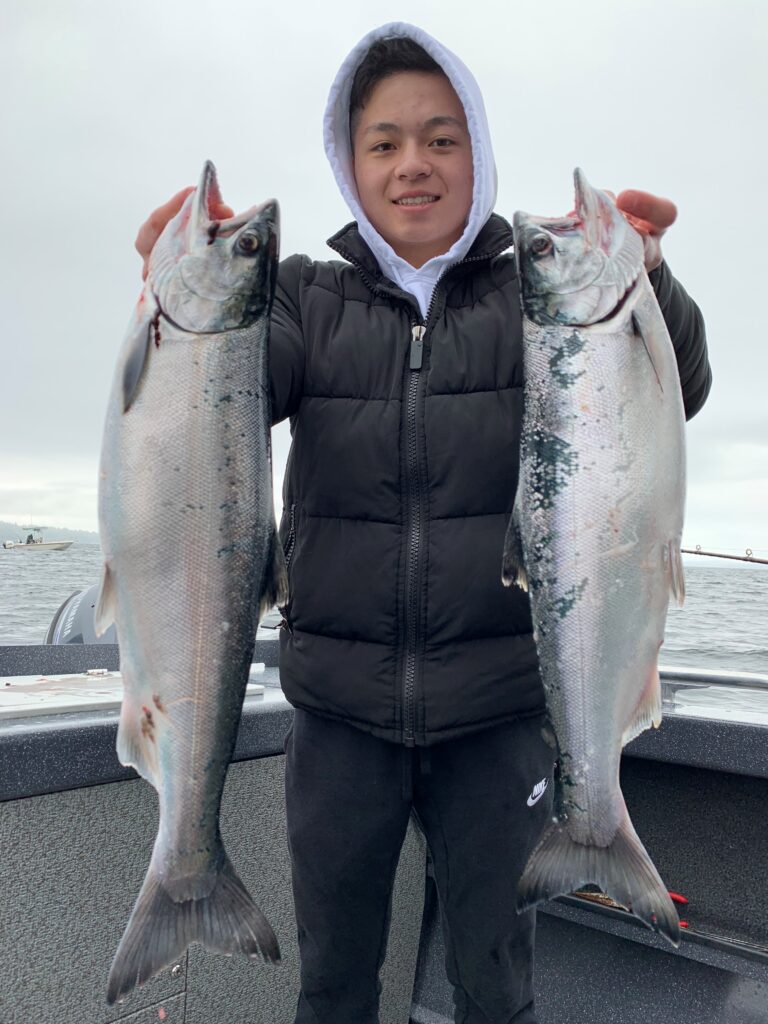
For the past several summers, Marine Area 10 (Seattle-Bremerton Area), mainly the northern portion, has been good for early coho and is open daily beginning June 1. The resident coho average 2 to 4 pounds, along with a few larger ones, and are fairly snappy. Their bright red-orange meat is excellent for the BBQ grill. This is due in part to the abundant schools of krill: small, microscopic, shrimp-like crustaceans found in Marine Area 10 during the summer.
Most will target coho in the shipping lanes off Jefferson Head to the Kingston-Apple Tree Point boundary line, and from the Edmonds oil dock to Richmond Beach. Other locations worth a try are Point Monroe off the north side of Bainbridge Island, West Point south of Shilshole Bay, Blake Island/Southworth area, and the entire eastern side of Bainbridge Island.
If you’re looking to catch an early summer hatchery Chinook, then Marine Area 11 (Tacoma-Vashon Island) is an option and open Wednesdays through Saturdays only from June 4 to 30. These hatchery kings average 8- to 15-pounds along with some topping exceeding the 25-pound mark.
WDFW will regularly monitor the Marine Area 11 fishery and could close sooner if the quota or other guidelines are attained. The Chinook catch quota for June is 1,423 (1,423 in 2024 and 2023, 580 in 2022, and 431 in 2021) with a total unmarked encounter of 818, and a total sublegal encounter of 1,601. The Chinook fishery is managed under two separate summer quotas, and a second window of opportunity happens in late July. Commencement Bay east of the Cliff House Restaurant/Sperry Ocean Dock boundary line is closed to salmon.
Those who fish for salmon regularly in Puget Sound marine areas – especially in the Tacoma region – know that dogfish can be an issue in the summer.
To avoid pesky schools of dogfish, anglers will jig or troll with downriggers and meat liners using plugs, spoons or a plastic hoochie squid. If you drop a whole or cut plug herring, make sure you’ve got plenty of extra leaders tied. The sharp teeth and abrasive sandpaper-like skin of a dogfish will fray leaders. Lesson learned, I’ve burned through more than a dozen in a matter of a couple of hours.
In Marine Area 11, look for Chinook lurking around the Clay Banks to Owen Beach at Point Defiance Park in Tacoma, the Slag Pile off the Tacoma Yacht Club, the “Flats” outside of Gig Harbor, Quartermaster Harbor, and Point Dalco on the southwest side of Vashon Island.
In the northern part of Marine Area 11, try Dolphin Point and Point Robinson on the northeast side of Vashon Island, south of the Southworth Ferry Landing, Colvos Passage, Dash Point, and Apple Tree Cove to Redondo Beach.
Keep in mind that the salmon fisheries mentioned above for Marine Area 10 and Marine Area 11 are only for June, and that additional salmon fishing opportunities will occur in both areas. Anglers should check the WDFW North of Falcon webpage for additional season information.
Another June option for hatchery Chinook is south of the Tacoma-Narrows Bridge in Marine Area 13 (South Puget Sound), which is open seven days per week. Look for fish are Gibson Point, the concrete dock off Fox Island’s east side, Hale Passage, Johnson Point and Point Fosdick.
The Tulalip Bubble Fishery (Marine Area 8-2) is open through Sept. 1 with fishing allowed from 12:01 a.m. Fridays to 11:59 a.m. on Mondays of each week, and closed June 21. Before going, anglers should check the WDFW website as intermittent closures may be needed to ensure the hatchery is meeting spawning escapement goals. Fishing is also open Sept. 6 to 21 and allowed Saturdays and Sundays of each week. The bubble fishery is open within the terminal boundary only – closed east of a line from Mission Point to Hermosa Point – and can be decent for summer Chinook in the 10- to 20-pound range, and is mainly a trolling or jigging show.
You can jig drop down a glow, chartreuse, pearl-white, green-nickel, blue-pearl or blue-gold pattern in three to six-ounce sizes depending on the current and wind. Remember, store-bought jigs have a treble hook, and they’re illegal for salmon in all marine areas. Only single-pointed barbless hooks and one fishing line with up to two hooks may be used.
Trolling is the popular method with downriggers and a flasher combined to plug, spoon, and/or a plastic hoochie squid. Before or at daybreak, the fish tend to be found from the surface down to 90 feet, and as the sun rises, they’ll go deeper up to around 100 to 175 feet.
Many anglers are making plans to visit the coastal ports where Chinook and hatchery coho fishing get underway in late June. The ocean salmon season includes a recreational Chinook quota of 53,750 (41,000 in 2024) and a hatchery-marked coho quota of 99,720 (79,800 in 2024).
Marine Area 1
(Ilwaco)
Is open seven days per week from June 25 through Sept. 30, all salmon, with a subarea guideline of 16,600 Chinook (12,510 in 2024) and a subarea quota of quota of 49,860 marked coho (39,900 in 2024). The daily limit is two salmon and one Chinook only. Columbia Control Zone closed.
Marine Area 2
(Westport-Ocean Shores)
Is open seven days per week from June 21 through June 28, with a subarea guideline of 22,270 Chinook (17,430 in 2024), and the daily limit is one salmon, release all coho. Open seven days per week beginning June 29 through Sept. 15, all salmon, with a subarea quota of 36,900 marked coho (29,530 in 2024). Beginning June 29, the daily limit is two salmon, and only one may be a Chinook.
Marine Area 3
(La Push)
Is open seven days per week from June 21 through July 3, with a subarea guideline of 2,280 Chinook (1,630 in 2024), and the daily limit is one salmon, release all coho. Open seven days per week beginning July 4 through Sept. 15, all salmon, with 2,590 marked coho subarea quota (2,070 in 2024). Beginning July 4, the daily limit is two salmon. No chum retention beginning Aug. 1.
Marine Area 4
(Neah Bay)
Is open seven days per week from June 21 through July 3, with a subarea guideline of 12,600 Chinook (9,430 in 2024), and the daily limit is one salmon, release all coho. Open seven days per week beginning July 4 through Sept. 15, all salmon, with a subarea quota of 10,370 marked coho (8,300 in 2024). Beginning July 4, the daily limit is two salmon. No chum retention beginning Aug. 1. Beginning Aug. 1, Chinook non-retention east of the Bonilla-Tatoosh line during the managed ocean fishery.
WDFW fishery managers will monitor the number of salmon caught in season and may close areas earlier if quotas or guidelines are met. In-season management may be used to sustain season length and keep harvest within the overall Chinook and coho total allowable catch.
Piers open year-round for salmon in Puget Sound include the Edmonds Marina (usually a good place for early summer kings in June), Fox Island, Mukilteo Ferry Landing, Seacrest in West Seattle, Dash Point Dock, Point Defiance Park Boathouse, Les Davis, and Des Moines.
Note: The salmon daily catch limits, species and size restrictions, and other regulations vary for each marine area. Emergency closures or adjustments to marine area seasons are also possible. Anglers should check for details on the WDFW website or the 2025-2026 regulation pamphlet.
(Mark Yuasa is a Washington Department of Fish and Wildlife Communications Manager and a longtime local fishing and outdoor writer.)
/articles/washington-saltwater-salmon-opportunities