/articles/categories/gear
Ice Sled Hack to Save Your Back
My fondest memory of my grandfather is visiting his shop and looking at all his woodworking tools. He would show me what they were for and how to use them. Stanley and his wife, Martha, were from the old country, immigrants of Czechoslovakia. I credit my grandfather with my woodworking and tinkering skills. Anytime I use my hands to build something, I think of grandpa.
I can’t take credit for the following hack. I stumbled on it one evening surfing through ice-fishing videos on YouTube. I filed it in the back of my head last year as a project to work on before this year’s ice fishing adventures. As luck would have it, we’ve had a warm stretch here in Great Falls and, combined with a nice ten-day off stretch, I decided to get my act together and make the Ice Sled Ski Hack.
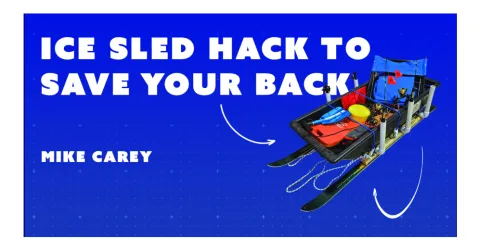
Those of you who ice fish are probably familiar with ice sleds. Piled high with our always-growing essential items, these sleds are designed for transporting your gear across the snow and ice of frozen lakes. Sleds are functional and a must for ice anglers. That said, as “essential” gear grows, anglers (especially we senior citizen anglers) get to deal with heavier sleds. Dragging a sled a few hundred yards can get to be a pain in the back, to be felt hours after the fishing day is done. The Ice Sled Ski Hack makes it easier to pull your sled across snow or ice. It’s an ingenious hack and works exactly like it looks, elevating the sled on two skis, allowing the sled to slide more easily, with less resistance.
This hack is a breeze to build, requiring a minimal number of tools. A saw, a power drill, screws, and a screwdriver will get the job done. There are a variety of designs posted on YouTube, and it’s easy to come up with your own design once you see what others have made.
The most important part of the ice sled ski hack is (of course) the skis. Fortunately, the investment is minimal. There’s no need to go out and buy a new set of snow skis. Instead, pay a visit to your nearest Goodwill, St. Vincent DePaul, or Salvation Army store. There, you’ll find a variety of inexpensive used skis perfect for our purposes. You’ll want to buy downhill skis, not cross-country skis. The reason for this is that downhill skis are shorter, wider, and thicker. You don’t need a long, thin cross-country ski. If you have a smaller sled, find a pair of used kid skis; otherwise, adult skis for a full-size sled are perfect.
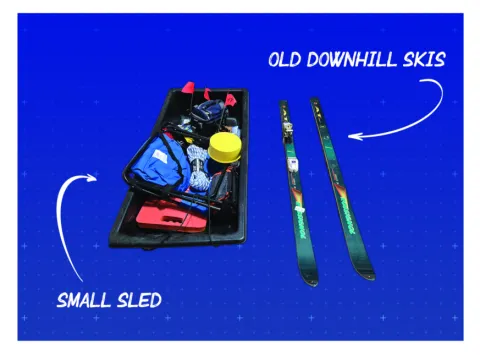
The first thing that needed to be done was the hardest part of this project, for me, removing the ski bindings. The bindings are screwed into the skis, and you’ll have to find what to remove to get access to those screws. Fortunately, between YouTube and an internet search, I was able to figure it out (and you will, too).
With the bindings removed, the next step is to construct a platform on which your sled will rest. I spaced the width of the skis to the width of the sled. Onto each ski I screwed on a four-foot-long 2x3-inch board, which matched up perfectly with the width of my skis. The purpose of the wood is two-fold. First, it gave me a solid structure to build from, and second, it raised the sled up off the snow. The whole point of this hack is to ride the sled on the skis and not have the sled drag on the snow. You may have seen some sleds that come with runners installed already, and while those runners certainly help, the sled is still dragging along the ice. The beauty of the ski hack is that the sled is gliding on the skis. And for those of you who have ever skied, you understand the advantage of this system.
The frame structure that the sled will rest on can be made with a variety of materials and ways. For my project, I decided to use 1 ¼” PVC tubing, lining up three cross-frames, and securing them with plumbing straps, then a couple of screws through the tube into the wood. Be sure to square up the skis so they are parallel, otherwise your ski sled will not track straight. I added two cross beams made of 2x3 wood to strengthen the frame.
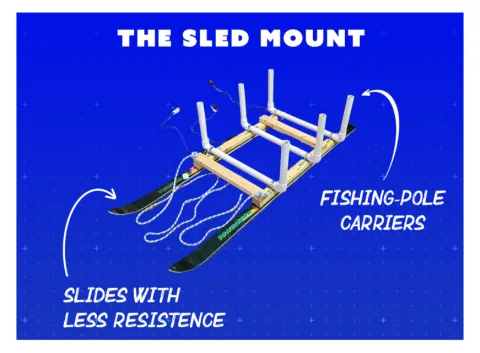
Wrapping up the project, I added 90-degree elbows on the PVC tubes and then 14” vertical tubes for side support and as rod holders. Finally, circular eye bolts on the front and sides of the frame serve as connection points for the tow rope and bungee cords that will hold the sled to the frame.
Project completed, I tested the ski-sled on carpet - December 24th, and we have no snow on the ground here in Great Falls (that won’t last!). The ski-sled slides effortlessly with just a fraction of the effort of pulling the sled without it. Success!
This was a fun and simple hack that will make my life much easier on the ice. If your sled is feeling a bit heavy with all your essential gear, give this setup a try!

/articles/ice-sled-hack-save-your-back
Slow and Deep - Spinner Fishing for Steelhead
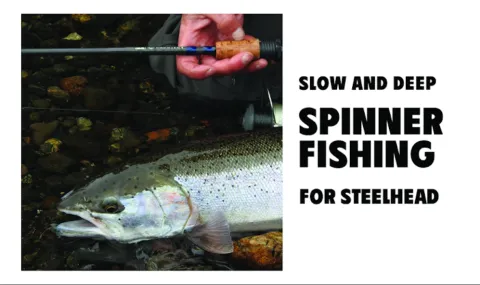
Not every fish in a pod of steelhead will bite. What we count on is that one or more in any school is the aggressive one. The spinner, like the swung fly, targets the aggressive fish, the biter, and the chaser.
Spinner water in the winter is different than what we look for in the summer. Classic steelhead water that moves at the speed of a fast walk is still a good bet, but I like to target deeper holes and slower-moving current.
In the colder flows of winter, when the metabolism slows down, steelhead are not as likely to chase a lure as far. For this reason, we want to put the lure at the level of the fish and keep it there longer. Casting and retrieving might work, but a swinging presentation is preferred, where the inline weight or the weight of the lure takes it to the bottom.
What contributes to a fast sink rate? The weight of the lure and its mass (or lack of mass) are factors. Also, a braided line with less resistance will sink faster than mono.
If the fish are six to 18 inches off the bottom, the spinner should run in the same place in the water column.
And the lure should thump.
Test drive the spinner before the first cast. Get a feel for the thump of the blade as it rotates.
On the cast, let the lure hit the water, then keep the bail open long enough for more line to peel off the spool as the lure sinks. Now close the bail and let the current grab the blade. Hold the rod tip low.
THE PRESENTATION
Use a retrieve that makes the blade flash like a strobe; if the blade blurs around the shaft, it is going too fast. Steelhead strike out of aggression, curiosity, defense, and feeding impulses, and flash moves the fish longer distances to the lure. Carry spinners in the whole range of blade finishes, with most emphasis on the flashier finishes: silver and brass.
There was a time when I made my own spinners, both to save a little money and to make the lures I needed for each situation. These days, there are more choices available in good fishing departments and on the internet.
For the waters I fish, I start with Wicked Lures with a 30-inch-plus leader and an inline weight, and Blue Fox (Nos. 3, 4, and 5) and heavy-bladed No. 4 custom-tied spinners.
The most common finishes on spinner blades are, in order of most flash to least flash: Silver-plate, brass, tarnished brass, nickel (mirror-finish), and black.
On medium-sized western rivers, use medium-sized spinners like Nos. 3-4 with brass, nickel, and black finish. Smaller rivers call for smaller lures. Black, nickel, and tarnished brass are good producers in these rivers. Use larger spinners in bigger pools and size down in lower, clearer water.
Almost as important as the proper size and flash is using the right color. An angler can add color with prismatic tape. In the cold months of winter, I like to use pinks, oranges, and reds to dress up my spinners.
The decorative tape goes on the inside of the blade. Think about the spinner moving through the water. The fish sees a shiny, flashing thing approaching. As it swings in front of the fish and moves on by, suddenly, there is a bit of color showing. That element of surprise might incite a follow-up and a strike.
More important than flash or color is the presentation, and the confidence it will catch fish. Fish it slowly so that the lure is presented in the same plane as the fish. Let it tumble, but keep the blade turning, tantalizingly slow. A fast-moving spinner is more apt to spook fish. Slow it down, almost to the point where it stops spinning.
Because fish are apt to be slower to move in cold water, and because the lure is presented at the same depth as holding fish, expect the strike to be softer than in the summer. The bite often just stops the lure. If the angler adds weight on the line, the shock-absorbing nature of the rig is accentuated, and the bite can feel like a wet sock. Set the hook and set it hard. A fish may also swim with the lure, snap its jaws around it, and swim with it. Set the hook hard!
# # #
For a copy of the Fishing Central Oregon book, send $29.99 to Gary Lewis Outdoors, PO Box 1364, Bend, OR 97709 To contact Gary Lewis, visit www.GaryLewisOutdoors.com
/articles/slow-and-deep-spinner-fishing-steelhead
Winter Trailering
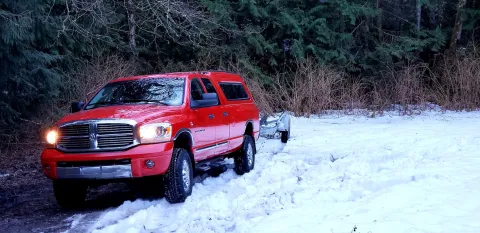
Being a sportsman, it is likely that you own at least one trailer. Whether it be one or more boat trailers, the utility trailer you use once a year to haul gear to high camp, or even motorcycle trailers, they all need a little TLC for winter duties.
The late Patrick McManus addressed life with trailers in his book “The Grasshopper Trap”, a collection of short stories. A few quotes from his story “Trailer Trials” may find their way into this article.
“Over the course of his life, any sportsman worthy of the name will own a dozen or so trailers of various kinds—utility trailers, tent trailers, boat trailers, house trailers, horse trailers, trail-bike trailers, and snowmobile trailers, to name but a few.”
Patrick F. McManus
With all these trailers cluttering up the driveway, it is probably a good idea to create a Winter Trailer Maintenance Checklist. Below are a few suggestions for maintenance checklist items, but be sure to customize the list for your specific needs:
- Check your tire pressure.
- Check the spare tire condition.
- Check your tires for wear and correct inflation.
- Check Bearing Buddies or the oil bath sight glass for condition.
- Check brake pads, shoes, brake drums, and hydraulic lines.
- Check the brake fluid reservoir.
- Check the trailer lights.
- Check the trailer for overall condition.
- Check trailer and payload for unauthorized passengers, cats, raccoons, and wasp nests.
- Ball mounts and Safety chains
- Hitch and ball mount
- Check payload tiedowns.
Tires
Check tires for condition and proper inflation before each trip. Check tread depth for uneven wear, damage, cracking, and bulges. Include the spare in your tire check. Make sure the spare tire lock is functional. The spare tire for my drift boat trailer is mounted under the trailer tongue. The lock gets seriously fouled with mud, road grime, and ice.
Bearing Buddies and Oil Bath Bearings
Failed wheel bearings are often a preventable source of trailer troubles. Bearings can get rusty if they are contaminated by water. Most boat trailers are equipped with Bearing Buddy Bearing Protectors or oil bath hubs. Bearing Buddys use a spring-loaded piston to hold grease in the wheel bearings to displace any water. With oil bath bearings, the bearings run in a sealed cavity filled with oil. Typically, there will be a sight window that allows you to assess the level and condition of the oil.
Servicing Bearing Buddys is easy. An occasional pump of waterproof grease is really all that is required between bearing repacks. Depending on usage, they should be repacked and inspected every 1 to 3 years.
Oil bath bearings should be checked for leakage, oil level, white frothy contamination, or very dark oil regularly. There isn’t really a recommended teardown interval. If you see any signs of contamination or water in the oil, it’s time to service them.
Brakes
If you launch your boat in salt water, it’s important to rinse the trailer brakes as soon as possible after you retrieve the boat. Trailer brakes may be disc-type (with brake pads) or drum-type (with shoes). Just like the brake pads or shoes on your tow vehicle, trailer brakes will wear with use,
Inspect or have the pads or shoes inspected every few seasons.
You can combine brake service with wheel bearing service. This can be handled via DIY, a general auto repair service, or even some tire stores can handle this job.
Be sure to also check the brake lines for signs of rust and cracking.
Brake Fluid
Check the brake fluid reservoir in the master cylinder (on the trailer tongue) a couple of times a season, following instructions in the trailer owner’s manual. The fluid level will go down as the pads wear. If the level is suddenly very low, you could have a leak in the brake system, which should be repaired immediately.
Trailer Lights
“One eighth of a sportsman’s life is spent trying to hook up trailer lights.”
Patrick F. McManusAnd if the wife tries to help, “The divorce rate among trailer owners is nine times that of the general population.”
Patrick F. McManus
Be sure to check your trailer lights every time you hook up the trailer. It is a good idea to protect the trailer light connector pigtail on your trailer when not towing to prevent corrosion from forming. Many will have a plastic cap that fits over the connector, or even a small plastic bag with a twist tie will get the job done. A little dielectric grease will also help prevent corrosion.
Bad grounds are often the cause of trailer light failure. The ground wire should be white and secured to the trailer. Locate the connection point and evaluate for corrosion or broken wires. Make sure there is a good, clean ground path with the trailer frame.
Most new trailers have LED lights. Aside from ground issues, LEDs are reliable and more or less trouble-free. Older trailers with incandescent bulbs, on the other hand… Even with proper care and feeding will frequently burn out, sometimes between the boat ramp and home! Keep a stash of the correct bulbs and a small tube of dielectric grease handy.
“Shortly after man invented the wheel, he invented the trailer. Ever since then, he has been trying to figure out how to hook up the lights.”
Patrick F. McManus
Tie-downs
Check the condition of your tiedowns. It may be a good idea to store them somewhere out of the elements, but then you have to remember to install them before you hit the road. Even if your boat is heavy, use some form of tie-down straps. Years ago, I was pulling my offshore sportfishing boat down the 22 Freeway in Southern California. A car bounced off the K-barrier and spun right in front of me. I had to slam on the brakes hard to keep from hitting it. I managed to stop in time without jackknifing. With the traffic stopped, I got out of the truck to check on the boat. Where I had thought that it was heavy enough to stay put, one of the tie-down straps had broken. Fortunately, the safety chain prevented the boat from going airborne and landing on my truck.
Ball Mounts, Trailer Hitch Receivers, and Safety Chains
Check the ball mount and receiver for any obvious signs of damage. Be sure the ball is the correct size for the trailer hitch and is secured to the ball mount. Check the pin holding the ball mount in the receiver. Look at its condition and verify that any locking feature is functional.
Regarding safety chains, all trailers should have 2 different safety chain setups. One secures the boat to the trailer, and the other secures the trailer to the tow vehicle. Make sure that both are connected properly and in good condition.
“Trailer hitches can be a problem, although they are nothing compared with trailer lights. The hitch simply clamps down over a steel ball on the car. The steel balls come in three sizes—too large, too small, and just right.”
Patrick F. McManus
“Safety chains, by the way, are required on all trailers. Their purpose, should the hitch come loose, is to rip the rear end off the towing vehicle, thus further punishing you for using the wrong ball.”
Patrick F. McManus
Winter driving
Double-check your trailer and tires, being sure to check the tire pressure. Consider running mud and snow tires on your trailer. They can help prevent the trailer from sliding around. Properly fitted chains are your friend in icy conditions.
If you tow a trailer during inclement weather, never use the cruise control. Drive with a plan, no sudden stops or hard turns. If you miss an exit or turn, continue to the next safe place to turn around. It is a good idea to keep a bag of kitty litter or sand and a shovel in the back of your tow vehicle. The added weight will improve your traction and can be used under the tires for extra grip if needed. Know when to say no, we need to pull over, or even we’re going to leave it in the driveway.
Storage
If you’re storing your rig for winter, try to find a covered location like a garage or barn to protect it from the elements. Otherwise, invest in a breathable or ventilated tarp. Pull all drain plugs and ensure there is no water in the washdown pump or livewell system. To keep water from pooling, try to store your boat a little bow high if possible. If your boat is an outboard, tilt the motor down to the running position to prevent freeze damage to the internal components or lower unit. It is also a good idea to jack up the axles and block them to prevent damage to the tires or bearings during long-term storage. Tire covers can help prevent tire UV damage.
Conclusion
As your winter work week ends and you feel the need to get up 3 hours before your alarm would normally go off, then hook up the boat or hunting trailer to hit the road. Be sure to take a few minutes to ensure your rig is winter roadworthy. In closing, a few more quotes from our friend Patrick McManus.
“Rancid was poor. He didn't seem to know that he was poor, however, and I never had the heart to tell him, because he was the happiest person I'd ever met. If he had known he was poor, of course, then he would have been sad and miserable all the time. As it was, Rancid was able to live out his whole life in blissful ignorance of the fact that he was poor.”
Patrick F. McManus (They Shoot Canoes, Don't They?)
“My grandmother had actually known some real mountain men back in the old days, but she had never taken a liking to them. She said they drank and swore and spit tobacco and never took baths, and fought and bragged and lied all the time. I don't recall, however, that she ever mentioned what was bad about them.”
Patrick McManus
/articles/winter-trailering
Tossing Hardware for Coho
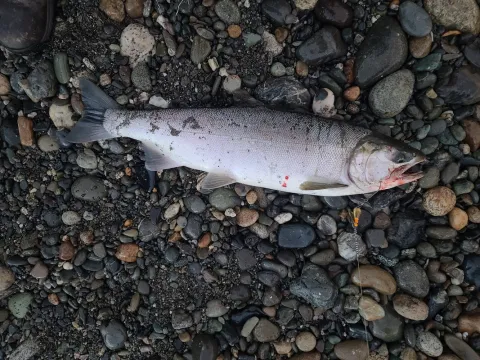
November is here, bringing chilly winds and icy rains. Although the year is almost over, the good news is that the coho run is not. Many rivers, coastal ones in particular, hold late-running fish from November well into December and January. But how do you get these fish in your cooler?
Bait has its time and place. For picky A run fish in clear, low water conditions, eggs are king. November is the perfect time to start using hardware for these big and aggressive B-run fish. Let's go over how to use spinners and spoons for these late B run coho.
Spinners
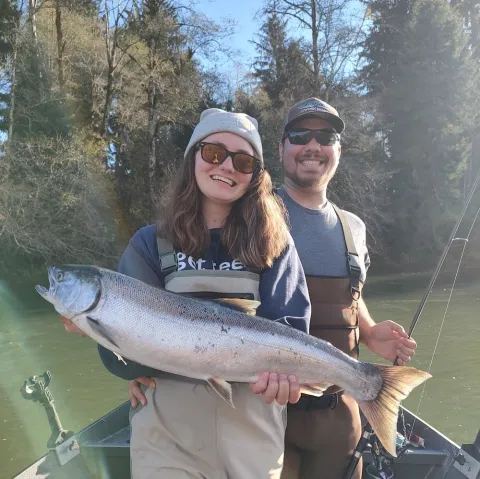
If I had to pick my favorite way to fish for coho, it would be throwing spinners. The takedown is aggressive, and there is no question when you have a fish on. Spinners are a great way to search for fish when you aren't sure where they are holding. Cast and retrieve in a spot several times, then walk down 10 steps and repeat until you get a bite. Late-run fish are more aggressive and more likely to strike a well-presented spinner. It's a good idea to bring weighted and unweighted spinners. Make sure to use a bead chain or two attached to a snap swivel so you can change between the types of spinners easily. Unweighted spinners such as Wicked Lures can be fished with a variety of different inline weights according to the depth and speed of the run you're at, making them incredibly versatile. I carry inline weights between 1/4 oz and 1/2 oz. Wicked Lures come in a variety of different colors and sizes. I like the pink/green ones as well as the black/pink ones for most conditions.
Alternatively, weighted spinners such as Blue Foxes are a great option as well. Use small, dark size 3 spinners in clear conditions, and bright size 5 or 6 spinners in murky conditions. Fish will chase down spinners and aggressively chomp them, making for a fun fight. Vibrax spinners have a lot of drag and tend to ride higher in the water column than torpedo spinners. Use the right spinner for the conditions!
Spoons
Much like spinners, spoons are an effective way to search the run for aggressive fish. Spoons can be fished a multitude of ways for coho. You can drift small spoons like Dick Nites or throw larger ones, like Little Cleos and Kastmasters. Smaller spoons wobble and dart when drifted like a cork and a yarn. Many northern Puget Sound anglers use this technique with great success. Use a 3-6ft leader and don't change out the hook- no matter how tempting it is! Bigger hooks would change the action of the spoon. The stock hook works just fine as long as you don't horse the fish in. Cast upstream and follow the drift with your rod tip, using just enough lead to tick the bottom every few seconds. It takes some patience and time to learn what a bite feels like. It can be subtle, so don't wait to set the hook until you feel headshakes.
For larger spoons, it's tempting to fish them like a spinner, but the technique is slightly different. Cast upstream and allow your spoon to sink. Point your rod at the spoon and mend your line as it drifts downstream. Feed out the line as necessary to keep the spoon slowly wobbling near the bottom. The action drives coho crazy! The takedown is much like a spinner bite- aggressive and unmistakable. 50/50 colors work well in most water conditions. It's a good idea to keep a variety of different spoon shapes and colors to see what the fish key in on. Every day is different, and every fish is different.
Setups
Rods and reels for hardware fishing tend to be based mostly on personal preference. While some anglers prefer to use a heavier, shorter rod, I like to use a light and long noodle rod. I find that these absorb the headshakes and jumps much better than a short, stiff rod. They also allow me to cast light spinners when the conditions call for it. Pair your rod with a size 3000 to 4000 reel.
I highly recommend using braided line with a monofilament top shot. This allows you to have the sensitivity of braid, but if you break off, you'll leave monofilament in the river instead of braid, which will break down much sooner. 8-17lb rated rods work great, but I've used 6-12lb rods as well. Use at least an 8ft rod. For my leader line, I use 10-15lb fluorocarbon. I find it has good abrasion resistance but also looks almost invisible in the water. Tighten your drag, but loosen it up after your hookset. Remember, these B run fish are big, hook-nosed brutes. You're in for a fun fight!
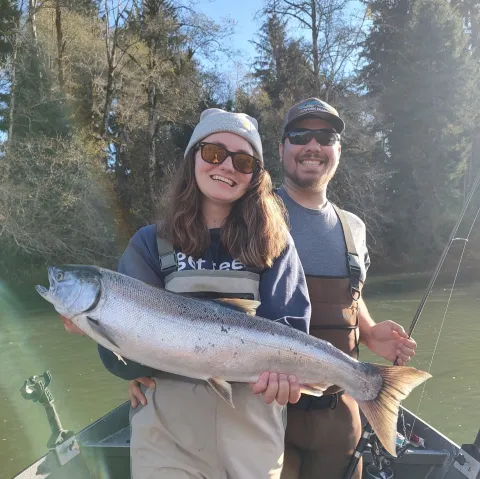
Now is the time of year to perfect your hardware technique for those large, aggressive B-run coho. Spinners and spoons can be used in both slow and fast water, making them a versatile technique. Not every river is open in November, so make sure to check both the regulations and emergency rules before heading out. Pinch those barbs or buy barbless hooks if required; it never hurts to double-check. The Fish Washington app is a great resource!
/articles/tossing-hardware-coho
Spoon Theory
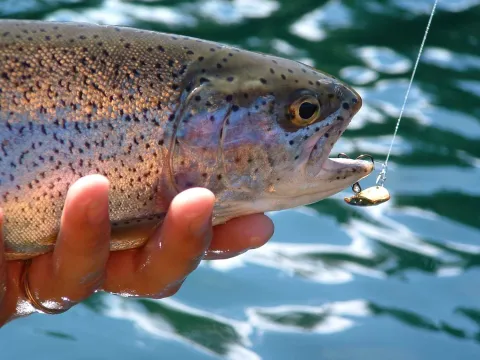
If there is one best time of year for trout fishing, it's fall when the insect life is fading away and trout that have been fattening all summer are starting to feel the pinch of empty bellies. Trout that are going to make it through the winter have to switch from eating insects to eating minnows. This is the time of the year to put baitfish imitations to use. Trout are full of energy and will go a long way to hit a shiny bit of metal.
On those days when we launch the boat in the early morning. When the water is glass, we know the fish are elevated. It can be fun to put a small spoon in play.
PLANNING THE TRIP
Before you back up to the boat trailer, take a look at a map and click up www.myodfw.com to get an idea of some Oregon waters that will definitely get fresh stocks of fish in the early fall. This is the time of year when hatchery trout stocking ramps up again. Water levels are beginning to fall, and ambient temperatures are good for trout. Most fish & wildlife agencies post their stocking schedules on public websites. Weather changes, the price of fuel, and emergencies can change the timing of fish releases, but it's a good idea to comb the stocking schedules.
Top bets in the Willamette region (an easy drive for anglers from Portland, Salem, or Eugene) include North Fork Reservoir (on the Clackamas River), Foster Reservoir, Trillium Lake, Dexter Reservoir, Hills Creek Reservoir, and Dorena Reservoir. Most lakes get the "legals", which average 8 to 12 inches, but a person can put more poundage in a trout limit by targeting the "trophy size" trout that are older, better fed, and better fighters. If a lake gets 5,000 legals in the season, it might also get 250 trophies and a few brood stock trout that can tip the scales at five pounds or more. Premier fisheries that get a lot of angling attention, like any larger reservoir with campgrounds and mountain views within a two-hour drive of a metropolitan area, are likely to get a couple of stockings of brood fish or trophies every season.
It's all there in the stocking schedule. Except it's not.
BEHIND THE SCENES
A lot of what happens behind the scenes does not show up in the hatchery schedule. Sometimes there is an abundance of brood stock or surplus steelhead in the system that need to go somewhere. Another thing to watch for is when a lake is drained for maintenance or to kill trash fish. When the lake fills up again, the fisheries department scrambles to fill it with trout. Then there are the lakes that are never on the stocking schedule, but they magically have hatchery trout every season, and plenty of them. What's up with that?
Some reservoirs are not on the published stocking schedule because they are managed by agencies or municipalities, or utility companies with their own hatcheries. These can be some of the best destinations. Think about it. A power company built the dam, and part of the negotiation with the tribe or the community that permitted the dam was to provide a fishery. So every year, they are contractually obligated to populate the lake with some 30,000 trout. They're going to do it, but chances are they aren't taking the time to put it on a list somewhere. That's a lot of silvery slabs vying for a chance at a slow-trolled trout spoon.
SPOONAGE
There are a lot of spoons on the market, and they all have their place, but when we are talking about catching a limit of hatchery "legals" and "trophies", the best choice is one and a half to two inches long, like the Mepps Syclops, Triple Teaser, Thomas, Jerry Leo, Z-Ray, and Acme Little Cleo.
In most cases, a spoon should be trolled slowly so that it wobbles side to side. The slower the better. I like the speed at less than 1 mile per hour, up to 1.5 miles per hour, and if I can, I try to keep it at zero-point-nine. This can be accomplished some days on a wind drift, but a bow-mount trolling motor is pretty consistent. There are exceptions. In some lakes, the fish are used to chasing baitfish. This is the case on Upper Klamath and Agency Lakes, where sometimes you can't reel fast enough.
The spoon itself could be an Acme Kastmaster, Little Cleo, or Thomas Buoyant, maybe in the 1/6-ounce class. Every lake fishes a little differently, so it helps to have local knowledge. Frog patterns can be important, as are brown trout, chub, rainbow, and perch colors, depending on the local bait. Sometimes we put a flasher in front of the spoon with a 15-inch leader. Another trick we like is to add a touch of Pro-Cure's trophy trout scent to the spoon. And it never hurts to tip the hook with a bit of worm, corn, or a salmon egg. Trout that are going to carry over through the cold months have to start eating baitfish. Put baitfish imitations like trolling spoons to work. Trout are supercharged in the cold water and will chase up and down in the water column to hit a shiny bit of metal.
/articles/spoon-theory
Interview With a Kokanee Concluded
DUDE: You know I have read so many times on various fishing forums about how some guy had a great time fishing for kokanee. He is bragging about how many he caught and retained, and how many he caught and released "in good shape to live for another day." Thoughts?
KOKANEE: Maybe I'm mellowing a bit in my old age. I am always grateful for good intentions. But I also believe that there are times when good intentions produce not so good results.
DUDE: Let me guess -- it is more complicated than I would have thought, and probably more complicated the well-intentioned kokanee fisherman realized.
KOKANEE: Indeed. Let's start first with the fact of just how old are the kokanee that bite. Most kokanee will respond to a well-balanced color and scented lure starting in their third year. Spawning will take place later in either their third or fourth year depending on location. Biting has everything to do with spawning. For the kokes that will be spawning later in the season, their scales are on course to transition from soft and flaky to absorbed and hardened.
DUDE: Come to think of it, the scales are very soft and flake off easily in the early spring bite. They get on everything. But late in the season, the scales do not flake off at all.
KOKANEE: It is a natural process of maturing. By pre-spawn, the kokes are well along in resorbing their own scales. They need hardened scales to withstand the rigors of the spawn. Do you know why fish have scales?
DUDE: Scales are the protective outer layer of the fish's skin. I can understand why hardened scales are protective, but what about soft scales?
KOKANEE: The outer part of these soft scales has a consistency similar to mucous, making the fish extra slippery in the battle not to become prey. The slime can come off without a problem. But the scales themselves have a very important function -- they act as a barrier to ward off infection. If some of the scales are removed from the fish, infection easily moves in. Remember, theirs is a water environment. Infection is easy to come by. Fish will not be able to get a prescription for an antibiotic, and the fish has no biological mechanisms to replace the lost scales. The result is usually a slow and painful death.
DUDE: So how does the well-meaning fisherman cause the harm?
KOKANEE: The harm is more likely early in the season when the scales are very soft. The scales come off with the use of any net, as well as any touching with the human hand. Well intentioned fisherman wanting to remove the hooks so the "fish can live another day" are shredding those protective scales. And although the fish when released happily swims off, the fatal damage is already inflicted. That fish gives the impression that all is well. All is not well.
DUDE: So how long does it take?
KOKANEE: You mean before the infection becomes fatal? Depends. Hours. Days. But it will happen. Of course other species benefit. Ospreys for example love those well-intentioned fisherman. So do mackinaw -- lake trout. Fish in weakened condition become a tasty addition to the food chain.
DUDE: So if a fisherman wanted to simply just release the kokanee without touching it from any means, just how is that accomplished?
KOKANEE: Let me refine your question a bit. Remember we are talking about the time in their life cycle before the scales are fully hardened. Let’s say a fisherman has a two rod stamp - which many states now have. Two rods - but single limit. Let’s further say that the fisherman is one fish shy of a limit. Both rods are out. Bam. A double. Only one can be taken. There are only two choices. First, land the one and then "release the other to live another day" using the net and manually removing the hooks - and thus killing the released fish. The other choice is to land the one fish, but as to the other fish, just let it have some slack. Unless it has a hook through the bone in the snoot, it will self-release. Neat - no net, no human hands, no loss of scales. Actually does live another day.
DUDE: What if it does have a hook through the snoot?
KOKANEE: Easy. If you have brought the fish to the side of the boat and just let it swim there, the fish will be pretty tired. Control the distance to the side of the boat with your rod. This works best with the boat moving forward. Without netting the fish or touching it, simply cut the line as close as you can to the hook and let the fish swim off. In most cases, the fish will be fine.
DUDE: You said "in most cases."
KOKANEE: Yes that is what I said. And kokes are generally resilient to injuries as long as the injury does not entail scale removal. I have seen some of my friends with broken and partially split lower jaws reach full fat maturity. There are some other injuries I have seen that even I have been amazed that the fish survived.
DUDE: So as you have explained it, any contact with the soft early season scales is likely fatal. But as the season progresses, the soft scales become harder, and don't flake off. When the pre-spawn kokes have reached this maturity, and I want or need to release it, then I can use the net and actually touch the fish to remove the hooks.
KOKANEE: Correct. Just be aware that this is a gradual process over the course of the fishing season. A smart and caring fisherman will make these timing observations and react appropriately.
DUDE: I have caught kokanee in the later part of the season, and the scales are flaky and come off easily. What gives?
KOKANEE: Think it through. I told you that the process of scale hardening and absorption is a characteristic of the pre-spawn kokanee. If you catch a late season kokanee with flaky scales, then it is not pre-spawn. As it turns out, there are quite a few precocious young kokanee that are ready to chase lures as they get towards the end of their second year. They will spawn the following year.
DUDE: I told you that I read as much as I can -- with a critical eye on content -- and I have run across a couple of other kokanee concepts that I would like to ask you about.
KOKANEE: I'll do the best I can.
DUDE: I have heard rumors that there are kokes that are bred to become "late season spawners." I have friends in Idaho, who tell me they can fish for kokes on Thanksgiving, and the scales are hardened, but the fish have not yet turned color and the males are just barely beginning to show signs of a kype. Seems like most of us see color and kypes sometime in late July, and definitely by late August and for sure by Labor Day.
KOKANEE: The rumors are true. We kokes are fairly adaptable to our environments wherever situated. Some kokes developed genetic characteristics that better guarantee survival. Let us suppose a particular kokanee world is a draw down reservoir - so the alfalfa farmers can get their late summer water. In that situation it makes good sense to spawn earlier in the streams and feeder creeks as they will not be water to spawn in in the main body of water. But some kokes have an easier situation. For these kokes size matters genetically. A longer growing season means consistently larger kokes if the food supply is adequate to support them.
DUDE: No harm in larger kokes.
KOKANEE: When the early spawn/late spawn characteristics become predictable, then such a population of kokes can be introduced into a water system that would be compatible with that characteristic. Manipulation of the species.
DUDE: You are not going to wax philosophical on me now are you?
KOKANEE: No. Just sayin'
DUDE: I got an invitation for next year to go and fish Wickiup Lake in La Pine, central Oregon.
KOKANEE: Believe me -- I know about La Pine and Wickiup.
DUDE: I hear the kokes there are huge -- sixteen to twenty two inches or more, and the daily limit is twenty five. I was passing through there last September and decided to go check the reservoir out. I could not believe what I saw. The only water I saw was in the river channel. There were vast wide areas of shallow dry lake bed gently sloping to the river, which was not very wide.
KOKANEE: And you probably want to know where the fish go when the reservoir dries up. Well let me tell you. The reservoir is to capacity just about every year in spring. But during the season, the water is gradually drained out down the Deschutes River. When the dam was constructed, it was not constructed for kokanee. It was built to provide irrigation water for downstream farmers and alfalfa growers. The kokanee in Wickiup are early spawners. They have to be. And it may come as a surprise to you but the kokanee fishery at Wickiup is entirely natural.
DUDE: Not supplemented?
KOKANEE: Not at all. This is a great example of the adaptation I was speaking about earlier. The kokes have to be ready to spawn before the water supply challenges and limits their ability to graze. Fortunately, just enough water is available to make redds that will be properly oxygenated even with the draw down.
DUDE: But the size and the great number?
KOKANEE: With so much of the reservoir being shallow when full, the draw down encourages a great variety of insect hatches. One species in particular thrives there. These are a type of fly. In larval form they are called chironomids. They are produced in such abundance as to be mind-boggling. Wickiup kokanee have discovered that these chironomids are a better source of protein than the zooplankton water fleas known as daphnia. These chironomids don't run and hide when the sun comes up, and the kokes can feed on them round the clock. And they do. An abundant protein source makes for very large kokes, much the same as the Mysis shrimp did for the third year kokes at Wallowa Lake. Only the chironomids don't destroy the next generation of kokes.
DUDE: And let me guess, the second year kokes at Wickiup can eat chironomids because the fly larvae are small enough, unlike the Mysis.
KOKANEE: Exactly. So the second year kokes gorge and become very large second year olds. As such, they have more strength to make it through the severe winter conditions at Wickiup. So when spring comes, now as three year olds, they are still in great shape, large and cranky - just the way they should be. In the meantime the three year olds have spawned. The drawdown of the reservoir provides a good measure of protection as virtually all motorized boating ceases. If left alone, the redds will produce huge numbers of kokanee fry ready to start the cycle.
DUDE: You have taught me so much and I don’t know how to meaningfully repay you.
KOKANEE: Well, there is a way you can do that.
DUDE: Anything.
KOKANEE: You know all those mornings when you get on the lake just before first light, and then some light starts chasing the darkness away? How quiet and still things seem to be. Your mind is filled with anticipation of the great fishing day ahead. And you take a slow deep breath – just trying to take it all in. Don’t ever lose that feeling, and don’t keep it to yourself. Pass on such ethics to your children, and family and friends. Help out and encourage those just starting out in the sport.
DUDE: Yes, I can do that.
KOKANEE: I’ll be on my way now. Gotta fulfill my real purpose. It’s been great chatting with you and I’m really glad you responded in the way you did. As for me, the ladies are calling.
/articles/interview-kokanee-concluded
Gearing Up for the Razor Clam Season
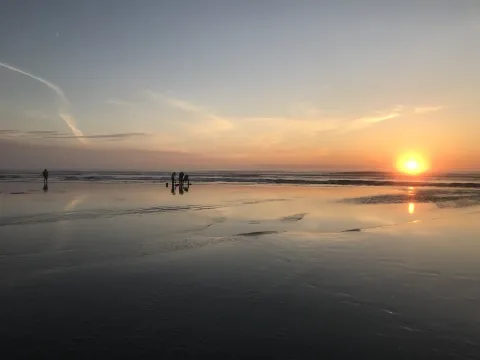
If you visit the Washington coast in October during low tide, you’ll likely see the beach lined with hundreds of people of all ages. Beyond the rolling sand dunes and swaying grasses, where the receding waterline reveals miles of open flat beach, they walk with heads down and eyes fixed on the sand. The experienced ones are likely tapping at the ground with some sort of apparatus, almost as if they were knocking to see if anyone was home beneath the surface. It turns out, that’s quite literally what they are doing. This is the time of the year when the long-awaited razor clam season opens back up after its annual summer hiatus.
Each year, an estimated 400,000 recreational diggers go out in search of these clams on Washington State beaches. Razor clams have been an important part of Pacific Northwest history, dating back to the first commercial canneries along the coast of Grays Harbor in the early 1900s. They are ingrained in the cultural identity of indigenous Coast Salish people like the Quinault and Cowlitz tribes, who have been harvesting these bivalves for millennia.
Each month, on their website, the Washington State Department of Fish and Wildlife will post tentatively scheduled dig dates for the Washington coast. Digs are generally in the mornings or evenings and always during low tides that are anywhere from a +3 ft to -3 ft level. The best time to start digging is 2 hours before the listed low tide. This is both the legal start time for digging and, as I’ve found, when the most success happens.
Locating Clam shows
The “clam show” is a colloquial term for the hole in the sand left behind as a razor clam retracts its neck back into its shell, and it is what allows you to locate the razor clam. When walking the beach, look for the clam shows that are roughly the size of a nickel or a quarter. If you’re not seeing any existing holes, you can tap the sand as you walk with your clam gun or shovel, and this often causes clams beneath the surface to retract their necks, thus creating a hole.
Equipment
Razor clam digging doesn’t require a lot. In a pinch, you could potentially dig your limit with only a chunk of driftwood and your hands. Heck, you could even do this while wearing sweats and tennis shoes if you wanted. However, if you’re not a glutton for punishment, then there are a few essential items you should bring with you to the beach. First item you’ll need is a digging tool. The two primary tools most often used for digging razor clams are the clam shovel and the clam gun.
The Shovel
A clam shovel is essentially a trench shovel that has a bit of a curve to the head. Once you locate your clam show, dig the shovel into the sand about 6 inches back towards the ocean side of the hole. This part is important, because if you were to dig directly above the clam, you would likely bury your shovel into the clam itself and damage the shell. This leads to a dead clam that quickly becomes inedible. Digging on the ocean side of the hole also allows you to grab the razor clam from its hinge-side as opposed to its sharp-edged side (hence the name razor clam).
You don’t want to do all of your digging with the shovel. Instead, take 2-3 scoops of sand away to form a hole, then finish by digging with your hands until you can feel the clam. From there, you’ll want to grab hold of the clam’s shell and rock it back and forth till you feel it break free. If the clam won’t break loose, start pulling more sand away from the sides of the clam and then try again at extracting it. If this all sounds incredibly difficult, well, that’s because it sort of is. Using a clam shovel is not the easiest way to harvest these critters, but many traditionalists (myself included) enjoy the challenge and the increased sense of pursuit that comes with a shovel.
The Clam Gun
The clam gun came about once people decided that digging with their hands and a shovel into the cold sand at 5 o’clock in the morning didn’t exactly match up with their version of “a good time”. Understandable. The clam gun is super effective, very approachable for people just getting into razor clam digging, and it’s generally much easier to use than a shovel.
A clam shovel consists of a long, roughly 6-inch diameter cylinder tube that has a double-handed handle on top. These are typically constructed out of aluminum or PVC. At the handle, you will find a suction hole that you can plug or unplug with your thumb. When left unplugged, it allows air to escape during the downward (or digging) process. When plugged, it creates suction during the upward pull that removes both the sand and the clam buried inside.
Simply locate your clam show, put the cylinder on top so that it's centered over the hole, tilt it slightly towards the ocean, and then rock it left and right as you put downward motion on the gun. The rocking motion will allow the gun to sink into the sand quickly. Once you have the cylinder about 1/2 to 3/4 of the way buried into the sand, bend your knees and straighten your back so that you’re spine is in a vertical position, straighten your arms, plug the suction hole with your thumb, then lift with your legs. Without using this proper lifting technique, you will struggle to get the clam gun removed from the sand, and you can very well injure your back in the process.
Clothing
Assuming you're choosing not to be the sweats and tennis shoes person, let's talk about the gear you should bring with you to the beach.
Hip boots or waiters will do an excellent job at keeping you dry and protected from the occasional wave that will inevitably make its way to where you're digging. If you're careful about retreating whenever a wave comes in, then rain boots can also suffice. Warm clothing and a rain jacket are generally a requirement, if it's not an unseasonably warm fall day.
Storage
You will need somewhere to store your razor clams for when you are digging and for when you’re on your way home. A 5-gallon bucket works for holding clams while you’re digging; however, if you don’t have a partner holding the bucket while you dig, you then run the risk of an incoming wave knocking over your bucket and turning your catch into seagull food. A better option would be a netted clam bag that you can hook to your hip with a carabiner. This option is pretty fail-proof and is what I always use when out on the beach.
You’ll likely find a lot of different suggestions on how to bring the clams home. The simplest and most recommended way is to put them in a dry cooler with a few ice packs. You can soak a towel in ocean water and cover the razor clams with the towel. Do not submerge the clams in water of any sort during transport!
Now that you’ve got your clams home. It's time to clean them and enjoy! For more info on the cleaning and preparation process, visit the WDFW website do get a step-by-step rundown.
Razor clam digging can be a great way to get family and friends together for a rewarding adventure in the outdoors. It's something kids can enjoy, and has some real potential at bringing food that you’ve harvested with your own hands from the ocean to the table.
/articles/gearing-razor-clam-season
Swinging Blades for Summer Steelhead
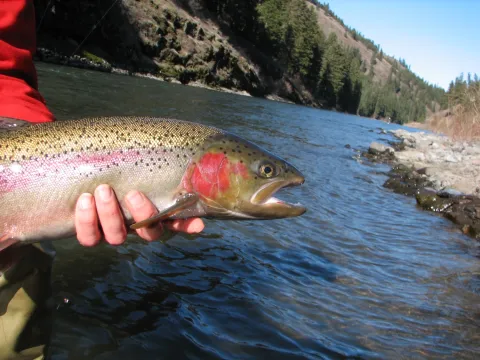
Last year at around this time, we were talking about the best steelhead run in a decade. And what could be better than that? Try this. As we go to press on this issue, we are watching the fish come over Bonneville Dam right now in numbers we haven't seen for 15 years. We are talking summer steelhead that filter into the Deschutes or run up the John Day or go up to the Clearwater, the Snake River, the Salmon, and the Grande Ronde. If your old waders have holes in them or you need new boots, now is the time to take care of it. And look at the calendar. The Deschutes summer run peaks in September, while October is tops in the Snake River, the Salmon, and on the Grande Ronde.
There are nine main methods for catching steelhead, and some of them are pro-level difficult, while others are easy. Two of my favorite ways to catch steelhead are swinging big flies and casting spinners. While spinner fishing is not the easiest way to catch a steelhead, it is super effective. And it is like a jolt of lightning when a fish grabs.
SPINNER WATER
Steelhead may be found in deep pools and slow frog water, but the best water for fishing spinners tends to move at the speed of a fast walk over gravel bottoms and through boulder runs.
Steelhead tend to travel at night and when the sun is low. They hug the banks and stay tight to structure, finding the path of least resistance up through rapids. Up through the tailout, into the pool along a ledge, and often head-in to the bubbles beneath the foam lines to the head of the pool. When the sun comes up, steelhead can be very close to the bank.
Summer flows are low and clear with an occasional shower to bring the water up. And steelhead are highly aware and alert. That's why knowing anglers don't wear spikes on their boots. The sounds of scraping studs are like nails on a chalkboard to summer steelhead. And the first casts to any run should be short.
Summer steelhead are willing to chase and can move as much as 15 feet to engage a target and might follow a spinner or a fly from one bank to the other.
SPINNER SELECTION
The spinner itself? For the lower Deschutes, for the Snake River, the Salmon, and other similar-sized streams, a spinner with a heavy French blade is a great choice. We tend to talk about Blue Fox spinners when we discuss steelhead fishing, and while these are good spinners, they tend to be a compromise. Look at the options available. A purpose-built spinner for the Deschutes should sink fast (faster than a Blue Fox) and start spinning the instant it hits the water. I would opt for a short heavy body and a No. 3 or No. 4 blade. Body colors? For summer steelhead, top colors are blue, green, purple, and black. Best blade colors? They are all good: copper, silver, black, nickel, brass. Silver tends to move fish further but throws more flash and can spook fish in low, clear water. Black and tarnished brass are good bets. I like to add blood red tape on the inside of the blade. And I like blood red hooks too. And the hooks should be sharp, sharp, sharp.
SPINNER TECHNIQUE
Cast, and let the spinner sink, especially in the channeled lava runs like are found in the lower Deschutes. The turn of the blade should thump in the rod tip. Don't just cast and reel. Let the spinner tumble and flash through the boulder fields. The closer the spinner is to the bottom, the better. And if you are snagging spinners, congratulations! You're fishing right.
Make sure the drag is loose enough to allow the fish to pull out line fast.
It's going to happen. A steelhead is going to stop that spinner. Or crush it. And streak upstream or down. Let the fish run, then try to gain as much line as possible when it stops. Even if it means chasing it downriver. When the fish jumps, and it can jump up to a dozen times, let some tension off. When it comes time to slip a net under it, try to get the fish's head up. It's a rush.
It can happen a dozen times in a day. Or it can take a dozen trips to hook the first one. But when there are steelhead in the river in a good year, the odds go up. If this is your first year for steelhead, or the first season in a long time, give spinners a try.
/articles/swinging-blades-summer-steelhead
Interview with the Well-Schooled Kokanee Part 3
DUDE: Some years, kokanee are pretty small, but in other years out of the same fishery, the kokes are much bigger. Is there an explanation?
KOKANEE: Yes. The correct answer takes in many considerations. Better sit down, as this might take some time to lay out for you.
DUDE: Done.
KOKANEE: I want you to know that if I give away too much information, I might lose my spawning rights.
DUDE: All the more reason to pay attention.
KOKANEE: Size is first approached from an available food concept. And one needs to focus on the available food supply for a single kokanee. If you have just one large bucket of food for just one kokanee, that koke will be well fed. However, if all you have is one bucket of food for a thousand kokanee, then, with not much food to go around, no one is getting fat or big.
DUDE: OK -- number of fish and an available food supply – got it.
KOKANEE: You have only the start of it. Let’s talk about birth control.
DUDE: You are not going to play political football on me, are you?
KOKANEE: Would you rather catch a bunch of small kokanee or a few less of much larger kokanee?
DUDE: It’s obvious.
KOKANEE: Kokanee are not an endangered species. We are very successful at spawning, hatching, and generally have lower fry mortality than most salmon species. But if the spawning habitat is cut off from spawning kokes, then cutting off that habitat acts as birth control.
DUDE: Oh. Fewer fish for the same food supply equals bigger fish.
KOKANEE: For many excellent kokanee lakes, there are several spawning creeks coming into the main body of water. Placing weirs in the creeks so the kokes are not able to reach their spawning grounds effectively cuts down the population.
DUDE: So for the fisheries folks, it’s “to weir or not to weir – that is the question.”
KOKANEE: And their task is not quite that simple either. Science can make better predictions if there are fewer variables. And always keep in mind that science and politics don’t mix. To be considered are also the factors that affect the food supply itself. If the food supply has been constant over several years, then manipulating spawning grounds gives a more reliable result. Calculations are made based on the number of fish desired as a ratio to the reliable food source necessary to sustain that fish population.
DUDE: So you are saying if many variations affect the food supply, it becomes more challenging to use weirs as a means of birth control.
KOKANEE: Exactly. And many fish and game folks are thrown blame based on factors they cannot control.
DUDE: So what are some of the factors that affect the food supply?
KOKANEE: The pH of the water and the water temperature are the first to be considered. In chemistry, pH is a numeric scale used to specify the acidity or basicity (alkalinity) of an aqueous solution. Recall that the primary food for kokanee is plankton, more specifically zooplankton. Kokanee's favorite food is the zooplankton called Daphnia. Kokanee fry devour copepods, a smaller zooplankton. Zooplankton can move about in the water column and are not dependent upon wind and wave action to go on an adventure. Zooplanktons eat their share of the phytoplankton. Phytoplankton needs sunlight to produce the carbohydrates that the zooplankton rely on. If the pH of the water is too acidic, the beneficial green algae cannot survive. Algae, like other plants, utilize light to photosynthesize food for growth. Low temperatures slow algae growth. During the day, photosynthesis takes place due to the presence of sunlight. Algae draw carbon dioxide from the water to utilize during photosynthesis, promoting cell growth. Removal of carbon dioxide from the water raises the pH levels, as a result of the reduction in carbonate and bicarbonate levels of water, since they are used to replenish the lost carbon dioxide. At night, no photosynthesis takes place, so algae stop taking in carbon dioxide from water and go into a respiratory stage. During this respiratory stage, algae consume oxygen that was produced during photosynthesis and release carbon dioxide into the water. This increased production of carbon dioxide decreases the pH levels in the water at night.
DUDE: There’s more?
KOKANEE: Algae are a very welcome part of a lake’s ecosystem. They form the base of the food chain and are thus vital. They provide a source of food, energy, and shelter for the zooplankton, fish, and other aquatic organisms. Algae also play a strong role in the ability of an ecosystem to absorb nutrients and heavy metals.
DUDE: Temperature?
KOKANEE: If the water is too cold, green algae cannot sustain growth. This is the situation in the cold months of late fall, all of winter, and early spring. If the winter produces abundant snow in the high country feeding a lake, the rate at which that snowpack melts and flows to the lake determines, in part, how fast a lake will warm up after winter. Remember too that in winter the angle of the sun to a lake is lower than when the days get longer in spring and summer. Water has a great capacity to absorb infrared radiation (from sunlight) and to retain that gained heat. And sunlight drives the growth of green algae. So, snowpack inflows and the angle of the sun on the lake work together to make the lake’s temperature what it is.
DUDE: Let me see if I can apply this. Fishing in the early spring for kokes can be frustrating because the water is too cold and there is little food for the kokanee to eat, making them less active.
KOKANEE: Right. The type and amount of dissolved nutrients also affect algae growth. The most important one is the amount of phosphorus available and dissolved in the water. Less phosphorus, less algae.
DUDE: How do the dissolved nutrients get into the lake?
KOKANEE: You really have to think in terms of the entire watershed that comes into the lake. When the watershed has wildfires, nutrients are released that are washed downstream and wind up in the lakes. Heavy storms can cause significant erosion in upstream water paths. Rapid snowmelt can do the same. While some of the nutrients are already dissolved in the water flowing downstream, sediments that enter the lakes will take time to dissolve, becoming part of that lake’s ecosystem. So you can see that there are a lot of factors. In the old days, runoff from agriculture produced too much phosphates and other gunk into reservoirs.
DUDE: What other factors affect size?
KOKANEE: Manipulation of the natural food supply has sometimes produced huge kokes with disastrous long-term effects. Many years ago, Mysis shrimp were introduced into the Flathead Lake watershed in Montana. The Mysis managed to migrate downstream into Flathead Lake. The sole purpose was to be an enhanced food supply for the resident kokanee in the upstream lakes. The goal was to create large kokanee. Mysis shrimp pack a lot more protein than processing plankton. It is sorta like the difference between steak and salad. At least that was the theory.
DUDE: Let me guess. Things did not go as planned?
KOKANEE: Not even close. Glad you are sitting down. Remember, phytoplankton is the primary food source of the zooplankton, which in turn is the main food source for kokanee. Phytoplankton needs sunlight, so in most waters, phytoplankton distribution is limited to about the top 30 feet of the water column. Once the sunlight that penetrates the water column falls below about 10%, phytoplankton cannot achieve photosynthesis. Zooplankton migrate up the water column to feed in the evening because they avoid light. They descend the water column in the morning.
DUDE: OK so far. So I guess zooplankton are like lawnmowers -- consuming the green algae and keeping it in check. But what do the Mysis shrimp eat?
KOKANEE: They eat the zooplankton that the kokanee depend on. In fact, the Mysis way is to devour all of the Daphnia. Kinda like water Vikings. Mysis are vast consumers of the Daphnia and easily out-compete kokanee for that food source. The remaining zooplanktons, such as the copepods, are much smaller and less efficient at keeping the algae in check, and are much less of a nutritious food source for the kokanee. It has been thought that Mysis consumes more than six times the zooplankton as the kokanee do.
DUDE: Why don’t the kokanee eat the Mysis?
KOKANEE: In case you had not noticed, when kokanee emerge as fry, they are tiny. Mysis being 1–2 centimeters would be more than a mouthful. And the Mysis are eating the food that the kokanee fry and fingerlings need. No food, no survival. The two-year-old kokanee don’t eat them. With less and less available food, kokanee become size-challenged. Of course, there was a temporary exception over in Wallowa Lake in Northeast Oregon. Mysis were introduced, and the chain reaction started. But somehow the adults managed to develop a taste for Mysis, and as a result grew to record sizes. But when these monster kokes were caught or spawned, the kokanee fishery collapsed. And putting huge numbers of kokanee fingerlings into that lake made no difference.
DUDE: So the kokes that did survive had their main food source removed until the Daphnia could get re-established. And with less food, smaller kokes.
KOKANEE: And, another factor is the presence of predator fish that feed on kokanee. Generally, these predator fish, such as lake trout and larger rainbows, hang out at the lower part of the water column, and that is where the Mysis hang out during the day. These predator fish love Mysis and grow fat and large on the bounty. As a result, their numbers increase dramatically. And in turn, more predator fish feed on the kokanee population, reducing and in some cases devastating the kokanee population.
DUDE: So the kokanee never get a chance to get very big.
KOKANEE: Exactly. A double whammy.
DUDE: How long can it take to get things back in balance?
KOKANEE: 20 to 25 years. Some lakes never recover.
DUDE: I’ve got a feeling you can tell me more.
KOKANEE: So you are paying attention. Yes, there are more factors.
Next Month, the Conclusion of Interview with a Kokanee!
/articles/interview-well-schooled-kokanee-part-3
Interview of the Well-Schooled Kokanee Continues
KOKANEE: Hmm. So what wisdom do you now possess after tempering theory with experience?
DUDE: I would say the most important thing is that I have a lot more to learn.
KOKANEE: Then you really have spent a lot of time on the water. My buds and I get a kick out of all the experts out there who spend fortunes on all of the most expensive boats, the highest-priced electronics, sometimes all for naught. Well, at least they get a nice boat ride.
DUDE: I admit I don’t have the fanciest of boats, but it is adequate. My sonar is color, and it is dialed in. I do have reliable downriggers, proper releases, and a trolling motor. I did spend the dollars on getting quality reels to match the ultralight rods. I can measure water temperature at depth. Got the rubber net, so the trailing hooks don’t break off anymore.
KOKANEE: And what did having the proper equipment do for your success?
DUDE: Well, I sure eat a lot more kokanee than before. Using a very short leader behind the dodger really helped, as did using only minimum drag – letting my rod and reel work together.
KOKANEE: So, did you figure out why many kokanee fishermen lose their fish during the fight?
DUDE: I learned early. There is no “try” – only “do.”
KOKANEE: OK, Yoda – explain yourself.
DUDE: What seemed apparent to me is that the average fisherman, once a kokanee is hooked, makes several mistakes trying to get the fish to the boat. First, they do not take the slack out of the line as soon as possible. They don’t reel fast enough to get the tension back to the rod. And some don’t stop reeling fast once that point is reached and jerk the hooks out of the fish’s mouth. So, lack of tension and too much tension will result in that dreaded long-distance release.
KOKANEE: What is the second thing?
DUDE: Many of these long-distance release failures seem to be caused by the fisherman trying to pull the fish out of the water. They have their rods pointed to the sky at about 11 o’clock, and then put the tension on the rod. I figured out that the very last thing you want to do is get that attracting dodger to the surface.
KOKANEE: Why is that?
DUDE: The surface of the dodger interacts with the surface of the water, and that can become a significant point of resistance, allowing the fish to escape the hooks – something like too much tension when you are reeling in.
KOKANEE: So what is it you do?
DUDE: Once I get hooked up and eliminate the line slack, I turn sideways to the fish, forming a 90-degree angle between the fish and my rod. I then lower my rod tip to the water and work the fish by applying and keeping sideways pressure on the fish at all times. When I bend the rod away from the fish, I know what the fish is doing as I can feel it. As the fish gives way, I continue taking in line but keeping that rod bent a bit, keeping that line pressure on.
KOKANEE: Do you adjust the drag during the fight?
DUDE: Not ever.
KOKANEE: How much drag is correct?
DUDE: Just enough drag to keep the rod properly loaded in the downrigger without the line going out of the reel.
KOKANEE: What about if the koke is really taking line?
DUDE: Excellent. Big fish. That’s why I have the ultralight rod. It allows me to exert proper pressure on the fish with my sideways approach, regardless of the size of the fish. The trick with the big fish is to know when the fish is heading back to you. Make sure you take in that line to keep that tension in the line. Keep bending the rod away from the fish, then reel in the slack. Learning just how much pressure to exert is the trick. Only experience can perfect the technique. However, once you get it, it becomes second nature.
KOKANEE: Sounds like you have really learned a lot.
DUDE: Learning how to properly fight the fish made fishing way more enjoyable. And it resulted in way more fish in the boat. Making the rod and reel work together works on all species of fish — not just kokanee. So if I’m out on the ocean after big salmon, I use the same methods. If I am combat fishing along the river, the same technique.
KOKANEE: Sounds like you have really come a long way. But are you ready to take your learning to the next level?
DUDE: Let’s get ‘er done.
KOKANEE: As I take you through all this new stuff, the best way to orient yourself is to reflect on each concept as it applies to what you have already learned.
DUDE: I have been reading all I can. But there is a lot of bad information out there that is passed off as expert. The one person who really seems to give reliable information is that Fish With Gary guy.
KOKANEE: I would agree with you on that. He gives it to you straight. But consider this: he is really smart, but he is no kokanee.
DUDE: So for trolling, the standard setup is using a dodger as an attractor with a lure attached a short distance behind it – really short. Of course, the exception is the apex type lure, which needs room to move – so more like 18-20 inches. Some kind of scent is applied to the lure. This setup is unknown in nature, so why does it work to catch kokanee?
KOKANEE: For that, I need to take you back in history to the time of King Nerca. He was the originator of “not in my neighborhood.” Essentially, anything that invaded Nerka’s space was run out of Dodge. His aggression became both a rallying cry and a lifestyle for the entire species ever since.
DUDE: Really?
KOKANEE: To us, lo these many generations later, it is not fake news. And getting run out of Dodge is how the “dodger” was named.
DUDE: I don’t have to believe that, do I? No need to answer. Coming to the attracting dodger for a look see is a far cry from actually biting the lure.
KOKANEE: Glad you are staying focused. Technically, the dodger’s disturbance action provokes that attraction response. Getting the fish to react to bite stimulants is the trick. Notice I said stimulants – plural. You want the fish to have a biting response to the bite stimulants.
DUDE: So break it down for me, please.
KOKANEE: For kokanee, the first real bite stimulant is scent. And not just any scent. It has to be the kind of scent that is both compatible with the kokanee’s natural biting response and sufficient on the other hand to overcome that initial attraction response. While you may be 100% successful in attracting the fish, you still don’t eat dinner if the fish does not bite. And you need that biting response to be so powerful that it becomes to main focus for the fish.
DUDE: So what is the second bite stimulant?
KOKANEE: The second is visible, contrasting color.
DUDE: So why is scent first?
KOKANEE: Scent is dispersed into the water. We salmon species are known for our exceptional scent detection – measured in parts per million. Visible, contrasting color is visual for the fish at only about 20 inches or so. Scent is detectible over a far greater distance than 20 inches.
DUDE: Since the scent has a source, and if that source coincides with the visible, contrasting color, that is why they work together.
KOKANEE: Exactly.
DUDE: Remind me again about the 20 inches.
KOKANEE: It is often a challenge to get humans to accept that the human eye is vastly different than the kokanee eye. We simply cannot focus. We see near and far at the same time. We kokanee have relatively good contrast vision for dark and light, but very limited vision for color. We have to be about 20 inches from a target to discern its colors other than light and dark.
And that color has to be right in front of our snoot. So, as we approach a target, there reaches a finite point where the vision for light and dark suddenly flashes to color – and we could be talking about a distance of a quarter inch. Within that 20 inches – color; outside that 20 inches – shades of dark and light. Just barely inside those 20 inches is suddenly an explosion of color that a quarter inch before was only light and dark. That color flash, working with scent, creates its own biting response.
DUDE: You said visible, contrasting color more than once.
KOKANEE: Indeed, I did. On purpose. If the color is not visible, there is no color flash, no matter how close the fish gets to the target. We know that ordinary colors turn black at some point down the water column. However, as you recall from our last session, fluorescent colors do not fade provided there is some light to act on them
DUDE: Right. So even if there is only green, blue, indigo, and violet light left at that particular depth, a fluorescent orange with still be bright orange, even though there is no orange light to act on it.
KOKANEE: Don’t get me wrong. Black is a good fishing color if it contrasts with a fluorescent white or natural glow. Remember too that black will contrast with the color of the water except at deeper depths.
DUDE: And I do recall from our last discussion that the term “UV” is marketing speak for fluorescent. I also recall that UV light technically does not penetrate the water column more than just a few inches. So it is not UV light reacting with the lure colors. Visible light penetrates the water column, but is absorbed in stages as you go deeper in the water column. It is visible light that reacts with the lure colors.
KOKANEE: Exactly. Contrast is necessary because it makes the color easier to see. Not for humans, but for us fish.
DUDE: So, in tackle presentation, it is more important to understand how kokanee will actually see the presentation, rather than to evaluate it from a human perspective.
KOKANEE: But the one thing I can’t tell you is why a color or color combination works so well one day and not the next. It can even change hour to hour. I just know that it does. And most kokanee get the color change memo all at once.
DUDE: Sorta like getting a text?
KOKANEE: It is against the law to swim and use our cell phones at the same time.
DUDE: So to sum up this bite stimulant concept, we need our presentation to have abundant scent and bright, contrasting visible colors to be the most effective. For scent, most people use corn, or corn soaked in some kind of scent. From my view, adding corn to my lure makes the lure droop and interferes with its action. From your view, is this what is happening?
KOKANEE: You are correct. Weighing down an ultralight lure with corn does indeed interfere with the lure’s action, and it also acts as a drag. This is particularly true with the slow speeds that kokanee fishermen are fond of using. White shoepeg corn does work because it contains a particular enzyme that acts as a bite stimulant. So is it the corn or the enzyme in the corn that works? It’s the enzyme. So if you can deliver the bite stimulant enzyme without having the weight of the corn, you keep the action of the lure intact.
DUDE: How is that accomplished?
KOKANEE: In the past few years, there have been some significant industry efforts put into the science of scents. The results have been amazing. Scents now come in liquids and gels. You may want to try the gels on beaded spinners, simply putting the gel on the beads only – leaving the hooks bare. For the squids – hoochies. Try using only the liquid stuff. Simply dip the whole rigged up squid into the liquid, shake off a little of the excess, and you are ready to go. Again, leave the hooks bare. On spinner bugs, use a bit of gel on the body segments. Leave the hooks bare.
DUDE: Let me guess. Leaving the hooks bare eliminates the short bite. The fish is concentrating on the color and scent, and when the fish strikes the lure, the hooks have already done the deed.
KOKANEE: A year ago, you would not have gotten that.
DUDE: I guess there might be another good reason to use the gels and liquids. If there is a short bite, you don’t have to bring everything up to check and see if you still have corn, because you are not using corn.
KOKANEE: And using the scents instead of corn puts way more attractive scent on your lure.
DUDE: I don’t suppose you would mind telling me which scents are the most effective?
KOKANEE: That’s right. Don’t suppose.
DUDE: C’mon. I have been working so hard at getting better. Cut me some slack.
KOKANEE: Does your tackle box contain just one dodger and one lure?
DUDE: No. I have a lot of stuff to throw at them. I call it my arsenal.
KOKANEE: And the reason why you have an arsenal?
DUDE: Because I can’t tell from one day to the next which is going to be the most effective.
KOKANEE: Same with the scents.
DUDE: Oh.
KOKANEE: Here is a sampling of what my rivals have fallen on: Bloody Tuna, Tuna Garlic, Garlic, Kokanee Special, Mike’s Glo-Scent, and anything with anise. I’m not saying these are exclusive. Make sure you have an arsenal of scents. And the favorite scent for one body of water may not work very well in another body of water. Be sure and record your notes so you have a good record.
DUDE: I am faithful to my collection of 3×5 note cards. I record everything I can data-wise. Here is an example. I found out that pink, as a color, has a lighter, more natural version as well as the hot pink “in your face” kind of color. One day, the hot pink is tops, and on another day, the lighter pink rules. The pink stuff works pretty well earlier in the season, and then tapers off a bit. Then, toward the later part of the season, it seems to pick up again. Do you know why that is?
KOKANEE: I subscribe to several audio journals, and that concept has been explored. While there appear to be opposing camps, the best explanation for me is that, later in the season, maturing kokanee are undergoing hormonal changes, which makes the cones in their eyes more sensitive to pink. See my kype? Since I got this kype thing going on, pink seems a bit more intense.
DUDE: So, no help on the early season?
KOKANEE: Sounds like you don’t need any help.
DUDE: I guess that is a compliment. One thing I have found is pretty consistent. If I’m out later in the afternoon, using chartreuse works pretty well down to about 35 feet.
KOKANEE: Well enough about color, let’s move on.
To Be Continued…
/articles/interview-well-schooled-kokanee-continues