Interview With a Kokanee Concluded
DUDE: You know I have read so many times on various fishing forums about how some guy had a great time fishing for kokanee. He is bragging about how many he caught and retained, and how many he caught and released "in good shape to live for another day." Thoughts?
KOKANEE: Maybe I'm mellowing a bit in my old age. I am always grateful for good intentions. But I also believe that there are times when good intentions produce not so good results.
DUDE: Let me guess -- it is more complicated than I would have thought, and probably more complicated the well-intentioned kokanee fisherman realized.
KOKANEE: Indeed. Let's start first with the fact of just how old are the kokanee that bite. Most kokanee will respond to a well-balanced color and scented lure starting in their third year. Spawning will take place later in either their third or fourth year depending on location. Biting has everything to do with spawning. For the kokes that will be spawning later in the season, their scales are on course to transition from soft and flaky to absorbed and hardened.
DUDE: Come to think of it, the scales are very soft and flake off easily in the early spring bite. They get on everything. But late in the season, the scales do not flake off at all.
KOKANEE: It is a natural process of maturing. By pre-spawn, the kokes are well along in resorbing their own scales. They need hardened scales to withstand the rigors of the spawn. Do you know why fish have scales?
DUDE: Scales are the protective outer layer of the fish's skin. I can understand why hardened scales are protective, but what about soft scales?
KOKANEE: The outer part of these soft scales has a consistency similar to mucous, making the fish extra slippery in the battle not to become prey. The slime can come off without a problem. But the scales themselves have a very important function -- they act as a barrier to ward off infection. If some of the scales are removed from the fish, infection easily moves in. Remember, theirs is a water environment. Infection is easy to come by. Fish will not be able to get a prescription for an antibiotic, and the fish has no biological mechanisms to replace the lost scales. The result is usually a slow and painful death.
DUDE: So how does the well-meaning fisherman cause the harm?
KOKANEE: The harm is more likely early in the season when the scales are very soft. The scales come off with the use of any net, as well as any touching with the human hand. Well intentioned fisherman wanting to remove the hooks so the "fish can live another day" are shredding those protective scales. And although the fish when released happily swims off, the fatal damage is already inflicted. That fish gives the impression that all is well. All is not well.
DUDE: So how long does it take?
KOKANEE: You mean before the infection becomes fatal? Depends. Hours. Days. But it will happen. Of course other species benefit. Ospreys for example love those well-intentioned fisherman. So do mackinaw -- lake trout. Fish in weakened condition become a tasty addition to the food chain.
DUDE: So if a fisherman wanted to simply just release the kokanee without touching it from any means, just how is that accomplished?
KOKANEE: Let me refine your question a bit. Remember we are talking about the time in their life cycle before the scales are fully hardened. Let’s say a fisherman has a two rod stamp - which many states now have. Two rods - but single limit. Let’s further say that the fisherman is one fish shy of a limit. Both rods are out. Bam. A double. Only one can be taken. There are only two choices. First, land the one and then "release the other to live another day" using the net and manually removing the hooks - and thus killing the released fish. The other choice is to land the one fish, but as to the other fish, just let it have some slack. Unless it has a hook through the bone in the snoot, it will self-release. Neat - no net, no human hands, no loss of scales. Actually does live another day.
DUDE: What if it does have a hook through the snoot?
KOKANEE: Easy. If you have brought the fish to the side of the boat and just let it swim there, the fish will be pretty tired. Control the distance to the side of the boat with your rod. This works best with the boat moving forward. Without netting the fish or touching it, simply cut the line as close as you can to the hook and let the fish swim off. In most cases, the fish will be fine.
DUDE: You said "in most cases."
KOKANEE: Yes that is what I said. And kokes are generally resilient to injuries as long as the injury does not entail scale removal. I have seen some of my friends with broken and partially split lower jaws reach full fat maturity. There are some other injuries I have seen that even I have been amazed that the fish survived.
DUDE: So as you have explained it, any contact with the soft early season scales is likely fatal. But as the season progresses, the soft scales become harder, and don't flake off. When the pre-spawn kokes have reached this maturity, and I want or need to release it, then I can use the net and actually touch the fish to remove the hooks.
KOKANEE: Correct. Just be aware that this is a gradual process over the course of the fishing season. A smart and caring fisherman will make these timing observations and react appropriately.
DUDE: I have caught kokanee in the later part of the season, and the scales are flaky and come off easily. What gives?
KOKANEE: Think it through. I told you that the process of scale hardening and absorption is a characteristic of the pre-spawn kokanee. If you catch a late season kokanee with flaky scales, then it is not pre-spawn. As it turns out, there are quite a few precocious young kokanee that are ready to chase lures as they get towards the end of their second year. They will spawn the following year.
DUDE: I told you that I read as much as I can -- with a critical eye on content -- and I have run across a couple of other kokanee concepts that I would like to ask you about.
KOKANEE: I'll do the best I can.
DUDE: I have heard rumors that there are kokes that are bred to become "late season spawners." I have friends in Idaho, who tell me they can fish for kokes on Thanksgiving, and the scales are hardened, but the fish have not yet turned color and the males are just barely beginning to show signs of a kype. Seems like most of us see color and kypes sometime in late July, and definitely by late August and for sure by Labor Day.
KOKANEE: The rumors are true. We kokes are fairly adaptable to our environments wherever situated. Some kokes developed genetic characteristics that better guarantee survival. Let us suppose a particular kokanee world is a draw down reservoir - so the alfalfa farmers can get their late summer water. In that situation it makes good sense to spawn earlier in the streams and feeder creeks as they will not be water to spawn in in the main body of water. But some kokes have an easier situation. For these kokes size matters genetically. A longer growing season means consistently larger kokes if the food supply is adequate to support them.
DUDE: No harm in larger kokes.
KOKANEE: When the early spawn/late spawn characteristics become predictable, then such a population of kokes can be introduced into a water system that would be compatible with that characteristic. Manipulation of the species.
DUDE: You are not going to wax philosophical on me now are you?
KOKANEE: No. Just sayin'
DUDE: I got an invitation for next year to go and fish Wickiup Lake in La Pine, central Oregon.
KOKANEE: Believe me -- I know about La Pine and Wickiup.
DUDE: I hear the kokes there are huge -- sixteen to twenty two inches or more, and the daily limit is twenty five. I was passing through there last September and decided to go check the reservoir out. I could not believe what I saw. The only water I saw was in the river channel. There were vast wide areas of shallow dry lake bed gently sloping to the river, which was not very wide.
KOKANEE: And you probably want to know where the fish go when the reservoir dries up. Well let me tell you. The reservoir is to capacity just about every year in spring. But during the season, the water is gradually drained out down the Deschutes River. When the dam was constructed, it was not constructed for kokanee. It was built to provide irrigation water for downstream farmers and alfalfa growers. The kokanee in Wickiup are early spawners. They have to be. And it may come as a surprise to you but the kokanee fishery at Wickiup is entirely natural.
DUDE: Not supplemented?
KOKANEE: Not at all. This is a great example of the adaptation I was speaking about earlier. The kokes have to be ready to spawn before the water supply challenges and limits their ability to graze. Fortunately, just enough water is available to make redds that will be properly oxygenated even with the draw down.
DUDE: But the size and the great number?
KOKANEE: With so much of the reservoir being shallow when full, the draw down encourages a great variety of insect hatches. One species in particular thrives there. These are a type of fly. In larval form they are called chironomids. They are produced in such abundance as to be mind-boggling. Wickiup kokanee have discovered that these chironomids are a better source of protein than the zooplankton water fleas known as daphnia. These chironomids don't run and hide when the sun comes up, and the kokes can feed on them round the clock. And they do. An abundant protein source makes for very large kokes, much the same as the Mysis shrimp did for the third year kokes at Wallowa Lake. Only the chironomids don't destroy the next generation of kokes.
DUDE: And let me guess, the second year kokes at Wickiup can eat chironomids because the fly larvae are small enough, unlike the Mysis.
KOKANEE: Exactly. So the second year kokes gorge and become very large second year olds. As such, they have more strength to make it through the severe winter conditions at Wickiup. So when spring comes, now as three year olds, they are still in great shape, large and cranky - just the way they should be. In the meantime the three year olds have spawned. The drawdown of the reservoir provides a good measure of protection as virtually all motorized boating ceases. If left alone, the redds will produce huge numbers of kokanee fry ready to start the cycle.
DUDE: You have taught me so much and I don’t know how to meaningfully repay you.
KOKANEE: Well, there is a way you can do that.
DUDE: Anything.
KOKANEE: You know all those mornings when you get on the lake just before first light, and then some light starts chasing the darkness away? How quiet and still things seem to be. Your mind is filled with anticipation of the great fishing day ahead. And you take a slow deep breath – just trying to take it all in. Don’t ever lose that feeling, and don’t keep it to yourself. Pass on such ethics to your children, and family and friends. Help out and encourage those just starting out in the sport.
DUDE: Yes, I can do that.
KOKANEE: I’ll be on my way now. Gotta fulfill my real purpose. It’s been great chatting with you and I’m really glad you responded in the way you did. As for me, the ladies are calling.
/articles/interview-kokanee-concluded
Interview with the Well-Schooled Kokanee Part 3
DUDE: Some years, kokanee are pretty small, but in other years out of the same fishery, the kokes are much bigger. Is there an explanation?
KOKANEE: Yes. The correct answer takes in many considerations. Better sit down, as this might take some time to lay out for you.
DUDE: Done.
KOKANEE: I want you to know that if I give away too much information, I might lose my spawning rights.
DUDE: All the more reason to pay attention.
KOKANEE: Size is first approached from an available food concept. And one needs to focus on the available food supply for a single kokanee. If you have just one large bucket of food for just one kokanee, that koke will be well fed. However, if all you have is one bucket of food for a thousand kokanee, then, with not much food to go around, no one is getting fat or big.
DUDE: OK -- number of fish and an available food supply – got it.
KOKANEE: You have only the start of it. Let’s talk about birth control.
DUDE: You are not going to play political football on me, are you?
KOKANEE: Would you rather catch a bunch of small kokanee or a few less of much larger kokanee?
DUDE: It’s obvious.
KOKANEE: Kokanee are not an endangered species. We are very successful at spawning, hatching, and generally have lower fry mortality than most salmon species. But if the spawning habitat is cut off from spawning kokes, then cutting off that habitat acts as birth control.
DUDE: Oh. Fewer fish for the same food supply equals bigger fish.
KOKANEE: For many excellent kokanee lakes, there are several spawning creeks coming into the main body of water. Placing weirs in the creeks so the kokes are not able to reach their spawning grounds effectively cuts down the population.
DUDE: So for the fisheries folks, it’s “to weir or not to weir – that is the question.”
KOKANEE: And their task is not quite that simple either. Science can make better predictions if there are fewer variables. And always keep in mind that science and politics don’t mix. To be considered are also the factors that affect the food supply itself. If the food supply has been constant over several years, then manipulating spawning grounds gives a more reliable result. Calculations are made based on the number of fish desired as a ratio to the reliable food source necessary to sustain that fish population.
DUDE: So you are saying if many variations affect the food supply, it becomes more challenging to use weirs as a means of birth control.
KOKANEE: Exactly. And many fish and game folks are thrown blame based on factors they cannot control.
DUDE: So what are some of the factors that affect the food supply?
KOKANEE: The pH of the water and the water temperature are the first to be considered. In chemistry, pH is a numeric scale used to specify the acidity or basicity (alkalinity) of an aqueous solution. Recall that the primary food for kokanee is plankton, more specifically zooplankton. Kokanee's favorite food is the zooplankton called Daphnia. Kokanee fry devour copepods, a smaller zooplankton. Zooplankton can move about in the water column and are not dependent upon wind and wave action to go on an adventure. Zooplanktons eat their share of the phytoplankton. Phytoplankton needs sunlight to produce the carbohydrates that the zooplankton rely on. If the pH of the water is too acidic, the beneficial green algae cannot survive. Algae, like other plants, utilize light to photosynthesize food for growth. Low temperatures slow algae growth. During the day, photosynthesis takes place due to the presence of sunlight. Algae draw carbon dioxide from the water to utilize during photosynthesis, promoting cell growth. Removal of carbon dioxide from the water raises the pH levels, as a result of the reduction in carbonate and bicarbonate levels of water, since they are used to replenish the lost carbon dioxide. At night, no photosynthesis takes place, so algae stop taking in carbon dioxide from water and go into a respiratory stage. During this respiratory stage, algae consume oxygen that was produced during photosynthesis and release carbon dioxide into the water. This increased production of carbon dioxide decreases the pH levels in the water at night.
DUDE: There’s more?
KOKANEE: Algae are a very welcome part of a lake’s ecosystem. They form the base of the food chain and are thus vital. They provide a source of food, energy, and shelter for the zooplankton, fish, and other aquatic organisms. Algae also play a strong role in the ability of an ecosystem to absorb nutrients and heavy metals.
DUDE: Temperature?
KOKANEE: If the water is too cold, green algae cannot sustain growth. This is the situation in the cold months of late fall, all of winter, and early spring. If the winter produces abundant snow in the high country feeding a lake, the rate at which that snowpack melts and flows to the lake determines, in part, how fast a lake will warm up after winter. Remember too that in winter the angle of the sun to a lake is lower than when the days get longer in spring and summer. Water has a great capacity to absorb infrared radiation (from sunlight) and to retain that gained heat. And sunlight drives the growth of green algae. So, snowpack inflows and the angle of the sun on the lake work together to make the lake’s temperature what it is.
DUDE: Let me see if I can apply this. Fishing in the early spring for kokes can be frustrating because the water is too cold and there is little food for the kokanee to eat, making them less active.
KOKANEE: Right. The type and amount of dissolved nutrients also affect algae growth. The most important one is the amount of phosphorus available and dissolved in the water. Less phosphorus, less algae.
DUDE: How do the dissolved nutrients get into the lake?
KOKANEE: You really have to think in terms of the entire watershed that comes into the lake. When the watershed has wildfires, nutrients are released that are washed downstream and wind up in the lakes. Heavy storms can cause significant erosion in upstream water paths. Rapid snowmelt can do the same. While some of the nutrients are already dissolved in the water flowing downstream, sediments that enter the lakes will take time to dissolve, becoming part of that lake’s ecosystem. So you can see that there are a lot of factors. In the old days, runoff from agriculture produced too much phosphates and other gunk into reservoirs.
DUDE: What other factors affect size?
KOKANEE: Manipulation of the natural food supply has sometimes produced huge kokes with disastrous long-term effects. Many years ago, Mysis shrimp were introduced into the Flathead Lake watershed in Montana. The Mysis managed to migrate downstream into Flathead Lake. The sole purpose was to be an enhanced food supply for the resident kokanee in the upstream lakes. The goal was to create large kokanee. Mysis shrimp pack a lot more protein than processing plankton. It is sorta like the difference between steak and salad. At least that was the theory.
DUDE: Let me guess. Things did not go as planned?
KOKANEE: Not even close. Glad you are sitting down. Remember, phytoplankton is the primary food source of the zooplankton, which in turn is the main food source for kokanee. Phytoplankton needs sunlight, so in most waters, phytoplankton distribution is limited to about the top 30 feet of the water column. Once the sunlight that penetrates the water column falls below about 10%, phytoplankton cannot achieve photosynthesis. Zooplankton migrate up the water column to feed in the evening because they avoid light. They descend the water column in the morning.
DUDE: OK so far. So I guess zooplankton are like lawnmowers -- consuming the green algae and keeping it in check. But what do the Mysis shrimp eat?
KOKANEE: They eat the zooplankton that the kokanee depend on. In fact, the Mysis way is to devour all of the Daphnia. Kinda like water Vikings. Mysis are vast consumers of the Daphnia and easily out-compete kokanee for that food source. The remaining zooplanktons, such as the copepods, are much smaller and less efficient at keeping the algae in check, and are much less of a nutritious food source for the kokanee. It has been thought that Mysis consumes more than six times the zooplankton as the kokanee do.
DUDE: Why don’t the kokanee eat the Mysis?
KOKANEE: In case you had not noticed, when kokanee emerge as fry, they are tiny. Mysis being 1–2 centimeters would be more than a mouthful. And the Mysis are eating the food that the kokanee fry and fingerlings need. No food, no survival. The two-year-old kokanee don’t eat them. With less and less available food, kokanee become size-challenged. Of course, there was a temporary exception over in Wallowa Lake in Northeast Oregon. Mysis were introduced, and the chain reaction started. But somehow the adults managed to develop a taste for Mysis, and as a result grew to record sizes. But when these monster kokes were caught or spawned, the kokanee fishery collapsed. And putting huge numbers of kokanee fingerlings into that lake made no difference.
DUDE: So the kokes that did survive had their main food source removed until the Daphnia could get re-established. And with less food, smaller kokes.
KOKANEE: And, another factor is the presence of predator fish that feed on kokanee. Generally, these predator fish, such as lake trout and larger rainbows, hang out at the lower part of the water column, and that is where the Mysis hang out during the day. These predator fish love Mysis and grow fat and large on the bounty. As a result, their numbers increase dramatically. And in turn, more predator fish feed on the kokanee population, reducing and in some cases devastating the kokanee population.
DUDE: So the kokanee never get a chance to get very big.
KOKANEE: Exactly. A double whammy.
DUDE: How long can it take to get things back in balance?
KOKANEE: 20 to 25 years. Some lakes never recover.
DUDE: I’ve got a feeling you can tell me more.
KOKANEE: So you are paying attention. Yes, there are more factors.
Next Month, the Conclusion of Interview with a Kokanee!
/articles/interview-well-schooled-kokanee-part-3
Interview of the Well-Schooled Kokanee Continues
KOKANEE: Hmm. So what wisdom do you now possess after tempering theory with experience?
DUDE: I would say the most important thing is that I have a lot more to learn.
KOKANEE: Then you really have spent a lot of time on the water. My buds and I get a kick out of all the experts out there who spend fortunes on all of the most expensive boats, the highest-priced electronics, sometimes all for naught. Well, at least they get a nice boat ride.
DUDE: I admit I don’t have the fanciest of boats, but it is adequate. My sonar is color, and it is dialed in. I do have reliable downriggers, proper releases, and a trolling motor. I did spend the dollars on getting quality reels to match the ultralight rods. I can measure water temperature at depth. Got the rubber net, so the trailing hooks don’t break off anymore.
KOKANEE: And what did having the proper equipment do for your success?
DUDE: Well, I sure eat a lot more kokanee than before. Using a very short leader behind the dodger really helped, as did using only minimum drag – letting my rod and reel work together.
KOKANEE: So, did you figure out why many kokanee fishermen lose their fish during the fight?
DUDE: I learned early. There is no “try” – only “do.”
KOKANEE: OK, Yoda – explain yourself.
DUDE: What seemed apparent to me is that the average fisherman, once a kokanee is hooked, makes several mistakes trying to get the fish to the boat. First, they do not take the slack out of the line as soon as possible. They don’t reel fast enough to get the tension back to the rod. And some don’t stop reeling fast once that point is reached and jerk the hooks out of the fish’s mouth. So, lack of tension and too much tension will result in that dreaded long-distance release.
KOKANEE: What is the second thing?
DUDE: Many of these long-distance release failures seem to be caused by the fisherman trying to pull the fish out of the water. They have their rods pointed to the sky at about 11 o’clock, and then put the tension on the rod. I figured out that the very last thing you want to do is get that attracting dodger to the surface.
KOKANEE: Why is that?
DUDE: The surface of the dodger interacts with the surface of the water, and that can become a significant point of resistance, allowing the fish to escape the hooks – something like too much tension when you are reeling in.
KOKANEE: So what is it you do?
DUDE: Once I get hooked up and eliminate the line slack, I turn sideways to the fish, forming a 90-degree angle between the fish and my rod. I then lower my rod tip to the water and work the fish by applying and keeping sideways pressure on the fish at all times. When I bend the rod away from the fish, I know what the fish is doing as I can feel it. As the fish gives way, I continue taking in line but keeping that rod bent a bit, keeping that line pressure on.
KOKANEE: Do you adjust the drag during the fight?
DUDE: Not ever.
KOKANEE: How much drag is correct?
DUDE: Just enough drag to keep the rod properly loaded in the downrigger without the line going out of the reel.
KOKANEE: What about if the koke is really taking line?
DUDE: Excellent. Big fish. That’s why I have the ultralight rod. It allows me to exert proper pressure on the fish with my sideways approach, regardless of the size of the fish. The trick with the big fish is to know when the fish is heading back to you. Make sure you take in that line to keep that tension in the line. Keep bending the rod away from the fish, then reel in the slack. Learning just how much pressure to exert is the trick. Only experience can perfect the technique. However, once you get it, it becomes second nature.
KOKANEE: Sounds like you have really learned a lot.
DUDE: Learning how to properly fight the fish made fishing way more enjoyable. And it resulted in way more fish in the boat. Making the rod and reel work together works on all species of fish — not just kokanee. So if I’m out on the ocean after big salmon, I use the same methods. If I am combat fishing along the river, the same technique.
KOKANEE: Sounds like you have really come a long way. But are you ready to take your learning to the next level?
DUDE: Let’s get ‘er done.
KOKANEE: As I take you through all this new stuff, the best way to orient yourself is to reflect on each concept as it applies to what you have already learned.
DUDE: I have been reading all I can. But there is a lot of bad information out there that is passed off as expert. The one person who really seems to give reliable information is that Fish With Gary guy.
KOKANEE: I would agree with you on that. He gives it to you straight. But consider this: he is really smart, but he is no kokanee.
DUDE: So for trolling, the standard setup is using a dodger as an attractor with a lure attached a short distance behind it – really short. Of course, the exception is the apex type lure, which needs room to move – so more like 18-20 inches. Some kind of scent is applied to the lure. This setup is unknown in nature, so why does it work to catch kokanee?
KOKANEE: For that, I need to take you back in history to the time of King Nerca. He was the originator of “not in my neighborhood.” Essentially, anything that invaded Nerka’s space was run out of Dodge. His aggression became both a rallying cry and a lifestyle for the entire species ever since.
DUDE: Really?
KOKANEE: To us, lo these many generations later, it is not fake news. And getting run out of Dodge is how the “dodger” was named.
DUDE: I don’t have to believe that, do I? No need to answer. Coming to the attracting dodger for a look see is a far cry from actually biting the lure.
KOKANEE: Glad you are staying focused. Technically, the dodger’s disturbance action provokes that attraction response. Getting the fish to react to bite stimulants is the trick. Notice I said stimulants – plural. You want the fish to have a biting response to the bite stimulants.
DUDE: So break it down for me, please.
KOKANEE: For kokanee, the first real bite stimulant is scent. And not just any scent. It has to be the kind of scent that is both compatible with the kokanee’s natural biting response and sufficient on the other hand to overcome that initial attraction response. While you may be 100% successful in attracting the fish, you still don’t eat dinner if the fish does not bite. And you need that biting response to be so powerful that it becomes to main focus for the fish.
DUDE: So what is the second bite stimulant?
KOKANEE: The second is visible, contrasting color.
DUDE: So why is scent first?
KOKANEE: Scent is dispersed into the water. We salmon species are known for our exceptional scent detection – measured in parts per million. Visible, contrasting color is visual for the fish at only about 20 inches or so. Scent is detectible over a far greater distance than 20 inches.
DUDE: Since the scent has a source, and if that source coincides with the visible, contrasting color, that is why they work together.
KOKANEE: Exactly.
DUDE: Remind me again about the 20 inches.
KOKANEE: It is often a challenge to get humans to accept that the human eye is vastly different than the kokanee eye. We simply cannot focus. We see near and far at the same time. We kokanee have relatively good contrast vision for dark and light, but very limited vision for color. We have to be about 20 inches from a target to discern its colors other than light and dark.
And that color has to be right in front of our snoot. So, as we approach a target, there reaches a finite point where the vision for light and dark suddenly flashes to color – and we could be talking about a distance of a quarter inch. Within that 20 inches – color; outside that 20 inches – shades of dark and light. Just barely inside those 20 inches is suddenly an explosion of color that a quarter inch before was only light and dark. That color flash, working with scent, creates its own biting response.
DUDE: You said visible, contrasting color more than once.
KOKANEE: Indeed, I did. On purpose. If the color is not visible, there is no color flash, no matter how close the fish gets to the target. We know that ordinary colors turn black at some point down the water column. However, as you recall from our last session, fluorescent colors do not fade provided there is some light to act on them
DUDE: Right. So even if there is only green, blue, indigo, and violet light left at that particular depth, a fluorescent orange with still be bright orange, even though there is no orange light to act on it.
KOKANEE: Don’t get me wrong. Black is a good fishing color if it contrasts with a fluorescent white or natural glow. Remember too that black will contrast with the color of the water except at deeper depths.
DUDE: And I do recall from our last discussion that the term “UV” is marketing speak for fluorescent. I also recall that UV light technically does not penetrate the water column more than just a few inches. So it is not UV light reacting with the lure colors. Visible light penetrates the water column, but is absorbed in stages as you go deeper in the water column. It is visible light that reacts with the lure colors.
KOKANEE: Exactly. Contrast is necessary because it makes the color easier to see. Not for humans, but for us fish.
DUDE: So, in tackle presentation, it is more important to understand how kokanee will actually see the presentation, rather than to evaluate it from a human perspective.
KOKANEE: But the one thing I can’t tell you is why a color or color combination works so well one day and not the next. It can even change hour to hour. I just know that it does. And most kokanee get the color change memo all at once.
DUDE: Sorta like getting a text?
KOKANEE: It is against the law to swim and use our cell phones at the same time.
DUDE: So to sum up this bite stimulant concept, we need our presentation to have abundant scent and bright, contrasting visible colors to be the most effective. For scent, most people use corn, or corn soaked in some kind of scent. From my view, adding corn to my lure makes the lure droop and interferes with its action. From your view, is this what is happening?
KOKANEE: You are correct. Weighing down an ultralight lure with corn does indeed interfere with the lure’s action, and it also acts as a drag. This is particularly true with the slow speeds that kokanee fishermen are fond of using. White shoepeg corn does work because it contains a particular enzyme that acts as a bite stimulant. So is it the corn or the enzyme in the corn that works? It’s the enzyme. So if you can deliver the bite stimulant enzyme without having the weight of the corn, you keep the action of the lure intact.
DUDE: How is that accomplished?
KOKANEE: In the past few years, there have been some significant industry efforts put into the science of scents. The results have been amazing. Scents now come in liquids and gels. You may want to try the gels on beaded spinners, simply putting the gel on the beads only – leaving the hooks bare. For the squids – hoochies. Try using only the liquid stuff. Simply dip the whole rigged up squid into the liquid, shake off a little of the excess, and you are ready to go. Again, leave the hooks bare. On spinner bugs, use a bit of gel on the body segments. Leave the hooks bare.
DUDE: Let me guess. Leaving the hooks bare eliminates the short bite. The fish is concentrating on the color and scent, and when the fish strikes the lure, the hooks have already done the deed.
KOKANEE: A year ago, you would not have gotten that.
DUDE: I guess there might be another good reason to use the gels and liquids. If there is a short bite, you don’t have to bring everything up to check and see if you still have corn, because you are not using corn.
KOKANEE: And using the scents instead of corn puts way more attractive scent on your lure.
DUDE: I don’t suppose you would mind telling me which scents are the most effective?
KOKANEE: That’s right. Don’t suppose.
DUDE: C’mon. I have been working so hard at getting better. Cut me some slack.
KOKANEE: Does your tackle box contain just one dodger and one lure?
DUDE: No. I have a lot of stuff to throw at them. I call it my arsenal.
KOKANEE: And the reason why you have an arsenal?
DUDE: Because I can’t tell from one day to the next which is going to be the most effective.
KOKANEE: Same with the scents.
DUDE: Oh.
KOKANEE: Here is a sampling of what my rivals have fallen on: Bloody Tuna, Tuna Garlic, Garlic, Kokanee Special, Mike’s Glo-Scent, and anything with anise. I’m not saying these are exclusive. Make sure you have an arsenal of scents. And the favorite scent for one body of water may not work very well in another body of water. Be sure and record your notes so you have a good record.
DUDE: I am faithful to my collection of 3×5 note cards. I record everything I can data-wise. Here is an example. I found out that pink, as a color, has a lighter, more natural version as well as the hot pink “in your face” kind of color. One day, the hot pink is tops, and on another day, the lighter pink rules. The pink stuff works pretty well earlier in the season, and then tapers off a bit. Then, toward the later part of the season, it seems to pick up again. Do you know why that is?
KOKANEE: I subscribe to several audio journals, and that concept has been explored. While there appear to be opposing camps, the best explanation for me is that, later in the season, maturing kokanee are undergoing hormonal changes, which makes the cones in their eyes more sensitive to pink. See my kype? Since I got this kype thing going on, pink seems a bit more intense.
DUDE: So, no help on the early season?
KOKANEE: Sounds like you don’t need any help.
DUDE: I guess that is a compliment. One thing I have found is pretty consistent. If I’m out later in the afternoon, using chartreuse works pretty well down to about 35 feet.
KOKANEE: Well enough about color, let’s move on.
To Be Continued…
/articles/interview-well-schooled-kokanee-continues
Interview With A Well-Schooled Kokanee Part One
This may or may not have taken place on one of my favorite kokanee lakes… but the advice is good whether it really happened or was just in my head…
KOKANEE: Ok, I'll admit it. I'm moody. But that does not mean I'm impossible. But being moody is as much fun for me as it is for the fisherman.
DUDE: You know, that might not be the case for all kokanee fishermen. Some can spend all day chasing you with no results. That is not fun.
KOKANEE: I suppose it is all in your perspective.
DUDE: So tell me why some days you cannot resist one particular color, and then the very next day you shun it.
KOKANEE: Well, it is a little more complicated. I hope you get it. If your readers had really carefully read and understood Kokanee University, Part 1, then the answer would be easy. But alas, you can lead some fish to water, but you can't make them swim.
So here goes.
Humans live in their world, and I live in mine. Most everything is different in my world from the human world. If a kokanee fisherman wants to become a whole lot better, he had better stop thinking about the material world and start thinking about what life is like in my water world.
I wonder how humans would like it if their favorite views were seen in contrasts of shades of gray, and light and dark. It might change their perspective a bit. Or suppose humans could only see color a distance of about 21 inches, and then only right in front of their nose. Or, how would humans react if they could not focus their eyes? Limited color vision and no ability to focus. For humans, limited color vision and no ability to focus would likely change a few things in your material world.
DUDE: You sound, maybe a little bitter. Only a guess, of course.
KOKANEE: I can do things in my world that humans only dream they could do. That kinda makes up for any human deficiency in my water world. Balance is achieved. It helps comfort me that my brain is the size of a pea, while the human brain…
DUDE: Please don't go there.
KOKANEE: As I was saying, my color vision is quite limited. And although I can see in shades of gray and black, the clarity of the water becomes a major issue for me. If the water clarity is limited, then that governs how far I can see contrast. Sometimes, the lack of water clarity makes it almost impossible for me to even see color within that 21-inch window.
DUDE: And the effect of light at depth?
KOKANEE: For sure, things get darker at depth. Go deep enoug,h and there is no light. Water literally eats light. Water gobbles light. Depending on the time of year, as much as 40-50% of the light that hits the water is reflected back and away from the water. That means there is less light under the water. Always. No exception.
DUDE: You said that water eats light?
KOKANEE: So I did. You are paying attention. When you go down the water column, things get darker. But not darker red or darker orange. As you descend the water column, it gets a reducing combination of darker green, blue, and indigo and purple before it goes completely black.
DUDE: So what happened to red, orange, and yellow?
KOKANEE: Dude, the water ate it.
DUDE: When?
KOKANEE: Up front. First the red, then the orange, and then the yellow. Gone. And this happens very quickly in fresh water. Except for early season, most of the fishing for us kokanee takes place in water that contains only green, blue, indigo, and violet light.
DUDE: Ok. I know that visible light can be put through a prism, and it then breaks down into the colors of the rainbow. In fact, as I recall, the colors of the rainbow are always displayed in the same sequence. Freaky?
KOKANEE: This is where you could benefit from having a pea-sized brain. When I am talking about color, I am really talking about wavelengths. Most colors that are visible are a blend of other visible colors.
DUDE: Let me stop you right there. You used the term "visible." Are there colors that are invisible?
KOKANEE: No. And I guess I have to make an admission that you humans and we fish actually have something in common. We are both vertebrates, and we have vertebrate eyes. Within our eyes are structures that connect our eyes to our brain. We both have corneas, and attached to these corneas are both rods and cones. Although we have them in different proportions, these rods and cones operate the same way. Simply stated, rods help us differentiate between light and dark, while cones take care of visible color detection.
Color is only a visible concept. If you put all of the visible colors together, you get white. White light is what daylight is all about. Run that white light through a prism, and you get a display of the rainbow.
When you look at that rainbow, the colors are always displayed the same way. That is because visible colors have specific wavelengths. Wavelengths are measured by frequency. Frequency can be thought of as a way to measure how long or how short the wavelength is. In the visible spectrum, red has the longest wavelength, whereas violet has the shortest. All of the other visible colors are in between.
DUDE: OK. But how does water eat light?
KOKANEE: It eats light by wavelength frequency. As you descend the water column, the longest wavelengths are eaten first. That would be the visible color red. Go a bit deeper, and you also lose the visible color orange. Go deeper, and you also lose the visible color yellow. The very last visible color to get eaten is violet. After that, the water is black.
DUDE: I guess that black is the absence of light.
KOKANEE: Technically, black is the absence of visible light. There are other wavelengths out there that you might understand and feel the effects of, but their wavelengths are outside of the visible color spectrum.
DUDE: I hear so much about UV light. All of the manufacturers want me to buy their stuff because it is "UV."
KOKANEE: Here is where I get to "see" how much you have been paying attention. "UV" is short for ultraviolet. It is called ultraviolet because it is in that part of the spectrum that is beyond violet. It has shorter wavelengths than violet.
DUDE: But if UV light has a shorter wavelength than violet, then that means that it is not part of the visible spectrum.
KOKANEE: Exactly.
DUDE: So what about the claims that fish can see UV light?
KOKANEE: That claim is nonsense. Go back to our discussion of the vertebrate eye. We have rods and cones. There are no rods or cones that can detect UV light. There is a study that attributes UV detection to the Japanese Dace and some goldfish. It has never been shown that salmonids can detect UV light.
DUDE: But the fishing tackle makers would never lie to us, would they?
KOKANEE: Decide that for yourself. I can tell you this: their terminology is incorrect, and the reasons they give for their product's effectiveness are incorrect. However, the products are effective.
DUDE: Now you are really confusing me.
KOKANEE: I specialize in confusing fishermen.
DUDE: Well then, what is the correct terminology for "UV?"
KOKANEE: The correct terminology is the term "fluorescent."
DUDE: Then why don't the tackle makers call it "fluorescent?"
KOKANEE: I suppose because it is a lot harder to spell than "UV." And "UV" is a lot easier to text.
DUDE: Is that black light charging the material, you know, to make it glow?
KOKANEE: No. Glow is phosphorescence. It gives off light energy (glow) regardless of whether there is light present, provided that it has been "charged. Fluorescent materials do not need to be charged. All that is required is for some available light to act on it. Fluorescent materials retain their color all the way down the water column. There is no color fade.
DUDE: Color fade?
KOKANEE: Ordinary colors can fade as you go down the water column. Ordinary red will turn black in just a few feet of water. But a fluorescent red will remain red all the way down the water column, provided there is some light to act on it. Even if there is only one percent light way down deep.
Fluorescent red will remain red in the absence of the red wavelength in the water column. And you will recall that red is the first wavelength to be eaten by the water as you descend the water column. Because I have cones in my eyes, I can see a fluorescent red at 50 feet - if there is some light - even just blue/purple light at that depth.
DUDE: So no fading. Does this work the same for all fluorescent colors?
KOKANEE: Yes. In fact, some fluorescent colors are so effective, they get brighter in the water as you go down the water column. In any event, no fade.
DUDE: You said that the stuff marketed as "UV" is mislabeled.
KOKANEE: All of the stuff marketed as "UV" is really fluorescent. So all of the stuff you bought as UV is still good stuff, but call it UV as much as you like, it is not a dragonfly - it is fluorescent. Remember, since that stuff is in fact fluorescent, there is no color fade as you descend the water column and likely gets brighter as well.
DUDE: Would using UV/fluorescent materials increase the visibility of my presentation?
KOKANEE: That is exactly what it does.
DUDE: But you earlier told me that you can only see color about 21 inches in front of your snoot.
KOKANEE: True. But you forgot that I can see contrast in shades of dark, light, and grey at a farther distance. Fluorescent material can still be detected outside that 21 inches because they do provide good contrast.
DUDE: Fluorescent colors retain their color all the way down the water column, independent of your ability to detect them at distance, correct?
KOKANEE: Correct. Color is not the way I get attracted to your lure. What makes me want to investigate is not color, but vibration.
DUDE: Vibration?
KOKANEE: Yep. I'm thinking about good vibrations.
DUDE: Is there a difference between the way sound acts in water than it does in the air?
KOKANEE: Yes, and very much yes. For one thing, sound travels in air at about 1,000 feet per second. You humans see a flash of lightning, then count off one/one-thousand, two/one-thousand, three/one-thousand to determine how far away that lightning struck.
But sound travels way faster in water than in air. Sound travels in water at 5,000 feet per second. And I'm not just talking about sounds that you humans can hear. I'm talking about sounds that are beyond human ability to detect. I assure you that I can detect sounds that you cannot. Just because you cannot hear such a sound does not mean that such sounds do not exist.
DUDE: My head is starting to reel.
KOKANEE: It is fine with me if you would like to take a break. A few minutes to stretch, perhaps?
DUDE: Yes, that would be fine. Catch you then.
KOKANEE: Not likely.
To be continued....
/articles/interview-well-schooled-kokanee-part-one
Making Sense of Scents
Where superstitions rule on my boat, making sense of scents is a bit of a challenge. What scent, how often to apply it, and washing things down at the end of the day are all done with a nod toward my personal superstitions. Get it wrong, and I’m facing seven years of bad luck! Whether or not you’re superstitious, here are a few smelly tips to help ensure luck is on your side.
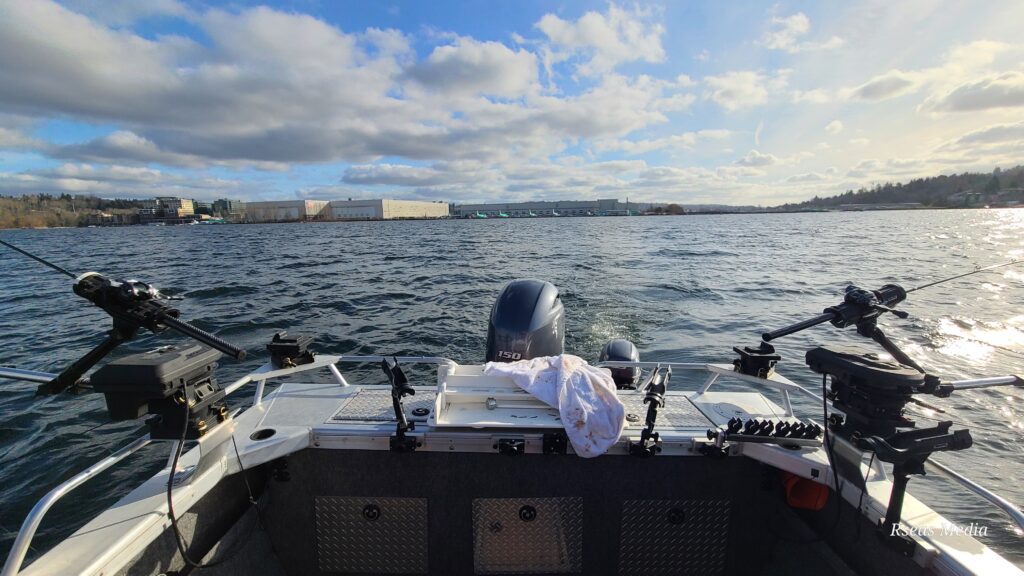
The application of scents to your lures and bait can act as an attractant or bite stimulant. It can also mask odors that repel fish. You can help reduce offensive orders by keeping your hands clean and free of sunscreen, bug repellent, petroleum products jellyfish goo, and tobacco products residue. On the day of your fishing trip, try to use unscented soaps or a light vinegar solution to wash your hands.
The use of scents should complement your game plan. They should work together with your presentation, location, and gear set-up.
There are numerous scent formulations out there: gels, liquid, sticky liquid, wax, oils, and water-soluble. Most scents are available in different “flavors".
Frequently scent oils are used to infuse other bait to create a hybrid cocktail that your target species will find irresistible.
With most sticky liquids, gels, paste and waxes you simply apply a small amount to your lures and let it work its smelly magic. Apply a thin even layer to the underside of spoons, spinner blades and plugs. Assure that the application doesn’t hinder the lure action. Scents can be very effective when applied to your dodgers or even downrigger balls.
Water temperature is your driver for how frequently to refresh your scent. With warmer water, you should pull your gear and refresh the scent more frequently. For most fisheries, I check the gear every 20 minutes or so and reapply the scent at that point.
When using some of the paste type of scents it is a good idea to wipe your lures down between each application. Otherwise, you may experience waxy buildup which could affect the lure’s action or even your hearing. What was that, did I just hear a groan?
If using a scent cocktail that includes dyes, it is a good idea to wear nitrile gloves and work over a towel or a work surface separate from your boat. Bait dyes are potent and will stain both your boat and skin. There were many times during my suit and tie days when I was giving a presentation with orange, pink, or blue fingers
Liquid scents can be used to marinate herring, shrimp, white shoepeg corn, chicken livers, salmon eggs, and dough baits. Place your bait of choice in one liquid scent or another overnight.
One of my go-to kokanee baits is tuna corn. A day before a trip I upend a can of white shoepeg corn into a mesh strainer and let it drain overnight in the fridge. Then I open a tin of packed-in oil tuna and pour the excess oil into my drained corn. I divide the corn/tuna juice mix evenly between some small containers or Zip-Lok snack bags and then add a different scent of oil to each container or bag.
Many freshwater salmon anglers marinate herring, sardine fillets, or shrimp in their secret mix of scent oils and amino acids then use the enhanced bait for trolling or wrapping their plugs.
Regarding flavor, everyone has their personal favorites for a given fishery. I find that garlic, anise, and carp-spit oils work best for Westside kokanee. For most Puget Sound salmon fisheries, I am partial to Anchovy. For general freshwater fishing, you can’t beat nightcrawler/garlic or anise. These are a few of my personal preferences (superstitions). There are a gazillion different scents available. Here in the PNW, scents like anise, sand shrimp, krill garlic, or bloody tuna seem to enhance any fishery.
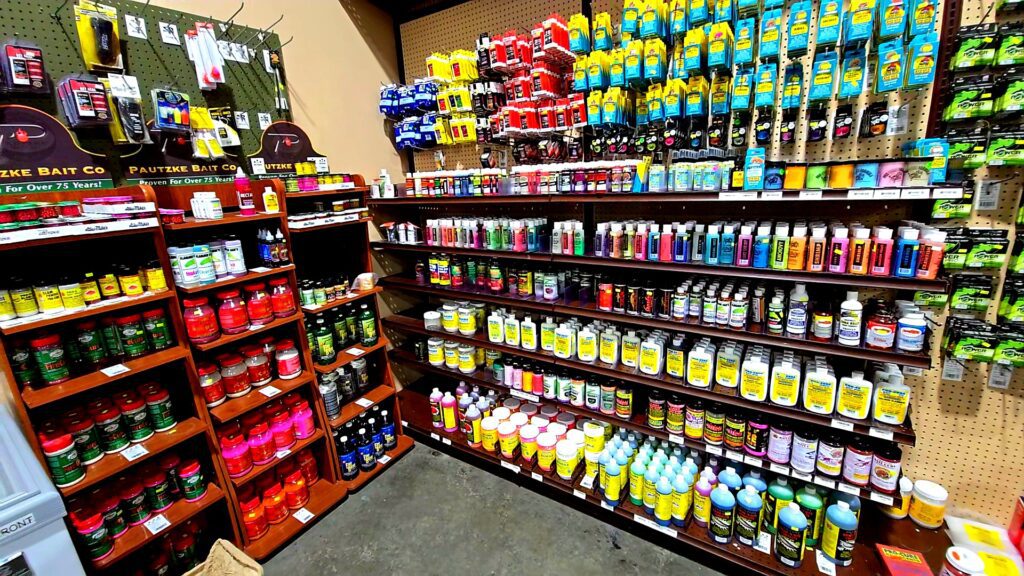
It would be a good idea to visit a tackle shop in the vicinity of your fishery to pick up the local favorite. With its proximity to some solid fresh and saltwater fisheries, Holiday Sports in Burlington is a great source for local fishing information. Their scent corner is well stocked with numerous brands and different scents.
Any scent discussion must include a segment on proper storage. Scents have different shelf lives depending on the product. Generally, they are:
Super Gels, Sauces and Paste: 7–10 years
Bait Oils: 3–5 years
Water Soluble: 3–5 years
It would be a good idea to use a permanent marker to mark the purchase date on your scent bottles. Typically, you’ll run out before they are ineffective but knowing when you purchased them gives you something to talk about. “I caught that huge walleye on 10-year-old worm sauce”.
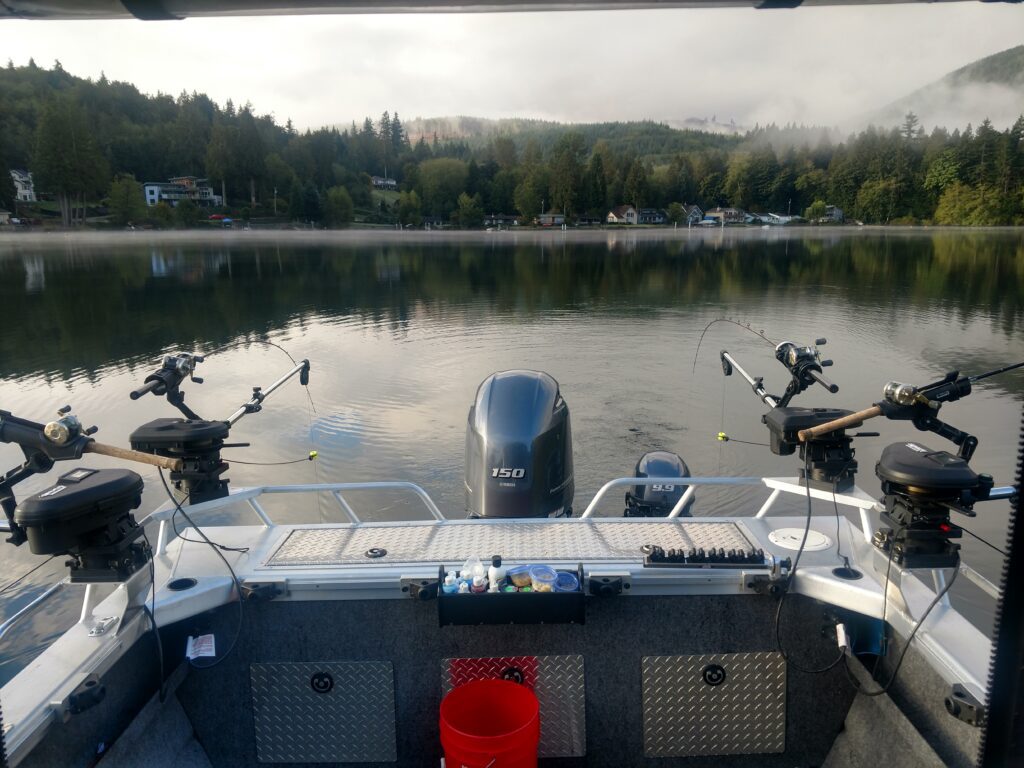
A couple of thoughts on storage:
On the boat store your scent collection out of direct sunlight in a cool place. While fishing I put a wet towel over my scent containers on my workstation, making sure to keep it damp as required.
At home store them in a dry, cool place. Preferably a metal cabinet in the garage or in the bait/beer fridge. The mice in my garage love to chew through scent bottles.
At the end of the day, make sure you clean your gear. Being superstitious I use Lemon Joy to wash all my lures and attractors. Lemon Joy or not, just make sure you clean everything after each trip.
Where your local knowledge, trip planning, gear set-up, and presentation are important in a successful outing, the use of scents will help you consistently fill the fish box.
Proper scent storage, application, and clean-up will go a long way in making sure your fishing trip doesn’t stink!
/articles/making-sense-scents
Essential Kokanee Science
So, you want to become a better kokanee fisherman? Yes, we all do. I assure you that you can be, but it takes some effort. It is not just getting out on the water, but it is using solid knowledge about kokanee that will make you more effective when you are on the water.
A while back I put together a wheel showing the inter-related concepts that occur in successful kokanee fishing. For a starting point of this paper, please consider:
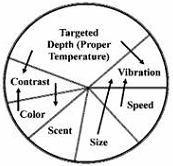
The idea is that if you get all of these factors right in your presentation, then you are fishing with 100% efficiency. There is some truth that IF you are in the right temperature zone, using a correct dodger at the right speed, then you are hovering around 50-55% effectiveness. Even a blind sow gets an acorn occasionally. But you will be at 0% effectiveness if you are not in the correct temperature and using the wrong presentation setup. As a fisherman, you already know that from practical experience. Taking the time to learn about all of these related factors will most likely help you become a better overall fisherman for kokanee and other species as well.
The single best predictor of kokanee location is temperature. I am not talking about surface water temperature, but rather the correct temperature down in the water column, or temperature at depth. For kokanee, the preferred temperature is close to 54 degrees. They can indeed be found at temperatures between 44 and 59 degrees. Below 54 degrees the kokanee are less active. Much above 54°, any extended stay will have detrimental or even lethal effects. Kokanee biology functions best at 54 degrees, and they will seek it out if it is available.
That temperature provides the most efficient growth from feeding. That temperature also allows for the least amount of energy consumed for swimming and generally being in the business of being a kokanee. Wherever that 54 degrees is in the water column, that is your target depth. Early season temperatures may not be as high as 54°, which accounts for sometimes slower fishing. There are a few reliable devices available that you can use such as the Fish Hawk model 840. Search Amazon for more options.
Since kokanee have a very elongated air bladder, you can use your fishfinder to determine their approximate depth. Kokanee will show a bright orange with a color fishfinder. Take an average depth of the images and have that as your initial target depth. Set your presentation within five feet top and bottom of that target depth. If the fish that hit your presentation are smaller than what is generally being caught, lower your target by five feet. Continue this process until you are zoned in.
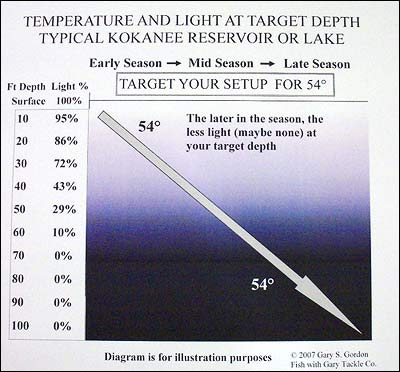
Generally, kokanee fishing picks up in the spring, when water temperatures are warming, and continues through August. This period can be broken down further into categories, each with distinctive features and methods for the best approach to your fishing. But to grasp the reasons for the differences, some additional discussion is necessary.
Zooplankton is animal plankton. Zooplankton can move about without being totally dependent on current and wave/wind action. For our kokanee, the most important zooplankton are daphnia (water fleas). Daphnia are intolerant of light and when sunlight hits the water, daphnia descend down the water column. In spring, the kokanee are waiting for them from below. The chase often ends (or continues) with kokanee jumping out of the water, much to our entertainment.
The absolute enemy of kokanee is the tiny mysis shrimp. Mysis eat the phytoplankton at such a rate that it virtually eliminates the food supply available to young kokanee. If there are no young kokanee, soon there will be no mature kokanee. These lessons were learned too late in Flathead Lake and Lake Tahoe.
As long as the kokanee can find that plankton in their preferred temperature range, all is good. Kokanee gorge and grow and grow and gorge. But as the season progresses, 54 degrees continues to lower in the water column and reaches a point where there is no growing phytoplankton where the 54-degree temperature depth is located.
The temperature range has dropped in the water column to the point where 54 degrees is below 10% light. The result is that the phytoplankton, though abundant, is in a temperature that is too warm for the kokanee. When that happens, kokanee will stop eating. And stop growing too. This is when kokanee enter the pre-spawn period. And changes start happening to the kokanee, as their stored energy (from gorging) is then directed to those body parts necessary for spawning.
A key factor for growing large kokanee is how long that 54 degree zone can remain within the growing plankton. Keeping that zone in the phytoplankton is influenced by inflows (the cooler the better), reservoir depth, and amount of heating (infrared) by the sun. If the water warms too quickly, kokanee will not have enough time to feed to achieve their maximum potential size. And there can be even more dramatic size downward if there are too many mouths for the available food supply at the temperature where kokanee prefer. Obviously, the spring weather and natural spawn success have a lot to do with it in either case. A mild spring, with an excellent slow melting substantial snowpack is ideal.
You can easily confirm the pre-spawn time. If you land a kokanee and clean it, and if the stomach is empty, that not only tells you it is pre-spawn, but it also tells you that the 54 degrees is now below that 10% light threshold in the water column. Fortunately for us, kokanee will continue to strike out at a proper setup, even in reduced light. Even in no light.
Understanding this fundamental principle that water absorbs light and that there is always less light at depth is the first step in deciding what dodger and lure combination (the setup) to fish.
To proceed further, we have to understand another two interlocking principles. Kokanee are first attracted to proper vibration, then to color. It is not the other way around. Proper vibration and color cannot be separated.
Yes, scent does play a role, but even the correct scent will not make up for a bad presentation at incorrect depth, speed, and dodger/lure choice. In fact, a bad scent choice will condition the kokanee not to strike. That is one of the best reasons to have scent choices on hand and to move to new fishing areas with a different scent. Simply staying in the same area but changing scents will do nothing to remove the bad scent already in the water. Only time and current can do that.
Regardless of species, we have all seen at times fish come and have a look at our presentation, only to swim away. When we send a setup to the target depth we are trying to accomplish two things. We want our setup to attract our target fish, and we want our setup to provoke a striking response to our lure. The whole point of kokanee fishing is to catch kokanee (and enjoy being on the water of course). But we do not put microscopic plankton or tiny daphnia water fleas on our hooks and go from there. As it turns out, kokanee are in fact attracted to colors, contrasts and objects that do not exist naturally in their environment.
Leading the proper setup is a dodger. The lure is then attached to the dodger by a short leader. Frankly, the shorter the better - a minimum of five inches but no more than 14 inches (except for apex types). The deeper your target depth is in the water column, the shorter the leader. For squids, RGTs, hoochies and bugs a five-inch setback is more productive than a 14-inch setback regardless of target depth.
But what does the dodger really do? The dodger is the most crucial part of your setup.
As the dodger moves forward through the water, it displaces water. When water is displaced, it creates a wave. The kind of wave and its intensity is determined by the shape of the object moving in the water and how fast it is moving. While a sleek shape will still make a wave, a shape that moves side to side will produce more intense waves. Squids, RGTs, hoochies and bugs are sleek. But while they still make a wave as they are pulled through the water, they do not make much of a wave. Yet place them a short distance behind a dodger that is moving side to side, and you have given your sleek presentation abundant action.
This back-and-forth displacement of water is creating a particular kind of wave: a low-frequency sound wave. Even though we cannot hear it, the important thing is that kokanee can hear it. How they can hear it deserves some comment. Kokanee have three tools to aid in sound detection. The first is their inner ears up front. The second is the lateral line on each side. Lateral lines are really a series of pores that contain a network of sensory structures called neuromasts. The third is the very elongated air bladder that kokanee have (much longer than in other freshwater fish). This air bladder acts like a drum in picking up sound waves. The three tools work together to give the kokanee a three-dimensional picture of what direction the sound is coming from.
Be assured that the sound you are creating with your dodger travels outward, upward, downward, backward, sideways and forward at speeds way in excess of the speed you are trolling. And kokanee can swim way faster than you are trolling.
If you are to be a successful kokanee fisherman, then you want your setup to make the kind of sound waves that will in fact attract kokanee. This is to also say that if you want to be a successful kokanee fisherman, you do not want your setup to make sound waves that repel kokanee. In my opinion, using flashers either ahead of the dodger or on the downrigger ball produce just the kind of sounds that repel kokanee. The reasons are basic.
Every manufacturer of flashers claims that their action produces sound that mimics wounded baitfish. And that they do, without question. Essentially flashers are predator attractants. Except kokanee are not attracted to wounded baitfish. But fish that eat kokanee are attracted to wounded baitfish. Any right-thinking kokanee (a survivor) has learned the sound of predators and what attracts them.
Kokanee hear that sound and go the opposite direction. You might in fact pick up a kokanee using flashers because there is always a really dumb one in the mix. But you will scatter the rest quickly. Many times I have heard and read that when the fishing is slow, use flashers. Bad advice. If the fishing is slow, change your setup to a larger dodger and different matching lure. Change location. Change scent. Change speed. Adjust depth.
Next month I will go further into kokanee eyesight, colors, and presentation to up your kokanee success.
Gary Gordon | Fish With Gary Tackle Company
/articles/essential-kokanee-science
Conconully Kokanee
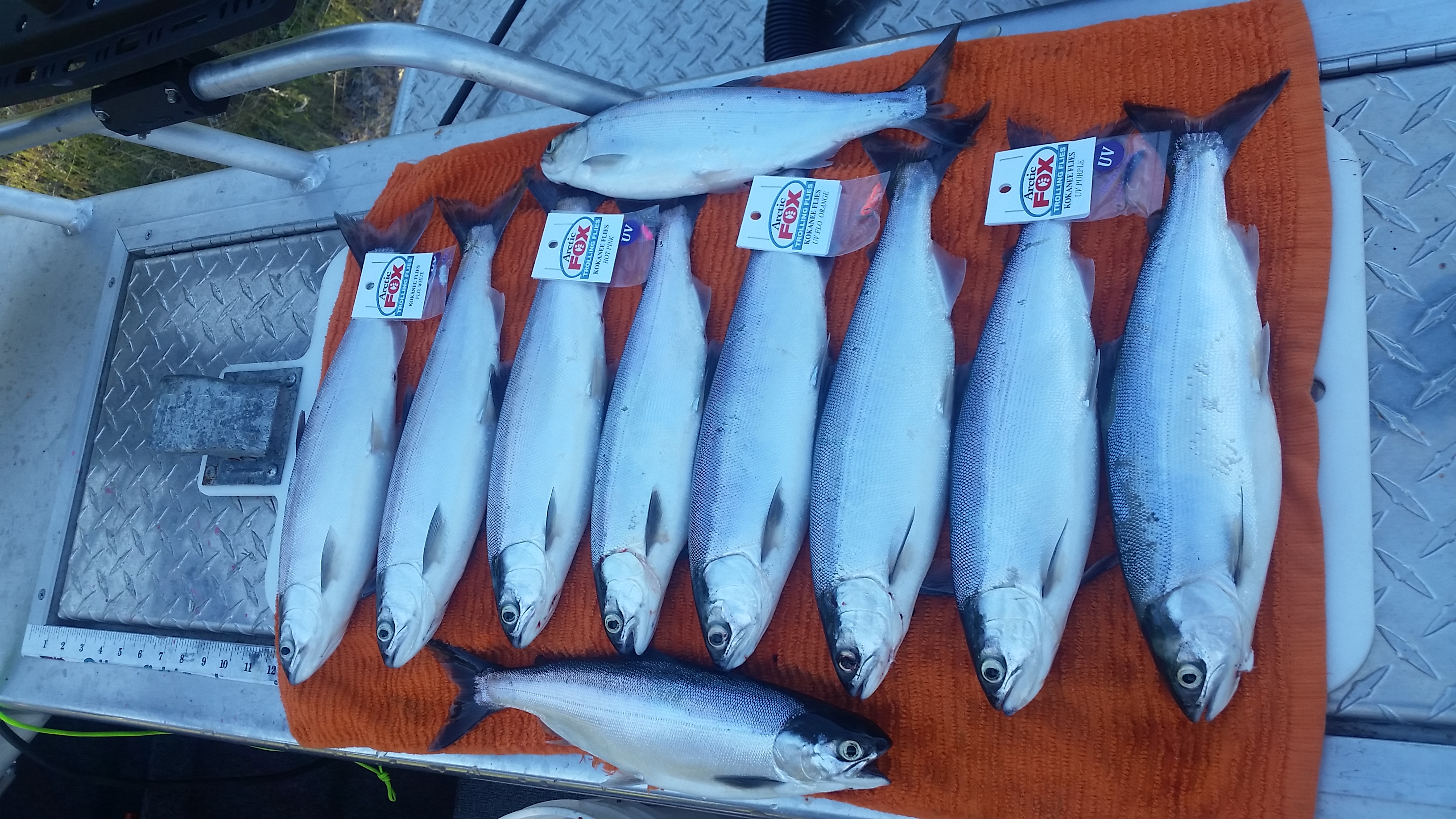
Some new products are truly unique, for example, Wiggle Fins. These products create and define new methods and fishing techniques. Other products take a great idea, refine it and make it better. In this category falls a new kokanee fly produced by Arctic Fox Trolling Flies. I had the opportunity to recently tackle test this product on Lake Conconully and came away very impressed. It’s going to be a “go to” lure in my kokanee arsenal.
Denis Peirce, the owner of Arctic Fox Trolling Flies, sent me some flies to try out. He told me they were based on an eighties steelhead fly pattern, the Krystal Bullet. Of course, just making a copy of an old fly is not going to cut it in today’s world of new and innovative kokanee products. Denis knows that, having been in the trolling fly business since 1993.
He knows the industry and, more importantly, he has a wealth of knowledge and information about trolling for game fish. Thus far his focus has been on salmon and trout and he has teamed up with Wiggle Fins to make a phenomenal line up of larger trolling flies. It was a natural evolution with the recent explosion in interest for kokanee that Denis turned his knowledge and expertise to kokanee flies. Hence, his new series of kokanee trolling flies.
My wife JoAnn and I took our annual trip to Conconully to try the flies out. We stayed at our favorite resort, Liar’s Cove on the lower lake. The ambiance is family-friendly and the fishing in Conconully around Memorial Day is off the charts! Both the upper and the lower lakes have excellent trout and kokanee action. The upper lake the past few years has produced the larger kokanee so we decided to start our test there.
We ran four lines, two off downriggers and two off leaded core long lines. Each rig had an Artic Fox Trolling Fly and a dodger in front of it. Leader length ran 8-10”. The flies come without leaders. This is actually something I appreciated. If you’re like me, over time a successful lure gets bit a lot and the leader becomes frayed and needs to be replaced.
Unlike hoochie or spinner rigs, single flies are quite easy to quickly replace the leader. Another option I like is the ability to adjust the leader to conditions. For Conconully we ran 12 pound fluocarbon leader. We ran some flies with no attractor, some with a small spinner blade, and some with a Mack’s smile blade. All rigs had a piece of corn on both the primary fly hook and the trailing treble hook.
We started fishing at a leisurely 8am. The action began slow but gradually began to build. At the start, we caught a fish here, a fish there. I can’t say that there was a significant difference between the flies that had attractors and the flies that were “naked”. We ran the downriggers at 35 and 45 feet deep, chasing meter marks. Last year, the downriggers performed well for us. This year, it was a leaded line show. We eventually reached the point where the action was fast enough that the downriggers got put away and we just ran two rods with leaded lines. We trolled with three colors out, and 60 feet of mono leader, trolling at 1.1 to 1.4, using an itroll from ifish solutions to vary the trolling speeds automatically.
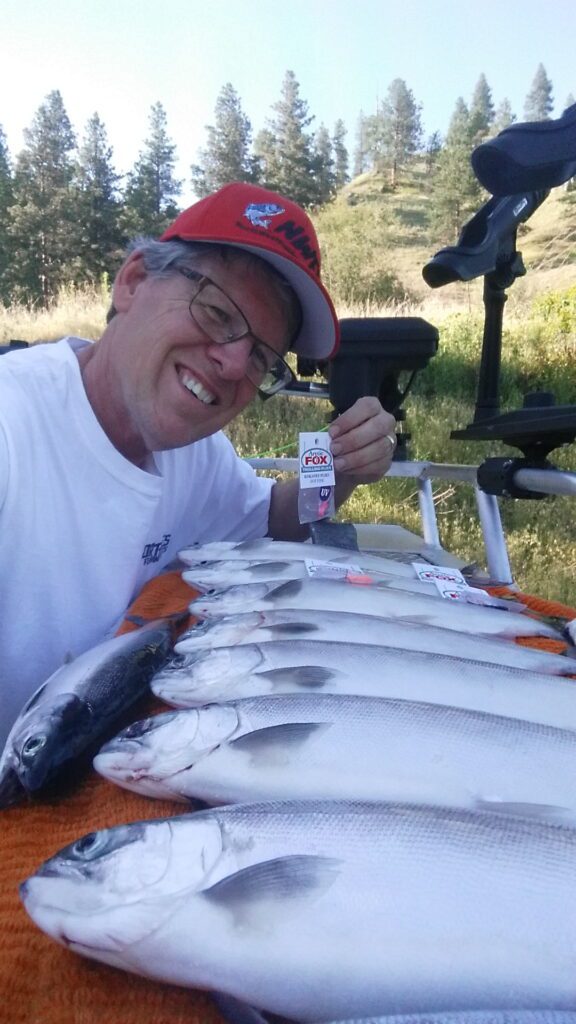
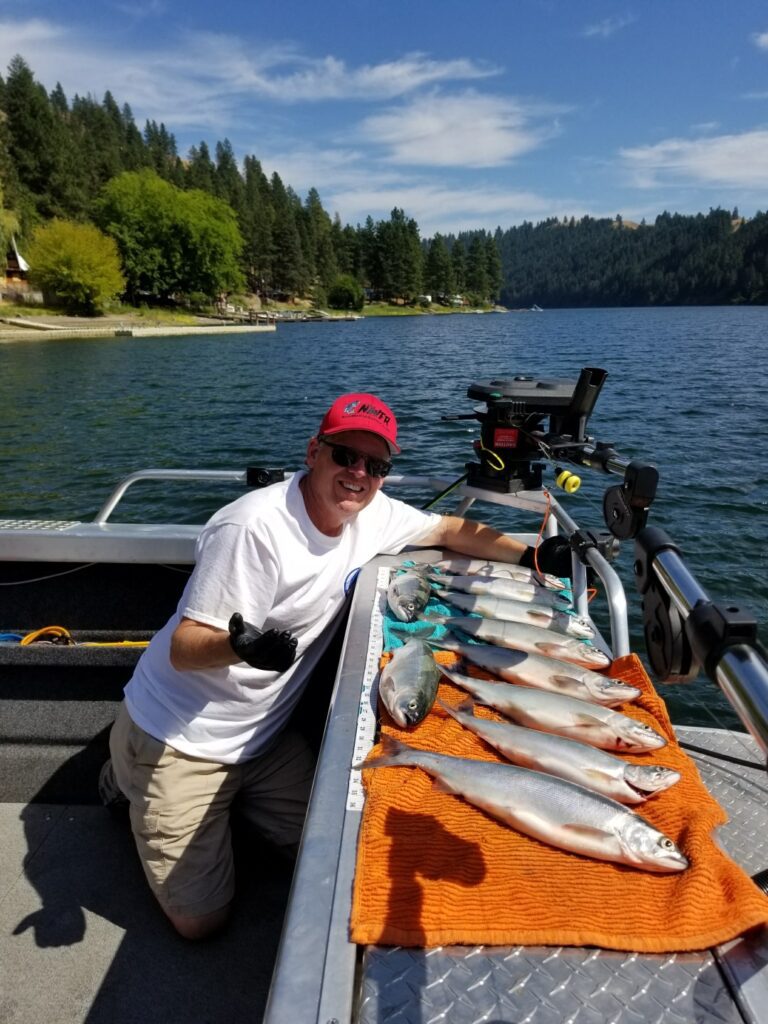
The fish at the upper lake were a plump 14-15” fish, shiny bright. Much to my surprise, later after cleaning the fish I had one hen that spilled mature eggs out. Other than that it was mostly bucks in our bucket. The hotspots for us were up lake of the houses to the narrow north end of the lake. Close to shore, middle of the lake – the kokanee are everywhere right now. Watch out for floating logs and debris. The lake has received more runoff than in past years so there is a lot of debris to avoid.
The Arctic Fox Trolling Flies were an obvious hit with the kokanee. Denis has definitely created an effective series of flies for kokanee.
The Arctic Fox Trolling Flies Kokanee series come in seven different colors. Five are fluorescent chenille and mylar. Denis reports that under UV light these flies are very “hot”, meaning they have excellent underwater color reflection. The two non-fluorescent flies are fire red and purple with silver core chenille. Purple remains visible at depth, while red is one of the first colors to be filtered out by water depth, meaning it turns grey-black at depth. The mylar, however, gives it a nice contrasting UV orange that continues to reflect available light at depth.
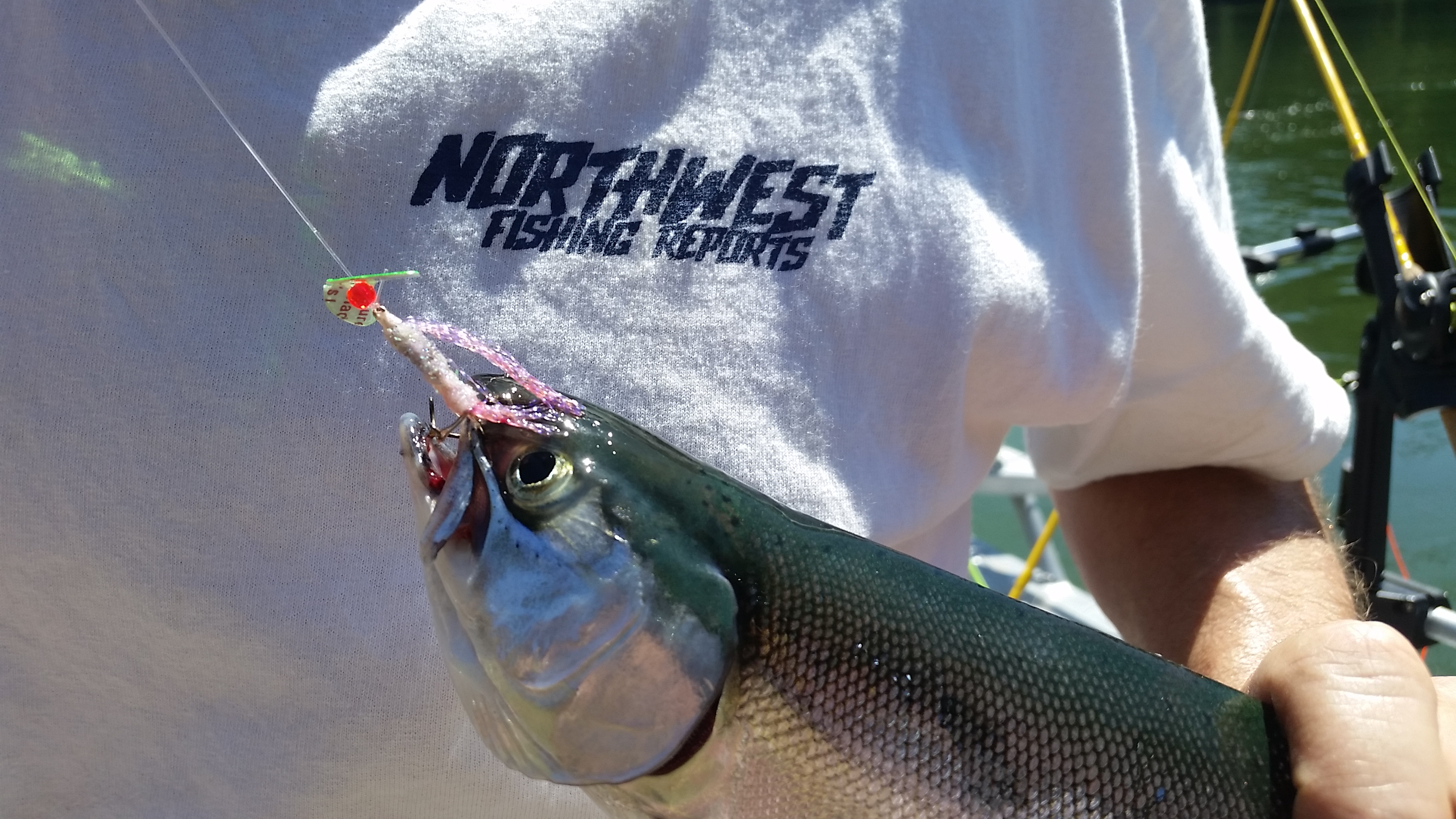
With seven color choices you’ll be able to fish whatever conditions you’re presented with, from cloudy Pacific Northwest to bright Central Washington days. You’ll also have a sufficient variety of colors to find what the finicky kokanee want on any given day.
For us the hot set up was without a doubt the orange with 10” of leader and an orange crush wobbler run at three colors out. The fish were just slamming this set up!
One concern I had when first checking out these flies was the size of the hooks. The main fly is tied on a #8 long hook, and the trailing hook is a #10 treble hook. Denis uses gamakatsu hooks and I will be the first to attest that these hooks are sticky sharp! Our experience was that the combination of these two hooks was incredibly effective.
We had few lost fish and noted several that missed the main body hook but were secured by the treble hook. Remember when I started this article and mentioned “refining” the pattern? Well, Denis has taken the treble hook and secured it using a loop of stainless steel leader that creates an articulation for the treble hook that the fish have a hard time throwing. Put another way, the treble hook is free to move around meaning the fish can’t get leverage on it to pull the hook free. I’ve reviewed underwater footage of kokanee and one thing that struck me was that once a kokanee is hooked it does incredible body shakes and spins in a desperate attempt to get away. It’s amazing we catch any of these acrobatic fish at all! Any small edge an angler can have against these wild gyrations will help land more fish. I would say our hook to catch ratio was higher than trips using standard kokanee lures.
JoAnn and I continued to pull in plump, healthy 14-15” kokanee and over the two days of fishing and easily got our limits. I came away very impressed with the Artic Fox Trolling Fly kokanee series. I’m definitely moving it into my first tier of kokanee lures. I like the smaller size profile compared to the majority of the kokanee lures on the market. It gives kokanee anglers an option to downsize when the fish are looking for a smaller presentation. With the articulated treble hook I don’t have any concerns about losing fish due to the smaller hooks.
Give these flies a look see! You can order them online at Arctic Fox Trolling Flies.

/articles/conconully-kokanee
The Art of Finding Kokanee
In the years since Kokanee University was written, many wonderful developments have happened. The tackle designs, for example, are way different now as technology has made available vast improvements in action and color. What has not changed are the concepts outlined in previous articles. Let’s take a look at fishing strategies to catch more kokanee!
Color Fish Finder
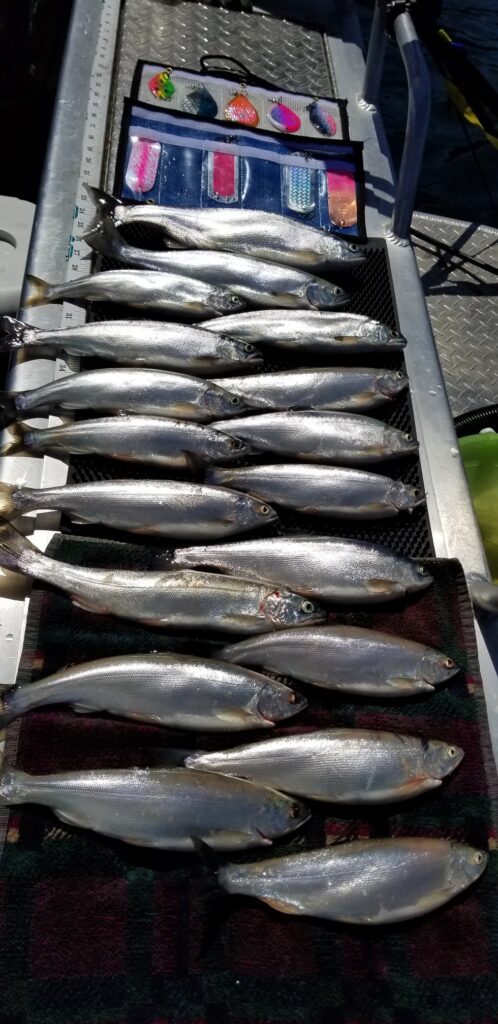
No doubt, the very best piece of electronic equipment is the color fish finder–sonar. Color is better because of the unique biology of the kokanee, which have an unusually large air sac, and sonar cannot penetrate air. Because of this, kokanee can be seen on the fish finder, usually as bright orange (the default color on many systems). No other freshwater fish has this distinct detectable characteristic, so you can easily tell the depth of kokanee by this method.
The fish finder will let you know the current depth. Knowing the depth of the bottom is essential, especially if your lake has varying contours. On more than one occasion, I have raised downrigger balls "just in time" to avoid getting hung up on a bottom that suddenly came up, seemingly out of nowhere. Your fish finder will track your downrigger ball, and you can use this to verify the accuracy of the counter on the downrigger.
One factor to consider is how large a viewing area there is. The larger the viewing area, the higher the cost. Screen resolution is another factor to consider – will your viewer be viewable in sunlight and with polarized sunglasses? Another critical factor is the location of the fish finder in relation to where you are sitting while fishing. You need to be able to see the details on the screen.
GPS
GPS serves many useful functions. One of the best is showing accurate boat speed. (The little paddle wheel on the fish finder is unreliable and next to useless.) If you are targeting a speed of 1.4 MPH, you will be able to know when you are going 1.4 MPH. You will also be able to know when you are NOT going 1.4 MPH.
GPS will display a track of where you have been, and the memory will store those tracks until you erase them. I have had these tracks for years on the same device, showing both where I have been and also where my favorite and most successful areas have been.
Another fabulous feature is the cartography, which shows the contour depths of the lake you are on. You can either purchase the SD card, or many now come with the cartography pre-installed. My SD card covers all the lakes in the western US. You can get these cards to cover your region as well. Knowing the depth contours is a tremendous help. For example, it will allow you to stay on course within a former river channel. It will show points of land that are underwater and which could be a problem in navigation when the downriggers are out.
Temperature At Depth
One of the very best recent developments in technology is the ability to accurately measure the temperature of the water at depth. While the temperature function on your fish finder only tells you the surface temperature, the simplest device for measuring water temperature at depth is from FishHawk Electronics.
This little device is called the FishHawk TD. It is easy to use by simply attaching the device to your fishing line, pressing START, waiting for READY, then lowering it into the water. I send it down deep, then retrieve it, then press view, and it shows the water temperature in 5-foot increments down the water column as far as you have lowered the probe. This is extremely useful, particularly when looking for that 54-degree temperature depth in kokanee season.
I have also used the device to understand what was going on underwater. During one early September outing on a high mountain lake, I could see on the fish finder a few scattered kokanee at 40 feet, and a whole bunch of kokanee at 60 feet. Try as I could, no kokanee could be enticed from the 60-foot depth. The kokanee at the 40-foot depth were the only ones that would bite. I set out the FishHawk TD to determine if temperature had anything to do with it. Sure enough, it did.
The fish at 40 feet enjoyed a temperature of 54 degrees. The fish at 60 feet were at 44 degrees. The deeper fish were already starting to settle in for the winter. Since it was September, I could tell these were the two-year-olds (next year's fish). Most of the kokanee I had caught at the 40-foot level were either turned or were turning color. By combining what I learned from the temperature measurements with what I saw on the fish finder, I was able to figure out why I was not getting bit at the deeper depths.
Electric Trolling Motors
The single best advantage of the electric trolling bow-mounted motor is the ability to steer the boat by wireless remote control from wherever you are in the boat. I simply strap the small control on my wrist, and that lets me easily control the boat's direction and speed, even when I am fighting a fish or setting the downrigger.
Scouting A New Lake
Once you have enjoyed some success fishing for kokanee, you can have confidence in fishing any lake with a kokanee population. Kokanee are kokanee regardless of whether they are in Oregon, Idaho, Montana, North Carolina, British Columbia, Washington, Colorado, New Mexico, Utah, Wyoming, or California. When I know I am going to fish a new lake, the very first thing I do is to find the lake using Google Earth. I need to know the shape of the lake, where the deep water is, and where the shallow water is. I need to know what feeder streams come into it and where the outlet(s) are. I need to know the structure of the surrounding terrain, such as whether one side coming into the lake is steep and the other side is gentle.
I also check out the lake using my GPS cartography. I can sit in my boat in Central Oregon and study lakes in any other location simply by moving the cursor on my GPS.
Generally, what I am looking for is where the current might be and where feeder streams come into the lake. Those are two locators of what I call "active" water. This is where water mixes with the regular lake water, adding oxygen to the water. Fish need oxygen. This is also where trace nutrients come into the lake from feeder streams. These nutrients act like fertilizer to the plankton (phytoplankton) that the zooplankton, kokanee, and other baitfish feed on.
I look for drop-offs, where the lake suddenly gets deeper. Recall that as you go deeper down the water column, the water gets colder. It cannot get colder unless it gives up heat that rises to the surface. This process causes mixing - water movement up and down. This process is also good for the plankton and, hence, good for the kokanee.
If I am fishing early in the season, I look for structures, such as points of land coming into the water. I have found that in the early season, kokanee relate to structure.
Finally, using the internet allows you to research in ways we never could years ago. Don’t limit yourself to fishing forums. Searching and finding hidden gems can give you inside information that many anglers have overlooked.
The whole idea is to learn as much reliable information about the new lake as you can from the available sources. Be assured, what has worked for you on your local lake will also work on the new lake.
The Science Of "Scent"
All fish have nares, which are scent-detecting tubes on the snout of the fish. A fish's ability to detect scent is flat out amazing, often measured in parts per million. And salmonids are probably near the best in scent detection. For thousands of years, fishermen have used bait on hooks to persuade fish to bite.
Some awesome kokanee fisherman or fisherwoman discovered a long time ago that kokanee will bite a lure baited with white shoepeg corn. And that discovery has been passed down for many years to the present time. What has not been passed down is why white shoepeg corn works so well.
It turns out that white shoepeg corn has an amino acid that is a bite stimulant for kokanee, something that yellow corn does not have. White shoepeg corn also manages to stay on the hook fairly well at kokanee trolling speeds. My research has revealed another interesting characteristic of white shoepeg corn: it stays white down the entire water column without any fade. As such, it presents a clearly defined target for the fish to attack. (For doubters, take a kernel of white shoepeg corn into a dark closet and shine a black light on it.)
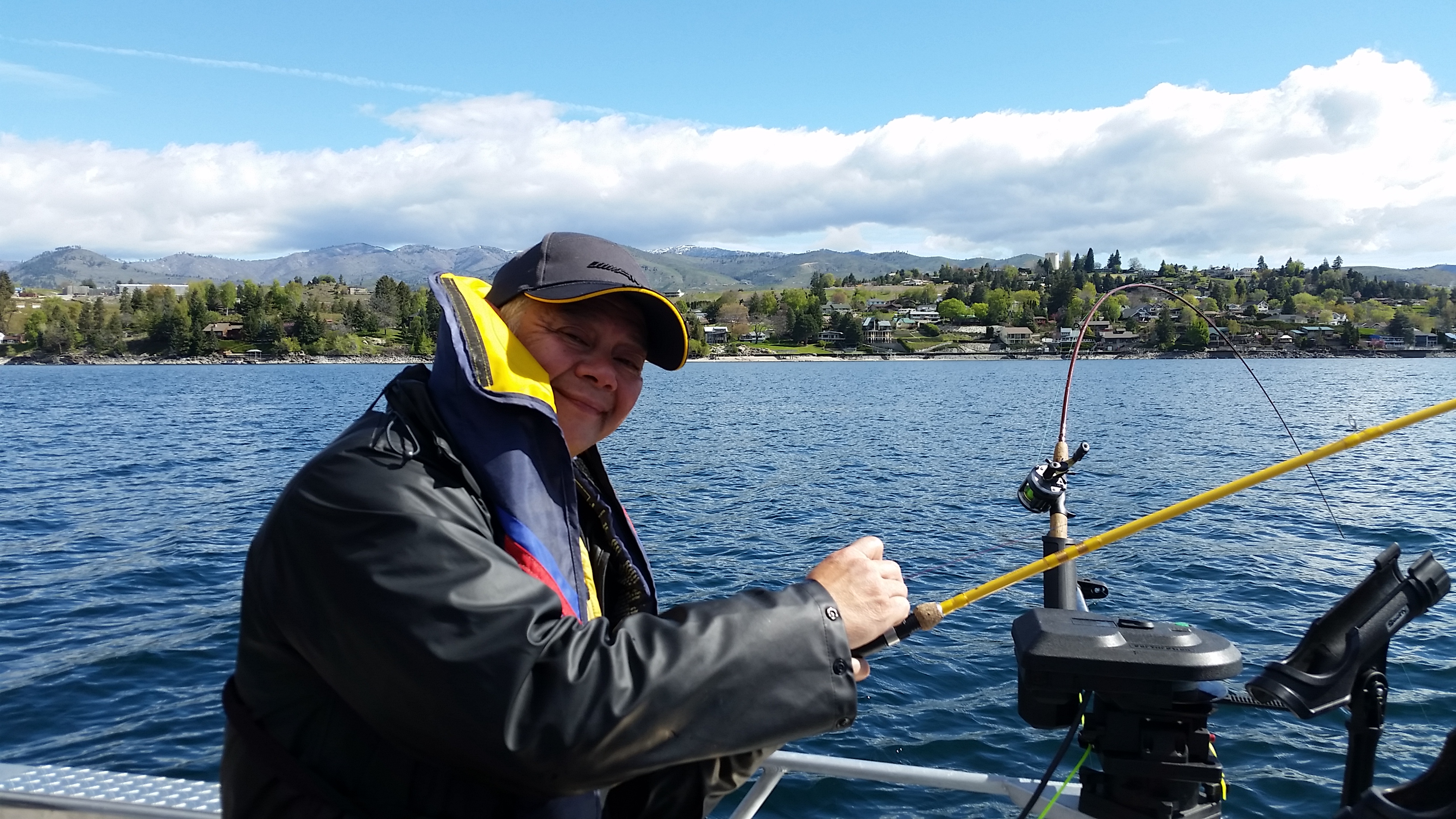
Over the years, it has become popular to add additional scent to the corn by brining it first. Such scents have included anise, garlic, vanilla, and a host of others. Savvy kokanee fishermen would have more than one type of scented corn to entice the kokanee; in case the first one didn't seem to work, they would have a backup. I know that making up different scent combinations is part of the wonderful pre-fishing ritual. Some even dye the corn different colors. More ritual.
In the past, I endorsed using two kernels of corn on each of the tandem hooks in the lure. I have changed my philosophy a bit over the years. I found out that putting corn only on the leading hook helped prevent that dreaded "short" bite. A "short" bite is where the fish targets the trailing hook, hits it, and does not get hooked. The same concept is where the fish will take a bite out of a worm that extends beyond the hook. Either way, the fish wins, and you get that wonderful, frustrated feeling.
Placing the corn on the leading hook takes advantage of a fish's biology. Since a fish cannot see directly in front of its snout a distance of about two inches, placing the target scent corn on the leading hook will make the trailing hook invisible to the fish. The result is a higher percentage of hook-ups and deeper penetration of the hooks.
I have also studied the hydrodynamics of putting two kernels of corn on the leading and trailing hooks. At kokanee trolling speeds, using two kernels on each hook significantly dampens the action of the lure. This poses an issue. I want maximum action on my lure, and I also want to maximize the scent on my lure. Can I have both action and scent without compromising the action of the lure? And I also want to prevent the "short" bite.
The best solution finally emerges as being obvious all along. Many scents now come available with a sticky gel. In my opinion, these scents are more powerful bite stimulants than anything that corn can produce by itself. I now use only a single kernel of undyed, and otherwise unscented, white corn on the leading hook only, and place some gel on the beads of my beaded spinners. This gives maximum scent to my lure without interfering with its action. If I am using a squid or a hoochie, I place some of the gel inside the squid or hoochie body, again using but a single piece of white shoepeg corn on the leading hook. I believe my success rate has increased using this setup.
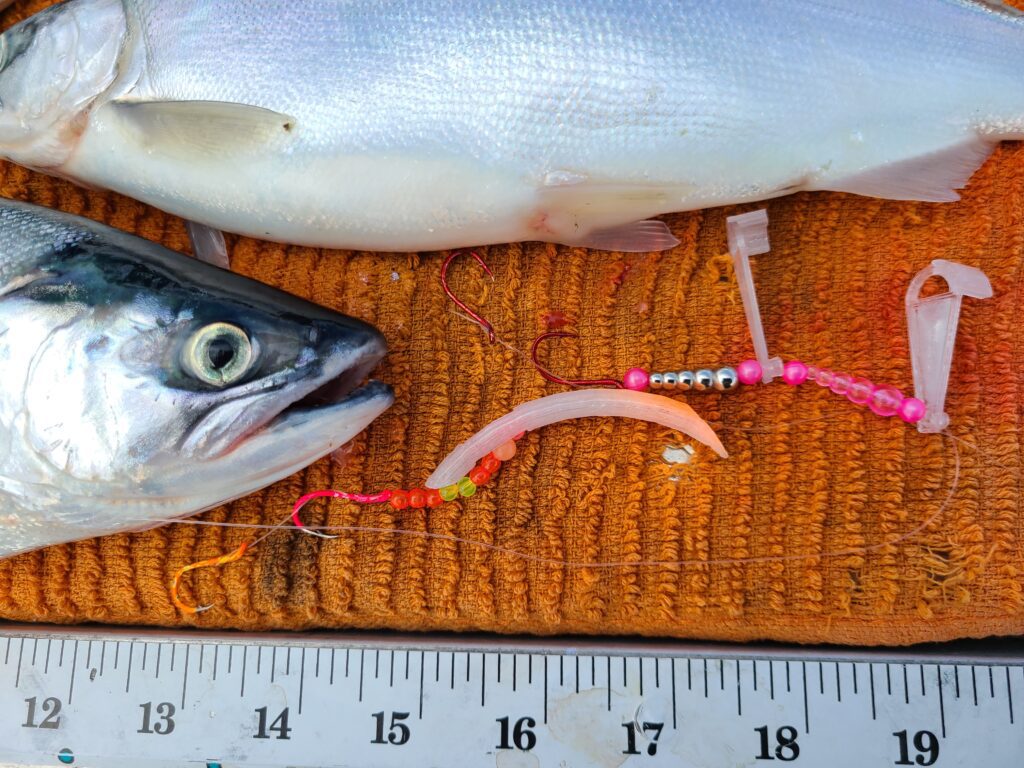
At the end of the day, do your best to rinse off the gel on your lures. Using generous amounts of hot water will help. I have now substituted my pre-fishing "brine the corn ritual" for a post-fishing "clean the lures ritual." I have found the gel scents of anise, kokanee special, garlic, and especially bloody tuna to be excellent.
Next month, we'll look at the gear you need to catch more
Fish With Gary - Kokanee university
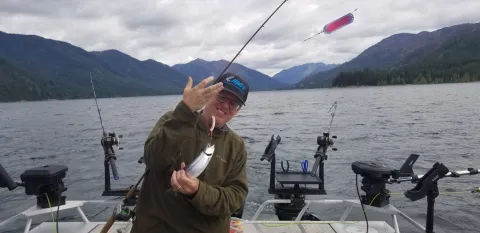
/articles/art-finding-kokanee
Gearing Up for Spring Kokanee
Counting kokanee in your sleep? As we slowly transition from winter’s frosty grip to warmer days, tee shirts, and flip-flops, your thoughts may shift to your local kokanee fishery. If so it’s time to inventory your gear and make sure there is still a boat under one of those mossy tarps out back.
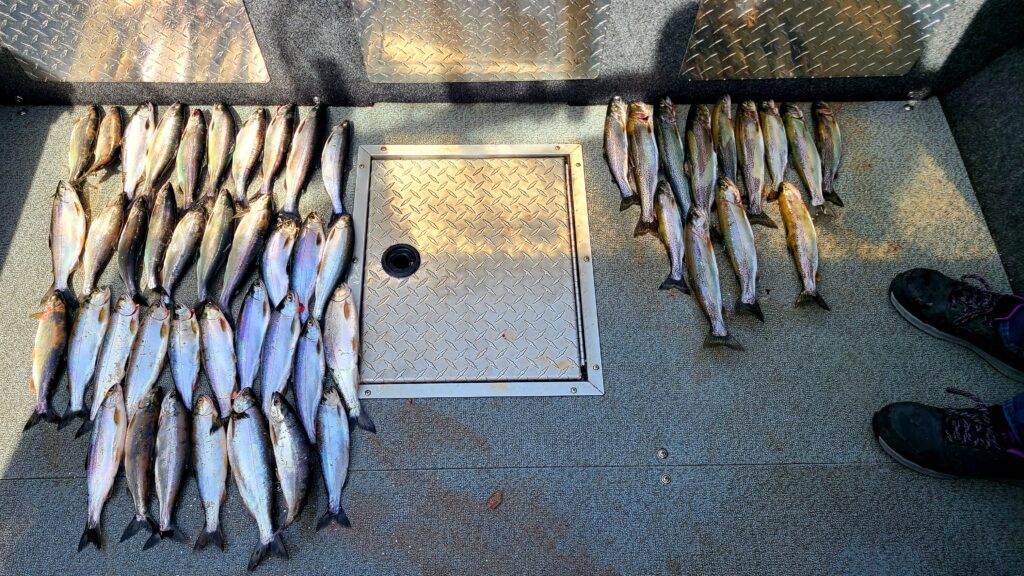
First thing on the list, you may want to give the boat motor and trailer a quick once over. Start peeling back tarps until you find the boat. You probably don’t want to mount new rod holders on the wood pile or stack of doors from a past remodel.
Check your fuel system; regardless if you used a fuel conditioner or stabilizer in your portable tanks get rid of last year’s fuel or not. For built-in tanks, hopefully, you treated the fuel with each fill-up. Even so, it is a good idea to drain the fuel filter bowl and replace the fuel filter/water separator. Replace any brittle fuel line, cracked or otherwise damaged. If you have your owner’s manual, use it as your preseason checklist.
Make sure the battery is topped off with distilled water. Then bring it up to full charge. If you find corrosion on the terminals remove the battery from the boat and clean it off with a mild solution of baking soda and water. Once everything is clean it is also a good idea to use one of the various corrosion guard offerings. You should also go through the rest of your electrical installation and look for loose connections and damaged wiring.
Give your trailer the once over. Check the trailer lights and trailer brake fluid levels. Also, check the tire pressure on all the tires including the spare. Check your safety chain, winch strap or cable and tie down straps and replace if they are questionable. Ensure that all bunks and/or rollers are in good condition. If your trailer lights are wonky, consider replacing them with waterproof LED lights.
Look over your rod holders, net, and downriggers for damage and functionality. Also check for loose fasteners, worn or missing parts, and corroded electrical connections. Fix anything that is even remotely questionable. We recently made a 30-mile run to fish salmon on one of the Canadian banks. One of the downriggers was acting up and it turned out that the shaft seal had failed and allowed water into the motor. Basically, it was sort of seized. Slow going down with a breaker popping retrieve. Would I have seen the problem on a preseason check, I doubt it, but you never know.
As a final note about kokanee boats. We have caught many kokanee from a human powered boat. Kayaks, drift boats, and inflatables will all work. No down riggers? just flat line or use a lead line rig and row away. I think the random action from paddling or rowing drives kokanee nuts. If you do head out without a motor watch the weather and consider whether your boat is appropriate for the body of water.
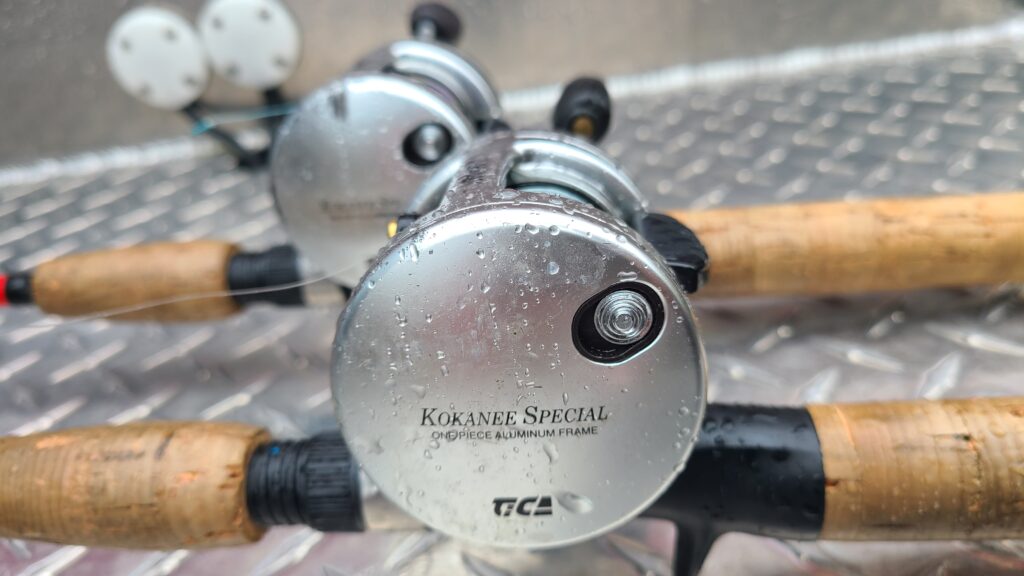
Check out your rods and reels. I know everything worked fine last year so you have nothing to do - wrong! It is the start of what should be a productive fishing season and you don’t want to lose the fish of a lifetime because your favorite reel has a funky drag. If anything is questionable, fix it or get it repaired. It may be time to replace your line. If so, take your reels to a high-volume tackle store (Think Holiday Sports in Burlington or similar) and have them bulk fill your reels. Their line should be fresher and most recycle your old line. Look at your rods and make a point to verify that the line guides are not cracked or worn. You can use a cotton swab and swirl around in each guide. If the guide catches any cotton fibers the guide needs to be replaced.
Because kokanee are notoriously unpredictable, kokanee fishing is kind of a numbers game. Generally, the boat with the most tackle wins. Sure, there are days where you can go out and limit before daybreak using one dodger and a worn-out lure. Unfortunately, those days are a gift from the kokanee gods. Most of the time you must cycle through gear and trolling patterns to get it dialed in. On any given kokanee trip, you should have several pretied rigs and attractors on hand and ready to go.
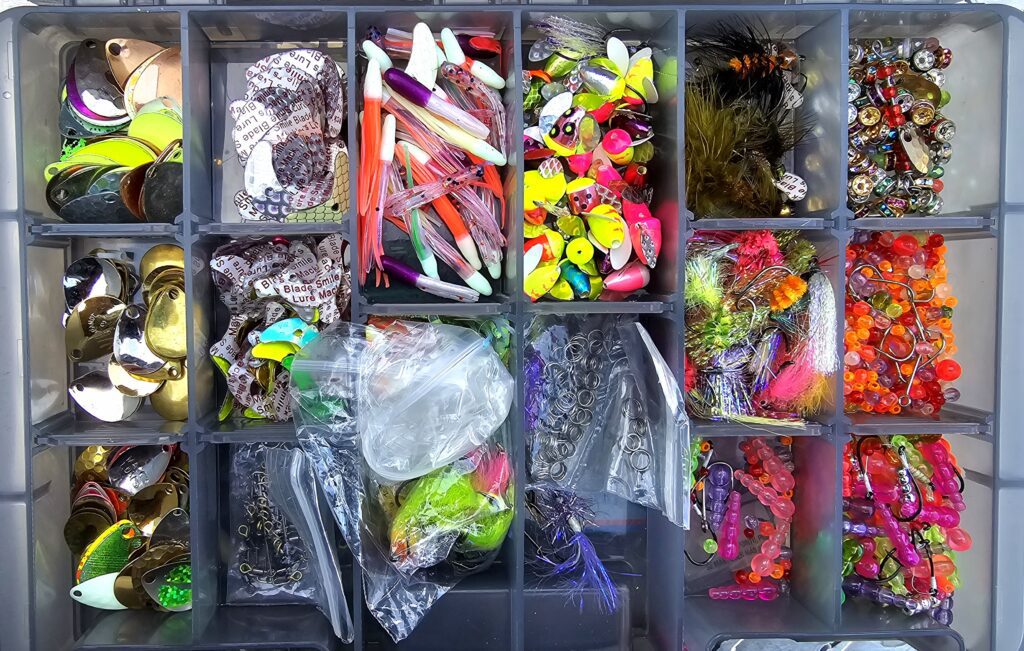
Before you head out on the lake with your collection of kokanee gear give it a good inspection. Look for rusty dull hooks, frayed lines, and missing or broken components. Repair and replace as required, A couple of years ago, we were fishing for kokanee on Lake Washington. We were pulling 8” flashers and veteran home-tied double hook kokanee flies.
One, being a tried-and-true favorite, was frazzled looking but I put it out anyway. After a solid takedown and an extended acrobatic fight, the line goes slack. What the heck? On inspection, the trailing hook was gone and much of the body of the fly had come unraveled. We only got a glimpse of the fish, but it was a huge chrome bright kokanee. I owned that one, I knew the fly was on its last leg and shouldn’t have used it. There’s peace of mind in knowing that your gear is in tip-top condition.
As you prepare for the 2024 spring kokanee fishery, review your gear to ensure you have the basics. Make sure that you have an assortment of small dodgers and swing blade-type flashers. Carry an assortment of small spinners, spoons, wedding rings, and flies. Other gear will work but this is your general kokanee kit. It is also a good idea to have a collection of lure components available. Start slow, a few spinner blades, beads, and spinner clevises and flies. If you’re a fly-tier, you probably already have the basics for any number of kokanee flies. Carry a separate Plano Box as your lure-making kit.
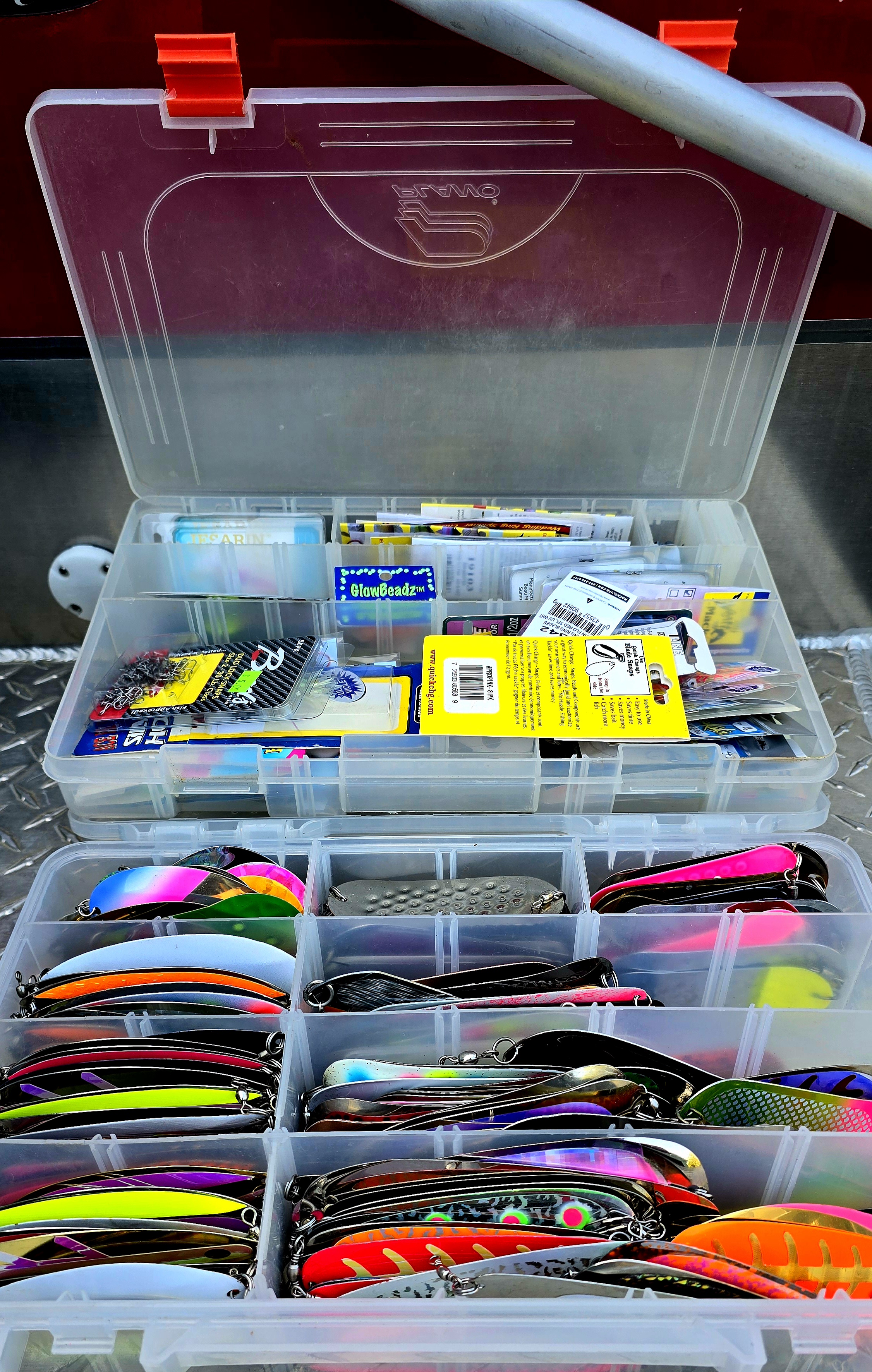
My lure/spinner Box allows me to tweak my presentations. I might add a couple of beads and a second spinner blade, make leader with a fly then add spinner components. The box has small spin n glo floats, extra beads, various kokanee flies, wedding ring collars, some kokanee bugs, and a few other things to dress up your lure.
Line size? With a few exceptions, I tie my kokanee leaders on 12-14# fluorocarbon. Hook size and color are kind of a personal preference. Many of my kokanee lures are tied using size 4 or 6 black octopus-style hooks. I typically tie a snelled rig with 2 hooks. With my standard rig, the hooks are close together.
Regarding leader length, although I tend to have spools of ready to go lures when I’m on a lake hunting kokanee. Typically, they are the correct leader length for the given fishery. It is a good idea to have a handful of pretied leaders that haven’t been cut to length available. The thought is that you’ll be able to assemble your lure and then set leader length as required quickly. An 8-10” is kind of my standard kokanee leader length but sometimes the fish will want something different.
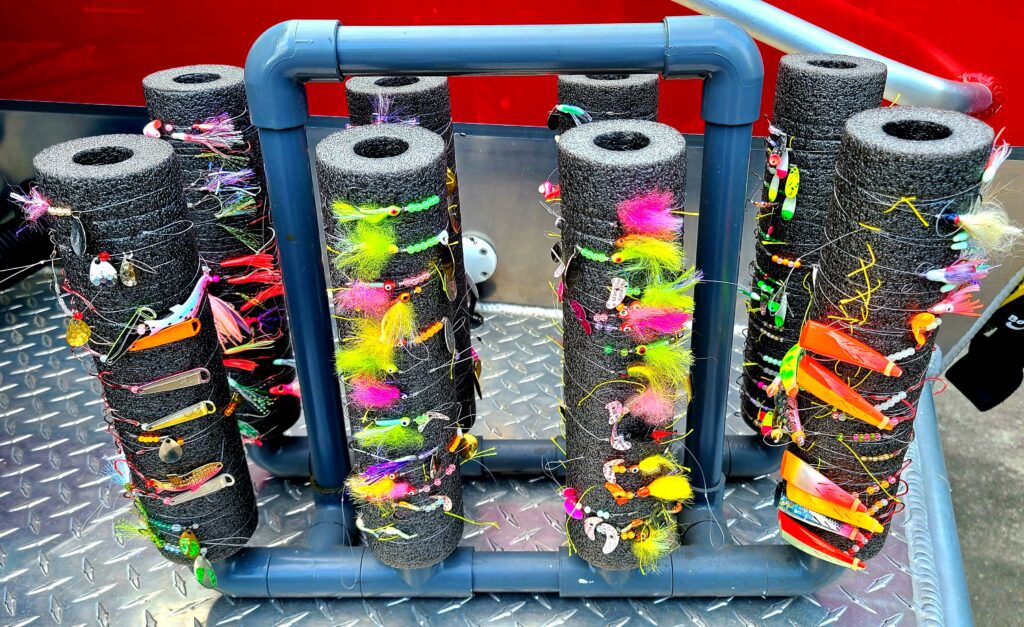
A couple of leader organization concepts are either sealable sandwich or snack bags or my favorite the slotted foam tubes. If using the resealable bags gently coil your kokanee leader and seal it in the bag. Store the sealed bags in something with a latching lid. With the slotted foam tubes, set the hook in the foam and wrap the leader securing the end in one of the slots. You can store the tubes on a rack, in a 3–5-gallon pail, or a 2-gallon resealable bag. I have found that using an empty 5-gallon to hang your leaders on during the day does wonders for keeping the boat organized as you cycle through set-ups. Come up with an organizational plan that works for you and your boat.
Kokanee fishing in general is a mental game. Be prepared but flexible and you will bring home a cooler full of spring kokanee.
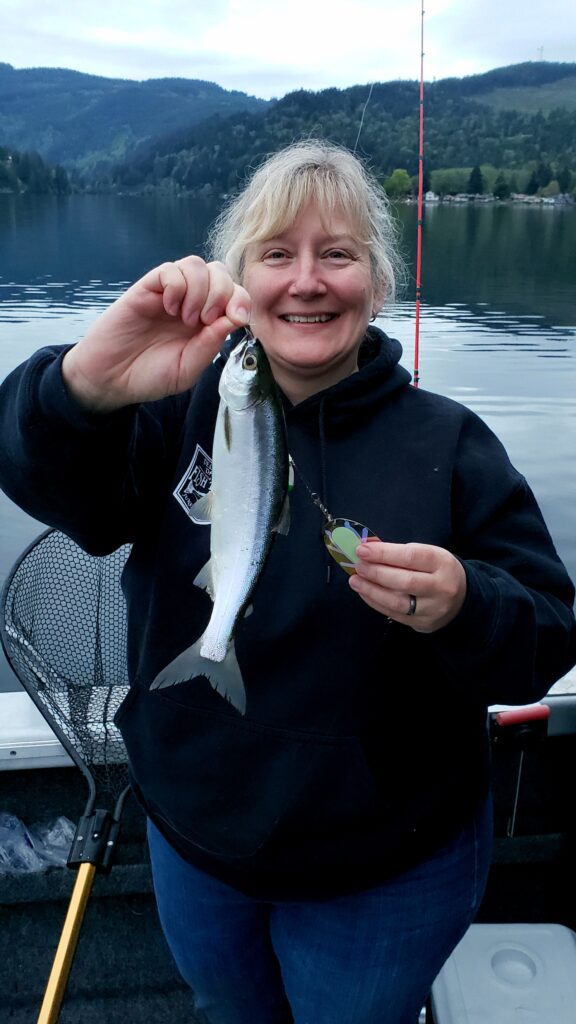
/articles/gearing-spring-kokanee
Spring Kokan-Energy
After our very cold January followed by the big thaw that brought us almost summer-like weather, more than our toes have thawed out. The average kokanee-obsessed sportsman is suddenly waking up with thoughts turning to spring kokanee fishing, kokan-energy.
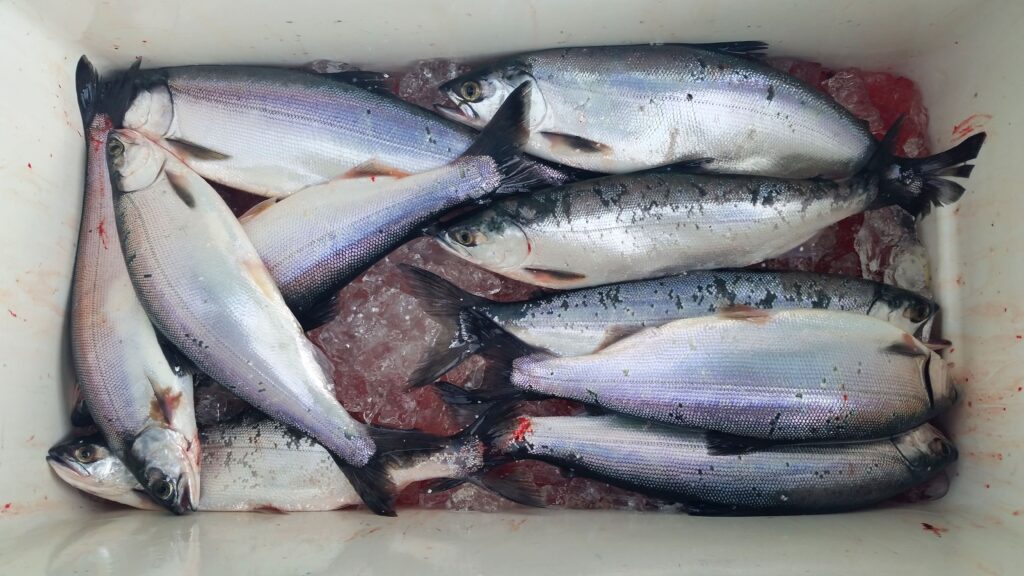
If so, plug in and use your kokan-energy to get ready for this year’s kokanee adventures. Spend the time making sure everything is in tip-top condition. Check out your boat, gear, and tackle while developing a game plan for filling the freezer with mini sockeye. Let me share some ramblings that may help you prepare for this year’s Kokanee crusades.
If you store your boat outside and are a seasonal user you have some work cut out for you. Garage-stored or year-round boaters have a task or two to attend to also and now is the time to get at it. The number 1 most important item on your pre-season chores list is your fuel system. Even if you used a fuel conditioner or stabilizer in your portable tanks get rid of last year’s fuel. Pour any gas from the portable tanks into the lawnmower gas can. I have nothing against lawn mowers but a little SeaFoam will cure many small engine fuel-related ailments that you don’t want to deal with on the lake.
For built-in tanks, hopefully last season you treated the fuel with each fill up. Even so, it is a good idea to drain the fuel filter bowl and replace the fuel filter/water separator cartridge as appropriate. If your rig (built-in tank or portable) is not equipped with a fuel/water separator, now is a great time to install one.
Check all fuel lines and fuel line fittings. Replace anything that is brittle, cracked or otherwise damaged. If you are a seasonal user and your boat was winterized this task is much easier. Next check fluid levels for your hydraulic steering, power tilt/trim units, lower unit/gearcase and your 4-stroke motor oil. Use your motor manufacturer's recommended products and do not top off or mix the various products.
Pull the propeller and check the shaft for fishing line or damage. Remember to lay all the nuts, washers, sleeves, or adaptors out in the same order they came off the shaft. This makes reassembly much easier and remember that most thrust washers have a right way and a wrong way to install them. Look at the propeller, if the blade edges are showing an excessive number of nicks/dings, now might be the time to send it off to be rebuilt. Even slightly damaged blades will affect performance and running a boat with severely damaged blades can lead to all kinds of shaft/seal problems down the road.
Each spring, be sure to top off the batteries with distilled water. It’s a good idea to get them on the appropriate charger for your battery type and bring them up to a full charge. If you find corrosion on the terminals remove the battery from the boat and clean it off with a mild solution of baking soda and water. Once everything is clean, it is also a good idea to use one of the various corrosion guard offerings. As long as you have 12-volt wiring on the brain you should also go through the rest of your electrical installation and look for loose connections and damaged wiring.
Mice and other rodents can cause a lot of damage during the off season. Check all the switches and breakers to make sure they are working. Then hook up the fish finder, VHF chart plotter, VHF, trolling motor and any other major electronics you are running to make sure they have power. Check all the lights to make sure they work. Electrical gremlins are difficult to trace and best investigated in your driveway.
Independent of the weather, my retirement job has me on the water running a small boat as many as 6 days a week. The winter weather is not forgiving and often rattles or jars nerves and electrical connections loose. I have lost the radio, wipers, tilt/trim motor and the bilge pump while running in winter chop. I just deal with things as required but you don’t want to spend your precious fishing time troubleshooting electrical problems.
After all things electrical are functioning as expected, hook the engine up to the garden hose (be sure to familiarize yourself with the manufacturer recommendations) or dunk it in a livestock trough and start your baby up. If your rig has water pressure and temperature gauges check them now. Make sure the tilt and trim are working. Check the steering, especially mechanical steering, to see if there are any problems. Also, before you shut the engine off pull the kill-switch to make sure it works. Check all the switches and breakers to make sure they are working.
Inspect the condition of your downrigger cable or braid. If you are running a stainless steel cable and it is rusted or kinked, replace it. If you are running one of the synthetic braids cut off a few feet and re-tie it. You don’t want 10-15 pounds of lead to suddenly head for the bottom, potentially taking your rod and rod holder with it. However, if it does, it may be an indication that your release clip was a bit too tight. Also check for loose fasteners, worn or missing parts and corroded electrical connections. Fix anything that is even remotely questionable.
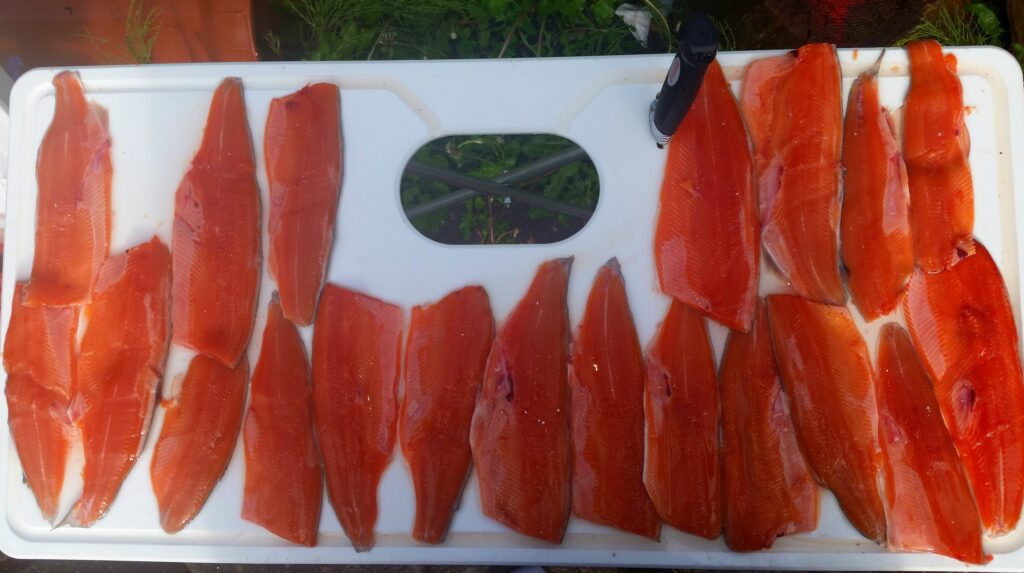
Give your trailer the once over. Now is the time to check the trailer lights and trailer brake fluid levels. Also, check the tire pressure on all the tires including the spare. Ensure that all bunks and/or rollers are in good condition. Check your safety chain, winch strap or cable and tie down straps and replace them if they are questionable. Check your lights and if they need replacing consider replacing them with waterproof LED lights. Initially, they are more costly but with increased reliability they will pay for themselves in no time. As an added safety benefit the LEDs are much brighter than the standard 12-volt incandescent lights. Now is also a good time to check and maybe even repack your trailer bearings, better safe than sorry.
I know, all your rods are piled up safe and sound in the corner of the garage and better yet everything worked fine last year so you have nothing to do, wrong! It is the start of what should be a productive fishing season and you don’t want to lose the fish of a lifetime because your favorite reel has a case of the herkie-jerkies. Although with most reels it is easy enough to replace the drag washers, sometimes getting the replacement parts can be a challenge. When you disassemble your reels use simple green to thoroughly clean the reel components. Rinse and then dry the parts using the low setting on a blow-drier or heat gun before reassembly. Once the parts are clean inspect everything, look for unusual wear and replace anything suspect. Use advanced synthetic lubricants and reel grease sparingly during the reassembly process.
If you are running mono, replace it with new line. Take your reels to a high-volume tackle store (Think Holiday Sports in Burlington or similar) and have them bulk-fill your reels. Their line should be fresher, and most tackle shops recycle your old line.
Also, give all your rods the once over. Make a point to verify that each line guide is not cracked or worn. You can use a cotton swab and swirl around in each guide. If the guide catches any cotton fibers the guide needs to be replaced. I have lost a few notable fish due to cracked ceramic guide inserts.
On any given trout or kokanee trip I pack several pre-tied rigs and various components to craft more. Often several of them were tied the previous year. Last year we caught a lot of fish and the 12# fluorocarbon I use to tie gear looks frazzled. It’s time to retie much of my Kokanee arsenal. Fishing with sharp hooks is critical when chasing kokanee. Check your hooks and replace them as required. Look over your gear, and retie anything questionable.
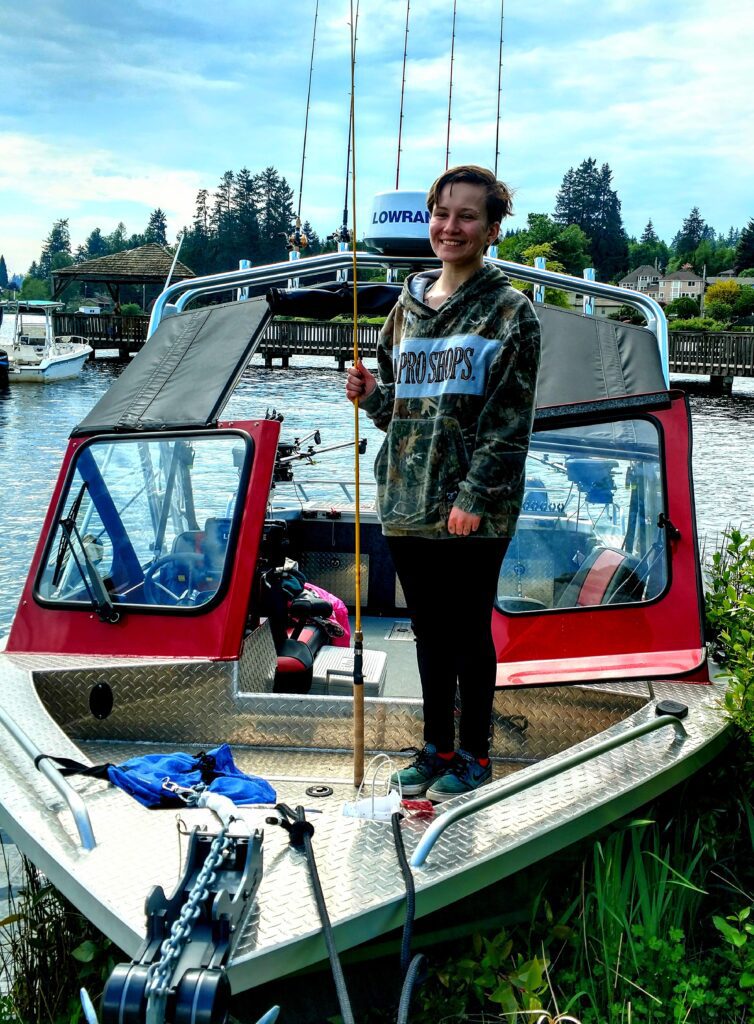
A few years back, one of the kids and I were fishing at the Lake Stevens Kokanee Derby. We ended up losing a huge kokanee. When I looked at the rig afterward, the trailing hook had come unraveled. It was a home-tied kokanee fly and after catching many fish it had just failed. There’s peace of mind in knowing that your gear is in tip-top condition.
Now is a great time to develop your Kokanee game plan. With all the PNW Kokanee lakes to choose from, my recommendation is that you choose a Kokanee lake close to your home. Somewhere where you can fish both on the weekend and during the week as your schedule permits. Don’t fret about the size of the fish or even the numbers. This will be your learning/confidence building lake. Learn your boat, fish finder, downriggers, trolling speed, lure presentation and generally become the local expert while building confidence in your kokanee angling abilities. Then, whether you’re fishing a new lake or fishing a frequently visited lake the lessons learned at your home lake will help you catch kokanee with confidence.
Kokanee are filter feeders, and the bulk of their calories come from plankton blooms. There are windows any given day where a bloom or hatch will occur, and the kokanee will briefly leave their comfort zone to feed. Because the bite may go off at 2:08-2:24 with your gear running at 43’, it is best to choose a kokanee lake close to home and as said before learn it. Especially when late winter or spring kokanee fishing, keep a detailed fishing log.
Be the local expert and share your hard-earned knowledge. Back at the ramp… “Yeah, it was great fishing today… Good luck, tight lines and may your cooler be full”
Although I align my tactics for a given lake, seasonally I don’t really change my overall approach much. The usual kokanee drill: a small dodger, lure with tuna corn is a great place to start when hunting for spring kokanee. Make sure you have your favorite scents, maybe a container of worms and additional leader onboard. Not always but occasionally you will need to revise your leader length. When trolling for spring kokanee you will want to run 0.8-1.2 MPH. “S” turns or tools like the iTroll “Hunt” mode help. Make sure to make a mental note of what’s working when you get bitten. “Monkey see, monkey do” strongly applies to kokanee fishing. Repeat what works.
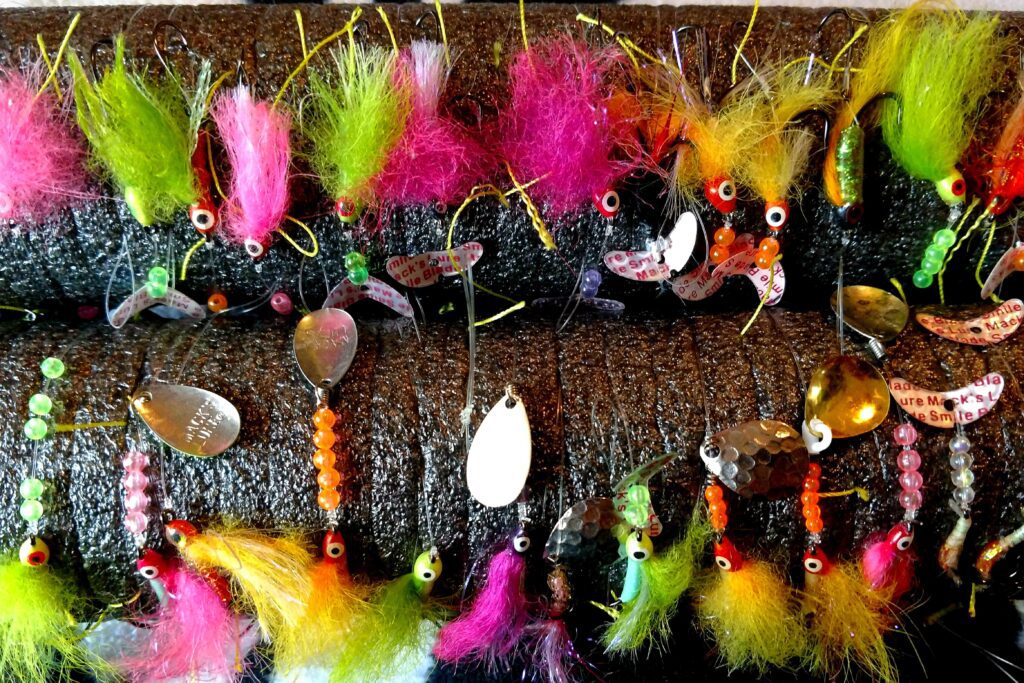
Our dodger box has more dodgers in it than most but during the spring Kokanee fishery my go-to dodgers are painted dodgers in various colors. Using either spinner rigs, flies or a very small Spin-n-glo behind the dodger seem to consistently produce kokanee during the spring fishery. After you hook your prize, gently fight the fish. Always lead the fish to the net, don’t repeatedly stab at the fish with your net and hope that the slimy bugger ends up in your cooler. As with any kokanee fishery, a long-handled net will increase your actual catch verses hook up statistics.
During the spring the lake temperatures should be down. But still make sure you still care for your catch. Bleed them and keep them on ice or even better in a slurry (ice, water, and salt) in your cooler. You’ll want to preserve the quality of your hard-earned prize.
Kokanee are a noble opponent. They often make short runs, jump and go bonkers at the net. Summer fish are more aggressive, but spring kokanee take more finesse to get them in the net. After grilling, smoking or chowderizing hundreds of Kokanee, both the summer and the winter fish are excellent table fare. But the early spring fish are outstanding for whole or fillet panfries and grilling.
The above is just a starting point. Choose a lake, learn it and you’ll soon be the local expert! Trolling for Washington State kokanee can be frustrating. But, with the management challenges impacting most of our salmon fisheries; a bit of kokanee frustration will quickly become an addiction. Enjoy your spring koka-energy!
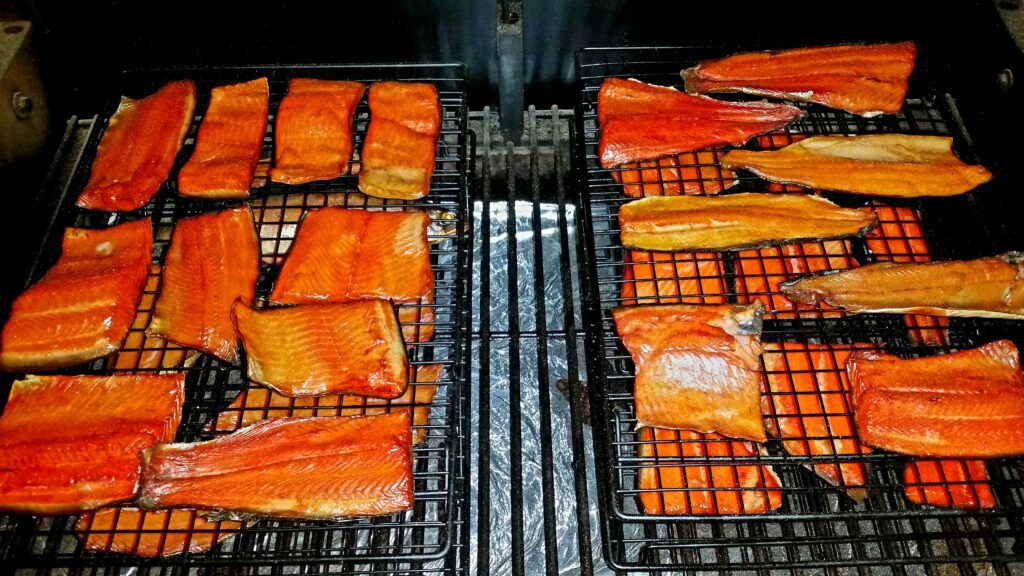
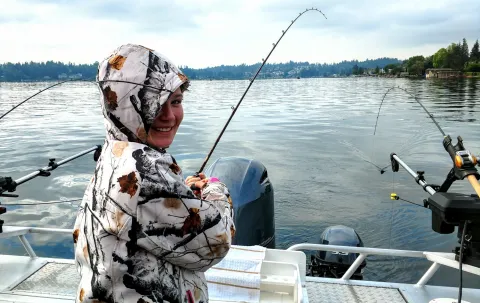
/articles/spring-kokan-energy