Kokan-Eye Eyesight Colors and Presentations
Make no mistake, kokanee can see up, down, and all around. They see close up and farther out (depending on water clarity) at the same time, but not as clearly as we can. They can see effectively behind them as they swim, because their undulating swimming motion turns the head just far enough to see very near the plane of the tail.
Color Shift At Depth
Since sight is part of the effective formula, you must make sight important in your presentation. The very last thing you want is for your lure to be camouflaged. You want it to be noticed. You work against yourself if your target winds up being camouflaged because you have not accounted for the three things that change your lure's appearance at depth:
- Lack of light at target depth;
- Color shift (attenuation), making your lure dull gray; and
- Lack of contrast (conveys information about shape and form)
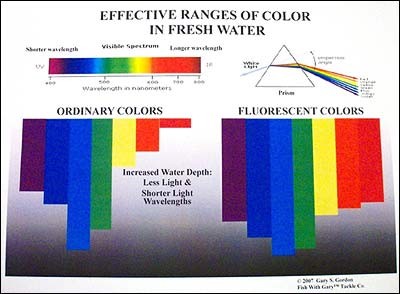
Consider what it is that you are trying to do. You want your setup color-wise to be different than the water surrounding it. If your setup contrasts with the water it is in, it has a far greater chance to be noticed and targeted. Remember, we are seeking a striking response. Your setup must appear different than the predominant color of the surrounding water at that depth.
As we descend the water column, certain light wave frequencies are absorbed (because water absorbs light). Here is the other prong of that absorption concept. As we go deeper in the water column, some of the colors we see at the surface will no longer be the same color at depth. At this point in the discussion, I am speaking of ordinary colors - the color spectrum we can see. Fluorescent colors will be discussed in a moment.
The longest visible color wavelengths are the reds. Shorter in descending order are orange, yellow, green, blue, indigo, and violet. As you descend the water column, the longer wavelengths are absorbed, leaving the shorter wavelengths to continue down the water column. Those shorter wavelengths will ultimately be absorbed, even in the clearest of water, provided you go deep enough. The kokanee fisherman is dealing with depths generally down to 100 feet, give or take. The typical kokanee body of water will have no light in the later season beyond 75 feet. In the very early season, there may be no light at 30 feet.
As you recall from last month’s article, the proper target depth for kokanee fishing is 54 degrees. And since that temperature descends the water column as the season wears on, the resulting less light at your target depth also means that certain ordinary colors are no longer what they appeared to be on the surface because their wavelengths have been absorbed. If you use such a color at depth, your presentation will be gray and not have much contrast to the water it is in.
A lure of ordinary red will virtually disappear in but a few feet of water. Soon to follow would be the ordinary orange, ordinary yellow, and then ordinary green. Also, about that time would be ordinary indigo and ordinary violet due to the structure of water and the use by phytoplankton of these frequencies. If you take an ordinary red object into a dark closet and shine orange light on it, the red object will appear gray. If you take an ordinary green object, and test it the same way with blue light, the green object will appear gray.
For the object to be seen in its correct color, it has to be struck by a light frequency of equal or higher wavelength. In these examples, if you take a green object and strike it with red light, it will appear green. If you take the green object and strike it with orange light, it will still be green. For ordinary colors, the deeper you go, the very light necessary for that color to be that color, has likely been absorbed in the water before you reach your target depth. Without the right light wavelength hitting it, it will be dull gray and not at all distinctive to the water that surrounds it. The little remaining visible light at depth makes the dullness even duller
Our lures are rarely of a pure color wavelength. But even the mixing of colors (hues) will still be subject to the same color deterioration at depth. Pink is a good example. Pink is not a color of the visible spectrum, but is a mixing of red and white. White is not a color of the spectrum, but is all colors of the visible spectrum. Thus in pink, a little of the color will respond to green and blue wavelength at depth. But the color intensity will be mostly dull. From what you now know, ordinary pink is not the ideal choice for getting noticed at depth.
While this might seem confusing to us above water, it is still the reality of the color situation in the water and at depth. Perhaps some encouragement is in order. To be "expert" of color at depth you need not memorize anything. Because most of our kokanee fishing occurs in green or blue light wave frequencies, we want all of our presentations to show up in green and blue light.
Fluorescent Colors
Enter the amazing world of fluorescent colors. No intense scientific discussion is needed here. What you need to know is this. A true fluorescent color will remain its color when struck by a lower light wave frequency. If a true fluorescent orange is struck by a green light (lower frequency than orange light), it will remain orange. The same is true for all of the fluorescent colors. And that means that if you use true fluorescent colors in your setup, your setup will be seen at depth. True fluorescent colors tend to be brighter as well, making for higher visibility.
Not all materials on the tackle market are of true fluorescent colors. You can easily test whether a color is a true fluorescent by taking your lures and dodgers into a dark closet and then shining a black or UV light on them. If the color seen is the color you saw in full light, you have a fluorescent color. Again, there is a difference in intensity of the color. Just because a material is fluorescent does not automatically mean it is intense.
U.V. light is below the visible spectrum (of lower wave frequency), which means it cannot be seen directly. All U.V. light is dissipated in very shallow fresh water holding kokanee, because the water, plankton and other particulates in the water absorb all of it. It is well documented that there will be no U.V. light in the freshwater column below just a few feet.
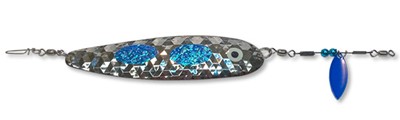
I have tested lures labeled "U.V." Most work very well in waters holding kokanee, and in particular, the UV squids should be a part of your tackle box. However, lures labeled "U.V." would be more accurately labeled as "fluorescent." These "U.V." lures come in visible colors. Since UV is not visible, the color you see is fluorescent. As with all fluorescent colors, stimulation by a black light will make the color jump out at you. But these lures are in fact, only fluorescent. But that is why they are good. They still need some visible light at depth to be most effective. They do not glow. Match one of these "UV" (fluorescent) squids with a Fish With Gary™ POWER Dodger, and you have a great setup.
Using true fluorescent materials in your setup will resolve issues of color shift in your favor. While some fluorescent colors will fade somewhat the deeper you are in the water column, they still are not gray if there is some light available to act on them. When using true fluorescent materials, the colors you are delivering at depth are those NOT ordinarily seen at depth. And that is exactly the effect you want. Your setup will be out of the ordinary, and kokanee will focus on it in the near field.
Vital Contrast
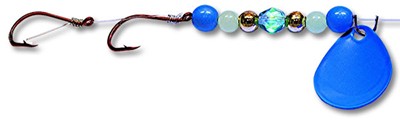
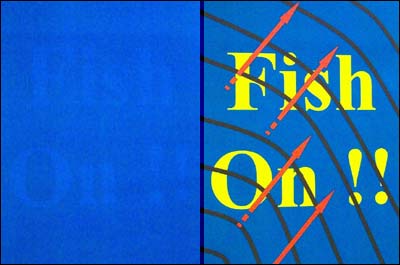
Using fluorescent materials is not the only way to get your setup noticed. Remember that you are after contrast, or what I call vital contrast. Vital contrast can be obtained by using different fluorescent colors next to each other or spaced in such a way as to create the illusion of not being connected. Components that contrast with themselves will stand out even more in dull watery depth.
Contrast is the enemy of camouflage. Contrast is the better-developed part of kokanee vision and encompasses about 10 times larger visual window area than does color. The color window is directly in front of the kokanee, but contrast is not only seen in front, it is seen up, down, sideways, and backwards. Contrast vision overlaps color vision. Effectively presented, color is a great contrast. When color and contrast are effectively presented, color and contrast are in front of the kokanee to see and react to them. This allows the kokanee to put its mouth where the color is, which is pretty much what you want!!
Glows
There is another fantastic way to achieve this vital contrast at depth, and that is the use of glows. Glows are termed phosphorescent (or luminescent) as they carry their own light to depth. No intense scientific discussion is needed here either. Glows emit light when the light source that charges them is removed. On the other hand, fluorescent materials appear brighter in light, but do not glow when that light is removed.
Most glows on the market and peddled to fisherman are of very poor quality. Their glow simply does not last even long enough to make it to depth, let alone work for you at depth.
All Fish With Gary™ glows are of the highest quality and are termed extended glows for good reason. The natural glow beads in particular will glow for hours on a simple charge of sunlight for a few minutes. Stimulation of glows by using a black light is not very efficient, and the resulting glow does not last as long as sunlight stimulation.
Glows clearly take on more importance when the level of light is less in the water column. As you descend below light in the water column in later season, glows make visible what would otherwise be invisible. And if the surrounding water is pitch black, the glow of light most certainly is the kind of dramatic contrast that will get your setup noticed.
The Ideal Presentation
The ideal presentation in achieving vital contrast is one that makes generous use of fluorescent materials and glows, arranged in such a way to be in contrast with each other and in contrast with the surrounding water. And this is exactly what is incorporated into the entire Fish With Gary™ Tackle line.
While the dodger blade attracts far field (long distance), the beads, and the spinner(s) on the leading wire are near field (short distance) attractors.
Here is what is going on with the beads and spinner in front of the dodger. Because the beads and spinner(s) are being moved about by the dodger, they are creating short field sound. The spinner(s) do not consistently spin as you would expect. Instead, their movement in the water makes the spinner(s) come in contact with the glass beads. Metal versus glass produces a sound. In this case the two produce an irregular sound that alternates with some spinning, and some "tap-tap" of the metal on the glass.
There is nothing in nature that this imitates, and this sequence of short field sound is itself a contrast to the natural water environment. Add to this is the natural movement of the glass beads working against themselves as this setup is whipped through the water. And all of this is going on while your dodger is still producing far field sound, attracting other kokanee to your setup. A gathering of kokanee is more likely to result in a strike than a single kokanee.
While your sound generating machine is working, your kokanee has been drawn close enough so that the colors and contrasts are within its sight window. A curious thing happens at this point. Having been drawn to the sound, the kokanee will see a particular color and contrast sequence. Once seen, this color and contrast sequence effectively imprints the kokanee with that combination, even if briefly. If your dodger and the upfront beads and spinner are of the same color and contrast, you increase that imprinting. And if your lure is of the same color and contrast, then you give the kokanee a target that it does not fear. That is why it is absolutely critical that your dodger setup and the lure be matched.
The lure is making short field vibrations and adding color and contrast, and adding scent.
So now you have the complete picture. Far field vibrations attract, short field vibrations and colors in consistent vital contrast imprint the kokanee and provoke the strike.
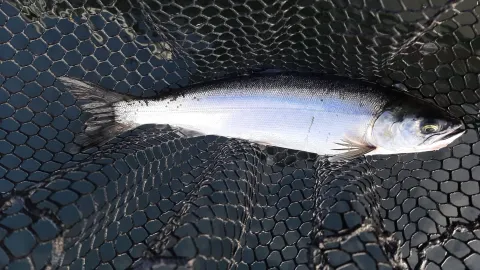
/articles/kokan-eye-eyesight-colors-and-presentations
Seven Oregon Kokanee Lakes to Fish This Year
Kokanee, which are a landlocked sockeye salmon, can be found in a couple of dozen or so lakes in Oregon and are some of the best eating at any fish fry. This year, we did the scouting for you. Here are seven lakes and reservoirs you must fish in 2025.
LAKE BILLY CHINOOK
At Lake Billy Chinook, it’s not hard to imagine the old river channels – the Deschutes, the Crooked, and the Metolius and their confluence, now obscured by 4,000 surface acres and up to 415 feet of water.
Round Butte Dam was finished in 1965, and the power of the water was harnessed by three 1000-kilowatt generators. Today, the Pelton Round Butte complex generates enough energy to power a city the size of Salem.
Kokanee angling is popular here, and anglers show up as early as February, teasing them with jigs early in the season. Trolling pays off later in the year.
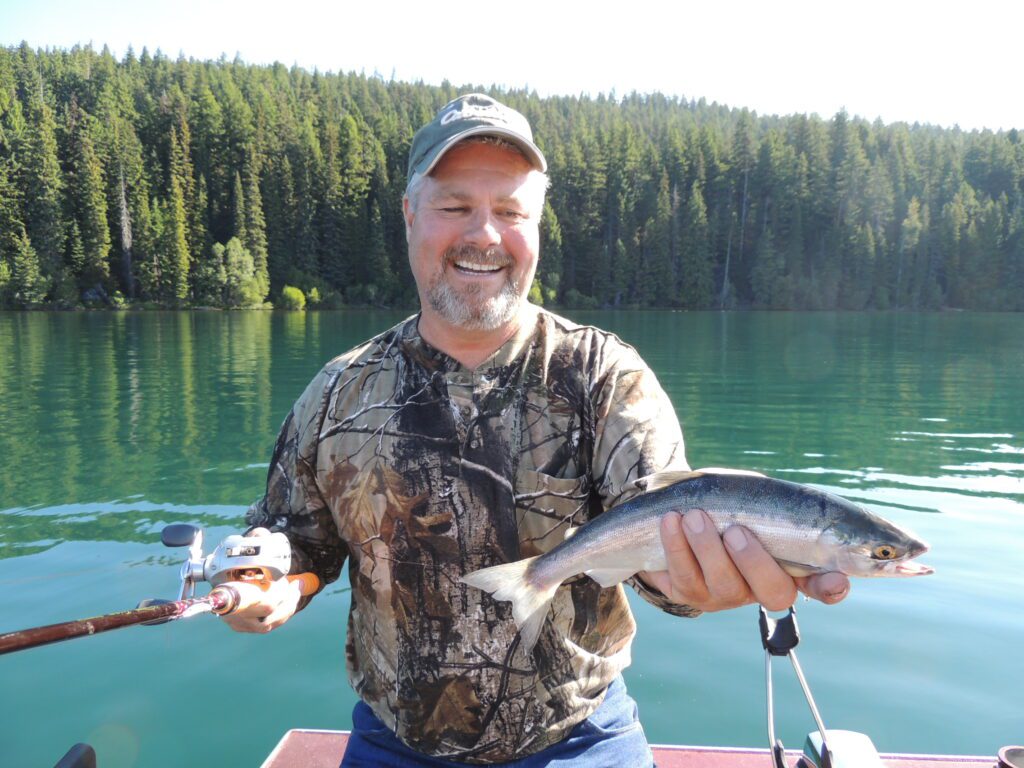
ODELL LAKE
Odell Lake (and nearby Crescent) are some of the coldest, deepest lakes in the state, which makes them good habitat for a big char we call lake trout or mackinaw. Odell and Crescent also have good populations of kokanee (a landlocked sockeye salmon), the lake trout’s favorite food.
Kokanee can be easy to catch when conditions are right. Full-grown, they average 12 to 18 inches. Kokanee are most easily enticed in the early morning. As soon as the sun hits the water, the plankton go deeper, and the kokanee follow.
Jigging is a favorite technique early, but trollers seem to do better in the summer. An easy rig, whether using a downrigger or not, consists of an eight-inch flasher on the main line terminated at an Apex or Wedding Ring spinner. Most anglers add white corn and season it with a scent like Pro-Cure's Kokanee Special Super Gel. To rent a cabin or a room, click on odelllakeresort.com
WALLOWA LAKE
Sockeye are native to Wallowa Lake. Historic runs of sockeye were strong in Wallowa Lake until 1916, when the lake’s dam was enhanced. The fish still in the lake were landlocked.
Wallowa, with 1,500 surface acres and an average depth of 160 feet, can be daunting. Favorite kokanee areas are the western shore off Eagle Point and along the eastern bank up and down from the large pine tree. Try jigging after ice-off and then switch to trolling in the summer. Great trolling lures include Pro-Troll Kokanee Killer, Worden's Spin-N-Glo Kokanee, and Mack's Double Whammy.
For a great place to stay, check out wallowalakelodge.com
WICKIUP
Wickiup as a storage reservoir is one of the largest in the state, and its waters harbor rainbows and brown trout. And the kokanee grow big, too.
Fed by the Upper Deschutes via Crane Prairie, the Davis Lake sump, Davis Creek, Browns Creek and several springs, some of the best fishing is in the old channels. At its deepest, the lake is 70 feet deep, but the average depth is 20 feet.
Kokanee are spread throughout the lake early in the season, but tend to school up and head toward deeper water (the channels) as temperatures warm. Both jigging and trolling are productive throughout the season.
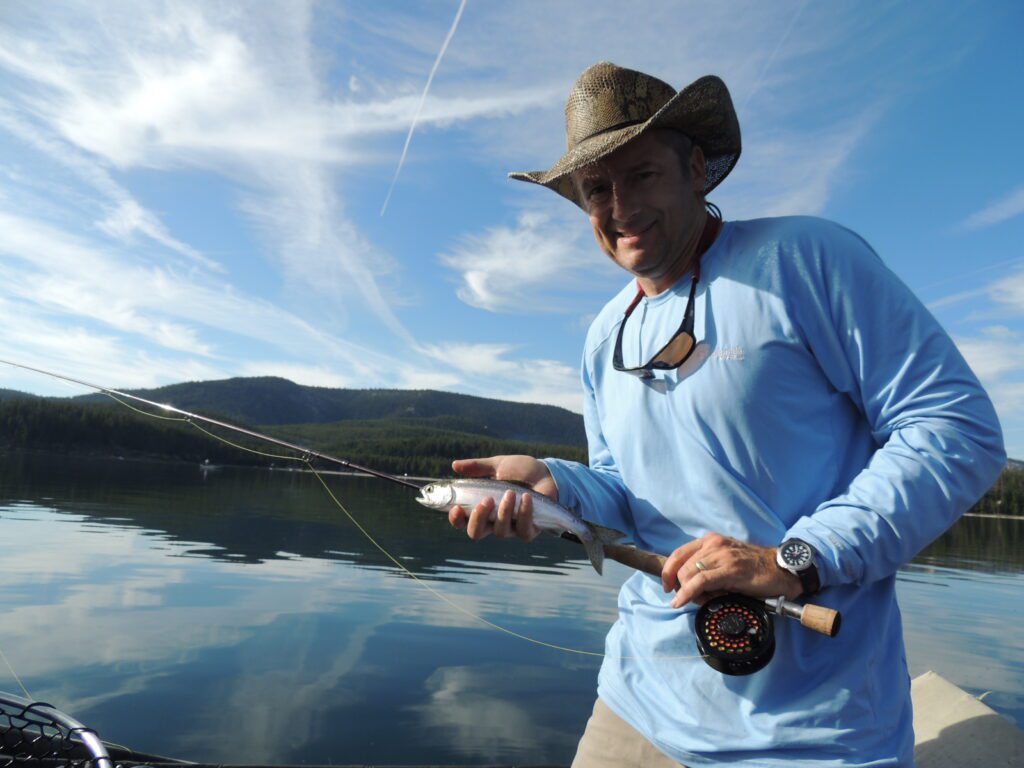
EAST LAKE
East Lake kokes average 12 to 17 inches. While kokanee are known to feed on plankton in most waters, the most reliable food sources at East Lake are the chironomids and midge larvae (chironomids). This is the reason a lot of people who are good kokanee anglers sometimes struggle at East.
Jigging works best early in the season and trolling takes more trout later in the season. Fly-anglers can take kokanee all season long on wind-drifted Callibaetis nymphs or on chironomids fished below an indicator.
PAULINA LAKE
Paulina Lake shares the caldera of Newberry National Volcanic Monument with its twin East Lake. This 1,300-acre lake is 250 feet in some places. Kokanee fishing is the main attraction and trolling flashers is the most popular method. Trolling a Wedding Ring with a kernel of corn or a chunk of worm on the end is very effective. Other great kokanee lures include the Cha Cha 1.5 Kokanee and the Kokanee Killer.
Jigging is the other way to catch them at Paulina, especially till about mid-June. Mack's Cripplure and Sonic Baitfish are productive, as are Nordic lures. First locate schools with a fish-finder and, depending on the depth, troll with a downrigger, flashers, a kokanee spinner and a kernel of corn on the hook. Or drop down a jig and try to put it in the school.
DETROIT RESERVOIR
The Detroit Dam was built in 1953, creating a large water storage and electric power generation reservoir that has become an important recreation resource. This nine-mile lake, with 32 miles of shoreline is surrounded by forest of Douglas fir and hemlock and is fed by the Breitenbush River, North Fork Santiam and Blowout and Kinney and several smaller creeks.
ODFW stocks Detroit with rainbows throughout the season. This 3,580-acre reservoir is also home to kokanee. Angling success picks up in May when the water warms.
Try the Kokanee Kid Mysis Bug or Promise Ring made in Salem, Oregon. Other good bets include the Silver Skalez Koko Leaf or Kokanee Creek Tackle 1.5 Micro Bite Squid. Popular trolling areas include Piety Island, west of Mongold State Park, the north shore near the dam and at the mouths of inlets.
AND FURTHERMORE
Some of our favorite fisheries were destroyed in 2023 and another one may be destroyed this fall.
One of the best kokanee days of my life was on Green Peter Reservoir. GPR had a seemingly inexhaustible supply of kokanee and if you figured them out on any given day, you could not go wrong. What did the Feds do? The US Army Corps of Engineers decided to drain Green Peter and Foster and wiped out some of the state's favorite kokanee fisheries while simultaneously silting over and smothering salmon and steelhead and trout spawning beds in the South Santiam for miles downstream. Brilliant.
Think they are done? The National Marine Fisheries Service and the Corps of Engineers have their fish-killing sights set on Detroit Reservoir and the North Fork Santiam now. So go fish Detroit this year and I hope you catch a bunch of limits and have a good time, but don't forget the very agencies that purport to be working for the people are often working against us and the fisheries we love.
# # #
For a copy of the Fishing Central Oregon book, send $29.99 to Gary Lewis Outdoors, PO Box 1364, Bend, OR 97709 To contact Gary Lewis, visit www.GaryLewisOutdoors.com
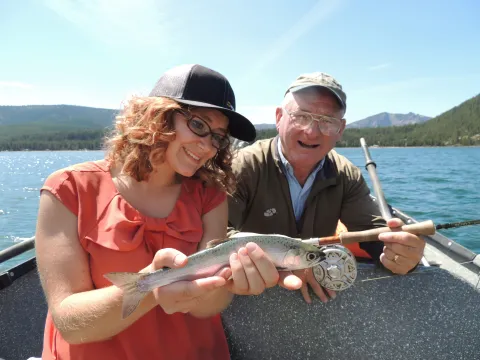
/articles/seven-oregon-kokanee-lakes-fish-year
Chironomids in Stream Channels
If everything is as it should be, there are two flies in the danger zone. For me, in most cases, I want a No. 10 red chironomid hung just over the top of the weeds, while a black chironomid rides about 18 inches above it.
Studies have been made on a number of lakes to determine the main food source for the trout.
Chironomids are midges, which look a little like mosquitoes, but lack that terrible creature’s bite. On many lakes, the midges make up close to 40 percent of a trout’s annual food intake. If there’s nothing else going on, you can bet the fish will eat a chironomid. But fishing a chironomid is different than fishing imitations of other bugs.
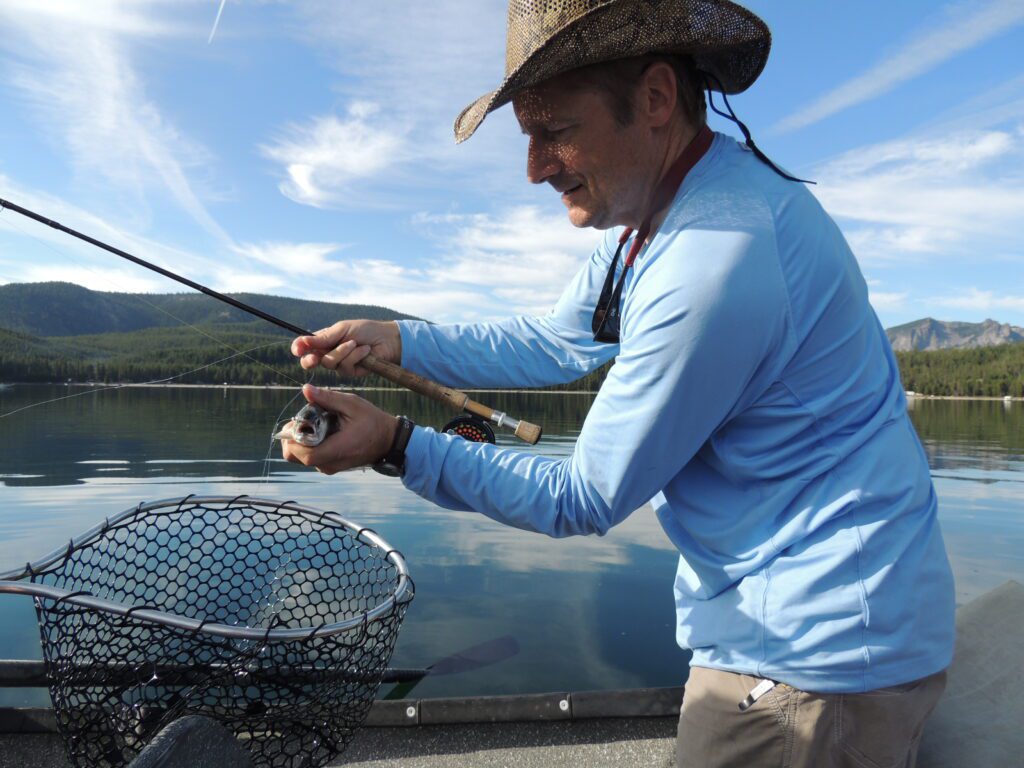
Midges don’t have legs or tails like mayfly nymphs or damselfly nymphs. So you want a vertical presentation instead of a horizontal presentation.
As chironomids hatch, they are trying to produce oxygen between their exoskeleton, their nymphal shuck, and the adult body. They come up out of the mud and they suspend about 12 to 18 inches above the bottom, for up to an hour. That makes them vulnerable to rainbows, browns, and cutthroat.
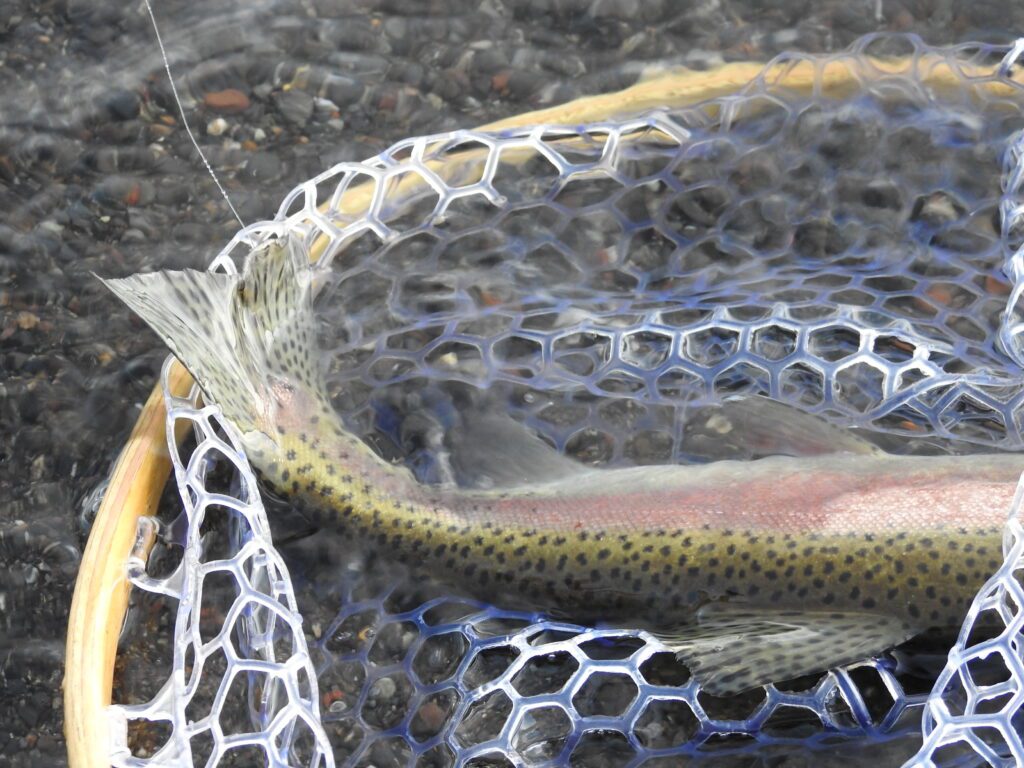
Chironomid imitations work wherever trout make a living. The hardest thing about it is the fish don’t set the hook themselves. You have to watch that indicator all-day
In Central Oregon, we fish chironomids on East, Lava, Little Lava, Hosmer, and even Wickiup for browns. They are a major food source for a lot of insect-eating trout. The tactics do not change that much except for the depth the angler is fishing.
From outside the boat, it looks like a boring way to fish. I beg to differ. Some methods are more suited to small fish, while other strategies are better suited to big fish. But all trout, big and small, eat chironomids. Setting the hook is like pulling the lever on a slot machine. Especially on reservoirs with submerged streambeds like Crane Prairie, Haystack, Prineville Reservoir, and Timothy Lake.
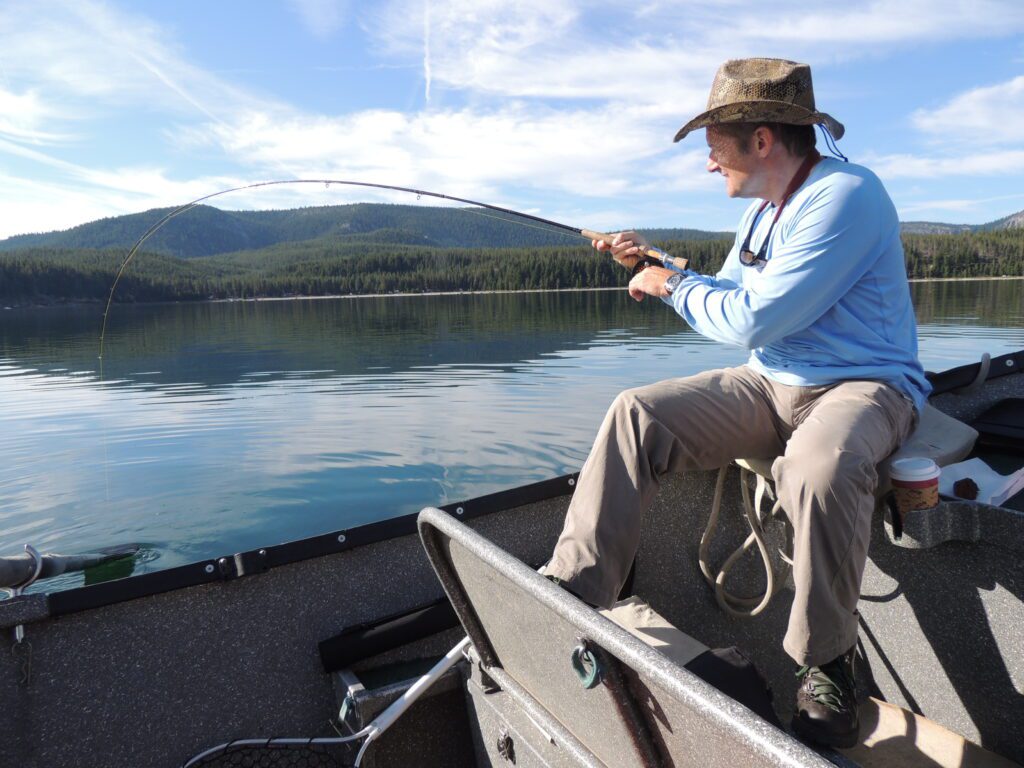
the trick is finding the old river channels. As the average lake temperature warms, the fish move into the cooler river channels and use them as highways to move around. The channels average 12 to 13 feet deep and are relatively weed-free with a sandy or silty floor.
So what you have is a 90-degree angle coming off your indicator. If you move your indicator a couple of inches. You give it a twitch and it rises up a couple of inches then settles back down. Vertical action is what you want with chironomids.
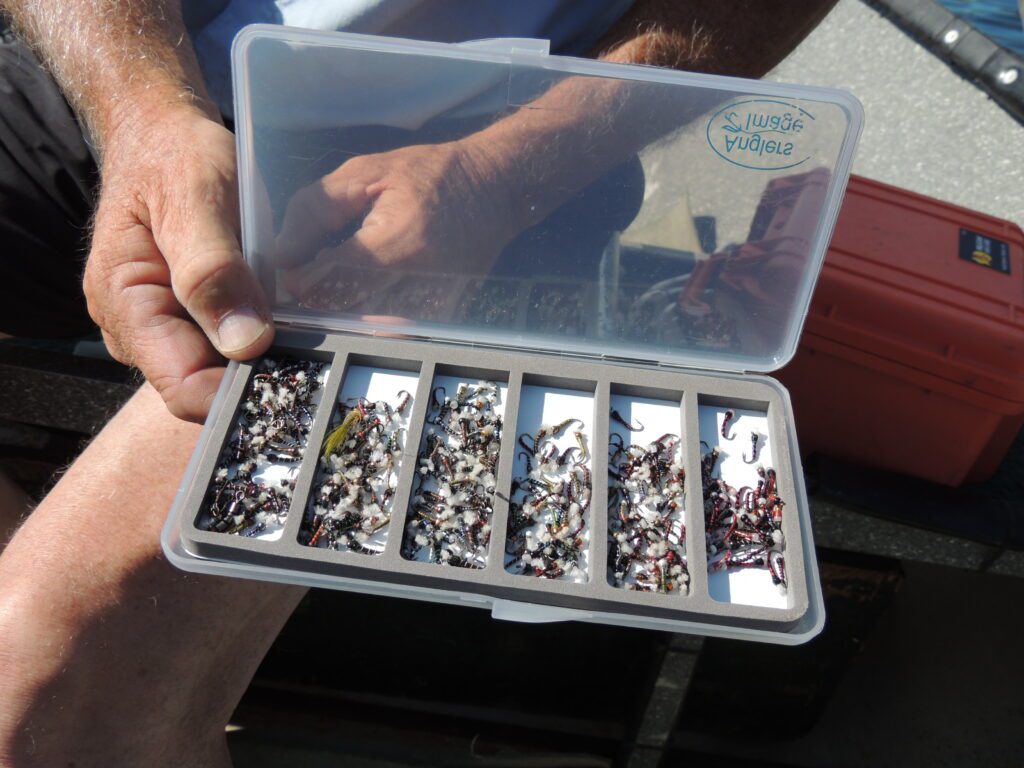
Photo by Gary Lewis
Reds and black are the primary colors most anglers use in Central Oregon, but olives and browns can also work. More important than color is to present at the right depth. The fish is probably more attracted by the silhouette of the midge.
One of the things we tell ourselves is we want to find the depth where the feeders are working. My friend Scott Cook calls it finding the feeders. If a certain depth is paying off, try to bracket all the flies in the boat around that part of the water column.
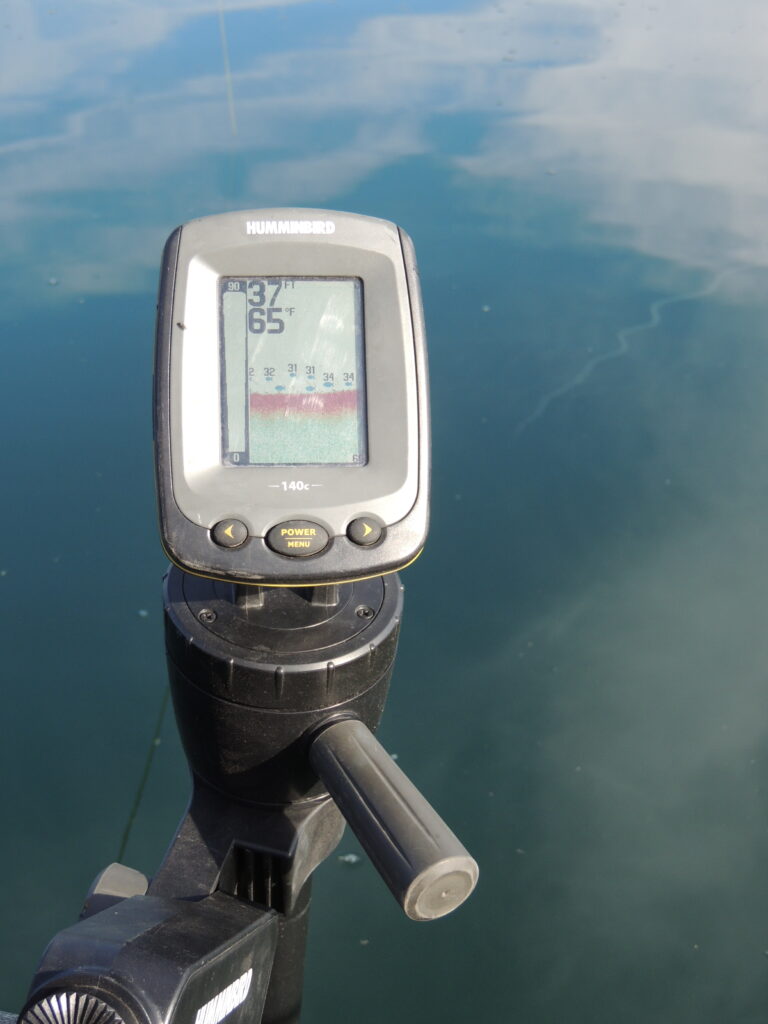
A depth finder can help locate schools of feeding fish.
Most chironomid fishing takes place at a depth of six to twelve feet below the indicator. I like to use a nine- or ten-foot leader tapered down to a 4X fluorocarbon tippet. Again knotted to a No. 10 chironomid with another chironomid on the dropper.
Any time the indicator goes down, the fish could be 10 inches or 10 pounds and you don’t know until you set the hook.
There are times when the small flies can get bit in deeper water. When trying to fish down at 15 or 20 feet, try using a very fast sinking line - like with a type 3, 4 or 5 - and retrieve it VERY, VERY slow. The trick is to work the fly in a vertical presentation, retrieving it up through the water column.
# # #
For a copy of the Fishing Central Oregon book, send $29.99 to Gary Lewis Outdoors, PO Box 1364, Bend, OR 97709 To contact Gary Lewis, visit www.GaryLewisOutdoors.com
/articles/chironomids-stream-channels
Hoodsport Chum
Editor’s Note – this article was first published in November 2019.
For salmon anglers in the Pacific Northwest, November heralds the final transition from targeting open saltwater to focusing on tidewaters and rivers. Yes, there are some saltwater opportunities (for example, blackmouth, when open), but the vast majority of anglers have put away their boats and are pursuing salmon in the rivers. That said, there are some prime opportunities to target and catch salmon out of your fishing boats, so don’t button them up just yet!
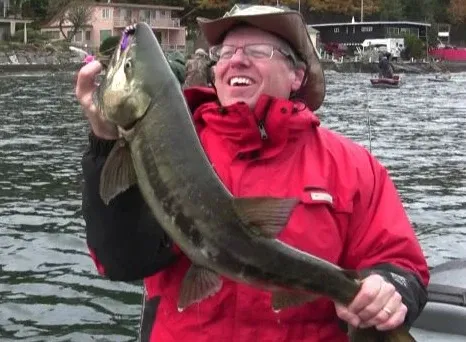
One of my favorite fisheries out of my boat in November has to be the Hoodsport chum fishery. The fight of a 10-15 pound chum ranks up there as one of the hardest fighting salmon you can catch. Taking on a chum with steelhead gear will give you all the battle you could ask for as these brutes slash and pull with every ounce of energy they have. One look at their fighting canine teeth and you’ll know this is a fish that is serious, very serious, about its reproducing goal.
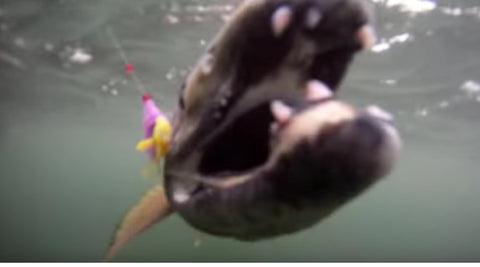
All up and down Hood Canal you’ll find chum as they work their way toward their spawning grounds. The state hatchery at Hoodsport and three miles south of there at Potlatch (a smaller, Native American hatchery) are the destination for many of these chum as they work their way down Hood Canal.
I have caught fish in both locations, and each spot has reason to recommend it. Potlatch, being smaller, has limited shore angling and parking, which is roadside only. That said, there are also fewer anglers there. Hoodsport, meanwhile, is the Fishing Mecca that chum anglers are drawn to. Fishing right out in front of the hatchery and watching hundreds of fish jockey for position as the tide sweeps them into the small feeder creek leading to the hatchery is truly a sight to behold. Of course, along with the fish comes combat fishing in all its glory. As the tide comes in and fishing space decreases getting to know your neighbor takes on a whole new meaning.
If you’re a fortunate one you’ll be fishing out of a boat – or some type of floating device. The waters around Hoodsport are open and the wind can come up and blow hard, plus fast running tides can make it a challenge to get an anchor to set. Be sure to bring an anchor with some bite, and terminal chain so you’ll stick in the rocky bottom. I’ve seen anglers fishing out of all manner of floating devices on calm days, including single person pontoons and float tubes.
Be sure to have your life jackets on and just don’t venture too far off shore. If you are feeling anxious that’s your inner voice telling you a fish isn’t worth your life – pay attention to it!
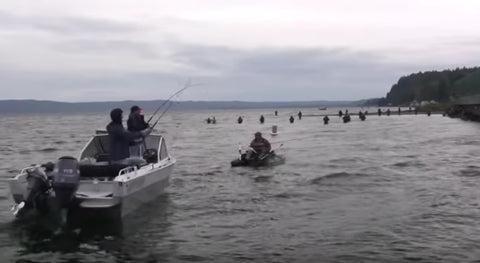
For boaters, the launch is two miles south of Hoodsport at the Skokomish Park at Potlatch. The launch has two concrete lanes which are in varying state of repair (read that as back down with caution!). There is ample parking, and a restroom. Once launched it’s a quick run to either terminal hatchery, faster to the small Potlatch facility.
When you arrive, survey the already anchor boats, taking into account the amount of anchor line you’ll need to get a solid grip on the bottom, as well as the shore anglers. Anchoring too close to the shore bound anglers will earn you a steady rain of lures and weights at your boat. Stay outside their casting zone - you’ll have plenty of water to work over and opportunities to catch fish the shore anglers don’t have.
As to the type of gear you should bring… you’re going to enjoy a variety of methods to catch these Hoodsport chum. Like chum everywhere, chartreuse and green are always great colors to choose. Pink or cerise is also good color choices.
For rod/reel setups I use my steelhead gear, both spinning reels and casting will get the job done. I like an 8 ½ foot medium action rod. Line should be strong enough to turn these big brutes so as to avoid massive tangle ups with your fellow anglers. I like 18-20 pound test. Chums are not leader shy in my experience so keep things hefty.
What technique you use is up to you but here are a few tried and true methods:
Floats and jigs , or floats and corkies with yarn can be deadly. A ¼ or 3/8-ounce pink, black or purple marabou jig fished under a float is deadly. Tipped with a piece of shrimp meat or coon shrimp tail is even better. The yarn is a nice trick as it helps by getting caught up in the chums teeth, allow you to drive the hook home. Other bait you can put under a float includes the ever popular anchovy or herring, whole or plug cut.
Think of the tide as the river current. Set your depth for the lure so it’s running a foot or so off the bottom. Vary the depth if you aren’t getting bites. These fish will hit suspended jigs. Cast “upstream”, i.e. up into the tide, and let your gear drift down with the tide to the end of the “drift”. If the coast is clear, free spool your line, keeping the float straight up and down to extend the drift. When the float goes under set the hook and be ready to do battle!
Twitching jigs – ditch the float and cast the jig on its own. Another effective technique, but be prepared for a lot of foul-hooked chum. Dragging a chum in by the tail is not fun, nor is it sporting to be snagging fish. If you find yourself foul hooking too many fish move on to a different method…
Casting spinners. Again, it’s a solid technique to try if the action is slow. I personally would remove the treble hook and use a single si-wash hook. A number 3 or 4 blade fished with a slow retrieve is just the ticket.
Corkie, yarn, and slinky. I personally have caught a lot of fish using this method and seldom snag fish. Again, think of the tide as a river. Cast out and let your gear drift. You’ll know you have a bite because your rod will be about ripped out of your hands. I use a 3-4 foot leader length.
Regarding the above technique, I’m sure I’m going to get comments about flossing – I personally think it’s a bunch of malarkey. Why do I say that? Because I remember a day years ago fishing Hoodsport when the chum were in thick, jumping all around us, swimming by in schools of 10-20 fish. I had my corkie/yarn/slinky set up going, casting, retrieving, and not getting a bump for a good hour.
Suddenly, the bite magically turned on and my gear started getting bit. In came fish after fish, hooked in the jaw. Explain to me how one can have a steady procession of fish go by with mouths open for a good hour and not “floss” one fish, then suddenly start catching one jaw hooked fish after another? And trust me when I say this, those hook-ups were solid strikes, not to be mistaken with a snagging sensation. Anyway, the flossing debate is one we anglers love to engage in every year and likely will do so as long as we fish corkies.
The fly fishermen do quite well at Hoodsport as well, fishing sinking tips and flies of various styles and colors. I’m not a fly guy but it sure does look like fun. Maybe my next trip I’ll give it a try.
Before you set out, be sure to check the Hoodsport netting line at 360-877-5222. Typically the nets go in on Tuesdays and Thursdays, but this is not set in stone. There’s nothing worse than driving a hundred miles only to find nets spread in every direction. So save yourself that aggravation before you set out.
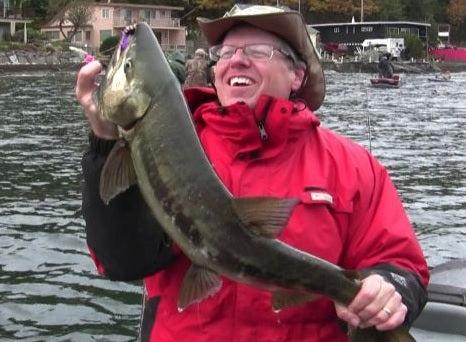
Fishing for hard fighting chum is a blast. Get in on the action this November!

/articles/hoodsport-chum-0
In Search of the Perfect Storm
Snow ain't good enough. Rain is better. The kind of rain that starts about 8:00 in the morning and melts the snow and upwells the river. It's going to be hard to catch a fish, but I only need to catch one.
Two other vehicles in the parking lot. Two other fishermen. Singles, I guessed, reading the tracks in the snow. I sat on the tailgate of the F-150, tightened my bootlaces, and decided to start downstream like a proper fisherman and work my way up. It was Super Bowl Sunday, one of my favorite days of the year.
As I walked down to the river, one of the anglers picked up his net and began the walk back toward the parking area. This was better.
Using a large pine tree as cover, I looked in the water with the glare glasses and saw trout. Noses in the current, but not active. No bugs on the surface either. And as I watched upstream, nothing rose.
At first, I tumbled nymphs to them, high-sticking, watching for the white of a mouth or a rainbow flash in the braided current. I suspected the fluoro leader was not working for me in the clear water. But I hesitate to fish 6X or (shudder) 7X because these bigger fish are likely to break off on the second jump. And besides, the tracks in the snow indicated there had been at least half a dozen anglers here before me.
Upstream there were tails visible beneath a downed tree and I flirted with disaster, drifting nymphs to the otherwise hidden trout in the branches.
Working up, casting bead-head wets, and tumbling them back through the regular slots did not pay off with a take. Now as the sun began to go off the water, it was harder to see into the regular slots and now the snow crunched under my boots as the temperature began to drop.
Where there once were willows to hide behind, I scouted the shallows and ran through channeled lava flows. A few trout here, but their body language reads the same way. If I could see them, they could see me.
Time to change tactics. The beadheads went back in the box and I trimmed the nine-foot leader down to seven feet, trimming the 5X tippet back to 4X.
This next run was best fished by wading in, but this time I would cast a streamer. I knotted on a root beer brown mohair leech.
Here, the water splits around a few boulders and drops fast down a couple of short waterfalls. Trout feed in the shallows if there is a hatch, but hold along a ledge in the absence of surface activity. It's deeper water than most flyfishermen are comfortable fishing, and faster too. But this is where the biggest fish can exist unseen and untouched.
The first cast quartered up, midway across the run with an upstream mend. After a couple of seconds to let the current grab the fly and pull it down, I short-stripped twice and a fish slammed the fly.
It turned and streaked toward the log jam at the bottom of the run, and then turned back upstream to try to see the line on the lava edge. Extending my arm, I kept the line off the rocks and after a couple of minutes where the fish streaked up and down the run, I made the first stab with the net. For a second, the fish was in the net and then it was out again. Praying the 4X would hold it, I waited till its head was up and skated it with my right hand, netting it with my left, turning so the bag would close.
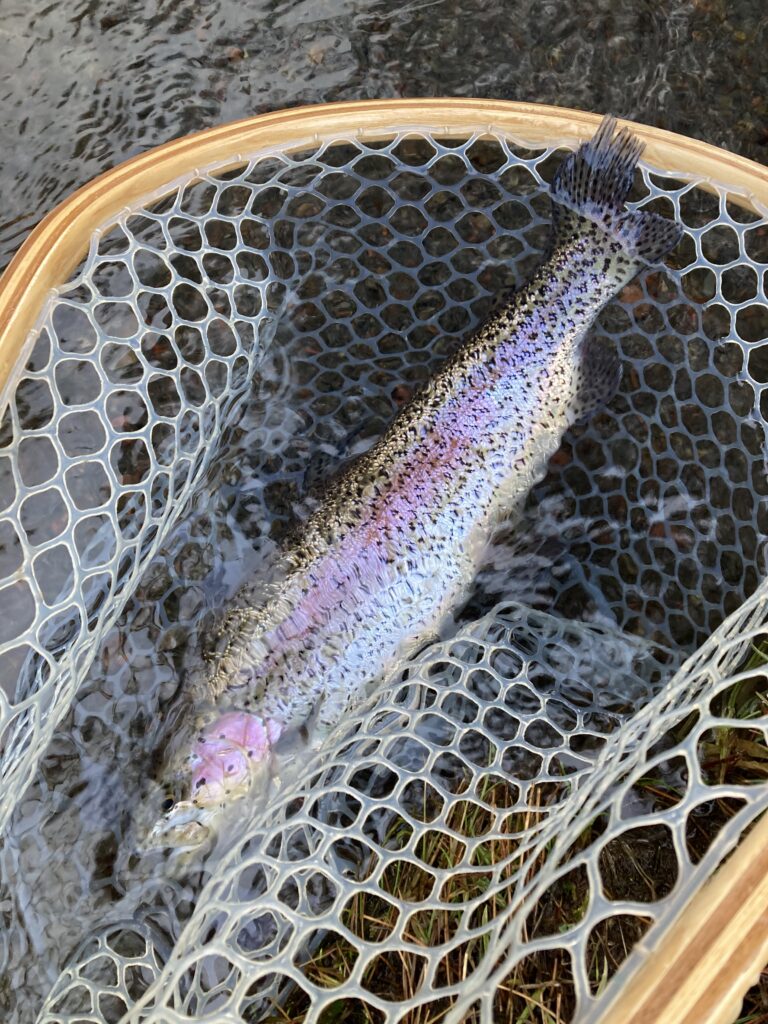
In hand, the fish was beat up. A hatchery survivor, its nose and tail frayed in the jungle of the hatchery raceway. Nineteen honest inches. Shaped like a football. And there and then in that moment, I noticed something else about it. If its head was off, it would fill my Camp Chef cast iron frying pan. So I kept it and cooked it for dinner that night with mayonnaise and angler's seasoning. And fried a half dozen prawns to go with it and proclaimed it a feast.
What I like best about football is it keeps people off the water. Same with a good rainstorm. In fact, where I live, the best scenario is the Seahawks are playing and there's a 70 percent chance of rain. Snow is not good enough. Lots of people around here fish in the snow, but fewer of them will fish in the rain. The only better thing would be if the Super Bowl coincided with Valentine's Day and a deluge. That would be the perfect storm.
# # #
For a copy of the Fishing Central Oregon book, send $29.99 to Gary Lewis Outdoors, PO Box 1364, Bend, OR 97709 To contact Gary Lewis, visit www.GaryLewisOutdoors.com
/articles/search-perfect-storm
Dry Fly Fishing 101
The image of a trout rising to eat an aquatic insect, usually a mayfly of sorts, is the encapsulation of what drives most anglers to pursue fly fishing. I remember as a young boy seeing it happen for the very first time. What seemed like a gargantuan brown trout rose from an abyss to chase, crush, and inhale a grasshopper. I think I was 7 years old. So in reality, that fish was probably only about 17-18 inches long, and the abyss it rose from was more than likely just a plunge pool that was as deep as I was tall. Nonetheless, it impacted my angling future by putting me on a path to learn fly fishing at a very young age.
Almost as quickly as I started, I found out just how difficult enticing a trout to eat a fake fly could be. My grandfather and my dad were kind enough to allow my pursuit of relentless frustration just to the breaking point before they insisted I fish with bait. At 8 years old, my patience wasn't virtuous at all. However, I did have the persistence and drive to succeed, just not the patience to figure out what I was doing wrong. God bless my grandfather and my dad for tolerating me during that time.

Fast forward 43 years and I have a much better idea of how to help new fly anglers get started. There are a couple of key ingredients that reduce the learning curve. First, buy some equipment that works. Notice I didn't say buy some expensive equipment, I said buy some equipment that works. For example, a 9’ 5 weight fly rod is the most universal of all rods. It is the perfect trout rod as well as panfish, and my favorite dry fly fish, the Arctic grayling. Just make sure your 5 weight rod has a 5 weight fly line on it, matched up with a 5 weight size fly reel.
Putting this together accordingly is literally the difference in casting and flailing. There will be some flailing, but not nearly as much if you match everything accordingly. If you are not sure if your set up is right, visit a fly shop for assistance. Any reputable fly shop will be more than willing to help you fuel this latest version of insanity.
So, you have visited the local fly shop, you have everything matched up. You probably bought some leaders, tippet, and a few flies. If it was a really super reputable fly shop, you probably got loaded up on a healthy dose of sarcasm and ridicule. The best shops always seem to have that air about them, but they will steer you in the right direction. It comes from a good place. Armed with your newfound knowledge and gear you need to proceed to step two: find some dumb fish. Really dumb. The dumbest. Find an entire village of idiot fish to cast to. Panfish make some of the best beginning dry fly fish to cast to. They aren't spooky, they eat willingly, and they taste delicious.
There is also absolutely no shame in following the local trout hatchery stocking schedule. Trout raised in a concrete raceway seem to fit the description “village of idiots.” They are used to looking up to eat the food served to them twice a day in the very pleasant, controlled environment of the hatchery. In addition, hatchery trout aren’t typically too spooky. What we are looking for here is bang for the buck on opportunities. In the beginning of your dry fly fishing pursuits, you need a lot of opportunities to fail without punishment. The more times you can make a cast and get results, the more you learn. The more learning opportunities you get, the faster you become a better fly angler. Don’t be bashful about fishing to the village idiots. We can all learn something from them.
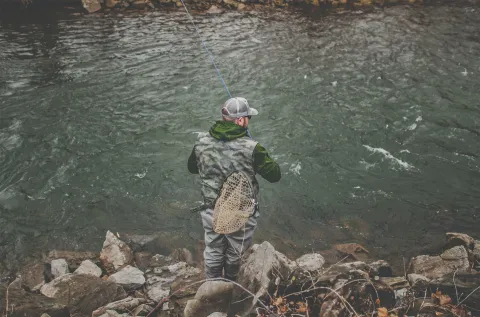
Once you have found your village to fish in, you need to consider what exactly you are trying to do. You are attempting to imitate an aquatic insect that is resting on the surface of the water above the meniscus. If you are lucky enough to live somewhere that has legitimate bug hatches on the trout creeks, stop and watch the bugs float downstream. Watch the trout that rise to eat them. Also watch the trout that rise for the intent of eating an insect but refuse at the last second. That’s just as important. The bugs that are floating downstream with trout eating them are the ones you want to imitate.
Invariably someone out there is currently saying “match the hatch.” It is a catch phrase that I have come to detest and loathe but it does bear some legitimacy. We can worry about the catch phrases later. For now, you just need to focus on making a cast so that your fly looks right to the fish. Ultimately, that is the most important part of the equation. Casting your fly with it splashing the water upon impact has the same impact as the brute squad knocking your front door down with a battering ram. If that happened at your house, you probably aren’t gonna want to hangout, hold hands, and sing kumbaya. Try to be soft on approach. A live insect doesn't even weigh fraction of an ounce. No way it can make a giant splash when it hits the water. Your fly shouldn’t either.

Lastly, in regards to presentation, there is this thing you need to learn called “drag free drift.” Yeah, I know, another catch phrase. This one is tolerable though only because it carries weight with it. Obtaining a drag free drift absolutely ensures that your presentation looks as good as it can possibly look to the fish. It’s imperative to seducing a fish to eat your fly. What is this drag free drift, you say, and how do I obtain it? The drag free drift is achieved by manipulating the fly line with upstream or downstream in order to make the fly travel at the same speed at the river current on the surface where the fly is positioned. Great. Now here it is in layman terms, you are going to cast your fly and there will be a V-wake coming off of it. V-wake is bad.
V-wake tells the fish that your fly presentation does not look right, therefore, the fish does not eat your fly. This is, of course, not what we are trying to accomplish at all. The act of “mending” your fly line, or manipulating the fly line, upstream or downstream of your fly will either speed up the fly or slow it down to the point of eliminating the V-wake. Trying to put in to words how to mend fly line in order to achieve a drag free drift is like trying to write down instructions for riding a bicycle for the first time. Hands on handle bars, feet on pedals, pedal fast, hold tight, and hope for the best. Mending fly line is best learned through visual aid. Hire a guide or watch a video from Rio Products on YouTube. It will be the difference in catching and flailing.
We have covered a lot of ground here, but one last thing. What do you do when the fish does actually eat your fly? You’ve made a good cast, good drift, and a trout graces your ego by taking your synthetic offering as if it were a tomahawk ribeye. Dear baby Jesus, this actually worked. What now? I’m willing to bet the first time it happens, you will set the hook well before the fish has the fly in its mouth. Most anglers react upon the visual of the fish breaking the surface resulting in the fly being pulled away from the fish before it has time to come down on top of the fly to ingest it.
If you can somehow force yourself to wait on the hook set until after you can see the dorsal fin, your success rate will increase substantially. I once had an Alaska client that came every year only to fish Arctic grayling on dry flies. He would stand in the run and say “God save the queen” every time a grayling rose to his fly. After he said the words, he set the hook. That was his way of metering his hook set so it wasn't too quick. After about the 50th time hearing it, I was hoping for a new phrase or no phrase at all, but it worked for him.
It's summer. Get your gear sorted out, find a village of idiots, have some fun, and God save the queen.
/articles/dry-fly-fishing-101
The Voles of Summer
As fly anglers, we are all cultured to believe that trout eat insects and nothing more. Trout gently sipping bugs from the surface of a calmly flowing stream paints the image of fly fishing narrative. It’s what we all learn in the beginning. Anything else would be culturally unacceptable in the fly fishing world. For years, I believed that no self-respecting trout would ever eat anything other than some form of aquatic insect or terrestrial bug. Fly fishing in Appalachia ingrained that into my head. That was right up until I read an article in Fish Alaska magazine about rainbow trout eating mice.
The level of disbelief wielding in my brain about what I was akin to what my grandfather thought about space travel. It wasn't happening. It didn’t happen and it wasn’t ever going to happen. Sure, I had seen a brown trout slashing at other fish and had buddies in the upper midwest that talked about mouse fishing for brown trout at night. But never, ever would a rainbow trout chase down and annihilate a mouse. Rainbows weren't that type of aggressor and besides, they didn’t get big enough to eat a mouse. Right? That’s what I, the 25 year old knower of all things trout, thought. No way.

I must have read that story 10 times before I finally accepted that the writer must have had a very minute amount of success using this “mousing” method for Alaskan Rainbow Trout. Back in those pre-internet days all we had to rely on was a trusted publication with mass circulation and a photo album. Yes kids, before internet and social media we all carried photo albums with us to trade shows, speaking engagements, etc. A three ring binder notebook full of print photographs. Sometimes carrying just one album was not enough; depending on the situation and competition. It was the only way to advertise your trade of skills and to prove that you weren't just a liar. In fact, the next trade show I worked at was where I found living proof that the “mousing” I had read about was in fact real. Not only real but a viable method for targeting the largest of the species. I was befuddled.
At that show, I met a lodge owner that hosted the writer for the story I had read in Fish Alaska. He explained to me how the whole Alaska trout universe operated. Upon understanding, the program made sense. It was no great consequence that this guy gave me my first job in Bristol Bay some years later. I adapted his explanation into my own version. If you have fished with me as a lodge guest, client or friend new to the Alaska trout universe, you have heard me deliver this lecture. Some of you may have heard it more than once. Its as follows - Alaska rainbow trout live a different life and lifestyle than lower 48 rainbow trout. They only have a three, maybe four, month window of time to get in a full twelve month life cycle, as compared to a regular lower 48 rainbow that might have nine or ten months to get everything in before the water cools to a point that their metabolism slows to a crawl.
So, in three months, an Alaska rainbow trout has to find a girlfriend, find a house or two and, it has to eat everything it can. And by eating everything it can, I mean everything starting with the highest forms of protein first. In spring, voles (mice) and leeches are the prominent source. As summer comes so do the salmon producing first eggs, then flesh after the spawn is over. Fall brings on the sculpin, more leeches and whatever else they can find. All that along with finding a girlfriend and a couple houses in three months. Its a lot of living.
But more importantly, the “mousing.” While in spring and summer hordes of mice or voles, red back voles to be specific, make their seemingly ridiculous trek transitioning from tundra animal to aspiring olympic swimmer. Why? I don’t know. Some say its because of some migration pattern. Maybe. Others say its because they are seeking the same things all mammals seek. Could be. Why a tiny little vole would jump into a raging river flowing at upwards of ten knots is beyond my level of good reasoning and understanding. Why do voles jump in the river? My opinion is because they just do and I don’t care why as long as trout continue to eat them. If you are more worried about why they do as opposed to the consequences of it, you should probably change the channel. I heard re-runs of the greatest Bob Hope Christmas specials were going to air in July. You might check that out.

The first time I watched a rainbow “mousing” left a scorching imprint of what really happens in the bush. Eat or get eaten. Brutality in its purest form. This poor little red back vole was just swimming across the river in a narrow channel that didn’t seem deep enough to hold a rainbow. Its swimming along just trying to get to the other side for who knows why and this two foot rainbow manifests, chases the vole, swirls and smashes on it but misses. Then it swirls and smashes again only to miss the vole again. Just when we all thought the show was over the trout comes back for one last grab. Third times a charm right. Nope. Another swing and miss precluded with a full body leap out of the water to come crashing down on top of the vole, missing completely.
All the while this vole is still just swimming. Doing its thing. While I am sure the thing was horrified beyond belief, it didn’t change its pace or course. Probably because it wasn't capable of physically fighting the river current. The fourth and final attempt from the rainbow proved worthy but not without show. The fish came back waking the even more shallow water like a great white shark chasing a seal. It literally powered its way through six inches of water to annihilate the vole just before it reached the other side of the narrow river channel. Pure unforgiving brutality. I and my Swiss clients stood there looking at each other. Until that moment, we had all struggled with a language barrier. they didn't speak much English and I didn’t speak Romansch. Once that rainbow crushed the vole, we all understood what needed to happen and it did.
The first pass with a “mouse” pattern fly was nothing less than epic. Three chases and then a hook up. Next guy cast and had four chases and then hooked up. This went on all day and the rest of the week. At one point, I even took all the flies out of my pack except mice. The fact that they witnessed the initial sacrificial lamb significantly flattened the curve. They knew not to set the hook until they felt weight on the hook. Like the precision watches the guys built, with systematical precision they took apart the entire river and covered every bit of water with mouse patterns. All week.
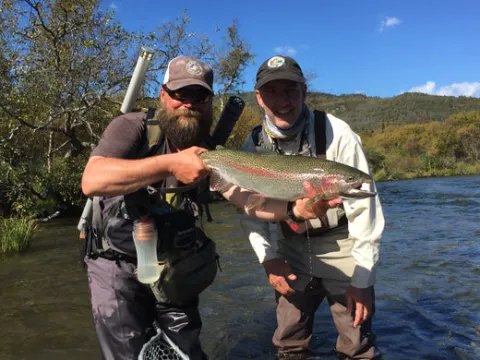
Now I have clients that book for Alaska specifically when “mousing” is peak. Usually, June and July. They bring only mouse pattern flies, and floating seven weight lines on 9’ rods. Most folks bring two rods, just in case the unspeakable happens. The bush isn’t a place to not be prepared but, that’s another story.......
/articles/voles-summer
Gearing Up for Spring Kokanee
Counting kokanee in your sleep? As we slowly transition from winter’s frosty grip to warmer days, tee shirts, and flip-flops, your thoughts may shift to your local kokanee fishery. If so it’s time to inventory your gear and make sure there is still a boat under one of those mossy tarps out back.
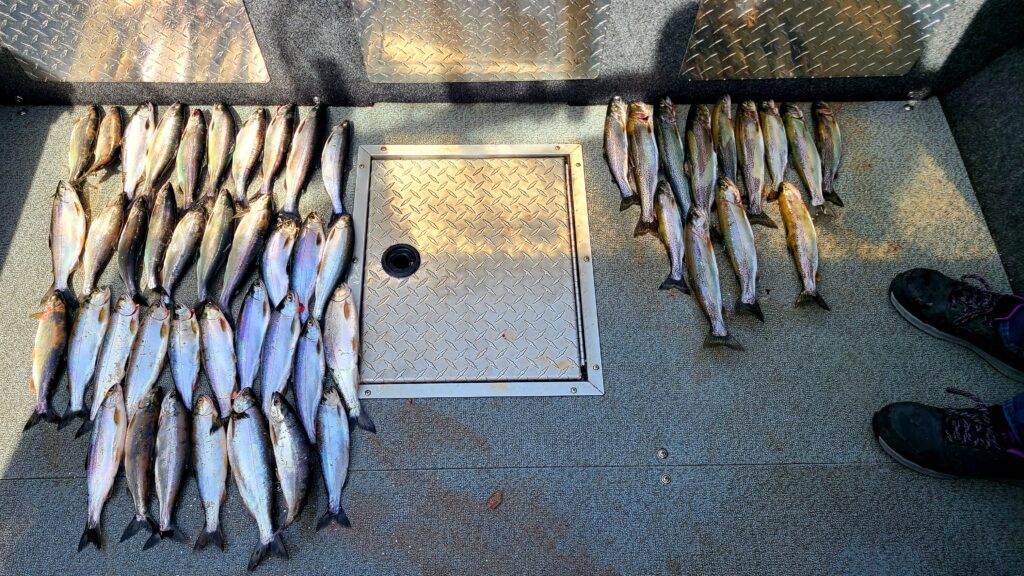
First thing on the list, you may want to give the boat motor and trailer a quick once over. Start peeling back tarps until you find the boat. You probably don’t want to mount new rod holders on the wood pile or stack of doors from a past remodel.
Check your fuel system; regardless if you used a fuel conditioner or stabilizer in your portable tanks get rid of last year’s fuel or not. For built-in tanks, hopefully, you treated the fuel with each fill-up. Even so, it is a good idea to drain the fuel filter bowl and replace the fuel filter/water separator. Replace any brittle fuel line, cracked or otherwise damaged. If you have your owner’s manual, use it as your preseason checklist.
Make sure the battery is topped off with distilled water. Then bring it up to full charge. If you find corrosion on the terminals remove the battery from the boat and clean it off with a mild solution of baking soda and water. Once everything is clean it is also a good idea to use one of the various corrosion guard offerings. You should also go through the rest of your electrical installation and look for loose connections and damaged wiring.
Give your trailer the once over. Check the trailer lights and trailer brake fluid levels. Also, check the tire pressure on all the tires including the spare. Check your safety chain, winch strap or cable and tie down straps and replace if they are questionable. Ensure that all bunks and/or rollers are in good condition. If your trailer lights are wonky, consider replacing them with waterproof LED lights.
Look over your rod holders, net, and downriggers for damage and functionality. Also check for loose fasteners, worn or missing parts, and corroded electrical connections. Fix anything that is even remotely questionable. We recently made a 30-mile run to fish salmon on one of the Canadian banks. One of the downriggers was acting up and it turned out that the shaft seal had failed and allowed water into the motor. Basically, it was sort of seized. Slow going down with a breaker popping retrieve. Would I have seen the problem on a preseason check, I doubt it, but you never know.
As a final note about kokanee boats. We have caught many kokanee from a human powered boat. Kayaks, drift boats, and inflatables will all work. No down riggers? just flat line or use a lead line rig and row away. I think the random action from paddling or rowing drives kokanee nuts. If you do head out without a motor watch the weather and consider whether your boat is appropriate for the body of water.
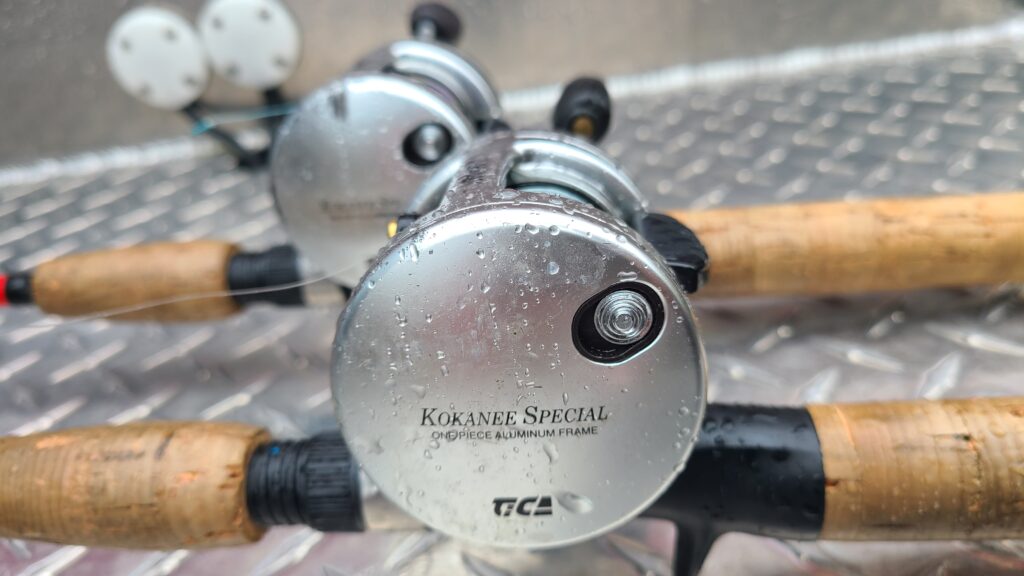
Check out your rods and reels. I know everything worked fine last year so you have nothing to do - wrong! It is the start of what should be a productive fishing season and you don’t want to lose the fish of a lifetime because your favorite reel has a funky drag. If anything is questionable, fix it or get it repaired. It may be time to replace your line. If so, take your reels to a high-volume tackle store (Think Holiday Sports in Burlington or similar) and have them bulk fill your reels. Their line should be fresher and most recycle your old line. Look at your rods and make a point to verify that the line guides are not cracked or worn. You can use a cotton swab and swirl around in each guide. If the guide catches any cotton fibers the guide needs to be replaced.
Because kokanee are notoriously unpredictable, kokanee fishing is kind of a numbers game. Generally, the boat with the most tackle wins. Sure, there are days where you can go out and limit before daybreak using one dodger and a worn-out lure. Unfortunately, those days are a gift from the kokanee gods. Most of the time you must cycle through gear and trolling patterns to get it dialed in. On any given kokanee trip, you should have several pretied rigs and attractors on hand and ready to go.
Before you head out on the lake with your collection of kokanee gear give it a good inspection. Look for rusty dull hooks, frayed lines, and missing or broken components. Repair and replace as required, A couple of years ago, we were fishing for kokanee on Lake Washington. We were pulling 8” flashers and veteran home-tied double hook kokanee flies.
One, being a tried-and-true favorite, was frazzled looking but I put it out anyway. After a solid takedown and an extended acrobatic fight, the line goes slack. What the heck? On inspection, the trailing hook was gone and much of the body of the fly had come unraveled. We only got a glimpse of the fish, but it was a huge chrome bright kokanee. I owned that one, I knew the fly was on its last leg and shouldn’t have used it. There’s peace of mind in knowing that your gear is in tip-top condition.
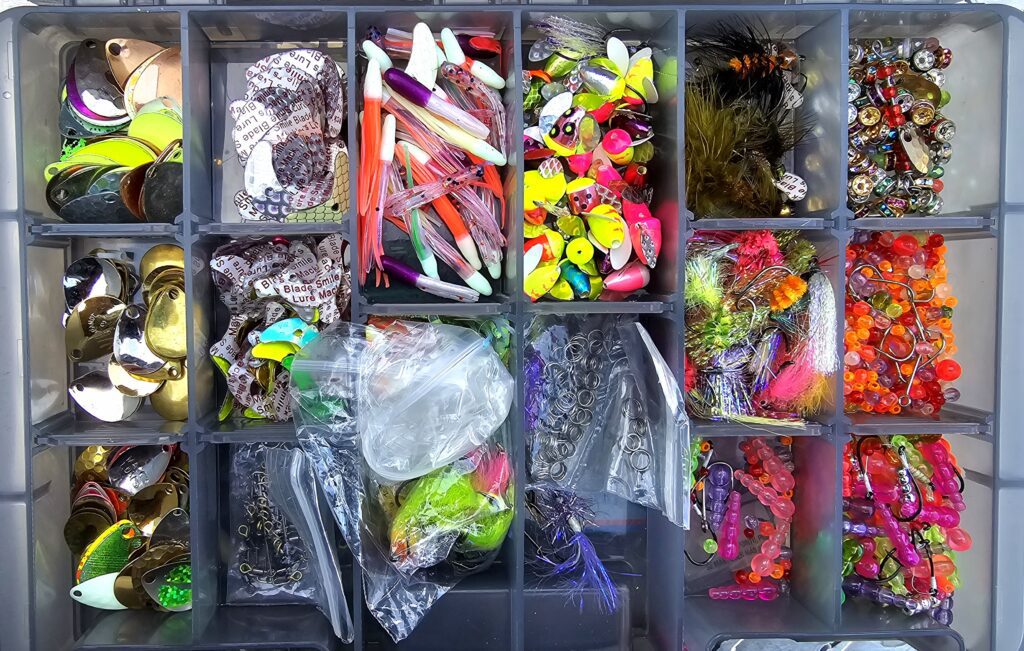
As you prepare for the 2024 spring kokanee fishery, review your gear to ensure you have the basics. Make sure that you have an assortment of small dodgers and swing blade-type flashers. Carry an assortment of small spinners, spoons, wedding rings, and flies. Other gear will work but this is your general kokanee kit. It is also a good idea to have a collection of lure components available. Start slow, a few spinner blades, beads, and spinner clevises and flies. If you’re a fly-tier, you probably already have the basics for any number of kokanee flies. Carry a separate Plano Box as your lure-making kit.
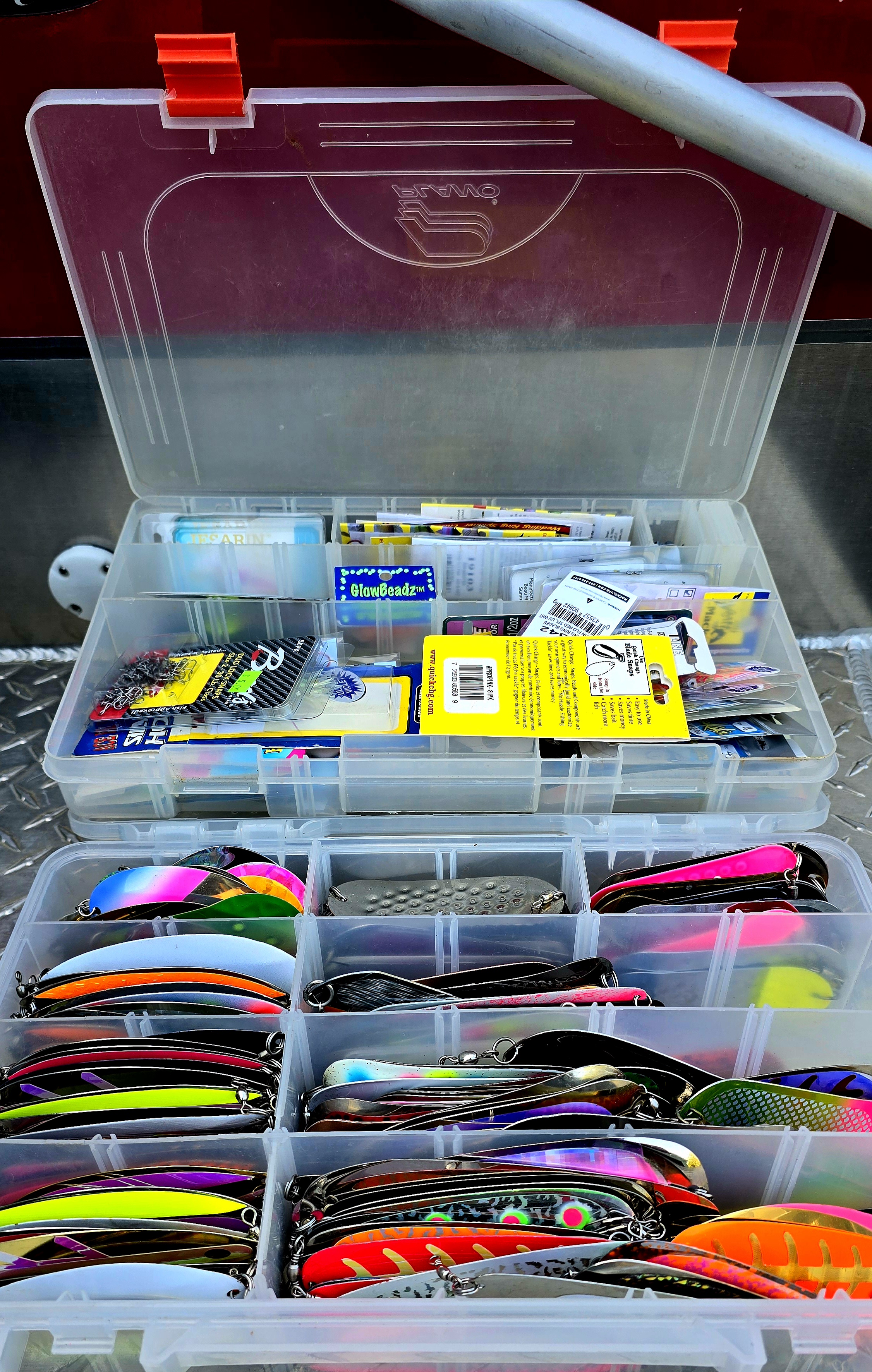
My lure/spinner Box allows me to tweak my presentations. I might add a couple of beads and a second spinner blade, make leader with a fly then add spinner components. The box has small spin n glo floats, extra beads, various kokanee flies, wedding ring collars, some kokanee bugs, and a few other things to dress up your lure.
Line size? With a few exceptions, I tie my kokanee leaders on 12-14# fluorocarbon. Hook size and color are kind of a personal preference. Many of my kokanee lures are tied using size 4 or 6 black octopus-style hooks. I typically tie a snelled rig with 2 hooks. With my standard rig, the hooks are close together.
Regarding leader length, although I tend to have spools of ready to go lures when I’m on a lake hunting kokanee. Typically, they are the correct leader length for the given fishery. It is a good idea to have a handful of pretied leaders that haven’t been cut to length available. The thought is that you’ll be able to assemble your lure and then set leader length as required quickly. An 8-10” is kind of my standard kokanee leader length but sometimes the fish will want something different.
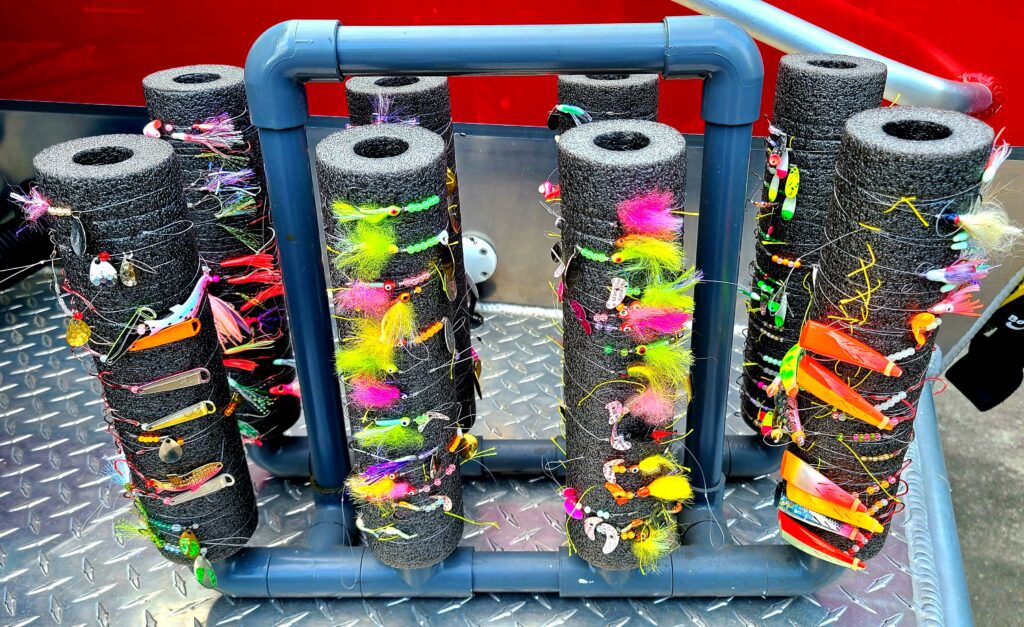
A couple of leader organization concepts are either sealable sandwich or snack bags or my favorite the slotted foam tubes. If using the resealable bags gently coil your kokanee leader and seal it in the bag. Store the sealed bags in something with a latching lid. With the slotted foam tubes, set the hook in the foam and wrap the leader securing the end in one of the slots. You can store the tubes on a rack, in a 3–5-gallon pail, or a 2-gallon resealable bag. I have found that using an empty 5-gallon to hang your leaders on during the day does wonders for keeping the boat organized as you cycle through set-ups. Come up with an organizational plan that works for you and your boat.
Kokanee fishing in general is a mental game. Be prepared but flexible and you will bring home a cooler full of spring kokanee.
/articles/gearing-spring-kokanee
It's an Addiction
When we first start angling, we take baby steps, buying our first rod and reel and other gear. It most likely was something we found at Walmart and figured “That should work”. And it does, to a point. If the fishing bug infects us though, we soon begin to show further signs of our illness. One rod and reel soon morph into twelve, because, well, different types of fishing require different setups. From there your illness moves in the direction of not only quantity and function but also quality. Suddenly, that Walmart special is being replaced by rods and reels found in legitimate tackle stores. Knockoff brands turn into name brands. Prices go up and you find yourself entering the realm of “guest rods”. Those old rods are given to friends who are casual anglers fishing a day here or there with you. Because watching a beginner rear back on a delicate fishing rod can bring new levels of anxiety to fishing!
In short, fishing rods can very quickly become an addiction.
Early on I told myself that I would never spend the vast amounts of money that some of the higher-end fishing rods can cost. The key was to find a happy medium between quality and cost. Enter a new source of fishing rods, the small business rod builder.
I first met Dave Calhoun many years ago at Ed Iman’s Fish Camp, a yearly gathering of Pacific Northwest outdoor gear manufacturers, guides, and media representatives. Dave was there promoting his small business, NWRods, which he started in 2004. His passion and enthusiasm for the sport were evident as he excitedly talked about the rods he was building, sharing their features and quality of build. I ended up getting a beautiful float rod from him that year, which I used over the following years to catch numerous steelhead and salmon. I really enjoyed that fishing rod and it performed flawlessly. It had a real attention to detail, and I’d not owned a rod of such quality before.
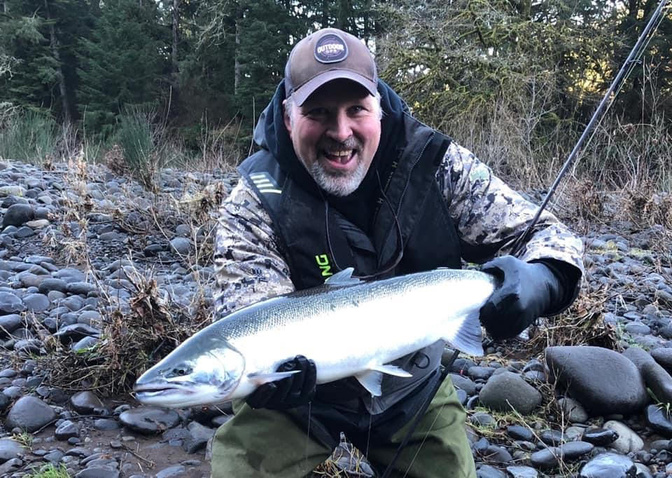
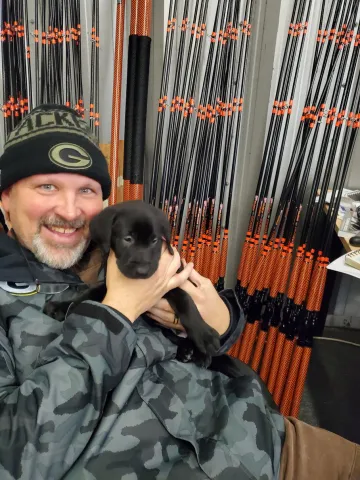
Fast forward to this year’s Big Horn Sportsman Show in Spokane, Washington. We had our media booth at the show, and as I was taking in the sights of all the vendors a familiar voice boomed out “Hey Mike, how’s it going?”. Turning my head I saw Dave and his NWRods booth. Walking over to say hi, we of course caught up on our favorite topic, fishing, and fishing rods.
“I heard you moved to Montana, Mike, how’s that been going for you?”
“Great”, I replied, “Although I’m now doing more fly fishing and no longer fish salmon or steelhead in rivers.”
“You know I’ve completed my move to Blanchard, Idaho. I’ve set up my shop and started focusing on fly rods”, Dave said.
My curiosity was raised. “Really? I’m looking for a nice 4-5 wt fly rod for small to medium-sized rivers. As you may know, Montana has a few trophy trout streams. What do you have?”
Dave pulled out one of his nine-foot, two-piece, 4-5 wt rods that he has been producing. Handing it over to me, I could see the familiar craftsmanship that impressed me so many years ago with his float rod. A carbon handle provided the solid base for attaching my fly reel, and the rod came with _____ guides, each flawlessly wrapped and of a stealthy dark green color. The graphite rod action itself felt “just right” with a nice flex but still enough backbone to make solid casts. Its two-piece construction is made to provide extra strength and durability.
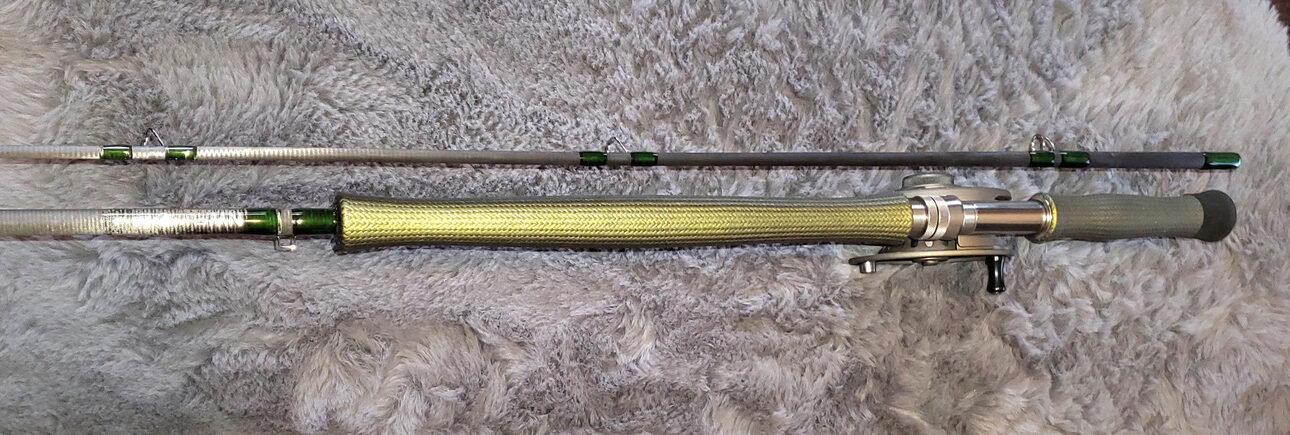
A word on fishing rods, in particular fly rods. They can range from starter sets that will cost you $75 bucks up to a thousand dollars and beyond. The rods that Dave makes fall in the range of above-budget rods but well below rods that will make you cry when they break. In this case, his fly rods start in the $350 range. For me, that would be my upper limit on what I would pay for a rod. That said, I do appreciate quality and workmanship, so it after a brief internal debate I said “yes” to the rod. As a bonus, Dave threw in a tee-shirt.
Dave told me that with his move to Idaho he plans to focus more on fly rods, and he has started a new website where you can see his current lineup, www.nwfly.com. I suspect in the years to come I’m going to see a few of his fly rods making the rounds on the Missouri, Blackfoot, Madison, and other trophy trout streams in Montana.
As I was about to leave, Dave showed me his kokanee rods which he is blowing out at $99 a rod. Eye-catching black with bright green threads on the eyes, these rods are fiberglass and a real steal at this price. Of course, I promptly blew my budget and bought four.
Dave ships rods throughout the Pacific Northwest. His original website, nwrods.com, has a full lineup of salmon, steelhead, and kokanee rods. Check them out if you’re in the market for a quality rod that won’t break the bank.
Just don’t break your budget as you feed your addiction.
If you’d like to see a video of me catching a steelhead on the float rod I mentioned earlier, here is the YouTube link: https://www.youtube.com/watch?v=AESq3Yg_6fs
/articles/its-addiction
Winter Trout
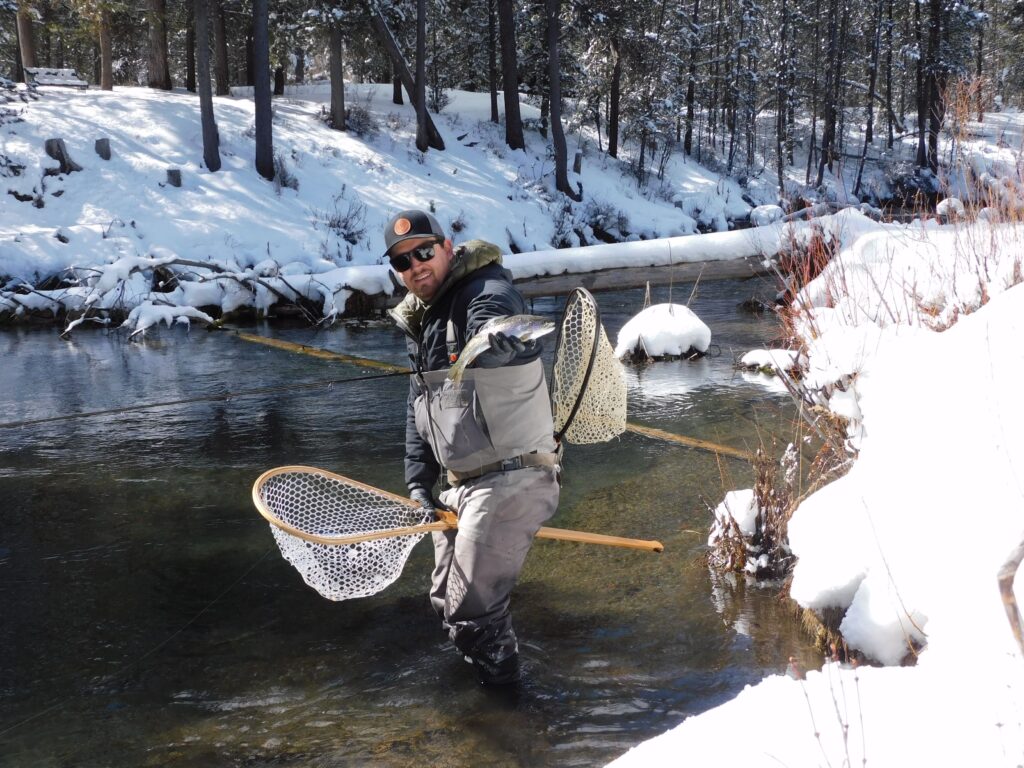
These are some of the best days on the water, in December and January, when a lot of other sportsmen are watching football. Fly-rodders watch the weather and hope for a hatch of midges and look forward to the little black stoneflies, but there are better ways to tempt bigger trout in December and January. Plastic worms and minnows can tease big trout out from beneath the undercut banks and beads, tailored to size and color can turn on the bite.
TWITCHING PLASTIC
Plastic worms tend to produce as many fish as natural baits. And you don't have to dig through the compost pile to find them.
Adapted from steelhead drift fishing the best rig is a six-pound main line tied to a barrel swivel. A sliding sinker on the main line is a good way to get the bait down but another option is to leave a tag on the main line knot and crimp on removable split shot. The leader should be 20 inches long terminated at a No. 10-8 single egg hook.
Rig to drift the edge of a seam with just enough weight to tickle the tops of the rocks. Jeff Warner, founder of X Factor Tackle, relies on three main colors in cold winter water - hot red, fluorescent pink, and natural worm.
Warner's go-to for brown trout on his home water is a 1/16-ounce jig head on a No. 4 hook and an X-Factor Teaser minnow. He fishes without a float.
"In my experience, it is better to allow the bait to do its work as an injured bait fish. I don't want a natural drift, I want violent rips and jerks. It's why I like the lightweight jig. I don't need it to be down on the bottom. It lets the bait look more erratic than it does with a heavy jig head."
Jeff Warner
Warner's favorite on a bright sunny day is motor oil with red flake. Warner recommends a plastic minnow in the tail-outs and along the seams and ripping it back.
"I like to cast it upriver and then work the clock so to speak. Even cast it straight downriver and twitch it. If I don't catch a fish by that time there ain't one in there."
Jeff Warner
The bite can be hard to detect. Keep the index finger on the line to stay in touch with the rocks and set the hook at the least tug that signals a grab.
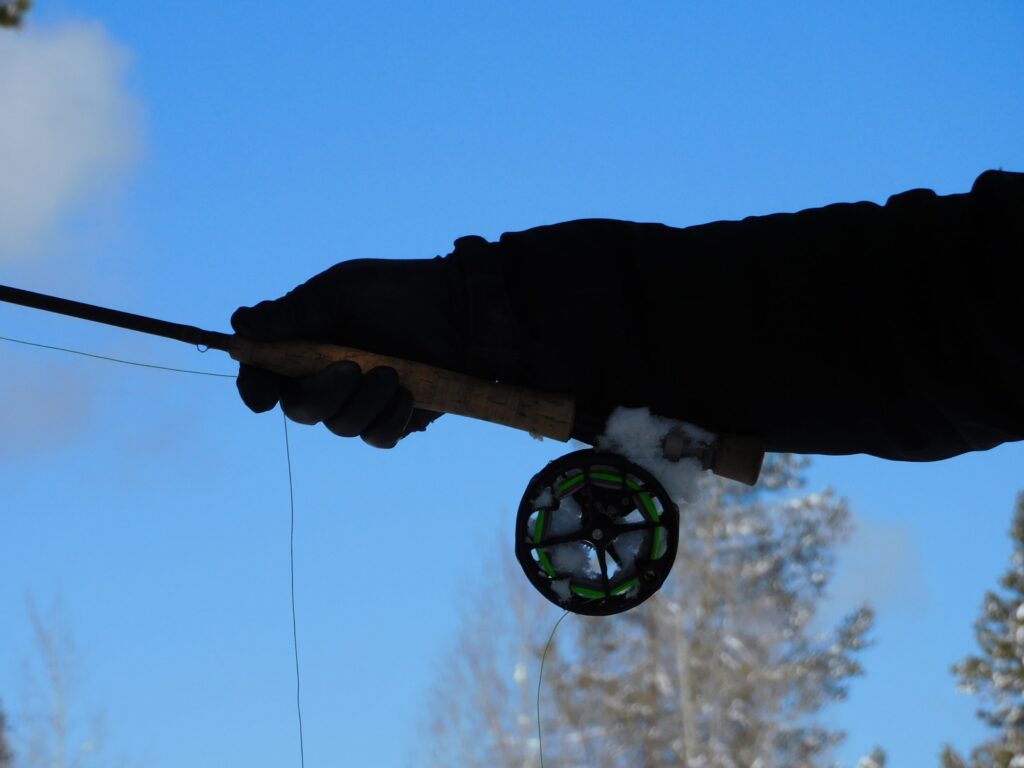
FLY ROD EGGS/BEADS
When fishing egg imitations and hard beads, the big challenge is to get them at the level the fish are holding and allow a dead-drift presentation.
Try to position the bead about two inches above the hook. This can be accomplished in several different ways. One easy way to do it is to nail knot a piece of clear mono on the leader and position it two inches above the hook acting as a stop.
Set the indicator (a good one is the easy-to-cast plastic Thingamabobber) and put split shot on above the tippet knot (or swivel) and set the float about the depth of the water.
When the trout bites the bead the angler reacts with a short upward lift which tends to pull the bead through and pin the hook in the outside corner of the mouth.
With whitefish spawning in western rivers in late January and February we have bait to match. Trout that key on whitefish spawn get used to gobbling the yellow eggs and its why some fly-fishermen tie on yellow wet flies in February without knowing the reason why the trout are biting. Summer steelhead may also spawn in January and February, in which case, the trout are eating orange eggs. In any case, small orange beads or tiny yellow eggs can turn a rainbow's head this month.
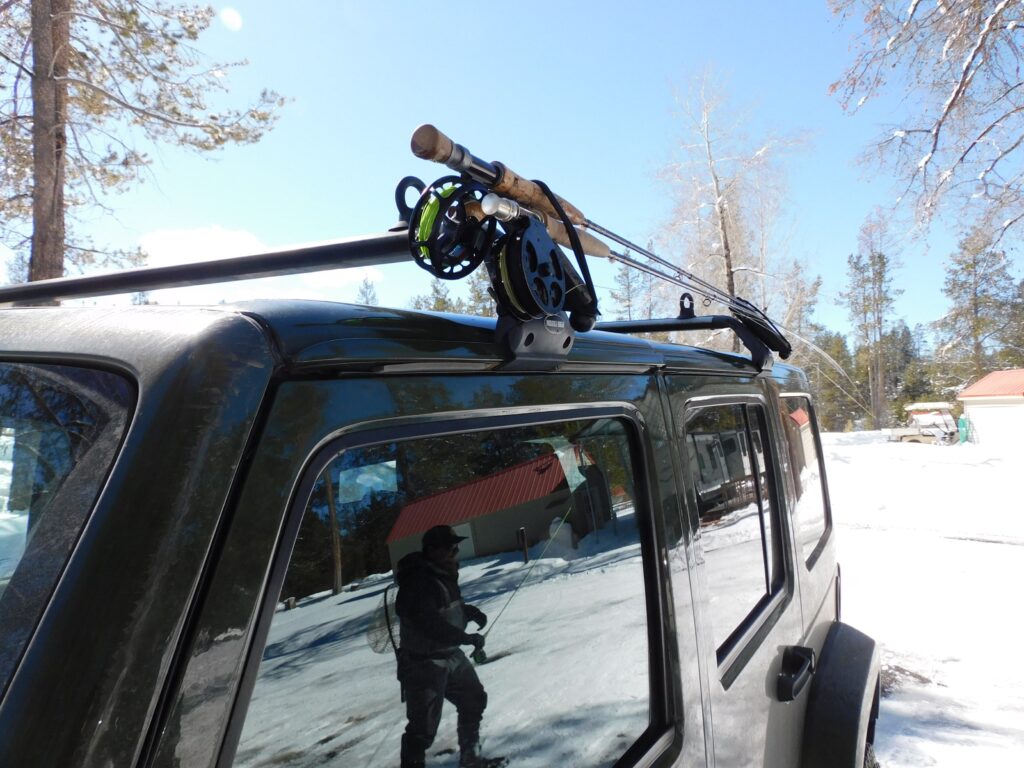
SOFT PLASTIC BEADS
One of the greatest moments in drift fishing is to watch a trout peel away from its holding lie and follow a soft orange egg downstream then crush it. A squishable, scented egg imitation tumbled along the gravel with a drift fishing rig or a bottom-walking drop shot setup is a good bet in December.
My favorite hook for this work is a Daiichi salmon egg bleeding bait hook sized No. 12 up to No. 8. Again, the soft bead is best positioned two inches above the hook, which can be accomplished by using a nail knot, a blood knot, a sequin or similar bead stopper.
One of the mistakes we make is using an indicator in shallow, clear water. If the fish and the bottom is visible, dispense with the indicator and just watch for the take.
A mistake we often make is allowing the weight to control the movement of the egg. This is why a sliding sinker is sometimes the best choice. And why a drop shot weight might be the best choice with a tag end of a surgeon's knot used to splice on a bit of 4-pound fluoro. That bait should present as freely as possible in multiple braided currents. The egg wants to be free!
# # #
For a copy of the Fishing Central Oregon book, send $29.99 to Gary Lewis Outdoors, PO Box 1364, Bend, OR 97709
To contact Gary Lewis, visit www.GaryLewisOutdoors.com
/articles/winter-trout