Dry Fly Fishing 101
The image of a trout rising to eat an aquatic insect, usually a mayfly of sorts, is the encapsulation of what drives most anglers to pursue fly fishing. I remember as a young boy seeing it happen for the very first time. What seemed like a gargantuan brown trout rose from an abyss to chase, crush, and inhale a grasshopper. I think I was 7 years old. So in reality, that fish was probably only about 17-18 inches long, and the abyss it rose from was more than likely just a plunge pool that was as deep as I was tall. Nonetheless, it impacted my angling future by putting me on a path to learn fly fishing at a very young age.
Almost as quickly as I started, I found out just how difficult enticing a trout to eat a fake fly could be. My grandfather and my dad were kind enough to allow my pursuit of relentless frustration just to the breaking point before they insisted I fish with bait. At 8 years old, my patience wasn't virtuous at all. However, I did have the persistence and drive to succeed, just not the patience to figure out what I was doing wrong. God bless my grandfather and my dad for tolerating me during that time.

Fast forward 43 years and I have a much better idea of how to help new fly anglers get started. There are a couple of key ingredients that reduce the learning curve. First, buy some equipment that works. Notice I didn't say buy some expensive equipment, I said buy some equipment that works. For example, a 9’ 5 weight fly rod is the most universal of all rods. It is the perfect trout rod as well as panfish, and my favorite dry fly fish, the Arctic grayling. Just make sure your 5 weight rod has a 5 weight fly line on it, matched up with a 5 weight size fly reel.
Putting this together accordingly is literally the difference in casting and flailing. There will be some flailing, but not nearly as much if you match everything accordingly. If you are not sure if your set up is right, visit a fly shop for assistance. Any reputable fly shop will be more than willing to help you fuel this latest version of insanity.
So, you have visited the local fly shop, you have everything matched up. You probably bought some leaders, tippet, and a few flies. If it was a really super reputable fly shop, you probably got loaded up on a healthy dose of sarcasm and ridicule. The best shops always seem to have that air about them, but they will steer you in the right direction. It comes from a good place. Armed with your newfound knowledge and gear you need to proceed to step two: find some dumb fish. Really dumb. The dumbest. Find an entire village of idiot fish to cast to. Panfish make some of the best beginning dry fly fish to cast to. They aren't spooky, they eat willingly, and they taste delicious.
There is also absolutely no shame in following the local trout hatchery stocking schedule. Trout raised in a concrete raceway seem to fit the description “village of idiots.” They are used to looking up to eat the food served to them twice a day in the very pleasant, controlled environment of the hatchery. In addition, hatchery trout aren’t typically too spooky. What we are looking for here is bang for the buck on opportunities. In the beginning of your dry fly fishing pursuits, you need a lot of opportunities to fail without punishment. The more times you can make a cast and get results, the more you learn. The more learning opportunities you get, the faster you become a better fly angler. Don’t be bashful about fishing to the village idiots. We can all learn something from them.
Once you have found your village to fish in, you need to consider what exactly you are trying to do. You are attempting to imitate an aquatic insect that is resting on the surface of the water above the meniscus. If you are lucky enough to live somewhere that has legitimate bug hatches on the trout creeks, stop and watch the bugs float downstream. Watch the trout that rise to eat them. Also watch the trout that rise for the intent of eating an insect but refuse at the last second. That’s just as important. The bugs that are floating downstream with trout eating them are the ones you want to imitate.
Invariably someone out there is currently saying “match the hatch.” It is a catch phrase that I have come to detest and loathe but it does bear some legitimacy. We can worry about the catch phrases later. For now, you just need to focus on making a cast so that your fly looks right to the fish. Ultimately, that is the most important part of the equation. Casting your fly with it splashing the water upon impact has the same impact as the brute squad knocking your front door down with a battering ram. If that happened at your house, you probably aren’t gonna want to hangout, hold hands, and sing kumbaya. Try to be soft on approach. A live insect doesn't even weigh fraction of an ounce. No way it can make a giant splash when it hits the water. Your fly shouldn’t either.

Lastly, in regards to presentation, there is this thing you need to learn called “drag free drift.” Yeah, I know, another catch phrase. This one is tolerable though only because it carries weight with it. Obtaining a drag free drift absolutely ensures that your presentation looks as good as it can possibly look to the fish. It’s imperative to seducing a fish to eat your fly. What is this drag free drift, you say, and how do I obtain it? The drag free drift is achieved by manipulating the fly line with upstream or downstream in order to make the fly travel at the same speed at the river current on the surface where the fly is positioned. Great. Now here it is in layman terms, you are going to cast your fly and there will be a V-wake coming off of it. V-wake is bad.
V-wake tells the fish that your fly presentation does not look right, therefore, the fish does not eat your fly. This is, of course, not what we are trying to accomplish at all. The act of “mending” your fly line, or manipulating the fly line, upstream or downstream of your fly will either speed up the fly or slow it down to the point of eliminating the V-wake. Trying to put in to words how to mend fly line in order to achieve a drag free drift is like trying to write down instructions for riding a bicycle for the first time. Hands on handle bars, feet on pedals, pedal fast, hold tight, and hope for the best. Mending fly line is best learned through visual aid. Hire a guide or watch a video from Rio Products on YouTube. It will be the difference in catching and flailing.
We have covered a lot of ground here, but one last thing. What do you do when the fish does actually eat your fly? You’ve made a good cast, good drift, and a trout graces your ego by taking your synthetic offering as if it were a tomahawk ribeye. Dear baby Jesus, this actually worked. What now? I’m willing to bet the first time it happens, you will set the hook well before the fish has the fly in its mouth. Most anglers react upon the visual of the fish breaking the surface resulting in the fly being pulled away from the fish before it has time to come down on top of the fly to ingest it.
If you can somehow force yourself to wait on the hook set until after you can see the dorsal fin, your success rate will increase substantially. I once had an Alaska client that came every year only to fish Arctic grayling on dry flies. He would stand in the run and say “God save the queen” every time a grayling rose to his fly. After he said the words, he set the hook. That was his way of metering his hook set so it wasn't too quick. After about the 50th time hearing it, I was hoping for a new phrase or no phrase at all, but it worked for him.
It's summer. Get your gear sorted out, find a village of idiots, have some fun, and God save the queen.
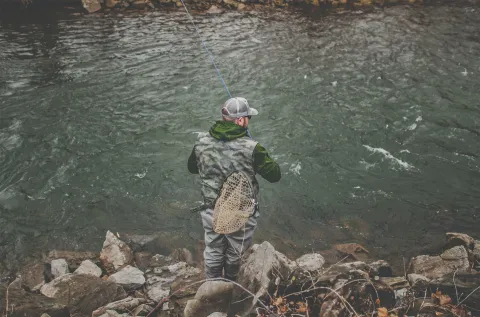
/articles/dry-fly-fishing-101
Nymphing for Trout
Chad Bryson
In the glamorously romanticized world of social media, there is nothing short of a plethora of fly fishing techniques and methodology. So many opinions, and it seems that everyone thinks they are right. Even though I am never one to be short on opinion, I prefer to stick to facts and truth. That’s where I try to form my opinion.
Watching Fish
Fact- every single person that is an angler loves to watch a fish of any species come to the surface to eat something presented to them. The surface bite is a visual interaction we as humans get to experience with an animal that we would hardly ever see otherwise. It’s cool beyond belief. Truth- that bite doesn’t happen every day. It doesn’t even happen every month.
Okay, sure, if you have your own jet with an unlimited amount of expendable income, you can travel all over four continents and two hemispheres chasing every bug hatch or mouse migration known to man to satisfy your craving for surface action. If you are that person, I want you to know that I am interviewing for new friends, and you could just be a candidate.
However, if you are like the rest of us who can't afford the financial commitment of owning our own jet, you are probably trying to enjoy the fishing that’s close to home and might be wondering what all the complicated fuss is about. I’m going to simplify it.
Fly Fishing
Fly fishing for trout is broken down into basically three methods - streamer fishing, nymph fishing and dry fly fishing. Dry fly fishing is by far the most celebrated and commonly recognizable. It’s the gentleman’s preferred fishing method. Streamer fishing is regarded as a viable means of catching but, like dry fly fishing, isn't always the most productive.
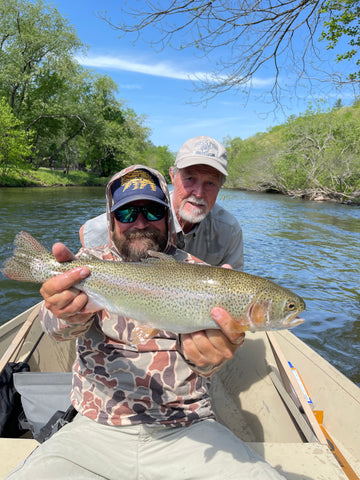
Then there is nymph fishing bringing up the rear in open popularity. I call it open popularity only because you never hear guys in a fly shop talking about how awesome the nymph bite was the past weekend that they went fishing. Everyone just wants to discuss how many bugs hatched or how many trout chased a streamer. Nymphing for trout is easily the most effective way to catch them, but this technique is often only regarded as a last-ditch effort to save a day of fishing.
Why
The most important question to answer is: why? Why is nymphing for trout the most productive way to catch them? First, let’s identify what a nymph is. A nymph is the juvenile form of aquatic insect that is born below the river’s surface and makes its way to the surface either by crawling or swimming so that it may hatch into an adult and fly away.
Once the nymph reaches the water’s surface and begins to shed its exoskeleton, it is at the mercy of wind, rain or anything above the surface that could potentially keep it from flying away. Hence, keeping a trout from being able to eat it from the surface like so many of us want. Every river, creek, and waterway anywhere that holds trout will have aquatic insects of some species. In that watershed is the nymph form of that aquatic insect.
They live there 24/7, 52 weeks a year beneath rocks, logs, stumps, and anything else that could be considered hold area. Nymphs are always in the river for trout to feed on. Every single day. They may not always be hatching, swimming or crawling, but no doubt, nymphs are around, and they comprise 90% of a trout’s diet. We just rarely see them eat one because it’s all done subsurface.
Nymphs
Fact- nymphs are 90% of a trout’s primary diet because it is a food source that is the most readily available in every creek, river, and water shed that holds trout. Also, a trout doesn’t have to expose itself to the surface to eat a nymph like it does a dry fly. It can remain relatively hidden from predators while feeding on nymphs. Imagine you are sitting on your couch watching baseball. You get hungry and need a snack.
Next to the couch within arm’s reach is a bag of beef jerky and a sack of Doritos. Cool Ranch Doritos at that. Now you could just sit there comfortably and feast on those Doritos and beef jerky until your heart’s content, or you could get up and go to the kitchen and make yourself some proper food such as a ribeye steak. Even though the ribeye steak sounds really good, it’s gonna take some time to prepare and cook.
You also run the risk of being caught away from your safety zone of anonymity. If you are in the kitchen, the dog is gonna see you and demand attention. Your wife or husband may realize that you are mobile instead of semi-comatose on the couch. God forbid you may have to fix a ribeye for them too. Next thing you know, the baseball game is over, and you are doing the dishes. Truth- dry flies are ribeye steaks while Doritos and beef jerky are nymphs.
Bobbers vs Strike Indicators
No discussion about nymph fishing for trout would be complete without the controversial subject of bobbers vs strike indicators. In the world of fly fishing, someone that wanted to make themselves dissimilar from gear fishermen decided to call the thing we use to make the flies float at a specific depth below the surface a “strike indicator”.
I suppose that is a more refined and highbrowed form of language that some fly anglers are known to have. My opinion is quite simple. If it floats and is made of a synthetic material such as foam or plastic, it’s a bobber. If it floats and is made of natural material, such as wool, it’s an indicator. Trust me when I say that both have their place in the game. Just call it what it is.
High Sticked
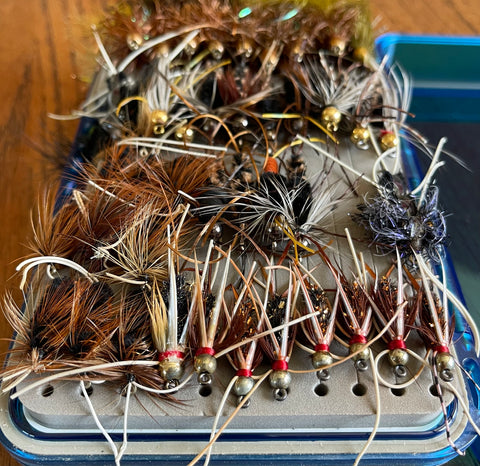
I learned to fly fish before the invention of indicators and bobbers. We “high sticked” when nymph fishing. This was basically using a rod that was about a foot longer than the rod I used for dry flies paired with a little stronger leader and a heavy nymph at the end of it. The idea was to “roll” the nymph along the bottom of the riverbed imitating a nymph that had been dislodged from its safety zone.
As long as the line was tight, you could feel the trout take. I caught so many big trout using this method, my grandfather finally limited me to using it only on rainy days. “Just to keep things even”, he said. If you can learn to highstick nymph, it will crush fish. Just don’t confuse it with this new thing the kids are doing called euro nymphing, that’s not fly fishing. Any good fly-fishing guide will agree with me.
So, watch a YouTube video about high stick nymphing, hire a guide, and find out what a trout eats 90% of the time. Don’t forget the Doritos and beef jerky.
/articles/nymphing-trout