In Like a Mayfly, Out Like a Brown
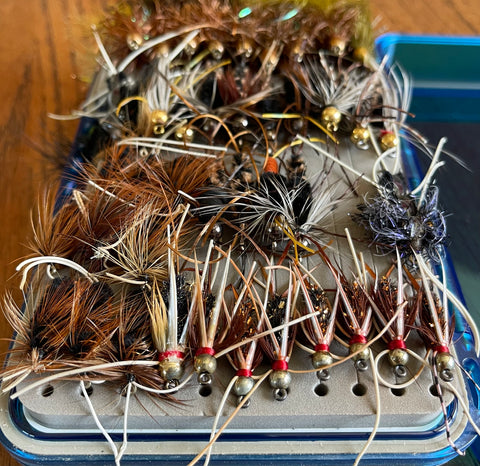
The emergence of the Western March Brown marks the end of winter for many trout fishermen. It may still be cold outside, but this mayfly can heat up the fishing when it makes its first appearance in March. These mayflies live among the rocks in swift-flowing currents. Look for insect activity in slower water adjacent to riffles. Present emergers like the March Brown Spider to rising trout, dead-drift a gold-ribbed Hare’s Ear or Pheasant Tail nymph beneath a strike indicator. If the fish are feeding on top, cast dry flies like the March Brown Upright to surface-feeding fish.
Use the March Brown Parachute when casting to finicky feeders in shallow water. The parachute presents a lifelike silhouette when viewed from a trout’s living room. Be ready with a Pheasant Tail spinner if the flies are falling, spent, to the water. In March, a Blue Winged Olive hatch might happen at any time. And in some waters, you might see both BWOs and March browns on the water at the same time. In Oregon, surrounded the way we are by hundreds of great places to fish, it is hard to remember that there are some great waters off on the eastern horizon. At this time of year, places like Chickahominy, Beulah Reservoir, and the Owyhee River spring to mind. If you crave solitude under an azure sky, the last weeks of winter often bring early green-up to the desert, awaken the aquatic insect life, and fire the appetite of rainbows and browns. And not a lot of people are back on the water yet.
Chickahominy fished well the last couple of years with a restock of hatchery rainbows. Chickahominy grows fish fast. A hundred miles east of Bend, it is a narrow reservoir with many coves and fingers and lots of shallows. Early in the season, dragonfly nymphs, scuds, and leech patterns will be productive. The reservoir reaches a maximum depth of 25 feet, but early in the year, the shallows hold the most fish. One of the best trout fishing destinations in early spring is the Owyhee River below Lake Owyhee. Rainbows are in the riffles, and browns are everywhere else. Owyhee rainbows average 14 to 18 inches, and browns run to 24 inches. Right now, with water temperatures still low, small red and black midges produce fish. But go armed with March browns, blue-winged olives in both emerger and dry patterns.
Another early spring fishery is Beulah Reservoir. Fed by the North Fork Malheur River, this big reservoir, from now until Memorial Day, is a good bet for holdover hatchery rainbows. Bring a float tube or a small boat because the low water may limit the usefulness of the boat ramp. Prowl the shorelines, fishing just outside of the shallows, or explore around the inlet. Fish can grow big in this food-rich reservoir as well. Use leech patterns to spark a strike from the bigger fish. If you land a bull trout, it must be released unharmed.
Other good early spring bets include Krumbo Reservoir and the Blitzen River. Krumbo is one of the lakes that gets early stocks of hatchery trout.
Flowing out of the Steens, the Blitzen River can grow trout big. Spend some time watching the water for clues and for feeding fish.
Put gas in the tank and string the rod. There is nothing like a road trip to greet the early spring green-up. And what better reason to take to the highway than hungry trout?
/articles/mayfly-out-brown
Nymphing for Trout
Chad Bryson
In the glamorously romanticized world of social media, there is nothing short of a plethora of fly fishing techniques and methodology. So many opinions, and it seems that everyone thinks they are right. Even though I am never one to be short on opinion, I prefer to stick to facts and truth. That’s where I try to form my opinion.
Watching Fish
Fact- every single person that is an angler loves to watch a fish of any species come to the surface to eat something presented to them. The surface bite is a visual interaction we as humans get to experience with an animal that we would hardly ever see otherwise. It’s cool beyond belief. Truth- that bite doesn’t happen every day. It doesn’t even happen every month.
Okay, sure, if you have your own jet with an unlimited amount of expendable income, you can travel all over four continents and two hemispheres chasing every bug hatch or mouse migration known to man to satisfy your craving for surface action. If you are that person, I want you to know that I am interviewing for new friends, and you could just be a candidate.
However, if you are like the rest of us who can't afford the financial commitment of owning our own jet, you are probably trying to enjoy the fishing that’s close to home and might be wondering what all the complicated fuss is about. I’m going to simplify it.
Fly Fishing
Fly fishing for trout is broken down into basically three methods - streamer fishing, nymph fishing and dry fly fishing. Dry fly fishing is by far the most celebrated and commonly recognizable. It’s the gentleman’s preferred fishing method. Streamer fishing is regarded as a viable means of catching but, like dry fly fishing, isn't always the most productive.
Then there is nymph fishing bringing up the rear in open popularity. I call it open popularity only because you never hear guys in a fly shop talking about how awesome the nymph bite was the past weekend that they went fishing. Everyone just wants to discuss how many bugs hatched or how many trout chased a streamer. Nymphing for trout is easily the most effective way to catch them, but this technique is often only regarded as a last-ditch effort to save a day of fishing.
Why
The most important question to answer is: why? Why is nymphing for trout the most productive way to catch them? First, let’s identify what a nymph is. A nymph is the juvenile form of aquatic insect that is born below the river’s surface and makes its way to the surface either by crawling or swimming so that it may hatch into an adult and fly away.
Once the nymph reaches the water’s surface and begins to shed its exoskeleton, it is at the mercy of wind, rain or anything above the surface that could potentially keep it from flying away. Hence, keeping a trout from being able to eat it from the surface like so many of us want. Every river, creek, and waterway anywhere that holds trout will have aquatic insects of some species. In that watershed is the nymph form of that aquatic insect.
They live there 24/7, 52 weeks a year beneath rocks, logs, stumps, and anything else that could be considered hold area. Nymphs are always in the river for trout to feed on. Every single day. They may not always be hatching, swimming or crawling, but no doubt, nymphs are around, and they comprise 90% of a trout’s diet. We just rarely see them eat one because it’s all done subsurface.
Nymphs
Fact- nymphs are 90% of a trout’s primary diet because it is a food source that is the most readily available in every creek, river, and water shed that holds trout. Also, a trout doesn’t have to expose itself to the surface to eat a nymph like it does a dry fly. It can remain relatively hidden from predators while feeding on nymphs. Imagine you are sitting on your couch watching baseball. You get hungry and need a snack.
Next to the couch within arm’s reach is a bag of beef jerky and a sack of Doritos. Cool Ranch Doritos at that. Now you could just sit there comfortably and feast on those Doritos and beef jerky until your heart’s content, or you could get up and go to the kitchen and make yourself some proper food such as a ribeye steak. Even though the ribeye steak sounds really good, it’s gonna take some time to prepare and cook.
You also run the risk of being caught away from your safety zone of anonymity. If you are in the kitchen, the dog is gonna see you and demand attention. Your wife or husband may realize that you are mobile instead of semi-comatose on the couch. God forbid you may have to fix a ribeye for them too. Next thing you know, the baseball game is over, and you are doing the dishes. Truth- dry flies are ribeye steaks while Doritos and beef jerky are nymphs.
Bobbers vs Strike Indicators
No discussion about nymph fishing for trout would be complete without the controversial subject of bobbers vs strike indicators. In the world of fly fishing, someone that wanted to make themselves dissimilar from gear fishermen decided to call the thing we use to make the flies float at a specific depth below the surface a “strike indicator”.
I suppose that is a more refined and highbrowed form of language that some fly anglers are known to have. My opinion is quite simple. If it floats and is made of a synthetic material such as foam or plastic, it’s a bobber. If it floats and is made of natural material, such as wool, it’s an indicator. Trust me when I say that both have their place in the game. Just call it what it is.
High Sticked
I learned to fly fish before the invention of indicators and bobbers. We “high sticked” when nymph fishing. This was basically using a rod that was about a foot longer than the rod I used for dry flies paired with a little stronger leader and a heavy nymph at the end of it. The idea was to “roll” the nymph along the bottom of the riverbed imitating a nymph that had been dislodged from its safety zone.
As long as the line was tight, you could feel the trout take. I caught so many big trout using this method, my grandfather finally limited me to using it only on rainy days. “Just to keep things even”, he said. If you can learn to highstick nymph, it will crush fish. Just don’t confuse it with this new thing the kids are doing called euro nymphing, that’s not fly fishing. Any good fly-fishing guide will agree with me.
So, watch a YouTube video about high stick nymphing, hire a guide, and find out what a trout eats 90% of the time. Don’t forget the Doritos and beef jerky.
/articles/nymphing-trout