The Cure for High Lakes Trout by Gary Lewis
How to turn eggs from hatchery trout into more hatchery trout.
We had a mild, dry winter with little snowpack. Now in the heat of summer, wildfire smoke shrouds the lowland valleys, and a lot of people who would rather be fishing are staying home.
Up in the mountains, the air is clear and beautiful. If there is smoke in the air, it filters the light and provides an otherworldly feel on the high lakes.
Here in central Oregon, the trout fishing has been fantastic. Fly-rodders, lure fishermen, and bait anglers have been having the best trout season of their lives.
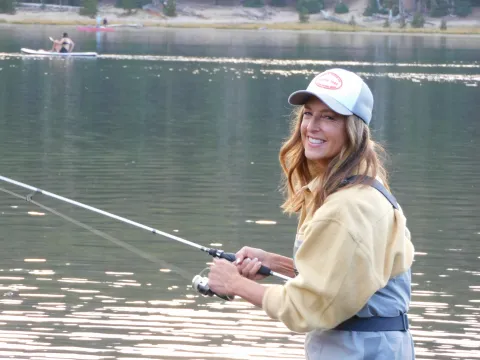
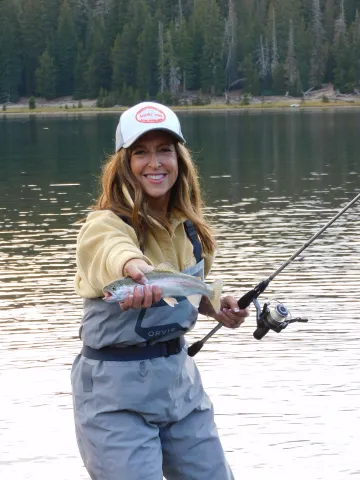
I have started tying egg loop knots and curing eggs on a smaller scale. Our hatchery programs turn out legals, "trophy" trout (14 to 18 inches), and brood stock fish that can go six pounds or more. Some of those hatchery fish have eggs in them, which look like bait to me.
WHY SPAWN SACS?
Trout eggs are few and fragile, and the skein is weak, but they are a dynamite way to turn hatchery trout into more hatchery trout.
Use spawn netting to conserve the eggs for a longer time in front of the fish. While an egg-looped bait might stay on the hook for three or four casts, the spawn sac bait can go for 40 or 50 casts and multiple fish.
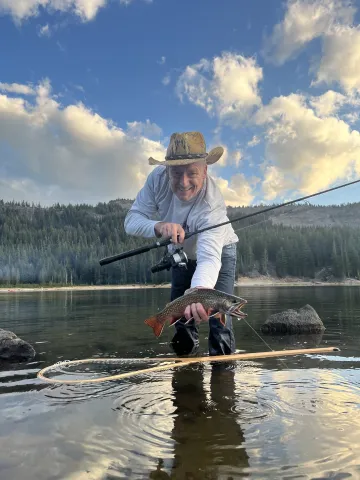
I kept the eggs from a 30-inch lake trout and put them in a paper towel in the refrigerator, and forgot about them till I was in Alaska. My wife was home and cured the eggs for me (her first time curing eggs), and we put them to use on a fall trip to one of my favorite lakes. I wound up catching a pair of beautiful brook trout. Opening our mixed bag of rainbows and brookies that evening, I harvested bait for the next trip.
Try to get eggs from four or five trout before starting the cure. First step in preparing the eggs is to allow them to air dry on a paper towel for a day or so.
The cure itself can be any one of dozens of commercial powder or liquid offerings or a person can prepare their own with Borax, brown sugar, and salt. Lately, we have been using Pro-Cure's Last Supper blend, augmenting it with sea salt and krill powder.
Donning latex gloves, I roll the eggs in the cure, making sure the cure adheres to both sides of the skein. Next, I sprinkle on extra salt and krill powder. Then I let that combination drain/air dry for about a day. After that, the eggs are ready for the spawn netting.
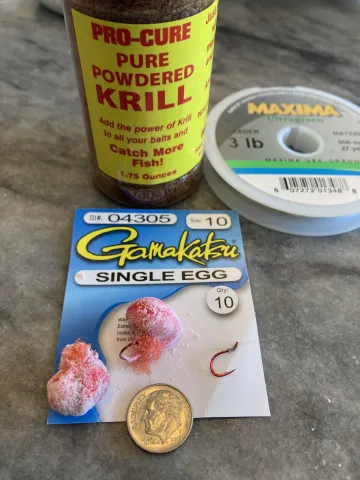
For these smaller baits, I will use a No. 8 or No. 10 egg hook with an egg-loop knot. The bait should be the size of a dime. I get two to four baits out of a skein and four to eight baits per fish.
Cut a small rectangle of netting (I use Atlas Mike's) and lay the bait on it. Then gather the edges and tie it with stretchy string (like Kwikfish Stretchy Thread. Trim off the extra string and netting, and you have a dime-sized bait ready to fish.
Baits can be stored in Ziploc bags, plastic boxes, or glass jars. Use the baits as-is or add a little more Borax to toughen them up.
Curing eggs for a spawn sac presentation allows the angler flexibility in doctoring the baits to specific conditions or to provoke a reaction bite. Eggs sink, which makes spawn sacs a great choice for a float (bobber) presentation. But because eggs sink, they are prone to hang up on rocks in a drift-fishing presentation. The "cure" for that is to add a foam egg (like a Mad River Fish Pill) to the spawn sac.
Jason Hambly, of Pro-Cure Bait Scents, in Salem, Ore., recommends adding krill powder to any trout bait. Garlic, too, is a proven trout favorite. I like to add a touch more garlic to a bait intended for cold water presentations. When the temperature drops in December in these parts, it can be harder to get fish to move. But they seem to move for garlic. Salt, brown sugar, and anise are other scents that could be added to spawn sacs. It makes a lot of sense to bring several flavors and experiment with what works in varying conditions.
STILL WATER RIGS
For our fisheries, I like a finesse presentation using a smaller No. 10 egg hook and a light three-pound test leader. When targeting bigger trout, consider sizing up to a No. 8 egg hook, nickel-size baits, and a five- or six-pound-test 20-inch leader.
Attaching bait is as simple as running the point of the hook beneath the netting knot, then securing it with the egg loop.
In a lake, the bait can be presented under a float when targeting a specific feeding zone. I like to use a sliding sinker fished over a ledge on a travel zone, such as along a drop-off.
WHERE TO FISH
In August and September, plan trips to hit one or more fisheries. Think early morning and late evenings. Eat an early dinner and fish the last two hours of the day. Get up at dawn, fish for the first hour of the day, and then go get breakfast.
In the Cascades, top destinations include Diamond Lake, Detroit Lake (even as it draws down), Cultus, Elk Lake, Olallie Lake, and Timothy. But there are a hundred more. Open a map or get a copy of the Fishing Central Oregon book or Fishing Mt. Hood Country. The Department of Fish and Wildlife stocks all the drive-to and hike-in Cascade lakes.
Sometimes it's fun to experiment with something new, to do something different.
Reinvent your fishing and target trophy fish and brood stock with scaled-down baits.
# # #
Gary Lewis makes his home in Central Oregon.
/articles/cure-high-lakes-trout-gary-lewis
Three High Desert Hotspots for Rainbows by Gary Lewis
Pull those spinning rods and fly rods out of the closet, tie up leaders, and wind new line on the reels. Here are three great spring fisheries that you need to know before you hit the water.
The warming water raises trout metabolisms and quickens an angler’s pulse as rise rings appear within an easy reach of shore.
CHICKAHOMINY
Chickahominy Reservoir is a trout fishing oasis on a windswept plain 100 miles east of Bend. Driving by on Highway 20, you see two blue fingers, a few campers, and picnic tables. Nothing more. What could draw campers to this windy place?
Rainbows are stocked in Chickahominy as fingerlings and reach ten to eleven inches in length by the following year. Two-year-old fish reach eighteen inches. Three years later, they will weigh between three and four pounds.
A narrow reservoir with many coves and fingers, much of the best fishing can be had from shore. Watch for depressions adjacent to shallow bays. Trout use these spots as staging areas prior to feeding in the shallows. A careful presentation yields a strike.
Early in the season, dragonfly nymph patterns are productive, as are scuds and red and black leech patterns. Concentrate on weed beds, edges, and drop-offs. The reservoir reaches a maximum depth of 28 feet. A slow-sinking fly line provides the best control for fishing below the surface.
Bait fishermen do well in the bays and inlets with nightcrawlers, salmon eggs, or jar bait. Use a sliding sinker to take your bait to the bottom. Leave a little slack in the line so a trout won’t feel resistance.
There is a paved boat launch near the dam. Troll trout spoons, or 1/6-ounce Rooster Tail spinners, in the narrows or explore the shoreline, casting to the shallows and letting the lure flutter over the drop-offs.
KRUMBO
A shallow lake on the west side of the Steens, Krumbo Reservoir, is a great rainbow destination in the desert.
Best bet is to bring a float tube, a canoe, or a car-topper. But there is bank access. Anglers can fish at the dam or walk from the ramp to one of two rocky points that look out over some of the lake’s deeper water. Fish a sliding sinker and 48 inches of leader terminating at a No. 8 single hook with Power Bait or Gulp!
With a boat, launch at the ramp and fish out from the cove to 15 yards from the rocky point on the south. A long weedbed stretches north across the lake. The lake averages ten feet deep. Rainbows stack along the weeds and grow fat on callibaetis and chironomids.
Use a clear intermediate sinking line and troll along the weedbed. Fish a No. 12-14 callibaetis nymph, or better yet, a pair of them. To tempt with chironomids, employ No. 16-18 zebra, black, or red midge larva imitations under an indicator.
Leech patterns are effective. Use black, red, or olive buggers, weighted at the head. Twitch the fly with one-inch pulls.
Krumbo is stocked in late March or early April. Trout that winter over grow to 16 inches in their second year. Every season, the lake produces a number of 20-inch and bigger fish.
Covered tables are provided. A restroom can be found near the dam and at the boat ramp. A handicap-accessible fishing platform is near the boat ramp. The launch is paved with a nice dock. Electric motors are permitted.
Krumbo is open for day-use-only from the opening of trout season through October 31. Access is controlled by an automatic gate that opens a half hour before sunrise and closes a half hour after sunset.
Page Springs campground is a few miles down the road. There is RV camping available in private campgrounds on both sides of the Malheur National Wildlife Refuge.
WILLOW CREEK RESERVOIR
Willow Creek gathers her water from the Blue Mountains and runs it down to the Columbia. An impoundment, built to control periodic flooding of the town of Heppner, Willow Creek Reservoir, is located less than a mile upstream from the town.
The 110-acre lake draws anglers from nearby Hermiston and other towns to do battle with its piscine inhabitants. April and May are the best months for rainbows.
Trout put on weight fast in this food-rich water. Most anglers opt for a bobber and worm or a jar bait to put fish on the stringer, but spinners, trolling, and fly-fishing techniques are productive.
The best trout water is along the rip-rapped south bank and across the lake along the north shore. The water drops off quickly to a maximum depth of 85 feet at the dam.
Good bank fishing access makes this reservoir a safe bet for anglers without a boat. Drive past the boat launch along the south shore and take a gravel road down to a parking lot above a riprap bank. Walk down to the water or fish from the car. A trail along an old roadbed provides plenty of room for fishermen to spread out.
Fly fishermen should troll small spinners or flies such as the No. 8 Woolly Bugger or Spruce. Use minnow imitations like the Zonker to spark the predatory instinct in the bigger rainbows. Change direction, speed, and depth to simulate the escape tactics of a worried minnow.
Willow Creek Campground is located high on the western shore, overlooking the dam and the lake. It has 24 hook-up sites, offering water, electric, and sewer. Maximum length is 40 feet. Covered tables, barbecues, flush toilets, drinking water, showers, and telephones are available.
From I-84, turn right at Exit 147 and follow State Route 74 south to Heppner. Proceed through town and follow the signs uphill to the reservoir.
There won’t be crowds of people, and there probably won't be a line at the boat ramp, but there are trout to fight.
# # #
For a copy of the Fishing Central Oregon book, send $30 to Gary Lewis Outdoors, PO Box 1364, Bend, OR 97709 To contact Gary Lewis, visit www.GaryLewisOutdoors.com
CAPTIONS
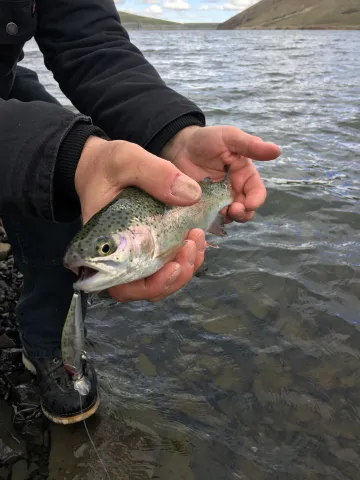
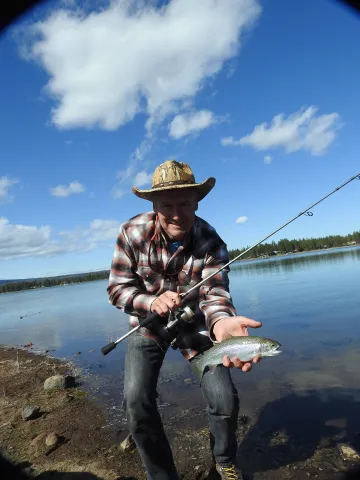
Gary Lewis 5 - An ODFW legal teased up out of Willow Creek Lake near the town of Heppner on a spring morning. Photo by Gary Lewis.
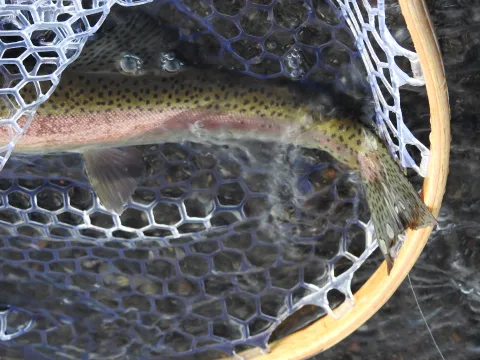
Gary Lewis 8 - In early May, trout can still be found feeding opportunistically and may be caught on a variety of techniques. Photo by Gary Lewis.
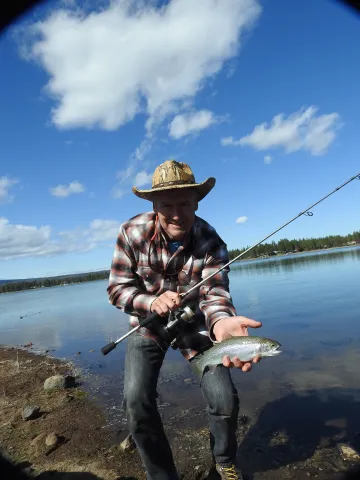
Gary Lewis 18 - Gary Lewis with a hatchery rainbow caught on jar bait. Photo by Gary Lewis.
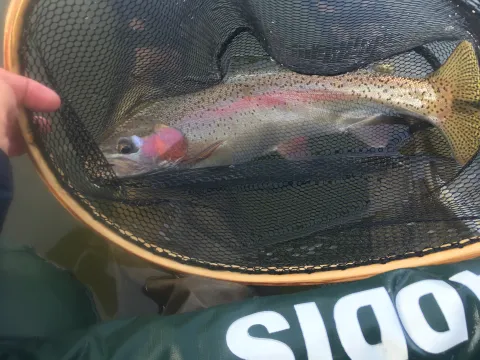
Gary Lewis_Isom 23 - A high desert rainbow caught on a fly. Photo courtesy Dave Isom.
/articles/three-high-desert-hotspots-rainbows-gary-lewis
In Like a Mayfly, Out Like a Brown
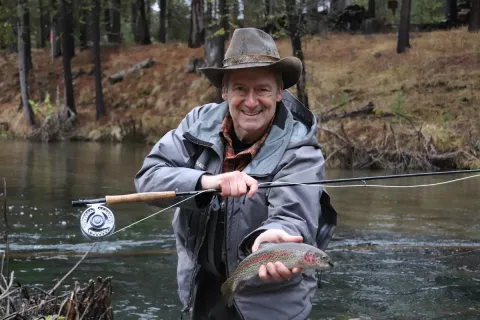
The emergence of the Western March Brown marks the end of winter for many trout fishermen. It may still be cold outside, but this mayfly can heat up the fishing when it makes its first appearance in March. These mayflies live among the rocks in swift-flowing currents. Look for insect activity in slower water adjacent to riffles. Present emergers like the March Brown Spider to rising trout, dead-drift a gold-ribbed Hare’s Ear or Pheasant Tail nymph beneath a strike indicator. If the fish are feeding on top, cast dry flies like the March Brown Upright to surface-feeding fish.
Use the March Brown Parachute when casting to finicky feeders in shallow water. The parachute presents a lifelike silhouette when viewed from a trout’s living room. Be ready with a Pheasant Tail spinner if the flies are falling, spent, to the water. In March, a Blue Winged Olive hatch might happen at any time. And in some waters, you might see both BWOs and March browns on the water at the same time. In Oregon, surrounded the way we are by hundreds of great places to fish, it is hard to remember that there are some great waters off on the eastern horizon. At this time of year, places like Chickahominy, Beulah Reservoir, and the Owyhee River spring to mind. If you crave solitude under an azure sky, the last weeks of winter often bring early green-up to the desert, awaken the aquatic insect life, and fire the appetite of rainbows and browns. And not a lot of people are back on the water yet.
Chickahominy fished well the last couple of years with a restock of hatchery rainbows. Chickahominy grows fish fast. A hundred miles east of Bend, it is a narrow reservoir with many coves and fingers and lots of shallows. Early in the season, dragonfly nymphs, scuds, and leech patterns will be productive. The reservoir reaches a maximum depth of 25 feet, but early in the year, the shallows hold the most fish. One of the best trout fishing destinations in early spring is the Owyhee River below Lake Owyhee. Rainbows are in the riffles, and browns are everywhere else. Owyhee rainbows average 14 to 18 inches, and browns run to 24 inches. Right now, with water temperatures still low, small red and black midges produce fish. But go armed with March browns, blue-winged olives in both emerger and dry patterns.
Another early spring fishery is Beulah Reservoir. Fed by the North Fork Malheur River, this big reservoir, from now until Memorial Day, is a good bet for holdover hatchery rainbows. Bring a float tube or a small boat because the low water may limit the usefulness of the boat ramp. Prowl the shorelines, fishing just outside of the shallows, or explore around the inlet. Fish can grow big in this food-rich reservoir as well. Use leech patterns to spark a strike from the bigger fish. If you land a bull trout, it must be released unharmed.
Other good early spring bets include Krumbo Reservoir and the Blitzen River. Krumbo is one of the lakes that gets early stocks of hatchery trout.
Flowing out of the Steens, the Blitzen River can grow trout big. Spend some time watching the water for clues and for feeding fish.
Put gas in the tank and string the rod. There is nothing like a road trip to greet the early spring green-up. And what better reason to take to the highway than hungry trout?
/articles/mayfly-out-brown
Spoon Theory
If there is one best time of year for trout fishing, it's fall when the insect life is fading away and trout that have been fattening all summer are starting to feel the pinch of empty bellies. Trout that are going to make it through the winter have to switch from eating insects to eating minnows. This is the time of the year to put baitfish imitations to use. Trout are full of energy and will go a long way to hit a shiny bit of metal.
On those days when we launch the boat in the early morning. When the water is glass, we know the fish are elevated. It can be fun to put a small spoon in play.
PLANNING THE TRIP
Before you back up to the boat trailer, take a look at a map and click up www.myodfw.com to get an idea of some Oregon waters that will definitely get fresh stocks of fish in the early fall. This is the time of year when hatchery trout stocking ramps up again. Water levels are beginning to fall, and ambient temperatures are good for trout. Most fish & wildlife agencies post their stocking schedules on public websites. Weather changes, the price of fuel, and emergencies can change the timing of fish releases, but it's a good idea to comb the stocking schedules.
Top bets in the Willamette region (an easy drive for anglers from Portland, Salem, or Eugene) include North Fork Reservoir (on the Clackamas River), Foster Reservoir, Trillium Lake, Dexter Reservoir, Hills Creek Reservoir, and Dorena Reservoir. Most lakes get the "legals", which average 8 to 12 inches, but a person can put more poundage in a trout limit by targeting the "trophy size" trout that are older, better fed, and better fighters. If a lake gets 5,000 legals in the season, it might also get 250 trophies and a few brood stock trout that can tip the scales at five pounds or more. Premier fisheries that get a lot of angling attention, like any larger reservoir with campgrounds and mountain views within a two-hour drive of a metropolitan area, are likely to get a couple of stockings of brood fish or trophies every season.
It's all there in the stocking schedule. Except it's not.
BEHIND THE SCENES
A lot of what happens behind the scenes does not show up in the hatchery schedule. Sometimes there is an abundance of brood stock or surplus steelhead in the system that need to go somewhere. Another thing to watch for is when a lake is drained for maintenance or to kill trash fish. When the lake fills up again, the fisheries department scrambles to fill it with trout. Then there are the lakes that are never on the stocking schedule, but they magically have hatchery trout every season, and plenty of them. What's up with that?
Some reservoirs are not on the published stocking schedule because they are managed by agencies or municipalities, or utility companies with their own hatcheries. These can be some of the best destinations. Think about it. A power company built the dam, and part of the negotiation with the tribe or the community that permitted the dam was to provide a fishery. So every year, they are contractually obligated to populate the lake with some 30,000 trout. They're going to do it, but chances are they aren't taking the time to put it on a list somewhere. That's a lot of silvery slabs vying for a chance at a slow-trolled trout spoon.
SPOONAGE
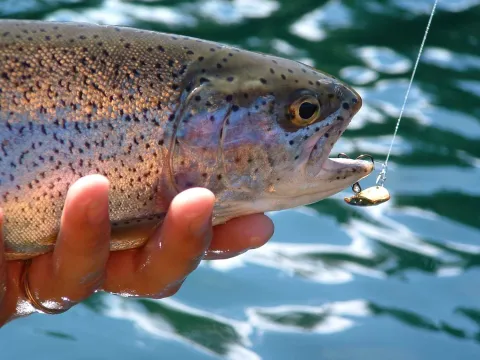
There are a lot of spoons on the market, and they all have their place, but when we are talking about catching a limit of hatchery "legals" and "trophies", the best choice is one and a half to two inches long, like the Mepps Syclops, Triple Teaser, Thomas, Jerry Leo, Z-Ray, and Acme Little Cleo.
In most cases, a spoon should be trolled slowly so that it wobbles side to side. The slower the better. I like the speed at less than 1 mile per hour, up to 1.5 miles per hour, and if I can, I try to keep it at zero-point-nine. This can be accomplished some days on a wind drift, but a bow-mount trolling motor is pretty consistent. There are exceptions. In some lakes, the fish are used to chasing baitfish. This is the case on Upper Klamath and Agency Lakes, where sometimes you can't reel fast enough.
The spoon itself could be an Acme Kastmaster, Little Cleo, or Thomas Buoyant, maybe in the 1/6-ounce class. Every lake fishes a little differently, so it helps to have local knowledge. Frog patterns can be important, as are brown trout, chub, rainbow, and perch colors, depending on the local bait. Sometimes we put a flasher in front of the spoon with a 15-inch leader. Another trick we like is to add a touch of Pro-Cure's trophy trout scent to the spoon. And it never hurts to tip the hook with a bit of worm, corn, or a salmon egg. Trout that are going to carry over through the cold months have to start eating baitfish. Put baitfish imitations like trolling spoons to work. Trout are supercharged in the cold water and will chase up and down in the water column to hit a shiny bit of metal.
/articles/spoon-theory
Mountain Trout As Art
We are captivated by trout. And we wonder why. Trout don't love us, they don't love each other, and they don't do anything for their fellow trout, except by accident or by instinct.
But the same could be said of art. We appreciate art for maybe the same reason we love trout. Let's see if the words — art and trout — are interchangeable.
Wynetka Ann Reynolds might have said,
“Anyone who says you can't see a thought simply doesn't know trout.”
For two summers, I spent afternoons and weekends exploring back roads, backcountry, and backwaters in streams and lakes down the flanks of Wy'East for a book we called Fishing Mount Hood Country. My co-author, Robert Campbell, covered most of the western water, and I fished more of the east side.
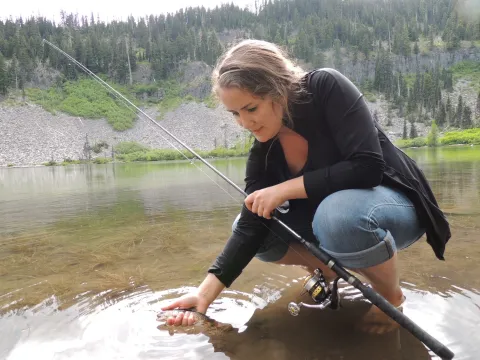
Early in the project, Campbell began to send close-ups of trout — Veda Lake cutthroats, Timothy Lake brookies, Salmon River rainbows — in hand, going back into the water. The imagery seeped into my consciousness, and when I brought East Fork Hood River cutts, or Boulder Lake brooks, or Badger Creek rainbows to the bank, I began to look at each one as a piece of art, at each scale as a stroke of a brush.
We seldom fished the same water twice during the two summers on and off the mountain. We caught bass, sturgeon, steelhead, and salmon, but the fish that defined the effort was the coastal cutthroat. There are many variations. The Clackamas watershed fish were different in coloration from Zigzag River fish, and in bigger lakes, trout coloration varied due to the micro-environments they frequented.
We might put the distinct differences down to genetics, habitat, food sources, and light penetration.
Hood River wild fish, where there are fewer trees above the water and the bottom is light, are bright and shiny. Fish in west-sloping rivers with darker streambeds are often tinted, an adaptation that helps them survive.
While there are a few resident rainbows near the mouth, Campbell's exploration of the upper Clackamas turned up big rainbows, part of a remnant strain that can grow to several pounds in that mountain water. I plan to research that water again soon.
If Goethe had been born to a fly-fishing family rather than to German drama, he might have written:
“There is no surer method of evading the world than by following trout, and no surer method of linking oneself to it than by trout.”
We caught hatchery planters, of course, and the further they were removed from the raceways, the better they looked. Holdovers — fish that had made it through a winter and gained inches and pounds — were the prettiest. We might call them modern trout and appreciate them in that regard.
John Anthony Ciardi could have said:
“Modern trout is what happens when fishermen stop looking at girls and persuade themselves they have a better idea.”
For me, one stream and one fish defined the project. A Still Creek cutthroat, about nine inches long, took a dry fly and threw the hook. The next fish was a bit smaller, but it shone in hand like treasure. I sent a picture to my friend Tye Krueger, and he drew it in every detail — a wild cutt with white tips on its fins and parr marks still visible on its sides.
Kojiro Tomita might have written it thus:
“It has been said that trout is a tryst, for in the joy of it, maker and beholder meet.”
Conditions seem to force beauty to the surface. Up toward the timberline, an angler finds the most striking examples — wild trout that in other environs would grow to be measured in pounds, not inches. Here, an eight-inch rainbow is mature, with white tips on the edges of his fins and a tint of rose in his gill plates, dark spots all the way to the tail.
G.K. Chesterton might have put it this way:
“Trout consists of limitation. The most beautiful part of every picture is the frame.”
Here in the Northwest, we have the run of an ancient gallery. The price of admission is a fishing license and the will to seek it.
“All trout requires courage,”
with apologies to Anne Tucker.
In the passage of time, we become collectors of art, the images stored in digital files and memories. And sometimes we make that beauty part of ourselves with brook trout grilled over a campfire.
If Scott Adams had been consulted, he might have offered:
“Creativity is allowing yourself to make mistakes. Trout is knowing which ones to keep.”
/articles/mountain-trout-art
Bull Trout in the Metolius
With the water swirling around us, we waded in at the mouth of Jack Creek. Skip Morris had hooked and lost a big rainbow here the day before. Today he stood back while Carol plumbed the two-foot deep run with a big stonefly nymph trailing a small beadhead attractor, called Gabriel's Trumpet.
For a moment we thought Carol's rig was hung up, but when she tightened the line, a fish torpedoed away. The fish rolled mid-river and I saw his tail and dark fins silhouetted against bright water: a bull trout. Close to eight pounds, I guessed. The line broke and Carol reeled in the slack. The fish had taken the big stonefly nymph after a 13-minute battle and a last headlong flight.
That’s what can happen when kokanee are on the move and bull trout follow them into the shallows.
LAKE RUN BULL TROUT
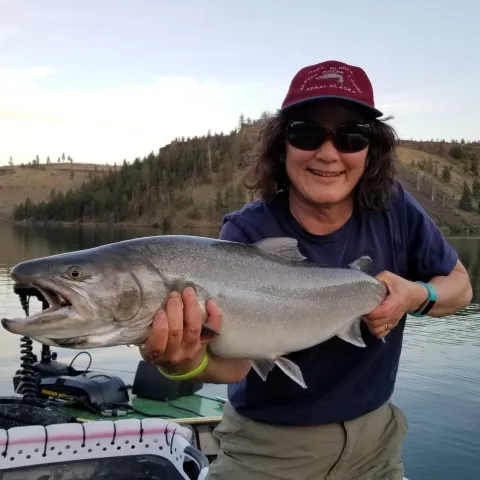
Kokanee are thickest in the Metolius in late September and October. And the biggest bull trout, which can get to 30 inches or more, hammer them. Bull trout are meat eaters and if it's a third of their size they will crunch it. If it's half their size, they will try to choke it down anyway. Anyone who has caught a bunch of big bull trout has seen the tail end of a kokanee or a whitefish sticking out of that gullet.
The Metolius River and Lake Billy Chinook are home to resident and migratory bull trout. The bulls move up the river to spawn in late August, September, and October. Oriented to ice-cold water, bull trout stage near springs and off the mouths of major tributaries like Canyon Creek and Jack Creek. After the spawn, they need to replace the calories they expended over the last few weeks. That’s when they find the kokanee.
The kokanee spawn puts both species in the river at the same time. And the bull trout are the winners. Preoccupied, the landlocked salmon are easy prey for sharp-toothed bull trout. Whitefish are on the menu for bull trout year-round, and many are the stories of anglers fighting whitefish only to lose them to bull trout which charge out from under a log to grab the hapless poor man's bonefish.
Bull trout are apt to eat the limp, the lame, the lazy. It’s the erratic behavior that trips the predatory sear in a bull trout's brain. Think strike triggers. Tie or buy streamers with big eyes, a flash of blood red near the gills. On the water, fish them on the wet fly swing, but give them action. Make the imitation twitch. Like a wounded fish in deep trouble.
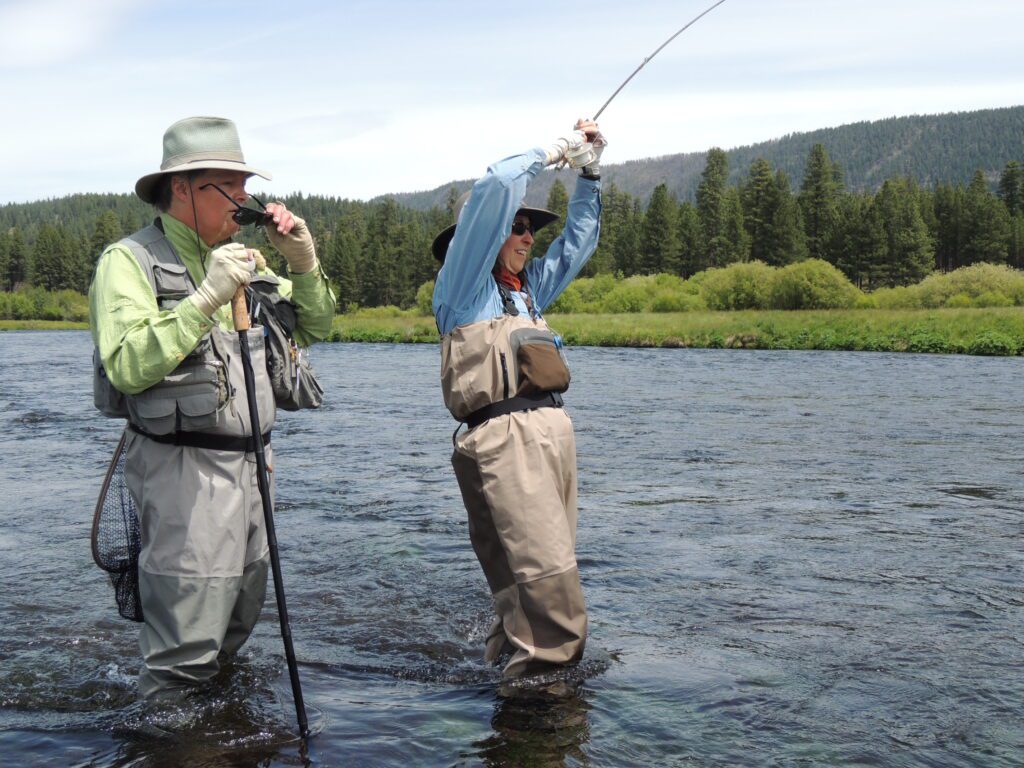
Carol Ann Morris fights a bull trout on the Metolius. Photo by Gary Lewis
FISHING LAKE BILLY CHINOOK
A down-running Metolius River bull trout ends up running into Round Butte Dam and turning around to make its living in a 4,000-acre reservoir fed by three rivers: the Metolius, the Deschutes and the Crooked River. Best time to target bull trout in Lake Billy Chinook is when the waters begin to warm in March and April. Bull trout hunt close to shore in the late winter and early spring. Anglers who throw Zonkers and other minnow imitations on long casts and strip hard can elicit hard strikes from fish. It's one of the best ways to get the biggest bull trout. A lot of 17- to 19-inchers will be brought to the net as well as the occasional 10-pounder.
SWINGING STREAMERS
When whitefish are schooled up, working the bottom, they are hard for bull trout to feed on, but when one of them leaves formation and streaks up to eat a mayfly emerger, its defenses are down and its easy money for bull trout.
When fishing a small streamer or a larger bunny leech, try to work it like a fish that is out of its element, a scared minnow that thought it could play in the deep end of the pool. It's vulnerable. It's lunch.
A variation on that theme is the sculpin. Bull trout eat sculpin year-round. In the river, they eat sculpin. In the lake - sculpin. When sculpin are doing what they do, daubing in the mud, they are pretty safe. But when they climb up through the water column or get caught in the current, something is going to nail them. Big lead eyes, blood-red gill flare or Flashabou, and prominent fins are some of the strike triggers to play on when tying sculpin flies.
Cast down and cross-current, let it swing and chug it. On long runs and into the tailout, let the sculpin work back and forth. Tied small, a sculpin imitation can be fished with a slackline presentation that keeps it working back and forth over bull trout holding water.
Think big. If a 30-inch bull can choke down a 12-inch whitefish, it will go for a 10-inch streamer. Big bunny leeches double as flesh flies. Just change the presentation.
DREDGING WITH A TWO-FLY RIG
As kokanee carcasses and decaying flesh become harder to find, bull trout begin to focus on bugs. Streamers and flesh flies can provoke a grab, but a dead-drifted nymph can pay off as well. To conserve strength, the biggest fish claim the best lies, hugging the bottom along downed timber and behind rock slabs and boulders. The major difference between drifting beadhead nymphs for rainbows and for bull trout is the length of the leader and the tightness of the presentation to the bottom. Fish the bottom. Keep the leader short so the dropper fly doesn't ride too high in the water column.
Tie on a big, heavy stonefly nymph and knot eight to ten inches of fluorocarbon tippet material to the bend of the hook. The primary fly can be a Flashback Pheasant Tail, an egg pattern, or a No. 16 Serendipity. The main thing is to get that heavy fly bumping on the bottom. Make it easy! That bull trout should be able to spot the trailing dropper fly, lean its head over, and grab without leaving its lie.
Metolius River File
- Origin: Metolius Springs
- Mouth: Lake Billy Chinook
- Length: 28.6 miles
- Nearest cities/towns: Sisters, Camp Sherman
- Designation: National Wild and Scenic River
- Major Species: Rainbow, Bull trout, Kokanee, Whitefish
- Camp Sherman Store - www.campshermanstore.com
- Fly Fisher's Place - www.flyfishersplace.com
- Metolius River Association - www.metoliusriver.com
- Best Coffee: Fishing Central Oregon Reserve Roast
/articles/bull-trout-metolius
Fall Trout Strategies
Tired of the salmon fishing crowds?
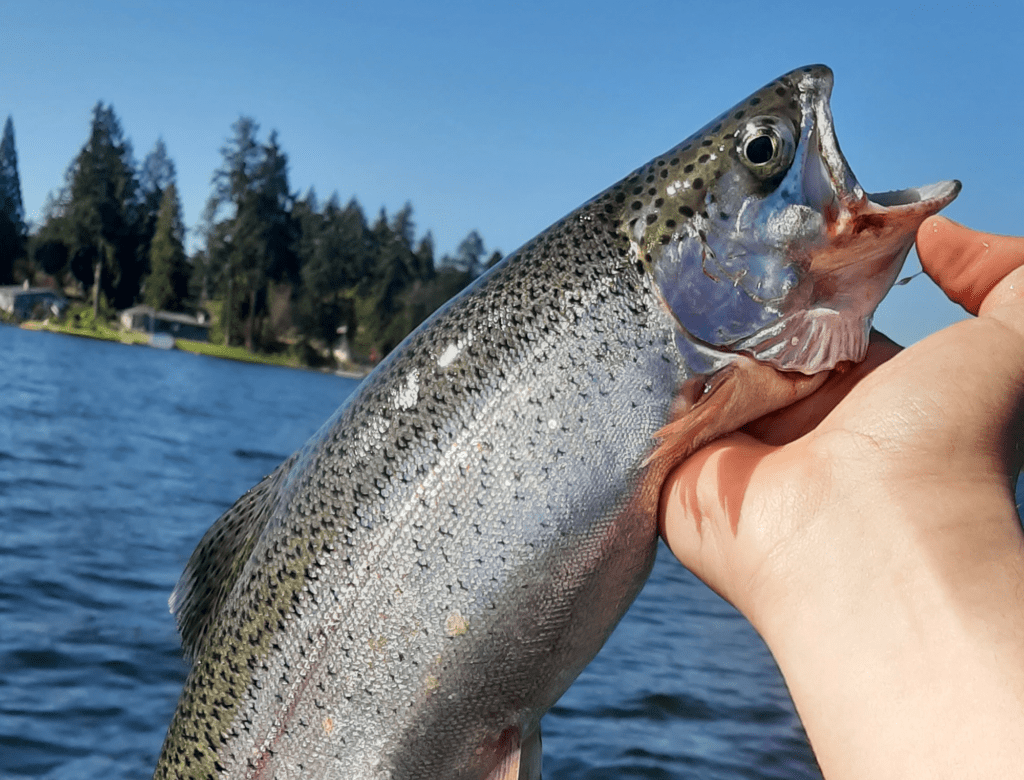
Tired of the salmon fishing crowds? Looking for one last hurrah before winter? Look no further than fall trout! Fall is one of my favorite times of year to fish for rainbow trout. The majority of other fishermen have either put the boat away for the year or are off targeting salmon, so most days you’ll have the lake to yourself.
Most pleasure boaters have also put their boats away for the season, so those of us with small boats don’t have to deal with their huge wakes! Another benefit of fishing for trout in the fall is that they once again start to patrol the shallows looking for a quick meal, putting them within reach of shore anglers. Those small planter trout from earlier in the year have also gotten much larger by this time, making for big, tasty fish. Not to mention they are also more aggressive during this time of year because they want to pack on the pounds before winter.
Though they do most of their trout stocking in the spring, WDFW also plants several lakes on both the east and west side throughout the fall. Check the stocking reports on their website, sometimes they stock jumbo trout! Fishing for fall trout is one of the best ways to spend a lazy fall day. You can enjoy the cooler weather and a break from the crowds. Whether you want to fish from shore or a boat, you can find success by following these tips.
No boat?
No boat? No problem! Dust off those ultralight rods and hit the lake. You can fish with a bobber, soak dough bait, or throw hardware. Spinners and spoons work very well for fall trout, but traditional dough baits and worms will also catch fish. On lakes where two-pole fishing is allowed, I like to put some dough bait on a hook, toss it out, and put the rod in a rod holder. I’ll grab a second rod and cast spinners while the dough bait soaks. Black/gold spinners are my favorite! It’s a good idea to bring several different colors and flavors of dough baits.
Take a look at reports or try to remember what you used in the spring. Worms, salad shrimp, corn, and maggots are all tried and true trout baits. If you don’t have luck fishing in one location, it pays to move around until you figure out where the fish are at. You’ll often see fall trout jumping and feeding on the surface. Fishing is best in the mornings and evenings, but trout are always hungry during the fall and will bite any time of day.

Shore anglers
Although shore anglers can easily get limits of trout in the fall, don’t be afraid to take out your boat and try trolling for them. There are fewer pleasure boaters in the fall, thanks to the cooling temperatures. It’s a great time of year to take out your kayak or small aluminum boat. Try a faster troll than you would in the summer. These trout are feisty and will chase down a meal willingly. You can use larger presentations than you would in the spring and summer, since the fish are bigger. I’d highly recommend using a fish finder. Do you miss trolling with leaded line?
This is a great opportunity to troll with leaded line or divers, since the fish are running much shallower than in the heat of the summer, making downriggers unnecessary. I often have good success trolling plugs in the fall, but spinners can work well too. For attractors, you can use dodgers or gang trolls. I lean towards dodgers, but maybe that’s because I’m also a kokanee fisherman.I already have a book of 20-30 dodgers in different colors, shapes, and sizes. Gang trolls have definitely put caught many a trout, but I find dodgers easier and more convenient to use. I can quickly put globs of scent on them, tune them, and change them to suit the conditions or try something new. Whichever method you use, you’re sure to get many fall trout on your hook!
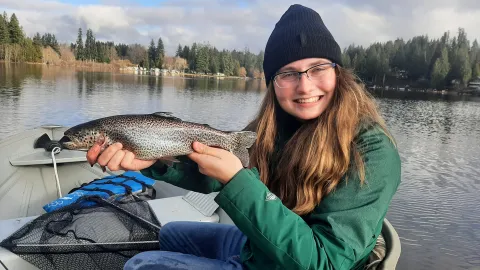
Don’t hesitate to give fall trout fishing a try! The fish are big, aggressive, and tasty. Your chances of scoring a trophy holdover are much higher this time of year. I would recommend trying Potholes Reservoir, the seep lakes, Mineral Lake, Clear Lake, American Lake, and Harts Lake, for starters. There’s no need to put up with crowds or drive all day to the coast. Give your favorite local lake a try! It’s also a great way to put kids on fish. Some kids just don’t have the patience to troll or cast all day for salmon, but they’ll love seeing those trout takedowns! Don’t forget to bring the net, the size of these trout can surprise you.
Hope to see you out there this fall!
/articles/fall-trout-strategies