Trout fishing with a dry fly in the Cascades by Gary Lewis
My first encounter with trout and a dry fly was like prayer. It was a Sunday afternoon. I was 12, the fish was as old as time, and the insect was a white miller moth that touched down on the water. I whispered a prayer. “Lord, if you want me to be a fly-fisherman, send a trout to eat that moth.”
With the sun on its wings, the moth bounced over the water, touched down, lifted, touched again. A trout broke the stillness of the pool, nosed through the surface, and ate the moth. Church was over.
In those days, to become a fly-fisherman meant becoming a different person. Fly-fishermen wore tweed, and they wore funny hats. They smoked pipes. This was what I must become. It was big stuff for a 12-year-old. I wasn’t even sure my mom would let me smoke a pipe.
On Monday, my grandpa drove me to the hardware store. I bought a 7-weight fly rod with the money saved from mowing lawns. I knew to start by fishing nymphs and wet flies, but as soon as I could, I would try to catch a trout on a dry fly.
In those days, I lived in southwest Washington and rode a ten-speed with a fly rod across the handle and crept through the alder to watch the trout and the bugs on the water.
WHERE AND WHEN
Today, the Cascade mountains and the streams that come down off the glaciers and out of those snowmelt reservoirs can offer the same kind of dry fly fishing.
The estimation of a trophy trout is on a sliding scale. Since it does not take a lot of water to keep trout alive, trophy rainbows and cutthroat can be found in a lot of east-slope and west-slope creeks and rivers, and even a few north-slope trickles.
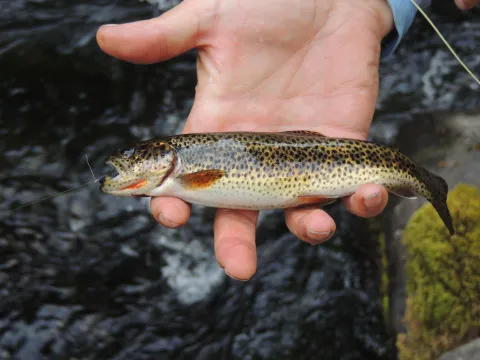
Highway 35 parallels and crosses the East Fork Hood River, which is home to beautiful cutthroats, vulnerable to any high-floating bushy dry fly.
Anyone good with a map can locate a dozen other small streams that can be accessed for spot-and-stalk dapping or casting in the same area.
In the Clackamas drainage, the Oak Grove Fork offers a bushwhacking opportunity where the light plays on the riffled water and mayflies dry their wings and form small clouds over the log jam pools.
Another stream winding down out of the national forest is the Breitenbush. Any trout from the Breitenbush is a trophy and may be too small to eat, but in time it will grow larger in memory. But don’t be deceived, there are some big trout in the little river too.
Another steep little river is the North Fork Santiam, with both wild and hatchery trout. In the fast riffled water, the trout are watching the surface for the mayflies, stoneflies, and caddis caught in the current.
Miles and miles of the McKenzie River are driftboat floatable and wet wadeable. In these years after the big fire, the river’s overstory (canopy) has opened, and there is no doubt the bug life has responded to the sunlight. Resident rainbows can grow big, coming out from under the cutbanks to feed.
Of the rivers and creeks tributary to the Willamette, the Middle Fork is a great option for the wading angler. In fact, there are a dozen streams. Pore over a map with a highlighter and note where the rivers cross under the roads. There will be a pullout and a trail down through the alders. An angler can base camp at Lowell, Westfir, or Oakridge and fish for days without going over the same water twice.
FLIES FOR SUMMER WADING
A well-stocked fly box should have foam body ants. It helps to tie or buy the fly with a high-viz wing to keep track of it in the riffles. Attractor dry flies like the Stimulator and its variants are great for those rare moments when the fish are feeding on stoneflies. Mayflies and caddis can be tied with a little foam or hollow-bodied deer hair. Another good attractor is anything from the Chubby series. Sometimes, when fishing a chubby, it’s a good idea to tie on a dry fly dropper. Cut off at least 20 inches of 5X. Put an ant on the light tippet tied off to the bend of the hook of the bigger fly. Then set the hook at a splash.
There are still a lot of places where rainbows and cutthroats flash to caddis from out of downed timber, the sun filtered through alders. The braided currents open windows to heaven in the clear water. Trout fishing is still like prayer.
To cast a dry fly and present it in a natural drift; to see trout come up out of the dark water to take it, that is the pinnacle of fly fishing.
# # #
For a copy of the Fishing Central Oregon book, send $30 to Gary Lewis Outdoors, PO Box 1364, Bend, OR 97709 To contact Gary Lewis, visit www.GaryLewisOutdoors.com
/articles/trout-fishing-dry-fly-cascades-gary-lewis
In Like a Mayfly, Out Like a Brown
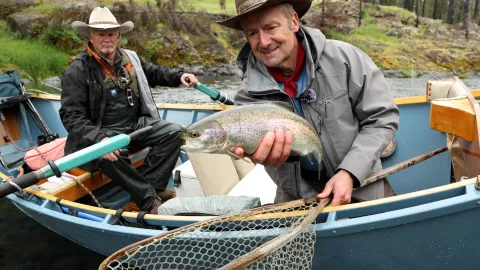
The emergence of the Western March Brown marks the end of winter for many trout fishermen. It may still be cold outside, but this mayfly can heat up the fishing when it makes its first appearance in March. These mayflies live among the rocks in swift-flowing currents. Look for insect activity in slower water adjacent to riffles. Present emergers like the March Brown Spider to rising trout, dead-drift a gold-ribbed Hare’s Ear or Pheasant Tail nymph beneath a strike indicator. If the fish are feeding on top, cast dry flies like the March Brown Upright to surface-feeding fish.
Use the March Brown Parachute when casting to finicky feeders in shallow water. The parachute presents a lifelike silhouette when viewed from a trout’s living room. Be ready with a Pheasant Tail spinner if the flies are falling, spent, to the water. In March, a Blue Winged Olive hatch might happen at any time. And in some waters, you might see both BWOs and March browns on the water at the same time. In Oregon, surrounded the way we are by hundreds of great places to fish, it is hard to remember that there are some great waters off on the eastern horizon. At this time of year, places like Chickahominy, Beulah Reservoir, and the Owyhee River spring to mind. If you crave solitude under an azure sky, the last weeks of winter often bring early green-up to the desert, awaken the aquatic insect life, and fire the appetite of rainbows and browns. And not a lot of people are back on the water yet.
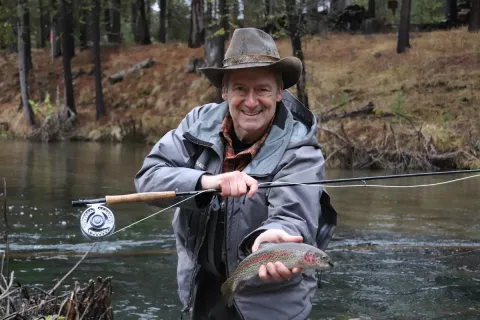
Chickahominy fished well the last couple of years with a restock of hatchery rainbows. Chickahominy grows fish fast. A hundred miles east of Bend, it is a narrow reservoir with many coves and fingers and lots of shallows. Early in the season, dragonfly nymphs, scuds, and leech patterns will be productive. The reservoir reaches a maximum depth of 25 feet, but early in the year, the shallows hold the most fish. One of the best trout fishing destinations in early spring is the Owyhee River below Lake Owyhee. Rainbows are in the riffles, and browns are everywhere else. Owyhee rainbows average 14 to 18 inches, and browns run to 24 inches. Right now, with water temperatures still low, small red and black midges produce fish. But go armed with March browns, blue-winged olives in both emerger and dry patterns.
Another early spring fishery is Beulah Reservoir. Fed by the North Fork Malheur River, this big reservoir, from now until Memorial Day, is a good bet for holdover hatchery rainbows. Bring a float tube or a small boat because the low water may limit the usefulness of the boat ramp. Prowl the shorelines, fishing just outside of the shallows, or explore around the inlet. Fish can grow big in this food-rich reservoir as well. Use leech patterns to spark a strike from the bigger fish. If you land a bull trout, it must be released unharmed.
Other good early spring bets include Krumbo Reservoir and the Blitzen River. Krumbo is one of the lakes that gets early stocks of hatchery trout.
Flowing out of the Steens, the Blitzen River can grow trout big. Spend some time watching the water for clues and for feeding fish.
Put gas in the tank and string the rod. There is nothing like a road trip to greet the early spring green-up. And what better reason to take to the highway than hungry trout?
/articles/mayfly-out-brown
Trout Fishing: When Life Gives You Lemons.
Farmed. Hatchery. Wild.
I fed a rusty orange streamer into the current, threw an upstream mend, and let it swing. We call it First Water. It's what you get early in the morning when you get to the river before the next guy. First Water makes you smile after a hard week at work. Like making lemonade out of lemons.
A trout hammered the fly and the tippet snapped. Heart pounding, I cut the leader back to 8-pound, tied on another fly and cast quartering-down. This time when the fish hit, it turned and charged, coming straight out of the water. Five minutes later we slid the net under a four-pound gnarly, hook-jawed brood stock rainbow. We have learned from experience it's hard to revive the big hatchery rainbows, so it was an easy decision to keep it for the table.
FARMED, HATCHERY, WILD OR NATIVE?
Here's a thing that doesn't make sense. We go to the grocery store and complain about the price of groceries and then we drive to the lake and catch and release a limit of rainbow trout at $10 a pound. I've done it.
Hey, those fish were put there to catch and keep. It's healthy food, high in omega-3 fatty acids and B vitamins. Easy to catch (sometimes). Easy to clean. Tastes good. Good for you.
Think of it like this: we have rainbows, cutthroats, brook trout, brown trout, bull trout, and lake trout in our lakes, rivers, and hatchery raceways. Some of them end up behind the butcher's glass at the grocery store. How do we tell where they came from? The ones in the cellophane and Styrofoam, that's easy. Those are farmed fish, which are generally shoveled a high-quality pelletized food and then fed a carotenoid called Astaxanthin which gives the meat an orange color and improves the taste.
According to Luke Allen, from the Wizard Falls Hatchery and Tim Foulk from the Fall River Hatchery, astaxanthin is produced by microalgae which is ingested by small fish and invertebrates like krill, which are then ingested by fish.
In Oregon, hatchery-raised rainbow trout (and cutthroats) are classified as legals (usually 8 to 12 inches), trophies (usually 14 to 18 inches), and brood stock, which are the surplus breeding trout that tip the scales somewhere between four to ten pounds. In Central Oregon, these fish end up in places like Pine Hollow Reservoir, Walton Lake, South Twin, and Fall River. Hatchery trout may also be released as fingerlings in waters like Lava Lake, East Lake and Diamond Lake where the natural feed is so good the fish grow fast. Fingerlings are also released in the high lakes every other year. Fingerlings, although raised in hatcheries in geometric order, tend to behave and look more like wild trout as they reach a harvestable age.
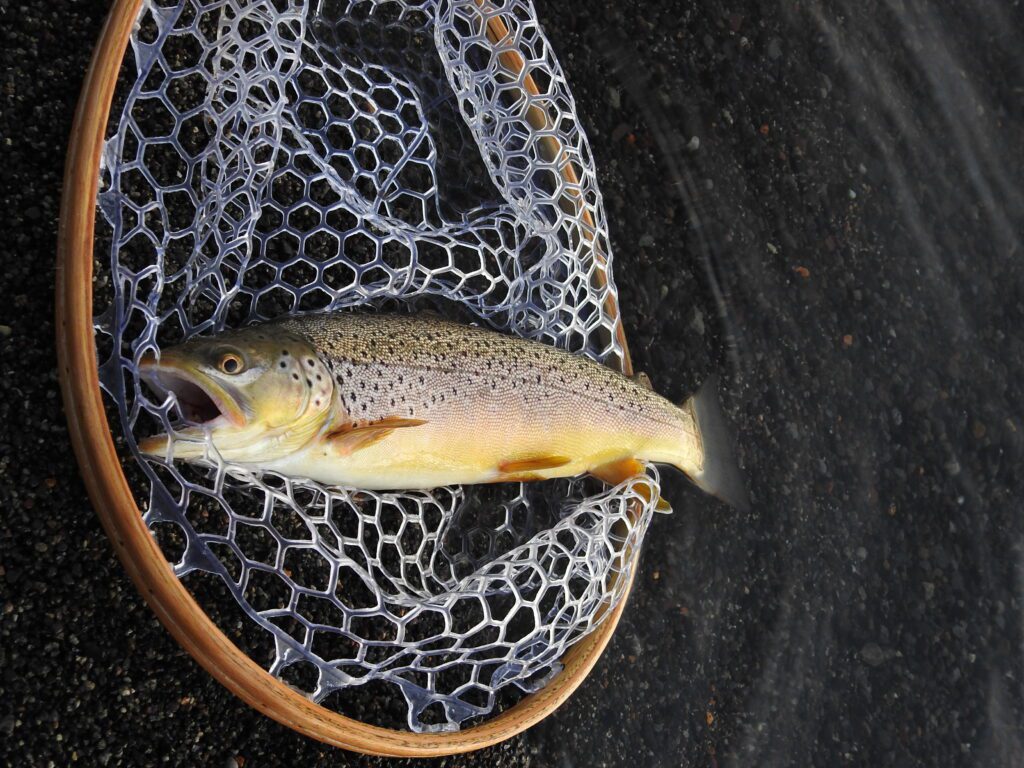
The terms wild and native can refer to the same fish or mean two different things. Brown trout, brook trout, and lake trout are not indigenous to Oregon but were introduced. Browns come from Germany and brooks come from the East Coast. That's why we refer to them as German browns and Eastern brooks. But if they were hatched in gravel we call them wild trout.
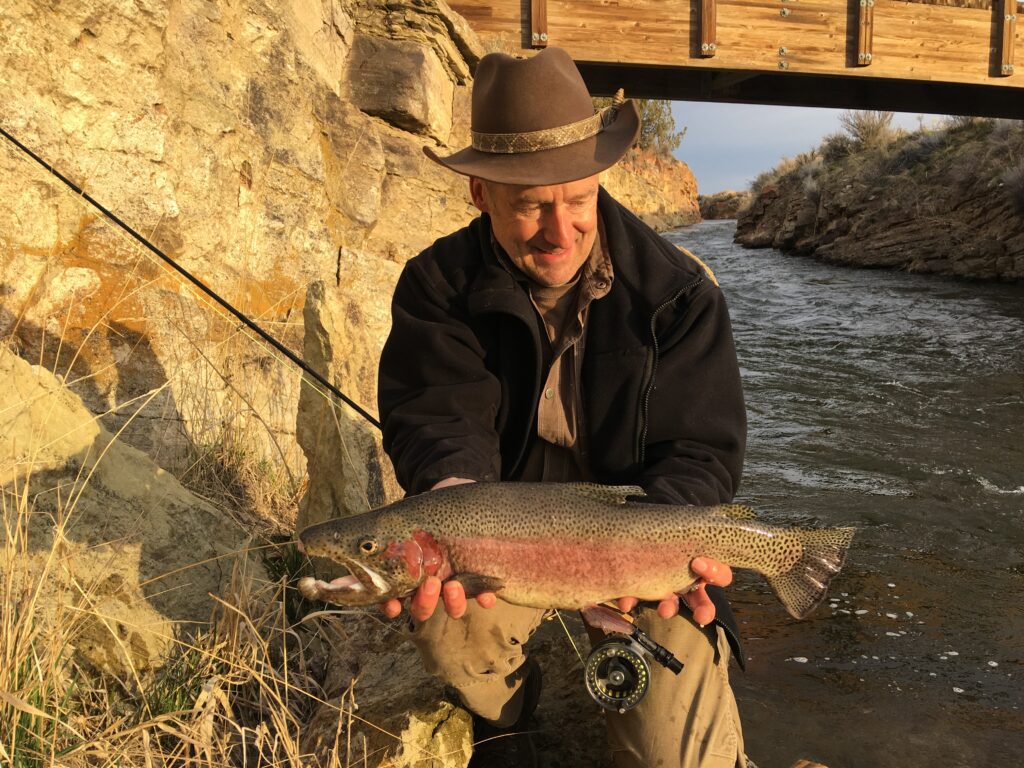
Photo courtesy Don Lewis
The term native is inclusive of rainbows, cutthroat and bull trout. In some cases these fish may be caught, kept and eaten, but it’s a good idea to release them to spawn and prosper. If you catch a brookie in the high lakes, hey, that's some of the best wild food you can get. And you are not eating a native fish.
A steelhead is a rainbow trout that migrated from freshwater to the ocean and returned. If a person eats farmed steelhead, it is probably not steelhead at all, but rainbow trout packaged as steelhead. An angler that catches and eats a fin-marked steelhead has consumed a hatchery steelhead. Surplus steelhead that returned to their hatcheries in places like Nehalem or Three Rivers are often trucked to coastal lakes and set free to give anglers another chance at them. Because they will probably not thrive in the lake, the highest use of these fish is to turn them into a good meal.
Fisheries managers sometimes struggle with the divide between the consumptive and the catch-and-release ethic.
Diamond Lake was devoid of fish before it was stocked by mule trains in the early 1900s. The food-rich lake still grows fish to trophy proportions and not enough gets taken home by sportsmen. It's a resource we could be making better use of, and the same principle applies all over the state from Lake Selmac to Wallowa Lake to Bikini Pond to Rock Creek Reservoir to Lava Lake. Those fish are there to eat. And there are some really good things like dill, parsley and lemon that go great with a pan full of eastern brookies or hatchery 'bows.
That's why I say when life gives you lemons, go catch a trout.
For a copy of the Fishing Central Oregon book, send $29.99 to Gary Lewis Outdoors, PO Box 1364, Bend, OR 97709 To contact Gary Lewis, visit www.GaryLewisOutdoors.com
/articles/trout-fishing-when-life-gives-you-lemons
Riffe Lake Roundup
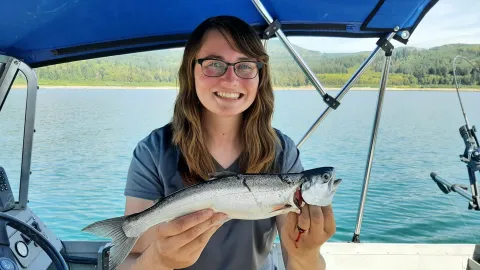
Fishing season is officially in full swing! With so many lakes, rivers, and marine areas to choose from, it can be hard to pick your next adventure. If you’re never fished Riffe Lake before, or if it’s been a while, you should put it at the top of your list. It’s one of my favorite fishing destinations, and I make it a point to fish it as much as I can every year. Not only is the fishing top notch, but the scenery is beautiful and the surrounding towns are well worth visiting. I can’t think of many other lakes that offer such a wide variety of fish, let alone with such a good opportunity.
You can catch brown trout, cutthroat trout, smallmouth bass, chinook salmon, coho salmon, crappie, and brown bullhead. The lake is simply packed with fish, and they’re willing biters. You can take the boat out or shore fish, and finish out the day with a Dam Burger from Pioneer Bar & Grill in Mossyrock before heading home to grill your catch. It’s a bit of a drive, but it’s a great way to spend a day!
Located in Lewis County, Tacoma Power created RIffe Lake by constructing Mossyrock Dam on the Cowlitz River in 1968, flooding the communities of Riffe, Nesika, and Kosmos. It has a maximum depth of 360 feet and is about 23.5 miles long. Not only does the lake boast good populations of land-locked coho salmon, but you can also catch triploid trout! Back in 2020, Tacoma Power bought about 400,000 Rufus Woods strain triploid trout and released them into the lake for anglers to catch. The fish have had plenty of time to grow and they are a ton of fun to catch. If you’re lucky, you may even hook into a steelhead or a chinook salmon on the same day! Tacoma Power releases these fish into the lake as well, once they’ve met their stocking quotas. With such a plethora of fish to catch, you can see why Riffe Lake is a favorite of many northwesterners.
Trolling Techniques
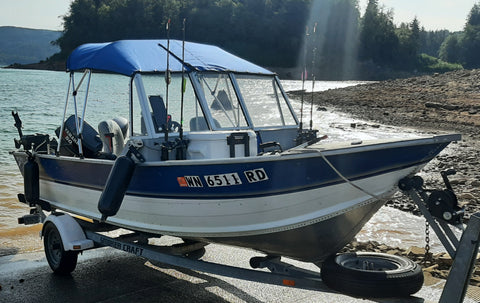
Riffe Lake has plenty of room for boats of all shapes and sizes. It is almost 24 miles long and up to 360 feet deep, which can sound intimidating. Not to worry, there are thousands of fish in the lake, and most days they are willing biters. There have been many days when we can’t even put the planer boards out because the two downrigger poles or lead lines are constantly going off! Early in the season, lead lines, divers, and dropper weights work just fine. The fish are still feeding on the surface and haven’t been driven down to the depths by the hot sun. As the season progresses, however, a good fish finder is a must, particularly for the land-locked coho. Troll until you find a school, mark where you get bites, and don’t be afraid to put a little scent on your lure.
I find that the land-locked coho are particularly attracted to pink lures and dodgers. You can use corn or maggots to bait your hooks. Spinners, plugs, spoons- they all catch fish at this lake. I tend to use whatever I already have rigged up for kokanee fishing at other lakes. As for locations, you really can’t go wrong on Riffe Lake- you can start trolling almost as soon as you launch at Mossyrock Park and will usually start catching fish right away. If the fish are being stubborn, try targeting points and coves. Keep an eye on your fish finder if you’re using downriggers, the lake can shallow up surprisingly quickly.
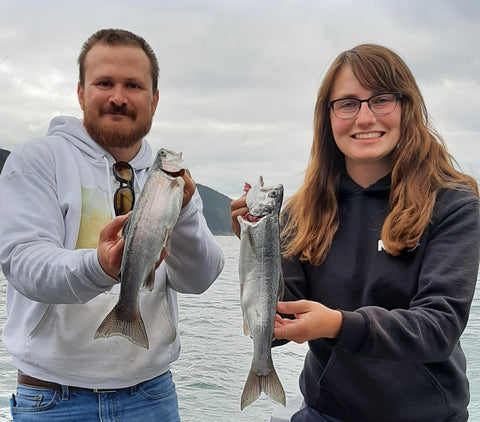
In recent years, it’s been difficult to keep the triploid trout off your hooks if you want to target the land-locked coho salmon in the reservoir. The salmon and trout tend to bite on the same lures and hang out at the same depths in the early season, so you can expect to catch a mixed bag. In general, the coho hang out deeper than the trout in the later season, making downriggers and a good fish finder almost a necessity for targeting them. The salmon tend to like a faster troll, so don’t be afraid to bump it up to 1.9 or 2.2 MPH. However, the trout taste great on the grill and put up a great fight, so most anglers don’t mind catching them.
As a word of caution to boaters, check the water levels at Tacoma Power’s website or give them a call before heading out. The lake’s level fluctuates throughout the year and launching can be difficult when water levels are low. The launch at Mossyrock Park is usually your best bet year-round. It has a large dock with 2 lanes to launch at, which is nice when the ramp is busy. Don’t sweat the crowds too much though, the lake is massive and there is plenty of room for everyone. The other boat launches, Taidnapam and Kosmos, are unsuitable for low water conditions. Check the wind forecast before hitching up the boat- the afternoon winds at Riffe Lake can kick up and create nasty white caps, catching unprepared boaters off guard.
Still Fishing Techniques
Don’t have a boat? No worries, Riffe Lake has plenty of shore access! You can fish at the dam in Mossyrock or at the fishing bridge at Taidnapam Park. These spots can get crowded on nice weekends though. Most shore anglers cast out shrimp or worms under a bobber with a sliding weight. Experiment with setting your bobber stopper anywhere from 3ft to 15 ft until you figure out where the fish are at.
If you can’t get a spot at the dam or fishing bridge, fishing at nearby Lake Mayfield or Swofford Pond is a good alternative. Lake Mayfield is stocked with tiger muskies, which are difficult but extremely rewarding to catch. WDFW also stocks decent numbers of rainbow trout there every year. Swofford Pond has good populations of panfish, stocked rainbow trout, and brown bullhead. There is a boat launch at both lakes, and good shore access. Many folks fish Swofford Pond with inflatables and kayaks, as there is an internal combustion motor ban.
Before you grab those poles and hook up the boat, keep in mind that Riffe Lake has a 5 fish limit. They can be any combination of landlocked salmon and trout, so you cannot legally keep 5 coho and 5 trout. The land locked coho don’t tend to survive catch and release very well, particularly in the summer heat. The lake is large and deep, and those afternoon winds can kick up unexpectedly, so make sure that everyone on your boat has a life jacket. Keep these rules in mind, hook up the boat, and have fun!
/articles/riffe-lake-roundup