Fishing a Lake For the First Time by Mike Carey
We passed cattle lazily grazing along the lush green rolling hillside, while antelope watched us cautiously, ready at a moment's notice to bolt to safety. The dust from the gravel road made it an easy choice to keep the windows up, while in the distance the Rocky Mountains drew ever closer as my son Matthew and I made our way towards our destination. A lone sign indicated we were approaching the boat launch, and our adventure was about to begin.
One of the great joys in my life is exploring new destinations to go fishing. I, like most people, have my favorite spots, but I make sure to set aside some weekends for adventures to parts unknown. I never tire of seeing what is around the next bend. New lakes hold a special fascination. What will we find when we get there? How will the fishing be? Will we find lunkers, and, more importantly, will this be a new place to add to my personal “favorite fishing spots”?
I’m guessing there are a lot of anglers that share my enthusiasm for finding new places to explore. I think it goes hand-in-hand for most hardcore anglers. We all dream of finding those hidden gems that few know, let alone fish. If you’re like me, you probably have some methods for researching these destinations. If you’re new to fishing or exploring new spots, I’d like to share some strategies that I’ve developed to optimize precious time on the road and on the water (not to mention gas and travel expenses).
First, how does one find these new fishing locations? In today’s age of the internet and social media, it’s pretty easy to learn about new spots. While there are those who would never consider revealing locations, others are more open to sharing information. I fall in the latter category. My reasoning is that, over the years, I’ve been blessed to learn of new places to fish from other anglers willing to share. I feel it’s the least I can do to “pay it forward”. Also, my opinion is that the more we share locations, the more we bring new anglers into our community. In this age of diminishing resources, it may seem counter-intuitive to do this; however, more anglers equal a stronger voice when decisions affecting fishing are made by fishery departments. Also, the more locations known to all, the more we spread out and reduce pressures on locations in general. Terminal fisheries will always be crowded, but other “secondary” locations can find relief of pressure as anglers find new spots.
Do your research ahead of time. Northwest Fishing has an ever-growing database of fishing locations and techniques to search through. I find YouTube to be a good resource. Social media giant Facebook can be hit or miss, with anglers willing to share information and others practicing their smart-aleck responses.
OK, you’ve found your new location; at first blush it looks like the kind of lake you’re looking for. You’ve researched the fish populations, and you’re excited by what you found. It’s time to drill down to the essential information before you load up your boat and hit the road!
What do I consider essential information, and how do I find it?
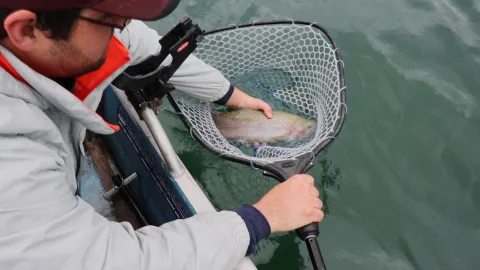
Since I’m likely fishing with my boat, number one, I need to know I can safely get my boat there and launch it. What are the roads like? What about the launch? Does it have a concrete ramp? How about a dock? What about parking? Besides YouTube videos, the best source to answer these questions is, without a doubt, Google Maps satellite view. It has been a game changer for me! For any place you want to go, you can switch into satellite view and zoom in to see exactly what you can expect when you arrive. I would never go to a new lake without first checking out this resource.
Next on my list is a depth map. This will likely be trickier. You may find a map on the internet to print out if you’re lucky. There are other sources, too: Navionics makes a phone app that has a surprising number of lake map contours in it. The app is reasonably priced. Just be sure to save the image prior to heading out, as if you’re in a remote location, it may not pull up. There is an option to save data to your phone - well worth it.
Next, if this is an overnight adventure, are there nearby camping spots or towns that have hotels to stay at? Small towns may only have a couple of options to choose from. There’s nothing worse than arriving at a town only to find no place to stay.
What to bring, or “Dang, I wish I had brought my kokanee lures!”
This one is on you - you’re going to, presumably, a remote location, traveling for an hour or three. Won’t you feel silly if you didn’t bring the right gear (been there, done that!). This all circles back to our earlier discussion about knowing what species the lake holds and deciding what you want to target. If you’re like me, you have lots of gear for lots of types of fishing. Suppose you get there and discover the kokanee you planned on trolling for really are 6-8” long, but guess what, there’s a smallmouth fishery for 3-5 pound fish… but you left your bass gear at home.
It’s that old adage - be prepared. Maybe throw in a couple bass rods and a tackle box of bass gear, just in case. For Matthew and my adventure, we fished for kokanee, and when the wind picked up, we moved into more sheltered waters and realized the lake had a darn good pike fishery. Unfortunately, we didn’t have much in the way of pike gear to toss at them. Bottom line: don’t have blinders on, figuring you’re only going to do one type of fishing. Being adaptable to what you find is key to a better fishing trip.
I hope the above ideas help in your quest for new and exciting waters to find and fish! I encourage you to share what you find with others and make the fishing world a better place for all of us.
/articles/fishing-lake-first-time-mike-carey
A Dock Full of Fun
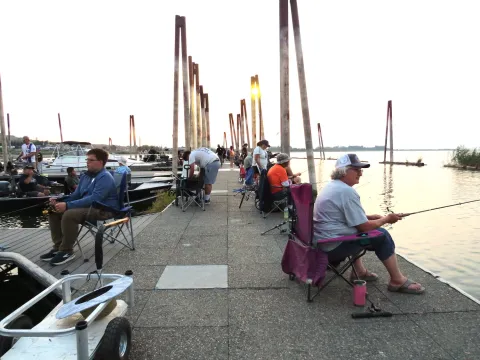
I grew up fishing off docks at Lake Sammamish in Western Washington for everything from bass to bluegills to perch to trout, pumpkinseed sunfish, and more. Little did I know that much later in life, I would be fishing off a dock again for multiple species of fish, but this time, for a potential monetary payout!
MarDon Resort is a multi-generational family-owned resort located on the south shore of Potholes Reservoir in Eastern Washington. For years, they have been putting on an annual dock tournament the second weekend of September. This is a popular event, with anywhere from 125 to 160 participants, many of them coming back every year.
The tournament is very affordable ($60 per entrant in 2025), and there is an 80-percent payout to the winning anglers. It is a vastly different tournament than most. Instead of catching a limit of five or six fish and weighing in the bass or walleye, you are fishing for the two biggest fish of eleven distinct species of fish.
The species you can catch off the dock are numerous. There are categories for largemouth bass, smallmouth bass, walleye, rainbow trout, perch, crappie, bluegill, pumpkinseed, carp, channel catfish, and yellow bullhead. This year, the first-place fish in each category netted the winner $375, and the second-place fish was worth $125.
The groups participating in this event are very diverse. There are families and extended families, couples, fishing buddies, senior citizens, women, and children all fishing off the dock day and night, and all trying to get a big fish.
The tournament kicks off with a potluck on Friday at 5 PM. MarDon Resort provides fried chicken tenders, water, and cookies while participants bring side dishes and more for a nice dinner. At 6 PM, anglers hit the docks and you fish as much or as little as you want from Friday night until 10 AM on Sunday.
There is a weigh-in station at the marina staffed 24 hours a day, this year by Russ and Kim Anderson, who took turns sleeping during the night. Some of the winning fish were caught right off the bat! Georgia Goss was using a crappie jig when she hooked into a monster walleye at sunset on Friday. The 5.56-pound fish netted her first place by a long shot. The only other walleye caught was by her niece, Madison Shopbaugh, and that was only six inches long but still worth $125. It was nice to see kids reel in winning fish!
On Saturday morning, 12-year-old Levi Garza caught a gigantic channel catfish that weighed 25.4 pounds, easily beating out a 16-pound catfish that took second place. And then there was Jaxon Pech. I met him last year when he reeled in two huge carp, earning him a $500+ paycheck. Jaxon, who is 13 years old, takes this tournament seriously. He lives in nearby Moses Lake, and he told me he fished twenty-nine times off the dock this summer, preparing for the tournament. Jaxon was fishing a sizeable pile of bait off the bottom, hoping to catch carp again. However, when his rod bent with a fish, he found out after a frantic 10-minute fight that he had caught not a carp, but instead, a 4.8-pound rainbow trout. Since Jaxon caught the only trout of the tournament, he got $500 for that fish!
Over the course of the event, the lead would change multiple times for different kinds of fish. For example, I was briefly in second place with a ½-pound bluegill on Saturday morning but was bumped within an hour by a bigger fish. At the end, both of the winning bluegill weighed in at over a pound. The final second-place winner was caught on Sunday morning.
At 10 AM, the event ends, and the whiteboard with the final results is brought up to a grassy area above the boat ramp and docks. Co-owners Levi and Annie Meseberg prepare checks for the winners as well as raffle prizes. Raffle tickets are sold for a dollar each, and at 11 AM, all sorts of raffle prizes are given away. The event wraps up with awards and checks being given out to the winners.
Talking to anglers during the event, I learned that everyone hoped to come back again next year. The mood on the docks is light, anglers are willing to share space, and everybody catches a whole bunch of fish over the weekend. Put it all together, and this unique dock tournament is chock full of fun!
/articles/dock-full-fun
Madison River Monsters
I’m sure a few of you reading this are football fans like me. Seattle seems to have had a generally successful run since about the 2010s, with obvious jubilation in 2013, followed by tear-jerking (or, in my case glasses glasses-throwing across the room and breaking them) despair in 2014. To those Millennials and older, or perhaps some Gen Z and below anglers who are dialed into their football history, the Monsters of the Midway elicit memories of imposing dominance. The 1985 Bears. Coach Ditka. Mike Singletary. Richard Dent. Refrigerator Perry. Icons in the football world. I couldn’t help but call back to that imposing connection on our latest fishing adventure on the Madison River in the Madison River Valley of Montana.
We connected again with our good friends Ed and Jeanne Williams of the Rainbow Valley Lodge in Ennis. Of course, we talked about fishing, but also some updates on life: their trip to Disneyland with their grandkids, the most recent trip to Argentina, among other things. Down-to-earth hosts who enjoy seeing their guests enjoy themselves.
The plan had been to fish the Jefferson River, to the north of Ennis, and explore the Jefferson River Canyon. Unfortunately, the weather didn’t cooperate, and the river wouldn’t make for a productive fishing day. Having had as much success as we did on our last episode on the Madison, a quick audible was in order. Fishing again with Hunter and Sam, outfitting out of the lodge, we knew we’d get into some beautiful country and big fish.
The first day was wet. Very wet. Like, I’m glad we have our rain gear, and no wonder there wasn’t anybody else on the water kind of wet. It made me appreciate the professionalism and love for guiding the river I saw from both of our guides for the trip. Both Hunter and Sam are what I would describe as “good dudes”. Easy to talk with, personable, and genuine. That, paired with their knowledge, patience, and excitement for the water, made them the guides I’d absolutely recommend if you head to Ennis to fish in a beautiful part of the country.
The fishing produced some great memories and tons of fish. My buddies Ty and Alex were in the second boat helping with filming, and between both boats, nearly 40 fish were caught that first day. Nonstop action with each angler trying to outcatch the other. Our guides instigated the goading as we came together - “Add three more to the scoreboard”, “Well, we got a 19’er, how small were your fish?” The solid number of fish was one thing. Getting bit non-stop is always fun.
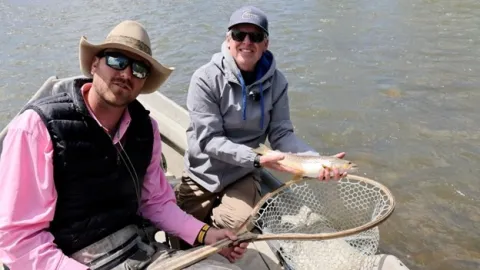
Again, nearly double-digit fish were caught by every angler. But the size of these fish is what was most impressive. Routinely, we were pulling in fish in the high teens. Browns, rainbows, and whitefish all with shoulders on them the size of linebackers. While the one legendary fish didn’t come, I was never disappointed when I hooked up. Every fish was seemingly in the respectable 13-15-inch range, with some bigger chunkier fish encroaching on the 20-inch size. And the fight? World-class. It was like being in a phone booth with a big offensive lineman. At times, the fish would seemingly be pulling the boat with it as it swam, dove, and jumped during our battles.
Ironically, one of the more memorable fish was a small one that I didn’t even land. Like a quarterback scanning the defense, I did my best to set myself up for a positive play. 15 feet out from the bank, approaching some tree roots, I had an excellent line on the fish.
The hook set was decisive. But this fish was tenacious. Immediately jumping out of the water like you’d hope from a classic rainbow trout battle. It must’ve jumped at least half a dozen times. It ran at me, seemingly knowing the weak spot in my offensive attack. On its final jump, it spat out the hook and swam back to safety, having bested me. All I could do was smile and chalk it up to a well-executed play by my opponent.
The second day was a completely different experience. Like going from a dome in Dallas to the frozen tundra in Green Bay, it was sunny, comfortable, and a day where you’d be just as happy doing yard work outside as you’d be fishing. Well, maybe not quite as happy as fishing, but you get the idea. My coach, Hunter, wanted to change strategies and get into some technical fly fishing. He tied on some streamers for us, and away we went. Varying my retrieval, we hoped to get into the larger fish you’d expect from using streamers compared to nymphs. Within my first three or four casts, I hooked into a solid fish. Unfortunately, the battle was short-lived, and I never saw it surface. But I think it had the potential to be that 20+ inch fish that had eluded us.
Not to be outdone, we kept floating down the river. A multi-play, methodical drive marching down the field, catching the same solid-sized fish as the day before. Towards the end of our float, we reached a slower pool of water that Hunter said had historically held some big fish. A guide’s knowledge and experience came to my benefit.
Like my first missed fish, within only a few casts in this new water, I hooked the fish and was locked into a one-on-one battle. Some pulling, some steering, and some muscle later, we landed what was close to a 20-inch fish. Impressive enough in size and more than formidable as an opponent, it led me to reflect on the past few days of fishing and the fables that come with it. Monsters of the Madison indeed!
/articles/madison-river-monsters
Billy Clapp Kokanee Saga
"Look at all those fish marks - kokanee for sure - darn things aren't biting though!"
It was a tough weekend of fishing for my wife JoAnn and I - lots of fish marks, but just a couple bites. Such is kokanee fishing. Kokanee anglers know this and accept our lot in life - some days can be lights out, other days you're scratching your head in frustration.
Kokanee anglers are always looking for the next great kokanee fishery and are eagerly searching the internet for fisheries that are exploding or unknown. To that list we humbly add Billy Clapp Reservoir. This reservoir and kokanee have an interesting history and offer a tantalizing possibility of another kokanee destination to add to Washington's list of quality kokanee fisheries.
I first became aware of Billy Clapp kokanee reading old reports from Dave Graybill, The Fishing Magician, a Central Washington expert on all things fishing. He talked about (and filmed) big, 18" kokanee coming out of Billy Clapp Lake. I scoured the internet and found tantalizing glimpses and reports of big kokanee caught over the years. Intrigued, I dig deeper, trying to puzzle out the mystery that is Billy Clapp kokanee.
My research revealed a few interesting factoids. First, up until recently (more on that in a bit) Billy Clapp Lake has never been stocked with kokanee. So how is it that it holds kokanee? For the answer to that, we have to talk about Banks Lake, just north of Billy Clapp.
Banks Lake has a long history of Washington Department of Fish and Wildlife efforts to create a thriving kokanee fishery, but due to white fish and walleye predication the kokanee fishery has never been able to get firmly established. Oh, there's been some scattered reports of 14-18" kokanee being caught, but overall reports indicate small fish and little angler effort, save some locals that "may" have the fishery dialed in. Certainly, Banks is not considered a destination kokanee fishery. Add to that my recent conversation with WDFW biologist Mike Schmuk who informed me that the long term plan was to end the Banks Lake kokanee planting program. Mind you, WDFW has been planting 400-500,000 kokanee fry per year into Banks, so it's a big deal that WDFW has decided to close the chapter on kokanee in Banks Lake.
At this point you're probably asking what in the heck Banks lake kokanee have to do with Billy Clapp kokanee? Well, Banks Lake and Billy Clapp are connected by a long, large irrigation pipe which fills Billy Clapp Lake. This is all part of an amazing vision by one Billy Clapp, lawyer, who in the early 1930s with fellow community members of the town of Ephrata came up with the proposal of damming the Columbia River to supply irrigation water. Namely, their vision led to the creation of the Grand Coulee Dam. We can thank Billy Clapp for an irrigation and electricity producing system that has fed millions of people since its construction. Say what you will about the loss of free-flowing water for salmon reproduction, you have to concede that the Columbia Basin has been an amazing engineering accomplishment that has benefited and fed generations of people since its construction.
The underwater pipe that flows water from Banks reservoir into Billy Clapp reservoir also delivered thousands of kokanee into Billy Clapp. Those kokanee thrived in a nutrient rich environment and produced (for those in the know) some amazing kokanee fishing. But for most anglers Billy Clapp was an enigma, a tale, a destination less traveled and a place of legendary but seldom fished kokanee lore.
Fast forward to 2021. I spoke with WDFW biologist Mike Smuck regarding my interest in Banks Lake kokanee. During our conversation he mentioned several interesting things to me. First, after an involved study WDFD had concluded that further planting of kokanee in Banks Lake was futile. The plan is to stop kokanee plants after 2020, and to focus on planting Banks Lake for rainbow trout. Then Mike dropped a bombshell on me. He reported that rather than me fishing Banks Lake for kokanee I should consider Billy Clapp Reservoir. The reason being, as fish biologist for that region, Mike had the discretion to plant excess kokanee wherever he thought appropriate, and he chose Billy Clapp Reservoir. He revealed that in 2018 285,000 kokanee fry were planted in Billy Clapp, and in the next two years over 100,000 additional fry were planted. That’s a lot of kokanee fry planted in Billy Clapp Lake!
With that information in mind, my wife JoAnn and I decided to give Billy Clapp a try in mid-April of this year. We fished hard for two days and came up with no kokanee. Despite the poor fishing, I was heartened by a couple things. First, the water temp was cold - 46 to 48 degrees. What this told me was we were a tad early in our quest. Second and just as important, we marked a lot of kokanee, especially at the north end of the lake by the power lines. This told me the fish were there, and we were early.
For kokanee anglers willing to take a chance and spend a few days exploring Billy Clapp Reservoir, I think the potential payoff could be substantial. The lake has a history of producing large kokanee, that is well documented. And with a recent heavy stocking program there may well be a couple years of outstanding kokanee production for anglers willing to give it a try. The wild card is what does the future hold for Billy Clapp Reservoir? Will WDFW continue to plant excess kokanee fry in Billy Clapp? Will they support this fishery? Or will they let it die, to become another Kokanee Destination Legend? Only time will tell. In the meanwhile, Billy Clapp could be a sleeper kokanee destination that may yield you your next 18-20" kokanee.
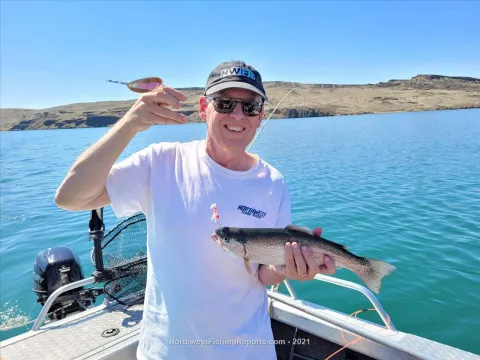
*Pictured - a beautiful rainbow trout caught on our trip. These beautiful trout are in there and make an amazing bonus catch to those elusive kokanee!
/articles/billy-clapp-kokanee-saga
Ten Pink Salmon Shore Locations
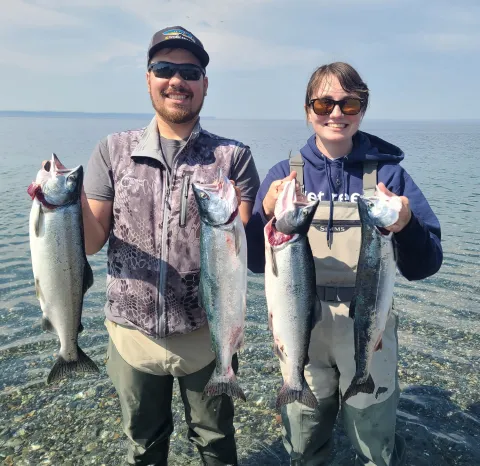
Of all the Pacific salmon species, pink salmon are the most common. 7.76 million pink salmon are expected to return to the Puget Sound this year; the third largest run on record! This is going to be a great year to teach newbies how to fish or learn a new fishery yourself. Pink salmon are snappy, eager biters, perfect for kids or new fishermen. They are named for the pink color of their meat. Speaking of their meat, they taste great grilled or smoked, especially when bled and iced right away.
August is a great time of year to target pink salmon in both the ocean and rivers. They run close to the shore, enabling many bank fishermen the chance at getting a limit. Let's go over 5 Puget Sound saltwater locations and 5 freshwater locations to get you started.
Lincoln Park
A favorite beach for Seattle locals! There is plenty of room to spread out on this large beach. It is a bit of a walk from the parking lot, but don't let that deter you. The fishing here is quite good! The fish run close to shore all the way up and down the beach. Bring your pink Buzz Bombs!
Point No Point
Probably the steepest beach on the list, Point No Point is a beautiful spot to fish. It has an old lighthouse with an adjoining park. The main parking lot is closed down, but you can park at the nearby overflow parking lot and walk to the beach. Make sure to look at a tide chart before you go. The current tends to rip here, which can lead to tangled lines.
Picnic Point
This is another beach that has good concentrations of pink salmon. Bring your waders and watch for schools swimming by. This beach is popular with fly fishermen; make sure to leave them plenty of room to cast. If the fish aren't biting, Edmonds Pier and Mukilteo Beach are both nearby.
Edmonds Pier
Though you'll definitely have company, especially on weekends, this is a fantastic pier for catching all types of salmon. You'll want to have a plan for bringing your fish up on the dock, however. Most people bring a crab ring and haul their catch up that way. Since you're in an elevated spot, it's easier to see fins and tails that signal when the schools of salmon are coming.
Les Davis Pier
This is another saltwater pier that has gained popularity since Dash Point and Redondo Piers were both closed. There are lots of nearby amenities, including a small cafe near the entrance of the pier. Schools of fish swim by frequently during the peak of the season. You'll want to bring a crab ring here to bring your fish up to the dock.
Puyallup River
Like many other fishermen, I learned how to catch pinks on this river! There is a ton of shore access, but it can be crowded, especially on weekends. Tread carefully when wading- it can be almost impossible to spot submerged boulders and trees in the murky water. Most people here drift pink corkies and yarn. Levee Road and River Road near the lower part of the river offer good bank access. Look for gravel bars and bends in the river. The Puyallup runs into the Carbon River, which also has great shore access, but typically opens later in the year. Look for parks and access points near Orting.
Green River
This river has a surprising amount of bank access. Numerous parks and trails dot the river. You can find spots to drift fish, toss spinners, and twitch jigs. The river is called the Duwamish as it gets closer to the mouth. Start in the Duwamish early in the season and follow the fish as they move into the upper river. Most of the river is clear and shallow, so you'll be able to see the schools coming. If they aren't biting at one spot, move to another.
Snohomish River
One of the most popular rivers for fishing pink salmon, there is plenty of shore access here. Thomas Eddy Park and Lord Hill Park have many trails you can walk to find your spot. Many anglers here drift Dick Nite spoons with good success. There are several other parks with good shore access on the lower river.
Nisqually River
This beautiful South Sound river doesn't have much bank access, but it is projected to get an especially strong run of pinks this year. The Nisqually River Public Access has a trail and some rocks that you can fish off of. Bring a lot of extra gear; there are some nasty snags in the river.
Skagit River
Most of the shore access here is at boat ramps and gravel bars. The folks at Holiday Sports in Burlington are always willing to share hot spots with anglers. Just about any gear will work on this river. There are shallow, fast runs that are perfect for drifting as well as slow, deep pockets for twitching jigs or throwing out a bobber. Versatile anglers will do well on this river.
Tackle
For Puget Sound beaches, I'd recommend bringing at least an 8-foot rod; casting distance is important. Make sure it can sling about an ounce of lead. Pink Buzz Bombs are the standard lure. Toss it out to schools of fish and try different jigging speeds and patterns to see what works. Make sure not to dunk your reel in sand or saltwater, and always rinse it thoroughly when you come home.
For rivers, you can use the same rod and reel you used for the beaches. Tie on a corky and yarn if you want to drift fish. About 4 to 6 feet of leader should do the trick. It takes some time to be able to feel the difference between the bottom and a fish bite. Bring a few different weights so you can adjust according to the speed of the current- you want to tick bottom every few seconds, not drag on it. Pink spinners and twitching jigs will also catch fish.
Before heading out, always make sure to check the latest rules and regulations. Emergency closure can and does happen. Pinch your barbs in the Sound and rivers with barbless requirements. Make sure to bring a cooler with ice: pink salmon don't taste as good when they're left flopping on the bank.
/articles/ten-pink-salmon-shore-locations
Rufus Woods Triploid Bait Fishing
Looking to hook into the trout of a lifetime? Then head to North Central Washington’s Rufus Woods Reservoir! This reservoir is actually part of the Columbia River impounded above Chief Joseph Dam and is mostly known for its world-class trophy triploid rainbow trout. It’s home to the current state record, and there is a good chance that the next state record triploid will be caught out of Rufus Woods as well.
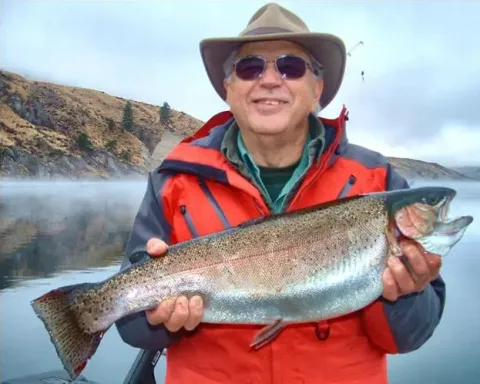
James Cato of Selah with a 9.2-pound Rufus Rainbow. The photographer and guide was Jeff Witkowski of Darrell & Dad’s Family Guide Service
The reservoir stretches from Bridgeport to Grand Coulee and is 53 miles long. The two best launch sites on the reservoir are on the Army Corps of Engineers property just above the dam and across and up the lake at the Bridgeport State Park. For approximately two-thirds of its length, the reservoir runs east-west. The north shore past Bridgeport State Park is mostly Colville Indian Reservation land.
The south side of the reservoir is a mix of public and private ownership. The Triploid Rainbow Trout fishery is completely dependent on a net pen operation located near the middle of the reservoir. The Colville tribe has an agreement with the operator to release approximately 2,500 fish per month into the system. These releases are unpredictably augmented at times due to accidents. The most recent excess release occurred during the heavy runoff in the spring of 2011, when heavy nitrogen buildup near the pens would have caused fish to die if confined, causing the owners to release a lot of fish. The high runoff also caused net pens to break apart, and an estimated 100,000 triploids escaped into Rufus Woods.
You can almost always get your two fish limit at Rufus by either slip sinker fishing Pautzke’s Fire Bait off the bottom or by fishing Pautzke’s Balls O’ Fire on a jig under a slip bobber. Sometimes it doesn’t matter what you do; if you hit the lake with bait, they’ll bite. Other times it can be more difficult. The devil is in the details. We will focus here on a few of those small details that will allow you to be more successful than most anglers when the bite is difficult.
So, what aspects of this fishery make bait fishing for these guys different than going to your local put-and-take pond to catch rainbows? The first is the environment. The second is a set of characteristics that make these fish different from diploid rainbows.
The environment of Rufus Woods has characteristics that position the fish differently than in most lakes. The first is variable flow, the second is temperature lag, and the third is fertility. Because Rufus Woods is dependent on what comes out of Grand Coulee Dam, its flow can vary from nothing to very fast. The effect on leader length and the weight necessary to hold bottom can vary greatly. Rufus Woods' water temps “lag” behind smaller bodies of water as it transitions through the seasons. Rainbow trout can tolerate water from 32 degrees to about 75 degrees Fahrenheit, with a preferred temperature range in the mid-fifties.
Rufus Woods has a well-deserved reputation for being a late fall/winter fishery. This is because it typically takes until November for its water temperature to drop below 60 degrees, which really gets the metabolism of a rainbow trout going fast. This, in turn, makes them easier to catch. Ironically, in the spring, when most anglers are eager to fish, Rufus Woods surface water temperature stays below 40°F, which makes the triploids relatively inactive and difficult to catch. This is because of the constant infusion of 32-degree snowmelt water entering the system from the Columbia’s upper watershed in Canada, as well as from the mountains of North Central Washington. The increased turbidity of the water also makes spring on Rufus a difficult time to fish. Keeping the ideal temperature range of the fish in mind can assist you in eliminating unproductive water and focusing your efforts where you are most likely to catch fish.
Fertility in Rufus Woods is greatest around the net pens because of the infusion of pellets that feed the fish and the waste that comes from the fish. Other areas of increased fertility are where agricultural runoff and other water sources enter the system. Also, keep in mind that when the general water temperature is below 40 and well out of the triploid's comfort range, they will seek areas where springs keep the temperature higher than the surrounding reservoir. The same thing occurs in late summer and early fall when the temperatures of the Reservoir water are above the Triploids' comfort range. Because of these factors combined with the specific characteristics of the Triploid Rainbow, you have to tailor your location and presentation in some specific ways to consistently catch these fish.
The specific characteristics of these fish that need to be considered when determining location and presentation are the shape and limitations of the fish and its conditioned feeding pattern. First, because these fish are not streamlined and have relatively worn fins, they will not swim as fast as non-net pen raised Diploid Rainbows. Slow your presentation down. Second, because they have been conditioned to eat hatchery pellets and they are slower, they tend not to take bigger baits. We have cleaned hundreds of these fish over the years. Rarely will you find a fish in them bigger than a perch fry or stickleback (.75 to 1.5”). Far and away, the most common stomach contents are hatchery pellets and snails. After that, midge larvae, along with vegetation of all kinds, are what you’ll typically find. The biggest (and weirdest) stomach content I’ve seen was a dough bait jar in a nine-pound trout.
Where to fish: The “no-brainer” location is of course, the net pens. Not very creative or original, but it can be very effective. Just remember that while it is ok to tie up to the support lines, it is not ok to tie up to the pens themselves. This is where the most readily available food source is present in the form of hatchery pellets to concentrate the fish. Remember, the fish are there to feed on pellets that escape the pens. Therefore, your best bet is to fish the bottom below the pens. This can be extraordinarily deep for rainbows. Most of the time, we are pounding away at water depths of 75 to 95 feet.
However, it is not necessary to run to the net pens to catch triploid trout by bait fishing. Use your eyes to locate the spots. Primarily, you are looking for concentrations of surfacing fish to find those locations. Secondly, look for water entering the system. Remember, the shallower the water that the fish are hanging out in, the spookier they will be. While a stealthy approach to the pens is completely unnecessary, some of these other shallower locations require a quiet approach or a significant stand-off distance. Since this is a 51-mile-long reservoir, there are plenty of potential hot spots for you to discover and make your own. It is unnecessary to crowd in with other anglers. There are fish concentrated in a variety of obvious and not-so-obvious locations. As an extra bonus, locating those spots can provide you with the opportunity to see a variety of wildlife as well as give you that satisfaction that comes from being a pioneer instead of a follower.
When it comes to bait, trying to “match the hatch” is futile. There are just too many pellets. Instead, you want to use something that attracts them with a smell that is similar to but distinct from the hatchery pellets. Use Pautzke’s Fire Bait in pinks and green. You will want to use enough bait to encase a single #6 hook completely. You only need to leave the hook exposed when the water temperatures drop below 40 degrees, making it difficult for the hook point to exit the bait into the fish. Fish a leader of two to eight pound test mono of at least four and a half feet in length. This will allow the Fire Bait to rise above the weed tips and be visible to the fish. Another effective bait combo is to use good old Pautzke’s Balls O’ Fire salmon eggs floated with a marshmallow.
You will need to lengthen the leader from there to compensate for the increased flow. If the flow is negligible, you can fish with the more common 3/8oz to 1/2oz slip sinker. You must increase the weight as the flow increases to find and hold bottom. I’d be prepared to go all the way to 3 or more ounces when the flow is heavy. Another subtle alteration of your presentation that can increase your bite rate when there is significant current is to add a small Mack’s Lure Smile Blade above your hook with a bead between the blade and hook knot. That slow wobble can provide just the right amount of vibration to appeal to the fish.
Another thing that we have found is that 90% of our bites occur within the first 5 or 10 minutes of a cast. If you haven’t gotten bit within 10 minutes of casting, I’d recommend that you retrieve your bait, check it, and recast.
If you are seeing significant surface activity and not many fish on the sonar, a reasonable alteration would be to change to a baited jig and slip bobber presentation. If you do this, I would recommend that you go small. Use jigs that vary from 1/8th oz to 1/32nd oz for best effect tipped with coon shrimp cured in orange or pink Fire Cure or a kernel or two of Fire Corn. I would recommend either Mack’s Lures Glow Getter Jigs or Worden Lures Maxi-Jigs. Again, when there is sufficient current to turn it, a Mack’s Lures Smile Blade above the jig can increase your effectiveness.
So, what the heck is a triploid trout? Well, it’s a trout that has had its chromosomes altered. This is accomplished by taking eyed eggs and treating them in either a warm water bath or a pressure bath. This causes one of the chromosomes to split, thereby creating a fish with three (triploid) rather than the normal two (diploid) chromosomes. The result is a sterile fish. This means that triploids do not go through a spawn cycle. Instead, they just continue to eat and grow. Think steer, not mule. In other words, a triploid is a sterile rainbow, not a sterile hybrid. Since they do not go through a spawn cycle and all the food that goes into them is turned into growth and waste with nothing diverted to reproduction, their size potential is much greater than a regular diploid rainbow. The state record rainbow of 29.6 pounds was a triploid that came out of Rufus Woods Reservoir. The world record rainbow of 43.6 pounds was a triploid that came out of Lake Diefenbaker in Saskatchewan. Average rainbows caught range from 2 to 6 pounds. Since they are raised in net pens before being released into the system, their fins (particularly the dorsal and tail fins) show wear. Because they are triploids and well fed, they have a much less streamlined shape than a diploid rainbow. This shape, resembling a football, adds to their fight as the girth of the fish in heavy currents makes them fun to catch on light gear.
Keeping the few above-mentioned principles in mind should help you become more consistently successful in bait fishing for Triploid Rainbows at Rufus Woods.
/articles/rufus-woods-triploid-bait-fishing
Washington Saltwater Salmon Opportunities
The list of saltwater salmon fishing options in early summer are far and wide, and in this column, I’ll break down the path to success around Puget Sound and off the Washington coast.
One important factor to keep in mind, when planning a fishing excursion is that the entire 2025-2026 season package won’t be officially adopted until sometime in early to mid-June. What tends to happen is that these early-season summer fisheries will require emergency opening approvals, so anglers should regularly check the Washington Department of Fish and Wildlife (WDFW) website (https://wdfw.wa.gov/) for possible updates and changes.
Back in mid-April, the Pacific Fishery Management Council held meetings in San Jose, California, and the 2025-2026 tentative statewide salmon fishing seasons were adopted by the Council. The season recommendations set forth by WDFW are then moved forward for federal approval by NOAA Fisheries.
While we wait for the ink to officially dry on the approval process, let’s visualize the possibilities of where to go and wet a line in the upcoming weeks, as well as a few pro tips to improve your chances of hooking a fish.
Since no salmon fishing season mirrors another, anglers have learned to become more adaptable to the constant ebb and flow of change. First off, anglers should be mobile and willing to move from location to location to maximize their time on the water.
Don’t focus all your time on one specific area. By doing a little bit of homework and reading this column below, you’ll likely find more choices by going outside of the box. Second, since many seasons are driven by catch quotas/guidelines, it is wise to go sooner rather than later.
Next, build a communication network to stay informed about the latest fishing trends, including the WDFW website and blog posts. Many other social media platforms can be used to gather this kind of information. Attending fishing seminars is another good avenue to gain more knowledge.
Other tips include reading blogs and watching YouTube videos from fishing influencers, especially publications like this magazine, which provide a plethora of information.
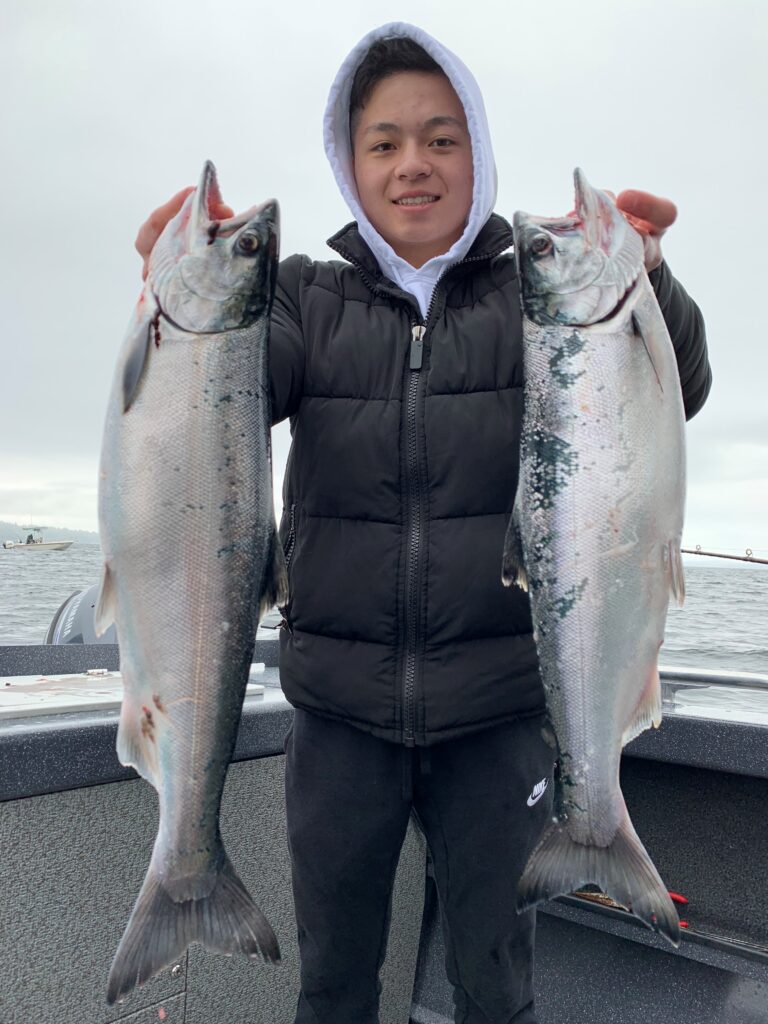
Where to go in June
For the past several summers, Marine Area 10 (Seattle-Bremerton Area), mainly the northern portion, has been good for early coho and is open daily beginning June 1. The resident coho average 2 to 4 pounds, along with a few larger ones, and are fairly snappy. Their bright red-orange meat is excellent for the BBQ grill. This is due in part to the abundant schools of krill: small, microscopic, shrimp-like crustaceans found in Marine Area 10 during the summer.
Most will target coho in the shipping lanes off Jefferson Head to the Kingston-Apple Tree Point boundary line, and from the Edmonds oil dock to Richmond Beach. Other locations worth a try are Point Monroe off the north side of Bainbridge Island, West Point south of Shilshole Bay, Blake Island/Southworth area, and the entire eastern side of Bainbridge Island.
If you’re looking to catch an early summer hatchery Chinook, then Marine Area 11 (Tacoma-Vashon Island) is an option and open Wednesdays through Saturdays only from June 4 to 30. These hatchery kings average 8- to 15-pounds along with some topping exceeding the 25-pound mark.
WDFW will regularly monitor the Marine Area 11 fishery and could close sooner if the quota or other guidelines are attained. The Chinook catch quota for June is 1,423 (1,423 in 2024 and 2023, 580 in 2022, and 431 in 2021) with a total unmarked encounter of 818, and a total sublegal encounter of 1,601. The Chinook fishery is managed under two separate summer quotas, and a second window of opportunity happens in late July. Commencement Bay east of the Cliff House Restaurant/Sperry Ocean Dock boundary line is closed to salmon.
Those who fish for salmon regularly in Puget Sound marine areas – especially in the Tacoma region – know that dogfish can be an issue in the summer.
To avoid pesky schools of dogfish, anglers will jig or troll with downriggers and meat liners using plugs, spoons or a plastic hoochie squid. If you drop a whole or cut plug herring, make sure you’ve got plenty of extra leaders tied. The sharp teeth and abrasive sandpaper-like skin of a dogfish will fray leaders. Lesson learned, I’ve burned through more than a dozen in a matter of a couple of hours.
In Marine Area 11, look for Chinook lurking around the Clay Banks to Owen Beach at Point Defiance Park in Tacoma, the Slag Pile off the Tacoma Yacht Club, the “Flats” outside of Gig Harbor, Quartermaster Harbor, and Point Dalco on the southwest side of Vashon Island.
In the northern part of Marine Area 11, try Dolphin Point and Point Robinson on the northeast side of Vashon Island, south of the Southworth Ferry Landing, Colvos Passage, Dash Point, and Apple Tree Cove to Redondo Beach.
Keep in mind that the salmon fisheries mentioned above for Marine Area 10 and Marine Area 11 are only for June, and that additional salmon fishing opportunities will occur in both areas. Anglers should check the WDFW North of Falcon webpage for additional season information.
Another June option for hatchery Chinook is south of the Tacoma-Narrows Bridge in Marine Area 13 (South Puget Sound), which is open seven days per week. Look for fish are Gibson Point, the concrete dock off Fox Island’s east side, Hale Passage, Johnson Point and Point Fosdick.
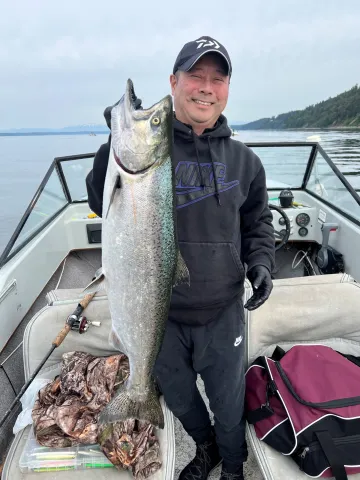
The Tulalip Bubble Fishery (Marine Area 8-2) is open through Sept. 1 with fishing allowed from 12:01 a.m. Fridays to 11:59 a.m. on Mondays of each week, and closed June 21. Before going, anglers should check the WDFW website as intermittent closures may be needed to ensure the hatchery is meeting spawning escapement goals. Fishing is also open Sept. 6 to 21 and allowed Saturdays and Sundays of each week. The bubble fishery is open within the terminal boundary only – closed east of a line from Mission Point to Hermosa Point – and can be decent for summer Chinook in the 10- to 20-pound range, and is mainly a trolling or jigging show.
You can jig drop down a glow, chartreuse, pearl-white, green-nickel, blue-pearl or blue-gold pattern in three to six-ounce sizes depending on the current and wind. Remember, store-bought jigs have a treble hook, and they’re illegal for salmon in all marine areas. Only single-pointed barbless hooks and one fishing line with up to two hooks may be used.
Trolling is the popular method with downriggers and a flasher combined to plug, spoon, and/or a plastic hoochie squid. Before or at daybreak, the fish tend to be found from the surface down to 90 feet, and as the sun rises, they’ll go deeper up to around 100 to 175 feet.
Many anglers are making plans to visit the coastal ports where Chinook and hatchery coho fishing get underway in late June. The ocean salmon season includes a recreational Chinook quota of 53,750 (41,000 in 2024) and a hatchery-marked coho quota of 99,720 (79,800 in 2024).
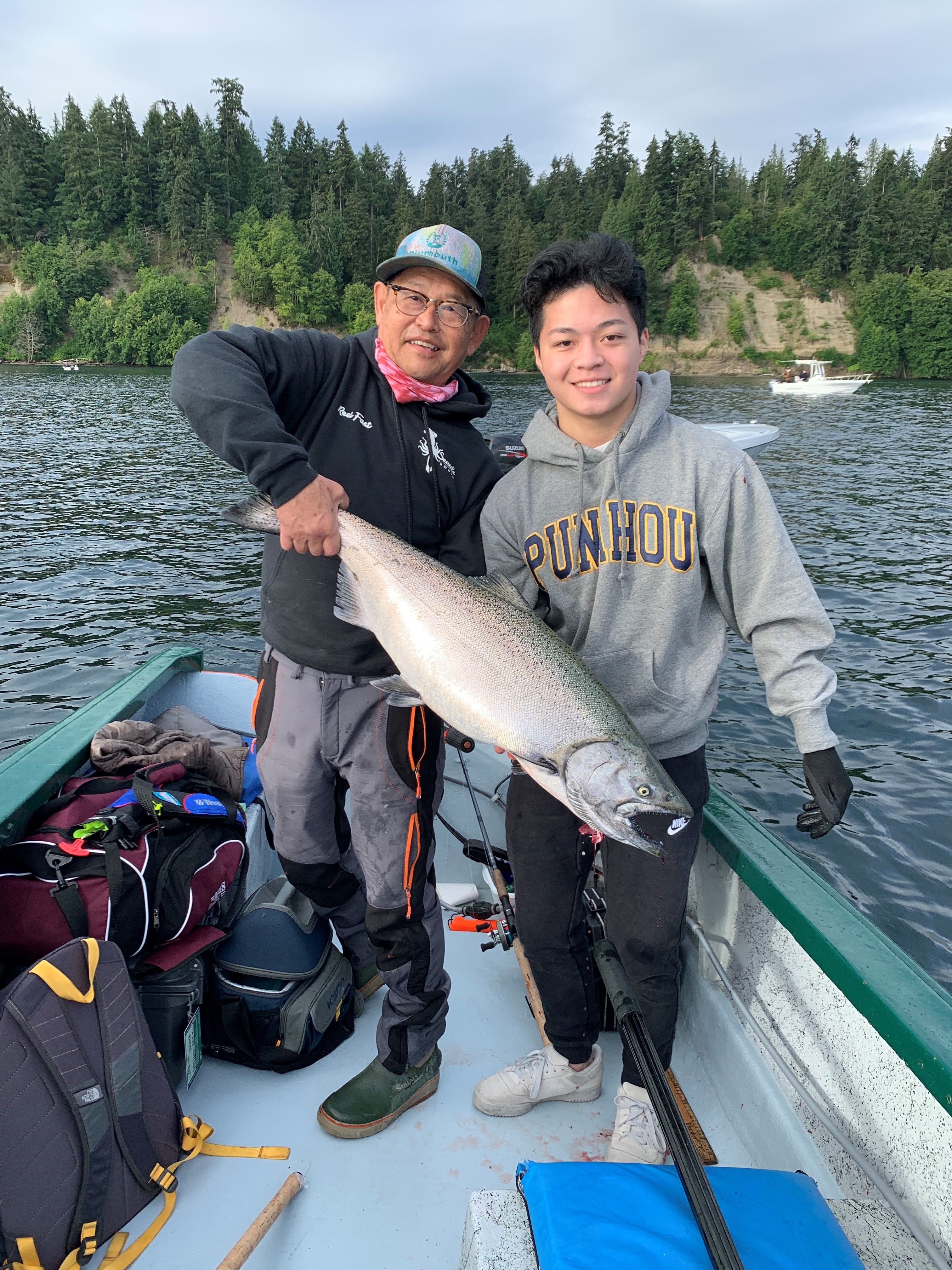
Marine Area 1
(Ilwaco)
Is open seven days per week from June 25 through Sept. 30, all salmon, with a subarea guideline of 16,600 Chinook (12,510 in 2024) and a subarea quota of quota of 49,860 marked coho (39,900 in 2024). The daily limit is two salmon and one Chinook only. Columbia Control Zone closed.
Marine Area 2
(Westport-Ocean Shores)
Is open seven days per week from June 21 through June 28, with a subarea guideline of 22,270 Chinook (17,430 in 2024), and the daily limit is one salmon, release all coho. Open seven days per week beginning June 29 through Sept. 15, all salmon, with a subarea quota of 36,900 marked coho (29,530 in 2024). Beginning June 29, the daily limit is two salmon, and only one may be a Chinook.
Marine Area 3
(La Push)
Is open seven days per week from June 21 through July 3, with a subarea guideline of 2,280 Chinook (1,630 in 2024), and the daily limit is one salmon, release all coho. Open seven days per week beginning July 4 through Sept. 15, all salmon, with 2,590 marked coho subarea quota (2,070 in 2024). Beginning July 4, the daily limit is two salmon. No chum retention beginning Aug. 1.
Marine Area 4
(Neah Bay)
Is open seven days per week from June 21 through July 3, with a subarea guideline of 12,600 Chinook (9,430 in 2024), and the daily limit is one salmon, release all coho. Open seven days per week beginning July 4 through Sept. 15, all salmon, with a subarea quota of 10,370 marked coho (8,300 in 2024). Beginning July 4, the daily limit is two salmon. No chum retention beginning Aug. 1. Beginning Aug. 1, Chinook non-retention east of the Bonilla-Tatoosh line during the managed ocean fishery.
WDFW fishery managers will monitor the number of salmon caught in season and may close areas earlier if quotas or guidelines are met. In-season management may be used to sustain season length and keep harvest within the overall Chinook and coho total allowable catch.
Piers open year-round for salmon in Puget Sound include the Edmonds Marina (usually a good place for early summer kings in June), Fox Island, Mukilteo Ferry Landing, Seacrest in West Seattle, Dash Point Dock, Point Defiance Park Boathouse, Les Davis, and Des Moines.
Note: The salmon daily catch limits, species and size restrictions, and other regulations vary for each marine area. Emergency closures or adjustments to marine area seasons are also possible. Anglers should check for details on the WDFW website or the 2025-2026 regulation pamphlet.
(Mark Yuasa is a Washington Department of Fish and Wildlife Communications Manager and a longtime local fishing and outdoor writer.)
/articles/washington-saltwater-salmon-opportunities
Razor Clam Forecast
It’s no secret that last year’s razor clam season was a banner year. Record number of clam diggers swarmed beaches, working hard to get their limits. 484,388 diggers showed up, harvesting 8,352,279 clams, over 120 total harvest days. That’s a lot of razor clams! This was a welcome success after the 2019-2020 and 2020-2021 seasons closed early due to COVID-19 and domoic acid, respectively. Thousands of eager razor clam diggers are wondering if this season will be as successful as the last.
Dust off those razor clam guns and get your hip boots ready, because the forecast is looking promising! WDFW assessed razor clam populations throughout the summer and all had strong, harvestable populations except for at Kalaloch, which will be closed this year to allow recovery. Let’s take a closer look at this year’s forecast, and how WDFW determines annual razor clam harvests.
Razor clams have been enjoyed by millions of people over thousands of years. They are a valuable resource to hungry fishermen and local economies. WDFW estimated the fishery value to be $71,689 last year. So how are these crucial resources managed? Since 1929, WDFW has managed the coastal razor clam harvest. It’s a difficult job- they have to balance the demands of recreational fishermen with the rights of the tribes, all while keeping public safety in mind. Management strategies have been ever evolving.
From 1929 to 1942, there was a year-round season, and a 36-clam limit. In 1943, WDFW limited the season from March 1st to September 30th, and in 1960, the clam limit was reduced to 18. In 1973, the seasons were further reduced, and in 1974, the 15 clam limit we are familiar with today was implemented. In 2000, the seasons became much less set in stone and varied from October to May, depending on counts conducted through the “pumped area” method. In 2004, WDFW switched to the system still in use today, the “adjusted exploitation rate” method. Management strategies are ever evolving based on the increasing amounts of clam diggers every year, and changing oceanic conditions.
There are 3 pieces to the puzzle that WDFW must take into account before announcing razor clam digs: population counts, domoic acid levels, and tribal rights. The first piece of the puzzle is population counts. Each summer, WDFW conducts population counts at every beach: Long Beach, Twin Harbors, Copalis, Mocrocks, and Kalaloch. Based on these counts, they estimate the total number of clams measuring under 3 inches, and the total number of clams measuring over 3 inches.
They allow a certain percentage of razor clam population over 3 inches to be harvested each year, in order to make sure the population stays sustainable for years to come. Up to 40% of razor clams 3 inches and above may be harvested every year for the population to remain sustainable. After every harvest, WDFW calculates the remaining TAC (total allowable harvest), and sets further days based on that number. This way, poor tidal conditions and weather don’t mean we get shorter seasons. Alternatively, if conditions are great and there are more harvesters than predicted, the season may close early on that beach. Population counts are closely monitored throughout the year to make sure this popular fishery will remain for years to come.
Before WDFW opens recreational harvesting, they must also determine whether the clams are safe to eat. WDFW’s goals are not only to keep the resource around for years to come, but also to protect public health and safety. Unfortunately, clams are subject to accumulating marine toxins in their bodies which can make harvesters sick. Harmful algae blooms are naturally occurring, but concentrate in razor clam tissue. The most prevalent toxin is domoic acid, caused by consumption of marine plankton, called diatoms.
Eating a razor clam that has high levels of domoic acid can cause nausea, dizziness, memory loss, and stroke-like symptoms. There is no antidote, and the toxin is not destroyed by cooking/freezing. WDFW carefully tests razor clam populations for domoic acid throughout the year, and will close seasons accordingly, even if TAC (total allowable catch) hasn’t been met.
The final piece which WDFW must take into account is tribal fishing rights. Each year in August, WDFW discusses population estimates and domoic acid levels with the coastal tribes that have fishing rights on razor clam beaches, and comes up with the total allowable catch (TAC). 50% of the TAC goes to recreational fishermen and 50% goes to the tribes.
The coastal tribes work with WDFW staff to come up with joint population assessments, and share their data together. Tribal seasons take place on different days than non-tribal seasons, and each group makes their own harvest estimates and enforces the rules themselves. Razor clams are a co-managed resource that tribal and non-tribal stakeholders take very seriously.
Beach has by far the largest TAC (total allowable catch) share at 5,865,490 clams, and Mocrocks has the smallest, at 1,964,732. Interestingly, the average size of clams is slightly smaller this year. Last year, they were 4.4 inches long, and this year they were 4.22 inches on average. Although the clams are a little smaller, there are plenty of them! Overall, the forecast looks promising. WDFW always tries to schedule razor clam digs on weekends at least once a month during the months of October through May. The WDFW director checks marine toxin levels and looks at the remaining TAC for the year before announcing that the harvest dates can proceed. Clam digs have been tentatively approved throughout November and December.
In an unprecedented move, WDFW increased the limits from 15 to 20 razor clams last year. Will it happen again this year? For now, keep an ear to the ground and always check your rules and regulations before heading out. Speaking of rules and regulations, it’s always a good idea to brush up.
Make sure each harvester has their own container to put clams in. Many sporting goods stores sell clam nets, which readily tie to your wading belt to keep your hands free for digging and holding flashlights. Remember that the first 15 clams dug must be kept, no matter the size or condition. We’ve all accidentally crunched clams while digging them, or dug up a tiny one, but they still must be retained as part of your 15-clam limit. That being said, there are plenty of clams out there to be had. It’s shaping up to be a good year, so go out and get those razor clams!
/articles/razor-clam-forecast-0
Catch More Bass This Summer!
Summer is an exciting season for bass anglers. The bass are done spawning and are actively feeding in both the shallows as well as deeper depths. There are also a variety of ways to catch bass, both largemouth and smallmouth, this time of year.
Perhaps the most exciting way to catch bass during the summer months is using topwater baits. Watching a largemouth bass explode out of the water to smash your lure is always an exhilarating experience! Just make sure you don’t set the hook when the bass comes out of the water. Pause and let them take it first. Easy to say, I know, but hard to do.
When it comes to topwater fishing, have a frog rigged up on at least one rod. Whether you use a standard frog or a popping frog, you have the advantage of fishing this weedless offering in heavy cover, whether it be weeds, grass, or lily pads.
If you are casting into more open water, I like to fish a topwater popper. My go-to popper is a Berkley Bullet Pop in either a bluegill, bass, or frog pattern. The Whopper Plopper made quite a splash in the bass fishing world when it was introduced in 2008, and many anglers insist it’s still a great offering. However, this is a low-confidence lure for me, and while I’ve had a blow-up or two, I’ve yet to catch a fish with a whopper plopper.
And then there are the classics. The Arbogast Jitterbug and Hula Popper have been around for over 70 years, but they still work, especially in the evening hours. Speaking of which, when is the best time to fish with a topwater lure? Conventional wisdom says you should fish topwater lures in the early morning and in the evening. However, if the weather is cloudy, you can experience good topwater fishing all day long.

LIPLESS CRANKBAITS
Lipless crankbaits like the original Bill Lewis Rat-L-Trap or my favorite, the Berkley War Pig, are great search lures. You can cast them a “country mile” and retrieve at a fast or moderate pace, which means you can cover a lot of water while looking for schools of bass. Places to fish lipless crankbaits are in shallow water (two to eight feet deep), especially parallel to brush lines, weed lines, or near points of land. These lures also work well over submerged grass or weed beds. One thing that can be particularly effective is to pause your retrieve, just for a moment, from time to time while you reel.
SPINNERBAITS
The spinnerbait, like the lipless crankbait, is used to search for schools of bass. One advantage the spinnerbait has is that, by design, it is more snag-proof than lipless crankbaits or topwater plugs with treble hooks. The spinner bait can be fished a couple of different ways in the summer. You can fish it mid-depth with a moderate retrieve, just under the surface of the water, creating a wake, with a fast retrieve. Or slow roll it, letting the spinnerbait sink to the bottom in six to 15 feet of water and bringing it slowly back just off the bottom. While ¼ and 3/8-ounce spinnerbaits are widely sold, I prefer to use a ½ or ¾ ounce spinnerbait, especially if I am fishing deep.
DEEP DIVING CRANKBAITS
High summer temperatures will drive those bass into deeper waters, especially smallmouth bass. So, how do you reach them? With a deep diving crankbait! Rapala and Berkley are two lure companies that make quality deep-diving crankbaits. I tend to use two types of crankbaits in the summer months. That would be lures that dive 8 to 12 feet deep and lures that will dive to 25 feet deep. Once you locate the fish, you can stay put and cast to them or switch over to a jig to pull bass out of the deep. As for crankbait colors, I try to “match the hatch” and use patterns that are forage for bass. Trout, perch, bluegill, and largemouth bass patterns all work well if these species live where you are fishing.
JIGS
I always have a weedless jig with a crawfish trailer tied on to one of my rods because they catch bass in the spring, summer and fall months. They can be fished in partially submerged brush, under docks, around beaver huts, trees and other areas where bass live, but other lures would get hung up.
Jigs can also be fished in deeper water on sloping banks, on underwater humps and other structure. Your choice is also wide. In addition to weedless jigs, you can fish neko rigs, which work great for smallmouth bass, and swim jigs, which have become a favorite for many bass anglers.
SOFT PLASTICS
You can’t go wrong fishing soft plastic baits. Drop Shot fishing with a weight a foot or two below a hook tied on the same line can work great, especially on heavily pressured waters. Put a small 4-inch worm or other small plastic grub or swimbait on your hook and just drop it to the bottom. Texas-rigged worms still work great for bass on the bottom, as do the tried-and-true Carolina rig, where a weight and glass bead are placed above a swivel. A foot to 18 inches of leader with a worm is tied behind that. Finally, tube baits, which were all the rage 25 years ago, still work fine today for bass.
The bottom line is this: When it comes to catching bass this summer, you have a lot of options. Don’t get stuck on one or two baits. If they are not working, try something new. As you can see, there is more than one way to catch a bass.
John Kruse
/articles/catch-more-bass-summer
The Derby Mentality
A fishing derby? I'd better set up a team and sign up. I’m the “Fish Whisperer", my buddies and I can outfish anybody! Actually, that’s not fair. Although the fame and money would be nice. Most people sign up for a derby just to participate in the event and to enjoy the camaraderie and fellowship. Winning would be a sidebar to enjoying the fishing trip, enhancing the overall experience.
Fishing derbies and tournaments for just about everything that swims are organized throughout the country each year. In the US, there are 30,000-50,000 derbies and tournaments organized each year. In 2023, there were around 58 million licensed anglers. Even if only a small percentage of licensed anglers participate in an event, participation could range from 1.5 million to 5 million anglers annually.
Here in the Pacific Northwest, there are derbies for trout, kokanee, walleye, tuna, salmon, surf perch, halibut, razor clams, and chowder cook-offs. There may be derbies targeting other species, and those anglers will know the whens and wheres. The basics of this article will cover all species.
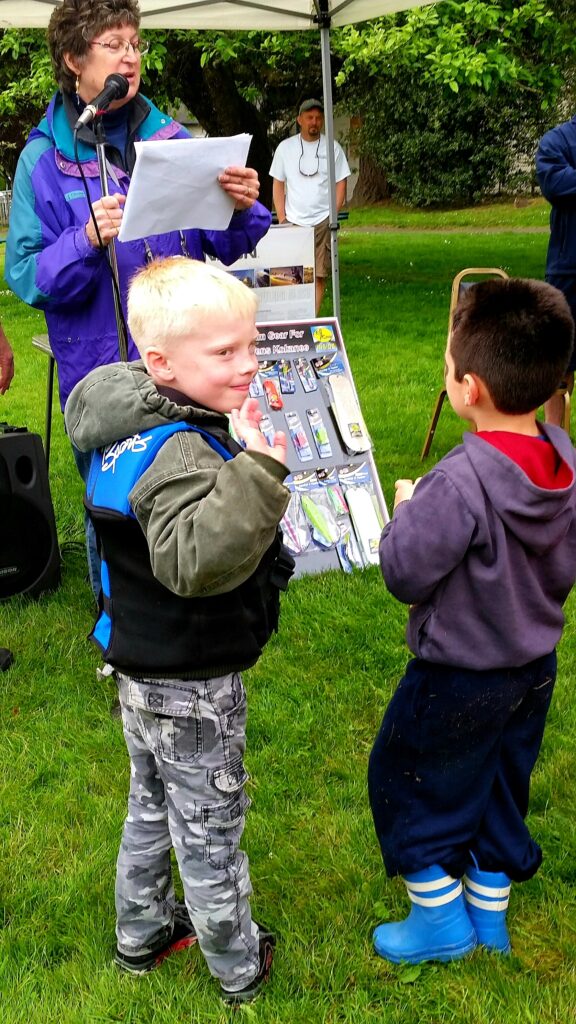
Although over the years the Castello clan has enjoyed occasional success while participating in various derbies, overall success has been metered. That said, I’ve had many “almost” in the money derby experiences.
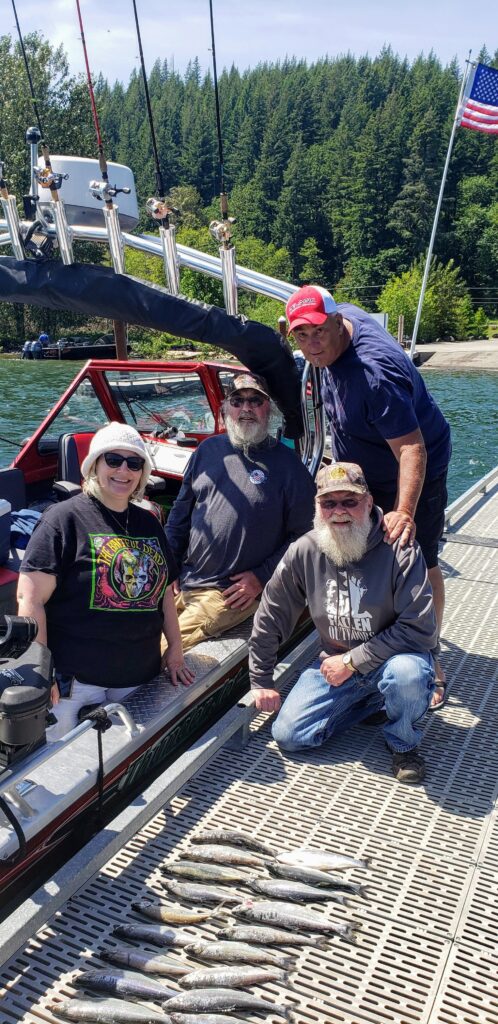
Many years ago, while fishing in a big money tuna tournament out of Ensenada, Mexico, we hooked a large big eye tuna with just hours to go before the weigh-in. By the time the fish was secured on deck, we only had a short few hours to make a 40+ mile run back to the marina for weigh-in. Despite having one of the fastest boats in the tournament, we did not make the weigh-in queue in time. We were quite the talk around town, but made the drive back to the border with nothing more than a stack of swag bags and my own flip-flop print on my board shorts.
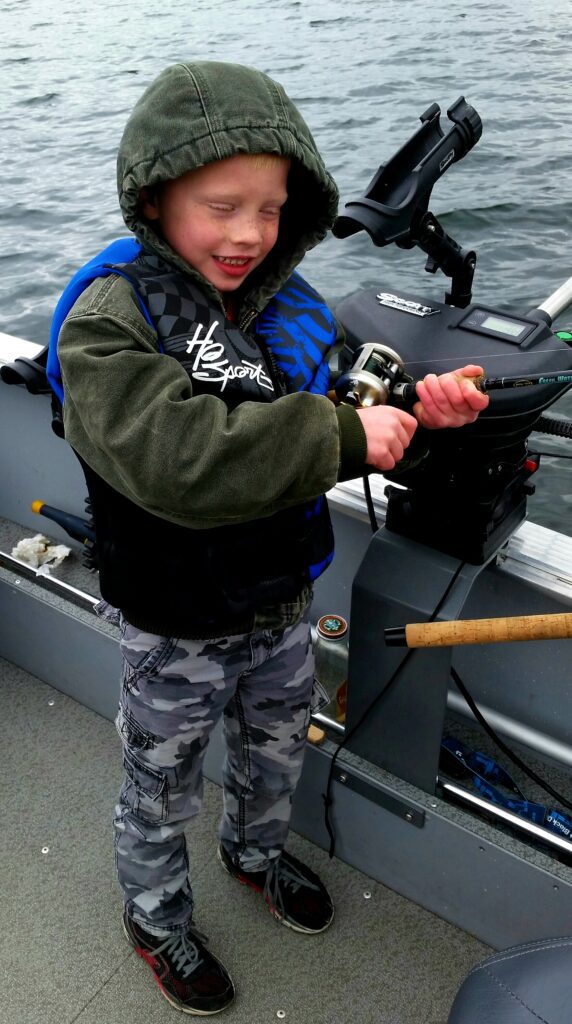
Then locally, with a derby contender, coho on ice, I’ve missed the weigh-in for the Everett Coho Derby by probably 15 minutes because of another last-minute fish. These were all skipper miscalculations where I knew the rules but pushed the time limit. The list goes on, but you get the idea. These kinds of errors can be minimized by creating a plan and then sticking with it.
If you plan to fish a derby or tournament, have a plan! Although it doesn’t hurt, your plan does not need to be written out. Either way, you and your fishing partners need to sit down and come up with a plan for derby day.
In working out a plan, consider basic things like getting enough sleep, being on time, and not showing up at the dock hung over.
One of the first items to discuss is how to handle winnings. On my boat, there is usually an agreement that all winnings are split evenly. Occasionally, we just let the prize go to the person catching the fish, but either way, this should be agreed upon before Derby morning. If a juvenile is part of the team, they always get their winnings in full.
There are many variations of how to distribute derby winnings. The team should consider a means of covering the day's expenses, such as fuel, launch fees, and moorage. Back to my boat, I usually cover the boat-related expenses, fuel, bait, and provide all the gear, but this is a team decision. Again, discuss winnings as an element of your derby plan, friendships depend on it!
In your derby plan, you should also discuss your catch rotation. Again, on my boat, we do a rotation through solid hookups with the skipper being last. Many teams will take a more traditional route where each angler runs with their personal gear, but this is a team decision.
Your derby plan needs to address technique, gear, and location. It is important that the boat fishes as a team, and everyone knows what to expect. At the end of the day, you want everybody to have fun and feel like they had an equal say in your potential success or if so, disappointment.
The plan should include an agreement for a meeting place, time, and ensure the skipper has everyone’s phone numbers. Also, decide what each angler should bring. Example: ice, lunch, derby tickets, license, and gear if required. Maybe also discuss parking and usage fees at the launch area.
For derby day, you want your deck as clear as possible, so it could be a good idea to address storage space and limit personal items. Use a common ice chest for fish. I have a case of fish bags, and each angler gets 1 for their Derby catch.
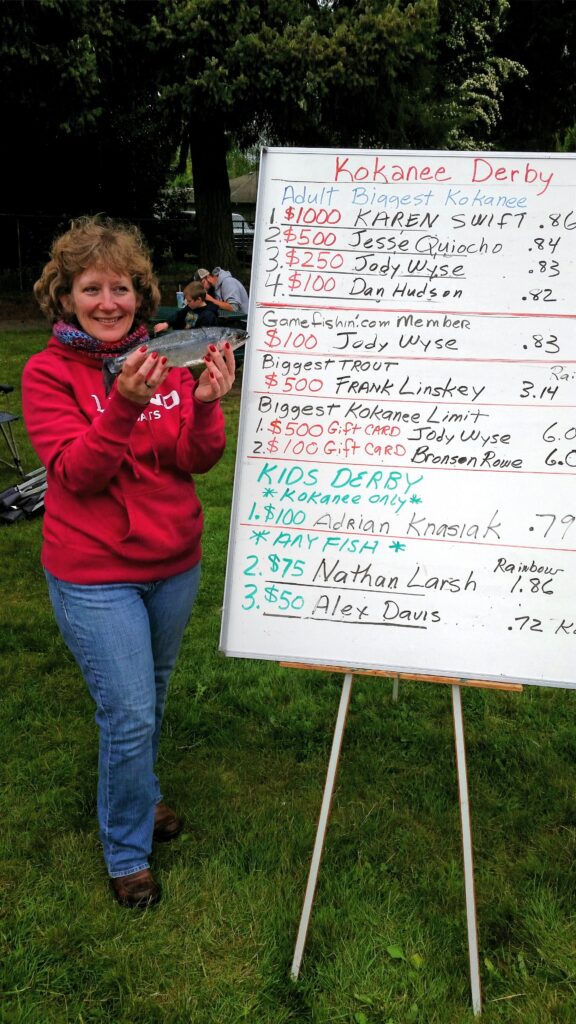
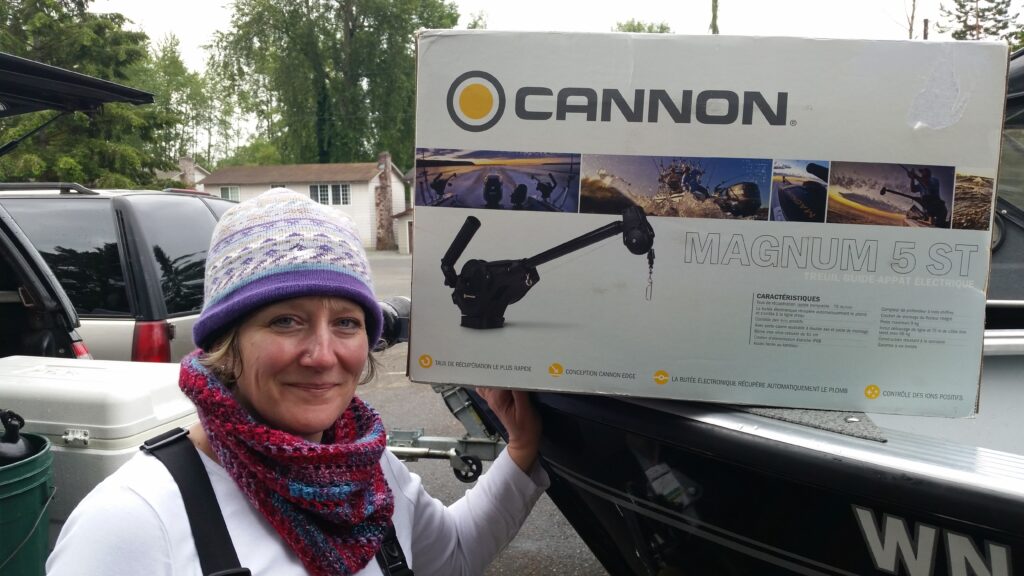
Back to location, your derby day plan should include an agreement regarding fishing location throughout the day or changes required for changing conditions. This is especially important when fishing in marine areas influenced by the tides.
The skipper is responsible for making sure the boat and gear are ready for derby day. This includes a rod and reel check, replacing line and or top shots as required. I always have a backup rod or three on the boat. Typically, I have two nets on board anyway, but having two nets available is especially important on derby day.
Depending on the derby, it is also important that at least one other team member can run the boat, drive the tow vehicle, and be familiar with the boat’s electronics. (Mostly in case the team gets tired of the skipper and the flipping plan, thus throwing the skipper overboard.)
As the skipper, I find Derby days pretty stressful. To be honest, I experienced this for any fishing trip, but for me derby day is worse. It’s not that I’m not having fun, but I feel a true responsibility towards my crew’s success.
That said, don't forget to have fun. Turn setbacks into opportunities and laugh in the face of calamity. Winning is icing on the cake of an otherwise enjoyable fishing trip. By developing a derby day plan, the skipper and crew are more likely to enjoy the day, even increasing their chances of putting a fish on the leader board.
/articles/derby-mentality