Washington Saltwater Salmon Opportunities
The list of saltwater salmon fishing options in early summer are far and wide, and in this column, I’ll break down the path to success around Puget Sound and off the Washington coast.
One important factor to keep in mind, when planning a fishing excursion is that the entire 2025-2026 season package won’t be officially adopted until sometime in early to mid-June. What tends to happen is that these early-season summer fisheries will require emergency opening approvals, so anglers should regularly check the Washington Department of Fish and Wildlife (WDFW) website (https://wdfw.wa.gov/) for possible updates and changes.
Back in mid-April, the Pacific Fishery Management Council held meetings in San Jose, California, and the 2025-2026 tentative statewide salmon fishing seasons were adopted by the Council. The season recommendations set forth by WDFW are then moved forward for federal approval by NOAA Fisheries.
While we wait for the ink to officially dry on the approval process, let’s visualize the possibilities of where to go and wet a line in the upcoming weeks, as well as a few pro tips to improve your chances of hooking a fish.
Since no salmon fishing season mirrors another, anglers have learned to become more adaptable to the constant ebb and flow of change. First off, anglers should be mobile and willing to move from location to location to maximize their time on the water.
Don’t focus all your time on one specific area. By doing a little bit of homework and reading this column below, you’ll likely find more choices by going outside of the box. Second, since many seasons are driven by catch quotas/guidelines, it is wise to go sooner rather than later.
Next, build a communication network to stay informed about the latest fishing trends, including the WDFW website and blog posts. Many other social media platforms can be used to gather this kind of information. Attending fishing seminars is another good avenue to gain more knowledge.
Other tips include reading blogs and watching YouTube videos from fishing influencers, especially publications like this magazine, which provide a plethora of information.
Where to go in June
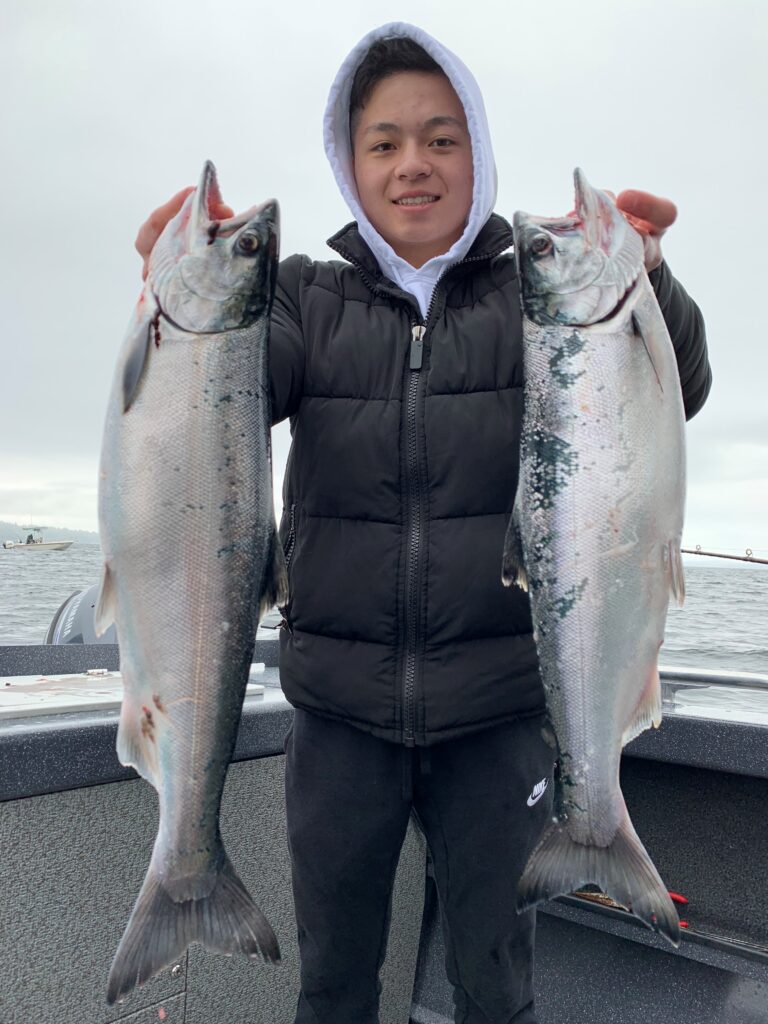
For the past several summers, Marine Area 10 (Seattle-Bremerton Area), mainly the northern portion, has been good for early coho and is open daily beginning June 1. The resident coho average 2 to 4 pounds, along with a few larger ones, and are fairly snappy. Their bright red-orange meat is excellent for the BBQ grill. This is due in part to the abundant schools of krill: small, microscopic, shrimp-like crustaceans found in Marine Area 10 during the summer.
Most will target coho in the shipping lanes off Jefferson Head to the Kingston-Apple Tree Point boundary line, and from the Edmonds oil dock to Richmond Beach. Other locations worth a try are Point Monroe off the north side of Bainbridge Island, West Point south of Shilshole Bay, Blake Island/Southworth area, and the entire eastern side of Bainbridge Island.
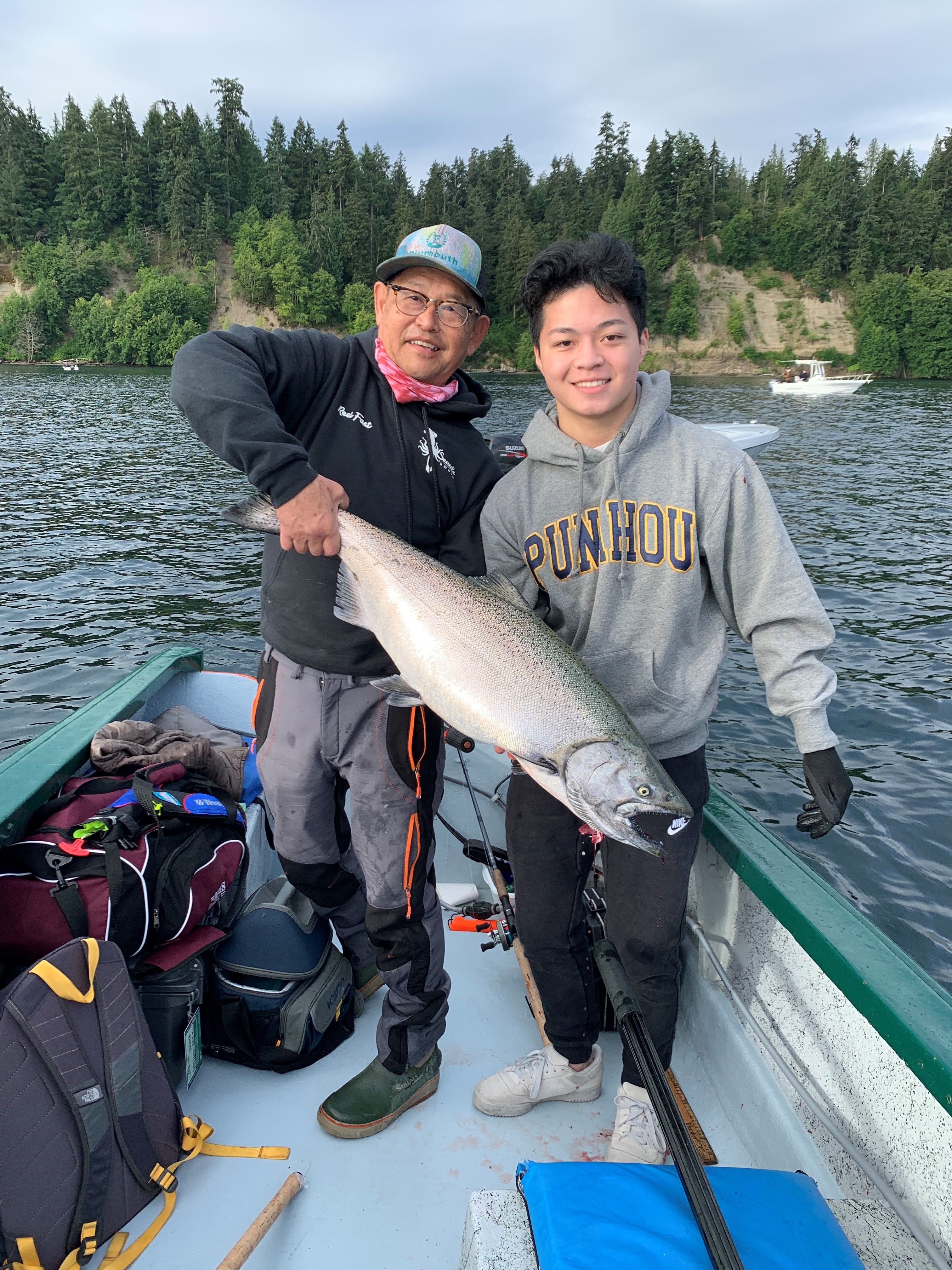
If you’re looking to catch an early summer hatchery Chinook, then Marine Area 11 (Tacoma-Vashon Island) is an option and open Wednesdays through Saturdays only from June 4 to 30. These hatchery kings average 8- to 15-pounds along with some topping exceeding the 25-pound mark.
WDFW will regularly monitor the Marine Area 11 fishery and could close sooner if the quota or other guidelines are attained. The Chinook catch quota for June is 1,423 (1,423 in 2024 and 2023, 580 in 2022, and 431 in 2021) with a total unmarked encounter of 818, and a total sublegal encounter of 1,601. The Chinook fishery is managed under two separate summer quotas, and a second window of opportunity happens in late July. Commencement Bay east of the Cliff House Restaurant/Sperry Ocean Dock boundary line is closed to salmon.
Those who fish for salmon regularly in Puget Sound marine areas – especially in the Tacoma region – know that dogfish can be an issue in the summer.
To avoid pesky schools of dogfish, anglers will jig or troll with downriggers and meat liners using plugs, spoons or a plastic hoochie squid. If you drop a whole or cut plug herring, make sure you’ve got plenty of extra leaders tied. The sharp teeth and abrasive sandpaper-like skin of a dogfish will fray leaders. Lesson learned, I’ve burned through more than a dozen in a matter of a couple of hours.
In Marine Area 11, look for Chinook lurking around the Clay Banks to Owen Beach at Point Defiance Park in Tacoma, the Slag Pile off the Tacoma Yacht Club, the “Flats” outside of Gig Harbor, Quartermaster Harbor, and Point Dalco on the southwest side of Vashon Island.
In the northern part of Marine Area 11, try Dolphin Point and Point Robinson on the northeast side of Vashon Island, south of the Southworth Ferry Landing, Colvos Passage, Dash Point, and Apple Tree Cove to Redondo Beach.
Keep in mind that the salmon fisheries mentioned above for Marine Area 10 and Marine Area 11 are only for June, and that additional salmon fishing opportunities will occur in both areas. Anglers should check the WDFW North of Falcon webpage for additional season information.
Another June option for hatchery Chinook is south of the Tacoma-Narrows Bridge in Marine Area 13 (South Puget Sound), which is open seven days per week. Look for fish are Gibson Point, the concrete dock off Fox Island’s east side, Hale Passage, Johnson Point and Point Fosdick.
The Tulalip Bubble Fishery (Marine Area 8-2) is open through Sept. 1 with fishing allowed from 12:01 a.m. Fridays to 11:59 a.m. on Mondays of each week, and closed June 21. Before going, anglers should check the WDFW website as intermittent closures may be needed to ensure the hatchery is meeting spawning escapement goals. Fishing is also open Sept. 6 to 21 and allowed Saturdays and Sundays of each week. The bubble fishery is open within the terminal boundary only – closed east of a line from Mission Point to Hermosa Point – and can be decent for summer Chinook in the 10- to 20-pound range, and is mainly a trolling or jigging show.
You can jig drop down a glow, chartreuse, pearl-white, green-nickel, blue-pearl or blue-gold pattern in three to six-ounce sizes depending on the current and wind. Remember, store-bought jigs have a treble hook, and they’re illegal for salmon in all marine areas. Only single-pointed barbless hooks and one fishing line with up to two hooks may be used.
Trolling is the popular method with downriggers and a flasher combined to plug, spoon, and/or a plastic hoochie squid. Before or at daybreak, the fish tend to be found from the surface down to 90 feet, and as the sun rises, they’ll go deeper up to around 100 to 175 feet.
Many anglers are making plans to visit the coastal ports where Chinook and hatchery coho fishing get underway in late June. The ocean salmon season includes a recreational Chinook quota of 53,750 (41,000 in 2024) and a hatchery-marked coho quota of 99,720 (79,800 in 2024).
Marine Area 1
(Ilwaco)
Is open seven days per week from June 25 through Sept. 30, all salmon, with a subarea guideline of 16,600 Chinook (12,510 in 2024) and a subarea quota of quota of 49,860 marked coho (39,900 in 2024). The daily limit is two salmon and one Chinook only. Columbia Control Zone closed.
Marine Area 2
(Westport-Ocean Shores)
Is open seven days per week from June 21 through June 28, with a subarea guideline of 22,270 Chinook (17,430 in 2024), and the daily limit is one salmon, release all coho. Open seven days per week beginning June 29 through Sept. 15, all salmon, with a subarea quota of 36,900 marked coho (29,530 in 2024). Beginning June 29, the daily limit is two salmon, and only one may be a Chinook.
Marine Area 3
(La Push)
Is open seven days per week from June 21 through July 3, with a subarea guideline of 2,280 Chinook (1,630 in 2024), and the daily limit is one salmon, release all coho. Open seven days per week beginning July 4 through Sept. 15, all salmon, with 2,590 marked coho subarea quota (2,070 in 2024). Beginning July 4, the daily limit is two salmon. No chum retention beginning Aug. 1.
Marine Area 4
(Neah Bay)
Is open seven days per week from June 21 through July 3, with a subarea guideline of 12,600 Chinook (9,430 in 2024), and the daily limit is one salmon, release all coho. Open seven days per week beginning July 4 through Sept. 15, all salmon, with a subarea quota of 10,370 marked coho (8,300 in 2024). Beginning July 4, the daily limit is two salmon. No chum retention beginning Aug. 1. Beginning Aug. 1, Chinook non-retention east of the Bonilla-Tatoosh line during the managed ocean fishery.
WDFW fishery managers will monitor the number of salmon caught in season and may close areas earlier if quotas or guidelines are met. In-season management may be used to sustain season length and keep harvest within the overall Chinook and coho total allowable catch.
Piers open year-round for salmon in Puget Sound include the Edmonds Marina (usually a good place for early summer kings in June), Fox Island, Mukilteo Ferry Landing, Seacrest in West Seattle, Dash Point Dock, Point Defiance Park Boathouse, Les Davis, and Des Moines.
Note: The salmon daily catch limits, species and size restrictions, and other regulations vary for each marine area. Emergency closures or adjustments to marine area seasons are also possible. Anglers should check for details on the WDFW website or the 2025-2026 regulation pamphlet.
(Mark Yuasa is a Washington Department of Fish and Wildlife Communications Manager and a longtime local fishing and outdoor writer.)
/articles/washington-saltwater-salmon-opportunities
How to Have a Blast At Brewster
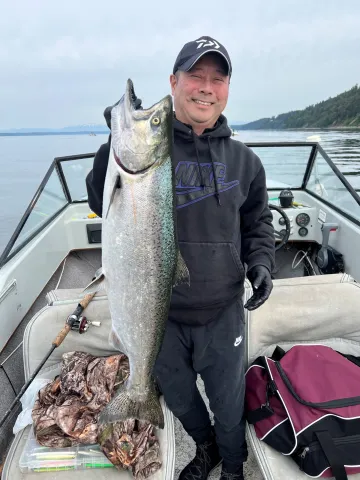
You’ve probably heard stories about the Brewster pool, if you haven’t fished it before. It’s one of the most productive and legendary fisheries in the state, and many fishermen look forward to fishing it every year. Thousands of chinook and sockeye salmon make their way up the Columbia River and stage in the cool waters of Lake Pateros (also known as the Brewster pool) before heading up the Okanagan River. The fishery typically opens up in July and can be extremely productive for both species of fish. Despite their long journey, the fish are willing biters and taste great on the grill or smoker. 20-pound chinook are regularly caught, and the sockeye are great eating quality.
It’s a fun fishery for a summer day, but learning how to fish it isn’t always easy. Brewster is about an hour north of Wenatchee, so it’s quite a drive. It can also be intimidating because there are so many other boats in the water. As long as you do some research and have patience, you’ll have a great time and catch some fish. Here’s some tips and tricks to help give you a successful day at the Brewster pool.

Chinook
The chinook fishery at Brewster tends to be a first light fishery, so grab the coffee and headlamps so you can launch in the dark. It’s a short run from the boat ramp to the pool, just stop when you see all the other boats! The most important thing to know about the Brewster pool is that it’s a trolling game. Some anglers jig or anchor up, but they are few and far between. There are just too many boats for anyone to anchor up. Most fishermen in the pool use cannon ball droppers and skip the downriggers. You can run anywhere between 4 to 12 ounces of lead, depending on the current and the stoutness of your rods. Brad’s Super Baits trolled behind 360 style flashers are the go-to, but many anglers have good success with spinners too.
Wrap or stuff your plug with tuna, herring, or shrimp to give it extra pizazz. If you run spinners, you can put some gel scent on them or hook on a coon shrimp. Don’t be afraid to swap out the hooks on your lures. Chinook have thick, tough jaws, so you want your hooks to stick. Troll between 1.5 to 2mph if you can, but you may have to match your speed with other boats if the pool is crowded enough. When fighting the fish, keep the pressure on. These fish will spit the hook if there’s any slack in the line, and they really tend to explode when they see the net. Adjust your drag and be patient.
Sockeye
If the chinook aren’t biting or you have bored kids in your boat, Brewster pool sockeye are plentiful and hungry! They are a bit smaller than Baker Lake sockeye, but they taste good and are much more numerous than the chinook. Like the chinook fishery, sockeye here are caught by trolling. There are usually two groups of boats in the pool, one that trolls faster for chinook on the current break between the Okanagan and the Columbia, and one that targets chinook closer to the mouth of the Okanagan. Chinook and sockeye do sometimes bite on the same gear, especially when the sockeye really start to stack up in the pool.
If you catch a chinook on sockeye gear, hang on! If you’re targeting sockeye, the same concepts you use when kokanee fishing apply. Use short leaders and lots of scent! Mack’s Lures offer a variety of sockeye lures that are all killer in the Brewster pool. Pink lures work best for sockeye. Pair them up with a dodger or smaller flasher, and you’re in business. Don’t forget to tip your lure with a piece of coon shrimp. You can cure your own or buy some pre-cured ones. No need to use the whole shrimp like you did for chinook that morning, you can just use a small tail piece. Thankfully, the sockeye bite all day, but the fish are more active in the early morning. Use lighter cannonballs than the ones that you used for chinook earlier in the morning. It’s worth using different weights to make sure your lines don’t tangle, particularly if you’re running 4 or more rods. The sockeye move deeper as the day heats up.
There’s a deep river channel somewhat near the shore that the sockeye like to hang out in, but definitely don’t be afraid to fish away from the crowd and try new areas. The sockeye in the Brewster pool are higher up in the water column than the chinook, so a good fish finder can really help you out. Just like their freshwater dwelling cousins, sockeye prefer a slow troll. Again, if you’re fishing in the crowd, you will probably have to match their general speed. Make sure your gear looks good before dropping it down. You’ll want your dodger to give your lure plenty of action to attract the sockeye, so shorten your leader if you need to.
Here’s a few words to the wise about the Brewster pool. Wear sunscreen! The sun can really beat down on those hot days between bites, you’ll be glad to have it on board. It’s a good idea to start fishing at first light and run back before noon, before the heat becomes too unbearable. Also, make sure to pay attention to your surroundings. The Brewster pool isn’t exactly a secret, so you can expect to have company. Sometimes there are hundreds of other boats out there, especially on weekends. Paying attention to the helm and giving other boats some space will help avoid flared tempers.
If you’d rather not deal with the potential stress, there are dozens of guides that you can book to fish the Brewster pool. You can kick back and enjoy the beautiful scenery, and come home with a cooler full of filets. Speaking of coolers, they are a must-have- both for cold drinks and for keeping fish. You’ll want to bleed and ice your fish ASAP for the best meat quality. Lastly, get to the boat ramp early and bring a good book. The boat ramp can get very crowded, especially when the sockeye are in. It’s a good idea to use the time spent waiting to prep your boat. This is another instance when having patience and a level head will help you out. If you’d rather not spend an hour or two waiting to launch, again, hiring a guide might not be a bad idea. Some of them actually launch the night before, anchor up, and sleep on the boat before they pick you up.
Once you’re done fishing for the day, head into the town of Brewster for lunch. There are several excellent restaurants, and downtown Brewster is worth exploring for the afternoon. It’s a great way to cap off your day of sockeye and chinook fishing! Fishing the Brewster pool is an unforgettable experience. Head out there and have fun!
/articles/how-have-blast-brewster
The Voles of Summer
As fly anglers, we are all cultured to believe that trout eat insects and nothing more. Trout gently sipping bugs from the surface of a calmly flowing stream paints the image of fly fishing narrative. It’s what we all learn in the beginning. Anything else would be culturally unacceptable in the fly fishing world. For years, I believed that no self-respecting trout would ever eat anything other than some form of aquatic insect or terrestrial bug. Fly fishing in Appalachia ingrained that into my head. That was right up until I read an article in Fish Alaska magazine about rainbow trout eating mice.
The level of disbelief wielding in my brain about what I was akin to what my grandfather thought about space travel. It wasn't happening. It didn’t happen and it wasn’t ever going to happen. Sure, I had seen a brown trout slashing at other fish and had buddies in the upper midwest that talked about mouse fishing for brown trout at night. But never, ever would a rainbow trout chase down and annihilate a mouse. Rainbows weren't that type of aggressor and besides, they didn’t get big enough to eat a mouse. Right? That’s what I, the 25 year old knower of all things trout, thought. No way.

I must have read that story 10 times before I finally accepted that the writer must have had a very minute amount of success using this “mousing” method for Alaskan Rainbow Trout. Back in those pre-internet days all we had to rely on was a trusted publication with mass circulation and a photo album. Yes kids, before internet and social media we all carried photo albums with us to trade shows, speaking engagements, etc. A three ring binder notebook full of print photographs. Sometimes carrying just one album was not enough; depending on the situation and competition. It was the only way to advertise your trade of skills and to prove that you weren't just a liar. In fact, the next trade show I worked at was where I found living proof that the “mousing” I had read about was in fact real. Not only real but a viable method for targeting the largest of the species. I was befuddled.
At that show, I met a lodge owner that hosted the writer for the story I had read in Fish Alaska. He explained to me how the whole Alaska trout universe operated. Upon understanding, the program made sense. It was no great consequence that this guy gave me my first job in Bristol Bay some years later. I adapted his explanation into my own version. If you have fished with me as a lodge guest, client or friend new to the Alaska trout universe, you have heard me deliver this lecture. Some of you may have heard it more than once. Its as follows - Alaska rainbow trout live a different life and lifestyle than lower 48 rainbow trout. They only have a three, maybe four, month window of time to get in a full twelve month life cycle, as compared to a regular lower 48 rainbow that might have nine or ten months to get everything in before the water cools to a point that their metabolism slows to a crawl.
So, in three months, an Alaska rainbow trout has to find a girlfriend, find a house or two and, it has to eat everything it can. And by eating everything it can, I mean everything starting with the highest forms of protein first. In spring, voles (mice) and leeches are the prominent source. As summer comes so do the salmon producing first eggs, then flesh after the spawn is over. Fall brings on the sculpin, more leeches and whatever else they can find. All that along with finding a girlfriend and a couple houses in three months. Its a lot of living.
But more importantly, the “mousing.” While in spring and summer hordes of mice or voles, red back voles to be specific, make their seemingly ridiculous trek transitioning from tundra animal to aspiring olympic swimmer. Why? I don’t know. Some say its because of some migration pattern. Maybe. Others say its because they are seeking the same things all mammals seek. Could be. Why a tiny little vole would jump into a raging river flowing at upwards of ten knots is beyond my level of good reasoning and understanding. Why do voles jump in the river? My opinion is because they just do and I don’t care why as long as trout continue to eat them. If you are more worried about why they do as opposed to the consequences of it, you should probably change the channel. I heard re-runs of the greatest Bob Hope Christmas specials were going to air in July. You might check that out.

The first time I watched a rainbow “mousing” left a scorching imprint of what really happens in the bush. Eat or get eaten. Brutality in its purest form. This poor little red back vole was just swimming across the river in a narrow channel that didn’t seem deep enough to hold a rainbow. Its swimming along just trying to get to the other side for who knows why and this two foot rainbow manifests, chases the vole, swirls and smashes on it but misses. Then it swirls and smashes again only to miss the vole again. Just when we all thought the show was over the trout comes back for one last grab. Third times a charm right. Nope. Another swing and miss precluded with a full body leap out of the water to come crashing down on top of the vole, missing completely.
All the while this vole is still just swimming. Doing its thing. While I am sure the thing was horrified beyond belief, it didn’t change its pace or course. Probably because it wasn't capable of physically fighting the river current. The fourth and final attempt from the rainbow proved worthy but not without show. The fish came back waking the even more shallow water like a great white shark chasing a seal. It literally powered its way through six inches of water to annihilate the vole just before it reached the other side of the narrow river channel. Pure unforgiving brutality. I and my Swiss clients stood there looking at each other. Until that moment, we had all struggled with a language barrier. they didn't speak much English and I didn’t speak Romansch. Once that rainbow crushed the vole, we all understood what needed to happen and it did.
The first pass with a “mouse” pattern fly was nothing less than epic. Three chases and then a hook up. Next guy cast and had four chases and then hooked up. This went on all day and the rest of the week. At one point, I even took all the flies out of my pack except mice. The fact that they witnessed the initial sacrificial lamb significantly flattened the curve. They knew not to set the hook until they felt weight on the hook. Like the precision watches the guys built, with systematical precision they took apart the entire river and covered every bit of water with mouse patterns. All week.
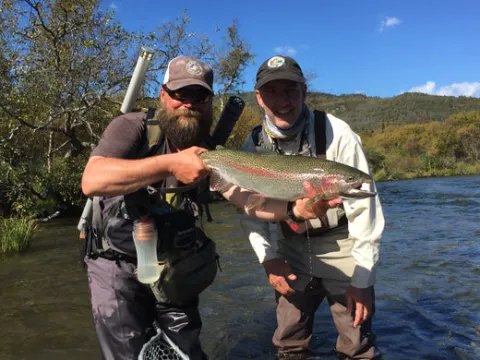
Now I have clients that book for Alaska specifically when “mousing” is peak. Usually, June and July. They bring only mouse pattern flies, and floating seven weight lines on 9’ rods. Most folks bring two rods, just in case the unspeakable happens. The bush isn’t a place to not be prepared but, that’s another story.......
/articles/voles-summer