How to Survive Opening Day
April is unofficially the start of spring and often linked to mythical tales of rebirth, resurrection, and fertility. Throughout history, spring has been celebrated via a diverse lineup of traditions. It is a time of rebirth that can be tracked back for centuries. Where many of the ancient festivals can be directly linked to some sort of bloodshed and brutality, fortunately for the Western Washington angler, we see April as opening day of lowland lakes season.
Where hopefully our participation does not result in bloodshed, opening day can either be a bodacious good time or a stressful one. As a small child I remember anticipating opening day for months, any given year it was probably the highlight of the year for me. My opening day experiences have always been memorable. To this day, fishing or not, I eagerly await opening day each year. In a sense, opening day marks my renaissance each year. Unfortunately, not everybody feels the same way, and opening day can be an overwhelming source of frustration.
So, how does one survive opening day crowds?
Opening day frustrations come in many forms and we all have different tolerances for things that are generally out of our control. Your mindset should be that most things associated with opening day will be out of your control. The list is long, but some things to think about are tackle/gear availability, where to go, gear failure, and crowds.
Planning and preparation will go a long way in smoothing over any pre-opening day jitters. Don’t go to your local tackle shop on the Friday before opening day and expect to find your favorite lure, a kiddie setup, a jar of Ball-O-Fire eggs, or buy your license. Even well stocked tackle stops can run low in the days leading up to opening day. Shop early and remember that in our post pandemic world, the tackle shops are dealing with supply chain issues.
If they don’t have something it’s likely not their fault, and they are doing everything they can to anticipate your needs. Locally, Kevin Johns with Holiday Sports is a both the tackle buyer and lifelong local fishing expert. They are well stocked for opening day. If they don’t have what you’re looking for, look up Kevin and he will steer you in the right direction. SportCo/Outdoor Emporium, Johns Sporting Goods, Yeager’s, and even some local hardware stores have a fishing expert. As a hidden gem, the fishing department manager at Ace Hardware in Anacortes knows her stuff and is very devout in her pursuit of our local fisheries.
Before opening day take the time to go through your gear and, if you’re using them, your boat and trailer. Did the battery survive the winter, trailer lights work, and are your winch and/or tiedown straps functional? Check the line on your reels, replace as required. Check your rods for damage and cracked guides. How does your tackle bag or box look, are they adequately stocked? Make sure you have serviceable PFDs for everyone that may be on your boat, and it’s a good idea to have life vests for any children and non-swimmers when fishing from shore.
As part of your planning activities, maybe visit the area you plan to fish ahead of time. Check ramp conditions, look at the boat trailer parking options, shoreline access points, and hazards. Make sure there are not any surprise road or access closures. Over the winter, some of our access points may have been updated, and parking or access could be different.
Hopefully your upfront planning and preparation will help to soothe and your opening day anxiety, but you’re not out of the woods just yet. You still have to survive opening day!
I kind of look at opening day as maybe attending Mardi Gras in New Orleans. All the individual components and food may be a little odd or even uncomfortable, but the combined experience is an absolute hoot. A big thing to remember about opening day is that it is typically a family event. Strive to make it a positive experience for everyone involved.
Children are very perceptive and are constantly learning from our behavior. If they get tangled with your prize stocked rainbow or one of the grandkids hooks your favorite fishing hat when casting just laugh it off. In the event of a tangle or other calamity, no matter who is at fault don’t be afraid to say that you are sorry to your fellow angler. Use the time to teach good sportsmanship and etiquette.
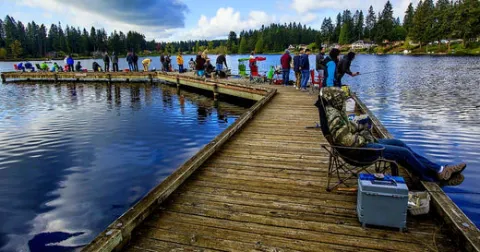
You will have no control of the crowds and know that going in. That said, you can do a few things going in to improve the experience. First and foremost is to arrive early. Not just early but hours early. Your favorite spot at the corner of the dock or bulrushes is more likely to be available, and if you’re boating, you may find trailer parking within a reasonable distance to the ramp. On that note; if fishing from the shore, don’t impede the boat ramp access. Boaters need room to maneuver their rig, a place to beach their boat, and a line free path to and from the boat ramp while on the water.
As an alternative, if early doesn’t work, sleep in. Get up, have a cup of joe or three, and maybe even breakfast before heading off the lake. There is a thought here; opening day is all about voracious, planted trout. These fish will have the feed bag on all day. Years ago, I hatched an opening day plan to fish Lake McMurry in Skagit County. We had a guest from Alaska, she was an avid angler but had never fished an opening day.
The plan was for me to launch at o-dark thirty, then wait for them to arrive around daybreak. In accordance with the plan, I launched hours before daylight and was the second rig in the parking area. After launching I motored out, dropped the anchor, and waited for the crew. It was cold, raining and breezy, and in short order I was soaked the bone. With dawn came a renewed hope that I wasn’t going to die of hypothermia just off the Lake McMurry boat ramp, but my wait continued. There was a lot of activity, and I enjoyed watching all the happenings. My waterlogged condition was improving and almost bearable.
It was a little later, the rain had turned to mostly a mist and the sun was trying to show itself. I was eager to join the other opening day participants but somehow, I was still waiting. A few of the boats that had already launched and headed out fishing were now coming back in with easy limits. I was getting a bit anxious and at that point I had full on gold (I mean, fish) fever.
Eventually the gang showed up, they had overslept and ended up parking somewhere way down the road. I considered expressing my displeasure with the situation, but here came one of the kids, little legs going as fast as they could, carrying a McDonald’s bag. She was over the top excited that they had stopped and gotten me breakfast and coffee. Although they were both cold, her enthusiasm was infectious and the wait was forgotten. We got loaded up and cast off on our adventure. We had an absolute blast, lots of joking around, lost fish, and full stringers. We started out just doing catch and release, and then quickly filled out our limits. I don’t know how many fish we caught that day, but it was one for the books. As applicable to opening day survival, there were a few lessons learned moments in our adventure.
Although a bit frustrated with the wait, I stayed positive and we had a great time. The kids and our guest thoroughly enjoyed our adventure and never saw my tribulations. The second lesson was in the opening day bite. Even though people were coming in with early limits, I think the bite improved as the day progressed. I believe that with the unsettled weather, the surface temperatures were lower early on. The bite really got going as the lake warmed up. I’m sure if we had waited until 1:00 or so to launch, we still would have limited and not had to worry about parking. Maybe off subject, but regarding lessons learned, always carry a big thermos of hot tea or coffee!
If you just can’t get into the opening day hocus pocus no worries, you still have options. Remember that almost everyone that owns a fishing rod will be fishing an opening day lake. What that means to you is that, for the most part, our other fisheries will be deserted. The year-round lakes will be just hitting their spring stride. We have enjoyed kokanee limits from Lake Stevens, Lake Cavanaugh, and Lake Samish on opening day.
There are other fisheries to explore as well. You’ll want to check the WDFW regs before you hitch up your rig, but for 2023 it is likely that both halibut (MA 6-10) and spring chinook in SE Washington will be open. Both have their own crowds and challenges but are solid alternatives to our Western Washington Lowland Lake opener. You may also consider shallow water fishing in the salt. Both surf perch and bottom fish such as the Irish lord family, sanddabs, sole, flounder, and greenling are all available year round. Check the WDFW regulations and bottom fish definitions for the area you plan to fish.
Your ability to survive opening day may be a crapshoot, but with a little advanced planning you adventure should be mostly painless with bloodshed limited to a skinned knee, sliver, or the rare hook in the finger. Again, opening day is a huge family event, so patience and understanding will be your friend. At all costs, make opening day fun for all and be a teacher.
Assure your gear, boat, and trailer are up for the task before you head to your favorite lake. Get your tackle and licenses as early as possible. Make sure the kidlets are wearing properly fitting lifejackets and, as appropriate, bundled up for the weather. Opening day is not the time to cut back on snacks, a full tummy is a happy tummy. A little attention to details and you will not only survive opening day, but the gang will eagerly look forward to next year’s festivities.
/articles/how-survive-opening-day
The Voles of Summer
As fly anglers, we are all cultured to believe that trout eat insects and nothing more. Trout gently sipping bugs from the surface of a calmly flowing stream paints the image of fly fishing narrative. It’s what we all learn in the beginning. Anything else would be culturally unacceptable in the fly fishing world. For years, I believed that no self-respecting trout would ever eat anything other than some form of aquatic insect or terrestrial bug. Fly fishing in Appalachia ingrained that into my head. That was right up until I read an article in Fish Alaska magazine about rainbow trout eating mice.
The level of disbelief wielding in my brain about what I was akin to what my grandfather thought about space travel. It wasn't happening. It didn’t happen and it wasn’t ever going to happen. Sure, I had seen a brown trout slashing at other fish and had buddies in the upper midwest that talked about mouse fishing for brown trout at night. But never, ever would a rainbow trout chase down and annihilate a mouse. Rainbows weren't that type of aggressor and besides, they didn’t get big enough to eat a mouse. Right? That’s what I, the 25 year old knower of all things trout, thought. No way.

I must have read that story 10 times before I finally accepted that the writer must have had a very minute amount of success using this “mousing” method for Alaskan Rainbow Trout. Back in those pre-internet days all we had to rely on was a trusted publication with mass circulation and a photo album. Yes kids, before internet and social media we all carried photo albums with us to trade shows, speaking engagements, etc. A three ring binder notebook full of print photographs. Sometimes carrying just one album was not enough; depending on the situation and competition. It was the only way to advertise your trade of skills and to prove that you weren't just a liar. In fact, the next trade show I worked at was where I found living proof that the “mousing” I had read about was in fact real. Not only real but a viable method for targeting the largest of the species. I was befuddled.
At that show, I met a lodge owner that hosted the writer for the story I had read in Fish Alaska. He explained to me how the whole Alaska trout universe operated. Upon understanding, the program made sense. It was no great consequence that this guy gave me my first job in Bristol Bay some years later. I adapted his explanation into my own version. If you have fished with me as a lodge guest, client or friend new to the Alaska trout universe, you have heard me deliver this lecture. Some of you may have heard it more than once. Its as follows - Alaska rainbow trout live a different life and lifestyle than lower 48 rainbow trout. They only have a three, maybe four, month window of time to get in a full twelve month life cycle, as compared to a regular lower 48 rainbow that might have nine or ten months to get everything in before the water cools to a point that their metabolism slows to a crawl.
So, in three months, an Alaska rainbow trout has to find a girlfriend, find a house or two and, it has to eat everything it can. And by eating everything it can, I mean everything starting with the highest forms of protein first. In spring, voles (mice) and leeches are the prominent source. As summer comes so do the salmon producing first eggs, then flesh after the spawn is over. Fall brings on the sculpin, more leeches and whatever else they can find. All that along with finding a girlfriend and a couple houses in three months. Its a lot of living.
But more importantly, the “mousing.” While in spring and summer hordes of mice or voles, red back voles to be specific, make their seemingly ridiculous trek transitioning from tundra animal to aspiring olympic swimmer. Why? I don’t know. Some say its because of some migration pattern. Maybe. Others say its because they are seeking the same things all mammals seek. Could be. Why a tiny little vole would jump into a raging river flowing at upwards of ten knots is beyond my level of good reasoning and understanding. Why do voles jump in the river? My opinion is because they just do and I don’t care why as long as trout continue to eat them. If you are more worried about why they do as opposed to the consequences of it, you should probably change the channel. I heard re-runs of the greatest Bob Hope Christmas specials were going to air in July. You might check that out.

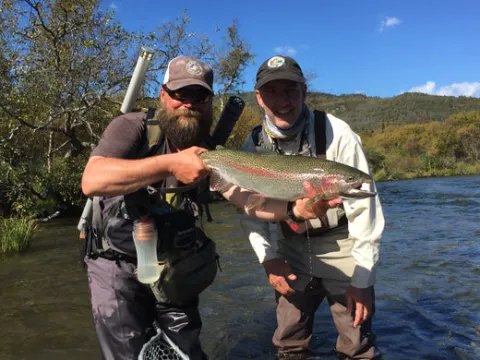
The first time I watched a rainbow “mousing” left a scorching imprint of what really happens in the bush. Eat or get eaten. Brutality in its purest form. This poor little red back vole was just swimming across the river in a narrow channel that didn’t seem deep enough to hold a rainbow. Its swimming along just trying to get to the other side for who knows why and this two foot rainbow manifests, chases the vole, swirls and smashes on it but misses. Then it swirls and smashes again only to miss the vole again. Just when we all thought the show was over the trout comes back for one last grab. Third times a charm right. Nope. Another swing and miss precluded with a full body leap out of the water to come crashing down on top of the vole, missing completely.
All the while this vole is still just swimming. Doing its thing. While I am sure the thing was horrified beyond belief, it didn’t change its pace or course. Probably because it wasn't capable of physically fighting the river current. The fourth and final attempt from the rainbow proved worthy but not without show. The fish came back waking the even more shallow water like a great white shark chasing a seal. It literally powered its way through six inches of water to annihilate the vole just before it reached the other side of the narrow river channel. Pure unforgiving brutality. I and my Swiss clients stood there looking at each other. Until that moment, we had all struggled with a language barrier. they didn't speak much English and I didn’t speak Romansch. Once that rainbow crushed the vole, we all understood what needed to happen and it did.
The first pass with a “mouse” pattern fly was nothing less than epic. Three chases and then a hook up. Next guy cast and had four chases and then hooked up. This went on all day and the rest of the week. At one point, I even took all the flies out of my pack except mice. The fact that they witnessed the initial sacrificial lamb significantly flattened the curve. They knew not to set the hook until they felt weight on the hook. Like the precision watches the guys built, with systematical precision they took apart the entire river and covered every bit of water with mouse patterns. All week.
Now I have clients that book for Alaska specifically when “mousing” is peak. Usually, June and July. They bring only mouse pattern flies, and floating seven weight lines on 9’ rods. Most folks bring two rods, just in case the unspeakable happens. The bush isn’t a place to not be prepared but, that’s another story.......
/articles/voles-summer
Too Many Kokanee? Here's the Cure
Too many kokanee. That was the problem. We had the cure.
As we idled away from the dock in the Nomad's Fishing Adventures 24-foot Koffler sled, Bill Kremers and Josh Hopkins tied up rigs. Our guide, Damon Struble, passed out cups of cured corn. Garlic on the starboard side and krill-marinated kernels on the other. Then Struble pointed the bow up into the narrows.
A few minutes later, when Struble shut off the Mercury, he looked each of us in the eye - Tim Wehde, Kremers, Hopkins, and me. "We're going to set the back rods at 60 feet out and the front rods at 70 feet. Put one to two kernels of corn on each hook. Things are going to be chaotic. If a rod starts bouncing, don't worry about whose rod it is. Pick it up. If you are tying up a new bait and see a rod with a fish, set the first rod down and get the fish in the boat."
Each rod was loaded with a 3-ounce weight to run the baits 30 to 40 feet down where thousands of kokanee schooled below us.
At full pool, Green Peter covers 3,700 acres and is ten miles long, with 38 miles of shoreline.
The water level fluctuates and the fish move around, but some of the best kokanee spots are by the dam, in the Quartzville arm (where we fished), and around the peninsula in the main channel. Jigging is a favorite technique early in the year, but trollers seem to do better in the summer.

Damon uses a Simon 4.0 kokanee dodger on the main line with a Gold Star micro hoochie. Another good bet is a Kokanee Kid Super Mysis Bug or a Mack's Lure Double Whammy with a 10-inch leader. Most anglers add white corn. Damon likes to marinate the corn overnight in Pro-Cure krill powder and Garlic Plus. Hopkins had brought two prototype Lamiglas kokanee rods, graphite/fiberglass hybrids with slow actions. We would put them to the test with these heavy 3-ounce weights.
For several years, ODFW found themselves with a surplus of sockeye smolts, Struble explained. Those fish ended up in Green Peter Reservoir.
"The result is such an overabundance there isn't enough food for all the fish. So they are stunted," Struble said.
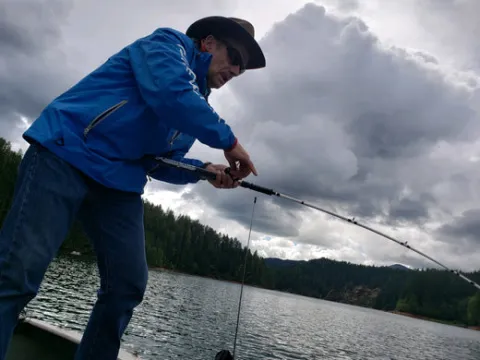
In less than two minutes, we had the first bite. The fish came fast, sometimes with two or three rods bouncing at once. As quick as we could put fish in the box and put fresh bait on hooks, there would be another bite. Our kokanee averaged eight to nine inches each. The direct beneficiary of the kokanee experiment is a little known landlocked chinook salmon fishery created by ODFW almost 20 years ago.
"They wanted to see if the chinook salmon would migrate through the dam and return. For seven or eight years, ODFW put 20,000 chinook smolts in the reservoir," Struble said. "After some high water flood years that blew out the catch nets, the project was abandoned." Technically, the experiment didn't prove successful, but the chinook are still there. "They turned Green Peter into their ocean and spawn up in the creeks," Struble said.
How big do they get?
"The biggest one I have caught was 16-1/2 pounds, while trolling for kokanee with a dodger and a little hoochie," Struble said. Those landlocked chinook are growing big on the kokanee. Struble estimates he has caught 25 or 30 chinook between two and ten pounds while fishing for kokanee.
"When they are small, I'm not sure what they feed on, but inside that 16-1/2 pounder was a mostly digested kokanee about eight inches long."We didn't have time to target Green Peter rainbows, but that is another facet of this interesting fishery. Ahead of every Memorial Day weekend, the state plants 10,000 rainbows. Anglers don't get them all.
"Come springtime there is a really good population of hungry holdovers that range from 12 to 18 inches," Struble said. While we worked back and forth above a biomass of kokanee, the eagles and ospreys watched. When we lost a fish at the surface, a raptor would swoop down to pluck it out of the wind-riffled water.

At Green Peter, the kokanee limit is 25 per day in addition to the daily five-trout limit. There is no size restriction for kokanee. Landlocked chinook salmon may be retained as part of the kokanee limit.
Damon glanced at the western sky, which had suddenly filled with clouds and said, "Unless you guys want part of that, we should run for the dock!" And run we did. By the time the Ford was pointed back toward Central Oregon, the windshield wipers were working overtime. We had boated 45 kokanee in two hours. We hardly put a dent in them.
/articles/too-many-kokanee-heres-cure
Washington Ocean Salmon Prospects
With salmon seasons being ever-changing, from season to season, month to month, and even minute to minute depending on where you fish, the recent announcement of summer salmon seasons was met with some excitement and hesitation. Fisheries managers met over several weeks during the North of Falcon process where everyone with an interest in salmon planned out the quotas and seasons. Washington’s governor added a new apprehension at the table with concern over making sure there is enough food for south Sound Orcas well as fish sport anglers, commercial harvesters, and tribal fisheries, while still allowing for escapement.
The escapement is the main focus, with ESA-listed stocks and wild fish returns dictating how and when anglers can pursue salmon. Once the run estimates are established then the managers need to figure out how many fish can be caught in the ocean and still allows for fishing, and escapement in each of the predicted runs. This is where the marine area gets its seasons and regulations. This year the allotment for ocean salmon off of the coast of Washington was set at 39,000 chinook and 159,600 coho. Each marine area will get its own seasons and a share of the fish.
Starting with Marine Area 4, Neah Bay, the northernmost ocean section which borders Canadian waters, will get first dibs on the salmon, along with Marine Area, 3 La Push, which will have the same start date of June 17th. This is just like last year, when the areas opened up on Father’s Day weekend, but this year anglers can still keep two salmon per day. However, only one can be a chinook and all coho must be clipped. It is open 7 days per week, but later this summer, chinook will be closed east of the Bonilla-Tatoosh line starting on August 1st.

Marine Area 3 will have similar regulations as Area 4 but will also have a late “bubble” fishery from October 3rd to the 7th with a one chinook per day limit. La Push is not nearly as popular as Neah Bay, mostly because it is an open water fishery where the area to the north in Neah Bay has some protected fishing. Since the Covid restrictions have lifted, both reservations are now open. Neah Bay offers a bit more in amenities, but nearby Forks is a great town to stay in when fishing out of either port and has accommodations, restaurants, and gas stations, along with a sporting goods store in case you forgot anything.
Westport in Marine Area 2 is probably the most popular of all offshore ocean fishing locations. The famed Grays Harbor bar is not fun to cross, but on good days the fishing makes it all worth it. This tiny fishing town has everything you need, and if the bar is not cooperating or you are looking for some bottom fish to take home, then fishing along the jetty or the many rock piles off the coast makes for a fun fishery. The season here opens June 24th and will be open 7 days per week with a two salmon daily limit. Only one can be a chinook, and all coho must be clipped.
The coast of Ocean Shores is a popular area to fish in Marine Area 2. You can use the hotels as a marker on where to fish. The casino is a well-known landmark where anglers will fish in 60 feet of water and make their way out deeper from there. Another good spot is south of the jetty, where you can intercept fish making their way to Willapa Bay and the Columbia River. One of the reasons why Marine Area 2 is such a good fishery is because anglers are targeting fish heading to Grays Harbor, and as they near the entrance they tend to hang out in the saltwater just offshore. Add in the fish migrating further south to Willapa Bay, the Columbia River, and even Oregon rivers, and it makes for a highway of salmon to intercept.
Marine Area 1 out of Ilwaco is for the serious salmon angler. The season is set to open June 24th with a two salmon per day limit, but only one can be a chinook and all coho must be clipped. Ilwaco is a protected port with a long jetty that protrudes out into the Columbia, and it can mislead the novice angler into thinking everything is good to go. Be sure to know how and when to cross the Columbia River bar safely. This is the deadliest bar in the world and there is a reason why the U.S. Coast Guard trains their rescue swimmers here. But if you can make it out to the ocean then you will get your first chance at the 554,000 fall chinook or the 595,300 coho making their way back to the Columbia River.
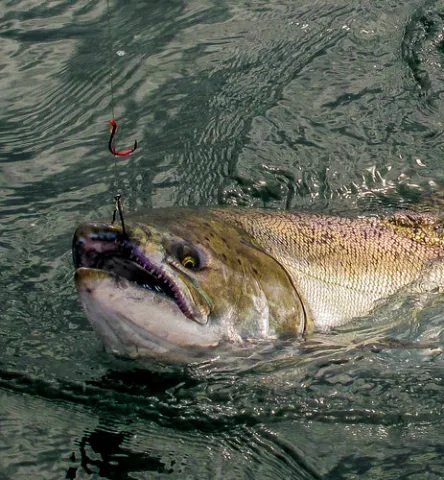
When it comes to salmon fishing in the ocean, nothing beats fishing fresh bait. I use brined herring that has sat overnight in Pro-Cure’s Brine-n-Brite and been toughened with some Bait Spice, an infused rock salt with bluing agents and scents. Learning to plug cut herring can be tricky but once you get the perfect cut down, it is one of the most productive ways to fish. But if you find yourself in a school of crazed coho where most will not be clipped and before you know it bait is running low, then there are a few things you can do to increase your catch rate when the bait runs out. There are many spinning plugs on the market now, including the SpinFish by Yakima Bait Company, the Cut Plug by Brad’s, and now the Simon Spin Dawg and Simon Cut Plug.
The first two have a hollow cavity to place scents, herring strips or canned tuna, but the products by Simon are solid and have a scent cavity. One benefit of the solid bait is that it won’t come apart when a chinook grabs hold. The other lures, though, offer more scent-holding capabilities. All of them work on the same wounded baitfish principle and work great when the real bait runs low or you don’t want to mess with brining and plug cutting. Old Goat Lures also makes a hollow one-piece wounded baitfish lure and they make it out of plastics that glow for those low-light days or early morning fisheries. With each of these lures, it is best to use a super sticky scent such as those by Pro-Cure in their Bait Sauce line.

To rig up the spinning plug lures, there are two primary ways to fish them when trolling in the ocean. The first is behind a 360-flasher such as a Mack’s Lure UV Paddle ScentFlash, which can be filled with even more scent. Use a long leader from 42 to 56 inches to the lure, and then use the downrigger to get it to the depth of choice. The other way to rig it is just like how one would mooch using a mooching weight from 2 to 5 ounces, depending on how deep you want to run it, and then a long leader, again 42 to 56 inches. Simply let this rod out of the back of the boat about 50 feet, and put it in the rod holders. This makes for a great top water rod when targeting coho. Once you find a school of chinook you can then use this same set-up to mooch for them, and even drop it down over a rock pile and catch rockfish and lingcod. It is a simple and very versatile set-up and one I always have rigged and ready in the boat when heading to fish the ocean.
It is time to do a little homework and figure out where you want to catch some salmon. With the marine areas now open, it is a matter of checking the tides and winds and making sure all of the safety equipment is up to date. This is also a good time to update any software for the sonar unit and make sure the life jackets are serviceable. Motor maintenance should have been done months ago, but if you haven’t done so then be sure to get them running right before heading out to the open ocean. The saltwater is one of the best places to catch salmon as long as you are prepared and know how to navigate the bar crossings safely. Head out to the open sea and catch some salmon.
/articles/washington-ocean-salmon-prospects
If A River Runs Thru It
By Gary Lewis
If the days spent fishing do not count against our allotted time on this earth, as we have been told, then we should fish more often. Because we spend a lot of our time in towns, we should be fishing in towns. It's more efficient.
When the family wanted to go to Disneyworld, I fished. When we went to Hawaii, I dabbled a line in a king's bathing pool. I have fished off hotel balconies and out the windows of cars all over the country.
There are a lot of great fishing towns in Oregon; Shady Cove, Maupin, and Grass Pants, to name a few. If a river runs through it, it's a fishing town.
Portland is, of course, the ultimate fishing town, with the Willamette running right through it and salmon, sturgeon, shad, and smallmouth on tap. One of the best smallmouth of my life came from under the Sellwood Bridge.
What I like is going to a town and catching fish right out from under the noses of the local anglers. Here are some great fishing opportunities coming up in May and June.
SHAD FISHING AT OREGON CITY
One of the best fisheries in May and June is for shad - on the Umpqua, the Columbia, and the Willamette. American shad were introduced to the American west in 1871 when fish were released in major rivers up and down the Pacific coast. Today, millions of shad return to spawn in the spring. Plankton eaters, our American shad is the biggest of the herring species and averages three to five pounds. They bite and fight with abandon.
One great place to catch them is below the falls on the Willamette at Oregon City.
They take small spoons like Dick Nites and Mack's Lure Sonic Baitfish, and red, yellow, or chartreuse jigs. Fly-rodders can get them on small shad flies and darts. They are a blast to catch.
The action starts in May, right about the time the pink dogwood blooms. A fisherman can have 50-plus fish days in June, and contrary to popular opinion, shad are good to eat. Hint: learn how to debone them. Shad roe is good to eat too. Fast fishing continues through mid-July.
SMALLMOUTH BASS FISHING AT THE DALLES
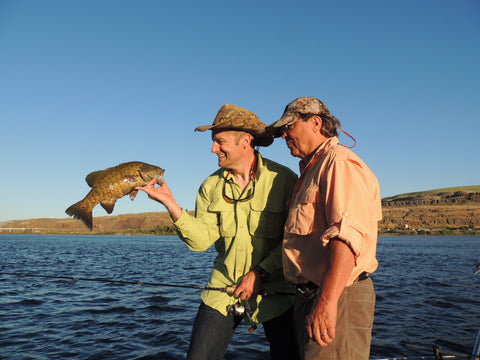
Smallmouth bass will probably spawn a bit later this year, as the waters are running cold with snow melt, but June is always great for smallies. When the water is running fast, they are likely to be in the eddies along the rip-rapped banks of the Columbia, from Mosier up to Boardman and beyond.
There is a lot of bank access in this section of the river. Some of it requires parking off the highway. Backwater fisheries are an overlooked resource with bass and panfish.
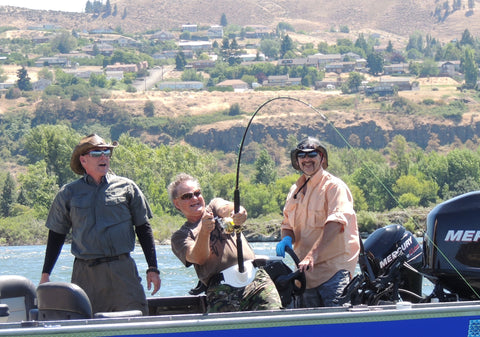
When towing a boat to the Columbia for the first time, keep in mind this is big, tricky water with heavy currents. That said, the river is accessible and the best fishing is along the banks next to the riprap and around jetties in softer water.
If the wind is blowing, there are always backwaters, side channels, and turns in the river where an angler can get out of the wind.
Another option is trout fishing. Taylor Lake, right on the edge of city limits of The Dalles, has been stocked three times already this spring.
TROUT FISHING AT JUNCTION CITY
A few miles north of Eugene on old Highway 99, the angler has to start slowing down at the edge of city limits at Junction City. This town with a population of 6,700 people has its own eponymous body of water, the 8-acre Junction City Pond. Stocked and fishable year-round, this pond gets legals, trophies, brood stock, and sometimes surprise surplus steelhead that will rock your world. By the time this issue went to press, JC Pond, as the locals know it, had been blessed with a reported 13,450 legals. That's a lot of fish, folks. It's worth a stop along the highway to soak some bait or cast a fly or spinner this spring.
PIKEMINNOW AT PDX
I caught my first pikeminnow across from the Portland airport. We caught a lot of them in those days, toothy critters that averaged 11 inches and ran up to 17 inches or so.
Northern pikeminnow thrive in the tailwaters below the dams and eat tons of baby salmon and steelhead. And for this, they have a bounty on their heads.
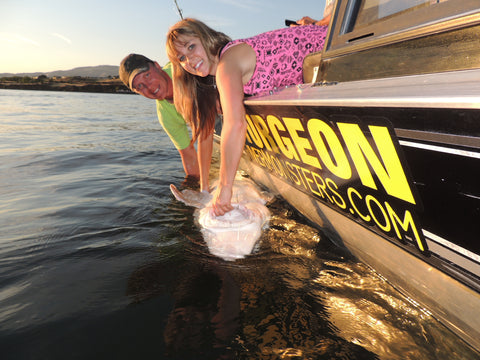
For a true city fishing experience, register at the check-in station early in the morning at M. James Gleason Boat Ramp on Marine Drive, then prowl upriver and downriver for northern pikeminnow - nightcrawlers are a good bait - and take your fish to the check-out station at the end of the day. Click on http://www.pikeminnow.org/ for more information. A fisherman can make $6 a fish these days.
Think about making this one a last stop on a spring fishing swing through western Oregon. It's not a bad way to cover some fuel expenses and do something for salmon and steelhead at the same time.
The days spent fishing don't count against your life, but the miles on the truck do go against my wallet.
For me, PDX is a 360-mile round trip. According to my calculations, I'll need to catch 11 pikeminnow to break even on the fuel. Once I catch fish number 12, I'm making a profit!
/articles/if-river-runs-thru-it
Josie & the Tomcats go to Alaska
The first time I met Josie Regula was when she boarded our charter boat, the Mystic Lady, at Sportsman's Cove Lodge on Prince of Wales Island in Southeast Alaska. The 50-something year-old-woman was accompanied by her husband, Max. The two had come here from San Diego, California to fish for salmon, halibut, cod, and more during a three-day stay at this luxury Alaska fishing lodge.
It turns out Josie isn't shy. As she boarded the boat for an orientation prior to the next morning of fishing, Josie let us know this was her very first fishing trip. She then told all of us with much bravado she intended to catch the biggest fish on the boat and probably the most as well.
Her husband Max looked shyly downward but the rest of us did not. Her shipmates were myself, my best friend Rusty Johnston, well known Pacific Northwest outdoors writer Terry Sheeley, Frank Skipworth (a veterinarian from Kentucky), and the Captain of the Mystic Lady, Steve Helton. I think Josie was expecting a chorus of loud guffaws and snorts from us but several of us nodded in agreement and said there was a good chance she would do just that.
Josie looked momentarily confused until I explained first time anglers, especially women, tended to out fish their male shipmates because they had not formed a lifetime of bad habits like the rest of us had. Add to that, first time women anglers tend to not only pay attention to the fishing advice dispensed by the captain, but actually follow it. Several of us went on to say we had indeed seen women with no experience catch the biggest fish or the most fish because of this. I'm not sure Josie believed what she was telling us but we all knew her prediction could well come true.
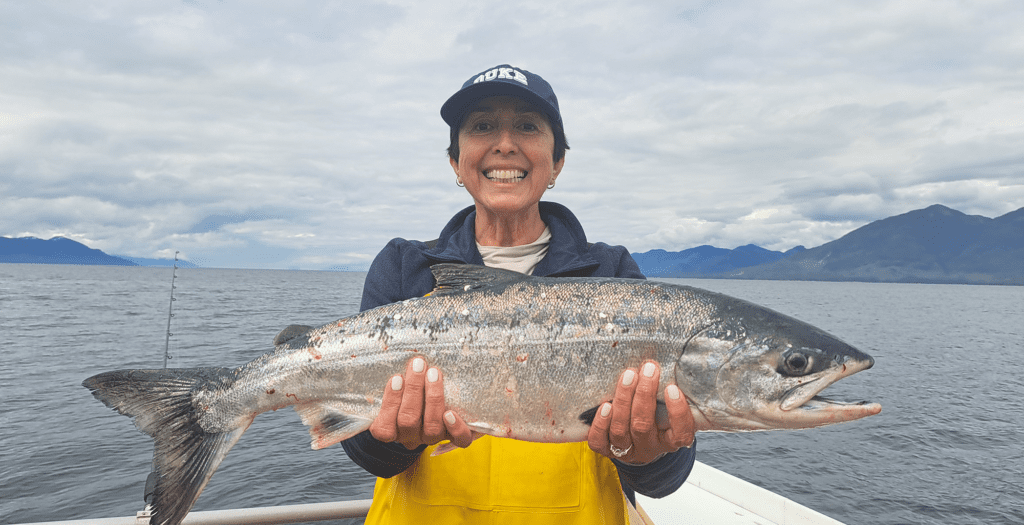
When I asked Josie her name, she said it was "Josie, like Josie and the Pussycats". Being all over 50 years of age on the boat, we all recognized the reference to the old television cartoon show featuring Josie, the star of a female rock band, and her supporting cast the Pussycats. With all of us being men Terry Sheeley said we wouldn't be the Pussycats as her band members, but we would be willing to be the Tomcats. And with that, the fishing band was formed.
On our first morning we fished a large sandy bottom flat that was about 260 feet deep, a non-descript part of the ocean some 35-minutes away from the lodge by boat. Dropping down our bait of herring with 12-ounce lead weights on a short leader, we began to jig for halibut, and wouldn't you know it, Josie caught the first fish of the day, a healthy five-pound true cod. Josie’s luck (and learning curve) increased over the next three days of fishing and she reeled in more than her share of cod, halibut, and salmon but it was our third day of fishing that Josie played her greatest hit.
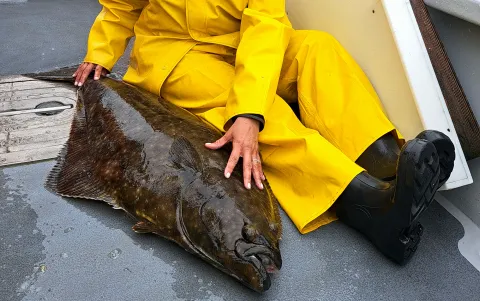
The weather the first two days was mild but our final day on the water was a rough one. We endured a steady drizzle most of the day and rough seas that had Josie feeling under the weather. In fact, despite the fact she took Dramamine to combat motion sickness, she became sea sick. I’ll give her credit though; she stuck it out on deck as we jigged for halibut during a slow morning of fishing that only yielded a few smaller halibut and true cod. Then, Josie’s rod tip bent down in a big way. She set the hook and the fight was on. The fish Josie hooked was definitely no small halibut; oh no, it was a very big one.
Josie, who was not above using colorful language, used it in abundance during the fight that followed with this goliath of a fish. Having never battled a big fish before, she decided to kneel down on the deck on one knee and brace her fishing rod against the deck rail as she reeled. It was an unorthodox way to fight a fish but it worked. The fish made several runs towards the bottom, robbing Josie of line as it did, and each time the fish made a run Josie would loudly express her dismay. However, Josie stuck it out, kept reeling and eventually, after a long fight, got that halibut to the surface.
The fish was brought on board and it measured well over the 40 inches where non-resident charter anglers are allowed to keep a halibut in this part of Alaska. In fact, that fish measured a whopping four-feet and weighed an estimated 53 pounds. After snapping a few photos, that halibut was released back into the sea unharmed to grow even bigger and Josie’s day one prediction of catching the biggest fish on the boat came true.
After taking a short break to deal with fatigue from both the fight and sea sickness, she was right back on the rail for the final afternoon of fishing, reeling in half a dozen salmon in the process. In the end it just goes to show first time female anglers really can out fish all the experienced men on board, and Josie’s Tomcats were more than happy to be here supportive band as performed her greatest hit!
If you would like to find out more about the first-class fishing adventures available at Sportsman’s Cove Lodge for anglers of any experience level, go to their website at www.alaskasbestlodge.com .
/articles/josie-tomcats-go-alaska