If A River Runs Thru It
By Gary Lewis
If the days spent fishing do not count against our allotted time on this earth, as we have been told, then we should fish more often. Because we spend a lot of our time in towns, we should be fishing in towns. It's more efficient.
When the family wanted to go to Disneyworld, I fished. When we went to Hawaii, I dabbled a line in a king's bathing pool. I have fished off hotel balconies and out the windows of cars all over the country.
There are a lot of great fishing towns in Oregon; Shady Cove, Maupin, and Grass Pants, to name a few. If a river runs through it, it's a fishing town.
Portland is, of course, the ultimate fishing town, with the Willamette running right through it and salmon, sturgeon, shad, and smallmouth on tap. One of the best smallmouth of my life came from under the Sellwood Bridge.
What I like is going to a town and catching fish right out from under the noses of the local anglers. Here are some great fishing opportunities coming up in May and June.
SHAD FISHING AT OREGON CITY
One of the best fisheries in May and June is for shad - on the Umpqua, the Columbia, and the Willamette. American shad were introduced to the American west in 1871 when fish were released in major rivers up and down the Pacific coast. Today, millions of shad return to spawn in the spring. Plankton eaters, our American shad is the biggest of the herring species and averages three to five pounds. They bite and fight with abandon.
One great place to catch them is below the falls on the Willamette at Oregon City.
They take small spoons like Dick Nites and Mack's Lure Sonic Baitfish, and red, yellow, or chartreuse jigs. Fly-rodders can get them on small shad flies and darts. They are a blast to catch.
The action starts in May, right about the time the pink dogwood blooms. A fisherman can have 50-plus fish days in June, and contrary to popular opinion, shad are good to eat. Hint: learn how to debone them. Shad roe is good to eat too. Fast fishing continues through mid-July.
SMALLMOUTH BASS FISHING AT THE DALLES
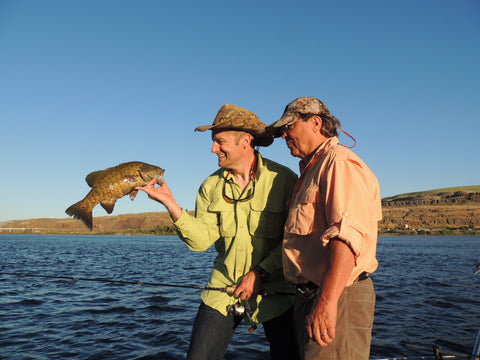
Smallmouth bass will probably spawn a bit later this year, as the waters are running cold with snow melt, but June is always great for smallies. When the water is running fast, they are likely to be in the eddies along the rip-rapped banks of the Columbia, from Mosier up to Boardman and beyond.
There is a lot of bank access in this section of the river. Some of it requires parking off the highway. Backwater fisheries are an overlooked resource with bass and panfish.
When towing a boat to the Columbia for the first time, keep in mind this is big, tricky water with heavy currents. That said, the river is accessible and the best fishing is along the banks next to the riprap and around jetties in softer water.
If the wind is blowing, there are always backwaters, side channels, and turns in the river where an angler can get out of the wind.
Another option is trout fishing. Taylor Lake, right on the edge of city limits of The Dalles, has been stocked three times already this spring.
TROUT FISHING AT JUNCTION CITY
A few miles north of Eugene on old Highway 99, the angler has to start slowing down at the edge of city limits at Junction City. This town with a population of 6,700 people has its own eponymous body of water, the 8-acre Junction City Pond. Stocked and fishable year-round, this pond gets legals, trophies, brood stock, and sometimes surprise surplus steelhead that will rock your world. By the time this issue went to press, JC Pond, as the locals know it, had been blessed with a reported 13,450 legals. That's a lot of fish, folks. It's worth a stop along the highway to soak some bait or cast a fly or spinner this spring.
PIKEMINNOW AT PDX
I caught my first pikeminnow across from the Portland airport. We caught a lot of them in those days, toothy critters that averaged 11 inches and ran up to 17 inches or so.
Northern pikeminnow thrive in the tailwaters below the dams and eat tons of baby salmon and steelhead. And for this, they have a bounty on their heads.
For a true city fishing experience, register at the check-in station early in the morning at M. James Gleason Boat Ramp on Marine Drive, then prowl upriver and downriver for northern pikeminnow - nightcrawlers are a good bait - and take your fish to the check-out station at the end of the day. Click on http://www.pikeminnow.org/ for more information. A fisherman can make $6 a fish these days.
Think about making this one a last stop on a spring fishing swing through western Oregon. It's not a bad way to cover some fuel expenses and do something for salmon and steelhead at the same time.
The days spent fishing don't count against your life, but the miles on the truck do go against my wallet.
For me, PDX is a 360-mile round trip. According to my calculations, I'll need to catch 11 pikeminnow to break even on the fuel. Once I catch fish number 12, I'm making a profit!
/articles/if-river-runs-thru-it
The S&P 500
Most folks think of the S &P 500 as a stock market index, but on a recent trip to the Columbia River Gorge, I realized it had a fishing meaning as well. Namely, the opportunity to catch 500 shad and pikeminnow over the course of a week! My friend Rusty Johnston and I spent a couple of days fishing on the Columbia River between Rufus and The Dalles. Our first goal was to catch a bunch of shad, not just for fun, but also to use for crab bait this summer. Our second goal was to catch some pikeminnow and turn them in for money through the Northern Pikeminnow Sport Reward Fishery Program.
This program is administered by the Bonneville Power Administration along with both the Washington and Oregon Department of Fish and Wildlife. The northern pikeminnow is a native fish, but fish nine inches and longer feed on outgoing salmon and steelhead smolt, impacting the survival of both species.
In this program, anglers are paid anywhere from $6 to $10 a fish for any pikeminnow turned into a designated station along the Columbia or Snake River. The more fish you catch, the more they are worth and if you catch a tagged fish, it is worth $500. You can find out more about this program, designed not to eliminate, but control the population of pikeminnow, at www.pikeminnow.org.
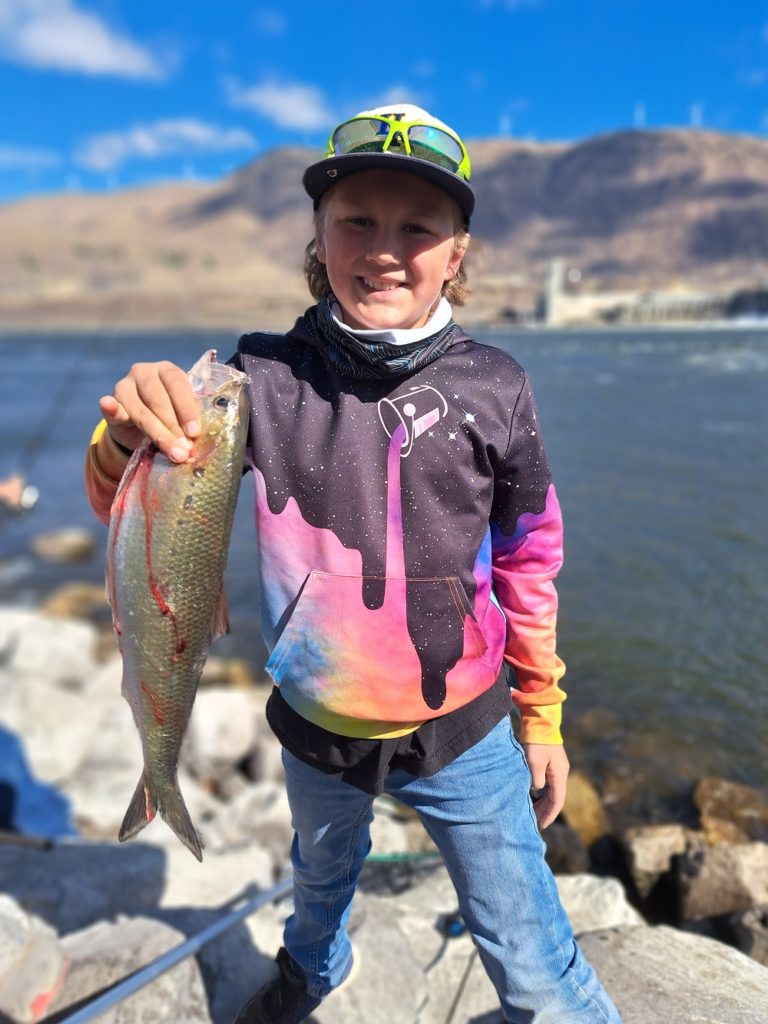
Rusty and I decided to start our trip fishing for shad below the John Day Dam. You can fish below the dam on both the Washington and Oregon side of the river, but we decided to buy a non-resident license at Gorge Outfitters Supply in Rufus and fish the Oregon side at Giles French Park.
Shad Killers
We were using Shad Killers, a local jig sold at Gorge Outfitters Supply, and the hot color for us was red and white. The Shad Killer is a 1/16-ounce jig with a bit of flashabou on it. We tied the jig onto a two-to-three-foot leader which we tied to a barrel swivel. Above the swivel we had another swivel which held a ½ ounce lead weight. Other lures that work well with this set up are shad darts and Dick Nite spoons.
We cast our offering from the bank, let it sink a few seconds, and the reeled in with a slow to moderate retrieve as the lure drifted downstream. We were soon rewarded by hook ups with a whole bunch of shad. The American Shad averages one to three pounds in size. They are scrappy fighters and up to six million of them make their way over Bonneville Dam between the end of May and mid-July, all heading up the Columbia to spawn. I have enjoyed good days on the water catching shad before, but this day was epic! Rusty and I hooked into some 50 shad in just two hours of fishing. We lost a few (they have a nasty habit of throwing the hook) but reeled in some three-dozen fish, getting more than enough crab bait for the summer.
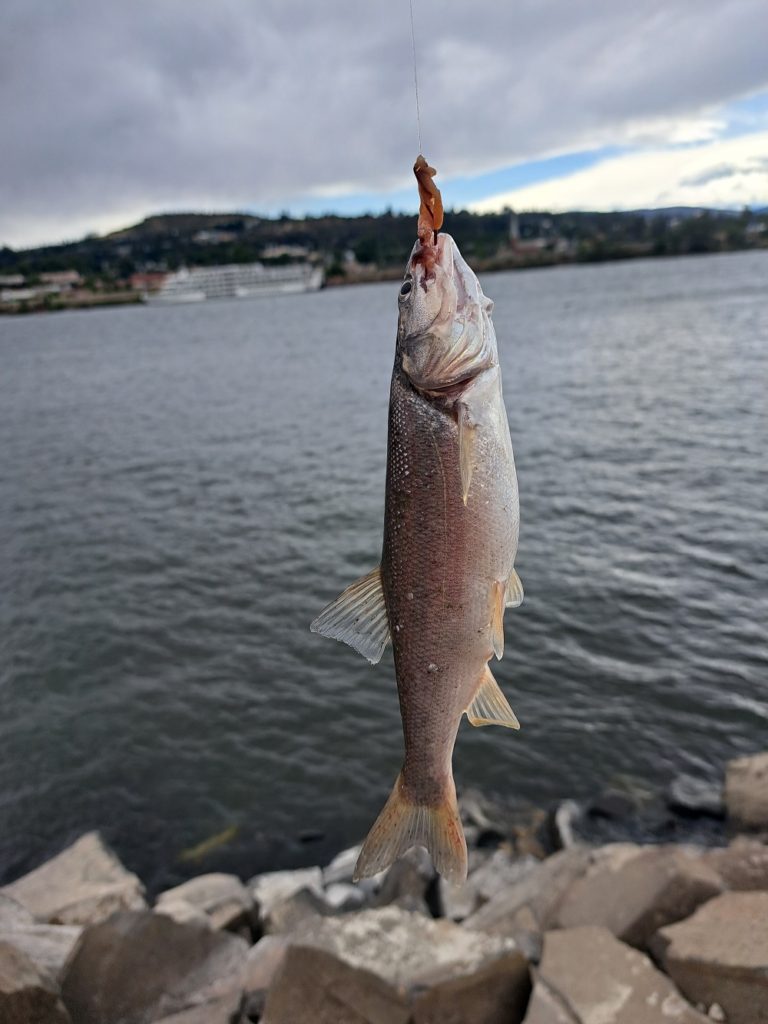
Speaking of uses for shad, the oily fish is also a favorite bait for sturgeon, and some even cut them up into chunks to use for catfish bait. Still others will eat them. We met one angler at a cleaning station at Maryhill State Park who carefully filleted out the shad he caught. He told me he brines them and puts them in a pressure cooker (which gets rid of the bones) before canning them. He said the fish taste very good. I will have to give him the benefit of the doubt.
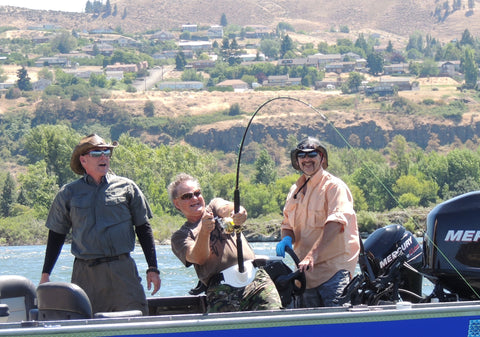
Finished with shad, we next registered at a check station and fished around The Dalles for pikeminnow. We only caught four keeper pikeminnow (worth $6 each) but since this was our first time participating, we also each got to turn in a coupon worth $10 each after checking in our first fish. Better still, three anglers from Idaho were desperate for sturgeon bait and paid us $20 for a single shad which they promptly put to use, casting their lines out at The Dalles marina, hoping to hook into a monster fish. Altogether, we made $64. That covered a good portion of our gas money getting back home.
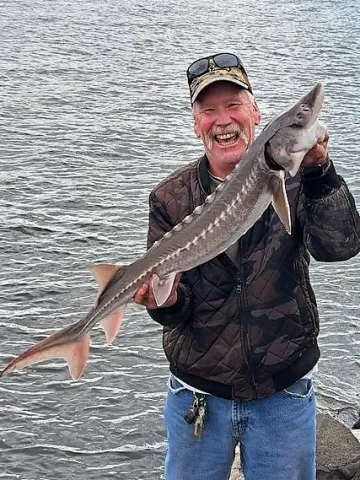
One other fun thing about fishing for pikeminnow are the other fish you catch. I ended up catching eight perch, and we both also caught smallmouth bass on the nightcrawlers we were using for pikeminnow bait, fished just off the bottom of the river with a two-ounce sliding weight. Rusty caught the most interesting bycatch of the day though, a 30-to-33-inch sturgeon on a bass rod that was spooled with braided line and just a 10-lb leader. It took him 15 minutes to get that prehistoric looking fish to shore, at which point I snapped a photo of the fish and he released it. It made for the end of a perfect day of fishing!
John Kruse – www.northwesternoutdoors.com and www.americaoutdoorsradio.com
/articles/sp-500