The Trip of a Lifetime
By Mike Carey
Over the loud throb of the single engine, our bush plane made its steady, if slow, journey over the Alaskan tundra. Several hundred feet below, the landscape was sparse and untouched by human hands. Between the marshes and brushy hillsides, I could see game trails crisscrossing the tundra. Straining to see an elk or moose, or maybe some bear, I imagined being dropped into this wilderness which looked so barren from above.
Suddenly, a river came into view ahead, long and meandering, cutting a path through the wild Alaska landscape. Rising up from the wilderness was our destination, Alaska Trophy Adventures Lodge. Our pilot lined us up with the dirt runaway and the land rushed ever closer. Wheels touching, bouncing the plane back and forth, our pilot throttled back and taxied the plane from the end of the runway back to the lodge.
Welcome to Alaska!
We were greeted by Wayne McGee, the owner of ATA, and his son Tyler. Surveying the land before me, I took in the rustic lodge and various buildings, tents, and at the river’s edge, a lineup of fishing boats tied up to a dock, seemingly ready and begging to be taken for a ride down the wild and free river.
The Alagnak River, a designated scenic river, and ATA Lodge lie within the Katmai National Park. The Lodge itself is on 160 acres of prime river frontage in an iconic section of the Alagnak River known as the upper braids, and can only be reached by plane.
Our group included me, Rob and Hillary Holman, and Mack’s Lure’s Britton Ransford. We had been waiting a long time for this adventure, as the previous year’s trip was canceled due to Covid. But the masks were off now, and Alaska was once again welcoming guests to enjoy this vast wilderness.
The Alagnak is a wild river, flowing steadily from inland through vast woods and tundra, finally emptying into Bristol Bay. Hosting five species of salmon and several species of trout, the river is a teeming habitat untouched by human hands. Anglers travel around the world to experience its beauty and incredible fishing, not to mention the amazing wildlife which includes moose and an impressive display of bears, which were our constant (if distant) companions for our six day stay.
Settling into our quarters, we took in the vast view from our chalet looking back toward the lodge and guest cabins, Below, I noticed a couple anglers working the waters along the shoreline. I wasted no time donning my waders and gear and walking down the short trail to the water’s edge. For the next hour I brushed off the cobwebs on my fly-casting skills and worked some productive seams in front of the lodge dock. I watched as fellow anglers landed several pinks, but it was not yet my time to hook into my first Alagnak salmon.
With the dinner bell ringing, we headed back to the lodge for a warm welcome from Wayne and the crew. Introductions around the dining room revealed this week’s group of twenty or so anglers, having come from around America and even from Germany and Ireland. Truly an international clientele. Our dinner was elegant and delicious, the main course a fine pork chop as moist and flavorful as any I’d ever had.
After dessert, Wayne greeted the group and provided a view of the coming week’s adventures. Introducing everyone from the guides to the lodge staff, the feeling of a close family was obvious. Topping off the evening with a glass of fine wine, we returned satiated to our chalet. The morning would come soon enough, and it was time to light a fire, play some cribbage, and get a good night’s sleep for the coming day’s fishing adventure.
Fly fishing for salmon and trout is what the ATA experience is all about.
While fishing the river does not exclude hardware (and we did have great success one day twitching Mack’s Lure jigs) the appeal of fishing the Alagnak River is without a doubt fly fishing. The lodge has all the quality gear that you would expect, but many anglers choose to bring their own favorite rods and reels.
I brought a rod and reel of my own, which I soon discovered from our guide, Tyler, was not set up quite right for the large streamer flies we would be using. After a few adjustments my set up allowed me to cast much better, and by the end of the trip I was making my casts longer and straighter than I could ever have imagined.
The guides at ATA are pros and excellent fly casting instructors as well. Hillary, new to casting flies, by the end of the trip was excited by how much she had learned. Don’t think that if you have no fly-casting experience this adventure isn’t for you. Indeed, many of our fish were caught close to shore and didn’t require long distance or accuracy. The river is bountiful and there is no lack of willing finned friends waiting to tug your line.
Fish On
My streamer came to a dead stop as I was stripping line in, and the head shake of a powerful fish caused my rod to strain and bend over in a solid arch. The fish broke the surface in front of me, a chrome-bright coho fresh from the ocean. Taking strong, line peeling runs, the fish began to tire and I eased her into Tyler’s waiting net.
After admiring her chrome colors and fresh sea lice, she was sufficiently revived and darted off on her mission. Anglers do bring fish back from the Alagnak, but Wayne and the guides encourage only keeping the bucks and releasing the hens to procreate.
It’s a policy that the anglers that come to ATA are in agreement with as the Alaska experience we are here for is not bringing home coolers full of fish, but rather days full of memories. The Alaska wilderness experience is what ATA is all about.
Each day we fished we got to try a different species to target. One day it would be salmon, working the numerous seams and back eddies for coho, chums, and pinks, the next day taking the long, scenic forty mile run to tide water to battle chrome coho, another day bead fishing for artic grayling, char, and leopard rainbow trout. The rainbows grow large from the abundance of feed and follow the spawning salmon, feasting on eggs.
Earlier in the season, anglers can target powerful chinook salmon and massive runs of sockeye that thrill with acrobatic leaps, challenging even the most experienced angler.
The ATA lodge
The ATA lodge is situated deep in bear country. Every day we saw large brown bears walking the shoreline, feeding on the salmon. Mother bears and cubs were a common sight. Wayne informed us that in twenty-five years of service they have not had a bear incident.
The guides have a strong understanding and respect for bears and safety is always the number one priority. I never had much worry about the bears. It was awesome to look down on sandy shorelines and see the large tracks of these majestic creatures interspersed with anglers’ footsteps.
For a change of pace one day, Britton and I decided to do a hike in with our guide Tyler to a local lake that holds northern pike. Having never caught a pike on a fly I was very excited! We ran about thirty minutes by river, secured the boat, and began our one-mile hike to the lake. The Alaska tundra is a unique habitat, with open fields interspersed by woods and tall brush.
Periodically calling out “here bear”, we were sure to make plenty of noise to alert any bear in the area of our presence. The tundra is soft and giving, much like walking on a mat of foam. Our every step we would sink six inches into the turf, making the one-mile hike feel like three.
It was a workout which I enjoyed, although when we reached the lake, I was very grateful for the break! Sad to say, on this day the pike were not cooperating, although I did get a small one and had a nice strike from a larger fish. It’s an adventure I’d definitely try again!
As most things do, our Dream Adventure came to an end much too quickly. The last evening, we shared our group meal with new friends and recapped the week that was. The smiles and laughter around the room were a clear indication of what a magical place we had the good fortune to enjoy.
We shared our highlights from the week and the common bonds the week’s group of anglers experienced. In the morning we boarded our bush plane for the quick flight back to King Salmon, then Anchorage, and then home. Watching the lodge recede in the distance, I sensed we all left a part of ourselves back in Alaska, but took a piece home with us as well.
For your trip of a lifetime, learn more Alaska Trophy Adventures at https://www.atalodge.com or call 1-877-801-2289.

/articles/trip-lifetime
Late Season on Alaska’s Kenai Peninsula
By Chad Bryson
Alaska’s Kenai Peninsula and its spectacular sport fishing opportunities are a far cry from being a worldly secret. Every summer, thousands of visitors travel to the Great Land in the pursuit of filling fish boxes with some of the cleanest and tastiest sockeye, king, and silver salmon on the planet. \
This occurrence has been happening for decades. In most fishing circles, going to the Kenai during the summer migratory runs of salmon would even almost be considered “old hat.” In fact, I myself even turned a cold shoulder to it.
As a veteran Bristol Bay guide, I couldn't imagine any good reason at all to punish myself, or anyone else for that matter, by enduring the crowds of summer on the Kenai Peninsula. It just didn't seem worth it.
Sure, the fishing was incredible, but it was at the price of standing in line either by boat or by foot next to hundreds of my “brothers in arms”, none of which I knew well enough to be comfortable in those proximities.
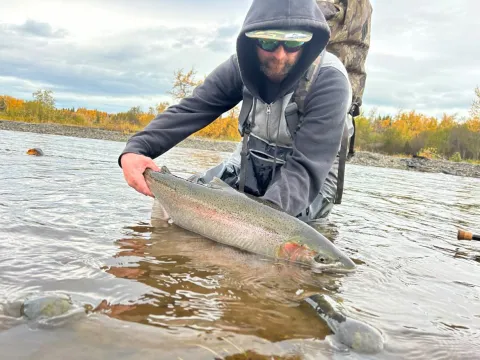
That was until at the suggestion of a friend to give the late fall steelhead fishing a try. In an effort to make my re-entry to society easier, I gave it a shot. I figured the worst thing that could happen is that I wouldn't have fun and I would hate the crowds. After the first day, I knew the worst wasn't going to happen, and that I had found a new place/time to fish steelhead.
That first trip was in early October. I fished the Anchor and Kasilof rivers. There were plenty of steelhead willing to eat dead drifted beads as well as swung flies. The weather was equally as pleasant as the number of anglers was few. It was almost too good to be true.
How could it be that this Shangri-La of Alaska steelheading could still exist? Furthermore, how long into fall would the fishing sustain? AKA- How long could I stay and do this every single day until the rivers froze or I spent every dollar I had earned over the summer? Whichever came first, I was hell-bent to find out.
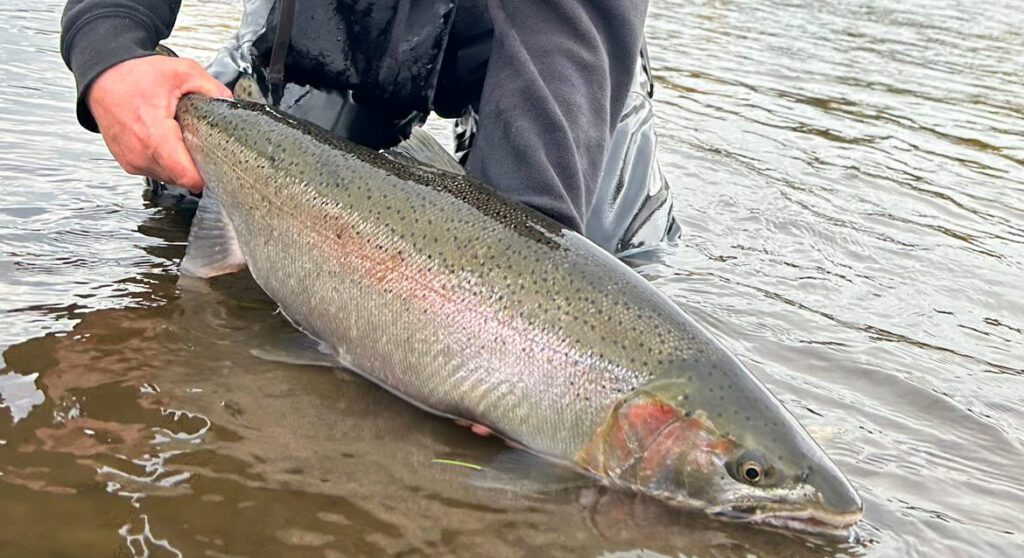
That year, I think I stayed until the third week of October. It was all I could afford both financially and personally. Kids, dogs, and girlfriends have this thing about me being away from home for extended periods of time. Especially the dogs. I was kicking and screaming the whole way to the airport. Fishing at that time was nothing short of remarkable and I didn't want to leave.
Some of the locals I met during my abode on the peninsula encouraged me to not even come back the following year until November 1, as long as the temps held out. At first, I wasn't sure if this was a carefully plotted ruse just so I wouldn't be there to “fish their water” or if it was a genuine act of rare angling kindness. After all, anglers are known for their sometimes harmlessly nefarious actions to keep the local water local.
That wasn't the case here. This was a genuine act of kindness and sharing amongst steelheaders in pursuit of one common goal. I shouldn't have been surprised. After all, that is the Alaska way.
In the years that followed, I fished the Kenai Peninsula later and later. As long as the weather and temps held out, the steelhead were there but, without the crowds of anglers. November/December in Alaska can be very, very cold, with potential of more cold brutality at any given moment. This keeps most fair-weather steelheaders away.
Fellow Bristol Bay guide and lifelong Kenai guide Matt Duncan fishes easily into November and some years well into December, with an occasional January boat launch. Growing up in Anchorage gives him, and other local resident guides, the hands down advantage when it comes to Kenai conditions.
Mike Brown at Mossy’s Fly Shop in Anchorage is also a great source of information regarding Kenai fisheries.

When I’m planning a late-season Kenai Steelhead trip, either for myself or others, I try to take into consideration that on a five-day trip, at least one of those days is going to be a cribbage day. Maybe even two days. Weather can blow in and blow out just that fast.
As long as you know the potential is there, it won't be that big a deal. There are numerous Airbnb, VRBO, and local cabin rentals on the lower Kenai Peninsula that will accommodate a world championship cribbage tournament should the need arise. While you are fishing, plan accordingly on how you dress. I wear boot foot waders and full synthetic layers no matter if I am in a boat or walking in to wade fish.
And don’t even think about wearing anything but a quality rain jacket. A friend joined me on a November Kenai steelhead adventure that only brought a “brand x” windbreaker that was water resistant. After about 90 minutes our fishing day morphed into an excursion into Homer for the purchase of a brand new Grundens product. Don't be that guy. Ever.
In regards to fishing tackle, you will see a myriad of techniques being used on the Kenai Peninsula. Everything from conventional float rods and beads to spey rods and swung flies tied with the rarest of materials. All of it works and has its own place in the system.
I have stood next to center pin anglers, float anglers and single hand fly anglers in a parking lot while I rig my spey rod for the day. Nobody cares what you fish with and nobody cares where you are from. Its Alaska, most people are from somewhere else anyway. Everyone just wants to fish. I find it refreshing.
If you are up for a unique steelhead experience at a time of year when most everyone has forgotten the Great Land exists, check flights to Anchorage. Winter flights are sometimes ridiculously cheap, especially from the PNW.
The local guides are still working every last day they can before the unforgiving arctic freeze sets in. You could be on the verge of discovering your new Thanksgiving family fishing vacation.......
/articles/late-season-alaskas-kenai-peninsula
Josie & the Tomcats go to Alaska
The first time I met Josie Regula was when she boarded our charter boat, the Mystic Lady, at Sportsman's Cove Lodge on Prince of Wales Island in Southeast Alaska. The 50-something year-old-woman was accompanied by her husband, Max. The two had come here from San Diego, California to fish for salmon, halibut, cod, and more during a three-day stay at this luxury Alaska fishing lodge.
It turns out Josie isn't shy. As she boarded the boat for an orientation prior to the next morning of fishing, Josie let us know this was her very first fishing trip. She then told all of us with much bravado she intended to catch the biggest fish on the boat and probably the most as well.
Her husband Max looked shyly downward but the rest of us did not. Her shipmates were myself, my best friend Rusty Johnston, well known Pacific Northwest outdoors writer Terry Sheeley, Frank Skipworth (a veterinarian from Kentucky), and the Captain of the Mystic Lady, Steve Helton. I think Josie was expecting a chorus of loud guffaws and snorts from us but several of us nodded in agreement and said there was a good chance she would do just that.
Josie looked momentarily confused until I explained first time anglers, especially women, tended to out fish their male shipmates because they had not formed a lifetime of bad habits like the rest of us had. Add to that, first time women anglers tend to not only pay attention to the fishing advice dispensed by the captain, but actually follow it. Several of us went on to say we had indeed seen women with no experience catch the biggest fish or the most fish because of this. I'm not sure Josie believed what she was telling us but we all knew her prediction could well come true.
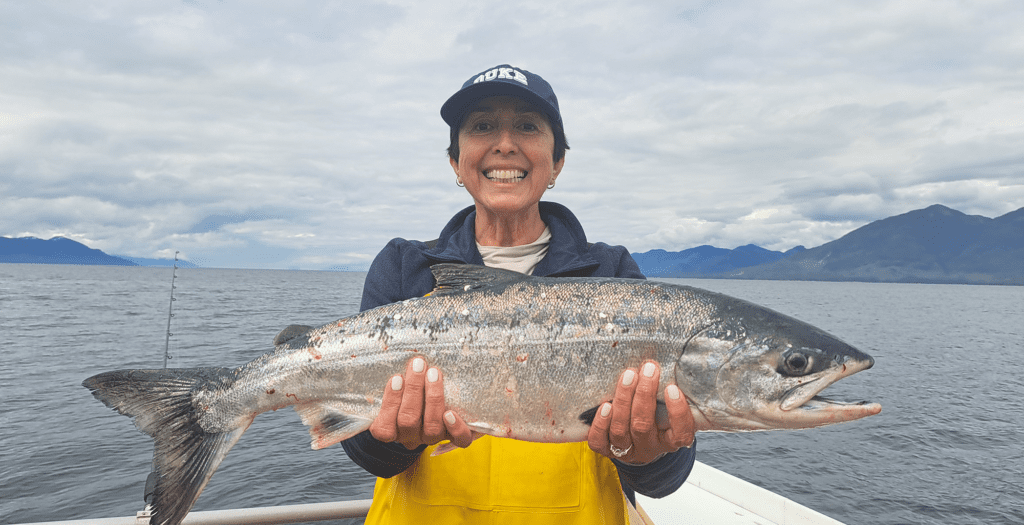
When I asked Josie her name, she said it was "Josie, like Josie and the Pussycats". Being all over 50 years of age on the boat, we all recognized the reference to the old television cartoon show featuring Josie, the star of a female rock band, and her supporting cast the Pussycats. With all of us being men Terry Sheeley said we wouldn't be the Pussycats as her band members, but we would be willing to be the Tomcats. And with that, the fishing band was formed.
On our first morning we fished a large sandy bottom flat that was about 260 feet deep, a non-descript part of the ocean some 35-minutes away from the lodge by boat. Dropping down our bait of herring with 12-ounce lead weights on a short leader, we began to jig for halibut, and wouldn't you know it, Josie caught the first fish of the day, a healthy five-pound true cod. Josie’s luck (and learning curve) increased over the next three days of fishing and she reeled in more than her share of cod, halibut, and salmon but it was our third day of fishing that Josie played her greatest hit.
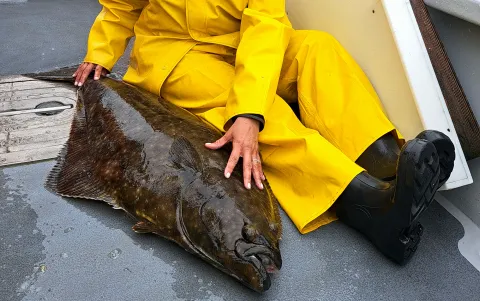
The weather the first two days was mild but our final day on the water was a rough one. We endured a steady drizzle most of the day and rough seas that had Josie feeling under the weather. In fact, despite the fact she took Dramamine to combat motion sickness, she became sea sick. I’ll give her credit though; she stuck it out on deck as we jigged for halibut during a slow morning of fishing that only yielded a few smaller halibut and true cod. Then, Josie’s rod tip bent down in a big way. She set the hook and the fight was on. The fish Josie hooked was definitely no small halibut; oh no, it was a very big one.
Josie, who was not above using colorful language, used it in abundance during the fight that followed with this goliath of a fish. Having never battled a big fish before, she decided to kneel down on the deck on one knee and brace her fishing rod against the deck rail as she reeled. It was an unorthodox way to fight a fish but it worked. The fish made several runs towards the bottom, robbing Josie of line as it did, and each time the fish made a run Josie would loudly express her dismay. However, Josie stuck it out, kept reeling and eventually, after a long fight, got that halibut to the surface.
The fish was brought on board and it measured well over the 40 inches where non-resident charter anglers are allowed to keep a halibut in this part of Alaska. In fact, that fish measured a whopping four-feet and weighed an estimated 53 pounds. After snapping a few photos, that halibut was released back into the sea unharmed to grow even bigger and Josie’s day one prediction of catching the biggest fish on the boat came true.
After taking a short break to deal with fatigue from both the fight and sea sickness, she was right back on the rail for the final afternoon of fishing, reeling in half a dozen salmon in the process. In the end it just goes to show first time female anglers really can out fish all the experienced men on board, and Josie’s Tomcats were more than happy to be here supportive band as performed her greatest hit!
If you would like to find out more about the first-class fishing adventures available at Sportsman’s Cove Lodge for anglers of any experience level, go to their website at www.alaskasbestlodge.com .
/articles/josie-tomcats-go-alaska