/articles/categories/techniques
It's "Shrimp-tacular" Season! by Mark Yuasa
When it comes to spot shrimp fishing, May and June are a “shrimp-tacular” time to be on the water in Puget Sound, Hood Canal, San Juan Islands, and Strait of Juan de Fuca.
The recreational spot shrimp fishery will open on May 24 in many Puget Sound marine areas, with additional dates scheduled in several areas into early July. The one area to have an opening prior to May 24 will be Marine Area 12 (Hood Canal), which will have an early opportunity on May 10.
“Test fishery data in Marine Areas 9 (Admiralty Inlet), 10 (Seattle-Bremerton Area), and 13 (South Puget Sound) continue to indicate low abundance of spot shrimp,” said Don Velasquez, a Washington Department of Fish and Wildlife (WDFW) Puget Sound shellfish biologist. “As a result, these areas are not scheduled to open for recreational spot shrimp harvests in 2026 (similar to the closures in 2025).”
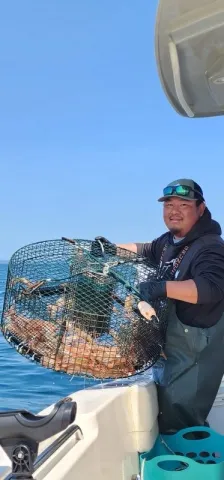
WDFW fishery managers selected the shrimp fishing dates to offer opportunities to harvest spot shrimp while distributing participants and reducing the chance of exceeding recreational harvest quotas. Due to high expected turnout, some areas cannot support weekend openings while remaining within their current quota.
To ensure a safe and enjoyable experience, shrimpers are encouraged to monitor weather conditions and avoid launching or leaving the dock if their vessel can’t safely participate. Check with local access ramps and marinas ahead of time to stay informed on potential closures or fee changes. Allow extra time for launching boats, show courtesy to others at the boat ramps, and respect others’ gear while on the water.
Spot shrimping is one of Washington’s signature recreational fisheries that occurs during the spring for these tasty prawn-sized denizens of the deep.
In all open areas of Puget Sound, the daily limit per shrimper is 80 spot shrimp with a total daily weight limit of 10 pounds (whole shrimp) for all species of shrimp combined. Shrimpers who retain only spot shrimp may remove and discard the heads while in the field and before returning to shore. Shrimpers retaining any shrimp species other than spot shrimp must continue to retain the heads until finished and on shore to verify compliance with the 10-pound daily limit.
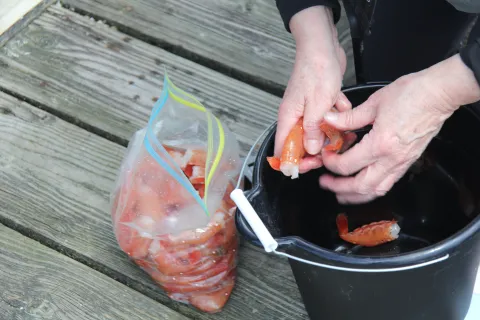
To avoid going over the daily limit, count your catch not once but twice or three times and put each limit into separate containers. Nothing is worse than being checked and finding out you’re one spot shrimp over the daily limit. Also, keep in mind that each angler can have only two traps and a maximum of four traps per boat, meaning when you are near the point where you only have one last limit to catch, you cannot have four traps sitting in the water.
More information on recreational shrimp fishing rules, seasons, and marine areas is available on WDFW’s webpage, including a webpage on shellfishing gear rules at https://wdfw.wa.gov/fishing/shellfishing-regulations/gear-rules.
Shrimpers are reminded that traps can be set one hour before official sunrise during any open period in the marine areas without specified harvest hours. These include Marine Areas 4, 5, 6 (except for the Discovery Bay Shrimp District), Marine Area 7 East, Marine Area 7 South, and Marine Area 7 West. The pots must be removed from the water in these same areas by one hour after sunset at the end of an open period. The start and end times for all other areas are listed above.
Seasons for non-spot shrimping (dock, coonstripe, sidestripe, and pink shrimp only) will begin later this year and will be announced separately. During non-spot shrimp seasons, 1/2-inch mesh pots are allowed, depth restrictions are in place, and all spot shrimp are required to be released immediately.
A rule adopted in 2025 prohibits setting shrimp gear from a vessel near 19 designated Washington State Department of Transportation-managed ferry terminals in Puget Sound and the San Juan Islands (Marine Areas 7, 8-1, 8-2, 9, 10, and 11).
Shrimpers and other boaters are reminded to follow Washington rules to help protect endangered Southern Resident killer whales (SRKWs). Under state law, recreational vessels in Washington waters must stay 1,000 yards away from Southern Resident killer whales (SRKW). For details about steps boaters and fishers can take to keep the whales – and themselves – safe, refer to the Be Whale Wise website at https://www.bewhalewise.org/.
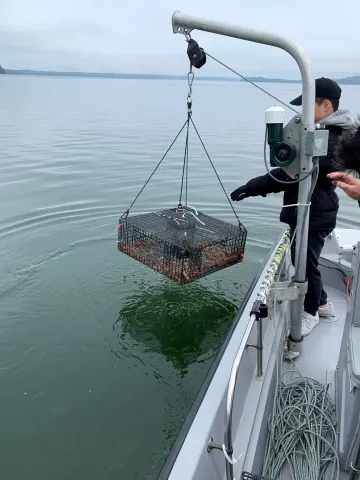
Tips to catch spot shrimp
Top of the list when planning a spot shrimp fishing outing is to make sure all your gear – pots rigged correctly, yellow buoys, line, cooler and ice, electric pot puller, and boat motor – is ready to go, and the bait is properly prepped before you leave home.
Another key point to keep in mind is that this highly popular fishery draws hundreds of anglers, so allow yourself plenty of time to get to the boat launch and secure a parking space, which can be limited depending on the area.
One of the tips that can make or break success is knowing where the schools of spot shrimp are congregating. The majority of spot shrimp can be found in deeper depths along steep ledges, drop-offs, and sharp inclined bottoms, and usually lurking in 200 to 350 feet of water.
Once you’ve located them on the fish-finder, make sure to scatter your pots across a broad area and set them at various depths because schools of spot shrimp tend to move around quickly depending on the tides and currents.
The amount of weight to keep your pots on the bottom depends on the tide, current, waves, and wind. A safe bet is anywhere from 20 to 30 pounds, and be sure they’re evenly placed and secured around the corners of the pot. Allow a one to two-hour soak before the first pull. This provides you with at least two more chances during a brief four-hour fishing period.
The bait mixture is another important factor in catching spot shrimp, and prep a good slurry of bait ingredients and thickness similar to yogurt. Make sure the scent cloud is leeching out of the trap consistently.
For the bait itself, use a good amount of shrimp bait pellets mixed in with oily tuna, whitefish, or salmon in a five-gallon bucket. Bring a large ladle or scooper and latex gloves, as it can get rather messy, and nothing is worse than a bunch of stinky slime on the boat deck. Be sure to add several cans of cat food with small holes punched into them just before you drop the traps. Don’t forget to take around 25 to 35 extra cans of cat food; more is better than running out while out on the water with a grocery store nearby.
A medium-sized square pot with a bait barrel (bring extra bait barrels) connected to a four-way rope harness attached to each corner of the pot. Keep your bait barrel securely fastened to the trap with a wide strip of elastic cord. Using a biodegradable escape cord made of cotton (or other natural fiber) will degrade and reduce the amount of shrimp wasted if the pot is lost and required on all shellfish traps.
Having an electric pot puller is a wise investment, especially when pulling up a 35-plus-pound trap from 300 feet of water. The Scotty Electric Pot Puller and the Ace Line Hauler Pro are two ideal choices that can be placed onto a Scotty downrigger mount and plug.
For buoys, go with a large round (soccer ball size) yellow buoy (your full name and address is required on the buoy and must be legible) attached to a secondary buoy stick with a flag or staff. A phone number is highly recommended. Use a colorful flag or staff to help easily locate your own buoy among the thousands of other buoys set nearby. Always attach buoys with the rounded end towards the trap and not the flat end, which creates more drag and can snag floating debris. Never use empty containers (like a one-gallon milk container) as a buoy, and it is illegal since they create drag and fill up with water and sink.
For each pot, use at least 400 feet of sinking lead line. The line length is dependent on how deep you drop the pots. Tide changes will alter your water depth, so a good tip is to use a line that is 1/3 longer than the maximum water depth to prevent losing a trap. Avoid using lines with a large diameter, particularly those greater than 5/16 inch, which create more drag in a current and can pull lighter traps away from where they’re set. You can also add a weight to the line. Propellers can sever floating lines on the surface and will increase the chance of entanglement with floating debris. Before heading out, make sure the drop lines are coiled neatly and ready to deploy.
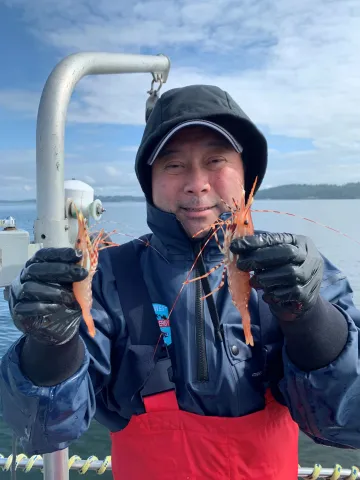
Spot shrimp are high in Omega-3 fatty acids with a nice, sweet flavor to the firm meat texture. They can be eaten raw, and if cooked, boil them for one to two minutes at most or until they turn pink. If possible, live spot prawns should be prepared the same day they’re caught to avoid them becoming mushy.
To keep spot shrimp in the best condition, ice immediately after you catch them. Shrimp can be kept in the refrigerator for a couple of days to be eaten fresh. Freeze immediately if you plan on saving them. Never store them with tap water, as chlorine kills them. If kept overnight, remove the heads as the digestive enzyme makes the flesh turn mushy.
Lastly, now that spring has arrived, you’ll need a 2026-2027 recreational fishing license valid from April 1, 2026, through March 31, 2027. WDFW offers two mobile apps https://wdfw.wa.gov/about/apps, and both apps are designed to make your outdoor experience easier and more efficient. MyWDFW serves both hunters and anglers, offering electronic tagging, harvest reporting, and access to licenses and permits, and go to https://wdfw.wa.gov/about/apps/mywdfw for details. The Fish Washington® at https://wdfw.wa.gov/fishing/regulations/app is tailored for anglers, providing fishing regulations, digital catch cards, and license management. Licenses may be purchased online at https://fishhunt.dfw.wa.gov/login or from hundreds of license dealers across the state.
(Mark Yuasa is a Washington Department of Fish and Wildlife Communications Manager and longtime local fishing and outdoor writer.)
Before making plans to go spot shrimp fishing, anglers should check the WDFW emergency rules webpage for possible in-season closures. at https://wdfw.wa.gov/fishing/regulations/emergency-rules.
Here are the 2026 spot shrimp fishing dates:
● Marine Area 4 east of the Bonilla-Tatoosh Line: Open daily beginning May 24. Shrimping is allowed during daylight hours only. The recreational spot shrimp season closes when the quota is met or Sept. 15, whichever comes first.
● Marine Area 5 (western Strait of Juan de Fuca): Open daily beginning May 24. Shrimping is allowed during daylight hours only. The recreational spot shrimp season closes when the quota is met or Sept. 15, whichever comes first.
● Marine Area 6 (Port Angeles Harbor, eastern Strait of Juan de Fuca, excluding the Discovery Bay Shrimp District): Open on May 24, May 26, June 7-8, and June 21-22. Shrimping is allowed during daylight hours only. An announcement regarding additional dates may be made later in the season.
● Marine Area 6 (Discovery Bay Shrimp District): Open on May 24 from 9 a.m. to 3 p.m. only. An announcement regarding additional dates may be made later in the season.
● Marine Area 7 East (northern Rosario Strait, Bellingham Bay, Sucia, and Matia islands, Strait of Georgia): Open on May 24, May 26, and June 7-8. Shrimping is allowed during daylight hours only. An announcement regarding additional dates may be made later in the season.
● Marine Area 7 South (Iceberg Point, Point Colville, Biz Point, Salmon Bank): Open on May 24, May 26, and June 7-8. Shrimping is allowed during daylight hours only. An announcement regarding additional dates may be made later in the season.
● Marine Area 7 West (San Juan Channel, Speiden Channel, Stuart, and Waldron islands): Open on May 24, May 26, June 7-8, June 21-22, and July 18-20. Shrimping is allowed during daylight hours only. An announcement regarding additional dates may be made later in the season.
● Marine Area 8-1 (Saratoga Passage, Deception Pass) and Marine Area 8-2 (Port Susan, Port Gardner, Everett): Open on June 8 and June 22 only with shrimp fishing allowed from 9 a.m. to 1 p.m. each day. An announcement regarding additional dates may be made later in the season.
● Marine Area 9 (Edmonds, Port Townsend Bay, Admiralty Inlet): Closed for spot shrimp harvest in 2026 due to low abundance.
● Marine Area 10 (inside of Elliott Bay east of a line from West Point to Alki Point): Closed for spot shrimp harvest in 2026 due to low abundance.
● Marine Area 10 (outside of Elliott Bay west of a line from West Point to Alki Point, which includes the Bainbridge Island shrimp fishing grounds): Closed for spot shrimp harvest in 2026 due to low abundance.
● Marine Area 11 (Tacoma-Vashon Island): Closed for spot shrimp harvest until further notice. An announcement regarding an opening may be made later in the season if sufficient quota is available.
● Marine Area 12 (Hood Canal Shrimp District): Open on May 10, May 24, May 26, June 7, and June 21 from 9 a.m. to 1 p.m. only. An announcement regarding additional dates may be made later in the season.
● Marine Area 13 (South Puget Sound, Carr Inlet): Closed for spot shrimp harvest in 2026 due to low abundance.
/articles/its-shrimp-tacular-season-mark-yuasa
Washington Saltwater Salmon Opportunities
The list of saltwater salmon fishing options in early summer are far and wide, and in this column, I’ll break down the path to success around Puget Sound and off the Washington coast.
One important factor to keep in mind, when planning a fishing excursion is that the entire 2025-2026 season package won’t be officially adopted until sometime in early to mid-June. What tends to happen is that these early-season summer fisheries will require emergency opening approvals, so anglers should regularly check the Washington Department of Fish and Wildlife (WDFW) website (https://wdfw.wa.gov/) for possible updates and changes.
Back in mid-April, the Pacific Fishery Management Council held meetings in San Jose, California, and the 2025-2026 tentative statewide salmon fishing seasons were adopted by the Council. The season recommendations set forth by WDFW are then moved forward for federal approval by NOAA Fisheries.
While we wait for the ink to officially dry on the approval process, let’s visualize the possibilities of where to go and wet a line in the upcoming weeks, as well as a few pro tips to improve your chances of hooking a fish.
Since no salmon fishing season mirrors another, anglers have learned to become more adaptable to the constant ebb and flow of change. First off, anglers should be mobile and willing to move from location to location to maximize their time on the water.
Don’t focus all your time on one specific area. By doing a little bit of homework and reading this column below, you’ll likely find more choices by going outside of the box. Second, since many seasons are driven by catch quotas/guidelines, it is wise to go sooner rather than later.
Next, build a communication network to stay informed about the latest fishing trends, including the WDFW website and blog posts. Many other social media platforms can be used to gather this kind of information. Attending fishing seminars is another good avenue to gain more knowledge.
Other tips include reading blogs and watching YouTube videos from fishing influencers, especially publications like this magazine, which provide a plethora of information.
Where to go in June
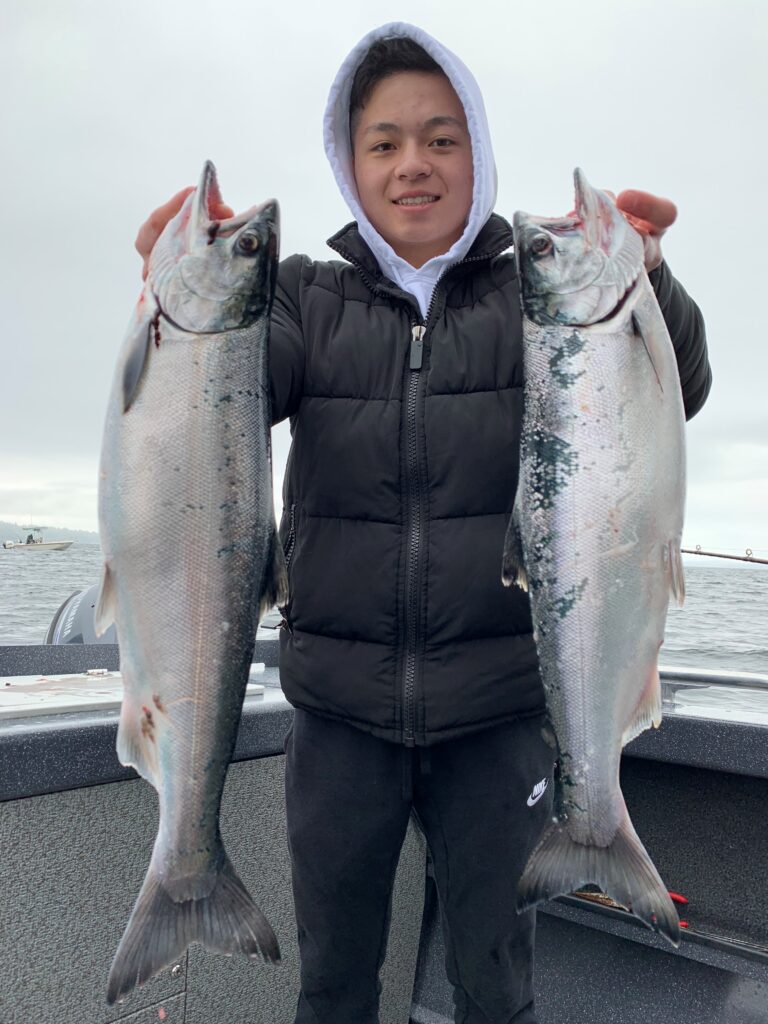
For the past several summers, Marine Area 10 (Seattle-Bremerton Area), mainly the northern portion, has been good for early coho and is open daily beginning June 1. The resident coho average 2 to 4 pounds, along with a few larger ones, and are fairly snappy. Their bright red-orange meat is excellent for the BBQ grill. This is due in part to the abundant schools of krill: small, microscopic, shrimp-like crustaceans found in Marine Area 10 during the summer.
Most will target coho in the shipping lanes off Jefferson Head to the Kingston-Apple Tree Point boundary line, and from the Edmonds oil dock to Richmond Beach. Other locations worth a try are Point Monroe off the north side of Bainbridge Island, West Point south of Shilshole Bay, Blake Island/Southworth area, and the entire eastern side of Bainbridge Island.
If you’re looking to catch an early summer hatchery Chinook, then Marine Area 11 (Tacoma-Vashon Island) is an option and open Wednesdays through Saturdays only from June 4 to 30. These hatchery kings average 8- to 15-pounds along with some topping exceeding the 25-pound mark.
WDFW will regularly monitor the Marine Area 11 fishery and could close sooner if the quota or other guidelines are attained. The Chinook catch quota for June is 1,423 (1,423 in 2024 and 2023, 580 in 2022, and 431 in 2021) with a total unmarked encounter of 818, and a total sublegal encounter of 1,601. The Chinook fishery is managed under two separate summer quotas, and a second window of opportunity happens in late July. Commencement Bay east of the Cliff House Restaurant/Sperry Ocean Dock boundary line is closed to salmon.
Those who fish for salmon regularly in Puget Sound marine areas – especially in the Tacoma region – know that dogfish can be an issue in the summer.
To avoid pesky schools of dogfish, anglers will jig or troll with downriggers and meat liners using plugs, spoons or a plastic hoochie squid. If you drop a whole or cut plug herring, make sure you’ve got plenty of extra leaders tied. The sharp teeth and abrasive sandpaper-like skin of a dogfish will fray leaders. Lesson learned, I’ve burned through more than a dozen in a matter of a couple of hours.
In Marine Area 11, look for Chinook lurking around the Clay Banks to Owen Beach at Point Defiance Park in Tacoma, the Slag Pile off the Tacoma Yacht Club, the “Flats” outside of Gig Harbor, Quartermaster Harbor, and Point Dalco on the southwest side of Vashon Island.
In the northern part of Marine Area 11, try Dolphin Point and Point Robinson on the northeast side of Vashon Island, south of the Southworth Ferry Landing, Colvos Passage, Dash Point, and Apple Tree Cove to Redondo Beach.
Keep in mind that the salmon fisheries mentioned above for Marine Area 10 and Marine Area 11 are only for June, and that additional salmon fishing opportunities will occur in both areas. Anglers should check the WDFW North of Falcon webpage for additional season information.
Another June option for hatchery Chinook is south of the Tacoma-Narrows Bridge in Marine Area 13 (South Puget Sound), which is open seven days per week. Look for fish are Gibson Point, the concrete dock off Fox Island’s east side, Hale Passage, Johnson Point and Point Fosdick.
The Tulalip Bubble Fishery (Marine Area 8-2) is open through Sept. 1 with fishing allowed from 12:01 a.m. Fridays to 11:59 a.m. on Mondays of each week, and closed June 21. Before going, anglers should check the WDFW website as intermittent closures may be needed to ensure the hatchery is meeting spawning escapement goals. Fishing is also open Sept. 6 to 21 and allowed Saturdays and Sundays of each week. The bubble fishery is open within the terminal boundary only – closed east of a line from Mission Point to Hermosa Point – and can be decent for summer Chinook in the 10- to 20-pound range, and is mainly a trolling or jigging show.
You can jig drop down a glow, chartreuse, pearl-white, green-nickel, blue-pearl or blue-gold pattern in three to six-ounce sizes depending on the current and wind. Remember, store-bought jigs have a treble hook, and they’re illegal for salmon in all marine areas. Only single-pointed barbless hooks and one fishing line with up to two hooks may be used.
Trolling is the popular method with downriggers and a flasher combined to plug, spoon, and/or a plastic hoochie squid. Before or at daybreak, the fish tend to be found from the surface down to 90 feet, and as the sun rises, they’ll go deeper up to around 100 to 175 feet.
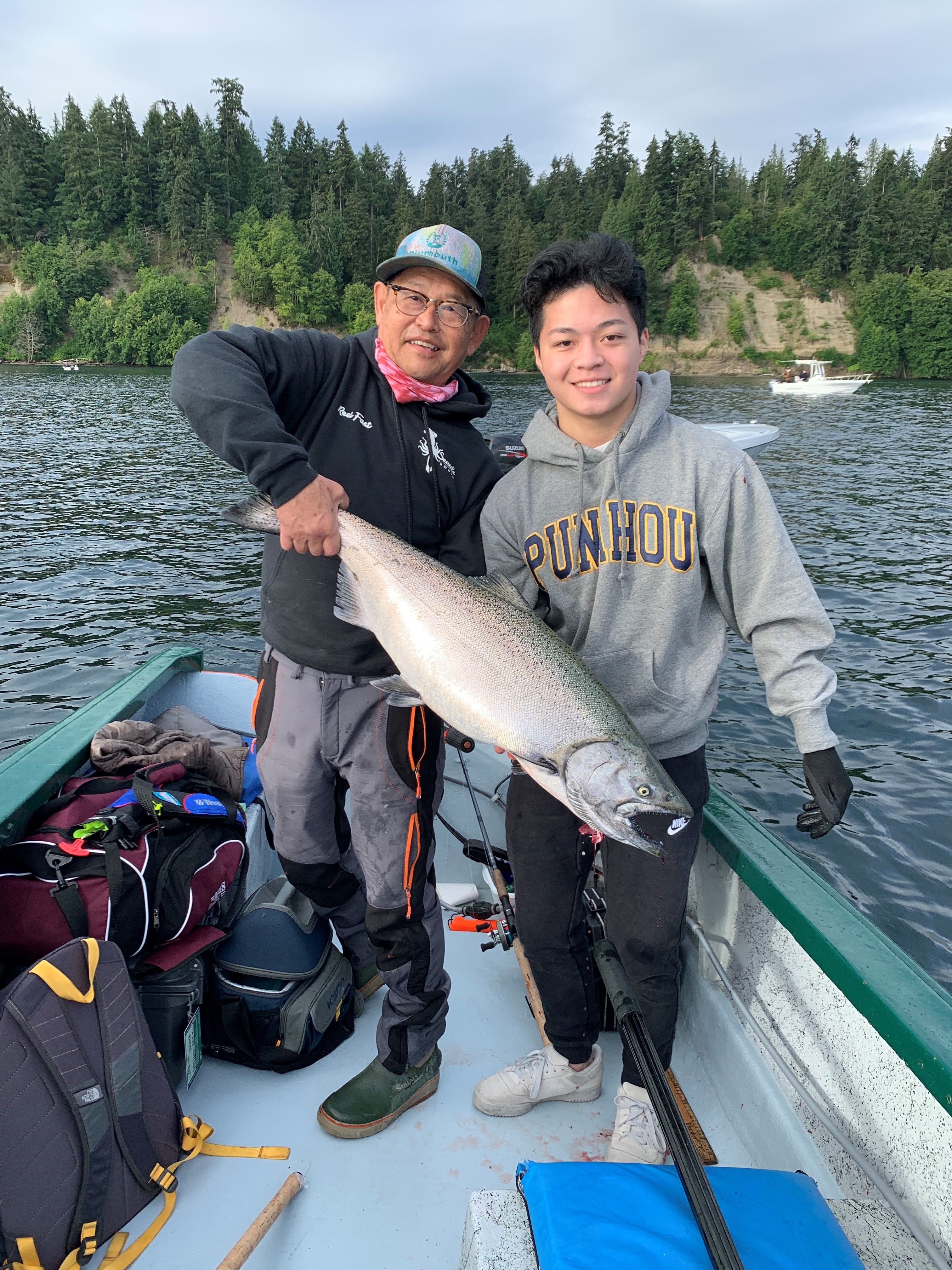
Many anglers are making plans to visit the coastal ports where Chinook and hatchery coho fishing get underway in late June. The ocean salmon season includes a recreational Chinook quota of 53,750 (41,000 in 2024) and a hatchery-marked coho quota of 99,720 (79,800 in 2024).
Marine Area 1
(Ilwaco)
Is open seven days per week from June 25 through Sept. 30, all salmon, with a subarea guideline of 16,600 Chinook (12,510 in 2024) and a subarea quota of quota of 49,860 marked coho (39,900 in 2024). The daily limit is two salmon and one Chinook only. Columbia Control Zone closed.
Marine Area 2
(Westport-Ocean Shores)
Is open seven days per week from June 21 through June 28, with a subarea guideline of 22,270 Chinook (17,430 in 2024), and the daily limit is one salmon, release all coho. Open seven days per week beginning June 29 through Sept. 15, all salmon, with a subarea quota of 36,900 marked coho (29,530 in 2024). Beginning June 29, the daily limit is two salmon, and only one may be a Chinook.
Marine Area 3
(La Push)
Is open seven days per week from June 21 through July 3, with a subarea guideline of 2,280 Chinook (1,630 in 2024), and the daily limit is one salmon, release all coho. Open seven days per week beginning July 4 through Sept. 15, all salmon, with 2,590 marked coho subarea quota (2,070 in 2024). Beginning July 4, the daily limit is two salmon. No chum retention beginning Aug. 1.
Marine Area 4
(Neah Bay)
Is open seven days per week from June 21 through July 3, with a subarea guideline of 12,600 Chinook (9,430 in 2024), and the daily limit is one salmon, release all coho. Open seven days per week beginning July 4 through Sept. 15, all salmon, with a subarea quota of 10,370 marked coho (8,300 in 2024). Beginning July 4, the daily limit is two salmon. No chum retention beginning Aug. 1. Beginning Aug. 1, Chinook non-retention east of the Bonilla-Tatoosh line during the managed ocean fishery.
WDFW fishery managers will monitor the number of salmon caught in season and may close areas earlier if quotas or guidelines are met. In-season management may be used to sustain season length and keep harvest within the overall Chinook and coho total allowable catch.
Piers open year-round for salmon in Puget Sound include the Edmonds Marina (usually a good place for early summer kings in June), Fox Island, Mukilteo Ferry Landing, Seacrest in West Seattle, Dash Point Dock, Point Defiance Park Boathouse, Les Davis, and Des Moines.
Note: The salmon daily catch limits, species and size restrictions, and other regulations vary for each marine area. Emergency closures or adjustments to marine area seasons are also possible. Anglers should check for details on the WDFW website or the 2025-2026 regulation pamphlet.
(Mark Yuasa is a Washington Department of Fish and Wildlife Communications Manager and a longtime local fishing and outdoor writer.)
/articles/washington-saltwater-salmon-opportunities
Spring Means Rockfish
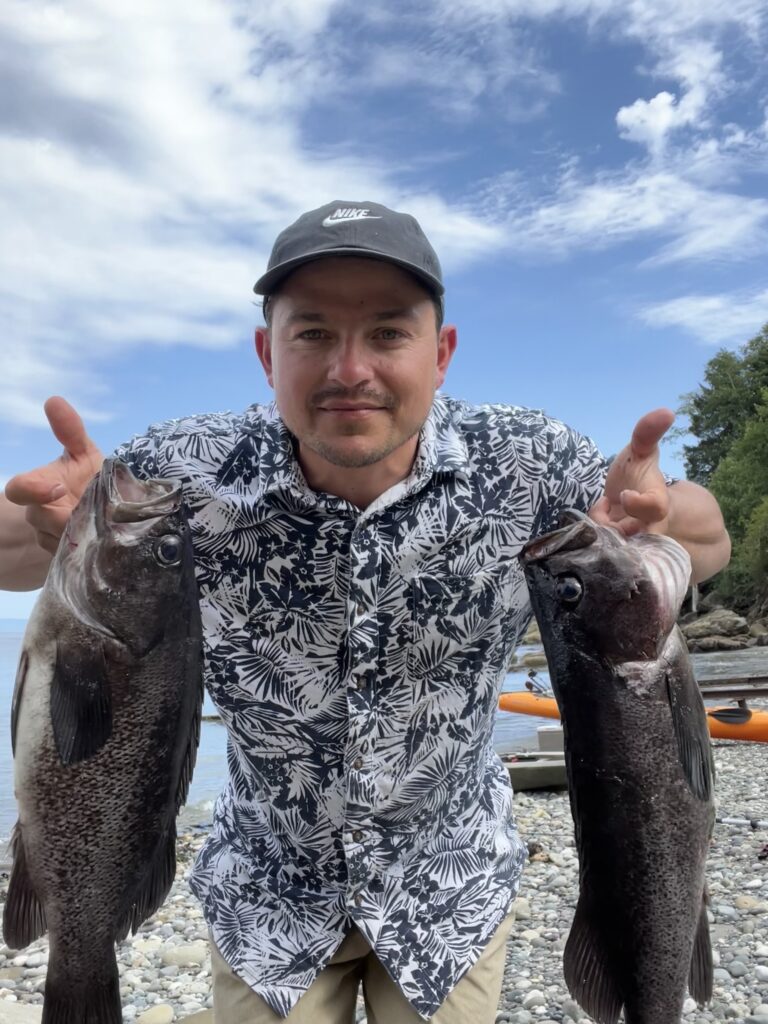
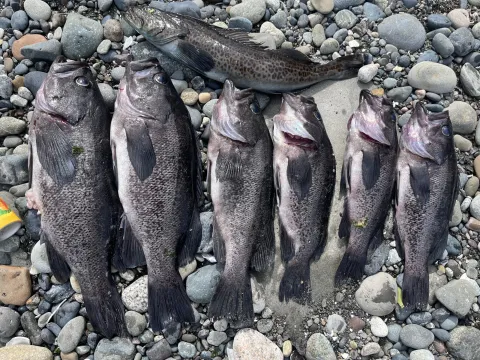
If you’ve fished anywhere off the coast of Washington state, chances are at some point you’ve landed a rockfish, or depending on who you talk to, a black seabass. While rockfish are often seen as only a bonus catch during the pursuit of something larger, like lingcod, they are, in my opinion, some of the best-eating fish that swim along our coastline. The name “Rockfish” is an umbrella term that encompasses over 100 different species of fish, but the ones we most commonly fish for here in the northwest are the canary rockfish, black rockfish, blue rockfish, and deacon rockfish.
Where to fish
Though Rockfish do inhabit the waters of the Puget Sound, it is illegal to retain or target them here due to conservation concerns. As you move northwest into the straights of Juan De Fuca, you’ll find that the populations of rockfish become healthier and fishing opportunity increases the closer you get to the Pacific Ocean. Marine Area 5 (Sekiu) is where allowable rockfish retention begins, though as of 2025, in MA 5, you can only retain 1 rockfish per day. Moving further west to MA 4 (Neah Bay) the possession limit increases to 7 and the season is year-round.
Aside from Neah Bay and Sekiu in Clallam Bay, you can also target rockfish southward along the Washington coast around Westport, Ocean Shores, and Pacific County near the mouth of the Columbia River. Boat fishing Rockfish tend to prefer deeper waters near rocky structures, reefs, kelp beds, or even shipwrecks, which in general makes fishing from shore not a viable option (though there are some exceptions). Fishing from boats, kayaks, or canoes, are generally the most effective method. And because rockfish are such aggressive feeders, it makes them a great species to target when bringing the family along on a boating trip, as these fish aren’t terribly difficult to catch.
Most soft plastic grubs on a 1-3 oz lead jig-head can entice a bite. Use lighter-weight jigs-heads when the current is mild, and heavier jig-heads during strong currents. The amount of sunlight should influence your choice of jig colors. I try to stick with darker color soft plastics during overcast days and brighter colors on sunny days. Flashy metal jigs anywhere from 2-4 oz can prove phenomenal for catching rockfish as well.
My favorite jig as of lately has been a 2.5 oz blue and silver laser minnow, and I seem to catch rockfish on this regardless of weather conditions and current strength. Most of the rockfish you catch will likely be around 2-3 lbs (though they can get much larger), considering this, they are a blast to catch on lightweight gear. However, larger fish like lingcod and cabezon will bite at the same jigs and lures as rockfish, so anglers should be prepared for this potential. I almost always run 25 lb braided mainline with a 20 lb monofilament leader off of a 6-7 ft medium light rod and find this to be a good middle of the road setup.
Jetty fishing
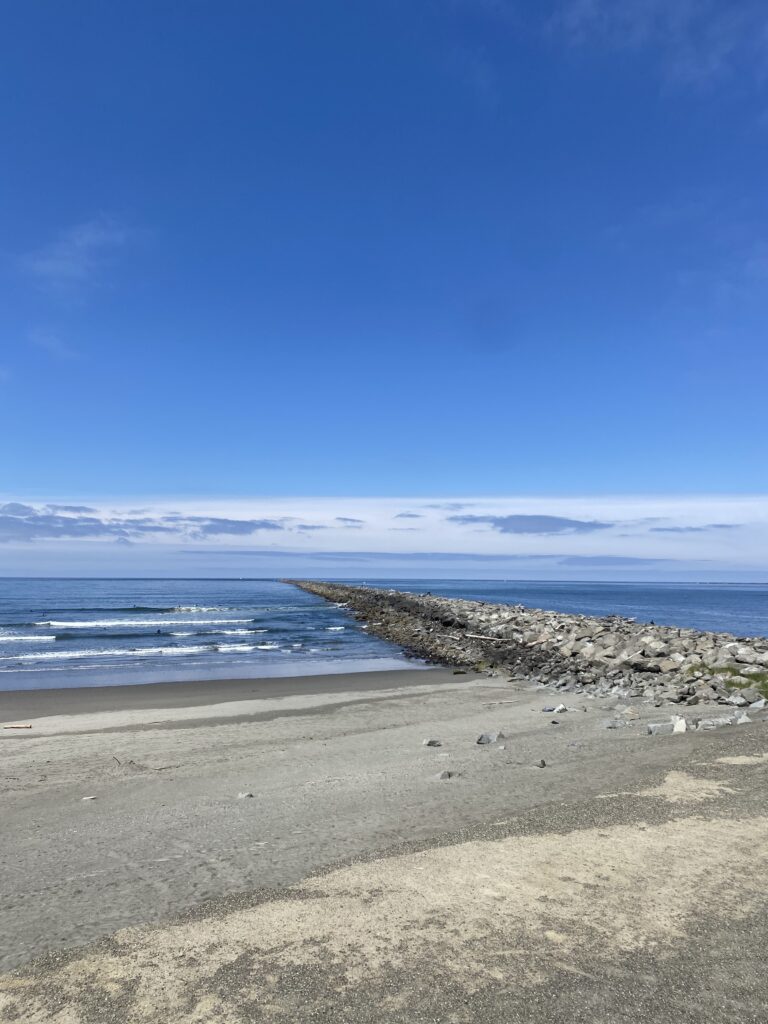
Though boat fishing may be the most effective method for catching rockfish, land dwellers should not fret because there are options for folks who prefer to stay off the water! Jetties or rocky outcroppings that extend into deep water offer ample opportunity for a limit of rockfish. The Westport jetty, the north jetty in Ocean Shores, and the Columbia River north jetty all allow somewhat easy access to this fishery. Furthermore, if you normally fish out of a boat for rockfish, and have had plenty of success over the years, you might find that the process, though fun, can eventually become a bit repetitive.
Jetty fishing offers a welcome change of pace as it provides an altogether different experience and requires different techniques and tackle to land the fish. When fishing from a jetty, netting the fish off the rocks isn’t always an option. This means you will have to lift the fish out of the water with your rod and line. That process can put an excessive amount of strain on your line, thus, jetty anglers should stick with a 25-40 lb mainline and 20-25 lb leader.
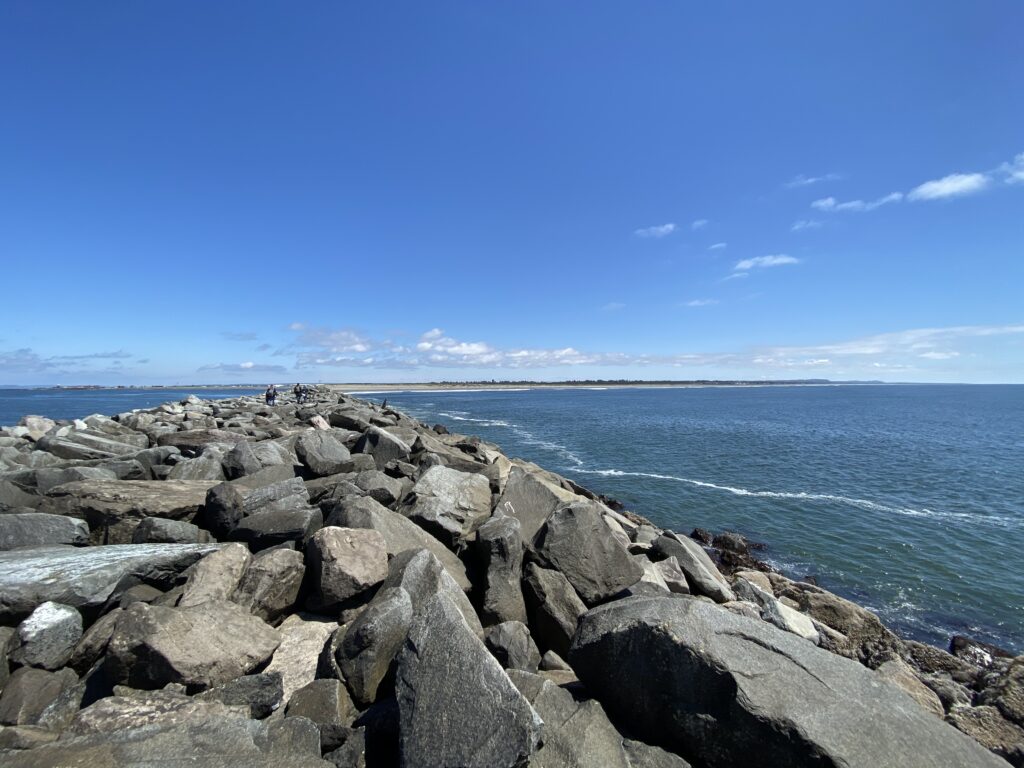
A soft plastic swim bait lure with a weight of 1/2 - 1 oz weight between your mainline and leader will allow your gear to fall deep enough into the water column while also remaining high enough to avoid snagging on the rocks. If you run a soft plastic jig, you can retrieve, jig and repeat. For a swim bait, anglers can find success by either doing a steady retrieve or by doing a steady retrieve with an occasional jig or twitch. Safety is a major concern while fishing on jetties. With this in mind, anglers should monitor weather, tides, and swell activity. During extreme conditions, waves can crash onto the jetties and pose a risk for anyone who’s on the rocks. Refer to NOAA for weather conditions and surf reports for swell and wave activity. Hiking boots, felt-soled boots, or even toe-shoes are favored by jetty anglers for walking around on wet rocks.
The rockfish fishery is a great way to get back out onto the water and get the sun back on your face as we crawl out of our long Pacific Northwest winter. Whether you're launching a kayak at Hobuck beach in Neah Bay, motoring out onto the straights, or climbing around on some rocks at the Westport jetty, there’s nothing better than introducing the upcoming summer season with a cooler full of rockfish and a fish taco dinner at home with the family.
/articles/spring-means-rockfish
Chasing The Elusive Burbot - A Guide To Ice Fishing Techniques
As winter tightens its icy grip on the local northern lakes, a dedicated group of anglers emerges from their homes, braving frigid temperatures and frozen waters. Their prize? The elusive and quite often underrated burbot. This curious freshwater species, often referred to as “poor man's lobster”, is highly prized for its delicate, white meat, and is a staple winter pursuit for many ice anglers.
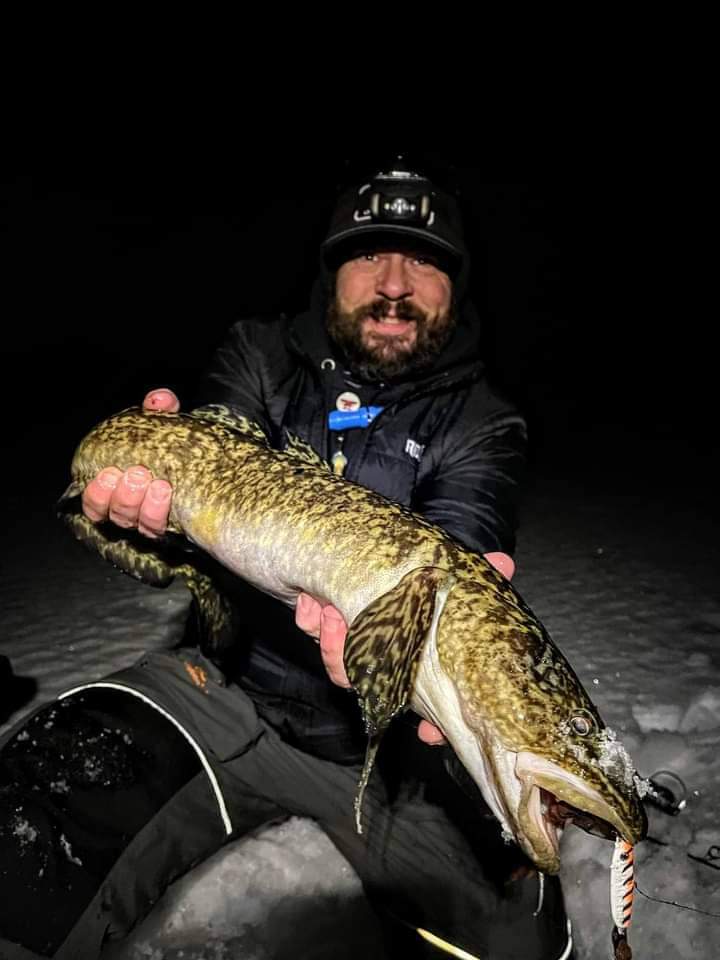
While ice fishing for burbot can be challenging, it is also incredibly rewarding. With their bottom-dwelling tendencies and nocturnal habits, catching burbot requires specialized techniques and a solid understanding of their behavior. In this article, we will explore the best strategies, gear, and tactics to help land this slippery catch beneath the ice.
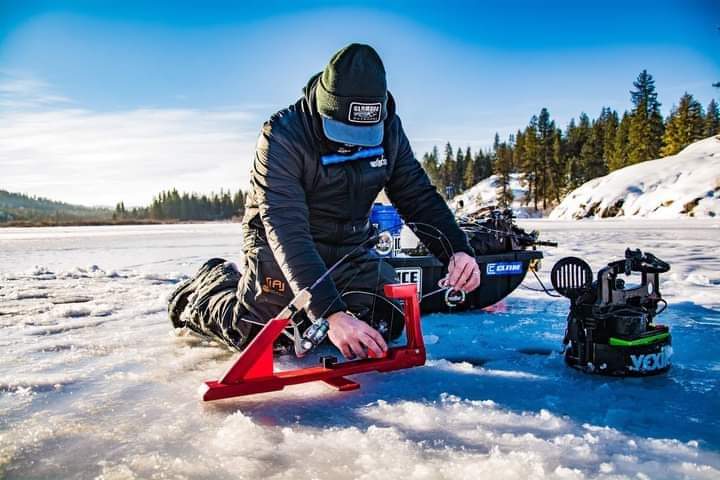
Understanding Burbot: Behavior and Habitat
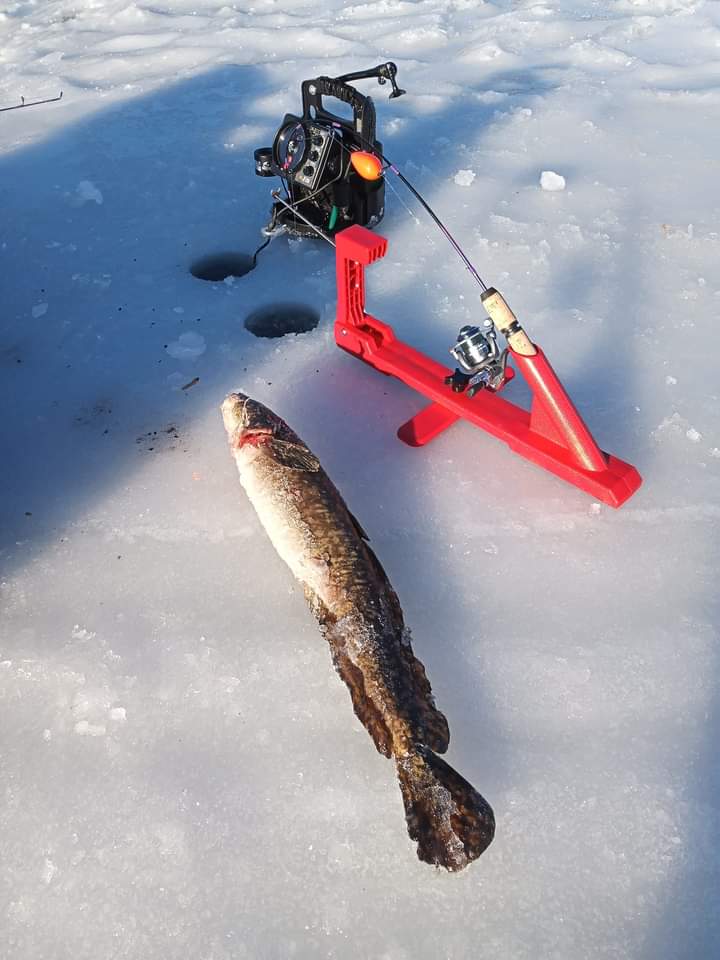
Burbot (LotaLota) is a unique species, the only member of the cod family found in freshwater. They are typically found in cold, deep lakes and rivers across North America. During the winter months, burbot are active as they prepare for their spawning season, making them a prime target for ice fishing. Burbot are known for their nocturnal behavior, being mostly active during the late evening and early morning hours. They prefer to linger near the bottom of lakes, often inhabiting rocky shorelines, deep basins, and steep drop-offs. Understanding these habits is crucial to developing an effective ice-fishing strategy.
One key element to burbot fishing is their winter spawning season, which typically occurs from mid-January to early March. During this time, burbot move into shallow waters, congregating in large numbers over sandy, or gravelly bottoms chasing crawdads. This makes them a little easier to catch and increases the chances of being successful.
Essential Ice Fishing Gear for Burbot
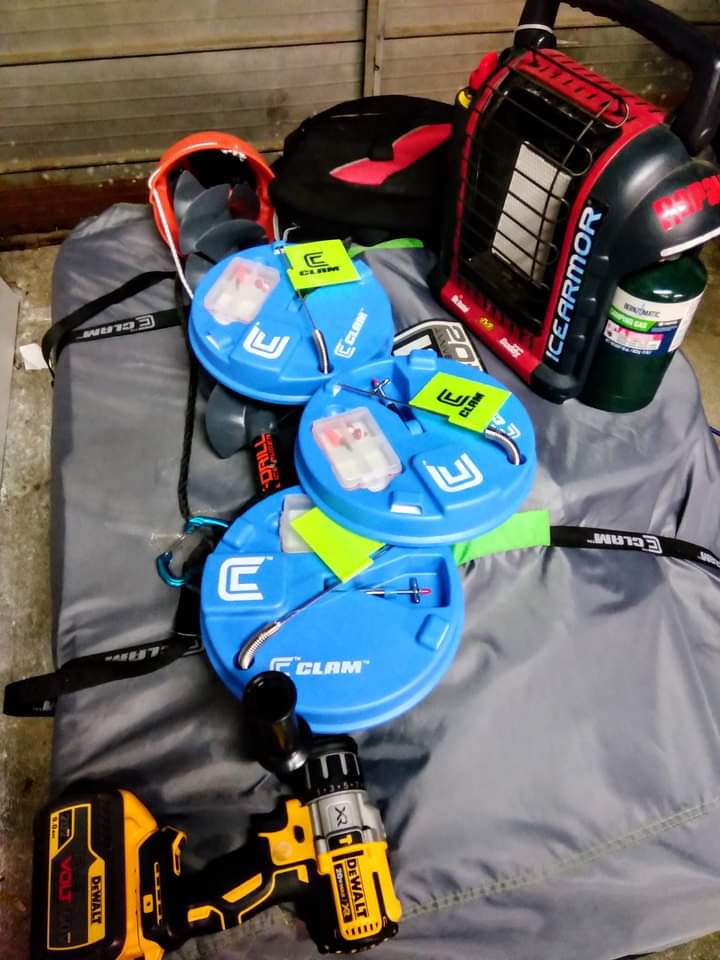
Ice fishing for burbot requires the right gear and equipment. While basic ice fishing gear will suffice, certain adjustments and tools can improve your chances of success. Let's take a closer look at what you will need.
Rods and Reels.
When targeting burbot, a sturdy medium-heavy ice rod paired with a reel capable of handling heavy fish is recommended. Since burbot are bottom dwellers and tend to put up a strong fight once hooked, a rod with good sensitivity and backbone is crucial. A rod in the 28-36 inches in range is ideal, allowing enough flexibility to feel them pick the bait up, but enough strength to handle a large fish.
Line.
Braided line is preferred by many burbot anglers due to its strength and low stretch, which is useful for detecting subtle bites on the bottom. A 10-15lb line is plenty, but braid will freeze in the cold as it absorbs water. Some anglers opt for a lighter line in a clearwater situation, to minimize visibility. Like braids, fluorocarbon has low stretch, helping with hooksets in deep water.
Jigs and Lures.
Burbot are opportunistic feeders, and their diet consists mainly of smaller fish, invertebrates, and of course, crawfish. Therefore, using a variety of baited jigs and spoons is a proven strategy. Glow-in-the-dark lures are especially effective, as burbot are often most active in low-light conditions.
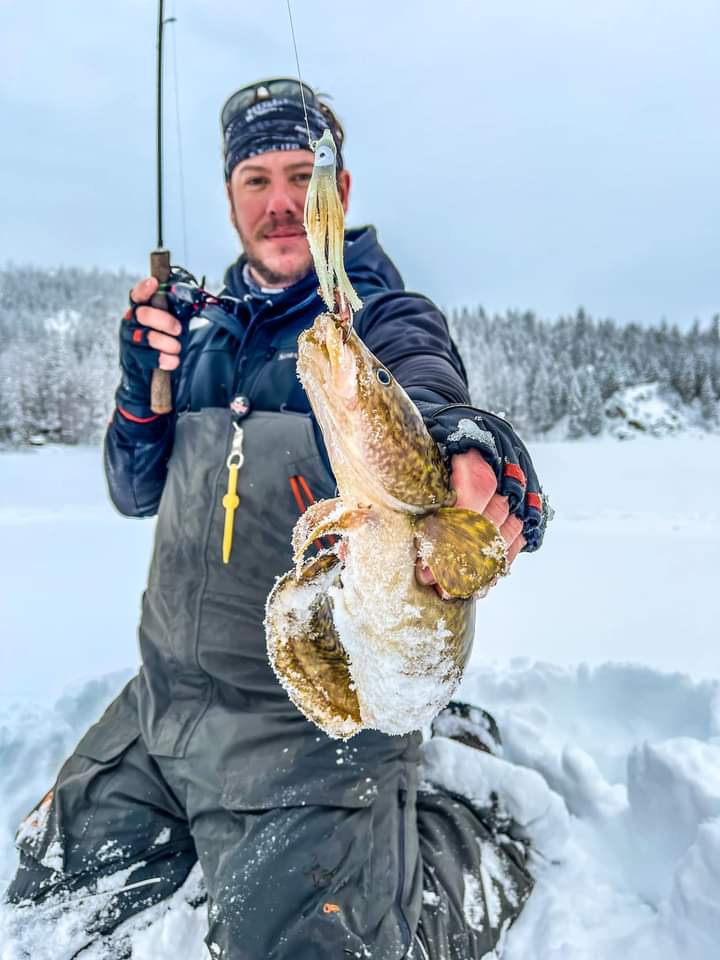
Some popular jigging lures for burbot include:
- Glow Jigs and Spoons: These lures provide maximum visibility in the dark, deep waters where burbot often reside. Tip them with cut bait, or a curly tail grub, and pound the bottom.
- Bucktail Jigs: Heavy Bucktail jigs, especially those with glow can mimic small baitfish, drawing the burbot's attention. Or the material of the jig holding a scent longer if used.
- Blade Baits: These produce vibrations that catch the attention of the burbot in deeper water where sound travels more effectively, typically tipped with cut bait.
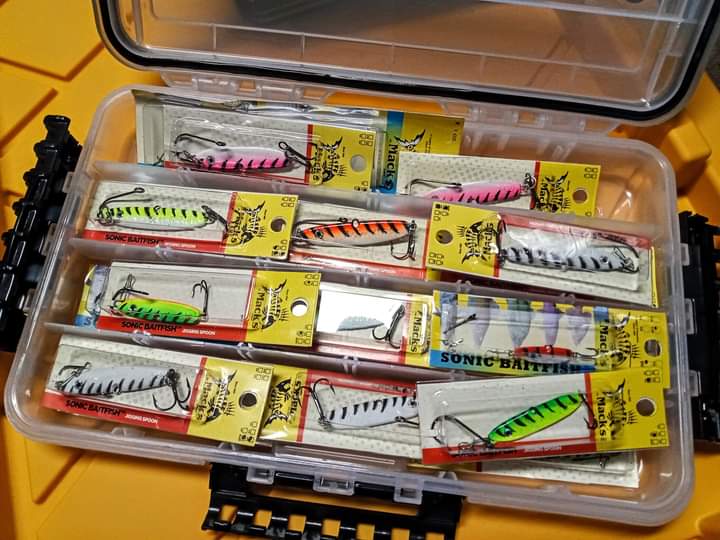
- Mack's Lure, Sonic Baitfish: My favorite burbot lure is the Sonic Baitfish from Mack's Lures. Glow finish tipped with my favorite cut bait is dynamite. The lure itself is so versatile in shallow and deep water.
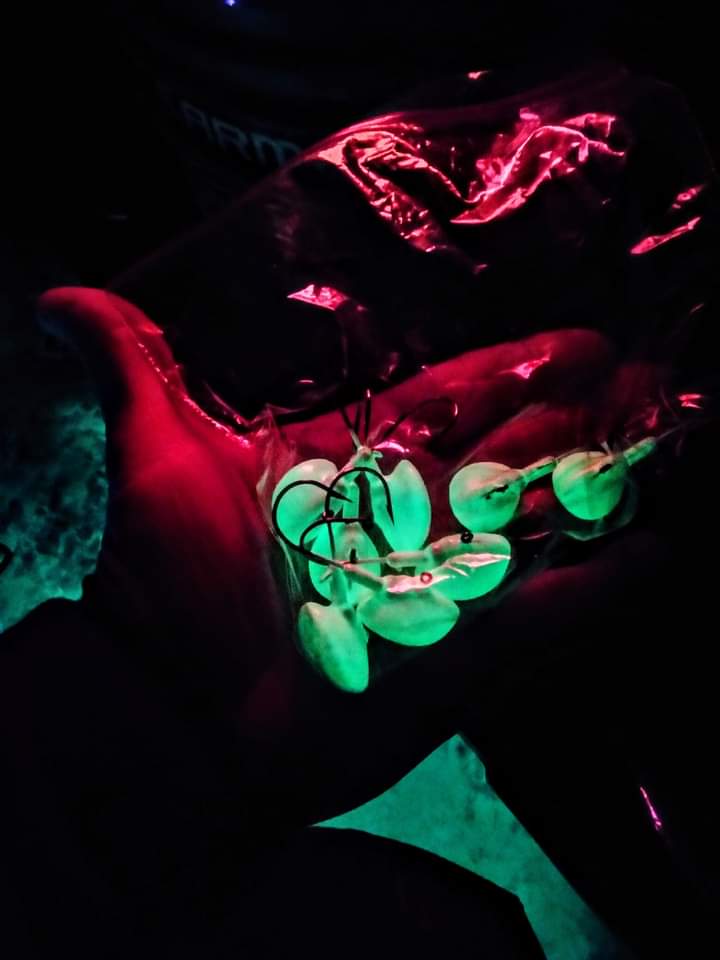
Bait:
While artificial lures are useful, tipping your presentation with natural bait is essential for burbot fishing. Cutbait such as store-bought smelt, or herring work, I recommend using fresh cut bait from the body of water with your fishing if state law approves. In the lakes we fish, we use many baits from the lakes themselves such as chubs, bluegill, crawfish, etc. The natural scent of the bait and the appeal of your jig will help entice burbot lurking on the bottom.
Key Spots to Target Burbot:
- -Rocky Structure: Burbot love rocky bottoms, especially areas with boulders surrounded by large areas of cobblestone-sized rocks. This is where they are constantly feeding and chasing the crawdads.
- -Deep Basins and Deep Drop-offs: These fish often patrol deep basins and steep underwater drop-offs, looking for food. Check your depth maps and focus on areas where the depth changes rapidly near the rocky flats.
- -Mouths of Rivers and Streams: Burbot are often found at the mouths of rivers or inlets, such as streams or creeks that dump into many lakes. This is where they can hunt small fish moving in and out of the main system, with a flow of fresh cool water to lay in.
Drilling multiple holes in different locations, along the structure, to drop-offs. I like to start deep during the day and drill holes shallower as the day begins to fade away. As it gets dark, the burbot tends to follow the crawfish to shallow waters. Using a sonar or flasher will help you detect burbot holding on the bottom and adjust your presentation accordingly.
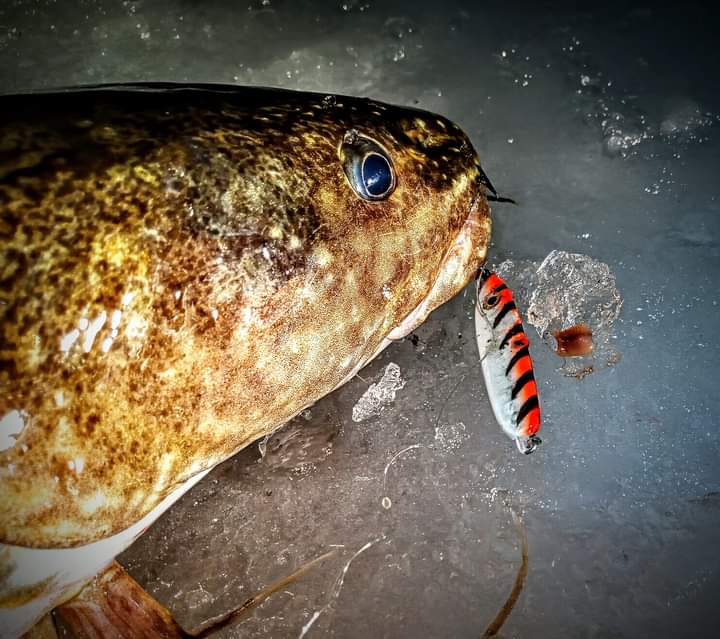
Burbot Ice Fishing Techniques
- 1. Dead sticking - One of the most effective ways to catch burbot is dead sticking. This involves dropping a baited spoon or jig to the bottom, giving it minimal movement, and letting it sit still. Burbot being scavengers are attracted to the scent of bait and will often bite without hesitation. Periodically lift the rod tip to create small movements to trigger a bite. Dead sticking is great for the lakes that allow a two-pole endorsement, as you can get the best of both worlds.
- 2. Active Jigging - While dead sticking works well, actively jigging a two-pole endorsement does just as well.
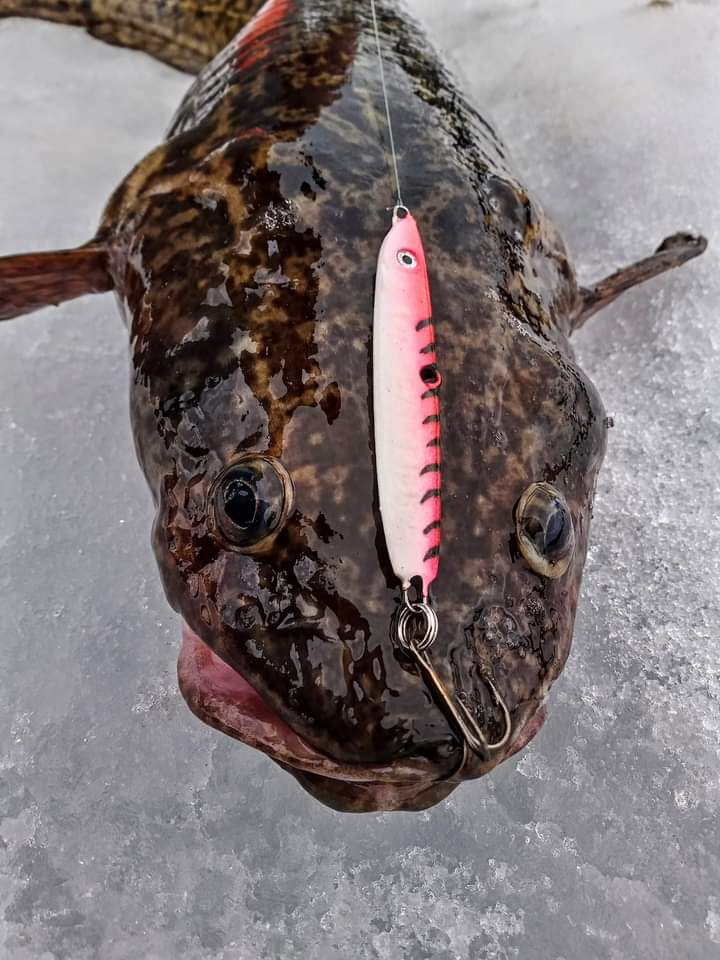
Conservation and Ethical Considerations
When targeting burbot, it's important to understand and practice ethical fishing and conservation techniques. While burbot populations are generally healthy, overfishing during the spawning season can harm local populations. Check your regs for and rules or regs on the lakes you're planning on fishing, most local lakes have the same regs. Practicing catch and release on the larger, breeding fish can help sustainable fishery for future generations.
Ice fishing for burbot may not be as popular or glamorous as chasing other winter species like lake trout, pike, walleye, or big trout, but it offers a unique and rewarding challenge. By understanding the behavior and patterns of these nocturnal fish, using the right gear, and applying proven techniques, you can increase your chance for success. Whether you're dead sticking with a baited hook, actively jigging at night, or setting a minefield of tip-ups over a rock flat, chasing burbot under the ice can be an exciting and fulfilling adventure this winter.
So grab your gear, bundle up, and head out to the frozen lakes in pursuit of these bottom-dwelling predators. You may just find yourself hooked on fishing for the “poor man's lobster.”
/articles/chasing-elusive-burbot-guide-ice-fishing-techniques
Silver Salmon River Lockjaw Strategies
Standing at the river's edge and surveying the waters, a loud splash disrupted the silence of the day. Coho or silver salmon are known to roll and jump often, and this gives away their location. This fish was in heavy cover where downed logs had created a log jam and there was no way to get to it without risking gear being lost to the sunken trees. But it meant that fish were in the river and that was good enough to load the tackle into the drift boat and launch for a day of searching for more coho.
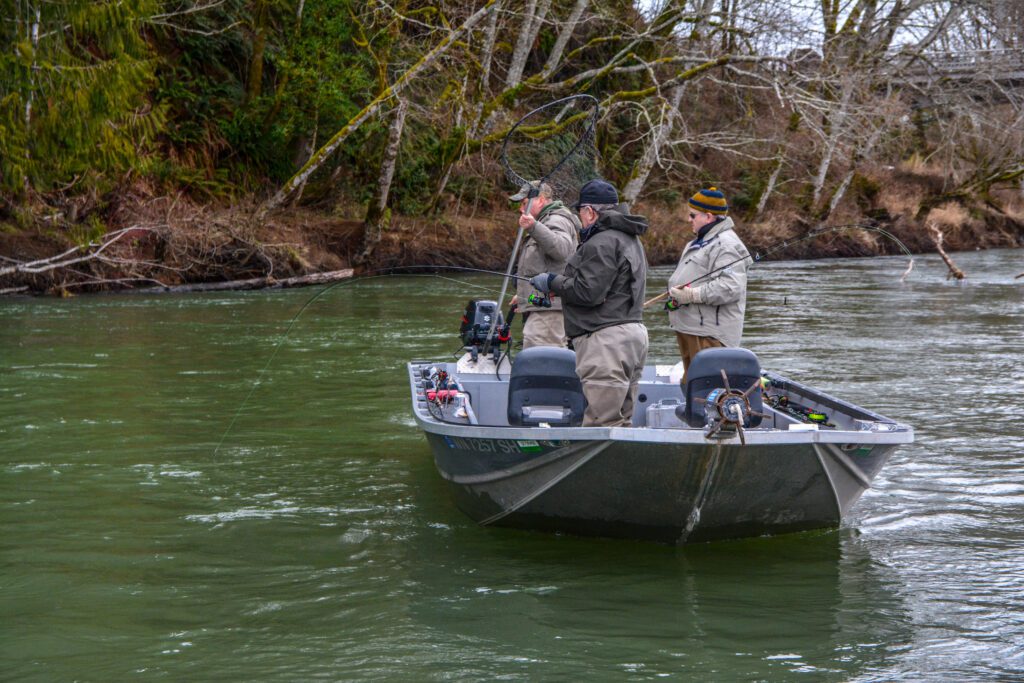
Rowing down the river, which was calm and quiet, we came to a large back slough. The water here was stacked up from the previous winter's floods that cut the side channel deep but now the water was shallow at the outfall creating a lake of sorts. This is known as “frog water” and coho prefer to sit here and rest until they regain energy to continue upriver. With a lot of fish holding in the stagnant waters, one would think these fish are easy to catch but anglers often forget that these are resting fish and that means they are lazy and often lockjaw.
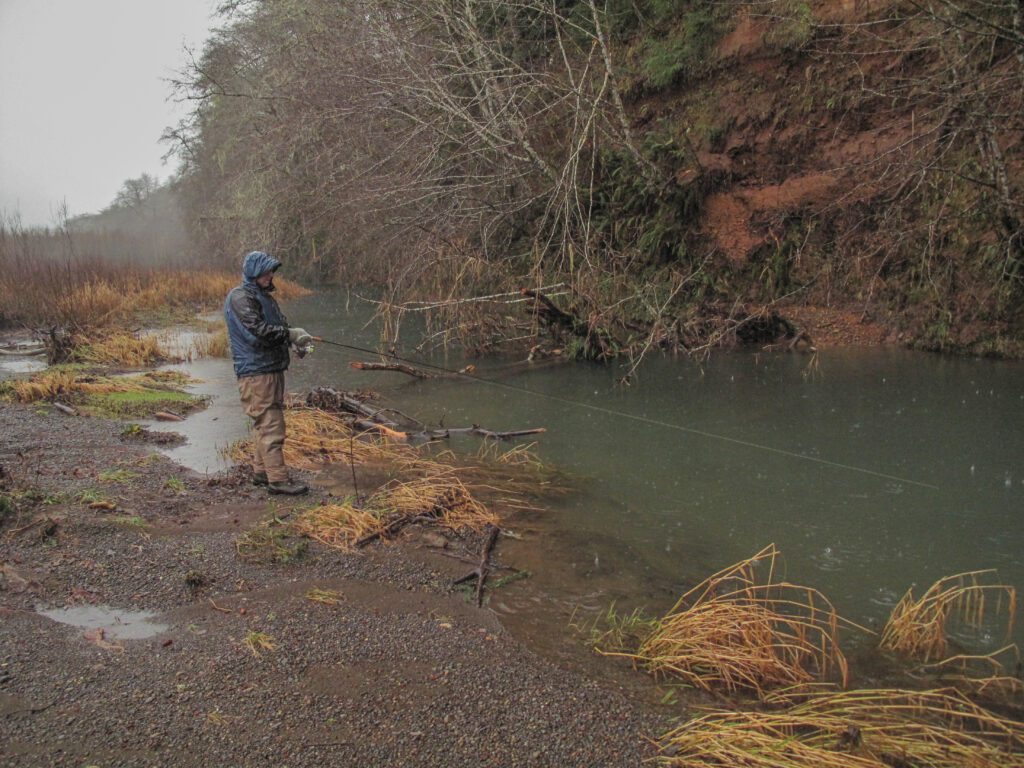
The term “lockjaw” means salmon unwilling to bite. Unfortunately, when anglers come upon a dozen or more fish that are lockjaw the temptation to snag becomes overwhelming. Not only is this illegal but also it hurts the runs of coho because these are resting fish and when snagged they exert energy they are trying to use to head upriver and spawn. When a fish becomes too tired to move it simply dies because water needs to flow through the gills and if the fish cannot move and it is released into slow or stagnant water it will suffocate and die.
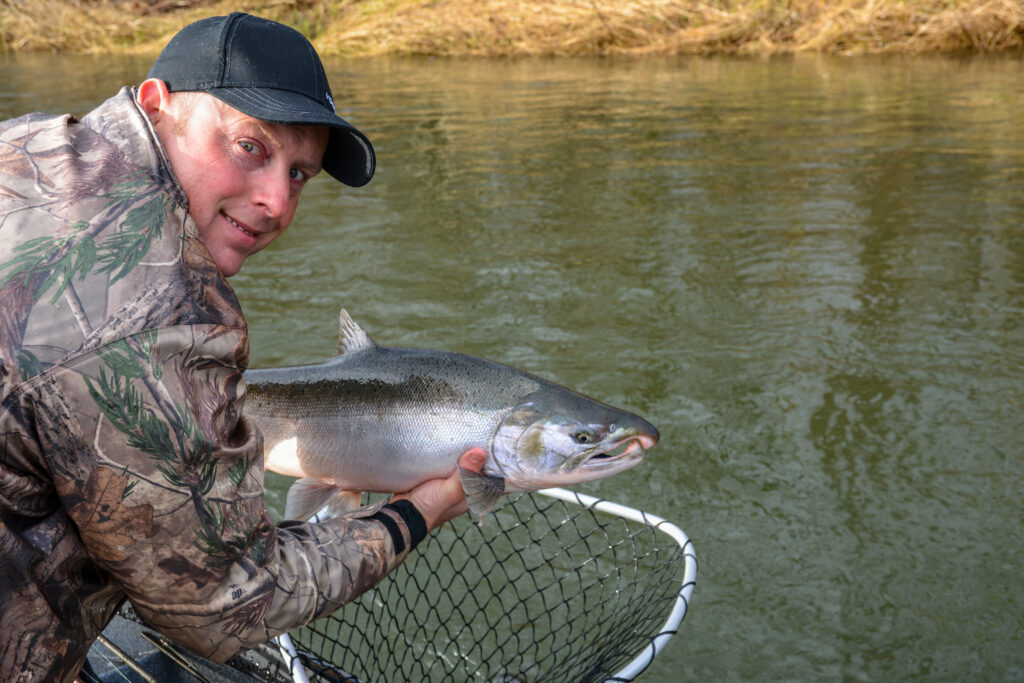
So, how do you get fish to bite when they are all lockjawed? The answer is simple and that is to find fish that are not lockjawed. Seems silly to say that but it is true, you will not get a lockjawed silver to bite. This does not mean giving up fishing for the day but instead knowing that there are biting fish, or a bite might turn on throughout the day. Back to the stagnant waters of the slough.
These fish are resting but that also means they will get their energy back and will bite. If you have ever thrown a spinner or twitched a jig in this water when it is clear enough to see the fish, then you will notice a fish or two out of the school will start to give chase. These are fish that are done resting and have energy and are just waiting for the right conditions.
The right conditions can be anything from enough time to recover to a shot of rain bringing up the river just enough to make it easier for them to migrate. Anglers often head to the river early to get the “early morning bite” but what is really happening is the water has cooled off from a brisk fall night and the fish are more active. As the day heats up the water also warms, and this means less dissolved oxygen and therefore tired salmon. One way to beat the lockjaw is to fish on cool days, after it rains, or early in the day.
Sometimes, our schedules do not line up with the perfect conditions and anglers can only hit a river when the conditions are all wrong for active fish. You can still beat the lockjawed effect by looking for parts of the river where the fish are active. For coho this can be a deep hole where the water is cooler, and boulders churn the flowing water creating dissolved oxygen. Same with riffles and holding areas in the shade. One hot fall day we were floating a coastal river and working on our sunburns when we came across a long stretch of water.
The current was moderate, and the bank had overhanging trees. Peering into the shadows we saw coho stacked up in the shade, swaying their tails in the current and we thought they were just resting. Tossing a jig and a few quick twitches later a fish slammed it hard and erupted out of the water. These were not lockjawed fish but ones that were just staying out of the bright sun and being protected by the overhanging branches. They were also not in “frog water” but instead in a moderate current where they could sit and let the water run through their gills.
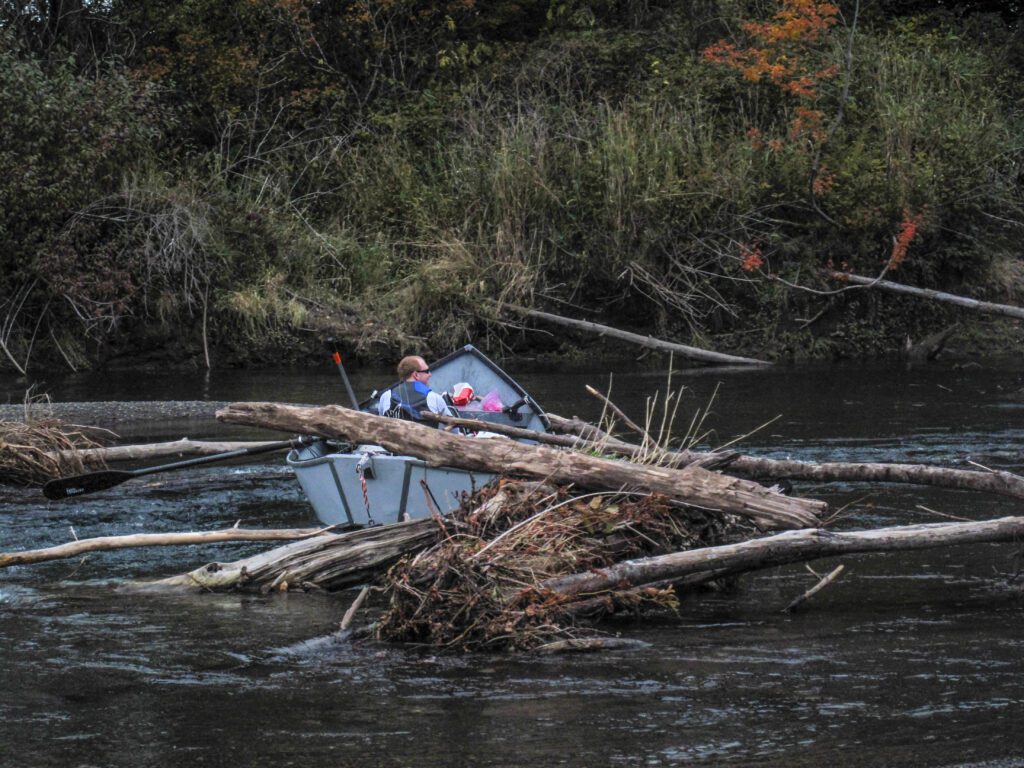
Log jams are notorious places for coho and for eating gear. It is the hardest place of all to catch salmon. Look for deep holes often created by the log jams and watch the fish, or when you see the splashing and rolling as this often means fish are active. A tired fish will sit and rest, but an active fish will be splashing and rolling as it uses energy to do this. Why salmon do this is still unknown with several theories but one thing that is known is that fish that are active are not lockjawed.
Be careful parking the boat over a log jam in current but if you find one that is in a soft part of the river then you can oftentimes move the boat over and tie up to the log jam. The key here is to let the hole rest because it is likely the fish moved out once you put the boat over them. Coho like log jams because it is covered and they feel safe from predators here; the boat will become part of that cover once the commotion stops. Several times we have looked over the edge of the boat and seen coho underneath, sitting there just like they do in other cover.
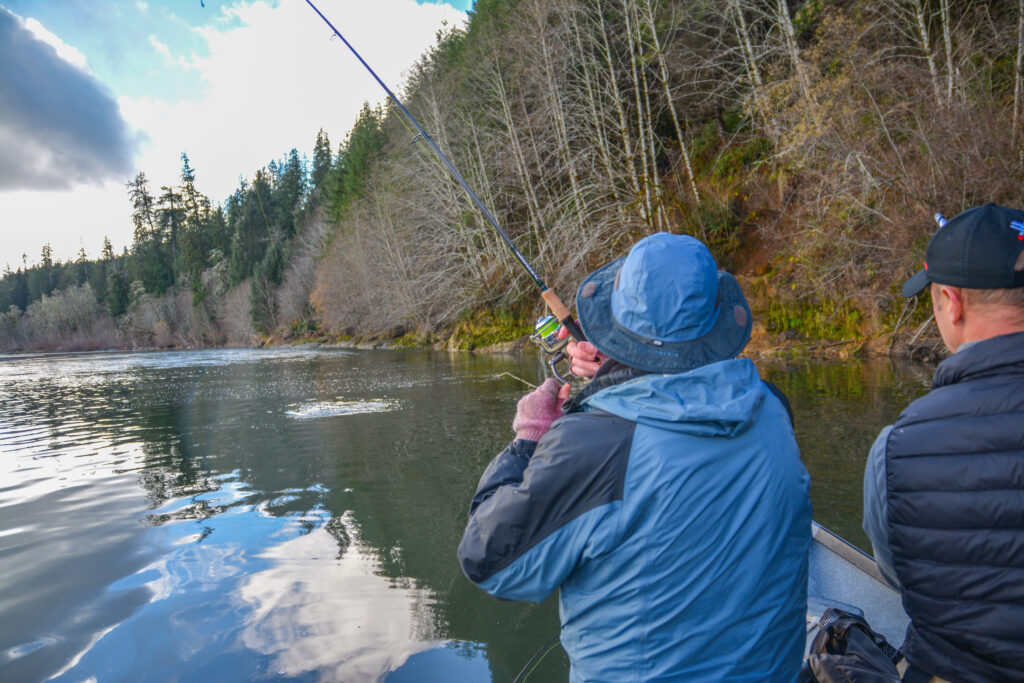
Techniques vary and sometimes you can get a “lockjawed” silver to bite–though the fish was just resting and is now recovered-by using a bait that it simply cannot resist. Such techniques are often the presentation of bait like cured eggs. If you have ever hoverfished, then you have caught resting fish using eggs. This technique which is extremely popular in the Columbia River Gorge is done at tributary mouths where the colder water from the tributary is dumping into the warmer Columbia. The fish will stack up here to rejuvenate in the cooler water and the bite is often very subtle. Floating eggs under a bobber is a top technique to get resting coho to bite. Back to the frog water slough, it is best to float fish it first and see if there are any resting but willing biters in there.
Twitching jigs and swinging spoons or spinners are for active fish. Use these techniques where fish that are more active, such as in runs, riffles, and deep holes. Yes, they also work in stagnant waters but again you will notice that out of the entire school of fish, only a few will chase down the lures. This means having patience and knowing that the fish will eventually get their strength back and bite.

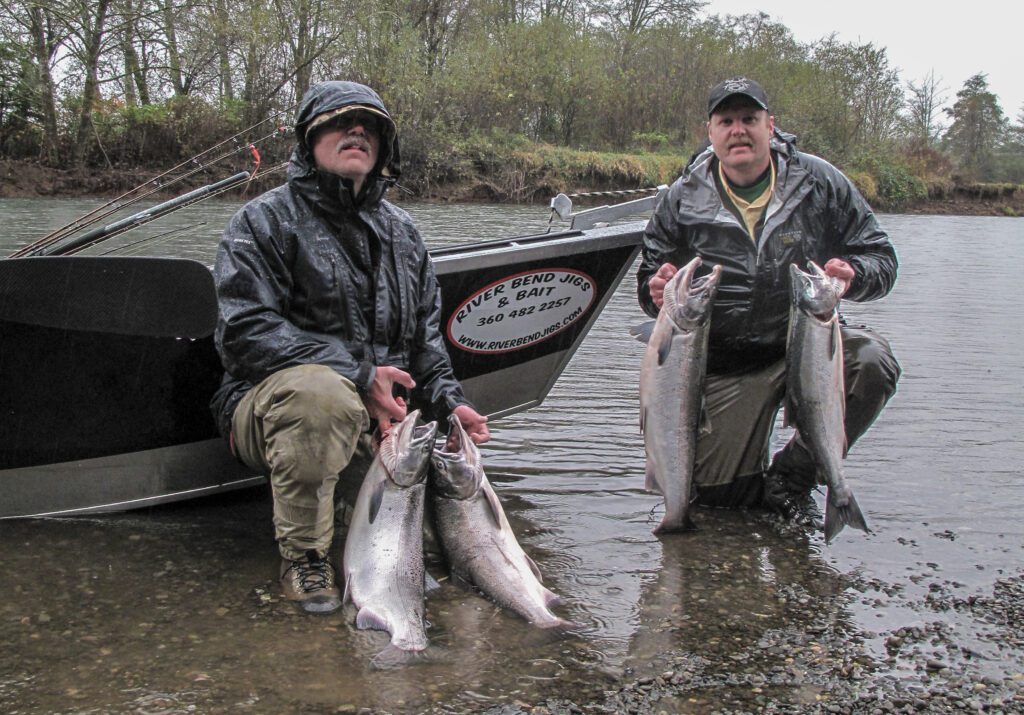
Same with moving fish, be ready for a long lull in action and then all a sudden the “bite” is on. It is likely fish moved upriver and to your location. One cold November day we were fishing the Satsop River and anchored by a small back eddy along a cut bank. We stayed there all day long twitching jigs and occasionally, a pod of coho would make their way upriver. This was announced by one of us hooking a fish and then it would be “on” for a few minutes with everyone catching a fish or two and then the coho simply moved on.
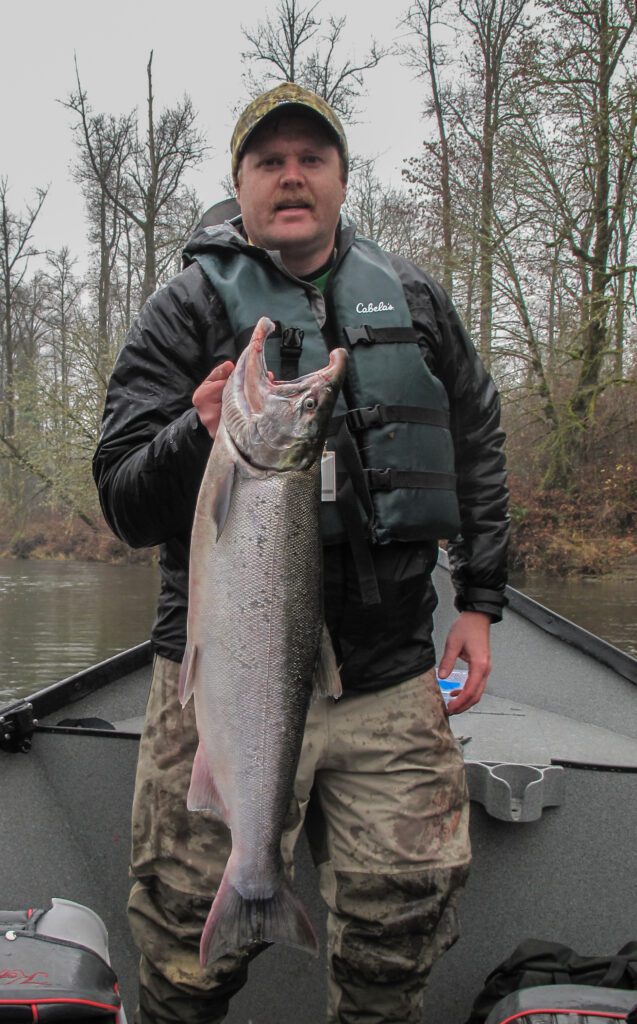
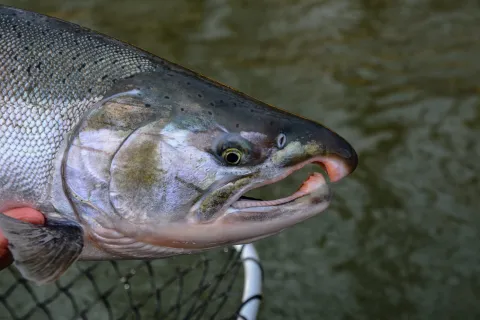
Lockjawed coho are hard to catch and the best way to catch them is to look for fish that are willing to bite. Knowing when they are lockjawed and not harassing them is the best technique you can do to catch more fish. Find willing biters and leave the tired fish alone. Wasting time on them only hurts the run and will cause you to become frustrated. When you make your way to the edge of the quiet river, pause and look around, listening for the splash of a coho. These are the fish you can catch.
/articles/silver-salmon-river-lockjaw-strategies
Drop-shot Technique for Bass
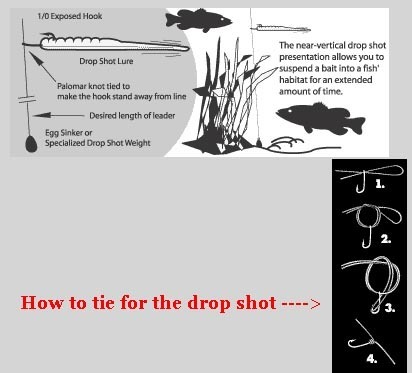
I am no expert by any stretch of the imagination, but I have grown fond of the Drop Shot technique in my short, four-season fishing journey. I have been using it for just over a season’s time. This is a very productive method to catch fish in a variety of states. In my first outing for smallies this season, I hooked and caught 3 smallies on three consecutive casts. It is the only method that has done this for me to date, and from the shore to boot. At the very least, I can share with you what I have learned through trial, error, and experience (which isn't much).
You don't need a Drop Shot specific rod. A medium-light to medium-action rod from 6'6" on up to 7' should work for you for now. If you find drop shotting to your liking, you can then opt to go with a Drop Shot specific rod of your choice. As a rule of thumb, a longer rod will enable you to have more line control and leverage; two big pluses in drop shotting.
I prefer spinning reels (a size 20 or 2500 reel is an excellent choice) because they require less work to give the bait a better (IMHO) descent than a baitcast reel. Sorry baitcast reel users, but the way a spinning drops the bait smokes a baitcast reel any and every day for drop shotting. To those who use baitcast reels exclusively, please note I said for drop shotting. There will not be a need to strip line off just to make the bait fall. With that said, casting reels can also be used. I just prefer a spinning reel. You may use whatever reel you want. Even a Barbie pole can get it done for drop shotting! However, I would opt for heavier line and a BC reel if I were to drop shot heavy cover.
Drop Shot Weight and Type
A 3/16 - 1/4 oz weight is a good starting weight. Going any lighter might make it harder for you to read what is going on until you get experience. As for the shape, I like to use either a teardrop or a cylindrical shape. I have not experimented with other shapes. Windier conditions and stronger currents might make you want to choose a heavier weight, but let’s not worry about that for now.
Line
Because you are drop shotting, lighter line is preferred if the cover you are fishing allows it. Go up in # strength if the cover dictates this. I like and use 6# fluorocarbon, particularly Seaguar's Invizx. This line kicks fanny. No doubt about it. The plus in going with fluorocarbon in a higher # test if needed is despite having a slightly thicker line diameter; the angler retains the benefit of fluorocarbon’s trait of near invisibility as advertisers so claim. Whichever line you choose, I think the fluorocarbon line of your choice will be fine.
Baits
Keep an open mind here. Many baits of a variety of shapes can be used. The general rule of thumb is a tendency to use smaller baits since we are "finesse" fishing (translates to downsizing in general). The typical length of a drop shot bait usually ranges from 3" - 4.5" but this is NOT set in stone. Roboworm, Senkos, Sniper Snubs and Bolts (these two are locally made baits), Reaction Innovations Flirts, and heck, even Baby Brush Hogs and Tubes can be used. Think out of the box. I have used longer worms too. This season, the 4.5” Roboworm (in Aaron’s Magic) and Sniper Snubs in Watermelon and Dark Brown have been so effective that to date I have not seen a need to try something else or other colors. It might be different for bass in other waters. If you wish to know, so far the most effective baits for me have been, the snubs and roboworms.
Hooks/Knot
I prefer to use size 1 or 2 (mostly size 2) Gamakatsu Split Shot/Drop Shot hooks, or Owner Mosquito hooks. I attach the hook to the line with a Palomar knot and after it is tied, I insert the extra line (tag end) through the hook's eye before attaching the weight. I have heard good things about size 4 Gamakatsu hooks, but I have not yet had a chance to try them yet.
Leader Length (Distance from the hook to the weight)
The best way to figure this out is to experiment. I have had success with leaders being as short 4-6" to nearly but not quite 2'. Because drop shotting is not limited to a purely vertical presentation, a longer leader is a good idea if you wish to work it somewhat like a Texas or Carolina rig. The longer leader length (which I define here as the distance between the weight and your hook, perhaps 18" as a ballpark figure) will enable you to keep the bait off the ground with the shallow angle that will result from a long cast. For a more vertical presentation, a shorter distance from the hook to the bait can work.
Imparting Life to the Lure
Despite the initial perception of working this lure, it is not all about jiggling and wiggling the bait. An angler can indeed work the bait this way, but I can tell you from personal experience, that wiggling and jiggling has accounted for the fewest number of catches.
So what should one do in addition to the wiggling/jiggling tactic?
Keep the weight on the bottom for the most part and leave enough slack to let the bait sink on its own weight. Then, when you think the bait is near the bottom lift/twitch the rod just enough to move the bait a little (without moving or minimizing the movement of the weight on the bottom) and repeat. In effect, what you are doing is working a semi-slack line and this is what is imparting action to the bait. No hits? Repeat if you wish, or add a little dead sticking to the mix or, drag your bait to the next spot. All are good choices. The dragging of the weight from one spot to the next also imparts life and action to the lure and can help to draw a strike. In addition, working with the slack and dead sticking have been far more effective for me compared to wiggling and jiggling the bait to death
Not sure what the bait will do? Find some shallow water and drop down your bait. The depth should be one where you can see all the way to the bottom. Once the weight is on the bottom, let your bait fall by lowering your rod. Before the lure hits the bottom, raise the rod’s tip enough to bring the lure up, and do your best to keep the weight in place. Watching this will give you an idea of what will likely be happening when you are not able to see the bait with your own eyes. Visualizing what the bait is doing when I can’t see it helps me to focus on what I am trying to do, and that is catching fish.
The Strike or Hit
This can vary depending on the activity level of the fish, the quality of your set up to a certain extent, and the line you are using. More sensitive rods do a better job of transmitting what is going on to you. I have had the blessing of drop shotting with my Berkley Cherrywood Rod, which is decent and not too shabby, but comparing it to my Lamiglas Certified Pro Drop Shot rod is something else. Here is my analogy. If the Cherrywood provides stereo sound to me while watching a DVD movie, the Lamiglas gives me the sound in THX, for the full cinema experience. The latter rod is not necessary to enjoy drop shotting, but it makes it a lot easier to feel and detect the subtle strikes.
The line you use also can influence the feel of the strike. My experience working with both mono and fluorocarbon is that the latter always seemed to give me a better picture. We all know now that although FC line can have as much or more stretch than a comparable monofilament line, it is likely that its density still enables it to beautifully transmit information from the end of our line, to the rod and to our hands.
The hit or strike can feel like:
1) A mushy tug or tick, which could translate to a complete inhalation of your bait or the fish attacking the lure from the hook's side.
2) A nibble or nibbling, that transmits vibrations through the line to you. Sometimes you can see or feel the line vibrate through your semi-slack line. More sensitive rods tell you this much better and more clearly. I believe when the hit is like this (my best guess anyway as I visualize the strike), it is possible that the fish might have taken the lure from the side opposite the hook and the nibbling/vibrations you feel is the fish taking in the bait into its mouth, eventually getting to the hook.
3) Bam! It's on!
The Hook Set
For one and three, just reeling up the slack and adding enough tension to make the line taught is sufficient for most cases to drive the light wire hook home. For case two, you have to wait until the fish gets to the hook and then do as mentioned above. If you don't, you will pull the lure from the fish's mouth. Since it didn't get to the hook, there is no way the fish can get hooked.
I have written this based on the experience I gained from drop shotting. Take it for what it’s worth, an opinion at best. I will close by giving you a final warning:
WARNING: Drop Shotting is as addictive as it is effective.
Good luck and go get’em!
/articles/drop-shot-technique-bass
How to Catch a Cone Licker
Fishing Lake of the Woods in Southern Oregon
You know what a cone licker is. You see them in places like Seaside and on the sand at Diamond Lake and they have cone lickers at Lake of the Woods in southern Oregon too. These are the poor folks whose mommas and papas never taught them how to fish. They like to go to the lake too, and they are the ones who, if you bump into them on their floaties, ask "Didja catch anything?" Or, "What kind of fish are in this lake?" It's not a sin to be a cone licker. It wasn't their fault they were born in Sacramento.
There's another kind of cone licker. They are the big trout that eat a steady diet of midge larvae and are particularly susceptible to a pattern called the Ice Cream Cone.
Lake of the Woods is a classic fishing lodge destination for the whole family. It's got something for everybody - a well-stocked marina store with boats and paddleboards to rent, a gift shop, cabins to rent, campgrounds, a great restaurant with a view of the lake, and a bar on the second floor with even better views.
I set up the tent in the back of the F-150, a roomy two-man tent from Napier ( napieroutdoors.com ), specially made to the Ford's dimensions. Then I went down to the lakeside to look at the boat I had rented for the morning.
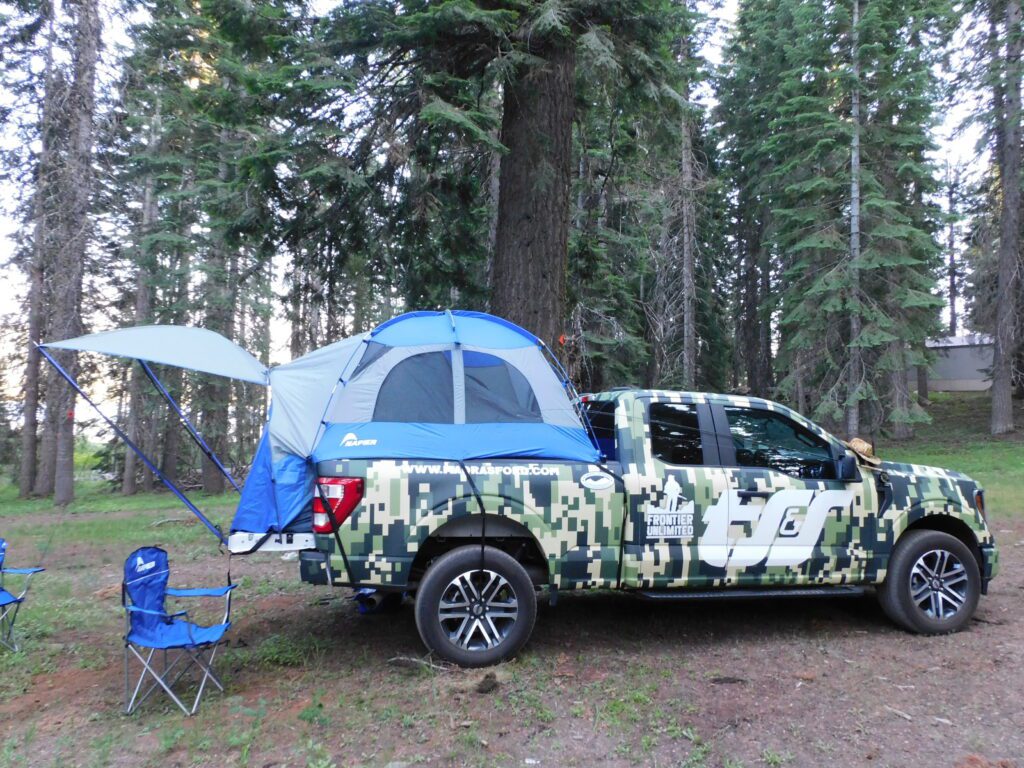
I knew exactly where I was headed, remembering it from the last time I had fished Lake of the Woods, which was too long ago. We were going to still-fish, having brought spinning rods and fly rods and a selection of jar baits and chironomids.
Soaking in the vacation vibe at Lake of the Woods, I could not help but smile. A lot of people are looking for exactly this kind of American experience. They just don't know where to find it.
FISHING CHIRONOMIDS
Set up the rod with a tapered leader down to 4X tippet. Affix a Thingamabob indicator well up the line and tie on a No. 8-10 Ice Cream Cone chironomid pattern. With another 12 to 18 inches of tippet add a second Ice Cream Cone tied off the bend of top fly.
Casting a two-fly rig is not an art form. The main thing is to put the flies at the depth of the feeders, keep slack out of the line, and watch for the indicator to indicate. The fun thing about this type of fishing is that some of the biggest fish move the indicator the least. Keep the rod tip low, touching the surface of the water, and be ready to set the hook. Like a rattlesnake.
Finding the feeders is the main thing with fishing chironomids. One trick is to drive the boat over the place you will fish then with a hemostat clamped to the bottom hook, gauge the depth of the water. Then adjust the float so that it puts the bottom fly something like 18 inches off the bottom. That puts the top fly 36 inches off the bottom. Pay attention to which bug gets bit the most and reset the rods accordingly.
You might have heard of the big bait-big fish principle. That doesn't apply to midge larvae. Big trout eat a whole of a lot of these tiny things.
WHERE TO ANCHOR UP FOR TROUT
A large mountain Stillwater in a forested setting, Lake of the Woods is fed by several creeks but gets the majority of its water from groundwater seepage. The deepest water is found along the western shore where the depth is reported as 50 to 55 feet. There is a good mix of shallows where weeds and bugs grow and colder water deeps and rocky ledges, which makes for interesting fishing.
The resort is situated on the eastern side of the lake on the north shore of Rainbow Bay.
One of the best spots for trout is just outside of the marina. Anchor up anywhere within 100 to 150 yards of the marina and within casting distance of either the east shore or the west shore. Anywhere out in front of the marina can hold trout.
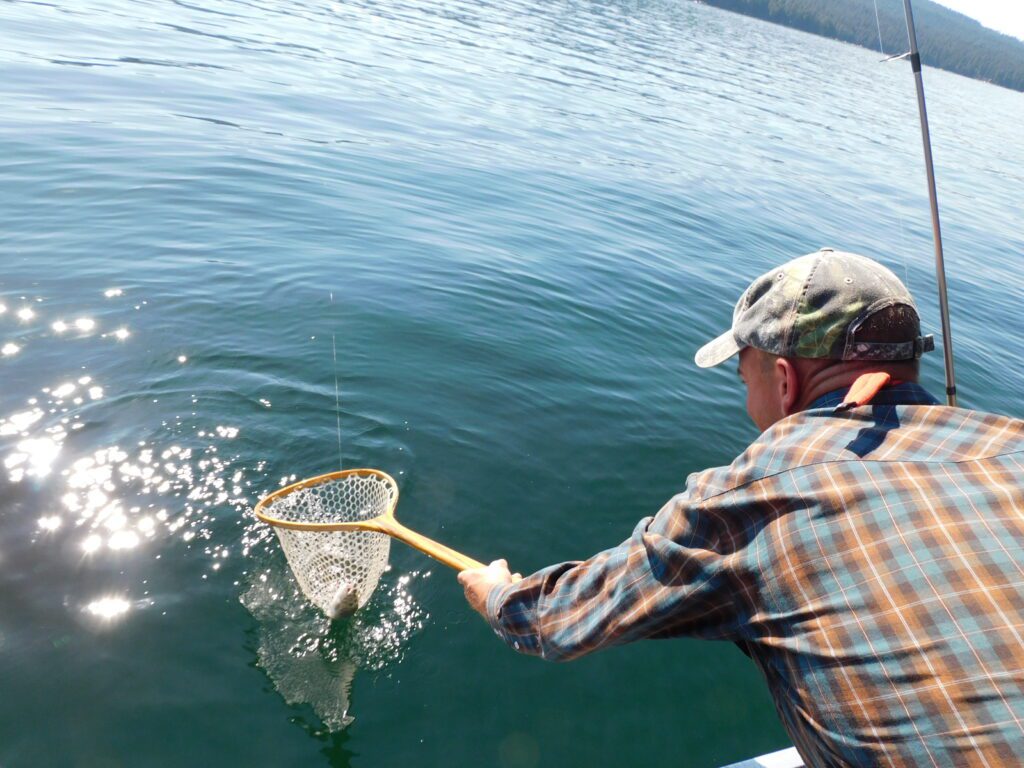
The other great trout area is along the west shore where a deep ledge makes for a great spot to anchor up or troll for rainbows and/or kokanee and the browns that hunt them.
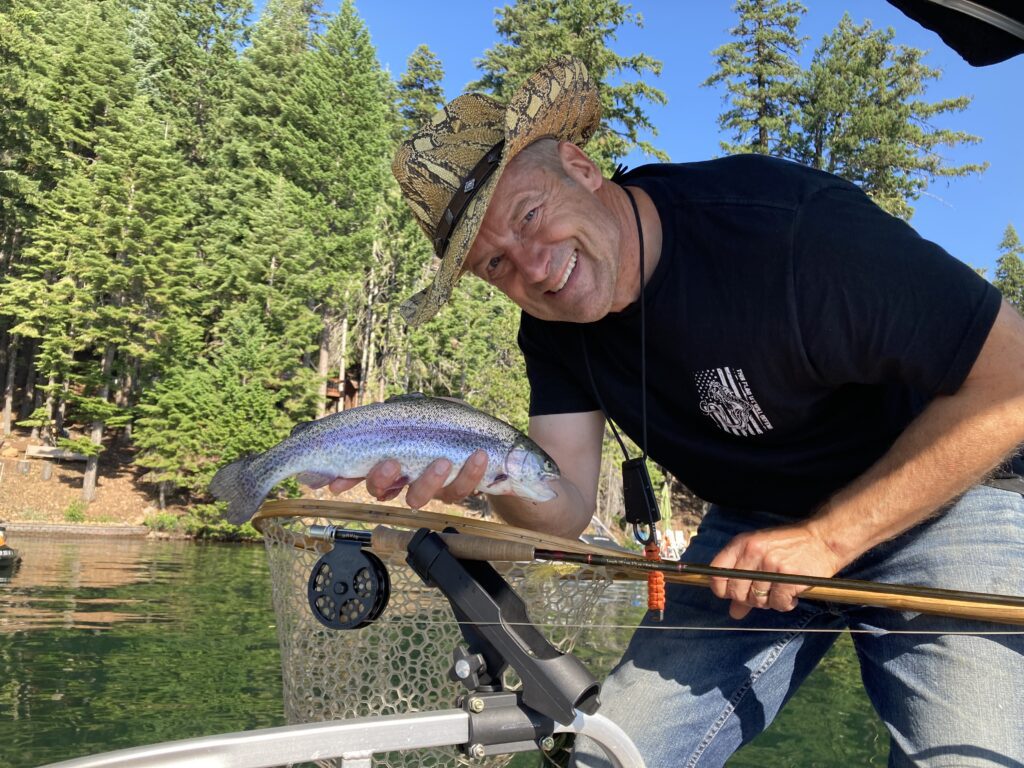
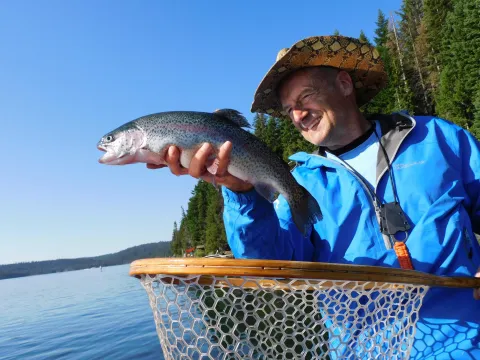
We caught nine trout, a catfish, a perch, and a couple of smallmouth bass in a couple of hours on both fly-fishing gear and spinning gear.
Standard trout rules apply for the Southeast Zone with a limit of 5 trout per day (only 1 trout over 20 inches) and 25 kokanee per day in addition to the trout limit. There is a 5 bass limit with only 1 bass over 15 inches. Angling is allowed 24 hours per day.
This lake is capable of growing hatchery trout big and holding them over. Trout can be caught year-round, but spring and fall are peak seasons for rainbows and browns. Trolling is popular on the lake, but still-fishing can fill out a limit faster, at least in my opinion.
Looking for a family fishing tradition to start? It's hard to beat Lake of the Woods with something for the whole family, even those cone-licking cousins who grew up in Sacrapimento. Heck, you might even teach them to fish.
# # #
For a copy of the Fishing Central Oregon book, send $29.99 to Gary Lewis Outdoors, PO Box 1364, Bend, OR 97709 To contact Gary Lewis, visit www.GaryLewisOutdoors.com
Directions: From Klamath Falls travel 35 miles west on State Highway 140; from Medford, take State Highway 62 north to Highway 140 then east 45 miles. From Ashland, travel 35 miles east on Dead Indian Memorial Road.
/articles/how-catch-cone-licker
Old School Catfishing
While some memories come and go, others stay with you for a lifetime.
One of my earliest fishing memories is of fishing on the Yahara River in the heart of Madison, Wisconsin. The river in this location was a channel that went from the Lake Mendota Locks, through the heart of the city, and a mile later emptied into Lake Monona. It was urban fishing at its finest, and as 12-year-olds we would look forward to fishing it often.
The day would start the night before, with a flashlight in hand my brothers and I would go into the backyard after dark and hunt for nightcrawlers. They always came out at night, and if one was stealthy, it would be possible to reach down and, pulling from the hole, ease out a plump crawler that was sure to be breakfast for one of the many species in the river. But pull too hard, and you ended up with half a crawler, which we would not keep as somewhere in our childhood brains we knew that putting in a broken crawler into the bait box would cause the other crawlers to die. I have no idea where we got that urban myth, but in any case, it caused us to be careful pulling those crawlers up.
The next morning we’d hop on our bikes and ride the three miles through Madison to reach our destination, and with any luck, our favorite spot was empty. This location had a small creek flowing from some ponds in the park into the Yahara River. The creek flowing into the larger river made for some good holding water.
Our rig of choice was simplicity itself. A hook and a couple of split shots 18 inches up, with a nightcrawler threaded onto the hook, and cast out into the river, along a seam from the inflowing creek. Let the bait hit bottom, tighten up the line, and watch for those first telltale jerks on the rod. Pickup said rod and set the hook. The tried-and-true Zebco 202 reel would squeak and moan at the weight of the fish on the end of the line. Sometimes a bass, walleye, or bluegill, but most often we would reel in a brown bullhead. On rare occasions, the excitement of a snapping or spiny softshell turtle would break up the morning’s procession of fish. These were always a joy for a twelve-year-old boy to catch.
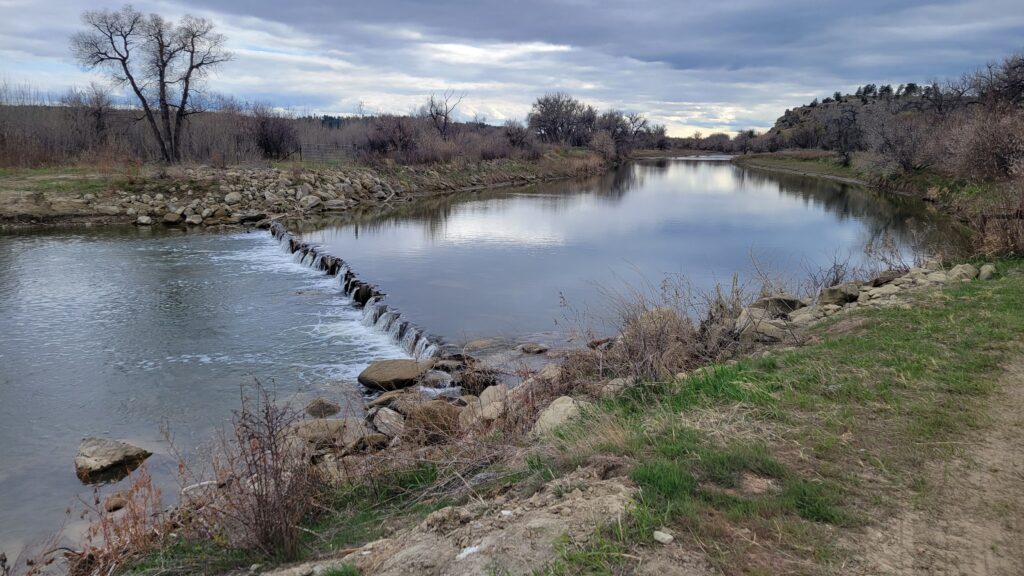
Fast forward 50+ years, my son Matt and I were heading to his father-in-law’s ranch on a spring turkey hunt. Years ago, Bill mentioned that the Musselshell River, which flows through his land, held catfish. After doing a little research I learned that indeed, the river in this area was well known to hold nice cats. The Musselshell flows from the small town of Melstone another fifty miles or so and empties into the Missouri River at the point where the river widens to form Fort Peck Reservoir. This stretch of water is known as the “warm water zone”. Catfish work their way up the Musselshell for spring spawning and live in the many deep holes the river has as it twists and bends through beautiful prairie and wooded hillside. Bill told me that cats in the 10-15 pound range can be caught, but 4-6 pounders were more common. Stopping their upriver passage is the Davis Diversion Dam, downstream for the town of Roundup, which we would be fishing below.
After a leisurely drive from Great Falls through ever-changing prairie land and wooded hillsides, I arrived at Bill’s ranch. Grabbing a quick dinner, I followed Bill as he drove along a gravel road to a prime spot on his land. Deer darted away from us, and turkey leisurely ate their dinners in the recently plowed fields. I had to resist the worry of someone being in “our spot”. The land is private property, so unless one of his neighbors were fishing there it would be devoid of other anglers. After living in Washington for thirty years I’m still getting used to the concept of being able to fish with no one around me!
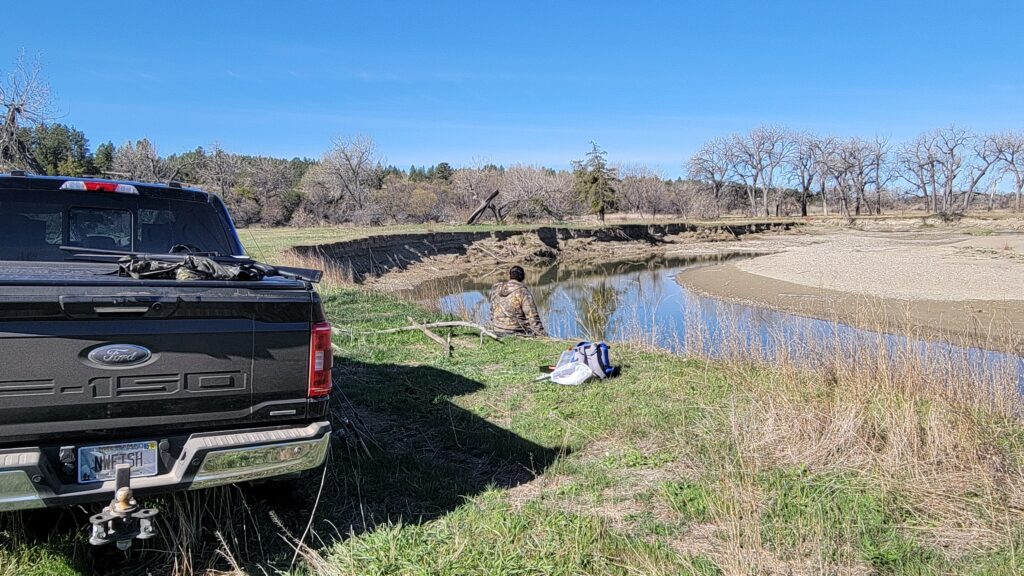
We arrived at an irrigation dam that had a beautiful hole below it and a clean river falling over the top of the spillway. As Bill drove off, I pulled out my seven-foot medium-weight spinning rod/reel combo and, like the days of my youth, tied on a large bass wide-gap hook. Two feet above the hook and tied a barrel swivel, and above that a sliding 3/8 ounce weight. For dinner, I was offering the fish down there a large, juicy nightcrawler.
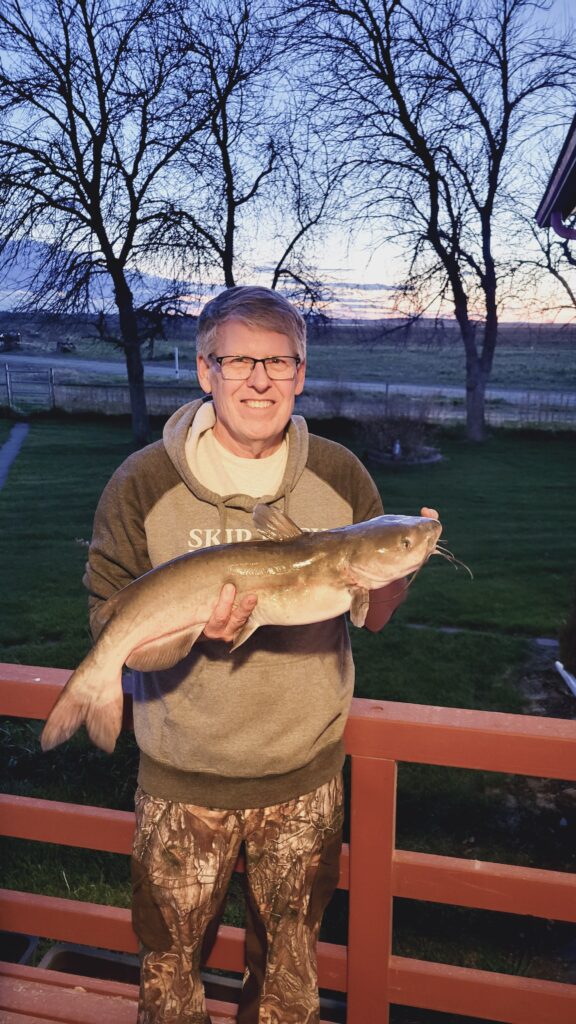
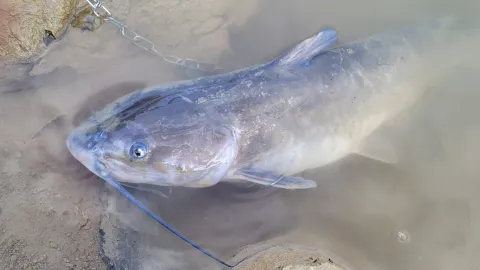
My first cast landed two-thirds of the way across the river. I reeled in the slack line and found a broken branch to prop my rod up against. Within minutes the rod tipped started to twitch, and then took a wild bend that started to pull the rod towards the river. I grabbed my rod and felt a solid fish on the other end of the line. The fish made several strong runs in the current and then settled down to a battle of tug of war with me. Working him ever closer to the shoreline, I saw that my first Musselshell fish was indeed a beautiful catfish! I found a sandy area of shoreline and dragged the fish onto land. What a beauty!
I re-baited my hook and cast it out to the middle of the river again. After a few minutes of waiting my rod again doubled over from the pull of a large fish. Setting the hook, this time I noted a different fight, and sure, enough, had a beautiful smallmouth bass on my line. Bringing in the fish I admired him, looking to be a solid 4 pounds. I released Mr. Smallmouth back to the river. With the sun beginning to set I decided to call it an evening and get back to the ranch before dark.
Arriving at Bill’s ranch my son Matt was there, having driven from Helena. “How’d you do”? they asked me. Pulling out the catfish from my cooler, Bill looked at it and said, “That’s a nice one, I’d say about ten pounds”. Matt’s eyes got wide and he asked, “When do we go?”
The next day’s sunrise was a classic Big Sky Painting, with red and yellow hues breaking over the trees. We had been shadowing a group of about thirty turkeys, trying to keep below a ridge that separated us from the turkeys between the field and the river. Finding an opportunity for an ambush location, we set up and started calling the mix of hens and gobblers toward us. Donn Morse of Old Goat Lures is also an avid turkey hunter and had given me a couple of the 3D pot calls that he makes and sells. The pots have great tone and soon several turkeys started our way. And then stopped. Dismayed, we watched the birds turn and head for the river, flying across to safety.
Returning to the ranch Bill had prepared for us a breakfast fit for a, well, a rancher. We made plans for the day, deciding to visit some friends and hitting the river after dinner for an evening bite.
I was excited to be fishing old school with Matt. Our lifetime fishing experiences had generally been from a boat, and I couldn’t recall bank fishing with him before. It gave me pause to think how sometimes possessions and technology can rob us of something so simple by making it complex. All the tools we use for fishing from a boat are certainly important, but there is just something about sitting on a bank and soaking a worm, waiting for a bobber to get pulled underwater, or seeing a rod tip twitch, knowing that on the other end, some kind of fishing is preparing to make your bait his meal.
After dinner we headed over to our fishing hole, passing groups of turkeys teasing us in the fields. They would have to wait for another day, we were Tom Sawyer and Huck Finn, our fishing rods and a box of worms in hand, looking for the perfect piece of forked tree branch to serve as a rod holder.
Matt baited up and cast out, and in a matter of minutes announced that he had a bite. Tightening down on the line, he set the hook and reeled in his first Musselshell catch, a nice smallmouth bass.
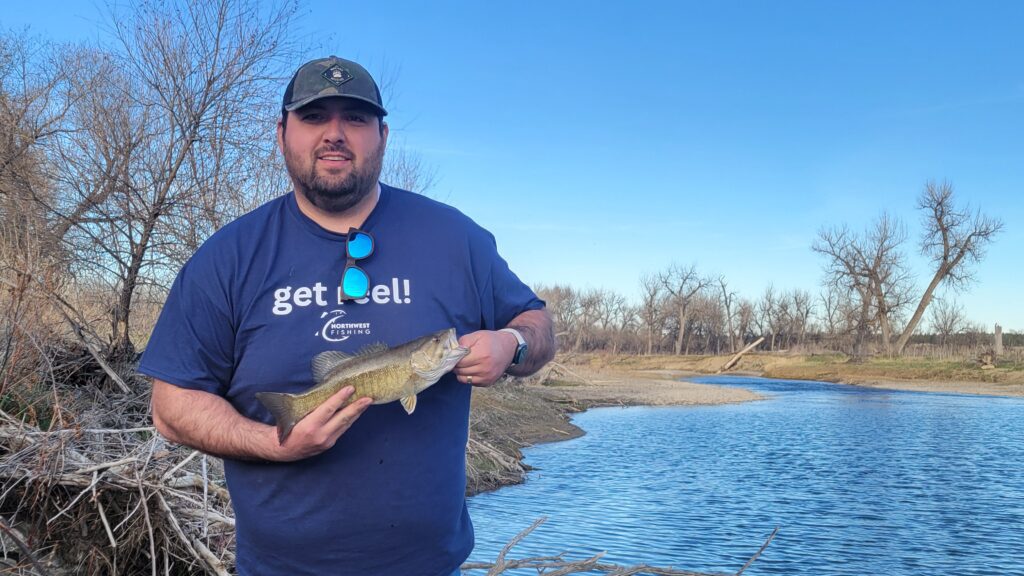
And so, the evening went on. Matt and I were kept busy with a steady evening bite. The smallmouth were most active, and we caught around a dozen ranging from dinks to nice 2-3 pounders. Thrown in the mix were plenty of yellow eye, which is a Montana version of a giant herring, around 12” in length and very spunky to catch. Sadly, the catfish bite was dead. No worries, though, with the Missouri River as our backyard there will be plenty of new places to explore the next time we decide to go “Old School” fishing.

/articles/old-school-catfishing
Ten Rules of Coho Trolling
By Mike Carey
September is a special time for me. Like the change in the weather, I can feel a change in myself, a pent up anticipation that has slowly been building over the summer and like clockwork bursts forth in full bloom. It’s coho time in Puget Sound!
Yes, this is a great time of the year to be a salmon angler in Puget Sound, if the runs are strong and the fishing is open. Last year was unique in that we had closures in the ocean and straits. The coho arrived to Puget Sound in good numbers and virtually unmolested.
This year was questionable what kind of a season we would be given. As of this date, coho is open in areas 8.2, 9, and 10. Check the regs and emergency closures for updates of course. As it stands the daily limit is two coho.

Looking at my fishing reports data from trips going back twenty years, it becomes pretty obvious that September is the time to put away freshwater gear and focus on salmon. August can be productive, but September can be (and often is) lights out.
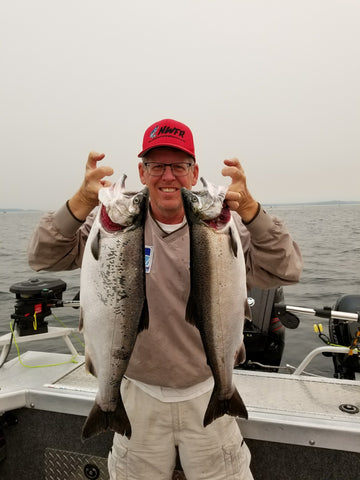
My reports show multiple trips with limits by 9am, red hot fishing, and lots of pictures of shiny chrome coho. As the season progresses into later September, the fish show a steady increase in size.
By late September to early October, the 6-8 pound coho are replaced by beautiful 10-14 pound hooknose monsters. It’s the time of year to stock up the freezer on tasty coho!
For those new to the fishery, you’ll find a wealth of information on techniques and locations scattered on the web. I've broken down some of my thoughts on coho trolling into Ten Rules of Coho Trolling.
Coho tend to be a pretty cooperative salmon when it comes to catching them. As these fish stream in from the ocean, heading through the Strait of Juan De Fuca and into Puget Sound, they are putting on the feed in preparation for their runs up to the spawning grounds.
It’s not unusual to find coho stuffed with herring. Don’t get me wrong, there are days they, like other salmon, will have lock-jaw. But that truly is the exception, not the rule. Speaking of rules, I offer a list of rules I’ve developed over the years to catch more coho.
You’ll likely have your rules to add to this list. Or you may disagree with some of them. But hopefully it will give you some additional ideas when targeting coho in the Sound.
Rule #1
As Russell Wilson would say, “Separation is in the preparation”. - When you put your boat in the water, you should have everything ready to go. No fiddling around with gear or bait the morning of a trip. My fishing ritual is to have everything ready to go the night before.
It’s like a general planning for battle. My rods are ready and geared up. My bait has been cut and cured. My boat is prepped and clean, batteries are charged, gas tank is full, snacks are bought, there’s ice in the coolers for the fish.
This evening before prep time is actually a ritual I cherish because like Russ, I’m visualizing success and making a plan in my head. I try to never go fishing without a plan.
Rule #2
Start early, go shallow. - I try to be on the water as early as possible. Ideally, that means running lights on and gear going in the water while it’s still dark or just turning light. I will run my gear in the top 10-30 feet of water to start.
This is the time of day when a salmon fly in the prop wash can be deadly. I like Artic Fox Trolling Flies. Denis Peirce ties a nice fly in a variety of effective salmon colors. Try running the fly back 40-50 feet and troll fast (more on that later) with the fly practically skipping on the surface.
Just be sure to have the clicker on the reel because these strikes can be vicious. I love the sound of a clicker going off in the morning!
Rule #3
Watch your fish finder, drop your depth – As the morning progresses, drop your downriggers down. I’ve read the “rule of thumb” is ten feet every hour until you’re trolling your gear around 40-60 feet. That’s fine, I guess, but I also use my fish finder.
If I see bait and fish marks down 50-70 feet, I’ll drop down to those fish even if it’s early in the morning. As the day goes on I may even drop my downrigger ball down to 110-120 feet deep.
Depth can be a tricky thing because when coho fishing I troll fast, which leads us to the next rule.
Rule #4
Troll fast! - In my experience, coho love a fast troll. I have an itroll throttle control and will set it on “hunt” mode to keep my boat going fast, around 3.3 to 3.9 mph. A few years back I did a lot of underwater filming and noticed a distinct increase in salmon aggression when the flasher was whipping around in a complete rotation.
If it was only doing a lazy rotation, or not doing a full rotation, coho would tend to swim behind the gear, just watching. But speeding up and getting that flasher fully spinning would elicit vicious strikes. I will troll both with and against the tide and catch fish going both ways.
Just be sure to increase your throttle going into the tide to maintain that 3.5 mph speed. I’ll also program my itroll to give a periodic 3-5 second slow down and then speed back up to “wake up” coho that may be lazily following but not biting.
It can often trigger a bite. Oh, another thing that will often trigger a bite – if you’re checking gear, pop your line off the release and set the rod in the rod holder. Let the gear come up on its own. I have caught a lot of coho that will chase the gear as it ascends to the surface.
Don’t reel your gear in until it hits the surface.
Rule #5
Coho are hungry, feed them! - Coho love a strip of herring on just about any lure. I will add strips to hoochies, flies, and even a small strip on the hook of a spoon (but not too much, you don’t want to kill the spoon’s action).
Be sure to brine the herring strips a day ahead of time in rock salt and/or commercial herring brine. Add scents and bite enhancers as well. Check your gear every 20-30 minutes and freshen up with a new herring strip. If you get a bite but no release, bring it in and check it!
The one exception to this rule I have is if the dogfish are in thick, I will go without bait.
Rule #6
Experiment – My “go to” set up is a magnum green splatter glow hoochie, herring strips, 26-30” leader, and an 11” dodger (pick your color…). I always start with this set up. On a second rod I may run a different color and smaller hoochie.
If there is no action and I am seeing fish on the fish finder I will start trying spoons and plastic lures like the old Big Al’s Cripple Herring. Sometimes the coho just want something with more action. This year I’m going to be trying the new Old Goat OG2 5” salmon lure.
The Old Goats have been awesome on kokanee and I think they will be deadly on coho. They have an amazing action that I think coho will love.
Rule #7
Fish Where They Ain’t (anglers that is) – coho in Puget Sound can be found pretty much anywhere. We all have favorite starting locations and it’s human nature to follow the crowds of boats because “hey, they must know something I don’t”.
Maybe…and maybe not. I try to start my troll away from clusters of boats. Why be surrounded by additional lures in the water? You want to troll over fish that aren’t seeing offerings non-stop. So, move away from everyone else – and if you take my advice and troll fast you will, very quickly.
You’ll still find the fish if they are there, and cover more water to find the biters. When you do, don’t be afraid to mark the fish on your fish finder and troll around and right back over the same spot. Again, in viewing underwater footage, I invariably see groups of 4-6 coho following my gear.
A solo fish is very rare. So, work over those spots when you pick up a fish.
Rule #8
Mid day and tide changes are good – I know I said earlier I like to hit the water at daybreak, but there are days when that just doesn’t happen. The good news with coho is that it doesn’t matter. You can (and will) catch coho all morning and into midday.
Tide bites are the period before and after a low or high tide, and these times can be very productive. My favorite tide sequence is a high tide at around 9-10am. The flood tide pushes fish and as the tide slows down it triggers a feeding opportunity below for the coho salmon.
Bait becomes easier to pick off without a steady flow of water and the coho bite often turns on. If you miss that crack of dawn bite, fear not, the coho will cooperate. I’ve caught my biggest hooknose fish from 11am to 1pm.
Rule #9
Playing and netting your fish – OK, you have a big fish on and are trolling at 3.5 mph. What do anglers often do? Why, slow down the of course. Bad move. In today’s age of barbless hooks, slowing down is an invitation to let the fish go. The second there is slack in that line the hook can slip out.
Trolling for coho is not a fishery that is about the fight, it’s about catching fish. If you want an epic battle against coho (and they are a hoot), catch them in rivers, or mooch for them. Trolling with an 11” flasher gives these fish a focal point with which they can get slack line.
We don’t want to do anything to help them out, like slowing down. Once they are on the surface, do your best to keep the flasher out of the water. This will help prevent the fish getting slack line between the hook and the flasher. Make sure you have a net with a long handle and big opening.
This will help as the netter reaches out. Remember, the netter scoops as the angler guides the fish into the net. Don’t make the mistake of the netter reaching to net the fish! Once the fish is close to the boat slowing down a bit is OK, by the way- just keep that flasher out of the water.
Rule #10
Take good care of your fish – Non-anglers have no idea what a freshly caught salmon tastes like. As anglers we are blessed to be able to have the freshest salmon on the planet. So, take good care of your caught fish. Bonk the fish enough to stun it, then cut a gill and bleed the fish out for a few minutes.
After that, into the ice cooler it goes. Don’t hang it off the side of the boat to bake in the sun. At the end of the day, gut and cut into steaks, or filet the fish out. If possible, vacuum-seal whatever fillets you don’t eat for dinner.
Properly cared for, you’ll have tasty fish until the next season, when you get to do it all over again!

There you have it. Ten “Rules” that will help increase your odds of success this coho season. Have fun out there and remember to be safe, have life jackets and all the safety equipment required and needed in case something goes sideways.
Good luck fishing and I’ll see you on the water.
/articles/ten-rules-coho-trolling-0
Get Ready to Catch More Fish
Anglers often hear about how ten percent of the fisherman catch ninety percent of the fish, and maybe this is not completely true, but there are things that you can do before hitting the water that will increase your catch. Guides are often blamed for showing anglers how to catch more fish, increasing pressure, and “taking” fish away from other anglers, but it is not the guides’ fault that they catch more fish. The difference between guides, those ten percent anglers, and the rest of those on the water often comes down to preparation. Success begins well before the boat gets wet, and those that learn to take care of gear, do needed maintenance, and prep for the day of fishing often catch more fish.
A few years ago, we were up in Nootka Sound fishing for chinook and early arriving coho. After fighting a fish to the boat, the toothy king had chewed up the leader to the point that the hooks broke off just as it was scooped into the net. A quick bonk on the head and a few photos along with taking care of the fish in the box, and it was time to get back to fishing. Instead of dropping the gear right back down to the school of salmon, we had to take a few minutes and re-tie the rigging. The few moments it took to do this caused us to lose the bait ball and the salmon feeding on it. That little mistake cost us an hour of fishing before we hooked up with another chinook and, once again, that fish tore up the leader and we were right back to needing to re-tie. If you have ever tried to snell a hook out in the open ocean you know how hard this can be, and it can cause you to start getting seasick.
Pre-tying leaders is necessary. Not only does it save time when you break off, but it can also help with switching presentations. It is not enough to just snell a bunch of hooks on leaders and call it good. Instead, tie up different set-ups so you can switch out easily. When winter steelhead fishing, one of the most popular lures is the pink rubber worm. Sometimes it is the rubber worm with a chartreuse tip tail, or a red and black worm, and other times it is the 4-inch worm or the 6-inch worm. Regardless, if you just tie up leaders and still need to thread the worm on then you are wasting time. Instead, use a Macks Pips Box and Leader Caddy, where you can pre-tie several different rigs and have them ready to go. Same when bead fishing, where you might need to change out to different size or color of beads.
Check the hooks. Sticky, sharp hooks are a must, no matter what species you are pursuing, but how often do you check the hooks or re-sharpen them? Keep a hook file handy, as in one in the boat tray, one in the tackle box, and one in your pocket. The idea is to keep them ready and make a few strokes on the hook each time you check the bait or switch out the lure. At the end of the day, re-sharpen the hooks so they are ready to go the next time you go fishing.
Wash your gear. The boat and trailer need good washing at the end of the day, but so does all the gear, including rods, reels, and lures. If you fish saltwater, then the benefits of washing everything metal is obvious, but even if you fish freshwater you should clean your gear. Using scents and baits, and even just sweating on the rod handle can lead to unwanted odors and cost you fish. Once, after a trip out shrimping, we came home and washed the exterior of the boat lightly rinsed the interior. A few weeks later, our garage reeked badly. Turns out we missed one shrimp that had fallen out of the pot and slid under the back decking. It took a few hours of re-washing the boat deck to get the stink out. If we had done a thorough cleaning of the boat the first time, we would have found that wayward prawn and avoided a stinky mess.
Rod and reel maintenance are often not done correctly or at all. Rods need to be inspected for broken or cracked guides, loose handles, and cracks in the blanks. If you have broken a rod, it might have been avoided by doing a simple inspection before the day of fishing. Reels have gears, bearings, and springs. Take them apart and learn how to grease and lubricate them, as well as clean the inside of the reels. Drag washers often need to be replaced as well, and once that is all done, then strip off all the line and re-spool. This type of maintenance can often be done once a year unless you fish in the saltwater a lot. If you do, then be sure to maintain the reel before and at least once during the season, and then again once after the season is over.
A deep cleaning followed by removing all the grease and reapplying is all that’s needed. Braided line can often be used for a few years, and one trick is to reverse the line or just strip off the top few hundred yards, use a surgeon's knot, and respool the amount of line you removed. When fishing braid, I often use a “top shot” of fifty feet or so of monofilament, and this gets replaced after each trip when using downriggers, as the clips can cause small nicks or crimps in the monofilament, which can cost you a fish if not checked or replaced.
Prepare the bait the day before. Most bait can be cured, brined, and rigged the day before the trip. Cured salmon eggs are often done months prior and then frozen, so be sure to take them out of the freezer and allow them to thaw slowly as a quick thawing can cause them to become mushy. One tip to thawing salmon roe is to add borax to the container or plastic bag they are frozen in, as this will soak up any moisture that is released during the thawing process and keep the eggs firm. Anglers who use herring or anchovies can make up the brine solution the day before and add the frozen baitfish, then place it into the refrigerator to allow the baits to thaw slowly and absorb the salted brine.
This keeps them firm and allows the chemicals in the brine to slowly soak, which will keep any chemical burns from occurring and toughen the baits. Brined herring can be used for multiple days if kept in the cold brine. If you plan to use a herring strip and wrapping plugs, do this the day before and keep them in the refrigerator by hanging them in a bait cooler. Having a day's worth of plugs pre-wrapped will save a lot of time on the water, and the more time the plugs are fishing, the more chances you will have of catching fish.
Trailer maintenance is more than just washing it and calling it good. The lights should be checked every time you go fishing, as well as before you put the boat away. A brake light out might not seem important, but it could lead to a collision with another driver who does not know you are braking. More than once, we were on our way to the river in the early morning hours, cruising down the highway, and we came upon a boat and trailer being hauled by an unsuspecting angler with the trailer light not hooked up or burnt out. The problem was the boat blocked the truck's rear lights and we almost ran right into the back of the truck. You cannot catch fish if you do not make it to the lake.
Batteries are one of the least thought of items boat owners and anglers think about. Marine batteries last a long time, but they do require maintenance. The best way to keep a battery in full charge and ready condition is to use a battery tender or on-board charging system that you plug in when you are back at home. This will charge the battery and then keep it topped off during the off season. Be sure to check all the cables at the beginning of each fishing season and especially after a trip where you encounter rough water.
Bouncing along and hitting waves causes loose connections, and you do not want to find out the motor will not start, or the downrigger will not retrieve, because the connection was loose or came undone. While you are checking the battery, be sure to look at the fuse box. Not only making sure they are all in good order and the wires are secure, but also what fuses you need to have on board for spares. Some are different AMPs, so it is best to have a handful of spares along.
Motor maintenance is more than just changing the oil. Be sure to open the cowling and look at all the connections. They should be tight and covered in marine grease. Same with any bolts, nuts, and electrical connections- they all need to have a special electrical grease on them. Fuel systems are an integral part of motor maintenance, including the fuel-water separator and fuel treatments.
With each tank re-fill, it is a good idea to add a fuel additive made for your motor. Be sure to check what the manufacturer recommends, and at the end of the season, a fuel additive and preservative is necessary. Even then, it is best to run the boat motor every few weeks or months until it is fishing season again, or have your motor properly winterized.
When you see a guide or one of those “fishy” anglers out on the water, realize that their success often comes down to preparation. If you have ever fished with a guide, you will notice good guides have good gear and are ready for anything that comes up. A nicked leader is quickly switched out with one ready to go, motors fire up right away, and baits are prepared before you step foot on the boat.
It is the trivial things that make the difference, and that is why those that prepare for the season ahead are successful. The old saying, “failing to prepare is preparing to fail” holds true when it comes to fishing success.
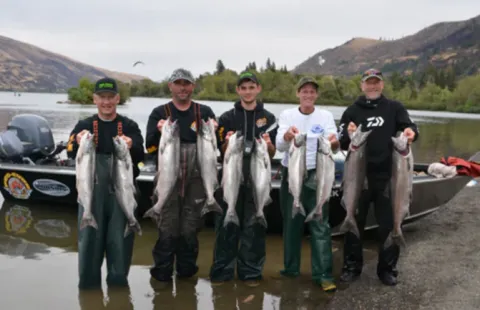
/articles/get-ready-catch-more-fish