Fishing the Palouse by Josh DeBruler
Far down in the southeastern corner of Washington State, there’s a river that is surrounded by millions of years of geological wonders. The journey begins at its headwaters in the Bitterroot Mountain Range of Northern Idaho. It meanders southwest and cuts through a landscape of grassy hills, formed by millions of years of wind-driven sediment that lay atop Pleistocene-era lava flows. For miles, it flows through a steep canyon carved out by the great Missoula flood that occurred during the rupture of an ice dam during our last glacial maximum. Finally, in Southeast Washington, it ends its solo journey at its confluence with the Snake River.
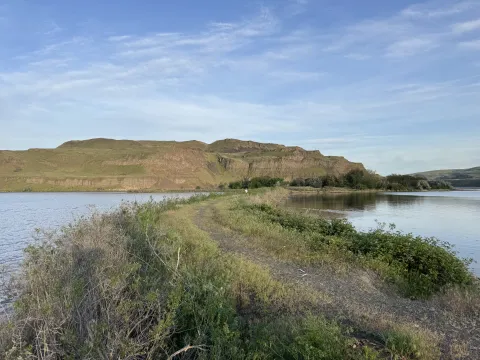
Historically, the waters at the confluence of the Snake and the Palouse were turbulent, characterized by rapids and fast-moving water. When Lewis and Clark reached the confluence of these two rivers during their expedition, they wrote about the ferocity of the water and how members of the group who didn’t know how to swim opted to go ashore and lug supplies on foot. Today, the waters here run much slower due to the construction of the Monumental Dam about 14 miles downstream on the Snake.
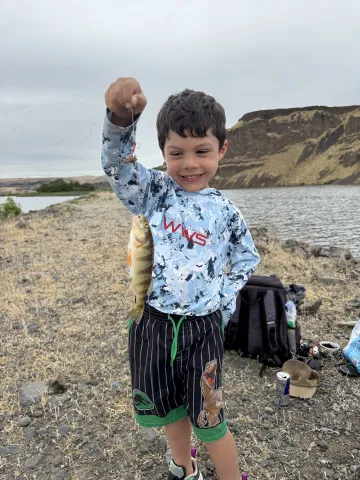
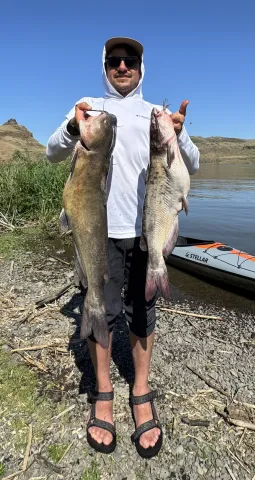
The slow-moving water near the confluence makes great habitat for a variety of fish like walleye, channel catfish, yellow perch, bluegill, smallmouth bass, and northern pikeminnow. What’s more, the fertile wheat land surrounding the Palouse offers a specific advantage for anglers targeting catfish. Peppered up and down the river are shoreline grain elevators where grain is transferred from barge to land, and during harvest season, these spots attract large numbers of Channel Catfish. Anglers can boat to these grain elevators and target fish that feed on grain spillover.
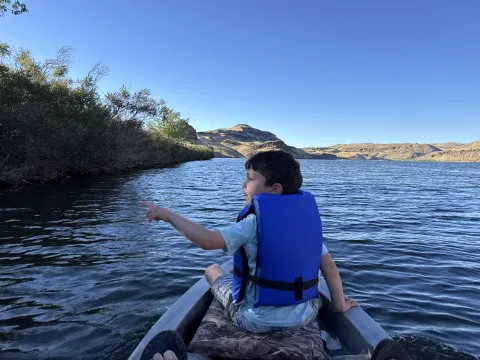
Catfish can also be targeted near shore in shallow, calm flats and deep holes with rocky bottoms. Channel catfish can be caught with night crawlers, bread dough balls, chicken livers, crawfish, shrimp, and stink baits, but the most consistent bait for me remains cut fish. Typically, a 1-2 inch chunk of yellow perch will do the trick.
Another method to deploy during the channel catfish spawning season (late spring-early summer) is running a small jig past a male catfish who sits guard over a nest. This often triggers a defensive strike from the male. This is a sight-fishing type of method, so to be successful, you’ll want a decent pair of polarized sunglasses and will need to be accurate with your casting.
Fishing the Palouse after June 16th in Washington State means 2 pole fishing is permitted. Since fishing for Channel catfish can often be a long waiting game, the two-pole endorsement offers up a great opportunity for rigging one rod up for the more passive catfishing while then using a second rod for something more active, like casting swim baits for walleye or smallmouth. It's good to equip your catfish rod with a bell at the tip to indicate a strike that you may not have noticed otherwise.
If you’re interested in catching a variety of fish and don’t want to deal with the hassle of switching from one setup to another, no need to worry; there is a simple solution. A nightcrawler, a hook, and a worm tied together on a simple drop rig is a setup that I use for shore fishing on the Palouse, and I have caught walleye, panfish, pike minnow, and large catfish on it. It's a one-size-fits-all set-up and works wonders in the calm waters of the Palouse. It’s also a great setup for kids, so long as they have the patience to sit and wait for a bite.
I’ve seen some pretty nasty winds at the Palouse, and each time I’ve been pleasantly surprised by the lack of effect the wind had on the water. This could be because of a sheltering effect from the canyon walls surrounding the water, the lack of depth in the river itself, or a combination of both. Either way, the lower Palouse is a safe and excellent spot to launch a kayak or any other type of boat for a day of fishing.
There are multiple boat launches on or near the lower Palouse. Lyons Ferry State Park offers a boat ramp and shore fishing opportunities. Riparia boat ramp on the Snake River is just east of the confluence of the Snake and the Palouse. Ayer Boat Basin is on the Snake River and about 7 miles west of the confluence. It has two boat ramps, a large parking lot to accommodate vehicles and trailers, and a campground for visitors,
So, if you’re looking to get out and explore some of the most beautiful and geologically rich lands that our state has to offer, and you wouldn’t mind coming home with a cooler full of a variety of fish, then the Palouse is where you should be heading on your next trip!
/articles/fishing-palouse-josh-debruler
Old School Catfishing
While some memories come and go, others stay with you for a lifetime.
One of my earliest fishing memories is of fishing on the Yahara River in the heart of Madison, Wisconsin. The river in this location was a channel that went from the Lake Mendota Locks, through the heart of the city, and a mile later emptied into Lake Monona. It was urban fishing at its finest, and as 12-year-olds we would look forward to fishing it often.
The day would start the night before, with a flashlight in hand my brothers and I would go into the backyard after dark and hunt for nightcrawlers. They always came out at night, and if one was stealthy, it would be possible to reach down and, pulling from the hole, ease out a plump crawler that was sure to be breakfast for one of the many species in the river. But pull too hard, and you ended up with half a crawler, which we would not keep as somewhere in our childhood brains we knew that putting in a broken crawler into the bait box would cause the other crawlers to die. I have no idea where we got that urban myth, but in any case, it caused us to be careful pulling those crawlers up.
The next morning we’d hop on our bikes and ride the three miles through Madison to reach our destination, and with any luck, our favorite spot was empty. This location had a small creek flowing from some ponds in the park into the Yahara River. The creek flowing into the larger river made for some good holding water.
Our rig of choice was simplicity itself. A hook and a couple of split shots 18 inches up, with a nightcrawler threaded onto the hook, and cast out into the river, along a seam from the inflowing creek. Let the bait hit bottom, tighten up the line, and watch for those first telltale jerks on the rod. Pickup said rod and set the hook. The tried-and-true Zebco 202 reel would squeak and moan at the weight of the fish on the end of the line. Sometimes a bass, walleye, or bluegill, but most often we would reel in a brown bullhead. On rare occasions, the excitement of a snapping or spiny softshell turtle would break up the morning’s procession of fish. These were always a joy for a twelve-year-old boy to catch.
Fast forward 50+ years, my son Matt and I were heading to his father-in-law’s ranch on a spring turkey hunt. Years ago, Bill mentioned that the Musselshell River, which flows through his land, held catfish. After doing a little research I learned that indeed, the river in this area was well known to hold nice cats. The Musselshell flows from the small town of Melstone another fifty miles or so and empties into the Missouri River at the point where the river widens to form Fort Peck Reservoir. This stretch of water is known as the “warm water zone”. Catfish work their way up the Musselshell for spring spawning and live in the many deep holes the river has as it twists and bends through beautiful prairie and wooded hillside. Bill told me that cats in the 10-15 pound range can be caught, but 4-6 pounders were more common. Stopping their upriver passage is the Davis Diversion Dam, downstream for the town of Roundup, which we would be fishing below.
After a leisurely drive from Great Falls through ever-changing prairie land and wooded hillsides, I arrived at Bill’s ranch. Grabbing a quick dinner, I followed Bill as he drove along a gravel road to a prime spot on his land. Deer darted away from us, and turkey leisurely ate their dinners in the recently plowed fields. I had to resist the worry of someone being in “our spot”. The land is private property, so unless one of his neighbors were fishing there it would be devoid of other anglers. After living in Washington for thirty years I’m still getting used to the concept of being able to fish with no one around me!
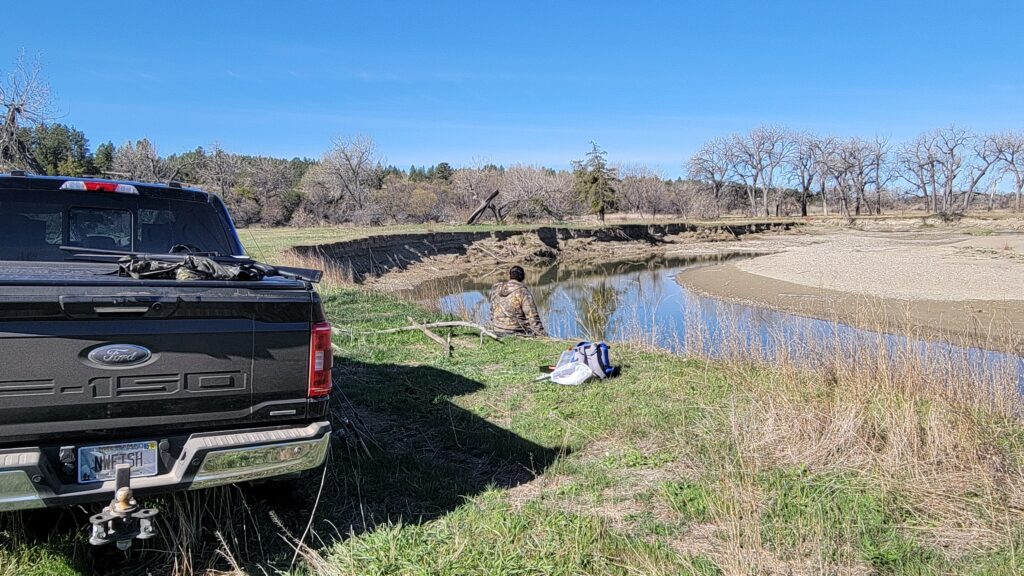
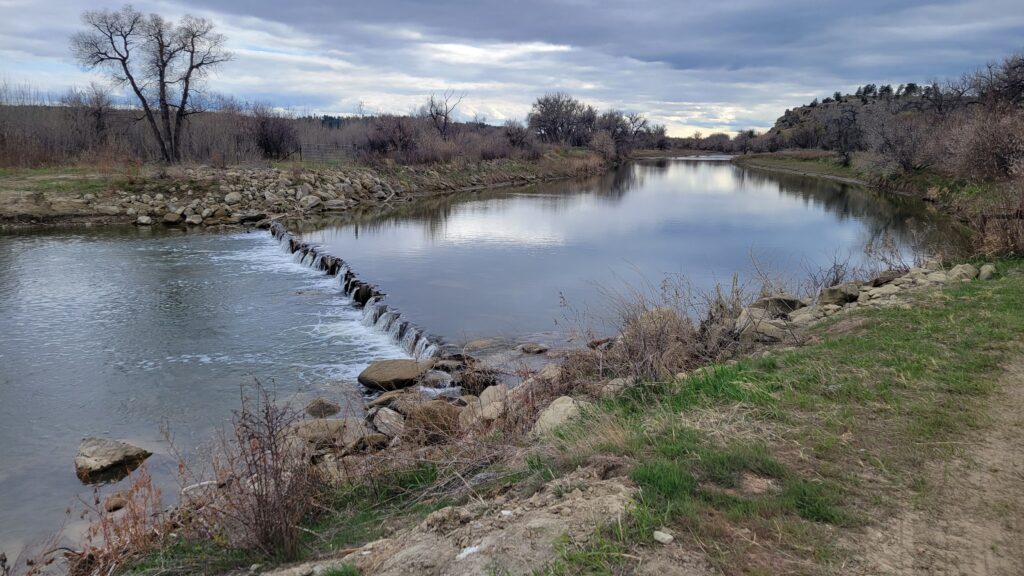
We arrived at an irrigation dam that had a beautiful hole below it and a clean river falling over the top of the spillway. As Bill drove off, I pulled out my seven-foot medium-weight spinning rod/reel combo and, like the days of my youth, tied on a large bass wide-gap hook. Two feet above the hook and tied a barrel swivel, and above that a sliding 3/8 ounce weight. For dinner, I was offering the fish down there a large, juicy nightcrawler.
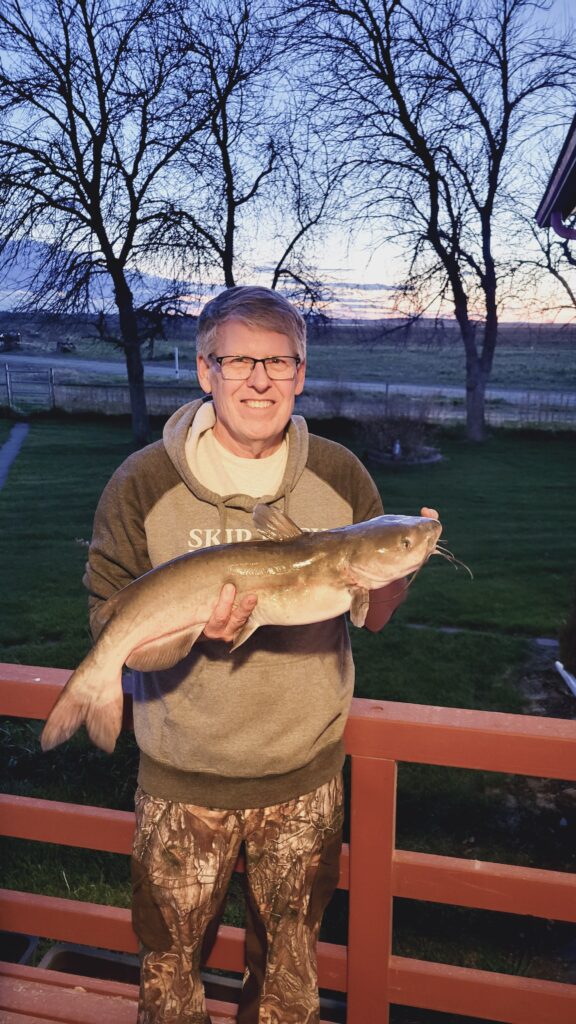
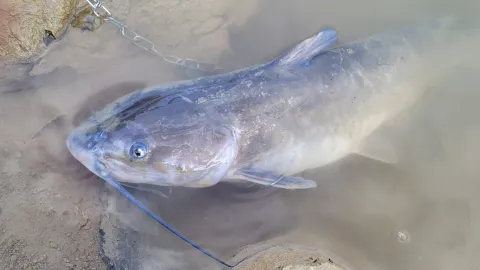
My first cast landed two-thirds of the way across the river. I reeled in the slack line and found a broken branch to prop my rod up against. Within minutes the rod tipped started to twitch, and then took a wild bend that started to pull the rod towards the river. I grabbed my rod and felt a solid fish on the other end of the line. The fish made several strong runs in the current and then settled down to a battle of tug of war with me. Working him ever closer to the shoreline, I saw that my first Musselshell fish was indeed a beautiful catfish! I found a sandy area of shoreline and dragged the fish onto land. What a beauty!
I re-baited my hook and cast it out to the middle of the river again. After a few minutes of waiting my rod again doubled over from the pull of a large fish. Setting the hook, this time I noted a different fight, and sure, enough, had a beautiful smallmouth bass on my line. Bringing in the fish I admired him, looking to be a solid 4 pounds. I released Mr. Smallmouth back to the river. With the sun beginning to set I decided to call it an evening and get back to the ranch before dark.
Arriving at Bill’s ranch my son Matt was there, having driven from Helena. “How’d you do”? they asked me. Pulling out the catfish from my cooler, Bill looked at it and said, “That’s a nice one, I’d say about ten pounds”. Matt’s eyes got wide and he asked, “When do we go?”
The next day’s sunrise was a classic Big Sky Painting, with red and yellow hues breaking over the trees. We had been shadowing a group of about thirty turkeys, trying to keep below a ridge that separated us from the turkeys between the field and the river. Finding an opportunity for an ambush location, we set up and started calling the mix of hens and gobblers toward us. Donn Morse of Old Goat Lures is also an avid turkey hunter and had given me a couple of the 3D pot calls that he makes and sells. The pots have great tone and soon several turkeys started our way. And then stopped. Dismayed, we watched the birds turn and head for the river, flying across to safety.
Returning to the ranch Bill had prepared for us a breakfast fit for a, well, a rancher. We made plans for the day, deciding to visit some friends and hitting the river after dinner for an evening bite.
I was excited to be fishing old school with Matt. Our lifetime fishing experiences had generally been from a boat, and I couldn’t recall bank fishing with him before. It gave me pause to think how sometimes possessions and technology can rob us of something so simple by making it complex. All the tools we use for fishing from a boat are certainly important, but there is just something about sitting on a bank and soaking a worm, waiting for a bobber to get pulled underwater, or seeing a rod tip twitch, knowing that on the other end, some kind of fishing is preparing to make your bait his meal.
After dinner we headed over to our fishing hole, passing groups of turkeys teasing us in the fields. They would have to wait for another day, we were Tom Sawyer and Huck Finn, our fishing rods and a box of worms in hand, looking for the perfect piece of forked tree branch to serve as a rod holder.
Matt baited up and cast out, and in a matter of minutes announced that he had a bite. Tightening down on the line, he set the hook and reeled in his first Musselshell catch, a nice smallmouth bass.
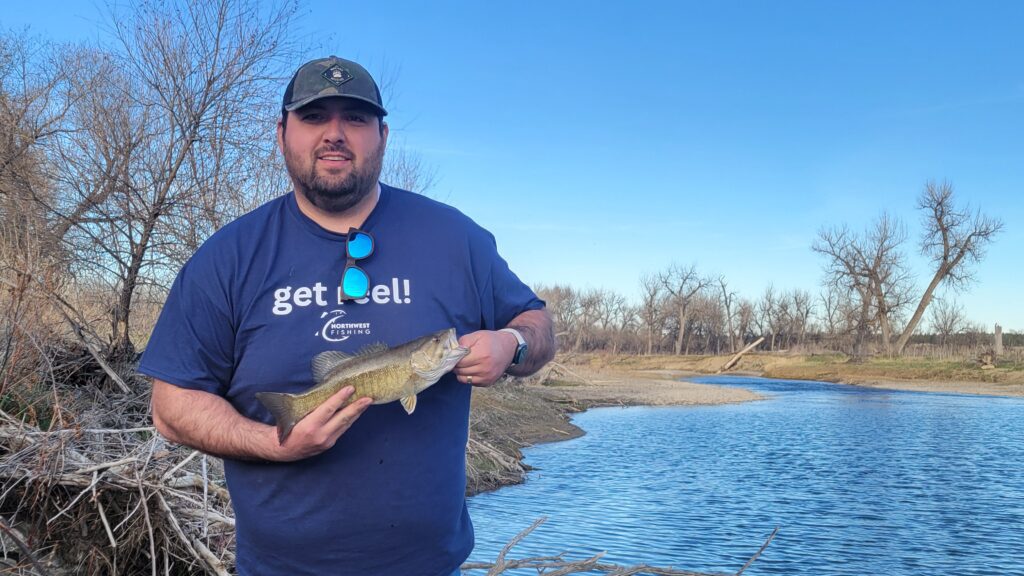
And so, the evening went on. Matt and I were kept busy with a steady evening bite. The smallmouth were most active, and we caught around a dozen ranging from dinks to nice 2-3 pounders. Thrown in the mix were plenty of yellow eye, which is a Montana version of a giant herring, around 12” in length and very spunky to catch. Sadly, the catfish bite was dead. No worries, though, with the Missouri River as our backyard there will be plenty of new places to explore the next time we decide to go “Old School” fishing.
/articles/old-school-catfishing
The Outdoors Roundup
Are you in need of outdoor activity ideas for the days ahead? Here, you'll find seven suggestions that offer you the chance to embrace the outdoors and partake in fresh experiences this spring season.
Wildflower Hikes
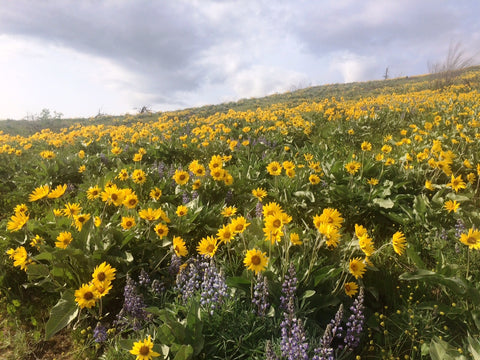
The wildflowers are blooming around Eastern Washington and now is a great time to go on a hike and immerse yourself in their presence! A few of my favorite places to go include Columbia Hills State Park in Klickitat County, Hay Canyon and Nahahum Canyon near Cashmere, Ingalls Creek south of Peshastin, the Turnbull National Wildlife Refuge south of Cheney, and the area around Palouse Falls State Park.
Waterfalls
Speaking of Palouse Falls, this is the best time of year to visit this state park near Starbuck in Southeast Washington. The spring runoff on the Palouse River sends a voluminous amount of water crashing into the 198-feet deep basalt basin below the falls. Other waterfalls worth checking out right now include Rainbow Falls near Stehekin, Silver Falls west of Entiat, and Periwee (also known as Peewee) Falls in Pend Oreille County, which cascades 233 feet into Boundary Lake.
Bass Fishing
The bass are in the shallows and getting ready to spawn. This is arguably the easiest time of year to sight fish for bass. Casting finesse rigs like senkos, jigs or Texas rigged worms and lizards can readily draw strikes. Look for these bass in thick cover and be prepared to scratch up the boat a bit to get at them.
Trout Fishing
Most of those trout planted prior to the lowland lakes opener are still there, and this is a great time to go fishing for them. If you are looking for places to go, check out the WDFW derby lakes where trout with blue tags have been planted. If you catch one of these trout, they are worth a prize, which could be anything from a gift card to a canoe!
Catfish Fishing
Another option for anglers right now is to go after catfish. You can find them in the lower John Day River between the mouth and the falls as well as the mouth of the Palouse River near Lyons Ferry State Park. Channel catfish are also plentiful in the Snake River.
Desert Hikes
As the weather warms, desert hikes become a lot less enjoyable, but if you go now, you can still take advantage of the great scenery and some of the lakes found in these regions. Some of my favorite desert hikes are the lower route to the Ancient Lakes, Dusty Lake, (1.5 and 3 mike one-way hikes respectively), and near Frenchman or Winchester Wasteway in the Desert Wildlife Area in Grant County. If you go, check yourself for ticks at the conclusion of your excursion.
The Washington lowland lakes opener is in the history books, but that doesn’t mean you can’t still catch fish from them. Here’s a report on some favorites and how angler did:
Steve Caromile, the Inland Fish Program Manager for the Washington Department of Fish and Wildlife said, “The lowland lake trout season, Washington’s single biggest fishing season, opened April 22nd with decent weather and catch rates. It is still one of the best bargains in local family recreation. The 22nd was also the first day of our annual trout derby, and we are already seeing catches of tagged trout!”
Caromile continued saying, “With typical springtime weather, angler catch and effort at our lakes was comparable to prior seasons, with catch averaging just about three fish per angler. The air temperatures weren’t bad, but water temperatures are still on the cool side. But with better weather in the forecast, the catch will be heating up as well.”
If you are wondering how Central and Eastern Washington lakes fished on opening day, here are reports from WDFW staff who visited various waters in the region:
Klickitat County
Horsethief Lake was fishing pretty slow on the opener. Individuals averaged two trout each. However, things were very different at Rowland Lake. 29 anglers were checked, and although there were not many people fishing, creel checkers noted they harvested lot of fish. Eight trout were caught per angler, and on average they kept 3.24 fish. The largest trout seen? A 21-incher!
Chelan County
Clear Lake was frozen over and Beehive Reservoir was not accessible to vehicular traffic due to snow at this lake located near the Mission Ridge Ski Area, south of Wenatchee. However, Wapato Lake, near Manson, was open for fishing, and anglers caught and kept around 3.5 trout apiece.
Douglas County
The crowds were out at Jameson Lake on opening morning. Creel checkers counted 234 anglers fishing for trout at 8 AM. Just under 3 trout per angler were caught here, the average fish measuring 11-inches long. The largest fish seen by WDFW staff was a 16-inch rainbow.
Grant County
The crowds were also out for the opener at Blue Lake, with nearly 300 individuals counted, and a lot of these anglers were kids. The average catch was only 1.5 trout each, but the size of the trout was a healthy 14 inches. Park Lake, south of Coulee City, was also crowded, and the catching was about the same as Blue Lake. There was far better fishing at nearby Deep Lake, in Sun Lakes State Park. Anglers there were catching five fish limits of rainbow trout averaging 13 inches.
Okanogan Country
Okanogan County is a popular destination for the lowland lakes opener and for good reason: the fishing can be very good here and the scenery is nice. Creel checkers did not make it out to any of the lakes here for the opener but I called Gene Bussell at Liars Cove Resort, who said anglers did pretty good for both bass and trout. However, the lake is really low right now, and according to Bussell, “it’s not easy to launch boats at the moment.” The good news is the lake is starting to fill and boat access is getting better. Check with Bussell for exactly where to launch so you don’t get stuck in the mud.
Pend Oreille Country
At Diamond Lake, the crowds were low and the fishing was slow, due primarily to cold water temperatures. Of the anglers checked, on average they only harvested a rainbow apiece, though most of them were 13-inches long, and the largest checked was a respectable 19-inch trout.
Stevens County
Waitts Lake had more anglers than any other body of water in Stevens County on opening day. Creel checkers noted the fishing was best in the morning before the winds kicked up. The anglers checked averaged 2.4 trout apiece, but the fish were large, with the rainbows going nearly 14 inches and the brown trout 16. There were not many anglers seen at the other Stevens County lakes. At Starvation Lake, anglers were indeed starving for trout and the fishing was slow. The same scenario played out at Rocky and Mudgett Lake. The few trout checked averaged 12 inches in length.
Last but not least, if you catch a trout with a blue tag on it, don’t throw it back. That’s a WDFW trout derby fish and it’s worth a prize. Go to https://wdfw.wa.gov/fishing/contests/trout-derby for details about where these fish have been stocked and how to claim your prize if you catch one.
John Kruse – www.northwesternoutdoors.com and www.americaoutdoorsradio.com
/articles/outdoors-roundup