Washington's Bottomfish Bounty
Places like Florida, Texas, and Baja California are all celebrated for their tasty white fish like grouper, red snapper, and white seabass. While here in the Northwest, the fatty red or pink meat from a chinook or coho salmon is often what comes to mind when we think of seafood associated with our coastal and inland waters. The truth is, we also have all the necessary resources to make a mean fish taco. That is, the Pacific Northwest bottomfish.
Don’t let the name “bottom fish” give you the wrong idea about where they might fall on the Hierarchy of seafood delicacies. The bottom fish mentioned in this article make for excellent table fare and can be utilized for a simple fish fry, tacos, or can be combined with some of our abundant shellfish for a seafood stew like a Cioppino.
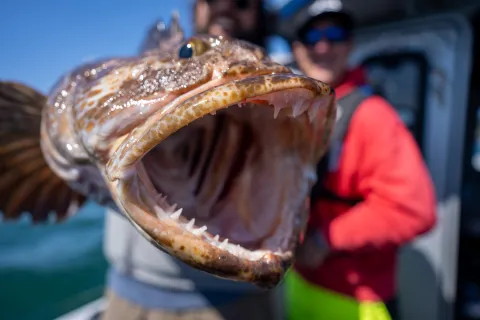
Our bottom fish range from large, dragon-like predatory fish like the Lingcod, to the massive halibut, which can get well over 200 lbs. In some cases, you can catch these fish from shore, but most often a boat of some sort will be necessary for success in these fisheries.
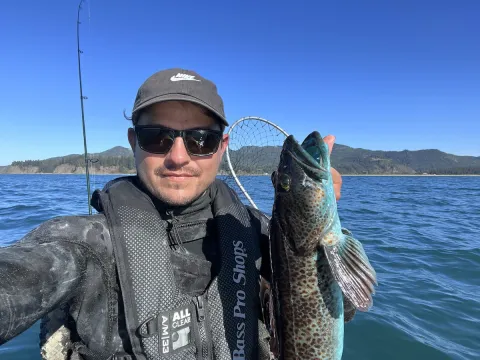
Lingcod
Straights of Juan de Fuca
Marine areas 6, 5, and 4 along the Straits of Juan de Fuca all provide great opportunities for lingcod. In MA 5, you can launch a boat at Clallam Bay from the town of Sekiu at Mason’s Resort boat launch. From there, you can head west towards Kydaka Point, where ample amounts of rocky underwater structures and reefs hold healthy numbers of lingcod. Soft plastics work well here, but if you're aiming to land a giant, try hooking up a small greenling as bait and sending it down to the bottom.
Puget sound
Conservation efforts make the Puget Sound a much more restrictive area to target lingcod. The 2026 season runs from May 1st through June 15th and allows the retention of 1 fish per day. Size restrictions are in place as well, and you can only keep lingcod that are between 26 to 36 inches. Possession Bar, Tavola Shore, and Alkai Reef all hold lingcod.
Cabezon
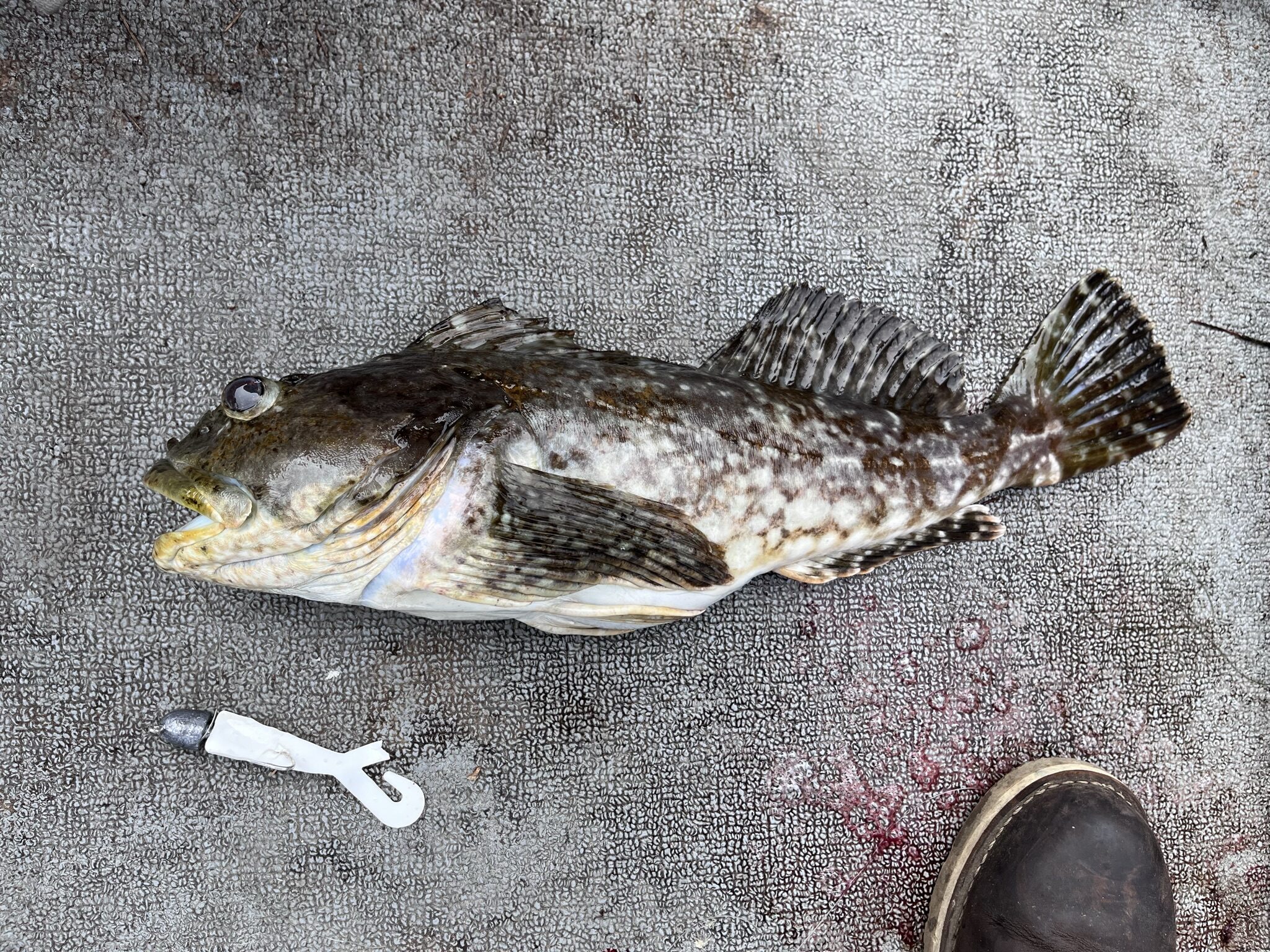
The cabezón. Loosely translated to “large head”, is aptly named for this exact reason. Cabezons, when larger, have giant heads and are built like a tank. When hooked, they will take off with your line and head-shake like a large lingcod. They’re a blast to catch and can be found all over the Straits of Juan de Fuca and the Washington coast. My favorite spot to fish for these is near Hobuck Beach in Neah Bay. This spot can be accessed via shore if you are using a kayak, otherwise you will have to launch your boat from the Big Salmon resort in Neah Bay.
Rockfish
Westport
Rockfish are abundant all throughout the Straits of Juan De Fuca and the Washington coast. With that said, if you’re looking for easy access, Westport provides a unique opportunity to catch these fish off of their one-mile-long jetty at Westhaven State Park. If climbing the rocks isn’t your thing, you can also hop on board one of the many charter boats that take off from the Westport marina to target salmon and bottom fish.
Halibut
Pillar Point
Pillar Point is about 15 miles east of Sekiu and has a small boat launch that is favored more by kayakers than those with larger vessels. For those looking for a larger boat launch, this area can be accessed by launching out of Sekiu and motoring east. A long sloping underwater ridge provides prime habitat for halibut, and it’s not uncommon to see 80+ lb halibut pulled out of this area.
Greenling
Neah Bay
The old Snow Creek resort on the northern part of the Straits of Juan de Fuca, just outside of Neah Bay, holds healthy populations of Kelp Greenling. Though these fish are often thrown back by anglers targeting lingcod or rockfish, they are incredibly tasty and can be found in the kelp beds only a few hundred yards offshore. This area is open year-round for kelp greenling so long as you stay east of the Bonilla-Tatoosh line.
Flounder
North Hood Canal
The flounder fishery is often overshadowed by some of the larger game fish species in the Puget Sound, yet these fish offer a fun year-round fishery that can be a great way for kids to get excited about fishing while at the same time making for excellent table fare. Flounder are found all throughout the Puget Sound and Hood Canal on sandy or muddy bottoms and are quite easy to catch using artificial sandworms, clams, or chunks of flounder meat. Dabob Bay, just south of Quilcene, is the only part of the Hood Canal that is open to flounder fishing. The bay can be accessed via the Quilcene Bay boat launch to the north or Tritan Cove boat ramp to the south.
South Puget Sound
If fishing the Puget Sound, you can find flounder in large numbers in MA 9 at Jeff head or fishing from the shore at Point no Point in Hansville. Further south in the South Puget Sound, good flounder fishing can be had at Dash Point in King County, where a fishing pier and easy kayak is launching from the beach. Going further down towards Olympia, you can find flounder from Dana Passage to Boston Harbor. Always check the Department of Health’s website for current information on flounder consumption safety guidelines.
With many bottom fish seasons opening this spring, and the year-round opportunities that these fish provide us with, there’s never a wrong time to get out there, get your cooler filled, and enjoy another one of our great fisheries here in the Northwest.
/articles/washingtons-bottomfish-bounty
Successful Bottom Fishing Strategy in the Pacific Northwest
Halibut, lingcod, and rockfish are the top three species of bottom fish here in the Pacific Northwest.
There are three main methods for targeting bottom fish, and the cool thing is that the tactic you use is more dependent on the depth and environment you’re fishing in, rather than the species itself. All species can be found in virtually any depth in the ocean. In fact, many of the biggest lingcod I have ever caught have been in less than 50 feet of water. This means that if you know your water, you can choose a tactic that will give you the best chance at success.
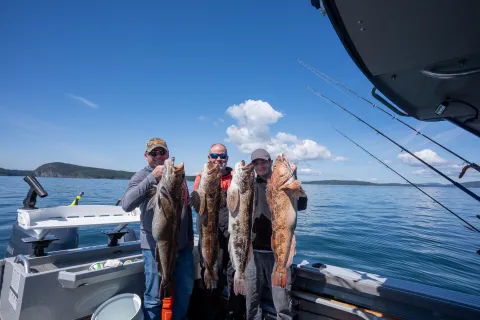
Tactic number one: Live bait rigs. Live bait is the most natural presentation to a fish. As the name implies, you need an actual prey item connected to your hook, and this often elicits the most aggressive feeding response. The flip side is that you have to spend considerable time catching bait. Additionally, it can be difficult to keep your bait alive throughout the day. I have found that live bait rigs work best when targeting ling cod on reefs that are under 150’ deep.
Ling cod will readily take live bait of nearly any size, and often do not even need to be hooked to bring them to the boat. To decide between large and small bait, know your area. If you are fishing a particularly busy reef with lots of rockfish, and you are not allowed to keep them, try to use larger baits such as greenling or other sculpin to keep bycatch to a minimum.
The best live bait rig I have ever seen, I learned from John Kerrigan of Seeking Limits Guide Service out of Everett, WA. John’s rig is devilishly simple. It consists of a sliding weight system where the plastic slide is connected to the weight with a rubber band, and it is stopped by a swivel to a leader (photo below). The rubber band keeps you from losing an entire rig if your weight gets stuck, and the swivel will keep the live bait tangle-free. Give it a try with surf perch on a single hook rig, or sand dabs and greenling on a double hook rig.
The second bottom fishing method is jigging with soft plastics. This method allows you to go right out to the fishing grounds. Oftentimes, the soft plastic jigs come pre-rigged, so all you have to do is tie them onto a 50-pound mono leader and drop it near the bottom. My absolute favorite for jigging soft plastic is a Fisherman’s Gold Electric Eel jig. (photo below). It has caught absolutely everything from giant 50-pound lingcod to limit after limit of rockfish. The only consideration is how heavy and how big you want your plastic. Obviously, using a 32 ounce 12 inch eel won’t be the right choice for rockfish, but if you’re shallow, there is little better than catching black rocks on a 1 or 2 ounce eel. Fishing soft plastics is the most versatile of the 3 methods. You can fish them light or heavy, large or small, shallow or deep. Soft plastics can struggle in areas of intense pressure and is most difficult in areas where there are lots of toothy bycatch, such as arrowtooth flounder or dogfish that can tear up your bait.
The last method is a combination of pipe jigs and unweighted soft plastics on a ganoin type rig. This method is great for deep drop fishing, particularly for halibut. The pipe jig not only allows enough weight for a rig in 500 feet of water, but it also can get chewed on for hours and not lose its efficacy. By running some unweighted plastics above the pipe jig, you can also take advantage of the extra color and action to bring fish to your rig. However, this method is really prone to snags, and can be expensive to lose if you are fishing the more shallow rocky reefs.
I typically pair this method with electric reels in deep water and on flatter bars in the open ocean. You can build a ganoin by using a 3-way swivel connecting the main braided line to one end, a 6 foot ganoin of heavy mono (80 pound or heavier) to one of the other sides, and lastly a short heavy mono leader connected to a large 12/0 J hook that you hook your eel or flounder plastic to.
Making a game plan for your specific environment is the best way to set yourself up for success. Always consider the time you have to fish, the depth at which you want to target, and the overall fishing pressure to help you decide between durable baits like pipe jigs or if a natural live bait is the right choice. Get out there and try it for yourself!
/articles/successful-bottom-fishing-strategy-pacific-northwest
Old School Catfishing
While some memories come and go, others stay with you for a lifetime.
One of my earliest fishing memories is of fishing on the Yahara River in the heart of Madison, Wisconsin. The river in this location was a channel that went from the Lake Mendota Locks, through the heart of the city, and a mile later emptied into Lake Monona. It was urban fishing at its finest, and as 12-year-olds we would look forward to fishing it often.
The day would start the night before, with a flashlight in hand my brothers and I would go into the backyard after dark and hunt for nightcrawlers. They always came out at night, and if one was stealthy, it would be possible to reach down and, pulling from the hole, ease out a plump crawler that was sure to be breakfast for one of the many species in the river. But pull too hard, and you ended up with half a crawler, which we would not keep as somewhere in our childhood brains we knew that putting in a broken crawler into the bait box would cause the other crawlers to die. I have no idea where we got that urban myth, but in any case, it caused us to be careful pulling those crawlers up.
The next morning we’d hop on our bikes and ride the three miles through Madison to reach our destination, and with any luck, our favorite spot was empty. This location had a small creek flowing from some ponds in the park into the Yahara River. The creek flowing into the larger river made for some good holding water.
Our rig of choice was simplicity itself. A hook and a couple of split shots 18 inches up, with a nightcrawler threaded onto the hook, and cast out into the river, along a seam from the inflowing creek. Let the bait hit bottom, tighten up the line, and watch for those first telltale jerks on the rod. Pickup said rod and set the hook. The tried-and-true Zebco 202 reel would squeak and moan at the weight of the fish on the end of the line. Sometimes a bass, walleye, or bluegill, but most often we would reel in a brown bullhead. On rare occasions, the excitement of a snapping or spiny softshell turtle would break up the morning’s procession of fish. These were always a joy for a twelve-year-old boy to catch.
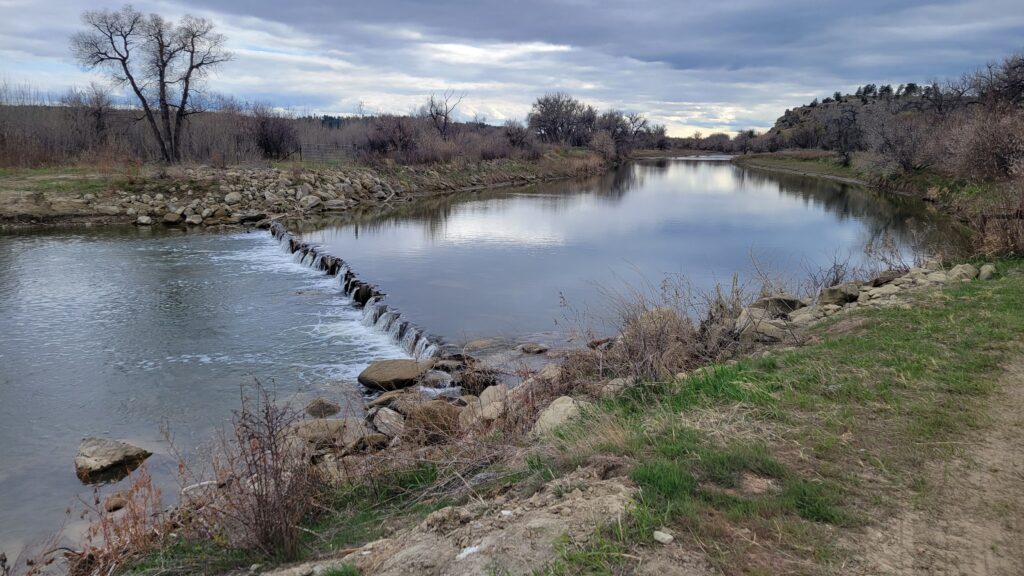
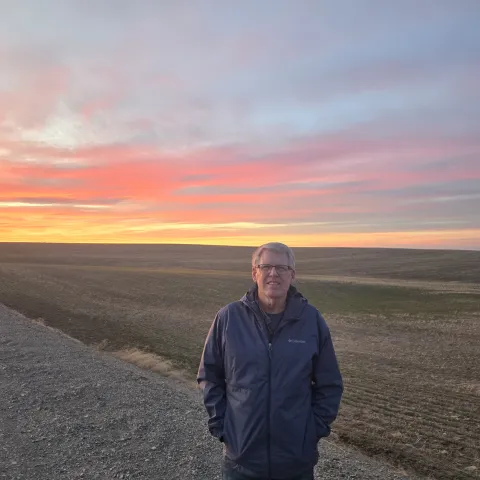
Fast forward 50+ years, my son Matt and I were heading to his father-in-law’s ranch on a spring turkey hunt. Years ago, Bill mentioned that the Musselshell River, which flows through his land, held catfish. After doing a little research I learned that indeed, the river in this area was well known to hold nice cats. The Musselshell flows from the small town of Melstone another fifty miles or so and empties into the Missouri River at the point where the river widens to form Fort Peck Reservoir. This stretch of water is known as the “warm water zone”. Catfish work their way up the Musselshell for spring spawning and live in the many deep holes the river has as it twists and bends through beautiful prairie and wooded hillside. Bill told me that cats in the 10-15 pound range can be caught, but 4-6 pounders were more common. Stopping their upriver passage is the Davis Diversion Dam, downstream for the town of Roundup, which we would be fishing below.
After a leisurely drive from Great Falls through ever-changing prairie land and wooded hillsides, I arrived at Bill’s ranch. Grabbing a quick dinner, I followed Bill as he drove along a gravel road to a prime spot on his land. Deer darted away from us, and turkey leisurely ate their dinners in the recently plowed fields. I had to resist the worry of someone being in “our spot”. The land is private property, so unless one of his neighbors were fishing there it would be devoid of other anglers. After living in Washington for thirty years I’m still getting used to the concept of being able to fish with no one around me!
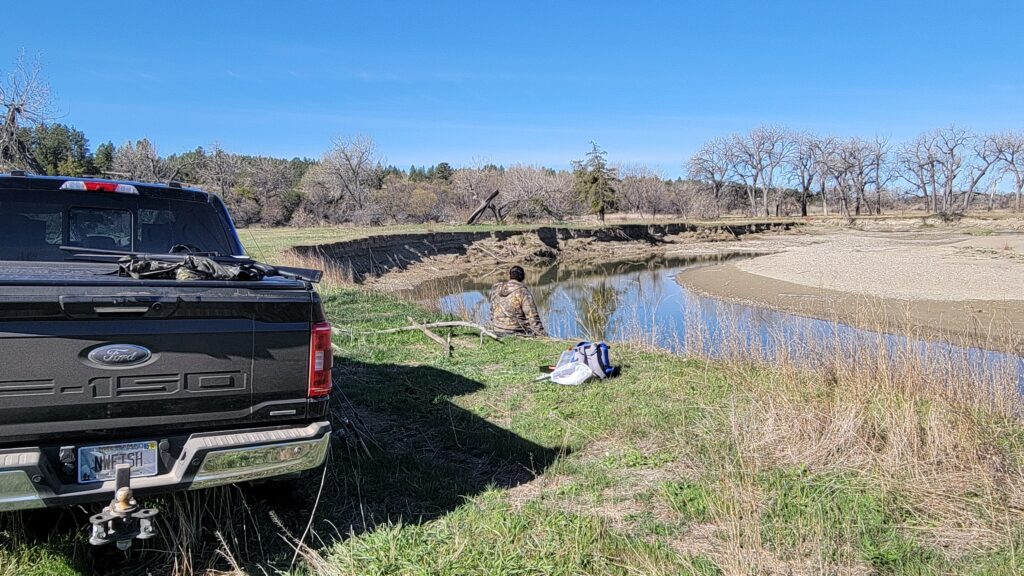
We arrived at an irrigation dam that had a beautiful hole below it and a clean river falling over the top of the spillway. As Bill drove off, I pulled out my seven-foot medium-weight spinning rod/reel combo and, like the days of my youth, tied on a large bass wide-gap hook. Two feet above the hook and tied a barrel swivel, and above that a sliding 3/8 ounce weight. For dinner, I was offering the fish down there a large, juicy nightcrawler.
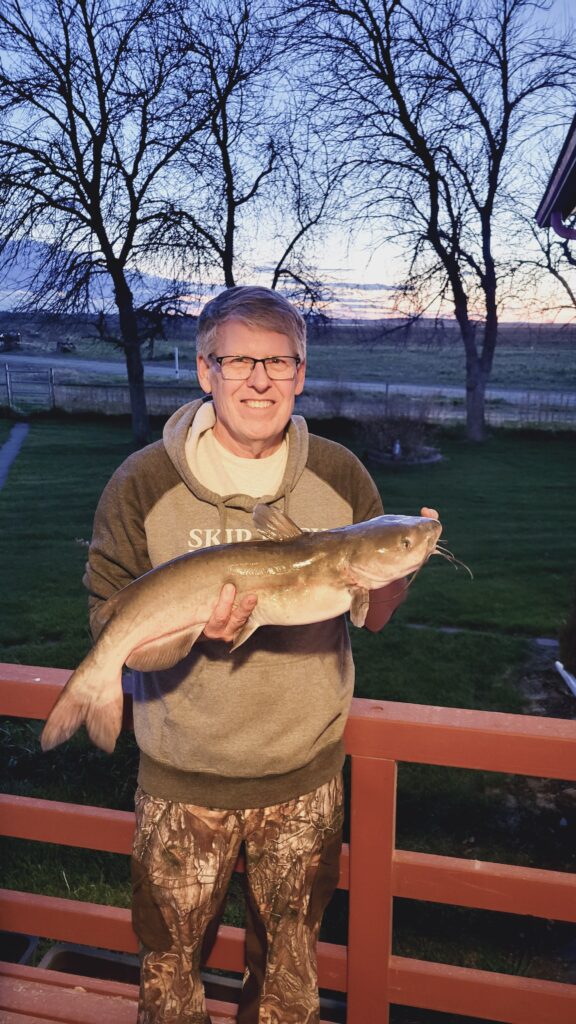
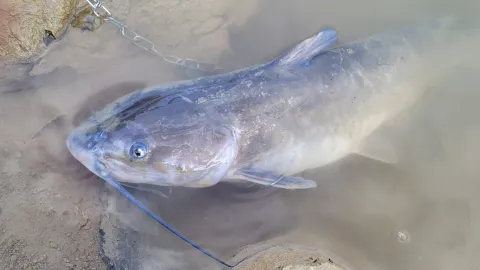
My first cast landed two-thirds of the way across the river. I reeled in the slack line and found a broken branch to prop my rod up against. Within minutes the rod tipped started to twitch, and then took a wild bend that started to pull the rod towards the river. I grabbed my rod and felt a solid fish on the other end of the line. The fish made several strong runs in the current and then settled down to a battle of tug of war with me. Working him ever closer to the shoreline, I saw that my first Musselshell fish was indeed a beautiful catfish! I found a sandy area of shoreline and dragged the fish onto land. What a beauty!
I re-baited my hook and cast it out to the middle of the river again. After a few minutes of waiting my rod again doubled over from the pull of a large fish. Setting the hook, this time I noted a different fight, and sure, enough, had a beautiful smallmouth bass on my line. Bringing in the fish I admired him, looking to be a solid 4 pounds. I released Mr. Smallmouth back to the river. With the sun beginning to set I decided to call it an evening and get back to the ranch before dark.
Arriving at Bill’s ranch my son Matt was there, having driven from Helena. “How’d you do”? they asked me. Pulling out the catfish from my cooler, Bill looked at it and said, “That’s a nice one, I’d say about ten pounds”. Matt’s eyes got wide and he asked, “When do we go?”
The next day’s sunrise was a classic Big Sky Painting, with red and yellow hues breaking over the trees. We had been shadowing a group of about thirty turkeys, trying to keep below a ridge that separated us from the turkeys between the field and the river. Finding an opportunity for an ambush location, we set up and started calling the mix of hens and gobblers toward us. Donn Morse of Old Goat Lures is also an avid turkey hunter and had given me a couple of the 3D pot calls that he makes and sells. The pots have great tone and soon several turkeys started our way. And then stopped. Dismayed, we watched the birds turn and head for the river, flying across to safety.
Returning to the ranch Bill had prepared for us a breakfast fit for a, well, a rancher. We made plans for the day, deciding to visit some friends and hitting the river after dinner for an evening bite.
I was excited to be fishing old school with Matt. Our lifetime fishing experiences had generally been from a boat, and I couldn’t recall bank fishing with him before. It gave me pause to think how sometimes possessions and technology can rob us of something so simple by making it complex. All the tools we use for fishing from a boat are certainly important, but there is just something about sitting on a bank and soaking a worm, waiting for a bobber to get pulled underwater, or seeing a rod tip twitch, knowing that on the other end, some kind of fishing is preparing to make your bait his meal.
After dinner we headed over to our fishing hole, passing groups of turkeys teasing us in the fields. They would have to wait for another day, we were Tom Sawyer and Huck Finn, our fishing rods and a box of worms in hand, looking for the perfect piece of forked tree branch to serve as a rod holder.
Matt baited up and cast out, and in a matter of minutes announced that he had a bite. Tightening down on the line, he set the hook and reeled in his first Musselshell catch, a nice smallmouth bass.
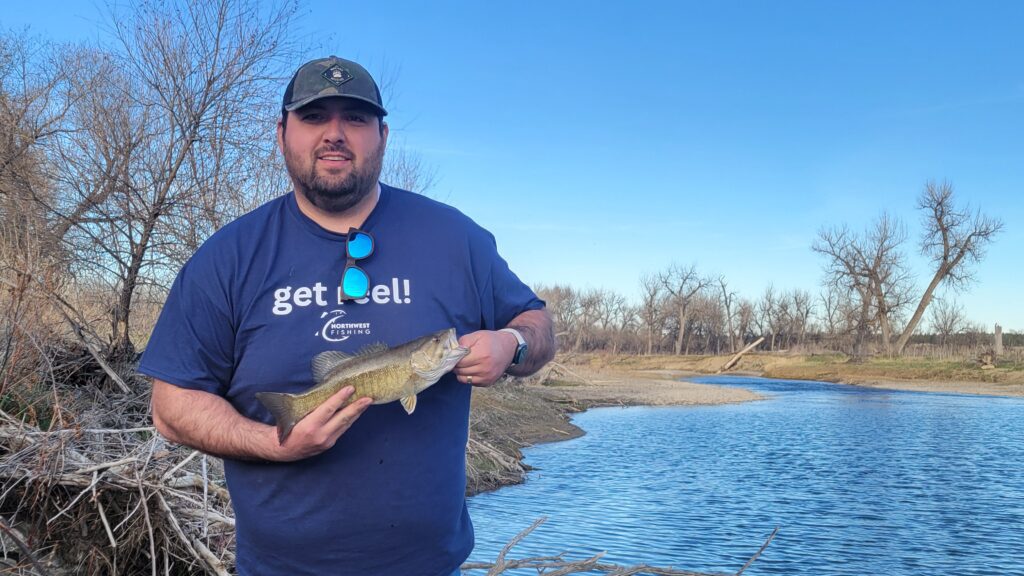
And so, the evening went on. Matt and I were kept busy with a steady evening bite. The smallmouth were most active, and we caught around a dozen ranging from dinks to nice 2-3 pounders. Thrown in the mix were plenty of yellow eye, which is a Montana version of a giant herring, around 12” in length and very spunky to catch. Sadly, the catfish bite was dead. No worries, though, with the Missouri River as our backyard there will be plenty of new places to explore the next time we decide to go “Old School” fishing.
/articles/old-school-catfishing
Fishing for Washington’s Stocked Rainbow Trout
Spanning through the past 130 years or so, Washington’s lakes have been stocked with a variety of fish species. The types of fish typically fall under two categories, the first being game fish like rainbow trout, Kokanee, steelhead, and cutthroat. These are all planted for the specific purpose of increasing public angling opportunities. The second category would be an aquatic vegetation control fish like the common carp, that was planted primarily by private landowners intending to mitigate overgrowth of vegetation in lakes and ponds. Regardless of the purpose of fish stocking, the practice has generated various stages of controversy throughout the years, and rightfully so as the early versions of fish stocking had been practiced without much consideration of ecological impacts on native fauna. Thankfully, the days of reckless and illegal stocking of ecologically sensitive lakes by private citizens are, for the most part, a thing of the past in Washington state. Nowadays, The Washington State Department of Fish and Wildlife and local tribes operate stocking programs that involve strict management guidelines and make use of both surveying and long-term field studies to effectively provide anglers with fishing opportunities while not disturbing vulnerable ecosystems.
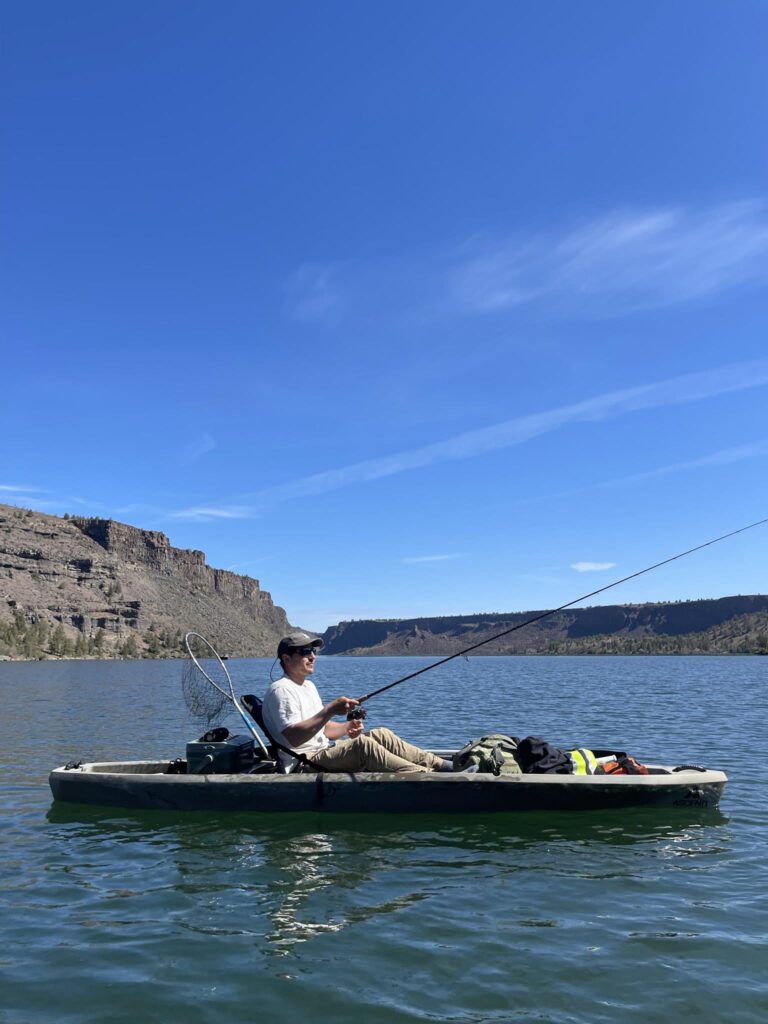
Rainbow trout are by in large the most widely stocked fish in Washington lakes, thus, they are the most common trout targeted by Washington State anglers. And though a stocked rainbow trout from a local lake might not be quite as alluring as say, a wild rainbow trout from some remote stream in the high-country wilderness, comparing these two is a bit like comparing apples and oranges. One can consider these stocked fisheries to be the staple of a lifestyle that places high value on family-friendly outdoor recreation, whereas the wild fish pursuit is an activity that often takes a bit more work and travel, and isn’t always quite as easy to get the family involved in
So, each has its place, and lucky for us, springtime marks the beginning of the trout stocking programs around the state. There’s a good chance that if you live on either side of the cascades, you won’t be far from a lake that’s getting a dump of catchable-sized hatchery-reared rainbow trout right about now. A visit to the Washington Department of Fish and Wildlife website will show you all of the recent catchable trout plants in Washington lakes. Here’s just a sample of some recent western and eastern Washington trout plant reports.
- Lake Thomas, Stevens County: 9,000 catchable trout
- Devereaux lake, Mason County: 7000 catchable trout
- Klineline pond Clark County: 10,000 catchable trout
- Black lake, Thurston County: 10,800 catchable trout
- Rotary lake, Yakima County: 3150 catchable trout
- Columbia Park pond, Benton county: 2012 catchable trout
There’s a myriad of techniques you can deploy to catch rainbow trout. Methods range from dropping jigging spoons down through a hole in the ice during the winter to casting flies out of a float tube in the summer. Stocked rainbow trout are not terribly picky and are known to strike at many different types of lures and bates. A surefire way to get some hookups would be to bring an arsenal of tackle so you can use the process of elimination in figuring out what the fish are biting on for that given day (it shouldn’t take you long). Below is a list of common techniques to catch stocked rainbow trout during the spring and early summer seasons.
Casting lures
This is by far my favorite method for rainbow trout. It’s simple in that you hardly need any gear other than rod, reel, and lure, but it also keeps you busy and engaged as you are constantly casting and retrieving while feeling for a strike. Casting lures like Rooster tails, spinners, spoons, wedding rings, and plugs have all proven effective at catching rainbow trout. Fishing during the morning and evenings when the fish are up near the surface will only increase the effectiveness of casting lures.
Trolling
Casting lures like the ones mentioned above can all be trolled behind a kayak or motorboat. If the fish are holding lower in the water column due to midday heat, try using a lightweight downrigger with a dodger. Or, if in a kayak, you can use a diver like a Deep 6 or Dipsy diver. Rainbow trout generally like faster trolling speeds around 1.5 to 2.0 mph
Sliding egg sinker rig.
This rig is very easy to set up and will get you onto the fish if they are holding deep towards the bottom of the water column. Slide a 1/2 oz egg sinker onto the mainline. Beneath that egg sinker attach a snap swivel. From there, attach your leader. Depending on how high off the bottom you want your bait to float will determine the length of your leader. 2-3 ft is generally a good bet. Tie your size 8-14 hook and bait it with a worm or dough bait. You will need to make sure your hook and bait are both floating. So, if you’re rigging an earthworm (or anything else that doesn’t float) you will need to add something with buoyancy. That can be either a small marshmallow (like the ones you’d buy from a grocery store) or a piece of buoyant dough bait.
Fixed Bobber
This is a fun and easy method for kids or new anglers to try out. Plus, it can also be extremely effective. Attach a fixed bobber to the mainline, and then anywhere from 18-24 inches beneath that a number 5 lead split shot (add more if there’s current). About 6 inches beneath that you can attach a size 8-14 octopus hook with a night crawler. Nightcrawlers can be replaced with a red plastic worm or dough bait.
Slip bobber rig
A slip bobber has a few more parts than a fixed bobber setup, though, unlike the fixed bobber, this setup will allow you to adjust your rig to virtually any depth. This is very handy for when the fish are suspended midway in the water column.
Add a pre-tied bobber stopper knot to your mainline. From there, add your bobber stop bead so that the bobber won’t slip past that knot. Add the slip bobber to the mainline, then add 1/2 oz egg sinker, and then a snap swivel. From here add 2-3 ft of leader and then your size 8-14 octopus hook. Now you can put your gear into the water and start sliding your knot up the mainline to adjust the depth of your hook and bait.
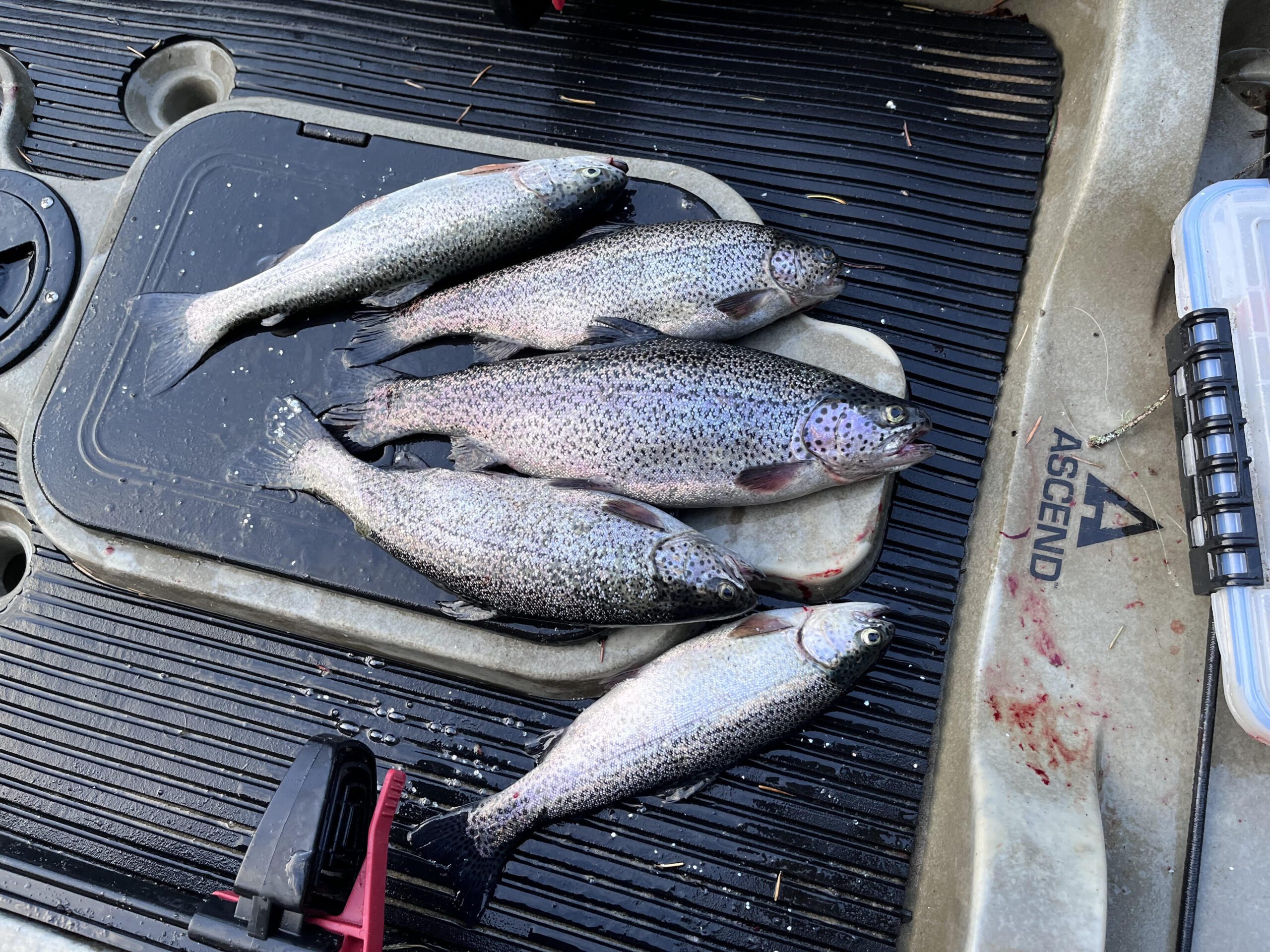
I’d wager that if you polled some friends and family and asked them what their first memories of fishing are, a good portion of them would likely start to share stories of fishing for rainbow trout off a dock during a hot summer day, or out of a john boat cruising around the lake hoping to land a big silver and pink beauty. I know this is true for me, and I encourage anyone who has kids (or adults for that matter) who are new to fishing, to take them out to your local lake and try out some of these tactics to bring home some fish. Despite what anyone might say about stocked trout, I assure you, they make great table fair, and they also do very well in the smoker. Fish on!
/articles/fishing-washingtons-stocked-rainbow-trout
The State of Bottomfish
One of the most sought-after ocean-dwelling fish is the bottomfish, also called rockfish and groundfish. Anglers also refer to some of the species as “sea bass” as they resemble freshwater largemouth bass. Regardless of what you call them anglers who target these fish all call them “tasty” which is why they are so popular. But do not expect the various species of bottomfish to take up a lot of space in magazines or flood your social media feed with lots of sea-bass photos and “how to’s”. Maybe it is because they are often a bycatch or used to fill the time between salmon bites or maybe it is because most daily limits offer enough fish to fill a freezer fast so anglers only fish for them a few times a year. If it is the latter, then be aware that regulations and fisheries are changing quickly.
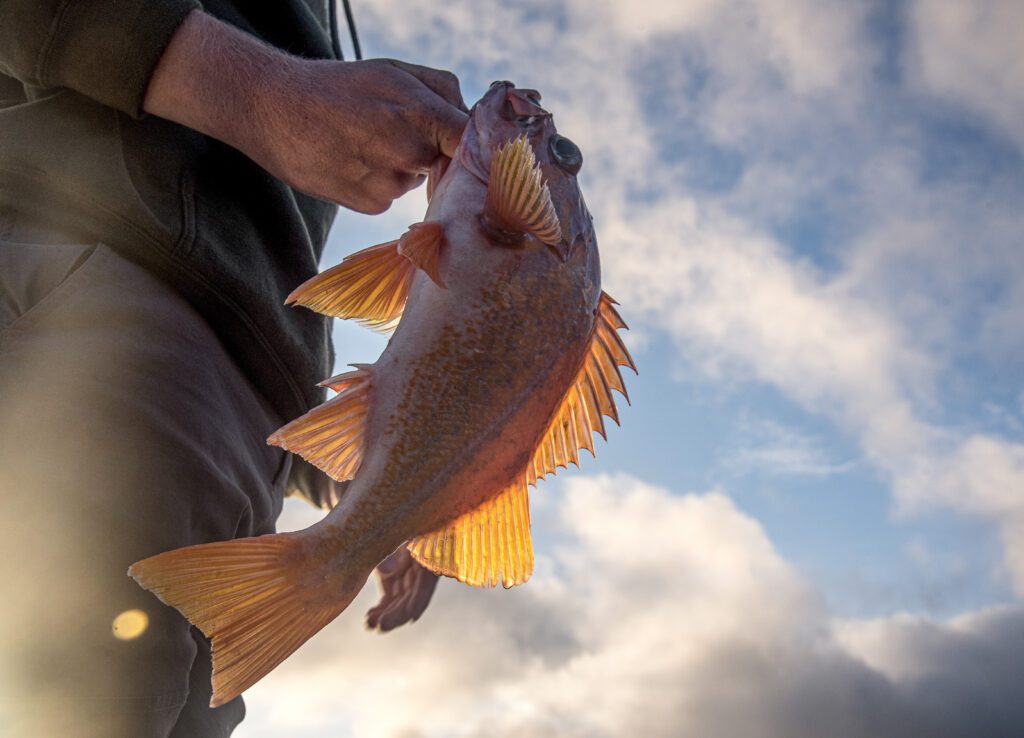
A few years ago, back in 2010, the yelloweye rockfish was listed on the Endangered Species List as threatened and remains there today in Washington and Oregon waters. This is because it is one of the largest rockfish species which means it lives an exceptionally long time, like over 100 years, with the oldest living yelloweye aged at 118 years and estimated to be able to live 147 years.
This long life means they mature slowly and do not reach adulthood until they are 19-22 years old. When it takes a species this long to mature, the over-harvest can be problematic. One of the saving graces for this species is that they live very deep, averaging 300 feet and can live as deep as 1,500 feet in the abyss. This is also a common detriment to most rockfish species and that is they are prone to barotrauma which is when the swim bladder becomes distended as the fish comes up from the high-pressure deep water. Using a descending device will help reduce mortality.
Like the yelloweye rockfish, most of the rockfish found in Puget Sound are off-limits due to the loss of species. There are some Marine Areas where rockfish can still be caught and kept including the ocean areas such as Marine Areas 1 through 4. Daily limits here were reduced a few years ago and now 7 rockfish of certain species combined such as black rockfish, blue rockfish, canary and vermillion, and a few other species.
Also new last year is a restriction for certain species between June 1st and July 31st, including copper, canary, and other popular species. There is also a depth restriction of 20 fathoms except for halibut days which can be a bit confusing. As of this writing the current regulations have not been published for the upcoming license season so be sure to check the WDFW website for updates.
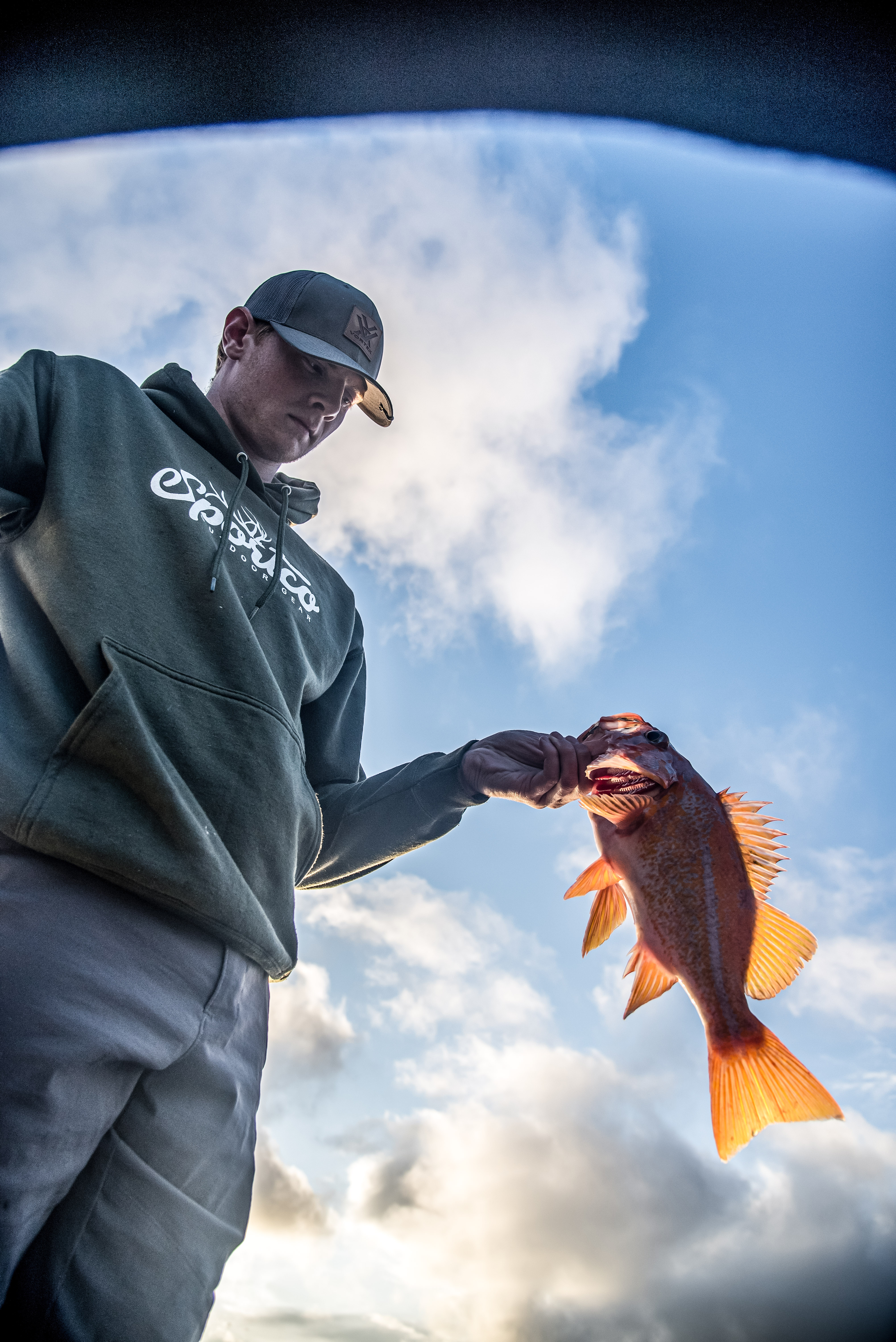
In Marine Area 5 which is the only other marine area where rockfish can be retained in Washington, the limit is 1 or 3 depending on which side of Slip Point you are on, and only black or blue rockfish can be kept. You also must use barbless hooks, even for non-rockfish bottomfish, such as halibut and lingcod which most anglers do not realize is required. After a quick chat last year at the dock at Sekiu with a WDFW Game Warden we learned that the only thing she wanted to check was our hooks. Not worried about our licenses or catch record cards, she just wanted to make sure we were using barbless hooks in the halibut we caught.
The last one had swallowed the bait and hook, and it was easier to just cut the leader, so we obliged and allowed her to cut the hook out which was barbless, and she was happy. Turns out that anglers did not know about the new rule, so it was more of a day of education for them. Luckily, we knew the rules. We also showed our licenses and catch record cards just to really put an exclamation point on following all the rules. She was thankful and it was a good interaction, always a plus when talking with WDFW staff.
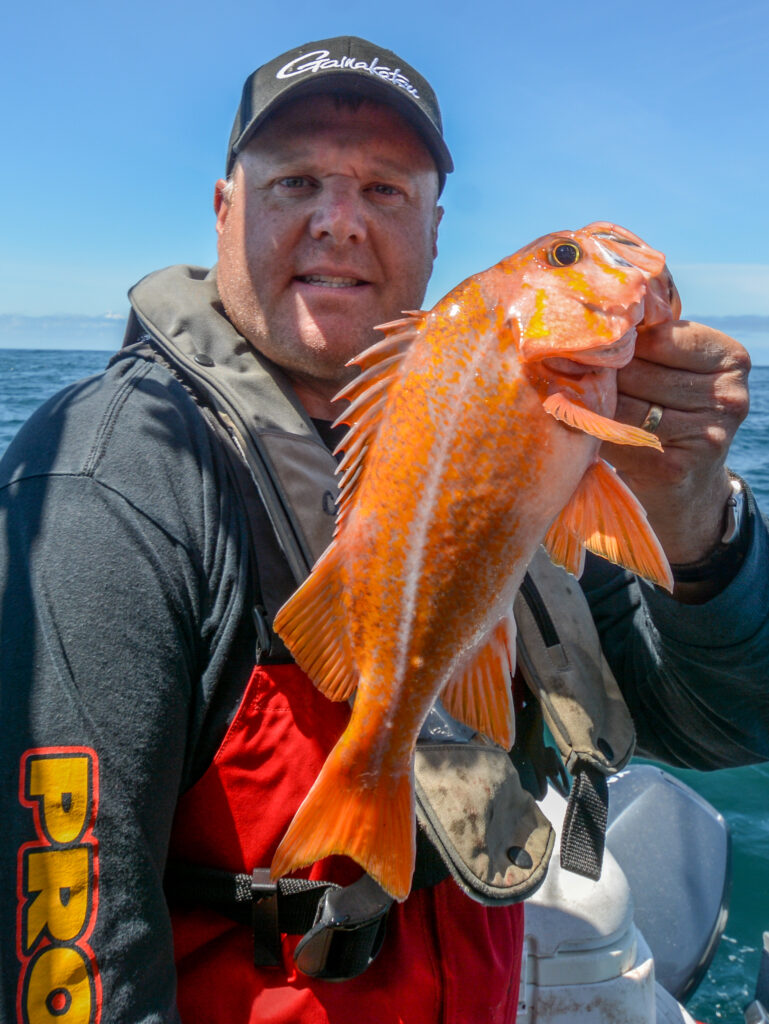
Oregon has simplified regulations compared to Washington but has even more restricted bag limits. As of now, the season is open year-round with no depth restrictions but a daily limit of 5, as well as a coastwide closure of yelloweye and quillback rockfish. Oregon also has a unique gear restriction when fishing deeper than 40 fathoms which is the use of “long leader” gear. Their website has tutorials on what this means and how to rig it. As always be sure to check current regulations before you go out fishing.
Both states have safety zones or rockfish conservation areas which are off limits to fishing for rockfish or any bottomfish. The reason for these conservation areas is to set aside a breeding and nursery area of sorts where rockfish are threatened, including the yelloweye. All rockfish species take a while to mature and since they tend to school up and live along structures such as underwater pinnacles, reefs, and rocky ledges they can be easy to locate and target.
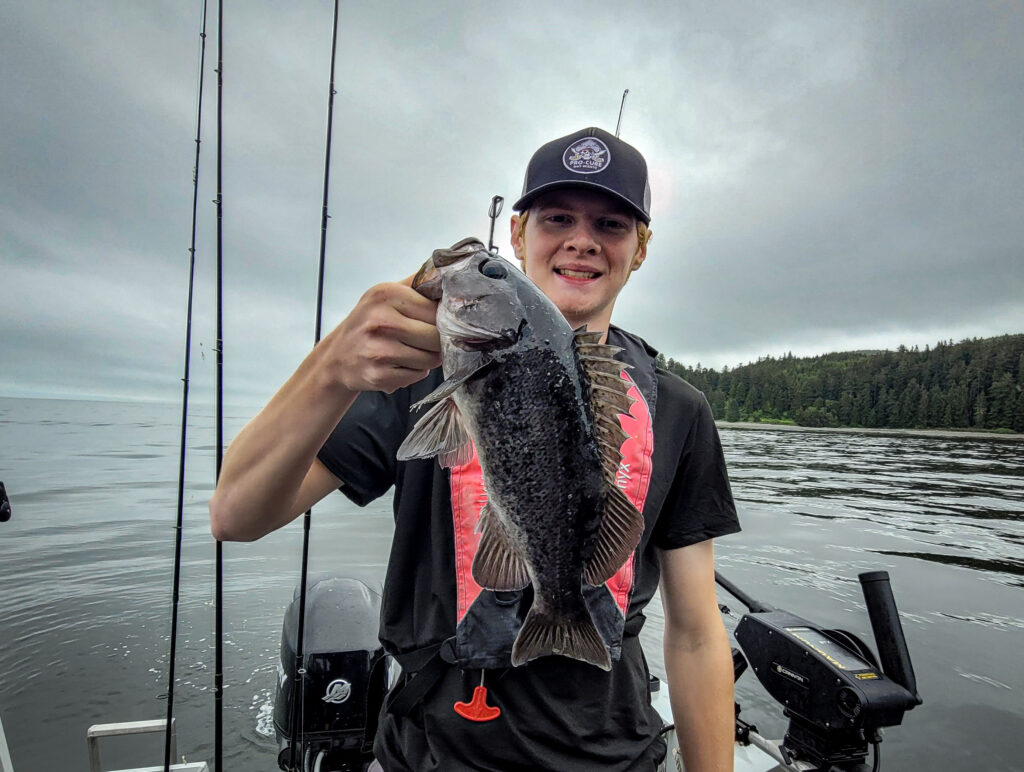
The Pacific Fishery Management Council keeps tabs on various fish species along the west coast including groundfish. Since these fish live a long time and can be subjected to over-harvest the Council provides a stock assessment and guideline regarding certain fisheries. When it comes to bottomfish, which again they refer to as groundfish, the Pacific Fishery Management Council realizes the importance of these fish. Popular in both commercial and recreational fisheries, bottomfish are prized for their great eating and provide a valuable economy to the fishing industry.
A quick walk around the boardwalk and harbor in Westport, Washington does not take long for someone to see how many charter fishing boats there are. Offering an opportunity for anglers who do not own a boat or have the savvy to head to the open Pacific Ocean, anglers can book a day trip on one of the many charters and have a good chance at catching some tasty rockfish. This is the same for every seaside town up and down the Washington and Oregon coast, and several towns in California.
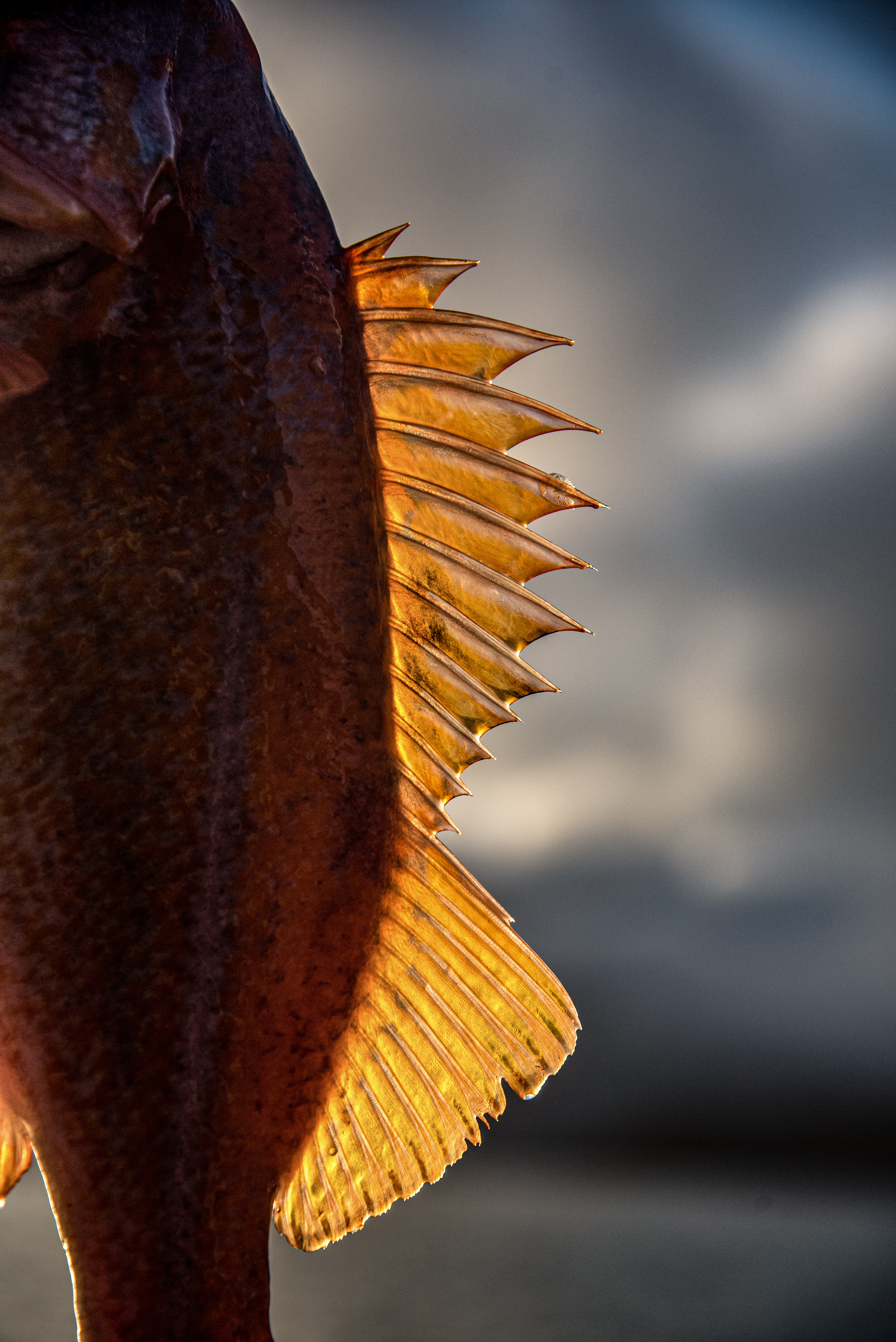
Keeping management goals of conservations, economics, and utilization of these fisheries the Pacific Fishery Management Council establishes objectives for each management goal outlined for the Pacific Coast groundfish. Taking in everything from gear used by both commercial and recreational anglers to social and economic impacts. Knowing that groundfish populations can be affected by several factors including areas where caught, as fish can be migratory the need for such a council helps track bottomfish and their populations.
If all of this seems a bit confusing that is because it is, and it is because bottomfish are highly sought after and they can be overfished. Anglers need to realize this and respect the fish population accordingly. Keep a descender device onboard, as required by regulation but also know how to use it. When you catch an undesired species then use the device. Also know your own limits, just because you can keep 7 fish per day does not mean you should keep that many.
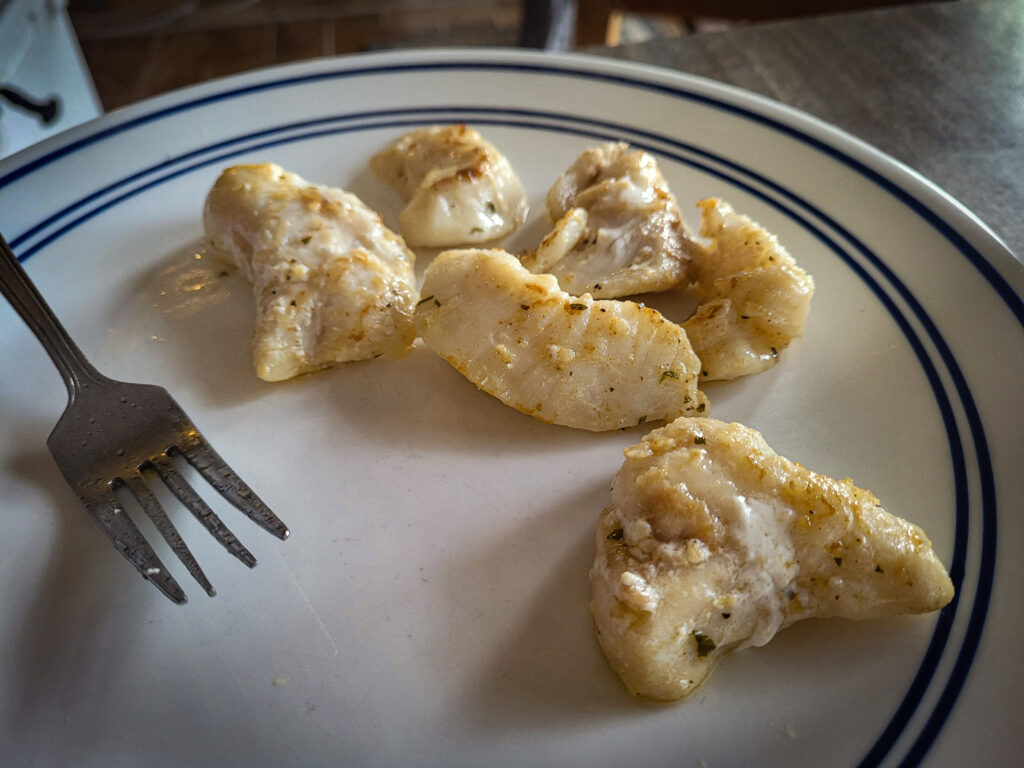
A few years ago, while on a multi-day vacation at Neah Bay my son and I went out and limited on rockfish. Between the two of us that was 14 fish, and we also caught some salmon that day and our lingcod we came back to the dock with nearly 20 fish to clean and fillet. That made for a long day, and we decided that the rest of the trip would be spent salmon fishing and that only if it were a slow day would we switch to bottomfish. Even then we kept our personal limits to what we wanted to clean that day, and by our third day we decided we had more than enough white flakey fillets for our trip. The last two days were spent trolling for salmon and watching local wildlife. Rockfish are delicious and fun to catch but make sure to catch responsibly.
/articles/state-bottomfish
Little Boat in Big Water
Chasing Fish in The Straits of Juan De Fuca
As summer winds to an end, readers are likely anticipating glorious tales of monster sized salmon bending rod tips over the sides of boats, while adrenaline filled anglers run about with nets in hand, hoping to assist a buddy in bringing the big-one aboard for a well earned grip-and grin photo of a lifetime. This story, regretfully, does not end in such a manner. The story does, however, dispel some myths about importance of boat size, shares some boating safety advice that pertains to smaller boats, and ends with a nice haul of tasty fish (the type that are more suited for a fryer rather than a smoker).
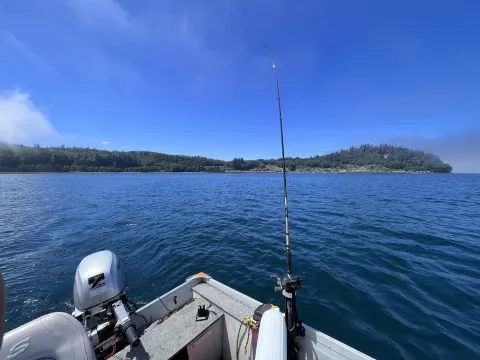
It was Saturday morning in the Sekiu village, and the gentle waves of the incoming tide at Clallum bay woke me in my tent at Masons Marina. Thick marine fog typically blankets the waters from Sekiu to Neah Bay during the summer mornings, however, the start to this day greeted me with glassy calm seas, and blue skies that extended from Masons marina, all the way north, across the straits, and to the mountainous shores of Victoria B.C. It was perfect weather, and it helped ease the nerves that had been accumulating over the past two days as I obsessed about all of the things that could possibly go wrong in a small boat out on the big water.
My boat is a V-hull 2008 14’ Smoker Craft Pro Mag with a 20 HP Honda. It’s a good little boat, equipped with a live well, an electric trolling motor, navigation lights, and a backup 6 hp Suzuki that I keep onboard in case of emergencies. I take her out often, with most of my destinations being on the Puget Sound, Hood Canal, and various lakes in my region. But, as with many others that own boats similar to mine, the thought of taking a small boat out onto water that behaves a lot like the ocean never really crossed my mind. Boating is fun, until it isn’t. And I’ve always figured it was better to avoid a bad situation than to plop myself directly into one. It wasn’t until I was on the Hood Canal that a friend told me about Sekiu, and how anglers were easily catching their limits of chinook and coho up there, that I began to put more thought into the idea. Thus, a seed was planted. As I researched and asked around, I found that it was actually quite common to take smaller boats out around Clallum bay. In fact, 14’ kicker boats were at one time the most common sport-fishing boats seen on the water. At least, that was the case in the 1940’s, when most people weren’t towing around larger boats and instead opted to rent the 14 footers from the marinas. The marinas still rent boats of this size today, most of them equipped with 15 HP outboards.
Sekiu is the quintessential small fishing town. It has two main marinas (both with campgrounds), a handful of motels, a cafe, a restaurant, and plenty of fishing tackle. The town got it start as a salmon cannery back in the late 1800’s, but after regulations ceased to allow commercial fishing, the cannery business crashed, and Sekiu had to look to other industries like logging, hide tanning, and sport fishing. The latter of the three being the one that worked, and oh did it work well. The fishing is world-class, and seldom will you find anywhere outside of Alaska that has this type of salmon and other saltwater fishing. The unincorporated community is situated right inside Clallum bay, in the northwestern portion of the Strait of Juan De fuca. The bay itself, and just west of the bay, enjoys decent protection from S,SW,W, and NW winds. Once you head further towards the ocean or out north into the open water, you become more exposed to the common west and northwesterly winds. Luckily, you will find excellent fishing near-shore, or without having to travel too far west in the direction of the ocean. In fact, most fisherman catch their limits of salmon just west of the bay near what is known as “the Caves”. Two main summer-run salmon routes exist in the area, and those two routes follow near shore on the Canada side and near shore on the Washington side. This is an ideal situation for a small boat fisherman who doesn’t want to venture too far out into the open water.
When I motored out of the marina that first morning, I was a day behind on my already limited schedule. This had me fishing on an odd numbered day of the month. At the time, odd days were closed to salmon retention due to emergency regulations set by the Department of Fish and Wildlife. This meant that fishing for salmon that day was out of the picture. However, in Marine Area 4, just northwest of me, lingcod, rockfish, and other bottom dwellers were all very much on the table! To get to these, I had to run about 5 miles west to Shipwreck Point just east of Neah Bay. So, with calm waters on my port side, I gunned it west towards the MA-4 boundary line. The swell and wind forecast for that day were predicted to be favorable up until around 1pm, and so far, the predictions seemed to be holding up. My little boat planed quite nicely heading out with the ebb tide and gracefully skipped over the rolling swells. My first “yikes” moment occurred when I approached Kaydaka point. This large point that sits roughly 2 miles from the marina brings underwater structure out into the straits, and as a result, kicks up the wave height significantly. Though the increased wave size didn’t pose a significant threat to me, I still figured it was a good idea to run a bit further offshore to avoid the turbulence. It’s worth noting that points like these can present sea conditions that might not be tolerable for particularly small boats during rougher conditions.
The bottom fishing was hot within minutes of being inside the MA 4 boundary.
I fished a 2 oz jig head with a pearl white double tailed grub over some structure, and within minutes I was into some fish. A few good-sized lingcod found my hook, along with several rockfish and a beautiful cabezon that fought like a bull! All in all, the day was a success. I won’t bore you with the details of my next morning’s salmon trolling trip. I only had an hour to get it done, and let’s just say I’m still eating last season’s silvers from my freezer (and yes, some of it’s looking a little freezer burnt). But the success was had in that I made it back to the marina both days in one piece. And this wasn’t accomplished in a 30’ fishing boat that’s worth more than my life savings- nope, this was done in 14’ aluminum boat with a small engine and an even smaller backup.
Now, let’s talk the important stuff. Small boat safety. Is it safe to take a small aluminum boat onto the straits? It certainly can be! There are inherent risks that come with any type of boating, regardless of the boat size or the water that you are on. Risk assessment, risk avoidance, and preparation are all key components to keeping you safe on the water.
DISCLAIMER: I am by no means, an expert on boating safety. All I can do is share what works for me and what I have learned myself.
My first bit of safety prep comes well before I arrive at the marina. Fortunately for me, I have a work schedule that affords me the liberty to plan my trips around weather windows, so I’ll start by looking for consistently fair weather in the long-range forecasts. As I get closer to my desired departure dates, I’ll home in on the NOAA webpage and start looking at wind directions and speed, wind waves, then swell predictions (paying close attention to wave period or duration), and then tide charts. It’s important to know how wind, swell, and tide currents all work together to cause either rough or manageable conditions. I don’t have the page space to get into that here, but there are plenty of resources available online for anybody who wants to educate themselves on the nuances of ocean behavior. The calm waters typically occur in the morning, so be up and ready before sunrise. If the winds are predicted to pick up, say, by 1pm, then I’ll be heading back to the marina at least 2 hours before those winds are predicted to occur.
Safety equipment.
Before I leave the docks I want to make sure I have life jackets (I carry an auto-inflate and a standard), a waterproof radio, working navigations lights, at least two GPS devices, a manual bilge pump in case my auto fails, a well-tuned and properly functioning outboard motor, a backup kicker, flare gun, an air- horn, and a reflector to hang up in case of dense fog.
Aside from these things, I also try to scout out beaches nearby that would be suitable for beaching my boat in case a situation calls for it. This is definitely a last-ditch option, as the risk of damaging the boat on rocks is very present. So, will I be taking my boat my boat out to Sekiu again? Absolutely! I already have my next trip planned! Do larger boats afford more comfort and protection in the event you get stuck in some adverse conditions? They absolutely do. But, if a capable small boat is all that you have, and you have educated yourself on all the safety measures necessary, then there is no reason for you to wait till you get that 100k boat to go have some fun and catch fish in arguably the most productive fishing grounds in our region.
/articles/little-boat-big-water