Little Boat in Big Water
Chasing Fish in The Straits of Juan De Fuca
As summer winds to an end, readers are likely anticipating glorious tales of monster sized salmon bending rod tips over the sides of boats, while adrenaline filled anglers run about with nets in hand, hoping to assist a buddy in bringing the big-one aboard for a well earned grip-and grin photo of a lifetime. This story, regretfully, does not end in such a manner. The story does, however, dispel some myths about importance of boat size, shares some boating safety advice that pertains to smaller boats, and ends with a nice haul of tasty fish (the type that are more suited for a fryer rather than a smoker).
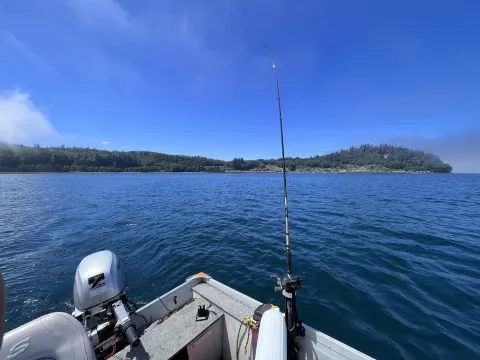
It was Saturday morning in the Sekiu village, and the gentle waves of the incoming tide at Clallum bay woke me in my tent at Masons Marina. Thick marine fog typically blankets the waters from Sekiu to Neah Bay during the summer mornings, however, the start to this day greeted me with glassy calm seas, and blue skies that extended from Masons marina, all the way north, across the straits, and to the mountainous shores of Victoria B.C. It was perfect weather, and it helped ease the nerves that had been accumulating over the past two days as I obsessed about all of the things that could possibly go wrong in a small boat out on the big water.
My boat is a V-hull 2008 14’ Smoker Craft Pro Mag with a 20 HP Honda. It’s a good little boat, equipped with a live well, an electric trolling motor, navigation lights, and a backup 6 hp Suzuki that I keep onboard in case of emergencies. I take her out often, with most of my destinations being on the Puget Sound, Hood Canal, and various lakes in my region. But, as with many others that own boats similar to mine, the thought of taking a small boat out onto water that behaves a lot like the ocean never really crossed my mind. Boating is fun, until it isn’t. And I’ve always figured it was better to avoid a bad situation than to plop myself directly into one. It wasn’t until I was on the Hood Canal that a friend told me about Sekiu, and how anglers were easily catching their limits of chinook and coho up there, that I began to put more thought into the idea. Thus, a seed was planted. As I researched and asked around, I found that it was actually quite common to take smaller boats out around Clallum bay. In fact, 14’ kicker boats were at one time the most common sport-fishing boats seen on the water. At least, that was the case in the 1940’s, when most people weren’t towing around larger boats and instead opted to rent the 14 footers from the marinas. The marinas still rent boats of this size today, most of them equipped with 15 HP outboards.
Sekiu is the quintessential small fishing town. It has two main marinas (both with campgrounds), a handful of motels, a cafe, a restaurant, and plenty of fishing tackle. The town got it start as a salmon cannery back in the late 1800’s, but after regulations ceased to allow commercial fishing, the cannery business crashed, and Sekiu had to look to other industries like logging, hide tanning, and sport fishing. The latter of the three being the one that worked, and oh did it work well. The fishing is world-class, and seldom will you find anywhere outside of Alaska that has this type of salmon and other saltwater fishing. The unincorporated community is situated right inside Clallum bay, in the northwestern portion of the Strait of Juan De fuca. The bay itself, and just west of the bay, enjoys decent protection from S,SW,W, and NW winds. Once you head further towards the ocean or out north into the open water, you become more exposed to the common west and northwesterly winds. Luckily, you will find excellent fishing near-shore, or without having to travel too far west in the direction of the ocean. In fact, most fisherman catch their limits of salmon just west of the bay near what is known as “the Caves”. Two main summer-run salmon routes exist in the area, and those two routes follow near shore on the Canada side and near shore on the Washington side. This is an ideal situation for a small boat fisherman who doesn’t want to venture too far out into the open water.
When I motored out of the marina that first morning, I was a day behind on my already limited schedule. This had me fishing on an odd numbered day of the month. At the time, odd days were closed to salmon retention due to emergency regulations set by the Department of Fish and Wildlife. This meant that fishing for salmon that day was out of the picture. However, in Marine Area 4, just northwest of me, lingcod, rockfish, and other bottom dwellers were all very much on the table! To get to these, I had to run about 5 miles west to Shipwreck Point just east of Neah Bay. So, with calm waters on my port side, I gunned it west towards the MA-4 boundary line. The swell and wind forecast for that day were predicted to be favorable up until around 1pm, and so far, the predictions seemed to be holding up. My little boat planed quite nicely heading out with the ebb tide and gracefully skipped over the rolling swells. My first “yikes” moment occurred when I approached Kaydaka point. This large point that sits roughly 2 miles from the marina brings underwater structure out into the straits, and as a result, kicks up the wave height significantly. Though the increased wave size didn’t pose a significant threat to me, I still figured it was a good idea to run a bit further offshore to avoid the turbulence. It’s worth noting that points like these can present sea conditions that might not be tolerable for particularly small boats during rougher conditions.
The bottom fishing was hot within minutes of being inside the MA 4 boundary.
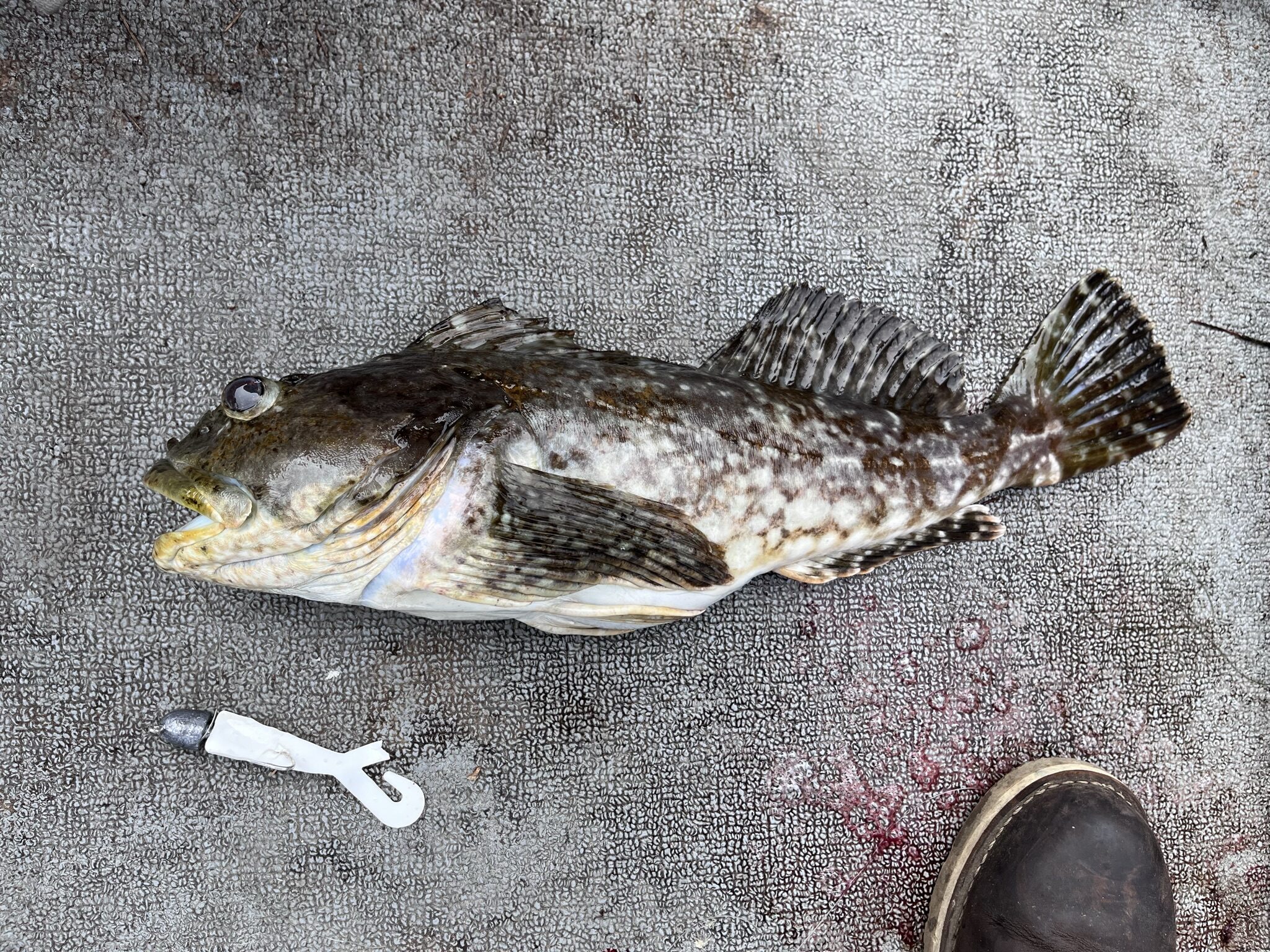
I fished a 2 oz jig head with a pearl white double tailed grub over some structure, and within minutes I was into some fish. A few good-sized lingcod found my hook, along with several rockfish and a beautiful cabezon that fought like a bull! All in all, the day was a success. I won’t bore you with the details of my next morning’s salmon trolling trip. I only had an hour to get it done, and let’s just say I’m still eating last season’s silvers from my freezer (and yes, some of it’s looking a little freezer burnt). But the success was had in that I made it back to the marina both days in one piece. And this wasn’t accomplished in a 30’ fishing boat that’s worth more than my life savings- nope, this was done in 14’ aluminum boat with a small engine and an even smaller backup.
Now, let’s talk the important stuff. Small boat safety. Is it safe to take a small aluminum boat onto the straits? It certainly can be! There are inherent risks that come with any type of boating, regardless of the boat size or the water that you are on. Risk assessment, risk avoidance, and preparation are all key components to keeping you safe on the water.
DISCLAIMER: I am by no means, an expert on boating safety. All I can do is share what works for me and what I have learned myself.
My first bit of safety prep comes well before I arrive at the marina. Fortunately for me, I have a work schedule that affords me the liberty to plan my trips around weather windows, so I’ll start by looking for consistently fair weather in the long-range forecasts. As I get closer to my desired departure dates, I’ll home in on the NOAA webpage and start looking at wind directions and speed, wind waves, then swell predictions (paying close attention to wave period or duration), and then tide charts. It’s important to know how wind, swell, and tide currents all work together to cause either rough or manageable conditions. I don’t have the page space to get into that here, but there are plenty of resources available online for anybody who wants to educate themselves on the nuances of ocean behavior. The calm waters typically occur in the morning, so be up and ready before sunrise. If the winds are predicted to pick up, say, by 1pm, then I’ll be heading back to the marina at least 2 hours before those winds are predicted to occur.
Safety equipment.
Before I leave the docks I want to make sure I have life jackets (I carry an auto-inflate and a standard), a waterproof radio, working navigations lights, at least two GPS devices, a manual bilge pump in case my auto fails, a well-tuned and properly functioning outboard motor, a backup kicker, flare gun, an air- horn, and a reflector to hang up in case of dense fog.
Aside from these things, I also try to scout out beaches nearby that would be suitable for beaching my boat in case a situation calls for it. This is definitely a last-ditch option, as the risk of damaging the boat on rocks is very present. So, will I be taking my boat my boat out to Sekiu again? Absolutely! I already have my next trip planned! Do larger boats afford more comfort and protection in the event you get stuck in some adverse conditions? They absolutely do. But, if a capable small boat is all that you have, and you have educated yourself on all the safety measures necessary, then there is no reason for you to wait till you get that 100k boat to go have some fun and catch fish in arguably the most productive fishing grounds in our region.
/articles/little-boat-big-water
Sharks. Who needs em?
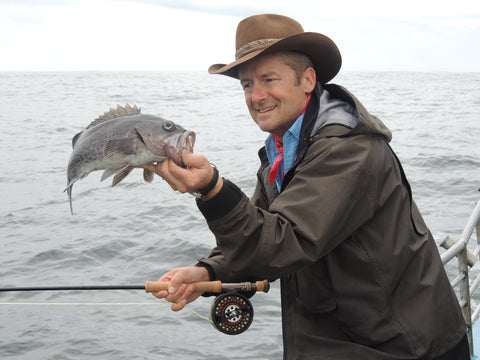
You’ve heard of Shark Week on Discovery CSharks. Who needs em? By Gary Lewishannel. This is not that. We booked two days on the F/V Miss Raven, a 43-foot fishing vessel out of Newport. Our mission was to find blue sharks in the deep blue, chum them to the surface, and stick them with feathers. We called it Shark Weekend. On board were my daughter Tiffany, Sterling West, Paul Galvin, Sam Pyke, Will Saunders and Mathew McFarland and his boys, Chisel and Finney. To catch sharks on the fly, Matthew McFarland prepared three rods, long sticks built to throw 10- to 14-weight lines, with steel leaders and bright feathered creations. Now all we needed were fins in the water.
We stepped aboard the Miss Raven and met skipper Mike Sorensen and his son Sean. Minutes after the safety meeting was over, the 300-horse John Deere diesel fired and we motored out of the harbor beneath the arch of the Yaquina Bay Bridge. When we crossed the bar, waves swallowed the lights of Newport. As dawn broke through the gray clouds, Sean threw the crab pots over and Mike marked them on the GPS. Then someone spotted harbor porpoises off the bow. For a few precious minutes, the porpoises ran ahead of the boat, their bodies briefly above the gray water, then beneath; twisting and spinning. And then as quickly as they had appeared, they peeled away. Twenty-three miles out, Mike cut the engine.
The Miss Raven bobbed in the deep swells that rolled through us. One moment we towered on a wave, the next we were in the trough. Here the ocean floor humped toward the surface. Here the baitfish congregate as well as the sharp-toothed predators that feed on them. Sean punched holes in a big kitchen wastebasket, then filled it with tuna heads and carcasses. Roped to the side of the boat, the basket milked tuna gore and soon we had birds above us - seagulls and albatross. Matthew and Paul rigged fly rods with steel leaders and big streamers. We watched the surface of the water for black fins. That was when we saw the sunfish. Ocean sunfish are a seldom seen species that make their living on jellyfish. They are as tall as they are long and can weigh up to 3,500 pounds. This one sunbathed at the surface and we were able to get a good look. In some languages they are referred to as moon fish, because of their shape. The Polish name means “head alone”; because it doesn’t have a true tail.
A school of 40 or so dolphins found us and ran through our greasy tuna chum line. They circled and came through again and again, breaking through the swells and flashing away below the boat. An albatross paddled nearby and took the fly in its beak. Then he dropped it. That was when I knew we would not catch a shark. The sharks had taken the weekend off. Out on the horizon, I saw a spout and then another.
A great barnacled beast breached, its great, gray body lifted above the surface. Foamy spray crashed out of the swell. In the afternoon, back in sight of the bridge at Newport, Tiffany dipped the hook and pulled in the first buoy. Sean put the rope on the pulley and we held our breath as the pot came into view, brimming with Dungeness crab. Minutes later, we took our stations, sorting males from females, throwing back the little ones. In the dark next morning, we motored south along the coast. Off Cape Perpetua, Mike Sorensen pointed out a watch station that was manned during World War II.
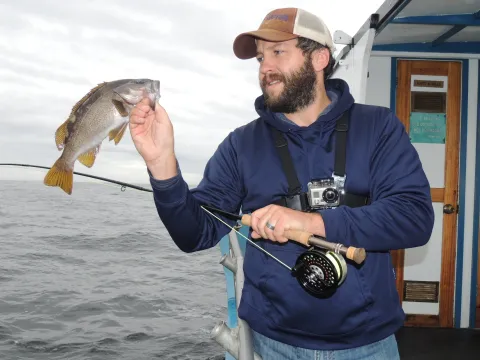
In range of the ghost coastal cannon emplacement, we drifted on a large underwater hilltop. Our jigs and flies bounced through a biomass of rockfish, and in moments, we had our first raw material for fish and chips. In one pass we had filled two-thirds of our limits. On the second drift, we had to call a halt and reel in. Multiple times we caught two rockfish in one cast. Once, we brought three fish aboard in one cast. We came away with a rich haul of crab and rockfish, but that sort of memory is quickly gone in melted butter and tartar sauce. We set out into the Pacific in the dark of the night and watched the sun light up the West Coast; we looked for one thing and found much more. Sharks. Who needs em?
/articles/sharks-who-needs-em