Washington's Bottomfish Bounty
Places like Florida, Texas, and Baja California are all celebrated for their tasty white fish like grouper, red snapper, and white seabass. While here in the Northwest, the fatty red or pink meat from a chinook or coho salmon is often what comes to mind when we think of seafood associated with our coastal and inland waters. The truth is, we also have all the necessary resources to make a mean fish taco. That is, the Pacific Northwest bottomfish.
Don’t let the name “bottom fish” give you the wrong idea about where they might fall on the Hierarchy of seafood delicacies. The bottom fish mentioned in this article make for excellent table fare and can be utilized for a simple fish fry, tacos, or can be combined with some of our abundant shellfish for a seafood stew like a Cioppino.
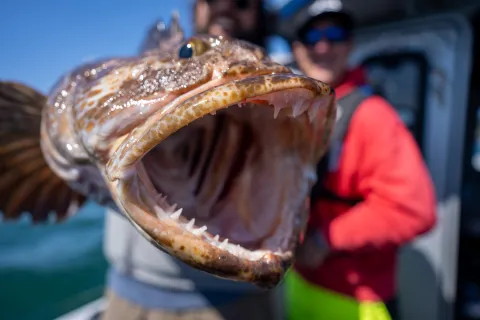
Our bottom fish range from large, dragon-like predatory fish like the Lingcod, to the massive halibut, which can get well over 200 lbs. In some cases, you can catch these fish from shore, but most often a boat of some sort will be necessary for success in these fisheries.
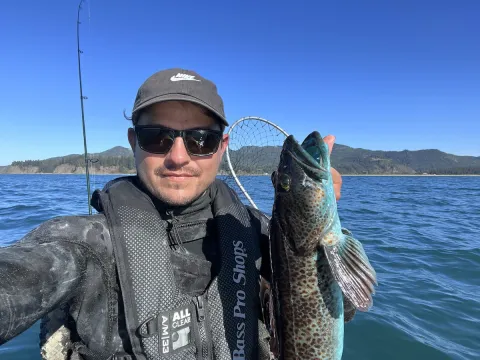
Lingcod
Straights of Juan de Fuca
Marine areas 6, 5, and 4 along the Straits of Juan de Fuca all provide great opportunities for lingcod. In MA 5, you can launch a boat at Clallam Bay from the town of Sekiu at Mason’s Resort boat launch. From there, you can head west towards Kydaka Point, where ample amounts of rocky underwater structures and reefs hold healthy numbers of lingcod. Soft plastics work well here, but if you're aiming to land a giant, try hooking up a small greenling as bait and sending it down to the bottom.
Puget sound
Conservation efforts make the Puget Sound a much more restrictive area to target lingcod. The 2026 season runs from May 1st through June 15th and allows the retention of 1 fish per day. Size restrictions are in place as well, and you can only keep lingcod that are between 26 to 36 inches. Possession Bar, Tavola Shore, and Alkai Reef all hold lingcod.
Cabezon
The cabezón. Loosely translated to “large head”, is aptly named for this exact reason. Cabezons, when larger, have giant heads and are built like a tank. When hooked, they will take off with your line and head-shake like a large lingcod. They’re a blast to catch and can be found all over the Straits of Juan de Fuca and the Washington coast. My favorite spot to fish for these is near Hobuck Beach in Neah Bay. This spot can be accessed via shore if you are using a kayak, otherwise you will have to launch your boat from the Big Salmon resort in Neah Bay.
Rockfish
Westport
Rockfish are abundant all throughout the Straits of Juan De Fuca and the Washington coast. With that said, if you’re looking for easy access, Westport provides a unique opportunity to catch these fish off of their one-mile-long jetty at Westhaven State Park. If climbing the rocks isn’t your thing, you can also hop on board one of the many charter boats that take off from the Westport marina to target salmon and bottom fish.
Halibut
Pillar Point
Pillar Point is about 15 miles east of Sekiu and has a small boat launch that is favored more by kayakers than those with larger vessels. For those looking for a larger boat launch, this area can be accessed by launching out of Sekiu and motoring east. A long sloping underwater ridge provides prime habitat for halibut, and it’s not uncommon to see 80+ lb halibut pulled out of this area.
Greenling
Neah Bay
The old Snow Creek resort on the northern part of the Straits of Juan de Fuca, just outside of Neah Bay, holds healthy populations of Kelp Greenling. Though these fish are often thrown back by anglers targeting lingcod or rockfish, they are incredibly tasty and can be found in the kelp beds only a few hundred yards offshore. This area is open year-round for kelp greenling so long as you stay east of the Bonilla-Tatoosh line.
Flounder
North Hood Canal
The flounder fishery is often overshadowed by some of the larger game fish species in the Puget Sound, yet these fish offer a fun year-round fishery that can be a great way for kids to get excited about fishing while at the same time making for excellent table fare. Flounder are found all throughout the Puget Sound and Hood Canal on sandy or muddy bottoms and are quite easy to catch using artificial sandworms, clams, or chunks of flounder meat. Dabob Bay, just south of Quilcene, is the only part of the Hood Canal that is open to flounder fishing. The bay can be accessed via the Quilcene Bay boat launch to the north or Tritan Cove boat ramp to the south.
South Puget Sound
If fishing the Puget Sound, you can find flounder in large numbers in MA 9 at Jeff head or fishing from the shore at Point no Point in Hansville. Further south in the South Puget Sound, good flounder fishing can be had at Dash Point in King County, where a fishing pier and easy kayak is launching from the beach. Going further down towards Olympia, you can find flounder from Dana Passage to Boston Harbor. Always check the Department of Health’s website for current information on flounder consumption safety guidelines.
With many bottom fish seasons opening this spring, and the year-round opportunities that these fish provide us with, there’s never a wrong time to get out there, get your cooler filled, and enjoy another one of our great fisheries here in the Northwest.
/articles/washingtons-bottomfish-bounty
Successful Bottom Fishing Strategy in the Pacific Northwest
Halibut, lingcod, and rockfish are the top three species of bottom fish here in the Pacific Northwest.
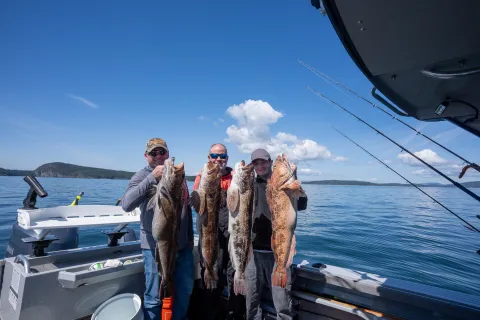
There are three main methods for targeting bottom fish, and the cool thing is that the tactic you use is more dependent on the depth and environment you’re fishing in, rather than the species itself. All species can be found in virtually any depth in the ocean. In fact, many of the biggest lingcod I have ever caught have been in less than 50 feet of water. This means that if you know your water, you can choose a tactic that will give you the best chance at success.
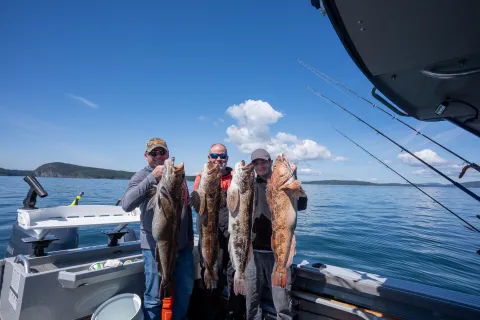
Tactic number one: Live bait rigs. Live bait is the most natural presentation to a fish. As the name implies, you need an actual prey item connected to your hook, and this often elicits the most aggressive feeding response. The flip side is that you have to spend considerable time catching bait. Additionally, it can be difficult to keep your bait alive throughout the day. I have found that live bait rigs work best when targeting ling cod on reefs that are under 150’ deep.
Ling cod will readily take live bait of nearly any size, and often do not even need to be hooked to bring them to the boat. To decide between large and small bait, know your area. If you are fishing a particularly busy reef with lots of rockfish, and you are not allowed to keep them, try to use larger baits such as greenling or other sculpin to keep bycatch to a minimum.
The best live bait rig I have ever seen, I learned from John Kerrigan of Seeking Limits Guide Service out of Everett, WA. John’s rig is devilishly simple. It consists of a sliding weight system where the plastic slide is connected to the weight with a rubber band, and it is stopped by a swivel to a leader (photo below). The rubber band keeps you from losing an entire rig if your weight gets stuck, and the swivel will keep the live bait tangle-free. Give it a try with surf perch on a single hook rig, or sand dabs and greenling on a double hook rig.
The second bottom fishing method is jigging with soft plastics. This method allows you to go right out to the fishing grounds. Oftentimes, the soft plastic jigs come pre-rigged, so all you have to do is tie them onto a 50-pound mono leader and drop it near the bottom. My absolute favorite for jigging soft plastic is a Fisherman’s Gold Electric Eel jig. (photo below). It has caught absolutely everything from giant 50-pound lingcod to limit after limit of rockfish. The only consideration is how heavy and how big you want your plastic. Obviously, using a 32 ounce 12 inch eel won’t be the right choice for rockfish, but if you’re shallow, there is little better than catching black rocks on a 1 or 2 ounce eel. Fishing soft plastics is the most versatile of the 3 methods. You can fish them light or heavy, large or small, shallow or deep. Soft plastics can struggle in areas of intense pressure and is most difficult in areas where there are lots of toothy bycatch, such as arrowtooth flounder or dogfish that can tear up your bait.
The last method is a combination of pipe jigs and unweighted soft plastics on a ganoin type rig. This method is great for deep drop fishing, particularly for halibut. The pipe jig not only allows enough weight for a rig in 500 feet of water, but it also can get chewed on for hours and not lose its efficacy. By running some unweighted plastics above the pipe jig, you can also take advantage of the extra color and action to bring fish to your rig. However, this method is really prone to snags, and can be expensive to lose if you are fishing the more shallow rocky reefs.
I typically pair this method with electric reels in deep water and on flatter bars in the open ocean. You can build a ganoin by using a 3-way swivel connecting the main braided line to one end, a 6 foot ganoin of heavy mono (80 pound or heavier) to one of the other sides, and lastly a short heavy mono leader connected to a large 12/0 J hook that you hook your eel or flounder plastic to.
Making a game plan for your specific environment is the best way to set yourself up for success. Always consider the time you have to fish, the depth at which you want to target, and the overall fishing pressure to help you decide between durable baits like pipe jigs or if a natural live bait is the right choice. Get out there and try it for yourself!
/articles/successful-bottom-fishing-strategy-pacific-northwest
The State of Bottomfish
One of the most sought-after ocean-dwelling fish is the bottomfish, also called rockfish and groundfish. Anglers also refer to some of the species as “sea bass” as they resemble freshwater largemouth bass. Regardless of what you call them anglers who target these fish all call them “tasty” which is why they are so popular. But do not expect the various species of bottomfish to take up a lot of space in magazines or flood your social media feed with lots of sea-bass photos and “how to’s”. Maybe it is because they are often a bycatch or used to fill the time between salmon bites or maybe it is because most daily limits offer enough fish to fill a freezer fast so anglers only fish for them a few times a year. If it is the latter, then be aware that regulations and fisheries are changing quickly.
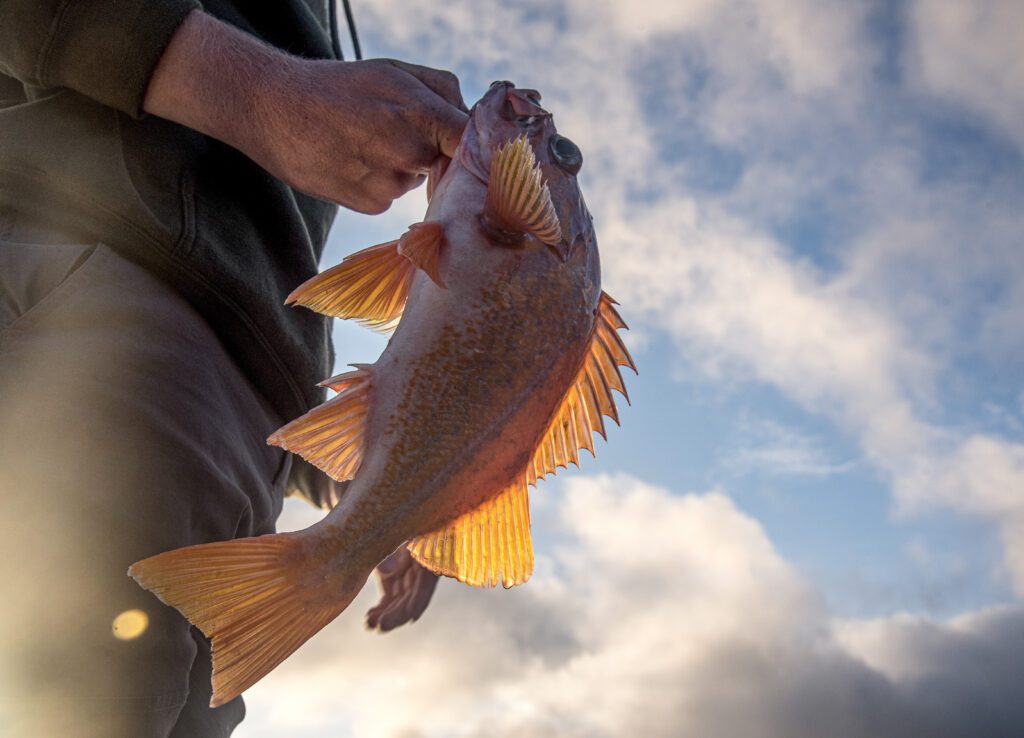
A few years ago, back in 2010, the yelloweye rockfish was listed on the Endangered Species List as threatened and remains there today in Washington and Oregon waters. This is because it is one of the largest rockfish species which means it lives an exceptionally long time, like over 100 years, with the oldest living yelloweye aged at 118 years and estimated to be able to live 147 years.
This long life means they mature slowly and do not reach adulthood until they are 19-22 years old. When it takes a species this long to mature, the over-harvest can be problematic. One of the saving graces for this species is that they live very deep, averaging 300 feet and can live as deep as 1,500 feet in the abyss. This is also a common detriment to most rockfish species and that is they are prone to barotrauma which is when the swim bladder becomes distended as the fish comes up from the high-pressure deep water. Using a descending device will help reduce mortality.
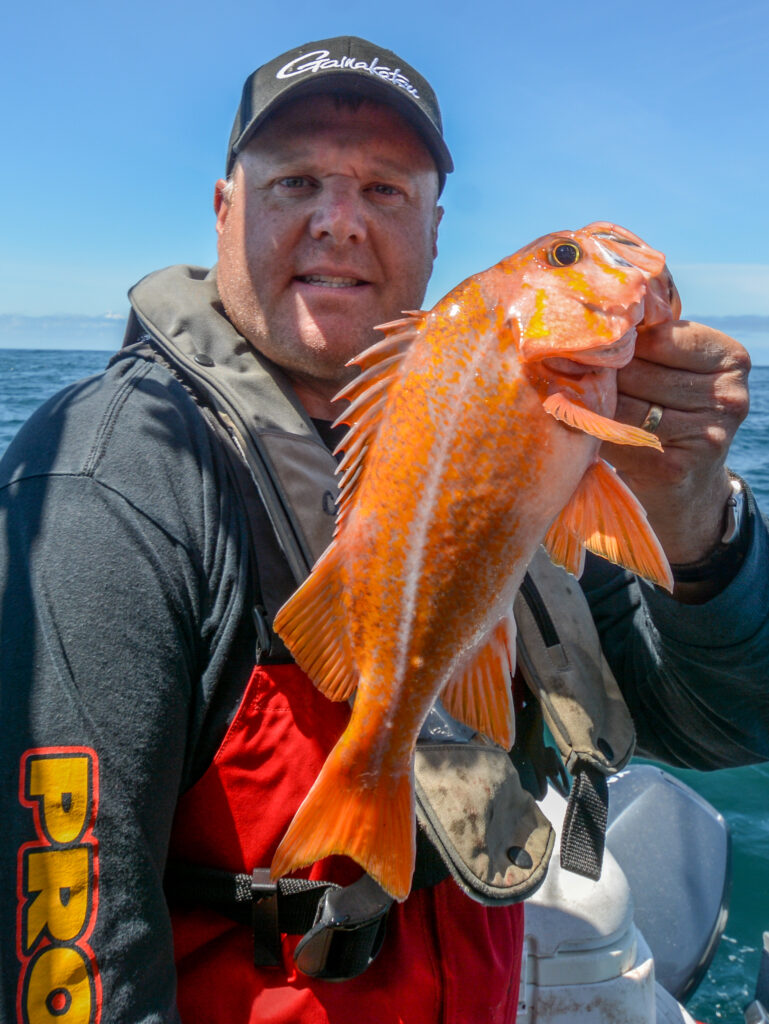
Like the yelloweye rockfish, most of the rockfish found in Puget Sound are off-limits due to the loss of species. There are some Marine Areas where rockfish can still be caught and kept including the ocean areas such as Marine Areas 1 through 4. Daily limits here were reduced a few years ago and now 7 rockfish of certain species combined such as black rockfish, blue rockfish, canary and vermillion, and a few other species.
Also new last year is a restriction for certain species between June 1st and July 31st, including copper, canary, and other popular species. There is also a depth restriction of 20 fathoms except for halibut days which can be a bit confusing. As of this writing the current regulations have not been published for the upcoming license season so be sure to check the WDFW website for updates.
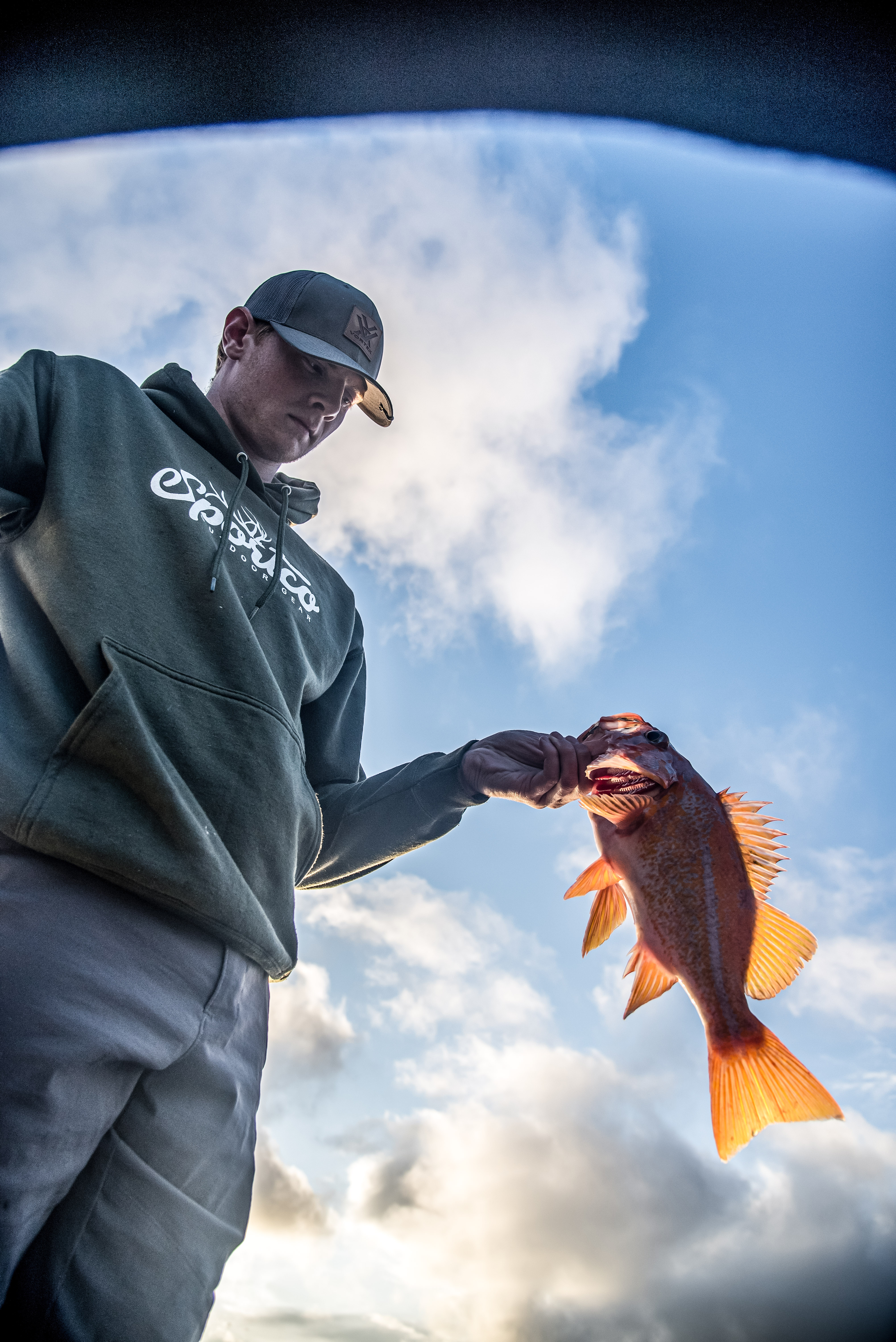
In Marine Area 5 which is the only other marine area where rockfish can be retained in Washington, the limit is 1 or 3 depending on which side of Slip Point you are on, and only black or blue rockfish can be kept. You also must use barbless hooks, even for non-rockfish bottomfish, such as halibut and lingcod which most anglers do not realize is required. After a quick chat last year at the dock at Sekiu with a WDFW Game Warden we learned that the only thing she wanted to check was our hooks. Not worried about our licenses or catch record cards, she just wanted to make sure we were using barbless hooks in the halibut we caught.
The last one had swallowed the bait and hook, and it was easier to just cut the leader, so we obliged and allowed her to cut the hook out which was barbless, and she was happy. Turns out that anglers did not know about the new rule, so it was more of a day of education for them. Luckily, we knew the rules. We also showed our licenses and catch record cards just to really put an exclamation point on following all the rules. She was thankful and it was a good interaction, always a plus when talking with WDFW staff.
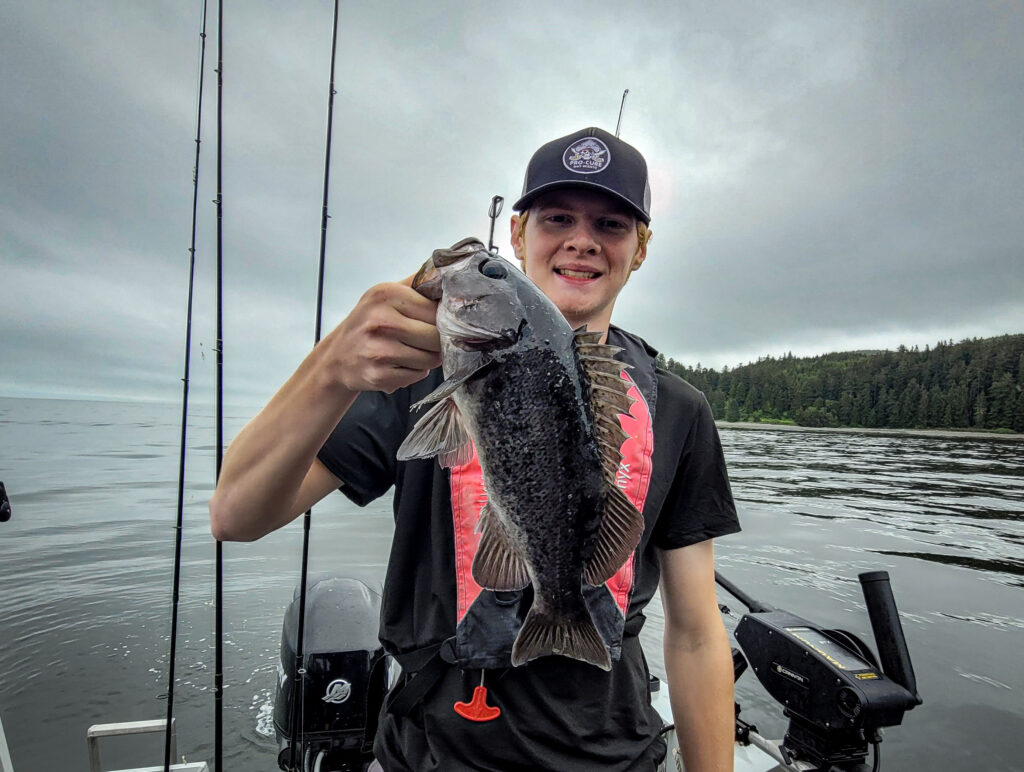
Oregon has simplified regulations compared to Washington but has even more restricted bag limits. As of now, the season is open year-round with no depth restrictions but a daily limit of 5, as well as a coastwide closure of yelloweye and quillback rockfish. Oregon also has a unique gear restriction when fishing deeper than 40 fathoms which is the use of “long leader” gear. Their website has tutorials on what this means and how to rig it. As always be sure to check current regulations before you go out fishing.
Both states have safety zones or rockfish conservation areas which are off limits to fishing for rockfish or any bottomfish. The reason for these conservation areas is to set aside a breeding and nursery area of sorts where rockfish are threatened, including the yelloweye. All rockfish species take a while to mature and since they tend to school up and live along structures such as underwater pinnacles, reefs, and rocky ledges they can be easy to locate and target.
The Pacific Fishery Management Council keeps tabs on various fish species along the west coast including groundfish. Since these fish live a long time and can be subjected to over-harvest the Council provides a stock assessment and guideline regarding certain fisheries. When it comes to bottomfish, which again they refer to as groundfish, the Pacific Fishery Management Council realizes the importance of these fish. Popular in both commercial and recreational fisheries, bottomfish are prized for their great eating and provide a valuable economy to the fishing industry.
A quick walk around the boardwalk and harbor in Westport, Washington does not take long for someone to see how many charter fishing boats there are. Offering an opportunity for anglers who do not own a boat or have the savvy to head to the open Pacific Ocean, anglers can book a day trip on one of the many charters and have a good chance at catching some tasty rockfish. This is the same for every seaside town up and down the Washington and Oregon coast, and several towns in California.
Keeping management goals of conservations, economics, and utilization of these fisheries the Pacific Fishery Management Council establishes objectives for each management goal outlined for the Pacific Coast groundfish. Taking in everything from gear used by both commercial and recreational anglers to social and economic impacts. Knowing that groundfish populations can be affected by several factors including areas where caught, as fish can be migratory the need for such a council helps track bottomfish and their populations.
If all of this seems a bit confusing that is because it is, and it is because bottomfish are highly sought after and they can be overfished. Anglers need to realize this and respect the fish population accordingly. Keep a descender device onboard, as required by regulation but also know how to use it. When you catch an undesired species then use the device. Also know your own limits, just because you can keep 7 fish per day does not mean you should keep that many.
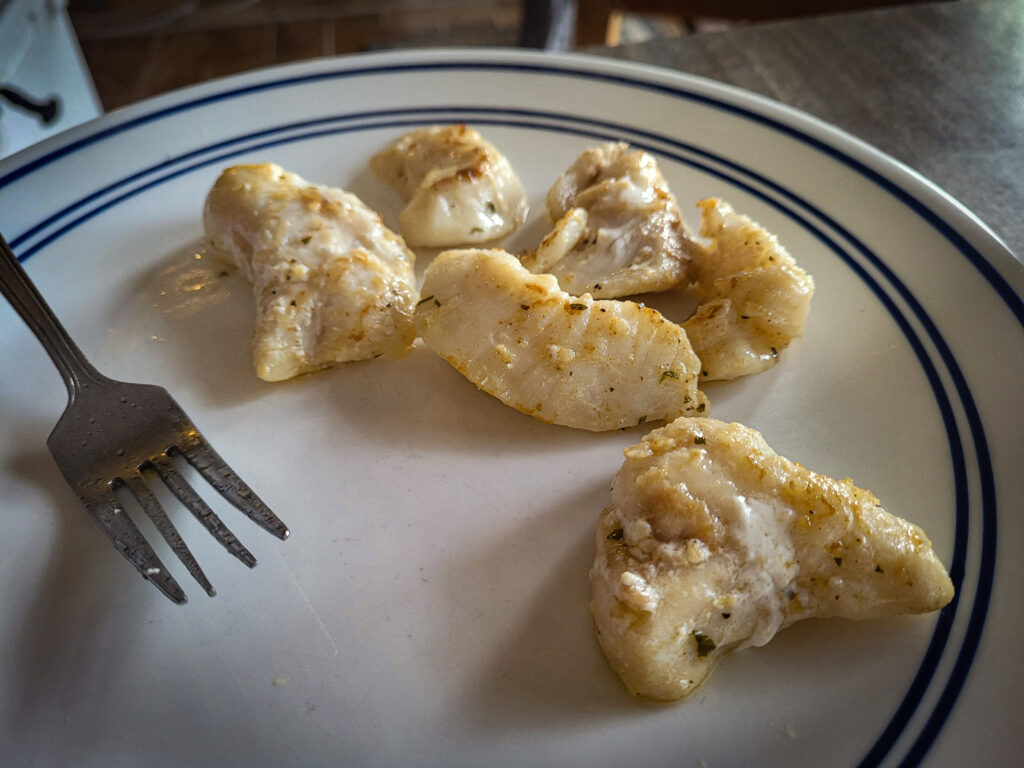
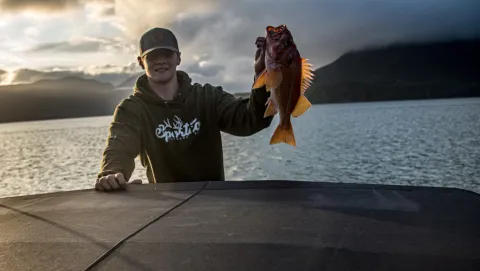
A few years ago, while on a multi-day vacation at Neah Bay my son and I went out and limited on rockfish. Between the two of us that was 14 fish, and we also caught some salmon that day and our lingcod we came back to the dock with nearly 20 fish to clean and fillet. That made for a long day, and we decided that the rest of the trip would be spent salmon fishing and that only if it were a slow day would we switch to bottomfish. Even then we kept our personal limits to what we wanted to clean that day, and by our third day we decided we had more than enough white flakey fillets for our trip. The last two days were spent trolling for salmon and watching local wildlife. Rockfish are delicious and fun to catch but make sure to catch responsibly.
/articles/state-bottomfish