Washington's Bottomfish Bounty
Places like Florida, Texas, and Baja California are all celebrated for their tasty white fish like grouper, red snapper, and white seabass. While here in the Northwest, the fatty red or pink meat from a chinook or coho salmon is often what comes to mind when we think of seafood associated with our coastal and inland waters. The truth is, we also have all the necessary resources to make a mean fish taco. That is, the Pacific Northwest bottomfish.
Don’t let the name “bottom fish” give you the wrong idea about where they might fall on the Hierarchy of seafood delicacies. The bottom fish mentioned in this article make for excellent table fare and can be utilized for a simple fish fry, tacos, or can be combined with some of our abundant shellfish for a seafood stew like a Cioppino.
Our bottom fish range from large, dragon-like predatory fish like the Lingcod, to the massive halibut, which can get well over 200 lbs. In some cases, you can catch these fish from shore, but most often a boat of some sort will be necessary for success in these fisheries.
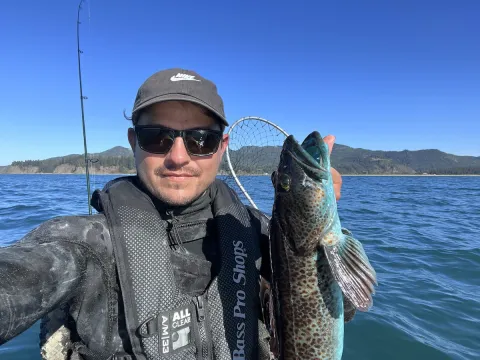
Lingcod
Straights of Juan de Fuca
Marine areas 6, 5, and 4 along the Straits of Juan de Fuca all provide great opportunities for lingcod. In MA 5, you can launch a boat at Clallam Bay from the town of Sekiu at Mason’s Resort boat launch. From there, you can head west towards Kydaka Point, where ample amounts of rocky underwater structures and reefs hold healthy numbers of lingcod. Soft plastics work well here, but if you're aiming to land a giant, try hooking up a small greenling as bait and sending it down to the bottom.
Puget sound
Conservation efforts make the Puget Sound a much more restrictive area to target lingcod. The 2026 season runs from May 1st through June 15th and allows the retention of 1 fish per day. Size restrictions are in place as well, and you can only keep lingcod that are between 26 to 36 inches. Possession Bar, Tavola Shore, and Alkai Reef all hold lingcod.
Cabezon
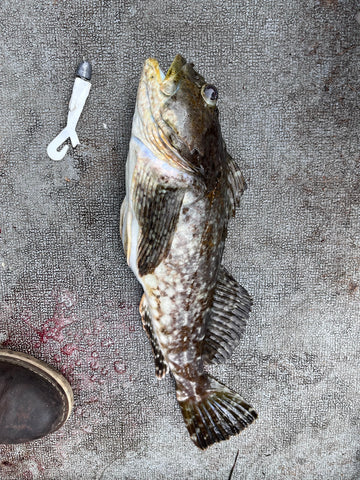
The cabezón. Loosely translated to “large head”, is aptly named for this exact reason. Cabezons, when larger, have giant heads and are built like a tank. When hooked, they will take off with your line and head-shake like a large lingcod. They’re a blast to catch and can be found all over the Straits of Juan de Fuca and the Washington coast. My favorite spot to fish for these is near Hobuck Beach in Neah Bay. This spot can be accessed via shore if you are using a kayak, otherwise you will have to launch your boat from the Big Salmon resort in Neah Bay.
Rockfish
Westport
Rockfish are abundant all throughout the Straits of Juan De Fuca and the Washington coast. With that said, if you’re looking for easy access, Westport provides a unique opportunity to catch these fish off of their one-mile-long jetty at Westhaven State Park. If climbing the rocks isn’t your thing, you can also hop on board one of the many charter boats that take off from the Westport marina to target salmon and bottom fish.
Halibut
Pillar Point
Pillar Point is about 15 miles east of Sekiu and has a small boat launch that is favored more by kayakers than those with larger vessels. For those looking for a larger boat launch, this area can be accessed by launching out of Sekiu and motoring east. A long sloping underwater ridge provides prime habitat for halibut, and it’s not uncommon to see 80+ lb halibut pulled out of this area.
Greenling
Neah Bay
The old Snow Creek resort on the northern part of the Straits of Juan de Fuca, just outside of Neah Bay, holds healthy populations of Kelp Greenling. Though these fish are often thrown back by anglers targeting lingcod or rockfish, they are incredibly tasty and can be found in the kelp beds only a few hundred yards offshore. This area is open year-round for kelp greenling so long as you stay east of the Bonilla-Tatoosh line.
Flounder
North Hood Canal
The flounder fishery is often overshadowed by some of the larger game fish species in the Puget Sound, yet these fish offer a fun year-round fishery that can be a great way for kids to get excited about fishing while at the same time making for excellent table fare. Flounder are found all throughout the Puget Sound and Hood Canal on sandy or muddy bottoms and are quite easy to catch using artificial sandworms, clams, or chunks of flounder meat. Dabob Bay, just south of Quilcene, is the only part of the Hood Canal that is open to flounder fishing. The bay can be accessed via the Quilcene Bay boat launch to the north or Tritan Cove boat ramp to the south.
South Puget Sound
If fishing the Puget Sound, you can find flounder in large numbers in MA 9 at Jeff head or fishing from the shore at Point no Point in Hansville. Further south in the South Puget Sound, good flounder fishing can be had at Dash Point in King County, where a fishing pier and easy kayak is launching from the beach. Going further down towards Olympia, you can find flounder from Dana Passage to Boston Harbor. Always check the Department of Health’s website for current information on flounder consumption safety guidelines.
With many bottom fish seasons opening this spring, and the year-round opportunities that these fish provide us with, there’s never a wrong time to get out there, get your cooler filled, and enjoy another one of our great fisheries here in the Northwest.
/articles/washingtons-bottomfish-bounty
Becoming A SeaWalker In Neah Bay
What Anglers Can Expect While Fishing Washington's Saltwater Frontier
It was mid-June, and we rolled into Neah Bay just before evening. Our scenery was fishing boats packed into the marina and the heavy smell of fireworks, as the local kids ran the waterfront. Surrounded by lush rainforest and steep cliffs, the village sat within the Makah Reservation and served as a hub for recreational and tribal fishing. June marks the start of the busiest season here. As waters warm and baitfish like sand lance, herring, and anchovies flood the area, predators follow in force. From the protected inshore waters of the Strait to the jagged pinnacles and kelp beds offshore of Cape Flattery, anglers have options for nearly every style of saltwater fishing imaginable. So we got some sleep, cause early the next morning we had a meeting at the dock with Captain Fred Walker of SeaWalker Charters.
Waking up early to the smells and sounds of the harbor is something I love. Walking down to the boat, seeing all the hustle and bustle so early, watching everyone load gear, and exchanging stories will get you excited for the day. Finding the "SeaWalker" boat was easy, and the captain and deckhand were eager and ready to go. Our captain for the day was Captain Fred Walker, and he had one of the cleanest and most organized boats and operations, which immediately put us at ease, knowing we were in good hands. Not to mention he's been fishing these waters for over 30 years. The top-notch Kingfisher boat was loaded with the highest quality of gear. From the Tanacom electric reels to the Custom Prolite Rods, we had everything from mooching, trolling, and bottom fishing covered. And he and his deckhand, Max, take safety very seriously, and the success comes with it.
●Lingcod And Rockfish
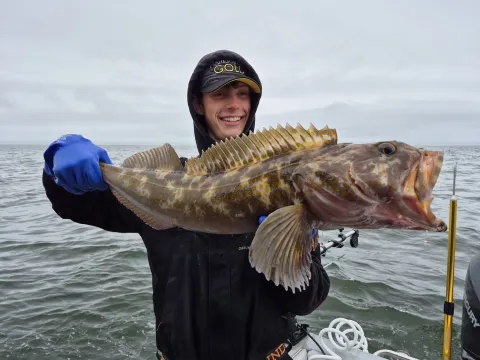
As we motored out, we were anywhere from 50-60 miles from shore and had everything prepared for the long day. Neah Bay is legendary for bottomfish, and June is prime time. Lingcod are aggressive and plentiful, often lurking around rocky reefs, underwater pinnacles, and kelp edges. These toothy predators just hammer the jigs, or whatever offerings you're presenting, with equal enthusiasm. It's not unusual for anglers to catch their 2 keeper-sized lings in a day, along with a chance at a true trophy over 30lbs. Rockfish, both black and yelloweye, fill out the action, providing near consistent bites for those dropping smaller spoons and jigs into the schools, making them furious while filling limits quickly. With daily limits generous compared to other parts, anglers can usually count on a cooler of rockfish to complement those lingcods.
●Halibut
By June, Washington's Halibut season is still underway, though regulations shift year to year. When opened, halibut is a major draw. Neah Bay is one of the few places in the state where anglers can run relatively short distances offshore to productive halibut grounds. Places like Swiftsure Bank and areas West of Tatoosh Island hold halibut ranging from 20lbs "chickens" to "barn door" halibut topping 100+ pounds. Fishing for halibut here is not only an exercise for the body, but an exercise in patience and persistence. Heavy lead and big baits waiting for the unmistakable thump of a halibut inhaling your offering. The payoff, however, is unmatched table fair and a true trophy to catch. Couldn't be more thankful for Captain Fred having them Tanacom 750 reels on board to winch up these flatfish from the depths of 380ft-500ft.
●Salmon
June is often the month when salmon begin filtering into the region. Chinook (Kings) are the headliners, while the main summer salmon season in Neah Bay typically kicks off later in July. Early arrivals show up in June, especially along kelp lines and nearshore structure, where we seemed to find ours. These early-season Kings are strong, chrome bright, and are prized by many anglers. Mooching can be a very exciting way to fish; having the knuckle-busting action can be just part of the fun. Coho may also be appearing offshore, although they are usually more prevalent in July and August. For those lucky enough to hook up in June, Coho provide acrobatic fights, and a taste you'll return for.
(Also, don't forget the opportunity for Albacore Tuna in late June, depending on water temps)
●Tactics And Techniques
•Bottomfish: Most anglers target lingcod and rockfish by jigging heavy spoons or jigs tipped with bait or soft plastics near rocky structure. Larger, similar profiles work very well for lingcod. GPS and electronics definitely help you stay directly on productive reefs and rocky structures.
•Halibut: Halibut set-ups typically consist of a stout rod, like the Prolites we used specifically for the bottom fishing. Heavy-duty reel, like a Tanacom, is ideal for the depths, matched with a quality braided line. Often drifting over humps and flats, bouncing pipe jigs and larger offerings, tipped with herring, squid, scents, drawing in fish at depths of 200-500 feet.
•Salmon: When targeting salmon, trolling is the go-to method. Downriggers with flashers and hoochies, spoons, or herring rigs dominate the setup. Inshore, mooching with different offerings can be deadly, particularly when schools of bait are thick near kelp lines. Definitely a "Knuckle Busting" Mooching reel can be so fun, and very sporty at times.
●Conditions And Weather
June weather at Neah Bay can be notoriously unpredictable. Anglers should expect anything from flat calm seas to fog, rain, and possible stiff winds. Mornings are often the calmest, as wind typically builds in the afternoon. Having the flexibility to fish on shorter notice, when the forecast cooperates, can make or break a trip. Fog can be a factor; the Strait and nearshore waters can sock in with heavy fog, making it invaluable for navigating, even with GPS and radar. Always plan for safety, as the Pacific can turn hostile quickly. Being on a guide’s boat, such as the SeaWalker, and knowing it was equipped with the best crew and safety gear, makes the trip so much more enjoyable.
●Regulations And Access
Neah Bay is subject to both Washington Department of Fish and Wildlife (WDFW) regulations and tribal considerations. Seasons for halibut and salmon can change annually, even for bottomfish. So anglers must review the most current rules and regulations before making the trip. Size limits, bag limits, and barbless hook requirements are strictly enforced. Access also requires awareness, as you are on a reservation. As a visitor, always respect the policies and rules of the tribe. And while launching and returning to the Big Salmon marina, there is a cleaning station to clean your catch daily. Or pay a couple bucks to have a couple locals do it for you.
Fishing Neah Bay in June is an adventure into one of the richest marine environments on the West Coast. With stunning scenery from the rugged cliffs of Cape Flattery, the westernmost point in the contiguous United States, to the pristine beaches and rainforest nearby. Wildlife is abundant, and so many bald eagles share the water with anglers.
The community itself is small and welcoming, with local lodging, camping, and the Makah Cultural and Research Center offers a window into the rich history of the Makah people and the many years of fishing. It's a place where the Pacific reveals both its bounty and its raw power. A destination where every trip feels like an expedition, and every fish tells a story. For those who are looking to make the trek, expect long days on the water, a cooler of catches, and the memories you reeled in at Washington's Saltwater Frontier.
●Tips For Success
1. Book lodging early; June is popular, and options are limited
2. Hire a charter for your first trip. Water can be intimidating, and a good captain like Fred Walker with SeaWalker Charters would be my choice.
3. Pack for all weather. Layered clothing, rain gear, deck boots, waterproof bag or backpack.
4. Stay Flexible - weather and seas dictate much of the fishing. Having a couple of backup days built into the trip always helps.
5. Pack snacks, drinks, meds, and motion sickness medication. Not all charters cover a lunch, but most will have water on board.
6. Know the rules and regulations, as they can change yearly, and enforcement can be strict
7. Have fun, and respect the boat and the operation going on around you.
8. And most of all, "Reel In The Memories"!
/articles/becoming-seawalker-neah-bay
Chasing Fish in The Straits of Juan De Fuca
By Josh DeBruler
As summer winds to an end, readers are likely anticipating glorious tales of monster sized salmon bending rod tips over the sides of boats, while adrenaline filled anglers run about with nets in hand, hoping to assist a buddy in bringing the big-one aboard for a well earned grip-and grin photo of a lifetime.
This story, regretfully, does not end in such a manner. The story does, however, dispel some myths about importance of boat size, shares some boating safety advice that pertains to smaller boats, and ends with a nice haul of tasty fish (the type that are more suited for a fryer rather than a smoker).
It was Saturday morning in the Sekiu village, and the gentle waves of the incoming tide at Clallum bay woke me in my tent at Masons Marina.
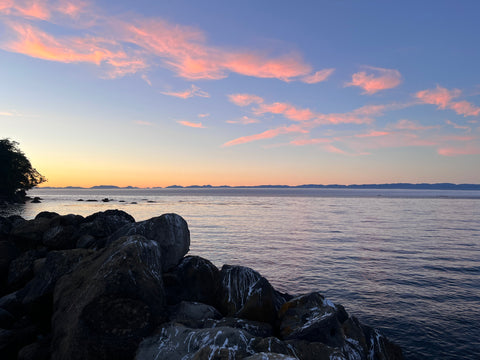
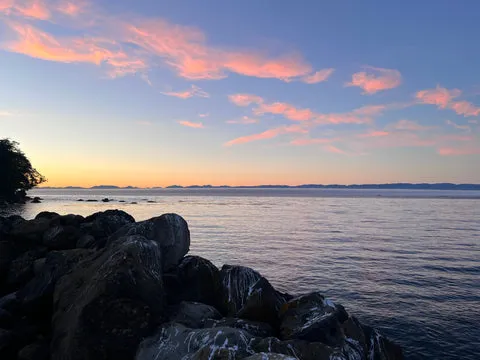
Thick marine fog typically blankets the waters from Sekiu to Neah Bay during the summer mornings, however, the start to this day greeted me with glassy calm seas, and blue skies that extended from Masons marina, all the way north, across the straits, and to the mountainous shores of Victoria B.C.
It was perfect weather, and it helped ease the nerves that had been accumulating over the past two days as I obsessed about all of the things that could possibly go wrong in a small boat out on the big water.
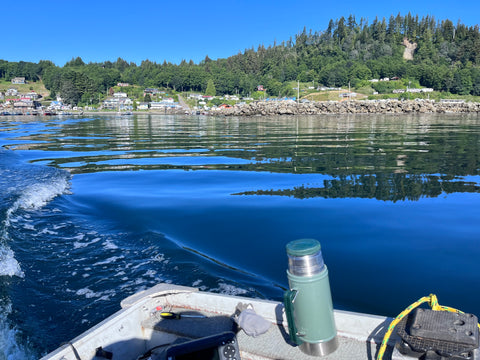
My boat is a V-hull 2008 14’ Smoker Craft Pro Mag with a 20 HP Honda. It’s a good little boat, equipped with a live well, an electric trolling motor, navigation lights, and a backup 6 hp Suzuki that I keep onboard in case of emergencies.
I take her out often, with most of my destinations being on the Puget Sound, Hood Canal, and various lakes in my region. But, as with many others that own boats similar to mine, the thought of taking a small boat out onto water that behaves a lot like the ocean never really crossed my mind.
Boating is fun, until it isn’t. And I’ve always figured it was better to avoid a bad situation than to plop myself directly into one. It wasn’t until I was on the Hood Canal that a friend told me about Sekiu, and how anglers were easily catching their limits of chinook and coho up there, that I began to put more thought into the idea.
Thus, a seed was planted. As I researched and asked around, I found that it was actually quite common to take smaller boats out around Clallum bay. In fact, 14’ kicker boats were at one time the most common sport-fishing boats seen on the water.
At least, that was the case in the 1940’s, when most people weren’t towing around larger boats and instead opted to rent the 14 footers from the marinas. The marinas still rent boats of this size today, most of them equipped with 15 HP outboards.
Sekiu is the quintessential small fishing town. It has two main marinas (both with campgrounds), a handful of motels, a cafe, a restaurant, and plenty of fishing tackle. The town got it start as a salmon cannery back in the late 1800’s, but after regulations ceased to allow commercial fishing, the cannery business crashed, and Sekiu had to look to other industries like logging, hide tanning, and sport fishing.
The latter of the three being the one that worked, and oh did it work well. The fishing is world-class, and seldom will you find anywhere outside of Alaska that has this type of salmon and other saltwater fishing. The unincorporated community is situated right inside Clallum bay, in the northwestern portion of the Strait of Juan De fuca.
The bay itself, and just west of the bay, enjoys decent protection from S,SW,W, and NW winds. Once you head further towards the ocean or out north into the open water, you become more exposed to the common west and northwesterly winds.
Luckily, you will find excellent fishing near-shore, or without having to travel too far west in the direction of the ocean. In fact, most fisherman catch their limits of salmon just west of the bay near what is known as “the Caves”.
Two main summer-run salmon routes exist in the area, and those two routes follow near shore on the Canada side and near shore on the Washington side. This is an ideal situation for a small boat fisherman who doesn’t want to venture too far out into the open water.
When I motored out of the marina that first morning, I was a day behind on my already limited schedule. This had me fishing on an odd numbered day of the month. At the time, odd days were closed to salmon retention due to emergency regulations set by the Department of Fish and Wildlife.
This meant that fishing for salmon that day was out of the picture. However, in Marine Area 4, just northwest of me, lingcod, rockfish, and other bottom dwellers were all very much on the table! To get to these, I had to run about 5 miles west to Shipwreck Point just east of Neah Bay.
So, with calm waters on my port side, I gunned it west towards the MA-4 boundary line. The swell and wind forecast for that day were predicted to be favorable up until around 1pm, and so far, the predictions seemed to be holding up.
My little boat planed quite nicely heading out with the ebb tide and gracefully skipped over the rolling swells. My first “yikes” moment occurred when I approached Kaydaka point. This large point that sits roughly 2 miles from the marina brings underwater structure out into the straits, and as a result, kicks up the wave height significantly.
Though the increased wave size didn’t pose a significant threat to me, I still figured it was a good idea to run a bit further offshore to avoid the turbulence. It’s worth noting that points like these can present sea conditions that might not be tolerable for particularly small boats during rougher conditions.
The bottom fishing was hot within minutes of being inside the MA 4 boundary.
I fished a 2 oz jig head with a pearl white double tailed grub over some structure, and within minutes I was into some fish. A few good-sized lingcod found my hook, along with several rockfish and a beautiful cabezon that fought like a bull! All in all, the day was a success.
I won’t bore you with the details of my next morning’s salmon trolling trip. I only had an hour to get it done, and let’s just say I’m still eating last season’s silvers from my freezer (and yes, some of it’s looking a little freezer burnt). But the success was had in that I made it back to the marina both days in one piece.
This wasn’t accomplished in a 30’ fishing boat that’s worth more than my life savings- nope, this was done in 14’ aluminum boat with a small engine and an even smaller backup.
Small Boat Safety
Now, let’s talk the important stuff. Small boat safety. Is it safe to take a small aluminum boat onto the straits? It certainly can be! There are inherent risks that come with any type of boating, regardless of the boat size or the water that you are on.
Risk assessment, risk avoidance, and preparation are all key components to keeping you safe on the water.
DISCLAIMER: I am by no means, an expert on boating safety. All I can do is share what works for me and what I have learned myself.
My first bit of safety prep comes well before I arrive at the marina. Fortunately for me, I have a work schedule that affords me the liberty to plan my trips around weather windows, so I’ll start by looking for consistently fair weather in the long-range forecasts.
As I get closer to my desired departure dates, I’ll home in on the NOAA webpage and start looking at wind directions and speed, wind waves, then swell predictions (paying close attention to wave period or duration), and then tide charts. It’s important to know how wind, swell, and tide currents all work together to cause either rough or manageable conditions.
I don’t have the page space to get into that here, but there are plenty of resources available online for anybody who wants to educate themselves on the nuances of ocean behavior. The calm waters typically occur in the morning, so be up and ready before sunrise.
If the winds are predicted to pick up, say, by 1pm, then I’ll be heading back to the marina at least 2 hours before those winds are predicted to occur.
Safety Equipment
Before I leave the docks I want to make sure I have life jackets (I carry an auto-inflate and a standard), a waterproof radio, working navigations lights, at least two GPS devices, a manual bilge pump in case my auto fails, a well-tuned and properly functioning outboard motor, a backup kicker, flare gun, an air- horn, and a reflector to hang up in case of dense fog.
Aside from these things, I also try to scout out beaches nearby that would be suitable for beaching my boat in case a situation calls for it. This is definitely a last-ditch option, as the risk of damaging the boat on rocks is very present.
So, will I be taking my boat my boat out to Sekiu again? Absolutely! I already have my next trip planned! Do larger boats afford more comfort and protection in the event you get stuck in some adverse conditions?
They absolutely do. But, if a capable small boat is all that you have, and you have educated yourself on all the safety measures necessary, then there is no reason for you to wait till you get that 100k boat to go have some fun and catch fish in arguably the most productive fishing grounds in our region.
/articles/chasing-fish-straits-juan-de-fuca