Becoming A SeaWalker In Neah Bay
What Anglers Can Expect While Fishing Washington's Saltwater Frontier
It was mid-June, and we rolled into Neah Bay just before evening. Our scenery was fishing boats packed into the marina and the heavy smell of fireworks, as the local kids ran the waterfront. Surrounded by lush rainforest and steep cliffs, the village sat within the Makah Reservation and served as a hub for recreational and tribal fishing. June marks the start of the busiest season here. As waters warm and baitfish like sand lance, herring, and anchovies flood the area, predators follow in force. From the protected inshore waters of the Strait to the jagged pinnacles and kelp beds offshore of Cape Flattery, anglers have options for nearly every style of saltwater fishing imaginable. So we got some sleep, cause early the next morning we had a meeting at the dock with Captain Fred Walker of SeaWalker Charters.
Waking up early to the smells and sounds of the harbor is something I love. Walking down to the boat, seeing all the hustle and bustle so early, watching everyone load gear, and exchanging stories will get you excited for the day. Finding the "SeaWalker" boat was easy, and the captain and deckhand were eager and ready to go. Our captain for the day was Captain Fred Walker, and he had one of the cleanest and most organized boats and operations, which immediately put us at ease, knowing we were in good hands. Not to mention he's been fishing these waters for over 30 years. The top-notch Kingfisher boat was loaded with the highest quality of gear. From the Tanacom electric reels to the Custom Prolite Rods, we had everything from mooching, trolling, and bottom fishing covered. And he and his deckhand, Max, take safety very seriously, and the success comes with it.
●Lingcod And Rockfish
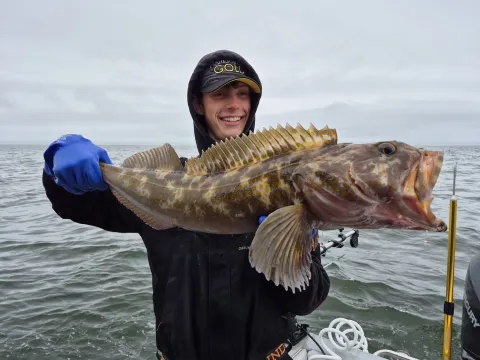
As we motored out, we were anywhere from 50-60 miles from shore and had everything prepared for the long day. Neah Bay is legendary for bottomfish, and June is prime time. Lingcod are aggressive and plentiful, often lurking around rocky reefs, underwater pinnacles, and kelp edges. These toothy predators just hammer the jigs, or whatever offerings you're presenting, with equal enthusiasm. It's not unusual for anglers to catch their 2 keeper-sized lings in a day, along with a chance at a true trophy over 30lbs. Rockfish, both black and yelloweye, fill out the action, providing near consistent bites for those dropping smaller spoons and jigs into the schools, making them furious while filling limits quickly. With daily limits generous compared to other parts, anglers can usually count on a cooler of rockfish to complement those lingcods.
●Halibut
By June, Washington's Halibut season is still underway, though regulations shift year to year. When opened, halibut is a major draw. Neah Bay is one of the few places in the state where anglers can run relatively short distances offshore to productive halibut grounds. Places like Swiftsure Bank and areas West of Tatoosh Island hold halibut ranging from 20lbs "chickens" to "barn door" halibut topping 100+ pounds. Fishing for halibut here is not only an exercise for the body, but an exercise in patience and persistence. Heavy lead and big baits waiting for the unmistakable thump of a halibut inhaling your offering. The payoff, however, is unmatched table fair and a true trophy to catch. Couldn't be more thankful for Captain Fred having them Tanacom 750 reels on board to winch up these flatfish from the depths of 380ft-500ft.
●Salmon
June is often the month when salmon begin filtering into the region. Chinook (Kings) are the headliners, while the main summer salmon season in Neah Bay typically kicks off later in July. Early arrivals show up in June, especially along kelp lines and nearshore structure, where we seemed to find ours. These early-season Kings are strong, chrome bright, and are prized by many anglers. Mooching can be a very exciting way to fish; having the knuckle-busting action can be just part of the fun. Coho may also be appearing offshore, although they are usually more prevalent in July and August. For those lucky enough to hook up in June, Coho provide acrobatic fights, and a taste you'll return for.
(Also, don't forget the opportunity for Albacore Tuna in late June, depending on water temps)
●Tactics And Techniques
•Bottomfish: Most anglers target lingcod and rockfish by jigging heavy spoons or jigs tipped with bait or soft plastics near rocky structure. Larger, similar profiles work very well for lingcod. GPS and electronics definitely help you stay directly on productive reefs and rocky structures.
•Halibut: Halibut set-ups typically consist of a stout rod, like the Prolites we used specifically for the bottom fishing. Heavy-duty reel, like a Tanacom, is ideal for the depths, matched with a quality braided line. Often drifting over humps and flats, bouncing pipe jigs and larger offerings, tipped with herring, squid, scents, drawing in fish at depths of 200-500 feet.
•Salmon: When targeting salmon, trolling is the go-to method. Downriggers with flashers and hoochies, spoons, or herring rigs dominate the setup. Inshore, mooching with different offerings can be deadly, particularly when schools of bait are thick near kelp lines. Definitely a "Knuckle Busting" Mooching reel can be so fun, and very sporty at times.
●Conditions And Weather
June weather at Neah Bay can be notoriously unpredictable. Anglers should expect anything from flat calm seas to fog, rain, and possible stiff winds. Mornings are often the calmest, as wind typically builds in the afternoon. Having the flexibility to fish on shorter notice, when the forecast cooperates, can make or break a trip. Fog can be a factor; the Strait and nearshore waters can sock in with heavy fog, making it invaluable for navigating, even with GPS and radar. Always plan for safety, as the Pacific can turn hostile quickly. Being on a guide’s boat, such as the SeaWalker, and knowing it was equipped with the best crew and safety gear, makes the trip so much more enjoyable.
●Regulations And Access
Neah Bay is subject to both Washington Department of Fish and Wildlife (WDFW) regulations and tribal considerations. Seasons for halibut and salmon can change annually, even for bottomfish. So anglers must review the most current rules and regulations before making the trip. Size limits, bag limits, and barbless hook requirements are strictly enforced. Access also requires awareness, as you are on a reservation. As a visitor, always respect the policies and rules of the tribe. And while launching and returning to the Big Salmon marina, there is a cleaning station to clean your catch daily. Or pay a couple bucks to have a couple locals do it for you.
Fishing Neah Bay in June is an adventure into one of the richest marine environments on the West Coast. With stunning scenery from the rugged cliffs of Cape Flattery, the westernmost point in the contiguous United States, to the pristine beaches and rainforest nearby. Wildlife is abundant, and so many bald eagles share the water with anglers.
The community itself is small and welcoming, with local lodging, camping, and the Makah Cultural and Research Center offers a window into the rich history of the Makah people and the many years of fishing. It's a place where the Pacific reveals both its bounty and its raw power. A destination where every trip feels like an expedition, and every fish tells a story. For those who are looking to make the trek, expect long days on the water, a cooler of catches, and the memories you reeled in at Washington's Saltwater Frontier.
●Tips For Success
1. Book lodging early; June is popular, and options are limited
2. Hire a charter for your first trip. Water can be intimidating, and a good captain like Fred Walker with SeaWalker Charters would be my choice.
3. Pack for all weather. Layered clothing, rain gear, deck boots, waterproof bag or backpack.
4. Stay Flexible - weather and seas dictate much of the fishing. Having a couple of backup days built into the trip always helps.
5. Pack snacks, drinks, meds, and motion sickness medication. Not all charters cover a lunch, but most will have water on board.
6. Know the rules and regulations, as they can change yearly, and enforcement can be strict
7. Have fun, and respect the boat and the operation going on around you.
8. And most of all, "Reel In The Memories"!
/articles/becoming-seawalker-neah-bay
Avoiding Wildlife Collisions
By John Kruse
Steelheaders typically get up early to hit their favorite spots, meaning traveling in the dark on roads that can be wet and icy. In addition to those hazards, there is another hazard this time of year we all need to be mindful of.
I’m talking about wildlife collisions,
Every year, law enforcement agencies submit reports to the Washington State Department of Transportation (WSDOT) of vehicles that have sustained over $1,000 of damage. On average, 1500 reports are received every year.
The animal is killed in most of these collisions but there are dangers to the occupants of the vehicles as well. Typically, 167 people are injured on an annual basis and at least one individual is killed.
WSDOT believes, based on the number of deer and elk carcasses they remove every year from roadways, that the actual number of animal/vehicle accidents is far higher than reported.
State Farm Insurance actually projects, state by state, how many deer/vehicle collisions will likely occur every year. The latest data available is from 2014 but the Northwest numbers are illuminating:
IDAHO – 6,372
MONTANA – 10,099
OREGON – 10,523
WASHINGTON – 14,043
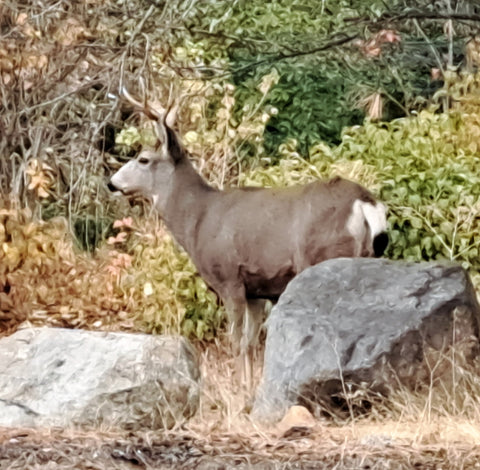
The next question is, why do deer and elk collisions increase during the fall months? The answer to that is partially due to sex. Fall is the time of year deer and elk go into the rut and the primary thing they have on their mind is mating.
If a buck or bull picks up the scent of a doe or cow, no highway will stand in the way of that animal making a beeline towards what they hope will be a hook up.
Another reason why is because fawns and calves are now grown enough to act on their own and being the young animals they are, make bad decisions about crossing roadways in front of speeding vehicles.
How do you avoid collisions with wildlife?
When you see a wildlife crossing sign, know that it’s there for a reason. Pay attention to the roadway in front of you and to the sides of the road.
- If you see a deer or elk on the side of the road assume it’s going to do something stupid. Slow down to the point you’ll be able to avoid a collision.
- Most wildlife collisions occur at times of limited visibility, particularly between sunset and sunrise. Make it a point to slow down and not overdrive your headlights when driving in areas known to have wildlife. For most vehicles, that means slowing down to 55 MPH.
- If a deer or elk does step out or sprint in front of you, do not swerve off the road or into the incoming lane to avoid a collision. You may have a much worse collision to contend with if you do.
If you do strike a deer or elk and sustain damage to your vehicle, call 911. If the animal is alive a law enforcement officer or fish and wildlife enforcement officer can dispatch it with a firearm. If you want to salvage the meat from the animal a relatively new law in Washington State allows you to do that. Remove the entire animal from the roadway.
Then, within 24 hours obtain a free salvage permit from the Washington Department of Fish and Wildlife website. According to WDFW over 4,000 of these salvage permits have been issued since August of 2020. You can find out more details about this program and apply for an online salvage permit at https://wdfw.wa.gov/licenses/roadkill-salvage
Oregon has a similar las regarding roadkill salvage. According to the Oregon Department of Fish and Wildlife, “It is lawful for a member of the public to humanely dispatch a crippled or helpless animal, but OSP must be immediately notified. In these cases, only the driver of the vehicle that struck the deer or elk may salvage it as part of the roadkill salvage permit program.”
In Idaho you can also dispatch not only a deer, but any other lawfully hunted animal that you accidently hit. You then have 24 hours to notify the Idaho Department of Fish and Game and 72 hours to obtain a salvage permit.
Montana also allows you to salvage any roadkill big game animals killed in vehicle collisions that are lawful to hunt. Like Washington, you have 24 hours to obtain a salvage permit which can be provided by a law enforcement officer at the crash scene or obtained online.
Last but not least, know that state Department of Transportation working with state Fish and Wildlife agencies and non-profit partner organizations like Backcountry Hunters & Anglers, Conservation Northwest, the Mule Deer Foundation and others have been working to reduce collisions between wildlife and vehicles in recent years.
They are doing so through the construction of a wildlife crossings and fences. Places in Washington where this has occurred include
- Wildlife crossing underpass on SR 240 that provides access to habitat in the vicinity of McNary National Wildlife Refuge
- A wildlife crossing underpass and fencing on U.S. 97 in Okanogan County
- Bridge and fencing at Butler Creek on U.S. 97 north of Goldendale
- Wildlife fence on U.S. 97 north of Wenatchee
- Interstate 90 near Snoqualmie Pass where a large overpass and fencing was installed
In Idaho similar work has occurred:
- A wildlife underpass for mule deer on Highway 21 east of Boise
- A planned wildlife crossing at Rocky Point on US Highway 30 near Montpelier is also being designed in an area that averages 100 deer/vehicle collisions a year.
These projects do work to reduce collisions with wildlife but there are still plenty of animals crossing our roadways this fall so pay attention, be careful, and avoid colliding with a wild animal this fall.
John Kruse – www.northwesternoutdoors.com and www.americaoutdoorsradio.com
/articles/avoiding-wildlife-collisions
Stocked Trout Extravaganza
By Paul Lewis
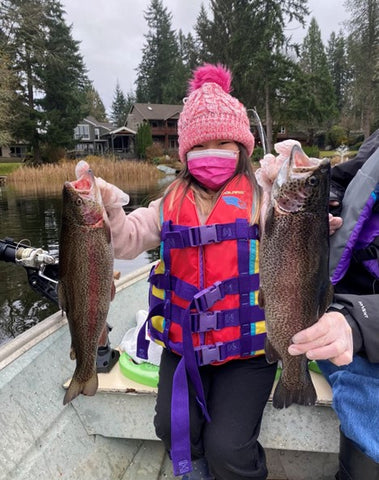
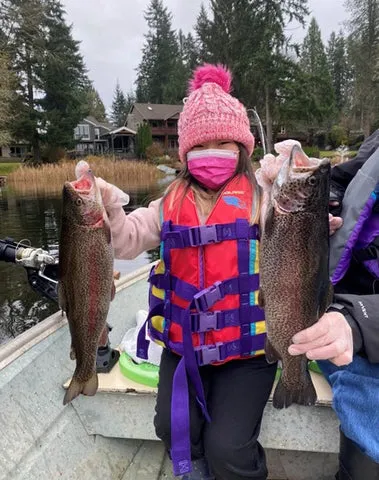
Well, winter is around the corner and it’s time to put the rods away and winterize the boat, right? NOT QUITE YET! Salmon season is indeed winding down, aside from some late season river opportunities, and winter steelhead is often a mystery, so many anglers don’t know where to look for the next bite. If this is you, look no further than some fantastic winter trout fishing at multiple stocked lakes! Winter trout fishing is incredibly rewarding, and in many cases, produces some large trout that cut beautifully. There are many ways to chase these fish from shore or from the boat, and with a little research and timing, you are sure to be on the fish!
HOW TO PREPARE
To begin, let’s look at the setups to use. Cold water temps have a lot of effect on fish, as they are a cold-blooded species. During this time, they are in energy consumption mode, with not a ton of energy to be spent moving around.
Additionally, cold temps slow down fish metabolism. All this together means that when the fish feed, they are looking for an easy meal that does not require too much energy wasted in chasing it down. For this reason, small profile lures and stationary baits are often the best choice.
When fishing from shore, it is hard to beat the “stocked-trout standby”, the Carolina rig! An egg sinker on the mainline with a 2–3-foot leader to a small hook, with an inflated nightcrawler or chunk of Powerbait, is an easy meal for a meandering trout to engulf. Another good option is a small spoon or spinner with a slim profile and wounded look.
Lighter casting spinners and spoons can be worked slow through the water column and produce a very crippled look. They are a great way to cover water in new spots and find the fish.
From a boat, these methods work great as well, but trolling can be added to the mix. Small spoons and spinners tipped with a worm are always a good option. Trolling allows the angler to go to the fish. Compared to spring and summer, trolling a little slower can be very effective. Many rainbow trout will sit low below the thermocline. Trolling past them just fast enough to get their attention but slow enough have them commit is the target.
WHERE TO GO
As with any fishing trip, the first thing to do is check the regulations. Many stocked trout lakes are seasonal, meaning they close at the end of October. If your lake is open, you are set to legally fish, but there may not be great fishing. Luckily for the angler, the WDFW publishes a list of recently stocked lakes that is updated weekly. Checking lakes in your area will give you the best idea of where and when to wet a line.
The best time to catch stocked trout in the winter is directly after the stock. This is when the trout aren’t quite acclimated to the new area, and they are the most aggressive. After a couple weeks in the lake, the fish will hunker down and be far less active compared to their first little bit in the new water. Knowing when the trout are stocked can be the difference in a couple bites and a nice limit on the stringer! During most of the winter months, the state stocks their “jumbo’s”, which are trout over 1lb, which usually cut fantastically.
FINISHING TOUCHES
As a local Western Washington Angler, I know a couple great lakes in my surrounding counties that are stocked in November, which give me just enough time to make some smoked trout dip for the Thanksgiving table. Nothing warms a day like a tight line on a cool river bank, sipping hot coffee, and enjoying some bank lunch.
With a little research, a simple setup, and a couple of free hours, you can be knee deep in some delicious trout! Just like the spring, ultralight trout setups, light monofilament line, some extra hooks, and a couple of weights, and you are set on terminal tackle. Then add some jars of Powerbait, a few lures, and a stringer, and you will be ready to hit the water. As always, be prepared for the weather!
/articles/stocked-trout-extravaganza
The Multipurpose Fishing Trip
By Matt Carey
I have to start off this article with the obvious: I love reeling in the trophy fish as much as the next guy. My trophy case might be a little bare, but that’s beside the point. If there’s an opportunity to get into a big fish, I am as excited as anyone. The reality is we don’t always end our fishing trips with those monsters. Sometimes we’re lucky to even get a bite all day. Maybe what’s even more disheartening than the slow, sporadic bite with a few lost fish here and there is the one fish you do land that ends up a fishing tale for the wrong reasons.
That one guppy you sling over the side of the boat. The fish you’re talking up as you reel in. “It might have some weight behind those shoulders” ... “Last time we were here I hooked into that (insert exaggerated size fish), you all remember that one...!” I have my issues, and giving my buddies more ammunition than they already have by way of an embarrassing fish doesn’t have to be on the list!
Our Time on The Water
So, what do we do with our time on the water when the fishing isn’t as great as we hoped? I think some of the best parts about fishing are all the extras that come with it. I don’t mean different gear or setups. I don’t mean using a drift boat versus one with multiple props. I don’t even mean the variety of species out in the water. I think about the extras associated with fishing that make for lasting memories. The kind of fishing trip where you look back and remember the fishing and everything else. Time with friends or family. The time spent on the shore with kids or pets. When you combine a fishing trip that has a great time on the water with a great time on the land, it’s hard to beat anything else.
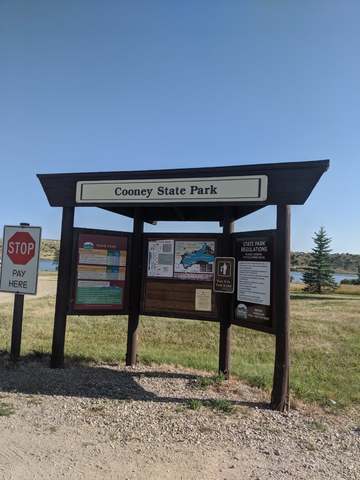
Cooney Reservoir
Cooney Reservoir outside of Billings, MT comes to my mind when I think about this multipurpose fishing trip. My in-laws had something of a family reunion planned for the summer. Within their immediate family, my wife and her siblings, kids etc. there are almost 20 people. The reservoir is for some a 30-minute drive and others an hour and half drive. Manageable for everybody. Being the only boat owner in the group, we agreed to bring our Klamath. Not a grandiose vessel, but reliable, and a good opportunity to let the nieces and nephews get some exposure to fishing and boating.
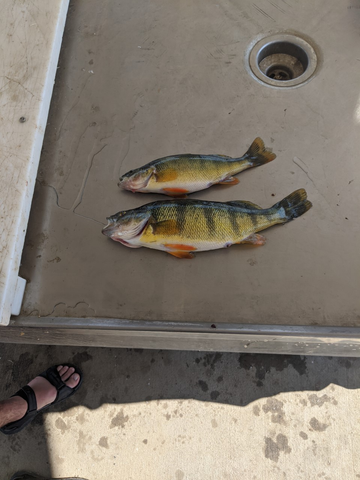
I brought some fishing gear that is pretty user friendly. Spinning reels with plugs and jigs. Open the spool, cast the line. So simple, kids could do it. Between taking turns getting everyone out on the water who wanted to go and practicing patience with other people’s kids, the fishing left something to be desired. Still, we caught a few nice perch and I was able to get my brother-in-law and his kids on a few more bites. Here’s where the “extras” come in.
Seeing jet skis, pontoons and other larger boats pull skiers and tubers led to some envy among the kids in our camp. We did have a little raft that could get hooked up to the boat, some rope, life vests, flags (remember this part in a second), and enough power in the motor to at least tug along kids wanting to enjoy the tubing action. So, I turned over the keys and let my brother-in-law take a spin with his kids.
On land I was enjoying some BBQ, swimming in the shallows with those on shore, and enjoying a typical day at the beach. Some time to chat with my in-laws, watching my dog swim and chase after a ball. All the extras that can go into a great fishing trip. Sometimes our fishing trips don’t have to be about limiting out or bragging rights. I had just as much fun on the shore as I did out on the boat. The experience of being with others is as important as the fish you catch. Or, even more important. Fishing itself can be a small part of a great memory and we as outdoorsmen/women cannot understate that.
Oh, and the flag? Well, a miscommunication happened between my brother-in-law and I which led to a “friendly” conversation between him and a game warden about needing to use the flag when someone is in the water. I swear I told him, but he swears he didn’t hear me say anything about it. Thankfully it wasn’t a huge issue, and everything turned out fine. It’s a friendly talking point for me when I have some lighthearted banter I need to call back to.
/articles/multipurpose-fishing-trip