Three High Desert Hotspots for Rainbows by Gary Lewis
Pull those spinning rods and fly rods out of the closet, tie up leaders, and wind new line on the reels. Here are three great spring fisheries that you need to know before you hit the water.
The warming water raises trout metabolisms and quickens an angler’s pulse as rise rings appear within an easy reach of shore.
CHICKAHOMINY
Chickahominy Reservoir is a trout fishing oasis on a windswept plain 100 miles east of Bend. Driving by on Highway 20, you see two blue fingers, a few campers, and picnic tables. Nothing more. What could draw campers to this windy place?
Rainbows are stocked in Chickahominy as fingerlings and reach ten to eleven inches in length by the following year. Two-year-old fish reach eighteen inches. Three years later, they will weigh between three and four pounds.
A narrow reservoir with many coves and fingers, much of the best fishing can be had from shore. Watch for depressions adjacent to shallow bays. Trout use these spots as staging areas prior to feeding in the shallows. A careful presentation yields a strike.
Early in the season, dragonfly nymph patterns are productive, as are scuds and red and black leech patterns. Concentrate on weed beds, edges, and drop-offs. The reservoir reaches a maximum depth of 28 feet. A slow-sinking fly line provides the best control for fishing below the surface.
Bait fishermen do well in the bays and inlets with nightcrawlers, salmon eggs, or jar bait. Use a sliding sinker to take your bait to the bottom. Leave a little slack in the line so a trout won’t feel resistance.
There is a paved boat launch near the dam. Troll trout spoons, or 1/6-ounce Rooster Tail spinners, in the narrows or explore the shoreline, casting to the shallows and letting the lure flutter over the drop-offs.
KRUMBO
A shallow lake on the west side of the Steens, Krumbo Reservoir, is a great rainbow destination in the desert.
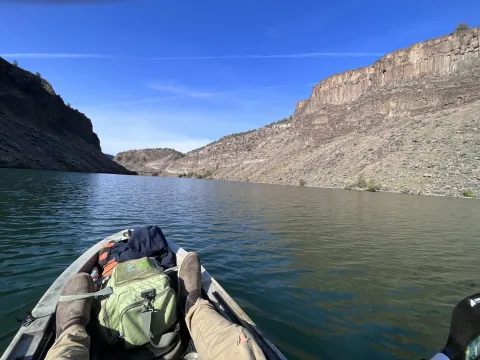
Best bet is to bring a float tube, a canoe, or a car-topper. But there is bank access. Anglers can fish at the dam or walk from the ramp to one of two rocky points that look out over some of the lake’s deeper water. Fish a sliding sinker and 48 inches of leader terminating at a No. 8 single hook with Power Bait or Gulp!
With a boat, launch at the ramp and fish out from the cove to 15 yards from the rocky point on the south. A long weedbed stretches north across the lake. The lake averages ten feet deep. Rainbows stack along the weeds and grow fat on callibaetis and chironomids.
Use a clear intermediate sinking line and troll along the weedbed. Fish a No. 12-14 callibaetis nymph, or better yet, a pair of them. To tempt with chironomids, employ No. 16-18 zebra, black, or red midge larva imitations under an indicator.
Leech patterns are effective. Use black, red, or olive buggers, weighted at the head. Twitch the fly with one-inch pulls.
Krumbo is stocked in late March or early April. Trout that winter over grow to 16 inches in their second year. Every season, the lake produces a number of 20-inch and bigger fish.
Covered tables are provided. A restroom can be found near the dam and at the boat ramp. A handicap-accessible fishing platform is near the boat ramp. The launch is paved with a nice dock. Electric motors are permitted.
Krumbo is open for day-use-only from the opening of trout season through October 31. Access is controlled by an automatic gate that opens a half hour before sunrise and closes a half hour after sunset.
Page Springs campground is a few miles down the road. There is RV camping available in private campgrounds on both sides of the Malheur National Wildlife Refuge.
WILLOW CREEK RESERVOIR
Willow Creek gathers her water from the Blue Mountains and runs it down to the Columbia. An impoundment, built to control periodic flooding of the town of Heppner, Willow Creek Reservoir, is located less than a mile upstream from the town.
The 110-acre lake draws anglers from nearby Hermiston and other towns to do battle with its piscine inhabitants. April and May are the best months for rainbows.
Trout put on weight fast in this food-rich water. Most anglers opt for a bobber and worm or a jar bait to put fish on the stringer, but spinners, trolling, and fly-fishing techniques are productive.
The best trout water is along the rip-rapped south bank and across the lake along the north shore. The water drops off quickly to a maximum depth of 85 feet at the dam.
Good bank fishing access makes this reservoir a safe bet for anglers without a boat. Drive past the boat launch along the south shore and take a gravel road down to a parking lot above a riprap bank. Walk down to the water or fish from the car. A trail along an old roadbed provides plenty of room for fishermen to spread out.
Fly fishermen should troll small spinners or flies such as the No. 8 Woolly Bugger or Spruce. Use minnow imitations like the Zonker to spark the predatory instinct in the bigger rainbows. Change direction, speed, and depth to simulate the escape tactics of a worried minnow.
Willow Creek Campground is located high on the western shore, overlooking the dam and the lake. It has 24 hook-up sites, offering water, electric, and sewer. Maximum length is 40 feet. Covered tables, barbecues, flush toilets, drinking water, showers, and telephones are available.
From I-84, turn right at Exit 147 and follow State Route 74 south to Heppner. Proceed through town and follow the signs uphill to the reservoir.
There won’t be crowds of people, and there probably won't be a line at the boat ramp, but there are trout to fight.
# # #
For a copy of the Fishing Central Oregon book, send $30 to Gary Lewis Outdoors, PO Box 1364, Bend, OR 97709 To contact Gary Lewis, visit www.GaryLewisOutdoors.com
CAPTIONS
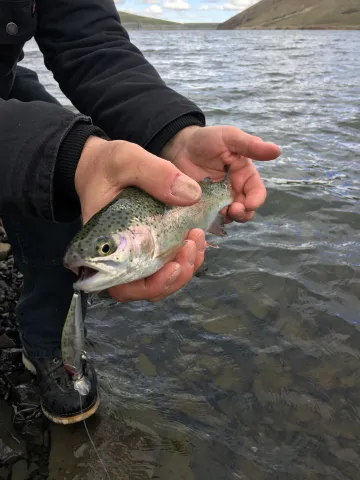
Gary Lewis 5 - An ODFW legal teased up out of Willow Creek Lake near the town of Heppner on a spring morning. Photo by Gary Lewis.
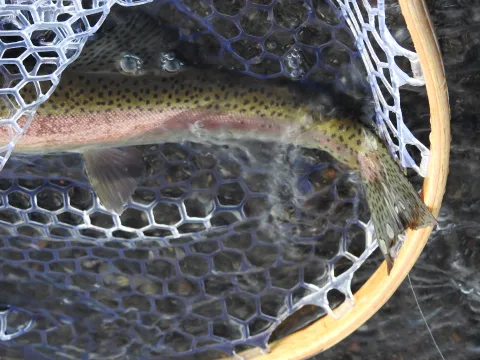
Gary Lewis 8 - In early May, trout can still be found feeding opportunistically and may be caught on a variety of techniques. Photo by Gary Lewis.
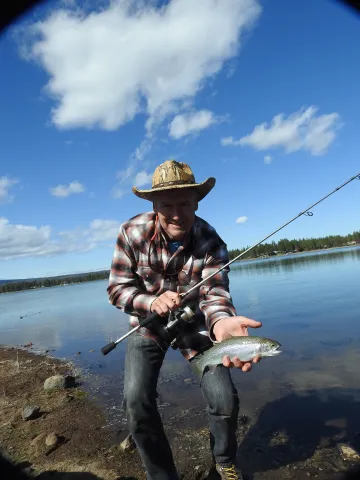
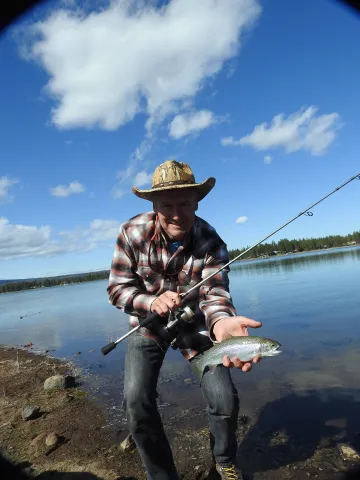
Gary Lewis 18 - Gary Lewis with a hatchery rainbow caught on jar bait. Photo by Gary Lewis.
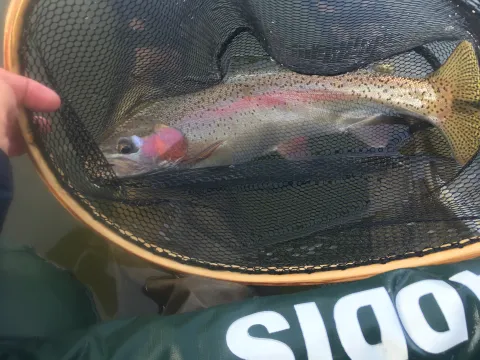
Gary Lewis_Isom 23 - A high desert rainbow caught on a fly. Photo courtesy Dave Isom.
/articles/three-high-desert-hotspots-rainbows-gary-lewis
Spoon Theory
If there is one best time of year for trout fishing, it's fall when the insect life is fading away and trout that have been fattening all summer are starting to feel the pinch of empty bellies. Trout that are going to make it through the winter have to switch from eating insects to eating minnows. This is the time of the year to put baitfish imitations to use. Trout are full of energy and will go a long way to hit a shiny bit of metal.
On those days when we launch the boat in the early morning. When the water is glass, we know the fish are elevated. It can be fun to put a small spoon in play.
PLANNING THE TRIP
Before you back up to the boat trailer, take a look at a map and click up www.myodfw.com to get an idea of some Oregon waters that will definitely get fresh stocks of fish in the early fall. This is the time of year when hatchery trout stocking ramps up again. Water levels are beginning to fall, and ambient temperatures are good for trout. Most fish & wildlife agencies post their stocking schedules on public websites. Weather changes, the price of fuel, and emergencies can change the timing of fish releases, but it's a good idea to comb the stocking schedules.
Top bets in the Willamette region (an easy drive for anglers from Portland, Salem, or Eugene) include North Fork Reservoir (on the Clackamas River), Foster Reservoir, Trillium Lake, Dexter Reservoir, Hills Creek Reservoir, and Dorena Reservoir. Most lakes get the "legals", which average 8 to 12 inches, but a person can put more poundage in a trout limit by targeting the "trophy size" trout that are older, better fed, and better fighters. If a lake gets 5,000 legals in the season, it might also get 250 trophies and a few brood stock trout that can tip the scales at five pounds or more. Premier fisheries that get a lot of angling attention, like any larger reservoir with campgrounds and mountain views within a two-hour drive of a metropolitan area, are likely to get a couple of stockings of brood fish or trophies every season.
It's all there in the stocking schedule. Except it's not.
BEHIND THE SCENES
A lot of what happens behind the scenes does not show up in the hatchery schedule. Sometimes there is an abundance of brood stock or surplus steelhead in the system that need to go somewhere. Another thing to watch for is when a lake is drained for maintenance or to kill trash fish. When the lake fills up again, the fisheries department scrambles to fill it with trout. Then there are the lakes that are never on the stocking schedule, but they magically have hatchery trout every season, and plenty of them. What's up with that?
Some reservoirs are not on the published stocking schedule because they are managed by agencies or municipalities, or utility companies with their own hatcheries. These can be some of the best destinations. Think about it. A power company built the dam, and part of the negotiation with the tribe or the community that permitted the dam was to provide a fishery. So every year, they are contractually obligated to populate the lake with some 30,000 trout. They're going to do it, but chances are they aren't taking the time to put it on a list somewhere. That's a lot of silvery slabs vying for a chance at a slow-trolled trout spoon.
SPOONAGE
There are a lot of spoons on the market, and they all have their place, but when we are talking about catching a limit of hatchery "legals" and "trophies", the best choice is one and a half to two inches long, like the Mepps Syclops, Triple Teaser, Thomas, Jerry Leo, Z-Ray, and Acme Little Cleo.
In most cases, a spoon should be trolled slowly so that it wobbles side to side. The slower the better. I like the speed at less than 1 mile per hour, up to 1.5 miles per hour, and if I can, I try to keep it at zero-point-nine. This can be accomplished some days on a wind drift, but a bow-mount trolling motor is pretty consistent. There are exceptions. In some lakes, the fish are used to chasing baitfish. This is the case on Upper Klamath and Agency Lakes, where sometimes you can't reel fast enough.
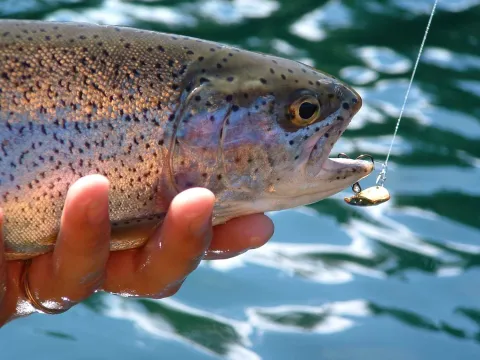
The spoon itself could be an Acme Kastmaster, Little Cleo, or Thomas Buoyant, maybe in the 1/6-ounce class. Every lake fishes a little differently, so it helps to have local knowledge. Frog patterns can be important, as are brown trout, chub, rainbow, and perch colors, depending on the local bait. Sometimes we put a flasher in front of the spoon with a 15-inch leader. Another trick we like is to add a touch of Pro-Cure's trophy trout scent to the spoon. And it never hurts to tip the hook with a bit of worm, corn, or a salmon egg. Trout that are going to carry over through the cold months have to start eating baitfish. Put baitfish imitations like trolling spoons to work. Trout are supercharged in the cold water and will chase up and down in the water column to hit a shiny bit of metal.
/articles/spoon-theory
Fishing for Washington’s Stocked Rainbow Trout
Spanning through the past 130 years or so, Washington’s lakes have been stocked with a variety of fish species. The types of fish typically fall under two categories, the first being game fish like rainbow trout, Kokanee, steelhead, and cutthroat. These are all planted for the specific purpose of increasing public angling opportunities. The second category would be an aquatic vegetation control fish like the common carp, that was planted primarily by private landowners intending to mitigate overgrowth of vegetation in lakes and ponds. Regardless of the purpose of fish stocking, the practice has generated various stages of controversy throughout the years, and rightfully so as the early versions of fish stocking had been practiced without much consideration of ecological impacts on native fauna. Thankfully, the days of reckless and illegal stocking of ecologically sensitive lakes by private citizens are, for the most part, a thing of the past in Washington state. Nowadays, The Washington State Department of Fish and Wildlife and local tribes operate stocking programs that involve strict management guidelines and make use of both surveying and long-term field studies to effectively provide anglers with fishing opportunities while not disturbing vulnerable ecosystems.
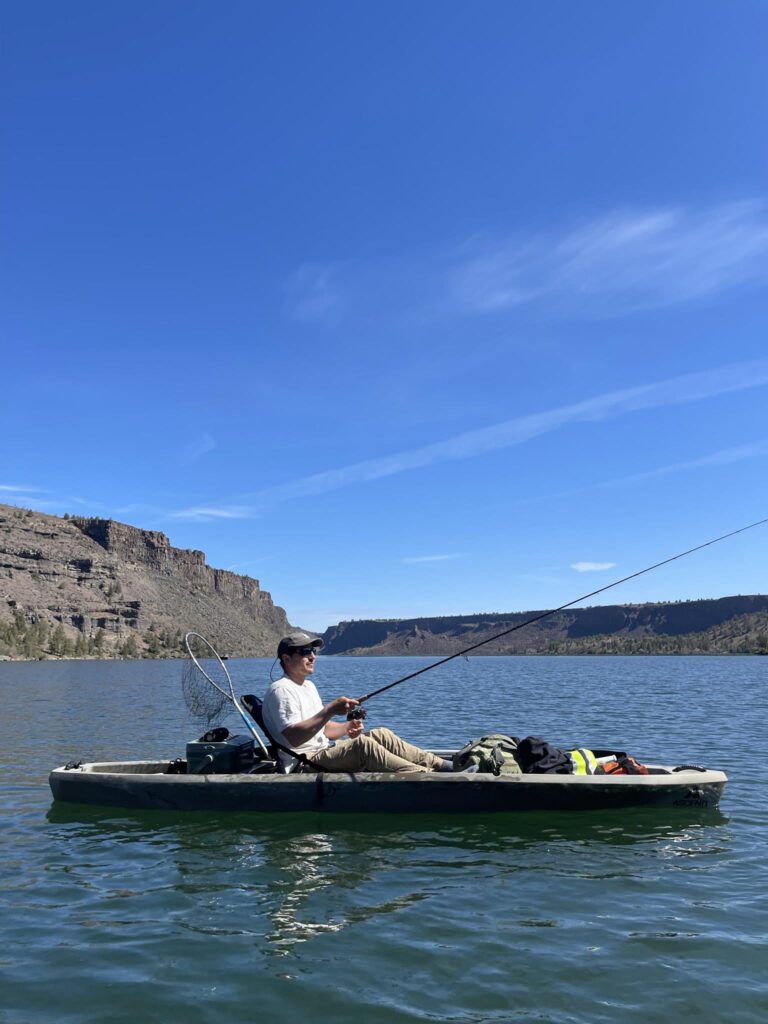
Rainbow trout are by in large the most widely stocked fish in Washington lakes, thus, they are the most common trout targeted by Washington State anglers. And though a stocked rainbow trout from a local lake might not be quite as alluring as say, a wild rainbow trout from some remote stream in the high-country wilderness, comparing these two is a bit like comparing apples and oranges. One can consider these stocked fisheries to be the staple of a lifestyle that places high value on family-friendly outdoor recreation, whereas the wild fish pursuit is an activity that often takes a bit more work and travel, and isn’t always quite as easy to get the family involved in
So, each has its place, and lucky for us, springtime marks the beginning of the trout stocking programs around the state. There’s a good chance that if you live on either side of the cascades, you won’t be far from a lake that’s getting a dump of catchable-sized hatchery-reared rainbow trout right about now. A visit to the Washington Department of Fish and Wildlife website will show you all of the recent catchable trout plants in Washington lakes. Here’s just a sample of some recent western and eastern Washington trout plant reports.
- Lake Thomas, Stevens County: 9,000 catchable trout
- Devereaux lake, Mason County: 7000 catchable trout
- Klineline pond Clark County: 10,000 catchable trout
- Black lake, Thurston County: 10,800 catchable trout
- Rotary lake, Yakima County: 3150 catchable trout
- Columbia Park pond, Benton county: 2012 catchable trout
There’s a myriad of techniques you can deploy to catch rainbow trout. Methods range from dropping jigging spoons down through a hole in the ice during the winter to casting flies out of a float tube in the summer. Stocked rainbow trout are not terribly picky and are known to strike at many different types of lures and bates. A surefire way to get some hookups would be to bring an arsenal of tackle so you can use the process of elimination in figuring out what the fish are biting on for that given day (it shouldn’t take you long). Below is a list of common techniques to catch stocked rainbow trout during the spring and early summer seasons.
Casting lures
This is by far my favorite method for rainbow trout. It’s simple in that you hardly need any gear other than rod, reel, and lure, but it also keeps you busy and engaged as you are constantly casting and retrieving while feeling for a strike. Casting lures like Rooster tails, spinners, spoons, wedding rings, and plugs have all proven effective at catching rainbow trout. Fishing during the morning and evenings when the fish are up near the surface will only increase the effectiveness of casting lures.
Trolling
Casting lures like the ones mentioned above can all be trolled behind a kayak or motorboat. If the fish are holding lower in the water column due to midday heat, try using a lightweight downrigger with a dodger. Or, if in a kayak, you can use a diver like a Deep 6 or Dipsy diver. Rainbow trout generally like faster trolling speeds around 1.5 to 2.0 mph
Sliding egg sinker rig.
This rig is very easy to set up and will get you onto the fish if they are holding deep towards the bottom of the water column. Slide a 1/2 oz egg sinker onto the mainline. Beneath that egg sinker attach a snap swivel. From there, attach your leader. Depending on how high off the bottom you want your bait to float will determine the length of your leader. 2-3 ft is generally a good bet. Tie your size 8-14 hook and bait it with a worm or dough bait. You will need to make sure your hook and bait are both floating. So, if you’re rigging an earthworm (or anything else that doesn’t float) you will need to add something with buoyancy. That can be either a small marshmallow (like the ones you’d buy from a grocery store) or a piece of buoyant dough bait.
Fixed Bobber
This is a fun and easy method for kids or new anglers to try out. Plus, it can also be extremely effective. Attach a fixed bobber to the mainline, and then anywhere from 18-24 inches beneath that a number 5 lead split shot (add more if there’s current). About 6 inches beneath that you can attach a size 8-14 octopus hook with a night crawler. Nightcrawlers can be replaced with a red plastic worm or dough bait.
Slip bobber rig
A slip bobber has a few more parts than a fixed bobber setup, though, unlike the fixed bobber, this setup will allow you to adjust your rig to virtually any depth. This is very handy for when the fish are suspended midway in the water column.
Add a pre-tied bobber stopper knot to your mainline. From there, add your bobber stop bead so that the bobber won’t slip past that knot. Add the slip bobber to the mainline, then add 1/2 oz egg sinker, and then a snap swivel. From here add 2-3 ft of leader and then your size 8-14 octopus hook. Now you can put your gear into the water and start sliding your knot up the mainline to adjust the depth of your hook and bait.
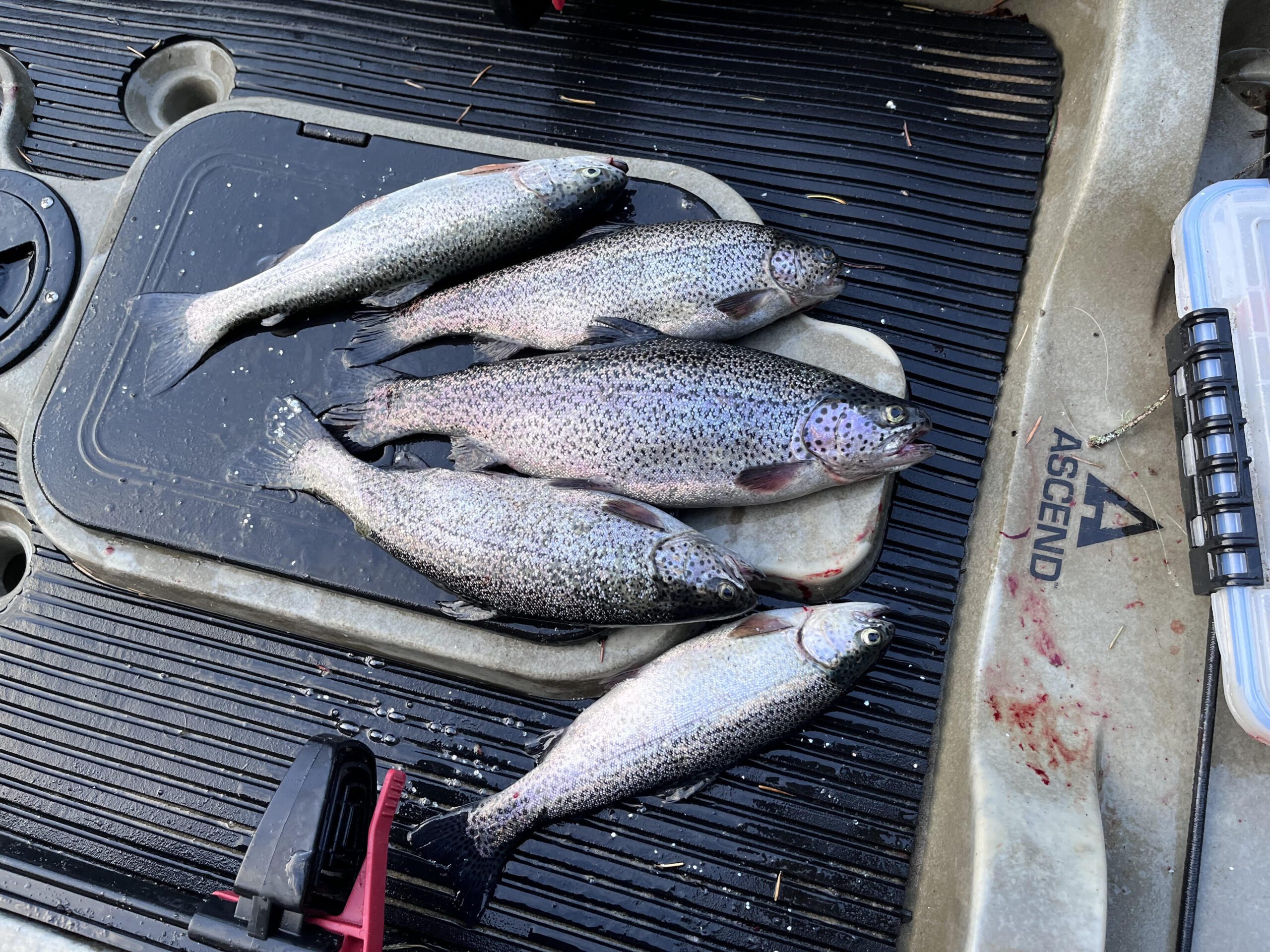
I’d wager that if you polled some friends and family and asked them what their first memories of fishing are, a good portion of them would likely start to share stories of fishing for rainbow trout off a dock during a hot summer day, or out of a john boat cruising around the lake hoping to land a big silver and pink beauty. I know this is true for me, and I encourage anyone who has kids (or adults for that matter) who are new to fishing, to take them out to your local lake and try out some of these tactics to bring home some fish. Despite what anyone might say about stocked trout, I assure you, they make great table fair, and they also do very well in the smoker. Fish on!
/articles/fishing-washingtons-stocked-rainbow-trout