The Cure for High Lakes Trout by Gary Lewis
How to turn eggs from hatchery trout into more hatchery trout.
We had a mild, dry winter with little snowpack. Now in the heat of summer, wildfire smoke shrouds the lowland valleys, and a lot of people who would rather be fishing are staying home.
Up in the mountains, the air is clear and beautiful. If there is smoke in the air, it filters the light and provides an otherworldly feel on the high lakes.
Here in central Oregon, the trout fishing has been fantastic. Fly-rodders, lure fishermen, and bait anglers have been having the best trout season of their lives.
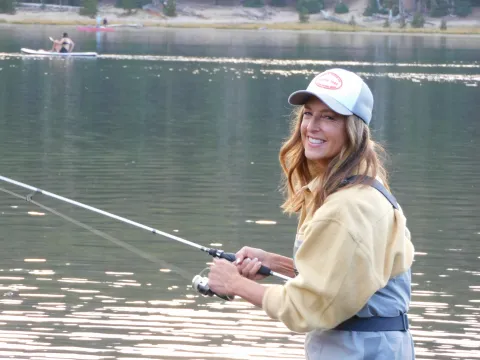
I have started tying egg loop knots and curing eggs on a smaller scale. Our hatchery programs turn out legals, "trophy" trout (14 to 18 inches), and brood stock fish that can go six pounds or more. Some of those hatchery fish have eggs in them, which look like bait to me.
WHY SPAWN SACS?
Trout eggs are few and fragile, and the skein is weak, but they are a dynamite way to turn hatchery trout into more hatchery trout.
Use spawn netting to conserve the eggs for a longer time in front of the fish. While an egg-looped bait might stay on the hook for three or four casts, the spawn sac bait can go for 40 or 50 casts and multiple fish.
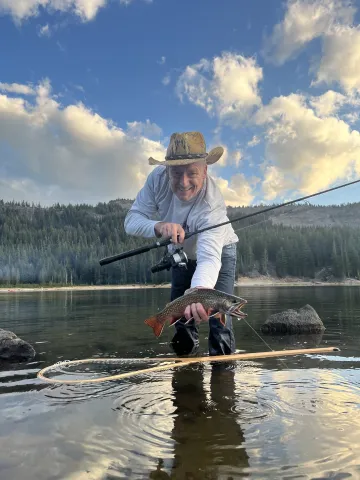
I kept the eggs from a 30-inch lake trout and put them in a paper towel in the refrigerator, and forgot about them till I was in Alaska. My wife was home and cured the eggs for me (her first time curing eggs), and we put them to use on a fall trip to one of my favorite lakes. I wound up catching a pair of beautiful brook trout. Opening our mixed bag of rainbows and brookies that evening, I harvested bait for the next trip.
Try to get eggs from four or five trout before starting the cure. First step in preparing the eggs is to allow them to air dry on a paper towel for a day or so.
The cure itself can be any one of dozens of commercial powder or liquid offerings or a person can prepare their own with Borax, brown sugar, and salt. Lately, we have been using Pro-Cure's Last Supper blend, augmenting it with sea salt and krill powder.
Donning latex gloves, I roll the eggs in the cure, making sure the cure adheres to both sides of the skein. Next, I sprinkle on extra salt and krill powder. Then I let that combination drain/air dry for about a day. After that, the eggs are ready for the spawn netting.
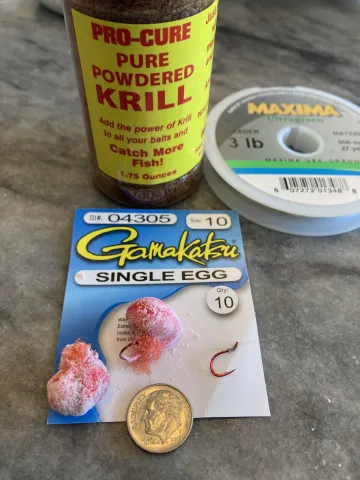
For these smaller baits, I will use a No. 8 or No. 10 egg hook with an egg-loop knot. The bait should be the size of a dime. I get two to four baits out of a skein and four to eight baits per fish.
Cut a small rectangle of netting (I use Atlas Mike's) and lay the bait on it. Then gather the edges and tie it with stretchy string (like Kwikfish Stretchy Thread. Trim off the extra string and netting, and you have a dime-sized bait ready to fish.
Baits can be stored in Ziploc bags, plastic boxes, or glass jars. Use the baits as-is or add a little more Borax to toughen them up.
Curing eggs for a spawn sac presentation allows the angler flexibility in doctoring the baits to specific conditions or to provoke a reaction bite. Eggs sink, which makes spawn sacs a great choice for a float (bobber) presentation. But because eggs sink, they are prone to hang up on rocks in a drift-fishing presentation. The "cure" for that is to add a foam egg (like a Mad River Fish Pill) to the spawn sac.
Jason Hambly, of Pro-Cure Bait Scents, in Salem, Ore., recommends adding krill powder to any trout bait. Garlic, too, is a proven trout favorite. I like to add a touch more garlic to a bait intended for cold water presentations. When the temperature drops in December in these parts, it can be harder to get fish to move. But they seem to move for garlic. Salt, brown sugar, and anise are other scents that could be added to spawn sacs. It makes a lot of sense to bring several flavors and experiment with what works in varying conditions.
STILL WATER RIGS
For our fisheries, I like a finesse presentation using a smaller No. 10 egg hook and a light three-pound test leader. When targeting bigger trout, consider sizing up to a No. 8 egg hook, nickel-size baits, and a five- or six-pound-test 20-inch leader.
Attaching bait is as simple as running the point of the hook beneath the netting knot, then securing it with the egg loop.
In a lake, the bait can be presented under a float when targeting a specific feeding zone. I like to use a sliding sinker fished over a ledge on a travel zone, such as along a drop-off.
WHERE TO FISH
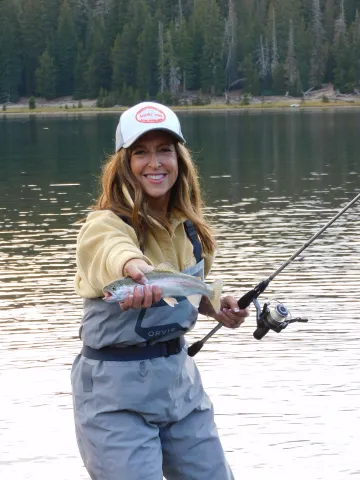
In August and September, plan trips to hit one or more fisheries. Think early morning and late evenings. Eat an early dinner and fish the last two hours of the day. Get up at dawn, fish for the first hour of the day, and then go get breakfast.
In the Cascades, top destinations include Diamond Lake, Detroit Lake (even as it draws down), Cultus, Elk Lake, Olallie Lake, and Timothy. But there are a hundred more. Open a map or get a copy of the Fishing Central Oregon book or Fishing Mt. Hood Country. The Department of Fish and Wildlife stocks all the drive-to and hike-in Cascade lakes.
Sometimes it's fun to experiment with something new, to do something different.
Reinvent your fishing and target trophy fish and brood stock with scaled-down baits.
# # #
Gary Lewis makes his home in Central Oregon.
/articles/cure-high-lakes-trout-gary-lewis
Opening Day Means Trout Derby Time! By Mark Yuasa, WDFW
Warmer weather, coupled with longer days, is a sure sign that spring has finally arrived, and the kickoff to the statewide lowland lakes trout fishing opener is just a stone’s throw away.
To prepare for this special fishing occasion on April 26-25, the Washington Department of Fish and Wildlife (WDFW) hatchery staff have been busy stocking about 525 seasonal lowland lakes and ponds with nearly 15.5 million trout and kokanee.
“Opening day is one of our biggest and most important days for anglers to get out on the water,” said Steve Caromile, WDFW Inland Fish Program manager. “Spring weather can be hard to predict, but we’ve had a mild winter, and hopefully that’ll lead to plenty of success for weeks to come.”
The 2026 stocking plan reveals more than 2.1 million catchable-size trout (averaging 11 to 13 inches) and another 157,000 “jumbo size” trout measuring 14 inches or longer will be swimming in lakes and ponds in time for anglers to catch on the opener. Most of the jumbos are expected to be planted in March and April, while others will be stocked to boost fall fisheries. Adding to the stocking list is another 1.6 million-plus trout categorized as “put, grow and take” – reared in hatcheries and 2.6 to 10 fish per pound in size – stocked in 2025. The fish that survived through the winter should now average 8 to 12 inches.
To further boost fishing prospects, an estimated 11.5 million fingerling and fry trout and kokanee planted one or two years ago should be in the catchable size range when the 2026 season gets underway. Most fry were stocked in Eastern Washington opening day lakes, which are managed to create decent fry survival. To spice it up, the WDFW Trout Derby is April 25 through Oct. 31 with more than 100 stocked statewide lakes. Around 70 statewide businesses are offering an estimated 915 prizes valued at $44,000 and worth about $48 per prize. The number of tags turned in during the 2025 season was 59%. The success of the trout derby would only be possible through WDFW’s ongoing partnerships with business dealers/vendors throughout the state.
Prizes include: gift cards, fishing gear and tackle, annual magazine subscriptions, Seattle Mariners game tickets, hooded jackets, books, rounds of golf at multiple golf courses, local aquarium admission, car detailing bucket, and kayak rentals. Higher valued prizes include: a kayak, guided lake fishing trip for two, handheld GPS units, lifetime memberships for a streaming app to locate trout streams in Washington, stays at local resorts and campgrounds, a backpack, and a beverage refrigerator. This season, each of the prize-winning trout can be identified by a green tag inserted near the dorsal fin.
Anglers can participate in the WDFW photo contest during the first week of the trout derby on Instagram by using the hashtag #watroutderby.
Join WDFW staff for the WDFW/Filson Trout Derby Kickoff Party hosted by Filson on April 18 from 11 a.m. to 3 p.m. at the Filson Seattle Flagship store, 1741 1st Avenue South in Seattle’s SoDo neighborhood. Get trout derby information, watch a fly-tying demo, learn from local fishing experts, and enjoy cuisine served by a local chef. For details, refer to https://www.filson.com/pages/seattle-store.
The derby is open to anyone with a valid 2026-2027 fishing license, and a temporary license may be used. There is no entry fee or registration required. Children under age 15 fish for free.
The WDFW Trout Derby website at https://wdfw.wa.gov/fishing/contests/trout-derby will be updated soon to see which statewide lakes contain tagged trout and learn more about how the derby works.
Why wait? Go now!
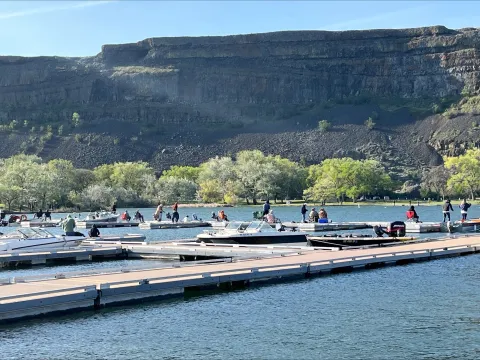
While most are gearing up for the later April opener, anglers can get a jump start right now by trekking to year-round westside lakes stocked with trout between March and May. Other lakes also receive bonus plants in the autumn/winter, and thousands of trout averaging 1- to 1.5-pounds apiece are going into some Puget Sound region lakes for the “Black Friday” fishing event in late-November. For the statewide stocking schedule, go to the WDFW fishing and stocking reports webpage at https://wdfw.wa.gov/fishing/reports.
More than 24 Eastern Washington lakes opened on March 1 for fishing and were or are being stocked with catchable-size rainbow trout. “As the days become longer, these early spring fisheries are a good way to start the season,” Caromile said. In Grant County, Martha and Upper Caliche lakes were recently stocked with catchable-size rainbow trout. Each also received rainbow trout fingerlings in March 2025 and an additional plant of catchable-sized trout in October 2025. These fish are expected to average 13 to 14 inches by opening day, with some reaching 20 inches.
WDFW stocked Quincy and Burke lakes with more than 21,000 trout fingerlings in spring 2025 and received an additional 1,500 catchable-size rainbow trout in February. Last year's fingerling plants are expected to be 10 to 12 inches, with some larger carryover fish in the 13- to 15-inch range.
Additional Grant County lakes open now for fishing are Cliff, Crystal, Cup, Lower Spring, and Upper Spring lakes. Lenice, Nunnally, Dry Falls, and Dusty lakes are also worth a try for trout. In Columbia County, try Blue, Deer, Rainbow, Spring, and Watson.
In Spokane County, head to Liberty Lake, which was stocked with catchable-size and jumbo rainbow trout. Amber and Medical lakes are open under selective gear rules and should fish well this spring.
In South Central Washington, many lakes in Benton, Franklin, Kittitas, and Yakima counties are open year-round and have been stocked with trout.
Weekly catchable trout stocking reports are posted on the fish stocking webpage at https://wdfw.wa.gov/fishing/reports/stocking/trout-plants.
Fishing gear to use
What anglers use for trout isn’t overly complicated, and a trout rod should be light and limber, in the four to 10-pound range, and lengthwise in the six- to seven-foot range. Many prefer a medium-sized spinning reel spooled with more than 100 yards of six- to eight-pound test fishing line.
From the main line, attach one or two number nine egg sinkers with a rubber bumper to a small barrel swivel. Leader length is vital; stay away from the store-bought pre-tied 12-inch leaders, which are way too short. Leaders should be three- to eight-pound test and 18 to 30 inches long. For hooks, think small and use an egg or worm hook in a size eight or 10, or try a No. 14 or 16 treble hook.
Traditional baits to use are worms, maggots, salmon eggs, or scented marshmallows, but dough bait like the wide variety of Berkley Power Baits is now the preferred option.
Fly patterns like a black or black-olive colored Woolly Bugger in a size eight or 10 attached to a five- or six-foot leader and trolled weightless close to the surface is a fun way to catch trout.
From a boat, troll a gang-flasher with a worm, maggot, or salmon egg laced with a tiny piece of scented dough bait or small spoon like a Dick Nite, Yakima Bait Triple Teazer, or Luhr Jensen Super Duper.
Bank anglers will usually cast out a bobber with their presentation sitting just below the surface in three to six feet of water. Others hang their presentation a few feet off the bottom, where the bigger fish tend to lurk. Once the stocked trout acclimate to their new surroundings, they’ll eventually spread out and move to deeper areas of the lake.
Keep in mind that most recently stocked trout tend to school near the surface, and many will swim around where the hatchery trucked them in the lake, usually within a short distance of the shoreline, boat ramps, and docks.
Lastly, remember to purchase a 2026-2027 fishing license before you head out, which is required for anyone age 16 or older. WDFW now offers two mobile apps to support outdoor recreation, available for free download in the Google Play and Apple App Stores. MyWDFW is a comprehensive licensing tool providing access to active fishing license privileges and can be found at https://wdfw.wa.gov/about/apps/mywdfw. The Fish Washington® mobile app at https://wdfw.wa.gov/fishing/regulations/app is tailored for anglers, offering fishing regulations and a feature that lets anglers manage their active license privileges, purchase license products, and enter catches or harvests.
Licenses may be purchased online at https://fishhunt.dfw.wa.gov/login or from hundreds of license dealers across the state at https://wdfw.wa.gov/licenses/dealers. The 2025–2026 fishing licenses expired on March 31.
(Mark Yuasa is a Washington Department of Fish and Wildlife Communications Manager and a longtime local fishing and outdoor writer.)
/articles/opening-day-means-trout-derby-time-mark-yuasa-wdfw
Fishing for Washington’s Stocked Rainbow Trout
Spanning through the past 130 years or so, Washington’s lakes have been stocked with a variety of fish species. The types of fish typically fall under two categories, the first being game fish like rainbow trout, Kokanee, steelhead, and cutthroat. These are all planted for the specific purpose of increasing public angling opportunities. The second category would be an aquatic vegetation control fish like the common carp, that was planted primarily by private landowners intending to mitigate overgrowth of vegetation in lakes and ponds. Regardless of the purpose of fish stocking, the practice has generated various stages of controversy throughout the years, and rightfully so as the early versions of fish stocking had been practiced without much consideration of ecological impacts on native fauna. Thankfully, the days of reckless and illegal stocking of ecologically sensitive lakes by private citizens are, for the most part, a thing of the past in Washington state. Nowadays, The Washington State Department of Fish and Wildlife and local tribes operate stocking programs that involve strict management guidelines and make use of both surveying and long-term field studies to effectively provide anglers with fishing opportunities while not disturbing vulnerable ecosystems.
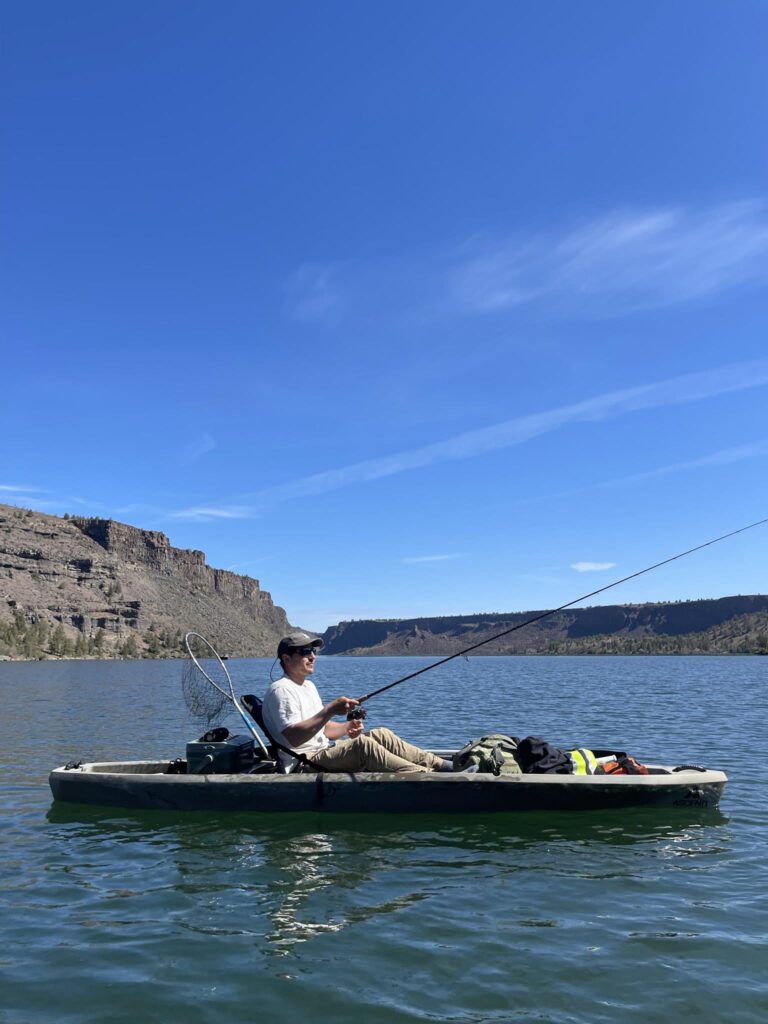
Rainbow trout are by in large the most widely stocked fish in Washington lakes, thus, they are the most common trout targeted by Washington State anglers. And though a stocked rainbow trout from a local lake might not be quite as alluring as say, a wild rainbow trout from some remote stream in the high-country wilderness, comparing these two is a bit like comparing apples and oranges. One can consider these stocked fisheries to be the staple of a lifestyle that places high value on family-friendly outdoor recreation, whereas the wild fish pursuit is an activity that often takes a bit more work and travel, and isn’t always quite as easy to get the family involved in
So, each has its place, and lucky for us, springtime marks the beginning of the trout stocking programs around the state. There’s a good chance that if you live on either side of the cascades, you won’t be far from a lake that’s getting a dump of catchable-sized hatchery-reared rainbow trout right about now. A visit to the Washington Department of Fish and Wildlife website will show you all of the recent catchable trout plants in Washington lakes. Here’s just a sample of some recent western and eastern Washington trout plant reports.
- Lake Thomas, Stevens County: 9,000 catchable trout
- Devereaux lake, Mason County: 7000 catchable trout
- Klineline pond Clark County: 10,000 catchable trout
- Black lake, Thurston County: 10,800 catchable trout
- Rotary lake, Yakima County: 3150 catchable trout
- Columbia Park pond, Benton county: 2012 catchable trout
There’s a myriad of techniques you can deploy to catch rainbow trout. Methods range from dropping jigging spoons down through a hole in the ice during the winter to casting flies out of a float tube in the summer. Stocked rainbow trout are not terribly picky and are known to strike at many different types of lures and bates. A surefire way to get some hookups would be to bring an arsenal of tackle so you can use the process of elimination in figuring out what the fish are biting on for that given day (it shouldn’t take you long). Below is a list of common techniques to catch stocked rainbow trout during the spring and early summer seasons.
Casting lures
This is by far my favorite method for rainbow trout. It’s simple in that you hardly need any gear other than rod, reel, and lure, but it also keeps you busy and engaged as you are constantly casting and retrieving while feeling for a strike. Casting lures like Rooster tails, spinners, spoons, wedding rings, and plugs have all proven effective at catching rainbow trout. Fishing during the morning and evenings when the fish are up near the surface will only increase the effectiveness of casting lures.
Trolling
Casting lures like the ones mentioned above can all be trolled behind a kayak or motorboat. If the fish are holding lower in the water column due to midday heat, try using a lightweight downrigger with a dodger. Or, if in a kayak, you can use a diver like a Deep 6 or Dipsy diver. Rainbow trout generally like faster trolling speeds around 1.5 to 2.0 mph
Sliding egg sinker rig.
This rig is very easy to set up and will get you onto the fish if they are holding deep towards the bottom of the water column. Slide a 1/2 oz egg sinker onto the mainline. Beneath that egg sinker attach a snap swivel. From there, attach your leader. Depending on how high off the bottom you want your bait to float will determine the length of your leader. 2-3 ft is generally a good bet. Tie your size 8-14 hook and bait it with a worm or dough bait. You will need to make sure your hook and bait are both floating. So, if you’re rigging an earthworm (or anything else that doesn’t float) you will need to add something with buoyancy. That can be either a small marshmallow (like the ones you’d buy from a grocery store) or a piece of buoyant dough bait.
Fixed Bobber
This is a fun and easy method for kids or new anglers to try out. Plus, it can also be extremely effective. Attach a fixed bobber to the mainline, and then anywhere from 18-24 inches beneath that a number 5 lead split shot (add more if there’s current). About 6 inches beneath that you can attach a size 8-14 octopus hook with a night crawler. Nightcrawlers can be replaced with a red plastic worm or dough bait.
Slip bobber rig
A slip bobber has a few more parts than a fixed bobber setup, though, unlike the fixed bobber, this setup will allow you to adjust your rig to virtually any depth. This is very handy for when the fish are suspended midway in the water column.
Add a pre-tied bobber stopper knot to your mainline. From there, add your bobber stop bead so that the bobber won’t slip past that knot. Add the slip bobber to the mainline, then add 1/2 oz egg sinker, and then a snap swivel. From here add 2-3 ft of leader and then your size 8-14 octopus hook. Now you can put your gear into the water and start sliding your knot up the mainline to adjust the depth of your hook and bait.
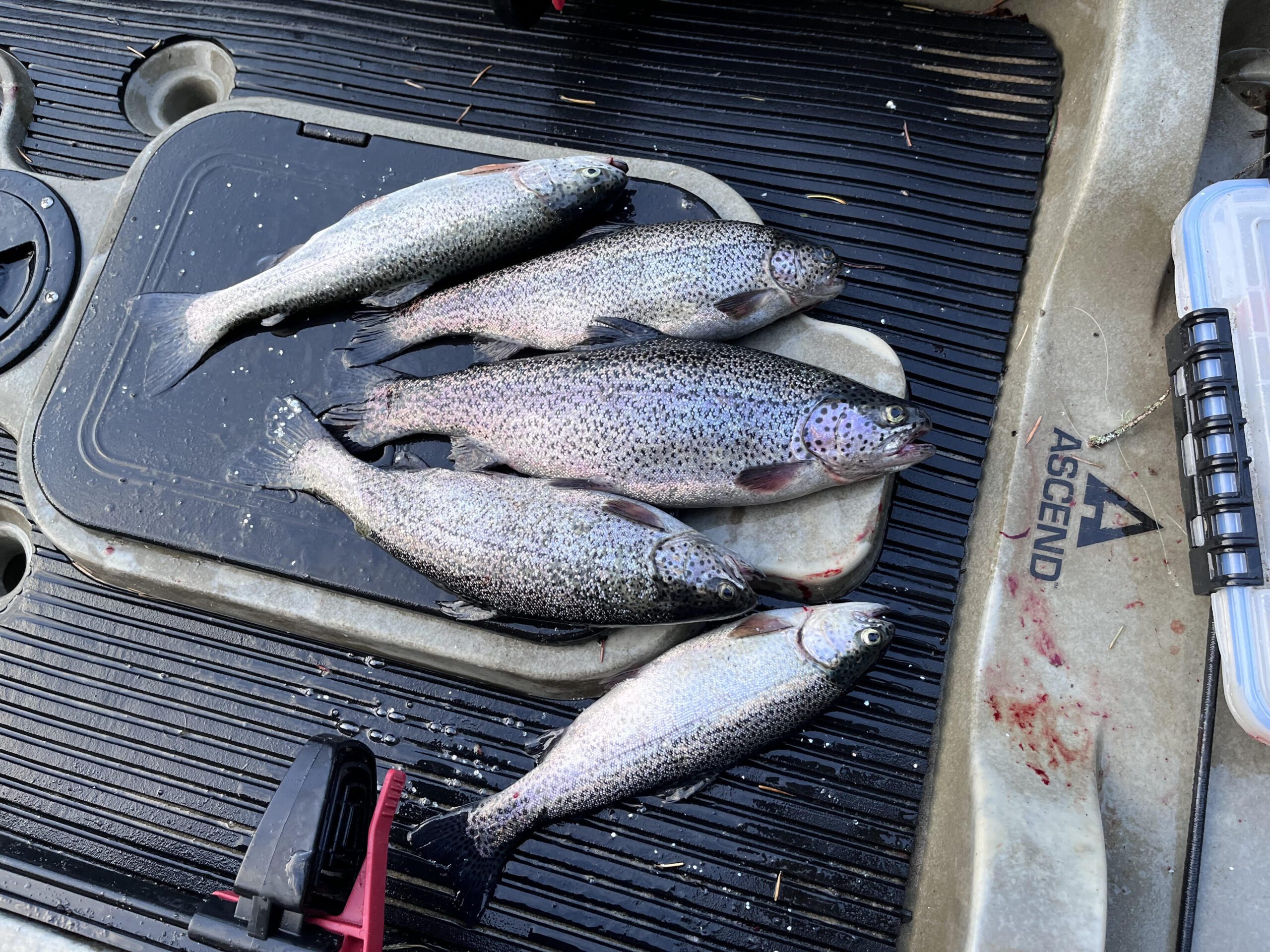
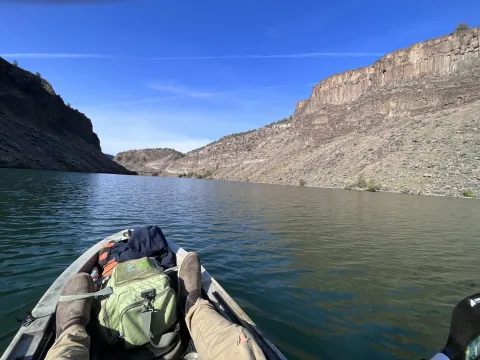
I’d wager that if you polled some friends and family and asked them what their first memories of fishing are, a good portion of them would likely start to share stories of fishing for rainbow trout off a dock during a hot summer day, or out of a john boat cruising around the lake hoping to land a big silver and pink beauty. I know this is true for me, and I encourage anyone who has kids (or adults for that matter) who are new to fishing, to take them out to your local lake and try out some of these tactics to bring home some fish. Despite what anyone might say about stocked trout, I assure you, they make great table fair, and they also do very well in the smoker. Fish on!
/articles/fishing-washingtons-stocked-rainbow-trout
Winter Trout
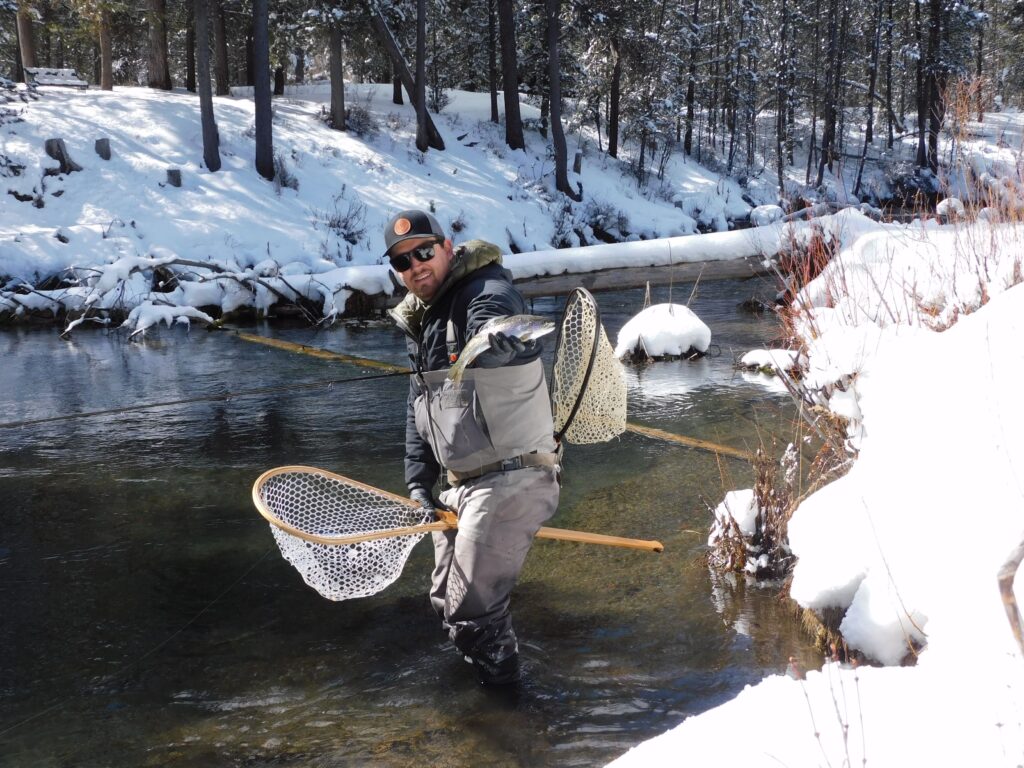
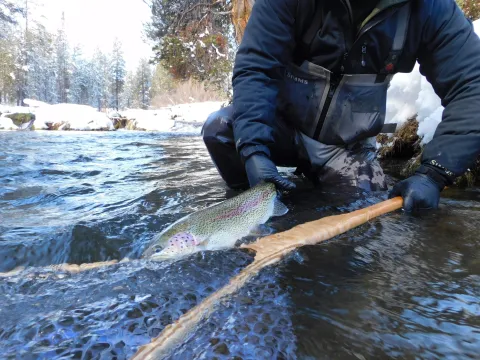
These are some of the best days on the water, in December and January, when a lot of other sportsmen are watching football. Fly-rodders watch the weather and hope for a hatch of midges and look forward to the little black stoneflies, but there are better ways to tempt bigger trout in December and January. Plastic worms and minnows can tease big trout out from beneath the undercut banks and beads, tailored to size and color can turn on the bite.
TWITCHING PLASTIC
Plastic worms tend to produce as many fish as natural baits. And you don't have to dig through the compost pile to find them.
Adapted from steelhead drift fishing the best rig is a six-pound main line tied to a barrel swivel. A sliding sinker on the main line is a good way to get the bait down but another option is to leave a tag on the main line knot and crimp on removable split shot. The leader should be 20 inches long terminated at a No. 10-8 single egg hook.
Rig to drift the edge of a seam with just enough weight to tickle the tops of the rocks. Jeff Warner, founder of X Factor Tackle, relies on three main colors in cold winter water - hot red, fluorescent pink, and natural worm.
Warner's go-to for brown trout on his home water is a 1/16-ounce jig head on a No. 4 hook and an X-Factor Teaser minnow. He fishes without a float.
"In my experience, it is better to allow the bait to do its work as an injured bait fish. I don't want a natural drift, I want violent rips and jerks. It's why I like the lightweight jig. I don't need it to be down on the bottom. It lets the bait look more erratic than it does with a heavy jig head."
Jeff Warner
Warner's favorite on a bright sunny day is motor oil with red flake. Warner recommends a plastic minnow in the tail-outs and along the seams and ripping it back.
"I like to cast it upriver and then work the clock so to speak. Even cast it straight downriver and twitch it. If I don't catch a fish by that time there ain't one in there."
Jeff Warner
The bite can be hard to detect. Keep the index finger on the line to stay in touch with the rocks and set the hook at the least tug that signals a grab.
FLY ROD EGGS/BEADS
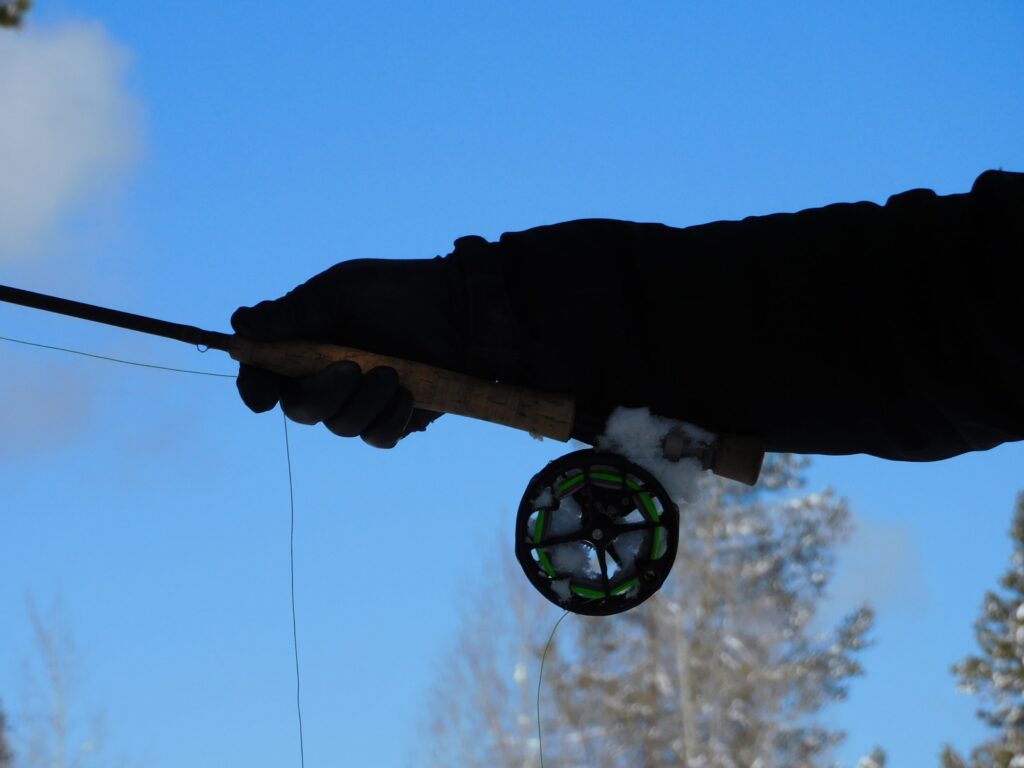
When fishing egg imitations and hard beads, the big challenge is to get them at the level the fish are holding and allow a dead-drift presentation.
Try to position the bead about two inches above the hook. This can be accomplished in several different ways. One easy way to do it is to nail knot a piece of clear mono on the leader and position it two inches above the hook acting as a stop.
Set the indicator (a good one is the easy-to-cast plastic Thingamabobber) and put split shot on above the tippet knot (or swivel) and set the float about the depth of the water.
When the trout bites the bead the angler reacts with a short upward lift which tends to pull the bead through and pin the hook in the outside corner of the mouth.
With whitefish spawning in western rivers in late January and February we have bait to match. Trout that key on whitefish spawn get used to gobbling the yellow eggs and its why some fly-fishermen tie on yellow wet flies in February without knowing the reason why the trout are biting. Summer steelhead may also spawn in January and February, in which case, the trout are eating orange eggs. In any case, small orange beads or tiny yellow eggs can turn a rainbow's head this month.
SOFT PLASTIC BEADS
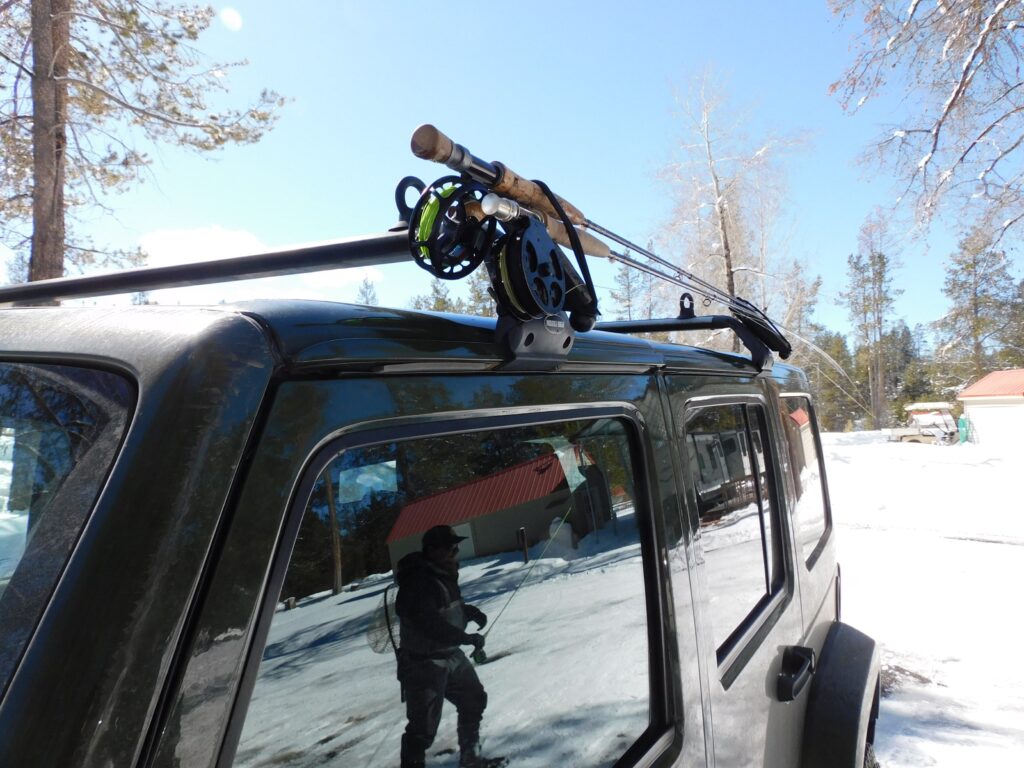
One of the greatest moments in drift fishing is to watch a trout peel away from its holding lie and follow a soft orange egg downstream then crush it. A squishable, scented egg imitation tumbled along the gravel with a drift fishing rig or a bottom-walking drop shot setup is a good bet in December.
My favorite hook for this work is a Daiichi salmon egg bleeding bait hook sized No. 12 up to No. 8. Again, the soft bead is best positioned two inches above the hook, which can be accomplished by using a nail knot, a blood knot, a sequin or similar bead stopper.
One of the mistakes we make is using an indicator in shallow, clear water. If the fish and the bottom is visible, dispense with the indicator and just watch for the take.
A mistake we often make is allowing the weight to control the movement of the egg. This is why a sliding sinker is sometimes the best choice. And why a drop shot weight might be the best choice with a tag end of a surgeon's knot used to splice on a bit of 4-pound fluoro. That bait should present as freely as possible in multiple braided currents. The egg wants to be free!
# # #
For a copy of the Fishing Central Oregon book, send $29.99 to Gary Lewis Outdoors, PO Box 1364, Bend, OR 97709
To contact Gary Lewis, visit www.GaryLewisOutdoors.com
/articles/winter-trout