Spring Means Rockfish
If you’ve fished anywhere off the coast of Washington state, chances are at some point you’ve landed a rockfish, or depending on who you talk to, a black seabass. While rockfish are often seen as only a bonus catch during the pursuit of something larger, like lingcod, they are, in my opinion, some of the best-eating fish that swim along our coastline. The name “Rockfish” is an umbrella term that encompasses over 100 different species of fish, but the ones we most commonly fish for here in the northwest are the canary rockfish, black rockfish, blue rockfish, and deacon rockfish.
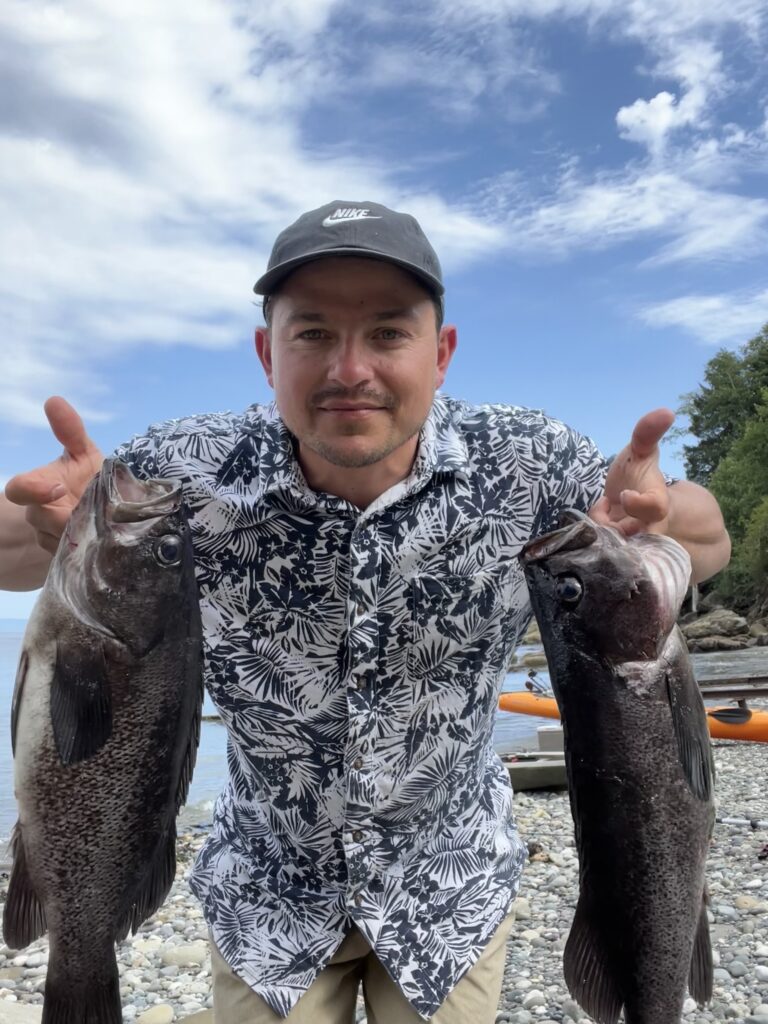
Where to fish
Though Rockfish do inhabit the waters of the Puget Sound, it is illegal to retain or target them here due to conservation concerns. As you move northwest into the straights of Juan De Fuca, you’ll find that the populations of rockfish become healthier and fishing opportunity increases the closer you get to the Pacific Ocean. Marine Area 5 (Sekiu) is where allowable rockfish retention begins, though as of 2025, in MA 5, you can only retain 1 rockfish per day. Moving further west to MA 4 (Neah Bay) the possession limit increases to 7 and the season is year-round.
Aside from Neah Bay and Sekiu in Clallam Bay, you can also target rockfish southward along the Washington coast around Westport, Ocean Shores, and Pacific County near the mouth of the Columbia River. Boat fishing Rockfish tend to prefer deeper waters near rocky structures, reefs, kelp beds, or even shipwrecks, which in general makes fishing from shore not a viable option (though there are some exceptions). Fishing from boats, kayaks, or canoes, are generally the most effective method. And because rockfish are such aggressive feeders, it makes them a great species to target when bringing the family along on a boating trip, as these fish aren’t terribly difficult to catch.
Most soft plastic grubs on a 1-3 oz lead jig-head can entice a bite. Use lighter-weight jigs-heads when the current is mild, and heavier jig-heads during strong currents. The amount of sunlight should influence your choice of jig colors. I try to stick with darker color soft plastics during overcast days and brighter colors on sunny days. Flashy metal jigs anywhere from 2-4 oz can prove phenomenal for catching rockfish as well.
My favorite jig as of lately has been a 2.5 oz blue and silver laser minnow, and I seem to catch rockfish on this regardless of weather conditions and current strength. Most of the rockfish you catch will likely be around 2-3 lbs (though they can get much larger), considering this, they are a blast to catch on lightweight gear. However, larger fish like lingcod and cabezon will bite at the same jigs and lures as rockfish, so anglers should be prepared for this potential. I almost always run 25 lb braided mainline with a 20 lb monofilament leader off of a 6-7 ft medium light rod and find this to be a good middle of the road setup.
Jetty fishing
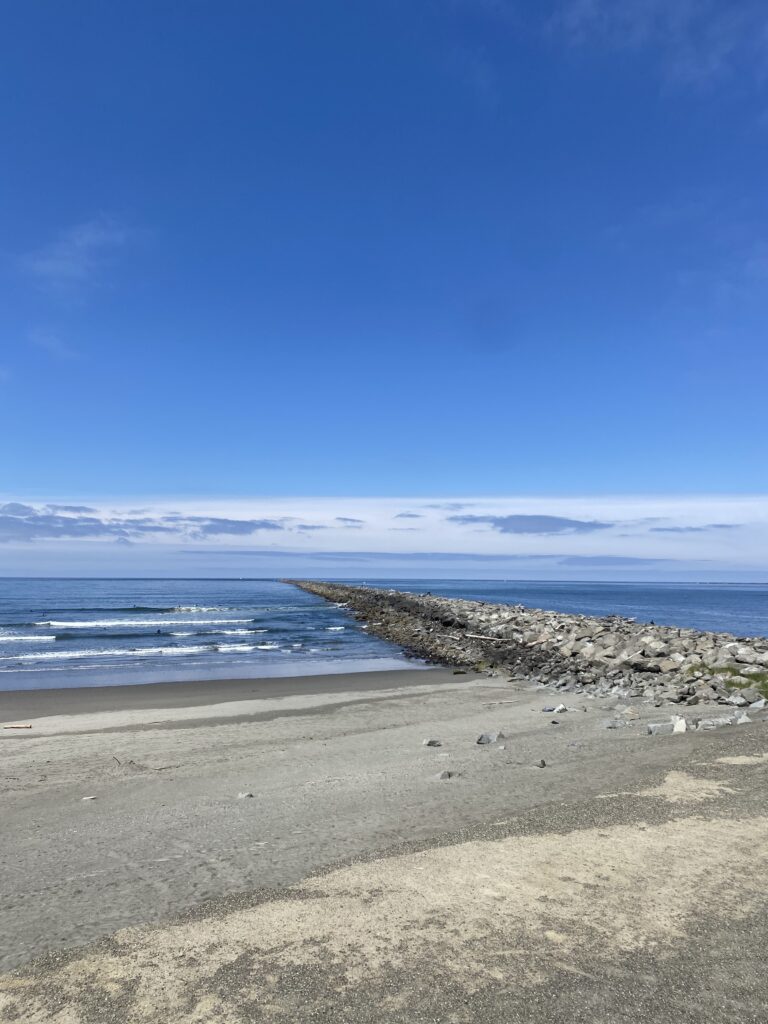
Though boat fishing may be the most effective method for catching rockfish, land dwellers should not fret because there are options for folks who prefer to stay off the water! Jetties or rocky outcroppings that extend into deep water offer ample opportunity for a limit of rockfish. The Westport jetty, the north jetty in Ocean Shores, and the Columbia River north jetty all allow somewhat easy access to this fishery. Furthermore, if you normally fish out of a boat for rockfish, and have had plenty of success over the years, you might find that the process, though fun, can eventually become a bit repetitive.
Jetty fishing offers a welcome change of pace as it provides an altogether different experience and requires different techniques and tackle to land the fish. When fishing from a jetty, netting the fish off the rocks isn’t always an option. This means you will have to lift the fish out of the water with your rod and line. That process can put an excessive amount of strain on your line, thus, jetty anglers should stick with a 25-40 lb mainline and 20-25 lb leader.
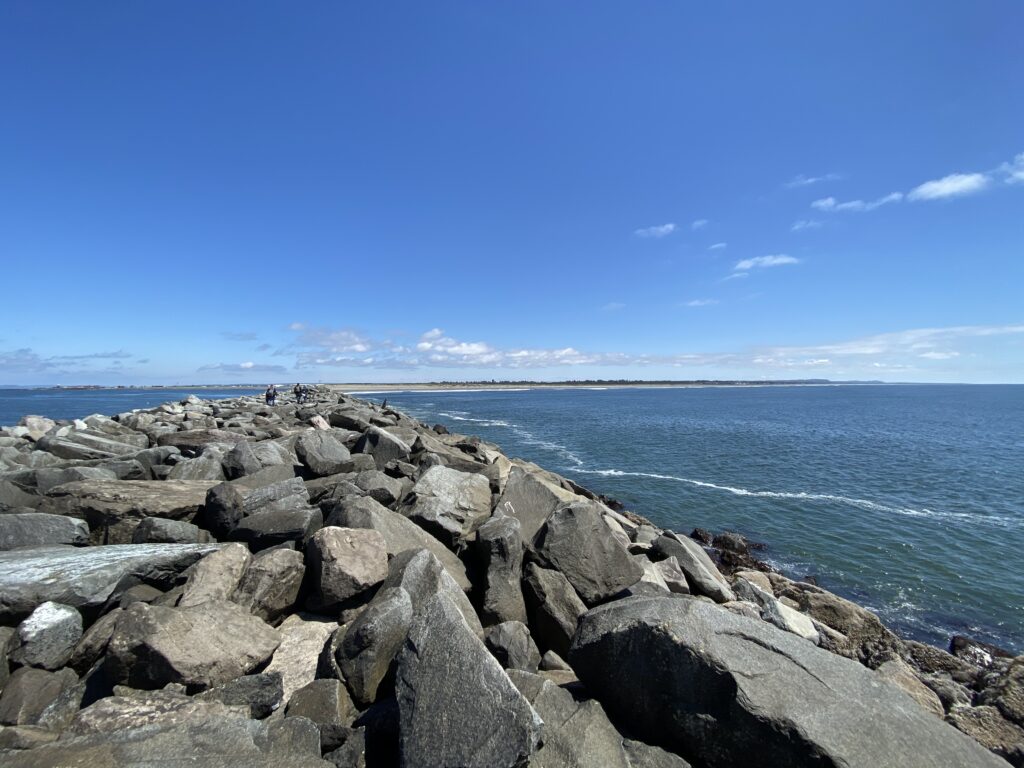
A soft plastic swim bait lure with a weight of 1/2 - 1 oz weight between your mainline and leader will allow your gear to fall deep enough into the water column while also remaining high enough to avoid snagging on the rocks. If you run a soft plastic jig, you can retrieve, jig and repeat. For a swim bait, anglers can find success by either doing a steady retrieve or by doing a steady retrieve with an occasional jig or twitch. Safety is a major concern while fishing on jetties. With this in mind, anglers should monitor weather, tides, and swell activity. During extreme conditions, waves can crash onto the jetties and pose a risk for anyone who’s on the rocks. Refer to NOAA for weather conditions and surf reports for swell and wave activity. Hiking boots, felt-soled boots, or even toe-shoes are favored by jetty anglers for walking around on wet rocks.
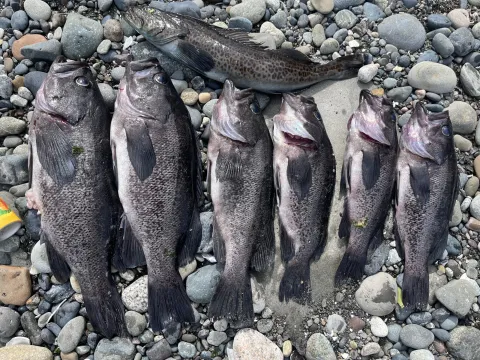
The rockfish fishery is a great way to get back out onto the water and get the sun back on your face as we crawl out of our long Pacific Northwest winter. Whether you're launching a kayak at Hobuck beach in Neah Bay, motoring out onto the straights, or climbing around on some rocks at the Westport jetty, there’s nothing better than introducing the upcoming summer season with a cooler full of rockfish and a fish taco dinner at home with the family.
/articles/spring-means-rockfish
Kokan-Eye Eyesight Colors and Presentations
Make no mistake, kokanee can see up, down, and all around. They see close up and farther out (depending on water clarity) at the same time, but not as clearly as we can. They can see effectively behind them as they swim, because their undulating swimming motion turns the head just far enough to see very near the plane of the tail.
Color Shift At Depth
Since sight is part of the effective formula, you must make sight important in your presentation. The very last thing you want is for your lure to be camouflaged. You want it to be noticed. You work against yourself if your target winds up being camouflaged because you have not accounted for the three things that change your lure's appearance at depth:
- Lack of light at target depth;
- Color shift (attenuation), making your lure dull gray; and
- Lack of contrast (conveys information about shape and form)
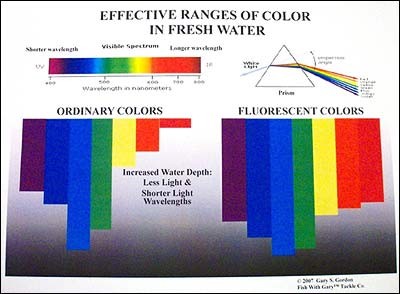
Consider what it is that you are trying to do. You want your setup color-wise to be different than the water surrounding it. If your setup contrasts with the water it is in, it has a far greater chance to be noticed and targeted. Remember, we are seeking a striking response. Your setup must appear different than the predominant color of the surrounding water at that depth.
As we descend the water column, certain light wave frequencies are absorbed (because water absorbs light). Here is the other prong of that absorption concept. As we go deeper in the water column, some of the colors we see at the surface will no longer be the same color at depth. At this point in the discussion, I am speaking of ordinary colors - the color spectrum we can see. Fluorescent colors will be discussed in a moment.
The longest visible color wavelengths are the reds. Shorter in descending order are orange, yellow, green, blue, indigo, and violet. As you descend the water column, the longer wavelengths are absorbed, leaving the shorter wavelengths to continue down the water column. Those shorter wavelengths will ultimately be absorbed, even in the clearest of water, provided you go deep enough. The kokanee fisherman is dealing with depths generally down to 100 feet, give or take. The typical kokanee body of water will have no light in the later season beyond 75 feet. In the very early season, there may be no light at 30 feet.
As you recall from last month’s article, the proper target depth for kokanee fishing is 54 degrees. And since that temperature descends the water column as the season wears on, the resulting less light at your target depth also means that certain ordinary colors are no longer what they appeared to be on the surface because their wavelengths have been absorbed. If you use such a color at depth, your presentation will be gray and not have much contrast to the water it is in.
A lure of ordinary red will virtually disappear in but a few feet of water. Soon to follow would be the ordinary orange, ordinary yellow, and then ordinary green. Also, about that time would be ordinary indigo and ordinary violet due to the structure of water and the use by phytoplankton of these frequencies. If you take an ordinary red object into a dark closet and shine orange light on it, the red object will appear gray. If you take an ordinary green object, and test it the same way with blue light, the green object will appear gray.
For the object to be seen in its correct color, it has to be struck by a light frequency of equal or higher wavelength. In these examples, if you take a green object and strike it with red light, it will appear green. If you take the green object and strike it with orange light, it will still be green. For ordinary colors, the deeper you go, the very light necessary for that color to be that color, has likely been absorbed in the water before you reach your target depth. Without the right light wavelength hitting it, it will be dull gray and not at all distinctive to the water that surrounds it. The little remaining visible light at depth makes the dullness even duller
Our lures are rarely of a pure color wavelength. But even the mixing of colors (hues) will still be subject to the same color deterioration at depth. Pink is a good example. Pink is not a color of the visible spectrum, but is a mixing of red and white. White is not a color of the spectrum, but is all colors of the visible spectrum. Thus in pink, a little of the color will respond to green and blue wavelength at depth. But the color intensity will be mostly dull. From what you now know, ordinary pink is not the ideal choice for getting noticed at depth.
While this might seem confusing to us above water, it is still the reality of the color situation in the water and at depth. Perhaps some encouragement is in order. To be "expert" of color at depth you need not memorize anything. Because most of our kokanee fishing occurs in green or blue light wave frequencies, we want all of our presentations to show up in green and blue light.
Fluorescent Colors
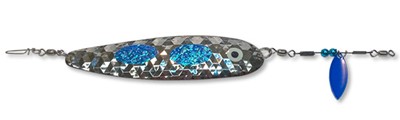
Enter the amazing world of fluorescent colors. No intense scientific discussion is needed here. What you need to know is this. A true fluorescent color will remain its color when struck by a lower light wave frequency. If a true fluorescent orange is struck by a green light (lower frequency than orange light), it will remain orange. The same is true for all of the fluorescent colors. And that means that if you use true fluorescent colors in your setup, your setup will be seen at depth. True fluorescent colors tend to be brighter as well, making for higher visibility.
Not all materials on the tackle market are of true fluorescent colors. You can easily test whether a color is a true fluorescent by taking your lures and dodgers into a dark closet and then shining a black or UV light on them. If the color seen is the color you saw in full light, you have a fluorescent color. Again, there is a difference in intensity of the color. Just because a material is fluorescent does not automatically mean it is intense.
U.V. light is below the visible spectrum (of lower wave frequency), which means it cannot be seen directly. All U.V. light is dissipated in very shallow fresh water holding kokanee, because the water, plankton and other particulates in the water absorb all of it. It is well documented that there will be no U.V. light in the freshwater column below just a few feet.
I have tested lures labeled "U.V." Most work very well in waters holding kokanee, and in particular, the UV squids should be a part of your tackle box. However, lures labeled "U.V." would be more accurately labeled as "fluorescent." These "U.V." lures come in visible colors. Since UV is not visible, the color you see is fluorescent. As with all fluorescent colors, stimulation by a black light will make the color jump out at you. But these lures are in fact, only fluorescent. But that is why they are good. They still need some visible light at depth to be most effective. They do not glow. Match one of these "UV" (fluorescent) squids with a Fish With Gary™ POWER Dodger, and you have a great setup.
Using true fluorescent materials in your setup will resolve issues of color shift in your favor. While some fluorescent colors will fade somewhat the deeper you are in the water column, they still are not gray if there is some light available to act on them. When using true fluorescent materials, the colors you are delivering at depth are those NOT ordinarily seen at depth. And that is exactly the effect you want. Your setup will be out of the ordinary, and kokanee will focus on it in the near field.
Vital Contrast
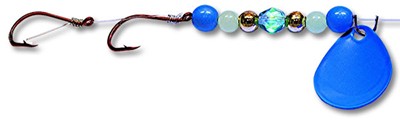
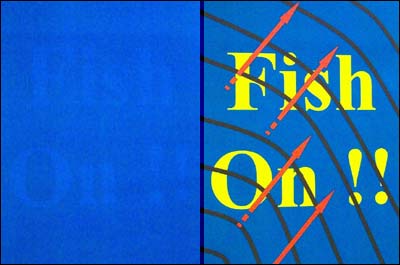
Using fluorescent materials is not the only way to get your setup noticed. Remember that you are after contrast, or what I call vital contrast. Vital contrast can be obtained by using different fluorescent colors next to each other or spaced in such a way as to create the illusion of not being connected. Components that contrast with themselves will stand out even more in dull watery depth.
Contrast is the enemy of camouflage. Contrast is the better-developed part of kokanee vision and encompasses about 10 times larger visual window area than does color. The color window is directly in front of the kokanee, but contrast is not only seen in front, it is seen up, down, sideways, and backwards. Contrast vision overlaps color vision. Effectively presented, color is a great contrast. When color and contrast are effectively presented, color and contrast are in front of the kokanee to see and react to them. This allows the kokanee to put its mouth where the color is, which is pretty much what you want!!
Glows
There is another fantastic way to achieve this vital contrast at depth, and that is the use of glows. Glows are termed phosphorescent (or luminescent) as they carry their own light to depth. No intense scientific discussion is needed here either. Glows emit light when the light source that charges them is removed. On the other hand, fluorescent materials appear brighter in light, but do not glow when that light is removed.
Most glows on the market and peddled to fisherman are of very poor quality. Their glow simply does not last even long enough to make it to depth, let alone work for you at depth.
All Fish With Gary™ glows are of the highest quality and are termed extended glows for good reason. The natural glow beads in particular will glow for hours on a simple charge of sunlight for a few minutes. Stimulation of glows by using a black light is not very efficient, and the resulting glow does not last as long as sunlight stimulation.
Glows clearly take on more importance when the level of light is less in the water column. As you descend below light in the water column in later season, glows make visible what would otherwise be invisible. And if the surrounding water is pitch black, the glow of light most certainly is the kind of dramatic contrast that will get your setup noticed.
The Ideal Presentation
The ideal presentation in achieving vital contrast is one that makes generous use of fluorescent materials and glows, arranged in such a way to be in contrast with each other and in contrast with the surrounding water. And this is exactly what is incorporated into the entire Fish With Gary™ Tackle line.
While the dodger blade attracts far field (long distance), the beads, and the spinner(s) on the leading wire are near field (short distance) attractors.
Here is what is going on with the beads and spinner in front of the dodger. Because the beads and spinner(s) are being moved about by the dodger, they are creating short field sound. The spinner(s) do not consistently spin as you would expect. Instead, their movement in the water makes the spinner(s) come in contact with the glass beads. Metal versus glass produces a sound. In this case the two produce an irregular sound that alternates with some spinning, and some "tap-tap" of the metal on the glass.
There is nothing in nature that this imitates, and this sequence of short field sound is itself a contrast to the natural water environment. Add to this is the natural movement of the glass beads working against themselves as this setup is whipped through the water. And all of this is going on while your dodger is still producing far field sound, attracting other kokanee to your setup. A gathering of kokanee is more likely to result in a strike than a single kokanee.
While your sound generating machine is working, your kokanee has been drawn close enough so that the colors and contrasts are within its sight window. A curious thing happens at this point. Having been drawn to the sound, the kokanee will see a particular color and contrast sequence. Once seen, this color and contrast sequence effectively imprints the kokanee with that combination, even if briefly. If your dodger and the upfront beads and spinner are of the same color and contrast, you increase that imprinting. And if your lure is of the same color and contrast, then you give the kokanee a target that it does not fear. That is why it is absolutely critical that your dodger setup and the lure be matched.
The lure is making short field vibrations and adding color and contrast, and adding scent.
So now you have the complete picture. Far field vibrations attract, short field vibrations and colors in consistent vital contrast imprint the kokanee and provoke the strike.
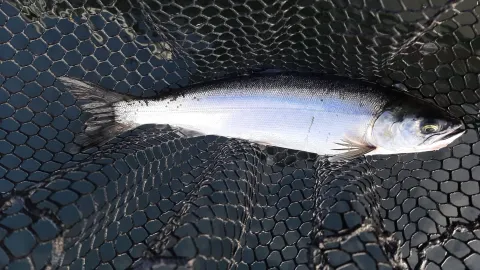
/articles/kokan-eye-eyesight-colors-and-presentations
Seven Oregon Kokanee Lakes to Fish This Year
Kokanee, which are a landlocked sockeye salmon, can be found in a couple of dozen or so lakes in Oregon and are some of the best eating at any fish fry. This year, we did the scouting for you. Here are seven lakes and reservoirs you must fish in 2025.
LAKE BILLY CHINOOK
At Lake Billy Chinook, it’s not hard to imagine the old river channels – the Deschutes, the Crooked, and the Metolius and their confluence, now obscured by 4,000 surface acres and up to 415 feet of water.
Round Butte Dam was finished in 1965, and the power of the water was harnessed by three 1000-kilowatt generators. Today, the Pelton Round Butte complex generates enough energy to power a city the size of Salem.
Kokanee angling is popular here, and anglers show up as early as February, teasing them with jigs early in the season. Trolling pays off later in the year.
ODELL LAKE
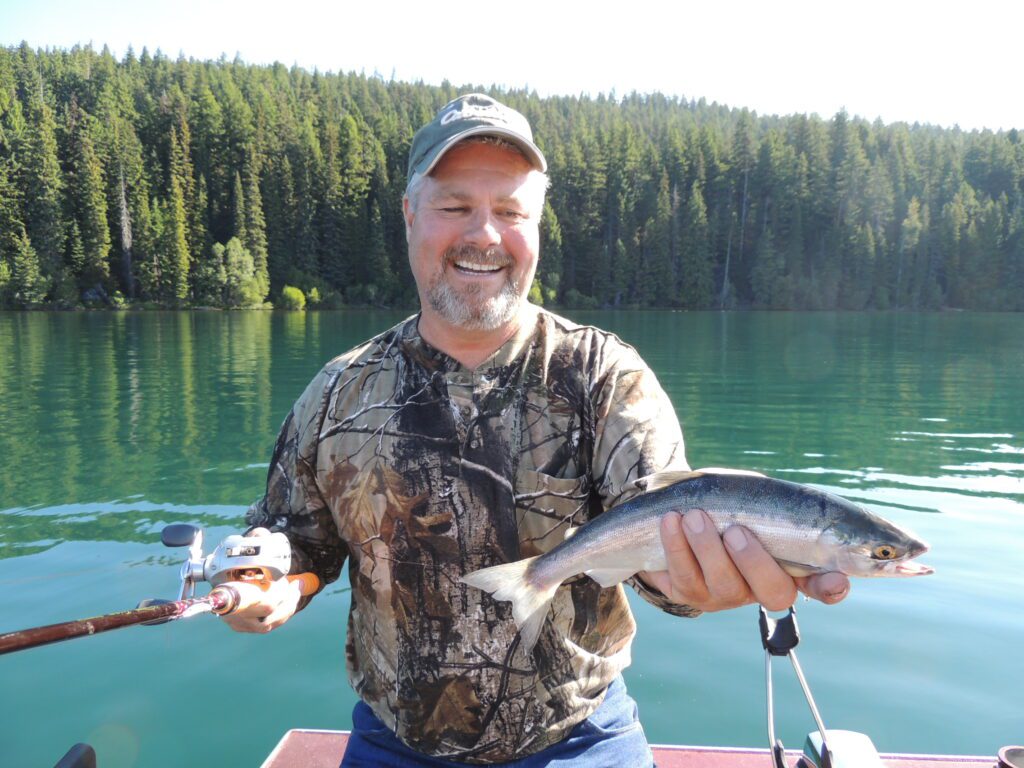
Odell Lake (and nearby Crescent) are some of the coldest, deepest lakes in the state, which makes them good habitat for a big char we call lake trout or mackinaw. Odell and Crescent also have good populations of kokanee (a landlocked sockeye salmon), the lake trout’s favorite food.
Kokanee can be easy to catch when conditions are right. Full-grown, they average 12 to 18 inches. Kokanee are most easily enticed in the early morning. As soon as the sun hits the water, the plankton go deeper, and the kokanee follow.
Jigging is a favorite technique early, but trollers seem to do better in the summer. An easy rig, whether using a downrigger or not, consists of an eight-inch flasher on the main line terminated at an Apex or Wedding Ring spinner. Most anglers add white corn and season it with a scent like Pro-Cure's Kokanee Special Super Gel. To rent a cabin or a room, click on odelllakeresort.com
WALLOWA LAKE
Sockeye are native to Wallowa Lake. Historic runs of sockeye were strong in Wallowa Lake until 1916, when the lake’s dam was enhanced. The fish still in the lake were landlocked.
Wallowa, with 1,500 surface acres and an average depth of 160 feet, can be daunting. Favorite kokanee areas are the western shore off Eagle Point and along the eastern bank up and down from the large pine tree. Try jigging after ice-off and then switch to trolling in the summer. Great trolling lures include Pro-Troll Kokanee Killer, Worden's Spin-N-Glo Kokanee, and Mack's Double Whammy.
For a great place to stay, check out wallowalakelodge.com
WICKIUP
Wickiup as a storage reservoir is one of the largest in the state, and its waters harbor rainbows and brown trout. And the kokanee grow big, too.
Fed by the Upper Deschutes via Crane Prairie, the Davis Lake sump, Davis Creek, Browns Creek and several springs, some of the best fishing is in the old channels. At its deepest, the lake is 70 feet deep, but the average depth is 20 feet.
Kokanee are spread throughout the lake early in the season, but tend to school up and head toward deeper water (the channels) as temperatures warm. Both jigging and trolling are productive throughout the season.
EAST LAKE
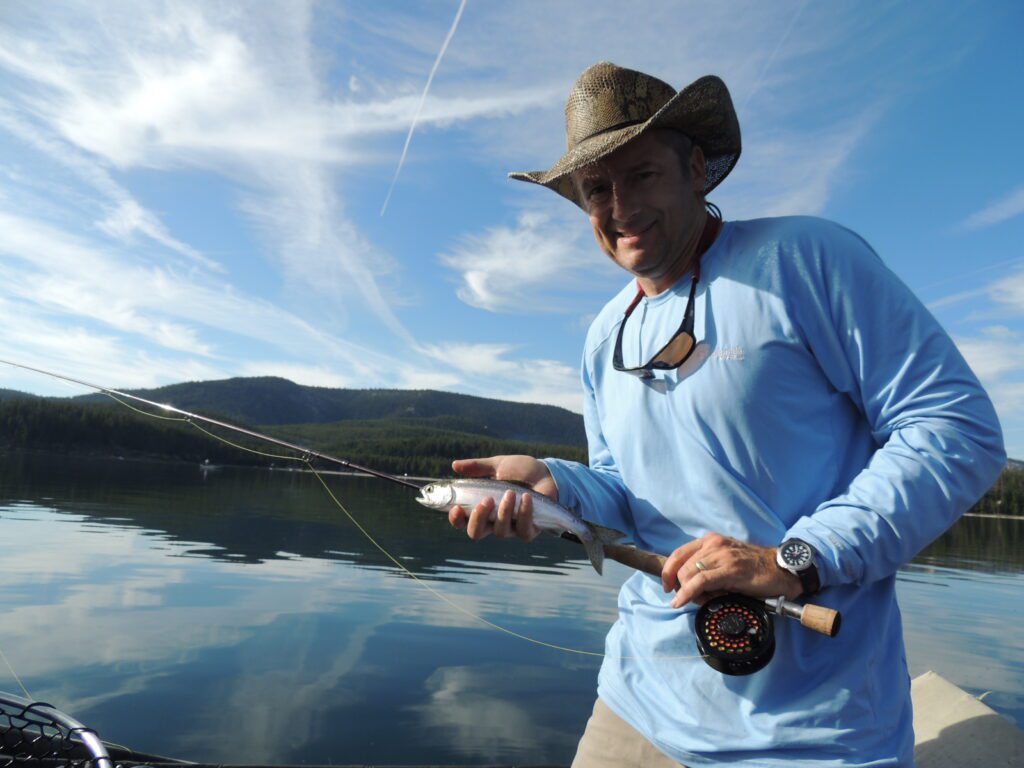
East Lake kokes average 12 to 17 inches. While kokanee are known to feed on plankton in most waters, the most reliable food sources at East Lake are the chironomids and midge larvae (chironomids). This is the reason a lot of people who are good kokanee anglers sometimes struggle at East.
Jigging works best early in the season and trolling takes more trout later in the season. Fly-anglers can take kokanee all season long on wind-drifted Callibaetis nymphs or on chironomids fished below an indicator.
PAULINA LAKE
Paulina Lake shares the caldera of Newberry National Volcanic Monument with its twin East Lake. This 1,300-acre lake is 250 feet in some places. Kokanee fishing is the main attraction and trolling flashers is the most popular method. Trolling a Wedding Ring with a kernel of corn or a chunk of worm on the end is very effective. Other great kokanee lures include the Cha Cha 1.5 Kokanee and the Kokanee Killer.
Jigging is the other way to catch them at Paulina, especially till about mid-June. Mack's Cripplure and Sonic Baitfish are productive, as are Nordic lures. First locate schools with a fish-finder and, depending on the depth, troll with a downrigger, flashers, a kokanee spinner and a kernel of corn on the hook. Or drop down a jig and try to put it in the school.
DETROIT RESERVOIR
The Detroit Dam was built in 1953, creating a large water storage and electric power generation reservoir that has become an important recreation resource. This nine-mile lake, with 32 miles of shoreline is surrounded by forest of Douglas fir and hemlock and is fed by the Breitenbush River, North Fork Santiam and Blowout and Kinney and several smaller creeks.
ODFW stocks Detroit with rainbows throughout the season. This 3,580-acre reservoir is also home to kokanee. Angling success picks up in May when the water warms.
Try the Kokanee Kid Mysis Bug or Promise Ring made in Salem, Oregon. Other good bets include the Silver Skalez Koko Leaf or Kokanee Creek Tackle 1.5 Micro Bite Squid. Popular trolling areas include Piety Island, west of Mongold State Park, the north shore near the dam and at the mouths of inlets.
AND FURTHERMORE
Some of our favorite fisheries were destroyed in 2023 and another one may be destroyed this fall.
One of the best kokanee days of my life was on Green Peter Reservoir. GPR had a seemingly inexhaustible supply of kokanee and if you figured them out on any given day, you could not go wrong. What did the Feds do? The US Army Corps of Engineers decided to drain Green Peter and Foster and wiped out some of the state's favorite kokanee fisheries while simultaneously silting over and smothering salmon and steelhead and trout spawning beds in the South Santiam for miles downstream. Brilliant.
Think they are done? The National Marine Fisheries Service and the Corps of Engineers have their fish-killing sights set on Detroit Reservoir and the North Fork Santiam now. So go fish Detroit this year and I hope you catch a bunch of limits and have a good time, but don't forget the very agencies that purport to be working for the people are often working against us and the fisheries we love.
# # #
For a copy of the Fishing Central Oregon book, send $29.99 to Gary Lewis Outdoors, PO Box 1364, Bend, OR 97709 To contact Gary Lewis, visit www.GaryLewisOutdoors.com
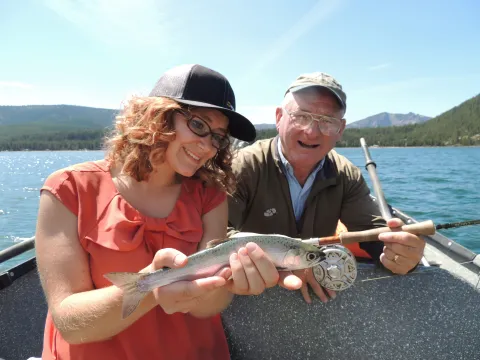
/articles/seven-oregon-kokanee-lakes-fish-year
Chironomids in Stream Channels
If everything is as it should be, there are two flies in the danger zone. For me, in most cases, I want a No. 10 red chironomid hung just over the top of the weeds, while a black chironomid rides about 18 inches above it.
Studies have been made on a number of lakes to determine the main food source for the trout.
Chironomids are midges, which look a little like mosquitoes, but lack that terrible creature’s bite. On many lakes, the midges make up close to 40 percent of a trout’s annual food intake. If there’s nothing else going on, you can bet the fish will eat a chironomid. But fishing a chironomid is different than fishing imitations of other bugs.
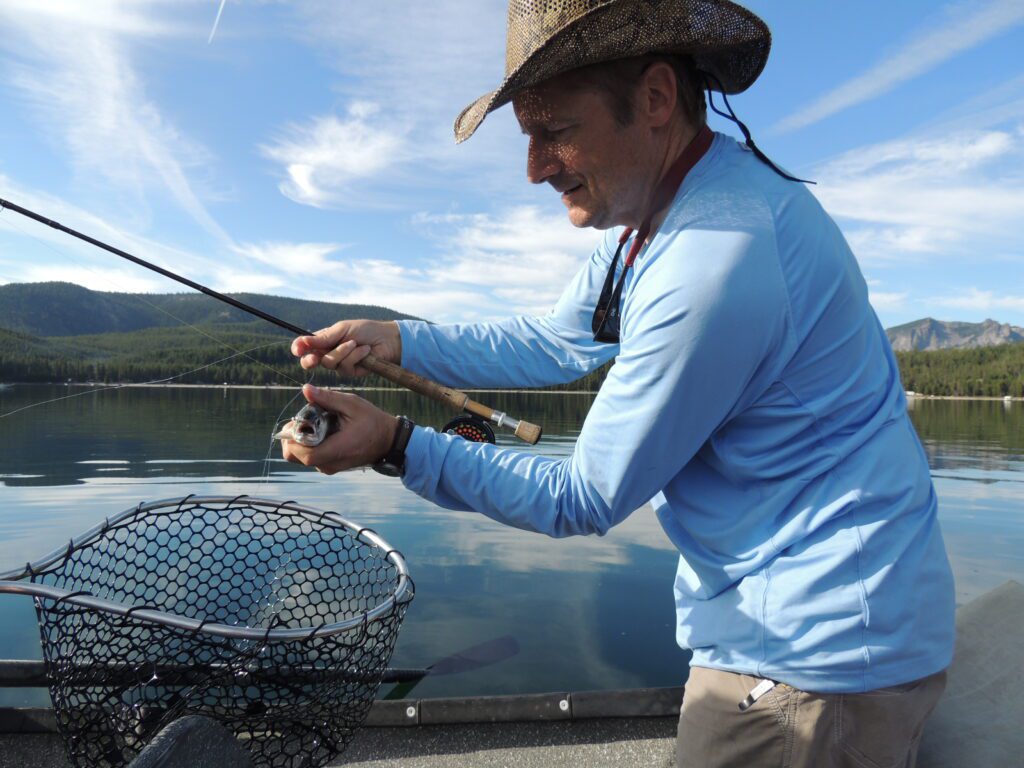
Midges don’t have legs or tails like mayfly nymphs or damselfly nymphs. So you want a vertical presentation instead of a horizontal presentation.
As chironomids hatch, they are trying to produce oxygen between their exoskeleton, their nymphal shuck, and the adult body. They come up out of the mud and they suspend about 12 to 18 inches above the bottom, for up to an hour. That makes them vulnerable to rainbows, browns, and cutthroat.
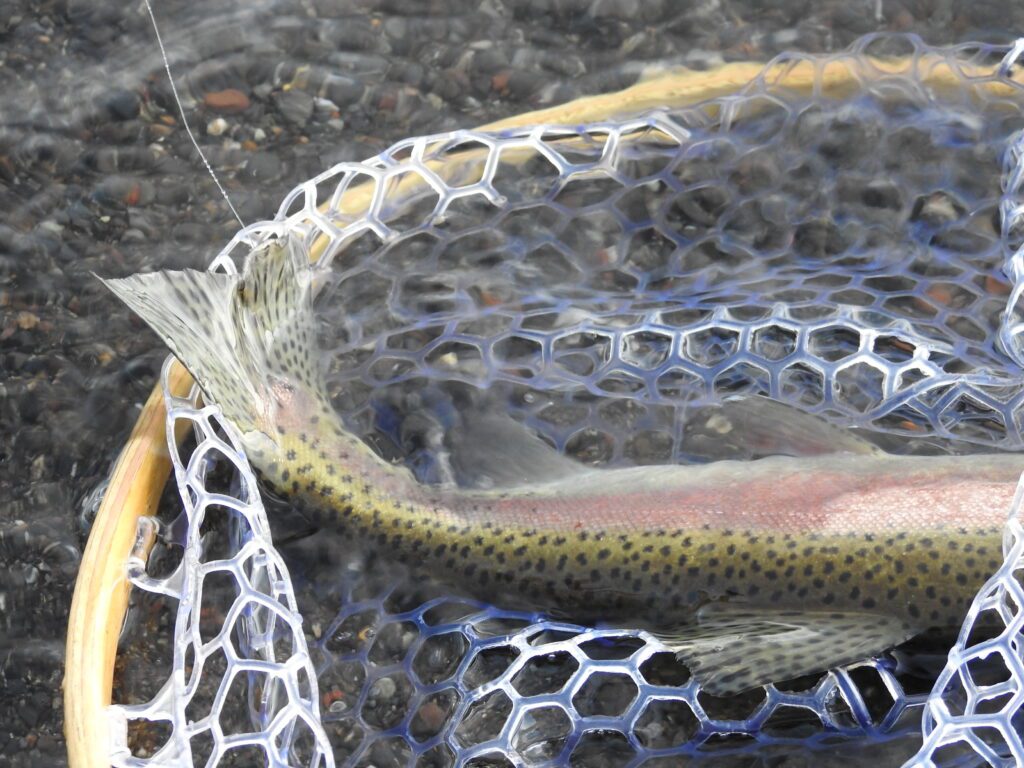
Chironomid imitations work wherever trout make a living. The hardest thing about it is the fish don’t set the hook themselves. You have to watch that indicator all-day
In Central Oregon, we fish chironomids on East, Lava, Little Lava, Hosmer, and even Wickiup for browns. They are a major food source for a lot of insect-eating trout. The tactics do not change that much except for the depth the angler is fishing.
From outside the boat, it looks like a boring way to fish. I beg to differ. Some methods are more suited to small fish, while other strategies are better suited to big fish. But all trout, big and small, eat chironomids. Setting the hook is like pulling the lever on a slot machine. Especially on reservoirs with submerged streambeds like Crane Prairie, Haystack, Prineville Reservoir, and Timothy Lake.
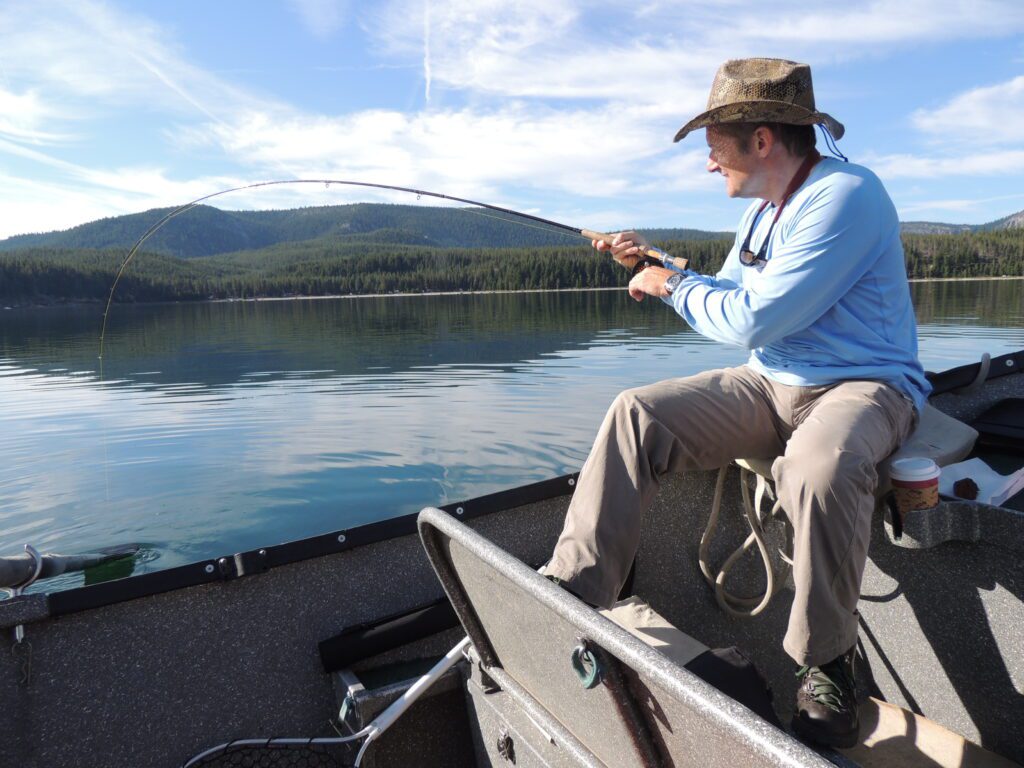
the trick is finding the old river channels. As the average lake temperature warms, the fish move into the cooler river channels and use them as highways to move around. The channels average 12 to 13 feet deep and are relatively weed-free with a sandy or silty floor.
So what you have is a 90-degree angle coming off your indicator. If you move your indicator a couple of inches. You give it a twitch and it rises up a couple of inches then settles back down. Vertical action is what you want with chironomids.
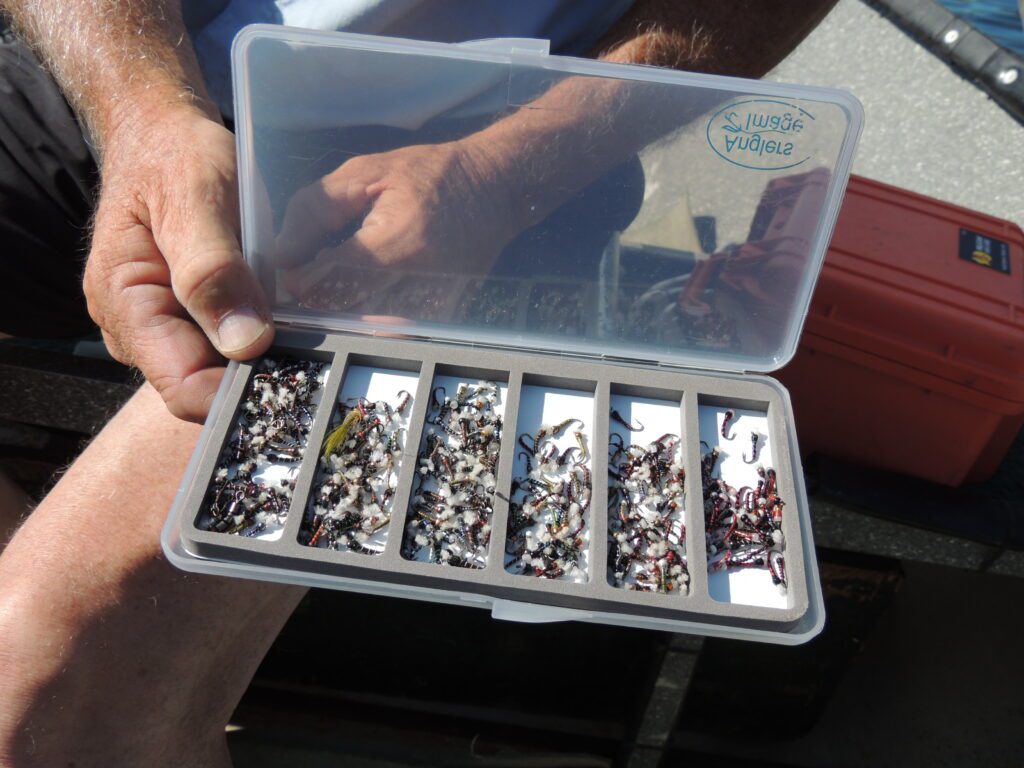
Photo by Gary Lewis
Reds and black are the primary colors most anglers use in Central Oregon, but olives and browns can also work. More important than color is to present at the right depth. The fish is probably more attracted by the silhouette of the midge.
One of the things we tell ourselves is we want to find the depth where the feeders are working. My friend Scott Cook calls it finding the feeders. If a certain depth is paying off, try to bracket all the flies in the boat around that part of the water column.
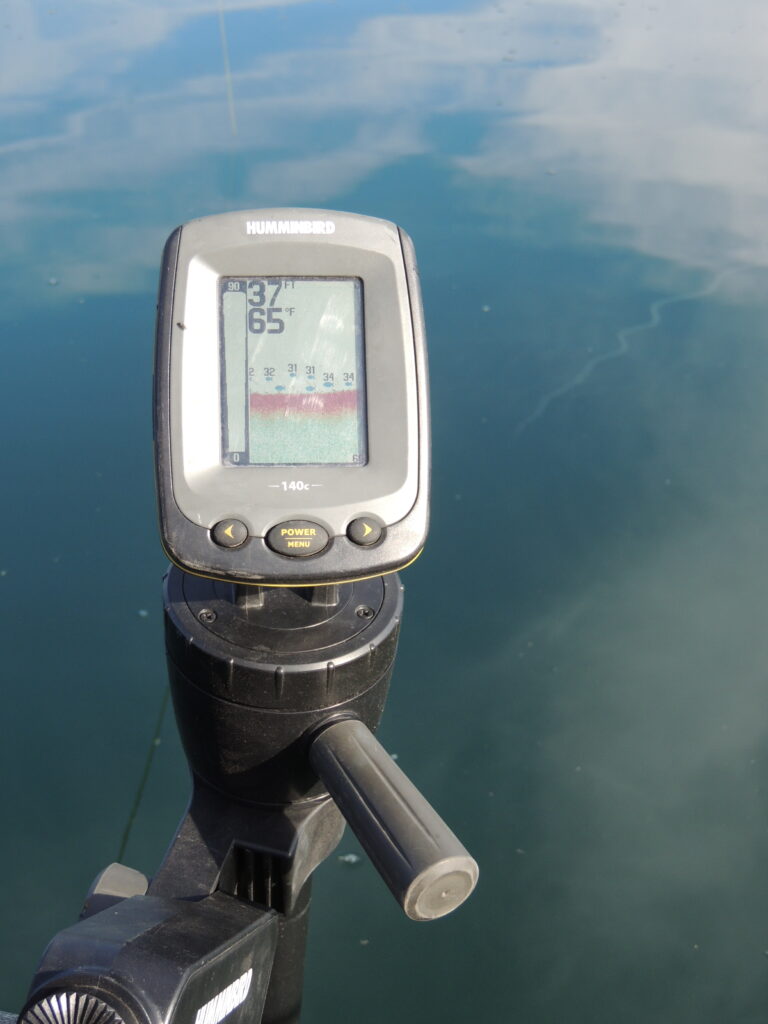
A depth finder can help locate schools of feeding fish.
Most chironomid fishing takes place at a depth of six to twelve feet below the indicator. I like to use a nine- or ten-foot leader tapered down to a 4X fluorocarbon tippet. Again knotted to a No. 10 chironomid with another chironomid on the dropper.
Any time the indicator goes down, the fish could be 10 inches or 10 pounds and you don’t know until you set the hook.
There are times when the small flies can get bit in deeper water. When trying to fish down at 15 or 20 feet, try using a very fast sinking line - like with a type 3, 4 or 5 - and retrieve it VERY, VERY slow. The trick is to work the fly in a vertical presentation, retrieving it up through the water column.
# # #
For a copy of the Fishing Central Oregon book, send $29.99 to Gary Lewis Outdoors, PO Box 1364, Bend, OR 97709 To contact Gary Lewis, visit www.GaryLewisOutdoors.com
/articles/chironomids-stream-channels
Making Sense of Scents
Where superstitions rule on my boat, making sense of scents is a bit of a challenge. What scent, how often to apply it, and washing things down at the end of the day are all done with a nod toward my personal superstitions. Get it wrong, and I’m facing seven years of bad luck! Whether or not you’re superstitious, here are a few smelly tips to help ensure luck is on your side.
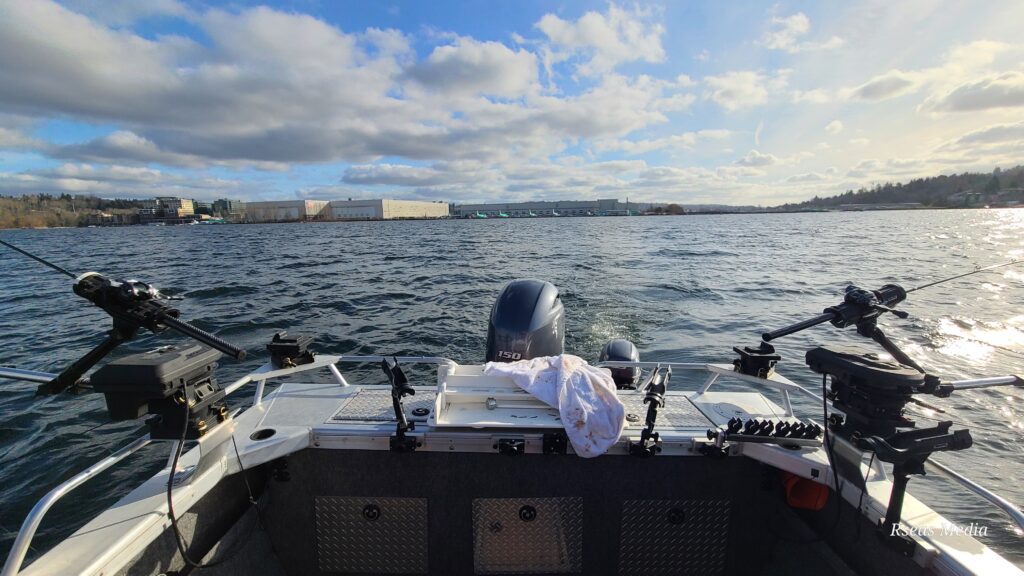
The application of scents to your lures and bait can act as an attractant or bite stimulant. It can also mask odors that repel fish. You can help reduce offensive orders by keeping your hands clean and free of sunscreen, bug repellent, petroleum products jellyfish goo, and tobacco products residue. On the day of your fishing trip, try to use unscented soaps or a light vinegar solution to wash your hands.
The use of scents should complement your game plan. They should work together with your presentation, location, and gear set-up.
There are numerous scent formulations out there: gels, liquid, sticky liquid, wax, oils, and water-soluble. Most scents are available in different “flavors".
Frequently scent oils are used to infuse other bait to create a hybrid cocktail that your target species will find irresistible.
With most sticky liquids, gels, paste and waxes you simply apply a small amount to your lures and let it work its smelly magic. Apply a thin even layer to the underside of spoons, spinner blades and plugs. Assure that the application doesn’t hinder the lure action. Scents can be very effective when applied to your dodgers or even downrigger balls.
Water temperature is your driver for how frequently to refresh your scent. With warmer water, you should pull your gear and refresh the scent more frequently. For most fisheries, I check the gear every 20 minutes or so and reapply the scent at that point.
When using some of the paste type of scents it is a good idea to wipe your lures down between each application. Otherwise, you may experience waxy buildup which could affect the lure’s action or even your hearing. What was that, did I just hear a groan?
If using a scent cocktail that includes dyes, it is a good idea to wear nitrile gloves and work over a towel or a work surface separate from your boat. Bait dyes are potent and will stain both your boat and skin. There were many times during my suit and tie days when I was giving a presentation with orange, pink, or blue fingers
Liquid scents can be used to marinate herring, shrimp, white shoepeg corn, chicken livers, salmon eggs, and dough baits. Place your bait of choice in one liquid scent or another overnight.
One of my go-to kokanee baits is tuna corn. A day before a trip I upend a can of white shoepeg corn into a mesh strainer and let it drain overnight in the fridge. Then I open a tin of packed-in oil tuna and pour the excess oil into my drained corn. I divide the corn/tuna juice mix evenly between some small containers or Zip-Lok snack bags and then add a different scent of oil to each container or bag.
Many freshwater salmon anglers marinate herring, sardine fillets, or shrimp in their secret mix of scent oils and amino acids then use the enhanced bait for trolling or wrapping their plugs.
Regarding flavor, everyone has their personal favorites for a given fishery. I find that garlic, anise, and carp-spit oils work best for Westside kokanee. For most Puget Sound salmon fisheries, I am partial to Anchovy. For general freshwater fishing, you can’t beat nightcrawler/garlic or anise. These are a few of my personal preferences (superstitions). There are a gazillion different scents available. Here in the PNW, scents like anise, sand shrimp, krill garlic, or bloody tuna seem to enhance any fishery.
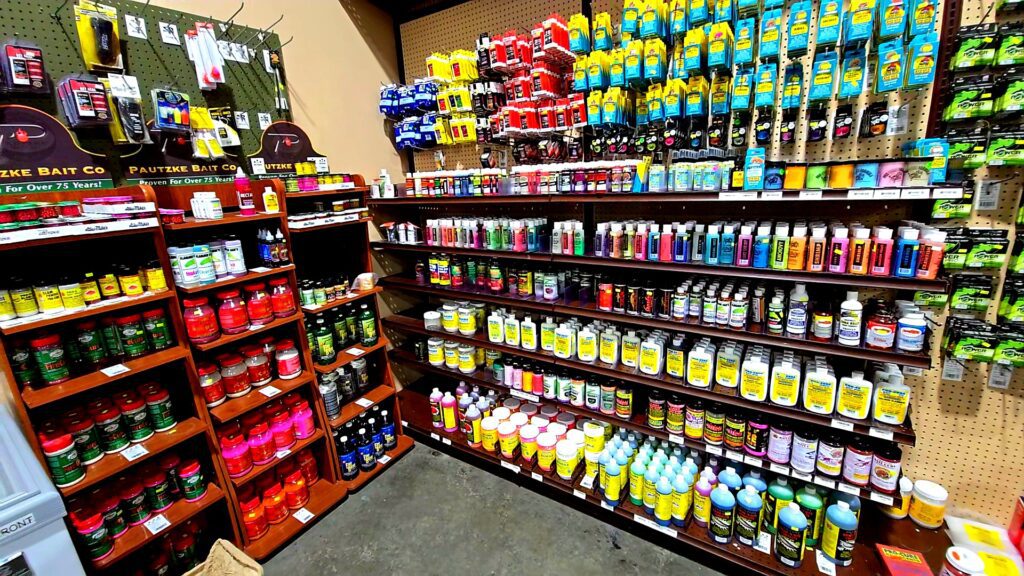
It would be a good idea to visit a tackle shop in the vicinity of your fishery to pick up the local favorite. With its proximity to some solid fresh and saltwater fisheries, Holiday Sports in Burlington is a great source for local fishing information. Their scent corner is well stocked with numerous brands and different scents.
Any scent discussion must include a segment on proper storage. Scents have different shelf lives depending on the product. Generally, they are:
Super Gels, Sauces and Paste: 7–10 years
Bait Oils: 3–5 years
Water Soluble: 3–5 years
It would be a good idea to use a permanent marker to mark the purchase date on your scent bottles. Typically, you’ll run out before they are ineffective but knowing when you purchased them gives you something to talk about. “I caught that huge walleye on 10-year-old worm sauce”.
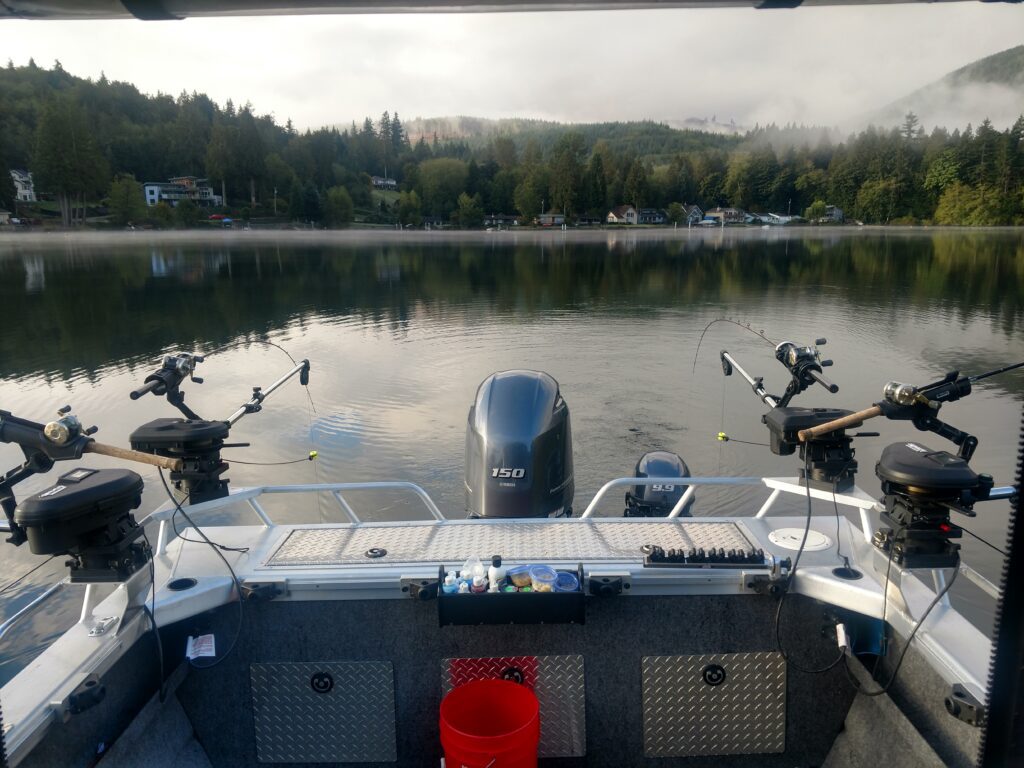
A couple of thoughts on storage:
On the boat store your scent collection out of direct sunlight in a cool place. While fishing I put a wet towel over my scent containers on my workstation, making sure to keep it damp as required.
At home store them in a dry, cool place. Preferably a metal cabinet in the garage or in the bait/beer fridge. The mice in my garage love to chew through scent bottles.
At the end of the day, make sure you clean your gear. Being superstitious I use Lemon Joy to wash all my lures and attractors. Lemon Joy or not, just make sure you clean everything after each trip.
Where your local knowledge, trip planning, gear set-up, and presentation are important in a successful outing, the use of scents will help you consistently fill the fish box.
Proper scent storage, application, and clean-up will go a long way in making sure your fishing trip doesn’t stink!
/articles/making-sense-scents
The Art of Finding Kokanee
In the years since Kokanee University was written, many wonderful developments have happened. The tackle designs, for example, are way different now as technology has made available vast improvements in action and color. What has not changed are the concepts outlined in previous articles. Let’s take a look at fishing strategies to catch more kokanee!
Color Fish Finder
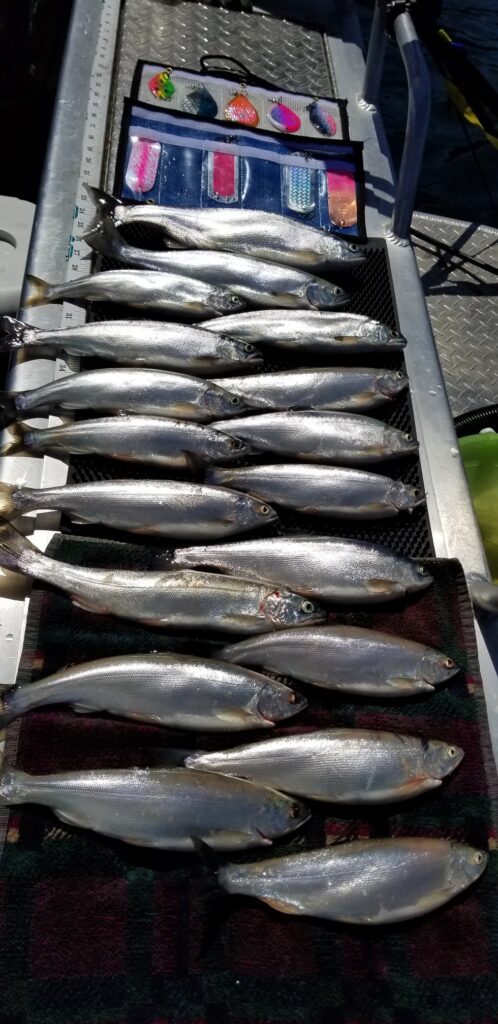
No doubt, the very best piece of electronic equipment is the color fish finder–sonar. Color is better because of the unique biology of the kokanee, which have an unusually large air sac, and sonar cannot penetrate air. Because of this, kokanee can be seen on the fish finder, usually as bright orange (the default color on many systems). No other freshwater fish has this distinct detectable characteristic, so you can easily tell the depth of kokanee by this method.
The fish finder will let you know the current depth. Knowing the depth of the bottom is essential, especially if your lake has varying contours. On more than one occasion, I have raised downrigger balls "just in time" to avoid getting hung up on a bottom that suddenly came up, seemingly out of nowhere. Your fish finder will track your downrigger ball, and you can use this to verify the accuracy of the counter on the downrigger.
One factor to consider is how large a viewing area there is. The larger the viewing area, the higher the cost. Screen resolution is another factor to consider – will your viewer be viewable in sunlight and with polarized sunglasses? Another critical factor is the location of the fish finder in relation to where you are sitting while fishing. You need to be able to see the details on the screen.
GPS
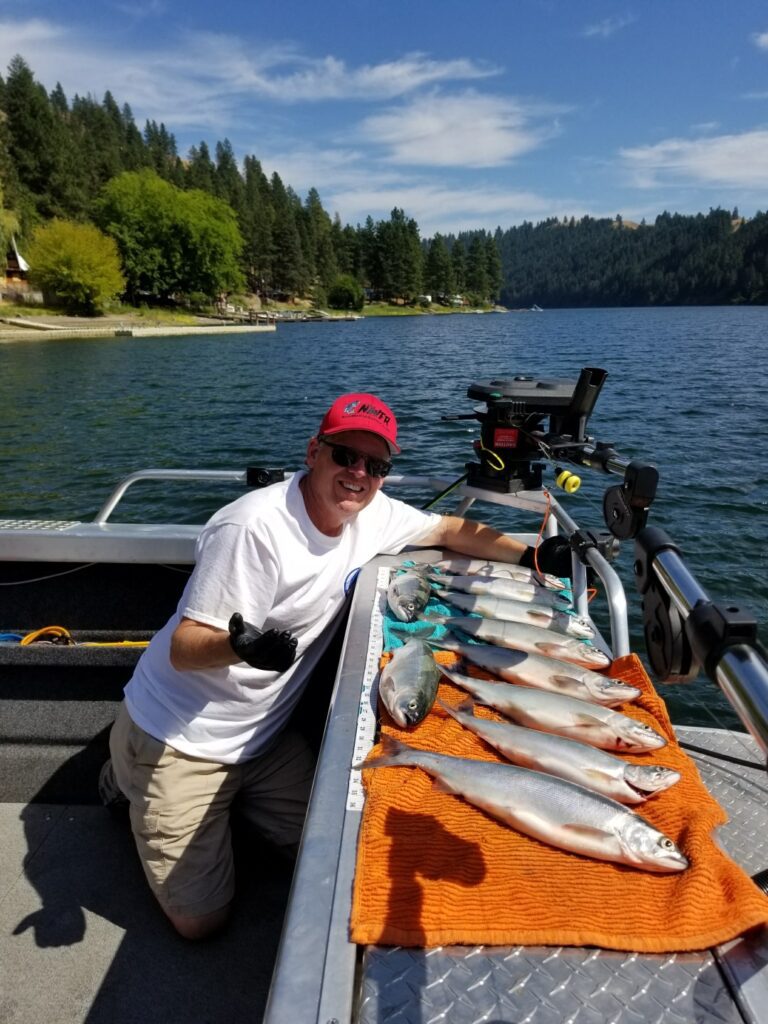
GPS serves many useful functions. One of the best is showing accurate boat speed. (The little paddle wheel on the fish finder is unreliable and next to useless.) If you are targeting a speed of 1.4 MPH, you will be able to know when you are going 1.4 MPH. You will also be able to know when you are NOT going 1.4 MPH.
GPS will display a track of where you have been, and the memory will store those tracks until you erase them. I have had these tracks for years on the same device, showing both where I have been and also where my favorite and most successful areas have been.
Another fabulous feature is the cartography, which shows the contour depths of the lake you are on. You can either purchase the SD card, or many now come with the cartography pre-installed. My SD card covers all the lakes in the western US. You can get these cards to cover your region as well. Knowing the depth contours is a tremendous help. For example, it will allow you to stay on course within a former river channel. It will show points of land that are underwater and which could be a problem in navigation when the downriggers are out.
Temperature At Depth
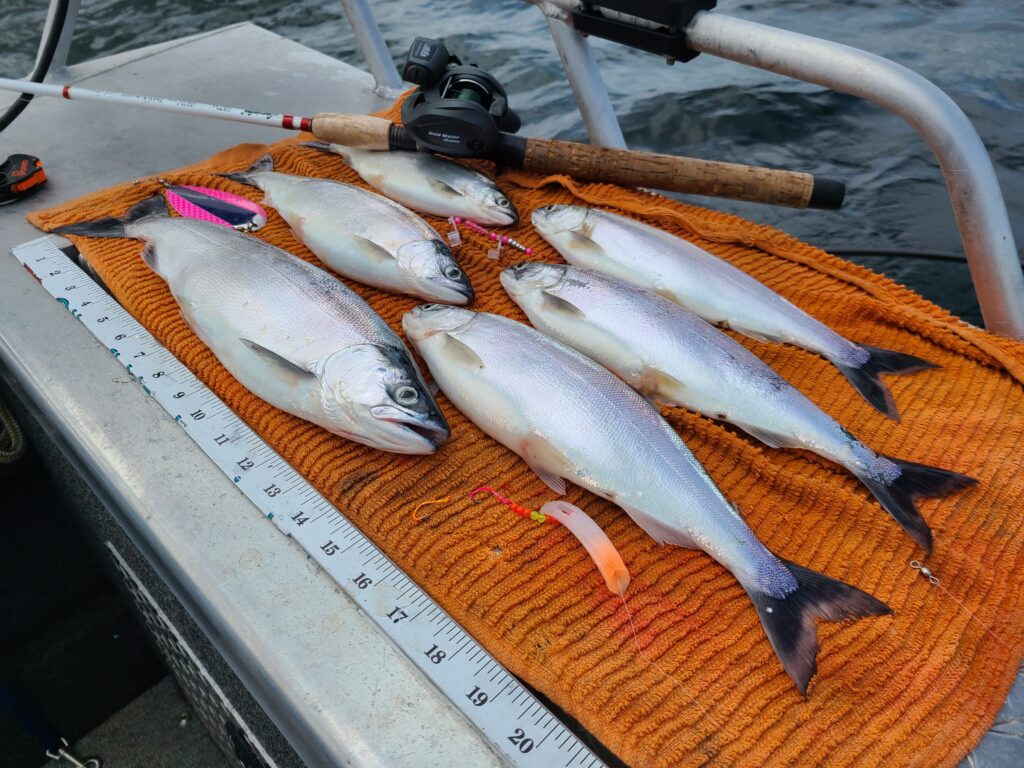
One of the very best recent developments in technology is the ability to accurately measure the temperature of the water at depth. While the temperature function on your fish finder only tells you the surface temperature, the simplest device for measuring water temperature at depth is from FishHawk Electronics.
This little device is called the FishHawk TD. It is easy to use by simply attaching the device to your fishing line, pressing START, waiting for READY, then lowering it into the water. I send it down deep, then retrieve it, then press view, and it shows the water temperature in 5-foot increments down the water column as far as you have lowered the probe. This is extremely useful, particularly when looking for that 54-degree temperature depth in kokanee season.
I have also used the device to understand what was going on underwater. During one early September outing on a high mountain lake, I could see on the fish finder a few scattered kokanee at 40 feet, and a whole bunch of kokanee at 60 feet. Try as I could, no kokanee could be enticed from the 60-foot depth. The kokanee at the 40-foot depth were the only ones that would bite. I set out the FishHawk TD to determine if temperature had anything to do with it. Sure enough, it did.
The fish at 40 feet enjoyed a temperature of 54 degrees. The fish at 60 feet were at 44 degrees. The deeper fish were already starting to settle in for the winter. Since it was September, I could tell these were the two-year-olds (next year's fish). Most of the kokanee I had caught at the 40-foot level were either turned or were turning color. By combining what I learned from the temperature measurements with what I saw on the fish finder, I was able to figure out why I was not getting bit at the deeper depths.
Electric Trolling Motors
The single best advantage of the electric trolling bow-mounted motor is the ability to steer the boat by wireless remote control from wherever you are in the boat. I simply strap the small control on my wrist, and that lets me easily control the boat's direction and speed, even when I am fighting a fish or setting the downrigger.
Scouting A New Lake
Once you have enjoyed some success fishing for kokanee, you can have confidence in fishing any lake with a kokanee population. Kokanee are kokanee regardless of whether they are in Oregon, Idaho, Montana, North Carolina, British Columbia, Washington, Colorado, New Mexico, Utah, Wyoming, or California. When I know I am going to fish a new lake, the very first thing I do is to find the lake using Google Earth. I need to know the shape of the lake, where the deep water is, and where the shallow water is. I need to know what feeder streams come into it and where the outlet(s) are. I need to know the structure of the surrounding terrain, such as whether one side coming into the lake is steep and the other side is gentle.
I also check out the lake using my GPS cartography. I can sit in my boat in Central Oregon and study lakes in any other location simply by moving the cursor on my GPS.
Generally, what I am looking for is where the current might be and where feeder streams come into the lake. Those are two locators of what I call "active" water. This is where water mixes with the regular lake water, adding oxygen to the water. Fish need oxygen. This is also where trace nutrients come into the lake from feeder streams. These nutrients act like fertilizer to the plankton (phytoplankton) that the zooplankton, kokanee, and other baitfish feed on.
I look for drop-offs, where the lake suddenly gets deeper. Recall that as you go deeper down the water column, the water gets colder. It cannot get colder unless it gives up heat that rises to the surface. This process causes mixing - water movement up and down. This process is also good for the plankton and, hence, good for the kokanee.
If I am fishing early in the season, I look for structures, such as points of land coming into the water. I have found that in the early season, kokanee relate to structure.
Finally, using the internet allows you to research in ways we never could years ago. Don’t limit yourself to fishing forums. Searching and finding hidden gems can give you inside information that many anglers have overlooked.
The whole idea is to learn as much reliable information about the new lake as you can from the available sources. Be assured, what has worked for you on your local lake will also work on the new lake.
The Science Of "Scent"
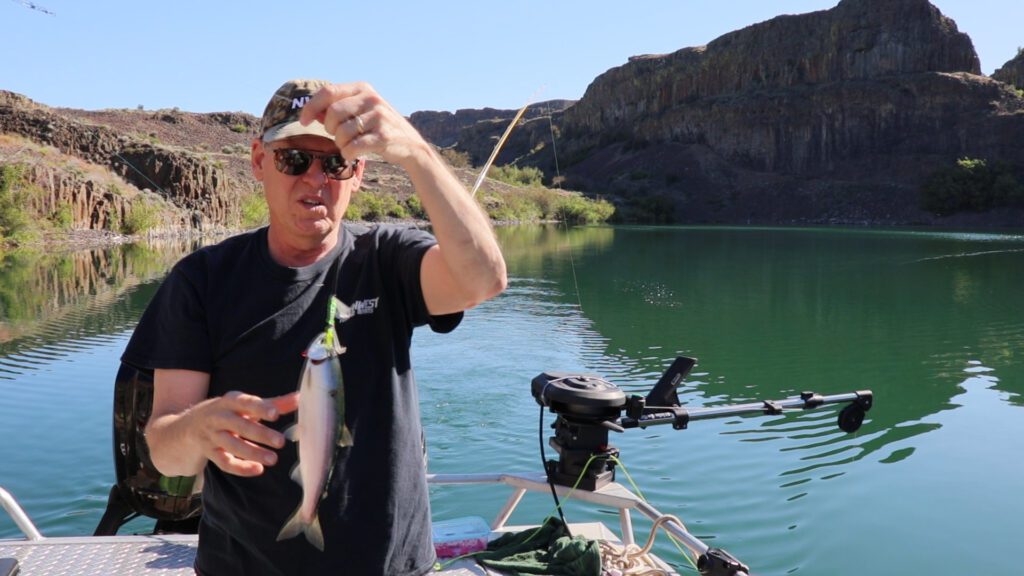
All fish have nares, which are scent-detecting tubes on the snout of the fish. A fish's ability to detect scent is flat out amazing, often measured in parts per million. And salmonids are probably near the best in scent detection. For thousands of years, fishermen have used bait on hooks to persuade fish to bite.
Some awesome kokanee fisherman or fisherwoman discovered a long time ago that kokanee will bite a lure baited with white shoepeg corn. And that discovery has been passed down for many years to the present time. What has not been passed down is why white shoepeg corn works so well.
It turns out that white shoepeg corn has an amino acid that is a bite stimulant for kokanee, something that yellow corn does not have. White shoepeg corn also manages to stay on the hook fairly well at kokanee trolling speeds. My research has revealed another interesting characteristic of white shoepeg corn: it stays white down the entire water column without any fade. As such, it presents a clearly defined target for the fish to attack. (For doubters, take a kernel of white shoepeg corn into a dark closet and shine a black light on it.)
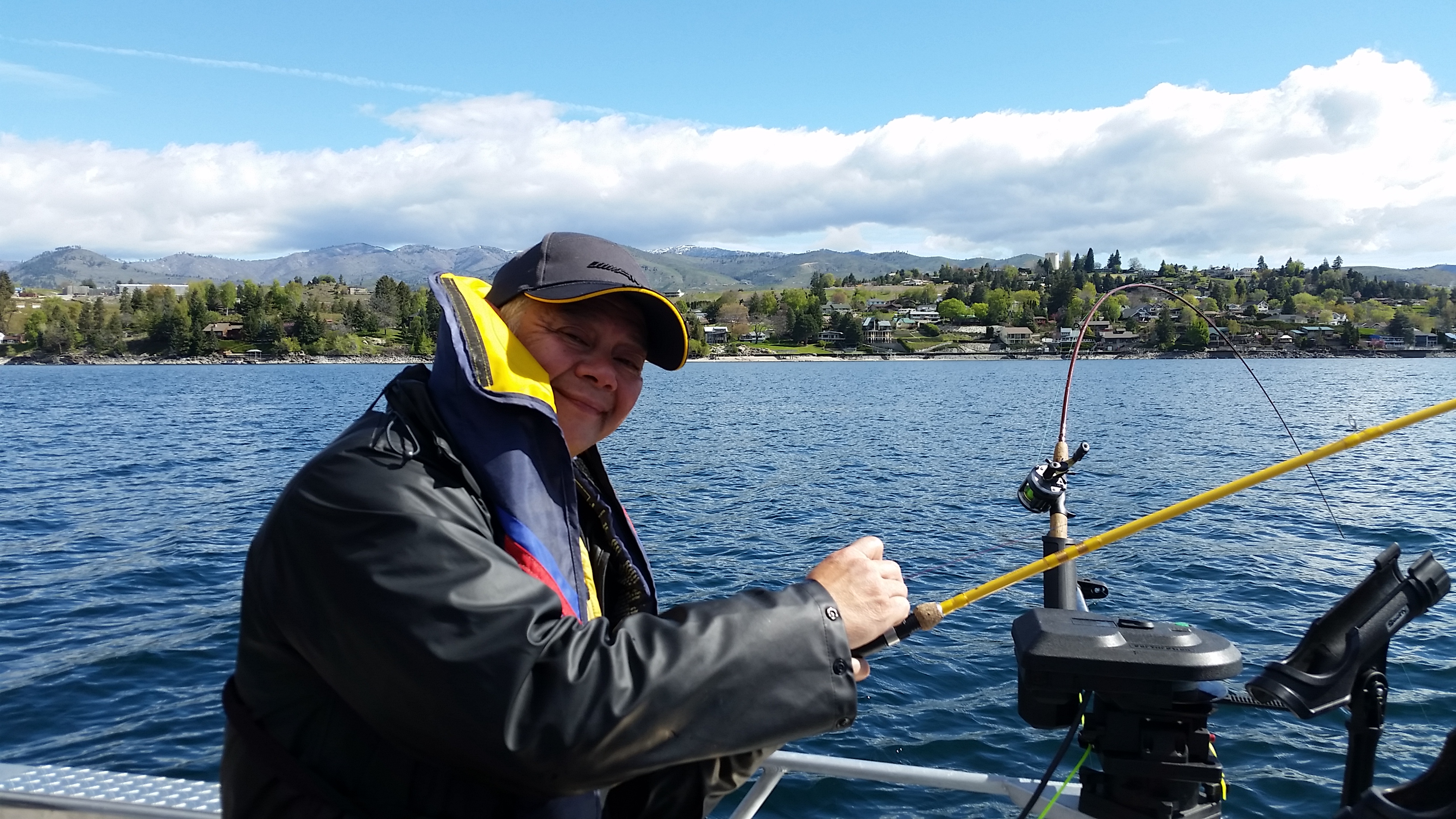
Over the years, it has become popular to add additional scent to the corn by brining it first. Such scents have included anise, garlic, vanilla, and a host of others. Savvy kokanee fishermen would have more than one type of scented corn to entice the kokanee; in case the first one didn't seem to work, they would have a backup. I know that making up different scent combinations is part of the wonderful pre-fishing ritual. Some even dye the corn different colors. More ritual.
In the past, I endorsed using two kernels of corn on each of the tandem hooks in the lure. I have changed my philosophy a bit over the years. I found out that putting corn only on the leading hook helped prevent that dreaded "short" bite. A "short" bite is where the fish targets the trailing hook, hits it, and does not get hooked. The same concept is where the fish will take a bite out of a worm that extends beyond the hook. Either way, the fish wins, and you get that wonderful, frustrated feeling.
Placing the corn on the leading hook takes advantage of a fish's biology. Since a fish cannot see directly in front of its snout a distance of about two inches, placing the target scent corn on the leading hook will make the trailing hook invisible to the fish. The result is a higher percentage of hook-ups and deeper penetration of the hooks.
I have also studied the hydrodynamics of putting two kernels of corn on the leading and trailing hooks. At kokanee trolling speeds, using two kernels on each hook significantly dampens the action of the lure. This poses an issue. I want maximum action on my lure, and I also want to maximize the scent on my lure. Can I have both action and scent without compromising the action of the lure? And I also want to prevent the "short" bite.
The best solution finally emerges as being obvious all along. Many scents now come available with a sticky gel. In my opinion, these scents are more powerful bite stimulants than anything that corn can produce by itself. I now use only a single kernel of undyed, and otherwise unscented, white corn on the leading hook only, and place some gel on the beads of my beaded spinners. This gives maximum scent to my lure without interfering with its action. If I am using a squid or a hoochie, I place some of the gel inside the squid or hoochie body, again using but a single piece of white shoepeg corn on the leading hook. I believe my success rate has increased using this setup.
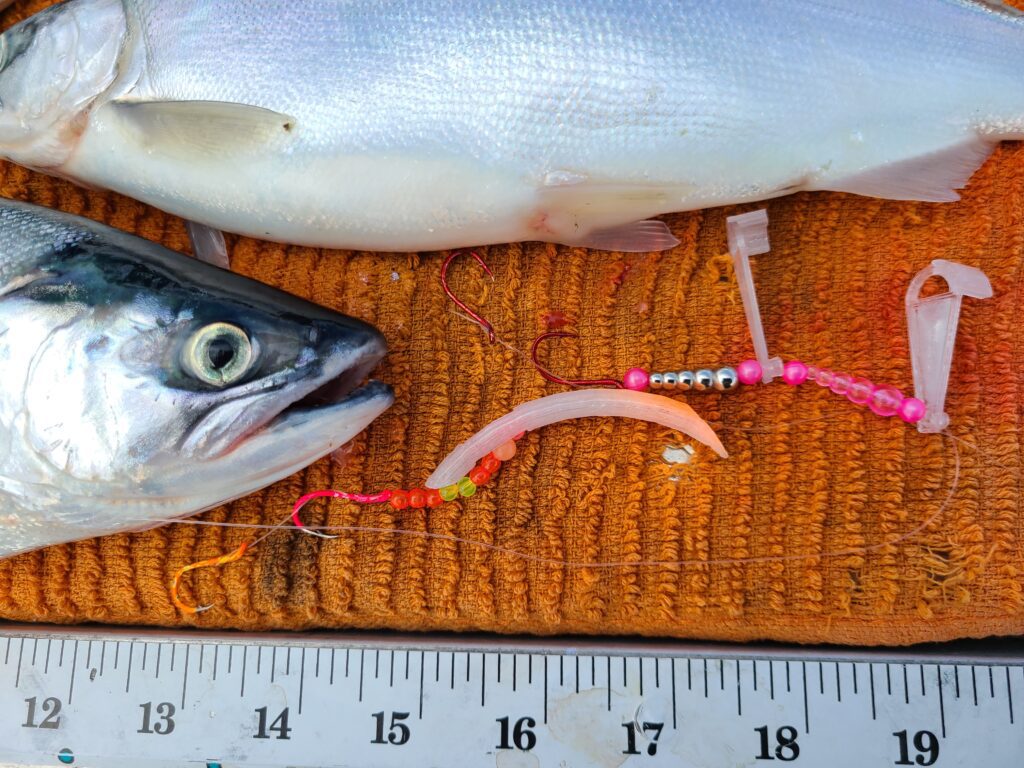
At the end of the day, do your best to rinse off the gel on your lures. Using generous amounts of hot water will help. I have now substituted my pre-fishing "brine the corn ritual" for a post-fishing "clean the lures ritual." I have found the gel scents of anise, kokanee special, garlic, and especially bloody tuna to be excellent.
Next month, we'll look at the gear you need to catch more
Fish With Gary - Kokanee university
/articles/art-finding-kokanee