Summer Saltwater Salmon
Sockeye are arguably the best-eating salmon in the world, and as the summer rolls in, so do they. In Washington State, we are lucky enough to have several great sockeye fisheries to enjoy, both in the river and the lakes. No matter where you end up chasing them, there are a lot of basic building blocks to being a successful sockeye fisherman. Take those fundamentals and with a few location-specific tweaks, you can be successful just about anywhere you choose to target these tasty, feisty fish.
To start, let's talk about some basic sockeye fundamentals and what makes them tick. Unlike other salmon, sockeye are filter feeders, which means their diets mostly consist of krill and zooplankton. They are schooling fish who like to travel in numbers, which can make fishing for them more hunting and waiting that turns into a flurry of chaos. They also have the largest eyes of any salmon species, making them more light sensitive, but they can also see your gear from further away, bonus! We need to keep all these little quirks in mind while targeting sockeye to be successful.
Because sockeye are schooling fish, we need to focus our fishing time where they are most likely to travel. In the rivers, we’re looking for soft seams and slower water, or places that will hold them like thermal barriers, as is the case at Brewster. In the lakes, sockeye will cruise around in pods, looking for more of their kind to join as they get closer and closer to spawning. We can use this to our advantage by using dodgers and flash to mimic a school of fish and pull them into our gear from a distance. My favorite way to do this is trolling with dodgers, with my go-tos being the Mack's Sling Blade in 9” or 6” or the good ole standby 0 Les Davis. Metallic finishes like just a plain chrome will work for sockeye in any water, but I do love having a mix of metallics and colored dodgers. Sockeye are pretty lazy fish, so our troll speed is pretty slow, fluctuating between 0.8-1.5mph. Once we have them joined and following our gear, it's time for our lures and bait (where allowed) to do their job.
Since sockeye are filter feeders, and we target them in the freshwater, they aren’t attacking our lures as a feeding response. This means that they are grabbing our hooks out of reaction. Although the Lake Washington classic of bare red hooks still works, we can improve this reaction bite by using hoochies or flys, UV, flash or glow depending on time of day, and wings or blades that add even more flash and vibration. It’s pretty fun to have what my friends and I call “craft time” and build different lures and see what works best. My top color choices for sockeye, no matter where I go, are pink, orange, and red. I tie my sockeye leaders on heavy fluorocarbon, 25-40lb, with number 2 to 2/0 hooks. Not because they are big fish that are going to break your line, but because the heavier the line, the more action the dodger will impart to your lure.
Sockeye are also hard-hitting, aerobatic, and chaotic. They will take off and tangle up multiple rods or wrap around downrigger cable or anything else they can find. You’ll be glad for the heavier leader when (not if) this happens. My basic sockeye leader is 12” overall, and always has no less than 2 hooks. Once you have your leaders tied up, if you’re fishing where bait is allowed, it's sure to help your odds of hooking dinner. Cured coonshrimp, in pink or red, is a pretty universal sockeye bait; however, chunks of cured prawns work great too. In the fisheries closer to the salt, like Baker Lake, the Skagit, and the lower Columbia, live sand shrimp work very well. Scents can help you as well, and maybe even more so than other salmon; sockeye have a real sweet tooth. Slammin’ Sam’s XXX is one of my favorite sockeye scents, and I will even go as far as sprinkling my baits with pure granulated sugar. Aside from those, the regular standbys work great, like anise, garlic, and krill. Keep in mind that if you are fishing somewhere like Lake Wenatchee, which doesn’t allow bait, you also are not allowed to use scent.
These basics will get you started on the right foot when it comes to sockeye fishing, but each fishery has its own nuances. I approach each fishery differently, whether it’s a lake or river, how far from the saltwater I am, and water and weather conditions all play a role. We covered a little bit of this already, but let's get into a little more depth with some of my favorite fisheries.
Baker Lake is what I consider my “home lake” and where I do most of my sockeye fishing, spending as much as 50 days a year there. Baker Lake is a big, crystal clear lake that tends to stay on the colder side. It has a lot of structure, being a reservoir, with a few original lakes being big deep spots, lots of shelves, shallows, and some sunken forests/stumps. We generally focus our attention on the deeper water areas and along the edges of shelves, with most of our fish coming in the top 40’ of water. This allows me to leave my downriggers at home and just fish “droppers,” which is using lead cannon balls ranging from 4-10 ounces on sliders, followed by a 24-30” bumper line and then my dodger and leader. My heaviest lead is on my rods closest to the bow, with my lightest leads being out the back of the boat, and my line out is the opposite (shortest at the bow and longest at the stern).
An example of this, while running 6 rods, would be my bow rods having 10oz out 30’, my middle rods having 8oz out 40’, and my stern rods having 6oz out 50’. This gives me a good spread while keeping the rods from getting tangled with each other while trolling and turning, yet still keeping them pretty close in depth to give the illusion of a school of fish swimming together. This technique also allows us to get the gear out and fishing quicker, covers more water, and moves more in the water column during turns and speed changes. Baker Lake is also the place I troll the slowest for sockeye, with my target speed being around 0.8-1 mph.
I take this same technique to Brewster Pool, and really, any excuse I have to leave the downriggers off the boat, I will take! Our biggest differences here are that there’s much more current to take into consideration, and we are fishing in shallower water. Those currents are something to watch too, with how busy this fishery gets, you have the main current of the Columbia River as well as the incoming current from the Okanogan River. This Okanogan current will slow you down and can push you sideways into passing boats, so be extra aware of your surroundings. Here’s another reason I love fishing “droppers” because you can really see the action of your dodger, and in changing currents, I watch the thump of my rod to tell me I’m going the right speed instead of my speed over ground on my electronics.
Here at Brewster, I tend to use lighter leads than at Baker, more 3-6 ounces and target 20-35’ deep on average. Although as the day progresses and the sun gets higher, if the heat doesn’t get me off the water, I will start fishing deeper as those big eyes balls will start to drive the sockeye down to escape the sun. My go-to bait here is coonies, and pink is definitely my top color. Some fish will take a detour before getting all the way to Brewster and end up in Lake Wenatchee. Although the one single lane launch can make this fishery a little difficult to access, the fishing here is usually great and the fish tend to be bittier than at Baker.
This fishery is the most unique of all my sockeye fisheries, and I even have a Wenatchee-specific tackle box with all my tools of sockeye destruction. This is the one sockeye fishery I always bring my downriggers to, although I do still fish some droppers. I definitely have more success on the downriggers. Even though this lake is cold, deep, and clear like Baker, these Wenatchee fish seem to travel and be active deeper, and I catch most of my fish from 40-80’ deep. This fishery also doesn’t allow bait or scent, and to make up for this, we do some crazy stuff with our tackle.
Barbless hooks are also required here, which means a lot of lost fish. I always fish with at least two hooks and often three to up the odds of landing a fish. I still tie heavy fluorocarbon leaders but keep them on the short side, 8-10” overall. I don’t use a whole bunch of extra stuff on my leaders here, usually opting for one bead above each hook and sometimes a Mack’s Smile Blade on top of that bead. If I’m feeling really crazy I’ll throw a little LP plankton hoochie on there too, but I like to keep my profiles small here. The crazy part comes when you start checking out my dodgers. Here again, I use 0 dodgers or large Slingblades, but I get really crazy with the bends and accentuate them by increasing the bends on each end. By the time I’m done with them, they resemble an “S” more than a dodger. All this gives my gear a really erratic action, and my troll speed is a little faster here, where I try to keep it around 1-1.4mph.
So you can see that there are a lot of similarities from one fishery to another, and if you take the basic sockeye building blocks to any of these places, you’ll probably catch fish. But if you can tweak your program a little bit to really fit where you're fishing, your success will increase, and space in your freezer will decrease!
/articles/summer-saltwater-salmon
Ten Rules of Coho Trolling
By Mike Carey
September is a special time for me. Like the change in the weather, I can feel a change in myself, a pent up anticipation that has slowly been building over the summer and like clockwork bursts forth in full bloom. It’s coho time in Puget Sound!
Yes, this is a great time of the year to be a salmon angler in Puget Sound, if the runs are strong and the fishing is open. Last year was unique in that we had closures in the ocean and straits. The coho arrived to Puget Sound in good numbers and virtually unmolested.
This year was questionable what kind of a season we would be given. As of this date, coho is open in areas 8.2, 9, and 10. Check the regs and emergency closures for updates of course. As it stands the daily limit is two coho.

Looking at my fishing reports data from trips going back twenty years, it becomes pretty obvious that September is the time to put away freshwater gear and focus on salmon. August can be productive, but September can be (and often is) lights out.
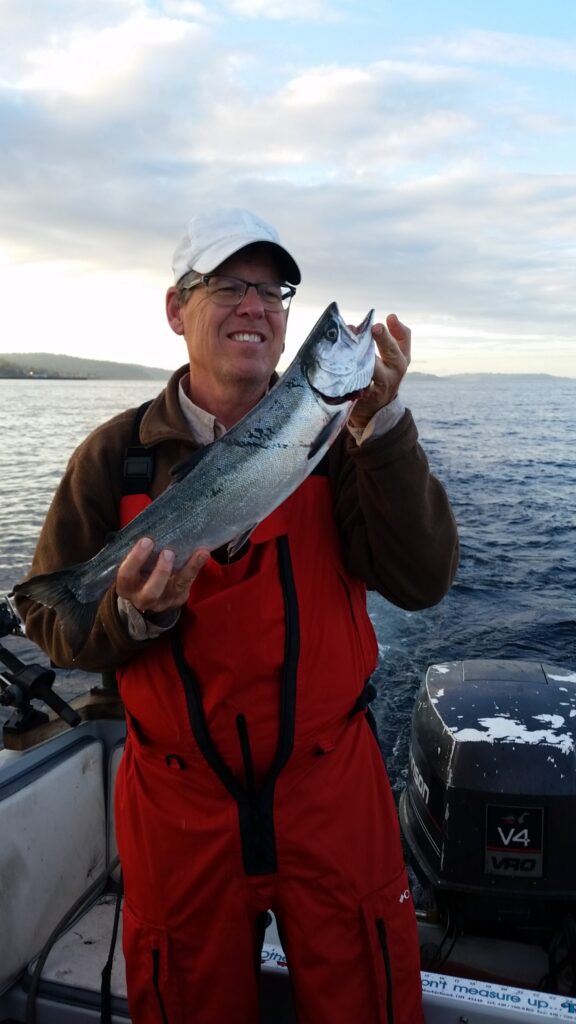
My reports show multiple trips with limits by 9am, red hot fishing, and lots of pictures of shiny chrome coho. As the season progresses into later September, the fish show a steady increase in size.
By late September to early October, the 6-8 pound coho are replaced by beautiful 10-14 pound hooknose monsters. It’s the time of year to stock up the freezer on tasty coho!
For those new to the fishery, you’ll find a wealth of information on techniques and locations scattered on the web. I've broken down some of my thoughts on coho trolling into Ten Rules of Coho Trolling.
Coho tend to be a pretty cooperative salmon when it comes to catching them. As these fish stream in from the ocean, heading through the Strait of Juan De Fuca and into Puget Sound, they are putting on the feed in preparation for their runs up to the spawning grounds.
It’s not unusual to find coho stuffed with herring. Don’t get me wrong, there are days they, like other salmon, will have lock-jaw. But that truly is the exception, not the rule. Speaking of rules, I offer a list of rules I’ve developed over the years to catch more coho.
You’ll likely have your rules to add to this list. Or you may disagree with some of them. But hopefully it will give you some additional ideas when targeting coho in the Sound.
Rule #1
As Russell Wilson would say, “Separation is in the preparation”. - When you put your boat in the water, you should have everything ready to go. No fiddling around with gear or bait the morning of a trip. My fishing ritual is to have everything ready to go the night before.
It’s like a general planning for battle. My rods are ready and geared up. My bait has been cut and cured. My boat is prepped and clean, batteries are charged, gas tank is full, snacks are bought, there’s ice in the coolers for the fish.
This evening before prep time is actually a ritual I cherish because like Russ, I’m visualizing success and making a plan in my head. I try to never go fishing without a plan.
Rule #2
Start early, go shallow. - I try to be on the water as early as possible. Ideally, that means running lights on and gear going in the water while it’s still dark or just turning light. I will run my gear in the top 10-30 feet of water to start.
This is the time of day when a salmon fly in the prop wash can be deadly. I like Artic Fox Trolling Flies. Denis Peirce ties a nice fly in a variety of effective salmon colors. Try running the fly back 40-50 feet and troll fast (more on that later) with the fly practically skipping on the surface.
Just be sure to have the clicker on the reel because these strikes can be vicious. I love the sound of a clicker going off in the morning!
Rule #3
Watch your fish finder, drop your depth – As the morning progresses, drop your downriggers down. I’ve read the “rule of thumb” is ten feet every hour until you’re trolling your gear around 40-60 feet. That’s fine, I guess, but I also use my fish finder.
If I see bait and fish marks down 50-70 feet, I’ll drop down to those fish even if it’s early in the morning. As the day goes on I may even drop my downrigger ball down to 110-120 feet deep.
Depth can be a tricky thing because when coho fishing I troll fast, which leads us to the next rule.
Rule #4
Troll fast! - In my experience, coho love a fast troll. I have an itroll throttle control and will set it on “hunt” mode to keep my boat going fast, around 3.3 to 3.9 mph. A few years back I did a lot of underwater filming and noticed a distinct increase in salmon aggression when the flasher was whipping around in a complete rotation.
If it was only doing a lazy rotation, or not doing a full rotation, coho would tend to swim behind the gear, just watching. But speeding up and getting that flasher fully spinning would elicit vicious strikes. I will troll both with and against the tide and catch fish going both ways.
Just be sure to increase your throttle going into the tide to maintain that 3.5 mph speed. I’ll also program my itroll to give a periodic 3-5 second slow down and then speed back up to “wake up” coho that may be lazily following but not biting.
It can often trigger a bite. Oh, another thing that will often trigger a bite – if you’re checking gear, pop your line off the release and set the rod in the rod holder. Let the gear come up on its own. I have caught a lot of coho that will chase the gear as it ascends to the surface.
Don’t reel your gear in until it hits the surface.
Rule #5
Coho are hungry, feed them! - Coho love a strip of herring on just about any lure. I will add strips to hoochies, flies, and even a small strip on the hook of a spoon (but not too much, you don’t want to kill the spoon’s action).
Be sure to brine the herring strips a day ahead of time in rock salt and/or commercial herring brine. Add scents and bite enhancers as well. Check your gear every 20-30 minutes and freshen up with a new herring strip. If you get a bite but no release, bring it in and check it!
The one exception to this rule I have is if the dogfish are in thick, I will go without bait.
Rule #6
Experiment – My “go to” set up is a magnum green splatter glow hoochie, herring strips, 26-30” leader, and an 11” dodger (pick your color…). I always start with this set up. On a second rod I may run a different color and smaller hoochie.
If there is no action and I am seeing fish on the fish finder I will start trying spoons and plastic lures like the old Big Al’s Cripple Herring. Sometimes the coho just want something with more action. This year I’m going to be trying the new Old Goat OG2 5” salmon lure.
The Old Goats have been awesome on kokanee and I think they will be deadly on coho. They have an amazing action that I think coho will love.
Rule #7
Fish Where They Ain’t (anglers that is) – coho in Puget Sound can be found pretty much anywhere. We all have favorite starting locations and it’s human nature to follow the crowds of boats because “hey, they must know something I don’t”.
Maybe…and maybe not. I try to start my troll away from clusters of boats. Why be surrounded by additional lures in the water? You want to troll over fish that aren’t seeing offerings non-stop. So, move away from everyone else – and if you take my advice and troll fast you will, very quickly.
You’ll still find the fish if they are there, and cover more water to find the biters. When you do, don’t be afraid to mark the fish on your fish finder and troll around and right back over the same spot. Again, in viewing underwater footage, I invariably see groups of 4-6 coho following my gear.
A solo fish is very rare. So, work over those spots when you pick up a fish.
Rule #8
Mid day and tide changes are good – I know I said earlier I like to hit the water at daybreak, but there are days when that just doesn’t happen. The good news with coho is that it doesn’t matter. You can (and will) catch coho all morning and into midday.
Tide bites are the period before and after a low or high tide, and these times can be very productive. My favorite tide sequence is a high tide at around 9-10am. The flood tide pushes fish and as the tide slows down it triggers a feeding opportunity below for the coho salmon.
Bait becomes easier to pick off without a steady flow of water and the coho bite often turns on. If you miss that crack of dawn bite, fear not, the coho will cooperate. I’ve caught my biggest hooknose fish from 11am to 1pm.
Rule #9
Playing and netting your fish – OK, you have a big fish on and are trolling at 3.5 mph. What do anglers often do? Why, slow down the of course. Bad move. In today’s age of barbless hooks, slowing down is an invitation to let the fish go. The second there is slack in that line the hook can slip out.
Trolling for coho is not a fishery that is about the fight, it’s about catching fish. If you want an epic battle against coho (and they are a hoot), catch them in rivers, or mooch for them. Trolling with an 11” flasher gives these fish a focal point with which they can get slack line.
We don’t want to do anything to help them out, like slowing down. Once they are on the surface, do your best to keep the flasher out of the water. This will help prevent the fish getting slack line between the hook and the flasher. Make sure you have a net with a long handle and big opening.
This will help as the netter reaches out. Remember, the netter scoops as the angler guides the fish into the net. Don’t make the mistake of the netter reaching to net the fish! Once the fish is close to the boat slowing down a bit is OK, by the way- just keep that flasher out of the water.
Rule #10
Take good care of your fish – Non-anglers have no idea what a freshly caught salmon tastes like. As anglers we are blessed to be able to have the freshest salmon on the planet. So, take good care of your caught fish. Bonk the fish enough to stun it, then cut a gill and bleed the fish out for a few minutes.
After that, into the ice cooler it goes. Don’t hang it off the side of the boat to bake in the sun. At the end of the day, gut and cut into steaks, or filet the fish out. If possible, vacuum-seal whatever fillets you don’t eat for dinner.
Properly cared for, you’ll have tasty fish until the next season, when you get to do it all over again!

There you have it. Ten “Rules” that will help increase your odds of success this coho season. Have fun out there and remember to be safe, have life jackets and all the safety equipment required and needed in case something goes sideways.
Good luck fishing and I’ll see you on the water.
/articles/ten-rules-coho-trolling-0
Ten Rules of Coho Trolling
September is a special time for me. Like the change in the weather, I can feel a change in myself, a pent up anticipation that has slowly been building over the summer and like clockwork bursts forth in full bloom. It’s coho time in Puget Sound!
Yes, this is a great time of the year to be a salmon angler in Puget Sound, if the runs are strong and the fishing is open. Last year was unique in that we had closures in the ocean and straits. The coho arrived to Puget Sound in good numbers and virtually unmolested. This year was questionable what kind of a season we would be given. As of this date, coho is open in areas 8.2, 9, and 10. Check the regs and emergency closures for updates of course. As it stands the daily limit is two coho.
Looking at my fishing reports data from trips going back twenty years, it becomes pretty obvious that September is the time to put away freshwater gear and focus on salmon. August can be productive, but September can be (and often is) lights out. My reports show multiple trips with limits by 9am, red hot fishing, and lots of pictures of shiny chrome coho. As the season progresses into later September, the fish show a steady increase in size. By late September to early October, the 6-8 pound coho are replaced by beautiful 10-14 pound hooknose monsters. It’s the time of year to stock up the freezer on tasty coho!

For those new to the fishery, you’ll find a wealth of information on techniques and locations scattered on the web. I've broken down some of my thoughts on coho trolling into Ten Rules of Coho Trolling.
Coho tend to be a pretty cooperative salmon when it comes to catching them. As these fish stream in from the ocean, heading through the Strait of Juan De Fuca and into Puget Sound, they are putting on the feed in preparation for their runs up to the spawning grounds. It’s not unusual to find coho stuffed with herring. Don’t get me wrong, there are days they, like other salmon, will have lock-jaw. But that truly is the exception, not the rule. Speaking of rules, I offer a list of rules I’ve developed over the years to catch more coho. You’ll likely have your rules to add to this list. Or you may disagree with some of them. But hopefully it will give you some additional ideas when targeting coho in the Sound.
Rule #1
As Russell Wilson would say, “Separation is in the preparation”.
- When you put your boat in the water, you should have everything ready to go. No fiddling around with gear or bait the morning of a trip. My fishing ritual is to have everything ready to go the night before. It’s like a general planning for battle. My rods are ready and geared up. My bait has been cut and cured. My boat is prepped and clean, batteries are charged, gas tank is full, snacks are bought, there’s ice in the coolers for the fish. This evening before prep time is actually a ritual I cherish because like Russ, I’m visualizing success and making a plan in my head. I try to never go fishing without a plan.

Rule #2
Start early, go shallow.
I try to be on the water as early as possible. Ideally, that means running lights on and gear going in the water while it’s still dark or just turning light. I will run my gear in the top 10-30 feet of water to start. This is the time of day when a salmon fly in the prop wash can be deadly. I like Artic Fox Trolling Flies. Denis Peirce ties a nice fly in a variety of effective salmon colors. Try running the fly back 40-50 feet and troll fast (more on that later) with the fly practically skipping on the surface. Just be sure to have the clicker on the reel because these strikes can be vicious. I love the sound of a clicker going off in the morning!
Rule #3
Watch your fish finder, drop your depth
As the morning progresses, drop your downriggers down. I’ve read the “rule of thumb” is ten feet every hour until you’re trolling your gear around 40-60 feet. That’s fine, I guess, but I also use my fish finder. If I see bait and fish marks down 50-70 feet, I’ll drop down to those fish even if it’s early in the morning. As the day goes on I may even drop my downrigger ball down to 110-120 feet deep. Depth can be a tricky thing because when coho fishing I troll fast, which leads us to the next rule.
Rule #4
Troll fast!
In my experience, coho love a fast troll. I have an itroll throttle control and will set it on “hunt” mode to keep my boat going fast, around 3.3 to 3.9 mph. A few years back I did a lot of underwater filming and noticed a distinct increase in salmon aggression when the flasher was whipping around in a complete rotation. If it was only doing a lazy rotation, or not doing a full rotation, coho would tend to swim behind the gear, just watching. But speeding up and getting that flasher fully spinning would elicit vicious strikes. I will troll both with and against the tide and catch fish going both ways. Just be sure to increase your throttle going into the tide to maintain that 3.5 mph speed. I’ll also program my itroll to give a periodic 3-5 second slow down and then speed back up to “wake up” coho that may be lazily following but not biting. It can often trigger a bite. Oh, another thing that will often trigger a bite – if you’re checking gear, pop your line off the release and set the rod in the rod holder. Let the gear come up on its own. I have caught a lot of coho that will chase the gear as it ascends to the surface. Don’t reel your gear in until it hits the surface.
Rule #5
Coho are hungry, feed them!
Coho love a strip of herring on just about any lure. I will add strips to hoochies, flies, and even a small strip on the hook of a spoon (but not too much, you don’t want to kill the spoon’s action). Be sure to brine the herring strips a day ahead of time in rock salt and/or commercial herring brine. Add scents and bite enhancers as well. Check your gear every 20-30 minutes and freshen up with a new herring strip. If you get a bite but no release, bring it in and check it! The one exception to this rule I have is if the dogfish are in thick, I will go without bait.
Rule #6
Experiment
My “go to” set up is a magnum green splatter glow hoochie, herring strips, 26-30” leader, and an 11” dodger (pick your color…). I always start with this set up. On a second rod I may run a different color and smaller hoochie. If there is no action and I am seeing fish on the fish finder I will start trying spoons and plastic lures like the old Big Al’s Cripple Herring. Sometimes the coho just want something with more action. This year I’m going to be trying the new Old Goat OG2 5” salmon lure. The Old Goats have been awesome on kokanee and I think they will be deadly on coho. They have an amazing action that I think coho will love.
Rule #7
Fish Where They Ain’t (anglers that is)
Coho in Puget Sound can be found pretty much anywhere. We all have favorite starting locations and it’s human nature to follow the crowds of boats because “hey, they must know something I don’t”. Maybe…and maybe not. I try to start my troll away from clusters of boats. Why be surrounded by additional lures in the water? You want to troll over fish that aren’t seeing offerings non-stop. So, move away from everyone else – and if you take my advice and troll fast you will, very quickly. You’ll still find the fish if they are there, and cover more water to find the biters. When you do, don’t be afraid to mark the fish on your fish finder and troll around and right back over the same spot. Again, in viewing underwater footage, I invariably see groups of 4-6 coho following my gear. A solo fish is very rare. So, work over those spots when you pick up a fish.
Rule #8
Mid day and tide changes are good
I know I said earlier I like to hit the water at daybreak, but there are days when that just doesn’t happen. The good news with coho is that it doesn’t matter. You can (and will) catch coho all morning and into midday. Tide bites are the period before and after a low or high tide, and these times can be very productive. My favorite tide sequence is a high tide at around 9-10am. The flood tide pushes fish and as the tide slows down it triggers a feeding opportunity below for the coho salmon. Bait becomes easier to pick off without a steady flow of water and the coho bite often turns on. If you miss that crack of dawn bite, fear not, the coho will cooperate. I’ve caught my biggest hooknose fish from 11am to 1pm.
Rule #9
Playing and netting your fish
OK, you have a big fish on and are trolling at 3.5 mph. What do anglers often do? Why, slow down the of course. Bad move. In today’s age of barbless hooks, slowing down is an invitation to let the fish go. The second there is slack in that line the hook can slip out. Trolling for coho is not a fishery that is about the fight, it’s about catching fish. If you want an epic battle against coho (and they are a hoot), catch them in rivers, or mooch for them. Trolling with an 11” flasher gives these fish a focal point with which they can get slack line. We don’t want to do anything to help them out, like slowing down. Once they are on the surface, do your best to keep the flasher out of the water. This will help prevent the fish getting slack line between the hook and the flasher. Make sure you have a net with a long handle and big opening. This will help as the netter reaches out. Remember, the netter scoops as the angler guides the fish into the net. Don’t make the mistake of the netter reaching to net the fish! Once the fish is close to the boat slowing down a bit is OK, by the way- just keep that flasher out of the water.
Rule #10
Take good care of your fish
Non-anglers have no idea what a freshly caught salmon tastes like. As anglers we are blessed to be able to have the freshest salmon on the planet. So, take good care of your caught fish. Bonk the fish enough to stun it, then cut a gill and bleed the fish out for a few minutes. After that, into the ice cooler it goes. Don’t hang it off the side of the boat to bake in the sun. At the end of the day, gut and cut into steaks, or filet the fish out. If possible, vacuum-seal whatever fillets you don’t eat for dinner. Properly cared for, you’ll have tasty fish until the next season, when you get to do it all over again!
There you have it. Ten “Rules” that will help increase your odds of success this coho season. Have fun out there and remember to be safe, have life jackets and all the safety equipment required and needed in case something goes sideways.
Good luck fishing and I’ll see you on the water.

/articles/ten-rules-coho-trolling