Ice Sled Hack to Save Your Back
My fondest memory of my grandfather is visiting his shop and looking at all his woodworking tools. He would show me what they were for and how to use them. Stanley and his wife, Martha, were from the old country, immigrants of Czechoslovakia. I credit my grandfather with my woodworking and tinkering skills. Anytime I use my hands to build something, I think of grandpa.
I can’t take credit for the following hack. I stumbled on it one evening surfing through ice-fishing videos on YouTube. I filed it in the back of my head last year as a project to work on before this year’s ice fishing adventures. As luck would have it, we’ve had a warm stretch here in Great Falls and, combined with a nice ten-day off stretch, I decided to get my act together and make the Ice Sled Ski Hack.
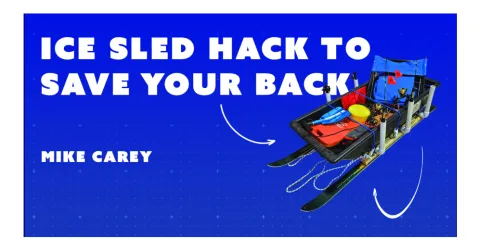
Those of you who ice fish are probably familiar with ice sleds. Piled high with our always-growing essential items, these sleds are designed for transporting your gear across the snow and ice of frozen lakes. Sleds are functional and a must for ice anglers. That said, as “essential” gear grows, anglers (especially we senior citizen anglers) get to deal with heavier sleds. Dragging a sled a few hundred yards can get to be a pain in the back, to be felt hours after the fishing day is done. The Ice Sled Ski Hack makes it easier to pull your sled across snow or ice. It’s an ingenious hack and works exactly like it looks, elevating the sled on two skis, allowing the sled to slide more easily, with less resistance.
This hack is a breeze to build, requiring a minimal number of tools. A saw, a power drill, screws, and a screwdriver will get the job done. There are a variety of designs posted on YouTube, and it’s easy to come up with your own design once you see what others have made.
The most important part of the ice sled ski hack is (of course) the skis. Fortunately, the investment is minimal. There’s no need to go out and buy a new set of snow skis. Instead, pay a visit to your nearest Goodwill, St. Vincent DePaul, or Salvation Army store. There, you’ll find a variety of inexpensive used skis perfect for our purposes. You’ll want to buy downhill skis, not cross-country skis. The reason for this is that downhill skis are shorter, wider, and thicker. You don’t need a long, thin cross-country ski. If you have a smaller sled, find a pair of used kid skis; otherwise, adult skis for a full-size sled are perfect.
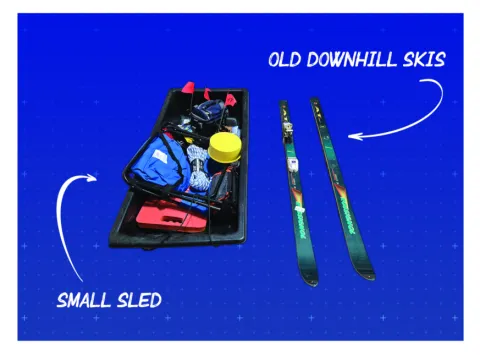
The first thing that needed to be done was the hardest part of this project, for me, removing the ski bindings. The bindings are screwed into the skis, and you’ll have to find what to remove to get access to those screws. Fortunately, between YouTube and an internet search, I was able to figure it out (and you will, too).
With the bindings removed, the next step is to construct a platform on which your sled will rest. I spaced the width of the skis to the width of the sled. Onto each ski I screwed on a four-foot-long 2x3-inch board, which matched up perfectly with the width of my skis. The purpose of the wood is two-fold. First, it gave me a solid structure to build from, and second, it raised the sled up off the snow. The whole point of this hack is to ride the sled on the skis and not have the sled drag on the snow. You may have seen some sleds that come with runners installed already, and while those runners certainly help, the sled is still dragging along the ice. The beauty of the ski hack is that the sled is gliding on the skis. And for those of you who have ever skied, you understand the advantage of this system.
The frame structure that the sled will rest on can be made with a variety of materials and ways. For my project, I decided to use 1 ¼” PVC tubing, lining up three cross-frames, and securing them with plumbing straps, then a couple of screws through the tube into the wood. Be sure to square up the skis so they are parallel, otherwise your ski sled will not track straight. I added two cross beams made of 2x3 wood to strengthen the frame.
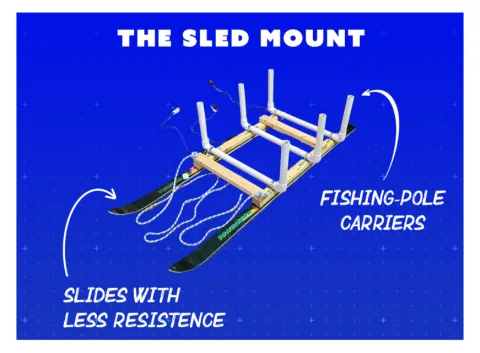
Wrapping up the project, I added 90-degree elbows on the PVC tubes and then 14” vertical tubes for side support and as rod holders. Finally, circular eye bolts on the front and sides of the frame serve as connection points for the tow rope and bungee cords that will hold the sled to the frame.
Project completed, I tested the ski-sled on carpet - December 24th, and we have no snow on the ground here in Great Falls (that won’t last!). The ski-sled slides effortlessly with just a fraction of the effort of pulling the sled without it. Success!
This was a fun and simple hack that will make my life much easier on the ice. If your sled is feeling a bit heavy with all your essential gear, give this setup a try!

/articles/ice-sled-hack-save-your-back
Three Winter Ice Fishing Events in Washington
Are you into ice fishing? Do you have a competitive edge? Then consider fishing one of three ice fishing events happening in North Central Washington this winter.
MOLSON ICE FISHING DERBY – SIDLEY LAKE – January 17 – 8 am to 1 PM
This is an annual event strongly supported by members of this small community just south of the border of Canada. Last year, 200 anglers participated, including 25 youth anglers.
Things kick off at the Molson Grange with a pancake breakfast for $12 from 7 to 10 AM. Sitzmark provides lunch in the grange in the early afternoon. Raffles take place for ice fishing gear and 25 different baskets with donated items and gift certificates.
Prizes for the biggest fish, smallest fish, and for the participant who traveled the furthest are awarded here. The biggest fish is worth $500 cash and a $500 gift card to Country Store. Registration costs $15 for youth up to 12 years of age and $30 for adults. You can also add an extra $20 and win at least $300 for the heaviest weight of up to five rainbow trout. Register online at the Oroville Chamber of Commerce website. www.orovillewachamber.com/events
BONAPARTE ICE FISHING DERBY – BONAPARTE LAKE RESORT – January 24
This is another popular annual derby, and this will be the fourth year the event is being held. Last year, 280 participants and another 120 lookers-on were there. There are three divisions of fish. They include the Adult Biggest Fish and an Adult Multi-species. There is also a category for the biggest fish caught by youth anglers.
There are six species of fish in the lake (tiger trout, rainbows, brook trout, kokanee, lake trout, and smallmouth bass). The angler who weighs the biggest weight of 3 to 6 fish wins. There is a combination of ice fishing gear and cash given to winners. Last year, an ice auger was given to the biggest fish winner, and a one-man ice fishing shelter to the adult multiple species winner. Register through the Bonaparte Lake Resort Facebook page.
In addition to the resort restaurant that will be open, there will also be a number of other vendors on site. Last year, there was one vendor who was grilling up reindeer sausage for customers. There are no cabins available (they sell out a year in advance), but there are potentially some RV spots available.
CATCHING FREEDOM - OPERATION HARDWATER – BONAPARTE LAKE RESORT – January 31
Operation Catching Freedom is a non-profit that gets veterans, active-duty soldiers, and their families out for no-cost fishing trips. This will be an inaugural event and different in that there are no registration fees and no cash prizes awarded for the biggest fish, smallest fish, or any other category.
Tony Warren, the President of Operation Catching Freedom, said that he just wants veterans and the community at large to come out and go fishing.
There is an in-person registration from 8 to 10 AM. Fishing takes place from 8 AM to 2 PM, and raffle prizes will be given away throughout the day. The event is taking place at Bonaparte Lake Resort, and there will be a BBQ for all attending between 11 AM and 1 PM. You can find further details at the Operation Catch Freedom Facebook Page.
HOW TO CATCH THEM
Want some advice on how to catch these fish? Eric Magnuson, a well-known ice fishing angler and pro-staffer for Mack’s Lure, says, “Just like open water fishing, it’s all about forage and matching the hatch.” Magnuson continued saying, “If I notice the fish are after gorging more on bugs, I’ll tie on a 3mm or 4mm tungsten jig and tip it with plastic or a couple of maggots. If I notice they are in more of a minnow feeding pattern, I might up my profile to a Swedish Pimple or Mack’s Sonic Baitfish spoon.”
And if that does not work, you can always tip a jig with a worm or nightcrawler, which will catch about anything. The bottom line is this: whether you just want to fish and have fun, or win cash or prizes, three great opportunities are waiting for you at North Central Washington’s Sidley Lake and Lake Bonaparte this winter.
Editor’s Note: Check out Eric Magnuson’s article on ice fishing for burbot at night on page xxx
John Kruse – www.northwesternoutdoors.com and www.americaoutdoorsradio.com
/articles/three-winter-ice-fishing-events-washington
Drill Baby Drill
The evolution of an ice fisherman parallels that of other angling pursuits in many similar ways. There are the initial baby steps, followed by a slow, but steady progression down the uneven road of knowledge. Over the course of time and experimentation, the neophyte grows in understanding of his craft, with the final result being a functioning ice fisherman, capable of venturing out and having a modicum of success.
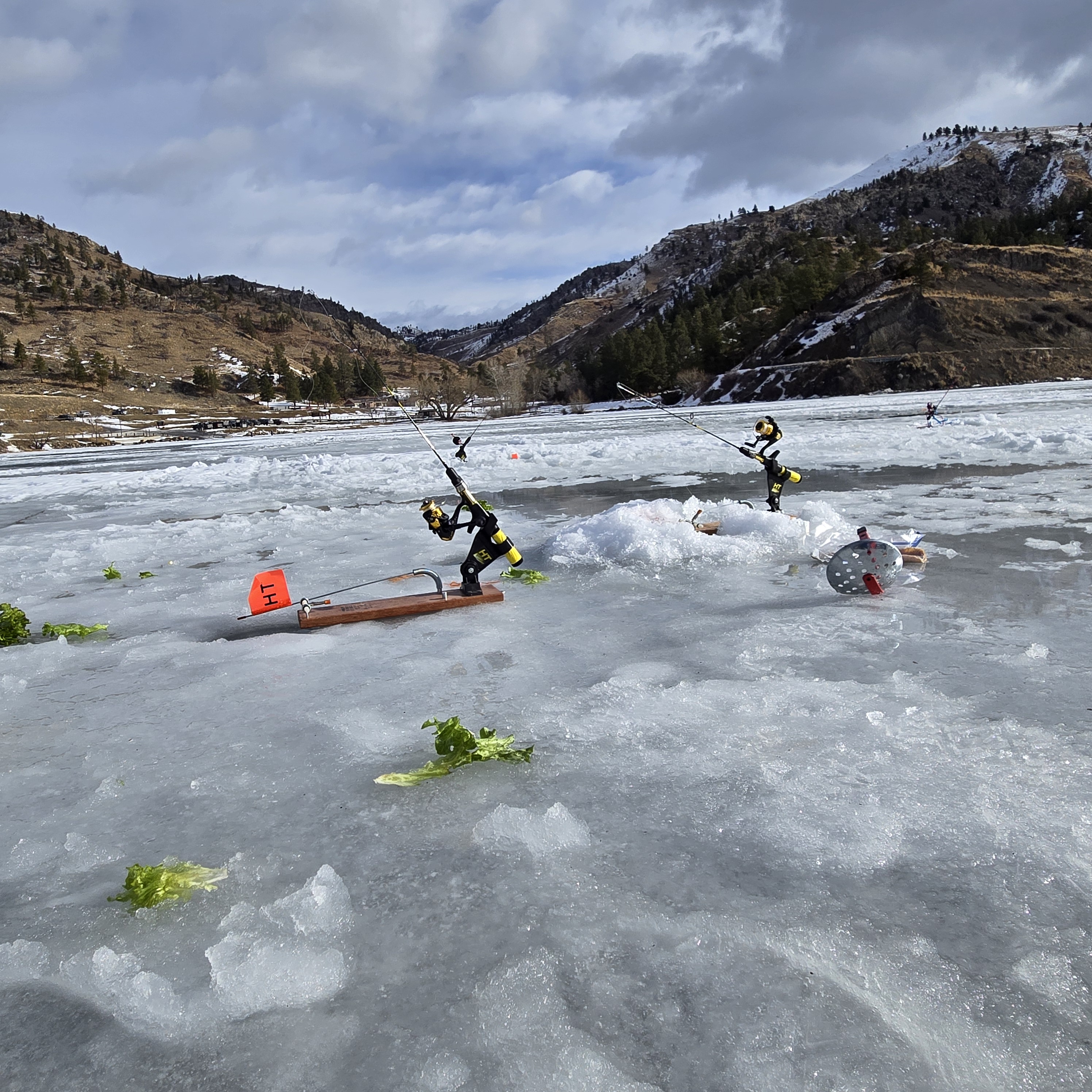
My journey, I imagine, is not much different from any others. I’ve reached the point where the “watch one, do one, teach one” adage of my nursing profession gives me the credentials to share a little knowledge with readers new to ice fishing.
If you are at the beginner stage of ice fishing, one of the things that may make you scratch your head and seek advice, are the various options of creating a hole in the ice to actually fish. There’s more than one way to drill a hole, so let’s run down some of your options before sinking too much money into an unproductive “hole”.
First, the “caveman” approach. For this technique, you’ll need a hammer. Yes, you’re reading my mind. With a hammer, you can break through previously drilled holes. The advanced hammer technique would be to bring a large chisel and hammer. Before the seasoned ice anglers laugh too much – this technique does work. The problem is it requires a lot of work! And finding relatively fresh holes to open. A variation of this technique is to use a Spud Bar, a full-size 6-foot pole with a hardened blade on the end of it. Again, it will work and as a bonus give you a nice cardio workout to boot. I predict you will quickly move up the ladder to more refined hole drilling methods.
Handheld augers have several advantages for new anglers. First and most importantly, they work. Second, they are an affordable solution if you’re on a budget or still at that phase of deciding how deeply you want to plunge into this winter sport. Third, they are carbon neutral (and as such the State of Washington should give its users a tax break…). Finally, they are also a great cardio workout. That said, when my 33-year-old strapping son tells me it’s a lot of work, as a new Social-Security-receiving citizen, I know I can pass on manual ice augers.
Which brings us to power augers. Our ancestors didn’t conquer fire for nothing!
As you explore the world of powered ice augers you’ll find three different styles, all of which work and each of which have their own advantages and disadvantages.
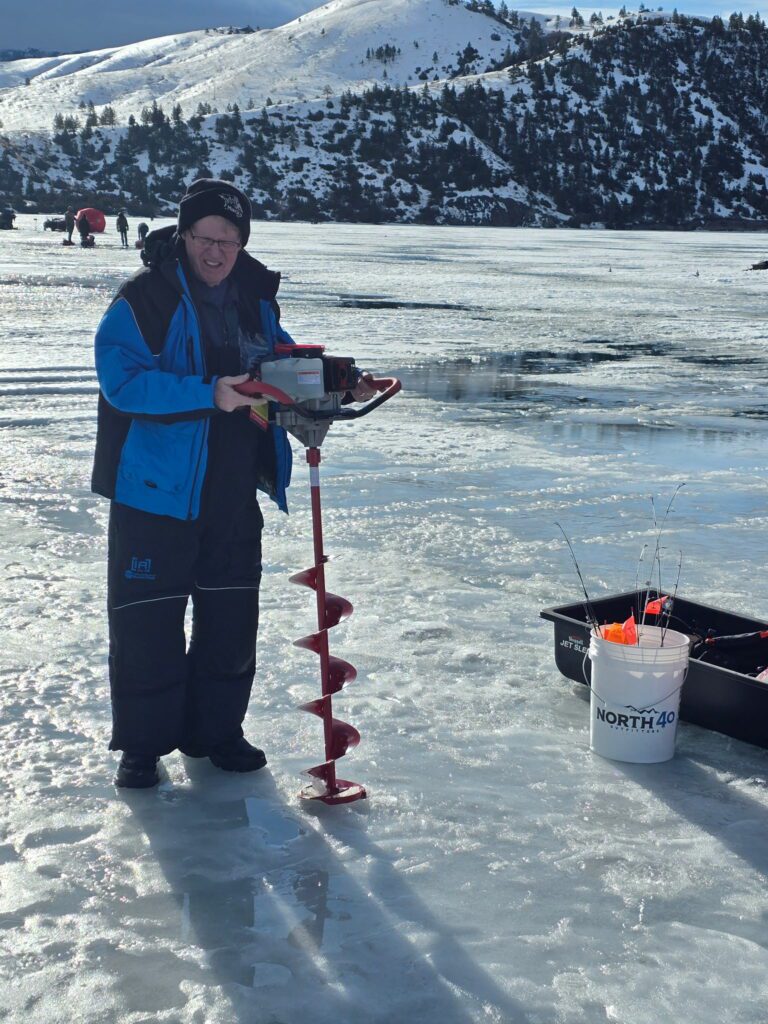
First, let’s look at the electric drill ice auger. Electric augers have a couple of nice advantages. First, they are not as noisy as gas augers. That’s important to some of us who value the peace and quiet of ice fishing, not to mention not scaring fish. Second, they tend to be lighter than gas augers. As you get more into ice fishing, you’re going to find your sled filling up with more “essential stuff”. Having a lighter ice auger means you can carry other “stuff”, i.e. crap. Electric ice augers can be further broken down into two subsets – self-contained augers and drill-attached augers. The self-contained have everything you need to start drilling. The electric drill auger requires a separate drill that attaches to the auger, and batteries to run it. This drill should be brushless for longevity and should have a minimal amount of power available, around 700-inch pounds with an ½ inch drill chuck and at least a 4amp battery. An underpowered drill will not get the job done and will likely destroy the drill in short order.
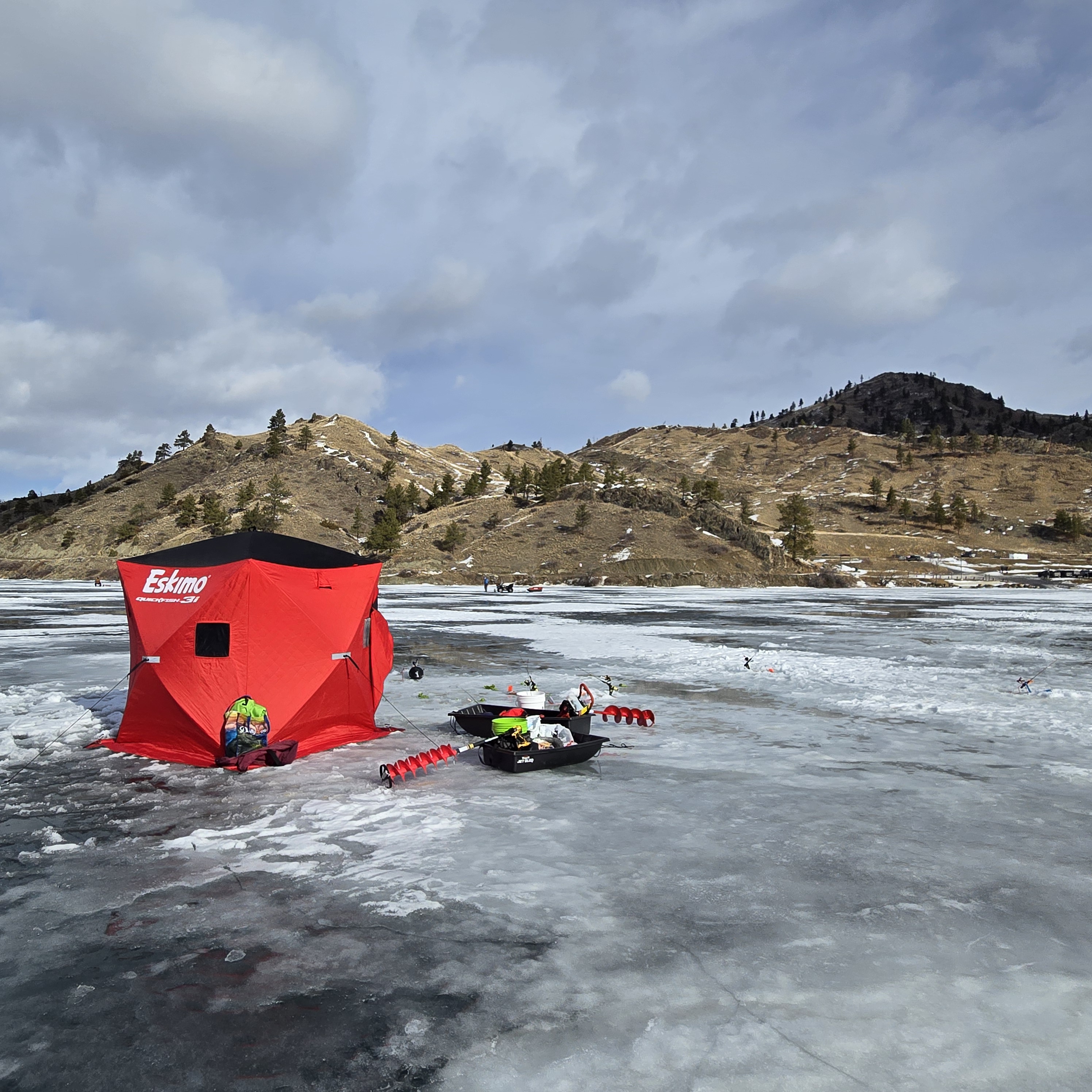
Electric drill ice augers work, and many people use them. That said, they have a big negative: batteries. Drilling a 6” deep hole is a piece of cake, but when you get into 12-18” of ice be prepared for a slower process, and more importantly, rapidly depleting batteries. Today’s batteries do not like cold weather and require that you bring several extra batteries. That adds both cost and weight to the equation. These batteries aren’t cheap.
The newer self-contained electric drills are lighter than gas, and the batteries last longer. They are also more powerful than most electric drill augers. However, they are also pricey, costing upwards of double the price of a gas-powered auger.
Both hand-powered and electric augers lead us to another disadvantage – less opportunity to drill more holes and move around. When that battery is done, it’s done. This brings us to the next ice augers class.
Gas-powered ice augers give anglers a tool that doesn’t limit one’s day of drilling. With a tankful of gas, you’ll be able to “run and gun” with the best of them. Drilling holes is easy and fast. The negatives of gas augers are the weight, the sound, and the odor. A variation on the gas auger is a propane auger. The only disadvantage I’ve heard about propane is that the bottles can freeze up in colder temperatures. Gas augers also can have issues with reliability and starting and require routine maintenance to be in top working order. The noise of a gas drill can spook fish as well.
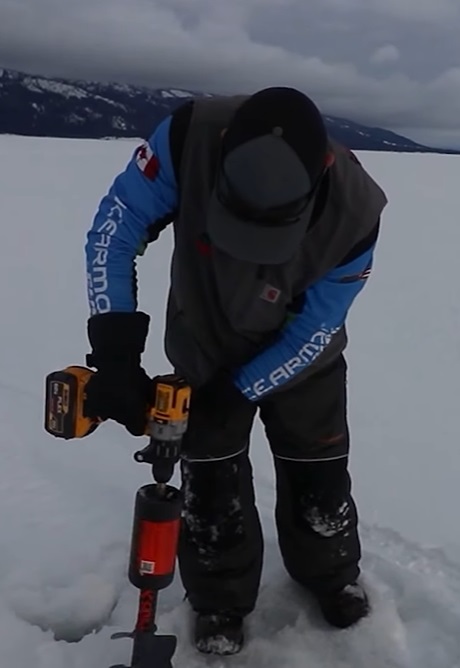
I used an electric drill auger last year, and while it did the job, I was frustrated by the slow drilling and the depleted battery issue. After finding a lighter-weight (26-pound) gas auger on sale recently, I pulled the trigger. I’m excited to give it a try, especially on those 12-18” thick lakes and reservoirs.
As you can see, there are several options for drilling holes in the ice, each with its own set of advantages and disadvantages. It boils down to personal preference and cost.
Whichever route you go, stay warm and safe on the ice!
/articles/drill-baby-drill
Five Ice Fishing Destinations in Montana
Why stop fishing just because it’s not flip-flops and t-shirt weather? The seasons may change, and the boat may be winterized and put away for storage, but that doesn’t mean we have to stop our fishing adventures. On the contrary, there is something to say about the hard water fishing experience when the temperatures drop. Here in Montana, ice fishing is just another part of the ebb and flow of the outdoor lifestyle many residents share and love. Candidly, I have not ice-fished on these bodies of water, yet. I have, however, fished most of them and we even have several episodes at a few of the mentioned locations with future plans to highlight the other fisheries! Without further ado, here's a detailed exploration of five fantastic ice-fishing spots in Montana. Let's dive into each location to understand why they're great choices for ice fishing enthusiasts.
1. Fort Peck Reservoir
Fort Peck Reservoir is a premier destination for ice fishing in Montana. This massive reservoir stretches across more than 245,000 acres, making it one of the largest bodies of water in the state. The reservoir's vast size provides a diverse habitat that supports a variety of fish species, including northern pike, walleye, lake trout, and smallmouth bass. You may recall a chinook salmon episode filmed in the late summer with the NWF crew and Shelby Ross of Ross Outdoor Adventures. While the chinook are certainly appealing, the ice fishing appears to be in its own class as well!
The reservoir's northern pike population is particularly noteworthy, with anglers regularly catching specimens of over 20 pounds. During the winter months, these fish are more accessible as they move into shallower waters under the ice. Ice fishing at Fort Peck requires careful planning due to its size and the potential for rapidly changing weather conditions. However, for those willing to brave the elements and the drive, the rewards can be substantial.
Local guides and outfitters offer ice fishing tours and equipment rentals, which can be particularly helpful for those unfamiliar with the area. The reservoir's remote location also means that anglers can enjoy a relatively undisturbed experience, surrounded by the stark beauty of Montana's winter landscape. The isolation is perhaps one of the major draws to the area - Circle, MT, just southeast of Fort Peck, is the farthest location away from a Starbucks in the contiguous United States.
2. Georgetown Lake
Georgetown Lake, located in the picturesque Anaconda-Pintler Range, is a popular ice fishing destination known for its abundant kokanee, rainbow, and brook trout populations. The lake sits at an elevation of over 6,000 feet, and its high altitude ensures solid ice cover during the winter months. Georgetown has been on my radar as a location to fish since picking up ice fishing - and for great reason.
One of the appealing aspects of Georgetown Lake is its accessibility. The lake is located near major highways, and there are several public access points with ample parking. This ease of access makes it a convenient option for both day trips and longer stays.
Rainbow trout are the primary target for ice anglers at Georgetown Lake. These fish can be found throughout the lake, but they often concentrate around the mouths of tributary streams where they feed on insects and other small organisms. Anglers typically use a combination of jigging and tip-ups to entice the trout, with small jigs tipped with worms or maggots being particularly effective.
In addition to rainbow trout, Georgetown Lake also hosts a healthy population of brook trout. These fish are often found in shallower waters and can be caught using similar techniques to those used for rainbow trout.
Outside of trout, the kokanee salmon bite makes Georgetown an attractive ice fishing location. There is no limit on kokanee and seeing some of the photos others have taken, they do not appear to be in short supply. The lake's consistent ice conditions and reliable fish populations make it a favorite among local anglers.
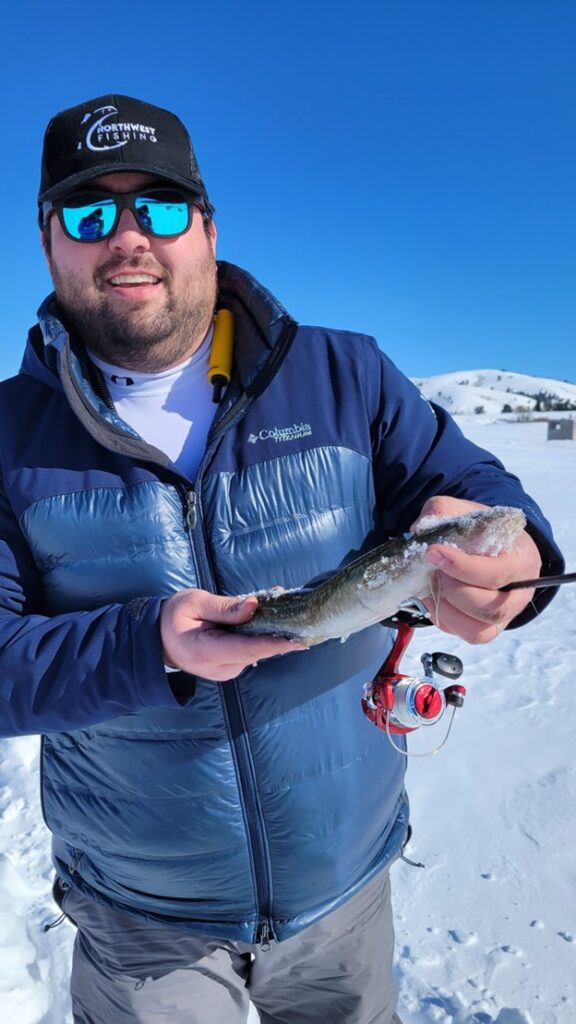
3. Canyon Ferry Lake
Canyon Ferry Lake, located just outside of Helena, is another top-notch ice fishing destination in Montana. This large reservoir spans over 33,000 acres and is known for its healthy populations of walleye, yellow perch, and rainbow trout.
One of the unique features of Canyon Ferry Lake is its relatively shallow depth, which helps maintain stable ice conditions throughout the winter. The lake's shallow waters also make it an ideal habitat for walleye and yellow perch, which are the primary targets for ice anglers.
Walleye can be found throughout the lake, but they often concentrate around submerged structures such as rock piles and drop-offs. Anglers typically use jigging techniques with lures that mimic small fish or insects to attract walleye. Tip-ups baited with live minnows are also effective for targeting these predatory fish. A recent walleye fishing trip with Mackenzie River Pizza Co. saw us bottom-bouncing for several nice eater-sized fish. It’s reasonable to assume that ice fishing would produce a similar yield.
Yellow perch are another popular target at Canyon Ferry Lake. These fish are known for their schooling behavior, and once a school is located, anglers can often catch multiple fish in quick succession. Small jigs tipped with worms or maggots are the preferred method for catching yellow perch, and the use of electronic fish finders can help locate schools of fish under the ice.
Canyon Ferry Lake's proximity to Helena makes it a convenient destination for both local anglers and visitors. The lake's abundant fish populations and reliable ice conditions ensure a productive and enjoyable ice fishing experience.
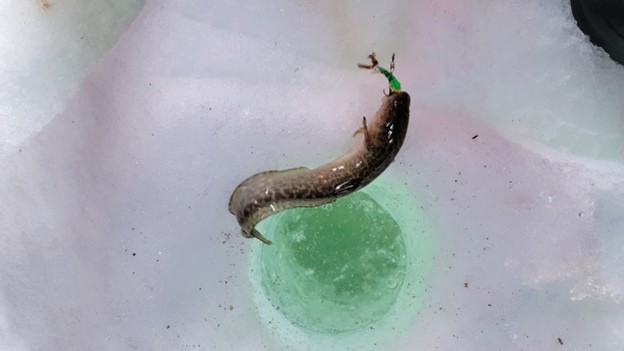
4. Lake Mary Ronan
For those seeking a quieter and more secluded ice fishing experience, Lake Mary Ronan is an excellent choice. Located west of Flathead Lake, just outside of Glacier National Park, this smaller body of water offers a peaceful setting. The lake is known for its healthy populations of kokanee salmon and yellow perch.
Kokanee salmon are the primary target for ice anglers at Lake Mary Ronan. These landlocked sockeye salmon are prized for their fighting ability and, of course, delicious flavor. Kokanee can be found throughout the lake, but they often concentrate in deeper waters during the winter months. Anglers typically use small jigs or spoons tipped with maggots or corn to attract kokanee. Electronics such as fish finders can be particularly useful for locating schools of these fish under the ice.
Yellow perch are another popular target. These fish can be found in shallower waters and are often caught using small jigs tipped with worms or maggots. The lake's clear waters and abundant vegetation provide an ideal habitat for yellow perch, and anglers can expect consistent action throughout the winter.
Lake Mary Ronan's scenic surroundings and peaceful atmosphere make it a great destination for those looking to escape the hustle and bustle of more popular ice fishing spots. The lake's relatively small size also makes it easy to navigate, ensuring a productive and enjoyable experience. An opportunity to combine ice fishing, a scenic view and a historic area make Lake Mary Ronan an ice fishing paradise.
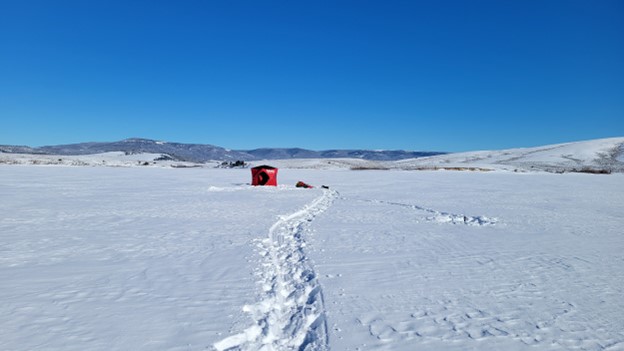
5. Hebgen Lake
Sticking with the “lakes close to national parks” theme, Hebgen Lake, located near West Yellowstone, is a renowned ice fishing destination known for its populations of rainbow and brown trout. The lake's proximity to Yellowstone National Park adds to its appeal, offering stunning views and a unique winter fishing experience.
Hebgen Lake is one of the first bodies of water in the region to freeze over each winter, providing early ice fishing opportunities. The lake's large size and diverse habitat support healthy populations of both rainbow and brown trout, making it a favorite among local anglers.
Rainbow trout are the primary target for ice anglers at Hebgen Lake. These fish can be found throughout the lake, but they often concentrate around the mouths of tributary streams and areas with submerged vegetation. Anglers typically use jigging techniques with lures that mimic small fish or insects to attract rainbow trout. Tip-ups baited with live minnows or worms are also effective.
Brown trout are another popular target at Hebgen Lake. These fish are often found in deeper waters and can be caught using similar techniques to those used for rainbow trout. The use of electronics such as fish finders can help locate schools of brown trout under the ice.
Hebgen Lake's stunning winter scenery and reliable ice conditions make it a must-visit destination for ice fishing enthusiasts. The lake's proximity to Yellowstone National Park also provides opportunities for wildlife viewing and other winter recreational activities. The Madison River Fly Fishing episode with The Rainbow Valley Lodge from this past season was filmed just a few miles north of Hebgen Lake. Imagining those picturesque mountains in the winter season with fresh snow would instill a sense of the rugged west in anyone.
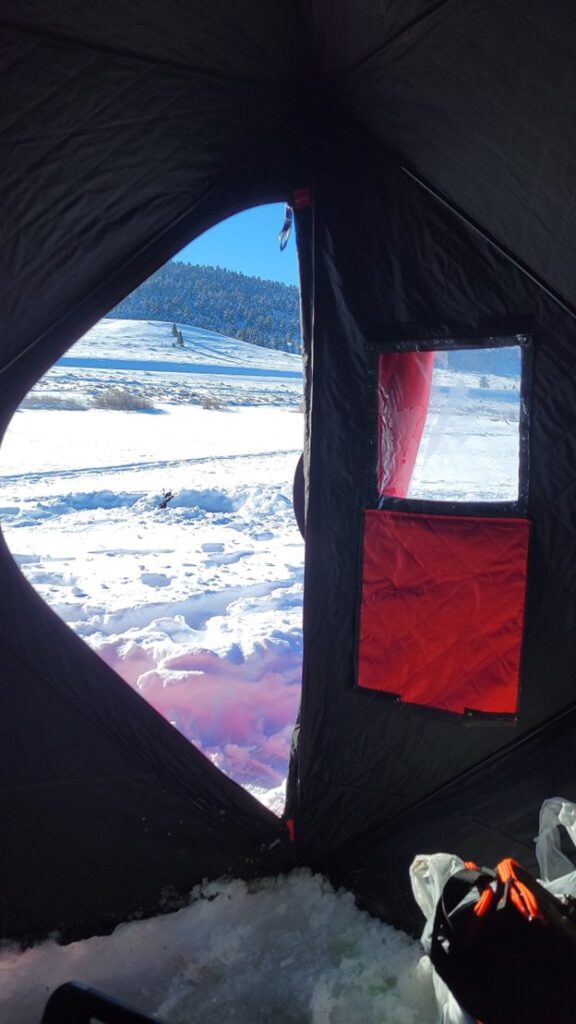
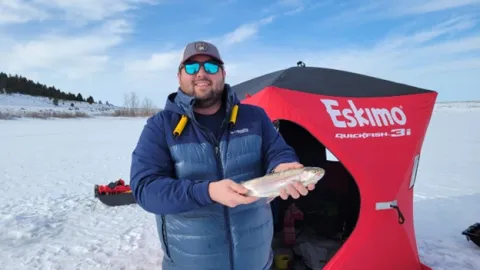
/articles/five-ice-fishing-destinations-montana
Chasing The Chill: Your Guide to Preparing For An Ice Fishing Adventure
Ice fishing, often described as a serene and rewarding experience, is more than drilling a hole in the ice and waiting for the fish. It's an adventure that combines the thrill of the outdoors with the patience of angling. But to truly enjoy your trip and ensure your safety, preparation is key. Whether you're a seasoned pro or a beginner, this guide will walk you through the essentials of planning and executing the perfect ice fishing outing.
Understanding The Environment and Weather
Before embarking on an ice trip, it is crucial to understand the unique challenges posed by the frozen landscape. Understand the environment you're heading into, and how the weather has been, and will be for the day. You want the area to have sustained a decent string of cold temperature days to put a solid 4 inches of ice before venturing out.
Safety First
The first rule to ice fishing is ensuring the ice is safe, as a minimum of 4” in is recommended for safe walking. Carrying a spud bar early, and late season is non-negotiable, as you can check the thickness while walking out. Local fishing reports, weather conditions, advice from seasoned anglers, and even tackle shops provide valuable insight into ice conditions and safety. Additionally, investing in safety gear like ice cleats for walking, flotation devices, flotation suits, ice picks, and some rope won’t only enhance your mobility on the ice, but also offer crucial protection if the unthinkable happens and you fall through. Extra clothing and a blanket with you are good as well.
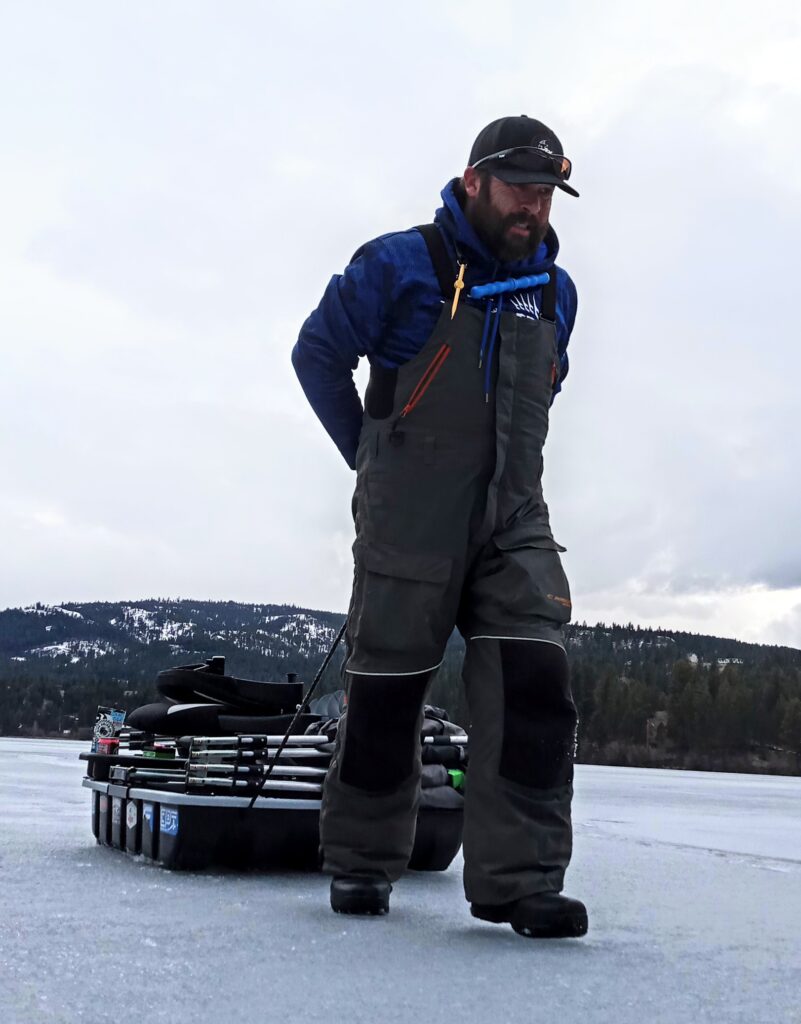
Gear Checklist
Ice Rods and Reels
Ice fishing rods are shorter than traditional rods, offering better control in a confined space of a shelter, or standing directly over the hole. Paired with a compact and durable reel, these rods and reels are typically designed for cold weather and built for conditions and the fight of winter fish. (Don't forget the use of Tip Up’s!)
Bait And Tackle
Top lures and prolites for most ice anglers are a spoon, such as a Swedish pimple, or a small 3mm/6mm tungsten jig tipped with a couple of maggots, waxxies, or your favorite plastic. Colors in shiny metallic, or glow are the most proven.
Ice Augers and Drills
You can’t fish without a hole, and creating that hole is impossible without an auger if it's manual, or even powered. Hand augers are plenty for most ice we get, and they're affordable and lightweight. I tend to stray away from the weight of gas and the mess, and instead, run a composite auger on a 20v drill. Please never use chainsaws, and in Washington state keep the hole no bigger than 10 inches.
Ice Shelter
Having a portable pop-up shelter on the ice offers protection from the biting winds and keeps you warm and dry. Some are equipped with insulated materials to hold heat from the heater and sun lights can be installed; they are a nice, cozy add-on when on the ice.
Warm Clothing
Layering is essential for ice fishing. Start with a moisture-wicking base layer, adding insulating layers like fleece, and top it off with wind/waterproof wear. Don't forget thermal socks and good insulated boots, gloves, beanies, and a face covering to retain body heat. I always recommend overdressing, because you can always take it off, but you can't if you don't have it.
Planning Your Trip
Once your gear is ready, it's time to plan the trip. Here are a few tips to ensure a seamless experience.
Research your destination: Selecting the right body of water may determine the bite, its thickness, and species. Maps will be your best resort or just common knowledge of the lake over time. Other options include checking local reports from tackle shops, Facebook pages, state websites, etc. And always make sure to check the regulations for rules and limits!
Monitor The Weather
Harsh winter conditions can change rapidly, so keeping an eye on the forecast is critical to avoid venturing out into the storm, high winds, and extreme cold. Having a blanket in your car and safety gear at all times is a must, and always let family and friends know where you plan on fishing when you leave, and when to expect your return.
Plan Your Route on The Ice
Venturing out on this ice, may it be by foot, snowmobile, or ATV, make sure to know if there are springs on the body of water, stay away from streams and inlets as the moving water makes for weak ice.
Watch for crossing wet or dark patches if possible, and never if you can avoid it, access ice from the docks, as the sun can warm the docks and weaken the ice surrounding it. Always try to access from a shoreline. Don't forget to try and follow the same path back, since you know it was safe prior.
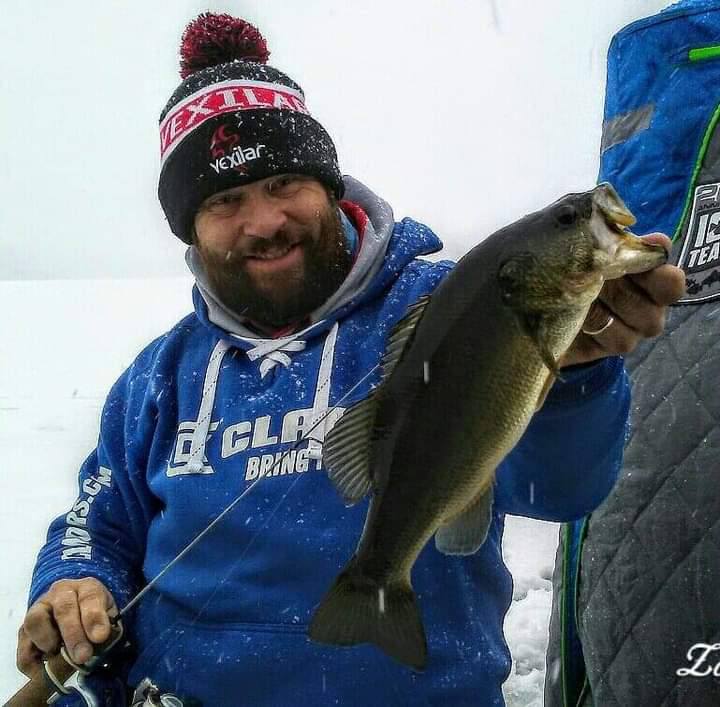
Before we go, just remember fish are active early morning and late afternoon hours so be prepared for long days. With schools of fish always on the move, fish near structures, weed beds, and drop-offs, and drill as many holes as you can to cover more water. This is where a fish finder comes in handy to find these spots quickly. Be as quiet as possible while moving from hole to hole, fish do spook easily as we’ve witnessed on cameras.
Fish behavior will change throughout the day with temps and lighting, so vary the depths of your presentation until you find the most active fish. Again, it's easy to solely focus on fishing and forget about your comfort. Stay warm and appropriately dressed, bring a thermos of something hot, and always carry water and snacks to enjoy a day on the ice all while respecting the environment by disposing of trash and packing out what was packed in. Respect nature, wildlife, and other anglers.
Ice fishing can be more than a hobby, but also a way to connect with nature, test your patience, and enjoy the camaraderie of fellow anglers. Every outing can be a learning experience with unique challenges and rewards. As you sit on the ice, surrounded by the quiet beauty of the frozen landscape, the cold becomes a distant memory. As I always say, “The tug is the drug!” and the joy of reeling in a fish are moments that make the preparation worthwhile.
With this overview, you're ready to tackle the ice, create memories, and perhaps catch the fish of a lifetime. Bundle up, grab your gear, and embrace the chilling adventure that awaits you!
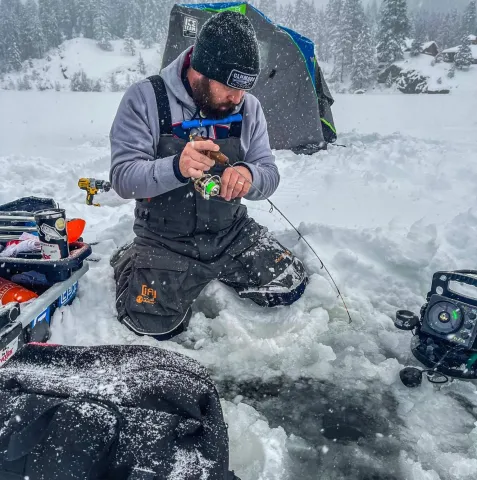
/articles/chasing-chill-your-guide-preparing-ice-fishing-adventure
Chasing The Elusive Burbot - A Guide To Ice Fishing Techniques
As winter tightens its icy grip on the local northern lakes, a dedicated group of anglers emerges from their homes, braving frigid temperatures and frozen waters. Their prize? The elusive and quite often underrated burbot. This curious freshwater species, often referred to as “poor man's lobster”, is highly prized for its delicate, white meat, and is a staple winter pursuit for many ice anglers.
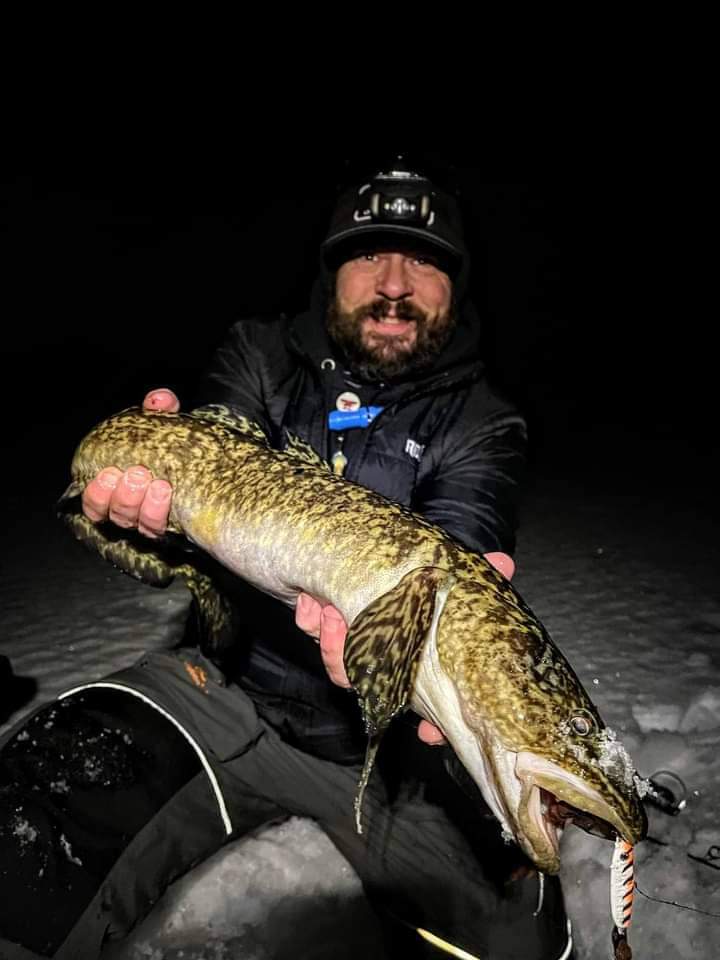
While ice fishing for burbot can be challenging, it is also incredibly rewarding. With their bottom-dwelling tendencies and nocturnal habits, catching burbot requires specialized techniques and a solid understanding of their behavior. In this article, we will explore the best strategies, gear, and tactics to help land this slippery catch beneath the ice.
Understanding Burbot: Behavior and Habitat
Burbot (LotaLota) is a unique species, the only member of the cod family found in freshwater. They are typically found in cold, deep lakes and rivers across North America. During the winter months, burbot are active as they prepare for their spawning season, making them a prime target for ice fishing. Burbot are known for their nocturnal behavior, being mostly active during the late evening and early morning hours. They prefer to linger near the bottom of lakes, often inhabiting rocky shorelines, deep basins, and steep drop-offs. Understanding these habits is crucial to developing an effective ice-fishing strategy.
One key element to burbot fishing is their winter spawning season, which typically occurs from mid-January to early March. During this time, burbot move into shallow waters, congregating in large numbers over sandy, or gravelly bottoms chasing crawdads. This makes them a little easier to catch and increases the chances of being successful.
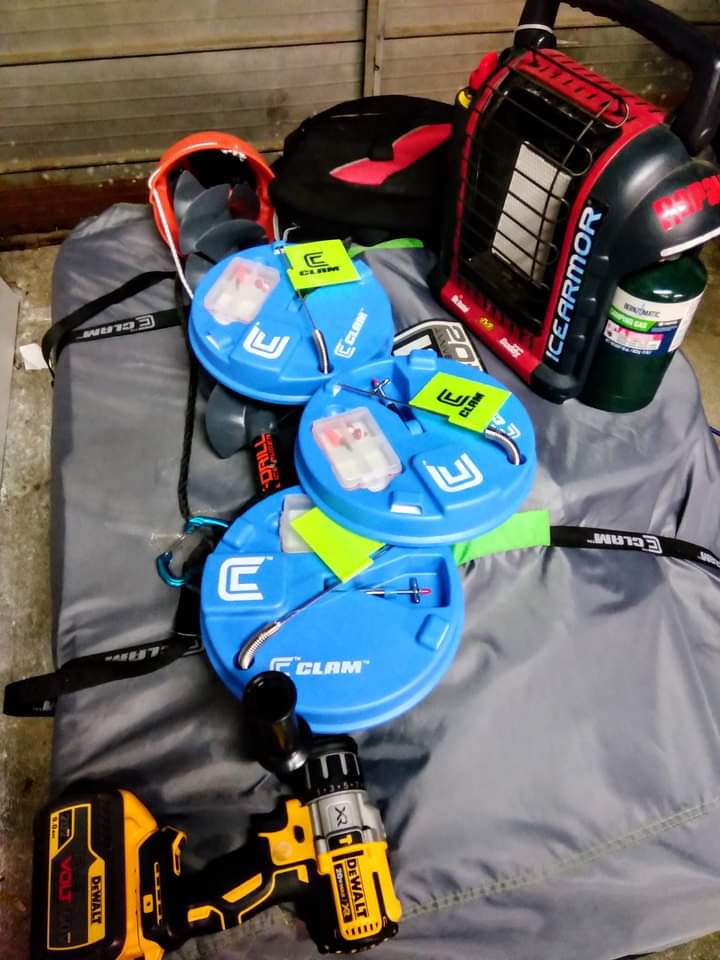
Essential Ice Fishing Gear for Burbot
Ice fishing for burbot requires the right gear and equipment. While basic ice fishing gear will suffice, certain adjustments and tools can improve your chances of success. Let's take a closer look at what you will need.
Rods and Reels.
When targeting burbot, a sturdy medium-heavy ice rod paired with a reel capable of handling heavy fish is recommended. Since burbot are bottom dwellers and tend to put up a strong fight once hooked, a rod with good sensitivity and backbone is crucial. A rod in the 28-36 inches in range is ideal, allowing enough flexibility to feel them pick the bait up, but enough strength to handle a large fish.
Line.
Braided line is preferred by many burbot anglers due to its strength and low stretch, which is useful for detecting subtle bites on the bottom. A 10-15lb line is plenty, but braid will freeze in the cold as it absorbs water. Some anglers opt for a lighter line in a clearwater situation, to minimize visibility. Like braids, fluorocarbon has low stretch, helping with hooksets in deep water.
Jigs and Lures.
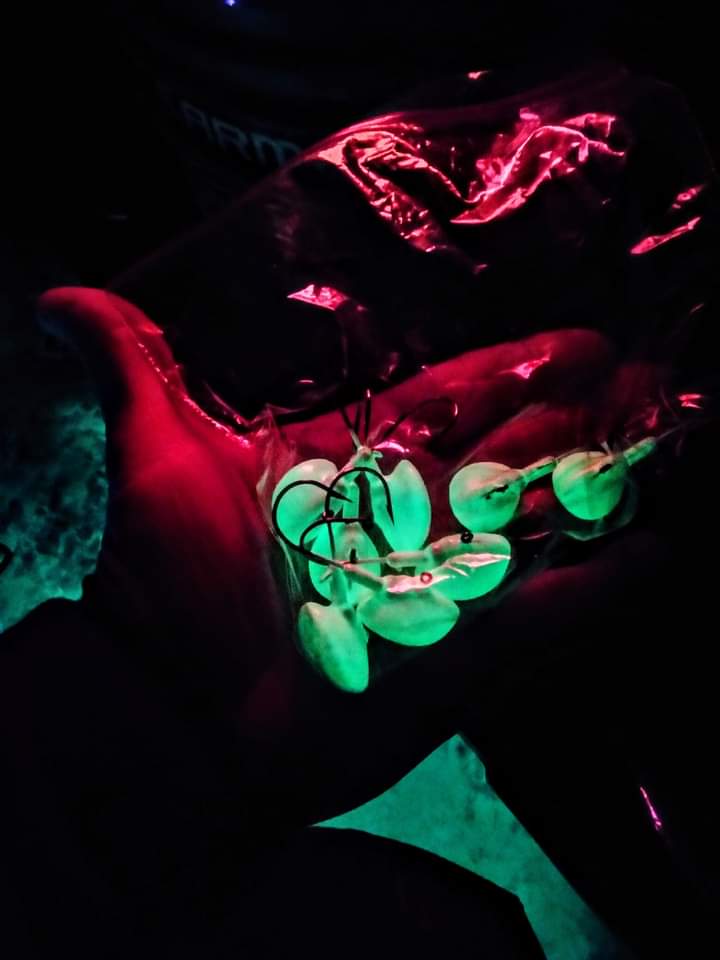
Burbot are opportunistic feeders, and their diet consists mainly of smaller fish, invertebrates, and of course, crawfish. Therefore, using a variety of baited jigs and spoons is a proven strategy. Glow-in-the-dark lures are especially effective, as burbot are often most active in low-light conditions.
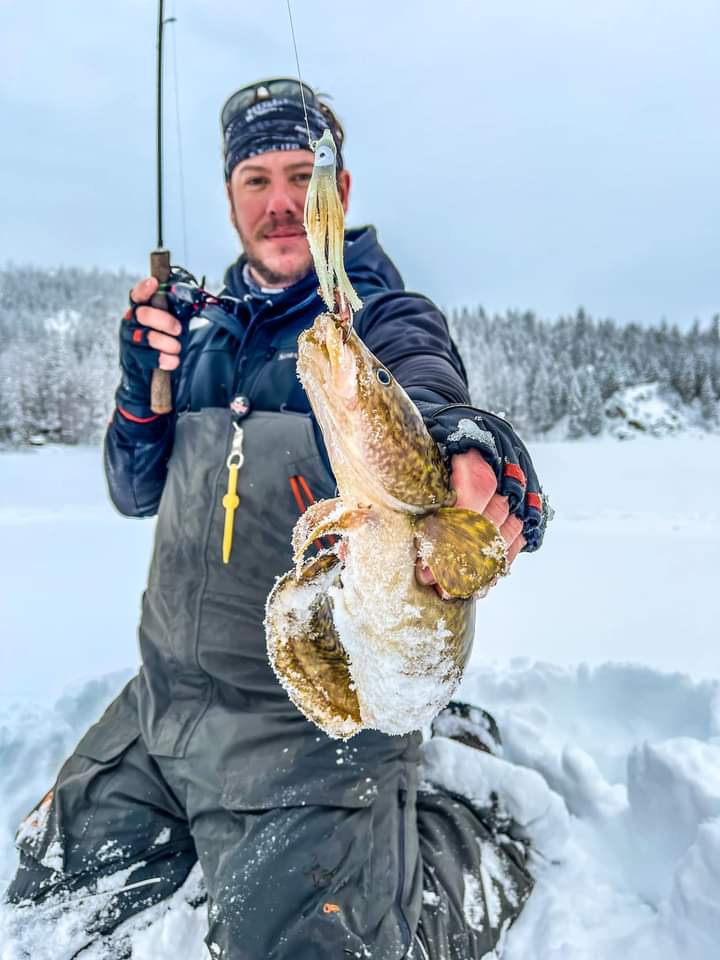
Some popular jigging lures for burbot include:
- Glow Jigs and Spoons: These lures provide maximum visibility in the dark, deep waters where burbot often reside. Tip them with cut bait, or a curly tail grub, and pound the bottom.
- Bucktail Jigs: Heavy Bucktail jigs, especially those with glow can mimic small baitfish, drawing the burbot's attention. Or the material of the jig holding a scent longer if used.
- Blade Baits: These produce vibrations that catch the attention of the burbot in deeper water where sound travels more effectively, typically tipped with cut bait.
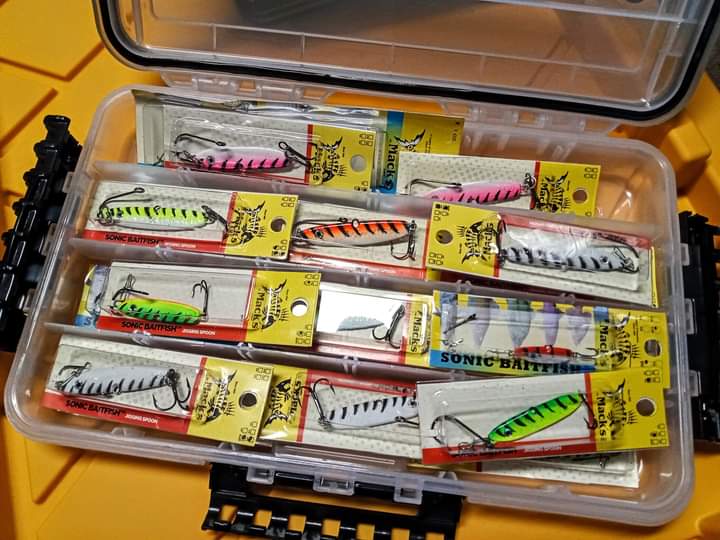
- Mack's Lure, Sonic Baitfish: My favorite burbot lure is the Sonic Baitfish from Mack's Lures. Glow finish tipped with my favorite cut bait is dynamite. The lure itself is so versatile in shallow and deep water.
Bait:
While artificial lures are useful, tipping your presentation with natural bait is essential for burbot fishing. Cutbait such as store-bought smelt, or herring work, I recommend using fresh cut bait from the body of water with your fishing if state law approves. In the lakes we fish, we use many baits from the lakes themselves such as chubs, bluegill, crawfish, etc. The natural scent of the bait and the appeal of your jig will help entice burbot lurking on the bottom.
Key Spots to Target Burbot:
- -Rocky Structure: Burbot love rocky bottoms, especially areas with boulders surrounded by large areas of cobblestone-sized rocks. This is where they are constantly feeding and chasing the crawdads.
- -Deep Basins and Deep Drop-offs: These fish often patrol deep basins and steep underwater drop-offs, looking for food. Check your depth maps and focus on areas where the depth changes rapidly near the rocky flats.
- -Mouths of Rivers and Streams: Burbot are often found at the mouths of rivers or inlets, such as streams or creeks that dump into many lakes. This is where they can hunt small fish moving in and out of the main system, with a flow of fresh cool water to lay in.
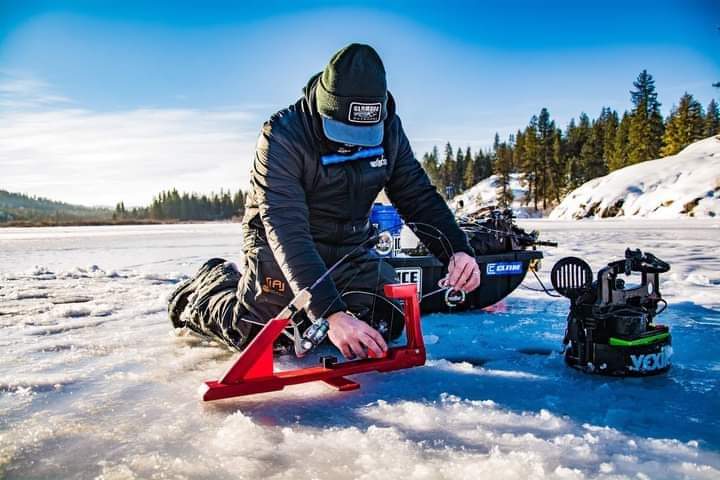
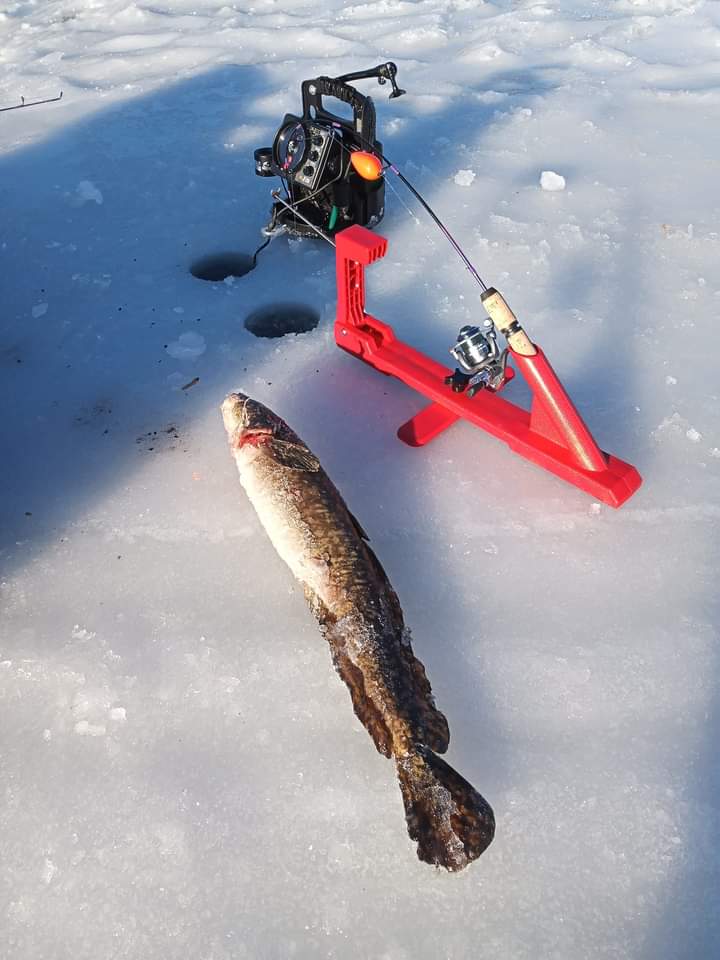
Drilling multiple holes in different locations, along the structure, to drop-offs. I like to start deep during the day and drill holes shallower as the day begins to fade away. As it gets dark, the burbot tends to follow the crawfish to shallow waters. Using a sonar or flasher will help you detect burbot holding on the bottom and adjust your presentation accordingly.
Burbot Ice Fishing Techniques
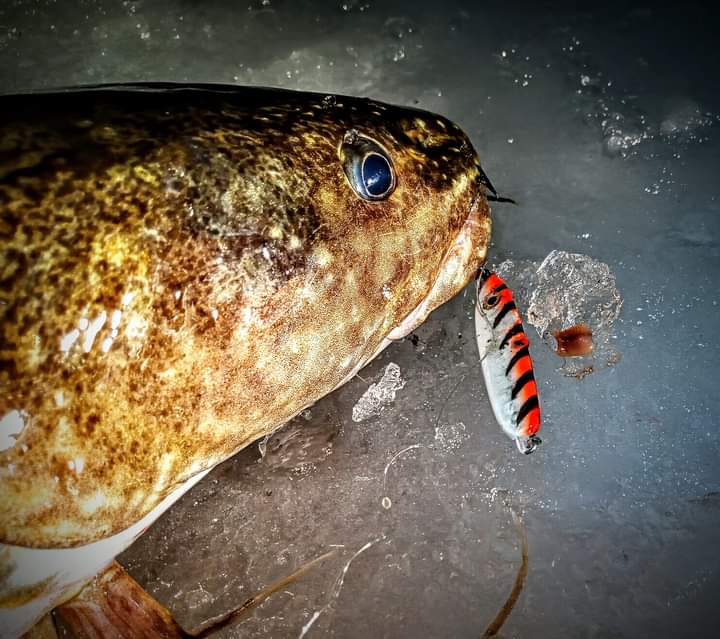
- 1. Dead sticking - One of the most effective ways to catch burbot is dead sticking. This involves dropping a baited spoon or jig to the bottom, giving it minimal movement, and letting it sit still. Burbot being scavengers are attracted to the scent of bait and will often bite without hesitation. Periodically lift the rod tip to create small movements to trigger a bite. Dead sticking is great for the lakes that allow a two-pole endorsement, as you can get the best of both worlds.
- 2. Active Jigging - While dead sticking works well, actively jigging a two-pole endorsement does just as well.
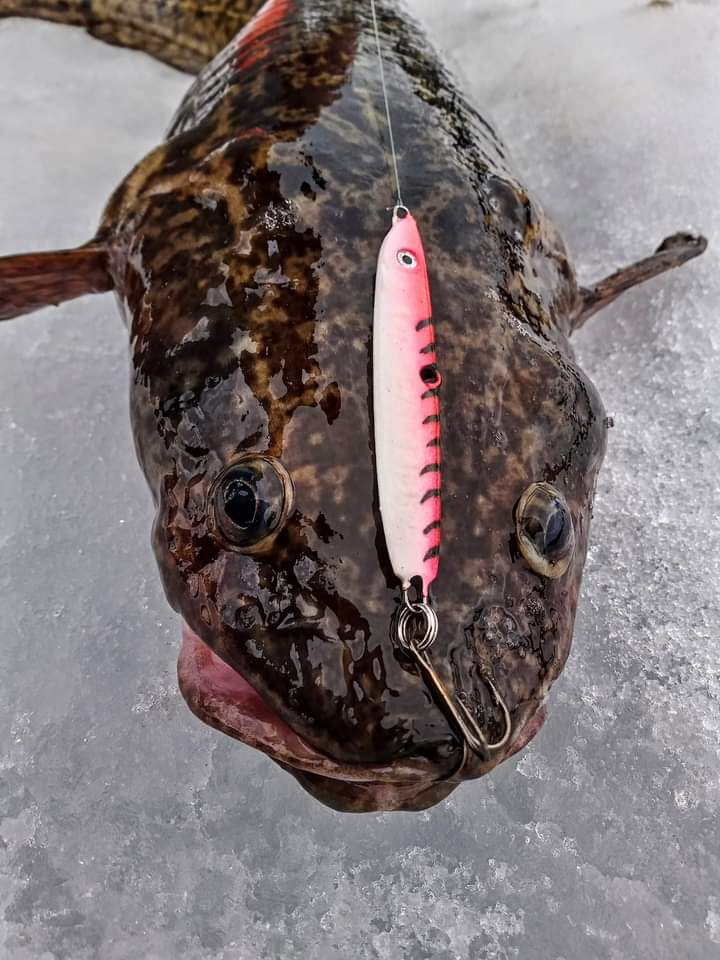
Conservation and Ethical Considerations
When targeting burbot, it's important to understand and practice ethical fishing and conservation techniques. While burbot populations are generally healthy, overfishing during the spawning season can harm local populations. Check your regs for and rules or regs on the lakes you're planning on fishing, most local lakes have the same regs. Practicing catch and release on the larger, breeding fish can help sustainable fishery for future generations.
Ice fishing for burbot may not be as popular or glamorous as chasing other winter species like lake trout, pike, walleye, or big trout, but it offers a unique and rewarding challenge. By understanding the behavior and patterns of these nocturnal fish, using the right gear, and applying proven techniques, you can increase your chance for success. Whether you're dead sticking with a baited hook, actively jigging at night, or setting a minefield of tip-ups over a rock flat, chasing burbot under the ice can be an exciting and fulfilling adventure this winter.
So grab your gear, bundle up, and head out to the frozen lakes in pursuit of these bottom-dwelling predators. You may just find yourself hooked on fishing for the “poor man's lobster.”
/articles/chasing-elusive-burbot-guide-ice-fishing-techniques
Icefishing a School Bus Away
by Matt Carey
It’s human nature to think that we need to go to great lengths to find happiness, joy, fulfillment or satisfaction. It makes sense at first glance – the more time invested, the higher the payoff. In reality, we can find value in a lot of things that are right in front of us. A quick jaunt, a stone’s throw away, right around the corner.
Maybe the same can be said for fishing.
In my day job, I work as a principal for an alternative high school. Much of my day is dedicated to helping these kids realize the opportunities they have in front of them and how to access those people who can offer help when needed. To my students, a career, graduation, just getting to Friday, are all unknown hurdles in their lives. Imposing forces that take away from the goal of just getting through the day. With the multitude of stressors on their minds, recreation and leisure are often a fading thought.
One of these recent lessons presented itself with a school fishing trip to the Helena Regulating Reservoir not too far from town, maybe 20 minutes. When I go fishing personally, I’ll opt to fish at Holter Lake, about an hour’s drive or Pishkun Reservoir, nearly two hours away, when I feel the need to fish. Coming into the day, I had low expectations. I’m not using my own gear. I’ll need to supervise these kids and keep everybody engaged.
It’s just down the road, not much adventure there. I’ll probably get called back to the building for something. We went, as a school, on this same fishing field trip last year – with no success. Not a bite. Windy conditions. On the metaphorical pendulum that is fishing, that outing swung strongly towards the forgettable side.
Furthermore, this fishing “trip” isn’t anything like those days where we need to wake up at 4am to drive to the dock at first light or prepare a few different set ups if we decide to target different fish. How could I possibly have the same level of excitement and anticipation as a fishing trip out with my buddies?
The afternoon started off unassuming. The folks from Montana Fish and Wildlife talked to our students and staff about some general ice fishing information. How to bait a hook. How to open the fishing bail. How to know if you have a bite. Trivial information you and I take for granted. To kids who have never gone fishing, this information was captivating.
One student even asked to come closer to see the line drop to the ground when the instructor opened the bale demonstrating how the bait would fall through the water. The seemingly innocuous presentation had captivated at least one of my students. We made our way on the ice and walked for a good 15 minutes. Many of the kids, and the guy in charge of supervising everyone, didn’t have the appropriate footwear.
This made the icy trek all the more cautious. The freeze was still in full effect, and our guide for the day reported the ice was about 18 inches thick. More than enough to comfortably fish without danger. After a few hundred yards we had made our way to our fishing holes. A previous school was there in the morning, with no luck of course, and the gear was ready for immediate fishing. We were given primarily Swedish Pimple jigs with a maggot as our bait for the afternoon.
Kids and teachers wandering around finding what they’d hope to be their lucky spot. Remember how I mentioned last year’s conditions? Well, now picture a complete 180* (you couldn’t really expect to not get a lesson from a guy in education, right?). The sun shining with a few clouds painted across the skyline.
A calm breeze that was never overbearing, but enough to remind you that you are outside during a Montana winter. Mid to high 30-degree weather, necessitating a jacket or sweatshirt, but no need for snowpants or a full facemask gaiter. My Reel Obsession Sport Fishing sweater and Montana Grizzly hat combination was the perfect balance of “drip” (swagger or style to those of you not up to date on the newest slang) and functionality.
In a similar fashion to the weather, our fishing experience was nothing like last year’s. Within 5 minutes two different kids are pulling up perch. No state records, but a fun experience. Kids goading each other to kiss the fish, being caught off guard by the fish slime and calling over their friends and teachers. Some kids catching multiple fish, one girl catching 3 in our outing. After seeing such a lively bite, I figured why not, I’m here anyway, I might as well wet a line.
A silver and blue jig with a maggot ended up being my lure of choice. More so because it was the only one open at the time. Engaged kids, minimum screwing around, it was a winning combination. I dropped the lure beneath the ice, hit the bottom, reeled up a few feet and started jigging around 18 feet of water.
A few other members of Fish and Wildlife were with us, and I struck up a conversation about anything and everything you’d expect – what set ups have been working well, other lakes or reservoirs in the area, that kind of thing. Caught off guard, my rod tip gets absolutely slammed. My FWP counterpart exclaiming “that ain’t no perch! You’ve got a koke on there!”. As I’m reeling, he asks if I saw the fish on the fish finder.
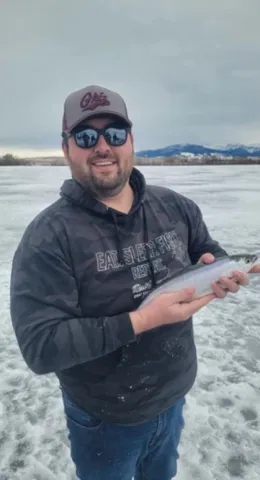
Sheepishly, I told him I wasn’t really paying attention and I was looking at everyone else catching fish. As I pull the fish out of the water, I see a solid 16 inch kokanee come out of the hole. This is a great fish and certainly not what I was expecting coming into the day. I ask for a picture and release my catch back into the reservoir for someone else to find.
I realized in that moment that even the mundane or trivial, we can find great joy and satisfaction. Are weeklong fishing adventures great? Of course. Can adventure and happiness be a school bus ride away?
Without a doubt.
/articles/icefishing-school-bus-away
Bucket List Fishing
What an adventure this whole fishing thing is. Like many things in life, often the journey is more fulfilling, exciting, and memorable than the ending. I shouldn't even say “ending”. Maybe outcome or result are better words. I have no intention of stopping fishing for what quickly became one of my new favorite fish—the latest stamp to be added to my fishing passport.
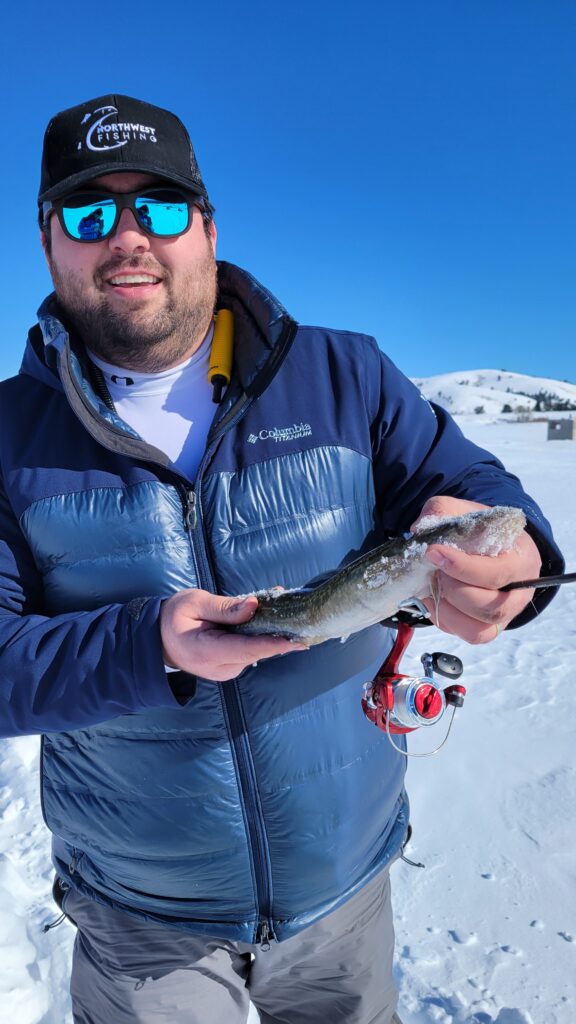
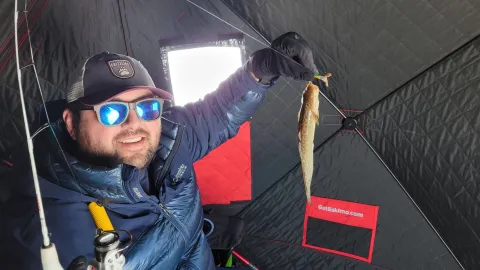
I’m going to come right out with it, the fish pictures included with this article are not show-stopping, wall-mounting, brag to your buddies type of fish. Some might look at them and wonder if they were even photo-worthy at all. But to those folks, I’d retort with a new phrase that has newly become part of my regular vernacular. A polite way to say be nice, be joyful for others, or perhaps more bluntly, a phrase we all heard as kids, if you don’t have anything nice to say, don’t say anything at all. Don’t yuck someone’s (my) yum. My recent yum, both literally and figuratively as you’ll come to read, centers around catching what became a winter fishing obsession. I am referring to one of the more mysterious fish I’ve come across as an angler, the burbot.
Highly regarded for its taste as poor man's lobster yet criticized for its appearance, I knew I had to catch one, two, as many as I could. They are most active during the winter months and at night, two challenges as we’ve had an unseasonably warm winter and I’m more apt to hit the snooze button and sleep in than drive to a frozen lake and sit outside in the dark or first light of the morning hours. Still, I had to add this fish to my checklist of caught species.
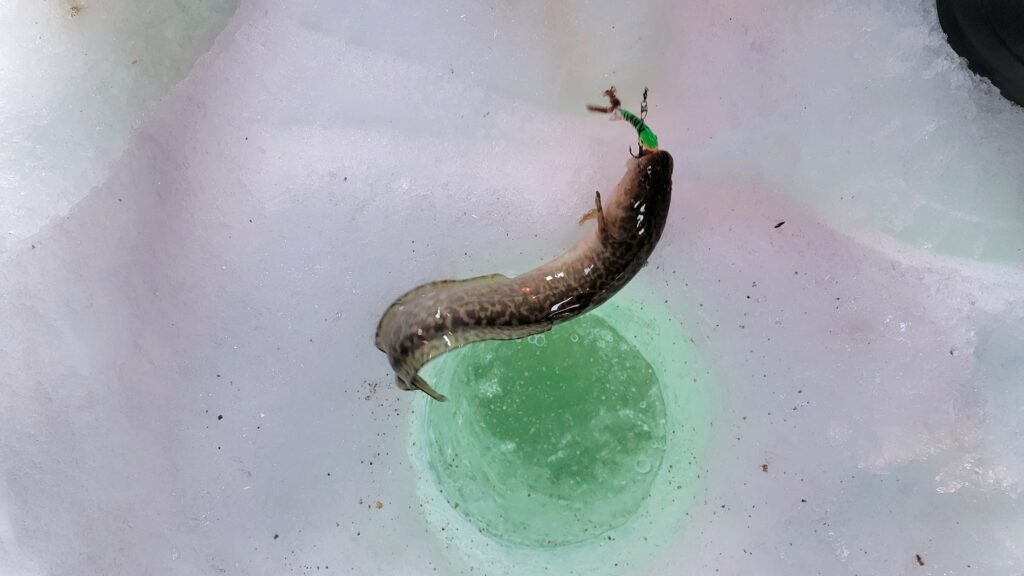
The fish is an oddity with their eel-like appearance, freshwater habitat (the only cod to live in such an environment in North America), and some seeming barriers in place - fishing during the winter, night activity, and competition with other anglers - I was obsessed. I researched online, talked with other anglers, called MT FWP for information from biologists in the field, asked questions when buying gear at local shops, and watched YouTube clips (check out our ProTip video with Craig Dowdy on the website or our YouTube channel on how to filet burbot), anything you could think of to educate myself on how to best catch this fish. Maybe a bit counter to the introductory prose, I’m all for enjoying the experience of fishing and the ambiance of the outdoors, but darn it, I really like catching fish, too. Especially with all the work and background knowledge I had completed. Not catching the fish would’ve been a letdown, surely.
After finding a few reservoirs in my area and properly gearing up, the only thing left to do was hit the ice. A scenic 20-minute drive to my first location yielded no fish. Slightly concerning, but motivating at the same time, another angler told me about some perch and a small ling (another name for the burbot) he released. Good to know, but after a few more evenings on the ice with no fish, it was time to try somewhere new. How about 40 minutes away? I had heard more consistent information about the fish being abundant in this second location but again, coming up sevens at this new spot.
For those without an interest in throwing dice at the craps table like myself, that means I didn't catch anything here either. So, perhaps where I should've started all along, a trip to White Sulphur Springs, MT about 1.5 hrs. away would host my next attempt. As with most fishing, the lulls made for some long hours. Despite the wait, I had the opportunity to hook into my newest fish friends both jigging for them and through a stationary rod, both targeting slightly off the bottom, about 40 feet. I'll never forget the sight of my first burbot as it appeared from the icy blue depths below. Examining this new-to-me fish, it had greenish, yellowish, olive covered spots all along its body. A catfish like appearance with a more than normal amount of fish slime coating the body, which I quickly became acquainted with as it slithered snake-like in my hands. Knowing I had finally caught one had me pumped up! All that was left was to see how it tasted.
As mentioned, they are highly regarded for their table fare. Bringing my catch home, I had done my homework as to how I should prepare my meal. Simplicity is sometimes the answer. Boil a little lemon soda, poach the fish for a few minutes and dip in some garlic butter with lemon on the side. Enjoy, easy. One thing I hadn’t accounted for, sharing with my family. My wife, not as invested in the pursuit of this fish, was fine to try it, compliment me on cooking it and move on with her evening. My kid, 2 years old, however, grabbed this fish by the fistful. So much so that I started getting a little jealous!
I put in the legwork to catch this fish and had built my first meal up in my head and here she is eating it all! Rationing out my portion, I was glad to see my daughter enjoyed the meal, but I was for a moment inclined to respond like the 2-year-old I was interacting with - to say “mine” and grab it all back. They don’t call this fish the poor man’s lobster for nothing I suppose. The white meat is what you’d expect from any similar cod fish, but the firm texture and taste of the fish paired with the garlic butter and lemon certainly lived up to my expectations. The enjoyable meal was the culmination of my burbot experience and a fitting way to affirm my latest fishing craze.
So, now that I’ve caught what was previously a mysterious fish to me, I look forward to another season with refined skills but the same level of excitement I had before encountering the burbot. A note for myself, I’ll have to do some research on some of those other strange fish to be caught…paddlefish, an arctic grayling, pallid sturgeon…all to hopefully be checked off the species bucket list.
/articles/bucket-list-fishing
Choosing The Right Ice Fishing Hut
Ice fishing is a unique and rewarding outdoor activity that requires specialized equipment to make the experience enjoyable. One crucial piece of gear that can significantly enhance your ice-fishing adventure is a shelter. Two popular options on the market are hub shelters and flip-style shelters. In this article, we will go over the reasons why anglers might prefer one over the other, exploring the benefits and considerations that come with each choice.
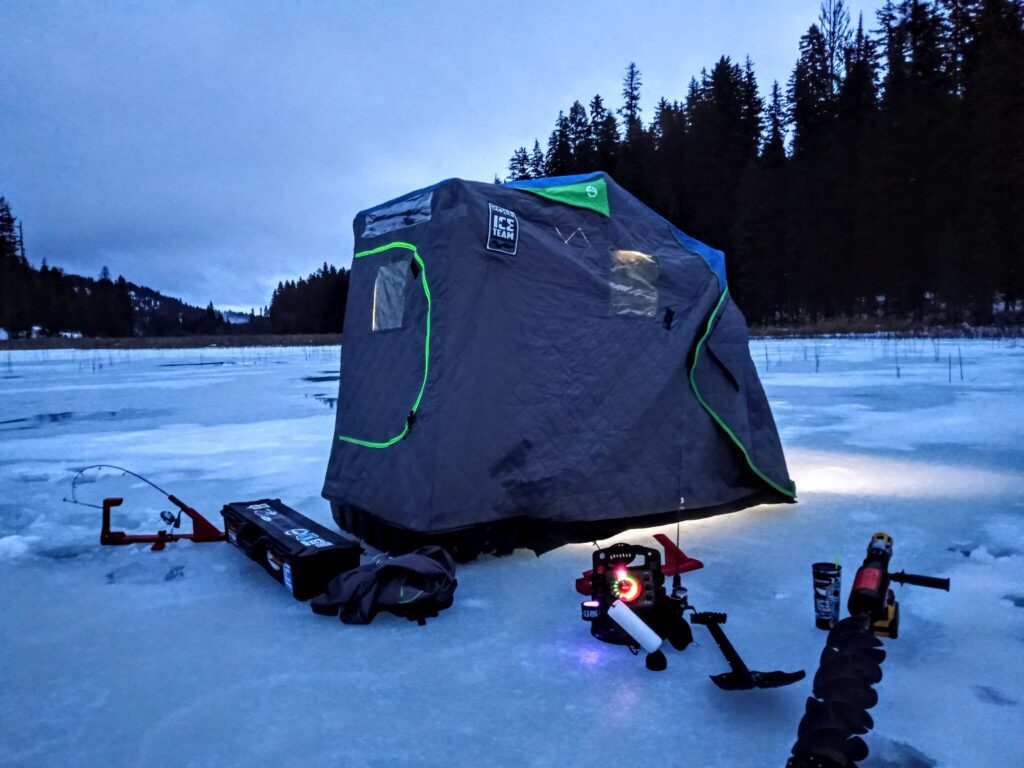
Hub Shelters: The Central Hub Of Comfort And Versatility.
-Spacious Interior: One of the primary advantages of hub shelters lies in their spacious interior. These shelters typically feature a hub on each side, and top, that serves as the support point for multiple poles, creating a roomy and open fishing space. Anglers can enjoy ample room for movement, accommodating multiple people comfortably.
-Quick set up: Hub shelters are known for their quick and super easy setup. With a simple pop-up mechanism, anglers can have their shelter ready in minutes, allowing more time for fishing. This convenience is valuable in extreme and inclement weather conditions when the swift assembly is crucial for staying warm and focused on the catch. The design of hub shelters, with multiple support arms radiating from a center hub, contributes to their stability, especially in windy conditions. With proper support, the stability ensures that the shelter remains firmly anchored to the ice, providing a secure environment for all anglers.
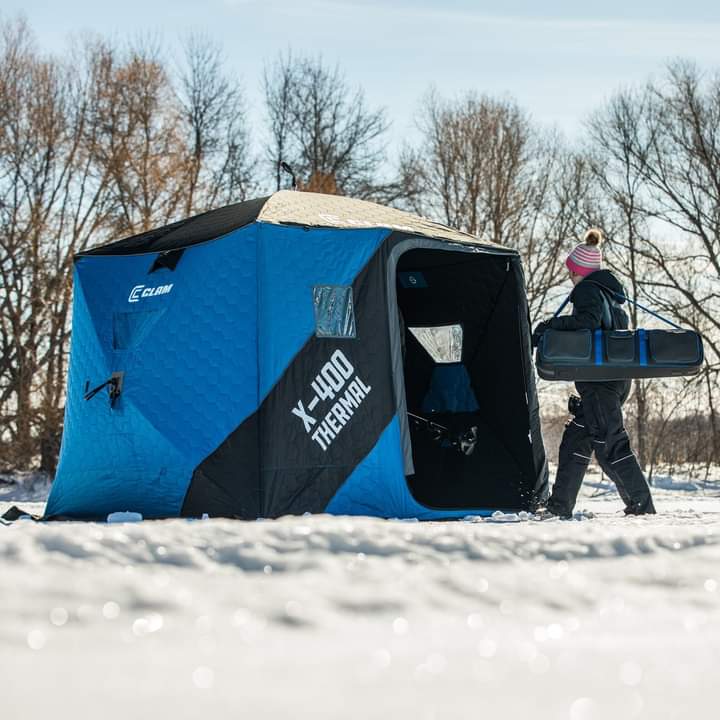
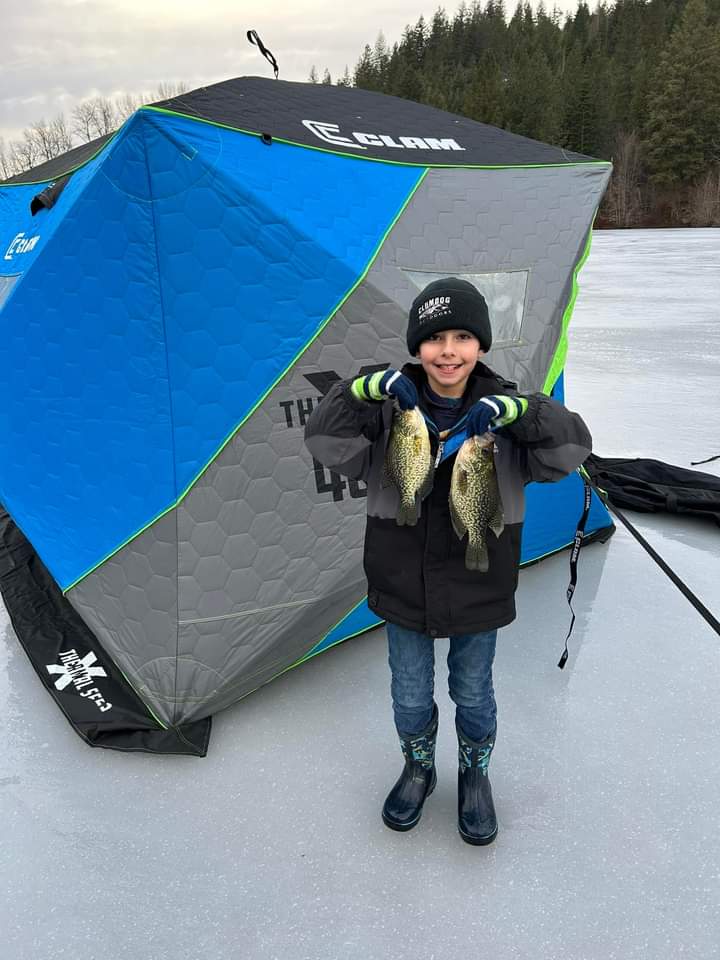
Hub shelters often come with customizable features, allowing the angler to adapt their set-up based on personal preferences and weather conditions or using an overnight setup. From adjustable ventilation options to detachable flooring, these shelters offer a level of customization that enhances the overall ice-fishing experience.
Flip-Style Shacks: Mobility And Quick Strikes.
Flip-style shacks are favored for their portability and ease of transport. These shacks typically come in a compact, sled-like design that can be easily towed across the ice. This portability is especially advantageous for anglers who prefer running and gunning from one fishing spot to another quickly.
The flip-styles are equipped with sleds, enhancing their mobility on the ice. This feature allows anglers to tow their shelter to different locations without the need for additional equipment. For ice anglers, the defining feature is the quick setup and take-down process. Anglers can simply flip open the shelter, allowing immediate access to gear and the fishing area. This rapid deployment is ideal for anglers who like to stay on the move, running and gunning to explore various spots, making the flip-style shelter a valuable companion.
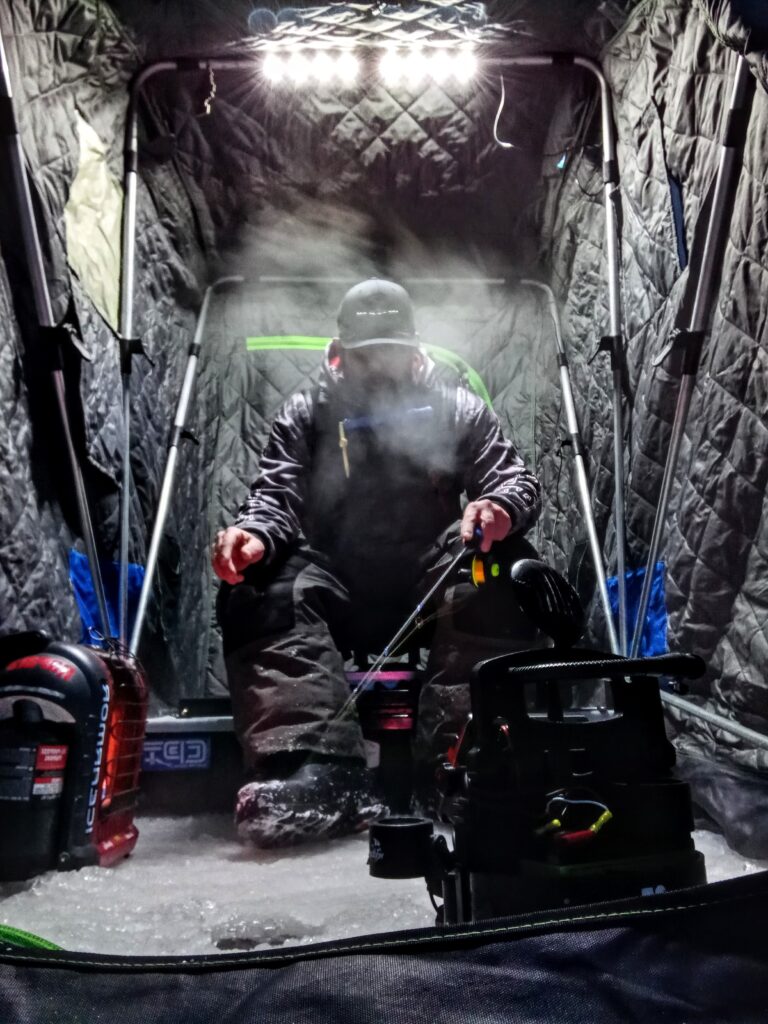
Ultimately, the decision between a hub shelter, and a flip-style shelter depends on individual preferences, fishing style, specific conditions, number of people, etc. Both options offer unique advantages, providing anglers with the flexibility to tailor their ice fishing experience and set up to suit their needs. Whether you choose the central hub for a spacious shelter or the quick mobility of a flip-style, investing in the right ice fishing shelter is a key step towards enhancing your winter fishing and adventures!
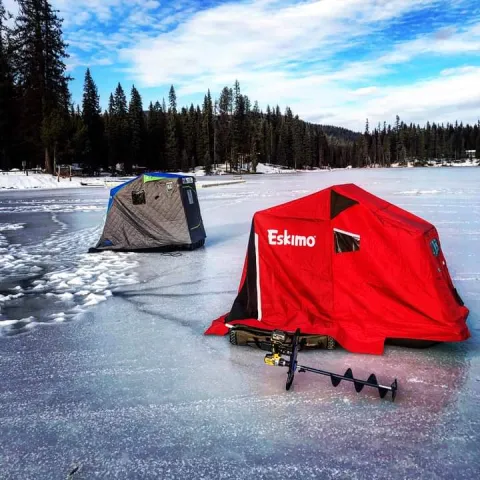
/articles/choosing-right-ice-fishing-hut
5 Frozen Treasures
Washington State, known for its stunning landscapes and diverse outdoor activities, offers a unique and thrilling experience for anglers during the winter months, Ice Fishing. As the temperatures drop and the lakes freeze over, enthusiasts from all over gather their gear and head to some of the state's most picturesque frozen waters. In this article, we’ll dive into the icy wonderland of 5 lakes that stand out as prime destinations for ice fishing in Washington: Curlew Lake, Bead Lake, Sacheen Lake, Banks Lake, and Eloika Lake.
Curlew Lake: A Frozen Oasis In The Northeast
Curlew Lake, nestled more in the Northcentral portion of the state, transforms into a winter wonderland, drawing anglers seeking a tranquil ice fishing experience. The lake spans over 900 acres and is surrounded by snow-covered mountains and hills, creating a beautiful backdrop to your frozen adventure.
The lake is home to a variety of fish, with Rainbow Trout and Yellow Perch being the most sought-after during the winter months. Anglers often set up shanties or their ice fishing spots right outside the state park patiently waiting for the telltale signs of the fish below, which doesn't take long. The vast mud flat just outside the park holds amazing numbers and is easy to get into. The camaraderie among anglers and the stunning scenery make Curlew Lake a must-visit destination for any Ice Fishing aficionado.
Bead Lake: A Hidden Gem in The North Mts.
Nestled in the North of Spokane Mountains, Bead Lake is a hidden gem that offers a secluded and serene ice fishing experience. The lake, surrounded by dense forests and snow-covered peaks, provides a pristine setting for anglers looking to escape the hustle and bustle of everyday life.
Bead Lake is known for its healthy population of Kokanee, and the popular large lake trout that roams the depths. As large marks appear on your sonar, don't be surprised if it's not a laker, but a monster of a burbot making this lake an enticing destination for those seeking a variety of catches. As you set up your gear on the frozen expanse of Bead Lake, the quietude and natural beauty will transport you to a world of tranquility, making each catch a memorable moment.
Sacheen Lake: Serenity and Splendor In Pend Oreille County
Located in Pend Oreille County, Sacheen Lake offers a charming blend of serenity and splendor during the winter months. Surrounded by evergreen forests and snow-covered hills, the lake becomes a haven for ice-fishing enthusiasts seeking a peaceful escape.
Sacheen Lake is known for its panfish, including perch and crappie, which are abundant and fun to chase. Also, fun to target nice trout under the ice as well, with good chances of catching! Rainbow, Brook, and Tiger Trout provide excellent opportunities for ice anglers to enjoy a variety of catches. As you drill your fishing holes and set up your equipment, take a moment to absorb the quiet tranquility of Sacheen Lake, where the only sounds are the soft crunch of snow beneath your boots and the occasional call of a winter bird.
Banks Lake: A Vast Frozen Playground in Central Washington
For those looking for a more expensive ice fishing experience, Banks Lake in Central Washington is a prime destination. This reservoir spans close to 27,000 acres and is known for its diverse fish population, including Walleye, Rainbow Trout, Burbot, and Whitefish which are the most popular to go after.
Ice fishing on Banks Lake is a social affair at times, with clusters of anglers setting up their shanties in popular spots and many staying overnight. The vast frozen expanse provides ample opportunities for exploration, and to get away from the crowds if needed. As the sun sets over the snow-covered horizon, the frozen lake transforms into a canvas of colors. Banks Lake is not only a haven for anglers, but also a visual spectacle that captivates the senses.
Elokia Lake: An Ice Anglers Original
Nestled in the heart of Northeastern Washington State, Elokia Lake transforms into a winter wonderland for avid ice fishing enthusiasts. As temperatures drop, the lake's icy surface becomes a haven for those seeking the thrill of angling beneath a blanket of snow.
Eloika Lakes expands over 600 acres, providing ample space for ice fishermen to explore its frozen expanses. One of the primary draws for anglers is the diverse range of fish species that inhabit this lake. Brown Trout, Rainbow Trout, Large-mouth Bass, Perch, Crappie, and Sunfish. Seems that Crappie are what attracts most ice anglers.
The savvy ice anglers will target the Brown and Rainbow Trout early season just a couple of feet below the ice and near creek outlets. Eloika’s cold waters create an ideal environment for these fish. Anglers can also test their skills against the Large-mouth bass, known for their elusive behavior even in freezing temperatures, and they are big in this lake, especially on an ice rod.
Yellow Perch and Crappie add a variety to the fishing experience at Eloika. These panfish offer more of a relaxing angling experience, making the lake suitable for seasoned veterans and beginners alike. Perch are abundant and make sure to check the regulations for the Crappie size and limit.
As ice fishing shelters and anglers dot the frozen landscape, camaraderie flourishes among anglers who gather to share stories and tips. Eloika Lakes icy embrace beckons, offering a unique and thrilling experience for those willing to brave the cold pursuit and snag the perfect catch!
/articles/5-frozen-treasures