Fishing the Palouse by Josh DeBruler
Far down in the southeastern corner of Washington State, there’s a river that is surrounded by millions of years of geological wonders. The journey begins at its headwaters in the Bitterroot Mountain Range of Northern Idaho. It meanders southwest and cuts through a landscape of grassy hills, formed by millions of years of wind-driven sediment that lay atop Pleistocene-era lava flows. For miles, it flows through a steep canyon carved out by the great Missoula flood that occurred during the rupture of an ice dam during our last glacial maximum. Finally, in Southeast Washington, it ends its solo journey at its confluence with the Snake River.
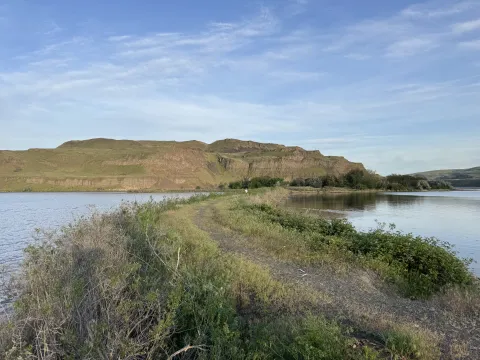
Historically, the waters at the confluence of the Snake and the Palouse were turbulent, characterized by rapids and fast-moving water. When Lewis and Clark reached the confluence of these two rivers during their expedition, they wrote about the ferocity of the water and how members of the group who didn’t know how to swim opted to go ashore and lug supplies on foot. Today, the waters here run much slower due to the construction of the Monumental Dam about 14 miles downstream on the Snake.
The slow-moving water near the confluence makes great habitat for a variety of fish like walleye, channel catfish, yellow perch, bluegill, smallmouth bass, and northern pikeminnow. What’s more, the fertile wheat land surrounding the Palouse offers a specific advantage for anglers targeting catfish. Peppered up and down the river are shoreline grain elevators where grain is transferred from barge to land, and during harvest season, these spots attract large numbers of Channel Catfish. Anglers can boat to these grain elevators and target fish that feed on grain spillover.
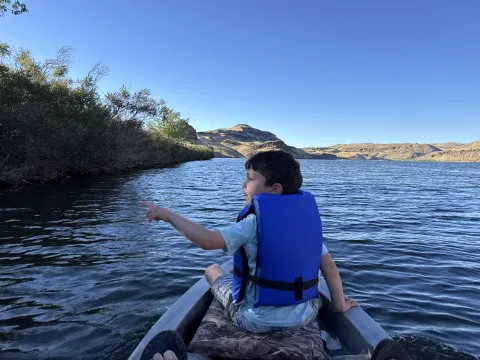
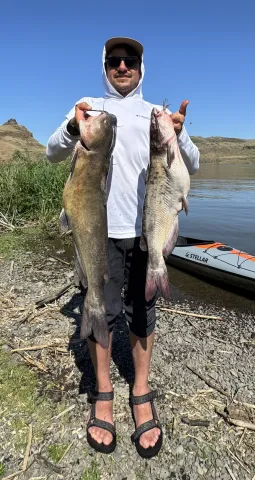
Catfish can also be targeted near shore in shallow, calm flats and deep holes with rocky bottoms. Channel catfish can be caught with night crawlers, bread dough balls, chicken livers, crawfish, shrimp, and stink baits, but the most consistent bait for me remains cut fish. Typically, a 1-2 inch chunk of yellow perch will do the trick.
Another method to deploy during the channel catfish spawning season (late spring-early summer) is running a small jig past a male catfish who sits guard over a nest. This often triggers a defensive strike from the male. This is a sight-fishing type of method, so to be successful, you’ll want a decent pair of polarized sunglasses and will need to be accurate with your casting.
Fishing the Palouse after June 16th in Washington State means 2 pole fishing is permitted. Since fishing for Channel catfish can often be a long waiting game, the two-pole endorsement offers up a great opportunity for rigging one rod up for the more passive catfishing while then using a second rod for something more active, like casting swim baits for walleye or smallmouth. It's good to equip your catfish rod with a bell at the tip to indicate a strike that you may not have noticed otherwise.
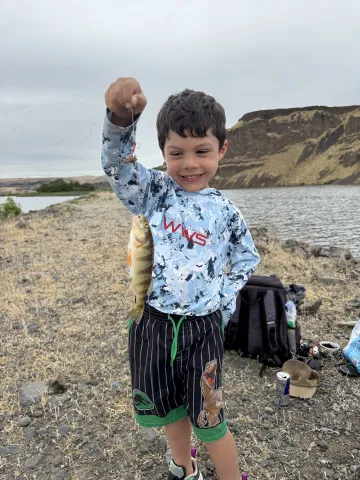
If you’re interested in catching a variety of fish and don’t want to deal with the hassle of switching from one setup to another, no need to worry; there is a simple solution. A nightcrawler, a hook, and a worm tied together on a simple drop rig is a setup that I use for shore fishing on the Palouse, and I have caught walleye, panfish, pike minnow, and large catfish on it. It's a one-size-fits-all set-up and works wonders in the calm waters of the Palouse. It’s also a great setup for kids, so long as they have the patience to sit and wait for a bite.
I’ve seen some pretty nasty winds at the Palouse, and each time I’ve been pleasantly surprised by the lack of effect the wind had on the water. This could be because of a sheltering effect from the canyon walls surrounding the water, the lack of depth in the river itself, or a combination of both. Either way, the lower Palouse is a safe and excellent spot to launch a kayak or any other type of boat for a day of fishing.
There are multiple boat launches on or near the lower Palouse. Lyons Ferry State Park offers a boat ramp and shore fishing opportunities. Riparia boat ramp on the Snake River is just east of the confluence of the Snake and the Palouse. Ayer Boat Basin is on the Snake River and about 7 miles west of the confluence. It has two boat ramps, a large parking lot to accommodate vehicles and trailers, and a campground for visitors,
So, if you’re looking to get out and explore some of the most beautiful and geologically rich lands that our state has to offer, and you wouldn’t mind coming home with a cooler full of a variety of fish, then the Palouse is where you should be heading on your next trip!
/articles/fishing-palouse-josh-debruler
Taking the Path Less Traveled by Brent Knight
Rediscovering Washington’s Overlooked Fisheries in Changing Times.
For many Washington anglers, recent seasons have felt like a slow unraveling of something we once took for granted. Winter steelhead? Few opportunities and often crowded. Blackmouth in Puget Sound? Gone almost as soon as it opened. Entire river systems in North Puget Sound were closed, not necessarily because fish weren’t there, but because WDFW monitoring dollars weren’t. And as each North of Falcon season unfolds, rumors swirl: fewer Chinook days, shrinking coho opportunities, more uncertainty where consistency once lived.
For lifelong anglers in the Evergreen State, especially those who remember the abundance of the 1970s and early ’80s, it’s hard not to feel discouraged.
But here’s the reality: while some of our most iconic fisheries are constrained by policy, funding, and complex ecological pressures, Washington still offers an incredible diversity of fishing opportunities, many of them thriving, and many of them overlooked.
So instead of stepping away, more anglers are doing something different, adapting.
A Shift in Mindset
Fishing in Washington today requires flexibility. The “go-to” fisheries may not always be there, but that doesn’t mean the experience has disappeared; it has just changed shape. The anglers finding success in 2026 aren’t necessarily fishing more; they are fishing differently. They’re exploring.
Lakes: The Quiet Comeback
As spring gives way to summer, Washington’s lakes quietly come alive.
Warming water triggers aggressive feeding behavior, opening the door to some of the most accessible and rewarding fishing in the state. Kokanee (landlocked sockeye) offer fast action in lakes like Lake Chelan, Lake Roosevelt, and American Lake. Meanwhile, trout fisheries across the state, from Pass Lake on Whidbey Island to Lenice and Nunnally Lakes near Vantage, provide consistent action for both fly and gear anglers.
And then there’s warmwater fishing.
Eastern Washington, in particular, is a goldmine:
• Walleye in Lake Roosevelt, Banks Lake, and the Columbia River system
• Smallmouth bass in the Snake River and Columbia River
• Largemouth bass, crappie, and bluegill in countless farm ponds and reservoirs
Walleye, especially, remain one of the most underrated table fish in the region, in my opinion, rivaling halibut or lingcod in quality.
Rivers Beyond Salmon
For anglers who define themselves by moving water, the loss of salmon and steelhead seasons hits hardest. But Washington’s rivers still offer exceptional opportunities, just with different targets.
The Yakima River stands out as one of the state’s premier trout fisheries. Stretching from Cle Elum through the Yakima Canyon to Roza Dam, it’s a blue-ribbon, catch-and-release system known for healthy populations of rainbow and cutthroat trout.
Other standout river options include:
• Methow River (selective trout fishing when open)
• Upper Columbia tributaries for seasonal trout
• Skagit and Sauk Rivers (when open for trout or limited steelhead opportunities)
• Olympic Peninsula streams for cutthroat trout
Guided trips through outfits like Red’s Fly Shop or Ellensburg Angler for the Yakima River can dramatically shorten the learning curve for those new to these systems.
Saltwater: Looking Beyond Salmon
While salmon seasons may be compressed, Puget Sound still offers underappreciated saltwater options.
Flatfish like flounder and sand dabs provide surprisingly fun and productive fishing. Target sandy bottoms in 30–80 feet of water using small bait rigs, Sabiki rigs, or setups tipped with shrimp, squid, piling worms, or other baits are especially effective. It’s not uncommon to hook multiple fish at once, and larger specimens make excellent table fare.
Other overlooked Puget Sound fisheries include:
• Squid jigging in winter months (Seattle waterfront, Edmonds, Tacoma)
• Surf perch along coastal beaches
• Pile perch and striped perch around docks and pilings
• Cabezon and greenling in rocky areas (when open)
These fisheries are accessible, often family-friendly, and largely underutilized. The Washington Coast: Opportunity Still Abounds
If you’re willing to travel, Washington’s outer coast remains one of the most productive fisheries in the Pacific Northwest.
Ports like Neah Bay, La Push, Westport, and Ilwaco offer a wide range of options:
• Rockfish (especially pelagic black rockfish)
• Lingcod
• Halibut (during tightly managed seasons)
• Seasonal Chinook and coho
Ocean fisheries are often more stable than inland salmon seasons and can provide both action and harvest opportunities.
High Country and Hidden Gems
For those willing to hike, Washington’s alpine lakes offer solitude and surprisingly good fishing.
Thousands of lakes scattered throughout the Cascades and Olympics are stocked with trout or sustain wild populations. Late summer is prime time, with fish eager to feed before winter.
Closer to home, don’t overlook:
• Urban lakes stocked with trout by WDFW
• Small neighborhood ponds holding bass and panfish
• Local docks and shorelines that consistently produce
Sometimes the best fishing isn’t far; it’s just forgotten.
Back to the Roots
For many anglers, the solution to today’s changing landscape isn’t to fish harder; it’s to fish simpler.
Cast a spinner from shore. Float a worm under a bobber. Take a kid to a stocked lake. Revisit the kind of fishing that made you fall in love with the sport in the first place.
Because at its core, fishing in Washington has never just been about limits or seasons; it’s about time on the water.
The Path Forward
Yes, we’ve lost opportunities. Yes, the future of some fisheries remains uncertain. But Washington still holds an incredible variety of waters, species, and experiences.
The anglers who continue to thrive are the ones willing to adapt, to take the path less traveled. So, check the regulations, explore something new, and keep going.
The fish and the experience are still out there.
/articles/taking-path-less-traveled-brent-knight
Destination Prineville by Gary Lewis
Two reservoirs within striking distance of Prineville offer great fishing for smallmouth bass, crappie, and rainbow trout.
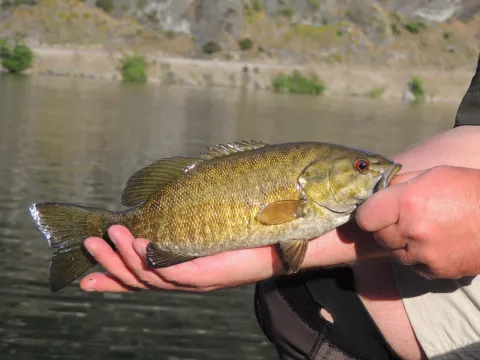
That angry red eye says it all. This fish doesn't like you, nor do the rest of his kind. Looking for a fight? You don't need to go any farther than right here. Two reservoirs in Central Oregon offer good fishing for smallmouth bass, and the top months for smallies are June, July, August, and September. The Central Oregon Bass Club regularly meets for tournaments on Prineville Reservoir. Once, I got a chance to fish in one of those tournaments, and our team had a shot at the trophy if one of us was able to get a big fish in the boat. As luck would have it, I hooked the money fish.
We fished Senko plastics that day, rigged "wacky-style," and bounced our baits off the rock walls and twitched them down deep. We battled the red-eyed brawlers all morning long with an eye on the clock for the weigh-in at 1:30 in the afternoon. Along a steep vertical wall, I cast to a broken fragment of boulder, watched the bait fall out of sight, twitched it once, and felt the 'tick' as a bass sucked it in. This one put a good bend in the rod, and just before I had a visual on it, she threw the hook. So went my dreams of getting the biggest bass of the tournament.
Any soft plastic worm can be rigged wacky. Simply run a worm hook through the middle of the worm such that both ends of the worm wiggle as it falls on its way to the bottom. Twitch it a little bit on the way down to entice a strike on the fall. When it hits bottom, hold the bait in place and impart a twitch through the rod tip and down the line to make the ends of the worm wiggle again.
Prineville Reservoir was created with the completion of the 245-foot Arthur R. Bowman dam in 1961. The Crooked River began to backfill the side canyons and rimrocks. A ranch, its buildings, and roads were claimed by the water. The new earthen structure backed up 150,000 acre-feet of water for a total of 3,136 surface acres and a depth of 130 feet.
As the water filled the arroyos of the Crooked River and engulfed the rocky outcroppings above the channel, a classic smallmouth bass habitat began to take shape. As soon as the water levels stabilized, smallmouth bass were planted and began to colonize the rocky points throughout the lake.
Six boat ramps are sited around the lake to provide access to the water. Powder Cove, at Bowman Dam, offers the closest launch from Bend, accessed from Highway 27. Closer to Prineville, there are launches at County Ramp No. 1, Prineville Reservoir State Park, Prineville Resort, and Jasper Point. Roberts Bay East offers access on the south side of the lake across from Prineville Resort. Smaller crafts can be launched in various places besides the developed and primitive ramps.
Although it takes a boat to cover the most water at Prineville Reservoir, the best fishing is right at the bank. Look for rockslides where smallies stage to pounce on schools of baitfish that stray too close. In the spring, search out the patches of small-diameter gravel close to woody or rocky structures where smallmouth spawn. Offshore, use electronics and polarized glasses to scout submerged spires and underwater humps that will hold fish throughout the year.
Some of the easiest structures to find are the cliffs where smallmouths stack in the post-spawn. Here they move up and down in the water column, vertically along the rock - shallow in low light and deeper at midday.
While smallmouth bass fishing takes center stage in the summer, the trout fishing and the crappie fishing are just as good. Best bets for trout are to troll in deeper water or present baits off the ledges where trout find cool water. Garlic marshmallows (green or pink) and nightcrawlers fished together are a great bait when employed with a sliding sinker. For crappie, try wind-drifting across the upper lake using red and white jigs tipped with Crappie Nibbles.
OCHOCO RESERVOIR
At full pool, Ochoco Reservoir is 3 miles long and about 5 miles wide and is open to fishing year-round. Fishing is excellent for stocked (and wild) rainbow trout, smallmouth bass, and crappie. The average trout catch is 12 to 14 inches, with bigger fish up to 6 pounds. Illegally introduced black crappie and a small number of brown bullhead are found in Ochoco. Rooster Tails, Mepps, and flashers are good choices on Ochoco. Fly fishing is very popular, but bait fishermen make up the highest percentage of fishermen. Trout move into deeper water as the water warms. In June, July, and August, anglers will have better success fishing nearer the dam with flashers and bright lures close to the bottom. Some people jig for trout, crappie, and bass in the deepest areas of the reservoir near the dam.
The trout limit is 5 per day, 8-inch minimum, and of these, no more than 1 over 20 inches.
Because it is an irrigation reservoir, water levels at Ochoco change dramatically over the year, and surface acreages vary from 120 to 1,100 acres. At full pool, Ochoco averages 30 feet in depth with a maximum of 100 feet near the dam. A few lava outcroppings occupy the banks. Because of the lowering water levels, shorelines will usually be composed of exposed silty bottom and muddy flats. Mill Creek and Ochoco Creek form channels in the reservoir.
# # #
For a copy of the Fishing Central Oregon book, send $30 to Gary Lewis Outdoors, PO Box 1364, Bend, OR 97709 To contact Gary Lewis, visit www.GaryLewisOutdoors.com
/articles/destination-prineville-gary-lewis
I-90: The Road to Fishing Paradise by Matt Carey
Buckle up, Northwest Fishing readers. You’re about to get a blend of the best of both worlds - a history lesson on this great country and one of its key transformative features that allowed for expansion, as well as a little bit of fishing knowledge for consideration when planning future trips. I’m a history buff, enjoy a little bit of windshield time, and of course, an avid fisherman. I’m sure there are quite a few of you out there that share a similar enjoyment as I do, and if you don’t, that’s fine too. I am almost certain you are here for the fishing information anyway! To those in the latter camp, continue to indulge me a little bit as we talk about one of the key interstate systems that connects the West Coast to the East Coast, spanning from Seattle, Washington, to Boston, Massachusetts. Being a Montanan, I’m going to give you a few stops along the way in this great state for you to think about as you make the nearly 3,100-mile trip along Interstate 90.
As noted, Interstate 90 (I-90) is just under 3,100 miles and is the longest highway in the U.S. Interstate System. Established under the Federal-Aid Highway Act of 1956, it was officially numbered in 1957 as the northernmost transcontinental route. My personal favorite president, Eisenhower, felt it was a necessary transportation need for the country that would strengthen the US defense and economic output after his experience with the autobahn during World War II. Its creation replaced earlier U.S. Highways and auto trails, unifying them into a modern, high-speed corridor designed for safer, more efficient long-distance travel. The project spanned over decades, with most of the remaining western segments between Seattle and South Dakota opened by 1987, completing the continuous coast-to-coast route.
As much as we may wish fishing access was the intent of the creation of the interstate, it was not. We, as anglers, however, gained convenient access to many tremendous waterways along the route. Let’s dig into those easily accessible bodies of water here in Big Sky Country, just a short jaunt off I-90, in no particular order.
1) Yellowstone River - Many of you are familiar with a little place called Yellowstone National Park, I’m sure. The Yellowstone River, as you’d expect, flows through the park while heading northeast throughout the state. It weaves along I-90 in several areas starting in Livingston and through the northeast corner of the state, but unless you're an angler looking for a remote fishing experience (and maybe you are!), its I-90 journey ends in Billings. To those wanting to make the drive along I-90, these cities offer anglers amenities you’d expect when planning a fishing trip, while also being able to quickly get into big fish. Anglers can expect to find rainbows and brown trout, as well as cutthroat and mountain whitefish.
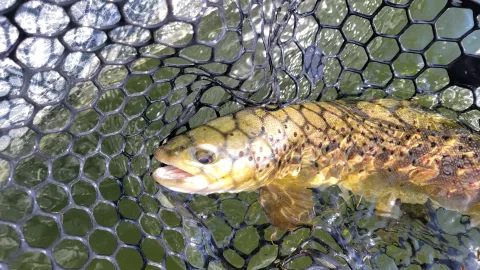
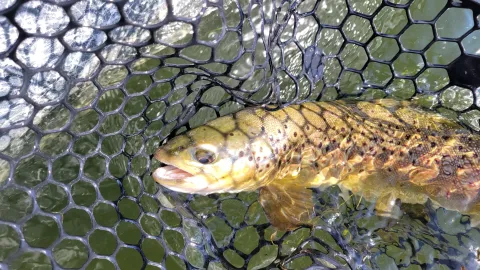
2) Clark Fork River - Sticking with accessible river fishing, Clark Fork is more than worthy of consideration if you plan to make a drive along the interstate. Many folks will talk about fishing in Montana on the Yellowstone River, and of course, the Missouri, but this river is as worthy of a day or two of fishing as any in the state, and certainly along the interstate. Perhaps because of the infamy of the other rivers, the Clark Fork can often be less crowded than other fly-fishing rivers in the state. Anglers can expect to catch similar species of trout, but may also find westslope cutthroat along with the native Mountain Whitefish that lurk in the river. Speaking of lurking, depending on how adventurous you want to be, you may even get into some pike if you’re looking to target something else while on the water.
3) Canyon Ferry Lake - Northwest Fishing fans may remember a combination pizza/walleye episode filmed on the lake, and while the lake doesn’t have the size of fish that some anglers may crave, it does offer plentiful limits and a variety of species to be caught. Its location, just a short drive off the interstate, gives it both convenience and aesthetics as it is tucked in the Rocky Mountains with the Big Belt Mountain Range looming over it. If for nothing else, the views surrounding the lake are worth it on their own, and the fishing is just an added bonus! It is a must-stop location with its scenic views, close but slightly out-of-the-way access, and an abundance of different fish to catch make it a worthwhile stop on your travels.
4) Georgetown Lake - Georgetown Lake is an ice fisherman’s paradise nestled in the western part of the state, sitting at nearly 6,500 feet. Kokanee are the prize here, and many consider Georgetown to be the destination for those looking to limit out. Like many kokanee, anglers can expect to catch fish in the 8-10 inch range, with some getting up to 15 inches. The limit on these kokanee? Not 10 daily, 15 or even 20. There is no daily or possession limit for the fish on the lake. To those looking to create a little kokanee candy, fire up the smoker and plan to spend some time at Georgetown and catch fish until eternity - or at least whenever the state decides to change the regulations.
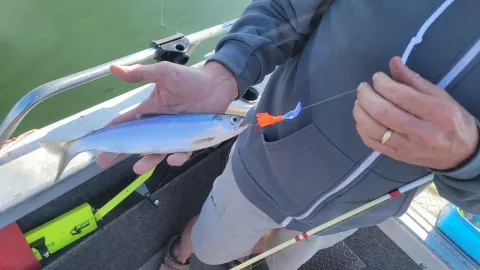
5) Missouri Headwaters - We’ll end with a trifecta, actually, rather than one fishing spot. The Missouri Headwaters near Three Forks provides anglers with an opportunity to fish three distinct Montana rivers in one central location. The Jefferson, Madison, and Gallatin Rivers all meet along the south-central side of the state, just minutes off the interstate. While some of the better fishing would be had elsewhere along any of those three rivers, the significance of the Missouri Headwaters cannot be overstated, as it was a pivotal point in the Lewis and Clark Expedition, is the starting point for the Missouri River, and also provides anglers with access to premium trout fishing anywhere in the country. The benefit of being situated just off of I-90 and close to a major city like Bozeman only adds to the allure of this historic and fishy spot.
/articles/i-90-road-fishing-paradise-matt-carey
Three Winter Ice Fishing Events in Washington
Are you into ice fishing? Do you have a competitive edge? Then consider fishing one of three ice fishing events happening in North Central Washington this winter.
MOLSON ICE FISHING DERBY – SIDLEY LAKE – January 17 – 8 am to 1 PM
This is an annual event strongly supported by members of this small community just south of the border of Canada. Last year, 200 anglers participated, including 25 youth anglers.
Things kick off at the Molson Grange with a pancake breakfast for $12 from 7 to 10 AM. Sitzmark provides lunch in the grange in the early afternoon. Raffles take place for ice fishing gear and 25 different baskets with donated items and gift certificates.
Prizes for the biggest fish, smallest fish, and for the participant who traveled the furthest are awarded here. The biggest fish is worth $500 cash and a $500 gift card to Country Store. Registration costs $15 for youth up to 12 years of age and $30 for adults. You can also add an extra $20 and win at least $300 for the heaviest weight of up to five rainbow trout. Register online at the Oroville Chamber of Commerce website. www.orovillewachamber.com/events
BONAPARTE ICE FISHING DERBY – BONAPARTE LAKE RESORT – January 24
This is another popular annual derby, and this will be the fourth year the event is being held. Last year, 280 participants and another 120 lookers-on were there. There are three divisions of fish. They include the Adult Biggest Fish and an Adult Multi-species. There is also a category for the biggest fish caught by youth anglers.
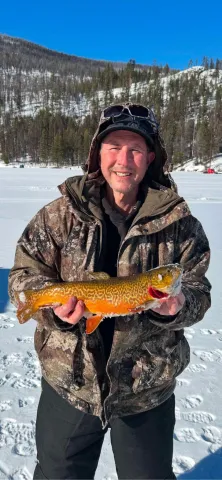
There are six species of fish in the lake (tiger trout, rainbows, brook trout, kokanee, lake trout, and smallmouth bass). The angler who weighs the biggest weight of 3 to 6 fish wins. There is a combination of ice fishing gear and cash given to winners. Last year, an ice auger was given to the biggest fish winner, and a one-man ice fishing shelter to the adult multiple species winner. Register through the Bonaparte Lake Resort Facebook page.
In addition to the resort restaurant that will be open, there will also be a number of other vendors on site. Last year, there was one vendor who was grilling up reindeer sausage for customers. There are no cabins available (they sell out a year in advance), but there are potentially some RV spots available.
CATCHING FREEDOM - OPERATION HARDWATER – BONAPARTE LAKE RESORT – January 31
Operation Catching Freedom is a non-profit that gets veterans, active-duty soldiers, and their families out for no-cost fishing trips. This will be an inaugural event and different in that there are no registration fees and no cash prizes awarded for the biggest fish, smallest fish, or any other category.
Tony Warren, the President of Operation Catching Freedom, said that he just wants veterans and the community at large to come out and go fishing.
There is an in-person registration from 8 to 10 AM. Fishing takes place from 8 AM to 2 PM, and raffle prizes will be given away throughout the day. The event is taking place at Bonaparte Lake Resort, and there will be a BBQ for all attending between 11 AM and 1 PM. You can find further details at the Operation Catch Freedom Facebook Page.
HOW TO CATCH THEM
Want some advice on how to catch these fish? Eric Magnuson, a well-known ice fishing angler and pro-staffer for Mack’s Lure, says, “Just like open water fishing, it’s all about forage and matching the hatch.” Magnuson continued saying, “If I notice the fish are after gorging more on bugs, I’ll tie on a 3mm or 4mm tungsten jig and tip it with plastic or a couple of maggots. If I notice they are in more of a minnow feeding pattern, I might up my profile to a Swedish Pimple or Mack’s Sonic Baitfish spoon.”
And if that does not work, you can always tip a jig with a worm or nightcrawler, which will catch about anything. The bottom line is this: whether you just want to fish and have fun, or win cash or prizes, three great opportunities are waiting for you at North Central Washington’s Sidley Lake and Lake Bonaparte this winter.
Editor’s Note: Check out Eric Magnuson’s article on ice fishing for burbot at night on page xxx
John Kruse – www.northwesternoutdoors.com and www.americaoutdoorsradio.com
/articles/three-winter-ice-fishing-events-washington
Destination Spotlight: MarDon Resort
We are a Destination RV Resort on the shores of Potholes Reservoir, 15 minutes South of I-90 at the Moses Lake exit. Potholes Reservoir is a 28,000-acre lake held back by a 3.5-mile earthen-filled dam, the longest such dam in the US. There is a boat launch at the resort as well as 3 others on the lake.
We are a 3rd generation family resort. The senior Mesebergs bought the resort in 1972, moving from Seattle to MarDon. Now their grandchildren, Levi and Annie manage the resort. Our motto is From our family to yours!
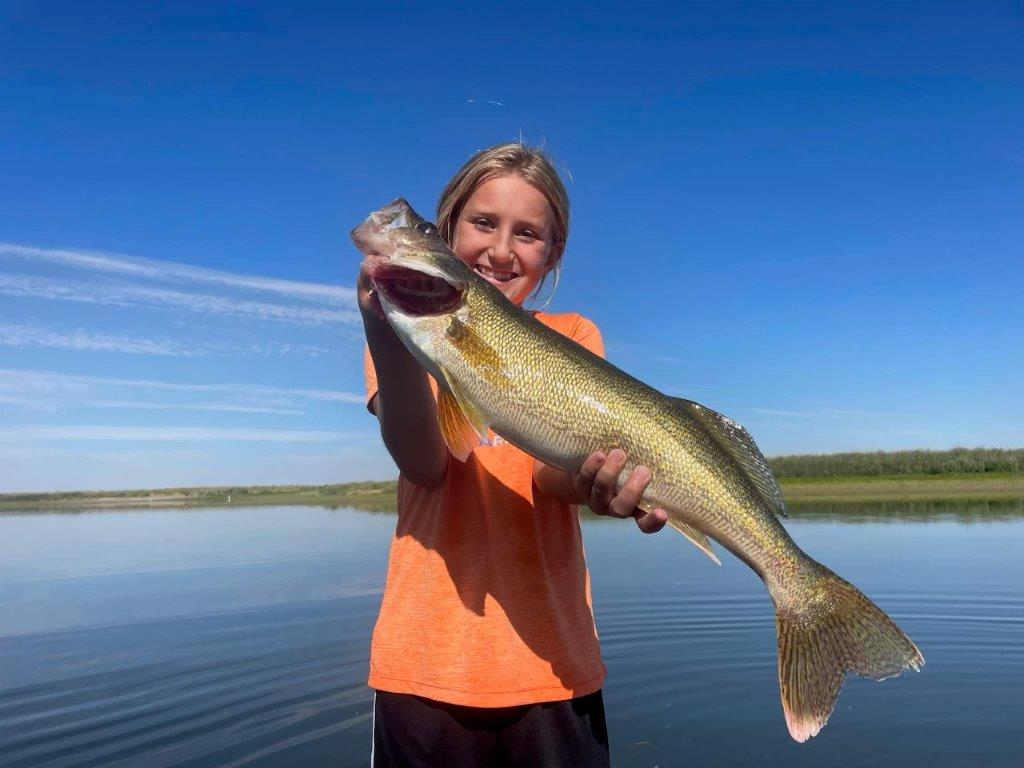
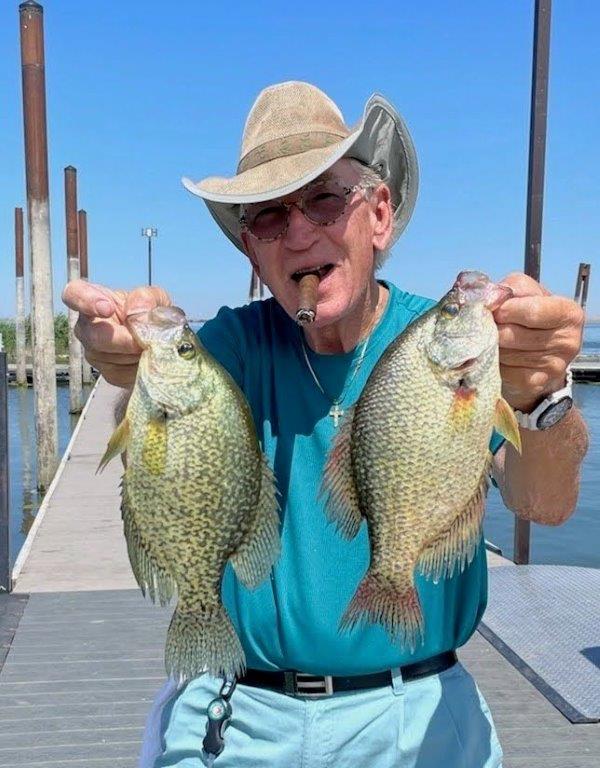
Over the last 10 years, our family has added big rig RV sites and remodeled existing RV sites in the park. We have replaced both old motels with 10 cottages and 5 beautifully appointed lake houses. We also have rental homes and camper cabins sprinkled throughout the resort. Once you are here and settled in the lodging or your RV, you can explore the resort and lake shoreline. Come evening, enjoy a meal in our Beach House at MarDon Restaurant and lounge. Or catch the sunset while you relax in a lawn chair on the marina while wetting a line. The marina boasts crappie, perch, bluegill, bass, trout, and the occasional walleye bite. And if you didn’t bring the right tackle or nightcrawlers the MarDon Tackle and Gift Shop is the place for you.
And don’t forget to leave time to try our 18-hole mini golf course, $5 or $10 (kid/senior or adult). It is challenging, fun, and a good way to work up a competitive banter amongst your group. Or spend the day on the beach while the kids build sand castles and frolic in the lake. For the older kids, there is a dock to swim to.
The resort offers seasonal rates. Summer RV is $40-$85, $40 being a weekday water and light hookup, while the $85 is a big rig pull-through full hookup site with a concrete slab. The spring/fall range is $30-$70. Summer lodging is $165 - $410. All units are for 4, 6 or 8-person families. The $165 is a camper cabin, Cottages are $240-$335, Lake Houses are $290-330, and the large rental homes are $410. The Spring/Fall range is $120 - $315.
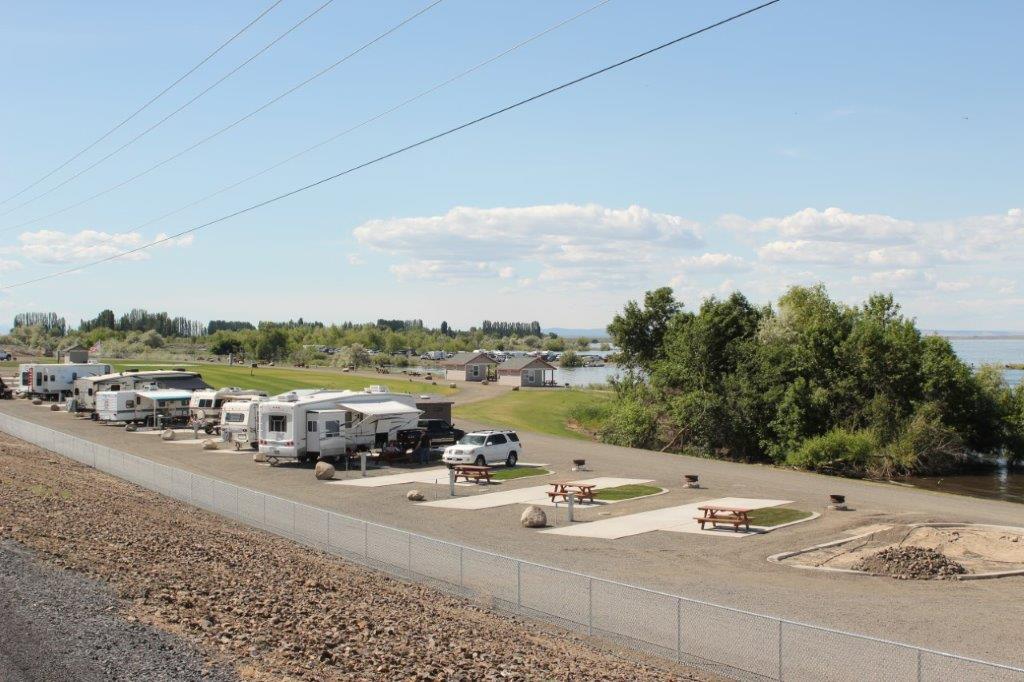
Nearby is a beautiful 18-hole course 1 mile from the resort, The Legacy Golf Resort. Pro Touch rents jet skis (1 mile away but they will deliver to our beach). MarDon Resort rents pontoon boats for families of 8 or less and 14’ fishing boats with a 15 hp motor for 2-4 people. There are 70+ small lakes below the dam to explore, www.columbianationalwildliferefuge.com
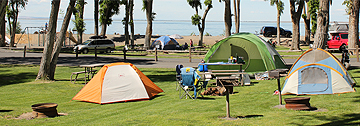
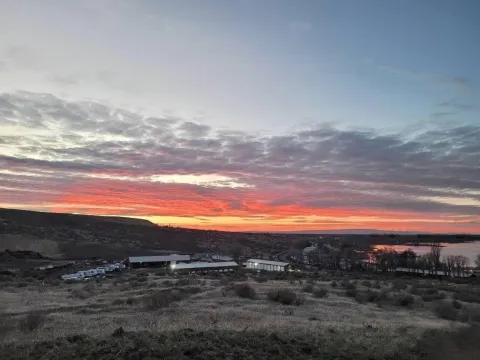
In other words, you will find more to do than you have time for. We have big skies, big water, and the best sunsets that I have ever seen (and I have been to Hawaii!).

/articles/destination-spotlight-mardon-resort