Razor Clam Forecast & Fall Trout Outlook
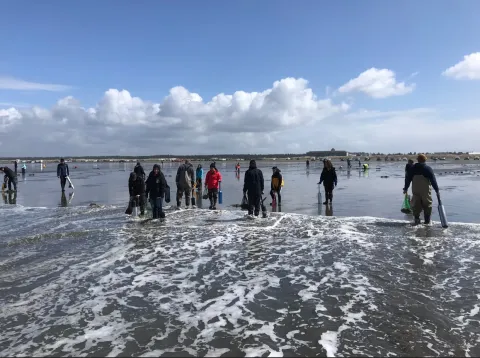
Coastal razor clam enthusiasts should be able to find a treasure trove of bivalves this fall and winter.
The Washington Department of Fish and Wildlife (WDFW) shellfish managers announced 47 days of tentative razor clam digs from Oct. 6 through Jan 6 for Long Beach, Twin Harbors, Copalis, and Mocrocks beaches.
“This recreational razor clam season will see similar digging opportunities to the past two years, with a full digging schedule again for this fall,” said Bryce Blumenthal, a WDFW coastal shellfish biologist. “The tides this year will allow for clam gathering opportunity in the lead up to the Thanksgiving and Christmas holidays, along with harvestable daylight digs for the late afternoons of New Year’s Eve and New Year’s Day.”
Summer assessment surveys conducted by WDFW and tribal co-managers showed a relatively stable population of razor clams on all four beaches. Kalaloch Beach along the northern Olympic Peninsula coast won’t be open due to continuing issues with depressed populations of harvestable clams.
All beach openings are dependent on final approval of marine toxin testing, which usually occurs about a week or less prior to the start of each digging series. The Washington Department of Health requires two test samples taken seven to 10 days apart, and domoic acid levels must fall under the guideline level before a beach opens for digging.
Domoic acid, a natural toxin produced by certain types of marine algae, can be harmful or fatal if consumed in sufficient quantities.
Most successful digging occurs between one and two hours before the listed time of low tide. No digging is allowed before noon during digs when low tide occurs in the afternoon or evening.
Here are the tentative series of dates:
Oct. 6, 7, 10, and 11 at Long Beach, Twin Harbors, and Mocrocks;
and Oct. 8, 9, and 12 at Long Beach, Twin Harbors, and Copalis.
Oct. 22, 23, and 26 at Long Beach, Twin Harbors, and Mocrocks; and
Oct. 20, 21, 24 and 25 at Long Beach, Twin Harbors, and Copalis.
Nov. 3, 4, 7, and 8 at Long Beach, Twin Harbors, and Mocrocks;
and Nov. 5, 6, and 9 at Long Beach, Twin Harbors, and Copalis.
Nov. 19, 20, and 23 at Long Beach, Twin Harbors, and Mocrocks; and
Nov. 18, 21, and 22 at Long Beach, Twin Harbors, and Copalis.
Dec. 3, 4, 7, and 8 at Long Beach, Twin Harbors, and Mocrocks; and
Dec. 2, 5, and 6 at Long Beach, Twin Harbors, and Copalis.
Dec. 19, 20, and 23 at Long Beach, Twin Harbors, and Mocrocks; and
Dec. 18, 21, and 22 at Long Beach, Twin Harbors, and Copalis.
Jan. 2, 3, and 6 at Long Beach, Twin Harbors, and Mocrocks; and
Dec. 31, and Jan. 1, 4, and 5 at Long Beach, Twin Harbors, and Copalis.
During the 2024-25 season, a total of 109 digging days at the four beaches were offered from Oct. 3 through May 15. During that time, 312,716 digger trips were made with a total harvest of 3,957,859 razor clams harvested. At Long Beach, 96,152 digger trips saw 1,253,207 razor clams harvested for an average of 12.7 clams per person; at Twin Harbors, it was 98,096 with 1,369,969 for 12.7; at Copalis, it was 66,628 with 804,903 for 11.9; and at Mocrocks, it was 51,840 with 629,781 for 12.0.
On all open beaches – Long Beach, Twin Harbors, Mocrocks, and Copalis – the daily limit is 15 clams per person. Each digger’s clams must be kept in a separate container, and all diggers must keep the first 15 clams they dig, regardless of size or condition.
“It's important that diggers keep the clams they dig to prevent wastage (includes discarding small clams, clams with broken shells, or reburying unwanted clams),” Blumenthal said. “It's not unusual to encounter some small clams, especially this early in the season.”
All diggers age 16 or older must have an applicable fishing license to harvest razor clams on any beach. Licenses can be purchased from WDFW’s licensing website and from hundreds of license vendors around the state. WDFW recommends buying your license before visiting coastal beach communities.
WDFW reminds beachgoers to avoid disturbing nesting snowy plovers – a small sand-colored shorebird – by staying out of the dunes and posted areas along the sandy beach coastline. Snowy plover nests are nearly invisible, and it is vital to give birds the space to live and thrive during the nesting period, especially along the southern end of Twin Harbors, known as Midway Beach, and north of Second Avenue in Ocean City to the north end of Copalis Beach and the north end of Long Beach. Avoid leaving leftover food or trash on the beach and picnic areas, keep pets on a leash, stay out of dunes, and avoid areas marked with posted signs.
When driving on the beach, please respect the 25-mph speed limit and enter only at designated access points. Stay on the hard-packed sand near the high tide line to avoid crushing clam beds, buried female Dungeness crab, and snowy plover nests. The 2025-26 Razor Clam Management Plan will be available soon on the WDFW’s website. WDFW welcomes public input on proposed razor clam schedules and considers this feedback when finalizing each season’s digs. Public comments may be emailed to razorclams@dfw.wa.gov. For more information, refer to the WDFW's razor clam webpage at https://wdfw.wa.gov/fishing/shellfishing-regulations/razor-clams.
Look for decent October trout fishing
It’s beginning to feel a lot like autumn as temperatures drop, the sun fades away much sooner, leaves are falling, and trout have become active in many statewide lakes.
While the bulk of trout plants occurred back in spring, many of those fish are still waiting to be caught, and some have grown larger in size, plus WDFW hatcheries continue to add more fish into lakes. The seasonal lakes remain open for trout fishing through Oct. 31, while others are open for year-round.
Some fair to good seasonal westside lakes include Pine, Wilderness, Langlois, Toad, Margaret, Whatcom, Steel, Summit, Bosworth, Ki, Storm, McMurray, Sixteen, Erie, Silver (Whatcom County), and Padden.
The top lakes east of the Cascades are Jameson in Douglas; Ellen in Ferry; Starvation in Stevens; Wapato in Chelan; Pearrygin; and Conconully Lake and Reservoir in Okanogan. You can track trout plants on the WDFW website at https://wdfw.wa.gov/fishing/reports/stocking/trout-plants.
To sweeten the deal, WDFW’s Trout Derby continues to offer anglers a chance to catch a tagged fish and win a prize through Oct. 31.
The derby – which began in late-April – features more than 100 lakes planted with fish that have an orange tag attached near their dorsal fin. If you catch one, be sure to keep the tag to claim your prize. For derby details, go to https://wdfw.wa.gov/fishing/contests/trout-derby.
Heading into November, WDFW hatchery staff will be busy leading up to Black Friday by stocking thousands of jumbo rainbow trout, weighing up to three pounds apiece and measuring longer than 14 inches, in lakes covering an area from the Puget Sound region to southwest Washington, as well as a few eastern Washington lakes and ponds.
The Black Friday program, created more than a decade ago by WDFW, looked at ways to raise thousands of rainbow trout for a late-season fishery in select year-round lakes. This post-Thanksgiving fishery has been a hit among anglers looking for options to go fishing at a time when choices are skinny.
Before heading out the door, be sure to check for lakes that are open or closed, and regulations at https://wdfw.wa.gov/.
/articles/razor-clam-forecast-fall-trout-outlook
Razor Clam Forecast
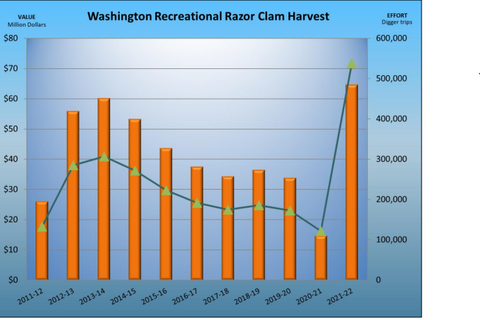
It’s no secret that last year’s razor clam season was a banner year. Record number of clam diggers swarmed beaches, working hard to get their limits. 484,388 diggers showed up, harvesting 8,352,279 clams, over 120 total harvest days. That’s a lot of razor clams! This was a welcome success after the 2019-2020 and 2020-2021 seasons closed early due to COVID-19 and domoic acid, respectively. Thousands of eager razor clam diggers are wondering if this season will be as successful as the last.
Dust off those razor clam guns and get your hip boots ready, because the forecast is looking promising! WDFW assessed razor clam populations throughout the summer and all had strong, harvestable populations except for at Kalaloch, which will be closed this year to allow recovery. Let’s take a closer look at this year’s forecast, and how WDFW determines annual razor clam harvests.
Razor clams have been enjoyed by millions of people over thousands of years. They are a valuable resource to hungry fishermen and local economies. WDFW estimated the fishery value to be $71,689 last year. So how are these crucial resources managed? Since 1929, WDFW has managed the coastal razor clam harvest. It’s a difficult job- they have to balance the demands of recreational fishermen with the rights of the tribes, all while keeping public safety in mind. Management strategies have been ever evolving.
From 1929 to 1942, there was a year-round season, and a 36-clam limit. In 1943, WDFW limited the season from March 1st to September 30th, and in 1960, the clam limit was reduced to 18. In 1973, the seasons were further reduced, and in 1974, the 15 clam limit we are familiar with today was implemented. In 2000, the seasons became much less set in stone and varied from October to May, depending on counts conducted through the “pumped area” method. In 2004, WDFW switched to the system still in use today, the “adjusted exploitation rate” method. Management strategies are ever evolving based on the increasing amounts of clam diggers every year, and changing oceanic conditions.
There are 3 pieces to the puzzle that WDFW must take into account before announcing razor clam digs: population counts, domoic acid levels, and tribal rights. The first piece of the puzzle is population counts. Each summer, WDFW conducts population counts at every beach: Long Beach, Twin Harbors, Copalis, Mocrocks, and Kalaloch. Based on these counts, they estimate the total number of clams measuring under 3 inches, and the total number of clams measuring over 3 inches.
They allow a certain percentage of razor clam population over 3 inches to be harvested each year, in order to make sure the population stays sustainable for years to come. Up to 40% of razor clams 3 inches and above may be harvested every year for the population to remain sustainable. After every harvest, WDFW calculates the remaining TAC (total allowable harvest), and sets further days based on that number. This way, poor tidal conditions and weather don’t mean we get shorter seasons. Alternatively, if conditions are great and there are more harvesters than predicted, the season may close early on that beach. Population counts are closely monitored throughout the year to make sure this popular fishery will remain for years to come.
Before WDFW opens recreational harvesting, they must also determine whether the clams are safe to eat. WDFW’s goals are not only to keep the resource around for years to come, but also to protect public health and safety. Unfortunately, clams are subject to accumulating marine toxins in their bodies which can make harvesters sick. Harmful algae blooms are naturally occurring, but concentrate in razor clam tissue. The most prevalent toxin is domoic acid, caused by consumption of marine plankton, called diatoms.
Eating a razor clam that has high levels of domoic acid can cause nausea, dizziness, memory loss, and stroke-like symptoms. There is no antidote, and the toxin is not destroyed by cooking/freezing. WDFW carefully tests razor clam populations for domoic acid throughout the year, and will close seasons accordingly, even if TAC (total allowable catch) hasn’t been met.
The final piece which WDFW must take into account is tribal fishing rights. Each year in August, WDFW discusses population estimates and domoic acid levels with the coastal tribes that have fishing rights on razor clam beaches, and comes up with the total allowable catch (TAC). 50% of the TAC goes to recreational fishermen and 50% goes to the tribes.
The coastal tribes work with WDFW staff to come up with joint population assessments, and share their data together. Tribal seasons take place on different days than non-tribal seasons, and each group makes their own harvest estimates and enforces the rules themselves. Razor clams are a co-managed resource that tribal and non-tribal stakeholders take very seriously.
Beach has by far the largest TAC (total allowable catch) share at 5,865,490 clams, and Mocrocks has the smallest, at 1,964,732. Interestingly, the average size of clams is slightly smaller this year. Last year, they were 4.4 inches long, and this year they were 4.22 inches on average. Although the clams are a little smaller, there are plenty of them! Overall, the forecast looks promising. WDFW always tries to schedule razor clam digs on weekends at least once a month during the months of October through May. The WDFW director checks marine toxin levels and looks at the remaining TAC for the year before announcing that the harvest dates can proceed. Clam digs have been tentatively approved throughout November and December.
In an unprecedented move, WDFW increased the limits from 15 to 20 razor clams last year. Will it happen again this year? For now, keep an ear to the ground and always check your rules and regulations before heading out. Speaking of rules and regulations, it’s always a good idea to brush up.
Make sure each harvester has their own container to put clams in. Many sporting goods stores sell clam nets, which readily tie to your wading belt to keep your hands free for digging and holding flashlights. Remember that the first 15 clams dug must be kept, no matter the size or condition. We’ve all accidentally crunched clams while digging them, or dug up a tiny one, but they still must be retained as part of your 15-clam limit. That being said, there are plenty of clams out there to be had. It’s shaping up to be a good year, so go out and get those razor clams!
/articles/razor-clam-forecast-0
Razor Clam Forecast
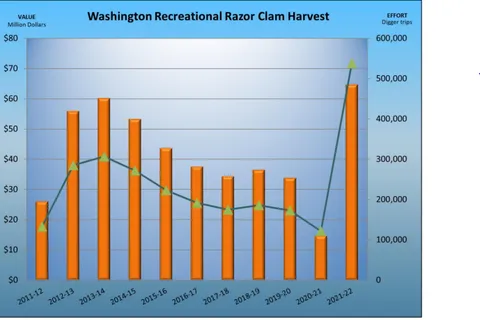
It’s no secret that last year’s razor clam season was a banner year. Record number of clam diggers swarmed beaches, working hard to get their limits. 484,388 diggers showed up, harvesting 8,352,279 clams, over 120 total harvest days. That’s a lot of razor clams! This was a welcome success after the 2019-2020 and 2020-2021 seasons closed early due to COVID-19 and domoic acid, respectively. Thousands of eager razor clam diggers are wondering if this season will be as successful as the last.
Dust off those razor clam guns and get your hip boots ready, because the forecast is looking promising! WDFW assessed razor clam populations throughout the summer and all had strong, harvestable populations except for at Kalaloch, which will be closed this year to allow recovery. Let’s take a closer look at this year’s forecast, and how WDFW determines annual razor clam harvests.
Razor clams have been enjoyed by millions of people over thousands of years. They are a valuable resource to hungry fishermen and local economies. WDFW estimated the fishery value to be $71,689 last year. So how are these crucial resources managed? Since 1929, WDFW has managed the coastal razor clam harvest. It’s a difficult job- they have to balance the demands of recreational fishermen with the rights of the tribes, all while keeping public safety in mind. Management strategies have been ever evolving.
From 1929 to 1942, there was a year-round season, and a 36-clam limit. In 1943, WDFW limited the season from March 1st to September 30th, and in 1960, the clam limit was reduced to 18. In 1973, the seasons were further reduced, and in 1974, the 15 clam limit we are familiar with today was implemented. In 2000, the seasons became much less set in stone and varied from October to May, depending on counts conducted through the “pumped area” method. In 2004, WDFW switched to the system still in use today, the “adjusted exploitation rate” method. Management strategies are ever evolving based on the increasing amounts of clam diggers every year, and changing oceanic conditions.
There are 3 pieces to the puzzle that WDFW must take into account before announcing razor clam digs: population counts, domoic acid levels, and tribal rights. The first piece of the puzzle is population counts. Each summer, WDFW conducts population counts at every beach: Long Beach, Twin Harbors, Copalis, Mocrocks, and Kalaloch. Based on these counts, they estimate the total number of clams measuring under 3 inches, and the total number of clams measuring over 3 inches.
They allow a certain percentage of razor clam population over 3 inches to be harvested each year, in order to make sure the population stays sustainable for years to come. Up to 40% of razor clams 3 inches and above may be harvested every year for the population to remain sustainable. After every harvest, WDFW calculates the remaining TAC (total allowable harvest), and sets further days based on that number. This way, poor tidal conditions and weather don’t mean we get shorter seasons. Alternatively, if conditions are great and there are more harvesters than predicted, the season may close early on that beach. Population counts are closely monitored throughout the year to make sure this popular fishery will remain for years to come.
Before WDFW opens recreational harvesting, they must also determine whether the clams are safe to eat. WDFW’s goals are not only to keep the resource around for years to come, but also to protect public health and safety. Unfortunately, clams are subject to accumulating marine toxins in their bodies which can make harvesters sick. Harmful algae blooms are naturally occurring, but concentrate in razor clam tissue. The most prevalent toxin is domoic acid, caused by consumption of marine plankton, called diatoms.
Eating a razor clam that has high levels of domoic acid can cause nausea, dizziness, memory loss, and stroke-like symptoms. There is no antidote, and the toxin is not destroyed by cooking/freezing. WDFW carefully tests razor clam populations for domoic acid throughout the year, and will close seasons accordingly, even if TAC (total allowable catch) hasn’t been met.
The final piece which WDFW must take into account is tribal fishing rights. Each year in August, WDFW discusses population estimates and domoic acid levels with the coastal tribes that have fishing rights on razor clam beaches, and comes up with the total allowable catch (TAC). 50% of the TAC goes to recreational fishermen and 50% goes to the tribes.
The coastal tribes work with WDFW staff to come up with joint population assessments, and share their data together. Tribal seasons take place on different days than non-tribal seasons, and each group makes their own harvest estimates and enforces the rules themselves. Razor clams are a co-managed resource that tribal and non-tribal stakeholders take very seriously.
Beach has by far the largest TAC (total allowable catch) share at 5,865,490 clams, and Mocrocks has the smallest, at 1,964,732. Interestingly, the average size of clams is slightly smaller this year. Last year, they were 4.4 inches long, and this year they were 4.22 inches on average. Although the clams are a little smaller, there are plenty of them! Overall, the forecast looks promising. WDFW always tries to schedule razor clam digs on weekends at least once a month during the months of October through May. The WDFW director checks marine toxin levels and looks at the remaining TAC for the year before announcing that the harvest dates can proceed. Clam digs have been tentatively approved throughout November and December.
In an unprecedented move, WDFW increased the limits from 15 to 20 razor clams last year. Will it happen again this year? For now, keep an ear to the ground and always check your rules and regulations before heading out. Speaking of rules and regulations, it’s always a good idea to brush up.
Make sure each harvester has their own container to put clams in. Many sporting goods stores sell clam nets, which readily tie to your wading belt to keep your hands free for digging and holding flashlights. Remember that the first 15 clams dug must be kept, no matter the size or condition. We’ve all accidentally crunched clams while digging them, or dug up a tiny one, but they still must be retained as part of your 15-clam limit. That being said, there are plenty of clams out there to be had. It’s shaping up to be a good year, so go out and get those razor clams!
/articles/razor-clam-forecast