Razor Clam Forecast & Fall Trout Outlook
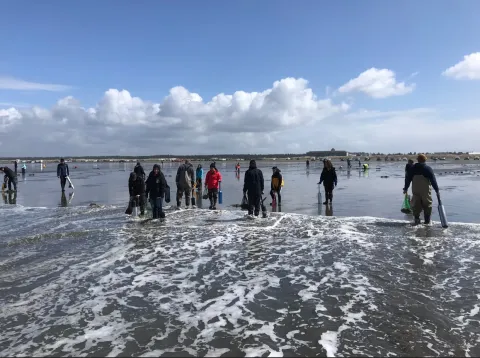
Coastal razor clam enthusiasts should be able to find a treasure trove of bivalves this fall and winter.
The Washington Department of Fish and Wildlife (WDFW) shellfish managers announced 47 days of tentative razor clam digs from Oct. 6 through Jan 6 for Long Beach, Twin Harbors, Copalis, and Mocrocks beaches.
“This recreational razor clam season will see similar digging opportunities to the past two years, with a full digging schedule again for this fall,” said Bryce Blumenthal, a WDFW coastal shellfish biologist. “The tides this year will allow for clam gathering opportunity in the lead up to the Thanksgiving and Christmas holidays, along with harvestable daylight digs for the late afternoons of New Year’s Eve and New Year’s Day.”
Summer assessment surveys conducted by WDFW and tribal co-managers showed a relatively stable population of razor clams on all four beaches. Kalaloch Beach along the northern Olympic Peninsula coast won’t be open due to continuing issues with depressed populations of harvestable clams.
All beach openings are dependent on final approval of marine toxin testing, which usually occurs about a week or less prior to the start of each digging series. The Washington Department of Health requires two test samples taken seven to 10 days apart, and domoic acid levels must fall under the guideline level before a beach opens for digging.
Domoic acid, a natural toxin produced by certain types of marine algae, can be harmful or fatal if consumed in sufficient quantities.
Most successful digging occurs between one and two hours before the listed time of low tide. No digging is allowed before noon during digs when low tide occurs in the afternoon or evening.
Here are the tentative series of dates:
Oct. 6, 7, 10, and 11 at Long Beach, Twin Harbors, and Mocrocks;
and Oct. 8, 9, and 12 at Long Beach, Twin Harbors, and Copalis.
Oct. 22, 23, and 26 at Long Beach, Twin Harbors, and Mocrocks; and
Oct. 20, 21, 24 and 25 at Long Beach, Twin Harbors, and Copalis.
Nov. 3, 4, 7, and 8 at Long Beach, Twin Harbors, and Mocrocks;
and Nov. 5, 6, and 9 at Long Beach, Twin Harbors, and Copalis.
Nov. 19, 20, and 23 at Long Beach, Twin Harbors, and Mocrocks; and
Nov. 18, 21, and 22 at Long Beach, Twin Harbors, and Copalis.
Dec. 3, 4, 7, and 8 at Long Beach, Twin Harbors, and Mocrocks; and
Dec. 2, 5, and 6 at Long Beach, Twin Harbors, and Copalis.
Dec. 19, 20, and 23 at Long Beach, Twin Harbors, and Mocrocks; and
Dec. 18, 21, and 22 at Long Beach, Twin Harbors, and Copalis.
Jan. 2, 3, and 6 at Long Beach, Twin Harbors, and Mocrocks; and
Dec. 31, and Jan. 1, 4, and 5 at Long Beach, Twin Harbors, and Copalis.
During the 2024-25 season, a total of 109 digging days at the four beaches were offered from Oct. 3 through May 15. During that time, 312,716 digger trips were made with a total harvest of 3,957,859 razor clams harvested. At Long Beach, 96,152 digger trips saw 1,253,207 razor clams harvested for an average of 12.7 clams per person; at Twin Harbors, it was 98,096 with 1,369,969 for 12.7; at Copalis, it was 66,628 with 804,903 for 11.9; and at Mocrocks, it was 51,840 with 629,781 for 12.0.
On all open beaches – Long Beach, Twin Harbors, Mocrocks, and Copalis – the daily limit is 15 clams per person. Each digger’s clams must be kept in a separate container, and all diggers must keep the first 15 clams they dig, regardless of size or condition.
“It's important that diggers keep the clams they dig to prevent wastage (includes discarding small clams, clams with broken shells, or reburying unwanted clams),” Blumenthal said. “It's not unusual to encounter some small clams, especially this early in the season.”
All diggers age 16 or older must have an applicable fishing license to harvest razor clams on any beach. Licenses can be purchased from WDFW’s licensing website and from hundreds of license vendors around the state. WDFW recommends buying your license before visiting coastal beach communities.
WDFW reminds beachgoers to avoid disturbing nesting snowy plovers – a small sand-colored shorebird – by staying out of the dunes and posted areas along the sandy beach coastline. Snowy plover nests are nearly invisible, and it is vital to give birds the space to live and thrive during the nesting period, especially along the southern end of Twin Harbors, known as Midway Beach, and north of Second Avenue in Ocean City to the north end of Copalis Beach and the north end of Long Beach. Avoid leaving leftover food or trash on the beach and picnic areas, keep pets on a leash, stay out of dunes, and avoid areas marked with posted signs.
When driving on the beach, please respect the 25-mph speed limit and enter only at designated access points. Stay on the hard-packed sand near the high tide line to avoid crushing clam beds, buried female Dungeness crab, and snowy plover nests. The 2025-26 Razor Clam Management Plan will be available soon on the WDFW’s website. WDFW welcomes public input on proposed razor clam schedules and considers this feedback when finalizing each season’s digs. Public comments may be emailed to razorclams@dfw.wa.gov. For more information, refer to the WDFW's razor clam webpage at https://wdfw.wa.gov/fishing/shellfishing-regulations/razor-clams.
Look for decent October trout fishing
It’s beginning to feel a lot like autumn as temperatures drop, the sun fades away much sooner, leaves are falling, and trout have become active in many statewide lakes.
While the bulk of trout plants occurred back in spring, many of those fish are still waiting to be caught, and some have grown larger in size, plus WDFW hatcheries continue to add more fish into lakes. The seasonal lakes remain open for trout fishing through Oct. 31, while others are open for year-round.
Some fair to good seasonal westside lakes include Pine, Wilderness, Langlois, Toad, Margaret, Whatcom, Steel, Summit, Bosworth, Ki, Storm, McMurray, Sixteen, Erie, Silver (Whatcom County), and Padden.
The top lakes east of the Cascades are Jameson in Douglas; Ellen in Ferry; Starvation in Stevens; Wapato in Chelan; Pearrygin; and Conconully Lake and Reservoir in Okanogan. You can track trout plants on the WDFW website at https://wdfw.wa.gov/fishing/reports/stocking/trout-plants.
To sweeten the deal, WDFW’s Trout Derby continues to offer anglers a chance to catch a tagged fish and win a prize through Oct. 31.
The derby – which began in late-April – features more than 100 lakes planted with fish that have an orange tag attached near their dorsal fin. If you catch one, be sure to keep the tag to claim your prize. For derby details, go to https://wdfw.wa.gov/fishing/contests/trout-derby.
Heading into November, WDFW hatchery staff will be busy leading up to Black Friday by stocking thousands of jumbo rainbow trout, weighing up to three pounds apiece and measuring longer than 14 inches, in lakes covering an area from the Puget Sound region to southwest Washington, as well as a few eastern Washington lakes and ponds.
The Black Friday program, created more than a decade ago by WDFW, looked at ways to raise thousands of rainbow trout for a late-season fishery in select year-round lakes. This post-Thanksgiving fishery has been a hit among anglers looking for options to go fishing at a time when choices are skinny.
Before heading out the door, be sure to check for lakes that are open or closed, and regulations at https://wdfw.wa.gov/.
/articles/razor-clam-forecast-fall-trout-outlook
Hoodsport Chum
For salmon anglers in the Pacific Northwest, November heralds the final transition from targeting open saltwater to focusing on tidewaters and rivers. Yes, there are some saltwater opportunities (for example, blackmouth, when open), but the vast majority of anglers have put away their boats and are pursuing salmon in the rivers. That said, there are some prime opportunities to target and catch salmon out of your fishing boats, so don’t button them up just yet!
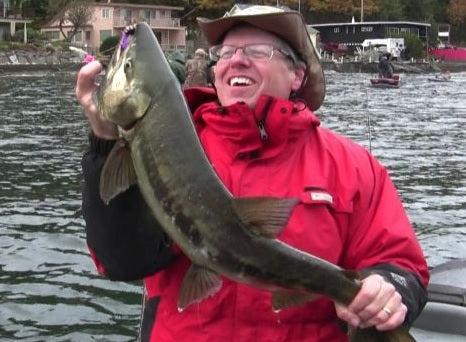
One of my favorite fisheries out of my boat in November has to be the Hoodsport chum fishery. The fight of a 10-15 pound chum ranks up there as one of the hardest fighting salmon you can catch. Taking on a chum with steelhead gear will give you all the battle you could ask for as these brutes slash and pull with every ounce of energy they have. One look at their fighting canine teeth and you’ll know this is a fish that is serious, very serious, about its reproducing goal.
All up and down Hood Canal you’ll find chum as they work their way toward their spawning grounds. The state hatchery at Hoodsport and three miles south of there at Potlatch (a smaller, Native American hatchery) are the destination for many of these chum as they work their way down Hood Canal.
I have caught fish in both locations, and each spot has reason to recommend it. Potlatch, being smaller, has limited shore angling and parking, which is roadside only. That said, there are also fewer anglers there. Hoodsport, meanwhile, is the Fishing Mecca that chum anglers are drawn to. Fishing right out in front of the hatchery and watching hundreds of fish jockey for position as the tide sweeps them into the small feeder creek leading to the hatchery is truly a sight to behold. Of course, along with the fish comes combat fishing in all its glory. As the tide comes in and fishing space decreases, getting to know your neighbor takes on a whole new meaning.
If you’re a fortunate one you’ll be fishing out of a boat – or some type of floating device. The waters around Hoodsport are open and the wind can come up and blow hard, plus fast running tides can make it a challenge to get an anchor to set. Be sure to bring an anchor with some bite, and terminal chain so you’ll stick in the rocky bottom. I’ve seen anglers fishing out of all manner of floating devices on calm days, including single person pontoons and float tubes. Be sure to have your life jackets on and just don’t venture too far off shore. If you are feeling anxious that’s your inner voice telling you a fish isn’t worth your life – pay attention to it!
For boaters, the launch is two miles south of Hoodsport at the Skokomish Park at Potlatch. The launch has two concrete lanes which are in varying state of repair (read that as back down with caution!). There is ample parking, and a restroom. Once launched it’s a quick run to either terminal hatchery, faster to the small Potlatch facility.
When you arrive, survey the already anchor boats, taking into account the amount of anchor line you’ll need to get a solid grip on the bottom, as well as the shore anglers. Anchoring too close to the shore bound anglers will earn you a steady rain of lures and weights at your boat. Stay outside their casting zone - you’ll have plenty of water to work over and opportunities to catch fish the shore anglers don’t have.
As to the type of gear you should bring… you’re going to enjoy a variety of methods to catch these Hoodsport chum. Like chum everywhere, chartreuse and green are always great colors to choose. Pink or cerise is also good color choices. For rod/reel setups I use my steelhead gear, both spinning reels and casting will get the job done. I like an 8 ½ foot medium action rod. Line should be strong enough to turn these big brutes so as to avoid massive tangle ups with your fellow anglers. I like 18-20 pound test. Chums are not leader shy in my experience so keep things hefty.
What technique you use is up to you but here are a few tried and true methods:
Floats and jigs , or floats and corkies with yarn can be deadly. A ¼ or 3/8-ounce pink, black or purple marabou jig fished under a float is deadly. Tipped with a piece of shrimp meat or coon shrimp tail is even better. The yarn is a nice trick as it helps by getting caught up in the chums teeth, allow you to drive the hook home. Other bait you can put under a float includes the ever popular anchovy or herring, whole or plug cut.
Think of the tide as the river current. Set your depth for the lure so it’s running a foot or so off the bottom. Vary the depth if you aren’t getting bites. These fish will hit suspended jigs. Cast “upstream”, i.e. up into the tide, and let your gear drift down with the tide to the end of the “drift”. If the coast is clear, free spool your line, keeping the float straight up and down to extend the drift. When the float goes under set the hook and be ready to do battle!
Twitching jigs – ditch the float and cast the jig on its own. Another effective technique, but be prepared for a lot of foul-hooked chum. Dragging a chum in by the tail is not fun, nor is it sporting to be snagging fish. If you find yourself foul hooking too many fish move on to a different method…
Casting spinners. Again, it’s a solid technique to try if the action is slow. I personally would remove the treble hook and use a single si-wash hook. A number 3 or 4 blade fished with a slow retrieve is just the ticket.
Corkie, yarn, and slinky. I personally have caught a lot of fish using this method and seldom snag fish. Again, think of the tide as a river. Cast out and let your gear drift. You’ll know you have a bite because your rod will be about ripped out of your hands. I use a 3-4 foot leader length.
Regarding the above technique, I’m sure I’m going to get comments about flossing – I personally think it’s a bunch of malarkey. Why do I say that? Because I remember a day years ago fishing Hoodsport when the chum were in thick, jumping all around us, swimming by in schools of 10-20 fish. I had my corkie/yarn/slinky set up going, casting, retrieving, and not getting a bump for a good hour. Suddenly, the bite magically turned on and my gear started getting bit. In came fish after fish, hooked in the jaw. Explain to me how one can have a steady procession of fish go by with mouths open for a good hour and not “floss” one fish, then suddenly start catching one jaw hooked fish after another? And trust me when I say this, those hook-ups were solid strikes, not to be mistaken with a snagging sensation. Anyway, the flossing debate is one we anglers love to engage in every year and likely will do so as long as we fish corkies.
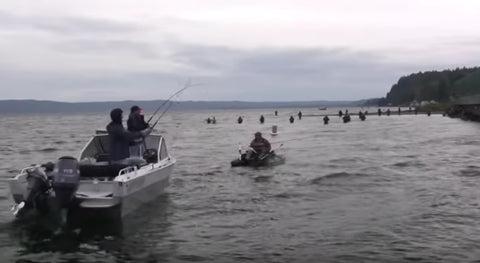
The fly fishermen do quite well at Hoodsport as well, fishing sinking tips and flies of various styles and colors. I’m not a fly guy but it sure does look like fun. Maybe on my next trip I’ll give it a try.
Before you set out, be sure to check the Hoodsport netting line at 360-877-5222. Typically the nets go in on Tuesdays and Thursdays, but this is not set in stone. There’s nothing worse than driving a hundred miles only to find nets spread in every direction. So save yourself that aggravation before you set out.
Fishing for hard fighting chum is a blast. Get in on the action this November!

/articles/hoodsport-chum