Razor Clam Forecast & Fall Trout Outlook
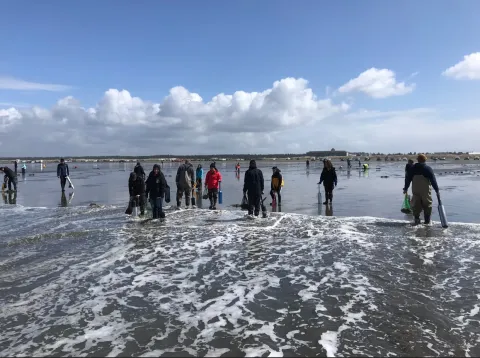
Coastal razor clam enthusiasts should be able to find a treasure trove of bivalves this fall and winter.
The Washington Department of Fish and Wildlife (WDFW) shellfish managers announced 47 days of tentative razor clam digs from Oct. 6 through Jan 6 for Long Beach, Twin Harbors, Copalis, and Mocrocks beaches.
“This recreational razor clam season will see similar digging opportunities to the past two years, with a full digging schedule again for this fall,” said Bryce Blumenthal, a WDFW coastal shellfish biologist. “The tides this year will allow for clam gathering opportunity in the lead up to the Thanksgiving and Christmas holidays, along with harvestable daylight digs for the late afternoons of New Year’s Eve and New Year’s Day.”
Summer assessment surveys conducted by WDFW and tribal co-managers showed a relatively stable population of razor clams on all four beaches. Kalaloch Beach along the northern Olympic Peninsula coast won’t be open due to continuing issues with depressed populations of harvestable clams.
All beach openings are dependent on final approval of marine toxin testing, which usually occurs about a week or less prior to the start of each digging series. The Washington Department of Health requires two test samples taken seven to 10 days apart, and domoic acid levels must fall under the guideline level before a beach opens for digging.
Domoic acid, a natural toxin produced by certain types of marine algae, can be harmful or fatal if consumed in sufficient quantities.
Most successful digging occurs between one and two hours before the listed time of low tide. No digging is allowed before noon during digs when low tide occurs in the afternoon or evening.
Here are the tentative series of dates:
Oct. 6, 7, 10, and 11 at Long Beach, Twin Harbors, and Mocrocks;
and Oct. 8, 9, and 12 at Long Beach, Twin Harbors, and Copalis.
Oct. 22, 23, and 26 at Long Beach, Twin Harbors, and Mocrocks; and
Oct. 20, 21, 24 and 25 at Long Beach, Twin Harbors, and Copalis.
Nov. 3, 4, 7, and 8 at Long Beach, Twin Harbors, and Mocrocks;
and Nov. 5, 6, and 9 at Long Beach, Twin Harbors, and Copalis.
Nov. 19, 20, and 23 at Long Beach, Twin Harbors, and Mocrocks; and
Nov. 18, 21, and 22 at Long Beach, Twin Harbors, and Copalis.
Dec. 3, 4, 7, and 8 at Long Beach, Twin Harbors, and Mocrocks; and
Dec. 2, 5, and 6 at Long Beach, Twin Harbors, and Copalis.
Dec. 19, 20, and 23 at Long Beach, Twin Harbors, and Mocrocks; and
Dec. 18, 21, and 22 at Long Beach, Twin Harbors, and Copalis.
Jan. 2, 3, and 6 at Long Beach, Twin Harbors, and Mocrocks; and
Dec. 31, and Jan. 1, 4, and 5 at Long Beach, Twin Harbors, and Copalis.
During the 2024-25 season, a total of 109 digging days at the four beaches were offered from Oct. 3 through May 15. During that time, 312,716 digger trips were made with a total harvest of 3,957,859 razor clams harvested. At Long Beach, 96,152 digger trips saw 1,253,207 razor clams harvested for an average of 12.7 clams per person; at Twin Harbors, it was 98,096 with 1,369,969 for 12.7; at Copalis, it was 66,628 with 804,903 for 11.9; and at Mocrocks, it was 51,840 with 629,781 for 12.0.
On all open beaches – Long Beach, Twin Harbors, Mocrocks, and Copalis – the daily limit is 15 clams per person. Each digger’s clams must be kept in a separate container, and all diggers must keep the first 15 clams they dig, regardless of size or condition.
“It's important that diggers keep the clams they dig to prevent wastage (includes discarding small clams, clams with broken shells, or reburying unwanted clams),” Blumenthal said. “It's not unusual to encounter some small clams, especially this early in the season.”
All diggers age 16 or older must have an applicable fishing license to harvest razor clams on any beach. Licenses can be purchased from WDFW’s licensing website and from hundreds of license vendors around the state. WDFW recommends buying your license before visiting coastal beach communities.
WDFW reminds beachgoers to avoid disturbing nesting snowy plovers – a small sand-colored shorebird – by staying out of the dunes and posted areas along the sandy beach coastline. Snowy plover nests are nearly invisible, and it is vital to give birds the space to live and thrive during the nesting period, especially along the southern end of Twin Harbors, known as Midway Beach, and north of Second Avenue in Ocean City to the north end of Copalis Beach and the north end of Long Beach. Avoid leaving leftover food or trash on the beach and picnic areas, keep pets on a leash, stay out of dunes, and avoid areas marked with posted signs.
When driving on the beach, please respect the 25-mph speed limit and enter only at designated access points. Stay on the hard-packed sand near the high tide line to avoid crushing clam beds, buried female Dungeness crab, and snowy plover nests. The 2025-26 Razor Clam Management Plan will be available soon on the WDFW’s website. WDFW welcomes public input on proposed razor clam schedules and considers this feedback when finalizing each season’s digs. Public comments may be emailed to razorclams@dfw.wa.gov. For more information, refer to the WDFW's razor clam webpage at https://wdfw.wa.gov/fishing/shellfishing-regulations/razor-clams.
Look for decent October trout fishing
It’s beginning to feel a lot like autumn as temperatures drop, the sun fades away much sooner, leaves are falling, and trout have become active in many statewide lakes.
While the bulk of trout plants occurred back in spring, many of those fish are still waiting to be caught, and some have grown larger in size, plus WDFW hatcheries continue to add more fish into lakes. The seasonal lakes remain open for trout fishing through Oct. 31, while others are open for year-round.
Some fair to good seasonal westside lakes include Pine, Wilderness, Langlois, Toad, Margaret, Whatcom, Steel, Summit, Bosworth, Ki, Storm, McMurray, Sixteen, Erie, Silver (Whatcom County), and Padden.
The top lakes east of the Cascades are Jameson in Douglas; Ellen in Ferry; Starvation in Stevens; Wapato in Chelan; Pearrygin; and Conconully Lake and Reservoir in Okanogan. You can track trout plants on the WDFW website at https://wdfw.wa.gov/fishing/reports/stocking/trout-plants.
To sweeten the deal, WDFW’s Trout Derby continues to offer anglers a chance to catch a tagged fish and win a prize through Oct. 31.
The derby – which began in late-April – features more than 100 lakes planted with fish that have an orange tag attached near their dorsal fin. If you catch one, be sure to keep the tag to claim your prize. For derby details, go to https://wdfw.wa.gov/fishing/contests/trout-derby.
Heading into November, WDFW hatchery staff will be busy leading up to Black Friday by stocking thousands of jumbo rainbow trout, weighing up to three pounds apiece and measuring longer than 14 inches, in lakes covering an area from the Puget Sound region to southwest Washington, as well as a few eastern Washington lakes and ponds.
The Black Friday program, created more than a decade ago by WDFW, looked at ways to raise thousands of rainbow trout for a late-season fishery in select year-round lakes. This post-Thanksgiving fishery has been a hit among anglers looking for options to go fishing at a time when choices are skinny.
Before heading out the door, be sure to check for lakes that are open or closed, and regulations at https://wdfw.wa.gov/.
/articles/razor-clam-forecast-fall-trout-outlook
Too Big To Ignore
By Gary Lewis
With this giant of western river caddis, what the angler sees on the surface is just a hint of what goes on beneath.
Across the West, the October caddis hatch begins in September and hits its stride in the first weeks of October. Even into November, the big bugs can still be found above the river.
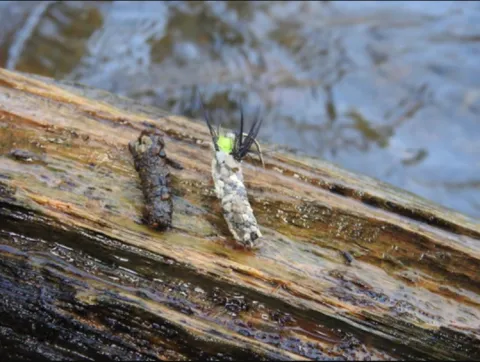
Separate a caddis larva from its shell and what you have is a pale yellow rock worm with jet black head and legs. Trout eat them shell and all, but the larva itself can be compared to trout candy.
Sometime in August, the caddis begin their final transitional stage, similar to the process of a caterpillar enclosing itself in a cocoon. The caddis attaches itself to a rock and seals itself inside its case, where it transitions from the larval stage into a pupa. When the time is right, the pupa breaks out of the case and begins to migrate to the edge of the stream, where it crawls out upon a branch or a rock and dries its wings.
Trout feed on caddis throughout the year, but they are suddenly more available in August, September, and October.
Hatch timing is not as easy to mark as a stonefly hatch. Much of the hatch can come off during night hours. In fact, it is safe to say that if a single orange-bodied, tent-winged bug can be seen above the river, the hatch is on. To the trout's way of looking at the world, the party has started, and it's mostly below the surface.
LARVAL
The larval stage is imitated in both cased and uncased versions. Artificials can be tied on scud-style on English bait hooks, or on straight hooks sized No. 10 to 6 and 2X to 4X long. The fly should be heavy. Beads, lead wire, and copper ripping can all be used to make sure it sinks fast. To tie a passable cased caddis imitation, peacock herl works as a good body base and may be overlaid with a rooster hackle to add depth to the body. The body of the worm can be tied to represent it partially out of the case, or not.
To be ready in the event of an October caddis feeding frenzy, tie or buy John Hazel's Deschutes Cased Caddis, Oswald's BH Rock Roller, Peeking Caddis.
Now picture the worm free from its case. This is a really good fly to fish by itself anytime between the middle of July and end of September. My favorite representations are tied in off-white, yellow, and orange overlaid with clear latex. Heads and legs are completed with dark rabbit or muskrat with the guard hairs picked out. Some other good caseless larva patterns include Tan Caddis Larva, Rip Caddis (Hafele and Morris).
For all intents and purposes, these flies should be fished dead-drift. I learned to fish them with the rod in the high-stick position, but they can also be fished with a strike indicator. Trout tend to suck them in and spit them out just as fast, so it pays to set the hook at the slightest suggestion of a grab.
EMERGENT
Peak caddis hatch activity will probably take place on cloudy days from late afternoon until dark. Anticipating this can precipitate what I think is the most important and exciting stage of the hatch.
Exploit the "pre-hatch" phase with a tandem rig that includes a pupal imitation up top and a larva imitation down deep.
Fish the two-fly rig on a dead-drift, then let the flies swing at the end of the drift.
If a few naturals begin to hatch, it might pay off to tie on a dry with a pupa imitation on a 24-inch trailing dropper. Cast, dead-drift, swing, lift the rod, twitch.
Some of the better pupa imitations include the Tungsten Dirty Bird, Mercer's Tungsten October Caddis, Morrish October BH Caddis Pupa.
ON THE SURFACE - HATCHING
Fishing the dry is a lot like fishing in hopper season. October caddis are not typically all across the surface with trout attacking them. But the flies are big and some trout are looking for them. The fly is trying to break free from the surface, get its wings dry, and fly off. Some accomplish this with ease, while others struggle.
After the natural has left the surface, it will not be available to trout again unless a strong wind drives it back to the river. At such times, the fly may be wind-smacked and a dead-drift is the preferable presentation.
Some of the great October Caddis dry imitations include Morrish October Caddis Dry Fly, Improved Orange Sofa Pillow, and Orange Stimulator.
This is a good time to stay with the time-honored dry and dropper routine with a small Rubber Leg Pheasant Tail, Emergent Sparkle Pupa (brown and yellow) or a yellow X Caddis in tow. Run the dropper about 24 inches back.
ON THE SURFACE - MATING
The next opportunity for the trout to eat the big bug is when the female returns for the egg laying dance.
When the adult female drops eggs atop the water, she touches down, lifts off, and touches down again. Sometimes the current pulls her under and she beats her wings to get back to the air, only to touch down again. This most often takes place from late afternoon until after dark, and the process will assuredly bring trout up off the bottom. Some trout get so engrossed in the ritual they will chase caddis out of the water and try to take them in the air.
Add skitter to the end of a dead-drift dry fly presentation with a quick mend to get the line up, and then turn a small circle with the rod tip. If the fly lifts off the water and touches back down, creating a bit of drag, it is okay. It is one of those moments in a dry fly fisherman's career when drag is a good thing.
Trout seem to materialize in the clear water and chase the bug for two, three, four, five feet across the surface.
Look at the "hatch" of the October caddis not as a single event, but as a process. It's October, what are we waiting for?
# # #
To contact Gary Lewis, visit www.GaryLewisOutdoors.com
The End
/articles/too-big-ignore