The Best Fly Ever Made
Strip, strip, strip… the intermediate sinking fly line passed through my fingers in three-inch increments. Varying the retrieve, sometimes fast sometimes slower, pausing and resuming my retrieve, I floated along in my belly tube, taking in all the remote mountain lake had to offer. A tree-lined shore, snow-covered mountains for a backdrop, and not another soul in sight.
Suddenly the line came to a hard stop, jerking my rod forward, the frantic pulling of another chunky rainbow signaled “fish on”. Catching up my line to the reel, I played the healthy native trout to me, sliding the knotless net under her belly. The glistening distinctive markings of the bow glowed vibrantly in the evening light. Gently removing my barbless fly, I cradled the tired fish while it rested. In a few moments, the rainbow impatiently strained against the confines of the net, eager to return to the cool depths of the lake. Safely recovered, I tilted the net and watched the fish dart away, a splash of cold water in my face as if to say, “don’t fool me again!”.
If you had just one fly in your arsenal to catch trout, what would you pick? The hardcore anglers of course will dismiss this question as irrelevant and silly. Fly fishing is all about matching the hatch, and there are literally hundreds of variations of flies – dry, wet, nymph, the possibilities could fill up several tackle boxes. Picking one sounds like a fool’s errand, doesn’t it? Well, I will cast my vote and be that fool. Drum roll please…
My favorite, go to fly is – the venerable Wooley Bugger.
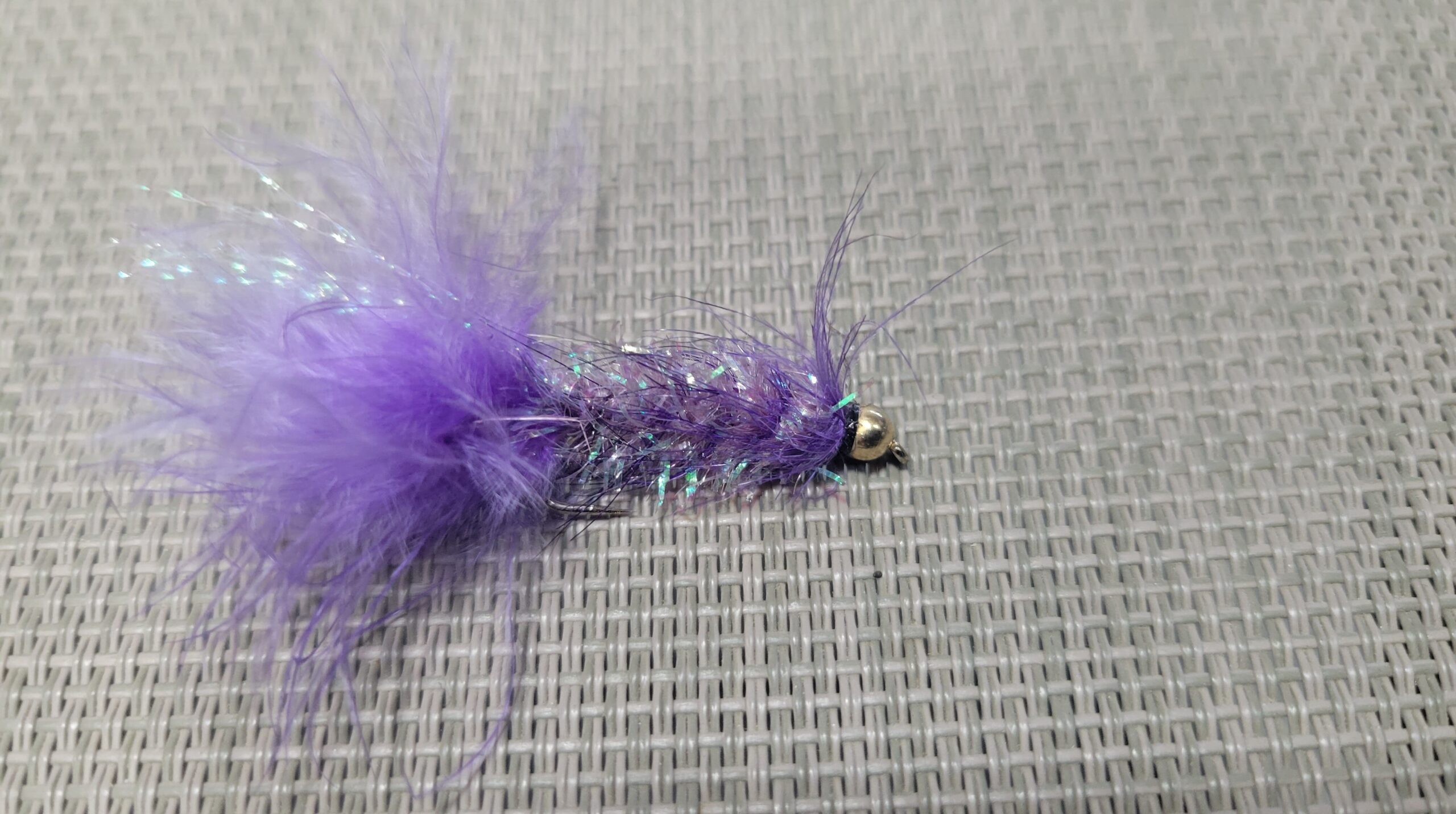
Was that your choice as well? If not, let me expand on why the Wooley Bugger is often the first fly I will cast out on a new body of water, and some of the qualities that make this fly, in my opinion, so essential to be in your tackle box.
First, a Wooley Bugger is a wet fly which can be used in lakes, rivers, ponds, and even saltwater fishing. Wooley Buggers come in a variety of styles and colors and can be considered to imitate many different food sources for fish, including small minnows, leeches, nymphs, and anything else swimming around a lake or river. As such, Wooley Buggers are the ultimate “searching” fly, perfect for exploring new bodies of water with.
Wooley Buggers lend themselves well to more than traditional fly fishing. They can be adapted for many styles of angling and fish species. Years ago, Uncle Wes Malmberg took me to a SW Washington Lake, and long lining a Wooley Bugger with a Mack’s Smile Blade off the back of his 14 foot aluminum boat we spent a relaxing morning catching and releasing rainbow after rainbow. A couple split shots was all that was required to sink the fly under the surface and entice fish after fish to grab on. Fished bait and scent-less, we easily caught and safely released several dozen fish that day. Such a simple but deadly effective method! I immediately went home and tied up several new colors to add to my collection.
For the beginner fly-tier, the Wooley Bugger is likely the first fly you ever will learn to tie. The reason is this fly is simple to make, and is generally on a larger, long hook shank, making it easy for beginner fingers (or those with older, arthritic hands). As such, it’s a great “introduction to fly-tying fly”, before tackling those challenging #20 dry flies and nymphs! A quick search on the internet will provide you with a multitude of videos and tutorials so I won’t go into the actual tying here, suffice it to say if this is an interest, you’ll find plenty of information on how to tie the Wooley Bugger. It’s a great first fly to tie and is hard to make a bad looking one.
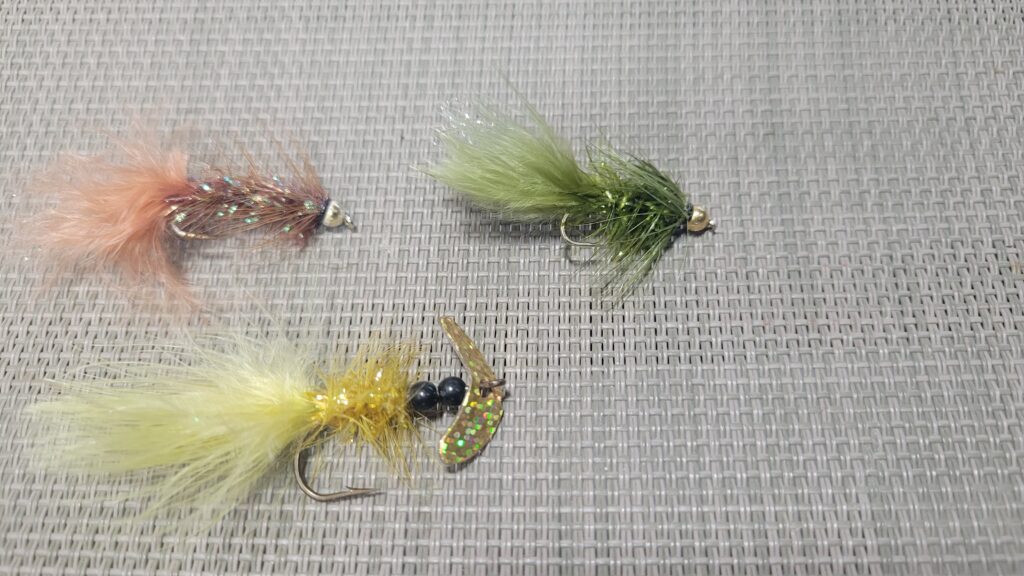
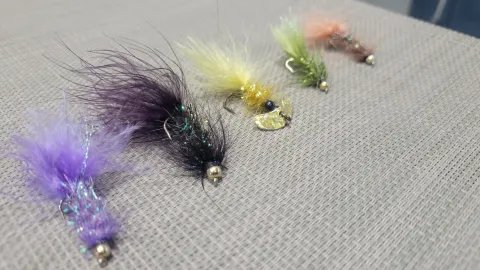
Another application for the Wooley Bugger that you don’t hear about often, but can be deadly effective, is trolling behind a sling blade for kokanee. Go to colors are pink, red, and orange. Add a Mack’s Smile Blade and a single kernel of corn, short leader of 8 inches, and you are in business. The single hook provides excellent penetration on strikes, but if you’re anxious about that single hook tying on a small treble hook or trailing hook is certainly fair game.
Now that I live in Montana, more of my time is spent fly fishing. When I arrive at a new lake or pond, if I don’t see rising trout, I’ll start off with a sinking tip line and Wooley Bugger in a natural color, tans, browns, and greens. Casting and stripping back is a tried-and-true method, as his casting out and slowly kicking my belly boat along, waiting for that solid jerk signaling another fish fooled by this classic and timeless fly. Whether behind a fly rod, spinning rod, or trolling rod, the Wooley Bugger will get you on fish. Give it a try, I think you’ll be happy with the results!

/articles/best-fly-ever-made
Kokanee Lures: Making Your Own
And other ramblings...
Although there are a limitless variety of both the latest, tried and true kokanee lures hanging from the pegs at your local purveyor of tackle, many people choose to hit the water with at least a few home-tied lures. There is nothing wrong with ready tied kokanee lures and depending on the location, many shops will have a section catering to kokanee fishing. Even tackle stores far from a kokanee lake seem to have enough kokanee gear in stock to get you started. Here locally, Holiday Sports in Burlington has an aisle dedicated to kokanee lures, flashers, and lure components. So, with the variety of prepackaged kokanee lures available, why create your own?
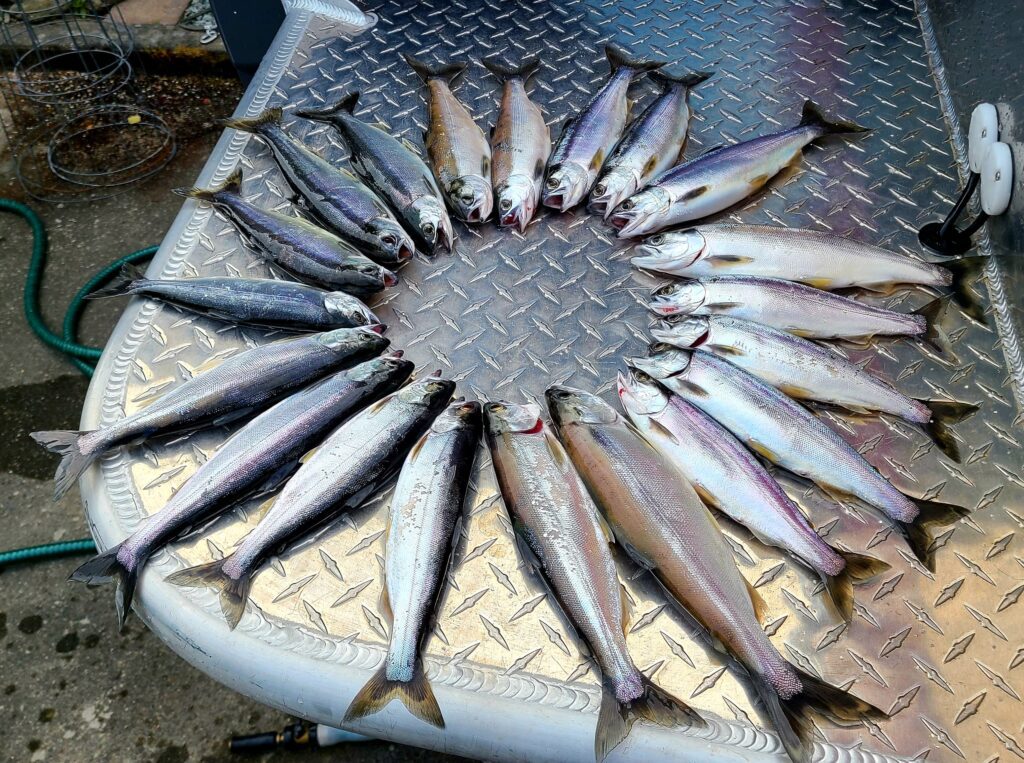
I think that the answer is in kokanee fishing overall. Sure, they are a scrappy opponent, taste fantastic, and here in Washington most lakes have a 10 fish bonus limit. But more so, kokanee fishing is a mental game. A successful kokanee fisherman understands both the regional and seasonal adjustments required to consistently put fish in the net. Much of the fishery is spent massaging the grey matter while trying to figure out the trick of the day or even hour. Kokanee are very fickle and when you entice a bite on a lure you tied the whole experience is enhanced.
My personal history of fishing custom lures goes way back. I have always been an avid fly-tier and enjoy making one-offs or attractor flies. In my youth I used a black marker or nail polish to doctor up Oakie-Drifters and Steel-Lee spoons to enhance my steelhead offerings. I spent 20+ years in Southern California chasing anything that swims. I would often put a short notch in the body of small curly tail grubs when fishing for trout in the Sierra’s. The cut would give the tail action a little extra vibration that drove the trout nuts. When fishing the bays and nearshore I would modify my swimbaits with a marker or colored Sharpie. I even bought a mold to cast my own 4 and 5” swimbaits. I poured many crazy colors; I even modified the 5” mold to incorporate a scent chamber where I could squirt a bit of scent into the swimbait. These are just some of the ideas that constantly bubbled from my head on their way to the end of my line. So, why the effort when there is plenty of excellent gear on the market?
It’s that kokanee mental thing, catching a fish on something that you concocted. I think that with kokanee fishing, when you can consistently catch fish on a lure that you developed or modified, it just plain feels good! Hooked yet? How does one get started?
The answer may vary a bit depending on your goal. Do you want to invent the next hot Kokanee fly, design a new spinner blade, or just hobble together some random spinner blade/bead combos? Whatever your goal is, it may be a good idea to ease into your new interest; don’t go out and buy the stuff to make 250 kokanee lures. Start slow; a few spinner blades, beads and spinner clevises. If you’re a fly-tier, you probably already have the basics for any number of kokanee flies. Tying kokanee flies is fun and with some basic skills your imagination is your only limiting factor.
Although I’m fortunate that I have a dedicated tackle workbench that is well stocked with just about everything needed for making lures, it’s not necessary. Your kitchen table, garage workbench, or even your lap while watching a game are perfect for making lures. I also carry a spinner/lure making Plano box on almost every fishing trip. One never knows when you’ll have to make mods or throw together an emergency lure.
A problem I have is that I have kind of settled into a given group of custom spinner/bead combos and a handful of kokanee flies that consistently produce fish. Good or bad, not sure. I enjoy making lures but do I need more kokanee lures? No, probably not, but I’m sure that I’ll hatch a new batch of kokanee lures this year anyway. I may even explore the world of tube flies!
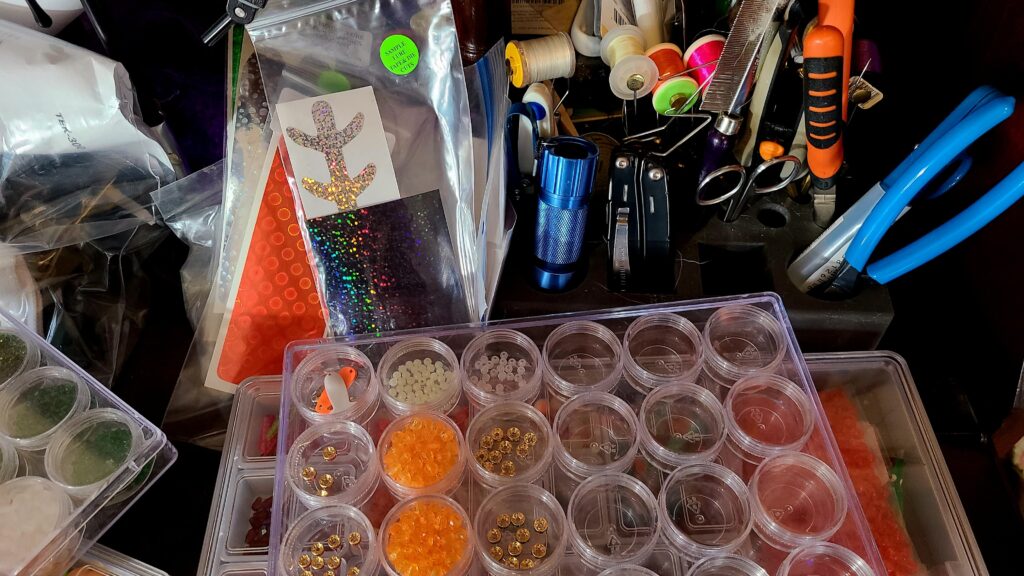
Where do you start? I think that before you spend any money, turn the trusty old trout tackle box upside down, give it a good shake and step back to see what you have. That big ball of old tangled up wedding ring spinners will be gold. Is there a handful of small spoons or old flies? Look in the tackle box and you’ll find an old rusty spoon stuck under one of the shelves. Pry it loose, maybe hit it with a drop or two of penetrating oil, and start dissecting your treasure pile. In the end it is likely that you’ll have quite a collection of small Colorado blades, wedding rings, beads, and a variety of components that may fuel your lure making passion all winter.
You can also purchase the components through one of the many lure making supply websites or your local tackle shop, but be aware that many are either wholesale or cater to the bug-eye crowd. Size 1 and 2 spinner blades are hard to find. If you don’t find any at your local tackle shop, ask if they will make a wholesale purchase and then package in smaller quantities for retail sale. Beads? I think that every fisherperson has wandered down the bead isle at your local hobby store and thought “If I was a fish…” If you are anywhere close to Lacey, Washington pay a visit to Shipwreck Beads, www.shipwreckbeads.com. Believe me, as a tackle crafter you will be blown away!
Now that you have a box full of doohickies to start making kokanee lures with, now what?
Regarding spinner blade clevises, try to find either the small plastic clevises or the spring type. The folded metal ones are great if you are making wire spinners but with manufacturing inconsistencies, they may abrade the light mono or fluorocarbon that you will be using as leader material.
I own a couple different wire benders and have tried to fabricate wire kokanee spinners. Even using a very fine wire gauge, the spinners end up being too heavy and rigid. When making kokanee lures, you want the action of the lure to just sort of flutter or follow the attractor action. Wire spinners tend to just hang there.
Line size? I used to believe a lighter leader line would draw more strikes than a heavier leader. Apparently in the underwater world of kokanee fishing I was WRONG, kokanee are not leader shy. In fact, there are a couple Washington State kokanee fisheries where I start with 20# fluorocarbon leaders and have no shortage of bites. I guess that it is mildly comical. Some days kokanee can be very boat shy, where they won’t bite anything running on less than a 70’ setback. Or crazy stuff; like a boat must be heading east instead of west with Jimmy Buffett, Son of a Sailor on the Bluetooth to get bit, but they have no problem smacking a spinner on an 8” hunk of 20-pound mono. That said, with few exceptions I tie my kokanee leaders on 12-14# fluorocarbon.
Hook size and color are kind of a personal preference. Many of my kokanee lures are tied using size 4 or 6 black octopus style hooks. I typically tie a snelled rig with 2 hooks. With my standard rig the hooks are pretty close together but there are times where I want a trailer or stinger hook in the set up.
Maybe a note about leader length; I tend to have spools of ready to go lures when I’m on a lake hunting kokanee. Typically, they are the correct leader length for that fishery. It is a good idea to have a handful of pre-tied leaders that haven’t been cut to length available. The thought is that you’ll be able to assemble your lure then set leader length as required quickly. An 8-10” is kind of a standard kokanee leader length, but sometimes the fish want something different.
Ok, you have a sizable collection of kokanee leaders, now what? How do you store them without ending up with a large cocoon of fluorocarbon? Speaking of…when I was a child, I used to have a recurring nightmare where I got caught in a spider web and then wrapped up for a later meal. In hindsight, maybe what I thought was a spider web was really kokanee leaders. I need to get organized…
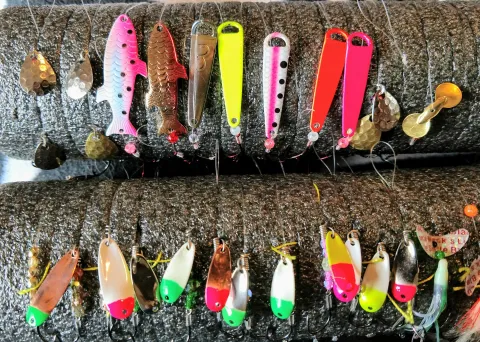
A couple of leader organization concepts are either sealable sandwich or snack bags, or, my favorite, the slotted foam tubes. If using the resealable bags, gently coil your kokanee leader and seal it in the bag. Store the sealed bags in something with a latching lid. With the slotted foam tubes, set the hook in the foam and wrap the leader securing the end in one of the slots. You can store the tubes on a rack, in a 3–5-gallon pail, or a 2-gallon resealable bag. I have found that using an empty 5 gallon to hang your leaders on during the day does wonders for keeping the boat organized as you cycle through set-ups. No point in becoming a fluorocarbon-spider meal, come up with an organizational plan that works for you and your boat.
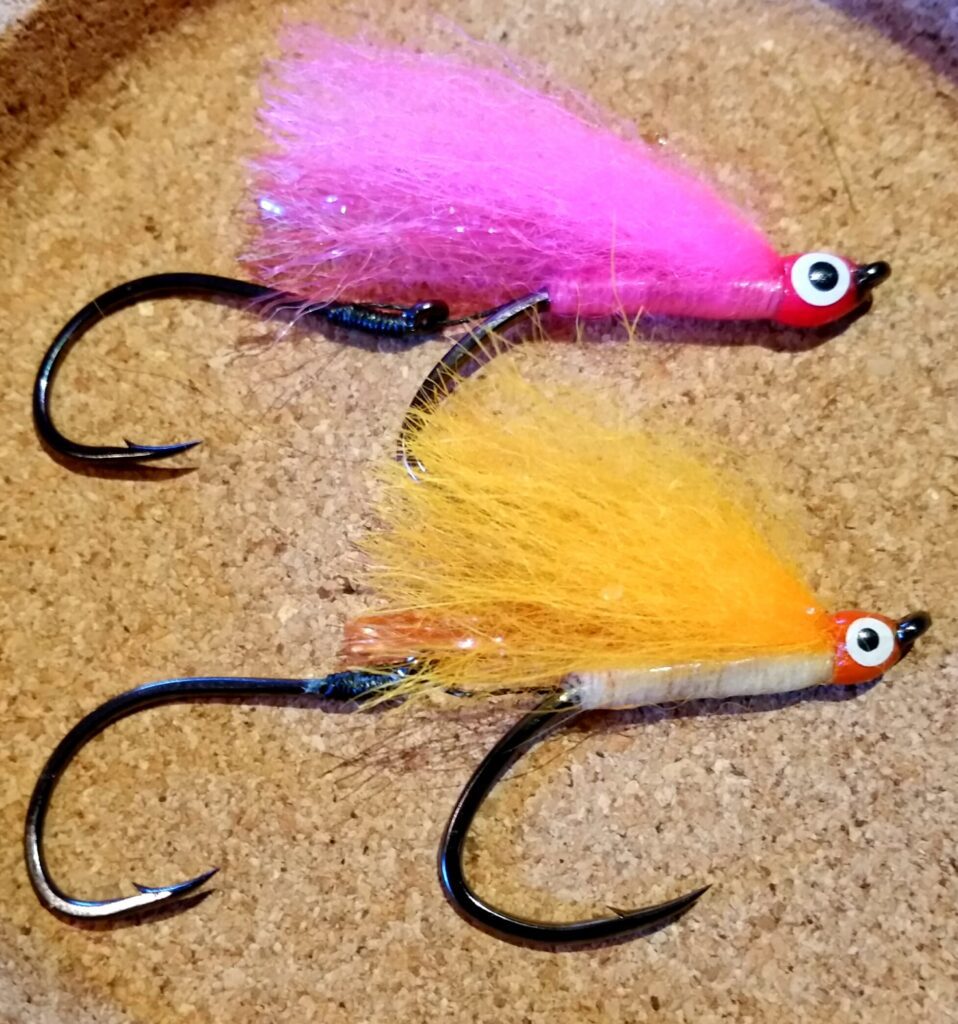
Previously I mentioned that kokanee fishing is a mental game. As prepared as you are in the comfort of your living room, sometimes once on the lake you will need to think out of the box. My lure/spinner box allows me to tweak my presentations. I might add a couple beads and a second spinner blade, make a leader with a fly, then add spinner components. The box has small spin n glo floats, extra beads, various kokanee flies, wedding ring collars, some kokanee bugs, and a few other things to dress up your lure.
Whether you are making spinners, tying flies or concocting something else, much of your kokanee lure making will be done at home. Enjoy the time and let your imagination go wild. Shoot, most small children love making lures, make it a family affair. Finally, lures made during the offseason should be stored in a cool, dark place.
/articles/kokanee-lures-making-your-own
Nymphing for Trout
Chad Bryson
In the glamorously romanticized world of social media, there is nothing short of a plethora of fly fishing techniques and methodology. So many opinions, and it seems that everyone thinks they are right. Even though I am never one to be short on opinion, I prefer to stick to facts and truth. That’s where I try to form my opinion.
Watching Fish
Fact- every single person that is an angler loves to watch a fish of any species come to the surface to eat something presented to them. The surface bite is a visual interaction we as humans get to experience with an animal that we would hardly ever see otherwise. It’s cool beyond belief. Truth- that bite doesn’t happen every day. It doesn’t even happen every month.
Okay, sure, if you have your own jet with an unlimited amount of expendable income, you can travel all over four continents and two hemispheres chasing every bug hatch or mouse migration known to man to satisfy your craving for surface action. If you are that person, I want you to know that I am interviewing for new friends, and you could just be a candidate.
However, if you are like the rest of us who can't afford the financial commitment of owning our own jet, you are probably trying to enjoy the fishing that’s close to home and might be wondering what all the complicated fuss is about. I’m going to simplify it.
Fly Fishing
Fly fishing for trout is broken down into basically three methods - streamer fishing, nymph fishing and dry fly fishing. Dry fly fishing is by far the most celebrated and commonly recognizable. It’s the gentleman’s preferred fishing method. Streamer fishing is regarded as a viable means of catching but, like dry fly fishing, isn't always the most productive.
Then there is nymph fishing bringing up the rear in open popularity. I call it open popularity only because you never hear guys in a fly shop talking about how awesome the nymph bite was the past weekend that they went fishing. Everyone just wants to discuss how many bugs hatched or how many trout chased a streamer. Nymphing for trout is easily the most effective way to catch them, but this technique is often only regarded as a last-ditch effort to save a day of fishing.
Why
The most important question to answer is: why? Why is nymphing for trout the most productive way to catch them? First, let’s identify what a nymph is. A nymph is the juvenile form of aquatic insect that is born below the river’s surface and makes its way to the surface either by crawling or swimming so that it may hatch into an adult and fly away.
Once the nymph reaches the water’s surface and begins to shed its exoskeleton, it is at the mercy of wind, rain or anything above the surface that could potentially keep it from flying away. Hence, keeping a trout from being able to eat it from the surface like so many of us want. Every river, creek, and waterway anywhere that holds trout will have aquatic insects of some species. In that watershed is the nymph form of that aquatic insect.
They live there 24/7, 52 weeks a year beneath rocks, logs, stumps, and anything else that could be considered hold area. Nymphs are always in the river for trout to feed on. Every single day. They may not always be hatching, swimming or crawling, but no doubt, nymphs are around, and they comprise 90% of a trout’s diet. We just rarely see them eat one because it’s all done subsurface.
Nymphs
Fact- nymphs are 90% of a trout’s primary diet because it is a food source that is the most readily available in every creek, river, and water shed that holds trout. Also, a trout doesn’t have to expose itself to the surface to eat a nymph like it does a dry fly. It can remain relatively hidden from predators while feeding on nymphs. Imagine you are sitting on your couch watching baseball. You get hungry and need a snack.
Next to the couch within arm’s reach is a bag of beef jerky and a sack of Doritos. Cool Ranch Doritos at that. Now you could just sit there comfortably and feast on those Doritos and beef jerky until your heart’s content, or you could get up and go to the kitchen and make yourself some proper food such as a ribeye steak. Even though the ribeye steak sounds really good, it’s gonna take some time to prepare and cook.
You also run the risk of being caught away from your safety zone of anonymity. If you are in the kitchen, the dog is gonna see you and demand attention. Your wife or husband may realize that you are mobile instead of semi-comatose on the couch. God forbid you may have to fix a ribeye for them too. Next thing you know, the baseball game is over, and you are doing the dishes. Truth- dry flies are ribeye steaks while Doritos and beef jerky are nymphs.
Bobbers vs Strike Indicators
No discussion about nymph fishing for trout would be complete without the controversial subject of bobbers vs strike indicators. In the world of fly fishing, someone that wanted to make themselves dissimilar from gear fishermen decided to call the thing we use to make the flies float at a specific depth below the surface a “strike indicator”.
I suppose that is a more refined and highbrowed form of language that some fly anglers are known to have. My opinion is quite simple. If it floats and is made of a synthetic material such as foam or plastic, it’s a bobber. If it floats and is made of natural material, such as wool, it’s an indicator. Trust me when I say that both have their place in the game. Just call it what it is.
High Sticked
I learned to fly fish before the invention of indicators and bobbers. We “high sticked” when nymph fishing. This was basically using a rod that was about a foot longer than the rod I used for dry flies paired with a little stronger leader and a heavy nymph at the end of it. The idea was to “roll” the nymph along the bottom of the riverbed imitating a nymph that had been dislodged from its safety zone.
As long as the line was tight, you could feel the trout take. I caught so many big trout using this method, my grandfather finally limited me to using it only on rainy days. “Just to keep things even”, he said. If you can learn to highstick nymph, it will crush fish. Just don’t confuse it with this new thing the kids are doing called euro nymphing, that’s not fly fishing. Any good fly-fishing guide will agree with me.
So, watch a YouTube video about high stick nymphing, hire a guide, and find out what a trout eats 90% of the time. Don’t forget the Doritos and beef jerky.
/articles/nymphing-trout
Angler-Based Psychotherapy
“Welcome back to the 'Winter Doldrums’”, read the message on the marquis in front of the local fly shop. My buddy and I just glanced at each other and went inside anyway. I was hosting a bonefish trip to Mexico in less than a month. I had chosen a local fly shop to meet with everyone on the trip to assist with gear prep, clothing needs, travel details, etc. You know, all those things that a good host should do instead of just sending a pack list/itinerary and hoping for the best. Once we were inside the shop, it didn’t take long for me to realize the twelve inches of newly fallen snow and more than 60 days of frigid temperatures had won the battle for “chipper attitude of the month.” Hence the marquis message.
Notice I said “a local fly shop”, not “my local fly shop.” The majority of the guests on that particular trip were from the upper Midwest, so I chose a fly shop most convenient to them to meet. Plane tickets were cheap for me back then. Alas, the old days of AirTran. I had spoken with the shop owner in great detail about our trip meeting. I had hoped it would generate some revenue for the shop as well as help him get into the travel fishing business. It seemed like a grand idea to use his shop, and it was. As the group started filing in one by one, the vibe in the room went from mass melancholia to downright elation in just a few minutes. It’s funny how just a little bit of talk about planning a fishing trip can change the mood.
Nowadays, I plan all my fishing trips in January/February. It is a superb time to have a get together with my buddies and plan a trip. My family calls it angler-based group psychotherapy. Either way, the timing works. Over the years, we have put together so many trips. Some turned out beyond great, others not so much. Through all the group therapy down in the fly-tying shop, I have learned that following a particular planning protocol will lead to a more successful trip, no matter if I am booking a lodge or going full DIY. In addition, the amount of flexibility I am willing to bestow makes a difference as well. The following is the way I plan not only for myself but for anyone who asks me to help them plan their fishing trip. Since the last two decades of my guiding career have been based in Alaska, we will work with that planning protocol. However, you will find that using this protocol will work for just about anywhere you want to go, third world countries included.
1) Decide what species of fish you want to target.
This seems simple, doesn’t it? One would think so. Put 10 anglers in a room and start the discussion and you will find out that 6 of them are like minded when it comes to what species they want to target on any particular trip. Singling out a particular species to target for this fishing trip is the very most important part. Everything else will fall into place after that. Once this obstacle is overcome, move to step 2. Don't jump ahead in line. Trust the protocol.
2) Decide where you want to travel to target the chosen species.
This is the part where you get to control the financial commitment towards your fishing trip. For example; I have decided that I really want to catch giant, clowned up, sea run Dolly Varden. I would love to travel to some remote portion of Siberia to cast to a Dolly that has absolutely never seen a human, much less been fished to. Without a doubt, it would be the trip of a lifetime, right up until I see that it’s gonna cost a second, third, and fourth mortgage. So that gives me the opportunity to reevaluate my financial commitment to another location. Once you've got this nailed down, move to step 3.
3) Deciding when you go is pretty easy after steps one and two are done, especially with Alaska trips.
Most of the fishing is based around the migration of Pacific salmon and their lifecycle as a target species, or a food source for another species of fish that capitalizes on salmon eggs and flesh. So, if I wanted to target king salmon during the peak of the run on the Nushagak River, I would plan to be there in late June. But, if I wanted to target leopard rainbows behind spawning sockeye in a creek, I would go mid-August. Now we have that established, go to step 4.
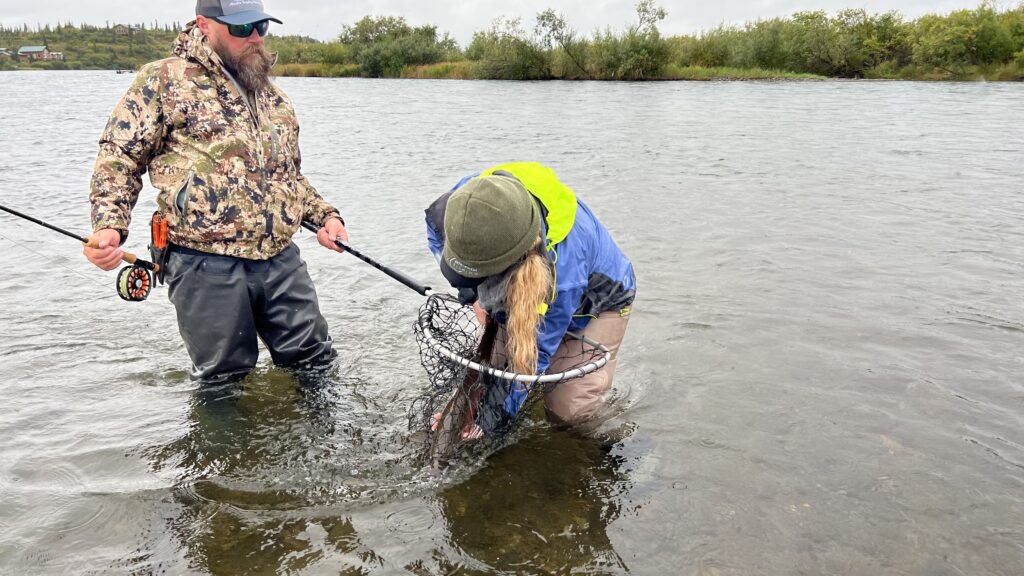
4) Last, and certainly far from least, is how to go.
How you go encompasses everything left about your trip. Are you going to DIY or book a lodge? Maybe you want to do a combination of DIY and day trips with a guide. I look at every option available, how much it costs, and figure out the bang for the buck. In some cases, a DIY trip turned into a fully guided lodge booked trip, only because the lodge had a special price that coincided with my species and timing. The lodge price wasn't much more than the DIY price estimate, and all the guess work was taken out of the program. Therefore, it was easily worth doing the lodge deal. This doesn't always happen, but it’s worth doing the research.
If you are like most of us self-taught anglers and wouldn't dream of doing a guided lodge trip even if budget wasn't a concern, I implore you to do your research. Make sure that where you are going and what you are targeting is still a viable thing. If you are doing a DIY raft trip for trout, make sure the river you chose has a good trout population in it. Alaska seems like a dreamy wonderland for all cold-water salmonids, but everything is cyclical. Just make sure. Don’t trust social media. Not all lodge owners and booking agents are telling the truth, some are just selling empty beds and boat seats. Probably the most valued asset you can find is a trip consultant. A trip consultant doesn't have any allegiance to a lodge or travel company, and for a couple hundred dollars, you will gain more information than you bargain for.
So, call your friends over, smoke a brisket, and plan a trip. It will do wonders for your mental state and seasonal affective disorder.
/articles/angler-based-psychotherapy
A Lifetime of Fishing Memories
Measured in terms of people killed, the last year of World War II (1945) is regarded as the worst year in human history. On April 27, the day Italian partisans captured Mussolini, Gordon Vance caught two in the morning on flies and three in the evening on salmon eggs. The day after the U.S. dropped fire bombs on Tokyo, Gordon Vance dropped salmon eggs in Johnston Lake and caught six small ones. On August 9, the day a plutonium bomb was dropped on Nagasaki, Gordon Vance was on Walterville Canal with a fly rod.
If you don't keep a fly fishing journal, maybe you should. It's a great way to remember good days on the water and figure out how to have more of them. But it can also be a link to the past when a son or daughter finds the journal years later. Think about Gordon Vance. Remember him? No? Well, his family does.
When he was a little boy, his mother would give him a pail of water and a stick with a line and a bent pin. "He would sit in the kitchen for hours, waiting for a bite," I spoke to Janice (Vance) McCargar after I received a package in the mail; she had found her father's fishing and hunting journals, kept in a three-ring binder, written in longhand.
Gordon Vance began to keep track of his fishing trips in 1931. Picture a barefoot boy in a tiny kitchen in Missouri in the 19-teens. Picture him a bit bigger in dry-as-a-bone Arizona. "When my dad's family moved again to the McKenzie River in 1926, he thought he had died and gone to heaven." Gordon Vance was 16 when he moved to Oregon.
On May 15, 1932, he writes of fishing Walterville Canal and Cogswell Creek. He caught five on a blue quill body grey hackle and, that evening, on the McKenzie, caught eight "in a hurry on a yellow body deer hair fly."
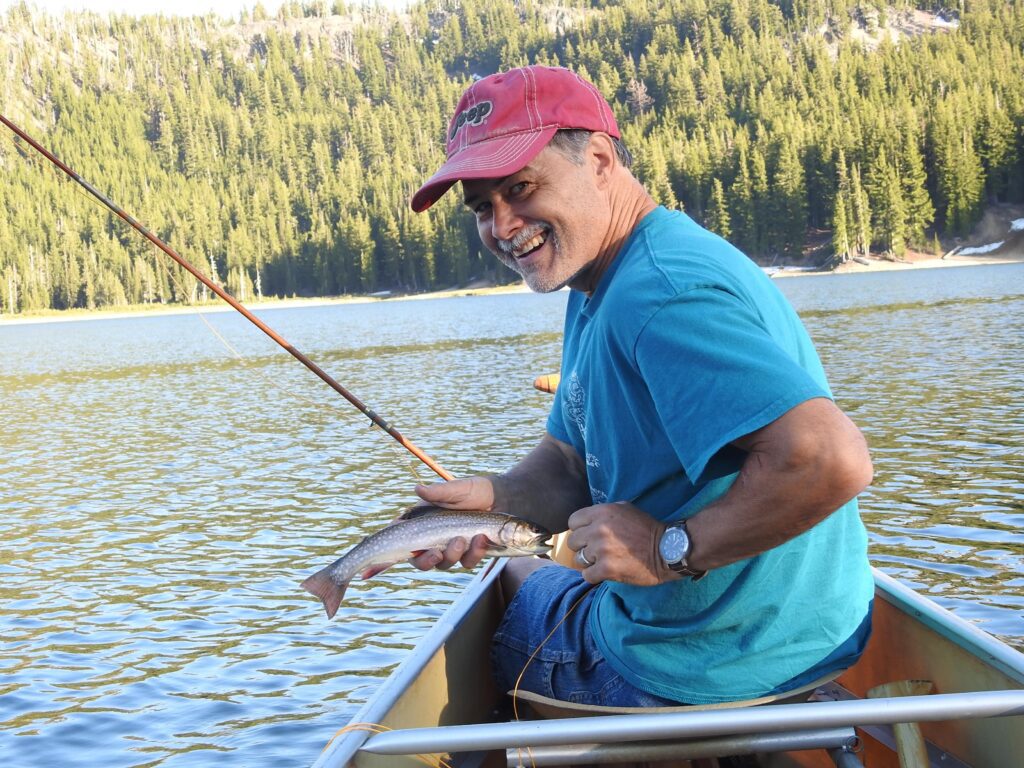
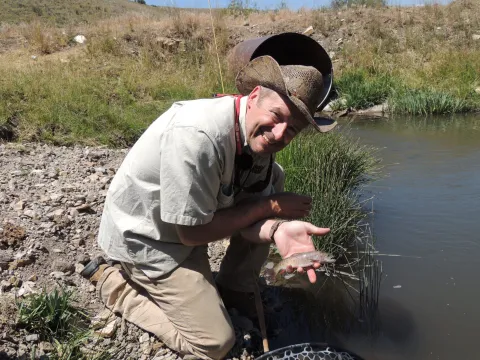
Don't just write down the number of fish you catch in your journals, but who was with you, the temperature, the weather, the barometer. Jon Guenther on a mountain lake in Oregon with a fly-rod brookie. Photo by Gary Lewis
Twenty-two years old in '32, Vance recorded 15 entries, on Leaburg Lake, the canal, Cogswell Creek, Horse Creek and the McKenzie. In 1933, he fished 20 times and would have fished more, but in September, according to his notes, he picked up a Winchester Model 54 and spent a good deal of time in the woods. "It was the fashion in those days to keep a journal," Janice said. People took the time to record thoughts and observations. Journaling helped the young man develop his craft on the water and in the woods. It was fun to think of the determination it took to drive to Diamond Lake, Miller Lake, Odell and Crescent in those days. Easy jaunts now, they were all-day rumbles along narrow timbered tracks in the 1940’s and '50s.
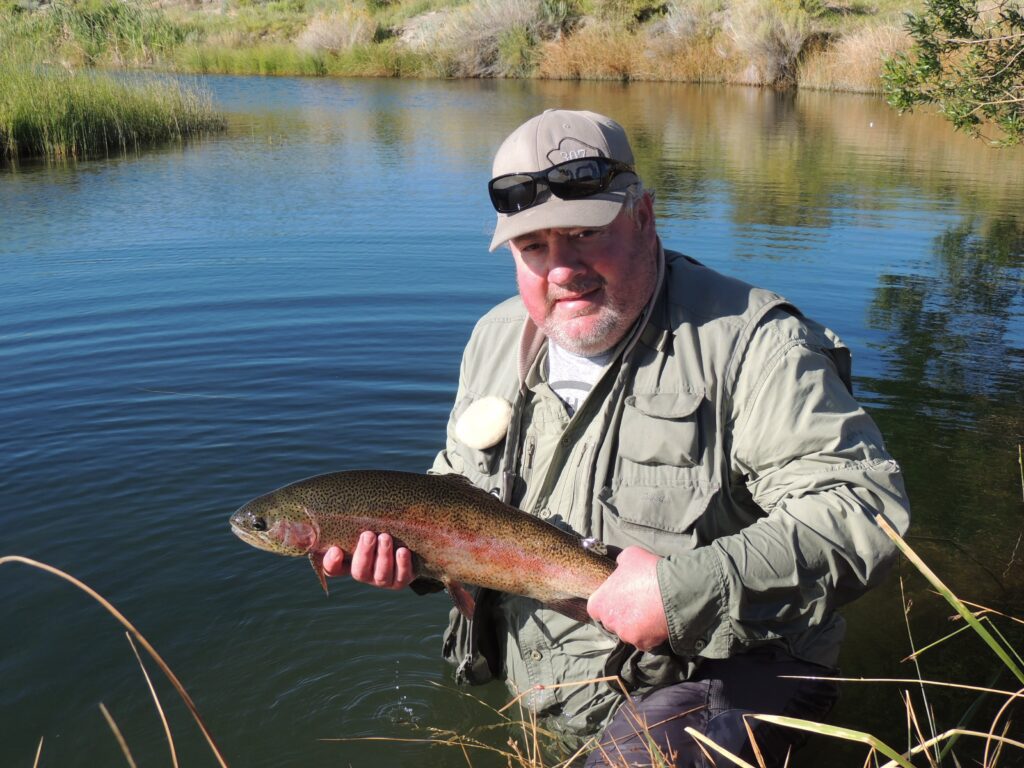
Keeping a journal reminds of the flies we used on that July morning in '16. Jeremy Groh, of Bend, Ore., with a big still water rainbow. Photo by Gary Lewis
In 1956, Vance fished Diamond Lake and wrote, "Don, Marion and I gave the Kamloops of the reborn lake an end of the season try. We caught 22 from 15 inches to 18 inches." He added, "A monofilament line is a must. Fish had been eating algae and tasted terrible." Monofilament: we take it for granted now, but it was the latest in fishing technology in the 1950s.
Some things haven't changed. On September 17, 1980, Vance fished Miller Lake. "Thirteen washboard miles from Chemult and up to 5,600 feet, the 550-acre lake is a beauty and if I had taken a fly rod could have been fun." A mayfly hatch was on and Vance had brought the wrong tackle. He ended the day with two small kokanee.
In 1990, the year he turned 80, Vance started with a March outing to Triangle Lake and recorded 27 trips on Cottage Grove Reservoir, Hills Creek Reservoir, Odell Lake, Cougar Reservoir, Green Peter, the Siuslaw and on his home waters, the McKenzie and Walterville Canal.
My friend, the noted outdoor writer Scott Haugen, makes his home in Walterville. He remembers Gordon Vance. And he remembers good days fishing the Walterville Canal. "There used to be really nice cutthroat in it," Haugen said. "When I was in high school, lots of jack salmon used to run up one section. I caught steelhead out of it too."
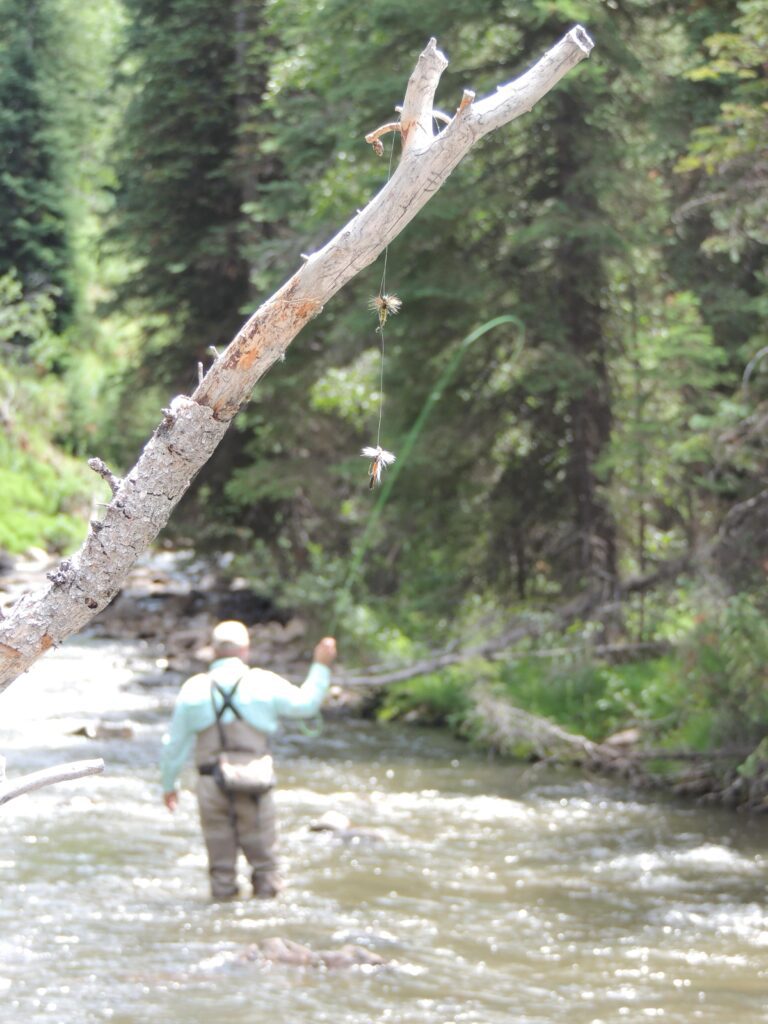
Lost and found on a mountain stream. Photo by Gary Lewis
It was interesting to look at my journals next to Vance's. I started my first notebook in 1980. I was in my teens and lived in southwest Washington and later in western Oregon; he would have been in his 70’s when our paths crisscrossed each other's, fishing the North Umpqua and Central Oregon lakes. We have planted our waders on the same rocks and caught trout, steelhead, and salmon in the same holes.
Vance recorded his last entry November 30, 2000, after a day on Foster Reservoir. "Well, I ran out of luck at Foster or ran out of fishing knowledge." He did catch one salmon, but figured he could have caught more. "Should have had a fly rod or tried smaller spoons or something!"
Vance passed away a month later, at the age of 90, on Christmas Day, leaving a lifetime of outdoor experience in his wake and a journal for his family to remember him by.
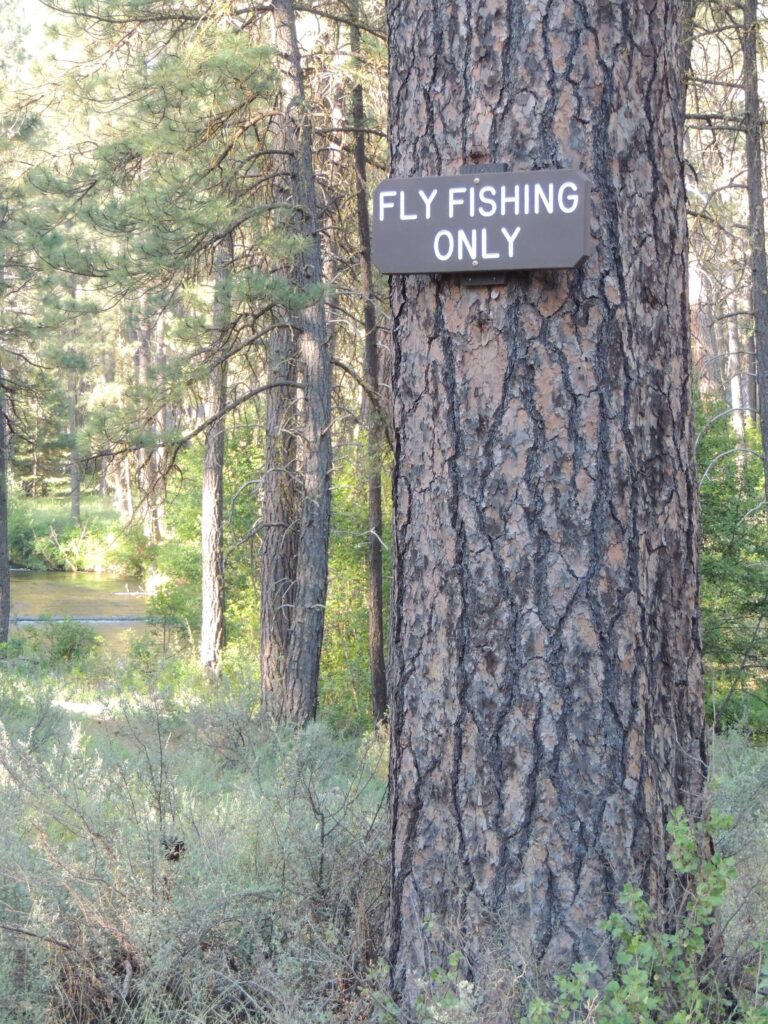
Fly Fishing Only on the Metolius. Photo by Gary Lewis
To contact Gary Lewis, visit www.GaryLewisOutdoors.com.
/articles/lifetime-fishing-memories
Fiberglass Rods
These fly rods party like it's 1971
I skipped school on a May morning to fish with my uncle Jon and his bride. That was 1985. You might say they were a bad influence on a teenager, but if I had it to do over again, I'd skip my whole senior year and go steelhead fishing. Wouldn't you?
I took two rods to the lake and when, at the end of the day, I put the gear away, I realized I had left the fly rod leaning against a tree. Someone else ended up with my 7-weight Wallace fiberglass and a Pflueger Medalist.
That Wallace rod was equal to or superior to the more popular Fenwicks of the day and looked like a Fenwick, except in a medium brown color.
That was 1985 and my next fly rod was a custom 5-weight graphite my uncle built. In the 1980s, graphite rods were lighter and a bit more responsive, but there were qualities glass rods had the graphite rods lacked.
Summers back
A couple of summers back, I floated the Williamson with Craig Schuhmann and our friend Larry Zeilstra. I brought a custom 5-weight McFarland fiberglass built by Uncle Jon. Before I had even wedged my knees into the casting brace of Craig Schumann's sweet Clackacraft, he was ribbing me about bringing an "old" fiberglass rod on a serious big trout trip. I pointed out this fiberglass rod was more modern than his attitude as well as the graphite rod he was fishing; also, his boat was made out of fiberglass.
I try to keep a small stable of fly rods, seven or eight in rotation. If I'm not using a rod, I give it to a kid. Over the last couple of years, I've given half a dozen rods to teenagers. Fly rods don't do anyone any good unless they are fishing.
Truth be told, I own two fiberglass fly rods. The other one is an 8-1/2-foot tobacco-brown Wright & McGill 3-A Champion I bummed off a friend for zero dollars. I gave the same amount of no money for the reel and bought a new Cortland floating line off eBay for $13. Thirteen bucks. That's all the money I have into this rig. It parties like it's 1971. Whenever a new acquaintance talks me into taking them fishing and they want to use one of my rods, they get the old-school glass. You want me to take you fishing? You want to use one of my thousand-dollar graphite rods because you're too cheap to buy your own? Nope. You get the Wright & McGill treatment. You don't even get to touch my Orvis magic wand Helios, the Cabela's Rogue rod, or my custom-antlered mule deer Loomis IMX.
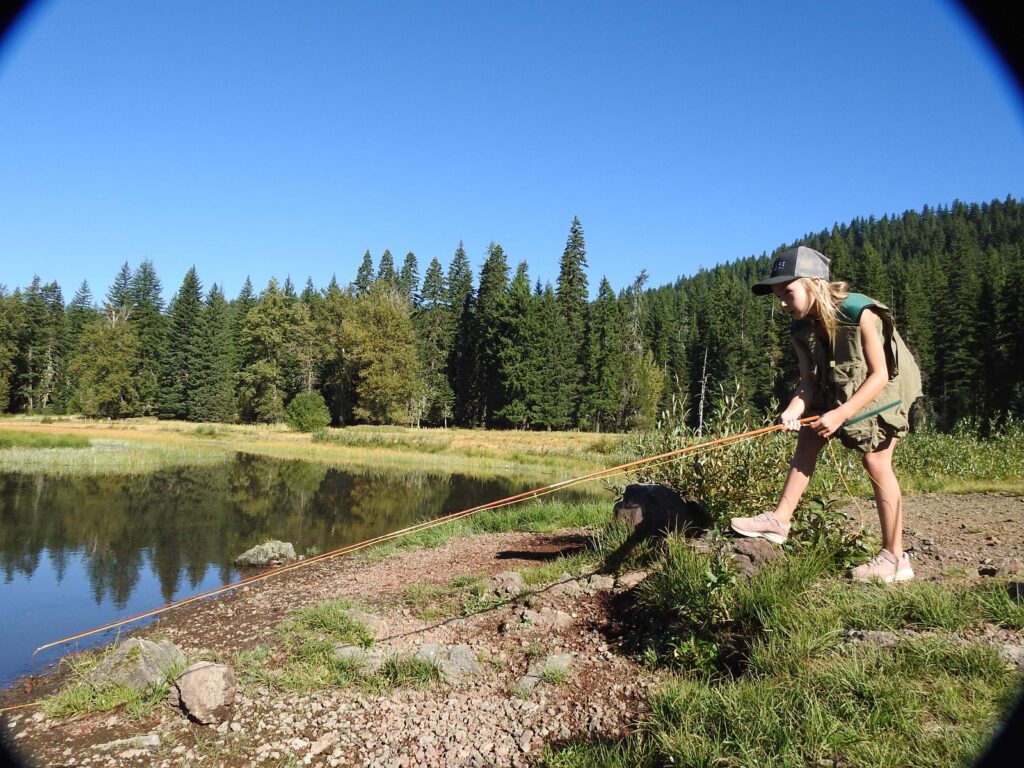
Using a 7-weight Wright & McGill, seven-year-old Little Smokey fishes a wet fly to small brook trout in the Cascades.
This Wright & McGill has bested a boatload of rainbows in the last few years in the hands of grandchildren and other mooches. I even fish it from time to time. It's a pretty good rod, and rugged too.
Glass rods are heavier, which is not a disadvantage. My granddaughter who is 8-years-old has never complained, Grandpa, this rod is too heavy! The heft of a glass rod, along with its to-the-cork action, allows the angler to sense the weight of the line as it shoots through the guides. Weight and slower action tend to slow the casting stroke, which contributes to faster casting competency for a novice.
Advantage
Another advantage is the forgiving nature of glass. Opt for a glass rod when fishing still waters where trout will be girthier. With a fiberglass rod in hand, the rod absorbs hard strikes better than graphite, which translates to fewer fish lost to broken tippets.
Fiberglass is durable too, which means fewer broken tips. That's why, if you want to use my tackle, you get to fish my $13 wonder.
What my collection lacks is a bamboo option. I have owned and fished bamboo and know what I'm missing. Fiberglass rods rival bamboo for liveliness, power, and balance in hand.
If I had it to do over again, I would not lean that Wallace against that fir tree. If you picked up a medium-brown 7-weight at Battleground Lake in the spring of '85, you got a nice rod. I hope you fished it hard.
# # #
For a copy of the Fishing Central Oregon book, send $29.99 to Gary Lewis Outdoors, PO Box 1364, Bend, OR 97709 To contact Gary Lewis, visit www.GaryLewisOutdoors.com
/articles/fiberglass-rods