Getting Ready for Salmon Season! by Hannah Pennebaker
If you're anything like me, then you have dreams about bobber downs and chrome fish. The long wait is over, and the time is finally here! Whether this is your first or fiftieth salmon season, preparation is the key to success. Let's go over some tips on how to ensure your boat, trailer, and gear are in tip-top shape for this salmon season.
If you have a boat, you'll want to make sure it's running smoothly and has all the gear you need. Fill up your gas tank, check your batteries, test your downriggers, and fire up your motors. Take a look at your engine hours and take care of any recommended services. Repair shops are busy this time of year, so it's not a bad idea to watch some tutorials and figure out how to do some basic repairs and services yourself. Our boat has both a 2-stroke main motor and a 4-stroke kicker, so my husband and I have had to become adept at both 2-stroke and 4-stroke motor maintenance!
Don't forget to ensure you have all the Coast Guard-required safety equipment aboard your boat. This equipment is required for good reason, and the Coast Guard conducts inspections.
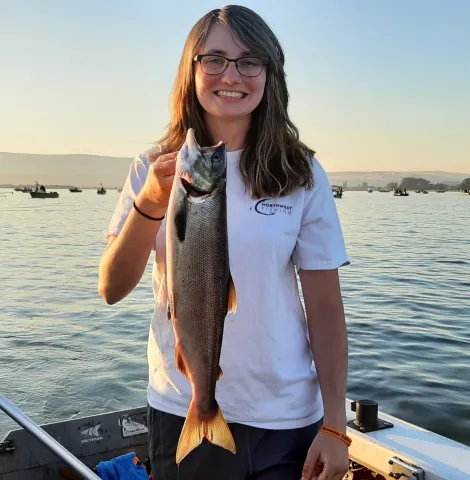
Here's a good checklist to use:
Flares (3 daytime and 3 nighttime, or 3 daytime/nighttime combos)
Life jackets for everyone on board
Throwable flotation device (if boat is 16ft or longer)
Navigation lights (if traveling between sunset and sunrise or during low visibility periods)
Horn/whistle/other sound signal
Fire extinguisher
Carbon monoxide warning sticker/placard
Not Coast Guard required, but good to have:
Manual bilge pump
Marine toolkit
Marine radio
Extra gas cans
Spare motor parts (spark plugs, hose clamps, etc.)
First aid kit
Let's not forget your boat trailer! Make sure to do a thorough visual inspection of the brakes, chains, couplers, straps, wheels, bearings, and tires for damage and wear. It's a good idea to re-grease your wheel bearings every year. Top up the air in your tires if needed. Hook up your trailer lights and verify that your signals are all working. While you're at it, make sure your registration is up to date for both your boat and trailer.
Once you've verified that both your boat and trailer are in good, safe condition, it's time to look at your other gear. Look over your rods and fix any broken guides or tips. Open up your reels and grease any and all moving parts to prepare them for the fights ahead. I like to polish up any spoons or spinners that have corroded during the off-season. This is also a good time to organize tackle boxes and stock up on any swivels, line, etc. Do it now before the season is in full swing and tackle store shelves are empty!
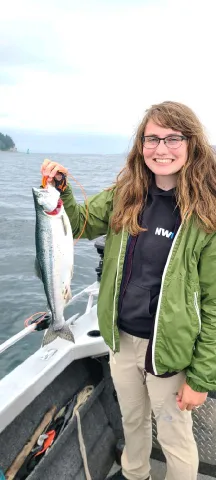
Here are a few other miscellaneous things to check before going out. Make sure you have an up-to-date fishing license and catch record card. You can either use a paper card or use the MyWDFW app. Catch record cards are not added automatically in the app. You need to add them to your cart in the MyWDFW or Fish Washington app for $0. If you're going to an area without cell phone service, the data in your card will be added locally and updated when you come back to an area with service. Be sure to familiarize yourself with the rules of the area where you'll be fishing. Don't forget to pinch your barbs and keep all fish in the water until you are 100% certain it's legal to retain. WDFW has great resources on how to identify each salmon species in both saltwater and freshwater. Please follow the rules and help protect the resource so that future generations can enjoy fresh, local salmon on the dinner table too!
/articles/getting-ready-salmon-season-hannah-pennebaker
Summer Salmon are Coming! by Mark Yuasa
That means it’s time to get all the salmon fishing gear in order and begin thinking about the kickoff to several salmon fisheries planned to open in June.
While the tentatively proposed 2026-2027 salmon fishing season package was finalized in mid-April, they won’t be officially adopted until sometime in mid-June.
The rules set by the Washington Department of Fish and Wildlife (WDFW) were submitted to the National Marine Fisheries Service within the National Oceanic and Atmospheric Administration (NOAA) Fisheries in early May.
NOAA Fisheries implements the actions through its regulatory channels under the Endangered Species Act and the Magnuson-Stevens Fishery Conservation and Management Act. Proposed fisheries are not finalized for the 2026-2027 salmon season until NOAA Fisheries approves them.
As part of the North of Falcon process, WDFW is hosting a virtual public hearing on Tuesday, June 9, from 10 a.m. to 12 p.m., and will take additional public comments. Go to this link https://wdfw.wa.gov/events/north-falcon-public-hearing-20260609 to register for the public hearing. Pre-registration is required. Final regulations will be adopted subsequent to that hearing and signed off by the WDFW Director by around mid-June. For a list of the proposed fisheries, go to https://wdfw.wa.gov/fishing/management/north-falcon/summaries. The 2026-2027 fishing regulation pamphlet will come out online around June 18. Printed copies should arrive at license dealers and at WDFW offices by June 26.
In the meantime, before rushing out the door, salmon anglers should check on any early-season summer fishery openers by going to the WDFW website (https://wdfw.wa.gov/) to see what areas are scheduled to open and for any possible emergency fishing rule changes or closures.
Where to Go in June
A much-anticipated early-summer salmon fishery occurs in Marine Area 10 (Seattle-Bremerton Area), which is scheduled to be open daily for a coho beginning June 1. Look for coho averaging 2 to 4 pounds in the shipping lanes off Jefferson Head, from the westernmost Kingston boundary line south to Presidents Point, from the Edmonds oil docks south to Richmond Beach, West Point south of Shilshole Bay, along the east side of Bainbridge Island, and the tide rips off Blake Island, Restoration Point, and the northside of Vashon Island west to Southworth.
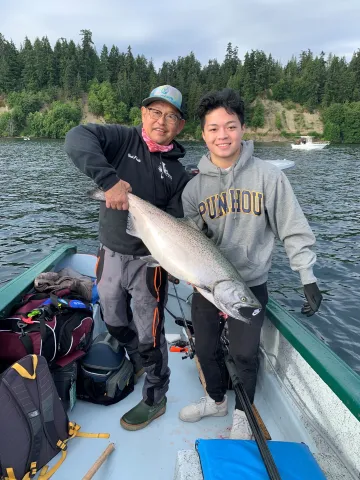
If your preference is a chance at catching an early-summer hatchery Chinook, then look no further than Marine Area 11 (Tacoma-Vashon Island). Fishing is scheduled to be open beginning June 1. These fish usually consist of a mix of resident and mature migrating Chinook averaging 7- to 15-pounds with some in the 20-plus pound category.
WDFW will monitor the June Marine Area 11 Chinook fishery, and it could close sooner in order to stay within the quota and/or other guidelines. The Chinook catch quota for the June fishery is 1,423, with a total unmarked encounter of 820 and a total sublegal encounter (Chinook under the 22-inch minimum size limit) of 2,186. The Marine Area 11 Chinook fishery is managed under two separate summer quotas, and a second window of opportunity is tentatively proposed to begin on July 23.
Look for salmon off Point Defiance Park in Tacoma from the Clay Banks to Owen Beach; Slag Pile off the Tacoma Yacht Club, outside of Gig Harbor on the “flats” area; northeast side of Vashon Island; Colvos Passage; outside of Quartermaster Harbor; and the southwest side of Vashon Island at Point Dalco. In the northern sections of Marine Area 11, try Dolphin Point and Point Robinson on the east side of Vashon Island, south of the Southworth Ferry Landing, and Apple Tree Cove to Redondo Beach.
If Marine Area 11 is slow or closes sooner than expected, another option is south of the Narrows Bridge in Marine Area 13 (South Puget Sound). Locating schools to baitfish is key to raising the bar on success for salmon at Gibson Point, Fox Island Fishing Pier, Hale Passage, Johnson Point, Anderson Island’s east side, and Point Fosdick. Marine Area 13 is scheduled to be open year-round for salmon. Anglers should check the WDFW website or the 2026-2027 regulation pamphlet for details.
Another good Chinook option is the Tulalip Terminal Area Fishery (Marine Area 8-2), which is open Fridays through Saturdays of each week and has a harvest quota of 600 Chinook. The popularity of this fishery has generated some decent action in the past few summers. The WDFW will monitor the Tulalip fishery, and it may close sooner to stay within the harvest quota.
For saltwater anglers without a boat, there are a good number of viable year-round fishing piers to catch salmon. They include the Edmonds, Fox Island, Mukilteo Ferry Landing, Seacrest in West Seattle, Dash Point Dock, Point Defiance Park Boathouse, Les Davis, and Des Moines piers.
If you prefer a freshwater salmon fishery, then make plans to head to the Skagit River (areas open vary depending on the species, hatchery Chinook or sockeye); Cascade River from the mouth to the Rockport-Cascade Road Bridge (opens beginning June 3 on Wednesdays through Saturdays only); and Nooksack River North Fork from Highway 9 Bridge to yellow marker at upstream end of the Kendall Hatchery property open through June 30. Anglers are advised to check the WDFW website for river sections open to salmon fishing and for any possible emergency fishing rule changes or closures.
Ocean Salmon Fisheries on Tap
Later this month – June 20 to be exact, which also coincides with the official first day of summer – many salmon anglers will head to the coast for the Chinook and hatchery coho ocean fishery. The recreational Chinook quota is 54,000 (up a tad from 53,750 in 2025) and a hatchery-marked coho quota of 102,900 (up from 99,720 in 2025).
Marine Area 1 (Ilwaco): Open daily beginning June 20 through Sept. 30, all salmon. The daily limit is two salmon and one Chinook only. The subarea guideline is 16,780 Chinook (16,600 in 2025), and the subarea quota is 51,450 marked coho (49,860 in 2025). Columbia Control Zone closed.
Marine Area 2 (Westport-Ocean Shores): Open daily beginning June 20 through June 28 for all salmon except coho, and the daily limit is one salmon; release all coho. Fishing is then open seven days per week from June 29 through Sept. 30, for all salmon. Beginning June 29, the daily limit is two salmon, and only one may be a Chinook. The subarea guideline is 21,910 Chinook (22,270 in 2025), with a subarea quota of 38,070 marked coho (36,900 in 2025).
Marine Area 3 (La Push): Open daily beginning June 20 through June 30, all salmon except coho, and the daily limit is one salmon; release all coho. Open seven days per week from July 1 through Sept. 30, all salmon. The subarea guideline is 2,200 Chinook (2,280 in 2025), with 2,680 marked coho subarea quota (2,590 in 2025). Beginning July 1, the daily limit is two salmon. Beginning Aug. 1, no chum retention.
Marine Area 4 (Neah Bay): Open daily beginning June 20 through June 30, all salmon except coho, and the daily limit is one salmon; release all coho. Open seven days per week from July 1 through Sept. 30, all salmon. Beginning July 1, the daily limit is two salmon. The subarea guideline is 13,110 Chinook (12,600 in 2025), with a subarea quota of 10,700 marked coho (10,370 in 2025). Beginning Aug. 1, no Chinook retention east of the Bonilla-Tatoosh line and no chum retention.
Species and size restrictions are dependent on the marine area. WDFW fishery managers will monitor the number of salmon caught in-season and may close areas earlier than scheduled if quotas or guidelines are met. In-season management may be used to sustain season length and keep harvest within the overall Chinook and coho total allowable catch.
Looking Ahead
While this column is focused on June fisheries, those looking ahead to July can look at the Strait of Juan de Fuca Marine Area 5 (Sekiu and Pillar Point) and Marine Area 6 (East Strait of Juan de Fuca) west of a true north/south line through the #2 Buoy immediately east of Ediz Hook, which are both planned to open beginning July 1 for hatchery Chinook and hatchery coho. Marine Area 7 (San Juan Islands) and Marine Area 9 (Admiralty Inlet) are planned to open July 16-18 for hatchery Chinook and hatchery coho. Marine Area 10 (Seattle and Bremerton Area) is scheduled to open on July 23-25 for a hatchery Chinook directed fishery and is also open daily for coho through Nov. 15. Marine Area 12 (Hood Canal) south of Ayock Point is proposed to open on July 1 for coho and hatchery Chinook.
Each marine area could close sooner for Chinook fishing if specific catch quotas or guidelines are met. Check the WDFW website or the 2026-2027 regulation pamphlet for areas where Chinook must be released or are closed to salmon fishing, and for other specific rules.
(Mark Yuasa is a Washington Department of Fish and Wildlife Communications Manager and longtime local fishing and outdoor writer. Contributed by Mark Yuasa, WDFW.)
/articles/summer-salmon-are-coming-mark-yuasa
Angler-Based Psychotherapy
“Welcome back to the 'Winter Doldrums’”, read the message on the marquis in front of the local fly shop. My buddy and I just glanced at each other and went inside anyway. I was hosting a bonefish trip to Mexico in less than a month. I had chosen a local fly shop to meet with everyone on the trip to assist with gear prep, clothing needs, travel details, etc. You know, all those things that a good host should do instead of just sending a pack list/itinerary and hoping for the best. Once we were inside the shop, it didn’t take long for me to realize the twelve inches of newly fallen snow and more than 60 days of frigid temperatures had won the battle for “chipper attitude of the month.” Hence the marquis message.
Notice I said “a local fly shop”, not “my local fly shop.” The majority of the guests on that particular trip were from the upper Midwest, so I chose a fly shop most convenient to them to meet. Plane tickets were cheap for me back then. Alas, the old days of AirTran. I had spoken with the shop owner in great detail about our trip meeting. I had hoped it would generate some revenue for the shop as well as help him get into the travel fishing business. It seemed like a grand idea to use his shop, and it was. As the group started filing in one by one, the vibe in the room went from mass melancholia to downright elation in just a few minutes. It’s funny how just a little bit of talk about planning a fishing trip can change the mood.
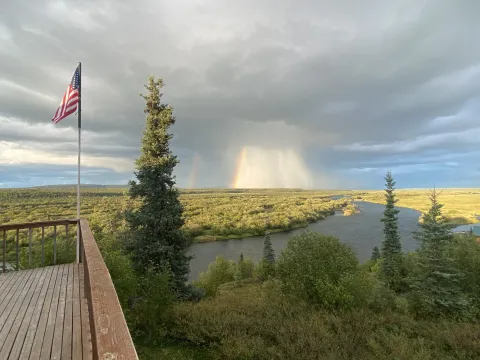
Nowadays, I plan all my fishing trips in January/February. It is a superb time to have a get together with my buddies and plan a trip. My family calls it angler-based group psychotherapy. Either way, the timing works. Over the years, we have put together so many trips. Some turned out beyond great, others not so much. Through all the group therapy down in the fly-tying shop, I have learned that following a particular planning protocol will lead to a more successful trip, no matter if I am booking a lodge or going full DIY. In addition, the amount of flexibility I am willing to bestow makes a difference as well. The following is the way I plan not only for myself but for anyone who asks me to help them plan their fishing trip. Since the last two decades of my guiding career have been based in Alaska, we will work with that planning protocol. However, you will find that using this protocol will work for just about anywhere you want to go, third world countries included.
1) Decide what species of fish you want to target.
This seems simple, doesn’t it? One would think so. Put 10 anglers in a room and start the discussion and you will find out that 6 of them are like minded when it comes to what species they want to target on any particular trip. Singling out a particular species to target for this fishing trip is the very most important part. Everything else will fall into place after that. Once this obstacle is overcome, move to step 2. Don't jump ahead in line. Trust the protocol.
2) Decide where you want to travel to target the chosen species.
This is the part where you get to control the financial commitment towards your fishing trip. For example; I have decided that I really want to catch giant, clowned up, sea run Dolly Varden. I would love to travel to some remote portion of Siberia to cast to a Dolly that has absolutely never seen a human, much less been fished to. Without a doubt, it would be the trip of a lifetime, right up until I see that it’s gonna cost a second, third, and fourth mortgage. So that gives me the opportunity to reevaluate my financial commitment to another location. Once you've got this nailed down, move to step 3.
3) Deciding when you go is pretty easy after steps one and two are done, especially with Alaska trips.
Most of the fishing is based around the migration of Pacific salmon and their lifecycle as a target species, or a food source for another species of fish that capitalizes on salmon eggs and flesh. So, if I wanted to target king salmon during the peak of the run on the Nushagak River, I would plan to be there in late June. But, if I wanted to target leopard rainbows behind spawning sockeye in a creek, I would go mid-August. Now we have that established, go to step 4.
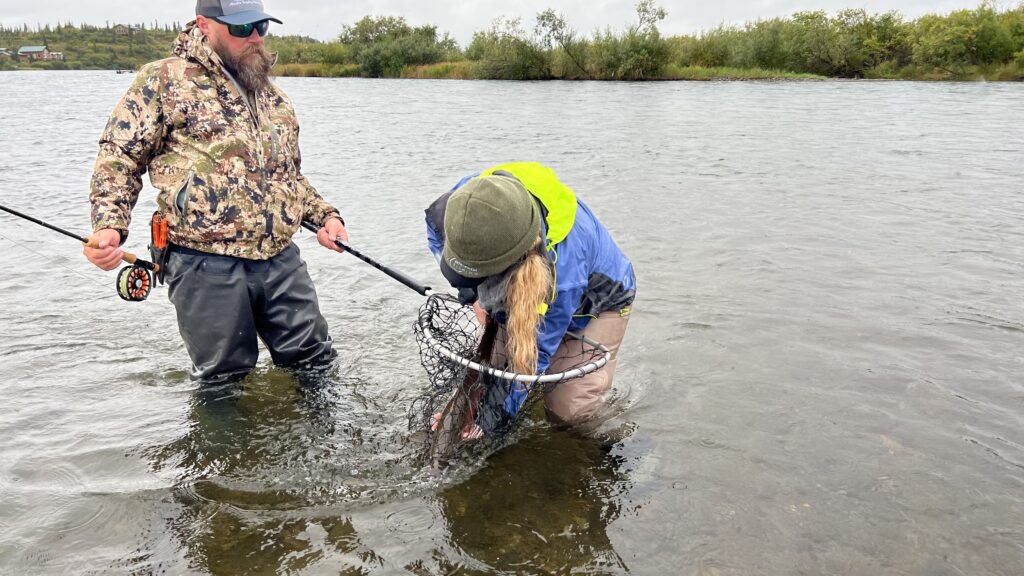
4) Last, and certainly far from least, is how to go.
How you go encompasses everything left about your trip. Are you going to DIY or book a lodge? Maybe you want to do a combination of DIY and day trips with a guide. I look at every option available, how much it costs, and figure out the bang for the buck. In some cases, a DIY trip turned into a fully guided lodge booked trip, only because the lodge had a special price that coincided with my species and timing. The lodge price wasn't much more than the DIY price estimate, and all the guess work was taken out of the program. Therefore, it was easily worth doing the lodge deal. This doesn't always happen, but it’s worth doing the research.
If you are like most of us self-taught anglers and wouldn't dream of doing a guided lodge trip even if budget wasn't a concern, I implore you to do your research. Make sure that where you are going and what you are targeting is still a viable thing. If you are doing a DIY raft trip for trout, make sure the river you chose has a good trout population in it. Alaska seems like a dreamy wonderland for all cold-water salmonids, but everything is cyclical. Just make sure. Don’t trust social media. Not all lodge owners and booking agents are telling the truth, some are just selling empty beds and boat seats. Probably the most valued asset you can find is a trip consultant. A trip consultant doesn't have any allegiance to a lodge or travel company, and for a couple hundred dollars, you will gain more information than you bargain for.
So, call your friends over, smoke a brisket, and plan a trip. It will do wonders for your mental state and seasonal affective disorder.
/articles/angler-based-psychotherapy
Alaska Memoirs
It was a foggy, rain-soaked day in King Salmon. One crusty looking grumpy guy in hip boots was clearly the ringmaster of what appeared to be a five-ring circus happening in front of me. An entire fleet of float planes were tied off to a massive wooden dock on the Naknek River. Dormant. Grounded due to the fog that socked in right down to my boots. Pilots were yelling at dock hands to get the planes loaded and the ringmaster just looked on with what seemed like surly disgust. Apparently, the tower was going to give special clearance for a few airplanes to fly. This fleet had been sitting for a couple days and everyone was anxious to make the planes do their job. It wasn't a time to be late to the party.
I sat there with my head down, staying out of the way, and waiting to be told to load up. I didn’t know a soul. I didn’t have any friends there. No family. No one. I was as alone as alone could be. The crusty looking grumpy ringmaster just called me “the kid from the south.” He finally came over to me and said “well kid, looks like I’m gonna have to fly you out to the Branch. Go ahead and load up in that 206 down there. I will be there in a minute.” I didn’t have the guts to ask what a 206 was. I knew it was an airplane but obviously it was a different airplane than the others. I knew that he knew I didn't know but, I wasn’t going to give him the satisfaction of delivering more surliness my way. Instead, I asked the dock hand that was getting yelled at the most. He was glad to load my two duffel bags and backpack in the right airplane. When the ringmaster returned, I quickly loaded up per instruction and that was it. Off to the Branch. Just like I had done it a hundred times.

Bristol Bay
That was not only my first day in Bristol Bay but, it was my first day in Alaska. Almost 20 years ago now. I had no clue how much it would change my entire life. As the years and seasons rolled on, the grumpy ringmaster stopped referring to me as “that kid from the south.” I earned my spot in the Bristol Bay community and made friends. In later years as my interest in aviation grew, the ringmaster would message me asking about weather conditions at my location. I became a part of an inner circle that once again, changed my life forever. I am grateful for all of it.
Alaska
By the time I started working in Alaska, I was no stranger to the duffel bag life. Living out of a couple of bags and a backpack was normal for me. I had just never done it in a location as remote as Bristol Bay. I read somewhere once that people who go to Alaska for work are either running from something, looking for something, or they are just too stupid to get a job anywhere else. I was all three. Maybe not too stupid to work somewhere else, but I was checking boxes on my resume. I needed Alaska experience to go where I really wanted to go. Trouble was that I had inadvertently fallen in love with Bristol Bay. She turned out to be the dirtiest mistress a fishing guide could have. The one that I couldn’t walk away from. The one that will kill you if you stay too long and ruin you if you leave too early. Bristol Bay has a way of doing both, no matter what you do.
If someone wanted to know exactly which part of Bristol Bay kept me returning for almost two decades, my answer would be “all of it.” Alaska is, without a doubt, the biggest adventure anyone can have. I’m sure somewhere in Siberia there is a bigger adventure but none of us are going there to do it any time soon. At least in my lifetime it seems that will be the case. Alaska has a certain captivating quality which speaks to those who are in fact, running, looking, or lost. Fishing fixes most everything and float planes fix everything else. Alaska has that in spades.
My Experience
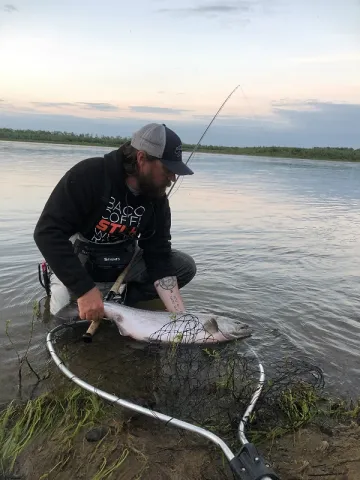
But honestly, as I sit here today trying to find a way to put in words that justly convey my experiences, the one thing that keeps coming to mind is the salmon migration. I lived for the days of hunting fresh, dime bright, chrome salmon straight in from the bay. No matter if I was up late studying weather patterns and maps trying to find a way to fly or if I was running a jet boat 50 miles one way down river to tidewater, it was the same rush. The satisfaction of watching waves of fish push a wake while migrating upriver, just as they have done for thousands of years. I lived for it. Dreamed about it. It’s the only thing I miss. This is the first summer in so many years that I have not been there for the migration. A couple nights ago, I dreamed about it. I was in the hip deep tidewater of the lower Branch. Fishing with my favorite 14’ spey rod. Chrome kings were streaming by, pushing wake. The tides were right, the skies were overcast and there was just enough wind to keep the mosquitoes at bay. Life was perfect.
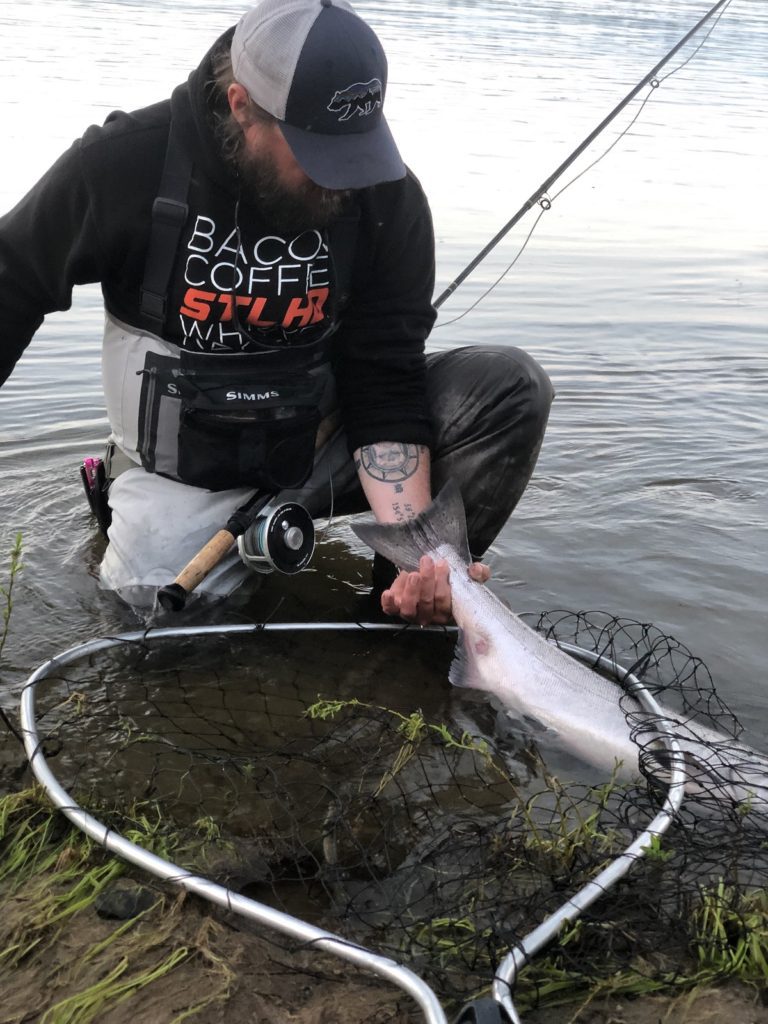
In my dream, I just stood there watching the wakes push upriver. Not fishing, not casting. Just puffing on a cigar and watching the whole thing happen. The dream was clearly a ridiculous romanticized abomination. Probably forced into my thoughts subliminally by some social media algorithm that doesn't really want people to fish, only act like they fish. Anyone that knows me knows that I can't smoke. It makes me deathly ill the next day. Worse than a hangover. I wish I could smoke cigars. It looks really cool. Most importantly though, the same people that know I can't smoke also know that if I’m breathing and capable of standing in the lower Branch, there is absolutely no chance I am not gonna swing for kings on a fresh high tide. No chance. Not now, not ever. It’s the one thing that will bring me out of retirement. Maybe next season..........
/articles/alaska-memoirs