Carp Bow-Fishing
A slight westerly wind nudged the port-side of my 14’ Smokercraft, sending me into a silent and gentle drift through an endless sea of lily pads. It was a quiet approach, ideal for sneaking up on unsuspecting prey, yet the piercing glare of the setting sun reflecting off the water rendered my eyes almost completely useless. Through a squinting gaze, I struggled to make out what looked like a slight ripple in the water, followed by a dorsal fin breaching the surface. Drawing back on my bow I prepared for what would not only be my last shot of the evening, but possibly the biggest common carp I’ve ever taken with a bow. A twang from the string pierced the silence, and at a 50 lb. draw weight the arrow pounded through the water, gliding right over the top of the fish. A near miss, and only one of many that I will experience when attempting to land carp through arguably one of the most difficult methods of fishing.
Beauty of Bow-Fishing
Bowfishing for carp is the crème de la crème of outdoor activities for those who have an affinity for both fishing and hunting. It combines two beloved pastimes in a way that is both unique and challenging, plus, it fulfills that nagging itch that plagues most hunters this time of year as they eagerly await fall hunting season. Just like fishing with a rod and reel, bowfishing is a game of patience. The beauty of bowfishing however, is that instead of sitting and waiting while you troll your rig under the water or wait for a bit of movement at the tip of your rod, you instead get to spend your time deeply focused as your ears are tuned into the sounds of thrashing water, or carp feeding at the surface. You’re in constant engagement as you scan the water looking for slight movements in the vegetation, or for fish jumping or flapping at the surface, or better yet, for a fish swimming within shooting range.
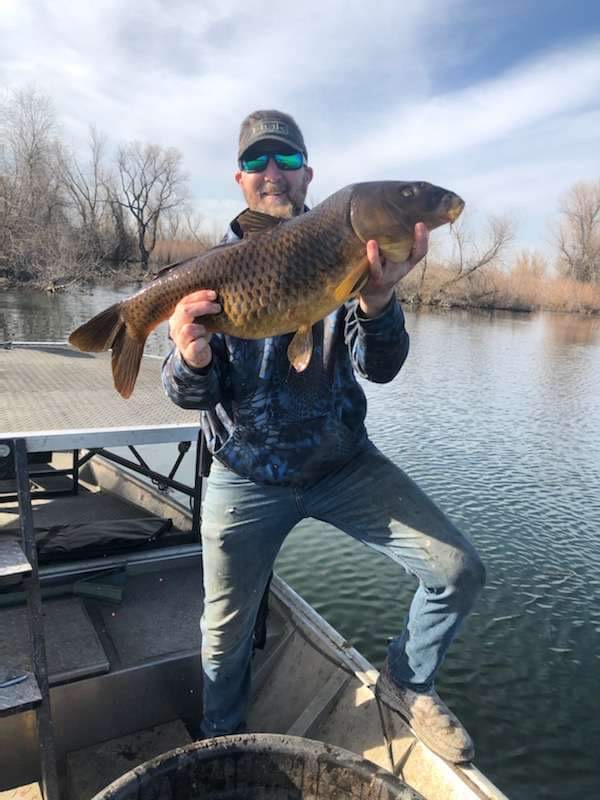
Aside from the large doses of adrenaline that are part and parcel to bowfishing, those who choose this method of taking on common carp also get the added benefit of taking part in lake and river ecosystem restoration. Though carp were introduced by well-intended folks, they are classified by the Washington State Department of Fish and Wildlife as an aquatic invasive species. These fish are highly fecund; with females laying up to 300,000 eggs per spring. Their ferocious appetites result in the removal of beneficial vegetation that would otherwise provide viable spawning habitat for native fish, they increase the amount of suspended solids in the water; causing increased turbidity, and they have been known to have a negative impact on phytoplankton production. Not only is the removal of common carp encouraged in Washington state, its supported to the extent that the WDFW does not require anglers to have a fishing license to catch or shoot them.
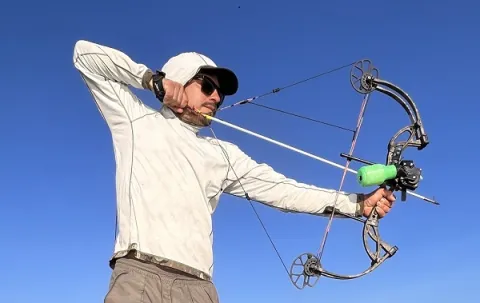
Looking to get into bowfishing for carp? If you’re already an archery hunter, then you’re over halfway there. For under 200 dollars, (at the time I write this) compound bows can be converted for bowfishing with the addition of a bottle reel, an arrow holder, pronged arrows, and some safety slides to prevent fishing line mishaps. Bottle reels are often preferred over spinning reels as they can hold heavier line for larger fish. The downside is that they require you to hand-line in your catch as opposed to reeling. If you own a high dollar bow, there’s a good chance you don’t want it getting banged and bloodied up in the boat, if that’s the case then there are plenty of options out there for bows built specifically for bowfishing.
Technique
Bowfishing is essentially a spot and stalk hunt through the shallows. You can drift slowly in a boat, covering the ground as you move though the water, or you can anchor in a spot where the fish are present and actively feeding on vegetation. Another method is to simply wade in the water and get on your fish that way. Whether in a boat or on foot, the key difference between bowfishing and land hunting is that you won’t be using sights when you aim at your target. Bowfishing, for the most part, is done with instinctive aiming. This means that you look at the target, aim, and shoot. This method takes a bit of practice to become proficient at, but most bow fishermen will find that instinctive shooting comes quite naturally and is a quick and effective way to get off shots.
Light refraction might be one of the biggest challenges you face when first getting started with bowfishing. When light traveling through air hits denser water, it slows down and bends. This causes the perceived image of the fish we see in the water to be above where the fish is actually located. Because of this, you have to aim low to get your shot on target. Like instinctive shooting, adjusting to light refraction takes practice, but as you miss time and time again, you’ll eventually find that sweet spot and gain an intuitive understanding of where the arrow needs to go.
Where To Fish
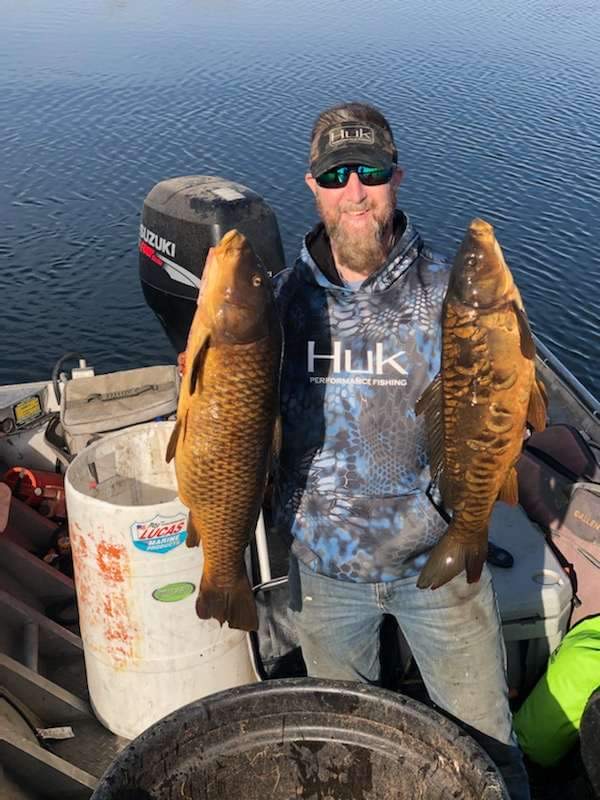
Common carp can be spotted throughout the expanse of Washington state, although, akin to many of the region's fisheries, the eastern part of the state, east of the Cascades, is where the majority of prime locations for these fish can be found. Here's a compilation of lakes and ponds across Washington State where common carp can be encountered:
Eastern Washington
- Lake Spokane
- Whitestone Lake
- Palmer Lake
- Horse Thief
- Elton Pond
- North Myron Lake
- Zillah Winery Pond
- Soda Lake
- Banks Lake
- Billy Clapp Lake
- Moses Lake
- Evergreen Lake
- Potholes Reservoir
- Hideaway Lake
- Big Bow Lake
- Lake Wallula
- Columbia Park Pond
Western Washington
- Silver Lake
- Horseshoe Lake
- Lake Sacajawea
- Kress Lake
- Vancouver Lake
- Kineline Pond
- Lacamas Lake
- Lake Washington
- Green Lake
- Long’s Pond
- Black Lake
- Blackmans Lake
So, whether you’re an archery hunter who’s spent a little too much time day dreaming about the fall hunt and is just itching to go fling off some arrows, or if you’re an angler who wants to both diversify and add excitement to their outdoor lifestyle, bowfishing for Washington common carp might be exactly what you’re looking for.
/articles/carp-bow-fishing
Alaska Memoirs
It was a foggy, rain-soaked day in King Salmon. One crusty looking grumpy guy in hip boots was clearly the ringmaster of what appeared to be a five-ring circus happening in front of me. An entire fleet of float planes were tied off to a massive wooden dock on the Naknek River. Dormant. Grounded due to the fog that socked in right down to my boots. Pilots were yelling at dock hands to get the planes loaded and the ringmaster just looked on with what seemed like surly disgust. Apparently, the tower was going to give special clearance for a few airplanes to fly. This fleet had been sitting for a couple days and everyone was anxious to make the planes do their job. It wasn't a time to be late to the party.
I sat there with my head down, staying out of the way, and waiting to be told to load up. I didn’t know a soul. I didn’t have any friends there. No family. No one. I was as alone as alone could be. The crusty looking grumpy ringmaster just called me “the kid from the south.” He finally came over to me and said “well kid, looks like I’m gonna have to fly you out to the Branch. Go ahead and load up in that 206 down there. I will be there in a minute.” I didn’t have the guts to ask what a 206 was. I knew it was an airplane but obviously it was a different airplane than the others. I knew that he knew I didn't know but, I wasn’t going to give him the satisfaction of delivering more surliness my way. Instead, I asked the dock hand that was getting yelled at the most. He was glad to load my two duffel bags and backpack in the right airplane. When the ringmaster returned, I quickly loaded up per instruction and that was it. Off to the Branch. Just like I had done it a hundred times.

Bristol Bay
That was not only my first day in Bristol Bay but, it was my first day in Alaska. Almost 20 years ago now. I had no clue how much it would change my entire life. As the years and seasons rolled on, the grumpy ringmaster stopped referring to me as “that kid from the south.” I earned my spot in the Bristol Bay community and made friends. In later years as my interest in aviation grew, the ringmaster would message me asking about weather conditions at my location. I became a part of an inner circle that once again, changed my life forever. I am grateful for all of it.
Alaska
By the time I started working in Alaska, I was no stranger to the duffel bag life. Living out of a couple of bags and a backpack was normal for me. I had just never done it in a location as remote as Bristol Bay. I read somewhere once that people who go to Alaska for work are either running from something, looking for something, or they are just too stupid to get a job anywhere else. I was all three. Maybe not too stupid to work somewhere else, but I was checking boxes on my resume. I needed Alaska experience to go where I really wanted to go. Trouble was that I had inadvertently fallen in love with Bristol Bay. She turned out to be the dirtiest mistress a fishing guide could have. The one that I couldn’t walk away from. The one that will kill you if you stay too long and ruin you if you leave too early. Bristol Bay has a way of doing both, no matter what you do.
If someone wanted to know exactly which part of Bristol Bay kept me returning for almost two decades, my answer would be “all of it.” Alaska is, without a doubt, the biggest adventure anyone can have. I’m sure somewhere in Siberia there is a bigger adventure but none of us are going there to do it any time soon. At least in my lifetime it seems that will be the case. Alaska has a certain captivating quality which speaks to those who are in fact, running, looking, or lost. Fishing fixes most everything and float planes fix everything else. Alaska has that in spades.
My Experience
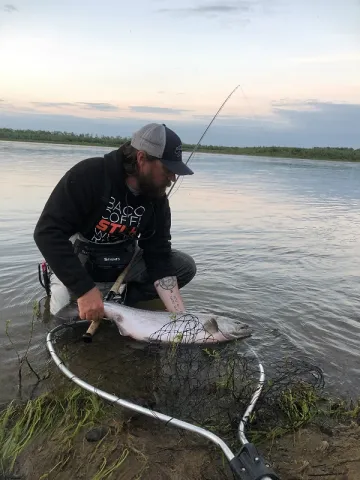
But honestly, as I sit here today trying to find a way to put in words that justly convey my experiences, the one thing that keeps coming to mind is the salmon migration. I lived for the days of hunting fresh, dime bright, chrome salmon straight in from the bay. No matter if I was up late studying weather patterns and maps trying to find a way to fly or if I was running a jet boat 50 miles one way down river to tidewater, it was the same rush. The satisfaction of watching waves of fish push a wake while migrating upriver, just as they have done for thousands of years. I lived for it. Dreamed about it. It’s the only thing I miss. This is the first summer in so many years that I have not been there for the migration. A couple nights ago, I dreamed about it. I was in the hip deep tidewater of the lower Branch. Fishing with my favorite 14’ spey rod. Chrome kings were streaming by, pushing wake. The tides were right, the skies were overcast and there was just enough wind to keep the mosquitoes at bay. Life was perfect.
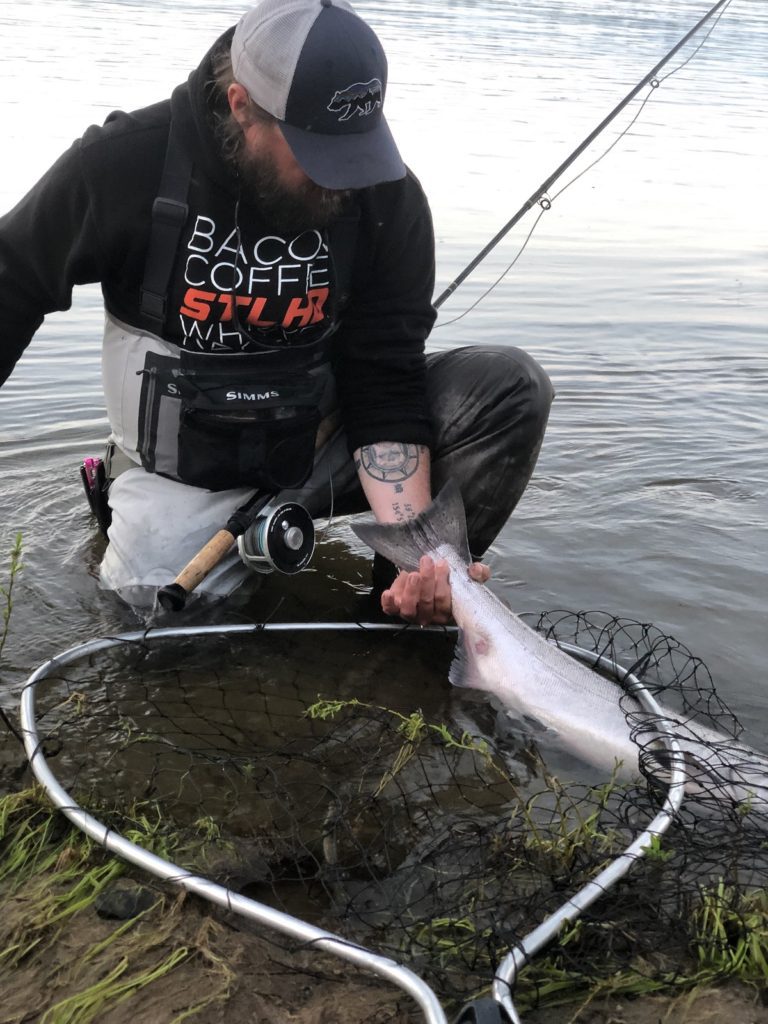
In my dream, I just stood there watching the wakes push upriver. Not fishing, not casting. Just puffing on a cigar and watching the whole thing happen. The dream was clearly a ridiculous romanticized abomination. Probably forced into my thoughts subliminally by some social media algorithm that doesn't really want people to fish, only act like they fish. Anyone that knows me knows that I can't smoke. It makes me deathly ill the next day. Worse than a hangover. I wish I could smoke cigars. It looks really cool. Most importantly though, the same people that know I can't smoke also know that if I’m breathing and capable of standing in the lower Branch, there is absolutely no chance I am not gonna swing for kings on a fresh high tide. No chance. Not now, not ever. It’s the one thing that will bring me out of retirement. Maybe next season..........
/articles/alaska-memoirs