How to fish for Columbia River Walleye
How to fish for Columbia River Walleye: The Easy Way!
By Kyle Jones
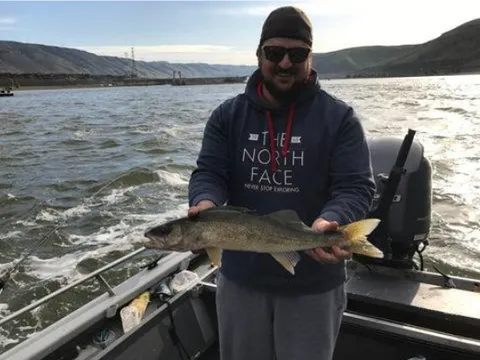
The Columbia River in Washington State and Oregon is one of the premier destination walleye fisheries in the United States. Anglers come from all around to target Walleye in the mighty Columbia River. The Columbia River is known, not only as a possible location for the next World Record Walleye, but also as a great place to catch unbelievable numbers of great eating size fish.
The point of this article is to be a starting point for people looking to take advantage of this great fishery. This is not an end all be all on Columbia River Walleye, just a simple article to get people catching fish fast. Catching good numbers of 14 – 20 inch Walleye on the Columbia River is easy, and with a little knowledge under your belt, you too will be putting lots of these tasty buggers in the boat.
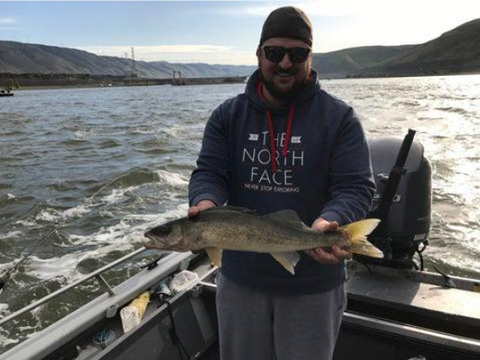
How to Find Columbia River Walleye
It goes without saying that you need to “find fish to catch fish,” and when it comes to a beginner staring at the mighty Columbia River it’s easy to get overwhelmed. Walleye are an ultra-predator and they will always position themselves in the best possible locations to find food. The Columbia River is a literal conveyor belt of food for foraging walleye and positioning yourself in the correct locations can make or break your trip.
During the spring and summer there are millions of out migrating juvenile salmon, steelhead, and shad making the downstream migration to the ocean. Walleye take every advantage of this and position themselves to make the most of these easy meals. During this out migration period there is often a lot of current in the Columbia. Walleye are not particularly strong swimmers and so they gravitate to the slower moving parts of the river. What we do is locate the areas of the river that are moving slower than the main flow and concentrate our efforts there. Large points, islands, inside bends, rip rap, and other natural structures can create these current breaks. Walleye will use these areas to ambush whatever can fit in their mouth.
As a general rule of thumb for most of the areas below dams that we fish in the spring and early summer we are looking for water 20-50 feet deep in areas with very little current, or just out of the main flow, adjacent to shallow water. The adjacent to shallow water is key, as walleye will move up into the shallows to feed on bait fish at night, and like to position themselves close to their nightly food source. By targeting the deep slow moving water near shallow feeding flats we put ourselves on large numbers of feeding walleye during daylight hours.
How to Catch Columbia River Walleye: Easy rigging for immediate success
By far the quickest and easiest way to get into Columbia River walleye is to use bottom bouncers and worm harnesses. This method makes it easy for beginners to not only make and maintain contact with the bottom, but also insure that their gear is in the walleye zone all the time. Columbia River walleye in current are tight to the bottom. These fish live and feed within the bottom foot of the water column so maintaining constant bottom contact is a must

Bottom bouncers (also called Bottom Walkers) come in all sorts of different sizes ranging from as small as a quarter ounce to as large as four ounces. Even larger bottom bouncers are available, but they often need to be ordered from custom manufactures. Generally speaking for almost all the situations we fish during spring and early summer we find that the three and four ounce bottom bouncers to be our go to size. Typically when fishing four anglers the rods near the bow are rigged with four ounces and the rods out the stern are rigged with three ounces.

When it comes to the worm harness the options are unlimited. If you go to a tackle shop that sells walleye gear you will notice the many pre tied rigs from companies such as Mack’s Lure and other in house pre tied gear. All of this stuff works, but for our purpose we like to keep things simple and tie our own. We basically use three different styles of rigs and below we have listed and pictured some of our favorites. We fish all these rigs on leaders lengths of three to four feet.
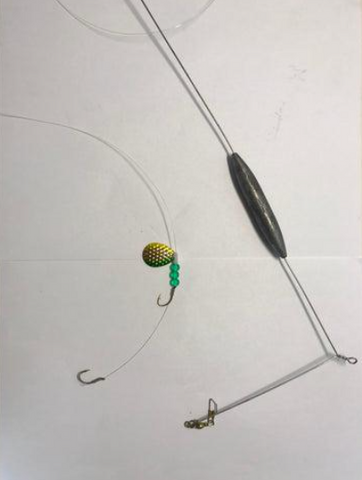
Spinner Blade rigs: These rigs are very simple and consist of a quick change clevis, size 1-4 colorado spinner blade, a few beads, and two #4 octopus style hooks tied four inches apart.
Smile Blade Rigs: This is again a very simple rig and consists of a size .8, 1.1, or 1.5 smile blade, a few beads, and the same two #4 octopus hooks tied four inches apart.
Corky Rig: This is by far the most simple rig we fish and seems to produce the best as the water starts to warm in late spring through early summer. It is simply one size #10 corky slid down the line on top of the two #4 octopus hooks.
How to catch Columbia River Walleye: Presentation
In general my favorite way to present a bottom bouncer and worm harness is to “troll” them down stream with the current. I put the quotations on the word troll because this is trolling in a very loose sense of the term. What we are actually doing is moving just fast enough to maintain the ability to steer the boat downstream. Enough emphasis cannot be placed on the need to go slow! When using bottom bouncers in this scenario I am often in and out of forward and neutral on my kicker motor and will often times spend a lot of the drift in neutral. Remember that you are already fishing in current that is pushing you downstream, so think of this more as a controlled drift.
The key to this presentation is to keep your gear on the bottom. The best way to do this is to fish with the rod in your hand. We see a lot of guys act like they are fishing for salmon and let their bottom bouncer and worm harness out, then let the rod rot in a rod holder. Don’t be that guy! This is active fishing and when you hold the rod in your hand you can make sure that you are always very near the bottom. When starting your troll slowly let out your gear so that it doesn’t get tangled, by slowly dropping your tackle you will ensure that you are actually fishing. Feel for the arm of the bottom bouncer to touch bottom, once you feel it bump bottom put your thumb on the spool and quit letting out line. Now you are fishing. To make sure you stay in the strike zone you need to actively fish your rod. At this point I start to lift the rod tip a few inches, I am intentionally trying to lift the arm of the bouncer off the bottom, and then drop my rod toward the water. If you do not feel it touch bottom you need to feed more line. You should be able to maintain contact with the bottom with every small lift and drop. I almost always fish the run with my thumb on the spool and prepared to feed more line. If you begin to feel the bouncer dredging bottom you need to reel in a few feet, remember that you just want the arm of the bouncer hitting bottom, as this will make sure your gear is at the correct level and minimize the inevitable hang ups on the bottom.
The second thing that the short lift and drop of the rod will help with is detecting bites. The bite from even a very large walleye is very subtle with this method. If at any time, while doing your lift and drop for the bottom you feel any extra weight or pressure on the rig you are getting a bite. When I feel the added pressure on my lift I continue a nice steady lift through the weight. There is no need for a hard hook set. You will miss fish if you try to give a big rip. Simply just lift through the weight and start reeling in your fish. Often times these fish are just barely hooked so bring them in nice and slow and have the net ready!
How to Catch Columbia river Walleye: Rods and Reel For Bottom Bouncing
The ideal rod and reel for this method of fishing can be debated for decades, but the bottom line is that it needs to be able to handle 3-4 ounce bottom bouncers, while still having a soft tip to detect the subtle take of a walleye.
Our favorite rod for bottom bouncing is a Gloomis E6X 7’1” 8-17 pound line rating in a medium heavy power. The model number is E6X 853C WBBR. While this rod is designed specifically for this use we also have used and really like an 8’6” 8-17 line rated medium heavy steelhead casting rod. This line rating seems to handle the weight of the rig nicely, but still lets you feel the subtle take.
For a reel we like a quality low profile casting reel such as the Shimano Curado. The reason we like a casting reel in this situation is that we are always adjusting how much line we have out and the ability to release line so easily and maintain feel of the bottom is much easier with the casting reel. We spool the reel with 30# power pro in either the high vis yellow or the low vis green. This is just personal preference here so go with the one you like.
In closing I hope that this article is of help to anyone who is trying to get into the wonderful walleye fishing the Columbia River has to offer. We love seeing new walleye anglers and if you decide to get a crash lesson on walleye fishing with us we will be happy to show you just how we do it and get you started off on the right foot. If you want more information on the walleye fishing trips we offer or to book a trip with us click here .
I just wanted to end on a small note of conservation. Even though these fish are not native to the Columbia River we want this exciting fishery to continue well into the future. I encourage anyone targeting walleye to please release the larger 25 plus inch fish. These larger fish are our brood stock, and their survival is key to having this fishery forever. The smaller fish are absolutely fantastic to eat and with the ability to catch them by the bucket load there is no real need to kill the larger fish.
Jones Sport Fishing is owned and operated by Kyle and Dani Jones. Kyle’s passion for the outdoors has driven him to commit to making his living as a professional fishing guide. Kyle prides himself in his commitment to make sure that your fishing trip meets and exceeds expectations, and is dedicated to serving his clients. You can follow Kyle on Northwest Fishing Reports and his web site JonesSportfishing.com
*This article was originally published March 2018.
/articles/how-fish-columbia-river-walleye
Carp Bow-Fishing
A slight westerly wind nudged the port-side of my 14’ Smokercraft, sending me into a silent and gentle drift through an endless sea of lily pads. It was a quiet approach, ideal for sneaking up on unsuspecting prey, yet the piercing glare of the setting sun reflecting off the water rendered my eyes almost completely useless. Through a squinting gaze, I struggled to make out what looked like a slight ripple in the water, followed by a dorsal fin breaching the surface. Drawing back on my bow I prepared for what would not only be my last shot of the evening, but possibly the biggest common carp I’ve ever taken with a bow. A twang from the string pierced the silence, and at a 50 lb. draw weight the arrow pounded through the water, gliding right over the top of the fish. A near miss, and only one of many that I will experience when attempting to land carp through arguably one of the most difficult methods of fishing.
Beauty of Bow-Fishing
Bowfishing for carp is the crème de la crème of outdoor activities for those who have an affinity for both fishing and hunting. It combines two beloved pastimes in a way that is both unique and challenging, plus, it fulfills that nagging itch that plagues most hunters this time of year as they eagerly await fall hunting season. Just like fishing with a rod and reel, bowfishing is a game of patience. The beauty of bowfishing however, is that instead of sitting and waiting while you troll your rig under the water or wait for a bit of movement at the tip of your rod, you instead get to spend your time deeply focused as your ears are tuned into the sounds of thrashing water, or carp feeding at the surface. You’re in constant engagement as you scan the water looking for slight movements in the vegetation, or for fish jumping or flapping at the surface, or better yet, for a fish swimming within shooting range.
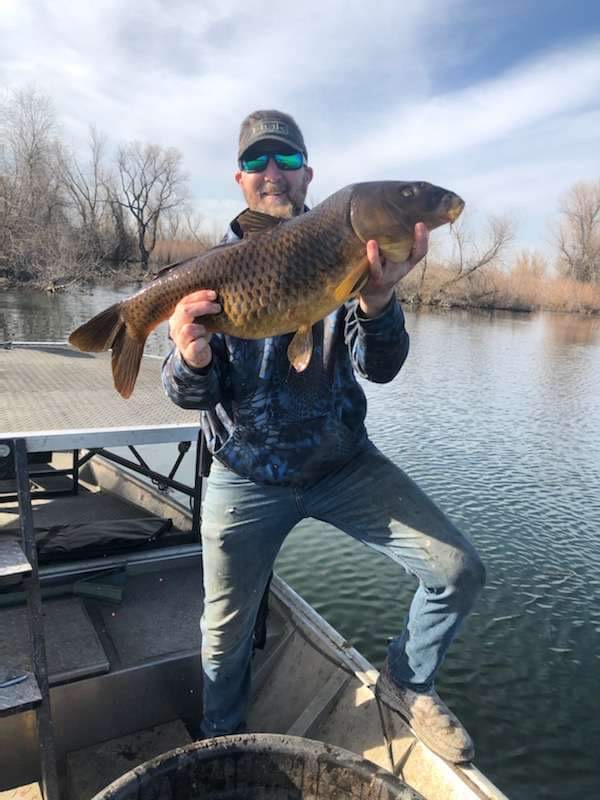
Aside from the large doses of adrenaline that are part and parcel to bowfishing, those who choose this method of taking on common carp also get the added benefit of taking part in lake and river ecosystem restoration. Though carp were introduced by well-intended folks, they are classified by the Washington State Department of Fish and Wildlife as an aquatic invasive species. These fish are highly fecund; with females laying up to 300,000 eggs per spring. Their ferocious appetites result in the removal of beneficial vegetation that would otherwise provide viable spawning habitat for native fish, they increase the amount of suspended solids in the water; causing increased turbidity, and they have been known to have a negative impact on phytoplankton production. Not only is the removal of common carp encouraged in Washington state, its supported to the extent that the WDFW does not require anglers to have a fishing license to catch or shoot them.
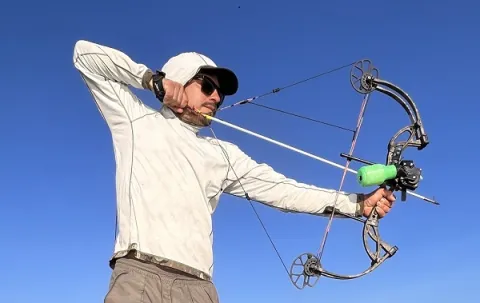
Looking to get into bowfishing for carp? If you’re already an archery hunter, then you’re over halfway there. For under 200 dollars, (at the time I write this) compound bows can be converted for bowfishing with the addition of a bottle reel, an arrow holder, pronged arrows, and some safety slides to prevent fishing line mishaps. Bottle reels are often preferred over spinning reels as they can hold heavier line for larger fish. The downside is that they require you to hand-line in your catch as opposed to reeling. If you own a high dollar bow, there’s a good chance you don’t want it getting banged and bloodied up in the boat, if that’s the case then there are plenty of options out there for bows built specifically for bowfishing.
Technique
Bowfishing is essentially a spot and stalk hunt through the shallows. You can drift slowly in a boat, covering the ground as you move though the water, or you can anchor in a spot where the fish are present and actively feeding on vegetation. Another method is to simply wade in the water and get on your fish that way. Whether in a boat or on foot, the key difference between bowfishing and land hunting is that you won’t be using sights when you aim at your target. Bowfishing, for the most part, is done with instinctive aiming. This means that you look at the target, aim, and shoot. This method takes a bit of practice to become proficient at, but most bow fishermen will find that instinctive shooting comes quite naturally and is a quick and effective way to get off shots.
Light refraction might be one of the biggest challenges you face when first getting started with bowfishing. When light traveling through air hits denser water, it slows down and bends. This causes the perceived image of the fish we see in the water to be above where the fish is actually located. Because of this, you have to aim low to get your shot on target. Like instinctive shooting, adjusting to light refraction takes practice, but as you miss time and time again, you’ll eventually find that sweet spot and gain an intuitive understanding of where the arrow needs to go.
Where To Fish
Common carp can be spotted throughout the expanse of Washington state, although, akin to many of the region's fisheries, the eastern part of the state, east of the Cascades, is where the majority of prime locations for these fish can be found. Here's a compilation of lakes and ponds across Washington State where common carp can be encountered:
Eastern Washington
- Lake Spokane
- Whitestone Lake
- Palmer Lake
- Horse Thief
- Elton Pond
- North Myron Lake
- Zillah Winery Pond
- Soda Lake
- Banks Lake
- Billy Clapp Lake
- Moses Lake
- Evergreen Lake
- Potholes Reservoir
- Hideaway Lake
- Big Bow Lake
- Lake Wallula
- Columbia Park Pond
Western Washington
- Silver Lake
- Horseshoe Lake
- Lake Sacajawea
- Kress Lake
- Vancouver Lake
- Kineline Pond
- Lacamas Lake
- Lake Washington
- Green Lake
- Long’s Pond
- Black Lake
- Blackmans Lake
So, whether you’re an archery hunter who’s spent a little too much time day dreaming about the fall hunt and is just itching to go fling off some arrows, or if you’re an angler who wants to both diversify and add excitement to their outdoor lifestyle, bowfishing for Washington common carp might be exactly what you’re looking for.
/articles/carp-bow-fishing