Alpine Kokanee Trifecta By Mike Carey
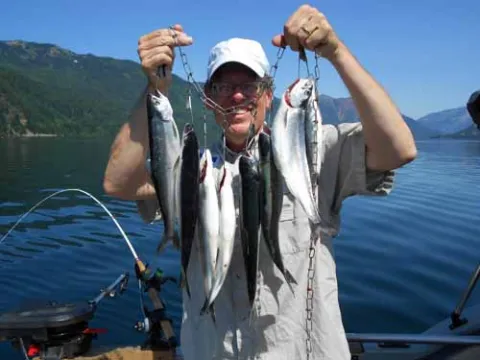
There’s an Alpine Kokanee Trifecta that is often overlooked compared to the more well-known and popular kokanee fisheries. What if I told you that within an hour and a quarter of traffic-free driving from Seattle, you could enjoy pristine Alpine lake fishing with little to no other boats on the water and have the chance to catch generous limits of kokanee every time out? No way, you say? It’s true and waiting for you. But a little planning and tempering of expectations is required. These fisheries won’t yield 18-20” Lake Roosevelt kokanee, but they do have an abundance of under-fished kokanee that will still give you a nice bounty to bring home. Have I got your attention yet?
The Alpine Kokanee Trifecta I speak of is familiar to many, but passed by with a reputation of having small kokanee. I’m here to tell you that it is a myth. While it’s true you won’t find those 20” kokanee, you will find fish that range from 10” up to 14”. The lakes I’m referring to?
Keechelus, Kachess, and Cle Elum. Yup, that first big reservoir as you crest Snoqualmie Pass going east is one of three Alpine Kokanee Lakes that I think you should make plans to visit. Let’s look at them one by one, going from west to east.
Keechelus Reservoir
This lake is the one that we all gaze at as we are driving somewhere else. It’s also the one that, come August, turns into a giant stump field. At 2,408 acres, it’s the smallest of the three lakes. At 2,521 feet of elevation, it’s also the highest of the three lakes. The lake holds rainbow, cutthroat, whitefish, bull trout (which are endangered and are to be carefully released), burbot, and kokanee. Of the three lakes we will look at, this lake probably has the smallest kokanee in it. But check this out – the 2016 stocking numbers for this lake were a whopping 256,892 kokanee! In 2015, it was 265,000, and in 2014, it was 238,000 kokanee. So, bottom line, that’s a lot of kokanee swimming around waiting to be caught!
Here’s the catch (there’s always a catch, right?). This reservoir gets drawn down as the summer progresses. Seriously drawn down, as in not able to launch a boat drawn down. So if you want to fish the Trifecta next year, you’d best plan on hitting this lake first. The primary boat launch is found on the west end of the lake. The earthen dam is on the far east end of the lake. Be aware that this lake, perhaps the worst of the three, is prone to heavier winds and whitecaps. Be prepared to get back to the launch if the wind picks up. The lake is also the least serene of the three lakes, as the constant hum of the freeway and view of semis roaring past are a sharp contrast to the beautiful surrounding mountains. This lake is a one-pole-only lake.
Kachess Reservoir
If you’re looking for a beautiful camping location with stunning scenery, this is your lake. The Kachess Forest Service Campground is one of the nicer ones around. Plenty of camping spots and some larger pull-through sites make it “boat friendly”. The restrooms are - surprise – running water and flush toilets! The boat launch is a two-lane concrete ramp with a nice grade and plenty of surrounding shoreline to pull your boat up on. Winds can be an issue as it’s not in a sheltered location. Parking is good.
Like Keechelus, Kachess holds a nice variety of fish. Rainbow, cutthroat, bull trout (protected), whitefish, and burbot can all be found in addition to the kokanee. As to kokanee stocking, in 2014, WDFW stocked 365,000 fish, 2015 490,000, and for 2016 413,098. You’ll get into the kokanee as soon as you launch the boat. Motor out a hundred yards and watch as your depth finder shows the bottom dropping to 180 feet and deeper. And then you’ll see your fish finder light up with kokanee arches 35 to 80 feet deep. You’ll find fish all the way the length of the lake down to the dam end, over four miles away. But beware: if you head north, the lake shallows up at a choke point north of the launch, and you’ll find yourself in ten feet of water.
On our most recent trip, we found a great early morning bite that turned off at 8:30am. After an hour of fruitless trolling, we ran all the way down to the dam and were rewarded with good action the rest of the morning. Don’t be afraid to leave non-biting fish in search of the biters! On this trip, we also caught and safely released a powerful 16” bull trout. What a thrilling fight on kokanee gear. We hooked him at 55 feet deep on the downrigger. To help protect these beautiful fish, bring a knotless net.
Kachess is 4,377 acres and has an elevation of 2,258 feet.
Cle Elum Reservoir
The final gem of our trifecta is Cle Elum Reservoir. Although the farthest of the three lakes, it’s still a day trip for the Seattle-area angler. Cle Elum also has a Forest Service campsite and a nice paved launch (an old road, actually). Not as nice as Kachess, but the scenery is again spectacular, and there is no freeway sound to ruin the experience. Cle Elum also has the nearby town of Roslyn to grab provisions and a nice dinner at the end of your day of fishing.
Cle Elum is the largest of the three reservoirs at 4,566 acres. It’s the lowest lake, at 2,227 acres. As the summer water drawdown lowers the lake, the ramp becomes high and dry. Boaters will then launch among the stumps on the southeast side of the lake by the dam. Watch your props and winds out of the north, as this can be a risky proposition.
The lake holds the same species as our other two lakes, with a notable and significant difference. First, there is Mackinaw trout in the lake.
These fish are on WDFW and the Yakima Tribe’s radar screen to remove from the lake. Why, you may ask, when some dandy lakers up to 15 pounds and more have been caught? Well, in the (hopefully) not too distant future, Cle Elum may join Baker and Wenatchee lakes as a destination sockeye fishery. That’s right; the Yakima Tribe has been working since 2009 to restore a sockeye run to Lake Cle Elum. It works like this: the sockeye are captured at Priest Rapids Dam and transferred to the lake. They then run up the Cle Elum River and spawn. When the fish hatch, they spend 1-2 years in the lake and then leave the lake via a flume around an earthen dam to the Yakima River. From the Yakima River, they will swim to the Columbia, and traveling on another 330 miles, around four Columbia River dams, to the Pacific Ocean.
Here’s more information from the Yakima Nation Fisheries website:
“One thousand adult sockeye were transplanted in the summer of 2009, 2,500 in 2010, 4,500 in 2011, 10,000 in 2012, and 4,000 in 2013. The sockeye successfully spawned in tributaries above the Lake in all years, becoming the first sockeye to spawn in the Yakima Basin in over 100 years. Juveniles from the 2009 brood were observed migrating downstream at Roza and Prosser Dams in 2011. Preliminary data from trapping operations at Prosser indicated a 2011 smolt outmigration of approximately 80,000 sockeye. From July to October 2013, 701 Sockeye migrated to the Yakima River Basin (numbers reported on October 17, 2013). So far, 211 sockeye have migrated back home to the Yakima River Basin (updated July 1, 2014). Once these fish move north to Roza Dam they will be transported into Lake Cle Elum or the Cle Elum River. So far, we have trapped and hauled 4,500 sockeye from Priest Rapids to Lake Cle Elum. We will continue to monitor fish run numbers and trap and haul accordingly (updated July 1, 2014).”
So where are the kokanee, you may ask? Well, WDFW has stopped stocking Lake Cle Elum since this recovery process started. But that doesn’t mean you can’t catch kokanee.
According to a fisheries biologist I spoke with on the subject, some of the kokanee you catch are actually sockeye that have decided to not migrate back to the ocean. Instead, they spend their adult lives in Lake Cle Elum, and then spawn as well in the Cle Elum River. In order to protect the sockeye in Cle Elum, WDFW has placed a slot limit of 9” to 15” on kokanee in Cle Elum. The limits are different in Cle Elum as well. As of 2016, Keechelus and Kachess had ten kokanee limits, not including trout. Cle Elum has a five-fish limit, including trout. Cle Elum is also the only lake of the three to allow the two-pole endorsement. Finally, there is NO limit on lakers, brown, and eastern brook trout. WDFW wants these non-native species out of the lake to benefit juvenile sockeye salmon and encourages anglers to help in that effort. As always, be sure to check current regs for any updates.
There you have it. Three Alpine Lake Kokanee gems, all day trips from the greater Seattle region offer the angler spectacular scenery and fisheries that produce abundant (if not huge) kokanee. With gas prices at historical lows, now is the time to plan a trip to these great destinations and leave the masses behind.
I will offer a couple of words of caution for boating anglers. First, the winds blowing down the mountainsides on these three lakes can kick up and blow whitecaps, especially in the afternoon. So, keep an eye on the weather and be ready to head back in if things start blowing. Second, if you troll with downriggers, be aware that these reservoirs may have trees sticking up from the bottom that didn't get clear-cut. So be ready to bring those downrigger balls up fast!
See you on the water catching some tasty kokanee on these Alpine Lake Gems!
/articles/alpine-kokanee-trifecta-mike-carey
Ten Great Kokanee Destinations in the Pacific Northwest by Hannah Pennebaker
Spring has sprung, and kokanee fishing is in full swing here in the Pacific Northwest! These landlocked salmon are absolutely delicious on the smoker or grill. These silver bullets put up a good fight, too! Some lakes have naturally reproducing populations in adjoining creeks or rivers, and others have wild populations that are supplemented by state game department stocking.
Kokanee are typically caught by trolling or jigging from a boat. Whichever method you choose, you'll need a good fish finder to locate the schools. Jig fishermen will anchor on top of schools and vertically jig lures tipped with corn. If fish are scattered, trolling can bring you more success. Toss out a small dodger and a lure tipped with corn or maggots, and troll between .9 and 1.3 mph. Kokanee like a slow troll!
Wherever you live, chances are there's a kokanee lake near you. Whether you like jigging or trolling, get out there and give it a shot! Limits vary greatly by location, so make sure to check before going out. Let's go over the top ten kokanee lakes in Washington, Oregon, Idaho, and Montana!
American Lake
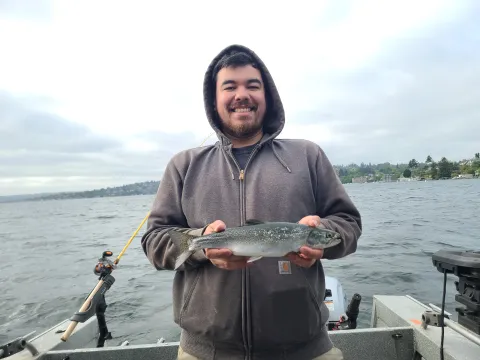
Public access abounds at this south Puget Sound lake! It receives ample plants of kokanee every spring. They grow to a healthy size, around 14-15 inches. You can't beat the accessibility and wealth of knowledge on how to target them in this lake. This is a hugely popular fishery and is great for beginner kokanee fishermen. April through September are the prime months to target kokanee here. It also receives a healthy rainbow trout planting, so you might need to weed through them to get to the kokanee. This lake is on the shallow side, so you can count on the fish hanging out near the thermocline most days.
Lake Chelan
While you're trolling for kokanee here, you might just end up with a chinook salmon on the end of your line! This is the largest natural lake in Washington, over 50 miles long. The sheer size and depth of this lake can certainly be intimidating, but there are several reputable guides who fish these waters. They can help you figure out the best locations and tackle to use. The fish can be finicky here. Your best bet will be to troll the top 20 feet of water in the morning, then go deeper in the afternoon. Most people troll for kokanee in the lower basin of the lake. Target points and coves until you find willing biters!
Loon Lake
Over on the eastern side of Washington, this lake boasts large kokanee and mackinaw as well. You can troll for them, but many anglers jig for kokanee at nighttime here. Use glow hooks, corn, and plenty of scent. The fish are usually near the bottom during the night, but keep a close eye on your sonar. The bite is very light, so you'll need to pay close attention to your rod. Mack's Wedding Rings work great if you're trolling. Try tipping them with a piece of worm or a Gulp maggot. There is only 1 boat ramp at this lake, so plan on getting there early to beat the lines, especially during the summer.
Spirit Lake
Just across the Washington/Idaho state border, this picturesque lake is a known kokanee producer. In fact, there are a few boat ramps and resorts with boat rentals along this smaller lake. This is a great lake to hit if you're worried about the afternoon winds at nearby Lake Pend Oreille. These fish are on the smaller side, but they're numerous and tend to be very snappy. Fish early in the mornings; this lake is very popular with power boaters. As a bonus, this lake was stocked with chinook salmon in 2016!
Lake Pend Oreille
Another Idaho lake, this one is significantly larger than neighboring Spirit Lake. Mackinaw, walleye, and Kamloops rainbow trout also reside in this 134-square-mile lake. Just like Lake Chelan, there are a few guides that you can hire to help get a feel for the lake. Idaho Fish and Game supplements the wild population with yearly releases of millions of kokanee fry. There was a kokanee population crash in the 80's and 90's. Idaho Fish and Game found that kokanee populations were crashing due to increased lake trout predation. They netted 177k lake trout and put a bounty out for the fish to encourage anglers to remove them. Now, thanks to their combined efforts, there is a thriving kokanee fishery at this lake.
Odell Lake
There is a very popular kokanee jigging fishery at this Oregon lake. Motor around slowly until you find a school and then drop your jigs! Don't forget to tip them with corn. Most tackle manufacturers make kokanee jigs. They're about 3/8 to 1 oz in weight, and typically pink or orange. Try jigging slowly at first, then switch up your speed until you find what works. It's important not to allow slack in your line because you'll miss bites. If you catch a fish, remember what depth it was at. Jigging for kokanee can help keep the day interesting.
Detroit Lake
Another Oregon lake, this is a popular, tried-and-true fishery for both kokanee and rainbows. Interestingly, you don't need a boat to catch them here. Many anglers report success from the dock and shore. Try fishing near creek mouths! If you're trolling, use the usual kokanee gear. The later in the season, the deeper you'll need to fish. Troll slowly, about 1mph, and don't forget the corn! Many anglers report success jigging for the fish in the early season. Detroit Lake has been stocked with kokanee since the 1950's as a response to declining sea-run salmon populations and has thrived ever since. Give it a shot!
Holter Lake
This is your destination if you want a shot at 5-pound kokanee. Populations are rebounding, which is great news for anglers near this Montana lake. Old Goat lures are proven fish catchers here. This is a large, deep reservoir where downriggers truly shine. You might need to put in some work to find the fish, but the payoff could be a trophy kokanee! Check out Northwest Fishing's episode of Holter Lake for an in-depth tutorial on this fishery- Mike Carey had a great day filling his boat with 5-pound kokanee!
Pishkun Reservoir
Located near Glacier National Park in Montana, this lake is worth the drive for the views alone. The kokanee can be few and far between, but they are big! You'll likely have the lake to yourself, and you'll have a shot at big rainbow trout and pike as well. For the best chance of getting a big kokanee, try to put as many lines in the water as you can. Use planer boards and stack your downriggers. Watch your fish finder carefully. This lake is sixty feet deep, and the kokanee will likely be near the thermocline. Oh, and bring bug spray!
/articles/ten-great-kokanee-destinations-pacific-northwest-hannah-pennebaker
Conconully Kokanee
Some new products are truly unique, for example, Wiggle Fins. These products create and define new methods and fishing techniques. Other products take a great idea, refine it and make it better. In this category falls a new kokanee fly produced by Arctic Fox Trolling Flies. I had the opportunity to recently tackle test this product on Lake Conconully and came away very impressed. It’s going to be a “go to” lure in my kokanee arsenal.
Denis Peirce, the owner of Arctic Fox Trolling Flies, sent me some flies to try out. He told me they were based on an eighties steelhead fly pattern, the Krystal Bullet. Of course, just making a copy of an old fly is not going to cut it in today’s world of new and innovative kokanee products. Denis knows that, having been in the trolling fly business since 1993.
He knows the industry and, more importantly, he has a wealth of knowledge and information about trolling for game fish. Thus far his focus has been on salmon and trout and he has teamed up with Wiggle Fins to make a phenomenal line up of larger trolling flies. It was a natural evolution with the recent explosion in interest for kokanee that Denis turned his knowledge and expertise to kokanee flies. Hence, his new series of kokanee trolling flies.
My wife JoAnn and I took our annual trip to Conconully to try the flies out. We stayed at our favorite resort, Liar’s Cove on the lower lake. The ambiance is family-friendly and the fishing in Conconully around Memorial Day is off the charts! Both the upper and the lower lakes have excellent trout and kokanee action. The upper lake the past few years has produced the larger kokanee so we decided to start our test there.
We ran four lines, two off downriggers and two off leaded core long lines. Each rig had an Artic Fox Trolling Fly and a dodger in front of it. Leader length ran 8-10”. The flies come without leaders. This is actually something I appreciated. If you’re like me, over time a successful lure gets bit a lot and the leader becomes frayed and needs to be replaced.
Unlike hoochie or spinner rigs, single flies are quite easy to quickly replace the leader. Another option I like is the ability to adjust the leader to conditions. For Conconully we ran 12 pound fluocarbon leader. We ran some flies with no attractor, some with a small spinner blade, and some with a Mack’s smile blade. All rigs had a piece of corn on both the primary fly hook and the trailing treble hook.
We started fishing at a leisurely 8am. The action began slow but gradually began to build. At the start, we caught a fish here, a fish there. I can’t say that there was a significant difference between the flies that had attractors and the flies that were “naked”. We ran the downriggers at 35 and 45 feet deep, chasing meter marks. Last year, the downriggers performed well for us. This year, it was a leaded line show. We eventually reached the point where the action was fast enough that the downriggers got put away and we just ran two rods with leaded lines. We trolled with three colors out, and 60 feet of mono leader, trolling at 1.1 to 1.4, using an itroll from ifish solutions to vary the trolling speeds automatically.
The fish at the upper lake were a plump 14-15” fish, shiny bright. Much to my surprise, later after cleaning the fish I had one hen that spilled mature eggs out. Other than that it was mostly bucks in our bucket. The hotspots for us were up lake of the houses to the narrow north end of the lake. Close to shore, middle of the lake – the kokanee are everywhere right now. Watch out for floating logs and debris. The lake has received more runoff than in past years so there is a lot of debris to avoid.
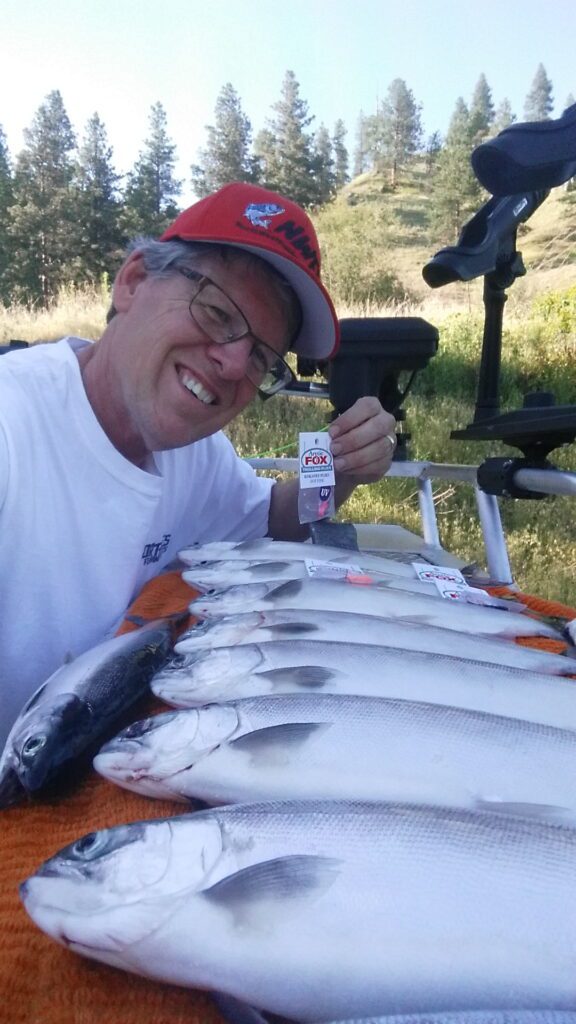
The Arctic Fox Trolling Flies were an obvious hit with the kokanee. Denis has definitely created an effective series of flies for kokanee.
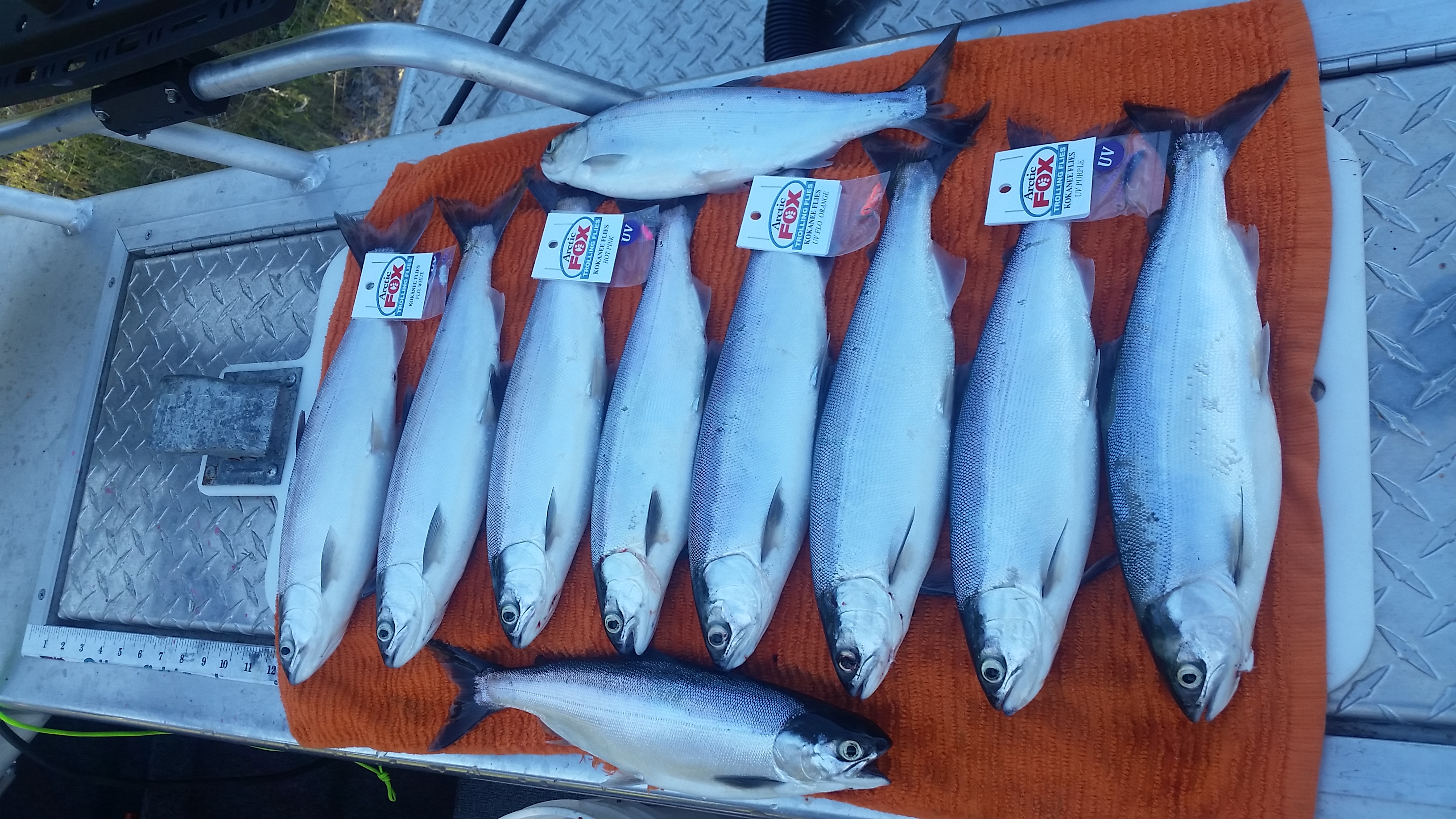
The Arctic Fox Trolling Flies Kokanee series come in seven different colors. Five are fluorescent chenille and mylar. Denis reports that under UV light these flies are very “hot”, meaning they have excellent underwater color reflection. The two non-fluorescent flies are fire red and purple with silver core chenille. Purple remains visible at depth, while red is one of the first colors to be filtered out by water depth, meaning it turns grey-black at depth. The mylar, however, gives it a nice contrasting UV orange that continues to reflect available light at depth.
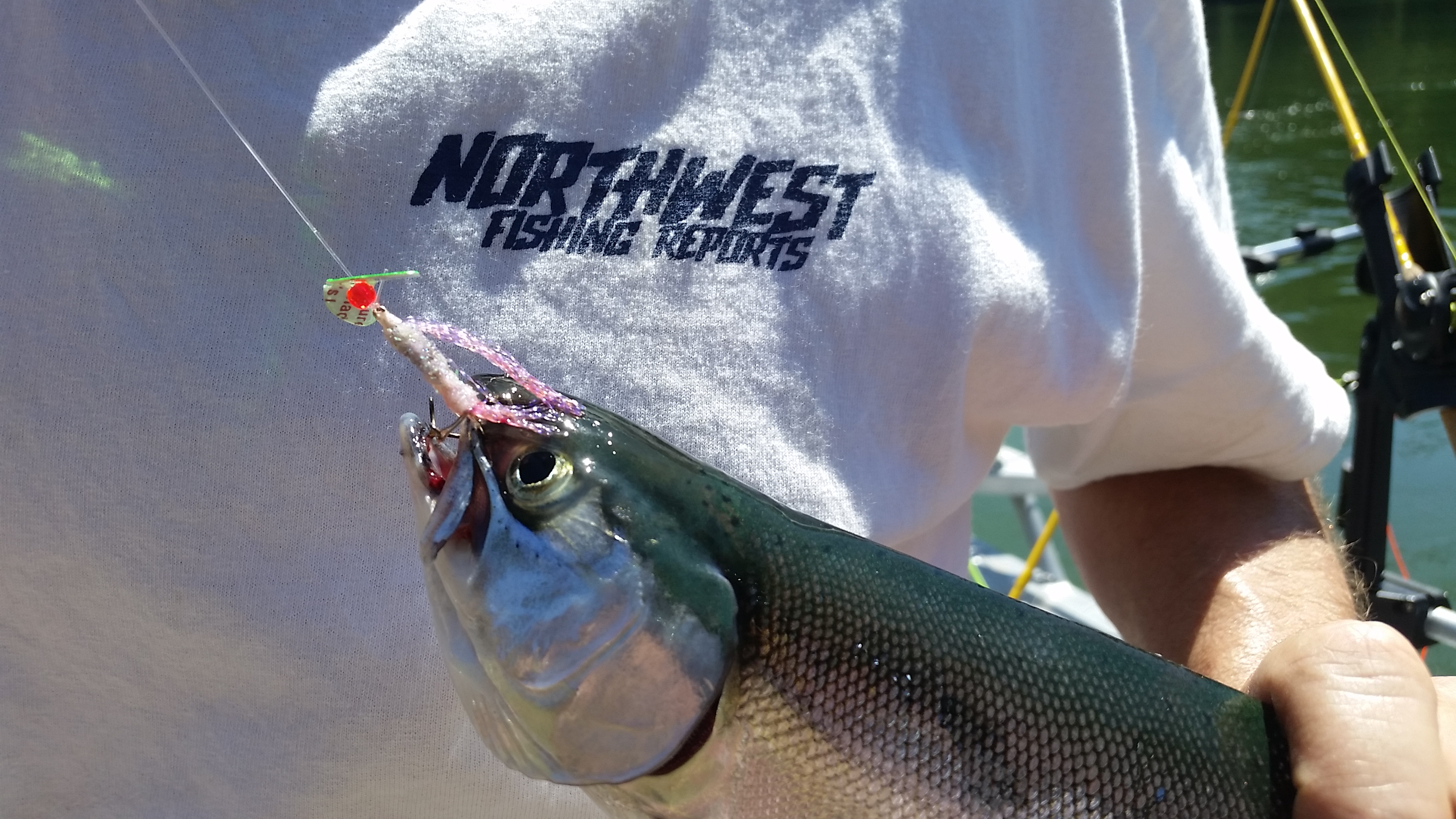
With seven color choices you’ll be able to fish whatever conditions you’re presented with, from cloudy Pacific Northwest to bright Central Washington days. You’ll also have a sufficient variety of colors to find what the finicky kokanee want on any given day.
For us the hot set up was without a doubt the orange with 10” of leader and an orange crush wobbler run at three colors out. The fish were just slamming this set up!
One concern I had when first checking out these flies was the size of the hooks. The main fly is tied on a #8 long hook, and the trailing hook is a #10 treble hook. Denis uses gamakatsu hooks and I will be the first to attest that these hooks are sticky sharp! Our experience was that the combination of these two hooks was incredibly effective.
We had few lost fish and noted several that missed the main body hook but were secured by the treble hook. Remember when I started this article and mentioned “refining” the pattern? Well, Denis has taken the treble hook and secured it using a loop of stainless steel leader that creates an articulation for the treble hook that the fish have a hard time throwing. Put another way, the treble hook is free to move around meaning the fish can’t get leverage on it to pull the hook free. I’ve reviewed underwater footage of kokanee and one thing that struck me was that once a kokanee is hooked it does incredible body shakes and spins in a desperate attempt to get away. It’s amazing we catch any of these acrobatic fish at all! Any small edge an angler can have against these wild gyrations will help land more fish. I would say our hook to catch ratio was higher than trips using standard kokanee lures.
JoAnn and I continued to pull in plump, healthy 14-15” kokanee and over the two days of fishing and easily got our limits. I came away very impressed with the Artic Fox Trolling Fly kokanee series. I’m definitely moving it into my first tier of kokanee lures. I like the smaller size profile compared to the majority of the kokanee lures on the market. It gives kokanee anglers an option to downsize when the fish are looking for a smaller presentation. With the articulated treble hook I don’t have any concerns about losing fish due to the smaller hooks.
Give these flies a look see! You can order them online at Arctic Fox Trolling Flies.
/articles/conconully-kokanee
Lake Washington Kokanee Secrets
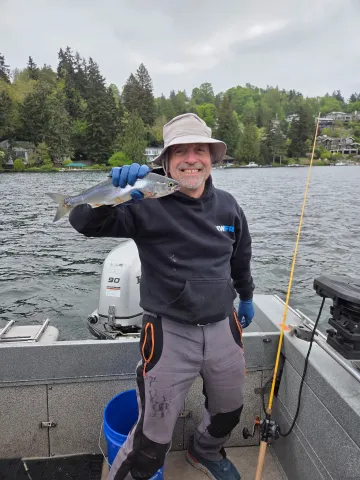
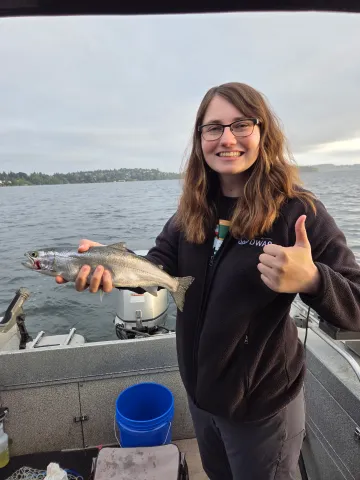
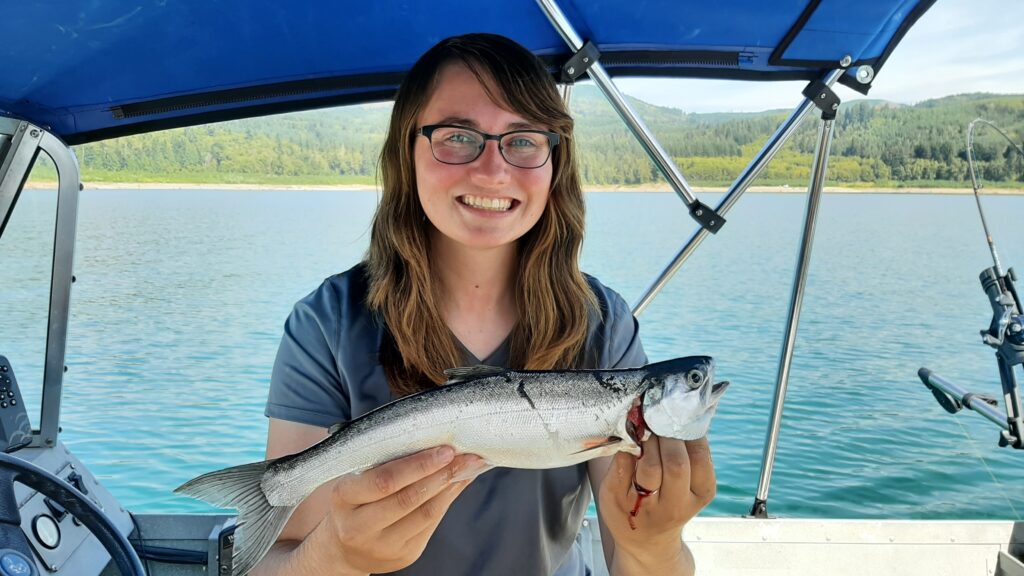
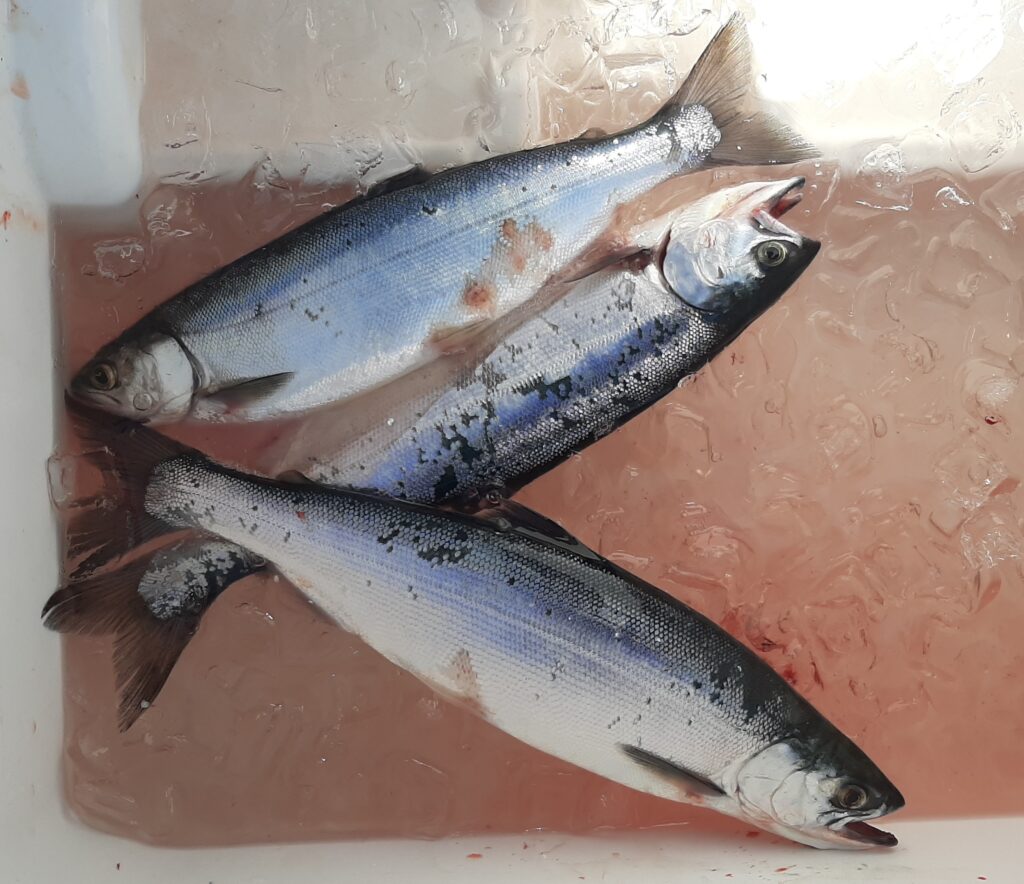
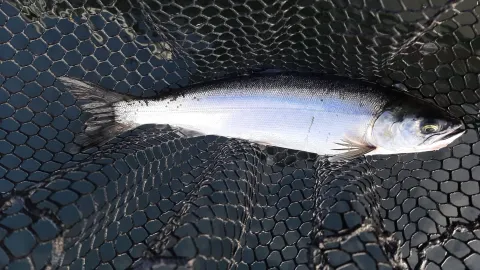
For most people, a trip to Lake Washington means a day of kayaking, jet skiing, or picnicking. But did you know that the lake plays host to thousands of kokanee? These land-locked sockeye salmon are smaller than their ocean-going cousins, but they taste great and are available year-round. Early summer is the perfect time to target them.
They are aggressive and plentiful. Learning how to troll for kokanee is a great way to dip your toe in the water before you fish for salmon in the fall. Whether you're an avid kokanee fisherman or a beginner, you should add Lake Washington to your list of summer fishing destinations. Not sure how to start? Let's go over some key information to make your trip to Lake Washington a success: which launches to use, tried and true techniques, and productive locations to start with.
Launches
There are many boat launches surrounding Lake Washington, so I'll just name the most popular ones here. In the south, the Atlantic City boat ramp is pretty spacious and has restrooms available. There is a fee to launch your boat, but the parking is free and plentiful. Gene Coulon Park is another popular option at the southern end of the lake. Parking can be tight, especially during weekends. There is a launch fee but there are restrooms and an Ivar's close by if you get hungry!
Near the middle of the lake, the Kirkland Marina has a small boat ramp. The launch fee is steep, but you can buy an annual pass to save some money. On the other side of the lake, Magnuson Park offers a well-maintained and easy to use boat ramp. At the very northern tip of the lake is the Kenmore boat ramp. It gets pretty shallow here, so be careful when launching in the early morning. There is no dock, but there's a nice bathroom and there's no launch fee. Although Lake Washington is quite large, you're never very far from a boat ramp!
Techniques
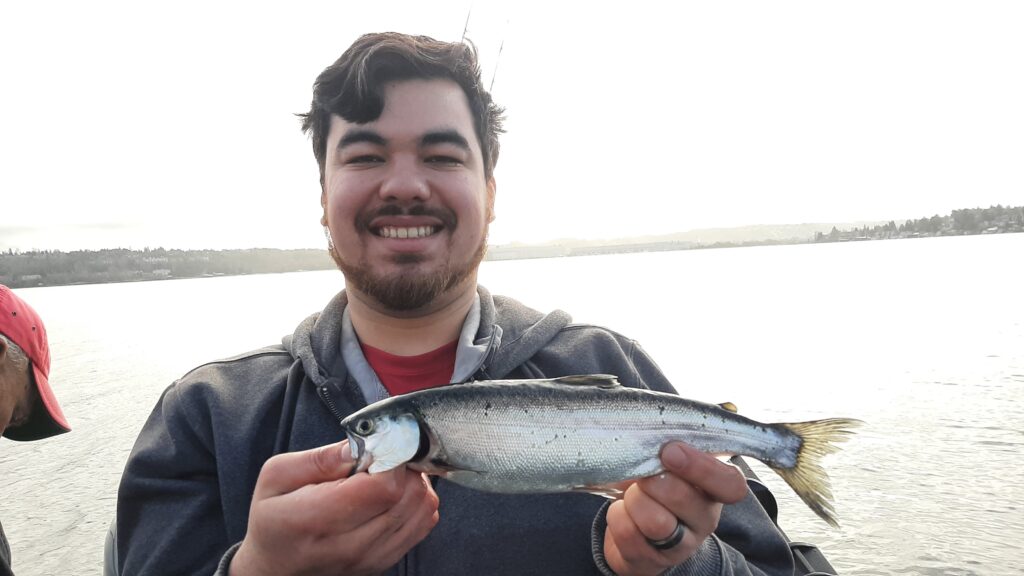
Although Lake Washington has a wealth of shore access, kokanee tend to hang out in water out of casting distance. Your best bet is to troll for them. Typical kokanee gear works well. Toss out a variety of lures and let the fish tell you what they want. Some days they like spinners, other days they want plugs. Kokanee can be very picky.
Artificial maggots and corn should both be in your tackle bag, as well as a few bottles of scent. While pink is the classic kokanee color for a reason, orange, red, and watermelon are all great choices for lure colors too. Sometimes giving the fish something they haven't seen before is the key to success. Trolling flies works great! Make sure you have a variety of dodgers too. You can experiment with different dodger styles and colors. I also tend to use a shorter leader than usual on Lake Washington. The fish seem to respond well to a 9-inch leader.
Make sure to bring a long-handled net for landing the fish. Kokanee have soft mouths- boat flipping them often results in lost fish. It's also a good idea to bring a stringer or a bucket to bleed the fish in. A cooler full of ice to keep your fish cool once bled is also crucial. Kokanee also has soft meat, to get the best meat quality it's a good idea to bleed and ice them.
Locations
One of the most important things to bring along on your Lake Washington trip is a fish finder. Especially during late summer when the kokanee dive down deep to escape the warm surface water, you'll need your fish finder to show you what depth to fish. I also recommend placing marks when you get hits or reel in a fish. Set your fish finder to show your trail, and you can set up a good trolling pattern. On the southern end of the lake, try fishing on either side of the I-90 bridge. On the north end, try fishing south of Highway 520. Target points and coves. The fish will move depending on the time of day and weather. Don't be afraid to try somewhere new!
Before we wrap up, let's talk about a few last-minute tips for your Lake Washington trip. First, I highly recommend planning on starting and ending your fishing trip early in the morning. This lake is incredibly popular with jet skiers, inner tubers, and water skiers, particularly later in the day.
If you get off the water early, you'll minimize your chances of tangling your lines or getting a rocky ride. It's a good idea to wear a life jacket and make sure your kids and/or dogs have them as well. The limit is 5 fish, and you must release any fish over 18 inches in length. This rule is in place to protect sockeye that run in the lake during late summer.
Lake Washington kokanee are the perfect fish to go after on a warm summer day. They're absolutely delicious on the smoker or even fried. Kids will love reeling in fish after fish! So, head out to Lake Washington and get your limit!
/articles/lake-washington-kokanee-secrets
Alpine Kokanee Trifecta
There’s an Alpine Kokanee Trifecta that is often over-looked compared to the more well-known and popular kokanee fisheries. What if I told you that within an hour and a quarter of traffic-free driving from Seattle you could enjoy pristine Alpine lake fishing with little to no other boats on the water and have the chance to catch generous limits of kokanee every time out? No way you say? It’s true and waiting for you. But a little planning and tempering of expectations is required. These fisheries won’t yield 18-20” Lake Roosevelt kokanee, but they do have an abundance of under-fished kokanee that will still give you a nice bounty to bring home. Have I got your attention yet?
The Alpine Kokanee Trifecta I speak of is familiar to many, but passed by with a reputation of having small kokanee. I’m here to tell you, that is a myth. While it’s true you won’t find those 20” koks, you will find fish that range from 10” up to 14”. The lakes I’m referring to?
Keechelus, Kachess, and Cle Elum. Yup, that first big reservoir as you crest Snoqualmie Pass going east is one of three Alpine Kokanee Lakes that I think you should make plans to visit. Let’s look at them one by one, going from west to east.
Keechelus Reservoir
This lake is the one that we all gaze at as we are driving somewhere else. It’s also the one that come August turns into a giant stump field. At 2,408 acres, it’s the smallest of the three lakes. At 2,521 feet of elevation it’s also the highest of the three lakes. The lake holds rainbow, cutthroat, whitefish, bull trout (which are endangered and are to be carefully released), burbot, and kokanee. Of the three lakes we will look at, this lake probably has the smallest kokanee in it. But check this out – the 2016 stocking numbers for this lake were a whopping 256,892 kokanee! In 2015 it was 265,000 and in 2014 it was 238,000 kokanee. So bottom line, that’s a lot of kokanee swimming around waiting to be caught!
Here’s the catch (there’s always a catch, right?). This reservoir gets drawn down as the summer progresses. Seriously drawn down, as in not able to launch a boat drawn down. So if you want to fish the Trifecta next year, you’d best plan on hitting this lake first. The primary boat launch is found on the west end of the lake. The earthen dam is on the far east end of the lake. Be aware, this lake, perhaps worst of the three, is prone to heavier wind and whitecaps. Be prepared to get back to the launch if the wind picks up. The lake is also the least serene of the three lakes as the constant hum of the freeway and view of semis roaring past are a sharp contrast to the beautiful surrounding mountains. This lake is a one pole only lake.
Kachess Reservoir
If you’re looking for a beautiful camping location with stunning scenery this is your lake. The Kachess Forest Service Campground is one of the nicer ones around. Plenty of camping spots and some larger pull through sites make it “boat friendly”. The restrooms are - surprise – running water and flush toilets! The boat launch is a two lane concrete ramp with nice grade and plenty of surrounding shoreline to pull your boat up on. Winds can be an issue as it’s not in a sheltered location. Parking is good.
Like Keechelus, Kachess holds a nice variety of fish. Rainbow, cutthroat, bull trout (protected), whitefish and burbot can all be found in addition to the kokanee. As to kokanee stocking, in 2014 WDFW stocked 365,000 fish, 2015 490,000, and for 2016 413,098. You’ll get into the kokanee as soon as you launch the boat. Motor out a hundred yards and watch as your depth finder shows the bottom dropping to 180 feet and deeper. And then you’ll see your fish finder light up with kokanee arches 35 to 80 feet deep. You’ll find fish all the way the length of the lake down to the dam end, over four miles away. But beware, if you head north the lake shallows up at a choke point north of the launch and you’ll find yourself in ten feet of water.
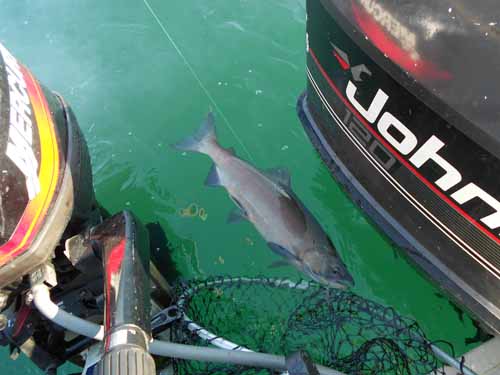
On our most recent trip, we found a great early morning bite that turned off at 8:30am. After an hour of fruitless trolling we ran all the way down to the dam and were rewarded with good action the rest of the morning. Don’t be afraid to leave non-biting fish in search of the biters! On this trip we also caught and safely released a powerful 16” bull trout. What a thrilling fight on kokanee gear. We hooked him at 55 feet deep on the downrigger. To help protect these beautiful fish bring a knotless net.
Kachess is 4,377 acres and an elevation of 2,258 feet.
Cle Elum Reservoir
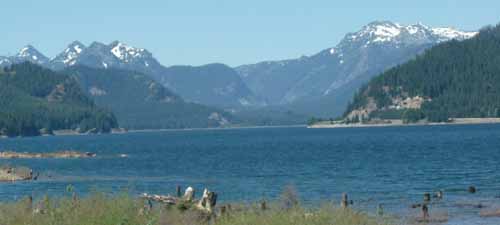
The final gem of our trifecta is Cle Elum reservoir. Although the farthest of the three lakes, it’s still a day trip for the Seattle area angler. Cle Elum also has a Forest Service campsite and nice paved launch (an old road, actually). Not as nice as Kachess, but the scenery is again spectacular and there is no freeway sound to ruin the experience. Cle Elum also has the nearby town of Roslyn to grab provisions and a nice dinner at the end of your day of fishing.
Cle Elum is the largest of the three reservoirs at 4,566 acres. It’s the lowest lake, at 2,227 acres. As the summer water draw down lowers the lake, the ramp becomes high and dry. Boaters then will launch among the stumps at the southeast side of the lake by the dam. Watch your props and winds out of the north as this can be a risky proposition.
The lake holds the same species as our other two lakes with a notable and significant difference. First there is Mackinaw trout in the lake.
These fish are on WDFW and the Yakima Tribe’s radar screen to remove from the lake. Why, you may ask, when some dandy lakers up to 15 pounds and more have been caught? Well, in the (hopefully) not too distant future Cle Elum may join Baker and Wenatchee lakes as a destination sockeye fishery.
That’s right; the Yakima Tribe has been working since 2009 to restore a sockeye run to Lake Cle Elum. It works like this: the sockeye are captured at Priest Rapids dam and transferred to the lake. They then run up the Cle Elum River and spawn. When the fish hatch, they spend 1-2 years in the lake and then leave the lake via a flue around an earthen dam to the Yakima River. From the Yakima River, they will swim to the Columbia, and traveling on another 330 miles, around four Columbia River dams, to the Pacific Ocean.
Here’s more information from the Yakima Nation Fisheries website:
“One thousand adult sockeye were transplanted in the summer of 2009, 2,500 in 2010, 4,500 in 2011, 10,000 in 2012 and 4,000 in 2013. The sockeye successfully spawned in tributaries above the Lake in all years becoming the first sockeye to spawn in the Yakima Basin in over 100 years. Juveniles from the 2009 brood were observed migrating downstream at Roza and Prosser Dams in 2011. Preliminary data from trapping operations at Prosser indicated a 2011 smolt outmigration of approximately 80,000 sockeye. From July - Oct. 2013, 701 Sockeye migrated to the Yakima River Basin (numbers reported at October 17, 2013). So far, 211 sockeye have migrated back home to the Yakima River Basin (updated July 1, 2014).Once these fish move north to Roza Dam they will be transported into Lake Cle Elum or Cle Elum River. So far, we have trapped and hauled 4,500 sockeye from Priest Rapids to Lake Cle Elum. We will continue to monitor fish run numbers and trap and haul accordingly (updated July 1, 2014).”
So where are the kokanee you may ask? Well, WDFW has stopped stocking Lake Cle Elum since this recovery process started. But that doesn’t mean you can’t catch kokanee.
According to a fisheries biologist I spoke with on the subject, some of the kokanee you catch are actually sockeye that have decided to not migrate back to the ocean. Instead, they spend their adult lives in lake Cle Elum, and then spawn as well in the Cle Elum River. In order to protect the sockeye in Cle Elum, WDFW has placed a slot limit of 9” to 15”on kokanee in Cle Elum. The limits are different on Cle Elum as well. As of 2016, Keechelus and Kachess had ten kokanee limits, and not including trout. Cle Elum has a five fish limit, including trout. Cle Elum is also the only lake of the three to allow the two pole endorsement. Finally, there is NO limit on lakers, brown, and eastern brook trout. WDFW wants these non-native species out of the lake to benefit juvenile sockeye salmon and encourages anglers to help in that effort. As always, be sure to check current regs for any updates.
There you have it. Three Alpine Lake Kokanee gems, all day trips from the greater Seattle region offer the angler spectacular scenery and fisheries that produce abundant (if not huge) kokanee. With gas prices at historical lows now is the time to plan a trip to these great destinations and leave the masses behind.
I will offer a couple words of caution for boating anglers. First, the winds blowing down the mountainsides on these three lakes can kick up and blow whitecaps, especially in the afternoon. So keep an eye on the weather and be ready to head back in if things start blowing. Second, if you troll with downriggers, be aware that these reservoirs may have trees sticking up from the bottom that didn't get clear cut. So be ready to bring those downrigger balls up fast!
See you on the water catching some tasty kokanee on these Alpine Lake Gems!
/articles/alpine-kokanee-trifecta