Puget Sound Squid
Squid fishing in the Puget Sound is becoming an increasingly popular resource for anglers of all ages and skill levels. Squid are a relaxing, low-pressure fishery and can be targeted successfully on nearly any budget. And you don’t even need a boat; in fact, some of the most successful squid fishermen only fish from shore. This piece will give you some understanding of where, when, and how to fish squid in the Puget Sound.
We will start with the rules and regulations for squid. You will need a shellfish license. I always recommend that everyone just get the Fish WA license, because with that, you are covered for everything, but squid can be covered simply under shellfish. The season and bag limits for squid are very simple.
Squid is open year-round, and the bag limit is 10 pounds per person. This is a lot of squid. I rarely stay and fish out a whole limit, but I always make sure to have a scale handy to make sure I don’t overfish! The only other relevant rule is that you can fish with a maximum of 4 squid jigs on your line at a time. I typically use two. If you are within these rules, you should be all good to get out there!
Next, let’s talk about where. Squid can be found in nearly all waters of the Puget Sound, from the Strait of Juan de Fuca, all the way to Tacoma. Depending on the time of year, they will be more prevalent than others. The general rule is that squid start showing up in the Port Angeles area around September and migrate down to Tacoma through January and February. This is not a hard and fast rule, but they generally follow that pattern.
There are people who catch squid every single day from the Les Davis pier in Tacoma. I, however, do not have that expertise. Some hot spots to check out are the Port Angeles City Pier, the Edmonds Pier, Pier 70 area in Seattle, Seacrest Marina Pier, and Les David Pier in Tacoma. There are several Facebook groups dedicated to squid fishing, and you can usually find out where the squid are from the number of success posts.
When to fish for squid is fairly widespread. There are some people that find success all year long from the same pier. But in general, squid fishing is best, and the squid themselves are largest, in the winter months. I usually start fishing for squid in about November and will fish regularly through February. Earlier in the season, I will usually fish closer to Edmonds, and then the deeper we go into winter, I will move further south and usually end my season closer to Tacoma. If I intend to fish from the pier, I will almost always fish at night. Sometimes I will arrive at 1 or 2 in the morning and fish until sunrise. If I am fishing from a boat, I will often fish in the morning or evening, but almost never at night.
Lastly, how do we fish for squid? Squid can be caught from shore or from a boat, so we will break down how, based on this distinction. Fishing from shore is the most popular and simplest method. You will need your own bucket and a long, sensitive rod (I would say no less than 9’). 9-foot, 5-weight fly rods are growing in popularity due to their sensitivity, and you can rest your arms on the pier and not have a long butt section getting in the way of your jigging action.
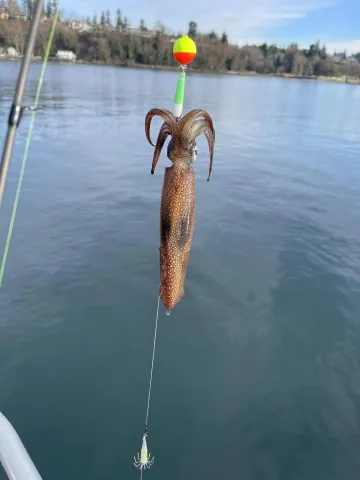
Generally, people will set up their rods with braided line about 20–30-pound test, with a corky on the mainline to act as an indicator so you can tell where your line is in relation to others. You will also want to have your squid jigs tied on with monofilament that is about 12-15-pound test. I really like to use one weighted Fisherman’s Gold squid jig in green or pink with another unweighted Fisherman’s Gold jig above that.
The current and tide will impact whether I am going to use half, three-quarter, or one-ounce jigs. The optional part of your kit is a light. There will generally be people on the dock who have lights. If you don’t have a light, you can try to get close to them, but be respectful of their space and bring your own if you want to fish right under a light for your whole session. When you are all rigged up, you will want to cast out and let your jig sink. I usually let mine go to the bottom to start, and I will slowly work the jig back towards me and up the water column using slow jigs with pauses at the top.
To detect a strike, you can usually feel either an increase or a decrease in the weight on your line. A big hookset isn’t required, but a fast set and an increase in your retrieve are enough to keep them pinned on the jig. Strike detection will take some time. If you see someone on the dock really crushing them, be nice and try to learn what they are doing, and maybe ask some questions. My experience has been that if you treat people with respect, they will treat you with respect and usually give you some pointers on how to do better.
If you are going to fish from a boat, the kit is mostly the same, but I usually use a 9’ or 9’6” spinning rod instead of a fly rod. Because you are not limited to how far you can cast from the pier, I will typically drive around slowly and look for a haze near the bottom on my fish finder in roughly 80-120 feet of water. I will then drop my anchor and fish on top of the squid. Because it is light out, they are almost always on the bottom. I will use the same jigging technique, but in a more vertical motion.
So, now you have the what, when, and how of catching squid in the Puget Sound. Give it a try this winter, and instead of waiting for calamari at a restaurant, you’ll be able to serve it up right in your own home.
/articles/puget-sound-squid
Squid Jigging the Piers of the Puget Sound
With the arrival of each new season here in the Northwest, it’s hard not to feel like a kid in a candy store. Whether it's fall, winter, spring, or summer, these annual intervals of changing weather and day length always seem to provide new opportunities for the men and women who choose to reap the spoils of the outdoors. If the desire is there, the fun and the food is at our doorsteps.
A commonly overlooked opportunity that starts up in Neah Bay during late August and ends down in the south Puget Sound towards the end of winter, is the squid fishery, specifically the Pacific coast squid, also known as the California market squid.

The Pacific coast squid are relatively small, averaging about 8 inches. They have short lifespans and spend most of their time in the Eastern Pacific Ocean—between Baja California and Southeastern Alaska. They move into the straights of Juan De Fuca during late summer and their numbers tend to peak in the Puget Sound around December and January.
The fishery is often fickle, with some years falling short of anglers’ expectations, while other years the fishery can prove to be quite robust. On these years when the squid are plentiful, the hardest working anglers can find themselves heading home with their limits, which, as of January of 2023, the Washington Department of Fish and Wildlife has set at 10 lbs or a five-gallon bucket filled to the halfway point. Now that is a lot of calamari!
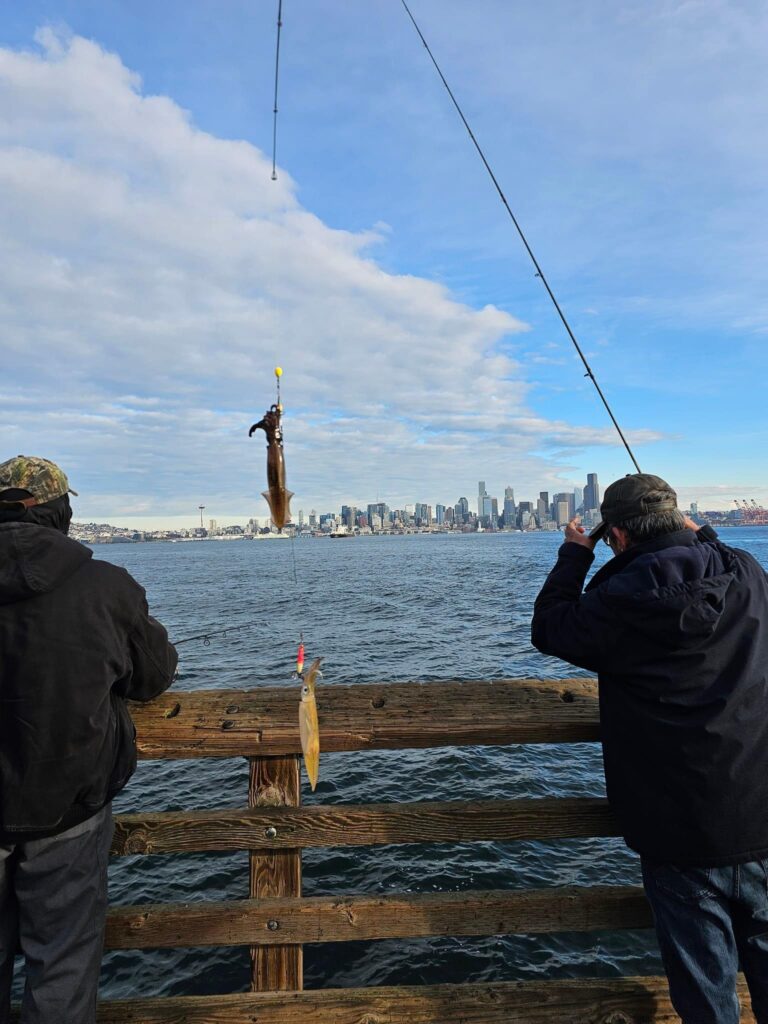
Jigging from a boat or a pier is the most common way to procure these saltwater delicacies, and during the winter you will often find the docks from Everett down to the south Puget Sound alive with folks chasing the Pacific squid. Squidding is a minimalistic endeavor. A fishing rod, a spinning reel, and a squid jig are essentially all that is needed. Squid jigs find their origins in Japan.
They are usually torpedo or bullet-shaped jigs with several spines at the bottom that point upright. These spines don't serve the same purpose as a typical fishing hook. Instead of puncturing or penetrating the squid, they create a bit of a platform for the squid to become entangled in as they latch onto the colorful plastic body portion of the jig.
Many squid jigging enthusiasts swear that nighttime is the best time to catch squid. By in large this holds true, but it’s also important to put some focus on the tides and water clarity. A high tide with decent water clarity can produce squid even during the daytime.
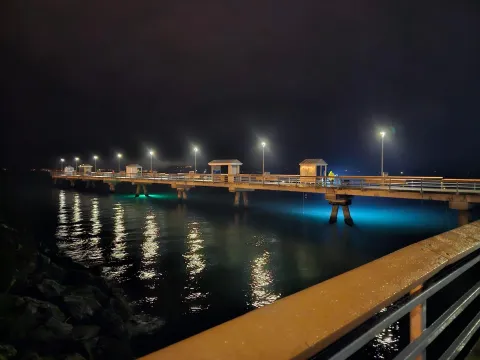
At night, squid are attracted to the lights illuminating off of the piers. The general belief around this is that light attracts phytoplankton, the phytoplankton then attracts zooplankton, and zooplankton attract the fish and other critters that squid like to feed on. Piers already come equipped with their own lights and these typically do a decent job of providing the needed illumination to bring in the squid.
With that being said, the chances of bringing in larger amounts of squid become increased when a more powerful and concentrated light is introduced. Folks will often bring battery or generator-powered lights to shine into the water. Check with local rules to find out if generators are allowed.
While on the topic of rules, it’s important to note that there is a fair amount of pier fishing etiquette to consider while navigating the pier. It’s best to speak with folks who are using lights and ask them if it’s ok to post up next to them. There’s a good chance they might be saving these spots for friends or family and It’s not uncommon for conflict to occur on the pier if people aren’t using common courtesy while acquiring their jigging spots.

Just as the gear is minimalistic, the technique is simple as well. Folks will work their jigs in a variety of ways, but sticking to the basics is what generally will get you on the squid. When casting, you should allow your jig to drop to a depth where squid are holding, lift the tip of your rod and slowly retrieve as you lower the rod tip back down, then repeat the process.
Once you have a squid on your jig, keep tension on the line and the squid should remain there as you retrieve. The method is similar while jigging directly beneath you, though you won’t be doing any reeling in of the line until a squid has attached itself. Some people like to do a few quick and hard lifts of the rod and then let it sit near the bottom for a few moments. Though you might not feel the squid strike your jig, the difference of weight at the end of your line once you lift again, will be your indicator that you have a squid on.
So, if you’re anything like me, and consider the sound of a bubbling deep fryer to be just as much of a winter staple as holiday tunes or roasted turkeys, then put on your winter jacket and head to a local pier for your shot at getting that bucket up to its halfway point with these great tasting cephalopods. And remember, there’s no such thing as bad weather, there’s only such a thing as bad gear!
/articles/squid-jigging-piers-puget-sound