Catching Spring Chinook
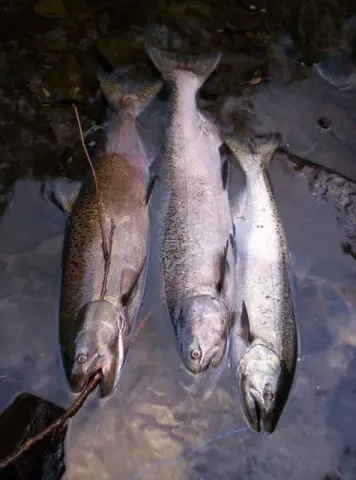
From Northern California to Canada, and the Pacific to Idaho, few secrets are as carefully guarded as uncrowded areas for spring bank-caught salmon. Each time one of my fishing buds gives the slightest hint of a clue of a lean in that direction, my phone goes dead, his email is lost, or I have to remind him, “I don’t text.” I turned the ringer off on my phone nine years ago. Even my wife, Suz, and I had a big fight over it. We were raised fishing the same rivers like the Molalla and Clackamas, and ocean reefs, so I guess it was only natural that sooner or later she demanded to know my springer spots. "Look," I said, "I bought you a diamond ring. Isn't that enough? I'm not giving you my secret fishing holes that took a lifetime to find. That kind of intimacy and trust takes years. If it's okay with you, I'd like to keep them between me and God." She said it wasn't okay.
"Let me get this straight," she said. "You trust me enough to marry me, but not enough to show me your secret fishing spots?"
"How it is," I said.
She responded by deliberately knocking off one of my big spring chinooks with the net (she swears it was an accident. Yeah, right.). Of course, we broke up over it. It was a nice fish that by all rights should have been in the box.
Now we are back together, and using her mermaid magic, she has my secret spots. Or thinks she does. I didn't tell her I learned from a Joseph Campbell video how Navajo US Army scout and storyteller Jeff King left out an essential piece of the story until the initiate was ready.
Why, you may wonder, are you so extreme as to not even tell your wife? The answer is these fish are my favorite to eat. At $18 to $27 a pound during prime season, I can’t afford to show up somewhere that previously had zero to three anglers and see 30 to 40. If that happened, I couldn’t get my regular 16 fish a season from rivers to get me through the year. In plain terms, a 20-pound cleaned springer is worth about $400. Add another, and that is an $800 morning. All of which is saying, springer fishing is serious business. Plutarch's Moralia notes that ancient Spartan mothers told their sons, “Return with your shield, or on it.” At least one Oregon mother told her son going after springers, “Return with your fishing rod, or on it”.
So what’s the point of this article? is the obvious question. The point is, if you want to catch a coveted bank-caught springer away from the crowds, put your time in hacking blackberry vines, searching maps, and getting permission from landowners; or get a boat, or hire a guide. However, if you want to go it alone bank-fishing after hearing all this, here is my advice.
Local Knowledge
Go where people regularly catch springers, and watch everything they use and do, right down to the gnat’s eyelash’s mite’s eyelash. I mean study gear, hook, bait, length and size, and kind of leader, exact placement and depth of lure, time of day, and if you are really serious, where they go to church and the color of their socks.
Study a Watershed
I found springers to be more picky than steelhead about where they pause in upriver migrations. In general, springers like it slow, dark, and deep, which makes sense if you consider these 10 to 30 pound brutes a short while ago had an entire Pacific ocean to forage. Chinook in our area travel as far as the Aleutian Islands past Dutch Harbor, into the Bering Sea. That is how they get so big and delicious.
Good Bait Makes All the Difference
After over 40 years of doing this, I see the same guys in the same spots at the same times of year on my springer travels from coastal rivers to Idaho. They are all expert anglers, but on some days one of them is slaying fish after fish while the rest of us look on in mouth-watering amazement. Why? It’s the bait cure the fish want that day, and to show how serious these fish are, they ignore everyone else’s bait, moving within inches of the same water. I asked one successful angler his secret, and he said it took over 20 years for an old-timer to share it, and there was no way in hell he was telling me. I said I understood. If you read my last article, “How to Outfit a Fish Car,” you know these fish “can smell parts per billion.” GrrlScientist, formerly of The University of Washington in Seattle and science writer for The Guardian, permitted me to include a SciLogs article “Salmon, scent and going home again” January 17, 2011, in which she noted:
"In the November 1978 issue of Pacific Search, author C. Herb Williams described a Canadian study where a nearly homeopathic solution containing one part of human skin dissolved in 80 billion parts of water was dumped into a river. Astonishingly, the scent from this solution was sufficient to stop migrating salmon for as long as half an hour. Additional experiments by Canadian scientists show that salmon will either slow or stop their migrations when certain human smells are present in the water, and trout — another salmonid — show distinct flight responses when a fisherman washes his hands upstream. [par break] This offensive scent was identified as the amino acid, serine, which — because human skin contains serine — has led to some fishermen to refer to this as 'the serine problem'."
This means when I catch a hen, I cure her eggs that night so I can fish them at daylight without being frozen. I keep my hands clean, and on sweaty days wear white latex gloves. One angler said I was Michael Jacksoning it, but I had a salmon, and he didn’t. Many years of experimenting led to my current egg cure recipe. Reel blazing runs, $800 fish mornings, and beet-red spring salmon steaks make it all worth it.
A Friends of William Stafford Scholar at the “Speak Truth to Power” Fellowship of Reconciliation Seabeck Conference, Scott T. Starbuck’s two books of fishing poems are River Walker, which sold out in less than a year, and Lost Salmon forthcoming from MoonPath Press. Starbuck’s writing focuses on the clash between ancient sustaining forces like wild salmon rivers with modern industrial lives. His most recent book is Industrial Oz: Ecopoems. His blog Trees, Fish, and Dreams is at riverseek.blogspot.com
/articles/catching-spring-chinook
Springers Are Here
When May rolls around, the spring Chinook fishery kicks into high gear as more and more fish begin filtering into the “Big-C.”
While most of the effort will shift to tributaries in May, the Columbia River mainstem spring Chinook fishery opportunities both above and below Bonneville Dam still remained up in the air as of this magazine’s publication deadline.
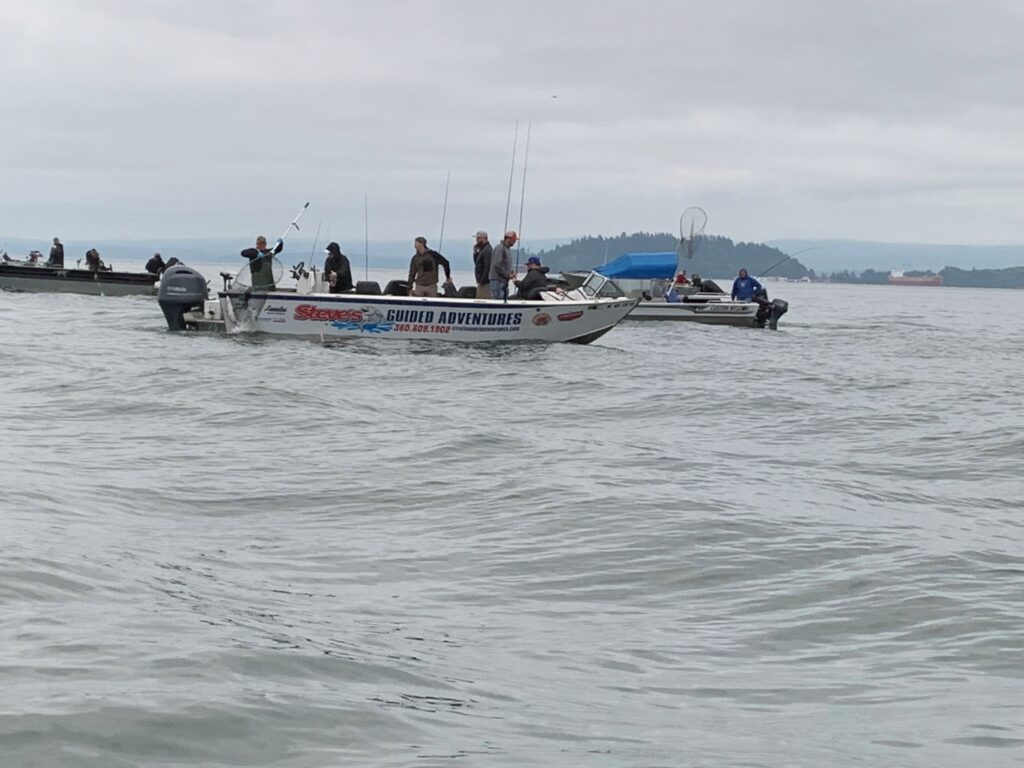
All decisions on whether the Columbia River mainstem reopens later in May and possibly into early summer are left up to joint Washington and Oregon in-season management decisions. To keep track of updates, the public is encouraged to sign up for WDFW Columbia River Compact mailing list notices at https://wdfw.wa.gov/about/lists.
The 2025 forecast for Columbia upriver spring Chinook is 122,250 fish, more than the 116,332 that returned in 2024, but lower than the 10-year average of 139,676 fish.
Several factors influence the arrival of spring Chinook, including flow patterns, which can change on a daily basis. These fish are known to work their way up the maze of channels and will follow bottom structure in the river. They will avoid turbulent water and are known to stall below dams when abrupt changes occur at the tailrace and fish ladder channels.
The initial spring Chinook fishing seasons for the Columbia River mainstem were set in late February, with end dates in mid/early April for below Bonneville Dam and late April upstream. It is usually soon after that when the run begins to ramp up. In recent years, the timing of the run has been later and later.
As of mid-April, the spring Chinook fishing success was just starting to build in the lower river. The number of fish seen at the Bonneville Dam fish ladder was also sporadic. Anglers can track daily fish counts by going to Columbia River adult salmon counts at https://www.fpc.org/currentdaily/HistFishTwo_7day-ytd_Adults.htm, which is key to knowing when to go fishing.
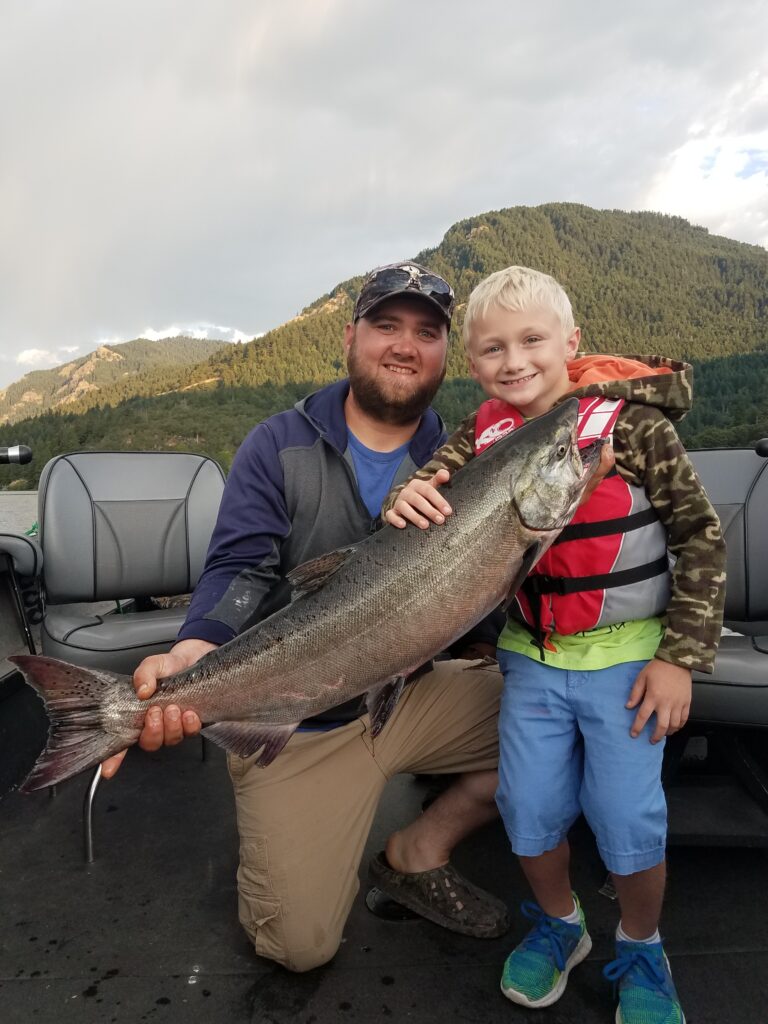
It’s also wise to not wait to go fishing once the run begins to peak, as you’ll likely miss out on the best time period. “For 2025, the corresponding harvest rate tiers are determined by the Snake River wild abundance estimate. Following that, we apply a 30% buffer applied to the forecast until we get a run size update, this is then used to determine the harvest rate,” said Ryan Lothrop, Columbia River fisheries manager with the Washington Department of Fish and Wildlife (WDFW), which he referred to as step one.
Next, fishery managers calculate the allowable catch. Lastly, fishery managers apply the commission guidance of proportion of the Endangered Species Act splits by sector and area.In 2025, recreational anglers are projected to harvest approximately 5,200 adult spring Chinook below Bonneville Dam in the Columbia mainstem, and 550 spring Chinook from Bonneville Dam upstream to the Washington/Oregon border.
“Fortunately, we were able to provide additional quality April days of opportunity downstream of Bonneville Dam this year, given there was a substantial balance remaining,” Lothrop said. “Upstream of Bonneville Dam, increasing catch rates in recent years have led to early closures, resulting in fewer open fishing days before this year’s in-season run size update."
However, if the run size update is large enough or if there’s remaining catch allocation, additional fishing time is likely. ”Fishery managers will monitor the fisheries, dam counts, and hatchery returns as the season progresses and adjust as necessary. The U.S. v. Oregon Technical Advisory Committee typically provides a run size update in mid-May. Based on the 2025 preseason forecasts, anglers can expect to find a decent number of spring Chinook in the Cowlitz, Kalama, and Lewis rivers. Tributary fisheries are managed based on hatchery spring Chinook surplus.
Places like the Cowlitz experienced closures a few years ago, but with a forecast of 13,310 (4,580 and 8,822), a closure isn’t necessary in 2025. The Cowlitz spring Chinook forecast to the tributary mouth is greater than the recent five-year and 10-year average return of 5,300 and 9,800, respectively. In the Kalama River, the spring Chinook forecast to the tributary mouth is 2,900 (1,840 was forecast with an actual return of 2,310 in 2024).
The Kalama spring Chinook forecast to the tributary mouth is similar to the recent five-year and 10-year average return of 2,200 and 2,500, respectively.In the Lewis River, the spring Chinook forecast is 3,060 (3,270 and 2,553). The Lewis spring Chinook forecast to the tributary mouth is similar to the recent five-year average return of 3,700 and greater than the 10-year average return of 2,600. During May a lot of the spring Chinook fishing attention also shifts to tributaries above Bonneville Dam such as Drano Lake, and the Wind and Klickitat rivers. The best way to gauge when it’s time to go is by watching the fish counts at Bonneville Dam.
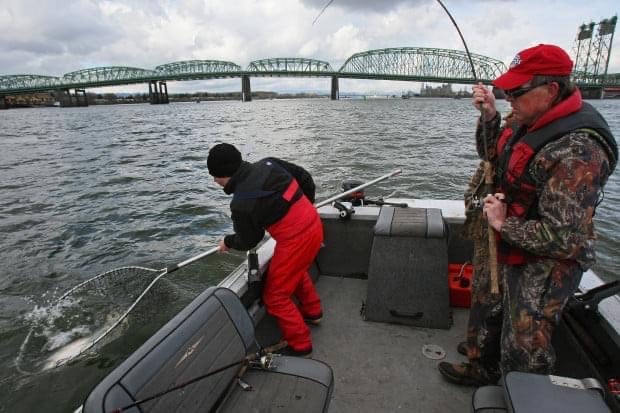
The Wind forecast is 4,900 (4,200 forecast and actual return of 4,604 in 2024) and is greater than the recent five-year and 10-year average return of 4,100 and 4,000, respectively. In Drano Lake (aka Little White Salmon) the forecast is 7,600 (5,300 and 7,863) and forecast is similar to the recent five-year average return of 7,400 and less than the recent 10-year average return of 8,100. The Klickitat forecast is 1,200 (1,300 and 491) and is similar to the recent five-year average return of 1,300 and less than the recent 10-year average return of 1,500.
In Drano Lake, the best action happens in the area referred to as “Toilet Bowl,” a popular spot where anglers troll in a tight circle near the entrance of the lake. While most are Drano Lake stock fish some of these fish are known as “dip-ins” as they first enter the lake before migrating further up the Columbia River. There isn’t much space to troll so make sure you’re following the same path as others and are good at handling your boat and keep your lines right underneath to avoid getting tangled up with others. If someone nearby hooks a fish stay clear of them.
If you plan to fish Drano Lake, be aware the Columbia River outside the mouth of Drano Lake is closed. There is a marked boat fishing boundary area in Drano to allow for some bank angling to occur near the mouth. From the shore cast spinners or Wiggle Warts. Anglers also fishing for springers in the Wind River must stay within the fishing boundary of the river itself and not stray into Columbia River mainstem area. Spring Chinook tips and tactics I could list a hundred different ways to successfully catch spring Chinook and what to use varies depending on river location, flow patterns and water clarity but the most important factor to keep in mind is patience.
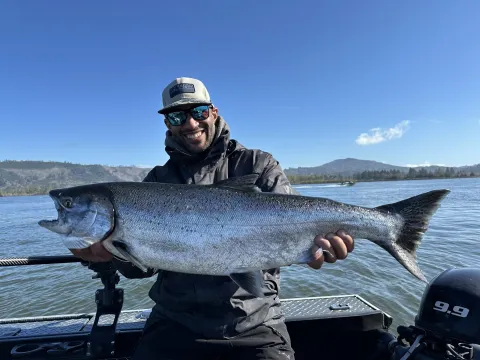
Earlier last month, I had a friend who spent six days and nearly 50 hours on the water of the Lower Columbia River and managed to bring home one hatchery-marked fish.
As for fishing gear, don’t skimp on the rod and reel and spending money wisely will be an investment toward catching more fish. The rods of choice are usually a 9 ½ to 10 ½ foot of 15 to 25 pounds with a lot flex and soft tip. Oftentimes these fish will grab the bait and turn away so flexibility in the rod will allow for a proper hook-up. Let the salmon pull your rod tip down a few times before gently setting the hook and don’t jerk hard since usually the depth of water you’re fishing isn’t very deep to begin with.
Line counter reels are the norm nowadays and enable you to find the sweet spot by aligning the depth on your fish finder to the area where the fish are lurking. Many like to use braided line, but I’m old school and will stick with monofilament line for a bit of stretch and give when the fish bites. The standard setup for trolling is a three-way swivel with 10 to 18 inches of 15-pound monofilament to an eight- to 15-ounce dropper weight, depending on current and flow.
On the other end of the swivel is 24 inches of 30-pound monofilament line to your fish flash and then another 40 to 50 inches of 30-pound monofilament line with a swivel halfway down the leader to allow the bait or lure to spin freely and eliminate the line from twisting and tangling. Often I’ll go “naked” and not use a fish flash which creates less drag too.
The traditional bait is a green-label herring, whole or cut-plug, with the proper tight spin. Many will soak their bait in a brine mixture to toughen them up. After bouncing off the bottom a few times or running into debris they’ll tend to get blown out or will lose their quality spin. To get the right spin on a whole herring, I like to insert a toothpick in the anal vent of the herring and bend the herring to a 45 degree angle. Then take the top hook and insert it under the lower jaw and out through the hard spot between the eyes. About halfway down the side of the body insert and pull out the trailing hook so it dangles freely.
Others like to pin a plastic bait helmet – Krippled Herring or Rhys Davis – to avoid wear and tear on the herring. Before dropping it down, add some scent and make sure it has the right spin. Other top choices are a 3.5 spinner and prawn, flat fish wrapped with a sardine or a Brad’s Super Bait. Downsizing to smaller Kokanee Cut Plugs, or a 2.5 or 3.0 Spinfish filled with tuna to tandem trailing hooks are effective in warmer water conditions and when it gets crowded during a slow troll like at Drano Lake.
Colors are also key to catching fish. Be sure to carry a wide variety but usually chartreuse, silver, orange and red work well. The scent of bare hands can be a deterrent so keeping some environmentally safe liquid soap, clean hand towels and elastic nitrile gloves will enable you to stay in the game of catching fish. Have a small bucket to wash down your lures and be sure to keep your rod handles and cranks on the reel clean.
Be sure to check the WDFW website at https://wdfw.wa.gov/ for current daily limits, other area-specific rules, any emergency rule changes, and closures or openings that tend to occur during the spring Chinook fisheries.
Tight lines, and I’ll see you on the water very soon!
(Mark Yuasa is a Washington Department of Fish and Wildlife Communications Manager. He was also the outdoor reporter at The Seattle Times for 28 years.)
/articles/springers-are-here
Spring Chinook Time
By Jason Brooks
One of the most sought after and tasty salmon in all of the Pacific Northwest is the spring chinook. This run of salmon draws thousands of anglers who will first head to the Columbia, as well as a few coastal rivers for a chance to catch a “springer”.
The fish start to arrive in January and will run until May, with the height of the runs occurring in April. Once the fish make their way up the Columbia to the many tributaries, the anglers will spread out to focus on terminal fisheries. Run estimates and seasons yet to be set will determine where you can go to catch a spring chinook.
Looking at the projected runs, the Columbia total run is expected to be 307,800 wild and hatchery combined. This is good news as it is well over last year's projected run of 197,000 fish and even over the actual return from last year of 274,495. This means anglers should have fisheries in the lower Columbia area as well as the Vancouver-Portland fishery between I-5 and I-205 in early spring.
The Kalama fishery is near the Port of Kalama on the Columbia River, where there is good boat access with a protected harbor and multi-lane boat launch. Run straight across the channel, and you are at the fishery. Some anglers will use a small boat to cross and then beach fish off Sand Island by plunking a Spin-n-Glo with a gob of cured salmon eggs. Other bank plunking options are wobblers on a dropper, or a banana plug such as a MagLip or K15 Kwikfish, both with a herring or sardine wrap.
The boat angler has two options here depending on the tide. Most will troll using a triangle flasher, such as the Mack’s Lure UV Triangle Scent Flash or a Yakima Bait Company Big Al’s Fish Flash, then a long leader from 36 to 48 inches, with a 6-bead chain swivel in the middle, to a plug cut herring. When it comes to bait, the most productive herring are dyed with Bad Azz bait dye in either chartreuse or blue, or brined with Brine-n-Brite, which also comes in chartreuse and blue.
Single point barbless hooks must be used, but to increase the chance at a hook-up, set back the farthest hook and downsize it to a size 4 Gamakatsu Big River. These hooks are strong even in the small size 4- which tends to grab onto the chinook's face or jaw when they swipe at the bait- and will increase your hook to landing ratio.
The second option is to anchor up during the outgoing tide and let out the plugs and wobblers. This is known as “sitting on the hook”, and boats will form lines, often using wing dams to tie up to and to help break up the strong outflowing current. My first time fishing this part of the river was fishing on anchor with a friend in his boat. We sat in the protected covered cabin and played card games until a rod started to bounce, running out into the rain and reeling in the fish.
Then we let out the line, making sure it landed in a travel lane (which are often shallow depressions in the sandy bottom), and then resumed the card game again. It might not sound like much of a fishing experience, but this is springer fishing, and it is all about putting the best-eating salmon in the freezer.
The Cowlitz
The Cowlitz is the second largest lower Columbia tributary, only to be surpassed by the Willamette. With a predicted return of 9,000 springers to the Cowlitz, we can hope there will be a fishery that often coincides with the late returning winter steelhead. The “Cow” is one of the few rivers where anglers can catch a double bag of good eating fish in the same day. Depending on where you go on the Cowlitz will dictate how you fish.
In the lower river, anglers often pull plugs or use bait divers and baits such as cured salmon eggs or prawns. The prawns will have sat a few days in Pro-Cure’s Shrimp and Prawn Cure in magenta or red, and some anglers will use both baits at the same time, making a “cocktail” of sorts. Further upriver, anglers will float fish gobs of eggs or even plunk them. The Cowlitz offers both bank and boat access and is within a few hours’ drive of several cities, which means it gets crowded, but it can be a great place to catch fish.
Willamette
If you are looking for a lower Columbia powerhouse, then look at the Willamette. Anglers will start in early spring, hoping to be one of the first to catch one of the 71,000 projected spring chinook expected back this year. That is nearly 20,000 more than projected last year (51,200) and almost 16,000 more than the 55,391 that returned. The early springtime anglers will target the Multnomah channel which starts at St. Helen’s, Oregon, right across from Ridgefield, Washington. This can be protected waters, often calm and out of the wind, unlike the mainstem Columbia in spring.
I was fishing here several years ago with Buzz Ramsey, and as we crossed the Columbia, I noted that the wind was starting to kick up. After fishing the day in the Multnomah channel, we started back towards Ridgefield, where we had launched from. Making the corner around the island, we were met with gale force winds and whitecaps, and later learned that a boat capsized on the Columbia that day, costing two people their lives.
Be sure to check the wind forecast if you plan to cross the Columbia to fish the Multnomah channel, otherwise, drive around to the Oregon side and launch from there. An Oregon fishing license is needed to fish in the Multnomah channel, as this is considered Oregon waters and is part of the Willamette River and not the Columbia.
Bonneville Dam
Further upriver and above the Bonneville Dam, anglers start to target terminal fisheries. The first being the Wind River, which will have both a run of Wind River bound fish as well as fish stopping to rest near the deadline of the Wind River outlet, as marked by large white buoys in the Columbia. The Wind River is expected to get back 4,400 fish, which is only 200 fish more than last year's projection of 4,200, but last year the run exceeded the estimate by over 2,000 fish, with an actual return of 6,530.
Here, trolling plugs such as MagLips, Kwikfish, and even going “old school” with an orange Mag Wart by Storm is commonplace. In the late 90’s and early 2000’s, about everyone flat lined the hot orange Mag Wart and then started fishing them on droppers to keep from tangling with other boats. This still works, but also anglers will be trolling triangle flashers and Brad’s Super Baits and Super Cut Plugs often in the Hot Lava color and stuffed with tuna.
Drano Lake
Drano Lake is the most popular spring chinook terminal fishery in the entire Columbia system. Here hundreds of boats will try to choke into the “toilet bowl”, which is the entrance to the impoundment at the highway 14 bridge. Be aware of the deadline and do not cross it as you will get cited and be sure to be courteous. Here, boats will slow down and make a turn, trolling in a counterclockwise direction.
Do not try to go against the current of boats, as it will only lead to a mess. Here, anglers primarily slowly troll prawn spinners with a triangle flasher. Again, the Pro-Cure cured prawns are effective, with magenta being the most popular color. For prawn spinners, you can use the tried-and-true Eric’s Prawn Rig by Lugh Jensen with the “backdraft” color, a combination of orange, chartreuse, and green with green beads.
Macks Lure also has a prawn rig which uses their Smile Blade, a Mylar blade that works at extremely low speeds which are needed at Drano. Again, the most popular color is green and chartreuse, with a magenta cured prawn.
For anglers hoping to get some spring chinook further upriver, then 2023 might be your year. The Snake River and Idaho bound fish are estimated to be 85,900, which means there could be a season, but do not expect any announcements until in-run estimates are updated with fish counted at the dams. Icicle River anglers up near Wenatchee, some 500 river miles from the ocean, also have some great news, along with Yakima River anglers, as 41,400 spring chinook are expected in the “Upriver Columbia” run.
Seasons on both rivers are not usually announced until dam counts show there are enough fish above the mid-Columbia pools. If this estimate is like the others and last years, all of which came in above projections, then spring chinook anglers in the upper Columbia and even into Idaho will hopefully have a season. With springers already showing up and passing over Bonneville dam, with one climbing the fish ladder on January 2nd, it looks to be a momentous year. The best eating fish are on their way here, and anglers will have plenty of places to go.
Let us hope the winds do not kick up too much and we can all get along in Drano’s toilet bowl. Start curing up the prawns and soaking the herring, it is springer time!
/articles/spring-chinook-time