The Best Kind of Fishing Trip by Jerad Sorber
Early-season Spring Chinook is always a bit hectic. There's a short window between when the fishing gets realistic and when the first season closes. The annual uncertainty about when the next opener will be increases the pressure. Both the fishing kind and the internal kind, even if the fish aren't quite here yet. It's easy to get discouraged when you don't see a lot of fish, and nobody else is catching them either. When the magic does happen, though, it makes it all the better. Recently, we had one of those days.
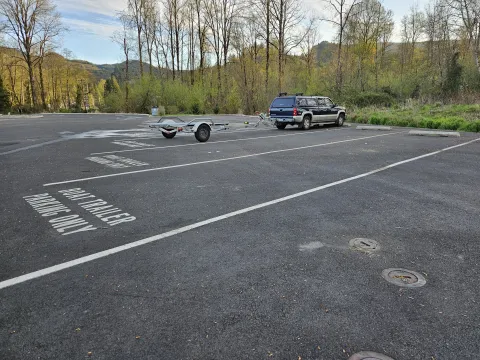
I arrived at the ramp around 5:15 AM to get the boat in the water and do any final preparations. I had told my clients to be there by 6 AM. There was a good morning outgoing tide, and there would be competition for spots to anchor up. As I prepped, I listened to the conversations from the other guides that were doing the same thing. This is a great time to get intel on what's going on with the fish.
Just as I finished up, my clients came down the dock. They had booked the whole boat and brought 4 people. If this had been a July ocean salmon trip, I would be excited about lots of fish. Today I was figuring out how to manage expectations. The fish checker reports the day before were 3 fish on 35 angler trips. We went through the usual greetings, and they hopped on board. A quick safety briefing, and we pulled away from the dock at precisely 6 AM.
I ran us out to the spot I had planned on. That was at least a good sign. With the anchor set, I put out the first round of plugs. I was hoping for the best. The water looked good, and the temperature had risen about half a degree. If they were here, they should be biting. A little bit later, another friend and fellow guide swung by and anchored to the outside of me. A bit after that, another guide popped in, and we had an old-fashioned hog line set up. We were covering everything from 12 feet of water to 40 feet. If a salmon was moving through it would have to look at our gear.
The conversation bounced between boats as it should for hog line fishing. One of my clients seemed to really love hearing the "inside baseball" chat. I talked to my clients about what they had been doing. I answered a lot of questions about fishing and fish biology. I learned about the ins and outs of building embassies for the US government in faraway places. My clients had been working internationally, and this was spring break for the youngest son. Their most recent location was Malawi in Africa. They chose to come back home and enjoy a day of fishing.
I swapped out the initial plugs with ones wrapped with tuna belly. If the water is slow, I usually start with bare plugs covered with some gel scent. This gives them a bit more action. Once the water speeds up with the outgoing tide, I wrap them with tuna belly and send them back. We coordinate line lengths and make sure that there is a literal wall of plugs. Between 3 boats, there were 9 rods in the water. We all waited for a fish to come in. The middle boat had a bite, but it didn't hook. They had a second and lost it within a minute. Then nothing.
The outgoing tide pulled my depth from 18 feet down to 16 on the sonar. It was getting shallow. The water wasn't that murky, and the sky was clear. By this time, I had swapped my middle rod to a flasher in the middle with a cut plug herring. It had worked before when nothing else did. I pulled out a spin glow, putting it on ahead of a coon shrimp. I hooked it to my inside rod and sent it flying to about 4 feet of water. There had been steelhead moving through. If three guide boats captained by guys I respect can't find a springer, maybe I could find some other action. Still nothing.
All three of us started calling and texting our friends that we knew were fishing nearby. Each time, we hoped desperately for a good report. Nothing below us. Nothing above us. A few take-downs, but nothing stuck. I was getting antsy. My clients were enjoying the day, watching ospreys dive on bait. They made a game of trying to spot the sea lion that would periodically cruise the channel. Fortunately, he never came close, but it didn't matter. I found myself talking about the better days of fishing. I stopped myself and cringed a bit inwardly. These guys were probably thinking, "he should have had us come then, instead of now". I do my best to be clear about what to expect with early Springer fishing. I describe it as the most challenging fishery we have. Even with that, I think that people often come to the dock expecting to be the exception. I know several guides that don't offer early spring chinook trips for that reason. They don't want people to be disappointed if they go home empty-handed.
The outside boat moved upriver to a different spot, and I moved out where he was. 23 feet of depth felt a lot better given the high sun and clearing water. All the rods were back to plugs, and the sun was getting high. I remembered some advice from a mentor. When the fishing is tough, don't go crazy changing things. Just go with what you know works best and keep at it. I put fresh wraps on all the plugs and set them down. One of my clients was glued to the sonar like it was a final four game during overtime. If a fish came by, or even something that looked like a fish, I knew he would let me know. There was still nothing. The boat that was now inside of me started picking up. They had to go home early for a doctor's appointment. I decided to make a move as well.
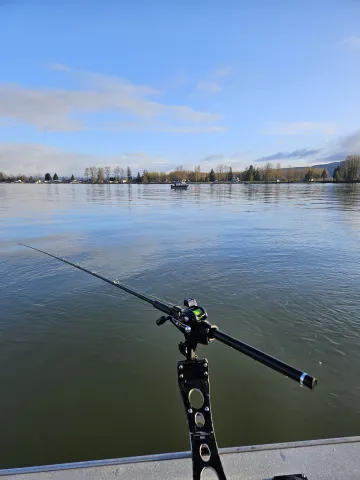
I started swapping out plugs for trolling gear. The outside rods would have 360 flashers with stuffer baits. The inside rods would be running in-line flashers with cut plug herring. There was enough current going that I could get the rods out while we were on anchor. I pulled the socks, fired up the kicker, pulled the anchor, and started trolling. I looked at either side of me on the side-scan looking for fish. I swerved out into even deeper water when the shallow wasn't showing anything. I thought I saw one mark, but nothing came of it. We reached the end of the pass and reeled up. It was time for a bigger move.
Usually, I move downriver when the fishing isn't good. If you're in a gap of fish moving upriver, there's no sense in staying in that gap. Going downriver means a chance to catch fish that you haven't seen. The reports from downriver had been poor, though, and the trolling area there was pretty spread out and fragmented. I had seen some fish move through on the sonar while we were on plugs. I chose to go upriver.
I went way up above the other boats that I saw. The boat that had been outside of us was there. I also spotted some other boats that I recognized as belonging to some really good fishermen. "If that guy is still fishing, then I don't feel so bad," I thought. That little bit of comfort quickly disappeared as the water got a bit choppy and the wind picked up.
The top was on the boat, and it started catching the wind. My clients and I struggled a bit to get the rods out, and we had a tangle. Clearing tangles in a foot and a half high chop while trolling into the wind is not easy. Finally, the torn cut plugs were replaced, and the gear was fishing. I worked the boat against the wind to try to keep it straight. I didn't put a sock on the bow to add stability, but probably should have. I did trim the main over a bit to help compensate. We worked our way out of the worst of it, and the water smoothed out. Even worse than no bites, I wasn't seeing any fish at all.
I stayed glued to the sonar and adjusted the throttle to counter any wind gusts. The 360's were working slowly, which is what I wanted. I didn't want things to move too fast in the water. It was a delicate dance between having enough power to steer and trolling too fast. About halfway down the pass, there is a big shelf that you must swing out wide to avoid. While the depth isn't bad on top of it, it's covered in weeds. They make it nearly impossible to fish in anything less than 18 feet of water. But moving away from the island would subject me to more wind. I had to swing out anyway.
The wind caught the top, and I soon found myself in 35 feet of water. My clients adjusted the rod depth down, and we continued, trying to make the best of it. It's not that 35 feet was magically too deep; I just didn't think the fish were out that far. We passed the shelf, and I pointed the bow back towards the island. The sonar ticked shallower again. At 25 feet, I turned back west and started running parallel to the shore. I looked up at the side scan and saw what looked like a diagonal streak. It started at the edge and moved towards the boat as the sonar scrolled. I waited to see if something would show up on the 2D and down scan. I looked over at the rods on the left side to see if something would come in. They kept working normally. False alarm.
I turned my head to look back and noticed the right inside rod take a dive. This was one of the triangles with a cut plug on it. "Probably bottom," I thought. I started to turn to give it a crank when it took another dive, more assertively this time. Before I could reach it, it started bouncing, then pulling. The line started rolling off the reel. "Fish! Fish! Fish!" We had designated the youngest as the first one to catch a fish. He had never caught a salmon before. He was also sleeping under the top. His dad shook him awake, and he stumbled to the back of the boat. I directed everyone else to start reeling. I grabbed a rod, got it in, handed it off, grabbed the net, and turned around. "I don't think it's there," he said. I looked at the flasher, and it was steady in the water.
When a flasher is moving normally, it has a motion to it, even an inline one. It sways and wobbles a bit with the current. If the lure is loaded with weeds or a fish, there is no sway. It moves firmly. This flasher was moving firmly. "Keep reeling," I told him. "Don't stop reeling, don't give it any slack". He blinked his eyes a couple of times and started to say, "I still don't think..." then chrome flashed under the water, just behind the flasher. The fish was thrashing.
"Reel to the bead, and when I tell you to, swing the rod to the front of the boat. Keep the tip down, it helps keep them from jumping”, I instructed. He reeled down to the orange bead I put just ahead of the line lock. I could see the fish get close, as it turned towards the boat, I took my chance. Just as the net hit the water, the fish turned away, and I brushed its tail with the net. It went wild and shot off. I pulled the net back.
"It's pulling!" The rod was bent over, and the line screamed off the drag.
"It's ok, just keep reeling," I tried to help him not panic. My own mind resembled a pack of chipmunks on a trampoline after someone dropped a bunch of nuts on it. He reeled down to the bead again, and the fish glided in front of me. It took a quick turn, but then came back towards the boat. I shoved the net under it, lifted, and watched it get surrounded. Feeling the net, the fish started thrashing around. I started looking for an adipose fin. We haven’t gotten a fish yet. It had to be hatchery.
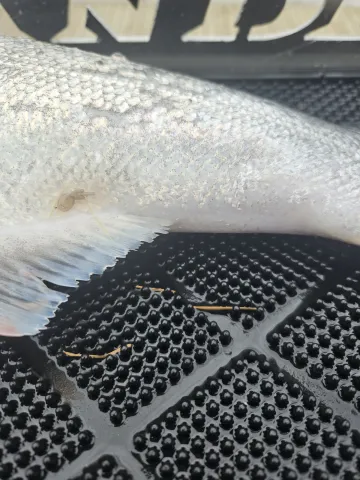
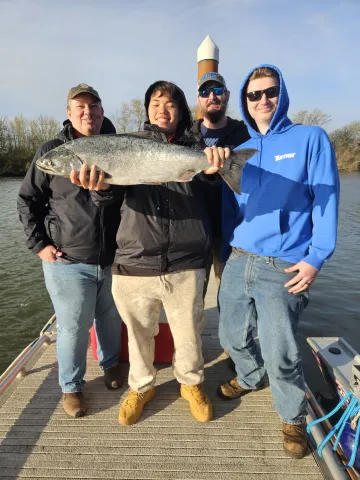
I pulled the fish towards the boat and reached in to steady the fish while trying to avoid the hooks. The fish flipped around, and I saw the back. It was smooth with a beautiful healed scar just ahead of the tail. No mis-clip, just perfect. "Hatchery!" I yelled. My own heart was pumping, and I could barely hear the cheers behind me. I lifted the fish and heard four jaws hit the deck. In the net was a beautiful, purple-backed, chrome-sided, slightly gray belly upriver Spring Chinook. I looked up and saw smiles all around. Dad seemed beside himself; the younger guys were thrilled. They were all talking about how excited they were.
I rushed to get the rods back out while my client tagged the fish. We took pictures, and I filled the bleed bucket with water. With the gills cut, the fish went headfirst to make sure the meat was as high-quality as possible. The latest price on Columbia River Spring Chinook was $70 per pound. This fish would give them about 8 lbs. of meat. I wanted to treat it right.
I put us back on course, circled back through the area where we had caught the fish, and hoped for another. It wasn't to be. Once bled, I put the fish in a bag, and it was placed on ice. I always bag the fish first so clients can use the ice in coolers on the way home. Another trick I learned from a mentor. We said hi to the boat that had been on the outside of us for most of the morning. He had one take-down that didn't stick, and didn't see any other boats catch anything. We set up for one final pass. That fish had bit just before 4 PM. We had been fishing for 10 hours. If we had found one, I didn't want to give up a chance at a second. I didn't have any clients the next day, and they wanted to keep fishing, so we did.
The second pass didn't give any results. I thought I saw one more on the sonar come in, but it didn't hook up. We got to the bottom, and I looked around. Everyone was still flying high from catching that fish. We all agreed that it was time to head back to the dock. There were only two other trailers left when we pulled in. The boat for one of them was already on the dock. I tied up, and everyone headed for the restroom. I retrieved my fillet table from the back of my truck.
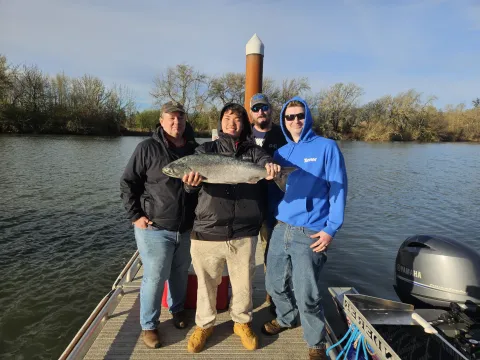
After a group photo, I cut up the fish and gave out a quick recipe tip. For Springer, just bake it at 425 for about 12-15 minutes maximum. Maybe a little salt and pepper. If you're looking to spice it up, top it with some mayo and sriracha first.
Dad pulled me aside and thanked me. "The point of today was to get my son on his first salmon. I just want to say mission accomplished. The salmon is great, but we're going to remember this for a long time. Thank you." They headed for their vehicle, still smiling. The other boat came in, loaded up, and headed out while I was cleaning up. Mine was the last trailer in the parking lot. Once in the truck, I sent a quick thank-you message and headed home.
I was exhausted. I thought about fishing on my own the next day, but decided against it. I wanted to savor the experience myself, and maybe sleep in. Like I said at the start, springer fishing can be tough, but the payoff is worth it!
/articles/best-kind-fishing-trip-jerad-sorber
Catching Spring Chinook
From Northern California to Canada, and the Pacific to Idaho, few secrets are as carefully guarded as uncrowded areas for spring bank-caught salmon. Each time one of my fishing buds gives the slightest hint of a clue of a lean in that direction, my phone goes dead, his email is lost, or I have to remind him, “I don’t text.” I turned the ringer off on my phone nine years ago. Even my wife, Suz, and I had a big fight over it. We were raised fishing the same rivers like the Molalla and Clackamas, and ocean reefs, so I guess it was only natural that sooner or later she demanded to know my springer spots. "Look," I said, "I bought you a diamond ring. Isn't that enough? I'm not giving you my secret fishing holes that took a lifetime to find. That kind of intimacy and trust takes years. If it's okay with you, I'd like to keep them between me and God." She said it wasn't okay.
"Let me get this straight," she said. "You trust me enough to marry me, but not enough to show me your secret fishing spots?"
"How it is," I said.
She responded by deliberately knocking off one of my big spring chinooks with the net (she swears it was an accident. Yeah, right.). Of course, we broke up over it. It was a nice fish that by all rights should have been in the box.
Now we are back together, and using her mermaid magic, she has my secret spots. Or thinks she does. I didn't tell her I learned from a Joseph Campbell video how Navajo US Army scout and storyteller Jeff King left out an essential piece of the story until the initiate was ready.
Why, you may wonder, are you so extreme as to not even tell your wife? The answer is these fish are my favorite to eat. At $18 to $27 a pound during prime season, I can’t afford to show up somewhere that previously had zero to three anglers and see 30 to 40. If that happened, I couldn’t get my regular 16 fish a season from rivers to get me through the year. In plain terms, a 20-pound cleaned springer is worth about $400. Add another, and that is an $800 morning. All of which is saying, springer fishing is serious business. Plutarch's Moralia notes that ancient Spartan mothers told their sons, “Return with your shield, or on it.” At least one Oregon mother told her son going after springers, “Return with your fishing rod, or on it”.
So what’s the point of this article? is the obvious question. The point is, if you want to catch a coveted bank-caught springer away from the crowds, put your time in hacking blackberry vines, searching maps, and getting permission from landowners; or get a boat, or hire a guide. However, if you want to go it alone bank-fishing after hearing all this, here is my advice.
Local Knowledge
Go where people regularly catch springers, and watch everything they use and do, right down to the gnat’s eyelash’s mite’s eyelash. I mean study gear, hook, bait, length and size, and kind of leader, exact placement and depth of lure, time of day, and if you are really serious, where they go to church and the color of their socks.
Study a Watershed
I found springers to be more picky than steelhead about where they pause in upriver migrations. In general, springers like it slow, dark, and deep, which makes sense if you consider these 10 to 30 pound brutes a short while ago had an entire Pacific ocean to forage. Chinook in our area travel as far as the Aleutian Islands past Dutch Harbor, into the Bering Sea. That is how they get so big and delicious.
Good Bait Makes All the Difference
After over 40 years of doing this, I see the same guys in the same spots at the same times of year on my springer travels from coastal rivers to Idaho. They are all expert anglers, but on some days one of them is slaying fish after fish while the rest of us look on in mouth-watering amazement. Why? It’s the bait cure the fish want that day, and to show how serious these fish are, they ignore everyone else’s bait, moving within inches of the same water. I asked one successful angler his secret, and he said it took over 20 years for an old-timer to share it, and there was no way in hell he was telling me. I said I understood. If you read my last article, “How to Outfit a Fish Car,” you know these fish “can smell parts per billion.” GrrlScientist, formerly of The University of Washington in Seattle and science writer for The Guardian, permitted me to include a SciLogs article “Salmon, scent and going home again” January 17, 2011, in which she noted:
"In the November 1978 issue of Pacific Search, author C. Herb Williams described a Canadian study where a nearly homeopathic solution containing one part of human skin dissolved in 80 billion parts of water was dumped into a river. Astonishingly, the scent from this solution was sufficient to stop migrating salmon for as long as half an hour. Additional experiments by Canadian scientists show that salmon will either slow or stop their migrations when certain human smells are present in the water, and trout — another salmonid — show distinct flight responses when a fisherman washes his hands upstream. [par break] This offensive scent was identified as the amino acid, serine, which — because human skin contains serine — has led to some fishermen to refer to this as 'the serine problem'."
This means when I catch a hen, I cure her eggs that night so I can fish them at daylight without being frozen. I keep my hands clean, and on sweaty days wear white latex gloves. One angler said I was Michael Jacksoning it, but I had a salmon, and he didn’t. Many years of experimenting led to my current egg cure recipe. Reel blazing runs, $800 fish mornings, and beet-red spring salmon steaks make it all worth it.
A Friends of William Stafford Scholar at the “Speak Truth to Power” Fellowship of Reconciliation Seabeck Conference, Scott T. Starbuck’s two books of fishing poems are River Walker, which sold out in less than a year, and Lost Salmon forthcoming from MoonPath Press. Starbuck’s writing focuses on the clash between ancient sustaining forces like wild salmon rivers with modern industrial lives. His most recent book is Industrial Oz: Ecopoems. His blog Trees, Fish, and Dreams is at riverseek.blogspot.com
/articles/catching-spring-chinook
The Outdoors Roundup
By John Kruse
SOMETHING FISHY FOR DINNER
TJ’s Bar and Grill in Kettle Falls is in hot water after serving seafood they should not have been selling to their patrons. According to Captain Brad Rhoden with the Washington Department of Fish and Wildlife, during the summer of 2019 the owner of the restaurant, Terry Baxter, went on a recreational fishing trip near Bamfield, British Columbia. Baxter then brought the Chinook and coho salmon, as well as the halibut he caught, back home, and proceeded to serve these fish to customers at his restaurant.
Captain Rhoden states, “By law, a business selling fish to a consumer, such as a restaurant, is required to state the species of the salmon and whether the fish was farmed or wild caught. The Legislature created these laws so consumers can be confident the fish they are about to eat is what it says.”
As for selling recreationally caught fish in a restaurant, Captain Rhoden explained, “Washington law does not allow the edible portions of wild animals, game birds and game fish to be sold. Food fish such as salmon and halibut can be commercially sold in Washington as long as the fish were lawfully harvested during on open season/area by commercially licensed fishers. So, no recreationally caught fish can be sold, bartered or traded lawfully in Washington.”
The multi-year investigation by the Washington Department of Fish and Wildlife was prosecuted by the Washington State Attorney General’s Public Lands and Conservation Division last summer. On January 17th, Baxter’s business plead guilty to the crime of First-Degree Unlawful Fish Catch in Stevens County Superior Court. He received no jail time but will have to pay a $10,000 fine.
STATE PARKS HIRING PARK AIDES
Looking for a fulfilling, seasonal job working in a great outdoors location? If so, apply for a job as a park aide with Washington State Parks. They are hiring 305 seasonal workers to work from April through September at their parks throughout the state.
Duties include everything from registering campers to cleaning campgrounds and maintaining facilities and trails. Aides may also be helping out with interpretive and educational programs at parks around the state. You may be assigned to one specific park, or rotate your daily duties amongst several parks in close proximity to one another.
My son David worked as a park aide for two years in college, and really enjoyed his time during the summer months at Lincoln Rock and Daroga State Parks in North Central Washington. However, this isn’t just a job for college students trying to make money during the summer. It’s also a great opportunity for retired or semi-retired individuals who enjoy meeting people and spending time outdoors in the beautiful settings our state parks are set in.
Park aides earn anywhere from $16.61 to $19.09, depending on qualifications and experience. Senior Park Aides (with previous experience) earn more. You can fill out an application at www.governmentjobs.com. Simply type in “Park Aide” in the search bar, along with “Washington” for the location, and you’ll see what’s available.
FISHING REPORTS
COLUMBIA RIVER GORGE
Autumn Lawyer at Gorge Outfitters Supply in Rufus says they are doing pretty well catching walleye below John Day Dam. Most of the walleye have been caught using spinner worm harnesses tipped with nightcrawlers. A bright orange and black combo-colored spinner worm harness is the hot ticket. Several large walleye (up to ten pounds) have been caught in the last week.
Autumn says sturgeon fishing was also pretty good last week. Catch and keep sturgeon fishing remains open (for now) in both The Dalles and John Day pools. Be sure to check the WDFW and ODFW websites before going out, to make sure harvest quotas have not been met.
RUFUS WOODS RESERVOIR
Austin Moser with Austin’s Northwest Adventures has been catching triploid rainbow trout near the net pens at Rufus Woods Reservoir over the last several weeks. Austin says they have been catching limits of these hefty rainbow trout, averaging 4 to 8 pounds and going all the way up to 15 pounds in size. Moser’s clients have been jigging 3/8-ounce Maxi jigs made by Yakima Bait Company. While many anglers use bright colors, Moser has found natural colors such as black, brown and olive work best.
Bank anglers are having success as well, though it can be hit and miss. Most anglers fishing from shore are using Powerbait to catch their trout. It is worth noting that there is a $20 access fee to use the park near the net pens and also a $10 launch fee. Shore anglers also need to have a Colville Tribal fishing permit. To book a trip go to www.austinsnorthwestadventures.com. If you want to find out more about fishing or camping at Lake Rufus Woods Park, which is operated by the Colville Tribe, go to www.colvilletribes.com/lake-rufus-woods.
John Kruse – www.northwesternoutdoors.com and www.americaoutdoorsradio.com
/articles/outdoors-roundup-2
Spring Chinook Time
By Jason Brooks
One of the most sought after and tasty salmon in all of the Pacific Northwest is the spring chinook. This run of salmon draws thousands of anglers who will first head to the Columbia, as well as a few coastal rivers for a chance to catch a “springer”.
The fish start to arrive in January and will run until May, with the height of the runs occurring in April. Once the fish make their way up the Columbia to the many tributaries, the anglers will spread out to focus on terminal fisheries. Run estimates and seasons yet to be set will determine where you can go to catch a spring chinook.
Looking at the projected runs, the Columbia total run is expected to be 307,800 wild and hatchery combined. This is good news as it is well over last year's projected run of 197,000 fish and even over the actual return from last year of 274,495. This means anglers should have fisheries in the lower Columbia area as well as the Vancouver-Portland fishery between I-5 and I-205 in early spring.
The Kalama fishery is near the Port of Kalama on the Columbia River, where there is good boat access with a protected harbor and multi-lane boat launch. Run straight across the channel, and you are at the fishery. Some anglers will use a small boat to cross and then beach fish off Sand Island by plunking a Spin-n-Glo with a gob of cured salmon eggs. Other bank plunking options are wobblers on a dropper, or a banana plug such as a MagLip or K15 Kwikfish, both with a herring or sardine wrap.
The boat angler has two options here depending on the tide. Most will troll using a triangle flasher, such as the Mack’s Lure UV Triangle Scent Flash or a Yakima Bait Company Big Al’s Fish Flash, then a long leader from 36 to 48 inches, with a 6-bead chain swivel in the middle, to a plug cut herring. When it comes to bait, the most productive herring are dyed with Bad Azz bait dye in either chartreuse or blue, or brined with Brine-n-Brite, which also comes in chartreuse and blue.
Single point barbless hooks must be used, but to increase the chance at a hook-up, set back the farthest hook and downsize it to a size 4 Gamakatsu Big River. These hooks are strong even in the small size 4- which tends to grab onto the chinook's face or jaw when they swipe at the bait- and will increase your hook to landing ratio.
The second option is to anchor up during the outgoing tide and let out the plugs and wobblers. This is known as “sitting on the hook”, and boats will form lines, often using wing dams to tie up to and to help break up the strong outflowing current. My first time fishing this part of the river was fishing on anchor with a friend in his boat. We sat in the protected covered cabin and played card games until a rod started to bounce, running out into the rain and reeling in the fish.
Then we let out the line, making sure it landed in a travel lane (which are often shallow depressions in the sandy bottom), and then resumed the card game again. It might not sound like much of a fishing experience, but this is springer fishing, and it is all about putting the best-eating salmon in the freezer.
The Cowlitz
The Cowlitz is the second largest lower Columbia tributary, only to be surpassed by the Willamette. With a predicted return of 9,000 springers to the Cowlitz, we can hope there will be a fishery that often coincides with the late returning winter steelhead. The “Cow” is one of the few rivers where anglers can catch a double bag of good eating fish in the same day. Depending on where you go on the Cowlitz will dictate how you fish.
In the lower river, anglers often pull plugs or use bait divers and baits such as cured salmon eggs or prawns. The prawns will have sat a few days in Pro-Cure’s Shrimp and Prawn Cure in magenta or red, and some anglers will use both baits at the same time, making a “cocktail” of sorts. Further upriver, anglers will float fish gobs of eggs or even plunk them. The Cowlitz offers both bank and boat access and is within a few hours’ drive of several cities, which means it gets crowded, but it can be a great place to catch fish.
Willamette
If you are looking for a lower Columbia powerhouse, then look at the Willamette. Anglers will start in early spring, hoping to be one of the first to catch one of the 71,000 projected spring chinook expected back this year. That is nearly 20,000 more than projected last year (51,200) and almost 16,000 more than the 55,391 that returned. The early springtime anglers will target the Multnomah channel which starts at St. Helen’s, Oregon, right across from Ridgefield, Washington. This can be protected waters, often calm and out of the wind, unlike the mainstem Columbia in spring.
I was fishing here several years ago with Buzz Ramsey, and as we crossed the Columbia, I noted that the wind was starting to kick up. After fishing the day in the Multnomah channel, we started back towards Ridgefield, where we had launched from. Making the corner around the island, we were met with gale force winds and whitecaps, and later learned that a boat capsized on the Columbia that day, costing two people their lives.
Be sure to check the wind forecast if you plan to cross the Columbia to fish the Multnomah channel, otherwise, drive around to the Oregon side and launch from there. An Oregon fishing license is needed to fish in the Multnomah channel, as this is considered Oregon waters and is part of the Willamette River and not the Columbia.
Bonneville Dam
Further upriver and above the Bonneville Dam, anglers start to target terminal fisheries. The first being the Wind River, which will have both a run of Wind River bound fish as well as fish stopping to rest near the deadline of the Wind River outlet, as marked by large white buoys in the Columbia. The Wind River is expected to get back 4,400 fish, which is only 200 fish more than last year's projection of 4,200, but last year the run exceeded the estimate by over 2,000 fish, with an actual return of 6,530.
Here, trolling plugs such as MagLips, Kwikfish, and even going “old school” with an orange Mag Wart by Storm is commonplace. In the late 90’s and early 2000’s, about everyone flat lined the hot orange Mag Wart and then started fishing them on droppers to keep from tangling with other boats. This still works, but also anglers will be trolling triangle flashers and Brad’s Super Baits and Super Cut Plugs often in the Hot Lava color and stuffed with tuna.
Drano Lake
Drano Lake is the most popular spring chinook terminal fishery in the entire Columbia system. Here hundreds of boats will try to choke into the “toilet bowl”, which is the entrance to the impoundment at the highway 14 bridge. Be aware of the deadline and do not cross it as you will get cited and be sure to be courteous. Here, boats will slow down and make a turn, trolling in a counterclockwise direction.
Do not try to go against the current of boats, as it will only lead to a mess. Here, anglers primarily slowly troll prawn spinners with a triangle flasher. Again, the Pro-Cure cured prawns are effective, with magenta being the most popular color. For prawn spinners, you can use the tried-and-true Eric’s Prawn Rig by Lugh Jensen with the “backdraft” color, a combination of orange, chartreuse, and green with green beads.
Macks Lure also has a prawn rig which uses their Smile Blade, a Mylar blade that works at extremely low speeds which are needed at Drano. Again, the most popular color is green and chartreuse, with a magenta cured prawn.
For anglers hoping to get some spring chinook further upriver, then 2023 might be your year. The Snake River and Idaho bound fish are estimated to be 85,900, which means there could be a season, but do not expect any announcements until in-run estimates are updated with fish counted at the dams. Icicle River anglers up near Wenatchee, some 500 river miles from the ocean, also have some great news, along with Yakima River anglers, as 41,400 spring chinook are expected in the “Upriver Columbia” run.
Seasons on both rivers are not usually announced until dam counts show there are enough fish above the mid-Columbia pools. If this estimate is like the others and last years, all of which came in above projections, then spring chinook anglers in the upper Columbia and even into Idaho will hopefully have a season. With springers already showing up and passing over Bonneville dam, with one climbing the fish ladder on January 2nd, it looks to be a momentous year. The best eating fish are on their way here, and anglers will have plenty of places to go.
Let us hope the winds do not kick up too much and we can all get along in Drano’s toilet bowl. Start curing up the prawns and soaking the herring, it is springer time!
/articles/spring-chinook-time
Bull Trout in the Metolius
By Gary Lewis
With the water swirling around us, we waded in at the mouth of Jack Creek. Skip Morris had hooked and lost a big rainbow here the day before. Today he stood back while Carol plumbed the two-foot deep run with a big stonefly nymph trailing a small beadhead attractor, called Gabriel's Trumpet.
For a moment we thought Carol's rig was hung up, but when she tightened the line, a fish torpedoed away.
The fish rolled mid-river and I saw his tail and dark fins silhouetted against bright water: a bull trout. Close to eight pounds, I guessed. The line broke and Carol reeled in the slack. The fish had taken the big stonefly nymph after a 13-minute battle and a last headlong flight.
That’s what can happen when kokanee are on the move and bull trout follow them into the shallows.
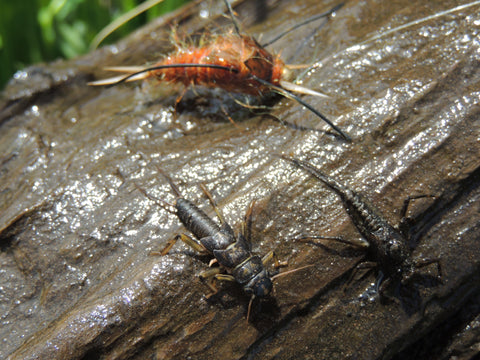
LAKE RUN BULL TROUT
Kokanee are thickest in the Metolius in late September and October. And the biggest bull trout, which can get to 30 inches or more, hammer them.
Bull trout are meat eaters and if it's a third of their size they will crunch it. If it's half their size, they will try to choke it down anyway. Anyone who has caught a bunch of big bull trout has seen the tail end of a kokanee or a whitefish sticking out of that gullet.
The Metolius River and Lake Billy Chinook are home to resident and migratory bull trout. The bulls move up the river to spawn in late August, September, and October.
Oriented to ice-cold water, bull trout stage near springs and off the mouths of major tributaries like Canyon Creek and Jack Creek. After the spawn, they need to replace the calories they expended over the last few weeks. That’s when they find the kokanee.
The kokanee spawn puts both species in the river at the same time. And the bull trout are the winners. Preoccupied, the landlocked salmon are easy prey for sharp-toothed bull trout.
Whitefish are on the menu for bull trout year-round, and many are the stories of anglers fighting whitefish only to lose them to bull trout which charge out from under a log to grab the hapless poor man's bonefish.
Bull trout are apt to eat the limp, the lame, the lazy. It’s the erratic behavior that trips the predatory sear in a bull trout's brain. Think strike triggers. Tie or buy streamers with big eyes, a flash of blood red near the gills. On the water, fish them on the wet fly swing, but give them action. Make the imitation twitch. Like a wounded fish in deep trouble.

FISHING LAKE BILLY CHINOOK
A down-running Metolius River bull trout ends up running into Round Butte Dam and turning around to make its living in a 4,000-acre reservoir fed by three rivers: the Metolius, the Deschutes and the Crooked River.
Best time to target bull trout in Lake Billy Chinook is when the waters begin to warm in March and April. Bull trout hunt close to shore in the late winter and early spring. Anglers who throw Zonkers and other minnow imitations on long casts and strip hard can elicit hard strikes from fish.
It's one of the best ways to get the biggest bull trout. A lot of 17- to 19-inchers will be brought to the net as well as the occasional 10-pounder.
SWINGING STREAMERS
When whitefish are schooled up, working the bottom, they are hard for bull trout to feed on, but when one of them leaves formation and streaks up to eat a mayfly emerger, its defenses are down and its easy money for bull trout.
When fishing a small streamer or a larger bunny leech, try to work it like a fish that is out of its element, a scared minnow that thought it could play in the deep end of the pool. It's vulnerable. It's lunch.
A variation on that theme is the sculpin. Bull trout eat sculpin year-round. In the river, they eat sculpin. In the lake - sculpin. When sculpin are doing what they do, daubing in the mud, they are pretty safe.
But when they climb up through the water column or get caught in the current, something is going to nail them. Big lead eyes, blood-red gill flare or Flashabou, and prominent fins are some of the strike triggers to play on when tying sculpin flies.
Cast down and cross-current, let it swing and chug it. On long runs and into the tailout, let the sculpin work back and forth. Tied small, a sculpin imitation can be fished with a slackline presentation that keeps it working back and forth over bull trout holding water.
Think big. If a 30-inch bull can choke down a 12-inch whitefish, it will go for a 10-inch streamer. Big bunny leeches double as flesh flies. Just change the presentation.

DREDGING WITH A TWO-FLY RIG
As kokanee carcasses and decaying flesh become harder to find, bull trout begin to focus on bugs. Streamers and flesh flies can provoke a grab, but a dead-drifted nymph can pay off as well.
To conserve strength, the biggest fish claim the best lies, hugging the bottom along downed timber and behind rock slabs and boulders. The major difference between drifting beadhead nymphs for rainbows and for bull trout is the length of the leader and the tightness of the presentation to the bottom.
Fish the bottom. Keep the leader short so the dropper fly doesn't ride too high in the water column.
Tie on a big, heavy stonefly nymph and knot eight to ten inches of fluorocarbon tippet material to the bend of the hook. The primary fly can be a Flashback Pheasant Tail, an egg pattern, or a No. 16 Serendipity.
The main thing is to get that heavy fly bumping on the bottom. Make it easy! That bull trout should be able to spot the trailing dropper fly, lean its head over, and grab without leaving its lie.
# # #
To contact Gary Lewis, visit www.GaryLewisOutdoors.com
/articles/bull-trout-metolius-0
No Kill Kalama
Sometimes we don’t get the fish, sometimes we don’t get the shot. And sometimes we don’t even think about it because there is just too much going on.
You are not going to get a slick fish picture, but I am going to let you in on a little secret called “License to Chill” on the Kalama River in Washington State. This underdog tributary of the Columbia River is often overlooked, but why? Well, it's hard to get to, and access is limited, but there are substantial year-long opportunities for salmon and steelhead runs. It's a sweet spot, roughly 45 miles long, and narrow enough to cast across to the opposite bank.
It may be relatively small, but when you're there you feel the pulse. It’s a mainline to the Pacific Northwest heartbeat. The swift mossy green waters amble through the Cascades from Mt St Helens to the Columbia.
License to Chill hosts 19 private acres of preserved forest, easy access to the riverbank, and multiple runs every year. Spring chinook get a lot of attention, followed by summer steelhead, coho in the fall, and the almighty winter steelhead running well into the spring.
Can you keep them? No. This is a strictly managed catch-and-release barbless fly-fishing stretch.
Should you pull them out of the water, take a picture, and admire your fish? No, what's the point of that? You're causing stress, suffocation, and possible internal injury. This river isn't for the eating fish, it's for the experience. No Kill Kalama is just the place to go if you want to unwind and wet your line.
I am one of those people who believes that all humans should have the right to forage, hunt, and fish for our own sustenance. And, why not fun? However, I also think we should absolutely look outside of ourselves at the natural world, sustainability, and what we are leaving for each other and our children.
This isn't a debate, but a few words to share what a great time I had on the Kalama River. If other like-minded folks appreciate the suggestion, then I'm pleased about that!
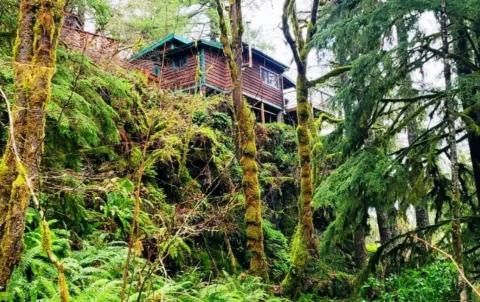
So much love and history has gone into this cabin and property. It is really one of a kind. At 90 feet above the river, you can feel it roar under you as you drift to sleep. If you like eagles, how about taking a shower outdoors while they fly above giant Red Cedars? It is epic!
/articles/no-kill-kalama
Hanford Reach Fall Chinook Bounty
My reel was peeling line at a dizzying rate and it felt like I had a freight train attached on the other end. Without thinking I applied my thumb to the level line spool and pulled back with a loud “ouch!” “That’ll leave a mark” our guide Dave deadpanned. The fish was a good fifty yards behind our boat before I was able to slowly start to regain line. Foot by foot the strong chinook and I battled back and forth, each of us gaining, and then losing line to the other.
The most popular location anglers congregate is Vernita Bridge. There is a large open area to the north of the bridge on the east side of the river. Every year a small town of anglers set up their base camp here. All variety of tents, RVs, and sleeping in the back of trucks can be seen. At night the cries of the coyotes remind you that this is wild country. Camping is free, but a Discovery pass is required. The launch here is rough and rocky and four-wheel drive is a must. Plan on your boat getting scraped up on the rocky shoreline and be sure to bring waders to help during the launch and retrieval process. Launching, by the way, starts at o-dark hundred. Alarm clocks are optional – unless you’re a deep sleeper, you will be awakened by the lights and sounds of anglers starting to launch around 3am.
Closer and closer the powerful fish came, each run a little less intense. Now a giant tail could be seen, trailing a large V wake behind it. Finally, the fish, exhausted came to the side of the boat and I saw the reassuring sign of fatigue as the fish laid on its side, telling us we were getting closer to that critical moment. Net sliding under the fish Dave skillfully scooped him up and into our boat. But not before the big fish gave one final flip of his tail, giving all of us an early morning soaking. Wow! This upriver fall bright was twenty plus pounds of pure power and beauty, not to mention great eating. The smiles and high fives of my friends were the icing on the cake and the day was just beginning!
A perfect morning, the sun just breaking over the shoreline and catching a hot Hanford Reach fall chinook - it’s the stuff dreams are made of, and it was living up to be everything I had heard about the Reach.
Washington’s Hanford Reach is synonymous with some of the state’s best fall chinook fishing to be found – and not coincidentally, the last of the chinook fishing to be found for the season. It’s the icing on the cake, and what icing it is! The Reach is the perfect setting and the perfect fish to end the year’s salmon fishing on the Columbia River. These are the brutes that dreams are made of. A fish worth dreaming about during the long off season and savoring the brief weeks they are available to catch. Battle plans must be made, so let’s talk about what you need to know to get into this fishery and have a chance at one of these amazing fish.
They call “The Reach” the last free-flowing stretch of the Columbia. With dams seemingly from one end of the Columbia to the other, this stretch of water has no dams to impede it. Here, from Priest Rapids dam down to Richland anglers have 63 miles of productive water to fish. Ideal spawning grounds make this a natural holding location for big chinook to do their reproducing thing. For the boat angler, you’ll find a variety of deep holes, shallow runs, and everything in between. A prop boat can be used – with extreme caution, however, downriver in the area known as Coyote Rapids a jet is the way to go.

Just upstream from the rough launch at Vernita you’ll run into the first hole, the Hog Hole. This spot will hold fish early and throughout the season. It’s in the middle of the river and runs a couple hundred yards in length and has a depth of 15-40 feet. Fish will be both suspended and hugging the bottom here. The hole is deep enough to require a way to get your gear down to the fish. This can include divers, dropper weights, and, yes, downriggers. A word of caution – the Columbia is a big, strong, and powerful river. Snagging a downrigger ball on the bottom of the Columbia has the potential for some seriously bad consequences and requires the boat captain and crew to be ready to deal with them. The times I’ve used downriggers I always have a wire cutter at the ready and a good dose of “always pay attention” to go along with it. It goes without saying if another boat hooks up to be ready to pull those riggers up. Backtrolling this hole works well and as you push the fish ever shallower by ready for that take down.
A variety of salmon catching gear can be used for Hanford chinook depending on the depth and speed of the spot you are fishing. Among the most popular setups are flashers with super baits (packed with tuna), plugs, flatfish (wrapped with a sardine or herring strip), and the ever-effective spin-n-glo with eggs, or eggs and shrimp. Anglers that are flexible and willing to adapt techniques to river flow and time of day will be most successful. Backtrolling your gear down the hole can be very effective, pushing fish back down the hole and triggering them to bite out of aggression is a tried-and-true technique.
Farther upriver as you head to toward the dam, you’ll find the King Hole about a mile and a half above the bridge, then the China Bar and Midway Drifts. One of my personal favorite spots is the deep hole just down from the dam. As well as being great holding water, it’s a stunningly beautiful spot. The deep hole off the rocks is great for downrigger fishing. You may even want to try running a diver twenty feet behind your release and bringing the ball up ten feet off the bottom, letting the diver do the work of bring your bait down to the bottom. Be sure to pay attention to the regulations and know the areas that are closed, downriver from the dam and on the west shoreline where the hatchery is located.

Below the Vernita Bridge you will find several more popular spots, including those famous old reactors. It’s about a three-mile run down to the B/C hole, and another four miles to reactor number one, and then number two. Beyond a large bend you’ll find the famous White Bluffs with a nice sixty-foot-deep hole. There’s a concrete launch located here, however; this is the area where running a prop boat becomes a dicey proposition. Be mindful that water levels can go up and down five to six feet in a day, leaving riffles where clear passage had been. It would be best to learn this water by first going with a guide before venturing out on your own.
Finally, farther downstream around the areas of the mouth of the Yakima down to the mouth of the Snake you’ll find slower water, more suited for prop boats. With several launches located around Richland, Pasco, and Kennewick, smaller boats will have a safer time of it than at the fast-flowing upper Reach spots.
As to timing, these up-river brights can be targeted from mid-September well into late October. Don’t be fooled by the dark coloring on these fish – they cut just fine and taste great!

The Reach is truly an amazing place to fish with the very real opportunity of hooking into large chinook. Multi-fish days are not unusual. As a bonus, while fishing you’ll be treated to amazing scenery. Besides moth-balled nuclear reactors, it’s very possible to see coyote, mule deer, several varieties of waterfowl, and even herds of elk on the shoreline. Some of the best weather in the Pacific Northwest can be had with temperatures moderating from the scorching hot summer days. You’ll find cool nights and a sky full of stars to gaze at as the coyotes sing you to sleep. And most likely you’ll be rewarded with some tasty chinook to take home.
/articles/hanford-reach-fall-chinook-bounty