Coho Prospects for 2026 by Mark Yuasa
As summer begins to fade away, excitement is blooming heading into fall with a large coho forecast expected to peak in the weeks ahead.
The front end of the migratory coho run - commonly labeled as silvers by anglers for their bright, chrome-colored body - entered the Strait of Juan de Fuca and Puget Sound in early August, with fair to good catches reported.
Coho (averaging 4 to 15 pounds, with some exceeding 20 pounds) create a lot of fervor, and when hooked, they’ll leap out of the water and make erratic zigzagging patterns across the surface.
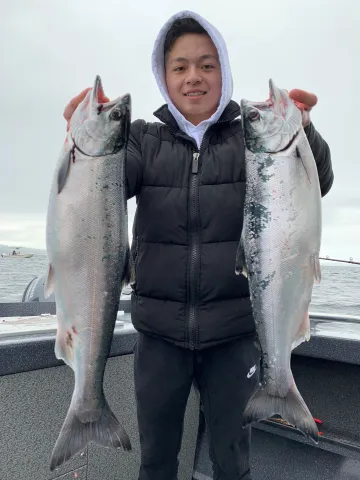
Washington Department of Fish and Wildlife (WDFW) salmon managers indicate that the 2026 coho prediction has the potential to generate the highest statewide recreational fishery catches seen in more than 20 years. Fingers crossed! The 2026 statewide combined hatchery and wild coho forecast is 1,827,748, up from 1,588,658 in 2025. In Puget Sound, the coho forecast is 897,190, up from 727,058 in 2025; 722,134 in 2024; and 760,029 in 2023.
During the North of Falcon salmon season setting process earlier this year, WDFW staff presented the 2026 Puget Sound coho forecasts and abundance trends. For hatchery coho, it showed a 4% improvement, and wild coho are up 53% compared to the 2025 forecast. The recent 10-year average for hatchery coho is up 45%, and wild coho is up 55%. The total Puget Sound coho (hatchery and wild combined) is up 49% from the 10-year average run size and up 22% from the 2025 forecast.
The coho buzz began back in June when Marine Area 10 (Seattle and Bremerton Area) saw good fishing for resident coho. Krill, a major part of a coho diet, has been plentiful in Marine Area 10, as well as baitfish such as herring. The ample feed kept many of the resident fish congregated in the area, and they are now being joined by their larger migratory cousins.
Marine Area 10 is open for coho daily through Sept. 30 with a two salmon daily limit, and anglers must release Chinook and chum. Fishing is also open daily from Oct. 1 through Nov. 15 with a two salmon daily limit, and anglers must release Chinook. Shilshole Bay reopens on Sept. 1. To know when it’s best to hit the water, be sure to monitor the WDFW catch sampling webpage at https://wdfw.wa.gov/fishing/reports/creel/puget.
A good number of coho have already entered the Strait of Juan de Fuca at Marine Area 5 (Sekiu-Pillar Point) and Marine Area 6 (East Strait of Juan de Fuca). These two areas are the barometer of when the peak return of coho will move into Puget Sound.
The Marine Area 5 salmon fishery is open daily through Sept. 24 with a two-salmon daily limit, and anglers must release Chinook, chum, sockeye, and wild coho. Then the area is open daily for all coho retention from Sept. 25 through Oct. 15 with a two-salmon daily limit, and anglers must release Chinook, chum, and sockeye.
In Marine Area 6, the salmon fishery is open daily through Sept. 24 with a two-salmon daily limit, and anglers must release Chinook, chum, sockeye, and wild coho. Then the area is open daily for all coho retention from Sept. 25 through Oct. 15 with a two-salmon daily limit, and anglers must release Chinook, chum, and sockeye.
The best fishing in the Strait tends to be located about one to 10 miles out in the shipping lanes at depths of 200 to 500 feet or deeper. Remember to stay within the U.S. side of the shipping lanes. Look for tide rips and current breaks where krill and baitfish tend to concentrate and attract coho. Also, watch for schools of coho jumping and rolling on the surface.
Moving inland, Marine Area 7 (San Juan Islands) is open daily for all coho retention from Sept. 1 through Sept. 30 with a two-salmon daily limit, and anglers must release Chinook, chum, and sockeye.
Looking for popular inner-sound locations for coho? Try Marine Area 8–1 (Deception Pass, Hope Island, and Skagit Bay), which is open for coho daily through Oct. 11 with a two-salmon daily limit, and anglers must release Chinook and chum. And, just to the south near Everett is Marine Area 8–2 (Port Susan and Port Gardner), which is open for coho daily through Sept. 25 with a two-salmon daily limit, and anglers must release Chinook and chum.
Marine Area 9 (Admiralty Inlet) from Port Townsend south to Apple Cove Point-Edwards Point southernmost boundary line, and all points in between, are open daily through Sept. 18 for hatchery-marked coho with a two-salmon daily limit, and anglers must release Chinook, chum, and wild coho. Fishing is also open for all coho retention from Sept. 19 through Sept. 30 with a two-salmon daily limit, and anglers must release Chinook and chum.
Marine Area 11 (Tacoma and Vashon Island) is open for coho daily through Sept. 30 with a two salmon daily limit, and anglers must release chum and all Chinook (closed for Chinook retention on Aug. 15). Fishing is also open seven days per week from Oct. 1 through Nov. 15 with a two salmon daily limit, and anglers must release Chinook.
Marine Area 13 (South Puget Sound) is open daily for hatchery-marked coho through Sept. 30 with a two-salmon daily limit, and anglers must release chum, wild coho, and wild Chinook. Fishing remains open daily beginning Oct. 1 with a two-salmon daily limit, and anglers must release chum, wild coho, and wild Chinook. Anglers may fish with two poles with a Two-Pole Endorsement. In Marine Area 13, Squaxin Island is a popular area for those targeting hatchery coho.
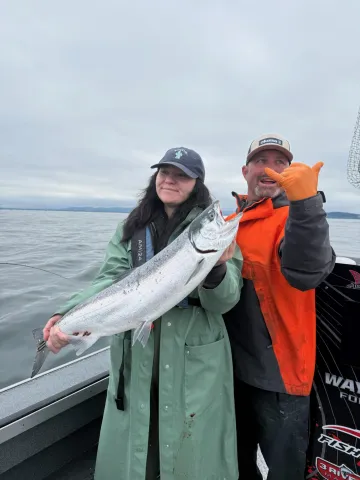
Coho bank fishing access
As these fish turn the corner around Port Townsend and enter Puget Sound, bank anglers can find numerous publicly accessible shorelines and piers that are within easy casting distance of silvers. When accessing these areas, make sure to be courteous and respectful around private property shoreline boundaries.
Top locations in the northern region include Point Wilson in Fort Worden State Park north of Port Townsend; Fort Flagler State Park on Marrowstone Island; Marrowstone Point Lighthouse; and the western and eastern shorelines of Whidbey Island around Fort Casey, Lagoon and Bush points, Bait Box Hole just north of Possession Point, and West and North beaches at Deception Pass State Park. The Oak Harbor Marina also has two net pens where hatchery coho are raised and released annually. In 2022, 30,000 fish were released from the net pen, and fish that survived will return this season to the area.
In northern and central Puget Sound, try Point No Point on Kitsap Peninsula; Browns Bay; Salsbury Point; Edmonds Marina Pier; Mukilteo Lighthouse and the public pier at the Mukilteo Ferry Landing; Richmond Beach and Meadow Point Beach at Golden Gardens; Shilshole Bay Pier; Seacrest Pier in West Seattle; West Point at Discovery Park; Carkeek Park, Lincoln Park and Alki Point Lighthouse in West Seattle.
In southcentral and southern Puget Sound, head to Browns Point Lighthouse Park and Dash Point State Park; Dolphin Point off the east side of Vashon Island; Blake Island State Park; Three Tree Point; Point Robinson Lighthouse, Point Beals, and KVI Beach on Vashon Island; Southworth and Manchester areas; and public piers at Des Moines, Redondo, Les Davis, and Point Defiance Park Boathouse.
Stay clear of large ships in shipping lanes
Many coho tend to congregate in the shipping lanes, and fishing is legal in the ship traffic lanes as long as the lanes are kept clear for ships, according to the Board of Pilotage Commissioners of Washington.
Shipping lanes should be cleared when ships - who have the right of way - are five minutes away (about two miles) to avoid impeding traffic. Be aware of your surroundings and monitor vessel traffic on VHF radio channel 14. Lastly, anglers should stay out of ferry lanes when ferry boats are present.
The U.S. Inland Navigation Rules and COLREGS Rule 10 state: Vessels less than 65 feet in length shall not impede the passage of vessels transiting the traffic lanes. For more information, refer to the Board of Pilotage website at www.pilotage.wa.gov.
Westport Boat Basin coho fishing
On Washington’s central coast, the Westport Boat Basin coho-only fishery is open daily through Jan. 31, 2027. The best timing is September through October as coho raised in the marina’s hatchery net pens begin to return.
The daily limit is six salmon, and no more than four may be adult fish. Anglers must release Chinook. No night fishing and an anti-snagging rule is in effect, and any hooks where the weight is molded directly to the hook - such as twitching jigs, swim jigs, or casting jigs - are not allowed. Only single-point barbless hooks may be used. The Catch Record Card (CRC) code for the basin fishery is 2-2W.
(Mark Yuasa is a Washington Department of Fish and Wildlife Communications Manager and longtime local fishing and outdoor writer.)
/articles/coho-prospects-2026-mark-yuasa
Off The Radar
By Randy Castello
With improving ocean conditions, the Puget Sound 2022 fall coho season could be the best in recent history. 666,648 coho are forecasted to return to the Puget Sound basin. With a few exceptions our local coho fisheries (Marine Area 5-13) will open August 16th.
Following is a quick breakdown of our inside coho fisheries. Make sure to review the WDFW Fish Washington App, WDFW Washington Sports Fishing Rules pamphlet and the emergency (https://wdfw.wa.gov/fishing/regulations/emergency-rules) for current daily limits and emergency closures.
MA 5 8/16-9/28 Hatchery Only
MA 6 8/16-9/28 Hatchery Only
Dungeness Bay fishery 10/1-10/31 Hatchery Only
MA 7 8/16-8/30 Hatchery Only
Bellingham Bay 8/16-9/30 Hatchery and Wild
MA 8-1 8/1-10/1 Hatchery and Wild
MA 8-2 South and West of the Line Defined by the Mukilteo and Clinton Ferry Docks 8/13-9/19 Hatchery Only
MA 9 8/16-9/25 Hatchery Only
MA 10 Through 10/31 Hatchery and Wild
The Sinclair Inlet Fishery Through 9/30 Hatchery and Wild
MA 11 Through 10/31 Hatchery and Wild
MA 12 North Through 10/31 Hatchery and Wild
MA 12 South Through 11/30 Hatchery and Wild
MA 13 Year-round Hatchery Only
What, somebody said coho? Break out the gear, check the trailer lights and move the garbage cans out of the way. It’s time to go fishing. I think that more than any other Western Washington fishery, our local coho opportunity is an eagerly anticipated family event.
Where there are many commonly known “stock” coho fisheries, this article will focus on a few of our out of the way opportunities.
Although areas like Eagle Point off San Juan Island, Point No Point, Possession Bar, the Edmonds Oil Docks, Meadowdale Point, Jeff Head, Kingston, Des Moines, Three Tree Point, Point Robinson, and the Slag Pile off Point Defiance are all solid coho fisheries, they can get crowded.
Are there other coho opportunities? The answer is affirmative, and even better, finding off the radar coho is pretty rewarding.
For me, pulling up on a spot and being the only boat in sight is magical. A quick look at the meter confirming there is bait and individual coho on the prowl gets my old ticker going. In general, coho are a very worthy opponent. Being on a school of them without another boat in sight could be the highlight of your summer.
Finding off the radar coho starts at home. Sit down with a digital chart, preferably one that will give you current arrows, and develop your game plan. Your game plan should include a few layers of back up plans.
If you use your phone, screenshot the areas you want to fish. In doing your research, consider the tides and how they will be flowing or interacting with adjacent structure or opposing tidal flows.
A few examples to get you started:
Eagle Point on the south side of San Juan Island is an option. Most people set up along the pronounced rips just off Eagle Point. The reality is that those rips will concentrate bait much further offshore than you would expect.
At the surface, the current break is very subtle, but at depth the current forms a hard wall trapping bait that the coho are feeding on.
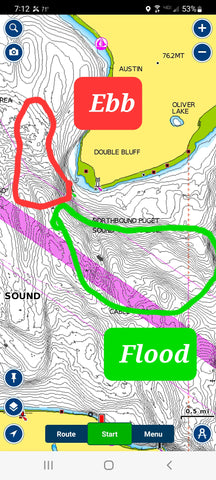
Double Bluff is another sleeper and rarely has more than a few boats on it. I really like Double Bluff; on the right day you can fish the general area and never have to fire up the main and go on the hunt.
Depending on the tides you can drag gear, mooch cut-plug herring, and even fish jigs. On the flood tide you want to fish the rips south of the bluff, and on the ebb, fish from the buoy north. You will need to keep an eye on the fish finder, but many of the early season coho will be suspended in less than 150’ of water. If you’re not seeing anything on the meter, move around.
More than any other place on the Sound, there will be coho holding somewhere at Double Bluff.
Another out of the way and often overlooked coho spot is Partridge Bank. That said, Partridge bank is one of my go-to coho spots. Depending on the given tide series, it typically fishes well on any tide. Fish along the edge of the shipping lane on the west side of the bank.
A couple things to note regarding the Partridge Bank fishery: sometimes there is a big swell that fractures as it approaches the bank. The resulting chop can be unpredictable and you need to be alert to changing sea conditions.
Secondly, you may stray into the shipping lane so keep your radio on and give any passing ships the right of way. Consider setting your VHF up on Tri-Watch, monitor 16, 13 (Bridge to Bridge, commercial traffic) and a floating channel. I have mine on 22 but many recreational boaters monitor channel 68.
The previous three examples are just a few of the areas to find off the radar coho. Again, sit down with some form of chart and current table and do your homework.
There are many other locations in MA 5-11 where you won’t be necessarily be chasing coho with a fleet of like-minded friends. Look for points, underwater structure, and areas where opposing currents will concentrate bait and you’ll find coho.
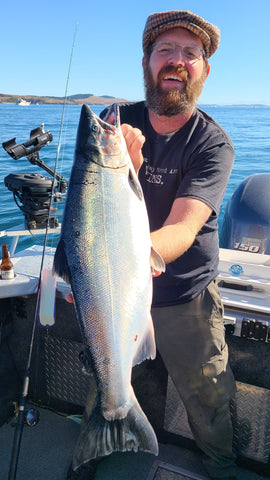
Now that you have identified your coho hidey-hole, what’s next? The coho drill on my boat is pretty basic. Although I have a couple jigging and/or mooching rods ready to go it’s mostly a trolling show. I pull 11” flashers and flies, hoochies or spoons.
Coho Killers, Silver Horde 3.5” Kingfisher Lite spoons and Gibbs G-Force spoons are my go-to spoon offering. I run 36” of 30# fluorocarbon between the flasher and the spoon. Regarding color; you can’t go wrong with any combination of green or chartreuse but a Purple Haze flasher and a clear hoochie with a green insert can be deadly.
Always head out with an assortment of flies, hoochies, or spoons and cycle through gear until you find the magic combination for the day. Also, use scent on your spoons. Try a sticky Bloody Tuna, Herring, or Anchovy goo and re-scent often. Add a salted herring strip to the leading hook on all your flies and hoochies.
At the butt-crack of dawn, fast trolling cut plug herring in the top 30’ of water is a solid option, but after first light it will be a downrigger show. Use 12 pound or heavier downrigger weights and troll 3.5 to 4 mph.
At the speed you’ll be trolling for coho it is likely that you will not see your downrigger balls on the meter and remember that with the blowback you will need additional cable out for a given depth. Especially for coho, I chase meter marks, so keep an eye on the meter.
Be ready for action, we have had every rod on the boat go off at once when trolling for early AM coho. Have a game plan, net ready, and a bleed bucket to assure that your silvery opponent makes its way into the fish box in the best possible condition.
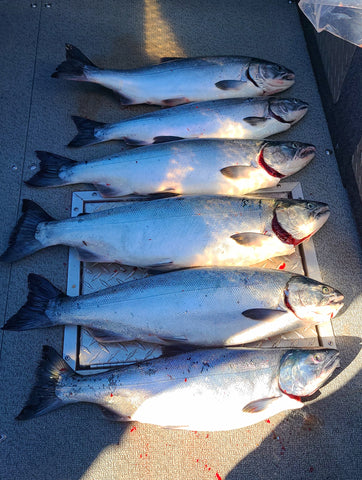
Good luck and remember that our fall coho fishery is an ideal family fishery. They are relatively easy to find, usually hungry, and have some serious shoulders. As a last thought, I want to address the weather. I work 5 to 6 days a week on the water.
While in the San Juans today I encountered a significant squall line of thunderstorms. Basically, the weather went from summer boating weather to “what the heck” in minutes. It was windy, pouring and very dark. Then the thunder was relentless and deafening. Since I had not hit send for the article yet, I figured that a quick note about coho weather was in order.
Coho season falls while our summer boating weather is transitioning to an unsettled weather pattern. Most of the time the pond will be very pleasant. Be aware of and prepared for changing conditions. If the forecast is questionable, don’t go, or at least proceed with caution.
A 15-mph wind against a running tide can be uncomfortable or even dangerous. Know the limits of both your boat and crew, then always error on the cautious side.
/articles/radar