Washington Winter Kokanee Observations
By Randy Castello

As we say good bye to our summer boating weather you may find yourself wondering, “do I winterize or do I find something to fish for?” Either way, you should probably winterize your boat, motor, and trailer, but let’s talk trolling for winter kokanee.
Winter kokanee
Winter kokanee in Washington State? Sure, so go ahead and winterize, but keep the keys handy. Find your gloves and earmuffs and make a thermos of steaming hot coffee because there are kokanee opportunities to be had. Both Western Washington and the Eastside have winter kokanee lakes.
Kokanee are the non-anadromous form of sockeye salmon. Basically, by choice or otherwise, kokanee are landlocked sockeye salmon. Kokanee are native to many Pacific Northwest lakes and have been introduced to a number of lakes across the United States.
The life cycle is of particular interest to winter kokanee anglers. Although there are exceptions, kokanee typically live 3-4 years before they spawn and die. For the dedicated winter kokanee angler that means that there are 2-3, maybe even 4-year kokanee available during the chilly months.
Winter kokanee fishing is a little different than our spring and summer fisheries. Most winter kokanee fishing is done in deeper water. Kokanee prefer water that is 50-56 degrees. In part, they are more active in this zone because it is rich in oxygen boosting energy to chase down their next meal. Each lake varies, but finding “the zone’” is important during winter kokanee fishing. One way is to keep your eyes glued to your fish finder and look for fish.
This is where the best fish finder/chart plotter you can afford is your friend. When you find fish, mark the spot, and pretty soon you’ll have a winter kokanee map. With it you can amaze your guest fishermen and go right to where they are. They’ll think you are the “Koke-Wisperer”, maybe a kokanee-shaman or something… You can also use a Fish Hawk Digital Gauge or the Vexilar Deptherm to graph out the water temperature at depth.
Winter kokanee fishing is more of a love thing, there is rarely a hot bite. Each lake has a winter fishery sweet spot depth. Generally, in Western Washington it is 30-60’, and Eastern Washington 40-200’ deep. Each lake, especially on the westside, seems to have a brief period each day where the kokanee will put on the feed bag and go on the bite outside of your usual grind it out depth.
Kokanee are filter feeders, and the bulk of their calories come from plankton blooms. There are windows any given day where there is a bloom or hatch, and the kokanee will briefly leave their comfort zone to feed.
Because the bite may be 2:06-2:23 at 43’ it is best to choose your winter kokanee lake close to home and learn it. Especially when winter kokanee fishing, keep a detailed fishing log.
Both summer and winter fish are a noble opponent. They often make short runs, jump, and go bonkers at the net. Summer fish are more aggressive, but winter kokanee take more finesse to get them in the net. After plating, smoking, or chowder-izing hundreds of kokanee, both the summer and the winter fish are excellent table fare, but the winter fish are outstanding for whole or fillet pan-frys and grilling.
The following list includes winter kokanee lakes that I am familiar with, and is focused on trolling. I am sure there are other winter kokanee lakes available. My westside lakes were originally selected because they are open all year and they have deeper basins that may hold fish. Both the westside and the eastside winter kokanee lakes are listed by my preference. My preference is based on success, proximity to home, and the potential for a trophy fish.
Eastern Washington
Lake Roosevelt
Nothing in Eastern Washington is close to home, and to be honest, as I get older, I don’t like hauling the boat over the pass in the winter anymore. That said, I love fishing Lake Roosevelt, so with the right forecast we may head that direction. I’m sure kokanee are available throughout the lake, but we usually fish out of Spring Canyon and focus on the dam area, but we also fish the lower 5 or 6 miles. I typically start at about 40’, but may fish 100+ deep as required. Because there is the potential to hook a 3+ pounder, I typically up my leader to 20-pound fluorocarbon.
Lake Chelan
It is a great winter kokanee lake, offering pretty consistent fishing. The winter kokanee fishery is concentrated between Manson, maybe the Narrows, up to 25 Mile Creek. There is enough kokanee in the Wapato Point area to keep you on the water if, or should I say when, the weather kicks up. The winter fishery at Chelan is a deep fishery, you can expect to run your gear 80-200’ deep. Watch the weather!
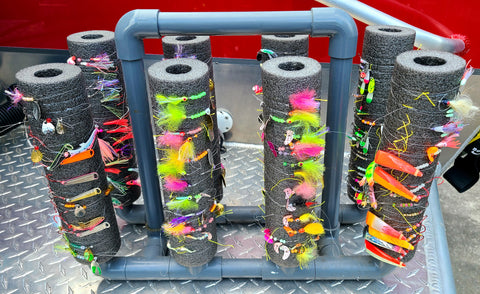
Before I get to the westside lakes, let’s discuss winter boating safety/etiquette. Carry chains for both your tow vehicle and for at least 1 axle on the trailer. Bring a couple sand bags and a shovel. A liberal application of sand can be a lifesaver. At the ramp, assess the situation before you back down a long icy ramp. Take the time to chain up your tow vehicle if required.
Thought being; although once your tires hit the water you’ll have traction, the area between the top of the ramp and the water could be icy. You don’t want to jackknife ½ way down the ramp. It would put a damper on your kokanee plans. Once the trailer is wet you may have to let the rig sit in the water for a bit to thaw and let the boat float free. Be safe on the boat, you don’t want to slip and end up sharing the lake with your aquatic rival.
Finally, and as a courtesy; at the end of your time on the lake load your boat and slowly pull out of the water just enough to clear the water. Stop and let the rig drain or drip-dry, this will minimize ice buildup on the lower 1/3 of the ramp.
Western Washington Winter Kokanee Lakes
Lake Washington
Although not exactly close to home, Lake Washington is my favorite westside winter kokanee lake. Our largest westside kokanee was a 3.13# 18” fish. We have caught many 1# plus and a few 2# kokanee in Lake Washington. To protect juvenile and migrating sockeye salmon there is an 8 – 18” slot limit for kokanee on in Lake Washington. A standard sockeye drill works, but consider stepping up your speed and gear selection. Most of our larger Lake Washington kokanee were taken on hoochies and 8” flashers.
The eyes have it; what am I talking about? Who knows why but most of our large Lake Washington kokanee were bamboozled by a lure with eyes. If Lake Washington were closer to home, I’d be fishing it every day that I possibly could.
Lake Cavanaugh
Lake Cavanaugh is an odd duck, easy kokanee limits for fish 10 – 18” kokanee during the spring, summer and fall, but when winter comes around it seems that every kokanee you catch is a chrome 8 – 12” fish. My nonscientific guess is that the majority of the kokanee in Cavanaugh spawn at 4 years and the winter sport catch are primarily 3-year kokanee. Most winter kokanee in Lake Cavanaugh will be caught over the deep pocket just east of the islands.
Lake Samish
Samish is really close to home with the typical winter kokanee bite being later in the day. It is a great lake for “breakfast and chores are done, let’s go fishing”. The lake includes a large basin with a smaller connected lake at the north end. When fishing winter kokanee on Lake Samish, most of our fish are caught in one of two areas. The first is along the west shoreline just west of the WDFW launch.
The second is generally in the center, maybe favoring the north shore/center of the small lake. Your trolling speed is critical, plan on fishing .8-1.0 mph with lots of “S” turns. Oddly, we have caught a fair number of Samish winter kokanee pulling small minnow type baits for cutthroat, but standard kokanee gear is a better starting point.

Lake Stevens
We don’t fish winter kokanee on Lake Stevens often, but it does host a winter fishery. There may be local secrets, but in our experience Lake Stevens winter kokanee are a hit or a miss. Most of our winter kokanee were caught along the bay at the northwest side of the lake. Typical kokanee gear with a pinch of nightcrawler or worm seems to have an edge over tuna corn.
Yale Lake
Yale is a great kokanee lake and is open year-round. There are winter challenges if you decide to make the trip. The wind can produce some crazy short chop, so make sure that you check the forecast before you hitch up the trailer. We haven’t had a problem but I’m pretty sure that the reservoir water levels are down November-February. The Yale Park launch should be open but other ramps may have restrictions.
Finally, there could be hazardous floating debris/flotsam. Boat with caution, and if it’s choppy, slow way down. The winter kokanee fishery should be concentrated by the dam or across the lake from Speelya Creek. In my experience, if fishing less than 30-40’, run really long setbacks or use lead line rigs.
OK, you have some idea which way you’re headed in your kokanee quest, now what? I don’t really change overall tactics when fishing winter kokanee. The usual kokanee drill; a small dodger, lure with tuna corn is a great place to start. Make sure you have your favorite scents, maybe a container of worms, and additional leader onboard. Not always, but occasionally, you will need to increase your leader length.
When trolling for winter kokanee, you will want to stay under 1.0 MPH. I probably do more “S” turns or engage the “Hunt” mode on my iTroll more often during our winter kokanee adventures. Our dodger box has more dodgers in it than most, but during the winter kokanee fishery my go to dodgers are painted, copper, or even dark metalflake.
Using either double spinner rigs or flies behind the dodger seem to consistently produce kokanee during the winter fishery. After you hook your cold weather prize, gently fight the fish, and, as with any kokanee fishery, a long handle net will increase your actual catch verses hook up statistics.
I know that it will be cooler out, maybe even freezing, and the lake temperature should be down as well. But make sure you still care for your catch. Bleed them and keep them on ice, or, even better, in a slurry in your cooler; you’ll want to preserve the quality of your hard-earned prize.
Winterize or not, keep your kokanee gear handy. The above is just a starting point. Choose a lake, learn it, and you’ll soon be the local expert! Trolling for Washington State winter kokanee can be frustrating. With the closure of most of our winter salmon fisheries, a bit of frustration will quickly become an addiction. Enjoy your winter kokanee adventure, but with the potential for rainy, slick roads, be sure to use extra caution towing your boat to and from your new favorite winter activity.
/articles/washington-winter-kokanee-observations-0
5 Family Friendly Trout Lakes in Western Washington
With opening day of the Western Washington Lowland Lake opener in the rearview mirror, many of us are looking for future lake fishing opportunities. Let’s take the family fishing! Following are a list of 5 family oriented Northern Washington trout/kokanee fishing adventure lakes. One of them, Lake Samish, would be a day adventure. The other four could be a multiday family camping and fishing expedition. All offer at least one boat ramp and shore fishing, a fishing pier, or both. This article will focus on opportunity, and not necessarily technique. All the lakes offer opportunities for trollers, bait soakers, and even fly fishers. That said, pack up the family, a frypan, maybe the sleeping bags, your favorite gear, then hit the road!
Cranberry Lake (Island County)
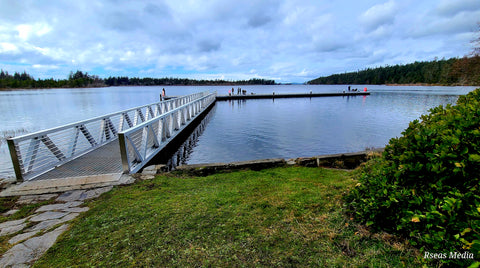
Cranberry Lake is located within the boundaries of Deception Pass State Park. There are multiple shore fishing access points and a very nice fishing pier. There is also a small boat ramp with very limited parking. If you are boating, internal combustion engines are not allowed on Cranberry Lake. You can use an electric motor but oars, paddles, or peddle power are perfect.
At 133.9 acres, Cranberry Lake hosts rainbow trout, coastal cutthroat trout, and an occasional brown trout. I’ve heard that that there are also smallmouth bass and perch in the lake but I’ve never seen anybody fishing for them. No picture, but when I was a teenager (Boy Scout camping trip) I caught a huge brown trout from one of the large boulders by the campground. The brute hit a worm/corn/marshmallow combo.
Not really sure why, but I love fishing Cranberry Lake. Although it is not, to me it feels like you’re fishing some remote lake in the Canadian wilderness. Be aware though, NAS Whidbey is right next door. There may be military aircraft doing maneuvers right overhead. I am in awe anytime one of the Navy aircraft are overhead but not everybody feels that way. It’s the sound of freedom!
If you’re not familiar with Deception Pass State Park, it is an absolute recreational gem. There are multiple well separated campsites, miles of hiking trails, and 77,000 feet of saltwater beaches to enjoy. Across Highway 20 from the lake, there is even a large saltwater boat launch with moorage. It’s not really mentioned anywhere, but in season you can fish for dungeness crab and smelt from the moorage floats. On the west side of the park, the sunsets from West Beach can be spectacular.
https://wdfw.wa.gov/fishing/locations/lowland-lakes/cranberry-lake
https://www.parks.wa.gov/497/Deception-Pass
Lake Samish
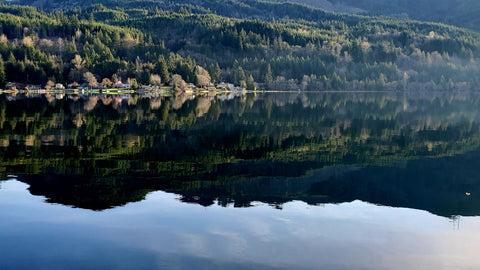
At 809.9 acres, Lake Samish is open to fishing year-round. It is managed as a multi-species lake, offering coastal cutthroat, large and smallmouth bass, crappie, brown bullhead/catfish, yellow perch, and excellent kokanee populations. I can personally attest that there are also largemouth bass and brown bullheads in the lake. The lake consists of a smaller lake connected to a larger main lake by a narrow channel. The larger main lake has significant weedy shallows at the south end and a max depth of 60 feet or so. The smaller lake located at the west end of the two-lake chain is up to 150 feet deep and maintains a large pocket of cool water throughout the late summer and fall. The cool water effectively extends the Lake Samish kokanee fishery when other west side lakes are too warm to support a fall kokanee fishery.
In late April-June, Lake Samish can be red hot kokanee fishing, easily giving up limits of fat 12”-16” kokanee. One of our biggest local kokanee came out of the smaller lake during a mid-October trip a few years back. It hit our old school gear running 2 colors on the lead line, 40’ of 8-pound leader, a rainbow color kokanee gang troll, and an orange wedding ring spinner tipped with a maggot. The fish was nearly 3 pounds and was in full spawning colors.
While the kokanee fishery is a trolling show, there is a fishing pier at Lake Samish Park. The fishing pier catch is primarily coastal cutthroat and peamouth chub. Lake Samish Park offers a couple of well-groomed picnic areas, a swim beach, hiking trails, and seasonal boat rentals. The park is the perfect place for a family outing and picnic with a little fishing thrown in.
An AIS Permit is required for every boat operating on Lake Samish. Here’s a few words about the AIS program at Lake Samish. Aquatic invasive species are non-native plants, animals, and pathogens that live primarily in water. They thrive in a new environment and cause economic loss, environmental damage, and harm to human health and property. An Annual AIS Permit and a per use boat inspection is required to operate your boat on Lake Samish. Whatcom County maintains an AIS inspection station at Lake Samish.
Boat inspections are important because they can help to prevent the transport of aquatic invasive species to Whatcom County lakes. AIS are transported on boats travelling from infested waters and can result in significant impacts to lake ecosystems, water quality, and water supply infrastructure. AIS can also make shoreline areas hazardous and uninviting for recreational users and property owners. To prevent the introduction, AIS inspectors are on the lookout for any animal or plant material on the watercraft that might pose a risk to Lake Samish. They will also be checking to see if your boat has been cleaned, drained, and dried, as some aquatic invasive species larvae can be transported in any areas on the boat that remain damp or have standing water in them. Inspectors will also conduct a physical inspection of the outside of your boat to feel for any signs of mussel larvae, algae, or other organic material on the hull that could pose a risk to the lakes.
As currently planned for 2023, Whatcom County will be staffing the inspection station at the Lake Samish WDFW Boat Launch. The AIS program is sensitive to the needs of anglers participating in the kokanee fishery at Lake Samish. They are planning/budgeting to staff the inspection station 5:30am-8:30pm 7 days a week. Although the AIS inspection program will be a bit of an inconvenience, having AIS inspectors on-site at Lake Samish will help to reduce the unfortunate vandalism problem at the Lake Samish WDFW launch.
On a similar note: Boat motor labels must have at least one star to operate on Lake Samish. Generally, any motor that is certified and labeled as meeting the 2006 or later model year United States EPA emissions standard will be compliant.
https://wdfw.wa.gov/fishing/locations/lowland-lakes/lake-samish
https://www.whatcomcounty.us/3542/Samish-Park
Silver Lake – Whatcom County
157.3 acre Silver Lake in Whatcom County is another unique recreational opportunity. It is a family friendly destination with camping, good trout fishing, and a WDFW boat ramp. The WDFW boat ramp is located at the north end of the lake and has ample trailer parking. The fishery is primarily for planted rainbow and coastal cutthroat trout. Even though the average depth is only 24 feet, holdovers are not uncommon. The fishery is friendly to whatever trout fishing style suits your style, but don’t be afraid to soak some dough bait.
Silver Lake Park is a large Whatcom County Parks and Recreation facility on Silver Lake. The park has 3 campgrounds and a RV accessible group campground. There are also cabin rentals, a handful of hiking trails, a playground, multiple picnic areas, an equestrian center, seasonal boat rentals, and a small boat launch that is probably best suited for hand carry boats.
https://wdfw.wa.gov/fishing/locations/lowland-lakes/silver-lake-whatcom
https://www.whatcomcounty.us/3517/Silver-Lake-Park
Fish Lake – Chelan County
Another family friendly trout destination is Cove Resort on 492-acre Fish Lake in Chelan County. For whatever reason it is probably better known for its winter, hardwater perch fishery but it hosts a solid spring and fall rainbow trout fishery. The lake also has a few respectable brown trout available. The brown trout fishery is kind of a specialty, but if you stick with it there are some true trophies cruising around, just waiting to be caught. In an interesting twist, the WDFW has been experimenting with kokanee fry plants in Fish Lake and it seems that there is blossoming kokanee fishery at hand. The lake also hosts a spring fishery for largemouth bass along with a year-round perch fishery. Access to the lake is primarily through Cove Resort.
Cove Resort is operated under a Forest Service private concession. You can bring your own boat: Cove Resort has a boat launch and moorage. They also have a store, boat rentals, a fishing dock, cabins, and a large campground.
https://wdfw.wa.gov/fishing/locations/lowland-lakes/fish-lake-chelan
https://www.coveresortatfishlake.com/
Lake Pearrygin
183-acre Lake Pearrygin is another first-rate choice for a family outing. There are 4 boat ramps, including a WDFW access point/boat ramp, 2 state park ramps, and a ramp at Silverline Lakeside Resort. For the shore fisherman there are many options. The state park alone has 11,000 feet of shoreline and there is a handicap accessible dock.
The trout fishing at Lake Pearrygin can be either fast and furious or just plain good. The seasoned trout angler can pull out the stops and get technical in their approach to the fishery, or, fortunately, anybody can catch fish using dough bait or casting their favorite spinner. A single salmon egg or a small piece of nightcrawler under a float can be deadly. As a bonus, Lake Pearrygin gives up more than its share of fat holdovers each season. Whether your family are trout fishing newbies or experienced trout hunters, Lake Pearrygin is an excellent choice for a family fishing getaway.
Lake Pearrygin State Park has a swimming beach, 169 various use campsites, 2 group sites, and cabin rentals. There are also 6.5 miles of hiking trails and picnic areas. As staffing permits, they offer campfire programs; they are conducted every Tuesday and Thursday night from June 15 - Labor Day. The park also offers a Junior Ranger program for kidlets.
It just keeps getting better; Silverline Lakeside Resort on Lake Pearrygin is a clean, well-maintained resort. They offer RV and tent sites and a group campground. The resort has RVs available for rent, boat rentals, aquatic equipment rentals, propane fire pit rentals, a store, and a small restaurant. If that’s not enough to spark your interest, Silverline Lakeside Resort also has 3 fishing docks, horseshoe pits, a playground, swimming beach, and mini golf.
https://wdfw.wa.gov/fishing/locations/lowland-lakes/pearrygin-lake
https://www.parks.wa.gov/563/Pearrygin-Lake
https://www.silverlineresort.com/
Have a hankering for a family outing and the sizzle of fresh trout in the ole cast iron? If so, add a trip to one or all of these lakes. Cranberry Lake, Lake Samish, Silver Lake, Fish Lake, and Lake Pearrygin each offer a unique family trout fishing experience. With the exception of Lake Samish, there is a campground adjacent to each lake with many of the campsites right on the lake. You better go pick up the phone, or bring up their websites, reservations are going fast!
/articles/5-family-friendly-trout-lakes-western-washington