Washington Winter Kokanee Observations
By Randy Castello

As we say good bye to our summer boating weather you may find yourself wondering, “do I winterize or do I find something to fish for?” Either way, you should probably winterize your boat, motor, and trailer, but let’s talk trolling for winter kokanee.
Winter kokanee
Winter kokanee in Washington State? Sure, so go ahead and winterize, but keep the keys handy. Find your gloves and earmuffs and make a thermos of steaming hot coffee because there are kokanee opportunities to be had. Both Western Washington and the Eastside have winter kokanee lakes.
Kokanee are the non-anadromous form of sockeye salmon. Basically, by choice or otherwise, kokanee are landlocked sockeye salmon. Kokanee are native to many Pacific Northwest lakes and have been introduced to a number of lakes across the United States.
The life cycle is of particular interest to winter kokanee anglers. Although there are exceptions, kokanee typically live 3-4 years before they spawn and die. For the dedicated winter kokanee angler that means that there are 2-3, maybe even 4-year kokanee available during the chilly months.
Winter kokanee fishing is a little different than our spring and summer fisheries. Most winter kokanee fishing is done in deeper water. Kokanee prefer water that is 50-56 degrees. In part, they are more active in this zone because it is rich in oxygen boosting energy to chase down their next meal. Each lake varies, but finding “the zone’” is important during winter kokanee fishing. One way is to keep your eyes glued to your fish finder and look for fish.
This is where the best fish finder/chart plotter you can afford is your friend. When you find fish, mark the spot, and pretty soon you’ll have a winter kokanee map. With it you can amaze your guest fishermen and go right to where they are. They’ll think you are the “Koke-Wisperer”, maybe a kokanee-shaman or something… You can also use a Fish Hawk Digital Gauge or the Vexilar Deptherm to graph out the water temperature at depth.
Winter kokanee fishing is more of a love thing, there is rarely a hot bite. Each lake has a winter fishery sweet spot depth. Generally, in Western Washington it is 30-60’, and Eastern Washington 40-200’ deep. Each lake, especially on the westside, seems to have a brief period each day where the kokanee will put on the feed bag and go on the bite outside of your usual grind it out depth.
Kokanee are filter feeders, and the bulk of their calories come from plankton blooms. There are windows any given day where there is a bloom or hatch, and the kokanee will briefly leave their comfort zone to feed.
Because the bite may be 2:06-2:23 at 43’ it is best to choose your winter kokanee lake close to home and learn it. Especially when winter kokanee fishing, keep a detailed fishing log.
Both summer and winter fish are a noble opponent. They often make short runs, jump, and go bonkers at the net. Summer fish are more aggressive, but winter kokanee take more finesse to get them in the net. After plating, smoking, or chowder-izing hundreds of kokanee, both the summer and the winter fish are excellent table fare, but the winter fish are outstanding for whole or fillet pan-frys and grilling.
The following list includes winter kokanee lakes that I am familiar with, and is focused on trolling. I am sure there are other winter kokanee lakes available. My westside lakes were originally selected because they are open all year and they have deeper basins that may hold fish. Both the westside and the eastside winter kokanee lakes are listed by my preference. My preference is based on success, proximity to home, and the potential for a trophy fish.
Eastern Washington
Lake Roosevelt
Nothing in Eastern Washington is close to home, and to be honest, as I get older, I don’t like hauling the boat over the pass in the winter anymore. That said, I love fishing Lake Roosevelt, so with the right forecast we may head that direction. I’m sure kokanee are available throughout the lake, but we usually fish out of Spring Canyon and focus on the dam area, but we also fish the lower 5 or 6 miles. I typically start at about 40’, but may fish 100+ deep as required. Because there is the potential to hook a 3+ pounder, I typically up my leader to 20-pound fluorocarbon.
Lake Chelan
It is a great winter kokanee lake, offering pretty consistent fishing. The winter kokanee fishery is concentrated between Manson, maybe the Narrows, up to 25 Mile Creek. There is enough kokanee in the Wapato Point area to keep you on the water if, or should I say when, the weather kicks up. The winter fishery at Chelan is a deep fishery, you can expect to run your gear 80-200’ deep. Watch the weather!
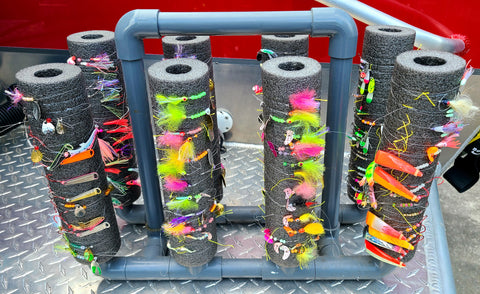
Before I get to the westside lakes, let’s discuss winter boating safety/etiquette. Carry chains for both your tow vehicle and for at least 1 axle on the trailer. Bring a couple sand bags and a shovel. A liberal application of sand can be a lifesaver. At the ramp, assess the situation before you back down a long icy ramp. Take the time to chain up your tow vehicle if required.
Thought being; although once your tires hit the water you’ll have traction, the area between the top of the ramp and the water could be icy. You don’t want to jackknife ½ way down the ramp. It would put a damper on your kokanee plans. Once the trailer is wet you may have to let the rig sit in the water for a bit to thaw and let the boat float free. Be safe on the boat, you don’t want to slip and end up sharing the lake with your aquatic rival.
Finally, and as a courtesy; at the end of your time on the lake load your boat and slowly pull out of the water just enough to clear the water. Stop and let the rig drain or drip-dry, this will minimize ice buildup on the lower 1/3 of the ramp.
Western Washington Winter Kokanee Lakes
Lake Washington
Although not exactly close to home, Lake Washington is my favorite westside winter kokanee lake. Our largest westside kokanee was a 3.13# 18” fish. We have caught many 1# plus and a few 2# kokanee in Lake Washington. To protect juvenile and migrating sockeye salmon there is an 8 – 18” slot limit for kokanee on in Lake Washington. A standard sockeye drill works, but consider stepping up your speed and gear selection. Most of our larger Lake Washington kokanee were taken on hoochies and 8” flashers.
The eyes have it; what am I talking about? Who knows why but most of our large Lake Washington kokanee were bamboozled by a lure with eyes. If Lake Washington were closer to home, I’d be fishing it every day that I possibly could.
Lake Cavanaugh
Lake Cavanaugh is an odd duck, easy kokanee limits for fish 10 – 18” kokanee during the spring, summer and fall, but when winter comes around it seems that every kokanee you catch is a chrome 8 – 12” fish. My nonscientific guess is that the majority of the kokanee in Cavanaugh spawn at 4 years and the winter sport catch are primarily 3-year kokanee. Most winter kokanee in Lake Cavanaugh will be caught over the deep pocket just east of the islands.
Lake Samish
Samish is really close to home with the typical winter kokanee bite being later in the day. It is a great lake for “breakfast and chores are done, let’s go fishing”. The lake includes a large basin with a smaller connected lake at the north end. When fishing winter kokanee on Lake Samish, most of our fish are caught in one of two areas. The first is along the west shoreline just west of the WDFW launch.
The second is generally in the center, maybe favoring the north shore/center of the small lake. Your trolling speed is critical, plan on fishing .8-1.0 mph with lots of “S” turns. Oddly, we have caught a fair number of Samish winter kokanee pulling small minnow type baits for cutthroat, but standard kokanee gear is a better starting point.

Lake Stevens
We don’t fish winter kokanee on Lake Stevens often, but it does host a winter fishery. There may be local secrets, but in our experience Lake Stevens winter kokanee are a hit or a miss. Most of our winter kokanee were caught along the bay at the northwest side of the lake. Typical kokanee gear with a pinch of nightcrawler or worm seems to have an edge over tuna corn.
Yale Lake
Yale is a great kokanee lake and is open year-round. There are winter challenges if you decide to make the trip. The wind can produce some crazy short chop, so make sure that you check the forecast before you hitch up the trailer. We haven’t had a problem but I’m pretty sure that the reservoir water levels are down November-February. The Yale Park launch should be open but other ramps may have restrictions.
Finally, there could be hazardous floating debris/flotsam. Boat with caution, and if it’s choppy, slow way down. The winter kokanee fishery should be concentrated by the dam or across the lake from Speelya Creek. In my experience, if fishing less than 30-40’, run really long setbacks or use lead line rigs.
OK, you have some idea which way you’re headed in your kokanee quest, now what? I don’t really change overall tactics when fishing winter kokanee. The usual kokanee drill; a small dodger, lure with tuna corn is a great place to start. Make sure you have your favorite scents, maybe a container of worms, and additional leader onboard. Not always, but occasionally, you will need to increase your leader length.
When trolling for winter kokanee, you will want to stay under 1.0 MPH. I probably do more “S” turns or engage the “Hunt” mode on my iTroll more often during our winter kokanee adventures. Our dodger box has more dodgers in it than most, but during the winter kokanee fishery my go to dodgers are painted, copper, or even dark metalflake.
Using either double spinner rigs or flies behind the dodger seem to consistently produce kokanee during the winter fishery. After you hook your cold weather prize, gently fight the fish, and, as with any kokanee fishery, a long handle net will increase your actual catch verses hook up statistics.
I know that it will be cooler out, maybe even freezing, and the lake temperature should be down as well. But make sure you still care for your catch. Bleed them and keep them on ice, or, even better, in a slurry in your cooler; you’ll want to preserve the quality of your hard-earned prize.
Winterize or not, keep your kokanee gear handy. The above is just a starting point. Choose a lake, learn it, and you’ll soon be the local expert! Trolling for Washington State winter kokanee can be frustrating. With the closure of most of our winter salmon fisheries, a bit of frustration will quickly become an addiction. Enjoy your winter kokanee adventure, but with the potential for rainy, slick roads, be sure to use extra caution towing your boat to and from your new favorite winter activity.
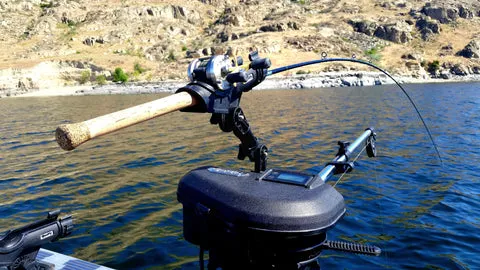
/articles/washington-winter-kokanee-observations-0
Get the Lead Out
By Randy Castello
Kokanee fishing this spring? Then get the lead out; lead core line, that is.
Where winter kokanee seems to be a very depth-oriented fishery, we are on the cusp of our popular spring/summer kokanee fishery. Downriggers rule for kokanee fishing, but on our boat we almost always put out 2 lead core line rigs before the downriggers are deployed. Using a properly set up lead core line rig gives the angler fairly accurate depth control without having to use downriggers.
Using the appropriate top shot and the following method for setting up your lead core line rigs, the angler can fish anywhere between the surface to about 30 or 40’ deep with some level of accuracy. To that note; while filming a Northwest Fishing segment, I snagged the bottom with a lead core line set up in 70’ of water while we were trolling in a straight line. Interesting, but how could that have happened?
Lake Southerland
We were trolling Lake Southerland on the Olympic Peninsula. We were metering a large body of kokanee at around 30-40’ in 70 feet of water. I ran out 2 ½ colors, or 60-70’ lead core line, plus my 60-70’ top shot while trolling at 1.0 mph. Not sure exactly what happened, but my guess is there was also an underwater current that was running with the boat. With minimal drag and water resistance on the line, it just sank to the bottom and I had to say goodbye to one of my favorite kokanee dodgers and custom kokanee flies. It was an unusual situation and you wouldn’t want to make a habit of trolling at 70 feet deep, but lead core line can run that deep.

What exactly is lead core line? It is a type of fishing line where there is an inner core of soft lead wire sheathed by an outer layer of braided fiber. Lead core line has been around since the 1940’s and is commonly used by Midwest walleye or Great Lakes salmon and steelhead trollers. The salmon guys use a technical approach using planer boards and multiple lines to target salmon on the great lakes.
Lead Line
Lead line isn’t as common here in the Pacific Northwest but it should be. Fortunately, our lead core line fishery doesn’t have to be technical, we can just clip on a dodger or lure and let out the appropriate number of colors. Lead core line is available at most of our local Northwest tackle shops. Lead core line comes in a variety of “pound test”, 12#, 15#, 18# and others. The line is your weight and eliminates the need for downriggers, planers, or separate weights. Lead core line comes dyed in contrasting colors. The color changes every 10 yards or about 30’.
The following is solely my opinion and not supported by industry testing or maybe even your own experience. When fishing for kokanee, use the lightest test lead core line available. With the slower speeds used when we hunt kokanee, the test of the lead core line will not affect the sink rate; 15# lead core line will not sink faster than 12# lead line, in fact the 12# lead core line may sink further while trolling. The thinner diameter would result in reduced drag, and may allow gear to sink faster. Finally, 12# lead core line breaking strength is more than adequate for kokanee fishing.
I think there is belief that lead core line setups are heavy and not really suited for the light tackle acrobatics common when kokanee fishing. For our lead core line rigs, we use standard 7 ½-8’ fiberglass kokanee rods and 150-300 (size ratings very greatly by manufacture) series round baitcasting reels. You really don’t need line counter reels because you will be counting colors; “hot bite at 1 ½ colors along the eastern shore…” My approach for spooling the reels is a bit different and is a phased setup that goes something like this:
On an empty reel with the same capacity as the reel you plan to fish the lead core line on, tape the end of the lead core line on the spool and load 3 colors of lead core line + 3-4’. Cut the lead core line, saving the balance of the filler spool.
Remove the actual lead core from 3-4‘of the loose end of the lead core line on the reel. Using a blood knot, Albright knot, a double uni knot, or other similar knot, tie 20# braid of your choice to the end of the stripped lead line. Then fill the spool with the 20# braid.
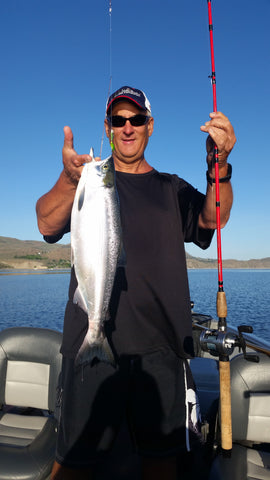
Here’s the tough part; you will need 2 empty spools or a second reel of the same type and size. The goal is to load the braid/lead line combo on your working reel braid first. When using the same reel or a reel with the same capacity as the reel temporarily holding the lead core line/braid combo, it is easy to just transfer reel to reel. Otherwise, you have to transfer to a spool, then to another empty spool, and then back on to the original reel.
The reel is now loaded with 3 colors of lead core line on top. Strip the lead core out of 3 or 4 feet of the loose end of the lead core line. Using your favorite braid to mono (or in this case, favorite stripped lead line to mono) knot, tie on a 60’ 8-12# fluorocarbon top shot.
That’s basically it. We use the lead core line setup almost exclusively for kokanee, so I just attach a small Duolock snap to the end of the fluorocarbon top shot to make changing dodgers easier. My reasoning for running only 3 colors of lead core line is that at 0.8-1.4 mph, 3 colors is all you need to fish to about 30-40’ deep.
In fact; as previously mentioned, using this approach I have snagged the bottom in 70 of water with just 2 1/2 colors of core lead line out. Running just 3 colors of lead core line with braid backing allows you to load a fair amount of backing on standard bait casting reels with the bonus of reducing the extra weight of additional colors of lead line.
Not always, but when fishing for kokanee, the lead core line rigs typically out fish any of the other rods on our boat. Believe it or not (you have to know me…), I have a theory about why the lead core line rigs are so fishy on our boat. I use a 60-70’ top shot, so even with just 1 color of lead core line out, the dodger/lure combo is running almost 100’ behind the boat.
Any boat-shy fish would have regrouped and forgotten about the big, noisy aluminum shadow that just passed overhead. Additionally, I know that I’m weird and overthink these things, but I think that the sonic vibration of the sheathed lead line moving through the water has some positive affect on a fishery. Something akin to a dog whistle: we can’t hear it, but they come running.
Whether or not the kokanee come running or swimming, lead core line is a deadly effective tool in our kokanee arsenal. It works equally well with the smaller dodgers, flashers, and gang trolls used for kokanee fishing. With the telltale thump, thump, thump at the rod tip, having at least one lead line rig in the water is a great indicator that your trolling speed is correct.
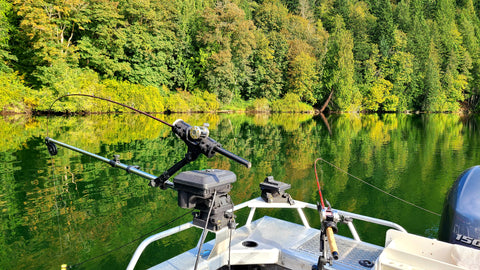
Lead core line rigs are also an exceptional choice when pulling small stick baits or minnow type lures baits for cutthroat and rainbows. Just run ½ a color and get the frypan ready! Lead core line and stick baits go together like peas and carrots. The takedown when trolling stick baits on lead core line is surprisingly aggressive. The fish’s battle for freedom seems to magnify as it telegraphs up your lead line to your rod tip.
Once you set up a lead line rig or two, you’ll likely find that the lead core line rigs will be your go to kokanee rods. Lead core line is effective and straightforward to use when paired with the smaller dodgers, flashers, and gang trolls we use for kokanee fishing. Lead core line is equally effective with small spoons and stick baits for various trout species.
The initial investment may seem extravagant, but it’s still cheaper than a pair of downriggers. If you’re fishing from a kayak, canoe, inflatable, or even a drift boat without downriggers, your lead line rigs will be indispensable in your quest to do battle with a PNW silver football.
/articles/get-lead-out