Lake Roosevelt Walleye and Turkey Bonanza
Looking out over the field, darkness still obscured our vision. Out there beyond the field we set up in we could hear the rapid gurgling, gobbling sound made by male turkeys in their tree roosts. Daylight would be coming soon, but meanwhile, I couldn’t get the image from The Blair Witch Project out of my head. I subconsciously swiped at my nose, suppressing a cough, desperate to not make a sound.
Daylight would be coming soon and I didn’t want to be “the new guy” blowing our cover and scaring away our target. It was my first ever turkey hunt. Joining me, were Dave Mason of Toyota and Dan Gabriel of The General Store. Our host, Rick Wakefield, owner of Buck Canyon Lodge, had invited us on this Opening Day of turkey hunting to check out the fine hunting he offers guests on his lodge properties. It was part of a “Cast and Blast” adventure Northwest Fishing Reports were enjoying. The “cast” part of the trip were upper Lake Roosevelt walleyes with Lake Roosevelt Charters.
I had arrived late Friday evening after driving across the state from Redmond to the lodge, located near the town of Gifford. In normal conditions it would have been a not-too-bad five-hour drive, however, a traffic accident going over the pass had set me back a good hour and a half. I arrived tired but excited for what the weekend had in store. Meeting up with the NWFR crew Aaron Borg and Rob Holman, I crashed into my comfortable fleece-covered bed in anticipation of a leisurely 6:30 start time with guides Scott and Todd of Lake Roosevelt Charters. I was excited because of reports they had been posted about deep water jigging for walleye. The pictures of healthy catches of nice-sized eating walleye had my hopes up for bringing home plenty of one of the Pacific Northwest’s tastiest fish, the walleye.
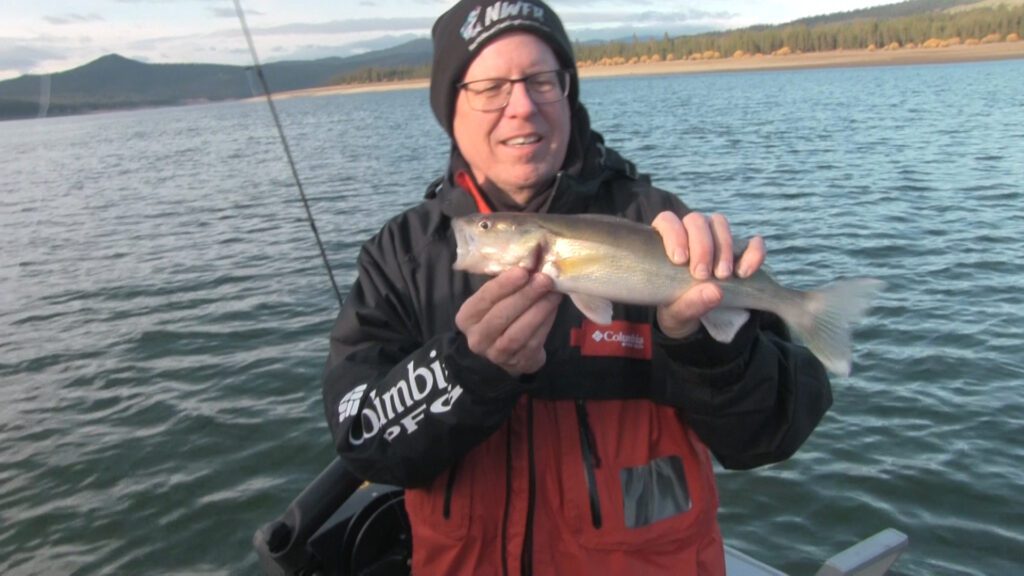
We met at the Hunters boat launch, which was high and dry, but still useable, if a little muddy. No matter, in short order we were off and cruising to a few preferred locations that Scott and Todd had been having success at.
I don’t know that Lake Roosevelt Charters were the first to deep jig for walleye, but I can say they were the first charter I’d ever seen promoting the fishery. I remember being instantly intrigued – jigging up walleye from 121-50 foot depths was so foreign to any other walleye technique I was familiar with that I just had to see and experience it for myself.
We pulled up to our first location and Todd handed out rods loaded with 20-pound Power Pro and one ounce, round jigs, To the jig he added a 4-5” curly tail plastic, and then a half a night crawler threaded several times with just a one inch tail sticking out. Again, very different from the traditional nightcrawler set up of a bottom walker and worm harness. Todd instructed us to let out our line until we made contact with the bottom.
“The trick to this fishery is you have to feel the “tap tap” of the jig as it bounces off the bottom. If you don’t feel that contact you aren’t fishing. Also, don’t make big jigging motions – 5-6” is plenty. The fish are deep and cold, they aren’t chasing after bait.”
I let my line out and at 120 feet could see the braid go slack. I closed the bale and reeled up the slack, starting gently upward motions of my rod tip, raising and lowering and being sure to keep in contact with the bottom. If I felt nothing I let out a little line until again making contact. I continued this technique for a few minutes and then felt the distinct tug and heaviness of a fish on the other end of my rod. Setting the hook, I reeled with steady pressure and soon enough brought up my first ever deep-water jigged walleye, a nice 15” “eater”.
Over the next two days the NWFR gang would catch a lot of these “eaters”. Looking over the vastness of this stretch of the upper Lake Roosevelt and seeing the low angling pressure, I was not surprised at the steady numbers we caught over the next two days. This fishery, while not untapped, is definitely under-utilized. The bites came pretty steadily throughout the day. As with most fishing, we had periods of fast fishing and then slow, but over-all it was pretty consistent. Along with the good numbers of fish we noted they are definitely smaller than what we have caught on the lower stretches of the Columbia River.
Our fish averaged mostly 13-15” with a few fish on either side of those sizes. Todd noted that there are big walleye to be had, but yes, the vast majority were these eater class fish. I’m OK with that – nice stringers of white-fleshed walleye are always welcome at my table! I did notice that the flesh of these upper Lake Roosevelt walleye are a whiter shade than fish we had been catching in the lower reaches of the Columbia.
When it comes to deep water jigging for walleye, wind is your enemy. Current is not an issue on this stretch of the Columbia, but wind will cause the boat to get pushed too fast and, just like salt water jigging, you’ll lose contact with the bottom. When this happens you’ll find yourself letting out more and more line in an attempt to maintain bottom contact. It’s time like this where a good captain knows ways to increase your chance for success.
Captain Scott deployed two large sea anchors, instantly slowing our drift down to a manageable speed. Another strategy is to find shallower water to jig in. Having a bow mounted trolling motor will also serve you well when the wind starts up. Finally, although there aren’t a lot of spots to get entirely out of the wind, guys who fish these waters a lot know the winds and places to move to when the winds do come up. Just one more reason for considering a guide the first time you fish these waters.
We fished until around noon, at which points the winds from the front blowing through made it too tough to fish effectively anymore. It was a decent enough morning. We were looking at around a dozen fish in the boat, and many lost as well. When you’re fishing at 120 feet deep it’s essential to keep a steady pressure on the fish, even with barbed hooks. Fortunately there is another common trait of the winds in this area – they tend to die off later in the afternoon. Scott and Todd were more than happy to bring us in and take us out after a couple hours siesta time. So after getting a power nap we were back out again, fishing from 4-7pm. This bite was actually better than the morning bite – don’t put your gear away! In short, there are fish to be had throughout the day if you’re willing to be flexible.
Darkness slowly gave way to dawn and the gobbling reached ever higher intensities. Soon we heard the first “whoosh” of a bird flying over our blind. Rick quietly announced – "the birds are starting to come off the trees where they roost. It won’t be long now. Get ready!”
I was anxiously anticipating my first opportunity at a turkey. Dave and Dan were old hands at tom hunting and they had given me a primer on Tom Hunting 101 Essentials. I knew the shot I needed to make was a head or neck shot. Hitting the body of a turkey is a low proposition shot. The feathers are thick and hard and act like armor making a “head shot” almost essential. My hunting skills thus far had been limited to pheasants and ducks – which in my experience were fairly easy to knock down, assuming I could hit them! But turkeys – head shots on a bobbing head? I was little intimidated…
“Toms coming from the right”. Rick’s whispered warning had me turning my head to the right and seeing – nothing. I turned and looked straight in front of me and there were three large toms strutting around the decoy Rick had set up. How did those large birds get there so quickly without me even seeing them?!?!?
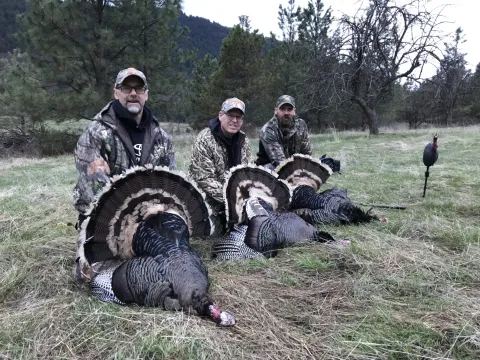
We three hunters slowly raised our guns to level, waiting for the three toms to separate enough that each of us had a clean shot at one bird. It seemed like forever as I hoped the birds wouldn’t startle and run off. Just then Rick gave the single to fire and in unison the three hunters let loose a booming volley of number 4 shot at each bird. It took a fraction of a second to travel the 15 yards to our targets and instantly two birds went down, and the third staggered, then rose into the air, flying over our blind. Three hunters, three shots, three birds! We came out of the blind and tracked down the third bird in the field behind us, around 30 yards away. Claiming this last bird we returned to the other two toms and admired our kills. The birds were all in the 25 pound range, gorgeous feathers and long beards. It was 6:30am and we were done for the day, with plenty of time to go back to the launch and get in more walleye fishing!
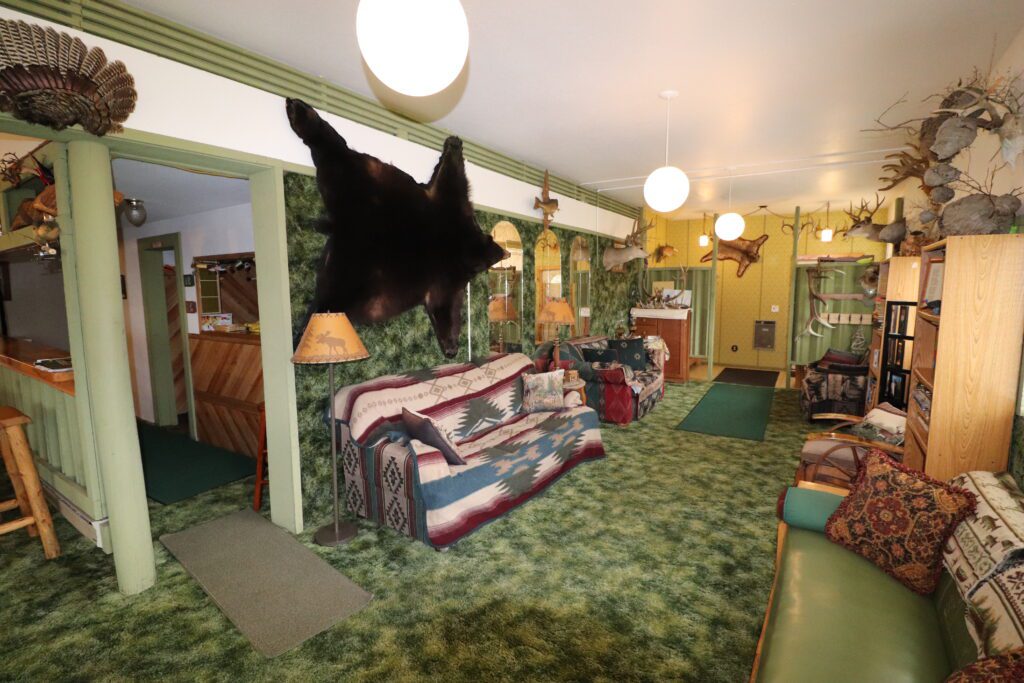
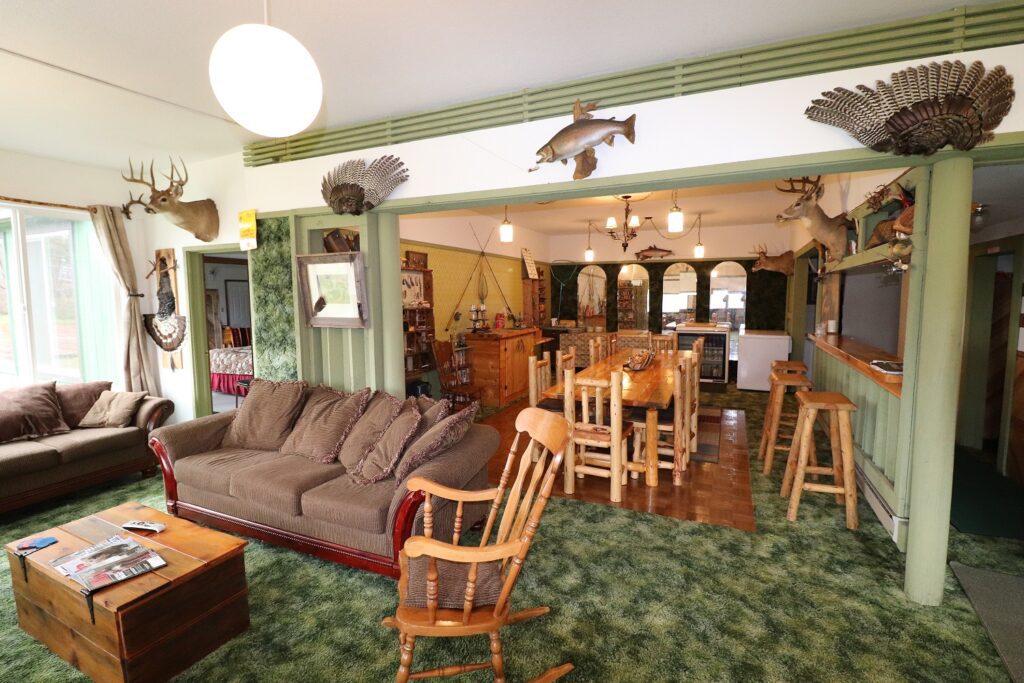
If you’re looking for a unique “Cast and Blast” adventure the spring turkey hunting and walleye fishing on Lake Roosevelt are not to be missed. Buck Canyon Lodge is the perfect base camp to take off on your adventures. Hosts Rick and Wendy Wakefield have a beautiful lodge and offer full amenities including provided meals. Rick does guided turkey hunts for guests, or, if you’re not a hunter, stay at the Lodge and get in on the great walleye fishing with Lake Roosevelt Charters. Either way (or both) way you go you’re guaranteed to have a wonderful adventure. The countryside is spectacular, wooded hills and breathtaking vistas great you at every bend in the road. It’s truly a unique experience you’ll remember for the rest of your life!
Visit Buck Canyon Lodge at Buck Canyon Lodge LLC or call 509-722-3949. Lake Roosevelt Charters web site is Lake Roosevelt Charters or call 509-722-3880.
/articles/lake-roosevelt-walleye-and-turkey-bonanza
Exploring My Favorite Waters: 7 Eastern Washington Lakes Every Angler Must Fish
When it comes to angling adventures, Eastern Washington boasts an array of lakes that promise unforgettable experiences for fishing enthusiasts. From serene hideaways to expansive waters teaming with aquatic life, each lake offers its own unique charm and beauty. In this article, we will go into the allure of 7 of my must-visit lakes in Eastern Washington. Loon Lake, Diamond Lake, Long Lake, Deer Lake, Waitts Lake, Sacheen Lake, and Lake Roosevelt.
#1 Loon Lake: A Tranquil Haven
Nestled amidst the scenic beauty of Stevens County, Loon Lake is a haven for anglers seeking tranquility and plentiful fish. Renowned for its population of Kokanee, Rainbow Trout, and Bass, this picturesque lake also offers World Record Tiger trout. An abundance of opportunities for both novice and seasoned anglers. Whether you prefer casting from the shore, chasing the sunfish and crappie around docks, or trolling on a boat, Loon Lake promises a rewarding fishing experience against a backdrop of natural beauty.
#2 Diamond Lake: A Gem For Anglers
True to its name, Diamond Lake sparkles as one of Eastern Washington’s hidden gems for fishing enthusiasts. Situated in Pend Oreille County, this pristine lake is celebrated for its clear water, and the diverse fish species. From trophy-sized Brown trout, and Rainbow trout, to feisty smallmouth bass, and some really nice perch, Diamond Lake presents anglers with a tantalizing challenge and the promise of unforgettable memories. From ice fishing to the warm summer months, the scenery year-round is amazing.
#3 Long Lake: Where Adventure Awaits
Stretching across Stevens and Spokane counties, Long Lake beckons anglers with its expansive waters and rich aquatic life. Boasting an array of fish species, including a healthy population of Walleye, some Northern Pike, great Perch and Crappie, plenty of Trout, and amazing bass fishing. This lake offers endless opportunities for exploration and angling excitement. Whether you prefer trolling, or casting from a boat, and or from the shore or dock, Long Lake invites you to embark on an adventure filled with anticipation and discovery.
#4 Deer Lake: A Serene Retreat
Tucked away in the foothills of Stevens County, Deer Lake exudes a charm that captivates anglers seeking solace in nature. With its clear waters and lush surroundings, this idyllic lake serves as a great place for relaxation and fishing. From Rainbow trout, and of course, the Mackinaw lurking below, you can also find some great bass and panfish. There was a time not too many years ago, when an angler could get into a mess of Kokanee, now the mystery is where did they go? Are they still swimming here? Deer Lake offers a bounty of opportunities for anglers to test their skills and unwind amidst the beauty of the great outdoors.
#5 Waitts Lake: Where Memories Are Made
Nestled in the heart of Stevens County, Waitts Lake stands as a testament to the enduring allure of Eastern Washington's fishing destinations. Boasting a rich history of big Brown trout, and abundant fish populations, Waitts has great opportunities for also Rainbow Trout, Perch, Bass, and Sunfish. Also a destination for many ice anglers in the winter months as well, as it's open year round. Whether you prefer trolling from the boat or fishing the resort's docks, Waitts Lake promises an experience filled with camaraderie, excitement, and the promise of cherished memories.
#6 Sacheen Lake: A Hidden Paradise
Not hidden like a secret, but tucked away in the forest of Pend Oreille County, Sacheen Lake beckons anglers with its year-round secluded beauty and great angling opportunities. This lake holds some gorgeous Brook trout, Rainbow, and Tiger trout. A healthy population of yellow perch, and crappie are a favorite target for the ice anglers. I saw some big bass pulled out of this lake as well. With its scenic surroundings, this lake offers something for every angler, whether novice or expert, Sacheen invites you to cast your line and immerse yourself in the peaceful rhythms of nature.
#7 Lake Roosevelt: The Jewel Of The Columbia
Stretching across the vast landscape of Eastern Washington, Lake Roosevelt is a testament to the region's natural grandeur and angling legacy. Formed by the mighty Columbia River, this expansive lake offers a wealth of fishing opportunities against a backdrop of rugged beauty and historical significance. With many launches and many miles of shore to enjoy and do some boat camping, you'll find that Lake Roosevelt offers a ton of activities. From trophy size Kokanee, and Trout, and an abundance of Walleye, some anglers may want to target the Sturgeon. Lake Roosevelt promises an angling adventure like no other.
Eastern Washington lakes offer a treasury of angling opportunities for enthusiasts of all ages and skill levels. From the small waters of Loon Lake to the expansive waters of Lake Roosevelt, each lake beckons with its own unique promise for adventure. So pack your gear, set your sights on those seven Eastern Washington lakes, and embark on a fishing journey filled with excitement, camaraderie, and the timeless beauty of our great outdoors.
![{"capture_mode":"AutoModule","faces":[]}](https://cdn.northwestfishing.net/sites/default/files/styles/large/public/images/IMG_20240127_094906_3-scaled.jpg.webp?itok=lCi6vt3M "{\"capture_mode\":\"AutoModule\",\"faces\":[]}")
/articles/exploring-my-favorite-waters-7-eastern-washington-lakes-every-angler-must-fish
The Outdoors Roundup
By John Kruse

It’s all fun and games in September and October as the foliage turns scarlet and gold. The fish put on the feed bag, biting readily. Then, November and December arrive, the leaves turn brown, tree branches become empty, and catching fish gets more challenging. Having said that, there are still some great places to catch fish in Eastern Washington in the late fall and early winter.
COLUMBIA RIVER GORGE
You know what they say, “the river never sleeps”, and neither do the fishing opportunities in the Gorge. At this time of year, the coho salmon bite is waning, but the walleye bite near John Day Dam, as well as catch and release sturgeon fishing, remains strong. If you are looking for current information, drop by Gorge Outfitters Supply in Rufus, Oregon.
GRANDE RONDE RIVER
It’s a long drive, but this picturesque river is worth it. Starting in November, good numbers of summer steelhead show up here, and fortunately, there is a good amount of public access for you to get at them, from Highway 129 at Boggan’s Oasis to Troy, Oregon. There is also some access near the mouth of the Grande Ronde, where it flows into the Snake River.
The steelhead run is much better than last year and anglers should be in for decent fishing from the bank, or from a raft or drift boat. Spinners, spoons, and small jigs fished under floats all work well here. Barbless hooks are required. Check the regulations for additional information.
POTHOLES RESERVOIR
The walleye bite continues well into December, and trout fishing is an option too! Try trolling near Medicare Beach or off the mouth of Frenchman’s Wasteway for quality size rainbow trout. Try off the face of the sand dunes, the mouth of Crab Creek, or in the Lind Coulee for walleye at this time of year. Trolling a spinner/worm harness behind a bottom bouncer weight works well in November, but as the water continues to cool, switch to blade baits for the walleye.
ROSES LAKE
Located near Manson, this 132-acre lake offers very good trout fishing during the fall and winter. There is a public access area on the south end of the lake, with some room to spread out for anglers fishing from shore. Once the lake freezes over, it becomes an ice fishing destination not only for trout but also for perch, which are found in good numbers here. Pro tip?
After you are done fishing, have breakfast or lunch at the nearby Blueberry Hills Restaurant. It will make the whole trip worthwhile even if you don’t catch a thing!

LONG LAKE
I was introduced to this lake when I was invited by Mack’s Lure President Bob Schmidt to fish with him and a couple of other friends on board Steve Morris’s boat, the man who owns SJM Guide Service. This lake is located just northeast of Spokane. Morris explained this fishery has a limited window because the boat launches become unusable by mid-December.
Our late November fishing trip was fantastic with a very quick limit of chunky, 12-to-14-inch rainbow trout. If you have never fished here before I would recommend using a guide like Steve. His website is www.sjmguideservice.com .
RUFUS WOODS RESERVOIR
This impoundment between Chief Joseph Dam in Bridgeport and Grand Coulee Dam is a long time draw for anglers going after the big triploid trout found in this reservoir. In the past, most of the triploids caught here were escapees reeled in near the net pens they were raised in on the reservoir. Now, the Colville Tribe raises triploid trout in a hatchery and releases them directly into the reservoir.
If you are fishing on tribal land, you will need a permit to do so, in addition to your fishing license. While many anglers take their boats to the areas just outside the net pens, bank anglers can also have success on tribal land by the net pens, as well as from shore at Bridgeport State Park, Brandt’s Landing, and the Willow Flats Recreation Area near Chief Joseph Dam. Oh, and if the triploid trout aren’t biting? Try trolling or jigging for walleye, there are a bunch of them here.
LAKE ROOSEVELT
Last but definitely not least, this 151-mile-long impoundment of the Columbia River stretching from Coulee Dam to Canada offers very good fishing during the winter months for quality rainbow trout and kokanee, both of which average 16 to 20 inches in size on a good year, with some fish even bigger than that. Walleye fishing is also very good here during the cool weather months, and they can get big (a walleye weighing nearly 12 pounds was caught this past March).
Anglers tend to fish around Keller, the mouth of the Spokane River, or by Kettle Falls. The kokanee are usually found in the lower end of the lake in the winter. If you want the latest fishing information about Lake Roosevelt, stop by Clark’s All-Sports in Colville.
/articles/outdoors-roundup-3
Get on the Water Now!
by Randy Castello
With football season recently behind us, baseball opening day is months away and they’re just dropping the checkered flag at either our local or at sanctioned tracks nationwide, how are we supposed to burn off our nervous energy? Assuming that you have already completed your winter maintenance regiment for your boat and gear, made all the lures that you and your neighbors can use in the foreseeable future, and read every issue of NW Reel Life for the third time, it’s time to go fishing.
The decision to wet a line is always the easy part, sorting through seasonal closures and winter accessibility can be a challenge. As with any PNW fishery, double check the regulations and Emergency Changes before you head out to participate in the many solid fishing opportunities available this time of the year. The following are a few ideas to get you started, and may your fish box need frequent cleaning.
Lakes
Lake Washington is an urban gem. Cutthroat trout, kokanee, perch, and various warm water fish are available year-round. There is great trailer boat access as well as a number of fishing piers. During the winter months it is primarily a cutthroat, kokanee, and smallmouth show but there are also large schools of perch available along deeper drop-offs.
The primary winter cutthroat and kokanee fishery is at the south end of Mercer Island. But if you are willing to go on the hunt, there are other areas that hold fish; some real trophies. Make sure to quickly release any chinook that take interest in your offerings.
Lake Merwin is a local go-to for winter kokanee. If you are traveling to get there, make sure you check the wind forecast before you head out the door. The lake can get very windy and choppy, make sure that you have all your safety gear in order.
When fishing Lake Merwin during the winter, try to troll at 1.0 MPH, and the smaller your presentation, the better. You will see multiple schools of fish on your electronics, but not all will be in a playful mood. When you do find a snappy lot, mark it on your electronics or take a visual bearing and keep after it.
Lake Cavanaugh and Lake Samish both host a winter kokanee fishery. They are kind of fickle during the winter and the bite may be during a brief afternoon hatch. We have limited at either lake during the winter but that’s not the norm.
Persistence is the name of the game. Troll 1.0-1.3 MPH. Small micro hoochies, flies, and spinners seem to have the edge. In addition to your secret corn recipe, a small tidbit of nightcrawler, worm, or a live maggot will greatly enhance your allure. You may even want to add them to your hooks, it will drive the kokanee wild!
Lake Roosevelt; as the weather permits, if you’re looking for lunker kokanee, Roosevelt is the place to be. Although I don’t like hauling the boat over the pass in the winter anymore, I love fishing Lake Roosevelt, so with the right weather forecast we may head that direction. I’m sure kokanee are available throughout the lake, but we usually fish out of Spring Canyon.
We tend to focus on the dam area but we also fish the lower 5 or 6 miles. I typically start at 10-40’ with a 60’ setback, but may fish deeper as required. Because there is the potential to hook a 3+ pounder, I typically up my leader to 20-pound fluorocarbon.
Winter road conditions are still a possibility. I addressed this in a previous article but it’s worthy of a mention. Again, pay attention to winter boating safety/etiquette. If the road conditions are questionable, carry chains for both your tow vehicle and for at least 1 axle on the trailer. Bring a couple sand bags and shovel. A liberal application of sand can be a lifesaver.
At the ramp, assess the situation before you back down a long, icy ramp. Take the time to chain up your tow vehicle if required. The area between the top of the ramp and the water could be icy. If you lose traction, don’t panic, it is likely that once your tires hit the water, you’ll regain traction. Just keep your cool, you don’t want to jackknife ½ way down the ramp.
It would put a damper on your plans. Once the trailer is wet, you may have to let the rig sit in the water for a bit to thaw before the boat will boat float free. No kokanee shuffle or celebratory dancing while onboard or at the dock, you don’t want to slip and end up sharing the lake with your aquatic rival. The fish won’t bite when they’re laughing their tails off.
Finally, and as a courtesy; at the end of your time on the lake load your boat and slowly pull out of the water just enough to clear the water. Stop and let the rig drain or drip-dry, this will minimize ice buildup on the lower 1/3 of the ramp.
In addition to winter lake opportunities, a trip on the salt can be very productive. Both Marine Area 10 and 13 should be open. MA 10 is scheduled to be open February 1, 2023 through March 31st, but check the WDFW Emergency Regulations for early closures or seasonal schedule adjustments. MA 13 is open year-round, but again, check the WDFW Emergency Regulations before you leave the driveway.
When open for winter chinook, MA 10 is one of the most consistent salmon fisheries in the state. The minimum size limit is 22” and the fish need to be clipped. 4-10# fish are common, with possibility of a trophy fish any time you hook up all makes for a very exciting fishery. I believe that pound for pound, blackmouth are one of the hardest fighting fish in the PNW.
Although many fish are caught mooching cut plug herring or jigging, the fishery is primarily a downrigger show. You want to be fishing right on the bottom. Often you will notice that your fish is all scraped up and find gravel in the fish’s belly when you clean them. Flies or small spoons paired with 11” flashers, plugs and helmeted anchovies all catch fish.
We fished the MA 10 opener this year. My boatmates and I had agreed to make it a C &R day. We hadn’t fished salmon in the salt since September, and didn’t want to go 3 and out in the first hour. We had a stellar trip. From the moment we went gear down, we had fish on. We had to wade through a lot of 20-22” fish and cycled through probably 10 or 12 legal fish before keeping one. I pulled the hook on the big fish of the day and the estimated 10 pounder swam off before we were able to slide the net under it.
I took full responsibility for the lost fish and had to wear the “farmer” overalls. We had already decided to finish the pass and pull the plug for the ride back to Everett. The meter showed a cloud of bait with a few salmon holding just off the bottom. 1, 2, 3, BAM! The port downrigger goes off, and we are on a very solid fish. Hoping to hook the second meter mark, I decided to keep the boat at speed and put the screws to the fish. It was up on top but way off to the side when it got sideways to the flasher, and it swam off. We rarely lose a fish, and I got too big for my farmer britches.
Although we had plugs and an assortment of both trolling flies and spoons on board, we started with Skinny-G spoons and never looked back. We did determine that the lighted flashers had an edge over our regular flashers. We fished the bottom in 80-120’ of water and tried to stay on the down current face of any underwater structure, or along underwater points. It was an incredible day of fishing and an excellent option for a winter fishery.
There are a number of winter steelhead opportunities in the PNW. Many coastal streams are open and occasionally Puget Sound rivers open under WDFW Emergency Rules. I considered breaking the February, April steelhead fisheries down, but I think that that is a whole different article and best written by a coastal steelhead expert. The point in mentioning winter steelhead is that when many of our fisheries are closed, we have a steelhead fishery available. A theme here; again, as with any PNW fishery, double check the regulations and Emergency Changes before you head out.
Fishing withdrawals, cold sweats, and general heebie-jeebies? There don’t have to be, with a little research you have multiple options to treat your fishless disorder. Whether you’re a freshwater, salt angler, or bankie, there are many opportunities to soothe what ails you.
/articles/get-water-now
A Bounty On Water Wolves
From the late 1800’s until the middle of the 20th century, there was a bounty on wolves in the Midwest and Western United States. Both individual and government hunters used any means necessary to kill these animals, deemed a dangerous nuisance to livestock. By the time this program ended, wolves were essentially exterminated from the lower 48 states. It wasn’t until 1995, when wolves were reintroduced to Yellowstone National Park, that their numbers began to come back, and today, we are seeing healthy populations of these animals in several states.
The relationship between humans and northern pike is a bit more complicated. These torpedo shaped fish are green in color with white spots and a white belly. They can grow to over 50 inches long and weigh over 45 pounds, though an average sized pike measures between 16 and 22 inches in length. Pike are ambush predators and feed on other fish as well as frogs and even ducklings, waiting in weeds or behind rocks and logs, and then lunging forward to attack their prey. With a mouthful of long, sharp teeth, they have garnered themselves the nickname, “water wolves”.
Land Wolf
Unlike the land-based wolf, there was no historical dislike for these fish, which are found in the northern tier of the United States as well as in Canada and Alaska. They are a sought-after catch because of their size and good fighting ability. They also taste good, though a y-bone in their body makes them more difficult to clean and fillet than walleye or trout. In the winter, anglers will target these fish through the ice, while in the spring they are often caught in places like Lake Coeur d’ Alene, fishing bait under a slip bobber. They can also be caught from spring through fall throughout their native range, using large spoons. Red and white Dardevle spoons and yellow spoons with red diamonds on them (known as a Five of Diamonds) are traditional offerings.
In Washington State, northern pike are found in Long Lake, the Pend Oreille River, and Lake Roosevelt, having migrated there from Lake Coeur d’ Alene in Idaho and Montana’s Clark Fork River. The fish are not welcome in the Evergreen State. Both the Washington Department of Fish and Wildlife as well as the Colville Tribes are extremely concerned about their impact to native populations in these waterways such as redband trout, sturgeon, burbot, and kokanee salmon. Fisheries managers also want to ensure northern pike do not get into the mainstem Columbia River below Grand Coulee Dam, where they could wreak havoc with native salmon and steelhead populations.
Pike
Since 2015, the Colville Tribes, Spokane Tribe, and Washington Department of Fish and Wildlife have been working hard to eradicate pike from these waterways. They have had good success in reducing a burgeoning population of these fish in the Pend Oreille River, and since 2015 have removed over 19,100 fish from Lake Roosevelt. The primary method the Colville Tribes use to catch these pike is with gill nets, but they have found this method alone is not enough.
That’s why a bounty program has been introduced at Lake Roosevelt for recreational anglers. Anglers who catch northern pike (of any size) can turn in the head of the fish at designated drop off sites around Lake Roosevelt and be paid $10 for each fish head turned in.
Anglers can drop off their pike heads at Noisy Waters Gas Station, Kettle Falls boat launch, Hunters boat launch, Fort Spokane boat launch, or at the Inchelium Fish and Wildlife office.
In 2022, anglers turned in 125 heads and were paid $1,250.
Increased Efforts
In an effort to increase the number of fish caught by recreational anglers for this program, the Colville Tribes Fish and Wildlife Department has published a map showing pike hot spots around the lake. Some of these hotspots are found at the mouth of the Kettle River, near Evans, on the eastern end of the lake near Noisy Waters, and at the mouth of the Colville River, south of Kettle Falls. Additional places worth fishing can be found south of Gifford and on either side of the reservoir near Hunters.
Here are the rules if you want to participate in the Northern Pike Bounty Program:
- You must be 17 years of age or older to participate in the program.
- Anglers must completely fill out the tag information at the designated drop off area. Fish heads must be placed in a freezer bag with the label and dropped into the freezer or brought to the Inchelium Fish and Wildlife office.
- Fish heads must be in good condition and clearly identifiable. Unidentifiable heads will not be accepted or awarded.
- Fish must be caught in the main stem Columbia River from Wells Dam upstream to the Canadian border, the Spokane River upstream to Little Falls, the Kettle River, or the Okanogan River.
- There are no size restrictions on northern pike.
- Anglers must adhere to all applicable state/tribal fishing regulations for the area in which you fish. Contact your local state or tribal agency for license requirements and current fishing regulations.
- Please allow 2 to 3 weeks to receive your reward.
Additional information about the program can be found at www.cct-fnw.com/northern-pike
John Kruse – www.northwesternoutdoors.com and www.americaoutdoorsradio.com
/articles/bounty-water-wolves
Washington Winter Kokanee Observations
By Randy Castello

As we say good bye to our summer boating weather you may find yourself wondering, “do I winterize or do I find something to fish for?” Either way, you should probably winterize your boat, motor, and trailer, but let’s talk trolling for winter kokanee.
Winter kokanee
Winter kokanee in Washington State? Sure, so go ahead and winterize, but keep the keys handy. Find your gloves and earmuffs and make a thermos of steaming hot coffee because there are kokanee opportunities to be had. Both Western Washington and the Eastside have winter kokanee lakes.
Kokanee are the non-anadromous form of sockeye salmon. Basically, by choice or otherwise, kokanee are landlocked sockeye salmon. Kokanee are native to many Pacific Northwest lakes and have been introduced to a number of lakes across the United States.
The life cycle is of particular interest to winter kokanee anglers. Although there are exceptions, kokanee typically live 3-4 years before they spawn and die. For the dedicated winter kokanee angler that means that there are 2-3, maybe even 4-year kokanee available during the chilly months.
Winter kokanee fishing is a little different than our spring and summer fisheries. Most winter kokanee fishing is done in deeper water. Kokanee prefer water that is 50-56 degrees. In part, they are more active in this zone because it is rich in oxygen boosting energy to chase down their next meal. Each lake varies, but finding “the zone’” is important during winter kokanee fishing. One way is to keep your eyes glued to your fish finder and look for fish.
This is where the best fish finder/chart plotter you can afford is your friend. When you find fish, mark the spot, and pretty soon you’ll have a winter kokanee map. With it you can amaze your guest fishermen and go right to where they are. They’ll think you are the “Koke-Wisperer”, maybe a kokanee-shaman or something… You can also use a Fish Hawk Digital Gauge or the Vexilar Deptherm to graph out the water temperature at depth.
Winter kokanee fishing is more of a love thing, there is rarely a hot bite. Each lake has a winter fishery sweet spot depth. Generally, in Western Washington it is 30-60’, and Eastern Washington 40-200’ deep. Each lake, especially on the westside, seems to have a brief period each day where the kokanee will put on the feed bag and go on the bite outside of your usual grind it out depth.
Kokanee are filter feeders, and the bulk of their calories come from plankton blooms. There are windows any given day where there is a bloom or hatch, and the kokanee will briefly leave their comfort zone to feed.
Because the bite may be 2:06-2:23 at 43’ it is best to choose your winter kokanee lake close to home and learn it. Especially when winter kokanee fishing, keep a detailed fishing log.
Both summer and winter fish are a noble opponent. They often make short runs, jump, and go bonkers at the net. Summer fish are more aggressive, but winter kokanee take more finesse to get them in the net. After plating, smoking, or chowder-izing hundreds of kokanee, both the summer and the winter fish are excellent table fare, but the winter fish are outstanding for whole or fillet pan-frys and grilling.
The following list includes winter kokanee lakes that I am familiar with, and is focused on trolling. I am sure there are other winter kokanee lakes available. My westside lakes were originally selected because they are open all year and they have deeper basins that may hold fish. Both the westside and the eastside winter kokanee lakes are listed by my preference. My preference is based on success, proximity to home, and the potential for a trophy fish.
Eastern Washington
Lake Roosevelt
Nothing in Eastern Washington is close to home, and to be honest, as I get older, I don’t like hauling the boat over the pass in the winter anymore. That said, I love fishing Lake Roosevelt, so with the right forecast we may head that direction. I’m sure kokanee are available throughout the lake, but we usually fish out of Spring Canyon and focus on the dam area, but we also fish the lower 5 or 6 miles. I typically start at about 40’, but may fish 100+ deep as required. Because there is the potential to hook a 3+ pounder, I typically up my leader to 20-pound fluorocarbon.
Lake Chelan
It is a great winter kokanee lake, offering pretty consistent fishing. The winter kokanee fishery is concentrated between Manson, maybe the Narrows, up to 25 Mile Creek. There is enough kokanee in the Wapato Point area to keep you on the water if, or should I say when, the weather kicks up. The winter fishery at Chelan is a deep fishery, you can expect to run your gear 80-200’ deep. Watch the weather!
Before I get to the westside lakes, let’s discuss winter boating safety/etiquette. Carry chains for both your tow vehicle and for at least 1 axle on the trailer. Bring a couple sand bags and a shovel. A liberal application of sand can be a lifesaver. At the ramp, assess the situation before you back down a long icy ramp. Take the time to chain up your tow vehicle if required.
Thought being; although once your tires hit the water you’ll have traction, the area between the top of the ramp and the water could be icy. You don’t want to jackknife ½ way down the ramp. It would put a damper on your kokanee plans. Once the trailer is wet you may have to let the rig sit in the water for a bit to thaw and let the boat float free. Be safe on the boat, you don’t want to slip and end up sharing the lake with your aquatic rival.
Finally, and as a courtesy; at the end of your time on the lake load your boat and slowly pull out of the water just enough to clear the water. Stop and let the rig drain or drip-dry, this will minimize ice buildup on the lower 1/3 of the ramp.
Western Washington Winter Kokanee Lakes
Lake Washington
Although not exactly close to home, Lake Washington is my favorite westside winter kokanee lake. Our largest westside kokanee was a 3.13# 18” fish. We have caught many 1# plus and a few 2# kokanee in Lake Washington. To protect juvenile and migrating sockeye salmon there is an 8 – 18” slot limit for kokanee on in Lake Washington. A standard sockeye drill works, but consider stepping up your speed and gear selection. Most of our larger Lake Washington kokanee were taken on hoochies and 8” flashers.
The eyes have it; what am I talking about? Who knows why but most of our large Lake Washington kokanee were bamboozled by a lure with eyes. If Lake Washington were closer to home, I’d be fishing it every day that I possibly could.
Lake Cavanaugh
Lake Cavanaugh is an odd duck, easy kokanee limits for fish 10 – 18” kokanee during the spring, summer and fall, but when winter comes around it seems that every kokanee you catch is a chrome 8 – 12” fish. My nonscientific guess is that the majority of the kokanee in Cavanaugh spawn at 4 years and the winter sport catch are primarily 3-year kokanee. Most winter kokanee in Lake Cavanaugh will be caught over the deep pocket just east of the islands.
Lake Samish
Samish is really close to home with the typical winter kokanee bite being later in the day. It is a great lake for “breakfast and chores are done, let’s go fishing”. The lake includes a large basin with a smaller connected lake at the north end. When fishing winter kokanee on Lake Samish, most of our fish are caught in one of two areas. The first is along the west shoreline just west of the WDFW launch.
The second is generally in the center, maybe favoring the north shore/center of the small lake. Your trolling speed is critical, plan on fishing .8-1.0 mph with lots of “S” turns. Oddly, we have caught a fair number of Samish winter kokanee pulling small minnow type baits for cutthroat, but standard kokanee gear is a better starting point.

Lake Stevens
We don’t fish winter kokanee on Lake Stevens often, but it does host a winter fishery. There may be local secrets, but in our experience Lake Stevens winter kokanee are a hit or a miss. Most of our winter kokanee were caught along the bay at the northwest side of the lake. Typical kokanee gear with a pinch of nightcrawler or worm seems to have an edge over tuna corn.
Yale Lake
Yale is a great kokanee lake and is open year-round. There are winter challenges if you decide to make the trip. The wind can produce some crazy short chop, so make sure that you check the forecast before you hitch up the trailer. We haven’t had a problem but I’m pretty sure that the reservoir water levels are down November-February. The Yale Park launch should be open but other ramps may have restrictions.
Finally, there could be hazardous floating debris/flotsam. Boat with caution, and if it’s choppy, slow way down. The winter kokanee fishery should be concentrated by the dam or across the lake from Speelya Creek. In my experience, if fishing less than 30-40’, run really long setbacks or use lead line rigs.
OK, you have some idea which way you’re headed in your kokanee quest, now what? I don’t really change overall tactics when fishing winter kokanee. The usual kokanee drill; a small dodger, lure with tuna corn is a great place to start. Make sure you have your favorite scents, maybe a container of worms, and additional leader onboard. Not always, but occasionally, you will need to increase your leader length.
When trolling for winter kokanee, you will want to stay under 1.0 MPH. I probably do more “S” turns or engage the “Hunt” mode on my iTroll more often during our winter kokanee adventures. Our dodger box has more dodgers in it than most, but during the winter kokanee fishery my go to dodgers are painted, copper, or even dark metalflake.
Using either double spinner rigs or flies behind the dodger seem to consistently produce kokanee during the winter fishery. After you hook your cold weather prize, gently fight the fish, and, as with any kokanee fishery, a long handle net will increase your actual catch verses hook up statistics.
I know that it will be cooler out, maybe even freezing, and the lake temperature should be down as well. But make sure you still care for your catch. Bleed them and keep them on ice, or, even better, in a slurry in your cooler; you’ll want to preserve the quality of your hard-earned prize.
Winterize or not, keep your kokanee gear handy. The above is just a starting point. Choose a lake, learn it, and you’ll soon be the local expert! Trolling for Washington State winter kokanee can be frustrating. With the closure of most of our winter salmon fisheries, a bit of frustration will quickly become an addiction. Enjoy your winter kokanee adventure, but with the potential for rainy, slick roads, be sure to use extra caution towing your boat to and from your new favorite winter activity.
/articles/washington-winter-kokanee-observations-0