Five Winter Fishing Options in Central Washington
Central Washington offers some great opportunities for anglers this year including river fishing, open water fishing in big lakes or reservoirs, and ice fishing in smaller lakes. Here are five solid bets for you this winter.
LAKE CHELAN
This 50-mile-long lake in North Central Washington is known for its lake trout, the largest often caught during the winter months. One person who knows this for a fact is Wenatchee resident Phil Colyar, who hauled a 35-pound, 10-ounce Mackinaw out of this lake in 2013. It’s a state record that stands to this day.
While lake trout fishing gets a lot of attention, there are other fish that can be caught during the winter months as well. Brad Wagner, owner of Bobber Down Guide Service out of Wenatchee (www.fishwenatchee.com) reported one of his guides took a couple of clients out on a trip and they came back with not only lake trout, but several kokanee and burbot.
Wagner says the kokanee last year were averaging 14 to 15 inches long. So far post-spawn, the kokanee are running around 12-inches long and most of them are being caught up the lake.
As for the burbot, they were a common sight at the lake until about 15 years ago when a virus nearly wiped them out. Wagner says the burbot population has bounced back though and if you jig for them in rocky areas about 150-feet below the surface, there is a good chance you will tie into one.
RUFUS WOODS RESERVOIR
The record lake trout may have been taken at Lake Chelan but the record resident rainbow trout was caught out of Rufus Woods Reservoir. Norm Butler accomplished that feat on Veteran’s Day of 2002 when he reeled in a 29.6-pound triploid rainbow trout from the 51-mile-long impoundment of the Columbia River above Chief Joseph Dam at Bridgeport.
Many anglers will jig for these trout out of boats near the net pens operated by the Colville Tribe. You can fish from shore on the Colville Reservation side of the reservoir, but you will need a tribal fishing permit to do so. You can also fish from shore on Washington State land just above Chief Joseph Dam or from a federal site called Brandt’s Landing on the Douglas County (east side) of the reservoir a few miles above Chief Joseph Dam.
Many anglers will still fish for their trout here sitting by a campfire. Rick Graybill, a local expert, likes to fish a shrimp and a marshmallow just off the bottom from shore. Others fish worms and marshmallows or even powerbait. If fishing from a boat near the net pens, Graybill will cast spinners, drift Corkies, cast flies, or jig for the trout with either a small piece of worm or shrimp on the jig.
If you have an RV, you can take it to the net pens where a campground has been developed with hook-ups. There is also a boat launch there, but a day or annual pass is required. You can find out more details at https://www.colvilletribes.com/lake-rufus-woods.
ROSES LAKE
Located near Manson, this small lake was stocked heavily in early November with over 10,500 rainbow trout. There is a public access and launch at the south end of the lake and if you don’t have a boat, you can have some success fishing from there before the lake freezes. After the lake freezes, this fishery really shines as an ice-fishing destination. Not only for trout, but also for warmwater species like bass, perch, crappie and bluegill. Better yet, you are allowed to use two rods here as long as you have your two-rod endorsement.
BONAPARTE LAKE
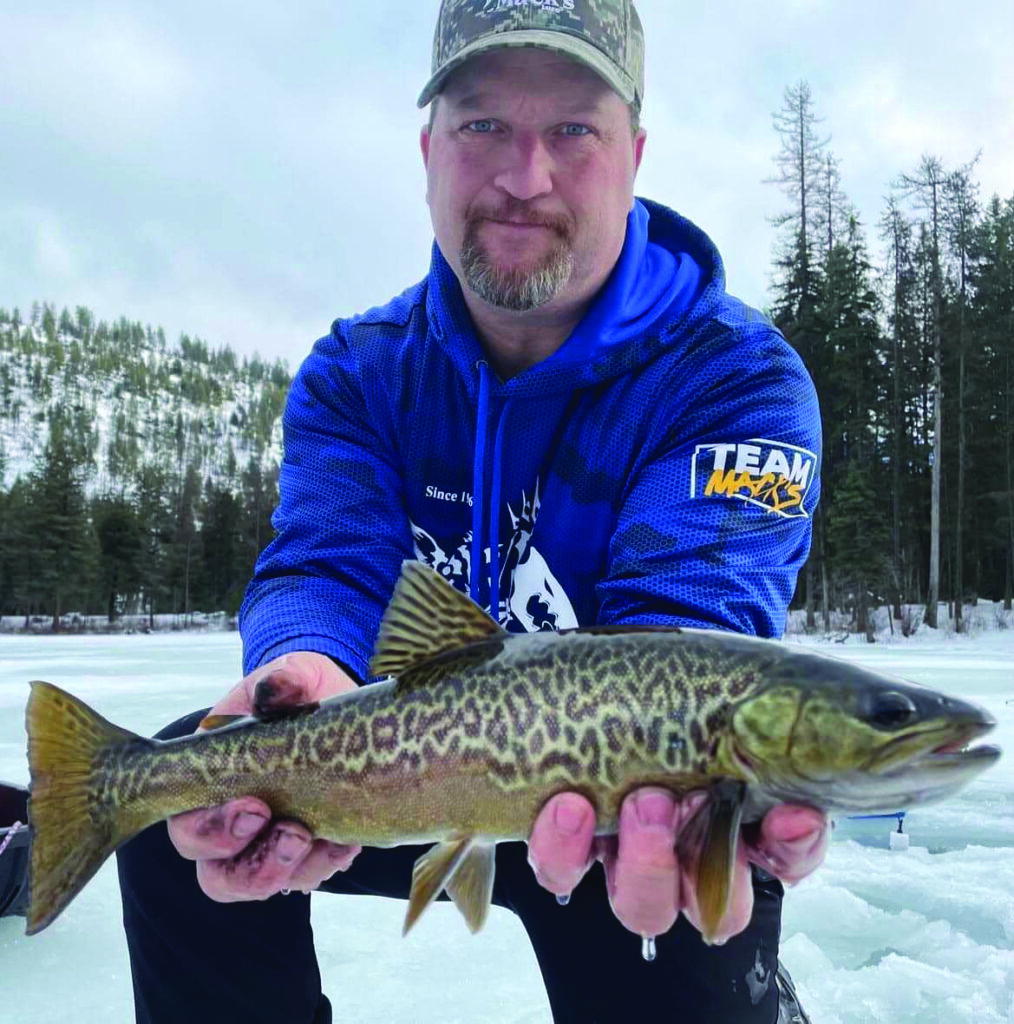
Chris Marcolin, a pro-staffer for Mack’s Lure, told me Bonaparte Lake offers opportunities for a variety of trout, including tiger, brook and rainbow trout that can be caught under the ice. Anglers can also reel in kokanee, smallmouth bass and if they’re lucky, catch one of the lake trout there.
The Third Annual Bonaparte Lake Ice Fishing Derby will take place on January 25th, 2025 with Ground Zero being Bonaparte Lake Resort. Last year, over 400 people attended the event and close to 350 adults and youth contestants fished in it. Stay tuned for details about this through the Bonaparte Lake Resort Facebook Page at www.facebook.com/bonapartelakeresort.
RIVER WHITEFISH
Another option this winter is to head to South Central Washington for mountain whitefish. The season opened for them on December 1st and runs through the end of February on the Yakima, Naches and Klickitat Rivers.
Rob Phillips is the long-time outdoors columnist for the Yakima Herald-Republic and has spent some time wading the cold waters of these streams hunting for whitefish. While you can catch these scrappy fighters with small spinners during the summer it’s a different technique that works in the winter.
Phillips recommends fishing a small nymph close to the bottom with a maximum size hook of #14. Black, brown, and yellow are all good colors, but the important thing is to tip the hook with a live maggot because the whitefish really like that bait.
So, there you have it. You can catch everything from whitefish to lake trout to kokanee to burbot to rainbows, tiger or brook trout as well as bass and panfish. Bundle up and head to one of these destinations and go fishing this winter!
John Kruse
www.northwesternoutdoors.com and www.americaoutdoorsradio.com
PHOTO CREDIT:
Chris Marcolin with a tiger trout caught while ice fishing at Bonaparte Lake – Courtesy Chris Marcolin
Phil Colyar’s state record lake trout – Courtesy Phil Colyar
/articles/five-winter-fishing-options-central-washington
Lunker Lake Chelan Kokanee
By Mike Carey
There has been speculation exactly why anglers are seeing such large and healthy kokanee in Lake Chelan. Site member Toni (Wannafishalure.com) recently contacted WDFW Fish Management and got these two responses:
From Larry Phillips, Fishery Manager
"My understanding of Kokanee (based on what I’ve read in the published literature) is that growth is closely related to density. More kokanee=smaller size. Because they are specialized feeders (almost exclusively daphnia which is a species of zooplankton), they can overgraze their forage base.
I suspect that in the case of Lake Chelan we had a couple of weak year classes prior to the year-class that supported last year’s fishery. The weak year classes may have been the result of high water or high predation which limited overgrazing.
This would have given the prey base a couple years to build and support much higher growth. Obviously this is a guess because I’m not the biologist for that area.
Recall that all kokanee are genetically identical to sockeye and most naturally occurring sockeye populations have an associated resident (kokanee) component. Also recall that several 20+ inch kokanee were caught in American last year……so Whatcom Lake (our state source for kokanee) also has high growth potential.
When prey abundance is high kokanee have the potential to get very large. Several other factor can affect growth but it typically comes down to the relationship between kokanee abundance, prey availability, and prey size. Other issues include predation, temperature, and turbidity."
From Travis Maitland, Fish Biologist
"Larry’s previous explanation to you of what has been going on with the Kokanee in Lake Chelan the last couple of years is “spot on”. I will only elaborate a bit more on a few points that I hope will help answer your questions.
Historical Lake Productivity: Lake Chelan is the textbook example of an oligotrophic body of water. Bodies of water like this tend to be relatively deep, nutrient poor, clear, light transmission is high and the euphotic zone is deep.
Even though light penetrates to a considerable depth, primary production of phytoplankton is limited by the lack of nutrients, all of which results in a biologically limited body of water.
Lake Chelan Kokanee history: Although details (Strain and numbers) of stocking history prior to 1933 are missing….we do know that Kokanee were first stocked into Lake Chelan in 1917. WDFW stocked only this initial naturally reproducing stock of kokanee back into the lake from the early 1940's until about 1957.
In 1957 Kootenay Lake stock kokanee were introduced as eyed eggs, and in 1966 Whatcom stock kokanee plus, Kootenay stock kokanee began to be stocked as eyed eggs and in later years as fry. Recently only lake Chelan stock (so, a conglomerate of Kootenay, Whatcom and what was originally stocked) are being stocked.
There are no records that I know of that point to the ocean going form (Sockeye) ever being stocked into the lake and no genetics work has been conducted to my knowledge.
Recent Year Classes
During the last couple of years, the Kokanee available in the fishery came off of relatively low adult spawning escapements….and by that I mean the parents of these fish were in relatively low abundance by the time they made it to spawn. As Larry also mentioned, this can also be caused or compounded by things such as predation or high water events that may have taken place on the spawning tributaries.
All of this comes back around to numbers. So, for what information we have at this point…I am comfortable in saying that the fish have grown to some larger sizes in recent years because they have been present in relatively lower densities with the same available food source, thus giving them the opportunity to grow larger. There is no evidence that suggest this is genetically driven.
I have been hearing a few good angler reports as well of good sized Kokanee already this year…..12”-16”.
I hope this has helped and please feel free to contact me if you have any further questions."
Best regards
Travis Maitland
Washington Department of Fish and Wildlife
Dist. 7 Fish Biologist
Wenatchee District Office
3860 Hwy 97a
Wenatchee, WA 98801
(509) 665-3337
-----------------------------------------------------------------------
No doubt, the quality of the kokanee in 2013 was phenomenal and hopefully 2014 will prove a repeat. As noted above, fish are beginning to be caught. For my wife and I, last year April was red-hot into early May.
Anglers continued to catch fish into the late spring/early summer, but early spring was best. By mid-April the weather generally is pretty good in Chelan, and the crowds are light. The fishery is well worth the drive from east or west side to centrally located Lake Chelan.
/articles/lunker-lake-chelan-kokanee
Washington Winter Kokanee Observations
By Randy Castello

As we say good bye to our summer boating weather you may find yourself wondering, “do I winterize or do I find something to fish for?” Either way, you should probably winterize your boat, motor, and trailer, but let’s talk trolling for winter kokanee.
Winter kokanee
Winter kokanee in Washington State? Sure, so go ahead and winterize, but keep the keys handy. Find your gloves and earmuffs and make a thermos of steaming hot coffee because there are kokanee opportunities to be had. Both Western Washington and the Eastside have winter kokanee lakes.
Kokanee are the non-anadromous form of sockeye salmon. Basically, by choice or otherwise, kokanee are landlocked sockeye salmon. Kokanee are native to many Pacific Northwest lakes and have been introduced to a number of lakes across the United States.
The life cycle is of particular interest to winter kokanee anglers. Although there are exceptions, kokanee typically live 3-4 years before they spawn and die. For the dedicated winter kokanee angler that means that there are 2-3, maybe even 4-year kokanee available during the chilly months.
Winter kokanee fishing is a little different than our spring and summer fisheries. Most winter kokanee fishing is done in deeper water. Kokanee prefer water that is 50-56 degrees. In part, they are more active in this zone because it is rich in oxygen boosting energy to chase down their next meal. Each lake varies, but finding “the zone’” is important during winter kokanee fishing. One way is to keep your eyes glued to your fish finder and look for fish.
This is where the best fish finder/chart plotter you can afford is your friend. When you find fish, mark the spot, and pretty soon you’ll have a winter kokanee map. With it you can amaze your guest fishermen and go right to where they are. They’ll think you are the “Koke-Wisperer”, maybe a kokanee-shaman or something… You can also use a Fish Hawk Digital Gauge or the Vexilar Deptherm to graph out the water temperature at depth.
Winter kokanee fishing is more of a love thing, there is rarely a hot bite. Each lake has a winter fishery sweet spot depth. Generally, in Western Washington it is 30-60’, and Eastern Washington 40-200’ deep. Each lake, especially on the westside, seems to have a brief period each day where the kokanee will put on the feed bag and go on the bite outside of your usual grind it out depth.
Kokanee are filter feeders, and the bulk of their calories come from plankton blooms. There are windows any given day where there is a bloom or hatch, and the kokanee will briefly leave their comfort zone to feed.
Because the bite may be 2:06-2:23 at 43’ it is best to choose your winter kokanee lake close to home and learn it. Especially when winter kokanee fishing, keep a detailed fishing log.
Both summer and winter fish are a noble opponent. They often make short runs, jump, and go bonkers at the net. Summer fish are more aggressive, but winter kokanee take more finesse to get them in the net. After plating, smoking, or chowder-izing hundreds of kokanee, both the summer and the winter fish are excellent table fare, but the winter fish are outstanding for whole or fillet pan-frys and grilling.
The following list includes winter kokanee lakes that I am familiar with, and is focused on trolling. I am sure there are other winter kokanee lakes available. My westside lakes were originally selected because they are open all year and they have deeper basins that may hold fish. Both the westside and the eastside winter kokanee lakes are listed by my preference. My preference is based on success, proximity to home, and the potential for a trophy fish.
Eastern Washington
Lake Roosevelt
Nothing in Eastern Washington is close to home, and to be honest, as I get older, I don’t like hauling the boat over the pass in the winter anymore. That said, I love fishing Lake Roosevelt, so with the right forecast we may head that direction. I’m sure kokanee are available throughout the lake, but we usually fish out of Spring Canyon and focus on the dam area, but we also fish the lower 5 or 6 miles. I typically start at about 40’, but may fish 100+ deep as required. Because there is the potential to hook a 3+ pounder, I typically up my leader to 20-pound fluorocarbon.
Lake Chelan
It is a great winter kokanee lake, offering pretty consistent fishing. The winter kokanee fishery is concentrated between Manson, maybe the Narrows, up to 25 Mile Creek. There is enough kokanee in the Wapato Point area to keep you on the water if, or should I say when, the weather kicks up. The winter fishery at Chelan is a deep fishery, you can expect to run your gear 80-200’ deep. Watch the weather!
Before I get to the westside lakes, let’s discuss winter boating safety/etiquette. Carry chains for both your tow vehicle and for at least 1 axle on the trailer. Bring a couple sand bags and a shovel. A liberal application of sand can be a lifesaver. At the ramp, assess the situation before you back down a long icy ramp. Take the time to chain up your tow vehicle if required.
Thought being; although once your tires hit the water you’ll have traction, the area between the top of the ramp and the water could be icy. You don’t want to jackknife ½ way down the ramp. It would put a damper on your kokanee plans. Once the trailer is wet you may have to let the rig sit in the water for a bit to thaw and let the boat float free. Be safe on the boat, you don’t want to slip and end up sharing the lake with your aquatic rival.
Finally, and as a courtesy; at the end of your time on the lake load your boat and slowly pull out of the water just enough to clear the water. Stop and let the rig drain or drip-dry, this will minimize ice buildup on the lower 1/3 of the ramp.
Western Washington Winter Kokanee Lakes
Lake Washington
Although not exactly close to home, Lake Washington is my favorite westside winter kokanee lake. Our largest westside kokanee was a 3.13# 18” fish. We have caught many 1# plus and a few 2# kokanee in Lake Washington. To protect juvenile and migrating sockeye salmon there is an 8 – 18” slot limit for kokanee on in Lake Washington. A standard sockeye drill works, but consider stepping up your speed and gear selection. Most of our larger Lake Washington kokanee were taken on hoochies and 8” flashers.
The eyes have it; what am I talking about? Who knows why but most of our large Lake Washington kokanee were bamboozled by a lure with eyes. If Lake Washington were closer to home, I’d be fishing it every day that I possibly could.
Lake Cavanaugh
Lake Cavanaugh is an odd duck, easy kokanee limits for fish 10 – 18” kokanee during the spring, summer and fall, but when winter comes around it seems that every kokanee you catch is a chrome 8 – 12” fish. My nonscientific guess is that the majority of the kokanee in Cavanaugh spawn at 4 years and the winter sport catch are primarily 3-year kokanee. Most winter kokanee in Lake Cavanaugh will be caught over the deep pocket just east of the islands.
Lake Samish
Samish is really close to home with the typical winter kokanee bite being later in the day. It is a great lake for “breakfast and chores are done, let’s go fishing”. The lake includes a large basin with a smaller connected lake at the north end. When fishing winter kokanee on Lake Samish, most of our fish are caught in one of two areas. The first is along the west shoreline just west of the WDFW launch.
The second is generally in the center, maybe favoring the north shore/center of the small lake. Your trolling speed is critical, plan on fishing .8-1.0 mph with lots of “S” turns. Oddly, we have caught a fair number of Samish winter kokanee pulling small minnow type baits for cutthroat, but standard kokanee gear is a better starting point.

Lake Stevens
We don’t fish winter kokanee on Lake Stevens often, but it does host a winter fishery. There may be local secrets, but in our experience Lake Stevens winter kokanee are a hit or a miss. Most of our winter kokanee were caught along the bay at the northwest side of the lake. Typical kokanee gear with a pinch of nightcrawler or worm seems to have an edge over tuna corn.
Yale Lake
Yale is a great kokanee lake and is open year-round. There are winter challenges if you decide to make the trip. The wind can produce some crazy short chop, so make sure that you check the forecast before you hitch up the trailer. We haven’t had a problem but I’m pretty sure that the reservoir water levels are down November-February. The Yale Park launch should be open but other ramps may have restrictions.
Finally, there could be hazardous floating debris/flotsam. Boat with caution, and if it’s choppy, slow way down. The winter kokanee fishery should be concentrated by the dam or across the lake from Speelya Creek. In my experience, if fishing less than 30-40’, run really long setbacks or use lead line rigs.
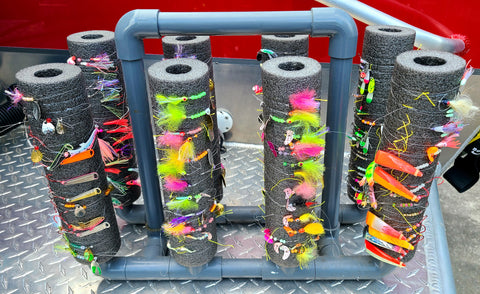
OK, you have some idea which way you’re headed in your kokanee quest, now what? I don’t really change overall tactics when fishing winter kokanee. The usual kokanee drill; a small dodger, lure with tuna corn is a great place to start. Make sure you have your favorite scents, maybe a container of worms, and additional leader onboard. Not always, but occasionally, you will need to increase your leader length.
When trolling for winter kokanee, you will want to stay under 1.0 MPH. I probably do more “S” turns or engage the “Hunt” mode on my iTroll more often during our winter kokanee adventures. Our dodger box has more dodgers in it than most, but during the winter kokanee fishery my go to dodgers are painted, copper, or even dark metalflake.
Using either double spinner rigs or flies behind the dodger seem to consistently produce kokanee during the winter fishery. After you hook your cold weather prize, gently fight the fish, and, as with any kokanee fishery, a long handle net will increase your actual catch verses hook up statistics.
I know that it will be cooler out, maybe even freezing, and the lake temperature should be down as well. But make sure you still care for your catch. Bleed them and keep them on ice, or, even better, in a slurry in your cooler; you’ll want to preserve the quality of your hard-earned prize.
Winterize or not, keep your kokanee gear handy. The above is just a starting point. Choose a lake, learn it, and you’ll soon be the local expert! Trolling for Washington State winter kokanee can be frustrating. With the closure of most of our winter salmon fisheries, a bit of frustration will quickly become an addiction. Enjoy your winter kokanee adventure, but with the potential for rainy, slick roads, be sure to use extra caution towing your boat to and from your new favorite winter activity.
/articles/washington-winter-kokanee-observations-0