A Hidden Gem by Mike Carey
Tucked away in the northeast corner of Montana is a body of water that is often overlooked by those not in the know. A 4,000-acre reservoir stocked with 100,000 walleye every year, and teeming with well-fed northern pike, yet anglers drive by oblivious as they head to the famed waters of Fort Peck Reservoir.
It's an understandable oversight. After all, Fort Peck is the destination for anyone traveling to this part of the state. It's a long drive from everywhere – why would you want to stop an hour short of Glasgow and miss out on the amazing fishing Fort Peck has to offer?
During my first three years of living in Montana, I made the 5-hour drive to Glasgow and went right by Nelson Reservoir, thinking how I could fish there and lose a day on Fort Peck? Then I started to do a little research and realized that this (much) smaller body of water was held in high regard by those in the know. Nelson Reservoir was viewed as an alternative option when the winds were blowing hard and keeping anglers off Fort Peck.
Nelson Reservoir was created from the Milk River in 1914 when the dam was constructed, and enlarged in 1921, providing off-stream irrigation. The reservoir has 30 miles of shoreline at full pool, with a maximum depth of 47 feet and fills to 4,320 acres. There is a free campground, first come, first served, pit toilets, and a concrete boat ramp with a small dock. A word of caution regarding this launch. It has to be one of the shallowest-angled ramps I have ever used. I had to back all the way into the water to eventually launch my 16-foot jon boat. If you have a larger boat, you will definitely benefit from having someone's help by driving the boat off your trailer!
Motoring out at the crack of dawn, I enjoyed a golden red, orange, and yellow sunrise, with a few scattered clouds catching and reflecting the morning rays over the calm lake. I have the Garmin Boating App on my phone, which I think is a must for anyone fishing in lakes and reservoirs. Sure enough, I had a depth map on my phone and had already selected a few likely-looking locations to try.
Montana is a two-rod state for lakes and reservoirs, and I always take advantage of the chance to put out a second line. My target for the day was walleye. I rigged both rods up with Mack's Lure setups, a green/yellow walleye pop on one rod, and a silver smile blade on the other. 2-ounce bottom walkers got my gear comfortably down to the 20-30 foot deep starting range. After feeling the bottom-walker bounce the bottom, I reeled up a couple feet and set the rods in rod holders. One rod had a nightcrawler for bait, and the other had a leech (which I must say; I have found just about out-fish nightcrawlers!).
My jon boat has a 50 HP jet to move it, and a Minn Kota Power Drive on the bow. I jokingly call
this jon boat my "old man" boat because I specifically wanted a 16-foot boat I could use on both the Missouri River and smaller lakes, and it had to be light enough that I could handle it as I got older. So far, it's worked out perfectly, and I really enjoy fishing in it. It's also a blast to be running a river on a jet boat again! It's a Lowe Aura L1648M from Elephant Boys in Spokane, and I was very pleased with the set-up and service.
Starting at 1.2 mph, I set the course and sat back to wait and see what might be around. My dog, Duke, looked at me and settled in for a nap. Duke is a great pheasant dog, but when it comes to fishing, he is more interested in naps and treats than fish. I decided to run bottom-bouncers, picking out a couple of 2.5 oz. On one rod I ran a Mack's Lure Wally-Pop in green/yellow with a smile blade, and on the other a set of orange and yellow beads with a smile blade. One rig had a nightcrawler on a slow death hook, and the other a leech on a single hook. I'm really growing to like leeches as bait. They are tough and stay on the hook well, stretch out nicely while trolling, and have a nice motion to them in the water. In addition, being shorter than a night crawler, I have been getting more consistent hook-ups. Finally, the perch are less interested in them, so I get fewer perch nipping my bait.
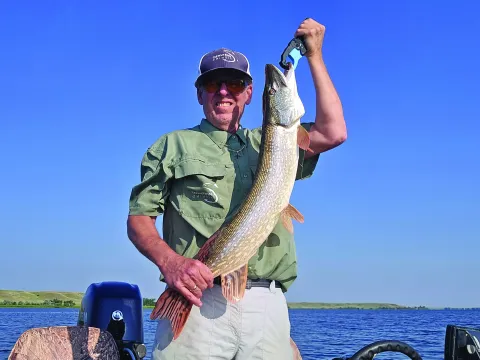
It didn't take too long before my rod doubled over and the line started pulling out of the reel. Grabbing the rod out of the rod holder, I felt the solid weight of a good fish. The line was peeling off the reel. "This is a nice fish, Duke!" Duke looked up from his nap, as if to say, "Hey, I'm sleeping here." I think this is one nice walleye when it takes a run and clears the water, revealing a very strong Northern Pike! OK, game on! I proceeded to work the freshwater barracuda to the boat and scooped him into the net – yes! For my personal best, I measured the fish in the net, and it hit 30". Not a monster by pike standards but a lot of fun to catch. After reviving the toothy beast, I released him back to the water. Although I understand pike is good to eat, I'm only keeping walleye on this trip. In any case, it's a great way to start the morning. The excitement over, Duke goes back to his bed, a little more awake and interested in what's going on.
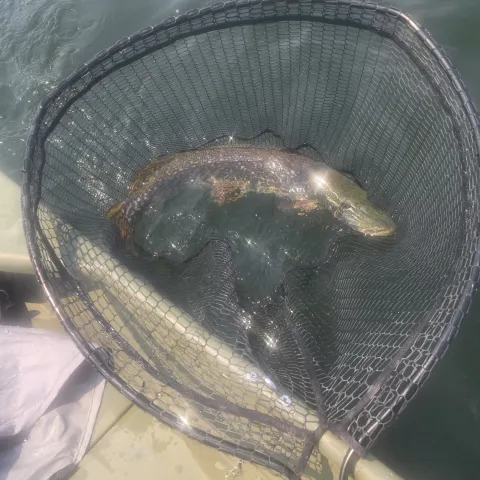
I methodically work different depths and land a nice 21" keeper walleye. But the pike just keep biting, getting in the way of my walleye fish fry. Every time either rod doubles back, I'm hoping it's a nice walleye, and every time it turns out to be another nice pike!
I do end up with three keeper walleye, more than enough for my fish fry, but wow, what a day for catching pike! I end up with easily over a dozen caught and more lost. The pike are healthy 28-33" specimens.
There are Nelson Reservoirs all over the Pacific NW. Lakes and reservoirs that are overlooked and driven past en route to more well-known, popular destinations. The moral of this story is: don't overlook that lake you drive past; it might just be your next great adventure.

/articles/hidden-gem-mike-carey
Pursuing Pike
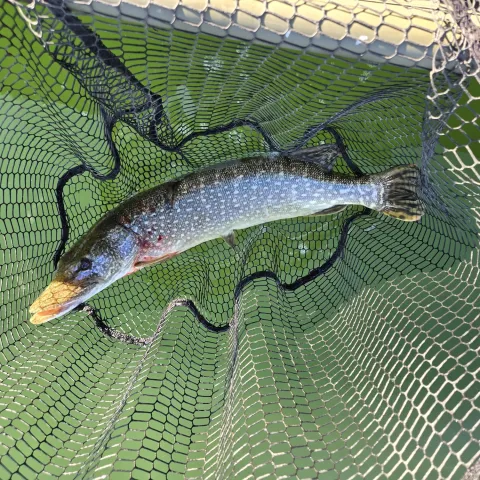
The sun was dipping low on the horizon as I cast my #3 Mepps spinner into my favorite country pond. As soon as it hit the water, I gave the rod tip a jerk, activating the spinner blade, and began a steady retrieve. Suddenly, my rod pulled away from me with the strike of a hammerhead pike. I excitedly reel in the small pike, landing the 15” fish after a brief battle. Carefully removing the hook, I released the fierce-looking pike back to the pond, taking in the evening's quiet, golden red and yellow sunset illuminating the shoreline trees and fields. Having moved the past year from the city of Madison to the small country town of Waunakee, this had become my solace as I struggled with the challenges of trying to fit into a farming community, having little in common with my freshman high school classmates. This pond became my solace on many an evening and quenched my inner need for solitude.
Pike hold a special place in my heart for angling adventures. They remind me of freshwater barracudas, with fierce features and vise-like jaws with a full set of razor-sharp teeth. Pike are the kings of their abode, and if I were a perch swimming around, I would be looking over my shoulder!
Knowing your adversary’s tendencies is an important key to successful angling. When it comes to pike, there is a keyword you should always remember – ambush. Pike are masters at ambush hunting skills, using their fins to stay suspended and motionless, waiting for a feeding opportunity to go by. They love cover. In rivers, look for downed trees and logs along the shoreline or cast to undercut banks. Slow backwaters and eddies are ideal locations to explore. If you see weeds under the surface, be sure to target those as well, using weedless baits like buzz baits or surface lures – frogs and poppers can be deadly effective, and hooking a pike on a surface lure is a blast – literally – as the pike comes up and slams your presentation.
Lake fishing presents a few more challenges, but again, target shoreline cover or find shallow bays with weed growth. In deeper lakes, pike will likely drop into cooler waters on hot days, making a deep diving crank bait a good option, casting along weedy drop-offs. More than one angler has been surprised by Montana’s Ft. Peck, jigging deeper waters for lakers and hooking into a pike!
Other popular casting lures include spinners, plastic paddle tail jigs, and spoons. These are all lures that pike will pursue and strike. Your retrieve should be steady and not too fast. A pike depends on sight, sound, and vibration. Often, that first splash of the lure hitting the water is what will alert the pike to a feeding opportunity, and strikes may come soon after your lure hits the water, so be ready to retrieve. Especially with buzz baits, the trick is to immediately close your bail, keep your rod tip up, and reel. You’ll find the sweet spot for retrieval speed that keeps the lure skimming the surface and making a big splashing commotion – so much fun!
Pike will hit just about any lure that moves, and they will also hit bait, including live or dead bait under a float. My personal preference is casting and moving locations. To each their own…
Rods and reels should match the lure you’re tossing, and both level and spinning reels work just fine. A medium/heavy rod will help pull those fish out of cover easier. Braid in a 20-30-pound weight is a good option.
As mentioned earlier, pike are predators, and one look at their mouth full of razor-sharp teeth will confirm that! Most pike anglers will use a metal leader to save those expensive lures. The pike aren’t leader shy, so no worries about scaring them off. When you catch your pike, if you plan to catch and release, handle them with care. Pike are surprisingly fragile. Barbless hooks, needle-nose pliers, and jaw pliers will help get that fish back into the water for others to enjoy.
The best time to fish for pike is the morning and the evening hours, although they will bite all day long, and all season long, making them a good choice when other fish aren’t cooperating.
If you decide to keep a few, save the larger ones and keep the smaller fish. Pike are good eating, but a bit of a hassle to clean. The accursed “Y” bone can present an issue when cleaning. I recommend checking out some YouTube videos on how to filet your catch. Meanwhile, releasing those bigger fish will allow other anglers to pursue the pike of their dreams!
/articles/pursuing-pike
A Bounty On Water Wolves
From the late 1800’s until the middle of the 20th century, there was a bounty on wolves in the Midwest and Western United States. Both individual and government hunters used any means necessary to kill these animals, deemed a dangerous nuisance to livestock. By the time this program ended, wolves were essentially exterminated from the lower 48 states. It wasn’t until 1995, when wolves were reintroduced to Yellowstone National Park, that their numbers began to come back, and today, we are seeing healthy populations of these animals in several states.
The relationship between humans and northern pike is a bit more complicated. These torpedo shaped fish are green in color with white spots and a white belly. They can grow to over 50 inches long and weigh over 45 pounds, though an average sized pike measures between 16 and 22 inches in length. Pike are ambush predators and feed on other fish as well as frogs and even ducklings, waiting in weeds or behind rocks and logs, and then lunging forward to attack their prey. With a mouthful of long, sharp teeth, they have garnered themselves the nickname, “water wolves”.
Land Wolf
Unlike the land-based wolf, there was no historical dislike for these fish, which are found in the northern tier of the United States as well as in Canada and Alaska. They are a sought-after catch because of their size and good fighting ability. They also taste good, though a y-bone in their body makes them more difficult to clean and fillet than walleye or trout. In the winter, anglers will target these fish through the ice, while in the spring they are often caught in places like Lake Coeur d’ Alene, fishing bait under a slip bobber. They can also be caught from spring through fall throughout their native range, using large spoons. Red and white Dardevle spoons and yellow spoons with red diamonds on them (known as a Five of Diamonds) are traditional offerings.
In Washington State, northern pike are found in Long Lake, the Pend Oreille River, and Lake Roosevelt, having migrated there from Lake Coeur d’ Alene in Idaho and Montana’s Clark Fork River. The fish are not welcome in the Evergreen State. Both the Washington Department of Fish and Wildlife as well as the Colville Tribes are extremely concerned about their impact to native populations in these waterways such as redband trout, sturgeon, burbot, and kokanee salmon. Fisheries managers also want to ensure northern pike do not get into the mainstem Columbia River below Grand Coulee Dam, where they could wreak havoc with native salmon and steelhead populations.
Pike
Since 2015, the Colville Tribes, Spokane Tribe, and Washington Department of Fish and Wildlife have been working hard to eradicate pike from these waterways. They have had good success in reducing a burgeoning population of these fish in the Pend Oreille River, and since 2015 have removed over 19,100 fish from Lake Roosevelt. The primary method the Colville Tribes use to catch these pike is with gill nets, but they have found this method alone is not enough.
That’s why a bounty program has been introduced at Lake Roosevelt for recreational anglers. Anglers who catch northern pike (of any size) can turn in the head of the fish at designated drop off sites around Lake Roosevelt and be paid $10 for each fish head turned in.
Anglers can drop off their pike heads at Noisy Waters Gas Station, Kettle Falls boat launch, Hunters boat launch, Fort Spokane boat launch, or at the Inchelium Fish and Wildlife office.
In 2022, anglers turned in 125 heads and were paid $1,250.
Increased Efforts
In an effort to increase the number of fish caught by recreational anglers for this program, the Colville Tribes Fish and Wildlife Department has published a map showing pike hot spots around the lake. Some of these hotspots are found at the mouth of the Kettle River, near Evans, on the eastern end of the lake near Noisy Waters, and at the mouth of the Colville River, south of Kettle Falls. Additional places worth fishing can be found south of Gifford and on either side of the reservoir near Hunters.
Here are the rules if you want to participate in the Northern Pike Bounty Program:
- You must be 17 years of age or older to participate in the program.
- Anglers must completely fill out the tag information at the designated drop off area. Fish heads must be placed in a freezer bag with the label and dropped into the freezer or brought to the Inchelium Fish and Wildlife office.
- Fish heads must be in good condition and clearly identifiable. Unidentifiable heads will not be accepted or awarded.
- Fish must be caught in the main stem Columbia River from Wells Dam upstream to the Canadian border, the Spokane River upstream to Little Falls, the Kettle River, or the Okanogan River.
- There are no size restrictions on northern pike.
- Anglers must adhere to all applicable state/tribal fishing regulations for the area in which you fish. Contact your local state or tribal agency for license requirements and current fishing regulations.
- Please allow 2 to 3 weeks to receive your reward.
Additional information about the program can be found at www.cct-fnw.com/northern-pike
John Kruse – www.northwesternoutdoors.com and www.americaoutdoorsradio.com
/articles/bounty-water-wolves